SOCIAL MEDIA
   IN RESEARCH
                                       Ian P. McCarthy

                                       Beedie School of Business
                                       Simon Fraser University
                                       ian_mccarthy@sfu.ca

                                       Access the related paper here:
                                       http://www.slideshare.net/IanMcCarthy
                                       /2011-social-mediabh


http://www.karenlancasterblog.co.za/
INTRODUCTION

• What, when and why I started.


• Why I persist and my approach.


• Concluding thoughts.
      • Progress
      • Lessons and some cautions
THE WHAT AND WHEN
• Opened a Twitter account - April 2009
       • @toffeemen68
       • First started Tweeting - November 2010


• Started a Blogger account - February 2011
       • http://itdepends4.blogspot.com


• Opened a Slideshare account - August 2011
       • http://www.slideshare.net/IanMcCarthy
WHY I STARTED
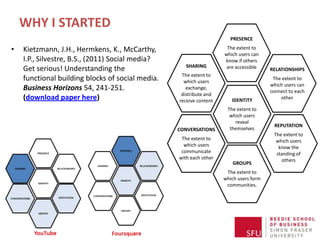
                                                                      PRESENCE

•   Kietzmann, J.H., Hermkens, K., McCarthy,                         The extent to
                                                                    which users can
    I.P., Silvestre, B.S., (2011) Social media?                     know if others
                                                     SHARING         are accessible
    Get serious! Understanding the                                                     RELATIONSHIPS
                                                   The extent to
    functional building blocks of social media.     which users
                                                                                        The extent to
                                                                                       which users can
    Business Horizons 54, 241-251.                   exchange,
                                                                                       connect to each
                                                   distribute and
    (download paper here)                         receive content      IDENTITY            other

                                                                     The extent to
                                                                      which users
                                                                        reveal
                                                                                        REPUTATION
                                                  CONVERSATIONS       themselves
                                                                                        The extent to
                                                   The extent to                         which users
                                                    which users                           know the
                                                   communicate                           standing of
                                                  with each other                          others
                                                                       GROUPS
                                                                     The extent to
                                                                    which users form
                                                                     communities.
WHY I STARTED

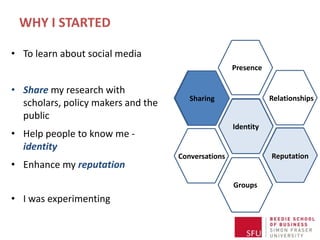
• To learn about social media
                                                    Presence

• Share my research with
                                      Sharing                  Relationships
  scholars, policy makers and the
  public
                                                    Identity
• Help people to know me -
  identity
                                    Conversations              Reputation
• Enhance my reputation
                                                    Groups
• I was experimenting
WHY I PERSIST AND MY APPROACH

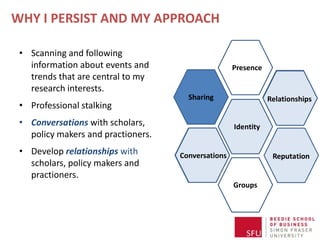
 • Scanning and following
   information about events and                     Presence
   trends that are central to my
   research interests.
                                                               Relationships
                                                               Relationships
 • Professional stalking
 • Conversations with scholars,                     Identity
   policy makers and practioners.
 • Develop relationships with       Conversations
                                    Conversations
   scholars, policy makers and
   practioners.
                                                    Groups
WHY I PERSIST AND MY APPROACH
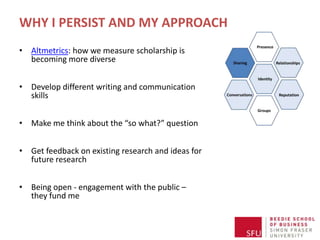
• Altmetrics: how we measure scholarship is
  becoming more diverse


• Develop different writing and communication
  skills


• Make me think about the “so what?” question


• Get feedback on existing research and ideas for
  future research


• Being open - engagement with the public –
  they fund me
PROGRESS
• Twitter (since Nov 2010)
        • 2,311 tweets and 12,000 followers
        • My “good” tweets will:
            – reach between 5,000 - 40,000 tweeters
            – 500 – 2,000 people will see it
            – 20 – 300 will engage with it
• 71,000 visits to my Blog – It Depends! (since Feb 2011)
• 23,000 views and 2,300 downloads of my
  presentations and papers posted on SlideShare
PROGRESS
• Several new research relationships
       • Research grants, papers, special issues, and
         invited talks.


• Appear on several “who to follow” lists
• Newspapers, magazines, radio and TV.
• Awards and impact
LESSONS

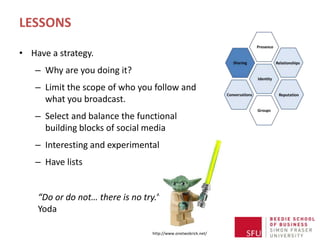
• Have a strategy.
   – Why are you doing it?
   – Limit the scope of who you follow and
     what you broadcast.
   – Select and balance the functional
     building blocks of social media
   – Interesting and experimental
   – Have lists


    “Do or do not… there is no try.”
    Yoda

                                  http://www.onetwobrick.net/
CAUTIONS
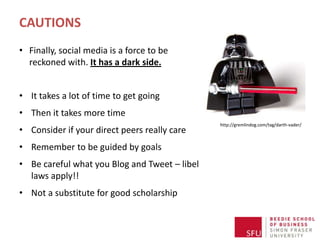
• Finally, social media is a force to be
  reckoned with. It has a dark side.


• It takes a lot of time to get going
• Then it takes more time
                                               http://gremlindog.com/tag/darth-vader/
• Consider if your direct peers really care
• Remember to be guided by goals
• Be careful what you Blog and Tweet – libel
  laws apply!!
• Not a substitute for good scholarship
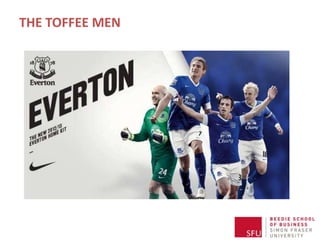
THE TOFFEE MEN

Social Media in Research

  • 1.
    SOCIAL MEDIA IN RESEARCH Ian P. McCarthy Beedie School of Business Simon Fraser University ian_mccarthy@sfu.ca Access the related paper here: http://www.slideshare.net/IanMcCarthy /2011-social-mediabh http://www.karenlancasterblog.co.za/
  • 2.
    INTRODUCTION • What, whenand why I started. • Why I persist and my approach. • Concluding thoughts. • Progress • Lessons and some cautions
  • 3.
    THE WHAT ANDWHEN • Opened a Twitter account - April 2009 • @toffeemen68 • First started Tweeting - November 2010 • Started a Blogger account - February 2011 • http://itdepends4.blogspot.com • Opened a Slideshare account - August 2011 • http://www.slideshare.net/IanMcCarthy
  • 4.
    WHY I STARTED PRESENCE • Kietzmann, J.H., Hermkens, K., McCarthy, The extent to which users can I.P., Silvestre, B.S., (2011) Social media? know if others SHARING are accessible Get serious! Understanding the RELATIONSHIPS The extent to functional building blocks of social media. which users The extent to which users can Business Horizons 54, 241-251. exchange, connect to each distribute and (download paper here) receive content IDENTITY other The extent to which users reveal REPUTATION CONVERSATIONS themselves The extent to The extent to which users which users know the communicate standing of with each other others GROUPS The extent to which users form communities.
  • 5.
    WHY I STARTED •To learn about social media Presence • Share my research with Sharing Relationships scholars, policy makers and the public Identity • Help people to know me - identity Conversations Reputation • Enhance my reputation Groups • I was experimenting
  • 6.
    WHY I PERSISTAND MY APPROACH • Scanning and following information about events and Presence trends that are central to my research interests. Relationships Relationships • Professional stalking • Conversations with scholars, Identity policy makers and practioners. • Develop relationships with Conversations Conversations scholars, policy makers and practioners. Groups
  • 7.
    WHY I PERSISTAND MY APPROACH • Altmetrics: how we measure scholarship is becoming more diverse • Develop different writing and communication skills • Make me think about the “so what?” question • Get feedback on existing research and ideas for future research • Being open - engagement with the public – they fund me
  • 8.
    PROGRESS • Twitter (sinceNov 2010) • 2,311 tweets and 12,000 followers • My “good” tweets will: – reach between 5,000 - 40,000 tweeters – 500 – 2,000 people will see it – 20 – 300 will engage with it • 71,000 visits to my Blog – It Depends! (since Feb 2011) • 23,000 views and 2,300 downloads of my presentations and papers posted on SlideShare
  • 9.
    PROGRESS • Several newresearch relationships • Research grants, papers, special issues, and invited talks. • Appear on several “who to follow” lists • Newspapers, magazines, radio and TV. • Awards and impact
  • 10.
    LESSONS • Have astrategy. – Why are you doing it? – Limit the scope of who you follow and what you broadcast. – Select and balance the functional building blocks of social media – Interesting and experimental – Have lists “Do or do not… there is no try.” Yoda http://www.onetwobrick.net/
  • 11.
    CAUTIONS • Finally, socialmedia is a force to be reckoned with. It has a dark side. • It takes a lot of time to get going • Then it takes more time http://gremlindog.com/tag/darth-vader/ • Consider if your direct peers really care • Remember to be guided by goals • Be careful what you Blog and Tweet – libel laws apply!! • Not a substitute for good scholarship
  • 13.

Editor's Notes

  • #6 Tweet about each new publication, website update or new blog that the project completes. To gauge feedback, you could send a tweet that links to your research blog and ask your followers for their feedback and comments.For tweeting to work well, always make sure that an open-web full version or summary of every publication, conference presentation or talk at an event is available online. Summarize every article published in closed-web journal on a blog, or lodge an extended summary on your university’s online research depository. Tweet about new developments of interest from the project’s point of view, for instance, relevant government policy changes, think tank reports, or journal articles.Reaching out to external audiences is something that Twitter is exceptionally good for. Making links with practitioners in business, government, and public policy can happen easily. Twitter’s brevity, accessibility and immediacy are all very appealing to non-academics.