A seminar
ON
Excipients
PRESENTED BY
RAJENDRA D. MAHAJAN
M. PHARM I (Pharmaceutics)
.
Department of pharmaceutical Sciences
Rashtrasant Tukadoji Maharaj Nagpur University, Nagpur
2014-15
CONTENTS
2
 Directly compressed vehicles
 Surfactants- micelle formation
 Liquid Crystal Phase
 Thickners
 Standerdization of excipients
INTRODUCTION
3
Antiadherents
USED To Reduce
The Adhesion Between
The Powder (Granule)
Binders
Binders Hold The
Ingredients In A
Tablet Together
Coatings
Tablet Ingredients
From
Deterioration By
Moisture
Disintegrants
Dissolve When
Wet Causing The
Tablet To Break
Apart
Fillers And
Diluents
Fill Out The Size
Of A Tablet
Flavors
Used To Mask
Unpleasant Tasting
Active Ingredients
Colors
Improve The
Appearance Of
A Formulation
Glidants
Promote Powder
Flow By
Reducing
Interparticle
Friction
Lubricants
Prevent Ingredients
From Clumping
Together And From
Sticking To The Tablet
Punches
Preservatives
Preserve The
Formulation
EXCIPIENTS: Excipient is an inactive substance used as A carrier for the active
Ingredients of a medication
TYPES OF EXCIPIENTS :
NEWER EXCIPIENT
 Cyclodextrin
 Ion Exchange Resins
 Film Coating Materials
 Superdisintegrants
 Directly Compressible Vehicles
 Surfactants- Micelle Formation
 Liquid Crystal Phase
 Thickeners
 Standardization Of Excipients
4
What is Direct compression
 Direct compression (DC) is the tabletting of a blend of
ingredients i.e. the compression mix, without a preliminary
granulation or aggregation process.
 The compression mix contains the active pharmaceutical
ingredient (API) blended with one or more excipients.
 The excipients may include binders, fillers/diluents,
disintegrant and lubricants.
5
Advantages of DC :
 More Economic compare to wet granulation since it requires
fewer unit operations.
 Documentation and validation requirements are reduced.
 It requires less equipment, and space, time.
 lower power consumpation , and less labor leading to reduce
production cost of tablets.
 More suitable for moisture and heat sensitive APIs, since it
eliminates wetting and drying steps.
 Lower microbial contamination
 Faster drug release.
6
Disadvantages of DC :
 Segregation because of the difference in the density of the API
and excipients.
 The dry state of the material during mixing may induce static
charge and lead to segregation. due to this problems like
weight variation and content uniformity may occur.
 APIs that have poor flow properties and low bulk density is
difficult to process by direct compression.
 DC excipients are costly because these are prepared by spray
drying, fluid bed drying, roller drying or co-crystallization.
 Lubricant sensitivity.
7
DIRECTLY COMPRESSIBLE VEHICLE
Introduction
 The method consist of compressing tablets directly from
powdered material without modifying the physical nature of
the material.
 Tablets are compressed directly from powder blends of the
active ingredient (such as chloride, chlorates, bromide,
ammonium chloride etc) and suitable excipients. These
substances posses cohesive and flow property that make direct
compression posssible. No pretreatment of the powder blends
like wet or dry granulation procedures is necessary.
 Direct compression eliminates variabilities of wet granulation
processing binders (temp, viscous, quality) and other agents.
8
 These are the diluents or fillers designed to make up the
required bulk of the tablets.
 These are inactive ingredients that are added to tablets in
addition to the active drug.
 Some very common diluents in tablets include lactose and
their derivatives, starch, cellulose derivatives.
 Used in the direct compression of the tablets.
Requirements For A Good DCV :
 Non-toxic and acceptable to the regulatory agencies.
 Low cost.
 Physiologically inert.
 Must be color-compatible(not produce any off color
appearance). No deleterious effect on the bioavailability of the
drugs in the product.
 Stability.
 Controlled particle size.
 Good flowability.
10
Classification of DCV:
 Disintegrants And Poor Flow:
ex. Microcrystalline cellulose , Starch .
 Free-flowing Materials That Do Not Disintegrate :
ex. Dicalcium phosphate dihydrate.
 Free-flowing Powders That Disintegrate By Dissolution:
ex. Lactoses, Sorbitol ,Granulated lactitol,Crystalline maltose.
 Co-processed exicipients :
ex. Ludipress ,Silicified microcrystalline cellulose.
11
Disintegrants And Poor Flow:
 Microcrystalline cellulose:
 It is a purified, partially depolymerized cellulose, which is
prepared by treating a-cellulose with mineral acids, producing
bundles of needle-like microcrystals.
 most useful filler for direct compression.
 the compactibility of microcrystalline cellulose decreased with a
reduction in its moisture content.
 Avicel PH101,102,103,112,200,105,Emocel etc
 Mixed with a-lactose monohydrate DCP.
12
Disintegrants And Poor Flow:
 Starch :
 Good compactability .
 Starch -1500 :it is a form of pregelatinized starch that has
been modified to make it more compressible and flowable in
character.
 Useful as a result of their good binding and disintegrant
properties
 High moisture content 12-13%. Accelerate the decomposition
of moisture sensitive drugs.
 Lubricant sensitive.
 Magnesium stearate should be avoided or kept at a level
below 0.5%w/w because higher concentrations can have
adverse effects on tablet strength and dissolution.
13
Free-flowing Materials That Do Not Disintegrate:
 Dicalcium phosphate dihydrate:
 Filler produced by A complicated process using phosphoric
acid and slaked lime.
 low cost and desirable flow .
 Used in vitamin and mineral supplements because of the high
calcium and phosphorus content.
 Rapidly and completely penetrated by the liquid
 Anhydrous & DCP (Di-tab,emcomopress,DI-CAFOS
,Calstar.)
14
Free-flowing Powders That Disintegrate By Dissolution:
 Lactose :
 Natural disaccharide -4.6% of cow’s milk.
 Lactose present in different polymorphs depending on the
crystallization conditions. i.e a and b lactose .
 Most popular as a tablet filler .
 Lactose derivatives :
 a-lactose monohydrate:-
 It is hard crystal. Non hygroscopic.
 Excellent physical and chemical stability.
 Good water solubility.
 Poor binding property.
 Good flowability
15
Free-flowing Powders That Disintegrate By Dissolution…….
 Spray dried lactose:-
 Less brittleness than α-lactose monohydrate.
 Low hygroscopicity.
 Good flowability.
 Agglomerated lactose also used in the direct compression. It is
granulated form of α-lactose monohydrate.
 It has good binding property.
16
Free-flowing Powders That Disintegrate By Dissolution……
 Compressible Sugar:-
 Used as a filler in tablets.
 Used as co-crystallized sucrose with 3% modified dextrin.
 Good flow properties.
 Need glidant only above 50% relative humidity.
 Excellent color stability.
 Nu-tab -4% invert sugar small amts. Of corn starch and rest is
sucrose.
 Distab-96% sucrose + 4% invert sugar.
 Di-pac-97% sucrose + 3% modified dextrins.
17
 Dextrose :-
 It is crystallized dextrose contains 3-5% maltose.
 Moisture content 9%. Available in both anhydrous and
hydrous product.
 Highly compatible. At 75% relative humidity it becomes
quite hygroscopic.
 Good flow,filler-binder,with 1% mg st. Excellent
preformance.
 Emdex (celutab):90-92% dextrose +3-5% maltose
18
Free-flowing Powders That Disintegrate By Dissolution::
 Sorbitol :
 Affect the compactability and stability.
 Moisture content 0.5-2%.
 Mostly used in chewable tablets.
 It has cool taste so used in ‘sugar free’ mints.
 It is hygroscopic,while mannitol is not
 Need of lubricant when moisture content exceeds 2% in
formulation.
19
Free-flowing Powders That Disintegrate By Dissolution……
 Mannitol :-
 It is used where complete solubility is required.
 It is costly. Used as A filler in chewable tablets.
 It is non-hygroscopic.
 It also has cooling mouth feel.
 Maltodextrin :-
 It is highly compactible.
 Completely soluble.
 Low hygroscopicity.
20
Co-processed exicipients:
 Ludipress :
 It consisting of three components:a filler, a binder and a
disintegrant.
 The exact concentrations of its constituents are stated below:
 93.4% a-lactose monohydrate,
 3.2% polyvinyl pyrrolidone and
 3.4% crospovidone.
 Excellent flowability.
21
Different Concentration of excipient:
Sr.N
o
Excipient
Wet
granulation
Directly
compressible
vehicle
1 Microcrystalline
cellulose
10-30% 60-90%
2 Dicalcium phosphate
dihydrate
Up to90% 10-30%
3 Sorbitol /Mannitol Up to90% -
4 Lactoses Up to90% 40-50%
5 Starch 5-10% 5-20%
6 Sugar 10-80% 90-95
22
Surfactants are compounds that lower the surface tension of a
liquid, the interfacial tension between two liquids, or that
between a liquid and a solid.
Surfactants may act as detergents, wetting agents, emulsifiers,
foaming agents, and dispersants.
Surfactants are usually organic compounds that are amphiphilic,
i.e. they contain both hydrophobic groups (their tails) and
hydrophilic groups (their heads). Therefore, a surfactant
contains both a water insoluble (or oil soluble) component and
a water soluble component. Surfactants will diffuse in water
and adsorb at interfaces between air and water or at the
interface between oil and water, in the case where water is
mixed with oil.
Surfactants
The insoluble hydrophobic group may
extend out of the bulk water phase, into
the air or into the oil phase, while the
water soluble head group remains in the
water phase. This alignment of
surfactants at the surface modifies the
surface properties of water at the
water/air or water/oil interface. The
"tail" of most surfactants consisting of a
hydrocarbon chain, which can be
branch, linear, or aromatic. Fluoro
surfactants have fluorocarbon chains.
Siloxane surfactants have siloxane
chains.
Classification
of surfactants
Anionic
surfactants
Cationic
surfactant
Non-ionic
surfactants
Zwitterionic
surfactants
1.Anionic surfactants:
It contains anionic functional groups at their head, such as
sulfate, sulfonate, phosphate, and carboxylates.
Anionic surfactants containing sulfate, sulfonate, and
carboxylates ion are known as soaps.
The chain length of fatty acid ranges from 12 to 18 without which
the polar part becomes weak.
Monovalent soaps are hydrophillic in nature whereas di- and
trivalent soaps are hydrophobic because of higher proportion
of hydrophobic moiety.
Alkyl sulfates include ammonium lauryl sulfate, sodium lauryl
sulfate (SDS, sodium dodecyl sulfate), carboxylate includes
sodium stearate.
2.Cationic surfactant:
These are chiefly quaternary ammonium compounds. They are
mostly used for antimicrobial activity.
Ex:- cetyl trimethylammonium bromide (CTAB), hexadecyl
trimethyl ammonium bromide, cetyl trimethylammonium
chloride (CTAC), Cetylpyridinium chloride (CPC),
Benzalkonium chloride (BAC) Benzethonium chloride (BZT).
Another group of cationic surfactants comprises of amine salts.
They act as surfactants and posses good wetting, foaming and
detergent properties.
Ex:- octodecylamine hydrochloride.
NOTE:- Due to toxicity of ionic surfactant, vesicles are not used
for drug delivery.
3.Non-ionic surfactants:
These are widely used due to compatibility, stablilty and low
toxicity. They may be:
water insoluble:- are the long chain fatty acids. Ex: laury, cetyl
and stearyl alcohol, propylene glycol etc.
Water soluble:- it contains polyoxyethylene groups added through
an ether linkage with one of their alcohol group. Ex:-
polyoxyethlene sorbitan fatty acid ester.
4. Zwitterionic surfactants:
Zwitterionic (amphoteric) surfactants have both cationic and
anionic centers attached to the same molecule. The cationic
part is based on primary, secondary, or tertiary amines or
quaternary ammonium cations. The anionic part can be more
variable. Ex:- N-dodecyl-N,N-dimethlbetain(zwitter ion).
Micelle formation
surfactants are helpful in the solubilization of poorly water
soluble molecules through the formation of micelle.
When a surfactant is dissolved in water in very low
concentration, a fraction of it will be absorbed at the air-water
interface whereas the remainder will residue in the bulk.
When more surfactant is added the interface becomes fully
saturated and the surfactant is forced into the bulk of liquid and
surfactants form aggregates, such as micelles, where the
hydrophobic tails form the core of the aggregate and the
hydrophilic heads are in contact with the surrounding liquid.
Other types of aggregates such as spherical or cylindrical
micelles or bilayers can be formed. The shape of the
aggregates depends on the chemical structure of the surfactants
Micelles are stable in to water p[rovided that the concentration of
surfactant and above criticle micelle concentration.
Structure formation in surfactant solution
micelle rod hexagonal
monolayer
bilayer
Reverse micelle
Formation of MICROEMULSION
REVERSE
HEXAGONAL
Oil/alcohol
Effect of temperature and concentration on
the structure of lyotropic liquid crystals
HLB scale
HLB is a means of expressing the hydrophilic property
of surfactants in figures
The functional utility of surfactant depends on the
hydrophillic and lipophillic group attached to it.
An arbitary scale was devised by Griffin to serve as a
measure of the HLB of surfactants.
The values of surfactants are:
0-3= antifoaming agents
3-8= w/o emulsifying agent
7-9= wetting and spreading agent
8-16= o/w emulsifying agent
13-16= detergents
Above 16= solubilizing agent
Pharmaceutical applications of surfactants:
1.Wetting agents
2.Emulsifying agent
3.Solubilizing agent
4.Foaming and antifoaming agent
Liquid crystals are substances that exhibit a phase of
matter that has properties between those of a
conventional liquid, and those of a solid crystal.
Hence LC show anisotropy.
Mesogen:
It is the fundamental unit of a liquid crystal that
Mesophase or Liquid crystal phase:
 Phase that does not possess long-range positional
ordering, but does have long-range orientational
order .
 A phase occurring over a defined range of
temperature or pressure or concentration within the
mesomorphic state.
 Mesogen ( mesomorphic compound): A compound
that under suitable conditions of temperature,
pressure and concentration can exist as a mesophase .
TYPES OF LIQUID CRYSTAL PHASES
LIQUID CRYSTALS
PHASES
I. THERMOTROPIC
LC
NEMATIC
LC
CHOLESTRIC
LC
SMECTIC
LC
II. LYOTROPIC
LC
Lamellar
LC
Hexagonal
LC
Cubic
phases
i. Thermotropic Liquid Crystals
Liquid crystals are said to be thermotropic if there
liquid crystalline properties depand on the
temperature.
LIQUDS INTERMEDIATE
PHASE
CRYSTAL
HEAT HEAT
COOL COOL
MELT
SOLIDIFY
i. NEMATIC LIQUID CRYSTALS PHASE
One of the most common LC phases is the nematic,
where the molecules (mesogens) have no positional
order, but they have long-range orientational order.
(Most nematics are uniaxial: they have one axis that is longer and
preferred, with the other two being equivalent (can be approximated
as cylinders)
In nematic molecules can rotate in one axis but in 3-D.
Nematics have fluidity similar to that of ordinary
(isotropic) liquids but they can be easily aligned
by an external magnetic or electric field. An
aligned nematic has the optical properties of a
uniaxial crystal and this makes them extremely
useful in liquid crystal displays (LCD).
In Greek ‘nematic’ means thread. And hence the thread like
structure of the nematic crystals.
 These substances contain filamentous particles, which are
either deposited on the reservoir wall or remain free. These
filaments look "brushed" and are parallel to each other but can
slide up and down.
 Nematic liquid crystals are not so ordered as smectic.
Nevertheless, they are also optically anisotropic, and under a
microscope give a "moire" texture with alternating light and
dark stripes.
 Particles of a nematic liquid crystal react to electric and
magnetic fields the same way as iron filings, by arranging in
an orderly manner along the field lines.
 They also used in Electro optic display devices.
ii. SMECTIC LIQUID CRYSTALS
In the case of
Smectic type LC,
the mesogens
have both
positional order
and orientational
order. The smectic
phases, which are found
at lower temperatures
than the nematic and
cholestric, form well-
defined layers that can
slide over one another
like soap/ grease.
IN SMECTIC
MOLECULES CAN
ROTATE ABOUT ONE
AXIS BUT MOBILE IN
2-D
Smectic A Smectic C
 This phase can be reached at lower temperatures than the
nematic phase.
 Molecules align themselves in layers.(They are restricted to
their plane.)
 More order and higher viscosity
 In the smectic phase, the molecules maintain the general
order of the nematic phase but are also aligned in layers.
 Several variants of the smectic phase are known, depending
on the angle formed between the molecular axes and the
planes of molecules.
 The simplest such structure is the so-called smectic A phase,
in which the molecules can rotate about their long axes within
a given plane, but they cannot readily slide past one another.
 Smectic C used in LCDC.
iii. CHOLESTRIC LIQUID CRYSTALS
The cholestric phase can be
defined as a special type of
nematic LC in which the thin
layers of the parallel mesogens
have their longitudinal axes
rotated in adjacent layers at
certain angle.
 Cholesteric liquid crystals are mainly derivatives of
cholesterol. Here flat and long molecules are arranged into
layers the same way as in smectic liquid crystals, but within
each layer the arrangement of the particles resembles
nematic liquid crystals.
 It is interesting that neighbouring finest molecular layers in
such cholesteric liquid crystals are rotated slightly with
respect to each other, and thus a stack of such layers forms a
spiral. Due to their peculiar structure these liquid crystals
have specific optical properties.
 Ordinary light passing through such a substance is divided
into two beams that are refracted differently.
 When a colourless, like water, cholesteric liquid crystal gets
into a zone of varying temperature, it gets a bright colour.
The Liquid Crystal Phase
II. Lyotropic LIQUID CRYSTALS
Liquid crystals which are
prepared by mixing two or more
substances, of which one is a
polar molecule, are known as
lyotropic liquid crystals.
Eg. Soap in water.
Hydrophobic end
of the mesogen
Hydrophilic end
of the mesogen
The lamellar (Lα)lyotropic liquid crystals phase structure is
illustrated in Figure-4 and as can be seen this particular phase
consists of a layered arrangement of amphiphilic molecules.
The amphiphilic nature of the molecules means that the self-
assembly is bilayer in nature with two layers being made up of
intertwining non-polar chains form oppositely directed
molecules.
Where the polar head groups meet is separated by a layer of water.
The bilayer thickness is 10-30% less than twice the length of an ‘all-
trans’
non-polar chain and the water layer thickness is between 1 and 10
nm if the water content is between 10 and 50% by weight.
Lamellar Lyotropic Liquid Crystal Phase
Usually, lamellar lyotropic liquid crystals phase only exist
down to 50% surfactant. Below 50% surfactant, the
lamellar phase gives way to hexagonal lyotropic liquid
crystal phases or an isotropic miceller solution.
However, in some cases the lyotropic lamellar phase is
exhibited in extremely dilute solutions.
LLLCPs are less viscous than the hexagonal LLCPs despite
the fact that they contain less water.
This is because the parallel layers slide over each other with
relative ease during shear and this is quite easy to visualise
Lamellar Lyotropic Liquid Crystal Phase
Structure of the Lamellar Lyotropic Liquid Crystal Phase
Hexagonal Lyotropic Liquid Crystal
Phase
The hexagonal lyotropic liquid crystal phases have a molecular
aggregate ordering which corresponds to a hexagonal
arrangement .
These phases give similar birefringent texures when examined by
optical polarising microscopy to the thermotropic hexagonal liquid
crystal phases.
There are two types of hexagonal lyotropic liquid crystal phases,
the hexagonal phase (H1) and the reversed hexagonal phase (H2).
The hexagonal phase consists of micellar cylinders of indefinite
length packed in a hexagonal arrangement .
Hexagonal Lyotropic Liquid Crystal
Phase
Structure of the Hexagonal Lyotropic Liquid Crystal Phase
Reversed Hexagonal Lyotropic Liquid Crystal
Phase
Structure of the Reversed Hexagonal Lyotropic Liquid Crystal Phase
Hexagonal Lyotropic Liquid Crystal
Phase
The spacing between cylinders varies enormously between 1
and 5 nm depending upon the relative amounts of water and
surfactant.
 Hexagonal lyotropic liquid crystals phases typically contain 30
to 60% water by weight and despite this high water content the
phase is very viscous.
 The viscosity of the hexagonal phase means that it is best
avoided in the practical, industrial handling of surfactants.
 The reversed hexagonal phase is basically the same as the
hexagonal phase except that the micellar cylinder are reversed
with the non-polar chains radiating outwards from the cylinders.
Cubic Lyotropic Liquid Crystal Phase
Structure of the cubic lyotropic liquid crystal phase
Cubic Lyotropic Liquid Crystal Phase
Cubic lyotropic liquid crystal phase are not as common as the lamellar or
hexagonal phase.
 This phases are not as well characterised as the lamellar or hexagonal phases.
Two types of cubic lyotropic liquid crystals phases have been established and
each can be generated in the ‘ normal’ manner (water continuous ) or in the
‘reversed’ manner (non-polar chain continuous), which makes for a total of four
different phase types.
 The most well-known cubic phase consists of a cubic arrangement of molecular
Aggregates.
 The molecular aggregates are similar to micelles (I1 phase) or reversed micelles
(I2 phase)
micelles Reversed
micelles
Cubic Lyotropic Liquid Crystal Phase
structure of the ‘normal’ (I1) CLLC phase is shown in the Figure.
Some reports suggest that the molecular aggregates are spherical but
others claim that they are cylindrical or ellipsoidal.
The second type of CLLC phases is found to lie between the
hexagonal (H1) and lamellar (Lα) phases.
CLLC phases are extremely viscous and are even more viscous
than the hexagonal phases.
Cubic phases are often called viscous isotropic phases.
The isotropic nature of the cubic phases often makes them difficult
to detect by OPM and so they sometimes undetected.
Phase Diagram of Soap (1)
The best way to illustrate the
behaviour of an amphiphilic
material in water is to show a
phase diagram.
Phase diagram are constructed
with amphiphilic concentration
along the horizontal axis and
temperature along the vertical
axis.
Such phase diagrams are often
used to show the liquid crystal
phase behaviour of a mixture of
two thermotropic LCs.
Phase diagram for a typical soap (1) in water
Phase Diagram of Soap (1)
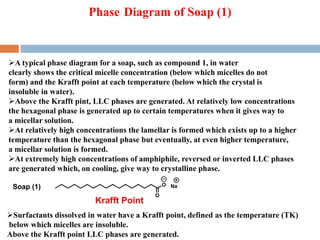
A typical phase diagram for a soap, such as compound 1, in water
clearly shows the critical micelle concentration (below which micelles do not
form) and the Krafft point at each temperature (below which the crystal is
insoluble in water).
Above the Krafft pint, LLC phases are generated. At relatively low concentrations
the hexagonal phase is generated up to certain temperatures when it gives way to
a micellar solution.
At relatively high concentrations the lamellar is formed which exists up to a higher
temperature than the hexagonal phase but eventually, at even higher temperature,
a micellar solution is formed.
At extremely high concentrations of amphiphile, reversed or inverted LLC phases
are generated which, on cooling, give way to crystalline phase.
O
O
NaSoap (1)
Krafft Point
Surfactants dissolved in water have a Krafft point, defined as the temperature (TK)
below which micelles are insoluble.
Above the Krafft point LLC phases are generated.
1. Liquid Crystal Displays: Used in display devices (LCDs) such
as Laptops, watches, calculators, clocks, etc.
2. Liquid Crystal Thermometers: Chiral nematic (cholesteric) liquid
crystals reflect light and the color reflected also is dependent
upon temperature.
3. Optical Imaging: An application of liquid crystals that is only
now being explored is optical imaging and recording.
3. Some of the liquid crystals are used in hydraulic break/clutch
system due to their high viscosity values.
Applications of Liquid Crystals
Liquid crystal technology has had a major effect many areas of science
and engineering, as well as device technology. Applications for this
special kind of material are still being discovered and continue to
provide effective solutions to many different problems.
 Liquid Crystal Displays:-
The most common application of liquid crystal technology is liquid
crystal displays (LCDs.) This field has grown into a multi-billion
dollar industry, and many significant scientific and engineering
discoveries have been made.
 Liquid Crystal Thermometers:-
As demonstrated earlier, chiral nematic (cholesteric) liquid crystals
reflect light with a wavelength equal to the pitch. Because the pitch is
dependent upon temperature, the color reflected also is dependent
upon temperature. Liquid crystals make it possible to accurately gauge
temperature just by looking at the color of the thermometer. By mixing
different compounds, a device for practically any temperature range
can be built.
 The "mood ring", a popular novelty a few years ago, took advantage
of the unique ability of the chiral nematic liquid crystal. More
important and practical applications have been developed in such
diverse areas as medicine and electronics. Special liquid crystal
devices can be attached to the skin to show a "map" of temperatures.
This is useful because often physical problems, such as tumors,
have a different temperature than the surrounding tissue. Liquid
crystal temperature sensors can also be used to find bad connections
on a circuit board by detecting the characteristic higher temperature.
 Optical Imaging
An application of liquid crystals that is only now being explored is
optical imaging and recording. In this technology, a liquid crystal cell
is placed between two layers of photocon ductor. Light is applied to
the photoconductor, which increases the material's conductivity. This
causes an electric field to develop in the liquid crystal corresponding to
the intensity of the light. The electric pattern can be transmitted by an
electrode, which enables the image to be recorded. This technology is
still being developed and is one of the most promising areas of liquid
crystal research.
Other Liquid Crystal Applications
Liquid crystals have a multitude of other uses. They are used for
nondestructive mechanical testing of materials under stress. This
technique is also used for the visualization of RF (radio frequency) waves
in waveguides. They are used in medical applications where, for example,
transient pressure transmitted by a walking foot on the ground is
measured. Low molar mass (LMM) liquid crystals have applications
including erasable optical disks, full color "electronic slides" for computer-
aided drawing (CAD), and light modulators for color electronic imaging.
As new properties and types of liquid crystals are investigated and
researched, these materials are sure to gain increasing importance in
industrial and scientific applications. typical applications are:
LCD displays research Dyes (cholesterics) Biomembrans Template
synthesis of nano materials Temperature measurement (by changing
colors)
Solvents for GC, NMR, reactions, etc.
Cosmetics Drug delivery effect colors and many other.
Conclusion
 We know today that many chemical compounds can exist in
the liquid crystal state, such as cholesteryl benzoate. Thanks to
the scientists that worked so diligently toward understanding
this phenomenon, the world can focus on ways to make this
product useful in society. Over the last century many
applications such as the detection of hot points in
microcircuits, the findings of fractures or tumors in humans
and the conversion of infared images have become accessible
due to the understanding of pitch in a liquid crystal.
THICKNERS
 Thickeners/Hydrocolloids Thickeners are high molecular
weight materials of colloidal dimensions, which in water,
produce highly viscous solution, suspension or gel.
 They impart viscosity to aqueous solution due to interactions
of their molecules with water.
 Classification of hydrocolloids:
 1.Natural hydrocolloids Plants – acacia, tragacanth ,
alginates Animals – gelatin ( pharmagel A, pharmagel B)
Minerals- bentonite , veegum , attapulgite
 2.Semisynthetic hydrocolloids – MC, CMC,
hydroxyethylcellulose
 3.synthetic hydrocolloids – carbapols , polyox
Classification
of
hydrocolloids
1.Natural
hydrocolloids
Plants
2.Semisynthetic
hydrocolloids3.synthetic
hydrocolloids
Various thickeners/hydrocolloids are:-
 Acacia:
1. Acacia is a complex, loose aggregate of sugars and hemicelluloses with a
molecular weight of approximately 240000 –580000.
2. The aggregate consists essentially of an arabic acid nucleus to which are
connected calcium, magnesium, and potassium along with the sugars
arabinose , galactose , and rhamnose .
3. Acacia is available as white or yellowish-white thin flakes, spheroidal
tears, granules, powder, or spray-dried powder. It is odorless and has a
bland taste.
4. Acacia is mainly used in oral and topical pharmaceutical formulations
as a suspending and emulsifying agent, often in combination with
tragacanth .
5. It is also used in the preparation of pastilles and lozenges, and as a tablet
binder, although it can produce tablets with a prolonged disintegration
time.
6. Acacia is incompatible with a number of substances including amidopyrine
, apomorphine , cresol, ethanol (95%), ferric salts, morphine, phenol,
physostigmine , tannins, thymol , and vanillin.
7. Functional Category: Emulsifying agent; stabilizing agent; suspending
agent; tablet binder; viscosity-increasing agent.
2. Tragacanth :
 Tragacanth is a naturally occurring dried gum obtained from
Astragalus gummifer . The gum consists of a mixture of water-
insoluble and water-soluble polysaccharides. Bassorin , which
constitutes 60–70% of the gum, is the main water-insoluble
portion, while the remainder of the gum consists of the water-
soluble material tragacanthin .
 On hydrolysis, tragacanthin yields L- arabinose , L- fucose , D-
xylose , D- galactose , and D- galacturonic acid. Tragacanth gum
also contains small amounts of cellulose, starch, protein, and
ash.
 Tragacanth gum has an approximate molecular weight of
840000.
 Description : White to yellowish in color, tragacanth is a
translucent, odorless substance, with an insipid mucilaginous
taste.
 Applications in Pharmaceutical Formulation: Tragacanth
gum is used as an emulsifying and suspending agent in a
variety of pharmaceutical formulations.
 It is used in creams, gels, and emulsions at various
concentrations according to the application of the formulation.
 Tragacanth gum is also used similarly in cosmetics and food
products, and has been used as a diluent in tablet
formulations.
3. Alginic acid:
 Alginic acid is a tasteless, practically odorless, white to
yellowish white , fibrous powder. Alginic acid is a linear
glycuron an polymer consisting of a mixture of b-(1!4)-D-
mannosyluronic acid and a-(1!4)-L- gulosyluronic acid residues,
of general formula (C6H8O)n. The molecular weight is
typically 20 000–240 000. Alginic acid as a mixture of
polyuronic acids [(C6H8O6)n] composed of residues of D-
mannuronic and Lglucuronic acid, and obtained mainly from
algae belonging to the Phaeophyceae .
 Applications in Pharmaceutical Formulation Alginic acid
 It is used in a variety of oral and topical pharmaceutical
formulations.
 In tablet and capsule formulations, alginic acid is used as both
a binder and disintegrating agent at concentrations of 1–5%
w/w.
 Alginic acid is widely used as a thickening and suspending
agent in a variety of pastes, creams, and gels; and as a
stabilizing agent for oil-in-water emulsions.
 Alginic acid has been used to improve the stability of
levosimendan . Therapeutically, alginic acid has been used as
an antacid.
 In combination with an H2-receptor antagonist, it has also
been utilized for the management of gastroesophageal reflux.
NEED:-
After invention of any new component to be used as an
Excipient. To verify the particular use of an Excipient. To
establish the standards for newly invented Excipient.
STANDARDIZATION OF EXCIPIENTS:
IPEC(International Pharmaceutical Excipient Council)Significant
Change Guidance: Two areas of concern to excipient makers
and users have been those of significant change and certificates
of analyses. Any change by the manufacturer of an excipient
that alters excipient’s physical or chemical property from the
norm or that is likely to alter the excipient’s performance in
dosage form is considered significant.
Standardization of excipients
The types of changes that might be considered include: Site Scale
Equipment Process Packaging Specifications.
1.EVALUATION CRITERIA:-
The evaluation criteria in the guideline include:
Changes in the chemical properties of excipients owing to the
change in the physical properties of excipients.
Changes in the impurity profile of excipients.
Changes in the functionality of excipients.
Changes in the moisture level of excipients.
Changes in the bioburden of excipients.
2.IMPURITY PROFILE:-
The IPEA-Americas profile addresses the following guide:- All
specific organic impurities should not exceed to 0.1% of total
weight.
3.PRECLINICAL TESTING OF EXIPIENTS:
Essentially, a new (novel) excipient is a material that has not been
previously used in a pharmaceutical formulation.
New proposed excipients cover a range of functions from
conventional use to active roles of enhanced drug uptake and
specific drug delivery.
The older formulations with compatible excipients are compared
with the newer formulation of same active ingredients using
new excipients.
GUIDELINES: A possible approach in toxicity studies is to add
groups of animals that receive the excipient alone as well as
the drug-excipient groups. The testing strategies proposed by
IPEC and the FDA offer a useful starting point for preclinical
excipient testing.
Proposed study types are given for a range of dose routes,
including oral, topical, parenteral and inhalational. The FDA
has divided testing requirements into those needed to support
maximum clinical duration of up to 14 consecutive days
(short-term use), more than two weeks but three months or less
(intermediate use), and more than three months of use.
Additional considerations: For inhalation/intranasal route: acute
inhalation toxicity, application site, and pulmonary
sensitization studies.
For parenteral route: acute parenteral toxicity and application site
studies.
For mucosal use: application site evaluation.
For transdermal and topical drugs: application site and photo
toxicity/ photoallergy evaluation.
ARRANGEMENT DURING STANDERDIZATION:-
Although it was originally intended that each monograph contain only
information about a single excipient, it rapidly became clear that
some substances or groups of substances should be discussed
together. This gave rise to such monographs as ‘Coloring Agents’
and ‘Hydrocarbons’.
In addition, some materials have more than one monograph
depending on the physical characteristics of the material, e.g.
Starch versus Pregelatinized Starch.
Regardless of the complexity of the monograph they are all divided
into 22 sections as follows:
MONOGRAPH
1.Nonproprietary Names: Lists the excipient names used in the
current British Pharmacopoeia, European Pharmacopeia,
Japanese Pharmacopeia, Indian Pharmacopoeia and the United
States Pharmacopeia/National Formulary.
2.Synonyms: Lists of other names for the excipient, including trade
names used by suppliers (shown in italics).
3.Chemical Name and CAS Registry Number: the unique
Chemical Abstract Services number for an excipient along with
the chemical name.
4.Empirical Formula and Molecular Weight: shows emperical
and molecular weight.
5.Structural Formula: shows sructural formula.
6.Functional Category:Lists the function(s) that an excipient is
generally thought to perform, e.g., diluent, emulsifying agent,
etc.
7.Applications in Pharmaceutical Formulation or
Technology: indicates the appilcation of excipient in various
formulations.
8. Description: Includes details of the physical appearance of the
excipient , e.g., white or yellow flakes, etc.
9. Pharmacopeial Specifications: presents the compendial
standards for the excipient . Information included is obtained
from BP, USP, IP, PhEup , JP,etc
10.Typical Properties: Describes the physical properties of the
excipient which are not shown in Section 9. All data are for
measurements made at 20°C unless otherwise indicated.
Where the solubility of the excipient is described in words.
11. Stability and Storage Conditions: Describes the conditions
under which the bulk material as received from the supplier
should be stored. In addition some monographs report on
storage and stability of the dosage forms that contain the
excipient.
12.Incompatibilities: Describes the reported incompatibilities
for the excipient either with other excipients or with active
ingredients.
13.Method of Manufacture: Describes the common methods of
manufacture and additional processes that are used to give the
excipient its physical characteristics.
14.Safety: Describes briefly the types of formulations in which the
excipient has been used and presents relevant data concerning possible
hazards and adverse reactions that have been reported.
15.Handling Precautions: Indicates possible hazards associated with
handling the excipient and makes recommendations for suitable
containment and protection methods.
16.Regulatory Status: Describes the accepted uses in foods and licensed
pharmaceuticals where known.
17.Related Substances: Lists excipients similar to the excipient discussed
in the monograph.
18.Comments: Includes additional information and observations relevant
to the excipient. Where appropriate, the different grades of the excipient
available are discussed.
19.Specific References: list of references cited within the monograph.
20.General References: Lists references which have general
information about this type of excipient or the types of dosage forms
made with these excipients.
21.Authors: Lists the current authors of the monograph in alphabetical
order
22.Date of Revision: Indicates the date on which changes were last
made to the text of the monograph.
References:
1. A text book of professional pharmacy by Jain and Sharma.
2. The theory and practices of Industrial pharmacy Leon
Lachman.
3. Text book of physical pharmaceutics by C.V.S.
Subramanyam.
Excipient

Excipient

  • 1.
    A seminar ON Excipients PRESENTED BY RAJENDRAD. MAHAJAN M. PHARM I (Pharmaceutics) . Department of pharmaceutical Sciences Rashtrasant Tukadoji Maharaj Nagpur University, Nagpur 2014-15
  • 2.
    CONTENTS 2  Directly compressedvehicles  Surfactants- micelle formation  Liquid Crystal Phase  Thickners  Standerdization of excipients
  • 3.
    INTRODUCTION 3 Antiadherents USED To Reduce TheAdhesion Between The Powder (Granule) Binders Binders Hold The Ingredients In A Tablet Together Coatings Tablet Ingredients From Deterioration By Moisture Disintegrants Dissolve When Wet Causing The Tablet To Break Apart Fillers And Diluents Fill Out The Size Of A Tablet Flavors Used To Mask Unpleasant Tasting Active Ingredients Colors Improve The Appearance Of A Formulation Glidants Promote Powder Flow By Reducing Interparticle Friction Lubricants Prevent Ingredients From Clumping Together And From Sticking To The Tablet Punches Preservatives Preserve The Formulation EXCIPIENTS: Excipient is an inactive substance used as A carrier for the active Ingredients of a medication TYPES OF EXCIPIENTS :
  • 4.
    NEWER EXCIPIENT  Cyclodextrin Ion Exchange Resins  Film Coating Materials  Superdisintegrants  Directly Compressible Vehicles  Surfactants- Micelle Formation  Liquid Crystal Phase  Thickeners  Standardization Of Excipients 4
  • 5.
    What is Directcompression  Direct compression (DC) is the tabletting of a blend of ingredients i.e. the compression mix, without a preliminary granulation or aggregation process.  The compression mix contains the active pharmaceutical ingredient (API) blended with one or more excipients.  The excipients may include binders, fillers/diluents, disintegrant and lubricants. 5
  • 6.
    Advantages of DC:  More Economic compare to wet granulation since it requires fewer unit operations.  Documentation and validation requirements are reduced.  It requires less equipment, and space, time.  lower power consumpation , and less labor leading to reduce production cost of tablets.  More suitable for moisture and heat sensitive APIs, since it eliminates wetting and drying steps.  Lower microbial contamination  Faster drug release. 6
  • 7.
    Disadvantages of DC:  Segregation because of the difference in the density of the API and excipients.  The dry state of the material during mixing may induce static charge and lead to segregation. due to this problems like weight variation and content uniformity may occur.  APIs that have poor flow properties and low bulk density is difficult to process by direct compression.  DC excipients are costly because these are prepared by spray drying, fluid bed drying, roller drying or co-crystallization.  Lubricant sensitivity. 7
  • 8.
    DIRECTLY COMPRESSIBLE VEHICLE Introduction The method consist of compressing tablets directly from powdered material without modifying the physical nature of the material.  Tablets are compressed directly from powder blends of the active ingredient (such as chloride, chlorates, bromide, ammonium chloride etc) and suitable excipients. These substances posses cohesive and flow property that make direct compression posssible. No pretreatment of the powder blends like wet or dry granulation procedures is necessary.  Direct compression eliminates variabilities of wet granulation processing binders (temp, viscous, quality) and other agents. 8
  • 9.
     These arethe diluents or fillers designed to make up the required bulk of the tablets.  These are inactive ingredients that are added to tablets in addition to the active drug.  Some very common diluents in tablets include lactose and their derivatives, starch, cellulose derivatives.  Used in the direct compression of the tablets.
  • 10.
    Requirements For AGood DCV :  Non-toxic and acceptable to the regulatory agencies.  Low cost.  Physiologically inert.  Must be color-compatible(not produce any off color appearance). No deleterious effect on the bioavailability of the drugs in the product.  Stability.  Controlled particle size.  Good flowability. 10
  • 11.
    Classification of DCV: Disintegrants And Poor Flow: ex. Microcrystalline cellulose , Starch .  Free-flowing Materials That Do Not Disintegrate : ex. Dicalcium phosphate dihydrate.  Free-flowing Powders That Disintegrate By Dissolution: ex. Lactoses, Sorbitol ,Granulated lactitol,Crystalline maltose.  Co-processed exicipients : ex. Ludipress ,Silicified microcrystalline cellulose. 11
  • 12.
    Disintegrants And PoorFlow:  Microcrystalline cellulose:  It is a purified, partially depolymerized cellulose, which is prepared by treating a-cellulose with mineral acids, producing bundles of needle-like microcrystals.  most useful filler for direct compression.  the compactibility of microcrystalline cellulose decreased with a reduction in its moisture content.  Avicel PH101,102,103,112,200,105,Emocel etc  Mixed with a-lactose monohydrate DCP. 12
  • 13.
    Disintegrants And PoorFlow:  Starch :  Good compactability .  Starch -1500 :it is a form of pregelatinized starch that has been modified to make it more compressible and flowable in character.  Useful as a result of their good binding and disintegrant properties  High moisture content 12-13%. Accelerate the decomposition of moisture sensitive drugs.  Lubricant sensitive.  Magnesium stearate should be avoided or kept at a level below 0.5%w/w because higher concentrations can have adverse effects on tablet strength and dissolution. 13
  • 14.
    Free-flowing Materials ThatDo Not Disintegrate:  Dicalcium phosphate dihydrate:  Filler produced by A complicated process using phosphoric acid and slaked lime.  low cost and desirable flow .  Used in vitamin and mineral supplements because of the high calcium and phosphorus content.  Rapidly and completely penetrated by the liquid  Anhydrous & DCP (Di-tab,emcomopress,DI-CAFOS ,Calstar.) 14
  • 15.
    Free-flowing Powders ThatDisintegrate By Dissolution:  Lactose :  Natural disaccharide -4.6% of cow’s milk.  Lactose present in different polymorphs depending on the crystallization conditions. i.e a and b lactose .  Most popular as a tablet filler .  Lactose derivatives :  a-lactose monohydrate:-  It is hard crystal. Non hygroscopic.  Excellent physical and chemical stability.  Good water solubility.  Poor binding property.  Good flowability 15
  • 16.
    Free-flowing Powders ThatDisintegrate By Dissolution…….  Spray dried lactose:-  Less brittleness than α-lactose monohydrate.  Low hygroscopicity.  Good flowability.  Agglomerated lactose also used in the direct compression. It is granulated form of α-lactose monohydrate.  It has good binding property. 16
  • 17.
    Free-flowing Powders ThatDisintegrate By Dissolution……  Compressible Sugar:-  Used as a filler in tablets.  Used as co-crystallized sucrose with 3% modified dextrin.  Good flow properties.  Need glidant only above 50% relative humidity.  Excellent color stability.  Nu-tab -4% invert sugar small amts. Of corn starch and rest is sucrose.  Distab-96% sucrose + 4% invert sugar.  Di-pac-97% sucrose + 3% modified dextrins. 17
  • 18.
     Dextrose :- It is crystallized dextrose contains 3-5% maltose.  Moisture content 9%. Available in both anhydrous and hydrous product.  Highly compatible. At 75% relative humidity it becomes quite hygroscopic.  Good flow,filler-binder,with 1% mg st. Excellent preformance.  Emdex (celutab):90-92% dextrose +3-5% maltose 18
  • 19.
    Free-flowing Powders ThatDisintegrate By Dissolution::  Sorbitol :  Affect the compactability and stability.  Moisture content 0.5-2%.  Mostly used in chewable tablets.  It has cool taste so used in ‘sugar free’ mints.  It is hygroscopic,while mannitol is not  Need of lubricant when moisture content exceeds 2% in formulation. 19
  • 20.
    Free-flowing Powders ThatDisintegrate By Dissolution……  Mannitol :-  It is used where complete solubility is required.  It is costly. Used as A filler in chewable tablets.  It is non-hygroscopic.  It also has cooling mouth feel.  Maltodextrin :-  It is highly compactible.  Completely soluble.  Low hygroscopicity. 20
  • 21.
    Co-processed exicipients:  Ludipress:  It consisting of three components:a filler, a binder and a disintegrant.  The exact concentrations of its constituents are stated below:  93.4% a-lactose monohydrate,  3.2% polyvinyl pyrrolidone and  3.4% crospovidone.  Excellent flowability. 21
  • 22.
    Different Concentration ofexcipient: Sr.N o Excipient Wet granulation Directly compressible vehicle 1 Microcrystalline cellulose 10-30% 60-90% 2 Dicalcium phosphate dihydrate Up to90% 10-30% 3 Sorbitol /Mannitol Up to90% - 4 Lactoses Up to90% 40-50% 5 Starch 5-10% 5-20% 6 Sugar 10-80% 90-95 22
  • 23.
    Surfactants are compoundsthat lower the surface tension of a liquid, the interfacial tension between two liquids, or that between a liquid and a solid. Surfactants may act as detergents, wetting agents, emulsifiers, foaming agents, and dispersants. Surfactants are usually organic compounds that are amphiphilic, i.e. they contain both hydrophobic groups (their tails) and hydrophilic groups (their heads). Therefore, a surfactant contains both a water insoluble (or oil soluble) component and a water soluble component. Surfactants will diffuse in water and adsorb at interfaces between air and water or at the interface between oil and water, in the case where water is mixed with oil. Surfactants
  • 24.
    The insoluble hydrophobicgroup may extend out of the bulk water phase, into the air or into the oil phase, while the water soluble head group remains in the water phase. This alignment of surfactants at the surface modifies the surface properties of water at the water/air or water/oil interface. The "tail" of most surfactants consisting of a hydrocarbon chain, which can be branch, linear, or aromatic. Fluoro surfactants have fluorocarbon chains. Siloxane surfactants have siloxane chains.
  • 25.
  • 26.
    1.Anionic surfactants: It containsanionic functional groups at their head, such as sulfate, sulfonate, phosphate, and carboxylates. Anionic surfactants containing sulfate, sulfonate, and carboxylates ion are known as soaps. The chain length of fatty acid ranges from 12 to 18 without which the polar part becomes weak. Monovalent soaps are hydrophillic in nature whereas di- and trivalent soaps are hydrophobic because of higher proportion of hydrophobic moiety. Alkyl sulfates include ammonium lauryl sulfate, sodium lauryl sulfate (SDS, sodium dodecyl sulfate), carboxylate includes sodium stearate.
  • 27.
    2.Cationic surfactant: These arechiefly quaternary ammonium compounds. They are mostly used for antimicrobial activity. Ex:- cetyl trimethylammonium bromide (CTAB), hexadecyl trimethyl ammonium bromide, cetyl trimethylammonium chloride (CTAC), Cetylpyridinium chloride (CPC), Benzalkonium chloride (BAC) Benzethonium chloride (BZT). Another group of cationic surfactants comprises of amine salts. They act as surfactants and posses good wetting, foaming and detergent properties. Ex:- octodecylamine hydrochloride. NOTE:- Due to toxicity of ionic surfactant, vesicles are not used for drug delivery.
  • 28.
    3.Non-ionic surfactants: These arewidely used due to compatibility, stablilty and low toxicity. They may be: water insoluble:- are the long chain fatty acids. Ex: laury, cetyl and stearyl alcohol, propylene glycol etc. Water soluble:- it contains polyoxyethylene groups added through an ether linkage with one of their alcohol group. Ex:- polyoxyethlene sorbitan fatty acid ester. 4. Zwitterionic surfactants: Zwitterionic (amphoteric) surfactants have both cationic and anionic centers attached to the same molecule. The cationic part is based on primary, secondary, or tertiary amines or quaternary ammonium cations. The anionic part can be more variable. Ex:- N-dodecyl-N,N-dimethlbetain(zwitter ion).
  • 30.
    Micelle formation surfactants arehelpful in the solubilization of poorly water soluble molecules through the formation of micelle. When a surfactant is dissolved in water in very low concentration, a fraction of it will be absorbed at the air-water interface whereas the remainder will residue in the bulk. When more surfactant is added the interface becomes fully saturated and the surfactant is forced into the bulk of liquid and surfactants form aggregates, such as micelles, where the hydrophobic tails form the core of the aggregate and the hydrophilic heads are in contact with the surrounding liquid. Other types of aggregates such as spherical or cylindrical micelles or bilayers can be formed. The shape of the aggregates depends on the chemical structure of the surfactants
  • 31.
    Micelles are stablein to water p[rovided that the concentration of surfactant and above criticle micelle concentration.
  • 32.
    Structure formation insurfactant solution micelle rod hexagonal monolayer bilayer Reverse micelle Formation of MICROEMULSION REVERSE HEXAGONAL Oil/alcohol
  • 33.
    Effect of temperatureand concentration on the structure of lyotropic liquid crystals
  • 34.
    HLB scale HLB isa means of expressing the hydrophilic property of surfactants in figures The functional utility of surfactant depends on the hydrophillic and lipophillic group attached to it. An arbitary scale was devised by Griffin to serve as a measure of the HLB of surfactants.
  • 35.
    The values ofsurfactants are: 0-3= antifoaming agents 3-8= w/o emulsifying agent 7-9= wetting and spreading agent 8-16= o/w emulsifying agent 13-16= detergents Above 16= solubilizing agent Pharmaceutical applications of surfactants: 1.Wetting agents 2.Emulsifying agent 3.Solubilizing agent 4.Foaming and antifoaming agent
  • 36.
    Liquid crystals aresubstances that exhibit a phase of matter that has properties between those of a conventional liquid, and those of a solid crystal. Hence LC show anisotropy. Mesogen: It is the fundamental unit of a liquid crystal that
  • 37.
    Mesophase or Liquidcrystal phase:  Phase that does not possess long-range positional ordering, but does have long-range orientational order .  A phase occurring over a defined range of temperature or pressure or concentration within the mesomorphic state.  Mesogen ( mesomorphic compound): A compound that under suitable conditions of temperature, pressure and concentration can exist as a mesophase .
  • 38.
    TYPES OF LIQUIDCRYSTAL PHASES LIQUID CRYSTALS PHASES I. THERMOTROPIC LC NEMATIC LC CHOLESTRIC LC SMECTIC LC II. LYOTROPIC LC Lamellar LC Hexagonal LC Cubic phases
  • 39.
    i. Thermotropic LiquidCrystals Liquid crystals are said to be thermotropic if there liquid crystalline properties depand on the temperature. LIQUDS INTERMEDIATE PHASE CRYSTAL HEAT HEAT COOL COOL MELT SOLIDIFY
  • 40.
    i. NEMATIC LIQUIDCRYSTALS PHASE One of the most common LC phases is the nematic, where the molecules (mesogens) have no positional order, but they have long-range orientational order. (Most nematics are uniaxial: they have one axis that is longer and preferred, with the other two being equivalent (can be approximated as cylinders) In nematic molecules can rotate in one axis but in 3-D.
  • 41.
    Nematics have fluiditysimilar to that of ordinary (isotropic) liquids but they can be easily aligned by an external magnetic or electric field. An aligned nematic has the optical properties of a uniaxial crystal and this makes them extremely useful in liquid crystal displays (LCD). In Greek ‘nematic’ means thread. And hence the thread like structure of the nematic crystals.
  • 42.
     These substancescontain filamentous particles, which are either deposited on the reservoir wall or remain free. These filaments look "brushed" and are parallel to each other but can slide up and down.  Nematic liquid crystals are not so ordered as smectic. Nevertheless, they are also optically anisotropic, and under a microscope give a "moire" texture with alternating light and dark stripes.  Particles of a nematic liquid crystal react to electric and magnetic fields the same way as iron filings, by arranging in an orderly manner along the field lines.  They also used in Electro optic display devices.
  • 43.
    ii. SMECTIC LIQUIDCRYSTALS In the case of Smectic type LC, the mesogens have both positional order and orientational order. The smectic phases, which are found at lower temperatures than the nematic and cholestric, form well- defined layers that can slide over one another like soap/ grease. IN SMECTIC MOLECULES CAN ROTATE ABOUT ONE AXIS BUT MOBILE IN 2-D Smectic A Smectic C
  • 44.
     This phasecan be reached at lower temperatures than the nematic phase.  Molecules align themselves in layers.(They are restricted to their plane.)  More order and higher viscosity  In the smectic phase, the molecules maintain the general order of the nematic phase but are also aligned in layers.  Several variants of the smectic phase are known, depending on the angle formed between the molecular axes and the planes of molecules.  The simplest such structure is the so-called smectic A phase, in which the molecules can rotate about their long axes within a given plane, but they cannot readily slide past one another.  Smectic C used in LCDC.
  • 45.
    iii. CHOLESTRIC LIQUIDCRYSTALS The cholestric phase can be defined as a special type of nematic LC in which the thin layers of the parallel mesogens have their longitudinal axes rotated in adjacent layers at certain angle.
  • 46.
     Cholesteric liquidcrystals are mainly derivatives of cholesterol. Here flat and long molecules are arranged into layers the same way as in smectic liquid crystals, but within each layer the arrangement of the particles resembles nematic liquid crystals.  It is interesting that neighbouring finest molecular layers in such cholesteric liquid crystals are rotated slightly with respect to each other, and thus a stack of such layers forms a spiral. Due to their peculiar structure these liquid crystals have specific optical properties.  Ordinary light passing through such a substance is divided into two beams that are refracted differently.  When a colourless, like water, cholesteric liquid crystal gets into a zone of varying temperature, it gets a bright colour.
  • 47.
  • 48.
    II. Lyotropic LIQUIDCRYSTALS Liquid crystals which are prepared by mixing two or more substances, of which one is a polar molecule, are known as lyotropic liquid crystals. Eg. Soap in water. Hydrophobic end of the mesogen Hydrophilic end of the mesogen
  • 49.
    The lamellar (Lα)lyotropicliquid crystals phase structure is illustrated in Figure-4 and as can be seen this particular phase consists of a layered arrangement of amphiphilic molecules. The amphiphilic nature of the molecules means that the self- assembly is bilayer in nature with two layers being made up of intertwining non-polar chains form oppositely directed molecules. Where the polar head groups meet is separated by a layer of water. The bilayer thickness is 10-30% less than twice the length of an ‘all- trans’ non-polar chain and the water layer thickness is between 1 and 10 nm if the water content is between 10 and 50% by weight. Lamellar Lyotropic Liquid Crystal Phase
  • 50.
    Usually, lamellar lyotropicliquid crystals phase only exist down to 50% surfactant. Below 50% surfactant, the lamellar phase gives way to hexagonal lyotropic liquid crystal phases or an isotropic miceller solution. However, in some cases the lyotropic lamellar phase is exhibited in extremely dilute solutions. LLLCPs are less viscous than the hexagonal LLCPs despite the fact that they contain less water. This is because the parallel layers slide over each other with relative ease during shear and this is quite easy to visualise
  • 51.
    Lamellar Lyotropic LiquidCrystal Phase Structure of the Lamellar Lyotropic Liquid Crystal Phase
  • 52.
    Hexagonal Lyotropic LiquidCrystal Phase The hexagonal lyotropic liquid crystal phases have a molecular aggregate ordering which corresponds to a hexagonal arrangement . These phases give similar birefringent texures when examined by optical polarising microscopy to the thermotropic hexagonal liquid crystal phases. There are two types of hexagonal lyotropic liquid crystal phases, the hexagonal phase (H1) and the reversed hexagonal phase (H2). The hexagonal phase consists of micellar cylinders of indefinite length packed in a hexagonal arrangement .
  • 53.
    Hexagonal Lyotropic LiquidCrystal Phase Structure of the Hexagonal Lyotropic Liquid Crystal Phase
  • 54.
    Reversed Hexagonal LyotropicLiquid Crystal Phase Structure of the Reversed Hexagonal Lyotropic Liquid Crystal Phase
  • 55.
    Hexagonal Lyotropic LiquidCrystal Phase The spacing between cylinders varies enormously between 1 and 5 nm depending upon the relative amounts of water and surfactant.  Hexagonal lyotropic liquid crystals phases typically contain 30 to 60% water by weight and despite this high water content the phase is very viscous.  The viscosity of the hexagonal phase means that it is best avoided in the practical, industrial handling of surfactants.  The reversed hexagonal phase is basically the same as the hexagonal phase except that the micellar cylinder are reversed with the non-polar chains radiating outwards from the cylinders.
  • 56.
    Cubic Lyotropic LiquidCrystal Phase Structure of the cubic lyotropic liquid crystal phase
  • 57.
    Cubic Lyotropic LiquidCrystal Phase Cubic lyotropic liquid crystal phase are not as common as the lamellar or hexagonal phase.  This phases are not as well characterised as the lamellar or hexagonal phases. Two types of cubic lyotropic liquid crystals phases have been established and each can be generated in the ‘ normal’ manner (water continuous ) or in the ‘reversed’ manner (non-polar chain continuous), which makes for a total of four different phase types.  The most well-known cubic phase consists of a cubic arrangement of molecular Aggregates.  The molecular aggregates are similar to micelles (I1 phase) or reversed micelles (I2 phase) micelles Reversed micelles
  • 58.
    Cubic Lyotropic LiquidCrystal Phase structure of the ‘normal’ (I1) CLLC phase is shown in the Figure. Some reports suggest that the molecular aggregates are spherical but others claim that they are cylindrical or ellipsoidal. The second type of CLLC phases is found to lie between the hexagonal (H1) and lamellar (Lα) phases. CLLC phases are extremely viscous and are even more viscous than the hexagonal phases. Cubic phases are often called viscous isotropic phases. The isotropic nature of the cubic phases often makes them difficult to detect by OPM and so they sometimes undetected.
  • 59.
    Phase Diagram ofSoap (1) The best way to illustrate the behaviour of an amphiphilic material in water is to show a phase diagram. Phase diagram are constructed with amphiphilic concentration along the horizontal axis and temperature along the vertical axis. Such phase diagrams are often used to show the liquid crystal phase behaviour of a mixture of two thermotropic LCs. Phase diagram for a typical soap (1) in water
  • 60.
    Phase Diagram ofSoap (1) A typical phase diagram for a soap, such as compound 1, in water clearly shows the critical micelle concentration (below which micelles do not form) and the Krafft point at each temperature (below which the crystal is insoluble in water). Above the Krafft pint, LLC phases are generated. At relatively low concentrations the hexagonal phase is generated up to certain temperatures when it gives way to a micellar solution. At relatively high concentrations the lamellar is formed which exists up to a higher temperature than the hexagonal phase but eventually, at even higher temperature, a micellar solution is formed. At extremely high concentrations of amphiphile, reversed or inverted LLC phases are generated which, on cooling, give way to crystalline phase. O O NaSoap (1) Krafft Point Surfactants dissolved in water have a Krafft point, defined as the temperature (TK) below which micelles are insoluble. Above the Krafft point LLC phases are generated.
  • 61.
    1. Liquid CrystalDisplays: Used in display devices (LCDs) such as Laptops, watches, calculators, clocks, etc. 2. Liquid Crystal Thermometers: Chiral nematic (cholesteric) liquid crystals reflect light and the color reflected also is dependent upon temperature. 3. Optical Imaging: An application of liquid crystals that is only now being explored is optical imaging and recording. 3. Some of the liquid crystals are used in hydraulic break/clutch system due to their high viscosity values.
  • 62.
    Applications of LiquidCrystals Liquid crystal technology has had a major effect many areas of science and engineering, as well as device technology. Applications for this special kind of material are still being discovered and continue to provide effective solutions to many different problems.  Liquid Crystal Displays:- The most common application of liquid crystal technology is liquid crystal displays (LCDs.) This field has grown into a multi-billion dollar industry, and many significant scientific and engineering discoveries have been made.  Liquid Crystal Thermometers:- As demonstrated earlier, chiral nematic (cholesteric) liquid crystals reflect light with a wavelength equal to the pitch. Because the pitch is dependent upon temperature, the color reflected also is dependent upon temperature. Liquid crystals make it possible to accurately gauge temperature just by looking at the color of the thermometer. By mixing different compounds, a device for practically any temperature range can be built.
  • 63.
     The "moodring", a popular novelty a few years ago, took advantage of the unique ability of the chiral nematic liquid crystal. More important and practical applications have been developed in such diverse areas as medicine and electronics. Special liquid crystal devices can be attached to the skin to show a "map" of temperatures. This is useful because often physical problems, such as tumors, have a different temperature than the surrounding tissue. Liquid crystal temperature sensors can also be used to find bad connections on a circuit board by detecting the characteristic higher temperature.  Optical Imaging An application of liquid crystals that is only now being explored is optical imaging and recording. In this technology, a liquid crystal cell is placed between two layers of photocon ductor. Light is applied to the photoconductor, which increases the material's conductivity. This causes an electric field to develop in the liquid crystal corresponding to the intensity of the light. The electric pattern can be transmitted by an electrode, which enables the image to be recorded. This technology is still being developed and is one of the most promising areas of liquid crystal research.
  • 64.
    Other Liquid CrystalApplications Liquid crystals have a multitude of other uses. They are used for nondestructive mechanical testing of materials under stress. This technique is also used for the visualization of RF (radio frequency) waves in waveguides. They are used in medical applications where, for example, transient pressure transmitted by a walking foot on the ground is measured. Low molar mass (LMM) liquid crystals have applications including erasable optical disks, full color "electronic slides" for computer- aided drawing (CAD), and light modulators for color electronic imaging. As new properties and types of liquid crystals are investigated and researched, these materials are sure to gain increasing importance in industrial and scientific applications. typical applications are: LCD displays research Dyes (cholesterics) Biomembrans Template synthesis of nano materials Temperature measurement (by changing colors) Solvents for GC, NMR, reactions, etc. Cosmetics Drug delivery effect colors and many other.
  • 65.
    Conclusion  We knowtoday that many chemical compounds can exist in the liquid crystal state, such as cholesteryl benzoate. Thanks to the scientists that worked so diligently toward understanding this phenomenon, the world can focus on ways to make this product useful in society. Over the last century many applications such as the detection of hot points in microcircuits, the findings of fractures or tumors in humans and the conversion of infared images have become accessible due to the understanding of pitch in a liquid crystal.
  • 66.
    THICKNERS  Thickeners/Hydrocolloids Thickenersare high molecular weight materials of colloidal dimensions, which in water, produce highly viscous solution, suspension or gel.  They impart viscosity to aqueous solution due to interactions of their molecules with water.  Classification of hydrocolloids:  1.Natural hydrocolloids Plants – acacia, tragacanth , alginates Animals – gelatin ( pharmagel A, pharmagel B) Minerals- bentonite , veegum , attapulgite  2.Semisynthetic hydrocolloids – MC, CMC, hydroxyethylcellulose  3.synthetic hydrocolloids – carbapols , polyox
  • 67.
  • 68.
    Various thickeners/hydrocolloids are:- Acacia: 1. Acacia is a complex, loose aggregate of sugars and hemicelluloses with a molecular weight of approximately 240000 –580000. 2. The aggregate consists essentially of an arabic acid nucleus to which are connected calcium, magnesium, and potassium along with the sugars arabinose , galactose , and rhamnose . 3. Acacia is available as white or yellowish-white thin flakes, spheroidal tears, granules, powder, or spray-dried powder. It is odorless and has a bland taste. 4. Acacia is mainly used in oral and topical pharmaceutical formulations as a suspending and emulsifying agent, often in combination with tragacanth . 5. It is also used in the preparation of pastilles and lozenges, and as a tablet binder, although it can produce tablets with a prolonged disintegration time. 6. Acacia is incompatible with a number of substances including amidopyrine , apomorphine , cresol, ethanol (95%), ferric salts, morphine, phenol, physostigmine , tannins, thymol , and vanillin. 7. Functional Category: Emulsifying agent; stabilizing agent; suspending agent; tablet binder; viscosity-increasing agent.
  • 69.
    2. Tragacanth : Tragacanth is a naturally occurring dried gum obtained from Astragalus gummifer . The gum consists of a mixture of water- insoluble and water-soluble polysaccharides. Bassorin , which constitutes 60–70% of the gum, is the main water-insoluble portion, while the remainder of the gum consists of the water- soluble material tragacanthin .  On hydrolysis, tragacanthin yields L- arabinose , L- fucose , D- xylose , D- galactose , and D- galacturonic acid. Tragacanth gum also contains small amounts of cellulose, starch, protein, and ash.  Tragacanth gum has an approximate molecular weight of 840000.
  • 70.
     Description :White to yellowish in color, tragacanth is a translucent, odorless substance, with an insipid mucilaginous taste.  Applications in Pharmaceutical Formulation: Tragacanth gum is used as an emulsifying and suspending agent in a variety of pharmaceutical formulations.  It is used in creams, gels, and emulsions at various concentrations according to the application of the formulation.  Tragacanth gum is also used similarly in cosmetics and food products, and has been used as a diluent in tablet formulations.
  • 71.
    3. Alginic acid: Alginic acid is a tasteless, practically odorless, white to yellowish white , fibrous powder. Alginic acid is a linear glycuron an polymer consisting of a mixture of b-(1!4)-D- mannosyluronic acid and a-(1!4)-L- gulosyluronic acid residues, of general formula (C6H8O)n. The molecular weight is typically 20 000–240 000. Alginic acid as a mixture of polyuronic acids [(C6H8O6)n] composed of residues of D- mannuronic and Lglucuronic acid, and obtained mainly from algae belonging to the Phaeophyceae .
  • 72.
     Applications inPharmaceutical Formulation Alginic acid  It is used in a variety of oral and topical pharmaceutical formulations.  In tablet and capsule formulations, alginic acid is used as both a binder and disintegrating agent at concentrations of 1–5% w/w.  Alginic acid is widely used as a thickening and suspending agent in a variety of pastes, creams, and gels; and as a stabilizing agent for oil-in-water emulsions.  Alginic acid has been used to improve the stability of levosimendan . Therapeutically, alginic acid has been used as an antacid.  In combination with an H2-receptor antagonist, it has also been utilized for the management of gastroesophageal reflux.
  • 73.
    NEED:- After invention ofany new component to be used as an Excipient. To verify the particular use of an Excipient. To establish the standards for newly invented Excipient. STANDARDIZATION OF EXCIPIENTS: IPEC(International Pharmaceutical Excipient Council)Significant Change Guidance: Two areas of concern to excipient makers and users have been those of significant change and certificates of analyses. Any change by the manufacturer of an excipient that alters excipient’s physical or chemical property from the norm or that is likely to alter the excipient’s performance in dosage form is considered significant. Standardization of excipients
  • 74.
    The types ofchanges that might be considered include: Site Scale Equipment Process Packaging Specifications. 1.EVALUATION CRITERIA:- The evaluation criteria in the guideline include: Changes in the chemical properties of excipients owing to the change in the physical properties of excipients. Changes in the impurity profile of excipients. Changes in the functionality of excipients. Changes in the moisture level of excipients. Changes in the bioburden of excipients. 2.IMPURITY PROFILE:- The IPEA-Americas profile addresses the following guide:- All specific organic impurities should not exceed to 0.1% of total weight.
  • 75.
    3.PRECLINICAL TESTING OFEXIPIENTS: Essentially, a new (novel) excipient is a material that has not been previously used in a pharmaceutical formulation. New proposed excipients cover a range of functions from conventional use to active roles of enhanced drug uptake and specific drug delivery. The older formulations with compatible excipients are compared with the newer formulation of same active ingredients using new excipients. GUIDELINES: A possible approach in toxicity studies is to add groups of animals that receive the excipient alone as well as the drug-excipient groups. The testing strategies proposed by IPEC and the FDA offer a useful starting point for preclinical excipient testing.
  • 76.
    Proposed study typesare given for a range of dose routes, including oral, topical, parenteral and inhalational. The FDA has divided testing requirements into those needed to support maximum clinical duration of up to 14 consecutive days (short-term use), more than two weeks but three months or less (intermediate use), and more than three months of use. Additional considerations: For inhalation/intranasal route: acute inhalation toxicity, application site, and pulmonary sensitization studies. For parenteral route: acute parenteral toxicity and application site studies. For mucosal use: application site evaluation. For transdermal and topical drugs: application site and photo toxicity/ photoallergy evaluation.
  • 77.
    ARRANGEMENT DURING STANDERDIZATION:- Althoughit was originally intended that each monograph contain only information about a single excipient, it rapidly became clear that some substances or groups of substances should be discussed together. This gave rise to such monographs as ‘Coloring Agents’ and ‘Hydrocarbons’. In addition, some materials have more than one monograph depending on the physical characteristics of the material, e.g. Starch versus Pregelatinized Starch. Regardless of the complexity of the monograph they are all divided into 22 sections as follows:
  • 78.
    MONOGRAPH 1.Nonproprietary Names: Liststhe excipient names used in the current British Pharmacopoeia, European Pharmacopeia, Japanese Pharmacopeia, Indian Pharmacopoeia and the United States Pharmacopeia/National Formulary. 2.Synonyms: Lists of other names for the excipient, including trade names used by suppliers (shown in italics). 3.Chemical Name and CAS Registry Number: the unique Chemical Abstract Services number for an excipient along with the chemical name. 4.Empirical Formula and Molecular Weight: shows emperical and molecular weight. 5.Structural Formula: shows sructural formula.
  • 79.
    6.Functional Category:Lists thefunction(s) that an excipient is generally thought to perform, e.g., diluent, emulsifying agent, etc. 7.Applications in Pharmaceutical Formulation or Technology: indicates the appilcation of excipient in various formulations. 8. Description: Includes details of the physical appearance of the excipient , e.g., white or yellow flakes, etc. 9. Pharmacopeial Specifications: presents the compendial standards for the excipient . Information included is obtained from BP, USP, IP, PhEup , JP,etc
  • 80.
    10.Typical Properties: Describesthe physical properties of the excipient which are not shown in Section 9. All data are for measurements made at 20°C unless otherwise indicated. Where the solubility of the excipient is described in words. 11. Stability and Storage Conditions: Describes the conditions under which the bulk material as received from the supplier should be stored. In addition some monographs report on storage and stability of the dosage forms that contain the excipient. 12.Incompatibilities: Describes the reported incompatibilities for the excipient either with other excipients or with active ingredients. 13.Method of Manufacture: Describes the common methods of manufacture and additional processes that are used to give the excipient its physical characteristics.
  • 81.
    14.Safety: Describes brieflythe types of formulations in which the excipient has been used and presents relevant data concerning possible hazards and adverse reactions that have been reported. 15.Handling Precautions: Indicates possible hazards associated with handling the excipient and makes recommendations for suitable containment and protection methods. 16.Regulatory Status: Describes the accepted uses in foods and licensed pharmaceuticals where known. 17.Related Substances: Lists excipients similar to the excipient discussed in the monograph. 18.Comments: Includes additional information and observations relevant to the excipient. Where appropriate, the different grades of the excipient available are discussed.
  • 82.
    19.Specific References: listof references cited within the monograph. 20.General References: Lists references which have general information about this type of excipient or the types of dosage forms made with these excipients. 21.Authors: Lists the current authors of the monograph in alphabetical order 22.Date of Revision: Indicates the date on which changes were last made to the text of the monograph.
  • 83.
    References: 1. A textbook of professional pharmacy by Jain and Sharma. 2. The theory and practices of Industrial pharmacy Leon Lachman. 3. Text book of physical pharmaceutics by C.V.S. Subramanyam.

Editor's Notes