SETTLEMENTS
Hierarchy, Patterns & Types
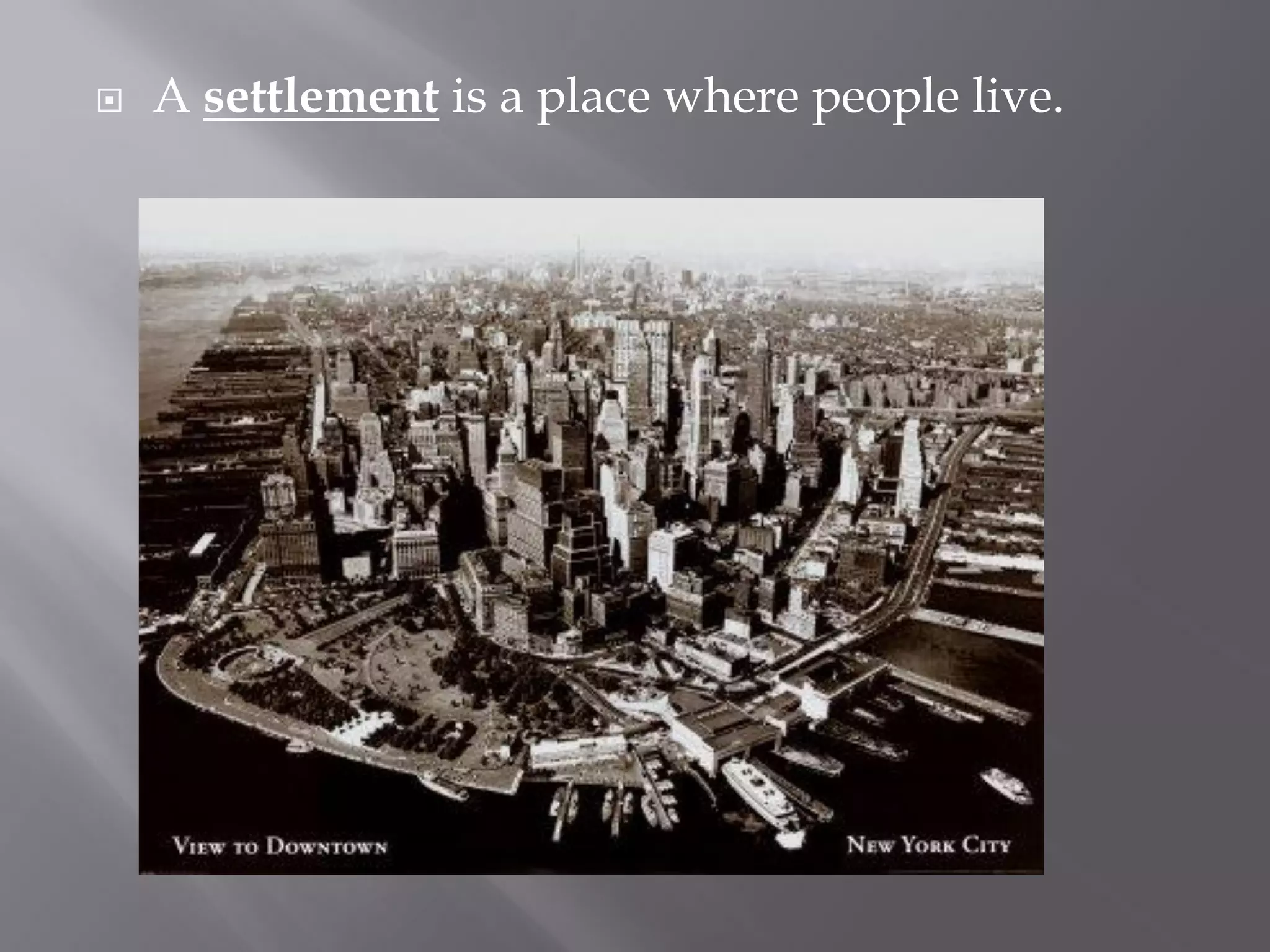
 A settlement is a place where people live.
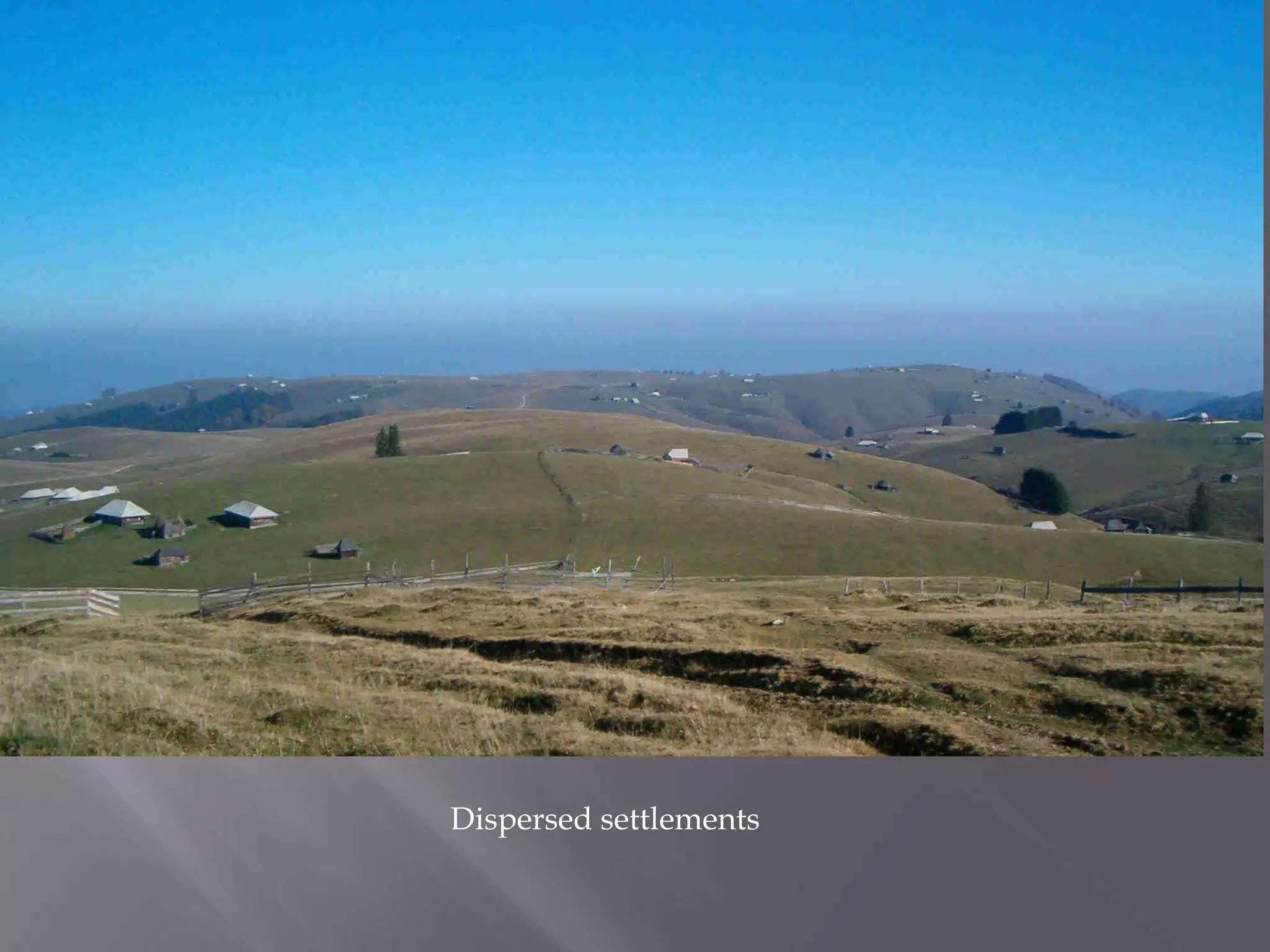
Dispersed settlements
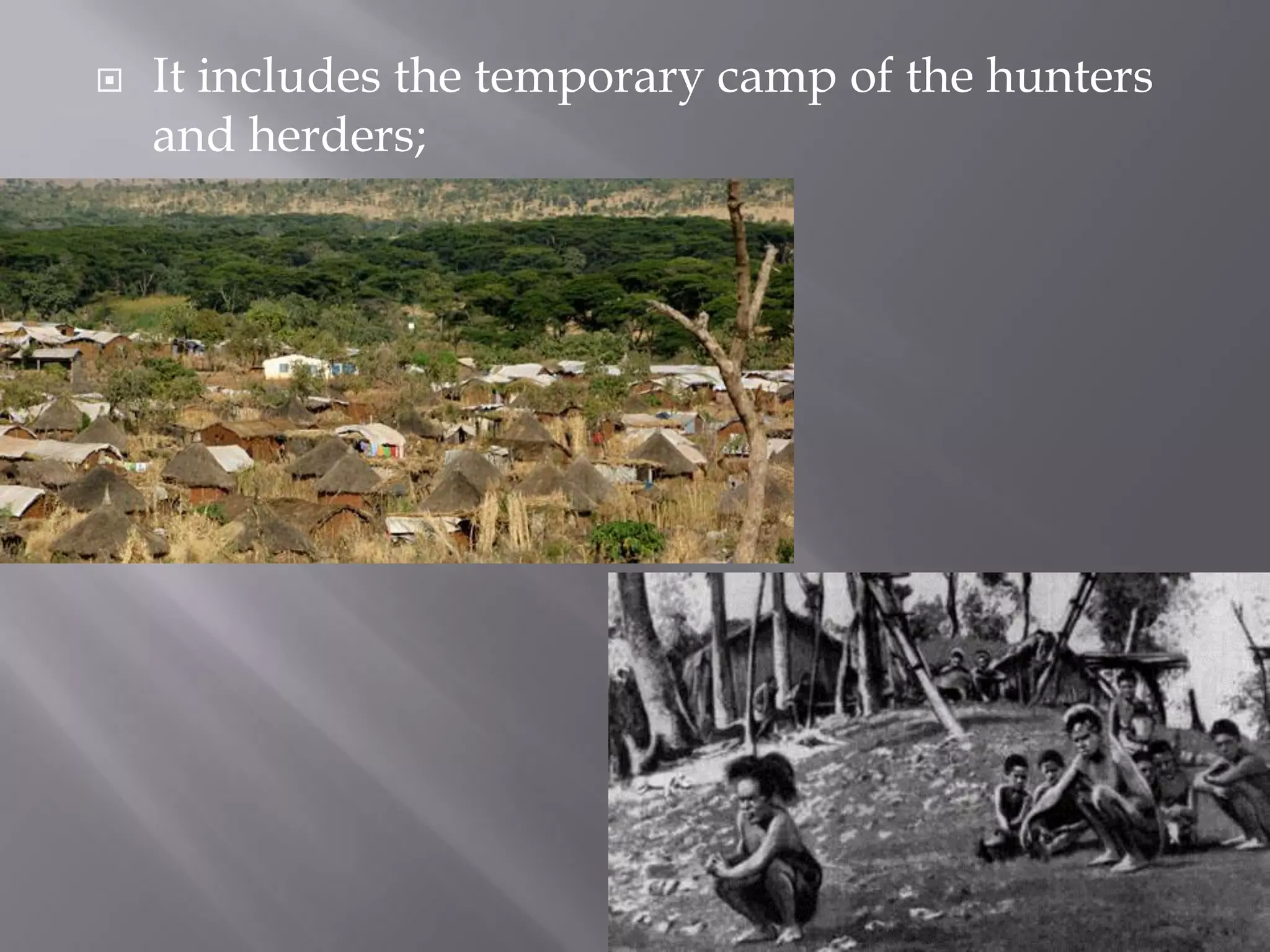
 It includes the temporary camp of the hunters
and herders;
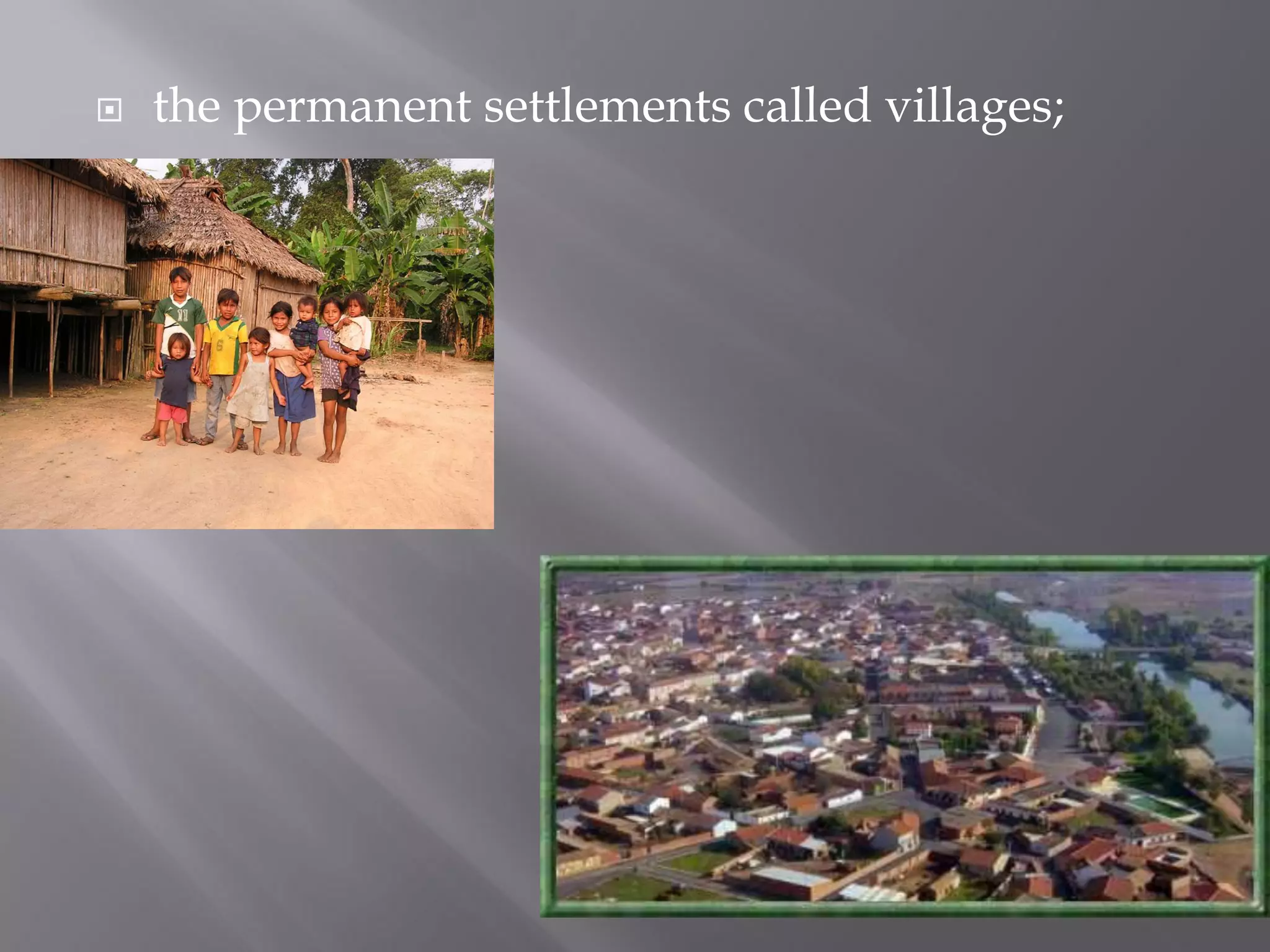
 the permanent settlements called villages;
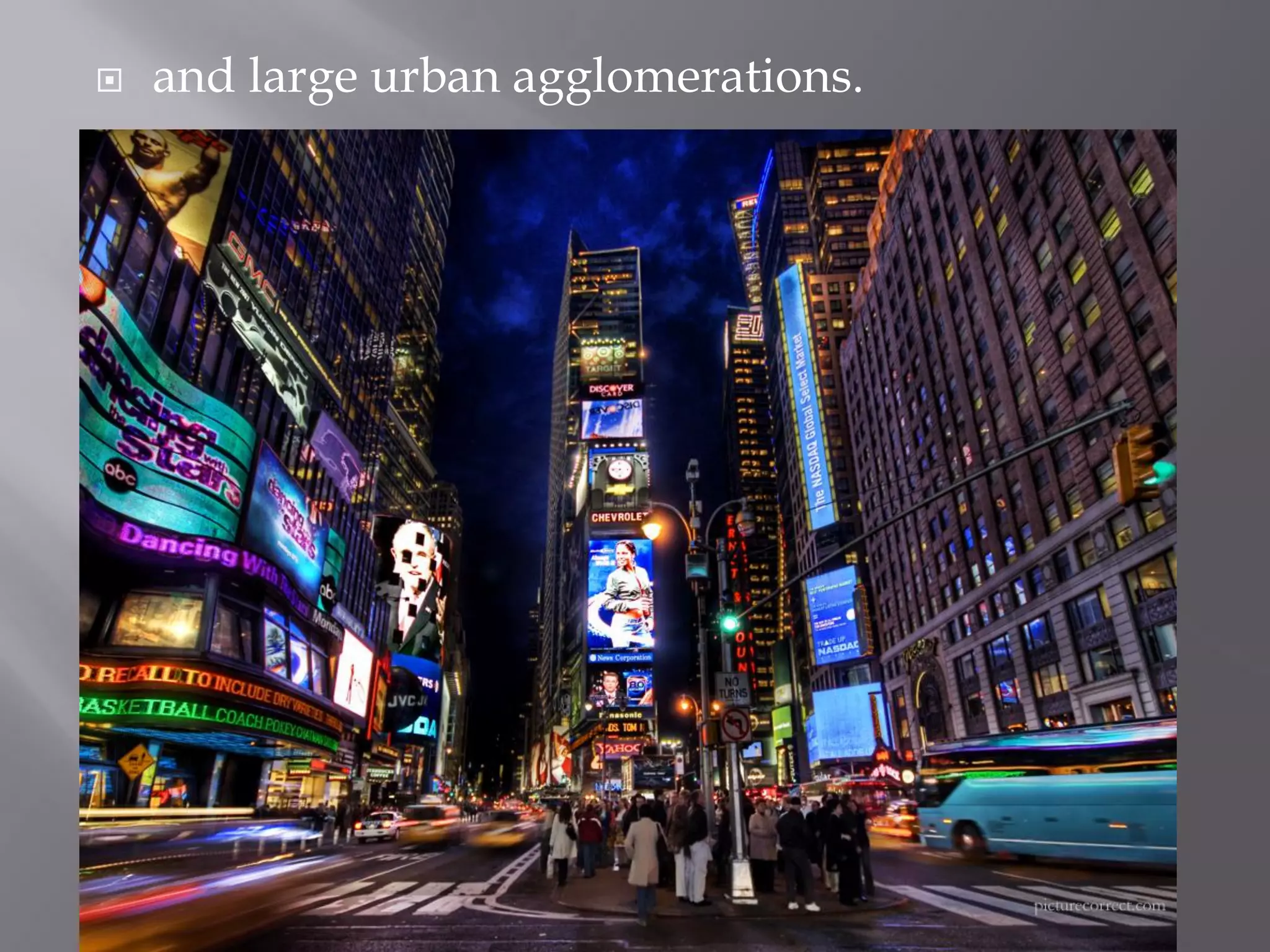
 and large urban agglomerations.
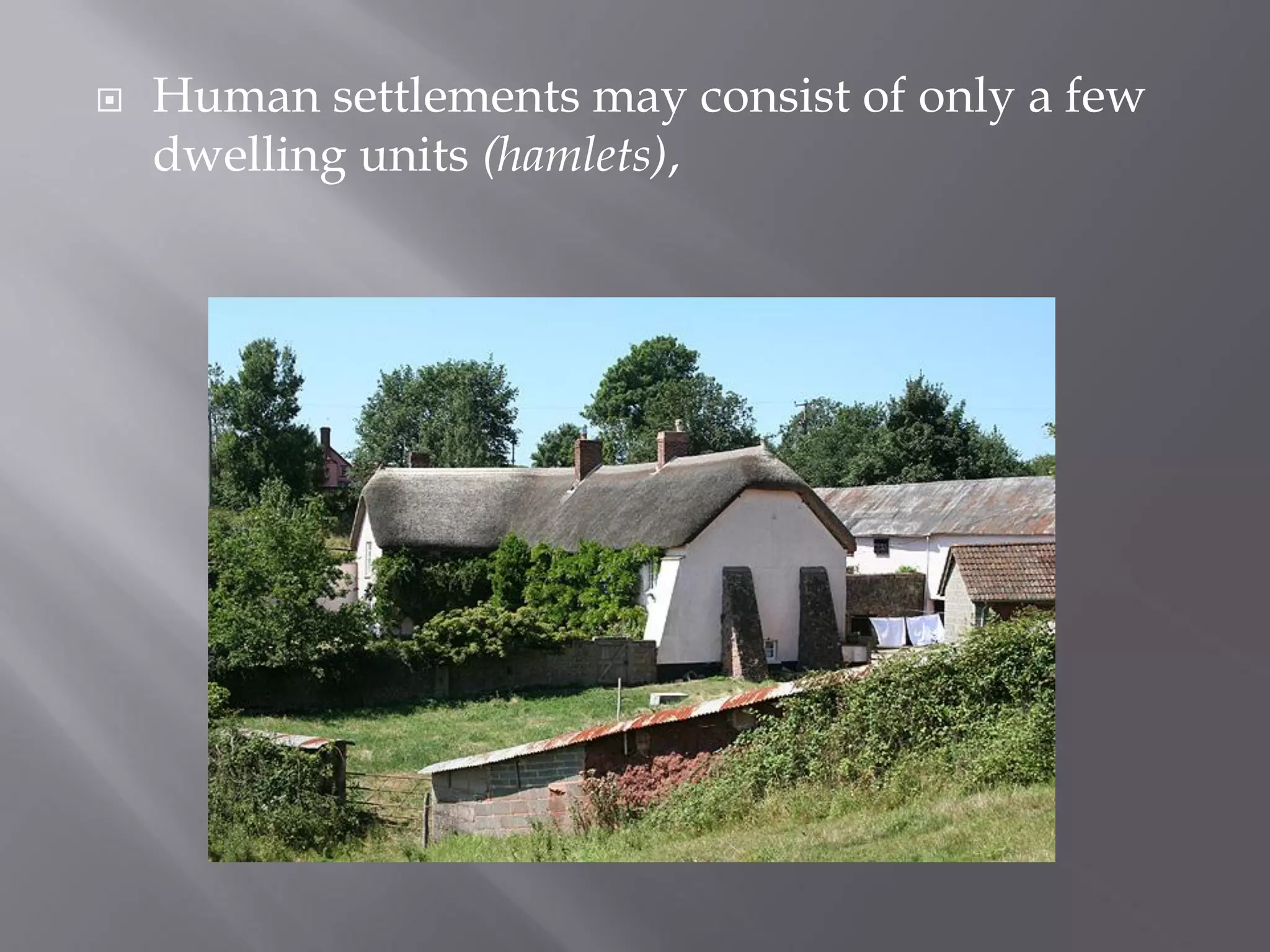
 Human settlements may consist of only a few
dwelling units (hamlets),
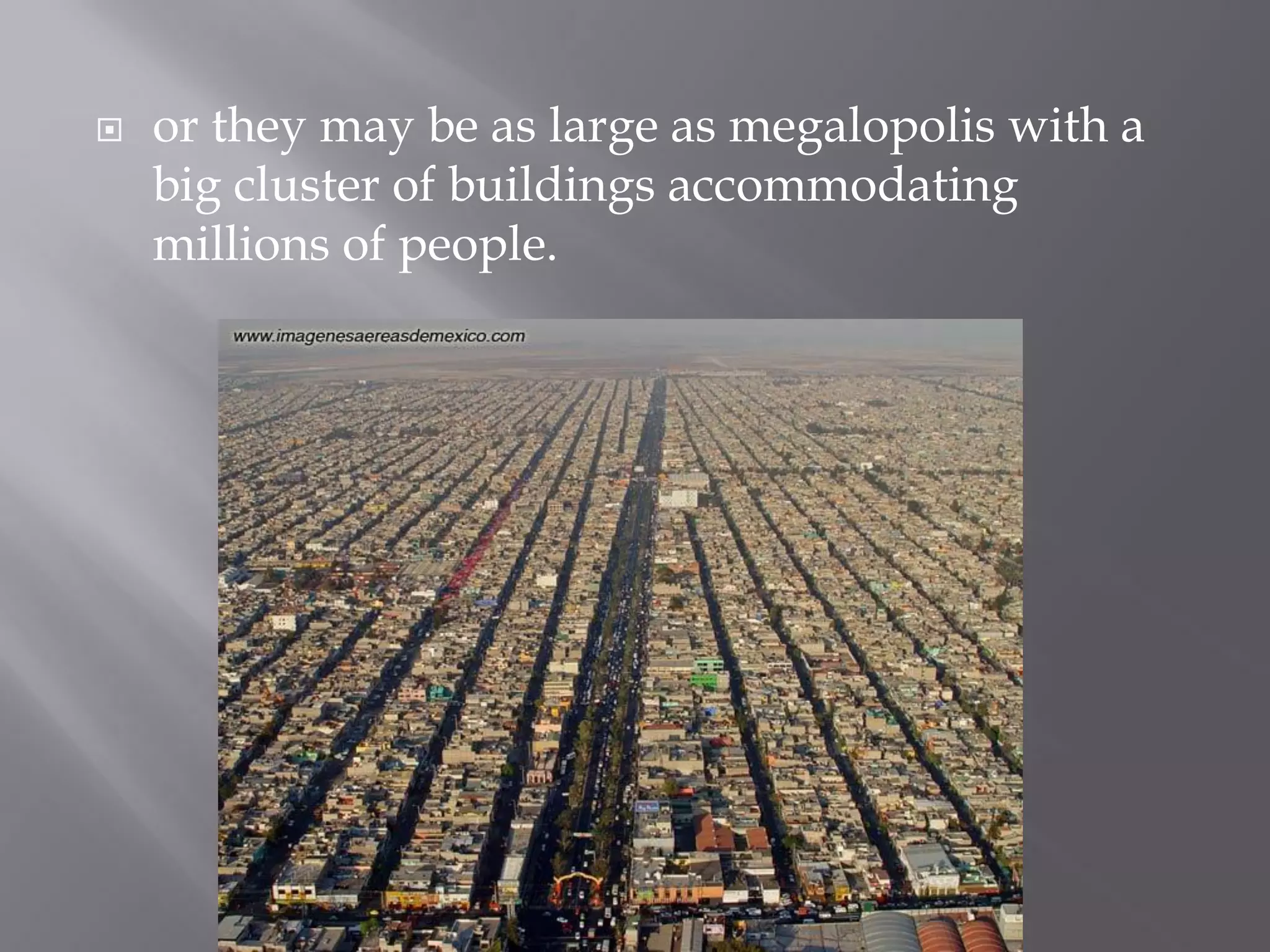
 or they may be as large as megalopolis with a
big cluster of buildings accommodating
millions of people.
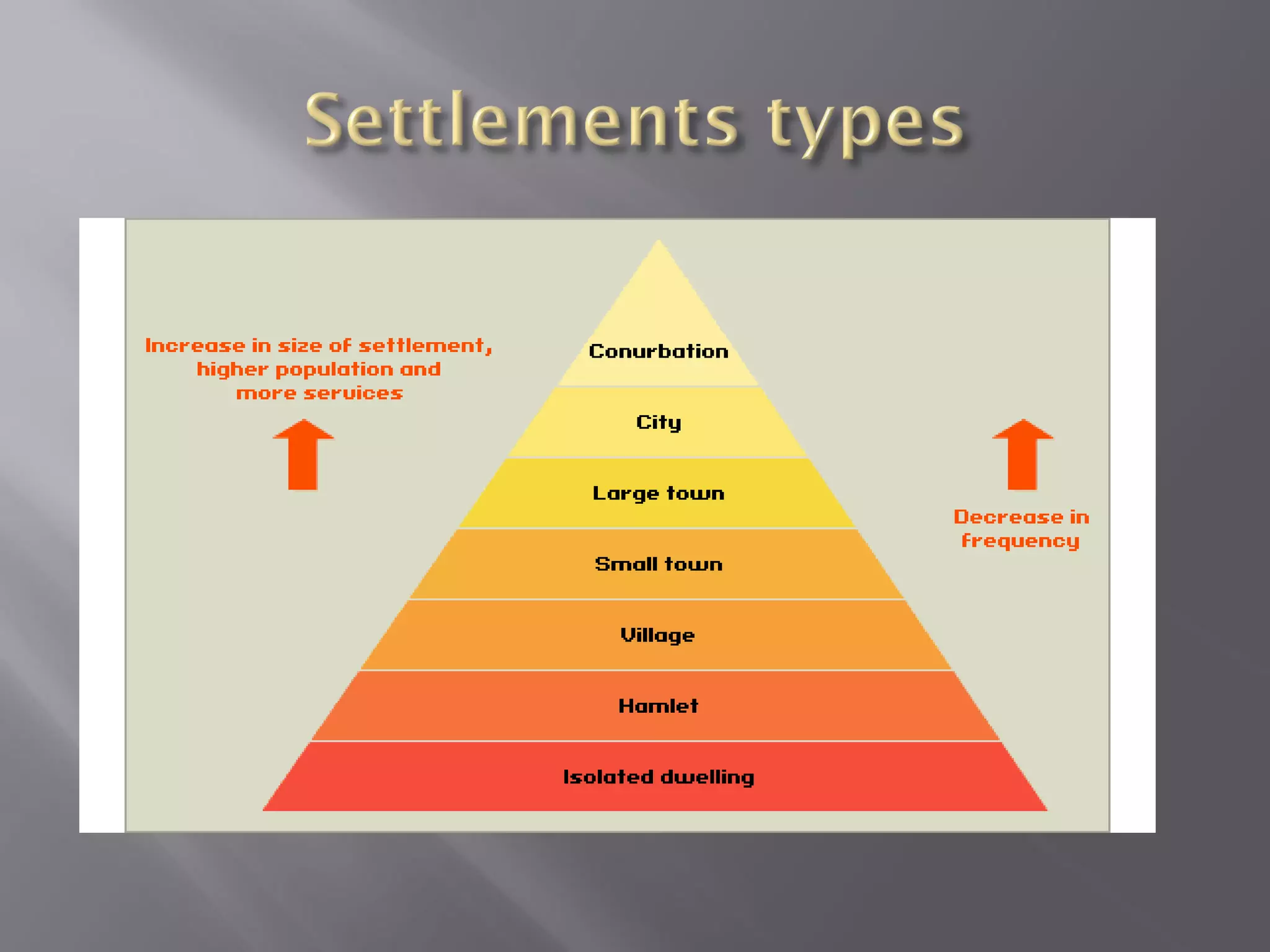
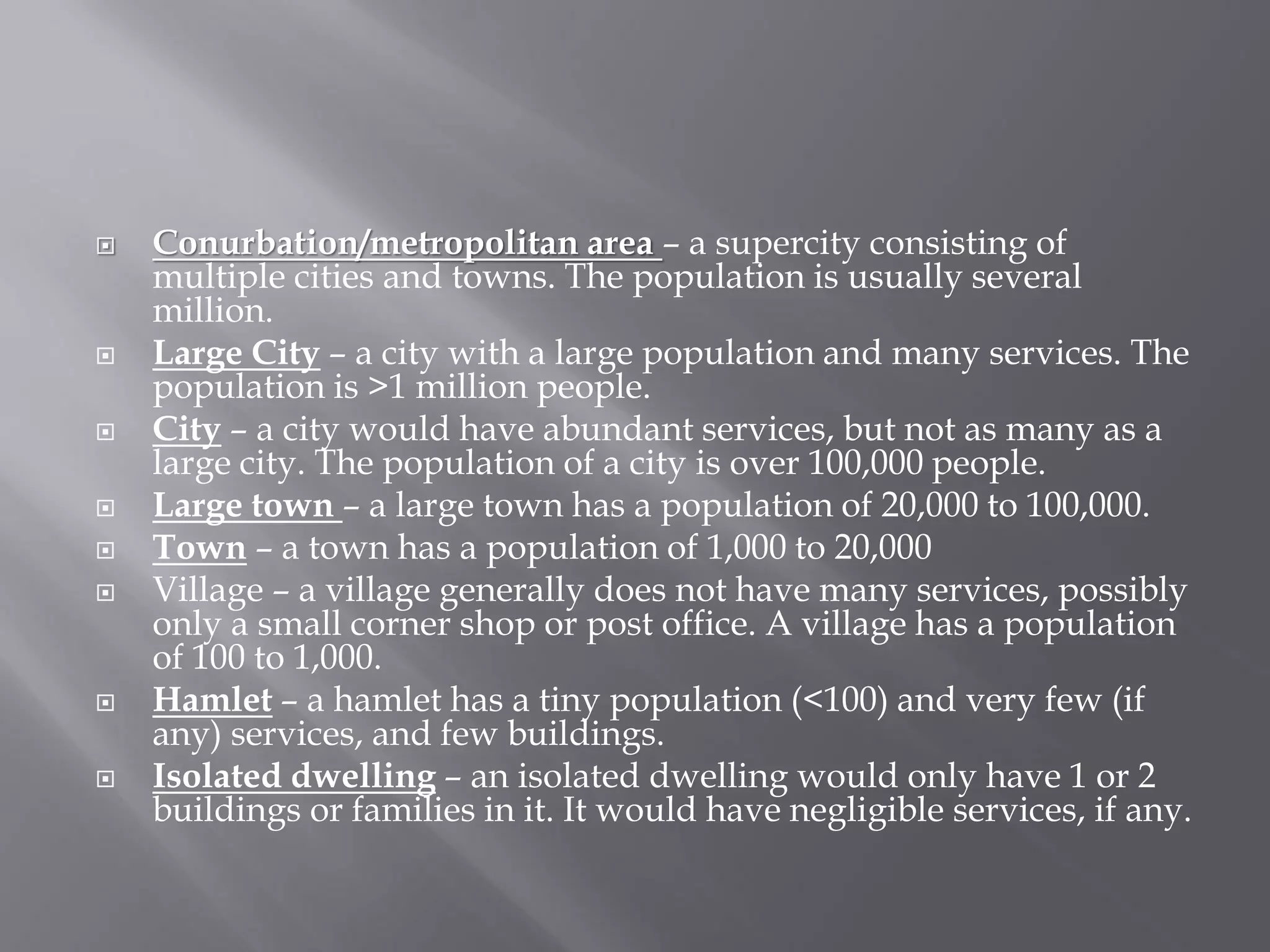
 Conurbation/metropolitan area – a supercity consisting of
multiple cities and towns. The population is usually several
million.
 Large City – a city with a large population and many services. The
population is >1 million people.
 City – a city would have abundant services, but not as many as a
large city. The population of a city is over 100,000 people.
 Large town – a large town has a population of 20,000 to 100,000.
 Town – a town has a population of 1,000 to 20,000
 Village – a village generally does not have many services, possibly
only a small corner shop or post office. A village has a population
of 100 to 1,000.
 Hamlet – a hamlet has a tiny population (<100) and very few (if
any) services, and few buildings.
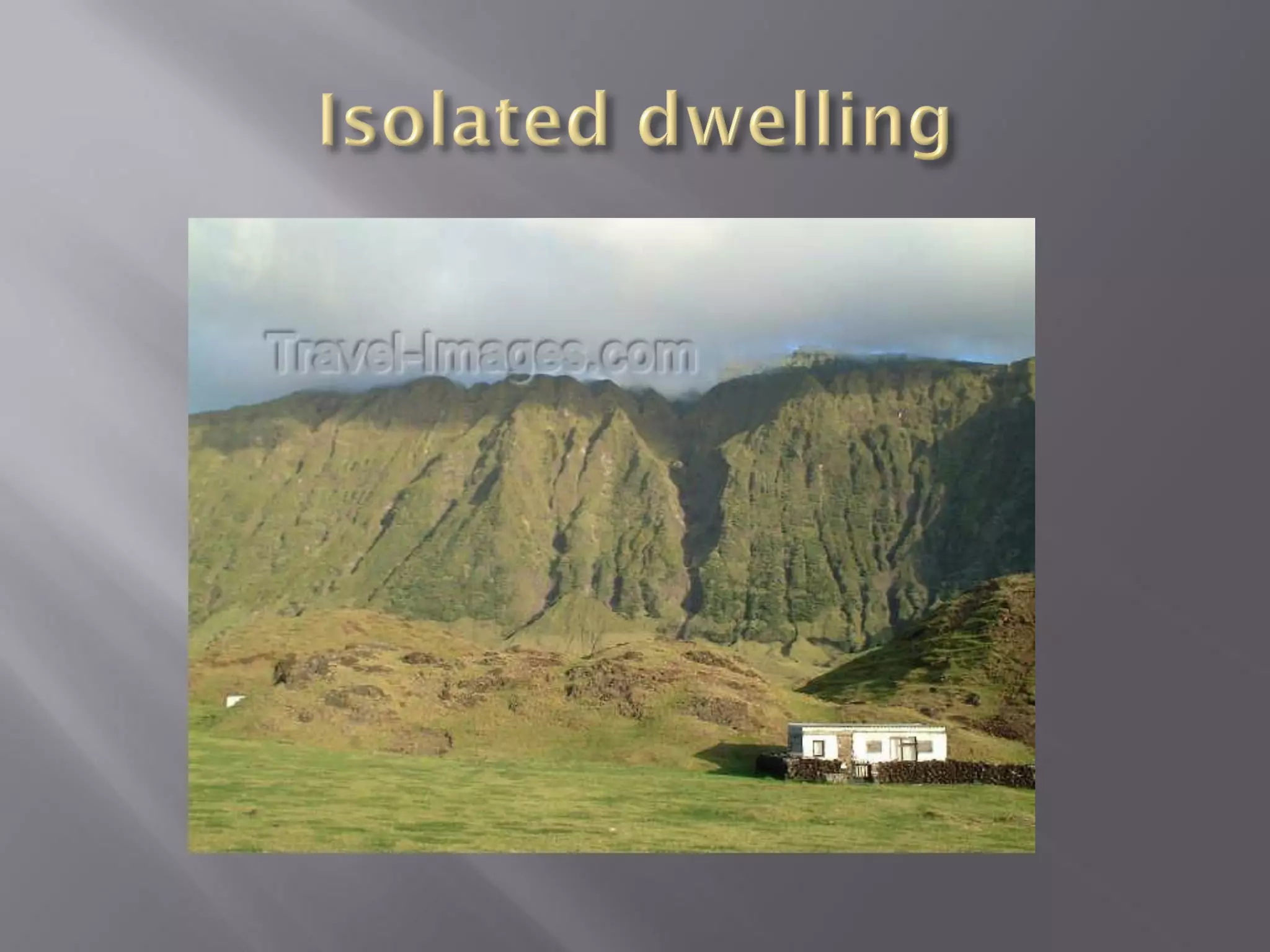
 Isolated dwelling – an isolated dwelling would only have 1 or 2
buildings or families in it. It would have negligible services, if any.
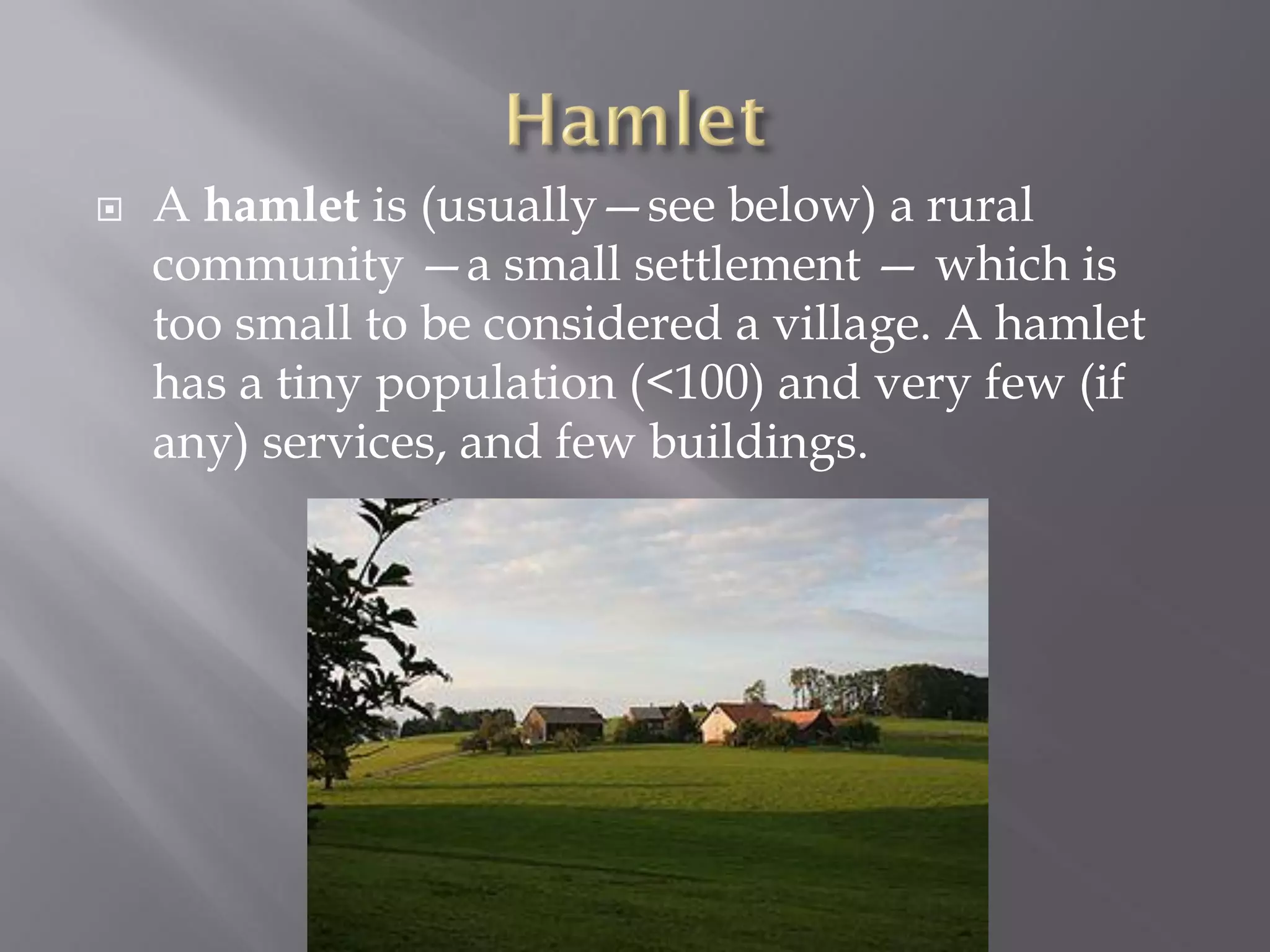
 A hamlet is (usually—see below) a rural
community —a small settlement — which is
too small to be considered a village. A hamlet
has a tiny population (<100) and very few (if
any) services, and few buildings.
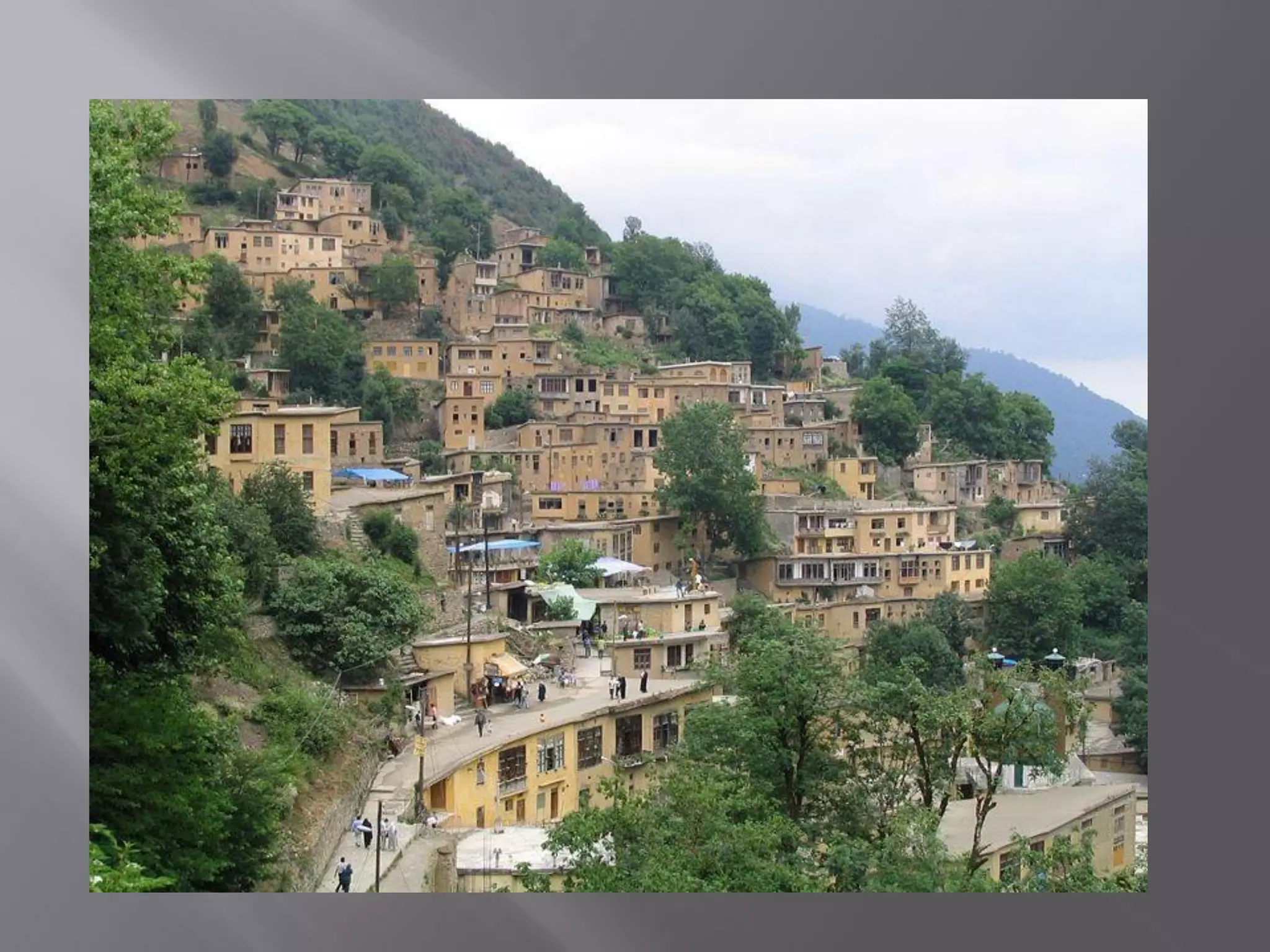
 A village is a clustered human settlement or
community, larger than a hamlet, but smaller
than a town or city. Though generally located
in rural areas.
 A village generally does not have many
services, possibly only a small corner shop or
post office. A village has a population of 100 to
1,000.
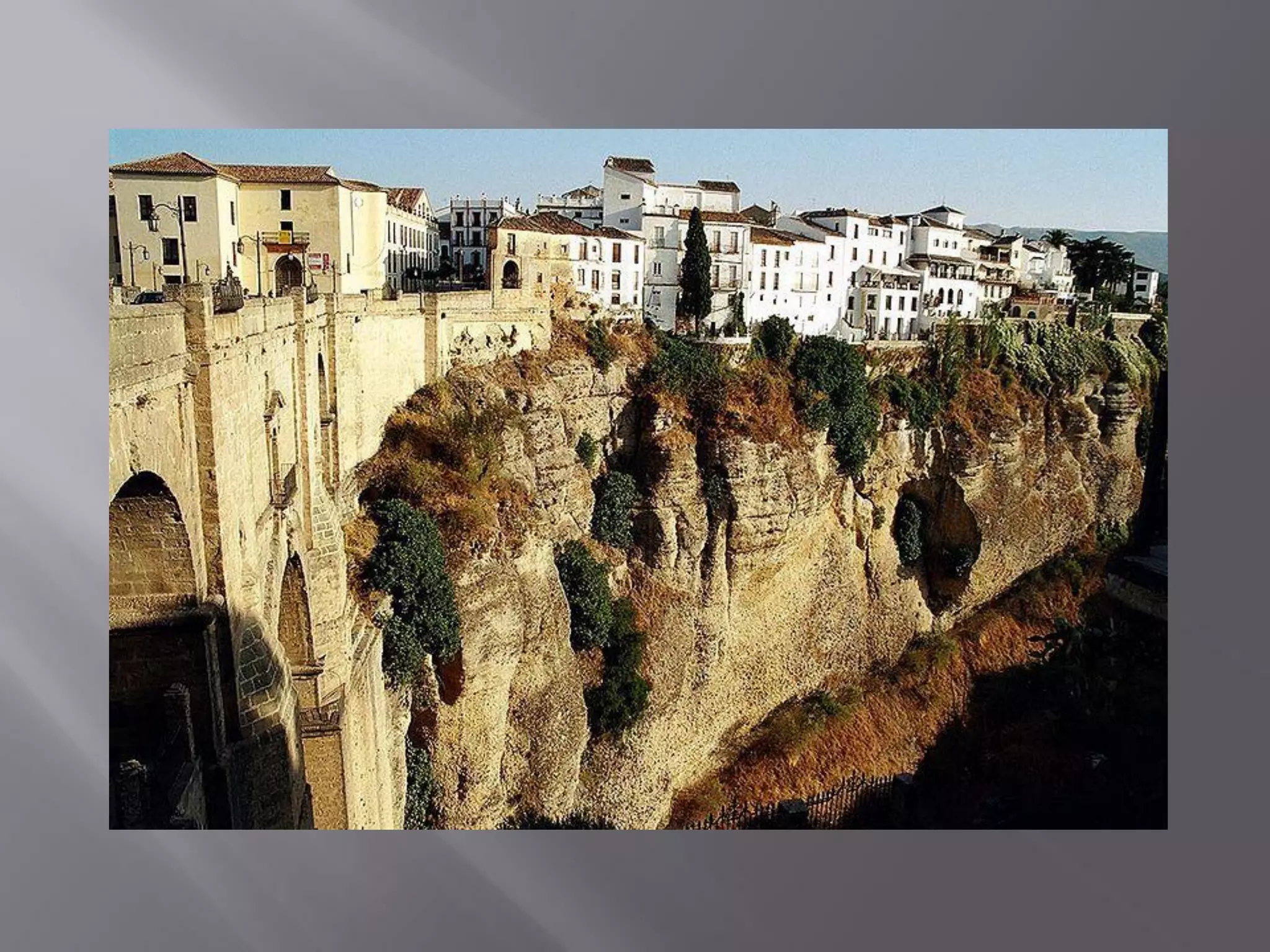
 A town has a population of 1,000 to 20,000.
 A town is a type of settlement ranging from a
few to several thousand (occasionally
hundreds of thousands) inhabitants. Usually, a
"town" is thought of as larger than a village but
smaller than a "city",
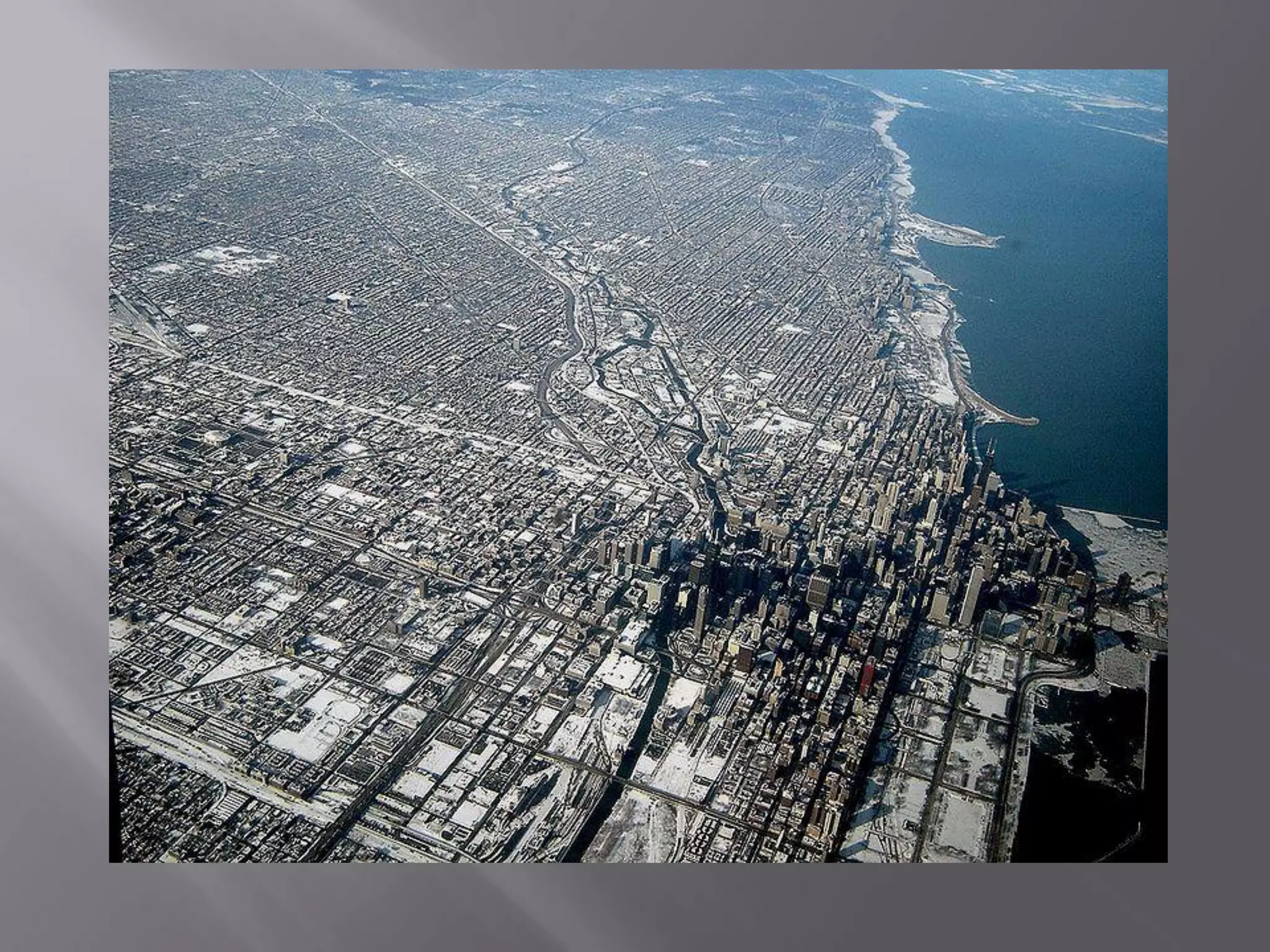
 A city would have abundant services, but not
as many as a large city. The population of a city
is over 100,000 people.
 A city is an urban area with a large population
and a particular administrative, legal, or
historical status.
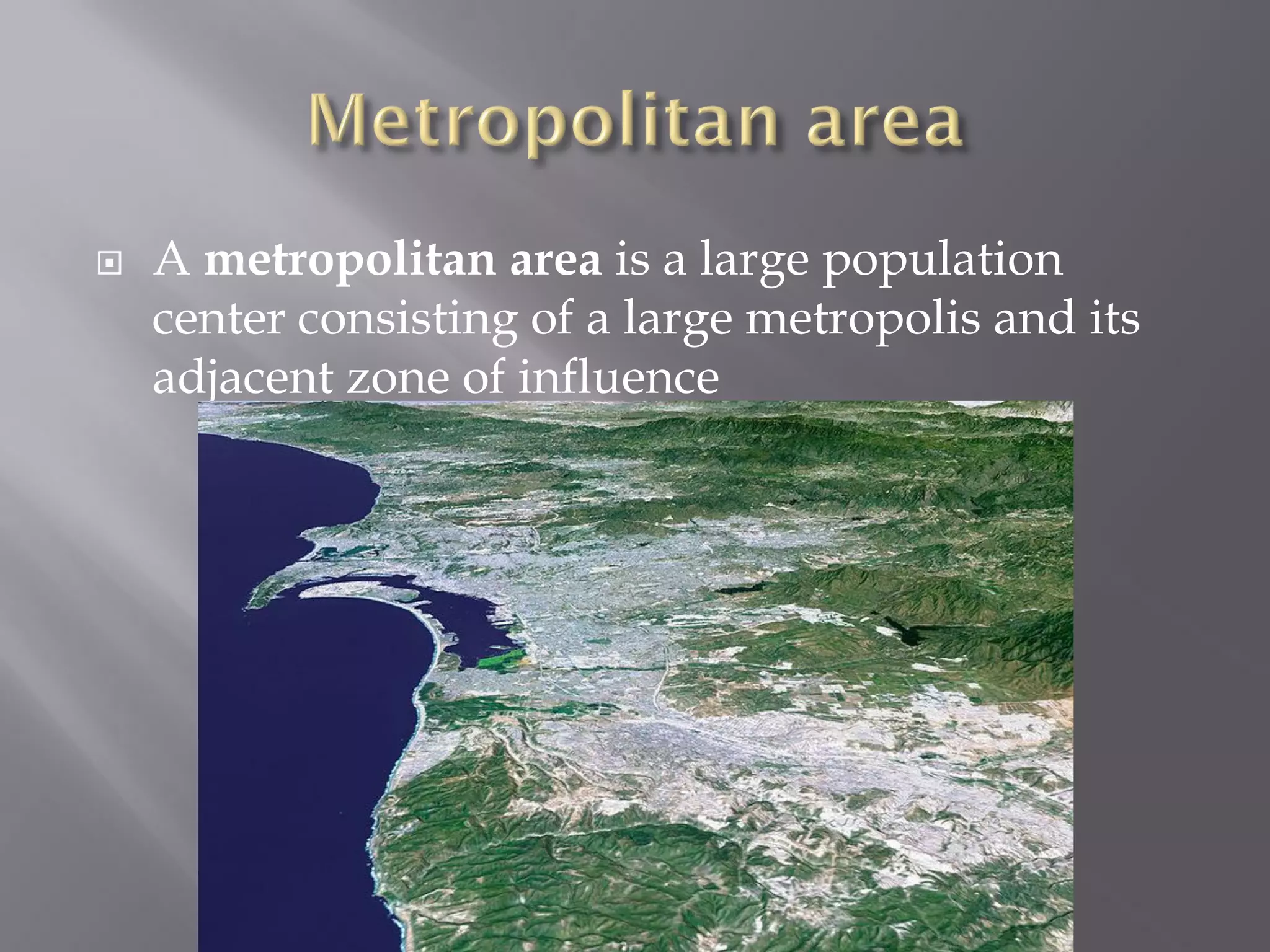
 A metropolitan area is a large population
center consisting of a large metropolis and its
adjacent zone of influence
 A conurbation is an urban area or agglomeration
comprising a number of cities, large towns and
larger urban areas that, through population
growth and physical expansion, have merged to
form one continuous urban and industrially
developed area.
 A conurbation can be confused with a
metropolitan area. As the term is used in North
America, a metropolitan area consists of many
neighborhoods, while a conurbation consists of
many different metropolitan areas that are
connected with one another and are usually
interdependent economically and socially.
 Match up the settlement type with its
description by dragging the words into the
spaces provided.
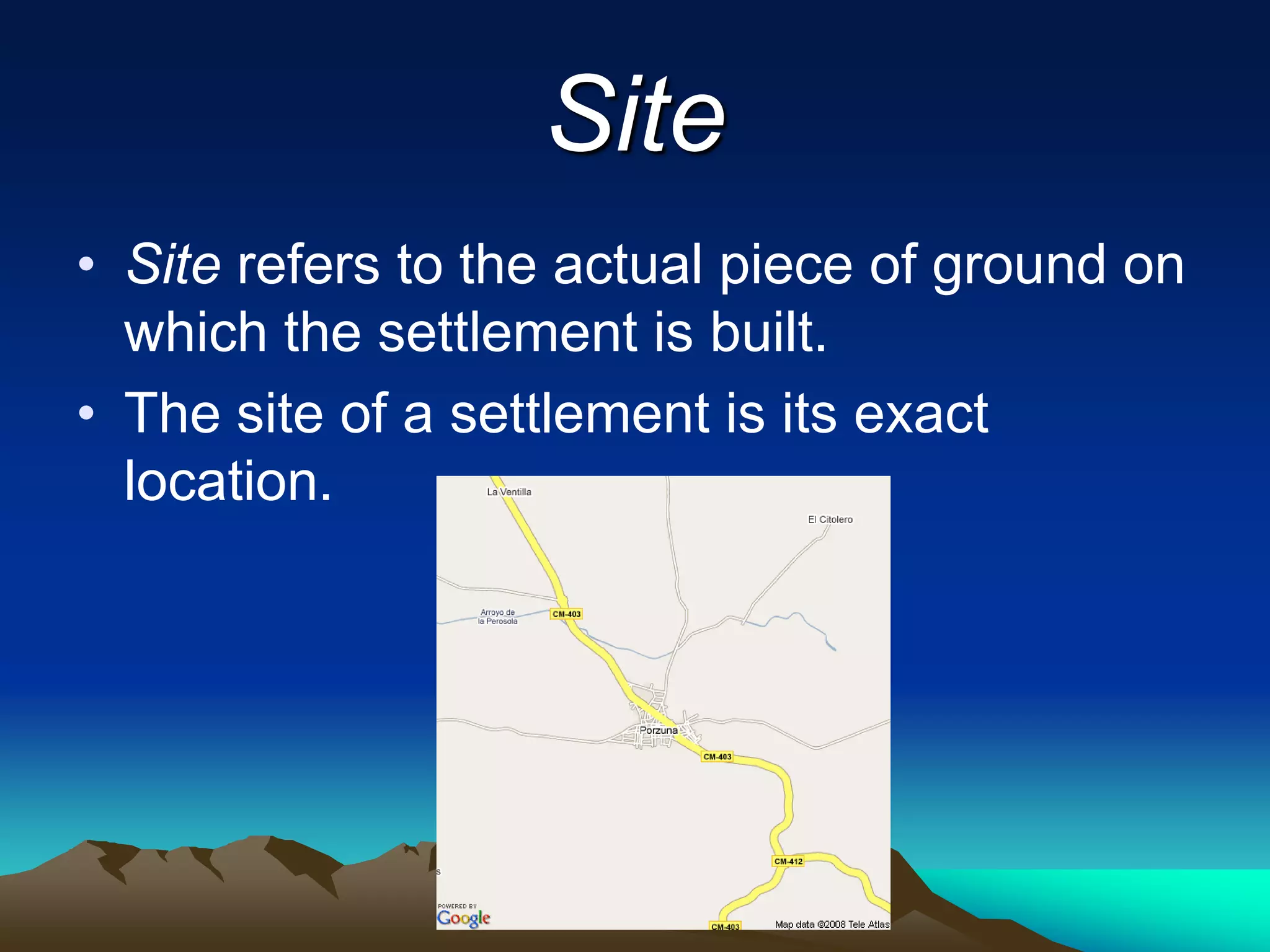
Site
• Site refers to the actual piece of ground on
which the settlement is built.
• The site of a settlement is its exact
location.
• The physical geography of an area was
very important to early people when they
were deciding on the site for a new
settlement.
• Site Factors:
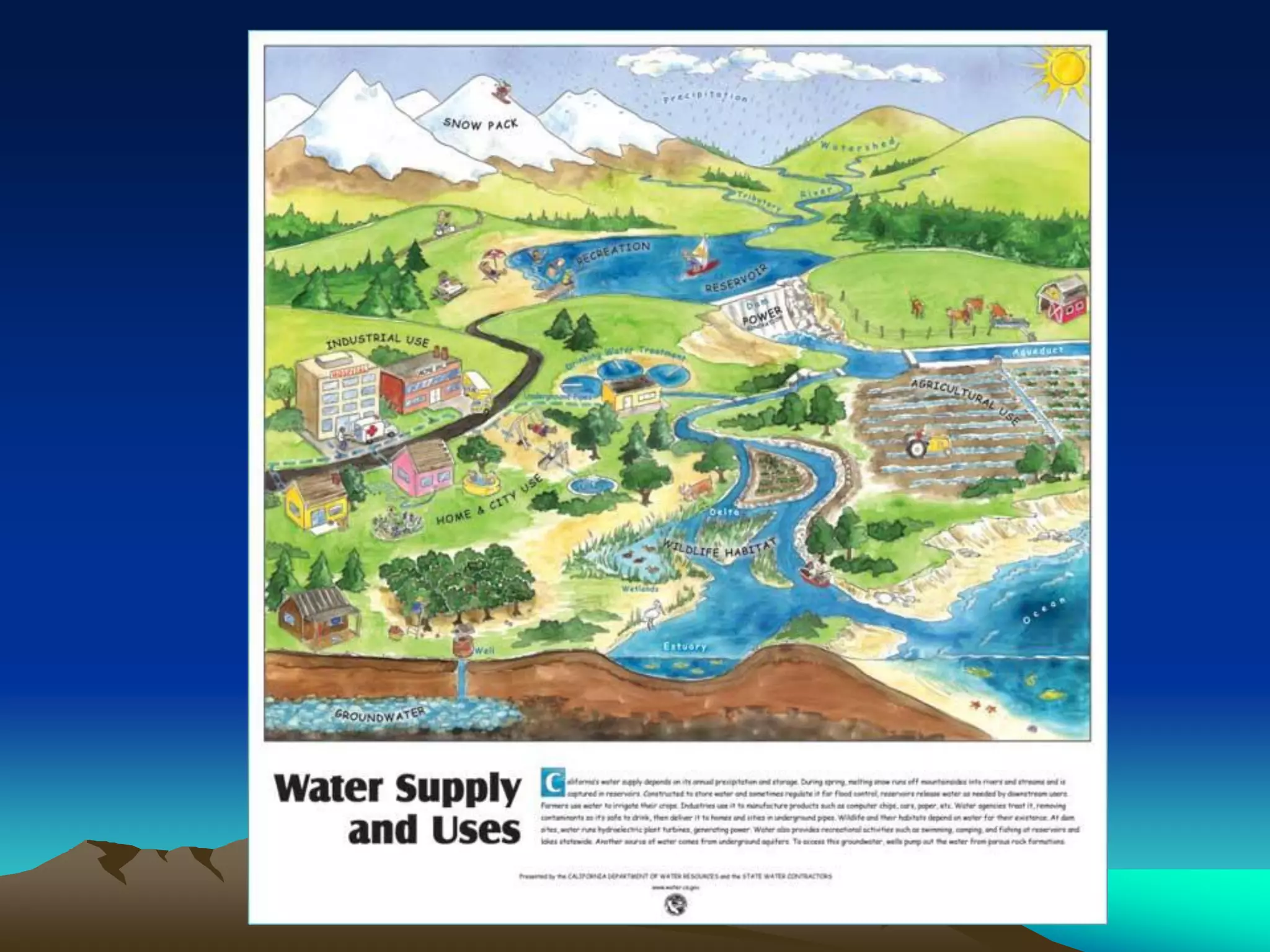
– Water supply: a clean supply of water was
needed for drinking, cooking and cleaning.
Water could be taken from a river or a well.
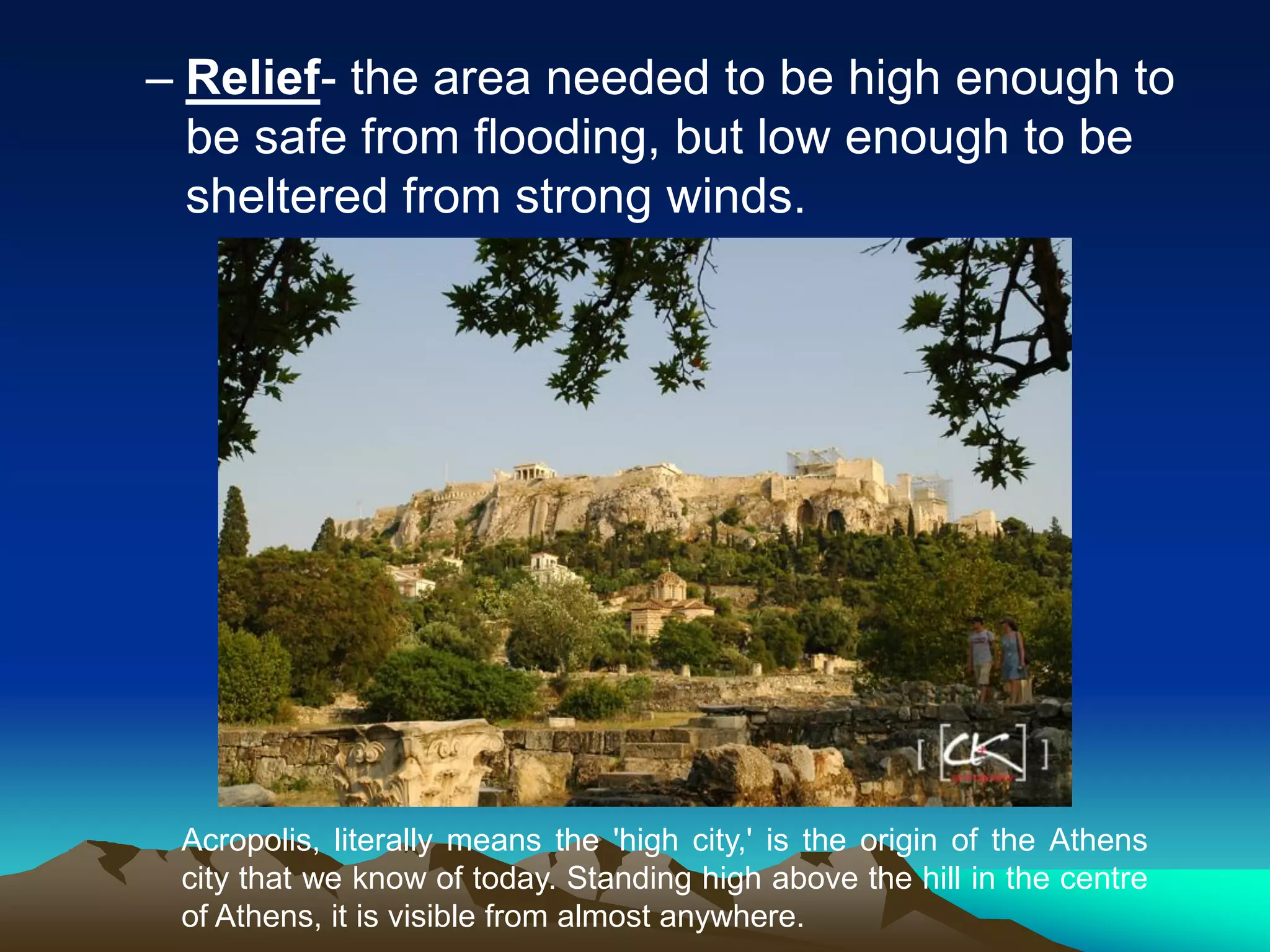
– Relief- the area needed to be high enough to
be safe from flooding, but low enough to be
sheltered from strong winds.
Acropolis, literally means the 'high city,' is the origin of the Athens
city that we know of today. Standing high above the hill in the centre
of Athens, it is visible from almost anywhere.
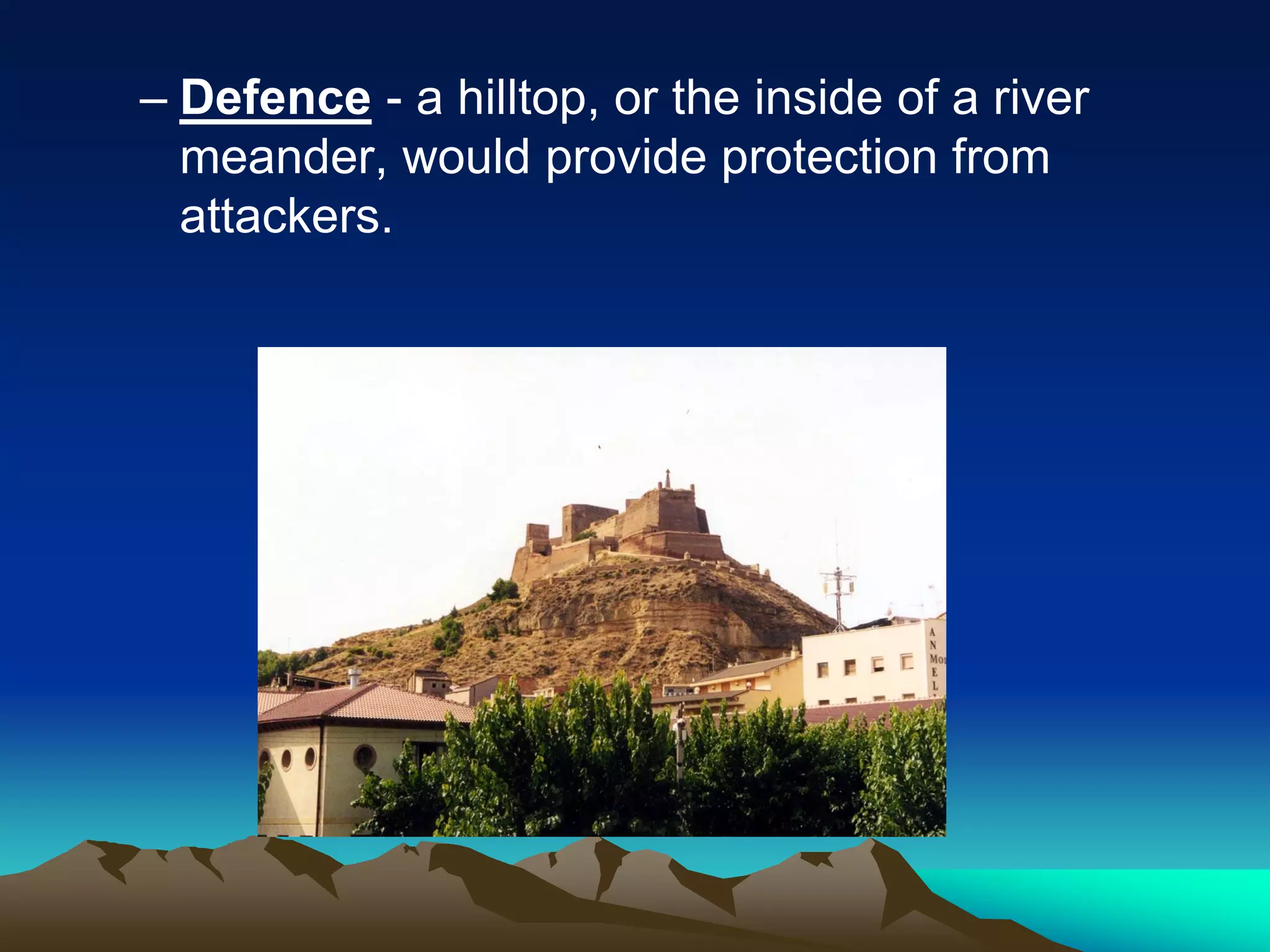
– Defence - a hilltop, or the inside of a river
meander, would provide protection from
attackers.
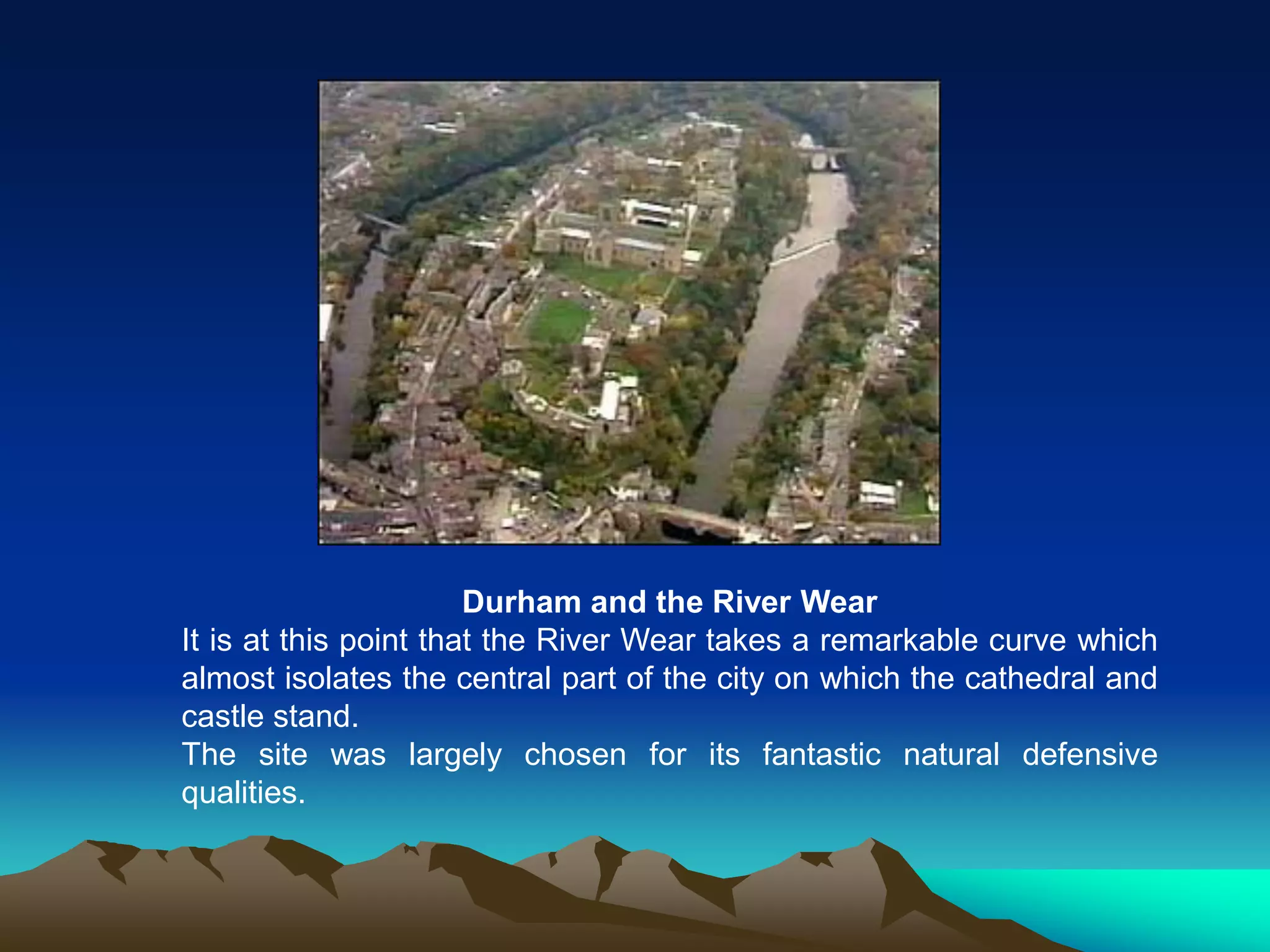
Durham and the River Wear
It is at this point that the River Wear takes a remarkable curve which
almost isolates the central part of the city on which the cathedral and
castle stand.
The site was largely chosen for its fantastic natural defensive
qualities.
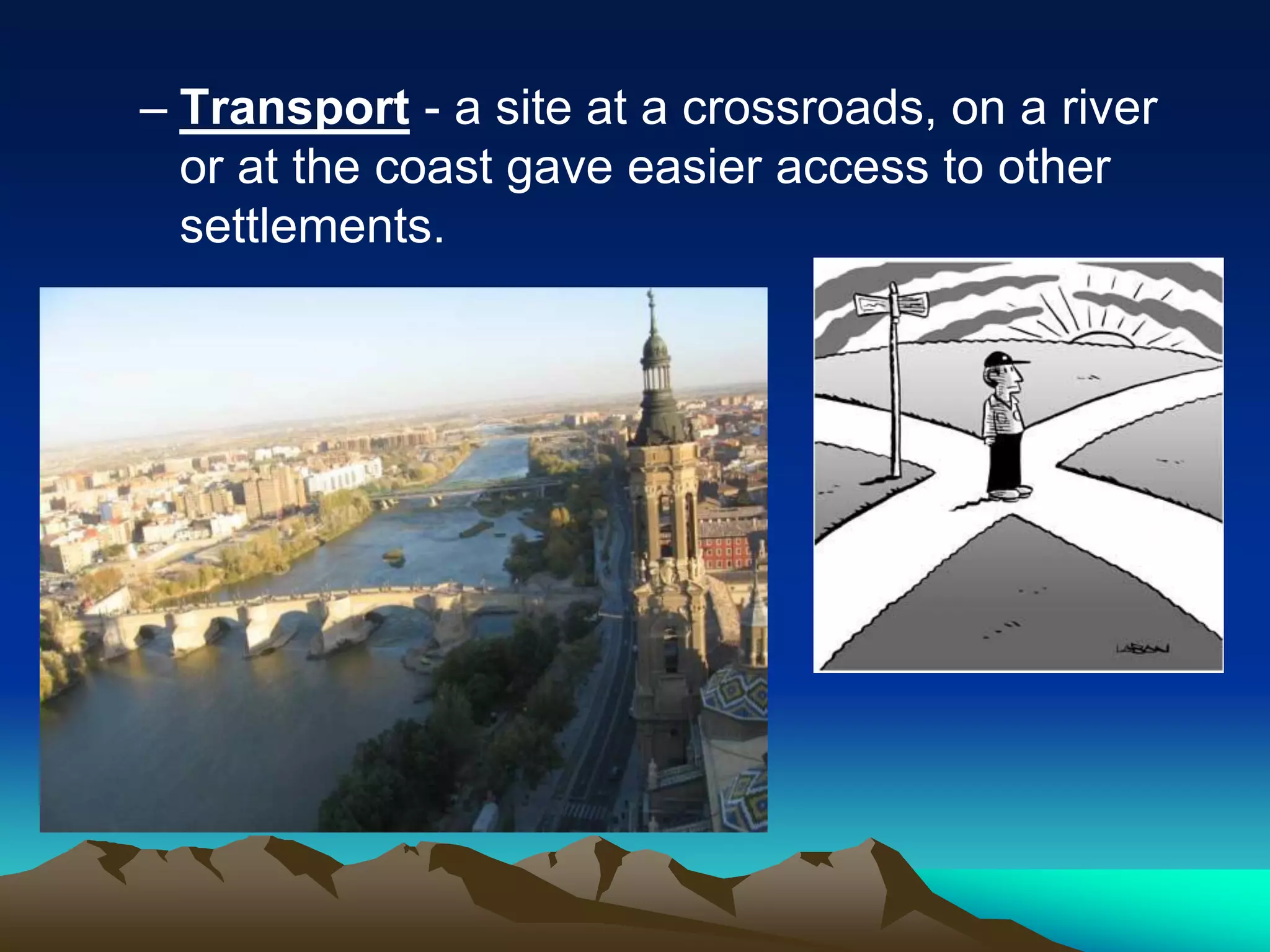
– Transport - a site at a crossroads, on a river
or at the coast gave easier access to other
settlements.
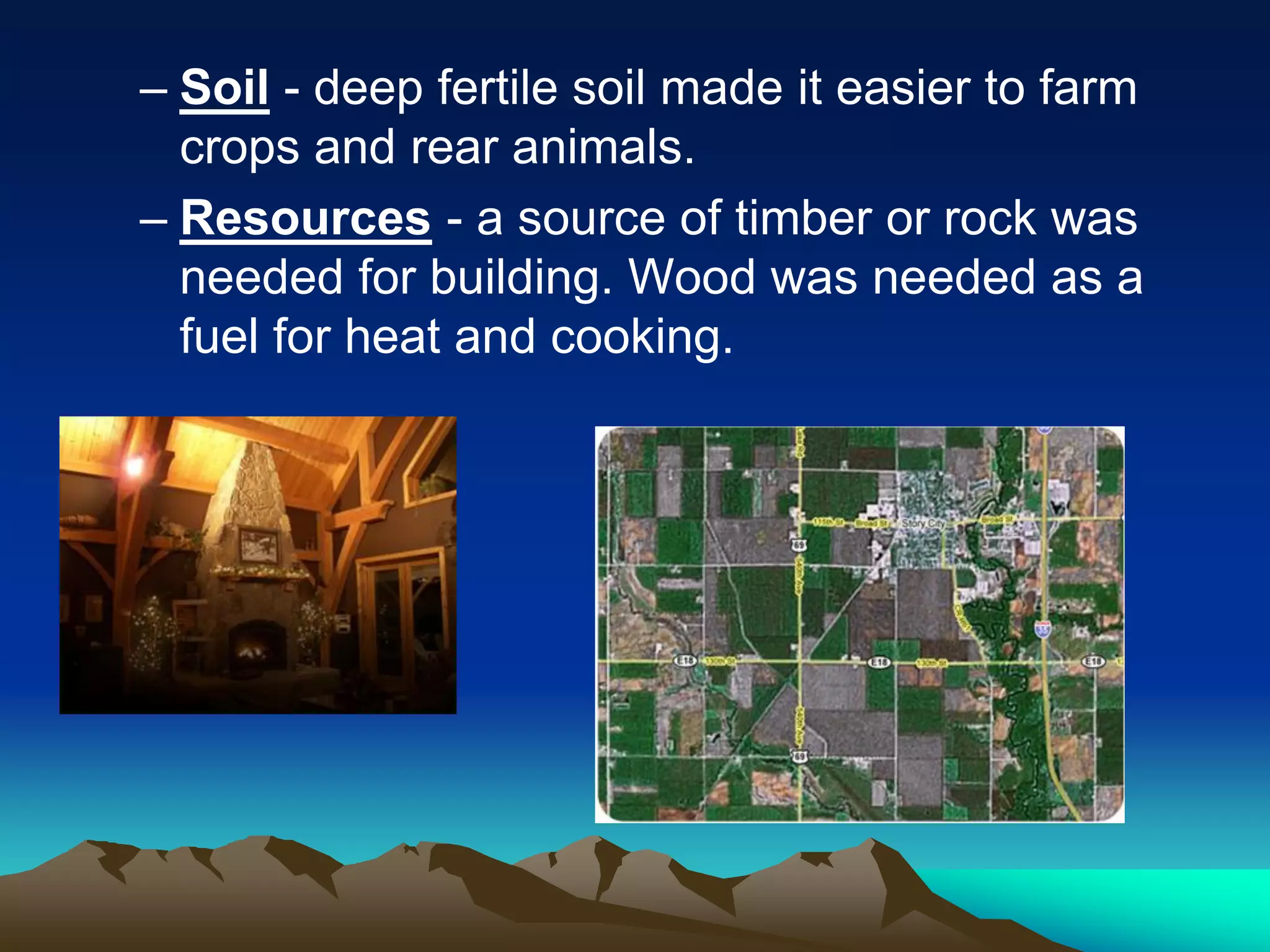
– Soil - deep fertile soil made it easier to farm
crops and rear animals.
– Resources - a source of timber or rock was
needed for building. Wood was needed as a
fuel for heat and cooking.
Situation
• Situation or Position refers to the location
of the village or town in relation to
surrounding areas.
– If a settlement had good access to natural
resources, and to other settlements, it would
grow in size. Many settlements with a good
site and situation have grown into large cities.
Paris
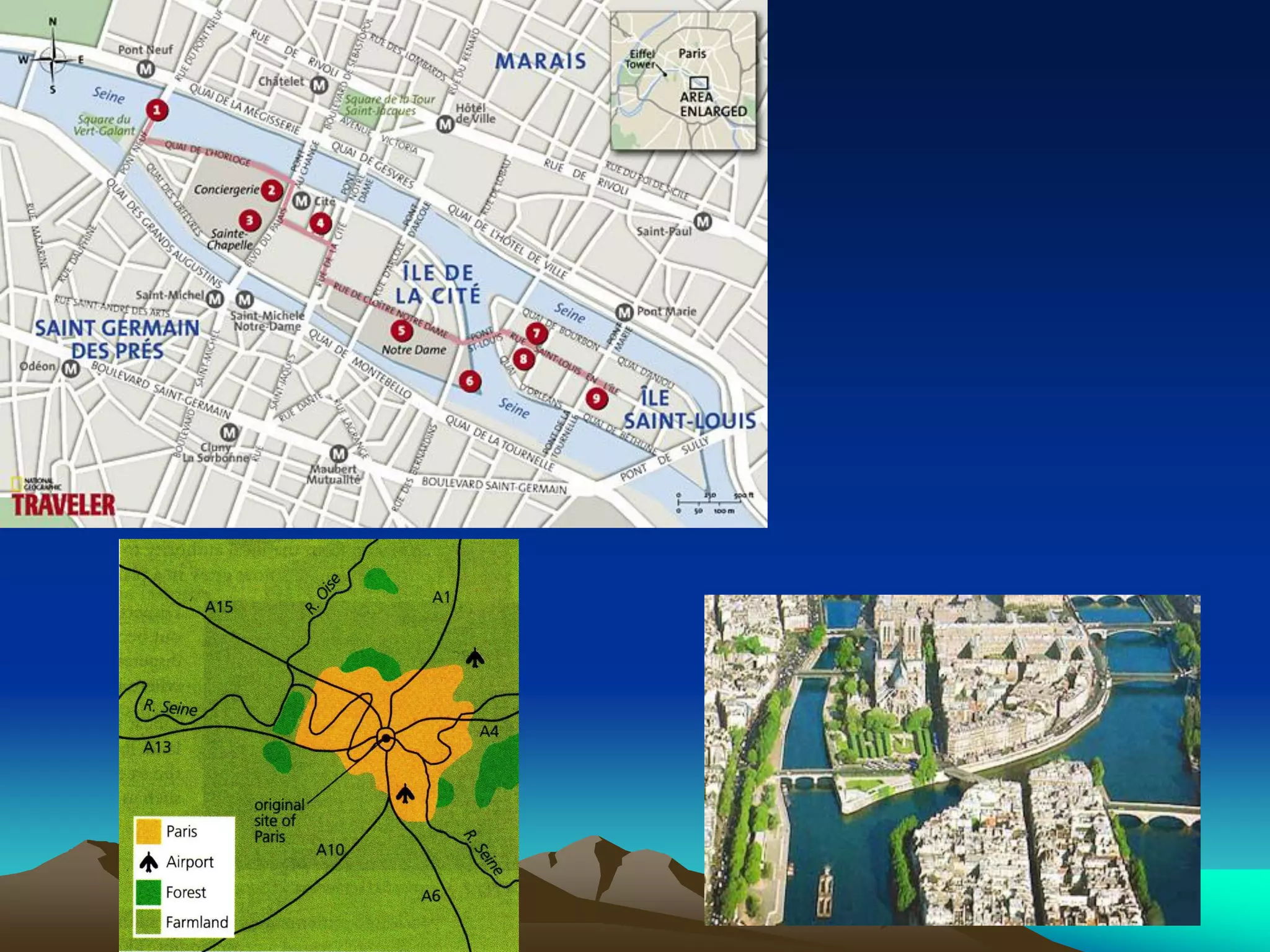
• Paris is the capital city of France. It is the largest city
in Europe and has a population of 10 million people.
Paris began in the third century BC. It was sited on a
small island in the River Seine. The site was good for
defence, but was also a crossing point across the
river. The fertile soil of the River Seine's floodplain was
also excellent for farming. Under Roman rule, Paris
grew and became the centre of a network of roads
stretching across Europe.
• The situation of Paris has made it one of the most
important cities in Europe. It is the focus of many
major roads and railway lines. Paris has also become
the centre for many international air routes.
Settlement patterns
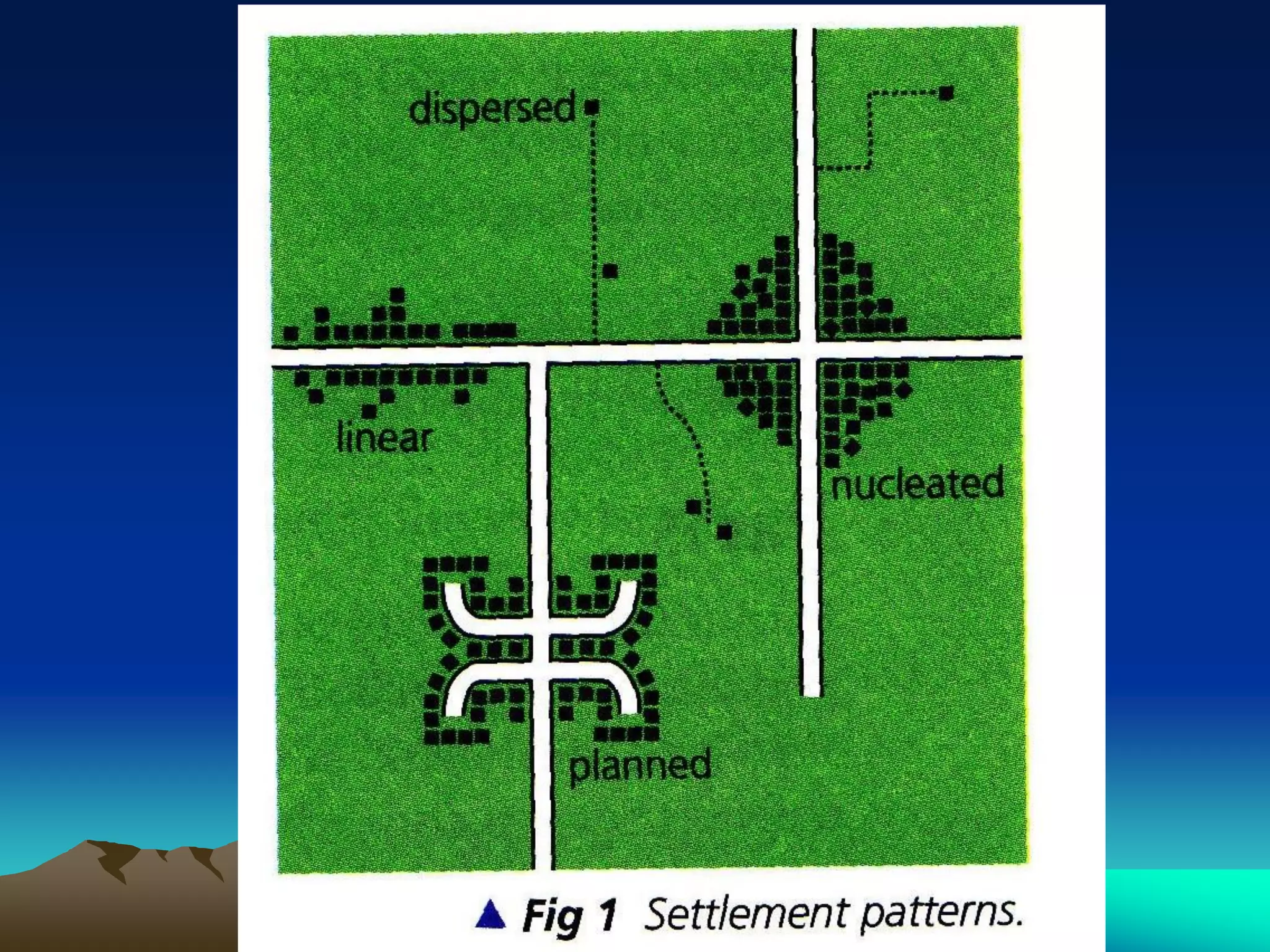
• When early settlements began to grow there were
no planning regulations. People built houses
where they wanted to. Some houses were built far
apart from each other (dispersed). Other houses
were built close together, making villages. Villages
began to grow outwards and the shape of the
settlements changed. Some settlements became
long and narrow (linear), others stayed clustered
together (nucleated). Today, people must have
permission from the local authority to build
houses. Settlements now grow in a planned way.
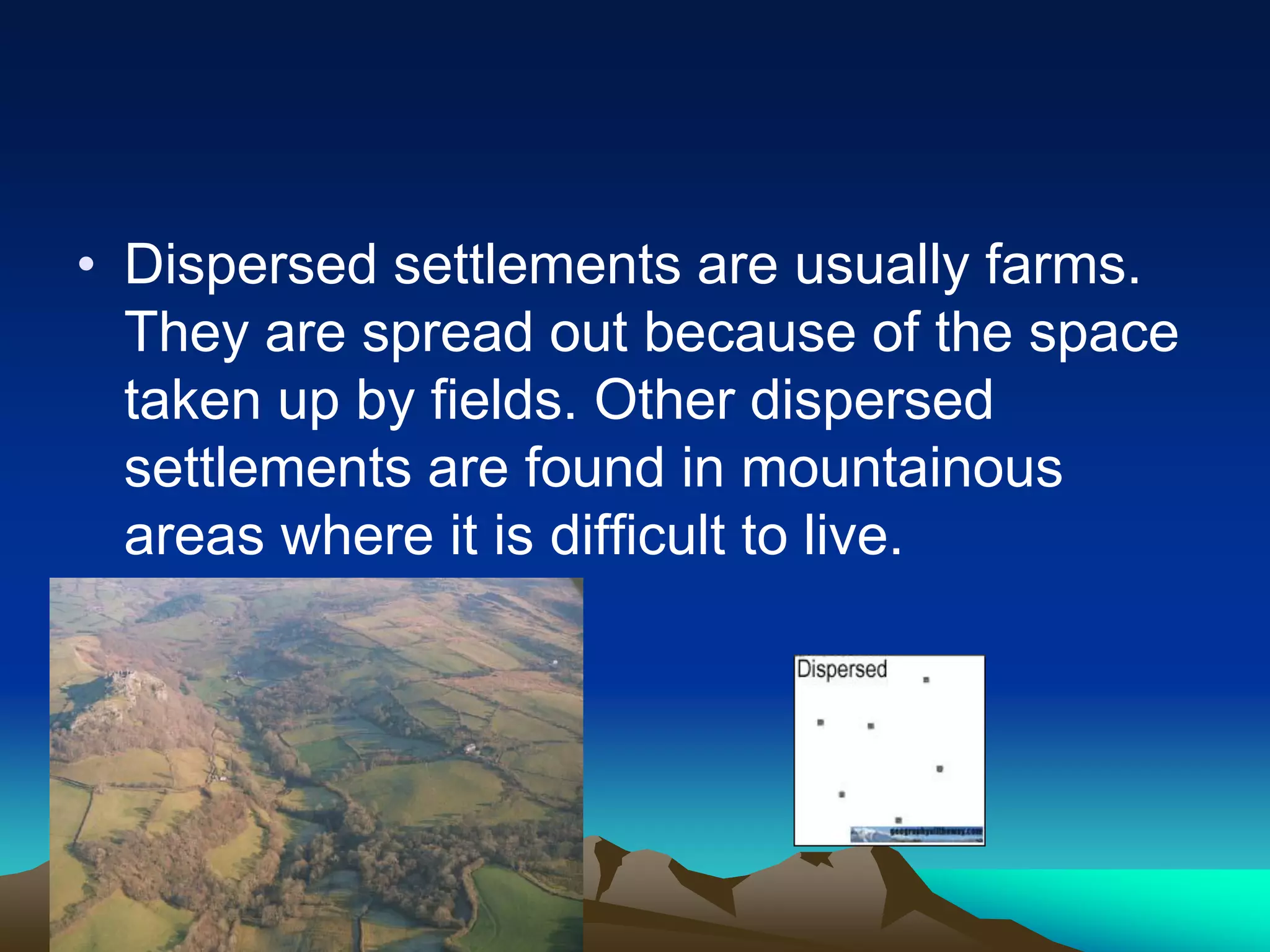
• Dispersed settlements are usually farms.
They are spread out because of the space
taken up by fields. Other dispersed
settlements are found in mountainous
areas where it is difficult to live.
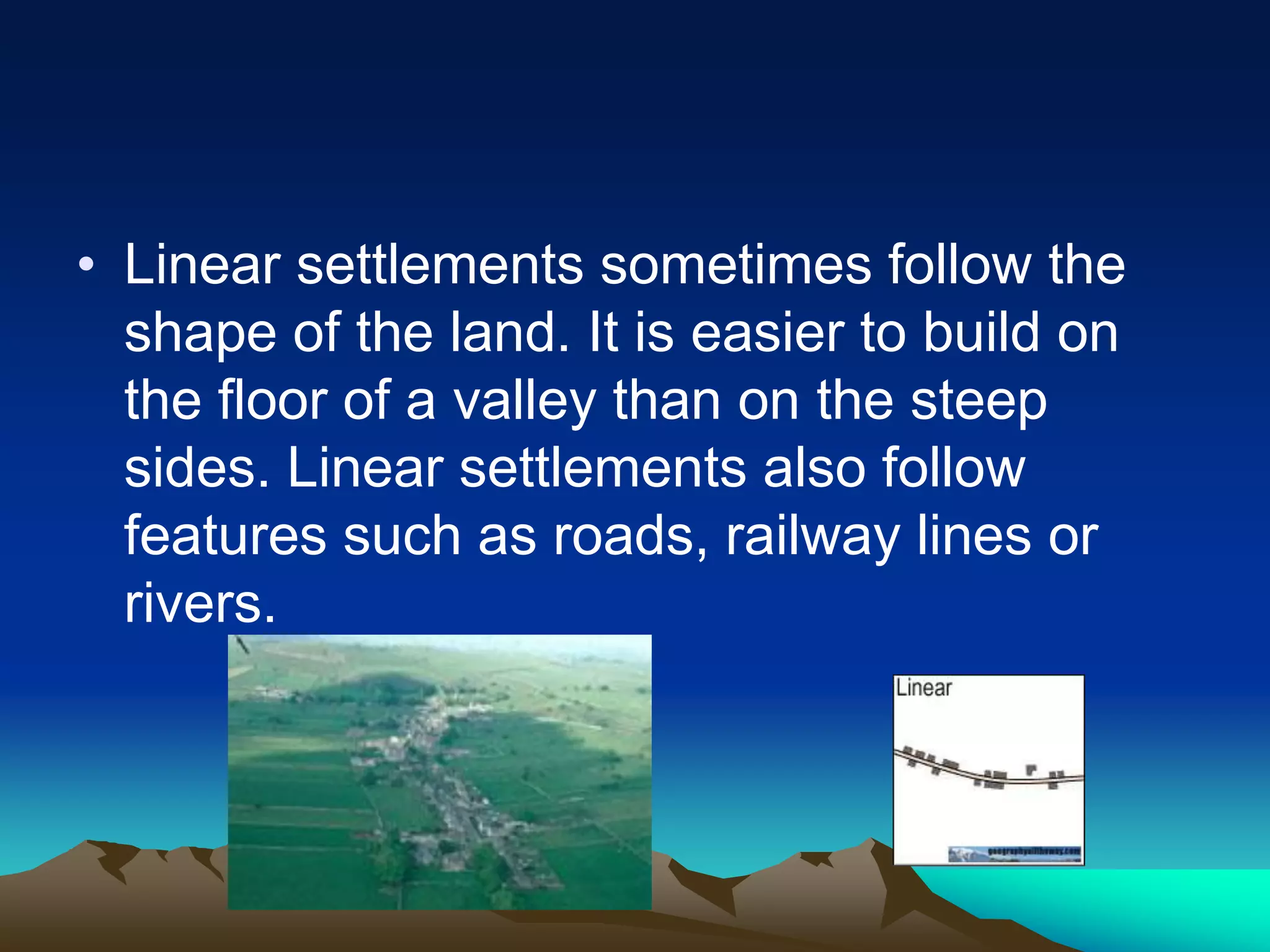
• Linear settlements sometimes follow the
shape of the land. It is easier to build on
the floor of a valley than on the steep
sides. Linear settlements also follow
features such as roads, railway lines or
rivers.
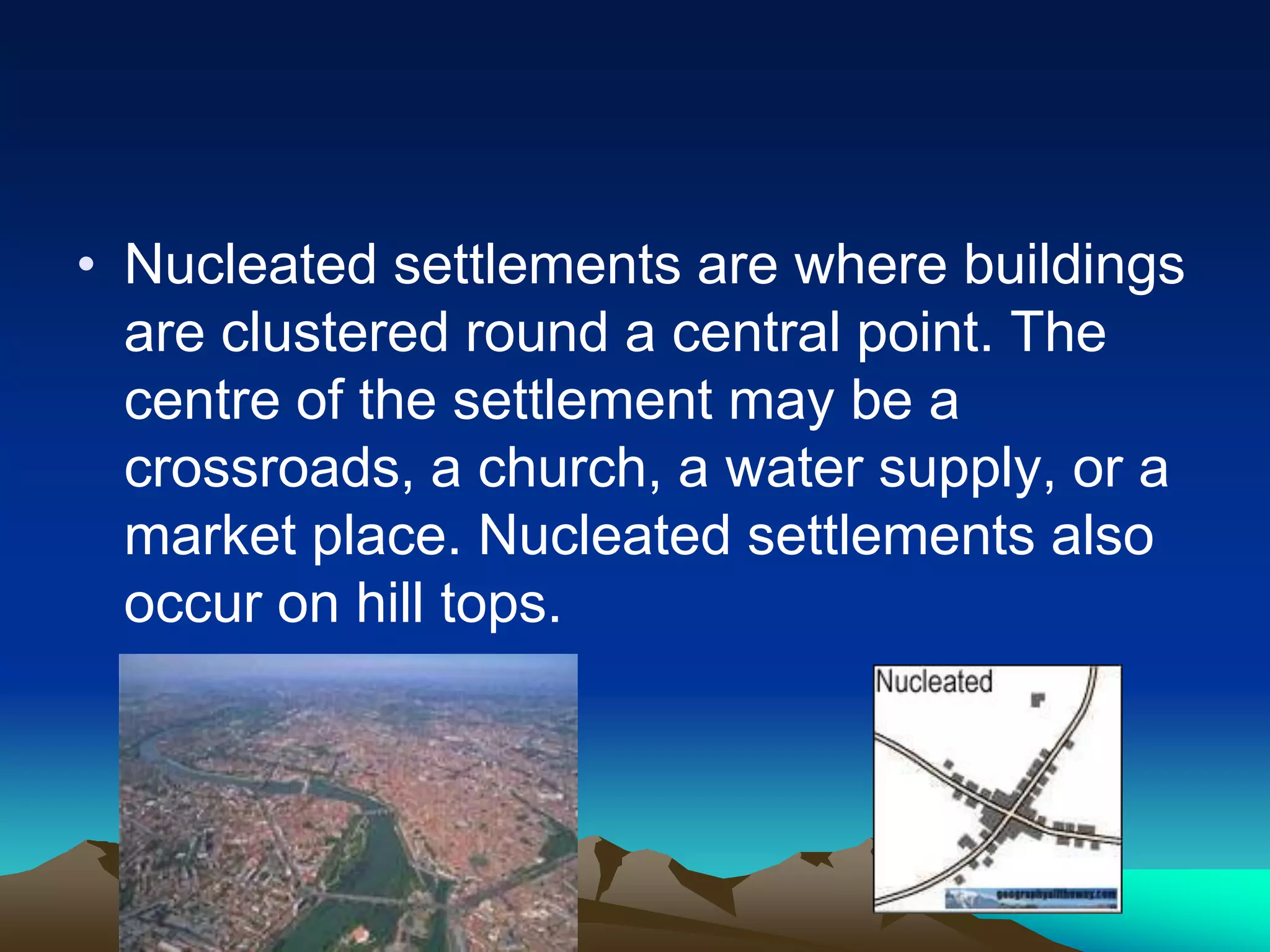
• Nucleated settlements are where buildings
are clustered round a central point. The
centre of the settlement may be a
crossroads, a church, a water supply, or a
market place. Nucleated settlements also
occur on hill tops.
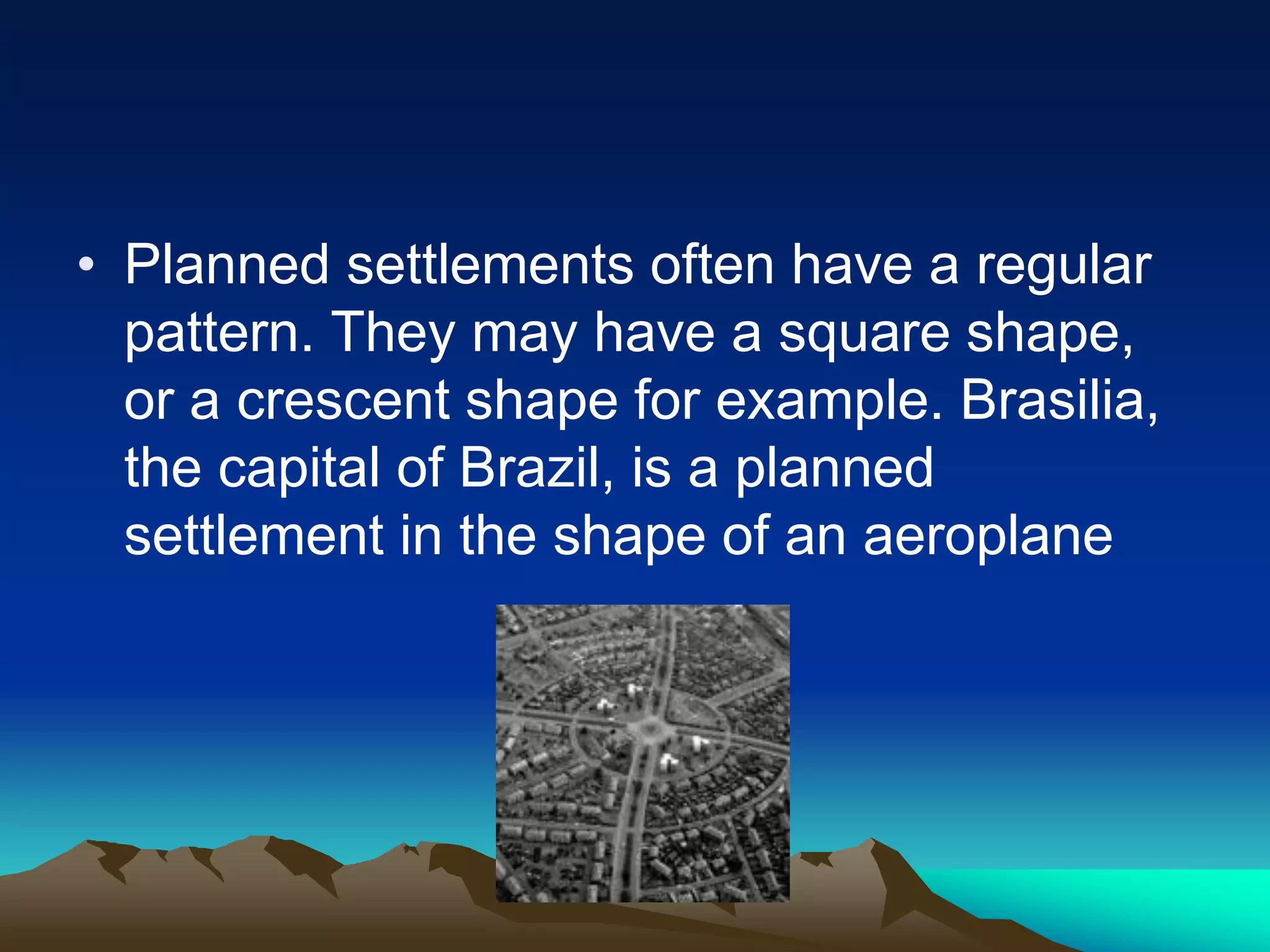
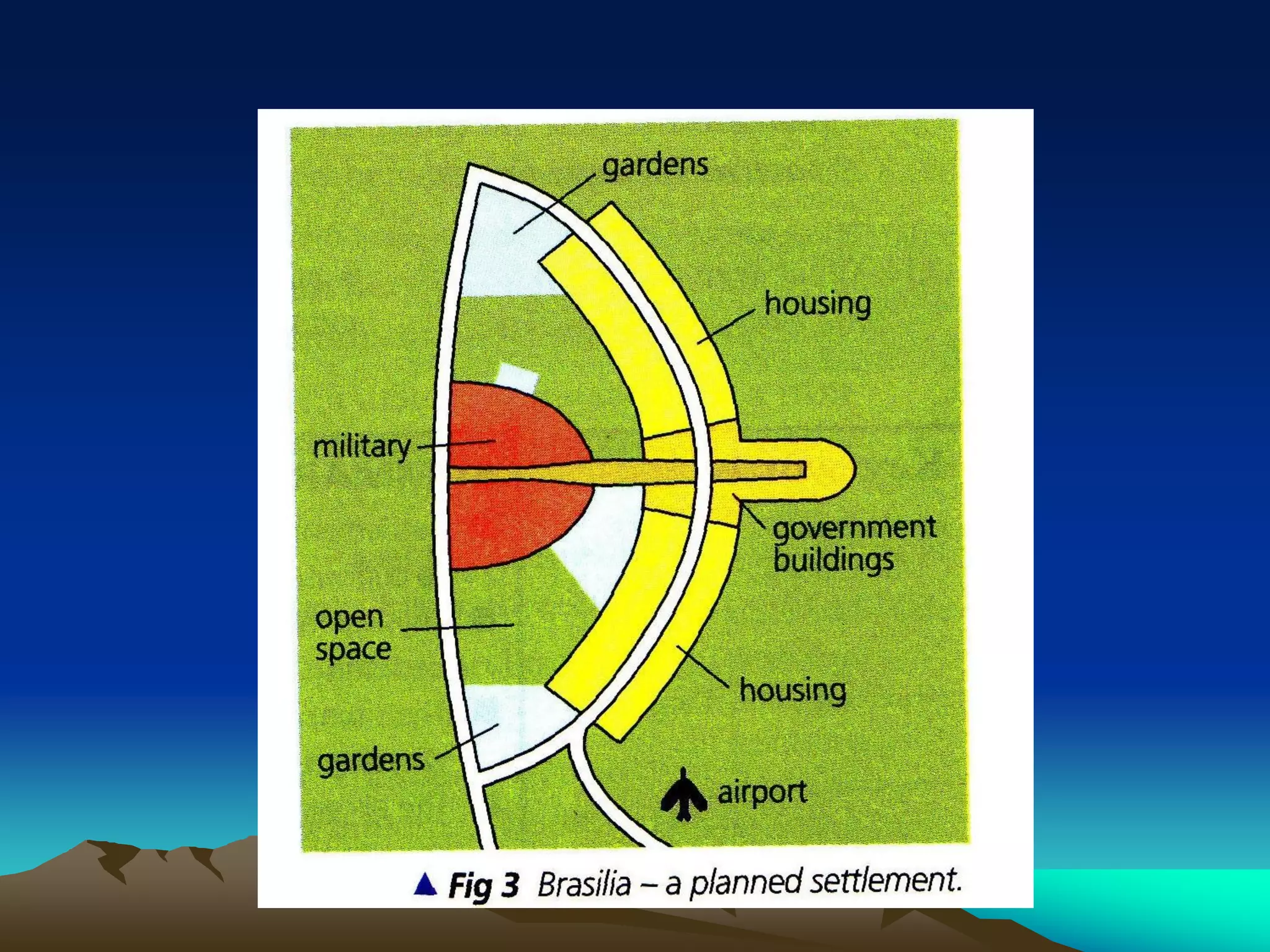
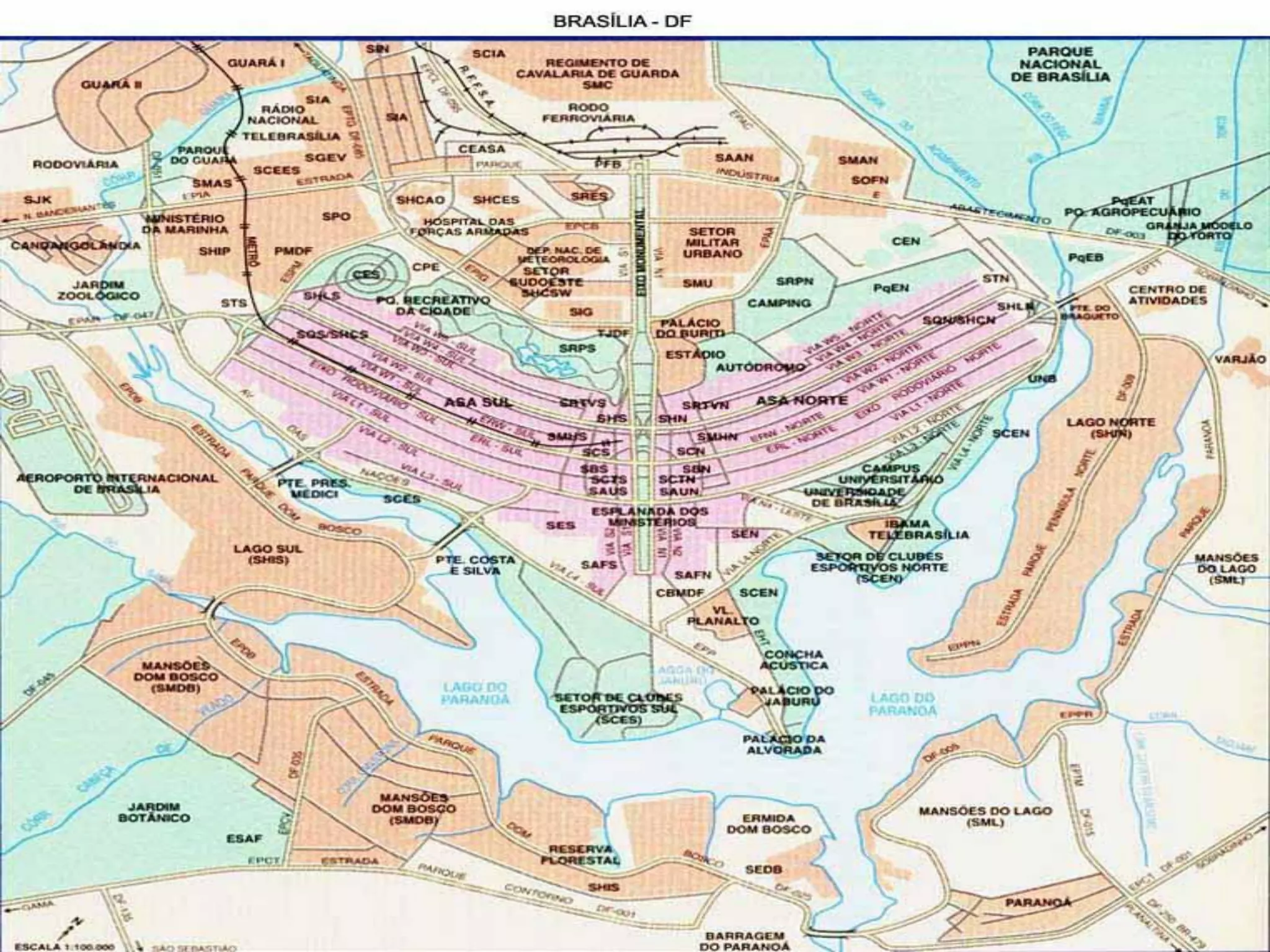
• Planned settlements often have a regular
pattern. They may have a square shape,
or a crescent shape for example. Brasilia,
the capital of Brazil, is a planned
settlement in the shape of an aeroplane
City layout
• The layout of a city is the way its streets
and buildings are distributed.
• There are different types of layout:
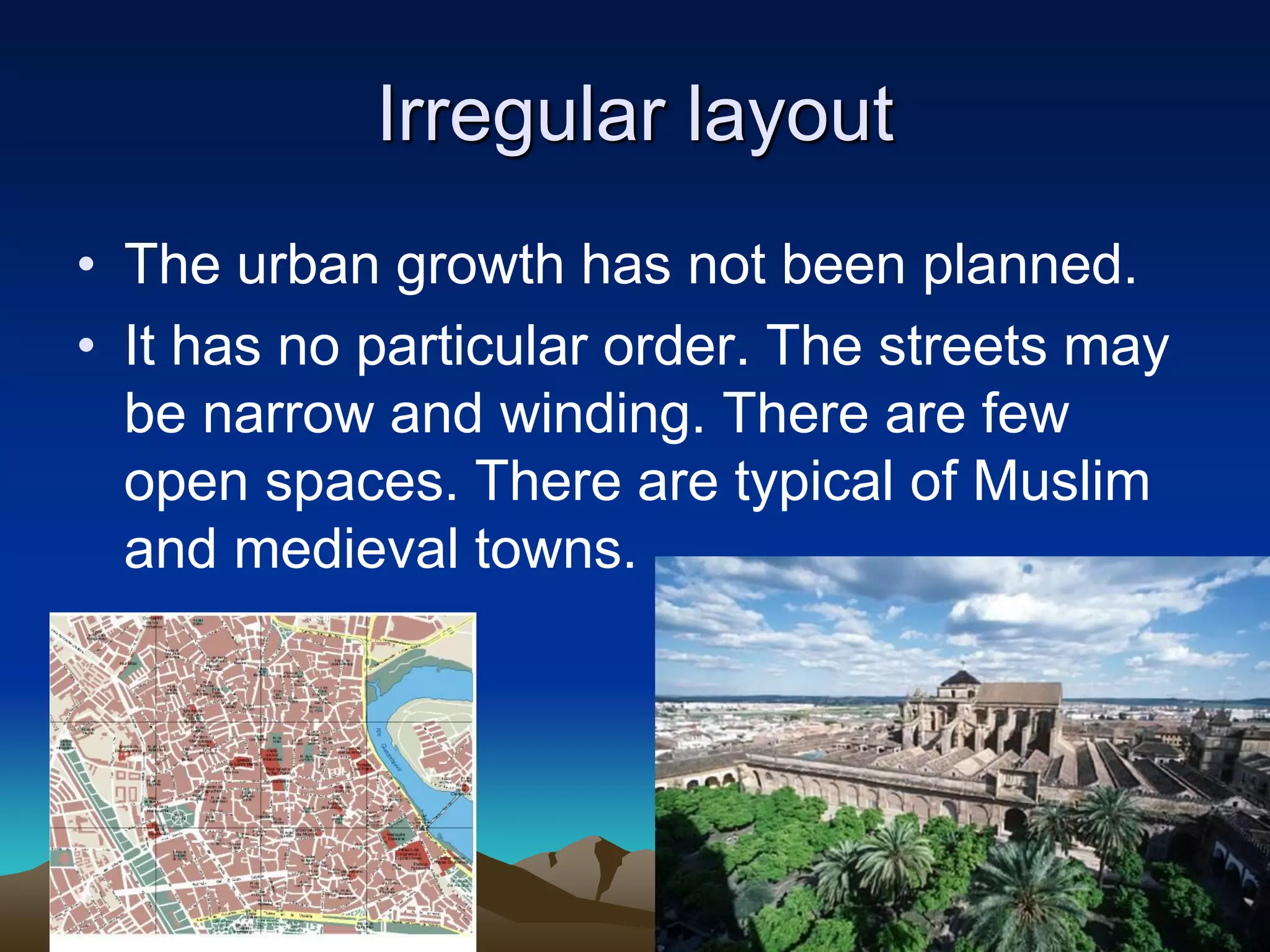
Irregular layout
• The urban growth has not been planned.
• It has no particular order. The streets may
be narrow and winding. There are few
open spaces. There are typical of Muslim
and medieval towns.
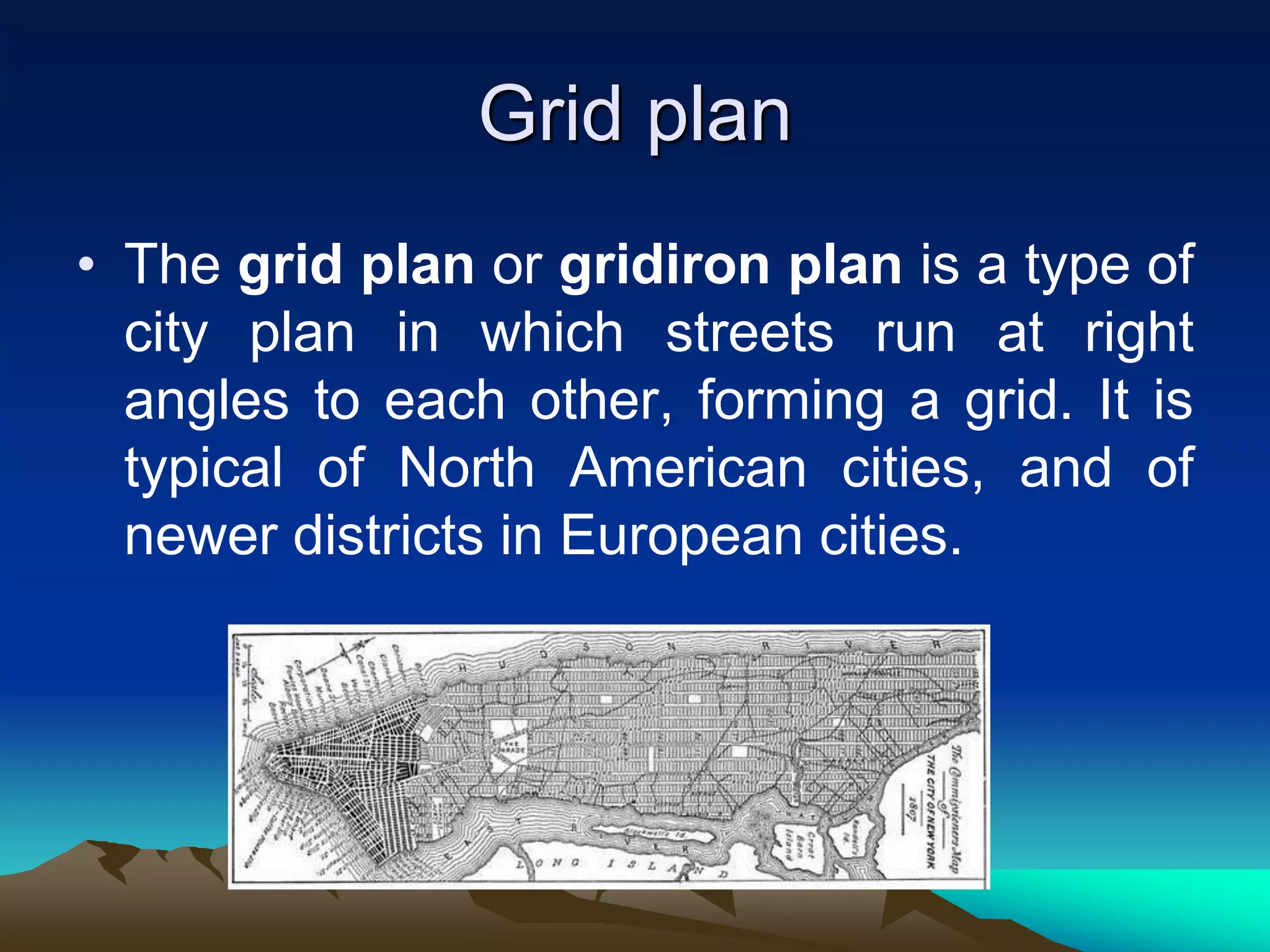
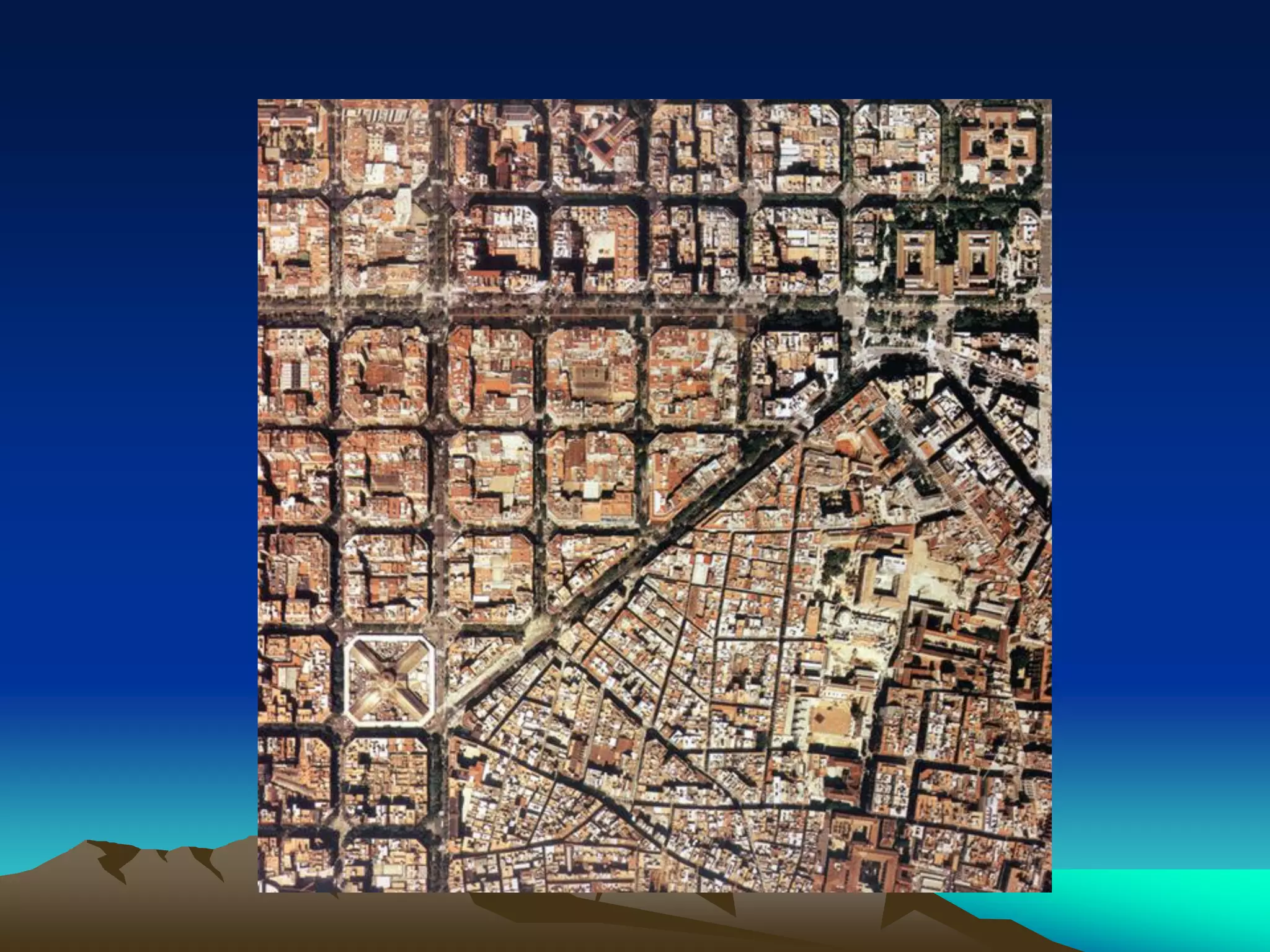
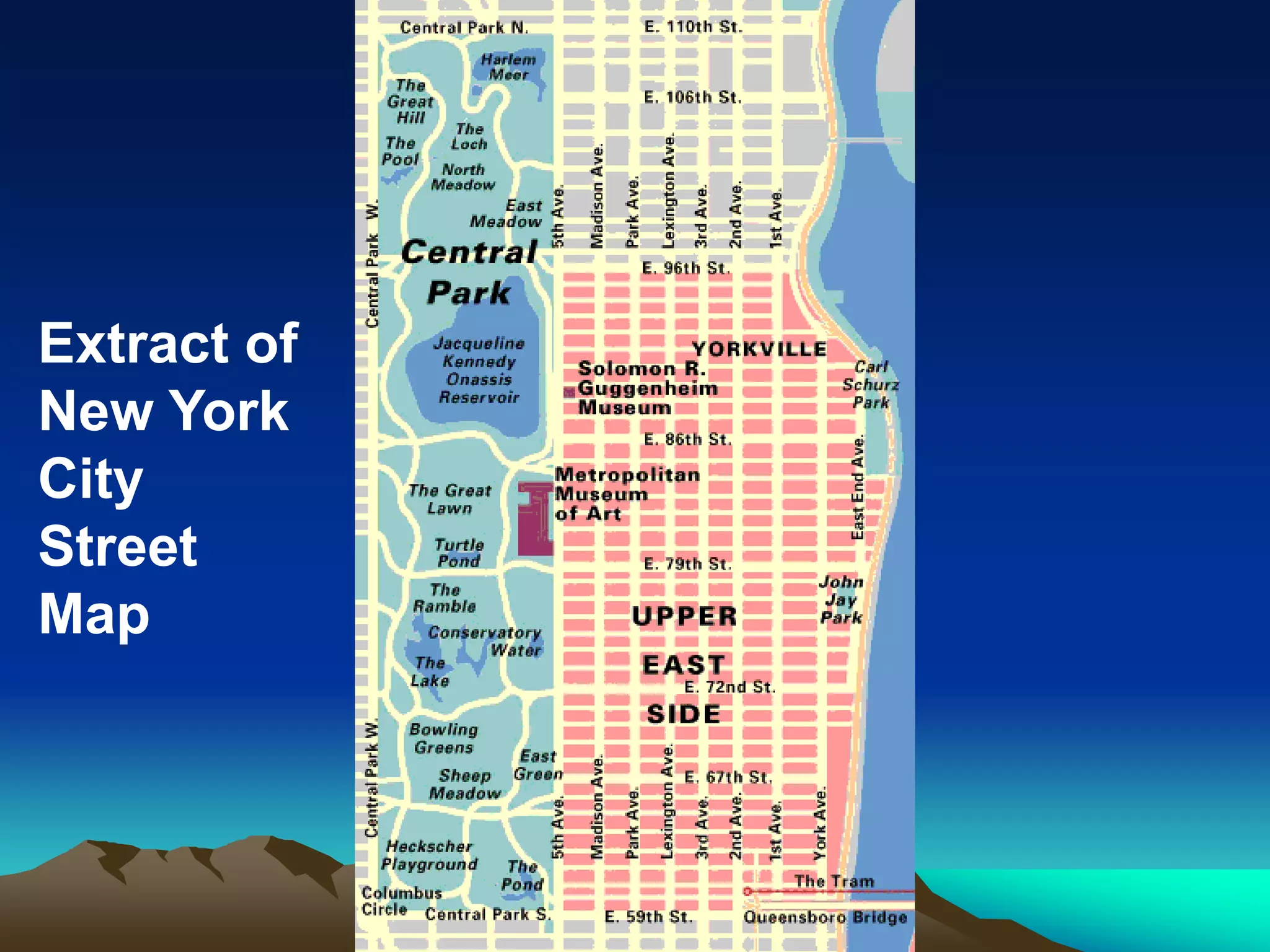
Grid plan
• The grid plan or gridiron plan is a type of
city plan in which streets run at right
angles to each other, forming a grid. It is
typical of North American cities, and of
newer districts in European cities.
Extract of
New York
City
Street
Map
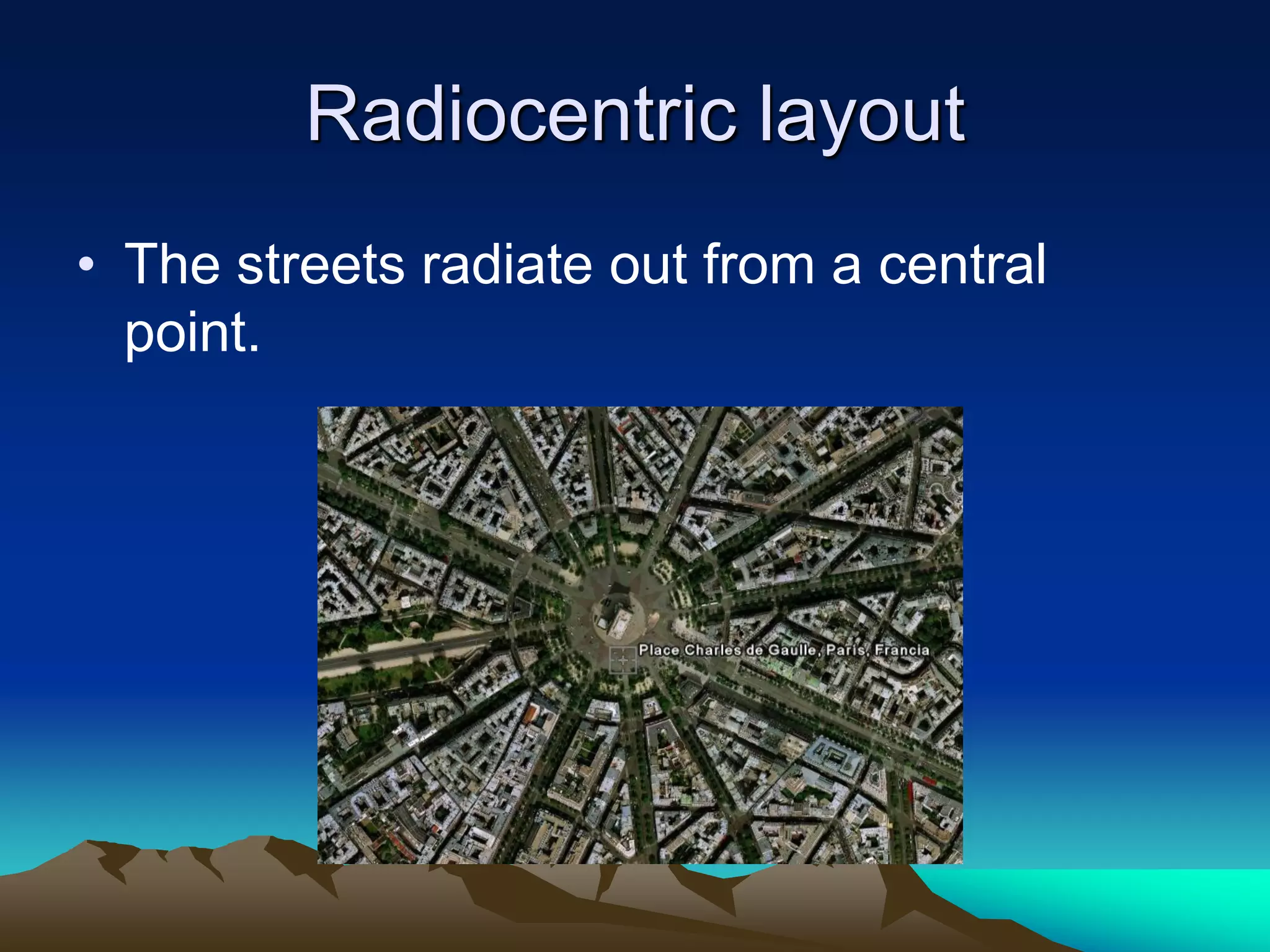
Radiocentric layout
• The streets radiate out from a central
point.
SETTLEMENT FUNCTIONS
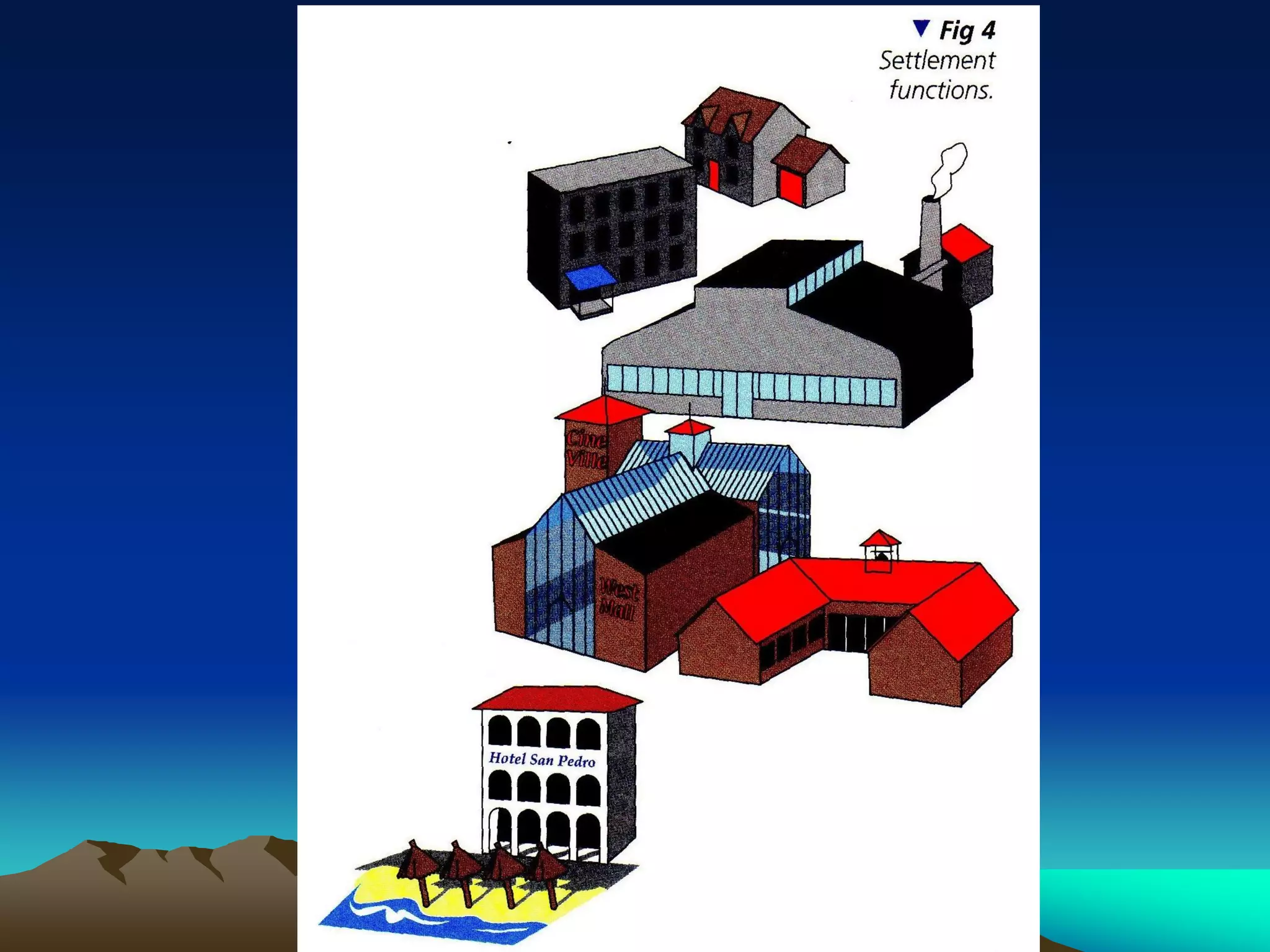
Settlement functions
• The functions of a settlement are the
things that happen there.
• The function of most early settlements was
farming. As settlements grew, the
functions increased to include things such
as markets and inns. Today settlements
have many functions, which continue to
change over time.
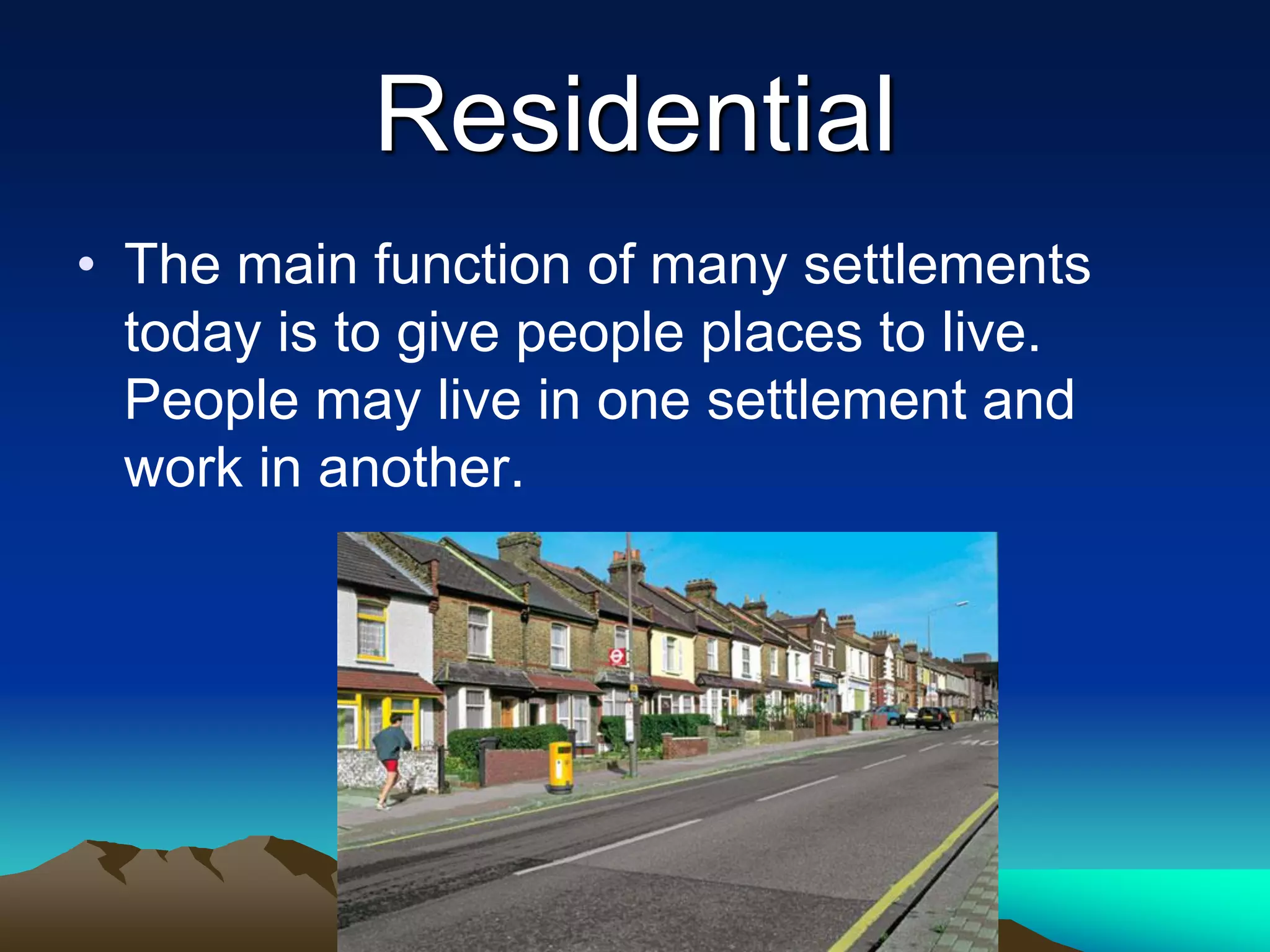
Residential
• The main function of many settlements
today is to give people places to live.
People may live in one settlement and
work in another.
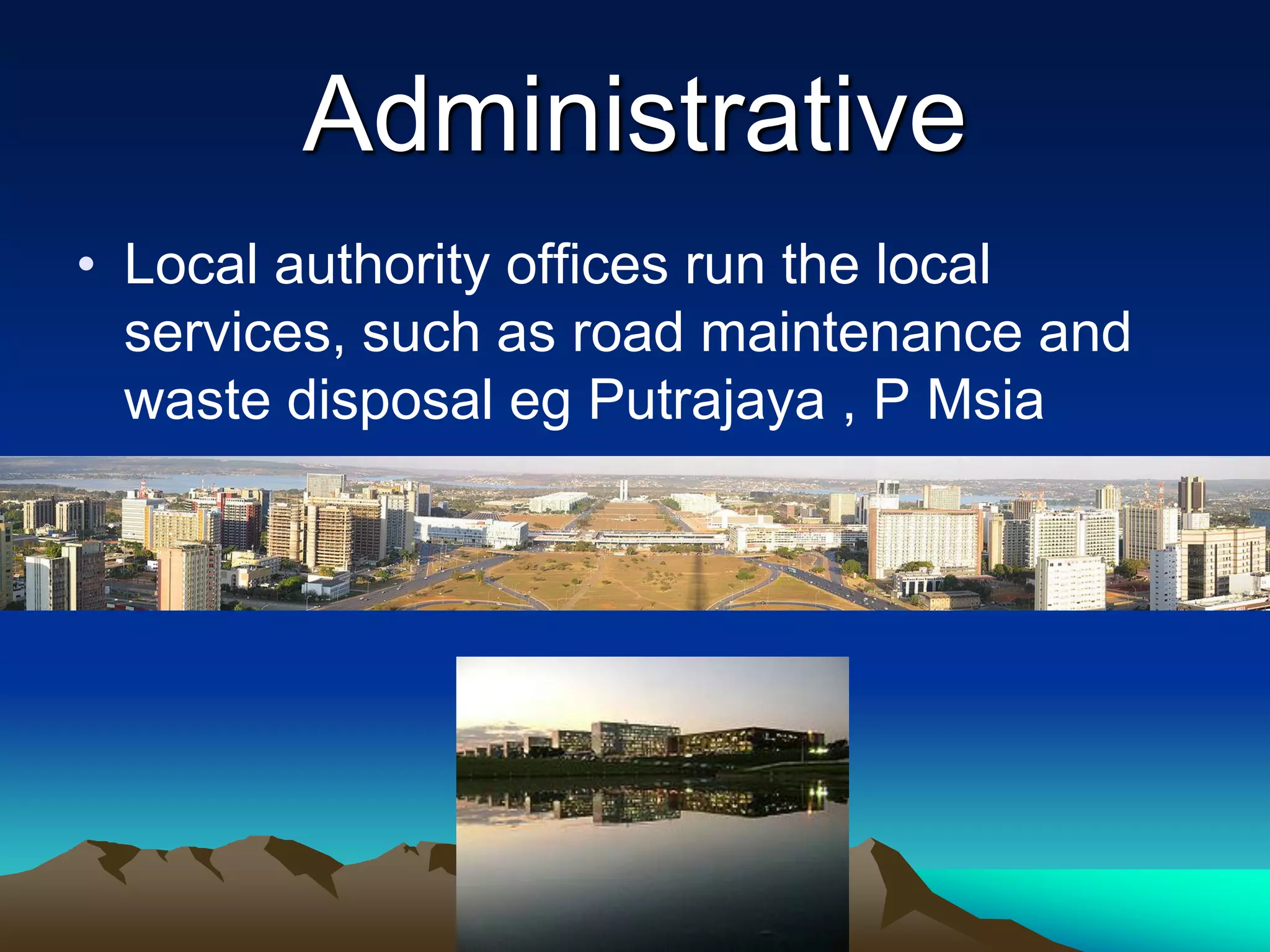
Administrative
• Local authority offices run the local
services, such as road maintenance and
waste disposal eg Putrajaya , P Msia
Industrial
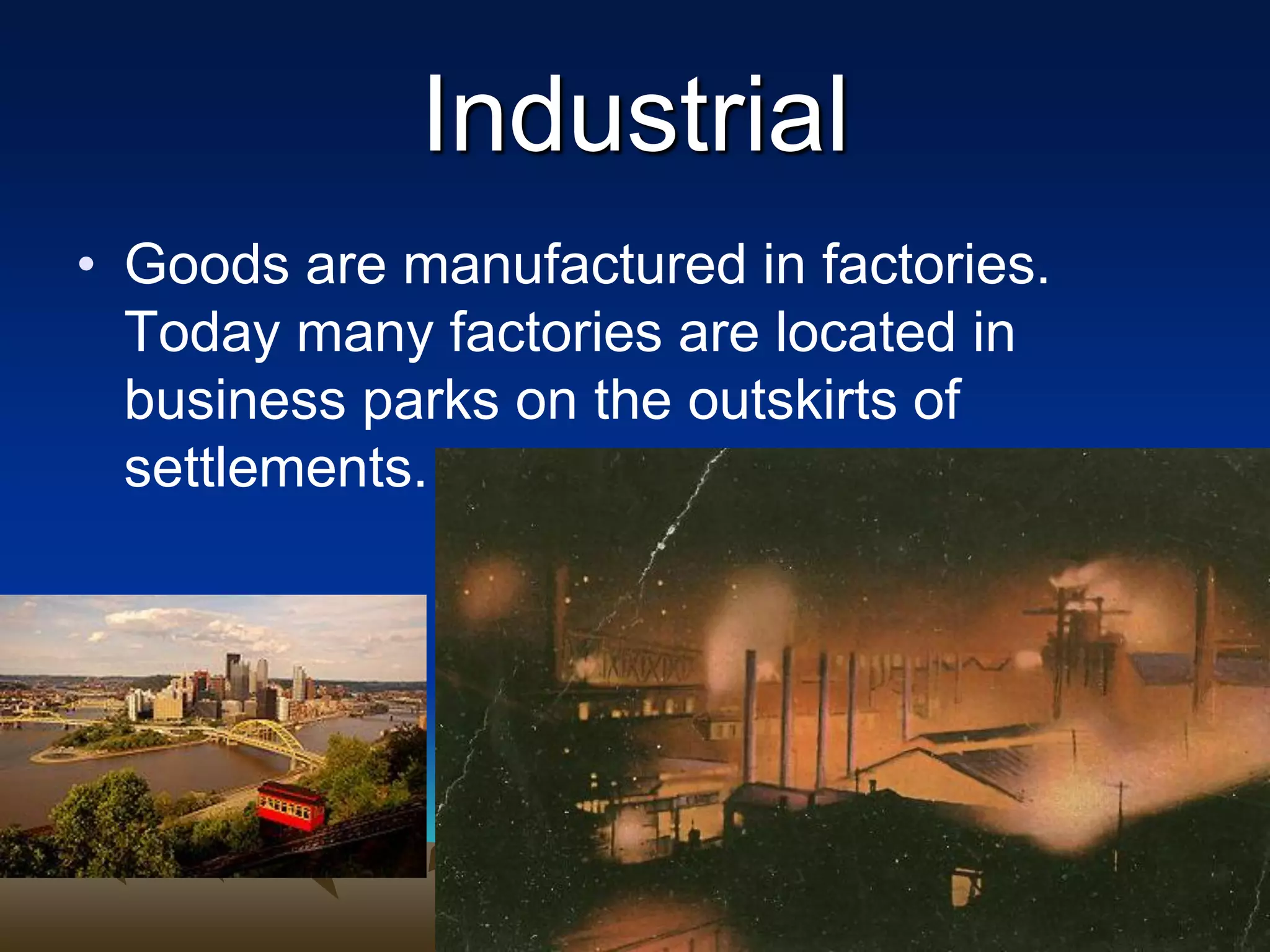
• Goods are manufactured in factories.
Today many factories are located in
business parks on the outskirts of
settlements.
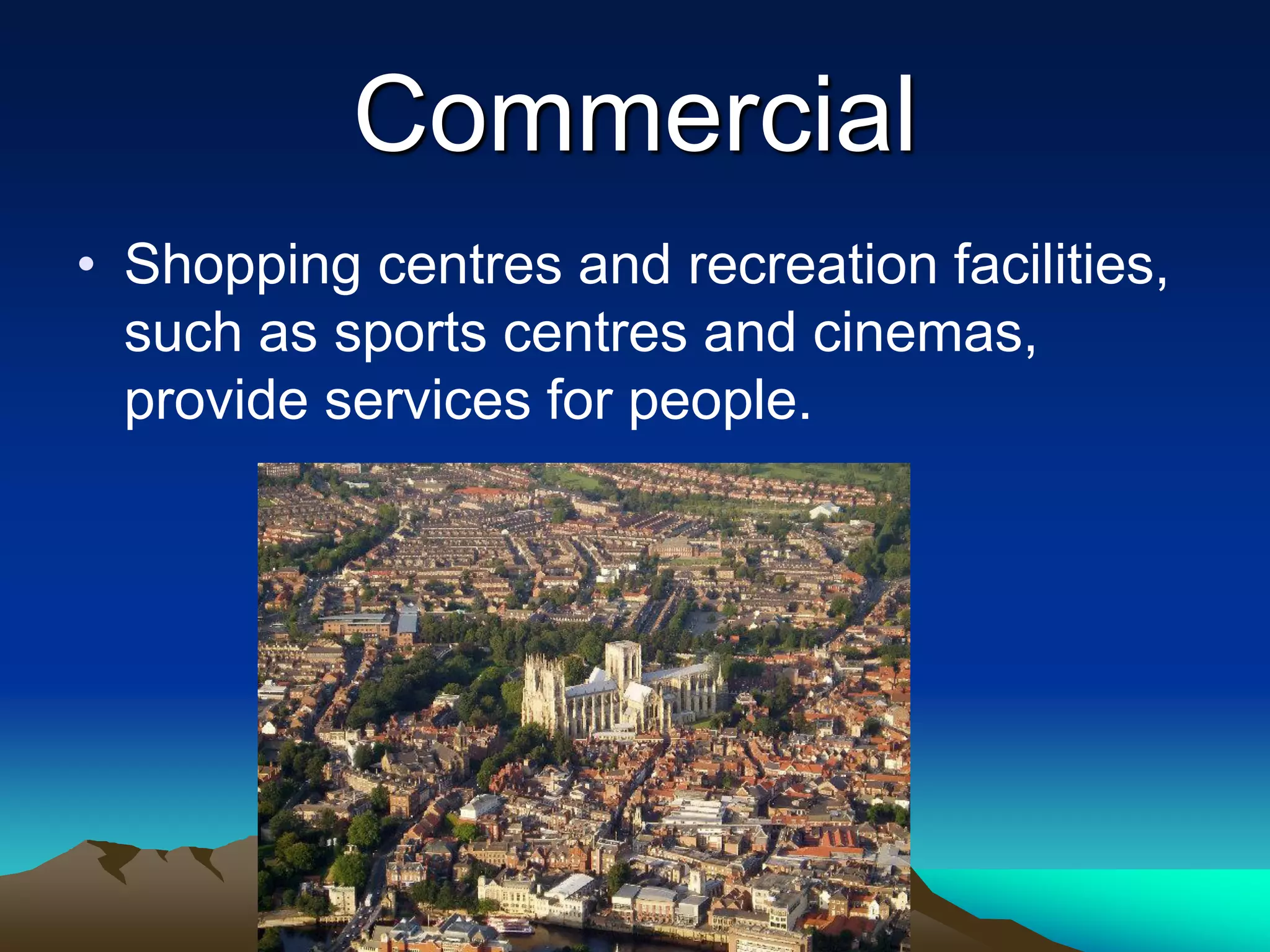
Commercial
• Shopping centres and recreation facilities,
such as sports centres and cinemas,
provide services for people.
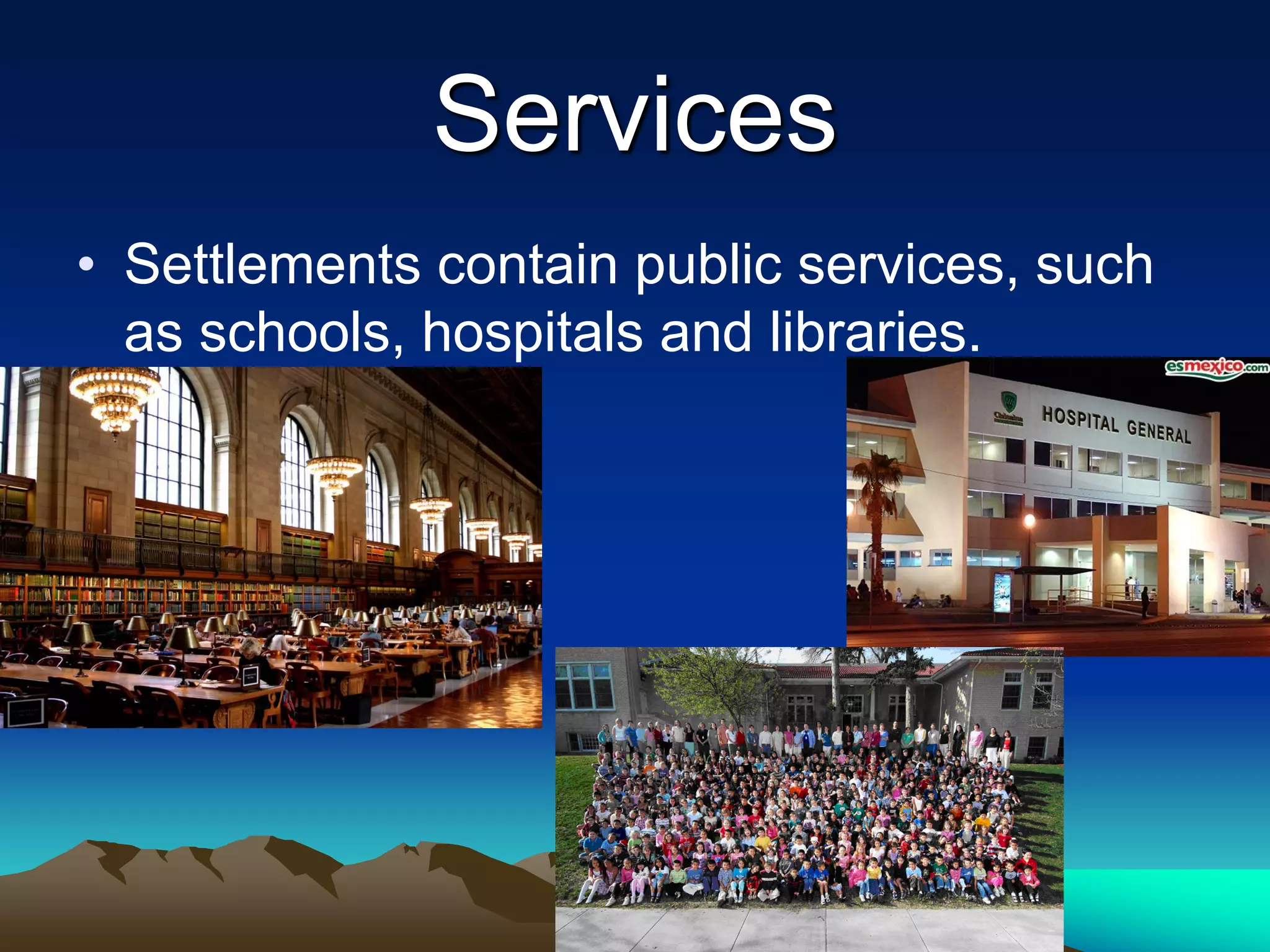
Services
• Settlements contain public services, such
as schools, hospitals and libraries.
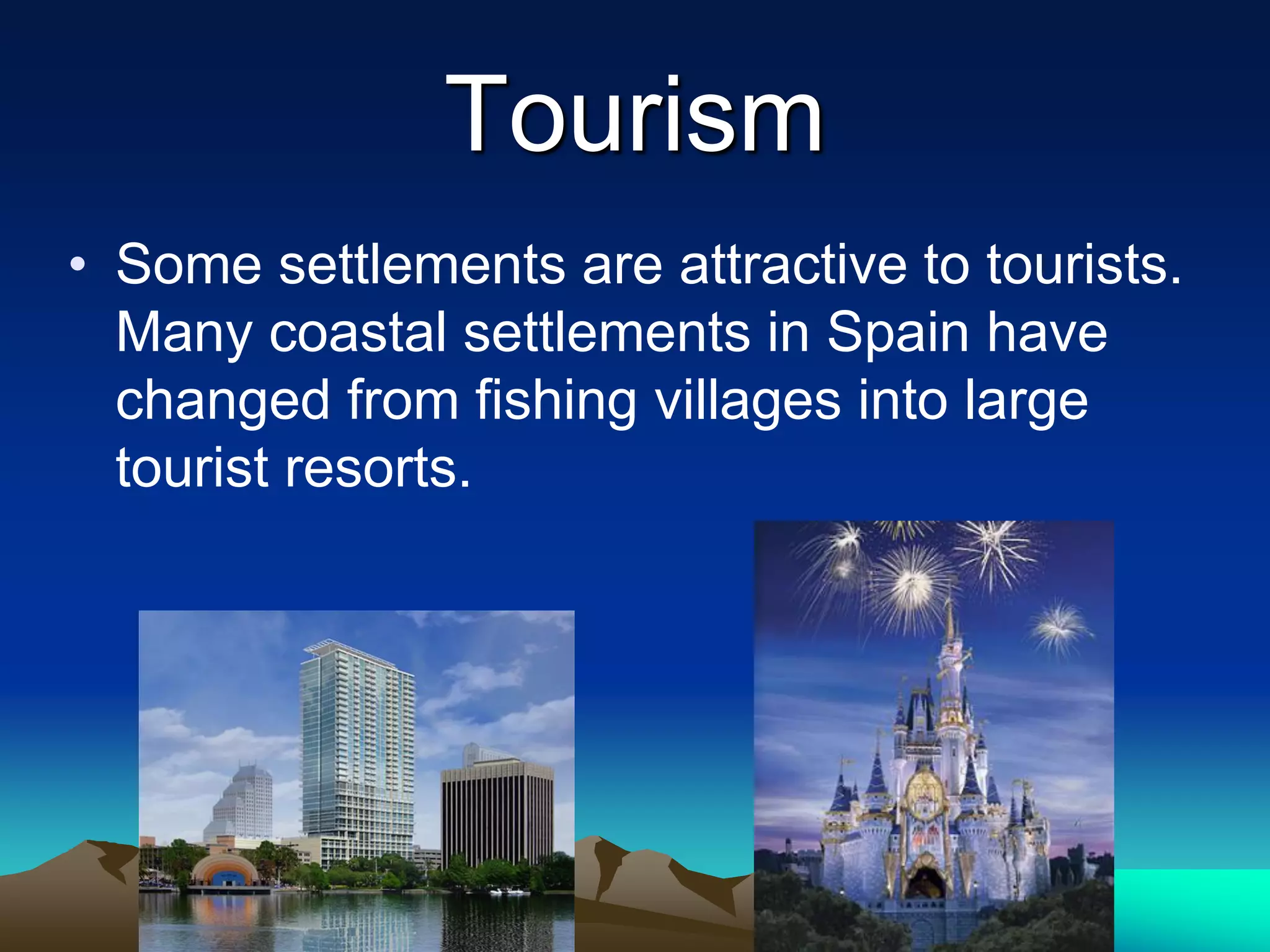
Tourism
• Some settlements are attractive to tourists.
Many coastal settlements in Spain have
changed from fishing villages into large
tourist resorts.

T3 w3

  • 1.
  • 2.
     A settlementis a place where people live.
  • 3.
  • 4.
     It includesthe temporary camp of the hunters and herders;
  • 5.
     the permanentsettlements called villages;
  • 6.
     and largeurban agglomerations.
  • 7.
     Human settlementsmay consist of only a few dwelling units (hamlets),
  • 8.
     or theymay be as large as megalopolis with a big cluster of buildings accommodating millions of people.
  • 10.
     Conurbation/metropolitan area– a supercity consisting of multiple cities and towns. The population is usually several million.  Large City – a city with a large population and many services. The population is >1 million people.  City – a city would have abundant services, but not as many as a large city. The population of a city is over 100,000 people.  Large town – a large town has a population of 20,000 to 100,000.  Town – a town has a population of 1,000 to 20,000  Village – a village generally does not have many services, possibly only a small corner shop or post office. A village has a population of 100 to 1,000.  Hamlet – a hamlet has a tiny population (<100) and very few (if any) services, and few buildings.  Isolated dwelling – an isolated dwelling would only have 1 or 2 buildings or families in it. It would have negligible services, if any.
  • 12.
     A hamletis (usually—see below) a rural community —a small settlement — which is too small to be considered a village. A hamlet has a tiny population (<100) and very few (if any) services, and few buildings.
  • 13.
     A villageis a clustered human settlement or community, larger than a hamlet, but smaller than a town or city. Though generally located in rural areas.  A village generally does not have many services, possibly only a small corner shop or post office. A village has a population of 100 to 1,000.
  • 15.
     A townhas a population of 1,000 to 20,000.  A town is a type of settlement ranging from a few to several thousand (occasionally hundreds of thousands) inhabitants. Usually, a "town" is thought of as larger than a village but smaller than a "city",
  • 17.
     A citywould have abundant services, but not as many as a large city. The population of a city is over 100,000 people.  A city is an urban area with a large population and a particular administrative, legal, or historical status.
  • 19.
     A metropolitanarea is a large population center consisting of a large metropolis and its adjacent zone of influence
  • 20.
     A conurbationis an urban area or agglomeration comprising a number of cities, large towns and larger urban areas that, through population growth and physical expansion, have merged to form one continuous urban and industrially developed area.  A conurbation can be confused with a metropolitan area. As the term is used in North America, a metropolitan area consists of many neighborhoods, while a conurbation consists of many different metropolitan areas that are connected with one another and are usually interdependent economically and socially.
  • 22.
     Match upthe settlement type with its description by dragging the words into the spaces provided.
  • 23.
    Site • Site refersto the actual piece of ground on which the settlement is built. • The site of a settlement is its exact location.
  • 24.
    • The physicalgeography of an area was very important to early people when they were deciding on the site for a new settlement. • Site Factors: – Water supply: a clean supply of water was needed for drinking, cooking and cleaning. Water could be taken from a river or a well.
  • 27.
    – Relief- thearea needed to be high enough to be safe from flooding, but low enough to be sheltered from strong winds. Acropolis, literally means the 'high city,' is the origin of the Athens city that we know of today. Standing high above the hill in the centre of Athens, it is visible from almost anywhere.
  • 28.
    – Defence -a hilltop, or the inside of a river meander, would provide protection from attackers.
  • 29.
    Durham and theRiver Wear It is at this point that the River Wear takes a remarkable curve which almost isolates the central part of the city on which the cathedral and castle stand. The site was largely chosen for its fantastic natural defensive qualities.
  • 30.
    – Transport -a site at a crossroads, on a river or at the coast gave easier access to other settlements.
  • 31.
    – Soil -deep fertile soil made it easier to farm crops and rear animals. – Resources - a source of timber or rock was needed for building. Wood was needed as a fuel for heat and cooking.
  • 32.
    Situation • Situation orPosition refers to the location of the village or town in relation to surrounding areas. – If a settlement had good access to natural resources, and to other settlements, it would grow in size. Many settlements with a good site and situation have grown into large cities.
  • 33.
    Paris • Paris isthe capital city of France. It is the largest city in Europe and has a population of 10 million people. Paris began in the third century BC. It was sited on a small island in the River Seine. The site was good for defence, but was also a crossing point across the river. The fertile soil of the River Seine's floodplain was also excellent for farming. Under Roman rule, Paris grew and became the centre of a network of roads stretching across Europe. • The situation of Paris has made it one of the most important cities in Europe. It is the focus of many major roads and railway lines. Paris has also become the centre for many international air routes.
  • 35.
    Settlement patterns • Whenearly settlements began to grow there were no planning regulations. People built houses where they wanted to. Some houses were built far apart from each other (dispersed). Other houses were built close together, making villages. Villages began to grow outwards and the shape of the settlements changed. Some settlements became long and narrow (linear), others stayed clustered together (nucleated). Today, people must have permission from the local authority to build houses. Settlements now grow in a planned way.
  • 37.
    • Dispersed settlementsare usually farms. They are spread out because of the space taken up by fields. Other dispersed settlements are found in mountainous areas where it is difficult to live.
  • 38.
    • Linear settlementssometimes follow the shape of the land. It is easier to build on the floor of a valley than on the steep sides. Linear settlements also follow features such as roads, railway lines or rivers.
  • 39.
    • Nucleated settlementsare where buildings are clustered round a central point. The centre of the settlement may be a crossroads, a church, a water supply, or a market place. Nucleated settlements also occur on hill tops.
  • 40.
    • Planned settlementsoften have a regular pattern. They may have a square shape, or a crescent shape for example. Brasilia, the capital of Brazil, is a planned settlement in the shape of an aeroplane
  • 43.
    City layout • Thelayout of a city is the way its streets and buildings are distributed. • There are different types of layout:
  • 44.
    Irregular layout • Theurban growth has not been planned. • It has no particular order. The streets may be narrow and winding. There are few open spaces. There are typical of Muslim and medieval towns.
  • 45.
    Grid plan • Thegrid plan or gridiron plan is a type of city plan in which streets run at right angles to each other, forming a grid. It is typical of North American cities, and of newer districts in European cities.
  • 47.
  • 48.
    Radiocentric layout • Thestreets radiate out from a central point.
  • 49.
  • 50.
    Settlement functions • Thefunctions of a settlement are the things that happen there. • The function of most early settlements was farming. As settlements grew, the functions increased to include things such as markets and inns. Today settlements have many functions, which continue to change over time.
  • 52.
    Residential • The mainfunction of many settlements today is to give people places to live. People may live in one settlement and work in another.
  • 53.
    Administrative • Local authorityoffices run the local services, such as road maintenance and waste disposal eg Putrajaya , P Msia
  • 54.
    Industrial • Goods aremanufactured in factories. Today many factories are located in business parks on the outskirts of settlements.
  • 55.
    Commercial • Shopping centresand recreation facilities, such as sports centres and cinemas, provide services for people.
  • 56.
    Services • Settlements containpublic services, such as schools, hospitals and libraries.
  • 57.
    Tourism • Some settlementsare attractive to tourists. Many coastal settlements in Spain have changed from fishing villages into large tourist resorts.