MALTHUS
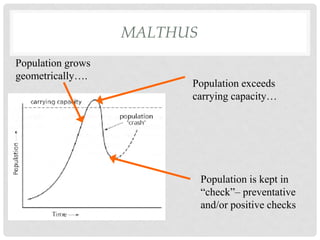
Population grows
geometrically….
Population exceeds
carrying capacity…
Population is kept in
“check”– preventative
and/or positive checks
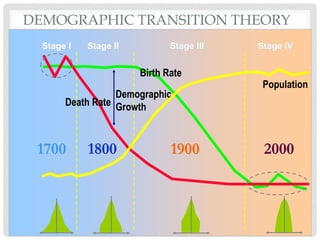
DEMOGRAPHIC TRANSITION THEORY
190018001700
Stage I Stage II Stage IVStage III
Birth Rate
Death Rate
2000
Demographic
Growth
Population
STAGES IN DEMOGRAPHIC TRANSITION
Stage I Stage II Stage III Stage IV
High birth rates High birth rates Falling birth rates Low birth rates
No or little Family Planning.
Parents have many children
because few survive.
Many children are needed to
work the land.
Children are a sign of virility.
Religious beliefs and cultural
traditions encourage large
families.
Family Planning.
Lower infant mortality rates.
Industrialization means less
need for labor.
Increased desire for material
possessions and less desire
for large families.
Emancipation of women.
Children as liabilities instead
of assets (no economic
contribution as labor).
High death rates Falling death rates Low death rates Low death rates
Disease and plague (e.g.
bubonic, cholera,
kwashiorkor).
Famine, uncertain food
supplies and poor diet.
Poor hygiene, no clean water
or sewage disposal.
Improved medicine.
Improved sanitation and
waters supply.
Improvements in food
production in terms of quality
and quantity.
Improved transport to move
food.
Decrease in child mortality.
Modern medicine.
Optimal life expectancy.
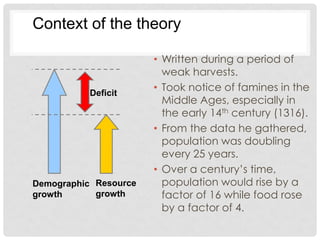
• Written during a period of
weak harvests.
• Took notice of famines in the
Middle Ages, especially in
the early 14th century (1316).
• From the data he gathered,
population was doubling
every 25 years.
• Over a century’s time,
population would rise by a
factor of 16 while food rose
by a factor of 4.
Demographic
growth
Resource
growth
Deficit
Context of the theory
• The “Malthusian crisis” in context
• Available agricultural spaces are limited.
• Technical progresses (machinery, irrigation,
fertilizers, and new types of crops) are slow to
occur.
• Increasing incapability to support the population.
• If this persists, the population will eventually
surpass the available resources.
• The inevitable outcomes are “Malthusian crises”
where nature will bring about the check and
balance between population food supply:
• Food shortages.
• Famines.
• War and epidemics
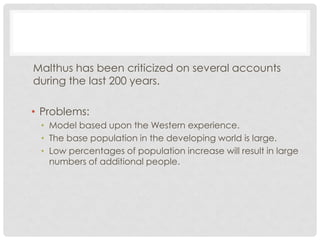
Malthus has been criticized on several accounts
during the last 200 years.
• Problems:
• Model based upon the Western experience.
• The base population in the developing world is large.
• Low percentages of population increase will result in large
numbers of additional people.
OverexploitationPopulation
Resources
Technological Innovation
Time
Quantity t2
t3
t1
What does this graph suggest?
That…..
• The Malthusian Crisis has not occurred
• Did not foresee the demographic transition:
• Changes in the economy that changed the role of
children in the industrializing societies.
• Failed to account for improvements in
technology:
• Enabled food production to increase at rates greater
than arithmetic, often at rates exceeding those of
population growth.
• Enabled to access larger amounts of resources.
• Enabled forms of contraception.
ESTHER BOSERUP
“NECESSITY IS THE MOTHER OF ALL INVENTIONS”
ESTHER BOSERUP
THEORY OF POPULATION GROWTH
• In contrast to Malthus, instead of too many
mouths to feed, Boserup emphasized the
positive aspects of a large population;
• In simple terms, Boserup suggested that the
more people there are, the more hands
there are to work;
• She argued that as population increases,
more pressure is placed on the existing
agricultural system, which stimulates
invention;
• The changes in technology allow for
improved crop strains and increased yields.
(1910 – 1999)
GLOBAL GROWTH IN POPULATION AND
GRAIN (WHEAT AND RICE) PRODUCTION,
1961-2005
200
250
300
350
400
450
500
550
600
650
700
1961
1963
1965
1967
1969
1971
1973
1975
1977
1979
1981
1983
1985
1987
1989
1991
1993
1995
1997
1999
2001
2003
2005
Millions
3
4
5
6
7
Billions
Wheat Production (tons)
Rice Production (tons)
Population
CONTEMPORARY ISSUES
• The Malthusian crisis today
• Demographic growth:
• Between 1960 and 2000, three billion persons were added to
the global population.
• To sustain this growth, agricultural resources had to be doubled.
• Required housing space surpassed all that was constructed
since the beginning of mankind.
• Agricultural growth:
• Between 1960 and 1990, grain yields has increased by 92% while
cultivated surfaces have only increased by 8%.
• Foresee a limit to growth in agricultural production.
• Consumption growth.
• Environmental degradation.
CONTEMPORARY ISSUES
• Relevance of the Malthusian theory
• Was Malthus right or the trend in agricultural production will
again increase to surpass population growth?
• Are improvements in agricultural techniques enough to
answer demand?
• The next 25 years will be crucial and will bring forward
answers to these questions.
• The work of Malthus continues to be important to
demographers:
• Influence of many contemporary theorists from various
academic disciplines.
• Built upon Malthus’s ideas and linked them to modern sciences.
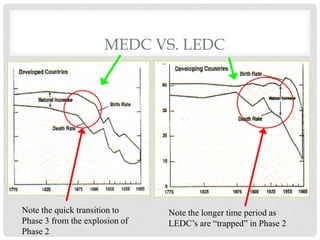
MEDC VS. LEDC
Note the quick transition to
Phase 3 from the explosion of
Phase 2
Note the longer time period as
LEDC’s are “trapped” in Phase 2
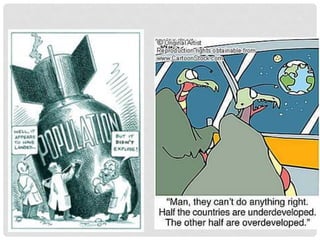
ANTI-POPULATIONISTS VS. PRONATALISTS
• Malthus– anti-populationist
• Echoed in recent debates by Paul Ehrlich, author
of The Population Bomb;
• Ehrlich believed that the earth’s carrying
capacity would quickly be exceeded, resulting in
widespread famine and population reductions;
• Boserup– pronatalist (cornucopian)
• Echoed in recent debates by Julian Simon, who
opposed Ehrlich by using economic theories; ie.
Resources needed to support populations are
becoming more abundant, not scarcer;
RELEVANCE OF THE THEORY?
• Types of innovations
• Discovery:
• An entirely new class of resources is made available.
• Often adds to existing resources.
• Offers new economic opportunities.
• E.g. the usage of oil as a source of energy.
• Productivity gains:
• Existing resources are used more effectively.
• Often implies using less of the same resource.
• Developing a more efficient engine.
• Substitution:
• An alternative resource is used.
• Often because the existing resource becomes too expensive /
scarce.
• Using ethanol.
• Technological innovation and agriculture
• Intensification of agriculture.
• New methods of fertilization.
• Pesticide use.
• Irrigation.
• Multi-cropping systems in which more than one crop would
be realized per year.
• Creative pressure and global population growth
• Would lead to new productivity gains.
• Humans don’t deplete resources but, through technology,
create them.
• Resources will become more abundant.
• Help overcome shortage in food production and
employment.
RELEVANCE OF THE THEORY?
2. LIMITS TO PRODUCTIVITY
• Existing store of Resources
• As a resource become scarcer frictions and competition for
access.
• Eventually, a group secure / capture the resource and
makes it unavailable to others.
• This capture either takes place through legislation and / or
force.
• Leads to marginalization and risks of conflicts.
3. DOES TECHNOLOGY HAVE ALL THE
SOLUTIONS?
• Limits of food production by environmental factors
• Substitution is not possible for many resources.
• Soil exhaustion and erosion.
• Evolutionary factors such as the development of greater
resistance to pesticides.
• Climate change.
• Loss of productive soils due to land use conversion to other
purposes, such as urbanization.
• Water shortages and pollution.
• Limits by technology
• May be available but not shared.
• Maybe too expensive for some regions (e.g. desalination).

T1W3-4

  • 1.
    MALTHUS Population grows geometrically…. Population exceeds carryingcapacity… Population is kept in “check”– preventative and/or positive checks
  • 2.
    DEMOGRAPHIC TRANSITION THEORY 190018001700 StageI Stage II Stage IVStage III Birth Rate Death Rate 2000 Demographic Growth Population
  • 3.
    STAGES IN DEMOGRAPHICTRANSITION Stage I Stage II Stage III Stage IV High birth rates High birth rates Falling birth rates Low birth rates No or little Family Planning. Parents have many children because few survive. Many children are needed to work the land. Children are a sign of virility. Religious beliefs and cultural traditions encourage large families. Family Planning. Lower infant mortality rates. Industrialization means less need for labor. Increased desire for material possessions and less desire for large families. Emancipation of women. Children as liabilities instead of assets (no economic contribution as labor). High death rates Falling death rates Low death rates Low death rates Disease and plague (e.g. bubonic, cholera, kwashiorkor). Famine, uncertain food supplies and poor diet. Poor hygiene, no clean water or sewage disposal. Improved medicine. Improved sanitation and waters supply. Improvements in food production in terms of quality and quantity. Improved transport to move food. Decrease in child mortality. Modern medicine. Optimal life expectancy.
  • 4.
    • Written duringa period of weak harvests. • Took notice of famines in the Middle Ages, especially in the early 14th century (1316). • From the data he gathered, population was doubling every 25 years. • Over a century’s time, population would rise by a factor of 16 while food rose by a factor of 4. Demographic growth Resource growth Deficit Context of the theory
  • 5.
    • The “Malthusiancrisis” in context • Available agricultural spaces are limited. • Technical progresses (machinery, irrigation, fertilizers, and new types of crops) are slow to occur. • Increasing incapability to support the population. • If this persists, the population will eventually surpass the available resources. • The inevitable outcomes are “Malthusian crises” where nature will bring about the check and balance between population food supply: • Food shortages. • Famines. • War and epidemics
  • 6.
    Malthus has beencriticized on several accounts during the last 200 years. • Problems: • Model based upon the Western experience. • The base population in the developing world is large. • Low percentages of population increase will result in large numbers of additional people.
  • 7.
  • 8.
    That….. • The MalthusianCrisis has not occurred • Did not foresee the demographic transition: • Changes in the economy that changed the role of children in the industrializing societies. • Failed to account for improvements in technology: • Enabled food production to increase at rates greater than arithmetic, often at rates exceeding those of population growth. • Enabled to access larger amounts of resources. • Enabled forms of contraception.
  • 9.
    ESTHER BOSERUP “NECESSITY ISTHE MOTHER OF ALL INVENTIONS”
  • 10.
    ESTHER BOSERUP THEORY OFPOPULATION GROWTH • In contrast to Malthus, instead of too many mouths to feed, Boserup emphasized the positive aspects of a large population; • In simple terms, Boserup suggested that the more people there are, the more hands there are to work; • She argued that as population increases, more pressure is placed on the existing agricultural system, which stimulates invention; • The changes in technology allow for improved crop strains and increased yields. (1910 – 1999)
  • 11.
    GLOBAL GROWTH INPOPULATION AND GRAIN (WHEAT AND RICE) PRODUCTION, 1961-2005 200 250 300 350 400 450 500 550 600 650 700 1961 1963 1965 1967 1969 1971 1973 1975 1977 1979 1981 1983 1985 1987 1989 1991 1993 1995 1997 1999 2001 2003 2005 Millions 3 4 5 6 7 Billions Wheat Production (tons) Rice Production (tons) Population
  • 12.
    CONTEMPORARY ISSUES • TheMalthusian crisis today • Demographic growth: • Between 1960 and 2000, three billion persons were added to the global population. • To sustain this growth, agricultural resources had to be doubled. • Required housing space surpassed all that was constructed since the beginning of mankind. • Agricultural growth: • Between 1960 and 1990, grain yields has increased by 92% while cultivated surfaces have only increased by 8%. • Foresee a limit to growth in agricultural production. • Consumption growth. • Environmental degradation.
  • 13.
    CONTEMPORARY ISSUES • Relevanceof the Malthusian theory • Was Malthus right or the trend in agricultural production will again increase to surpass population growth? • Are improvements in agricultural techniques enough to answer demand? • The next 25 years will be crucial and will bring forward answers to these questions. • The work of Malthus continues to be important to demographers: • Influence of many contemporary theorists from various academic disciplines. • Built upon Malthus’s ideas and linked them to modern sciences.
  • 14.
    MEDC VS. LEDC Notethe quick transition to Phase 3 from the explosion of Phase 2 Note the longer time period as LEDC’s are “trapped” in Phase 2
  • 15.
    ANTI-POPULATIONISTS VS. PRONATALISTS •Malthus– anti-populationist • Echoed in recent debates by Paul Ehrlich, author of The Population Bomb; • Ehrlich believed that the earth’s carrying capacity would quickly be exceeded, resulting in widespread famine and population reductions; • Boserup– pronatalist (cornucopian) • Echoed in recent debates by Julian Simon, who opposed Ehrlich by using economic theories; ie. Resources needed to support populations are becoming more abundant, not scarcer;
  • 17.
    RELEVANCE OF THETHEORY? • Types of innovations • Discovery: • An entirely new class of resources is made available. • Often adds to existing resources. • Offers new economic opportunities. • E.g. the usage of oil as a source of energy. • Productivity gains: • Existing resources are used more effectively. • Often implies using less of the same resource. • Developing a more efficient engine. • Substitution: • An alternative resource is used. • Often because the existing resource becomes too expensive / scarce. • Using ethanol.
  • 18.
    • Technological innovationand agriculture • Intensification of agriculture. • New methods of fertilization. • Pesticide use. • Irrigation. • Multi-cropping systems in which more than one crop would be realized per year. • Creative pressure and global population growth • Would lead to new productivity gains. • Humans don’t deplete resources but, through technology, create them. • Resources will become more abundant. • Help overcome shortage in food production and employment. RELEVANCE OF THE THEORY?
  • 19.
    2. LIMITS TOPRODUCTIVITY • Existing store of Resources • As a resource become scarcer frictions and competition for access. • Eventually, a group secure / capture the resource and makes it unavailable to others. • This capture either takes place through legislation and / or force. • Leads to marginalization and risks of conflicts.
  • 20.
    3. DOES TECHNOLOGYHAVE ALL THE SOLUTIONS? • Limits of food production by environmental factors • Substitution is not possible for many resources. • Soil exhaustion and erosion. • Evolutionary factors such as the development of greater resistance to pesticides. • Climate change. • Loss of productive soils due to land use conversion to other purposes, such as urbanization. • Water shortages and pollution. • Limits by technology • May be available but not shared. • Maybe too expensive for some regions (e.g. desalination).