SETTLEMENT
 A settlement is a place where people live.
 A settlement may be as small as a single house
in a remote area or as a large as a mega city
(a city with over 10 million residents).
 A settlement can also be defined as a collection
of buildings with people living in them.
What is a settlement?
How can we classify or describe settlement
 Settlements can be grouped together or classified using a
variety of criteria.
 These include:
(i) Site
(ii) Type
(iii) Shape or pattern
(iv) Size
(v) Function
(vi) Hierarchy
 Site: The land that a settlement is built on.
 Situation describes where the settlement is
located in relation to surrounding features such
as other settlements
 A settlements functions are activities that
take place there.
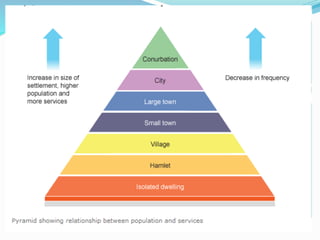
 Settlement hierarchies refers to the
arrangement of settlements within a given area
in an order of importance.
Favourable Conditions for Siting a
Settlement
 Factors or conditions which may favour the siting of a
settlement include the following:
 (i) Adequate water supply: There must be adequate and
dependable water supply for human use.
 (ii) Fertile soil: The soil must be fertile to promote
agricultural activities.
 (iii) Land for building: Such land must be lowland and
well drained for easy erection of buildings.
 (iv) Good communication network: The presence of
good road roads, railways, airport etc may promote easy
settlement of people in a place.
 (v) Defence: The area should be well protected against
invading enemies.
TYPES OF SETTLEMENT
Two types of
settlement
Rural
settlement
Urban
settlement
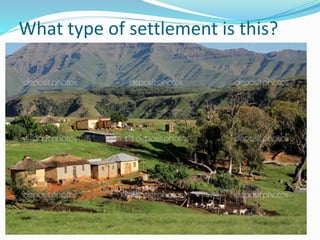
Rural settlement
 The majority of its inhabitants are involve in activity
like farming, fishing, forestry, mining.
 The pattern of rural settlement can vary from a single
farm to a cluster of houses.(dispersed, linear and
nucleated.)
Urban settlement
 The majority of people are engage in non –rural
activity.
 They work in office, shops and factories, operate
machinery, provide health care or other services.
 urban settlement can be small like 1000 people or can
be as large as Tokyo-Yokohama in Japan with over
30million people.
What type of settlement is this?
 Country such as Singapore, Japan, united states of
America, Australia, Germany, united kingdom more
than three quarter of population were living in
urban towns or cities.
 These are first world country.
 In other countries such as India , China ,Egypt ,
Nigeria, most people live in rural areas.
 These are third world country
Characteristic of Rural settlement
 It is a relatively small area .
 It has people that know themselves well( homogenous
people)
 It could be nucleated, dispersed or linear.
 They have people with the same cultural background and
language.
 They are normally made up of few building .
 They have few social amenities and the life is simple and
quite.
 They are normally involved in primary activities such as
farming, fishing and lumbering.
Characteristic of Urban settlement
 It is a relatively large area.
 It has a large number of people who do not know
themselves very well.(socially heterogeneous).
 They are usually nucleated settlements.
 They have people with different cultural background and
different languages.
 They are made up of many building with thousands of
people living in them.
 They have the abundance of social amenities like pipe
borne water, electricity etc.
 They are mainly involved in secondary ,tertiary and
quaternary industries.
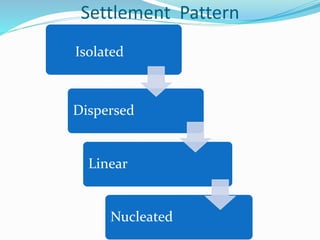
Settlement Pattern
Dispersed
Linear
Nucleated
Isolated
Isolated Settlement
 This is usually a farmhouse found either in areas
of extreme adverse physical conditions or in
areas of pioneer settlement where land was
divided into planned lots.
Dispersed Settlement
 This consists of 2 - 3 buildings, perhaps
forming a hamlet, and separated from the
next small group of buildings by 2 - 3 km
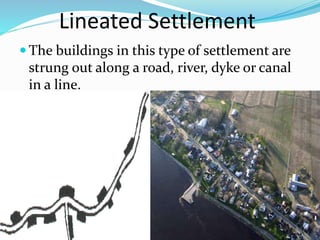
Lineated Settlement
 The buildings in this type of settlement are
strung out along a road, river, dyke or canal
in a line.
Nucleated Settlement
 Buildings grouped together, originally for defensive
purposes as well as for social and economic reasons.
Usually found around a cross-roads .
 A settlement can function as
(i) Market town
(ii) Mining Town
(iii) Industrial/ Manufacturing town
(iv) Port
(v)Route center
(vi) Commercial
(vii) Cultural/ religious
(viii) Administrative
(ix) Residential
(x)Tourist resorts
Settlement yr 7.2
Settlement yr 7.2

Settlement yr 7.2

  • 1.
  • 2.
     A settlementis a place where people live.  A settlement may be as small as a single house in a remote area or as a large as a mega city (a city with over 10 million residents).  A settlement can also be defined as a collection of buildings with people living in them. What is a settlement?
  • 3.
    How can weclassify or describe settlement  Settlements can be grouped together or classified using a variety of criteria.  These include: (i) Site (ii) Type (iii) Shape or pattern (iv) Size (v) Function (vi) Hierarchy
  • 4.
     Site: Theland that a settlement is built on.  Situation describes where the settlement is located in relation to surrounding features such as other settlements  A settlements functions are activities that take place there.  Settlement hierarchies refers to the arrangement of settlements within a given area in an order of importance.
  • 5.
    Favourable Conditions forSiting a Settlement  Factors or conditions which may favour the siting of a settlement include the following:  (i) Adequate water supply: There must be adequate and dependable water supply for human use.  (ii) Fertile soil: The soil must be fertile to promote agricultural activities.  (iii) Land for building: Such land must be lowland and well drained for easy erection of buildings.  (iv) Good communication network: The presence of good road roads, railways, airport etc may promote easy settlement of people in a place.  (v) Defence: The area should be well protected against invading enemies.
  • 6.
    TYPES OF SETTLEMENT Twotypes of settlement Rural settlement Urban settlement
  • 7.
    Rural settlement  Themajority of its inhabitants are involve in activity like farming, fishing, forestry, mining.  The pattern of rural settlement can vary from a single farm to a cluster of houses.(dispersed, linear and nucleated.)
  • 8.
    Urban settlement  Themajority of people are engage in non –rural activity.  They work in office, shops and factories, operate machinery, provide health care or other services.  urban settlement can be small like 1000 people or can be as large as Tokyo-Yokohama in Japan with over 30million people.
  • 9.
    What type ofsettlement is this?
  • 10.
    What type ofsettlement is this?
  • 11.
     Country suchas Singapore, Japan, united states of America, Australia, Germany, united kingdom more than three quarter of population were living in urban towns or cities.  These are first world country.  In other countries such as India , China ,Egypt , Nigeria, most people live in rural areas.  These are third world country
  • 12.
    Characteristic of Ruralsettlement  It is a relatively small area .  It has people that know themselves well( homogenous people)  It could be nucleated, dispersed or linear.  They have people with the same cultural background and language.  They are normally made up of few building .  They have few social amenities and the life is simple and quite.  They are normally involved in primary activities such as farming, fishing and lumbering.
  • 13.
    Characteristic of Urbansettlement  It is a relatively large area.  It has a large number of people who do not know themselves very well.(socially heterogeneous).  They are usually nucleated settlements.  They have people with different cultural background and different languages.  They are made up of many building with thousands of people living in them.  They have the abundance of social amenities like pipe borne water, electricity etc.  They are mainly involved in secondary ,tertiary and quaternary industries.
  • 14.
  • 15.
    Isolated Settlement  Thisis usually a farmhouse found either in areas of extreme adverse physical conditions or in areas of pioneer settlement where land was divided into planned lots.
  • 16.
    Dispersed Settlement  Thisconsists of 2 - 3 buildings, perhaps forming a hamlet, and separated from the next small group of buildings by 2 - 3 km
  • 17.
    Lineated Settlement  Thebuildings in this type of settlement are strung out along a road, river, dyke or canal in a line.
  • 18.
    Nucleated Settlement  Buildingsgrouped together, originally for defensive purposes as well as for social and economic reasons. Usually found around a cross-roads .
  • 20.
     A settlementcan function as (i) Market town (ii) Mining Town (iii) Industrial/ Manufacturing town (iv) Port (v)Route center (vi) Commercial (vii) Cultural/ religious (viii) Administrative (ix) Residential (x)Tourist resorts