Theories in Social Work Vs Social Work Theory Based on the article written by Prof. Rajeshwar Prasad,Former Director, Institute of Social Sciences, Agra IASSI Quarterly, Vol.20.No.1.2001PPT Presentation by S. RengasamyMadurai Institute of Social Sciences
There is a plethora of theories in Social work education, training, research & practice
One may account for approximately thirty theories taught during the period of instruction to social work graduates.
These theories have been borrowed from other disciplines viz. psychiatry, psychology, sociology, anthropology, economics, criminology, political science, theology, philosophy, administration etc.
Attempt is made by social work educators and practitioners to do a good fit of these theories with professional practice of social work.Theories in Social Work Vs Social Work Theory
It will be useful if we understand the different types of theories taught and the logic as why are these theories imparted to the students.
It may be logical to group these theories in broader categories e.g. Theories  of  evolution,
Theories  of  personality (development) & learning theories,
Theories of social organization and social change, theories of social stratification,
Theories of individual and group behavior,
Theories of deviance, crime and correction,
Theories of economic growth and development, theories of group dynamics and leadership,

Theories in social work

  • 1.
    Theories in SocialWork Vs Social Work Theory Based on the article written by Prof. Rajeshwar Prasad,Former Director, Institute of Social Sciences, Agra IASSI Quarterly, Vol.20.No.1.2001PPT Presentation by S. RengasamyMadurai Institute of Social Sciences
  • 2.
    There is aplethora of theories in Social work education, training, research & practice
  • 3.
    One may accountfor approximately thirty theories taught during the period of instruction to social work graduates.
  • 4.
    These theories havebeen borrowed from other disciplines viz. psychiatry, psychology, sociology, anthropology, economics, criminology, political science, theology, philosophy, administration etc.
  • 5.
    Attempt is madeby social work educators and practitioners to do a good fit of these theories with professional practice of social work.Theories in Social Work Vs Social Work Theory
  • 6.
    It will beuseful if we understand the different types of theories taught and the logic as why are these theories imparted to the students.
  • 7.
    It may belogical to group these theories in broader categories e.g. Theories of evolution,
  • 8.
    Theories of personality (development) & learning theories,
  • 9.
    Theories of socialorganization and social change, theories of social stratification,
  • 10.
    Theories of individualand group behavior,
  • 11.
    Theories of deviance,crime and correction,
  • 12.
    Theories of economicgrowth and development, theories of group dynamics and leadership,
  • 13.
    Theories of socialwork (clinical practice) etc. Theories in Social Work Vs Social Work Theory
  • 14.
    Curriculum Development Centrein Social Work Education, University Grants Commission, India recognized three elements of social work curriculum.Values of the profession
  • 15.
    .Skills and methodsthat are developed for the professional task
  • 16.
    .Major theories andconceptsObjectives of teaching theories .Refinement of practice
  • 17.
    .Provision of changingtheoretical inputs to the social work knowledge base
  • 18.
    .Building up ofnew theories from the practice data The centre has recommended to include many different theories discretely and dispersaly but failed to do a wise selectivity of appropriate theories to be taught rationally and coherently and imparting knowledge of these theories compactly as an independent course that are taught in other disciplines eg. Sociological Theories, Modern Economic Theories, Contemporary Political Theories, Psychological Theories Theories in Social Work Vs Social Work Theory
  • 19.
    The term theoryis loosely used in social work profession. The use of social work theories in professional literature is rather ambiguous. Concepts, frames of reference, practice models and philosophical propositions have been termed as theories. Theories in Social Work Vs Social Work Theory
  • 20.
    Some social workpractitioners maintain that due to the very nature of the fast changing society – social relations, social institutions, culture economy, polity, attitude and behavior patterns, dynamics of client – practitioner relationship and the very eclectic nature of the profession, theory has no value in professional practice. But some other advocates that theory should inform and guide the practice and the practice must function as a feedback for theory reformulationTheories in Social Work Vs Social Work Theory
  • 21.
    The social worldand the human behavior within it are so complex that any simplification model can only distort reality. This is not to argue that model building or measurement has no place in sociology. The point is that every social phenomenon must be quantified is neither acceptable nor desirable M. Francis Abraham. It holds true of the status of theory in social work also. Theories in Social Work Vs Social Work Theory
  • 22.
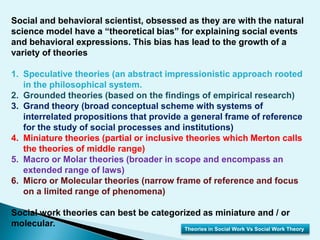
    Social and behavioralscientist, obsessed as they are with the natural science model have a “theoretical bias” for explaining social events and behavioral expressions. This bias has lead to the growth of a variety of theoriesSpeculative theories (an abstract impressionistic approach rooted in the philosophical system. Grounded theories (based on the findings of empirical research) Grand theory (broad conceptual scheme with systems of interrelated propositions that provide a general frame of reference for the study of social processes and institutions)Miniature theories (partial or inclusive theories which Merton calls the theories of middle range)Macro or Molar theories (broader in scope and encompass an extended range of laws)Micro or Molecular theories (narrow frame of reference and focus on a limited range of phenomena) Social work theories can best be categorized as miniature and / or molecular. Theories in Social Work Vs Social Work Theory
  • 23.
    Social work hasbeen widely viewed as a “helping profession”. This helping thrust has been broadly classified into clinical and wider system change orientation. The theories used in social work practice in the western world viz. USA, Canada are predominantly individual pathology oriented, largely influenced by psychoanalytic theory, with farfetched implications /usage for group dysfunctioning, community conflicts, family disintegration due to economic forces and wider societal contradictions that are generally responsible for individual maladjustments, group disorganization and other social problems in any society. Theories in Social Work Vs Social Work Theory
  • 24.
    The realization thatproblems of individual and /or group and community malfunctioning / maladjustments are rooted in the economic and social malaise created due to the inherent contradictions of the capitalist economic political system, ultimately lead to the recognition of macro analysis and the realization of mega actions. Marxist theory based on the above understanding has guided the practice of a considerably good number of social workers throughout the world. Theories in Social Work Vs Social Work Theory
  • 25.
    It is observedby some social workers that the psycho analytic theory instead of informing and guiding the social work practice has simply taken the practice over or in other way hijacked the practice. Theories in Social Work Vs Social Work Theory
  • 26.
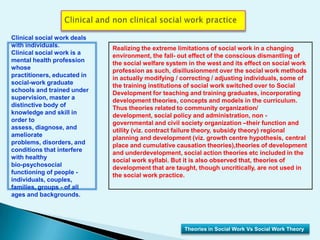
    Clinical and nonclinical social work practice Clinical social work deals with individuals. Clinical social work is a mental health profession whose practitioners, educated in social-work graduate schools and trained under supervision, master a distinctive body of knowledge and skill in order to assess, diagnose, and ameliorate problems, disorders, and conditions that interfere with healthy bio-psychosocial functioning of people - individuals, couples, families, groups - of all ages and backgrounds.Realizing the extreme limitations of social work in a changing environment, the fall- out effect of the conscious dismantling of the social welfare system in the west and its effect on social work profession as such, disillusionment over the social work methods in actually modifying / correcting / adjusting individuals, some of the training institutions of social work switched over to Social Development for teaching and training graduates, incorporating development theories, concepts and models in the curriculum. Thus theories related to community organization/ development, social policy and administration, non - governmental and civil society organization –their function and utility (viz. contract failure theory, subsidy theory) regional planning and development (viz. growth centre hypothesis, central place and cumulative causation theories),theories of development and underdevelopment, social action theories etc included in the social work syllabi. But it is also observed that, theories of development that are taught, though uncritically, are not used in the social work practice.Theories in Social Work Vs Social Work Theory