The system approach to management is
based on the general system theory- the
theory that to understand fully the
operation of an entity, the entity must be
viewed as a system. This requires the
understanding the interdependence of its
parts. The systems approach takes a
holistic view of the entire organization
system and stresses processes.
The System Approach
Systems theory
 It is an approach based on the notion that organization
can be visualized as a system. A system is a set of
interrelated parts that operate as a whole in pursuit of
common goals.
 The systems approach views the organization as a
system that is interdependent with other systems in its
environment. The environment of an organization
includes the social, political, cultural, technological, and
economic forces that affect it.
 Systems approach views the organization as a unified,
purposeful, directed system of interrelated parts, rather
than dealing separately with the various segments of an
organization.
 Systems theory is an extension of the humanistic
perspective that describes organizations as open
systems that are characterized by entropy,
synergy, and subsystem interdependence. A
system is a set of interrelated parts that function
as a whole to achieve a common purpose. A system
functions by acquiring inputs from the external
environment, transforming them in some way, and
discharging outputs back to the environment.
 Based from Ludwig von Bertalanffy ( founder of
general system theory), systems theory focuses on
the arrangement of and relations between the parts
which connect them into a whole (holism).
 The main premise of the theory is that to
understand fully the operation of an entity, the
entity must be viewed as a system. To understand
the system as a whole requires understanding the
interdependence of the parts.
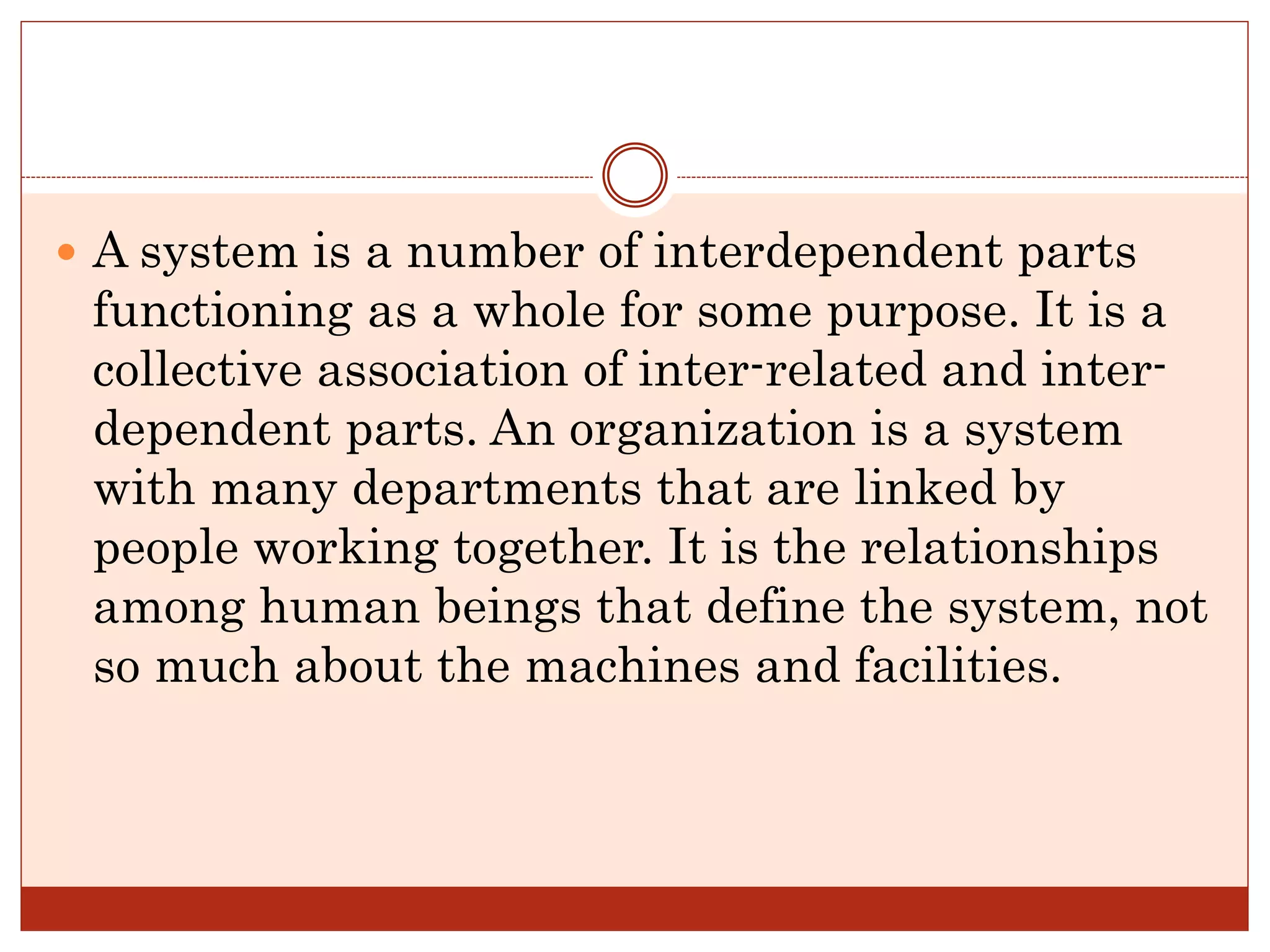
 A system is a number of interdependent parts
functioning as a whole for some purpose. It is a
collective association of inter-related and inter-
dependent parts. An organization is a system
with many departments that are linked by
people working together. It is the relationships
among human beings that define the system, not
so much about the machines and facilities.
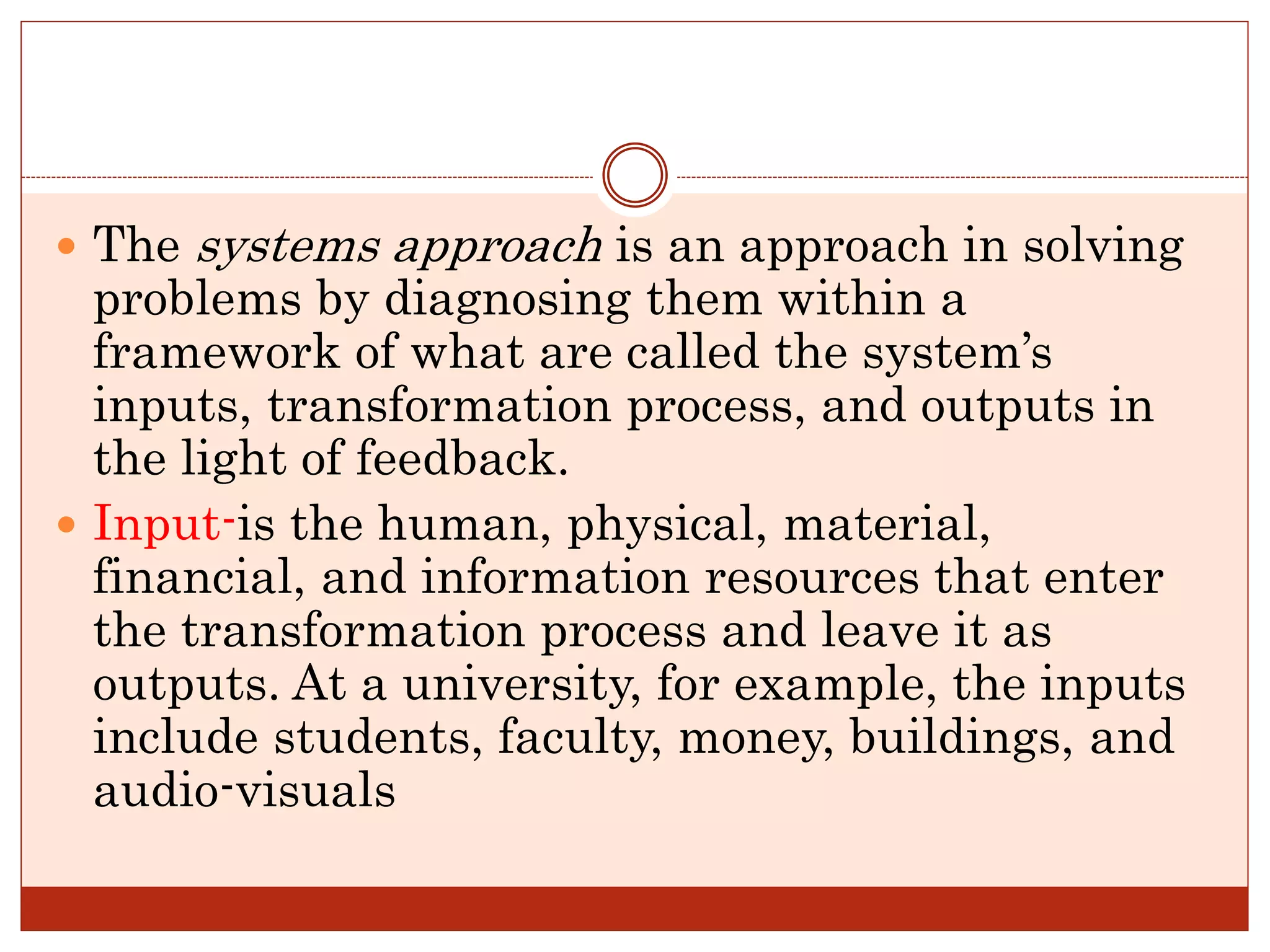
 The systems approach is an approach in solving
problems by diagnosing them within a
framework of what are called the system’s
inputs, transformation process, and outputs in
the light of feedback.
 Input-is the human, physical, material,
financial, and information resources that enter
the transformation process and leave it as
outputs. At a university, for example, the inputs
include students, faculty, money, buildings, and
audio-visuals
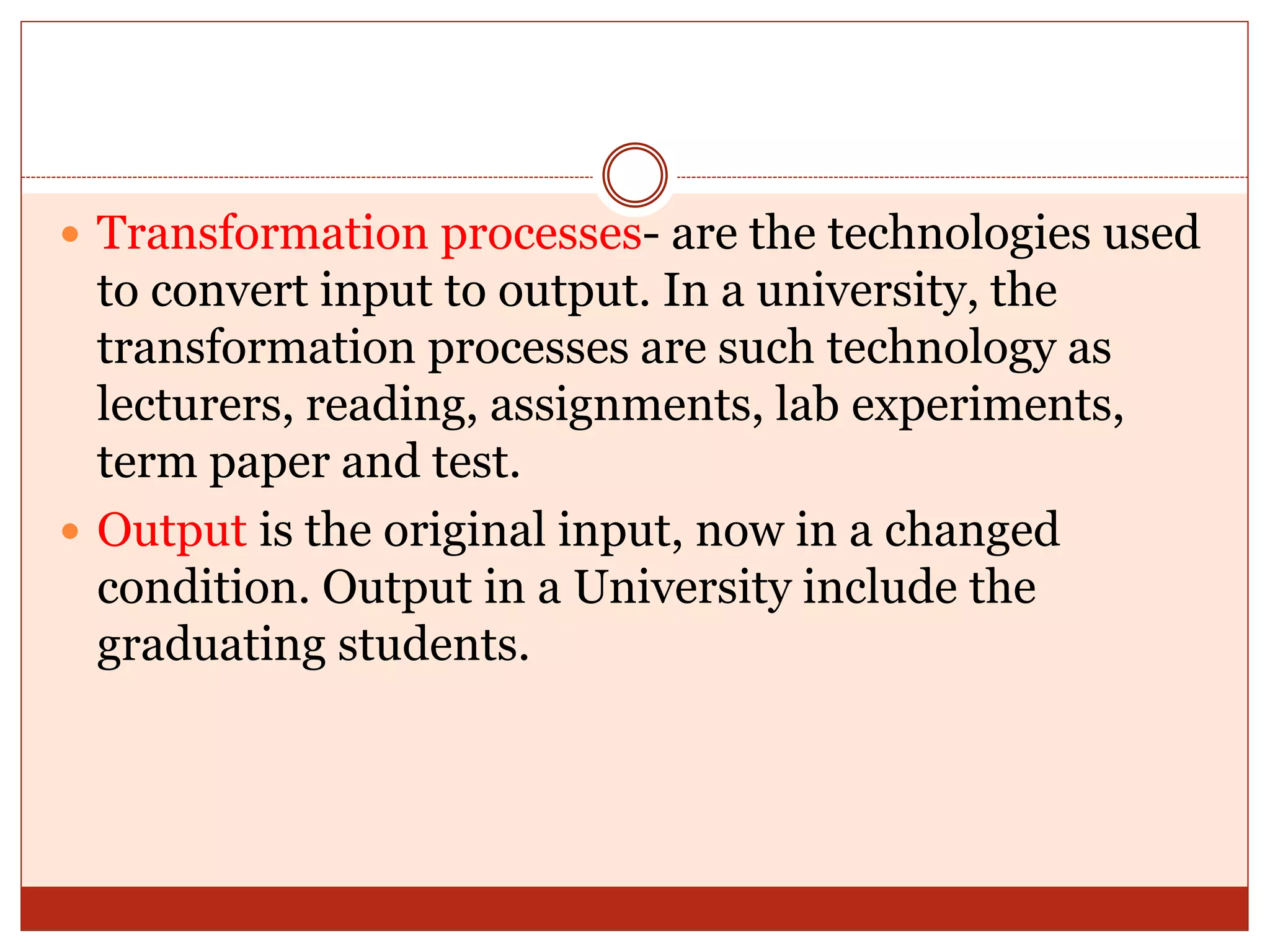
 Transformation processes- are the technologies used
to convert input to output. In a university, the
transformation processes are such technology as
lecturers, reading, assignments, lab experiments,
term paper and test.
 Output is the original input, now in a changed
condition. Output in a University include the
graduating students.
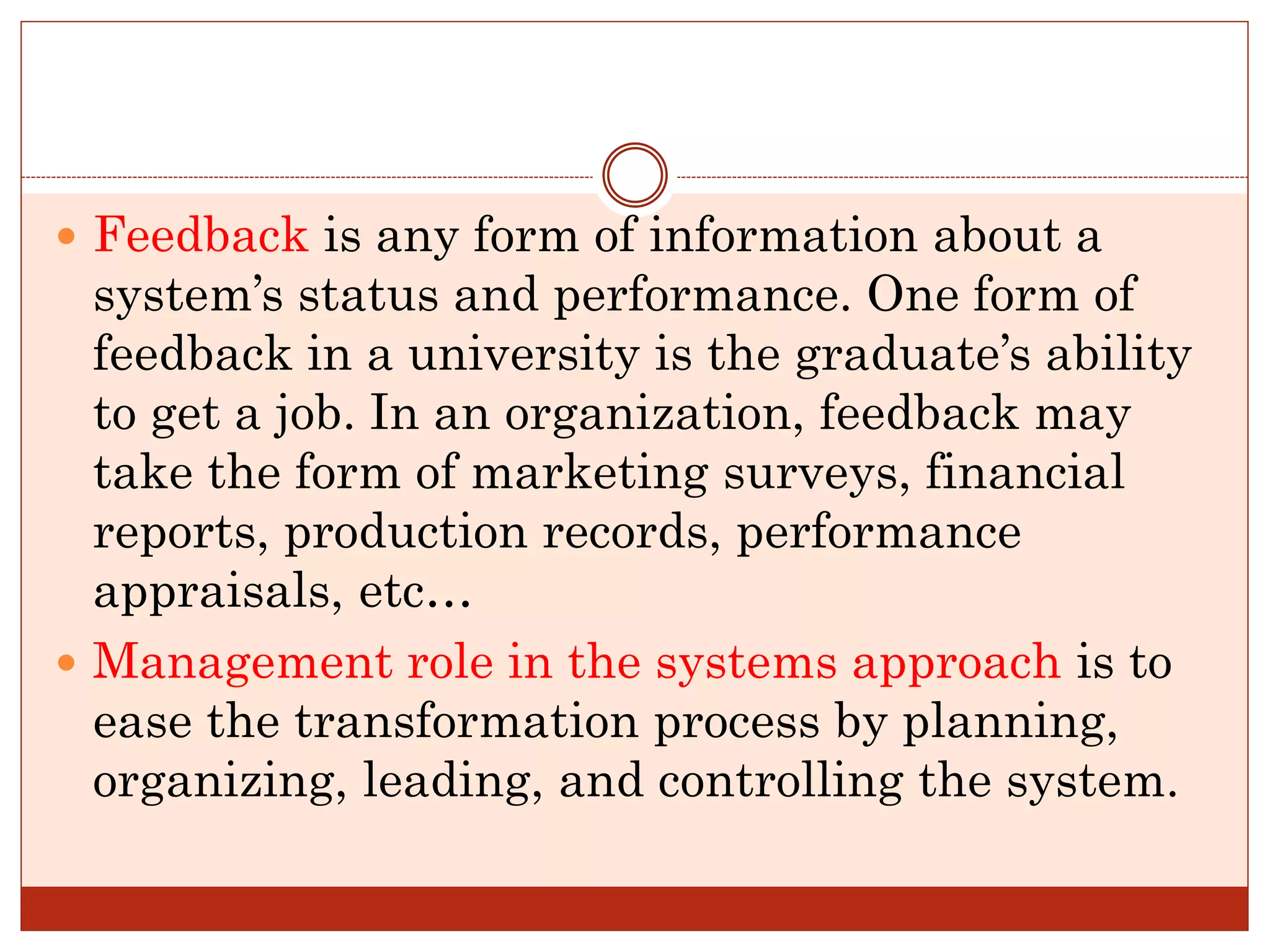
 Feedback is any form of information about a
system’s status and performance. One form of
feedback in a university is the graduate’s ability
to get a job. In an organization, feedback may
take the form of marketing surveys, financial
reports, production records, performance
appraisals, etc…
 Management role in the systems approach is to
ease the transformation process by planning,
organizing, leading, and controlling the system.
Transformation Process
INPUTS
Human,
physical,
financial,
and
information
resources
TRANSFORMATION
PROCESS
ENVIRONMENT
OUTPUTS
Products
and Services
Feedback Loops
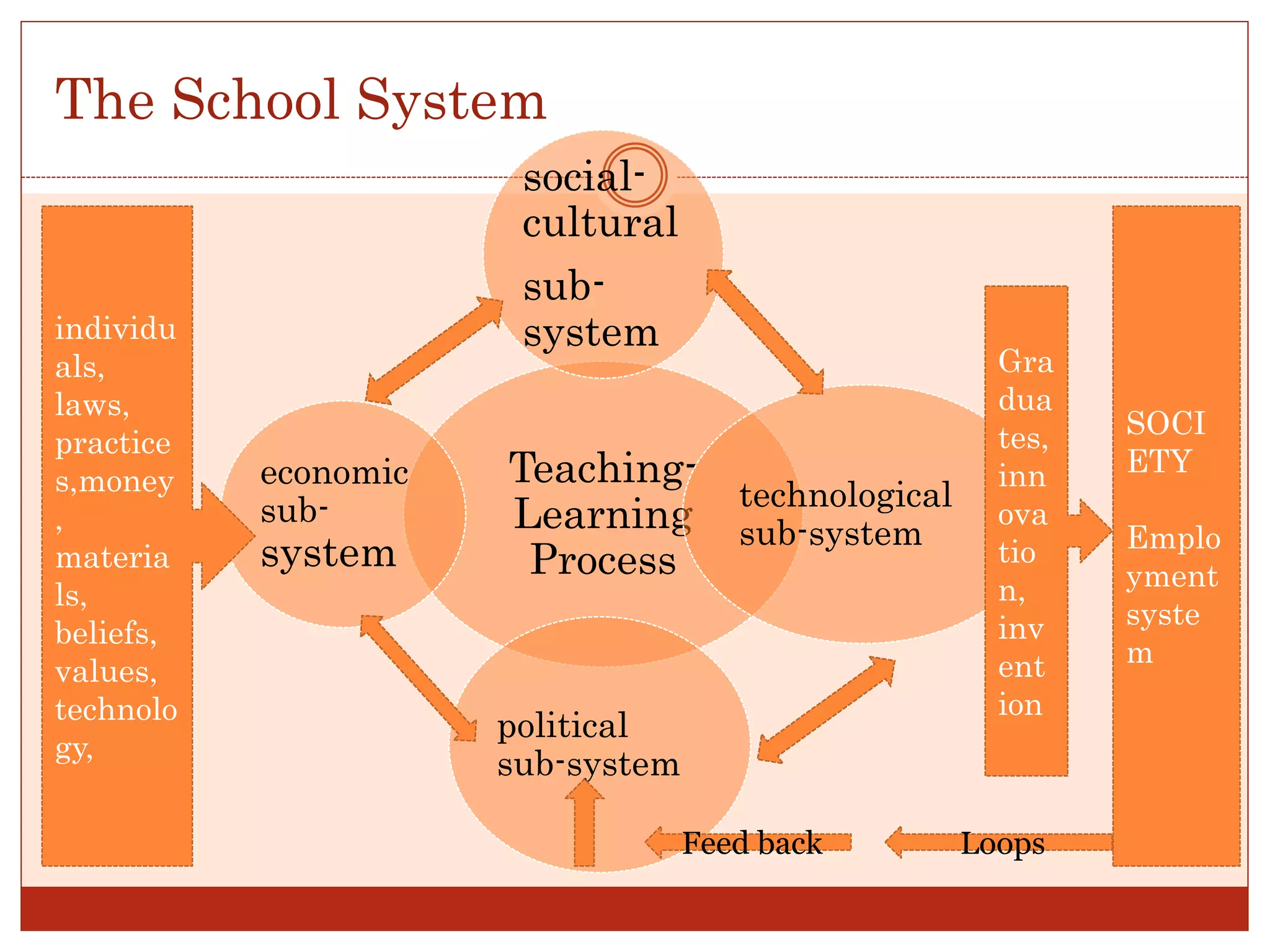
The School System
Teaching-
Learning
Process
social-
cultural
sub-
system
technological
sub-system
political
sub-system
economic
sub-
system
individu
als,
laws,
practice
s,money
,
materia
ls,
beliefs,
values,
technolo
gy,
Gra
dua
tes,
inn
ova
tio
n,
inv
ent
ion
SOCI
ETY
Emplo
yment
syste
m
LoopsFeed back

_System-Approach

  • 1.
    The system approachto management is based on the general system theory- the theory that to understand fully the operation of an entity, the entity must be viewed as a system. This requires the understanding the interdependence of its parts. The systems approach takes a holistic view of the entire organization system and stresses processes. The System Approach
  • 2.
    Systems theory  Itis an approach based on the notion that organization can be visualized as a system. A system is a set of interrelated parts that operate as a whole in pursuit of common goals.  The systems approach views the organization as a system that is interdependent with other systems in its environment. The environment of an organization includes the social, political, cultural, technological, and economic forces that affect it.  Systems approach views the organization as a unified, purposeful, directed system of interrelated parts, rather than dealing separately with the various segments of an organization.
  • 3.
     Systems theoryis an extension of the humanistic perspective that describes organizations as open systems that are characterized by entropy, synergy, and subsystem interdependence. A system is a set of interrelated parts that function as a whole to achieve a common purpose. A system functions by acquiring inputs from the external environment, transforming them in some way, and discharging outputs back to the environment.
  • 4.
     Based fromLudwig von Bertalanffy ( founder of general system theory), systems theory focuses on the arrangement of and relations between the parts which connect them into a whole (holism).  The main premise of the theory is that to understand fully the operation of an entity, the entity must be viewed as a system. To understand the system as a whole requires understanding the interdependence of the parts.
  • 5.
     A systemis a number of interdependent parts functioning as a whole for some purpose. It is a collective association of inter-related and inter- dependent parts. An organization is a system with many departments that are linked by people working together. It is the relationships among human beings that define the system, not so much about the machines and facilities.
  • 6.
     The systemsapproach is an approach in solving problems by diagnosing them within a framework of what are called the system’s inputs, transformation process, and outputs in the light of feedback.  Input-is the human, physical, material, financial, and information resources that enter the transformation process and leave it as outputs. At a university, for example, the inputs include students, faculty, money, buildings, and audio-visuals
  • 7.
     Transformation processes-are the technologies used to convert input to output. In a university, the transformation processes are such technology as lecturers, reading, assignments, lab experiments, term paper and test.  Output is the original input, now in a changed condition. Output in a University include the graduating students.
  • 8.
     Feedback isany form of information about a system’s status and performance. One form of feedback in a university is the graduate’s ability to get a job. In an organization, feedback may take the form of marketing surveys, financial reports, production records, performance appraisals, etc…  Management role in the systems approach is to ease the transformation process by planning, organizing, leading, and controlling the system.
  • 9.
  • 10.