PowerPoint Presentation by Rajeesh Viswanathan
Jansons school of Business
Organization Theory
Structure, Design, and Applications
Third Revised Edition
Stephen P. Robbins and Mary Mathew
C H A P T E R
1
PART I: INTRODUCTION: WHAT’S IT ALL ABOUT?
An Overview
After reading this chapter, you should be able to:
 Define organization theory
 Compare organization theory and organizational
behavior
 Explain the value in studying organization theory
 Describe the systems perspective
 Describe the life-cycle perspective
 Discuss how systems and life cycles are part of the
biological metaphor
1–2
1–3
What is an OrganizationWhat is an Organization
An organization is a consciously coordinated social
entity, with a relatively identifiable boundary, that
functions on a relatively continuous basis to achieve a
common goal or a set of goals.
What is Organization Structure?What is Organization Structure?
It defines how task are to be allocated, who reports to
whom and the formal coordination mechanisms and
interaction patterns that will be followed.
Organization structure has three components:
1. Complexity
2. Formalization
3. Centralization
1–4
Components of Organization StructureComponents of Organization Structure
Complexity: It considers the extent of differentiation
within the organization.
Formalization: The degree to which an organization
relies on rules and procedures to direct the behavior
of the employees is formalization.
Centralization: It considers where the locus of decision
- making authority lies.
1–5
Features of an OrganizationFeatures of an Organization
1. It has a relatively identifiable boundary.
2. People in the organization have some continuing
bond.
3. Organization has a goals and to attain it they set a
mission.
1–6
What is a Organization Design?What is a Organization Design?
Organization design is concerned with constructing
and changing an organization’s structure to achieve
the organization’s goals.
It to have a smooth flow of the system without any
ambiguity in functions.
1–7
Organization TheoryOrganization Theory
It is a discipline that studies the structure and design
of organizations. It describes how organizations are
actually structured and offers suggestions on how
they can be constructed to improve their
effectiveness. It studies the organization at a macro
level.
1–8
Contrasting Organization Theory and
Organization Behavior
Contrasting Organization Theory and
Organization Behavior
 Organizational Behavior takes a micro view –
emphasizing individuals and small groups.
» OB focuses on the behavior in organizations,
employees performance, and attitude
 Organizational Theory takes a macro
perspective. Its unit of analysis is organization itself
or its primary sub units
» OT is concerned not only with the performance
of employee and attitude but overall
organizations ability to adapt & achieve its goals
1–9
Why Study Organization Theory?Why Study Organization Theory?
To know how organizations operate from a scientific
point of view and then use the knowledge for
constructing and changing an organizations structure
to achieve the organizations goals.
1–10
Ten Different Ways of Glancing at OrganizationsTen Different Ways of Glancing at Organizations
1. Organizations have been conceptualized in numerous
ways
2. Rational entities in pursuit of goals
3. Coalitions of powerful constituencies
4. Open system
5. Meaning producing systems
6. Loosely coupled system
7. Political system
8. Instruments of domination
9. Information processing units
10. Psychic prisons
11. Social contracts
1–11
The Systems PerspectiveThe Systems Perspective
A systems perspective offers important insights into the
working of an organization.
A system is a set of interrelated and interdependent parts
arranged in a manner that produces a unified whole.
An organization has divisions, departments and like units
separated out to perform specialized activities. At the
same time, in order to maintain unity among the
differentiated parts and form a complete whole, every
energy system has a reciprocal process of integration.
It is achieved through devices such as coordinated levels
of hierarchy; supervision, rules, procedures & policies.
1–12
Types of SystemsTypes of Systems
Closed system. It would be the one that receives
no, enclosed, and sealed off from the outside world.
energy from an outside source and from which no
energy is released to its surroundings. A closed
system would not depend on its environment; it would
be autonomous.
Open System. An open system interacts with and
adapts to the environment by consuming resources
and exporting product and services to it. Because of
its interdependence with various elements issues
involved are more complex in nature.
1–13
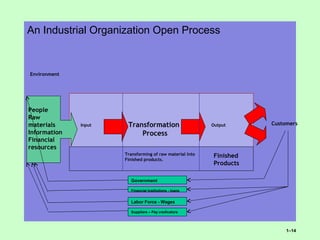
An Industrial Organization Open Process
1–14
Input Transformation
Process
Output Customers
Environment
People
Raw
materials
Information
Financial
resources
Finished
Products
Transforming of raw material into
Finished products.
Government
Financial Institutions - loans
Labor Force - Wages
Suppliers – Pay credicators
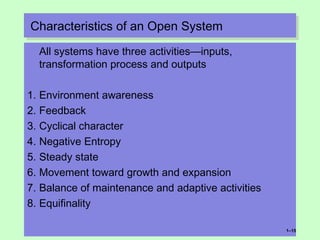
Characteristics of an Open SystemCharacteristics of an Open System
All systems have three activities—inputs,
transformation process and outputs
1. Environment awareness
2. Feedback
3. Cyclical character
4. Negative Entropy
5. Steady state
6. Movement toward growth and expansion
7. Balance of maintenance and adaptive activities
8. Equifinality
1–15
Importance of the Systems PerspectiveImportance of the Systems Perspective
For managers and future managers, the systems
perspective permits seeing the organization as a
whole with interdependent parts – a system
composed of subsystems.
It helps all managers to identify and understand
the environment in which their system operates.
1–16
The Life Cycle PerspectiveThe Life Cycle Perspective
A life cycle refers to a pattern of predictable change.
By applying it to an organization, we are saying that
their are distinct stages through which organizations
proceed, that the stages follow a consistent pattern
and that the transitions from one stage to another
are predictable rather than random occurrences.
1–17
Life Cycle StagesLife Cycle Stages
1. Entrepreneurial stage. The organization is in its infancy. Goals
tend to be ambiguous. Creativity is high.
2. Collectivity stage. Organizations mission is clarified. Communication
& structure within the organization remain informal.
3. Formalization and control stage. Organization structure is
stabilized with rules and procedures being imposed. Organization exists
beyond the presence of any one individual.
4. Elaboration of structure stage. It diversifies its products and
services in the market. Decisions are decentralized
5. Decline stage. As a result of competition its products demands
decreases. Management looks for alternatives to sustain and
development of new product.
1–18
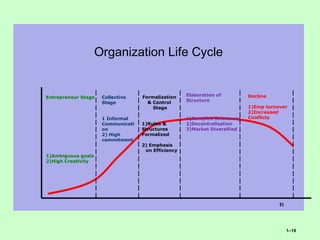
Organization Life Cycle
1–19
Ti
Entrepreneur Stage
1)Ambiguous goals
2)High Creativity
Collective
Stage
1 Informal
Communicati
on
2) High
commitment
Formalization
& Control
Stage
1)Rules &
Structures
Formalized
2) Emphasis
on Efficiency
Elaboration of
Structure
1)Complex Structures
2)Decentralisation
3)Market Diversified
Decline
1)Emp turnover
2)Increased
Conflicts

chapter 1

  • 1.
    PowerPoint Presentation byRajeesh Viswanathan Jansons school of Business Organization Theory Structure, Design, and Applications Third Revised Edition Stephen P. Robbins and Mary Mathew C H A P T E R 1 PART I: INTRODUCTION: WHAT’S IT ALL ABOUT? An Overview
  • 2.
    After reading thischapter, you should be able to:  Define organization theory  Compare organization theory and organizational behavior  Explain the value in studying organization theory  Describe the systems perspective  Describe the life-cycle perspective  Discuss how systems and life cycles are part of the biological metaphor 1–2
  • 3.
    1–3 What is anOrganizationWhat is an Organization An organization is a consciously coordinated social entity, with a relatively identifiable boundary, that functions on a relatively continuous basis to achieve a common goal or a set of goals.
  • 4.
    What is OrganizationStructure?What is Organization Structure? It defines how task are to be allocated, who reports to whom and the formal coordination mechanisms and interaction patterns that will be followed. Organization structure has three components: 1. Complexity 2. Formalization 3. Centralization 1–4
  • 5.
    Components of OrganizationStructureComponents of Organization Structure Complexity: It considers the extent of differentiation within the organization. Formalization: The degree to which an organization relies on rules and procedures to direct the behavior of the employees is formalization. Centralization: It considers where the locus of decision - making authority lies. 1–5
  • 6.
    Features of anOrganizationFeatures of an Organization 1. It has a relatively identifiable boundary. 2. People in the organization have some continuing bond. 3. Organization has a goals and to attain it they set a mission. 1–6
  • 7.
    What is aOrganization Design?What is a Organization Design? Organization design is concerned with constructing and changing an organization’s structure to achieve the organization’s goals. It to have a smooth flow of the system without any ambiguity in functions. 1–7
  • 8.
    Organization TheoryOrganization Theory Itis a discipline that studies the structure and design of organizations. It describes how organizations are actually structured and offers suggestions on how they can be constructed to improve their effectiveness. It studies the organization at a macro level. 1–8
  • 9.
    Contrasting Organization Theoryand Organization Behavior Contrasting Organization Theory and Organization Behavior  Organizational Behavior takes a micro view – emphasizing individuals and small groups. » OB focuses on the behavior in organizations, employees performance, and attitude  Organizational Theory takes a macro perspective. Its unit of analysis is organization itself or its primary sub units » OT is concerned not only with the performance of employee and attitude but overall organizations ability to adapt & achieve its goals 1–9
  • 10.
    Why Study OrganizationTheory?Why Study Organization Theory? To know how organizations operate from a scientific point of view and then use the knowledge for constructing and changing an organizations structure to achieve the organizations goals. 1–10
  • 11.
    Ten Different Waysof Glancing at OrganizationsTen Different Ways of Glancing at Organizations 1. Organizations have been conceptualized in numerous ways 2. Rational entities in pursuit of goals 3. Coalitions of powerful constituencies 4. Open system 5. Meaning producing systems 6. Loosely coupled system 7. Political system 8. Instruments of domination 9. Information processing units 10. Psychic prisons 11. Social contracts 1–11
  • 12.
    The Systems PerspectiveTheSystems Perspective A systems perspective offers important insights into the working of an organization. A system is a set of interrelated and interdependent parts arranged in a manner that produces a unified whole. An organization has divisions, departments and like units separated out to perform specialized activities. At the same time, in order to maintain unity among the differentiated parts and form a complete whole, every energy system has a reciprocal process of integration. It is achieved through devices such as coordinated levels of hierarchy; supervision, rules, procedures & policies. 1–12
  • 13.
    Types of SystemsTypesof Systems Closed system. It would be the one that receives no, enclosed, and sealed off from the outside world. energy from an outside source and from which no energy is released to its surroundings. A closed system would not depend on its environment; it would be autonomous. Open System. An open system interacts with and adapts to the environment by consuming resources and exporting product and services to it. Because of its interdependence with various elements issues involved are more complex in nature. 1–13
  • 14.
    An Industrial OrganizationOpen Process 1–14 Input Transformation Process Output Customers Environment People Raw materials Information Financial resources Finished Products Transforming of raw material into Finished products. Government Financial Institutions - loans Labor Force - Wages Suppliers – Pay credicators
  • 15.
    Characteristics of anOpen SystemCharacteristics of an Open System All systems have three activities—inputs, transformation process and outputs 1. Environment awareness 2. Feedback 3. Cyclical character 4. Negative Entropy 5. Steady state 6. Movement toward growth and expansion 7. Balance of maintenance and adaptive activities 8. Equifinality 1–15
  • 16.
    Importance of theSystems PerspectiveImportance of the Systems Perspective For managers and future managers, the systems perspective permits seeing the organization as a whole with interdependent parts – a system composed of subsystems. It helps all managers to identify and understand the environment in which their system operates. 1–16
  • 17.
    The Life CyclePerspectiveThe Life Cycle Perspective A life cycle refers to a pattern of predictable change. By applying it to an organization, we are saying that their are distinct stages through which organizations proceed, that the stages follow a consistent pattern and that the transitions from one stage to another are predictable rather than random occurrences. 1–17
  • 18.
    Life Cycle StagesLifeCycle Stages 1. Entrepreneurial stage. The organization is in its infancy. Goals tend to be ambiguous. Creativity is high. 2. Collectivity stage. Organizations mission is clarified. Communication & structure within the organization remain informal. 3. Formalization and control stage. Organization structure is stabilized with rules and procedures being imposed. Organization exists beyond the presence of any one individual. 4. Elaboration of structure stage. It diversifies its products and services in the market. Decisions are decentralized 5. Decline stage. As a result of competition its products demands decreases. Management looks for alternatives to sustain and development of new product. 1–18
  • 19.
    Organization Life Cycle 1–19 Ti EntrepreneurStage 1)Ambiguous goals 2)High Creativity Collective Stage 1 Informal Communicati on 2) High commitment Formalization & Control Stage 1)Rules & Structures Formalized 2) Emphasis on Efficiency Elaboration of Structure 1)Complex Structures 2)Decentralisation 3)Market Diversified Decline 1)Emp turnover 2)Increased Conflicts