GENERAL SYSTEM THEORY
Reduction vs. Systems

 1950’s the main approach to understanding
  was ‘reductionism’ – divide something into its
  parts
 Ludwig von Bertalnffy proposed systems
  thinking – discover how something interacts
  with its environment
General Systems Theory

 Science of understanding open systems theory
 GST provides a framework to study open systems
 GST is not too general nor too specific
Open Systems

 All living and many non-living things are open
  systems
 Systems theory gives us a way to ‘think about’
  open systems
 Systems theory lays the foundation for the
  analysis and modelling of systems
 Systems theory provides an analytical
  framework for comprehending dynamic
  interrelated operating systems
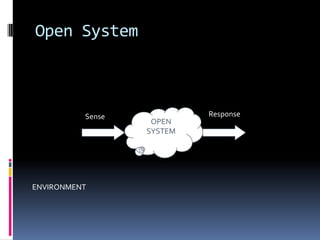
Open System


          Sense            Response
                   OPEN
                  SYSTEM


ENVIRONMENT
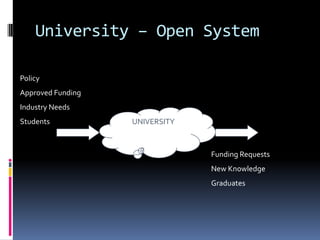
University – Open System

Policy
Approved Funding
Industry Needs
Students           UNIVERSITY


                                Funding Requests
                                New Knowledge
                                Graduates
Systems Thinking

 holistic approach to problem solving
 reflecting on how the organisation relates to
  its business environment and
 how factors in the environment can affect the
  organisation
Definition of ‘System’

“... an identifiable, complex dynamic entity
   composed of discernibly different parts or
   subsystems that are interrelated to and
   interdependent on each other and the whole
   entity with an overall capability to maintain
   stability and to adapt behaviour in response
   to external influences” [Webster’s]
Boulding’s Explanation

“Somewhere … between the specific that has
  no meaning and the general that has no
  content there must be, for each purpose and
  at each level of abstraction, an optimum
  degree of generality”
Beckett’s explanation

"The trust of general systems .. is to draw
  attention to the study of relationships of
  parts to one another within the wholes”
GST Traits

 Systems …
     are Goal Seeking
     are Holistic
     have Hierarchy
     have Inputs and Outputs
     transform inputs into outputs
     consume and/or create Energy
     are affected by Entropy
     have Equifinality
     have Feedback
Goal Seeking
 All open systems must have goals
 There are two types
    Inner directed goals
    Outer directed goals
 Design strategies are typically “outer
  directed” goals
 Maintenance strategies are an “inner
  directed” goal
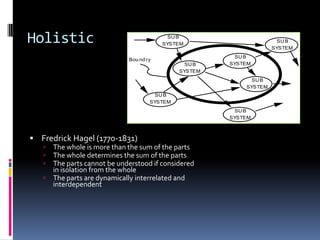
Holistic                                   SU B
                                         SYSTEM
                                                                      SU B
                                                                    SYSTEM
                                                         SU B
                             Bou nd ry
                                                SU B   SYSTEM
                                              SYSTEM
                                                             SU B
                                                           SYSTEM
                                       SU B
                                     SYSTEM
                                                         SU B
                                                       SYSTEM


 Fredrick Hagel (1770-1831)
    The whole is more than the sum of the parts
    The whole determines the sum of the parts
    The parts cannot be understood if considered
     in isolation from the whole
    The parts are dynamically interrelated and
     interdependent
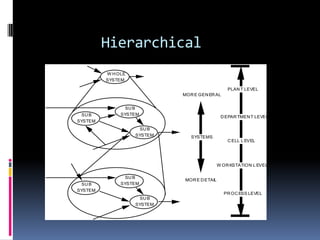
Hierarchical
         W H OLE
         SYSTEM

                                                PLAN T LEVEL
                            MOR E GEN ER AL


                SU B
  SU B        SYSTEM
                                             D EPAR TMEN T LEVEL
SYSTEM
                     SU B
                   SYSTEM      SYSTEMS
                                                C ELL L EVEL


                                            W OR KSTATION L EVEL

                SU B
                            MOR E D ETAIL
  SU B        SYSTEM
SYSTEM
                                              PR OC ESS LEVEL
                     SU B
                   SYSTEM
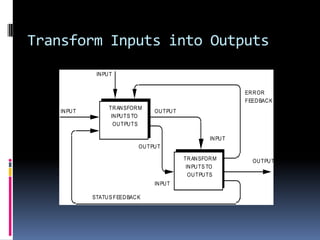
Transform Inputs into Outputs
               IN PU T


                                                                  ER R OR
                                                                  FEED BAC K
                    TR AN SFOR M
    IN PU T                         OU TPU T
                     IN PU TS TO
                      OU TPU TS

                                                        IN PU T
                               OU TPU T

                                               TR AN SFOR M         OU TPU T
                                                IN PU TS TO
                                                 OU TPU TS
                                    IN PU T

              STATU S FEED BAC K
Entropy

 A measure of the amount of disorder in a system
 Everything disintegrates over time
 Negative entropy or centropy
 Effects of entropy are offset by the system
  transforming itself continuously
 Maintain order through such things as repairs,
  maintenance and possibly growing by importing
  ‘energy’
Energy, Equifinality and Feedback

  Systems create/consume energy
    Physical
    Emotional
  Equifinality is the ability for systems to achieve
   goals in a number of ways
  This flexibility allows systems avoid the effects of
   entropy
  Systems have feedback - feedback can allow a
   system to change its direction
Conclusions
 Views of GST are universal
 GST combats ‘isolationist’ tendencies among engineers,
  systems analysts, business analysts, IT specialists, etc.
  etc.
 GST offers a framework for understanding all systems
 Benefits of GST to design of systems are significant
 Theory of GST lays at the foundation of much new
  thinking in - including ‘Learning Organisations’,
  ‘Structured Analysis’, ‘Sociotechnical Design’ and
  ‘Strategic Planning’
Boulding and the Hierarchy
of Systems Complexity
 Kenneth Boulding, “General System Theory –
  The Skeleton of Science”, 1956
   The existing over-specialization of science and the
    lack of communication between the different
    areas.
   Each studies some kind of systems, a classification
    is necessary if a general methodology for their
    study is to be developed.
Boulding and the Hierarchy
of Systems Complexity [2]
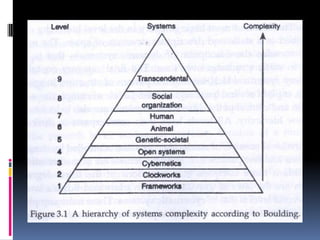
 Frameworks
   Level of static structures and relationship
   Ex: the arrangement of atoms in a crystal, the
    anatomy of genes, the organization of the
    astronomical universe.

 Clockworks
   The Solar System  simple dynamic system with
    predetermined motion
   Car engines and dynamos
Boulding and the Hierarchy
of Systems Complexity [3]
 Cybernetic Systems
   Control mechanism, characterized: feedback
    mechanisms with transmission and interpretation
    of information.
   A thermostat with teleological behavior


 Cell
   Self-maintaining structure
   Open-system level
Boulding and the Hierarchy
of Systems Complexity [4]
 Plant
   Process of the plant level take place without
    specialized sense organs, the reaction to changes in
    the environment is slow.

 Animal
   Wide range of specialized sensors convey a great
    amount of information via a nervous system to a brain
    where information can be stored and structured.
   Reaction to changes in the environment are more or
    less instantaneous.
Boulding and the Hierarchy
of Systems Complexity [5]
 Human
   Sophisticated language capability and the use of
    internal symbols through which man accumulates
    knowledge.

 Social Organization
   The units assumed roles and these are tied together
    by the channel of communication.

 Transcendental
   Unknowable, presupposed exhibit systemic structure
    and relationship.
Boulding and the Hierarchy
of Systems Complexity [6]
 Physical Scientist
   Category of physical and mechanical systems:
    framework, clockwork, cybernetics
 Biologist, Botanist, and zoologist
   cell, plant, and animal
 Social Scientist
   Human and social organization
 Philosophy
   Transcendental systems
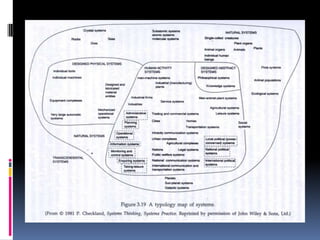
Checkland and the Systems
Typology
 Peter Checkland, “Systems Thinking Systems
  Practice”, 1981.
 The absolute minimum number of systems
  classes necessary to describe the existing
  reality is four  natural, human activity,
  designed physical, designed abstract,
  systems.
Checkland and the Systems
Typology [2]
 Natural Systems
   “they are systems which could not be other than
    they are, given a universe whose patterns and
    laws are not erratic”

 Human Activity Systems
   Have a tendency to integrate in such a way that
    they can be viewed as a whole.
   Social system
   Ex: agricultural, defence, trading, transportation
Checkland and the Systems
Typology [3]
 Designed Physical Systems
   Systems fitted with purpose of mind because a need
    for them in some human activity has been identified
   Individual tools, individual machines, other designed
    and fabricated material entities


 Designed Abstract Systems
   Various type of theological, philosophical or
    knowledge systems.
   Only associated with human beings.
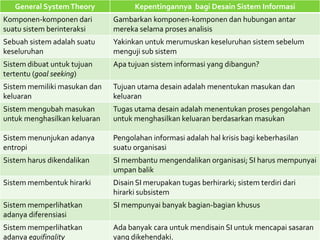
General System Theory            Kepentingannya bagi Desain Sistem Informasi
Komponen-komponen dari        Gambarkan komponen-komponen dan hubungan antar
suatu sistem berinteraksi     mereka selama proses analisis
Sebuah sistem adalah suatu    Yakinkan untuk merumuskan keseluruhan sistem sebelum
keseluruhan                   menguji sub sistem
Sistem dibuat untuk tujuan    Apa tujuan sistem informasi yang dibangun?
tertentu (goal seeking)
Sistem memiliki masukan dan   Tujuan utama desain adalah menentukan masukan dan
keluaran                      keluaran
Sistem mengubah masukan       Tugas utama desain adalah menentukan proses pengolahan
untuk menghasilkan keluaran   untuk menghasilkan keluaran berdasarkan masukan

Sistem menunjukan adanya      Pengolahan informasi adalah hal krisis bagi keberhasilan
entropi                       suatu organisasi
Sistem harus dikendalikan     SI membantu mengendalikan organisasi; SI harus mempunyai
                              umpan balik
Sistem membentuk hirarki      Disain SI merupakan tugas berhirarki; sistem terdiri dari
                              hirarki subsistem
Sistem memperlihatkan         SI mempunyai banyak bagian-bagian khusus
adanya diferensiasi
Sistem memperlihatkan         Ada banyak cara untuk mendisain SI untuk mencapai sasaran
adanya equifinality           yang dikehendaki.

1.2 General System Theory

  • 1.
  • 2.
    Reduction vs. Systems 1950’s the main approach to understanding was ‘reductionism’ – divide something into its parts  Ludwig von Bertalnffy proposed systems thinking – discover how something interacts with its environment
  • 3.
    General Systems Theory Science of understanding open systems theory  GST provides a framework to study open systems  GST is not too general nor too specific
  • 4.
    Open Systems  Allliving and many non-living things are open systems  Systems theory gives us a way to ‘think about’ open systems  Systems theory lays the foundation for the analysis and modelling of systems  Systems theory provides an analytical framework for comprehending dynamic interrelated operating systems
  • 5.
    Open System Sense Response OPEN SYSTEM ENVIRONMENT
  • 6.
    University – OpenSystem Policy Approved Funding Industry Needs Students UNIVERSITY Funding Requests New Knowledge Graduates
  • 7.
    Systems Thinking  holisticapproach to problem solving  reflecting on how the organisation relates to its business environment and  how factors in the environment can affect the organisation
  • 8.
    Definition of ‘System’ “...an identifiable, complex dynamic entity composed of discernibly different parts or subsystems that are interrelated to and interdependent on each other and the whole entity with an overall capability to maintain stability and to adapt behaviour in response to external influences” [Webster’s]
  • 9.
    Boulding’s Explanation “Somewhere …between the specific that has no meaning and the general that has no content there must be, for each purpose and at each level of abstraction, an optimum degree of generality”
  • 10.
    Beckett’s explanation "The trustof general systems .. is to draw attention to the study of relationships of parts to one another within the wholes”
  • 11.
    GST Traits  Systems…  are Goal Seeking  are Holistic  have Hierarchy  have Inputs and Outputs  transform inputs into outputs  consume and/or create Energy  are affected by Entropy  have Equifinality  have Feedback
  • 12.
    Goal Seeking  Allopen systems must have goals  There are two types  Inner directed goals  Outer directed goals  Design strategies are typically “outer directed” goals  Maintenance strategies are an “inner directed” goal
  • 13.
    Holistic SU B SYSTEM SU B SYSTEM SU B Bou nd ry SU B SYSTEM SYSTEM SU B SYSTEM SU B SYSTEM SU B SYSTEM  Fredrick Hagel (1770-1831)  The whole is more than the sum of the parts  The whole determines the sum of the parts  The parts cannot be understood if considered in isolation from the whole  The parts are dynamically interrelated and interdependent
  • 14.
    Hierarchical W H OLE SYSTEM PLAN T LEVEL MOR E GEN ER AL SU B SU B SYSTEM D EPAR TMEN T LEVEL SYSTEM SU B SYSTEM SYSTEMS C ELL L EVEL W OR KSTATION L EVEL SU B MOR E D ETAIL SU B SYSTEM SYSTEM PR OC ESS LEVEL SU B SYSTEM
  • 15.
    Transform Inputs intoOutputs IN PU T ER R OR FEED BAC K TR AN SFOR M IN PU T OU TPU T IN PU TS TO OU TPU TS IN PU T OU TPU T TR AN SFOR M OU TPU T IN PU TS TO OU TPU TS IN PU T STATU S FEED BAC K
  • 16.
    Entropy  A measureof the amount of disorder in a system  Everything disintegrates over time  Negative entropy or centropy  Effects of entropy are offset by the system transforming itself continuously  Maintain order through such things as repairs, maintenance and possibly growing by importing ‘energy’
  • 17.
    Energy, Equifinality andFeedback  Systems create/consume energy  Physical  Emotional  Equifinality is the ability for systems to achieve goals in a number of ways  This flexibility allows systems avoid the effects of entropy  Systems have feedback - feedback can allow a system to change its direction
  • 18.
    Conclusions  Views ofGST are universal  GST combats ‘isolationist’ tendencies among engineers, systems analysts, business analysts, IT specialists, etc. etc.  GST offers a framework for understanding all systems  Benefits of GST to design of systems are significant  Theory of GST lays at the foundation of much new thinking in - including ‘Learning Organisations’, ‘Structured Analysis’, ‘Sociotechnical Design’ and ‘Strategic Planning’
  • 19.
    Boulding and theHierarchy of Systems Complexity  Kenneth Boulding, “General System Theory – The Skeleton of Science”, 1956  The existing over-specialization of science and the lack of communication between the different areas.  Each studies some kind of systems, a classification is necessary if a general methodology for their study is to be developed.
  • 21.
    Boulding and theHierarchy of Systems Complexity [2]  Frameworks  Level of static structures and relationship  Ex: the arrangement of atoms in a crystal, the anatomy of genes, the organization of the astronomical universe.  Clockworks  The Solar System  simple dynamic system with predetermined motion  Car engines and dynamos
  • 22.
    Boulding and theHierarchy of Systems Complexity [3]  Cybernetic Systems  Control mechanism, characterized: feedback mechanisms with transmission and interpretation of information.  A thermostat with teleological behavior  Cell  Self-maintaining structure  Open-system level
  • 23.
    Boulding and theHierarchy of Systems Complexity [4]  Plant  Process of the plant level take place without specialized sense organs, the reaction to changes in the environment is slow.  Animal  Wide range of specialized sensors convey a great amount of information via a nervous system to a brain where information can be stored and structured.  Reaction to changes in the environment are more or less instantaneous.
  • 24.
    Boulding and theHierarchy of Systems Complexity [5]  Human  Sophisticated language capability and the use of internal symbols through which man accumulates knowledge.  Social Organization  The units assumed roles and these are tied together by the channel of communication.  Transcendental  Unknowable, presupposed exhibit systemic structure and relationship.
  • 25.
    Boulding and theHierarchy of Systems Complexity [6]  Physical Scientist  Category of physical and mechanical systems: framework, clockwork, cybernetics  Biologist, Botanist, and zoologist  cell, plant, and animal  Social Scientist  Human and social organization  Philosophy  Transcendental systems
  • 26.
    Checkland and theSystems Typology  Peter Checkland, “Systems Thinking Systems Practice”, 1981.  The absolute minimum number of systems classes necessary to describe the existing reality is four  natural, human activity, designed physical, designed abstract, systems.
  • 28.
    Checkland and theSystems Typology [2]  Natural Systems  “they are systems which could not be other than they are, given a universe whose patterns and laws are not erratic”  Human Activity Systems  Have a tendency to integrate in such a way that they can be viewed as a whole.  Social system  Ex: agricultural, defence, trading, transportation
  • 29.
    Checkland and theSystems Typology [3]  Designed Physical Systems  Systems fitted with purpose of mind because a need for them in some human activity has been identified  Individual tools, individual machines, other designed and fabricated material entities  Designed Abstract Systems  Various type of theological, philosophical or knowledge systems.  Only associated with human beings.
  • 30.
    General System Theory Kepentingannya bagi Desain Sistem Informasi Komponen-komponen dari Gambarkan komponen-komponen dan hubungan antar suatu sistem berinteraksi mereka selama proses analisis Sebuah sistem adalah suatu Yakinkan untuk merumuskan keseluruhan sistem sebelum keseluruhan menguji sub sistem Sistem dibuat untuk tujuan Apa tujuan sistem informasi yang dibangun? tertentu (goal seeking) Sistem memiliki masukan dan Tujuan utama desain adalah menentukan masukan dan keluaran keluaran Sistem mengubah masukan Tugas utama desain adalah menentukan proses pengolahan untuk menghasilkan keluaran untuk menghasilkan keluaran berdasarkan masukan Sistem menunjukan adanya Pengolahan informasi adalah hal krisis bagi keberhasilan entropi suatu organisasi Sistem harus dikendalikan SI membantu mengendalikan organisasi; SI harus mempunyai umpan balik Sistem membentuk hirarki Disain SI merupakan tugas berhirarki; sistem terdiri dari hirarki subsistem Sistem memperlihatkan SI mempunyai banyak bagian-bagian khusus adanya diferensiasi Sistem memperlihatkan Ada banyak cara untuk mendisain SI untuk mencapai sasaran adanya equifinality yang dikehendaki.

Editor's Notes

  • #21 -Keilmuanpadasaatituterlaluspesifik, kurangkomunikasidengankeilmuan lain.-Setiapilmumerupakansistem, olehsebabituklasifikasisangatdibutuhkanuntukpengembanganmetodologiumum.
  • #23 -Framework: level u/ strukturstatis/hub relasi (contoh: atom dalamkristal)-Clockwork: Berjuanguntukmenciptakankeseimbangan (contoh: sistemtatasurya sistemdinamissederhanadenganhukum/gerakanygtelahditentukan/dikodratkan)
  • #24 -Sistem cybernetic adamekanisme feedback melaluipengirimandaninterpretasiinformasi (contoh: thermostat, akanbertindakmenyesuaikandengansuhuruangan)-Cell  struktur yang memeliharadirinyasendiri, kehidupanmensyaratkanadanyazat & energidankemampuanuntukmengelaloladanmenghasilkankehidupan.
  • #25 -Plant  level proseskehidupantumbuhantidakmelibatkan organ spesifik, reaksiterhadapperubahanlingkunganlambat; diidentifikasimelaluiproses genetic-Animal  memiliki sensor yang khususmenyampaikaninformasimelaluisistemsyarafkeotakdimanainformasidiolah & disimpan; reaksiterhadapperubahanlingkunganlebihcepat (seketika)
  • #26 -Human kemampuanbahasa yang baik & penggunaansimboluntukmengumpulkanpengetahuan, mengirimkanpengetahuandariotakkeotak/generasikegenerasi.-Social Organization  memilikiaturandansalingberinteraksimelaluikomunikasi.-Transcendental  segalasesuatu yang tidakdiketahui, hanyaspekuliasitentangstrukturdanhubungannya.
  • #30 Natural: sistemekologi, Aktivitasmanusia: politik, perbankan
  • #31 Dwsignfisik:mesin, jembatanDesign abstrak: bahasa