Systemic Sclerosis (SSc
W. P. Rivindu H. Wickramanayake
Group no. 04a
5th Year 2nd Semester – 2019 October
Tbilisi State Medical University, Georgia
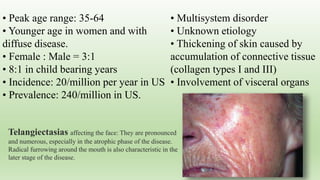
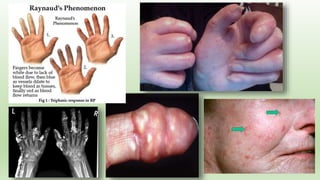
Telangiectasias affecting the face: They are pronounced
and numerous, especially in the atrophic phase of the disease.
Radical furrowing around the mouth is also characteristic in the
later stage of the disease.
• Multisystem disorder
• Unknown etiology
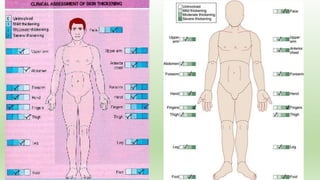
• Thickening of skin caused by
accumulation of connective tissue
(collagen types I and III)
• Involvement of visceral organs
• Peak age range: 35-64
• Younger age in women and with
diffuse disease.
• Female : Male = 3:1
• 8:1 in child bearing years
• Incidence: 20/million per year in US
• Prevalence: 240/million in US.
 Unknown / Idiopathic
 Chemical radiation exposure
 Environmental Exposures
• Silica exposure in men conferred increased risk
• Silicone breast implants: no definite risk identified
• Aniline laced Contaminated rapseed oil in Spain
• Vinyl chloride exposure increased risk of SSc like disorder: Eosinophilic Fasciitis
• bleomycin
• L-tryptophan: Eosinophilia Myalgia syndrome
 Genetic Factors
• Familial Clustering: 1.5-2.5% of those with 1st degree relative – Choctow
Native Americans: prevalence 4720/million.
• HLA-haplotypes: there are higher risk haplotypes in certain populations
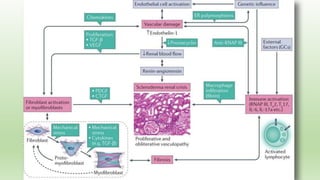
Etiology
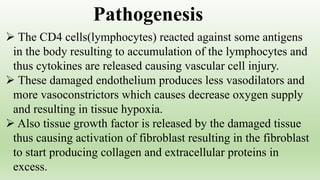
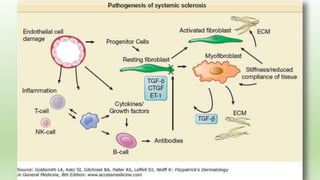
 The CD4 cells(lymphocytes) reacted against some antigens
in the body resulting to accumulation of the lymphocytes and
thus cytokines are released causing vascular cell injury.
 These damaged endothelium produces less vasodilators and
more vasoconstrictors which causes decrease oxygen supply
and resulting in tissue hypoxia.
 Also tissue growth factor is released by the damaged tissue
thus causing activation of fibroblast resulting in the fibroblast
to start producing collagen and extracellular proteins in
excess.
Pathogenesis
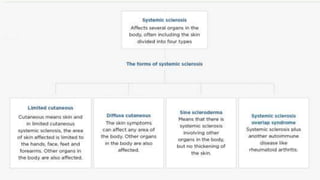
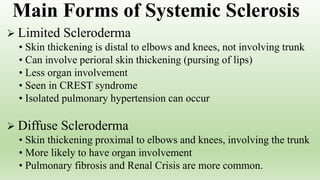
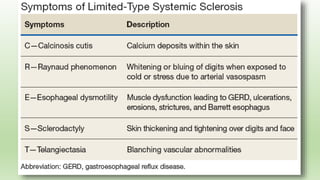
 Limited Scleroderma
• Skin thickening is distal to elbows and knees, not involving trunk
• Can involve perioral skin thickening (pursing of lips)
• Less organ involvement
• Seen in CREST syndrome
• Isolated pulmonary hypertension can occur
 Diffuse Scleroderma
• Skin thickening proximal to elbows and knees, involving the trunk
• More likely to have organ involvement
• Pulmonary fibrosis and Renal Crisis are more common.
Main Forms of Systemic Sclerosis
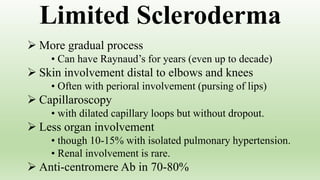
 More gradual process
• Can have Raynaud’s for years (even up to decade)
 Skin involvement distal to elbows and knees
• Often with perioral involvement (pursing of lips)
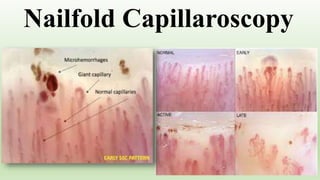
 Capillaroscopy
• with dilated capillary loops but without dropout.
 Less organ involvement
• though 10-15% with isolated pulmonary hypertension.
• Renal involvement is rare.
 Anti-centromere Ab in 70-80%
Limited Scleroderma
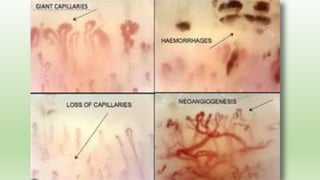
Nailfold Capillaroscopy
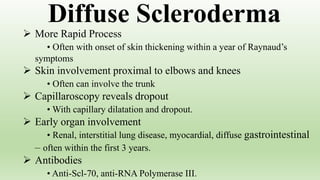
 More Rapid Process
• Often with onset of skin thickening within a year of Raynaud’s
symptoms
 Skin involvement proximal to elbows and knees
• Often can involve the trunk
 Capillaroscopy reveals dropout
• With capillary dilatation and dropout.
 Early organ involvement
• Renal, interstitial lung disease, myocardial, diffuse gastrointestinal
– often within the first 3 years.
 Antibodies
• Anti-Scl-70, anti-RNA Polymerase III.
Diffuse Scleroderma
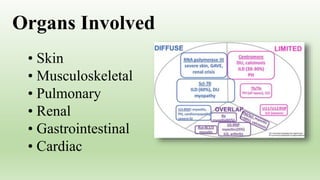
• Skin
• Musculoskeletal
• Pulmonary
• Renal
• Gastrointestinal
• Cardiac
Organs Involved
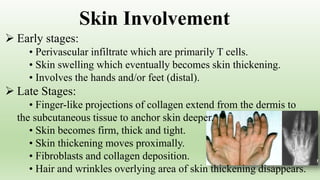
 Early stages:
• Perivascular infiltrate which are primarily T cells.
• Skin swelling which eventually becomes skin thickening.
• Involves the hands and/or feet (distal).
 Late Stages:
• Finger-like projections of collagen extend from the dermis to
the subcutaneous tissue to anchor skin deeper.
• Skin becomes firm, thick and tight.
• Skin thickening moves proximally.
• Fibroblasts and collagen deposition.
• Hair and wrinkles overlying area of skin thickening disappears.
Skin Involvement
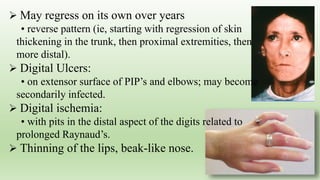
 May regress on its own over years
• reverse pattern (ie, starting with regression of skin
thickening in the trunk, then proximal extremities, then
more distal).
 Digital Ulcers:
• on extensor surface of PIP’s and elbows; may become
secondarily infected.
 Digital ischemia:
• with pits in the distal aspect of the digits related to
prolonged Raynaud’s.
 Thinning of the lips, beak-like nose.
 Arthritis
• in > 50% with swelling,
stiffness, and pain in the joints of the
hands.
 Carpal Tunnel Syndrome.
 Contractures
• related to skin thickening.
 Polymyositis
• may occur as part of mixed
connective tissue disease or overlap.
Musculoskeletal
 Leading cause of death
• since we are better at control
of renal disease.
 Symptoms:
• exertional dyspnea
 Types of lung Involvement:
• Interstitial lung disease.
• Isolated pulmonary
hypertension.
Pulmonary
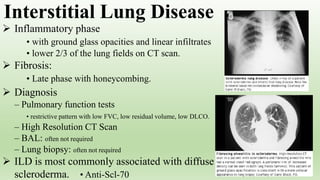
 Inflammatory phase
• with ground glass opacities and linear infiltrates
• lower 2/3 of the lung fields on CT scan.
 Fibrosis:
• Late phase with honeycombing.
 Diagnosis
– Pulmonary function tests
• restrictive pattern with low FVC, low residual volume, low DLCO.
– High Resolution CT Scan
– BAL: often not required
– Lung biopsy: often not required
 ILD is most commonly associated with diffuse
scleroderma. • Anti-Scl-70
Interstitial Lung Disease
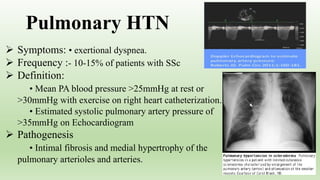
 Symptoms: • exertional dyspnea.
 Frequency :- 10-15% of patients with SSc
 Definition:
• Mean PA blood pressure >25mmHg at rest or
>30mmHg with exercise on right heart catheterization.
• Estimated systolic pulmonary artery pressure of
>35mmHg on Echocardiogram
 Pathogenesis
• Intimal fibrosis and medial hypertrophy of the
pulmonary arterioles and arteries.
Pulmonary HTN
 Pneumonia:
• due to aspiration secondary to
GERD; skin thickening of chest
may reduce effectiveness of cough.
 Alveolar carcinoma:
increased incidence
 Bronchogenic carcinoma:
increased incidence.
Other Pulmonary Associations
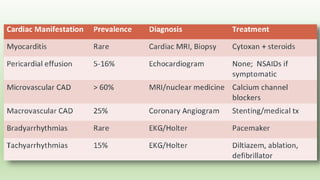
 Pericardial Effusion
– symptomatic pericarditis in 20%
 Microvascular CAD:
– recurrent vasospasm of coronary arteries
– Necrosis
– patchy myocardial fibrosis; leads to diastolic > systolic
dysfunction.
 Myocarditis
– Inflammation which leads to fibrosis
 Arrhythmias and conduction abnormalities
– Fibrosis of cardiac conduction system.
– AV conduction defects and arrhythmias.
Cardiac Manifestations
• Forms of cardiac involvement
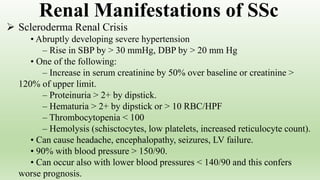
 Scleroderma Renal Crisis
• Abruptly developing severe hypertension
– Rise in SBP by > 30 mmHg, DBP by > 20 mm Hg
• One of the following:
– Increase in serum creatinine by 50% over baseline or creatinine >
120% of upper limit.
– Proteinuria > 2+ by dipstick.
– Hematuria > 2+ by dipstick or > 10 RBC/HPF
– Thrombocytopenia < 100
– Hemolysis (schisctocytes, low platelets, increased reticulocyte count).
• Can cause headache, encephalopathy, seizures, LV failure.
• 90% with blood pressure > 150/90.
• Can occur also with lower blood pressures < 140/90 and this confers
worse prognosis.
Renal Manifestations of SSc
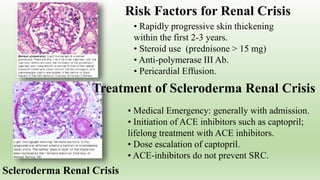
Scleroderma Renal Crisis
Risk Factors for Renal Crisis
• Rapidly progressive skin thickening
within the first 2-3 years.
• Steroid use (prednisone > 15 mg)
• Anti-polymerase III Ab.
• Pericardial Effusion.
Treatment of Scleroderma Renal Crisis
• Medical Emergency: generally with admission.
• Initiation of ACE inhibitors such as captopril;
lifelong treatment with ACE inhibitors.
• Dose escalation of captopril.
• ACE-inhibitors do not prevent SRC.
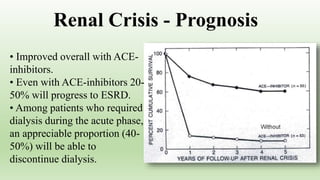
• Improved overall with ACE-
inhibitors.
• Even with ACE-inhibitors 20-
50% will progress to ESRD.
• Among patients who required
dialysis during the acute phase,
an appreciable proportion (40-
50%) will be able to
discontinue dialysis.
Renal Crisis - Prognosis
 Esophageal dysmotility: in up to 90%.
• Pathophysiology:
– reduced tone of gastroesophageal sphincter and distal dilatation of the esophagus.
– Lamina propia and submucosal tissue with Inflammatory changes and increased
collagen on pathology.
• Symptoms – Dysphagia, GERD; many asymptomatic.
• Diagnosis: – Esophageal manometry, Esophagram, CT scan.
• Treatment: – Proton Pump Inhibitors
– Elevation of head of the bed.
• Complications: – Barret’s Esophagus.
 Colon Involvement:
• Can cause symptoms of constipation due to decreased peristalsis.
• Fecal incontinence can occur due to alterations of internal and external
sphincter.
Gastrointestinal Manifestations
 Gastric Involvement:
• Symptoms: Early satiety.
• Diagnosis: Nuclear Gastric Emptying Test.
• Treatment: promotility agents
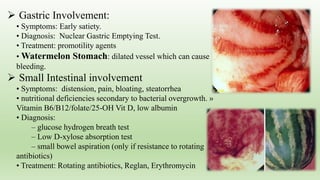
• Watermelon Stomach: dilated vessel which can cause
bleeding.
 Small Intestinal involvement
• Symptoms: distension, pain, bloating, steatorrhea
• nutritional deficiencies secondary to bacterial overgrowth. »
Vitamin B6/B12/folate/25-OH Vit D, low albumin
• Diagnosis:
– glucose hydrogen breath test
– Low D-xylose absorption test
– small bowel aspiration (only if resistance to rotating
antibiotics)
• Treatment: Rotating antibiotics, Reglan, Erythromycin
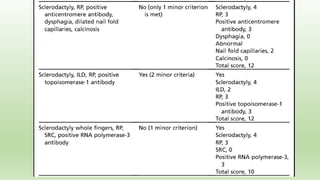
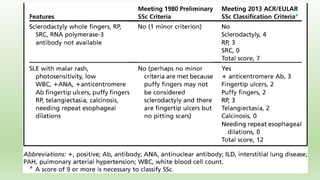
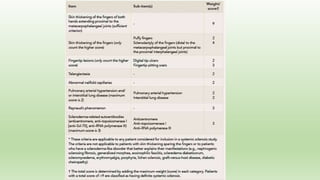
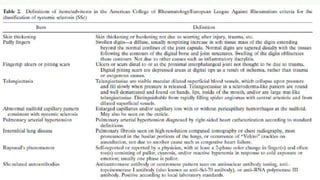
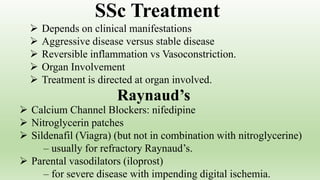
SSc Autoantibodies
 Depends on clinical manifestations
 Aggressive disease versus stable disease
 Reversible inflammation vs Vasoconstriction.
 Organ Involvement
 Treatment is directed at organ involved.
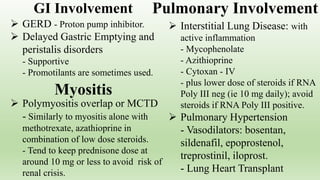
SSc Treatment
 Calcium Channel Blockers: nifedipine
 Nitroglycerin patches
 Sildenafil (Viagra) (but not in combination with nitroglycerine)
– usually for refractory Raynaud’s.
 Parental vasodilators (iloprost)
– for severe disease with impending digital ischemia.
Raynaud’s
 GERD - Proton pump inhibitor.
 Delayed Gastric Emptying and
peristalis disorders
- Supportive
- Promotilants are sometimes used.
 Interstitial Lung Disease: with
active inflammation
- Mycophenolate
- Azithioprine
- Cytoxan - IV
- plus lower dose of steroids if RNA
Poly III neg (ie 10 mg daily); avoid
steroids if RNA Poly III positive.
 Pulmonary Hypertension
- Vasodilators: bosentan,
sildenafil, epoprostenol,
treprostinil, iloprost.
- Lung Heart Transplant
 Polymyositis overlap or MCTD
- Similarly to myositis alone with
methotrexate, azathioprine in
combination of low dose steroids.
- Tend to keep prednisone dose at
around 10 mg or less to avoid risk of
renal crisis.
GI Involvement
Myositis
Pulmonary Involvement
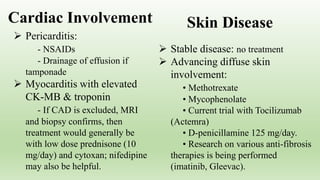
 Pericarditis:
- NSAIDs
- Drainage of effusion if
tamponade
 Myocarditis with elevated
CK-MB & troponin
- If CAD is excluded, MRI
and biopsy confirms, then
treatment would generally be
with low dose prednisone (10
mg/day) and cytoxan; nifedipine
may also be helpful.
 Stable disease: no treatment
 Advancing diffuse skin
involvement:
• Methotrexate
• Mycophenolate
• Current trial with Tocilizumab
(Actemra)
• D-penicillamine 125 mg/day.
• Research on various anti-fibrosis
therapies is being performed
(imatinib, Gleevac).
Cardiac Involvement Skin Disease
 Scleroderma
• No Raynauds, negative antibodies, seen in IDDM
• Proximal skin thickening (trunk, shoulders, back)
 Scleromyxedema
• Skin thickening/induration on head, neck, arms, trunk
• Monoclonal gammopathy (multiple myeloma/AL amyloid)
• Skin biopsy differentiates.
 Endocrinologic: diabetes and hypothyroid myxedema
• Can be associated with skin induration.
• In diabetes can have sclerodactyly (Diabetic Cheiroarthropathy) - dorsal
• POEMS (polyneuropathy, organomegaly, endocrinopathy, monoclonal gammopathy, skin thickening).
 Nephrogenic Systemic fibrosis
• Chronic kidney disease and gadolinium MRI contrast
• Can involve hands and feet.
 Eosinophilic fasciitis:
• Hands and feet are spared, peripheral blood eosinophilia, peau de orange appearance
• Diagnosis is via skin biopsy.
 Graft versus Host disease
• History of bone marrow transplant, no Raynaud’s symptoms.
• Diagnosis is via skin biopsy.
Differential Diagnosis
• Medscape & PubMed
• Up To Date
• Curr Opin Rheumatol 23;505-510
• Fischer A; CHEST 2006; 130:976 –981
• Rheum Dis Clin N Am;2003;29:293–313
• Arthritis Rheum 2006;54:3962-3970
• Rheumatology 2009;48:iii32–iii35
• Desai, et al; Curr Opin Rheumatol 2011; 23:545-554
• Steen VD; Rheum Dis Clin N Am 2003;29:315–333
• Hudson M, et al; Medicine 2010;89:976-981
• Bon LV; Curr Opin Rheumatol 2011;23:505–510
• Barnes J; Curr Opin Rheumatol 2012, 24:165–170
References;
Systemic Sclerosis - Rivin

Systemic Sclerosis - Rivin

  • 1.
    Systemic Sclerosis (SSc W.P. Rivindu H. Wickramanayake Group no. 04a 5th Year 2nd Semester – 2019 October Tbilisi State Medical University, Georgia
  • 2.
    Telangiectasias affecting theface: They are pronounced and numerous, especially in the atrophic phase of the disease. Radical furrowing around the mouth is also characteristic in the later stage of the disease. • Multisystem disorder • Unknown etiology • Thickening of skin caused by accumulation of connective tissue (collagen types I and III) • Involvement of visceral organs • Peak age range: 35-64 • Younger age in women and with diffuse disease. • Female : Male = 3:1 • 8:1 in child bearing years • Incidence: 20/million per year in US • Prevalence: 240/million in US.
  • 3.
     Unknown /Idiopathic  Chemical radiation exposure  Environmental Exposures • Silica exposure in men conferred increased risk • Silicone breast implants: no definite risk identified • Aniline laced Contaminated rapseed oil in Spain • Vinyl chloride exposure increased risk of SSc like disorder: Eosinophilic Fasciitis • bleomycin • L-tryptophan: Eosinophilia Myalgia syndrome  Genetic Factors • Familial Clustering: 1.5-2.5% of those with 1st degree relative – Choctow Native Americans: prevalence 4720/million. • HLA-haplotypes: there are higher risk haplotypes in certain populations Etiology
  • 4.
     The CD4cells(lymphocytes) reacted against some antigens in the body resulting to accumulation of the lymphocytes and thus cytokines are released causing vascular cell injury.  These damaged endothelium produces less vasodilators and more vasoconstrictors which causes decrease oxygen supply and resulting in tissue hypoxia.  Also tissue growth factor is released by the damaged tissue thus causing activation of fibroblast resulting in the fibroblast to start producing collagen and extracellular proteins in excess. Pathogenesis
  • 12.
     Limited Scleroderma •Skin thickening is distal to elbows and knees, not involving trunk • Can involve perioral skin thickening (pursing of lips) • Less organ involvement • Seen in CREST syndrome • Isolated pulmonary hypertension can occur  Diffuse Scleroderma • Skin thickening proximal to elbows and knees, involving the trunk • More likely to have organ involvement • Pulmonary fibrosis and Renal Crisis are more common. Main Forms of Systemic Sclerosis
  • 13.
     More gradualprocess • Can have Raynaud’s for years (even up to decade)  Skin involvement distal to elbows and knees • Often with perioral involvement (pursing of lips)  Capillaroscopy • with dilated capillary loops but without dropout.  Less organ involvement • though 10-15% with isolated pulmonary hypertension. • Renal involvement is rare.  Anti-centromere Ab in 70-80% Limited Scleroderma
  • 16.
  • 18.
     More RapidProcess • Often with onset of skin thickening within a year of Raynaud’s symptoms  Skin involvement proximal to elbows and knees • Often can involve the trunk  Capillaroscopy reveals dropout • With capillary dilatation and dropout.  Early organ involvement • Renal, interstitial lung disease, myocardial, diffuse gastrointestinal – often within the first 3 years.  Antibodies • Anti-Scl-70, anti-RNA Polymerase III. Diffuse Scleroderma
  • 19.
    • Skin • Musculoskeletal •Pulmonary • Renal • Gastrointestinal • Cardiac Organs Involved
  • 20.
     Early stages: •Perivascular infiltrate which are primarily T cells. • Skin swelling which eventually becomes skin thickening. • Involves the hands and/or feet (distal).  Late Stages: • Finger-like projections of collagen extend from the dermis to the subcutaneous tissue to anchor skin deeper. • Skin becomes firm, thick and tight. • Skin thickening moves proximally. • Fibroblasts and collagen deposition. • Hair and wrinkles overlying area of skin thickening disappears. Skin Involvement
  • 21.
     May regresson its own over years • reverse pattern (ie, starting with regression of skin thickening in the trunk, then proximal extremities, then more distal).  Digital Ulcers: • on extensor surface of PIP’s and elbows; may become secondarily infected.  Digital ischemia: • with pits in the distal aspect of the digits related to prolonged Raynaud’s.  Thinning of the lips, beak-like nose.
  • 23.
     Arthritis • in> 50% with swelling, stiffness, and pain in the joints of the hands.  Carpal Tunnel Syndrome.  Contractures • related to skin thickening.  Polymyositis • may occur as part of mixed connective tissue disease or overlap. Musculoskeletal  Leading cause of death • since we are better at control of renal disease.  Symptoms: • exertional dyspnea  Types of lung Involvement: • Interstitial lung disease. • Isolated pulmonary hypertension. Pulmonary
  • 24.
     Inflammatory phase •with ground glass opacities and linear infiltrates • lower 2/3 of the lung fields on CT scan.  Fibrosis: • Late phase with honeycombing.  Diagnosis – Pulmonary function tests • restrictive pattern with low FVC, low residual volume, low DLCO. – High Resolution CT Scan – BAL: often not required – Lung biopsy: often not required  ILD is most commonly associated with diffuse scleroderma. • Anti-Scl-70 Interstitial Lung Disease
  • 25.
     Symptoms: •exertional dyspnea.  Frequency :- 10-15% of patients with SSc  Definition: • Mean PA blood pressure >25mmHg at rest or >30mmHg with exercise on right heart catheterization. • Estimated systolic pulmonary artery pressure of >35mmHg on Echocardiogram  Pathogenesis • Intimal fibrosis and medial hypertrophy of the pulmonary arterioles and arteries. Pulmonary HTN
  • 26.
     Pneumonia: • dueto aspiration secondary to GERD; skin thickening of chest may reduce effectiveness of cough.  Alveolar carcinoma: increased incidence  Bronchogenic carcinoma: increased incidence. Other Pulmonary Associations
  • 27.
     Pericardial Effusion –symptomatic pericarditis in 20%  Microvascular CAD: – recurrent vasospasm of coronary arteries – Necrosis – patchy myocardial fibrosis; leads to diastolic > systolic dysfunction.  Myocarditis – Inflammation which leads to fibrosis  Arrhythmias and conduction abnormalities – Fibrosis of cardiac conduction system. – AV conduction defects and arrhythmias. Cardiac Manifestations • Forms of cardiac involvement
  • 29.
     Scleroderma RenalCrisis • Abruptly developing severe hypertension – Rise in SBP by > 30 mmHg, DBP by > 20 mm Hg • One of the following: – Increase in serum creatinine by 50% over baseline or creatinine > 120% of upper limit. – Proteinuria > 2+ by dipstick. – Hematuria > 2+ by dipstick or > 10 RBC/HPF – Thrombocytopenia < 100 – Hemolysis (schisctocytes, low platelets, increased reticulocyte count). • Can cause headache, encephalopathy, seizures, LV failure. • 90% with blood pressure > 150/90. • Can occur also with lower blood pressures < 140/90 and this confers worse prognosis. Renal Manifestations of SSc
  • 31.
    Scleroderma Renal Crisis RiskFactors for Renal Crisis • Rapidly progressive skin thickening within the first 2-3 years. • Steroid use (prednisone > 15 mg) • Anti-polymerase III Ab. • Pericardial Effusion. Treatment of Scleroderma Renal Crisis • Medical Emergency: generally with admission. • Initiation of ACE inhibitors such as captopril; lifelong treatment with ACE inhibitors. • Dose escalation of captopril. • ACE-inhibitors do not prevent SRC.
  • 32.
    • Improved overallwith ACE- inhibitors. • Even with ACE-inhibitors 20- 50% will progress to ESRD. • Among patients who required dialysis during the acute phase, an appreciable proportion (40- 50%) will be able to discontinue dialysis. Renal Crisis - Prognosis
  • 33.
     Esophageal dysmotility:in up to 90%. • Pathophysiology: – reduced tone of gastroesophageal sphincter and distal dilatation of the esophagus. – Lamina propia and submucosal tissue with Inflammatory changes and increased collagen on pathology. • Symptoms – Dysphagia, GERD; many asymptomatic. • Diagnosis: – Esophageal manometry, Esophagram, CT scan. • Treatment: – Proton Pump Inhibitors – Elevation of head of the bed. • Complications: – Barret’s Esophagus.  Colon Involvement: • Can cause symptoms of constipation due to decreased peristalsis. • Fecal incontinence can occur due to alterations of internal and external sphincter. Gastrointestinal Manifestations
  • 34.
     Gastric Involvement: •Symptoms: Early satiety. • Diagnosis: Nuclear Gastric Emptying Test. • Treatment: promotility agents • Watermelon Stomach: dilated vessel which can cause bleeding.  Small Intestinal involvement • Symptoms: distension, pain, bloating, steatorrhea • nutritional deficiencies secondary to bacterial overgrowth. » Vitamin B6/B12/folate/25-OH Vit D, low albumin • Diagnosis: – glucose hydrogen breath test – Low D-xylose absorption test – small bowel aspiration (only if resistance to rotating antibiotics) • Treatment: Rotating antibiotics, Reglan, Erythromycin
  • 35.
  • 36.
     Depends onclinical manifestations  Aggressive disease versus stable disease  Reversible inflammation vs Vasoconstriction.  Organ Involvement  Treatment is directed at organ involved. SSc Treatment  Calcium Channel Blockers: nifedipine  Nitroglycerin patches  Sildenafil (Viagra) (but not in combination with nitroglycerine) – usually for refractory Raynaud’s.  Parental vasodilators (iloprost) – for severe disease with impending digital ischemia. Raynaud’s
  • 37.
     GERD -Proton pump inhibitor.  Delayed Gastric Emptying and peristalis disorders - Supportive - Promotilants are sometimes used.  Interstitial Lung Disease: with active inflammation - Mycophenolate - Azithioprine - Cytoxan - IV - plus lower dose of steroids if RNA Poly III neg (ie 10 mg daily); avoid steroids if RNA Poly III positive.  Pulmonary Hypertension - Vasodilators: bosentan, sildenafil, epoprostenol, treprostinil, iloprost. - Lung Heart Transplant  Polymyositis overlap or MCTD - Similarly to myositis alone with methotrexate, azathioprine in combination of low dose steroids. - Tend to keep prednisone dose at around 10 mg or less to avoid risk of renal crisis. GI Involvement Myositis Pulmonary Involvement
  • 38.
     Pericarditis: - NSAIDs -Drainage of effusion if tamponade  Myocarditis with elevated CK-MB & troponin - If CAD is excluded, MRI and biopsy confirms, then treatment would generally be with low dose prednisone (10 mg/day) and cytoxan; nifedipine may also be helpful.  Stable disease: no treatment  Advancing diffuse skin involvement: • Methotrexate • Mycophenolate • Current trial with Tocilizumab (Actemra) • D-penicillamine 125 mg/day. • Research on various anti-fibrosis therapies is being performed (imatinib, Gleevac). Cardiac Involvement Skin Disease
  • 39.
     Scleroderma • NoRaynauds, negative antibodies, seen in IDDM • Proximal skin thickening (trunk, shoulders, back)  Scleromyxedema • Skin thickening/induration on head, neck, arms, trunk • Monoclonal gammopathy (multiple myeloma/AL amyloid) • Skin biopsy differentiates.  Endocrinologic: diabetes and hypothyroid myxedema • Can be associated with skin induration. • In diabetes can have sclerodactyly (Diabetic Cheiroarthropathy) - dorsal • POEMS (polyneuropathy, organomegaly, endocrinopathy, monoclonal gammopathy, skin thickening).  Nephrogenic Systemic fibrosis • Chronic kidney disease and gadolinium MRI contrast • Can involve hands and feet.  Eosinophilic fasciitis: • Hands and feet are spared, peripheral blood eosinophilia, peau de orange appearance • Diagnosis is via skin biopsy.  Graft versus Host disease • History of bone marrow transplant, no Raynaud’s symptoms. • Diagnosis is via skin biopsy. Differential Diagnosis
  • 40.
    • Medscape &PubMed • Up To Date • Curr Opin Rheumatol 23;505-510 • Fischer A; CHEST 2006; 130:976 –981 • Rheum Dis Clin N Am;2003;29:293–313 • Arthritis Rheum 2006;54:3962-3970 • Rheumatology 2009;48:iii32–iii35 • Desai, et al; Curr Opin Rheumatol 2011; 23:545-554 • Steen VD; Rheum Dis Clin N Am 2003;29:315–333 • Hudson M, et al; Medicine 2010;89:976-981 • Bon LV; Curr Opin Rheumatol 2011;23:505–510 • Barnes J; Curr Opin Rheumatol 2012, 24:165–170 References;