Progressive Systemic Sclerosis
ACMS Dept of Medicine
2010 Batch VIII Term
PSS: Definition
• Systemic sclerosis (previously called
'scleroderma') is a generalised disorder of
connective tissue affecting-
• The skin
• Internal organs and
• Vasculature.
PSS: Hallmark
The clinical hallmark is the presence of
• Sclerodactyly in combination with
• Raynaud's phenomenon or
• Digital ischaemia
PSS: Epidemiology
• The peak age of onset is in 4th & 5th decades
• Overall prevalence is 10-20 per 100 000
• 4:1 female: male ratio
PSS: Classification
It is subdivided into
• Diffuse cutaneous systemic sclerosis (DCSS)
• Limited cutaneous systemic sclerosis (LCSS)
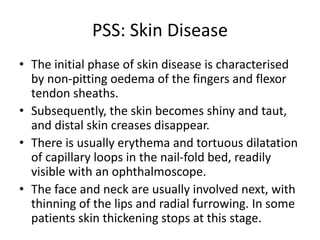
• Many patients with LCSS have features which
are phenotypically grouped into the 'CREST'
syndrome (calcinosis, Raynaud's, oesophageal
involvement, sclerodactyly, telangiectasia).
PSS: Classification
It is subdivided into
• Diffuse cutaneous systemic sclerosis (DCSS)
• Limited cutaneous systemic sclerosis (LCSS)
• Many patients with LCSS have features which are
phenotypically grouped into the 'CREST'
syndrome (calcinosis, Raynaud's, oesophageal
involvement, sclerodactyly, telangiectasia).
CREST syndrome
Systemic Manifestations
PSS: Etiopathology
• Unknown,
• No consistent genetic, geographical or racial
associations.
• Environmental factors are important in
isolated cases that result from exposure to
–silica dust,
–vinyl chloride,
–hypoxy resins and
–trichloroethylene.
PSS: Etiopathology
Early in the disease there is
• Skin infiltration by T lymphocytes
• Abnormal fibroblast activation
• That leads to increased production
of extracellular matrix in the dermis,
primarily type I collagen.
• This results in symmetrical
thickening, tightening and
induration of the skin
(sclerodactyly).
PSS: Etiopathology
Early in the disease there is
–Skin infiltration by T lymphocytes and
–Abnormal fibroblast activation
• In addition to skin changes there is arterial and
arteriolar narrowing due to intimal proliferation
and vessel wall inflammation.
• Endothelial injury causes release of
vasoconstrictors and platelet activation, resulting
in further ischaemia.
PSS Clinical Features and Diagnoais
• Systemic sclerosis is predominantly a clinical
diagnosis based on the presence of
sclerodactyly.
• Most patients are ANA-positive, and
• Approximately 30% of patients with diffuse
disease and
• 60% with limited disease have antibodies to
topoisomerase 1 and centromere respectively.
• Cutaneous changes Raynaud's phenomenon is
universal and may precede other clinical
features.
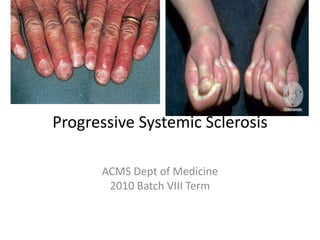
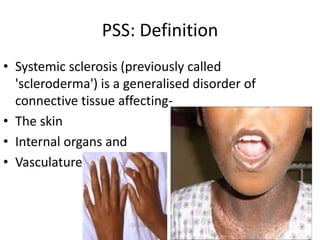
• Systemic sclerosis. Hands showing tight shiny
skin, sclerodactyly, flexion contractures of the
fingers and thickening of the left middle finger
extensor tendon sheath
PSS: Skin Disease
• The initial phase of skin disease is characterised
by non-pitting oedema of the fingers and flexor
tendon sheaths.
• Subsequently, the skin becomes shiny and taut,
and distal skin creases disappear.
• There is usually erythema and tortuous dilatation
of capillary loops in the nail-fold bed, readily
visible with an ophthalmoscope.
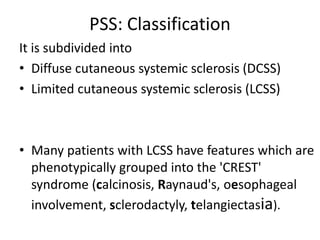
• The face and neck are usually involved next, with
thinning of the lips and radial furrowing. In some
patients skin thickening stops at this stage.
PSS: Skin Disease
• Skin involvement restricted to sites distal to
the elbow or knee (apart from the face) is
classified as 'limited cutaneous disease' or
CREST syndrome.
• Involvement proximal to the knee and elbow
and on the trunk is classified as 'diffuse
cutaneous disease'.
PSS: Skin Disease
In extremities-
• Intimal fibrosis and vessel wall inflammation may
combine to cause critical tissue ischaemia, skin
ulceration on pressure points
• Localised areas of infarction and
• Pulp atrophy at the fingertips.
PSS: Musculoskeletal features
• Arthralgia, morning stiffness and flexor
tenosynovitis are common.
• Restricted hand function is due to skin rather than
joint disease and erosive arthropathy is
uncommon.
• Muscle weakness and wasting are usually due to
myositis.
PSS: GI FEATURES
• Gut involvement is common.
• Smooth muscle atrophy and fibrosis in
the lower two-thirds of the oesophagus
lead to acid reflux with erosive
oesophagitis.
• Since this may progress to further
fibrosis, adequate treatment of reflux
(proton pump inhibitors) is important.
• Dysphagia and odynophagia (painful
dysphagia) may also occur.
PSS: GI FEATURES
• Involvement of the stomach causes early satiety
and occasionally outlet obstruction.
• Recurrent occult upper GI bleeding may indicate
a 'watermelon stomach' (antral vascular ectasia),
which occurs in up to 20% of patients.
• Small intestine involvement may lead to
malabsorption, bacterial overgrowth and
intermittent bloating, pain or constipation.
• Dilatation of large or small bowel due to
autonomic neuropathy may cause pseudo-
obstruction.
Watermelon Stomach
PSS: Cardiorespiratory features
• Pulmonary involvement is a major cause of
morbidity and mortality.
• Fibrosing alveolitis mainly affects pts with diffuse
disease, esp those with antibodies to
topoisomerase 1.
• Pulmonary hypertension is a long-standing
complication. It is 6X more prevalent in limited
than diffuse disease.
• The clinical features are rapidly progressive
dyspnoea (more than ILD), RHF and angina with-
• often rapidly progressing digital ischaemia.
PSS: Cardiorespiratory features
Treatment strategies include
• Vasodilators
• Continuous infusions of epoprostenol
• The oral endothelin 1 antagonist bosentan and
• Heart-lung transplantation.
PSS: Renal features
• Main cause of death is hypertensive renal crisis
(rapidly developing malignant hypertension and
renal failure).
• Treatment is by ACE inhibition even in presence of
renal impairment.
• Hypertensive renal crisis is more likely in patients
with diffuse rather than limited disease.
• It is also more prevalent in patients with
topoisomerase 1 antibodies.
• Clinicians use prophylactic ACE Is for diffuse disease
to prevent this manifestation.
PSS: Management and prognosis
Five-year survival is approx70%.
Risk factors for a poor prognosis include
• Older age
• Diffuse skin disease
• Proteinuria
• High ESR
• A low gas transfer factor for carbon monoxide
(TLCO) and
• Pulmonary hypertension
PSS: Management and prognosis
• Self-management to maintain core body
temperature and avoid peripheral cold
exposure is important.
• Infection of ulcerated skin should be treated
with prompt antibiotic therapy.
• Antibiotics penetrate poorly into the skin
lesions of systemic sclerosis and therefore
need to be given at higher dose for longer
periods (e.g. flucloxacillin 500 mg 6-hourly for
14 days).
PSS: Management and prognosis
• Calcium antagonists (e.g. nifedipine,
amlodipine) or angiotensin II receptor
antagonists (e.g. valsartan) may be effective
for Raynaud's symptoms.
• For severe digital ischaemia, intermittent
infusions of epoprostenol may be helpful.
PSS: Management and prognosis
• Corticosteroids and cytotoxic drugs are
indicated in patients with myositis or
alveolitis.
• No agent has been shown to arrest or improve
skin changes.

Progresive systemic sclerosis

  • 1.
    Progressive Systemic Sclerosis ACMSDept of Medicine 2010 Batch VIII Term
  • 2.
    PSS: Definition • Systemicsclerosis (previously called 'scleroderma') is a generalised disorder of connective tissue affecting- • The skin • Internal organs and • Vasculature.
  • 3.
    PSS: Hallmark The clinicalhallmark is the presence of • Sclerodactyly in combination with • Raynaud's phenomenon or • Digital ischaemia
  • 4.
    PSS: Epidemiology • Thepeak age of onset is in 4th & 5th decades • Overall prevalence is 10-20 per 100 000 • 4:1 female: male ratio
  • 5.
    PSS: Classification It issubdivided into • Diffuse cutaneous systemic sclerosis (DCSS) • Limited cutaneous systemic sclerosis (LCSS) • Many patients with LCSS have features which are phenotypically grouped into the 'CREST' syndrome (calcinosis, Raynaud's, oesophageal involvement, sclerodactyly, telangiectasia).
  • 6.
    PSS: Classification It issubdivided into • Diffuse cutaneous systemic sclerosis (DCSS) • Limited cutaneous systemic sclerosis (LCSS) • Many patients with LCSS have features which are phenotypically grouped into the 'CREST' syndrome (calcinosis, Raynaud's, oesophageal involvement, sclerodactyly, telangiectasia).
  • 8.
  • 9.
  • 10.
    PSS: Etiopathology • Unknown, •No consistent genetic, geographical or racial associations. • Environmental factors are important in isolated cases that result from exposure to –silica dust, –vinyl chloride, –hypoxy resins and –trichloroethylene.
  • 11.
    PSS: Etiopathology Early inthe disease there is • Skin infiltration by T lymphocytes • Abnormal fibroblast activation • That leads to increased production of extracellular matrix in the dermis, primarily type I collagen. • This results in symmetrical thickening, tightening and induration of the skin (sclerodactyly).
  • 12.
    PSS: Etiopathology Early inthe disease there is –Skin infiltration by T lymphocytes and –Abnormal fibroblast activation • In addition to skin changes there is arterial and arteriolar narrowing due to intimal proliferation and vessel wall inflammation. • Endothelial injury causes release of vasoconstrictors and platelet activation, resulting in further ischaemia.
  • 13.
    PSS Clinical Featuresand Diagnoais • Systemic sclerosis is predominantly a clinical diagnosis based on the presence of sclerodactyly. • Most patients are ANA-positive, and • Approximately 30% of patients with diffuse disease and • 60% with limited disease have antibodies to topoisomerase 1 and centromere respectively.
  • 14.
    • Cutaneous changesRaynaud's phenomenon is universal and may precede other clinical features.
  • 15.
    • Systemic sclerosis.Hands showing tight shiny skin, sclerodactyly, flexion contractures of the fingers and thickening of the left middle finger extensor tendon sheath
  • 16.
    PSS: Skin Disease •The initial phase of skin disease is characterised by non-pitting oedema of the fingers and flexor tendon sheaths. • Subsequently, the skin becomes shiny and taut, and distal skin creases disappear. • There is usually erythema and tortuous dilatation of capillary loops in the nail-fold bed, readily visible with an ophthalmoscope. • The face and neck are usually involved next, with thinning of the lips and radial furrowing. In some patients skin thickening stops at this stage.
  • 17.
    PSS: Skin Disease •Skin involvement restricted to sites distal to the elbow or knee (apart from the face) is classified as 'limited cutaneous disease' or CREST syndrome. • Involvement proximal to the knee and elbow and on the trunk is classified as 'diffuse cutaneous disease'.
  • 18.
    PSS: Skin Disease Inextremities- • Intimal fibrosis and vessel wall inflammation may combine to cause critical tissue ischaemia, skin ulceration on pressure points • Localised areas of infarction and • Pulp atrophy at the fingertips.
  • 19.
    PSS: Musculoskeletal features •Arthralgia, morning stiffness and flexor tenosynovitis are common. • Restricted hand function is due to skin rather than joint disease and erosive arthropathy is uncommon. • Muscle weakness and wasting are usually due to myositis.
  • 20.
    PSS: GI FEATURES •Gut involvement is common. • Smooth muscle atrophy and fibrosis in the lower two-thirds of the oesophagus lead to acid reflux with erosive oesophagitis. • Since this may progress to further fibrosis, adequate treatment of reflux (proton pump inhibitors) is important. • Dysphagia and odynophagia (painful dysphagia) may also occur.
  • 21.
    PSS: GI FEATURES •Involvement of the stomach causes early satiety and occasionally outlet obstruction. • Recurrent occult upper GI bleeding may indicate a 'watermelon stomach' (antral vascular ectasia), which occurs in up to 20% of patients. • Small intestine involvement may lead to malabsorption, bacterial overgrowth and intermittent bloating, pain or constipation. • Dilatation of large or small bowel due to autonomic neuropathy may cause pseudo- obstruction.
  • 22.
  • 23.
    PSS: Cardiorespiratory features •Pulmonary involvement is a major cause of morbidity and mortality. • Fibrosing alveolitis mainly affects pts with diffuse disease, esp those with antibodies to topoisomerase 1. • Pulmonary hypertension is a long-standing complication. It is 6X more prevalent in limited than diffuse disease. • The clinical features are rapidly progressive dyspnoea (more than ILD), RHF and angina with- • often rapidly progressing digital ischaemia.
  • 24.
    PSS: Cardiorespiratory features Treatmentstrategies include • Vasodilators • Continuous infusions of epoprostenol • The oral endothelin 1 antagonist bosentan and • Heart-lung transplantation.
  • 25.
    PSS: Renal features •Main cause of death is hypertensive renal crisis (rapidly developing malignant hypertension and renal failure). • Treatment is by ACE inhibition even in presence of renal impairment. • Hypertensive renal crisis is more likely in patients with diffuse rather than limited disease. • It is also more prevalent in patients with topoisomerase 1 antibodies. • Clinicians use prophylactic ACE Is for diffuse disease to prevent this manifestation.
  • 26.
    PSS: Management andprognosis Five-year survival is approx70%. Risk factors for a poor prognosis include • Older age • Diffuse skin disease • Proteinuria • High ESR • A low gas transfer factor for carbon monoxide (TLCO) and • Pulmonary hypertension
  • 27.
    PSS: Management andprognosis • Self-management to maintain core body temperature and avoid peripheral cold exposure is important. • Infection of ulcerated skin should be treated with prompt antibiotic therapy. • Antibiotics penetrate poorly into the skin lesions of systemic sclerosis and therefore need to be given at higher dose for longer periods (e.g. flucloxacillin 500 mg 6-hourly for 14 days).
  • 28.
    PSS: Management andprognosis • Calcium antagonists (e.g. nifedipine, amlodipine) or angiotensin II receptor antagonists (e.g. valsartan) may be effective for Raynaud's symptoms. • For severe digital ischaemia, intermittent infusions of epoprostenol may be helpful.
  • 29.
    PSS: Management andprognosis • Corticosteroids and cytotoxic drugs are indicated in patients with myositis or alveolitis. • No agent has been shown to arrest or improve skin changes.

Editor's Notes

  • #24  P450, a mechanism that is less likely to produce toxic intermediates. Adva-27a is an excellent inhibitor of Topoisomerase II with an IC50 of ... Topoisomerases (type I: EC 5.99.1.2, type II: EC 5.99.1.3) are enzymes that regulate the overwinding or underwinding of DNA. The winding problem of DNA ...