Skin Manifestation of
Systemic Sclerosis
Maha Hammady Hemdan
Systemic Sclerosis
Background:
Systemic sclerosis is a systemic connective tissue
disease. Characteristics of systemic sclerosis include
essential vasomotor disturbances; fibrosis; subsequent
atrophy of the skin, subcutaneous tissue, muscles, and
internal organs (e.g. alimentary tract, lungs, heart, kidney,
CNS); and immunologic disturbances accompany these
findings.
Systemic Sclerosis
Epidemiology:
●estimated to occur in 2.3-10 people per 1 million.
●female-to-male ratio of 3-6:1
●usually appears in women aged 30-40 years, and it
occurs in slightly older men.
Types of Systemic sclerosis:
●Localized Scleroderma:
They affect only the skin (and sometimes the underlying
muscles and bones) but do not affect the internal organs, or
reduce life expectancy
●Systemic Scleroderma:
The systemic forms can affect any part of the body (skin, blood
vessels, and internal organs.
Systemic Sclerosis
Types of Systemic sclerosis:
A)Localized Scleroderma:
They affect only the skin (and sometimes the underlying muscles and
bones) but do not affect the internal organs, or reduce life expectancy
1-linear scleroderma:
is a line of thickened skin which can affect the bone and muscles
underneath it , thus limiting the motion of the affected joints and
muscles. It most often occurs in the arms , legs , or forehead, and may
occur in more than one area .
2-Morphea scleroderma:
usually begins as patches of discolored, dry skin m there then become
hard , slightly depressed , oval shaped plaques whitish usually have a
whitish or yellowish center surrounded by a pinkish or purplish halo
Systemic Sclerosis
Types of Systemic sclerosis:
B)Systemic Scleroderma:
The systemic forms can affect any part of the body (skin,
blood vessels, and internal organs.
Systemic Sclerosis
Types of Systemic sclerosis:
B)Systemic Scleroderma:
The systemic forms can affect any part of the body (skin,
blood vessels, and internal organs.
Systemic Sclerosis
:Histopathology
Intima proliferation
in a deep arteriole.
(A) Prominent inflammatory infiltrate particularly in the perivascular region is
observed in the early stage of diffuse cutaneous systemic sclerosis.
(B) In the later stage of the disease, there is increased extracellular matrix
deposition. Note the loss of dermal papillary structures.
Cutaneous Manifestation :
A)Raynaud phenomenon
B)Skin thickening
C)Ulceration
D)Dyspigmentation
E)Calcinosis
F)Telangictases
Cutaneous Manifestation :
A)Raynaud phenomenon
B)Skin thickening
C)Ulceration
D)Dyspigmentation
E)Calcinosis
F)Telangictases
Cutaneous Manifestation :
A)Raynaud phenomenon:
Recurrent
vasospasm white (pallor) blue (cyanosis) red (hyperemia).
-usually (but not always) precedes skin changes by several months
- usually occurs in response to stress or cold exposure
- Symmetrical acral.
- Affected areas also show at least two color changes
Cutaneous Manifestation :
A)Raynaud phenomenon
B)Skin thickening
C)Ulceration
D)Dyspigmentation
E)Calcinosis
F)Telangictases
Cutaneous Manifestation :
B)Skin thickening:
3- Atrophic:
thin and atrophic
after many years .
1- Edematous :
swollen for weeks or months
2- Indurative :
thickened and tightly adherent
Phases:
1-phases
2-initial site and progression
3-skin appendages
4-Cutaneous pruritus is common.
5-Patterns :Diffuse :Face , Hand
localized :Linear , Morphea
Cutaneous Manifestation :
-elongated face
-tight shiny skin
-loss of skin wrinkles and facial
expression
-Loss of nasolabial fold
-pinched nose
-causing pursed lips(Radical
furrowing)
-small oral opening (difficulty in
chewing and oral hygiene)
1-phases
2-initial site and progression
3-skin appendages
4-Cutaneous pruritus is common.
5-Patterns :Diffuse :Face , Hand
localized :Linear , Morphea
B)Skin thickening: Face :
Cutaneous Manifestation :
-elongated face
-tight shiny skin
-loss of skin wrinkles and facial
expression
-Loss of nasolabial fold
-pinched nose
-causing pursed lips(Radical
furrowing)
-small oral opening (difficulty in
chewing and oral hygiene)
1-phases
2-initial site and progression
3-skin appendages
4-Cutaneous pruritus is common.
5-Patterns :Diffuse :Face , Hand
localized :Linear , Morphea
B)Skin thickening: Face :
Cutaneous Manifestation :
-elongated face
-tight shiny skin
-loss of skin wrinkles and facial
expression
-Loss of nasolabial fold
-pinched nose
-causing pursed lips(Radical
furrowing)
-small oral opening (difficulty in
chewing and oral hygiene)
1-phases
2-initial site and progression
3-skin appendages
4-Cutaneous pruritus is common.
5-Patterns :Diffuse :Face , Hand
localized :Linear , Morphea
B)Skin thickening: Face :
Cutaneous Manifestation :
-elongated face
-tight shiny skin
-loss of skin wrinkles and facial
expression
-Loss of nasolabial fold
-pinched nose
-causing pursed lips(Radical
furrowing)
-small oral opening (difficulty in
chewing and oral hygiene)
1-phases
2-initial site and progression
3-skin appendages
4-Cutaneous pruritus is common.
5-Patterns :Diffuse :Face , Hand
localized :Linear , Morphea
B)Skin thickening: Face :
Cutaneous Manifestation :
tight skin over finger gradually
limits full extension and flexion
leading to contracture and skin
ulceration.
1-phases
2-initial site and progression
3-skin appendages
4-Cutaneous pruritus is common.
5-Patterns :Diffuse :Face , Hand
localized :Linear , Morphea
B)Skin thickening: Sclerodactyly:
Cutaneous Manifestation :
1-phases
2-initial site and progression
3-skin appendages
4-Cutaneous pruritus is common.
5-Patterns :Diffuse :Face , Hand
localized :Linear , Morphea
B)Skin thickening: localized
Cutaneous Manifestation :
1-phases
2-initial site and progression
3-skin appendages
4-Cutaneous pruritus is common.
5-Patterns :Diffuse :Face , Hand
localized :Linear , Morphea
B)Skin thickening: localized
Cutaneous Manifestation :
1-phases
2-initial site and progression
3-skin appendages
4-Cutaneous pruritus is common.
5-Patterns :Diffuse :Face , Hand
localized :Linear , Morphea
B)Skin thickening: localized
Cutaneous Manifestation :
A)Raynaud phenomenon
B)Skin thickening
C)Ulceration
D)Dyspigmentation
E)Calcinosis
F)Telangictases
Cutaneous Manifestation :
C)Ulceration :
ischemia + skin thickening  skin ulcers over finger tips and bony prominences
infected infarction and gangrene,
resorption of distal phalanges.
Cutaneous Manifestation :
C)Ulceration :
ischemia + skin thickening  skin ulcers over finger tips and bony prominences
infected infarction and gangrene,
resorption of distal phalanges.
Cutaneous Manifestation :
A)Raynaud phenomenon
B)Skin thickening
C)Ulceration
D)Dyspigmentation
E)Calcinosis
F)Telangictases
Cutaneous Manifestation :
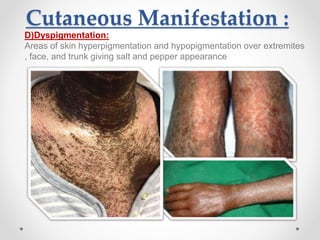
D)Dyspigmentation:
Areas of skin hyperpigmentation and hypopigmentation over extremites
, face, and trunk giving salt and pepper appearance
Cutaneous Manifestation :
A)Raynaud phenomenon
B)Skin thickening
C)Ulceration
D)Dyspigmentation
E)Calcinosis
F)Telangictases
Cutaneous Manifestation :
E)Calcinosis:
calcium deposits develop in the skin, particularly the fingers, hands
and other bony areas. These can breakdown and discharge chalky
material.
Cutaneous Manifestation :
E)Calcinosis:
calcium deposits develop in the skin, particularly the fingers, hands
and other bony areas. These can breakdown and discharge chalky
material.
Cutaneous Manifestation :
A)Raynaud phenomenon
B)Skin thickening
C)Ulceration
D)Dyspigmentation
E)Calcinosis
F)Telangictases
Cutaneous Manifestation :
F)Telangictases
Visibly dilated blood vessels appear on the fingers, palms, face,lips,
tongue and chest.they blanch on pressure.
CREST syndrome
• Management:
Treatment should be organ-based in order to try to
control the disease. Currently there is no cure. In
contrast to many other autoimmune diseases,
corticosteroids and immunosuppressants are rarely used
in SSc, with the exception of SSc-related pulmonary
fibrosis.
Systemic Sclerosis
• References:
http://emedicine.medscape.com/article/1066280-
overview
Kumar & Clarks Clinical Medicine, 7th Edition
http://dermnetnz.org/immune/systemic-sclerosis.html
Systemic Sclerosis

Systemic sclerosis - maha hammmady

  • 1.
    Skin Manifestation of SystemicSclerosis Maha Hammady Hemdan
  • 2.
    Systemic Sclerosis Background: Systemic sclerosisis a systemic connective tissue disease. Characteristics of systemic sclerosis include essential vasomotor disturbances; fibrosis; subsequent atrophy of the skin, subcutaneous tissue, muscles, and internal organs (e.g. alimentary tract, lungs, heart, kidney, CNS); and immunologic disturbances accompany these findings.
  • 3.
    Systemic Sclerosis Epidemiology: ●estimated tooccur in 2.3-10 people per 1 million. ●female-to-male ratio of 3-6:1 ●usually appears in women aged 30-40 years, and it occurs in slightly older men. Types of Systemic sclerosis: ●Localized Scleroderma: They affect only the skin (and sometimes the underlying muscles and bones) but do not affect the internal organs, or reduce life expectancy ●Systemic Scleroderma: The systemic forms can affect any part of the body (skin, blood vessels, and internal organs.
  • 4.
    Systemic Sclerosis Types ofSystemic sclerosis: A)Localized Scleroderma: They affect only the skin (and sometimes the underlying muscles and bones) but do not affect the internal organs, or reduce life expectancy 1-linear scleroderma: is a line of thickened skin which can affect the bone and muscles underneath it , thus limiting the motion of the affected joints and muscles. It most often occurs in the arms , legs , or forehead, and may occur in more than one area . 2-Morphea scleroderma: usually begins as patches of discolored, dry skin m there then become hard , slightly depressed , oval shaped plaques whitish usually have a whitish or yellowish center surrounded by a pinkish or purplish halo
  • 5.
    Systemic Sclerosis Types ofSystemic sclerosis: B)Systemic Scleroderma: The systemic forms can affect any part of the body (skin, blood vessels, and internal organs.
  • 6.
    Systemic Sclerosis Types ofSystemic sclerosis: B)Systemic Scleroderma: The systemic forms can affect any part of the body (skin, blood vessels, and internal organs.
  • 7.
    Systemic Sclerosis :Histopathology Intima proliferation ina deep arteriole. (A) Prominent inflammatory infiltrate particularly in the perivascular region is observed in the early stage of diffuse cutaneous systemic sclerosis. (B) In the later stage of the disease, there is increased extracellular matrix deposition. Note the loss of dermal papillary structures.
  • 8.
    Cutaneous Manifestation : A)Raynaudphenomenon B)Skin thickening C)Ulceration D)Dyspigmentation E)Calcinosis F)Telangictases
  • 9.
    Cutaneous Manifestation : A)Raynaudphenomenon B)Skin thickening C)Ulceration D)Dyspigmentation E)Calcinosis F)Telangictases
  • 10.
    Cutaneous Manifestation : A)Raynaudphenomenon: Recurrent vasospasm white (pallor) blue (cyanosis) red (hyperemia). -usually (but not always) precedes skin changes by several months - usually occurs in response to stress or cold exposure - Symmetrical acral. - Affected areas also show at least two color changes
  • 11.
    Cutaneous Manifestation : A)Raynaudphenomenon B)Skin thickening C)Ulceration D)Dyspigmentation E)Calcinosis F)Telangictases
  • 12.
    Cutaneous Manifestation : B)Skinthickening: 3- Atrophic: thin and atrophic after many years . 1- Edematous : swollen for weeks or months 2- Indurative : thickened and tightly adherent Phases: 1-phases 2-initial site and progression 3-skin appendages 4-Cutaneous pruritus is common. 5-Patterns :Diffuse :Face , Hand localized :Linear , Morphea
  • 13.
    Cutaneous Manifestation : -elongatedface -tight shiny skin -loss of skin wrinkles and facial expression -Loss of nasolabial fold -pinched nose -causing pursed lips(Radical furrowing) -small oral opening (difficulty in chewing and oral hygiene) 1-phases 2-initial site and progression 3-skin appendages 4-Cutaneous pruritus is common. 5-Patterns :Diffuse :Face , Hand localized :Linear , Morphea B)Skin thickening: Face :
  • 14.
    Cutaneous Manifestation : -elongatedface -tight shiny skin -loss of skin wrinkles and facial expression -Loss of nasolabial fold -pinched nose -causing pursed lips(Radical furrowing) -small oral opening (difficulty in chewing and oral hygiene) 1-phases 2-initial site and progression 3-skin appendages 4-Cutaneous pruritus is common. 5-Patterns :Diffuse :Face , Hand localized :Linear , Morphea B)Skin thickening: Face :
  • 15.
    Cutaneous Manifestation : -elongatedface -tight shiny skin -loss of skin wrinkles and facial expression -Loss of nasolabial fold -pinched nose -causing pursed lips(Radical furrowing) -small oral opening (difficulty in chewing and oral hygiene) 1-phases 2-initial site and progression 3-skin appendages 4-Cutaneous pruritus is common. 5-Patterns :Diffuse :Face , Hand localized :Linear , Morphea B)Skin thickening: Face :
  • 16.
    Cutaneous Manifestation : -elongatedface -tight shiny skin -loss of skin wrinkles and facial expression -Loss of nasolabial fold -pinched nose -causing pursed lips(Radical furrowing) -small oral opening (difficulty in chewing and oral hygiene) 1-phases 2-initial site and progression 3-skin appendages 4-Cutaneous pruritus is common. 5-Patterns :Diffuse :Face , Hand localized :Linear , Morphea B)Skin thickening: Face :
  • 17.
    Cutaneous Manifestation : tightskin over finger gradually limits full extension and flexion leading to contracture and skin ulceration. 1-phases 2-initial site and progression 3-skin appendages 4-Cutaneous pruritus is common. 5-Patterns :Diffuse :Face , Hand localized :Linear , Morphea B)Skin thickening: Sclerodactyly:
  • 18.
    Cutaneous Manifestation : 1-phases 2-initialsite and progression 3-skin appendages 4-Cutaneous pruritus is common. 5-Patterns :Diffuse :Face , Hand localized :Linear , Morphea B)Skin thickening: localized
  • 19.
    Cutaneous Manifestation : 1-phases 2-initialsite and progression 3-skin appendages 4-Cutaneous pruritus is common. 5-Patterns :Diffuse :Face , Hand localized :Linear , Morphea B)Skin thickening: localized
  • 20.
    Cutaneous Manifestation : 1-phases 2-initialsite and progression 3-skin appendages 4-Cutaneous pruritus is common. 5-Patterns :Diffuse :Face , Hand localized :Linear , Morphea B)Skin thickening: localized
  • 21.
    Cutaneous Manifestation : A)Raynaudphenomenon B)Skin thickening C)Ulceration D)Dyspigmentation E)Calcinosis F)Telangictases
  • 22.
    Cutaneous Manifestation : C)Ulceration: ischemia + skin thickening  skin ulcers over finger tips and bony prominences infected infarction and gangrene, resorption of distal phalanges.
  • 23.
    Cutaneous Manifestation : C)Ulceration: ischemia + skin thickening  skin ulcers over finger tips and bony prominences infected infarction and gangrene, resorption of distal phalanges.
  • 24.
    Cutaneous Manifestation : A)Raynaudphenomenon B)Skin thickening C)Ulceration D)Dyspigmentation E)Calcinosis F)Telangictases
  • 25.
    Cutaneous Manifestation : D)Dyspigmentation: Areasof skin hyperpigmentation and hypopigmentation over extremites , face, and trunk giving salt and pepper appearance
  • 26.
    Cutaneous Manifestation : A)Raynaudphenomenon B)Skin thickening C)Ulceration D)Dyspigmentation E)Calcinosis F)Telangictases
  • 27.
    Cutaneous Manifestation : E)Calcinosis: calciumdeposits develop in the skin, particularly the fingers, hands and other bony areas. These can breakdown and discharge chalky material.
  • 28.
    Cutaneous Manifestation : E)Calcinosis: calciumdeposits develop in the skin, particularly the fingers, hands and other bony areas. These can breakdown and discharge chalky material.
  • 29.
    Cutaneous Manifestation : A)Raynaudphenomenon B)Skin thickening C)Ulceration D)Dyspigmentation E)Calcinosis F)Telangictases
  • 30.
    Cutaneous Manifestation : F)Telangictases Visiblydilated blood vessels appear on the fingers, palms, face,lips, tongue and chest.they blanch on pressure.
  • 31.
  • 32.
    • Management: Treatment shouldbe organ-based in order to try to control the disease. Currently there is no cure. In contrast to many other autoimmune diseases, corticosteroids and immunosuppressants are rarely used in SSc, with the exception of SSc-related pulmonary fibrosis. Systemic Sclerosis
  • 33.
    • References: http://emedicine.medscape.com/article/1066280- overview Kumar &Clarks Clinical Medicine, 7th Edition http://dermnetnz.org/immune/systemic-sclerosis.html Systemic Sclerosis