SYSTEMIC
                              MYCOSES

Wednesday, January 11, 2012
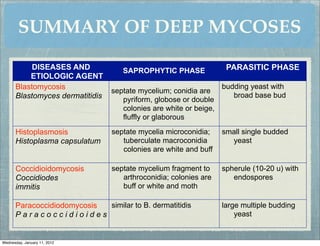
SUMMARY OF DEEP MYCOSES

           DISEASES AND             SAPROPHYTIC PHASE               PARASITIC PHASE
          ETIOLOGIC AGENT
      Blastomycosis                                                budding yeast with
                                 septate mycelium; conidia are
      Blastomyces dermatitidis                                        broad base bud
                                    pyriform, globose or double
                                    colonies are white or beige,
                                    fluffly or glaborous
      Histoplasmosis             septate mycelia microconidia;     small single budded
      Histoplasma capsulatum        tuberculate macroconidia         yeast
                                    colonies are white and buff

      Coccidioidomycosis         septate mycelium fragment to      spherule (10-20 u) with
      Coccidiodes                   arthroconidia; colonies are       endospores
      immitis                       buff or white and moth

      Paracoccidiodomycosis similar to B. dermatitidis             large multiple budding
      Paracoccidioides                                                 yeast


Wednesday, January 11, 2012
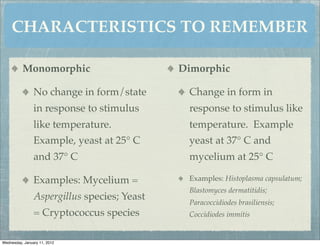
CHARACTERISTICS TO REMEMBER

          Monomorphic                        Dimorphic

                No change in form/state       Change in form in
                in response to stimulus       response to stimulus like
                like temperature.             temperature. Example
                Example, yeast at 25° C       yeast at 37° C and
                and 37° C                     mycelium at 25° C

                Examples: Mycelium =          Examples: Histoplasma capsulatum;
                                              Blastomyces dermatitidis;
                Aspergillus species; Yeast
                                              Paracoccidiodes brasiliensis;
                = Cryptococcus species        Coccidiodes immitis


Wednesday, January 11, 2012
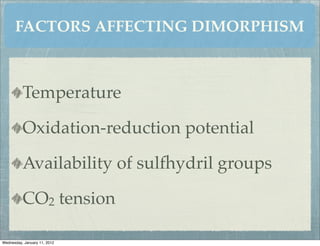
FACTORS AFFECTING DIMORPHISM


          Temperature

          Oxidation-reduction potential

          Availability of sulfhydril groups

          CO2 tension

Wednesday, January 11, 2012
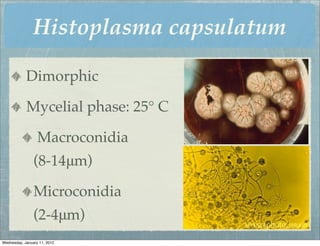
Histoplasma capsulatum

            Dimorphic

            Mycelial phase: 25° C

                  Macroconidia
                (8-14μm)

                Microconidia
                (2-4μm)
Wednesday, January 11, 2012
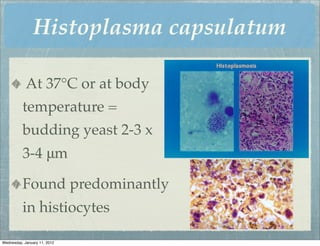
Histoplasma capsulatum

            At 37°C or at body
          temperature =
          budding yeast 2-3 x
          3-4 μm

          Found predominantly
          in histiocytes

Wednesday, January 11, 2012
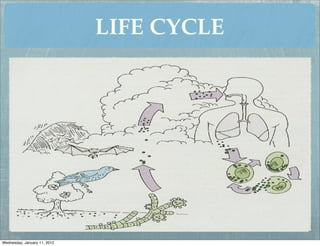
LIFE CYCLE

            soil with high nitrogen content, associated with the
          guano of bats and starlings

          rotting guano mixed with soil & feathers of the birds

          open environment, soil is nitrogen rich with a rainfall
          of 35-50 inches and 67-87% relative humidity

          caves, the main habitat of bats, which are the
          reservoir of Histoplasma capsulatum

Wednesday, January 11, 2012
LIFE CYCLE


Wednesday, January 11, 2012
CLASSIFICATION OF
                               HISTOPLASMOSIS

                 TYPE OF             SPECIFIC
                                                      COMMENTS
               INFECTION            DISORDER
                                 • Asymptomatic or
                                                   • Occurs with
                                   mild like flu
                                                     normal exposure
                                   illness
                                 • Acute pulmonary • Occurs with
      Normal Hosts
                                   histoplasmosis    heavy exposure
                                                   • Pericarditis,
                                 • Rare
                                                     mediastinal
                                   complications
                                                     fibrosis
Wednesday, January 11, 2012
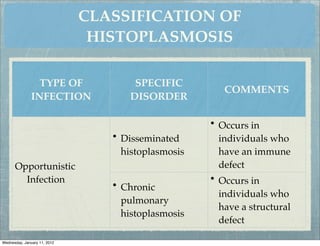
CLASSIFICATION OF
                               HISTOPLASMOSIS

                 TYPE OF             SPECIFIC
                                                      COMMENTS
               INFECTION            DISORDER

                                                    • Occurs in
                                 • Disseminated       individuals who
                                   histoplasmosis     have an immune
      Opportunistic                                   defect
        Infection                                   • Occurs in
                                 • Chronic
                                                     individuals who
                                   pulmonary
                                                     have a structural
                                   histoplasmosis
                                                     defect

Wednesday, January 11, 2012
CLASSIFICATION OF
                               HISTOPLASMOSIS

                 TYPE OF             SPECIFIC
                                                      COMMENTS
               INFECTION            DISORDER

                                                    • Occurs in
                                 • Disseminated       individuals who
                                   histoplasmosis     have an immune
      Opportunistic                                   defect
        Infection                                   • Occurs in
                                 • Chronic
                                                     individuals who
                                   pulmonary
                                                     have a structural
                                   histoplasmosis
                                                     defect

Wednesday, January 11, 2012
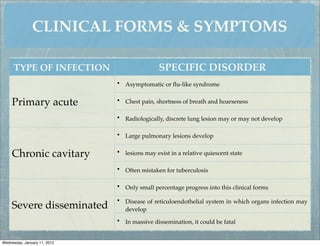
CLINICAL FORMS & SYMPTOMS

     TYPE OF INFECTION                        SPECIFIC DISORDER
                              • Asymptomatic or flu-like syndrome


     Primary acute            • Chest pain, shortness of breath and hoarseness

                              • Radiologically, discrete lung lesion may or may not develop

                              • Large pulmonary lesions develop


     Chronic cavitary         • lesions may exist in a relative quiescent state

                              • Often mistaken for tuberculosis

                              • Only small percentage progress into this clinical forms

                              • Disease of reticuloendothelial system in which organs infection may
     Severe disseminated        develop
                              • In massive dissemination, it could be fatal


Wednesday, January 11, 2012
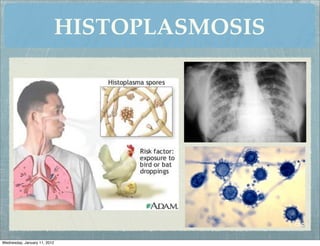
HISTOPLASMOSIS


Wednesday, January 11, 2012
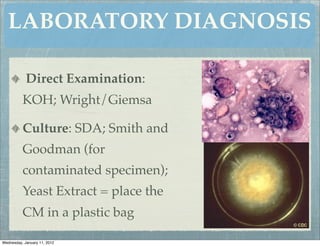
LABORATORY DIAGNOSIS

            Direct Examination:
          KOH; Wright/Giemsa

          Culture: SDA; Smith and
          Goodman (for
          contaminated specimen);
          Yeast Extract = place the
          CM in a plastic bag

Wednesday, January 11, 2012
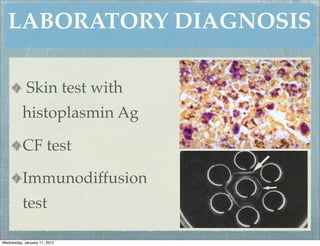
LABORATORY DIAGNOSIS

            Skin test with
          histoplasmin Ag

          CF test

          Immunodiffusion
          test

Wednesday, January 11, 2012
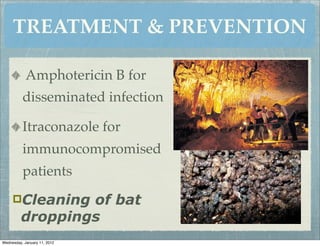
TREATMENT & PREVENTION

            Amphotericin B for
          disseminated infection

          Itraconazole for
          immunocompromised
          patients
     Cleaning   of bat
         droppings
Wednesday, January 11, 2012
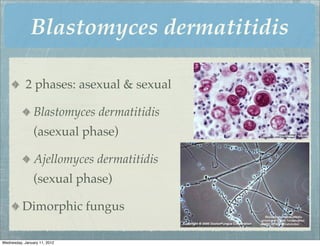
Blastomyces dermatitidis

            2 phases: asexual & sexual

                Blastomyces dermatitidis
                (asexual phase)

                Ajellomyces dermatitidis
                (sexual phase)

          Dimorphic fungus

Wednesday, January 11, 2012
Blastomyces dermatitidis
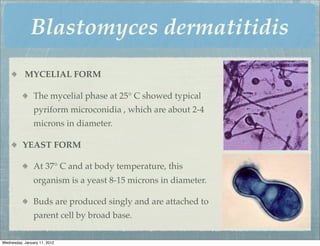
           MYCELIAL FORM

                The mycelial phase at 25° C showed typical
                pyriform microconidia , which are about 2-4
                microns in diameter.

          YEAST FORM

                At 37° C and at body temperature, this
                organism is a yeast 8-15 microns in diameter.

                Buds are produced singly and are attached to
                parent cell by broad base.

Wednesday, January 11, 2012
LIFE CYCLE

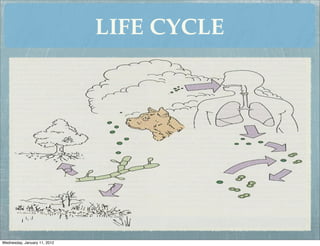
             The mode of transmission: inhalation of the
           spores or the microconidia

           Natural habitat: remains an enigma

           Favors environment with high nitrogen
           content, acid pH, abundant moisture, and
           perhaps enriched with animal excreta

Wednesday, January 11, 2012
LIFE CYCLE


Wednesday, January 11, 2012
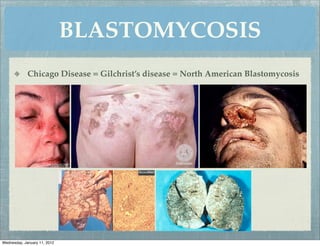
BLASTOMYCOSIS
             Chicago Disease = Gilchrist’s disease = North American Blastomycosis


Wednesday, January 11, 2012
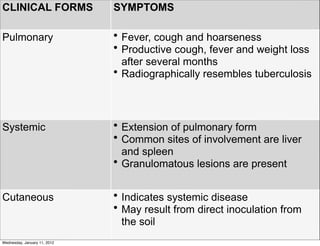
CLINICAL FORMS                SYMPTOMS

Pulmonary                     • Fever, cough and hoarseness
                              • Productive cough, fever and weight loss
                                after several months
                              • Radiographically resembles tuberculosis


Systemic                      • Extension of pulmonary form
                              • Common sites of involvement are liver
                                and spleen
                              • Granulomatous lesions are present


Cutaneous                     • Indicates systemic disease
                              • May result from direct inoculation from
                                the soil
Wednesday, January 11, 2012
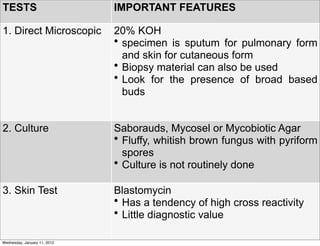
TESTS                         IMPORTANT FEATURES

1. Direct Microscopic         20% KOH
                              • specimen is sputum for pulmonary form
                                and skin for cutaneous form
                              • Biopsy material can also be used
                              • Look for the presence of broad based
                                buds


2. Culture                    Saborauds, Mycosel or Mycobiotic Agar
                              • Fluffy, whitish brown fungus with pyriform
                                spores
                              • Culture is not routinely done

3. Skin Test                  Blastomycin
                              • Has a tendency of high cross reactivity
                              • Little diagnostic value

Wednesday, January 11, 2012
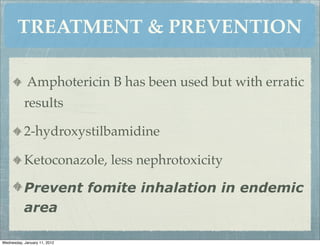
TREATMENT & PREVENTION

            Amphotericin B has been used but with erratic
           results

           2-hydroxystilbamidine

           Ketoconazole, less nephrotoxicity

           Prevent fomite inhalation in endemic
           area

Wednesday, January 11, 2012
Coccidioides immitis

            Amphotericin B has been used but with erratic results

           Asexual phase: Coccidiodes immitis

           Sexual phase: not known

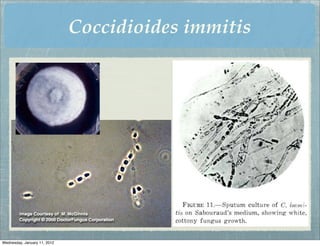
           MYCELIAL STAGE (25°C)

                 septate hyphae mature in a manner such that alternate cells
                 develop into arthroconidia being separated by vacuolized cells

                arthroconidia separate readily and have a “barrel” shape
                appearance

Wednesday, January 11, 2012
Coccidioides immitis


Wednesday, January 11, 2012
Coccidioides immitis

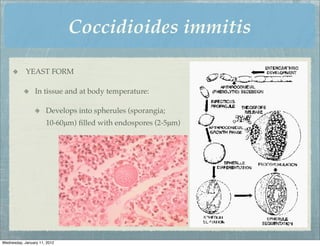
            YEAST FORM

                 In tissue and at body temperature:

                      Develops into spherules (sporangia;
                      10-60μm) filled with endospores (2-5μm)


Wednesday, January 11, 2012
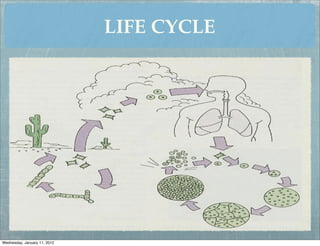
LIFE CYCLE


Wednesday, January 11, 2012
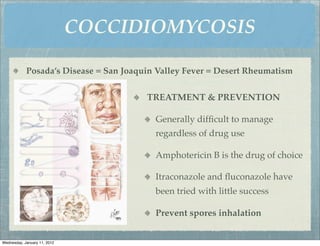
COCCIDIOMYCOSIS

            Posada’s Disease = San Joaquin Valley Fever = Desert Rheumatism


                                        TREATMENT & PREVENTION

                                          Generally difficult to manage
                                          regardless of drug use

                                          Amphotericin B is the drug of choice

                                          Itraconazole and fluconazole have
                                          been tried with little success

                                          Prevent spores inhalation


Wednesday, January 11, 2012
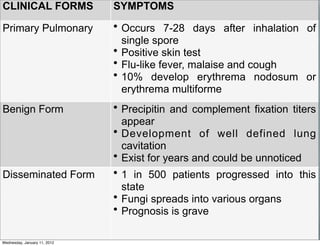
CLINICAL FORMS                SYMPTOMS

Primary Pulmonary             • Occurs 7-28 days after inhalation of
                                single spore
                              • Positive skin test
                              • Flu-like fever, malaise and cough
                              • 10% develop erythrema nodosum or
                                erythrema multiforme
Benign Form                   • Precipitin and complement fixation titers
                                appear
                              • Development of well defined lung
                                cavitation
                              • Exist for years and could be unnoticed
Disseminated Form             • 1 in 500 patients progressed into this
                                state
                              • Fungi spreads into various organs
                              • Prognosis is grave

Wednesday, January 11, 2012
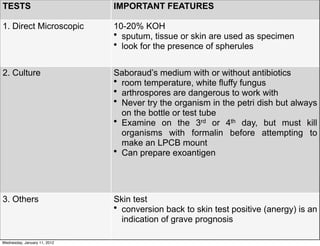
TESTS                         IMPORTANT FEATURES

1. Direct Microscopic         10-20% KOH
                              • sputum, tissue or skin are used as specimen
                              • look for the presence of spherules


2. Culture                    Saboraud’s medium with or without antibiotics
                              • room temperature, white fluffy fungus
                              • arthrospores are dangerous to work with
                              • Never try the organism in the petri dish but always
                                on the bottle or test tube
                              • Examine on the 3rd or 4th day, but must kill
                                organisms with formalin before attempting to
                                make an LPCB mount
                              • Can prepare exoantigen


3. Others                     Skin test
                              • conversion back to skin test positive (anergy) is an
                                indication of grave prognosis

Wednesday, January 11, 2012
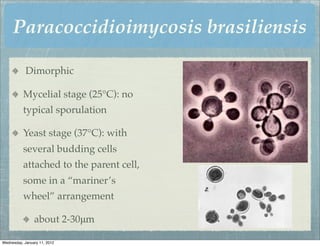
Paracoccidioimycosis brasiliensis

            Dimorphic

          Mycelial stage (25°C): no
          typical sporulation

          Yeast stage (37°C): with
          several budding cells
          attached to the parent cell,
          some in a “mariner’s
          wheel” arrangement

                about 2-30μm

Wednesday, January 11, 2012
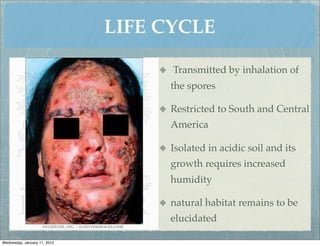
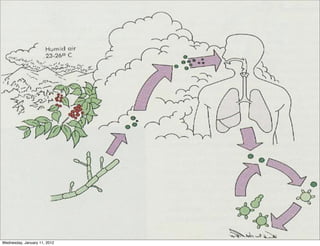
LIFE CYCLE

                                    Transmitted by inhalation of
                                   the spores

                                   Restricted to South and Central
                                   America

                                   Isolated in acidic soil and its
                                   growth requires increased
                                   humidity

                                   natural habitat remains to be
                                   elucidated

Wednesday, January 11, 2012
PARACOCCIDIODOMYCOSIS

            South American Blastomycosis = Lutz-
          Splendore-Almeida’s Disease

          A chronic granulomatous disease of skin,
          mucous membranes, lymph nodes and internal
          organs

          Central and South America more specifically in
          Brazil
Wednesday, January 11, 2012
PARACOCCIDIODOMYCOSIS

            Females are as susceptible to infections as males,
          but the incidence of clinical disease in males is
          nine times higher

          Primary pulmonary disease is often inapparent

          Disseminated disease often causes ulcerative
          lesions of the buccal, nasal and occasionally
          gastrointestinal mucosa.

Wednesday, January 11, 2012
TESTS                         IMPORTANT FEATURES

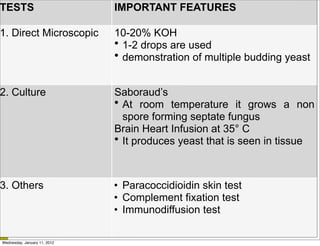
1. Direct Microscopic         10-20% KOH
                              • 1-2 drops are used
                              • demonstration of multiple budding yeast


2. Culture                    Saboraud’s
                              • At room temperature it grows a non
                                spore forming septate fungus
                              Brain Heart Infusion at 35° C
                              • It produces yeast that is seen in tissue


3. Others                     • Paracoccidioidin skin test
                              • Complement fixation test
                              • Immunodiffusion test
                               Dr. Supachai Basit

Wednesday, January 11, 2012
TREATMENT & PREVENTION


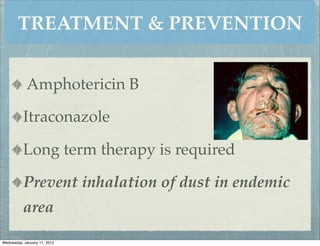
            Amphotericin B

          Itraconazole

          Long term therapy is required

          Prevent inhalation of dust in endemic
          area

Wednesday, January 11, 2012
Cryptococcus neoformans

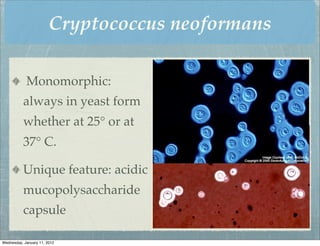
            Monomorphic:
          always in yeast form
          whether at 25° or at
          37° C.

          Unique feature: acidic
          mucopolysaccharide
          capsule

Wednesday, January 11, 2012
LIFE CYCLE

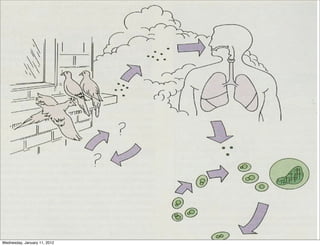
            The etiologic agent of cryptococcosis has been
          recovered in large numbers from the excreta

          debris of pigeon roosts, thus it appears to survive
          well in a dessicated, alkaline, nitrogen-rich and
          hypertonic environment

          There is a close relationship to the habitats of
          pigeon, but the organism does not infect the bird

Wednesday, January 11, 2012
Dr. Supachai Basit

Wednesday, January 11, 2012
CRYPTOCOCCOSIS

            Busse-Buschke’s Disease, Torulosis, European
          Blastomycosis

          The disease is worldwide in distribution.

          This yeast has been repeatedly isolated from sites
          inhabited by pigeons, particularly their roosts and
          droppings.

          Pigeons are not naturally infected.
Wednesday, January 11, 2012
CRYPTOCOCCOSIS


            Primary pulmonary cryptococcosis is usually
          inapparent but may be chronic, subacute or acute.

          The clinical entity is most often seen in
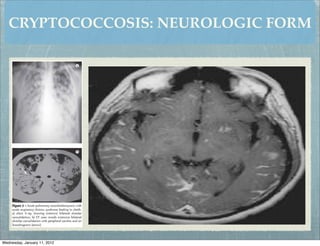
          cryptococcal meningitis.

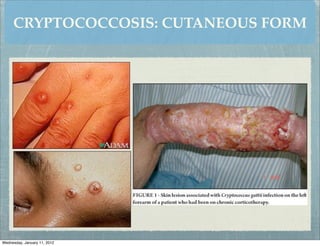
          Osseous and cutaneous disease can be present
          without apparent neurologic involvement.

Wednesday, January 11, 2012
CRYPTOCOCCOSIS: CUTANEOUS FORM


Wednesday, January 11, 2012
CRYPTOCOCCOSIS: NEUROLOGIC FORM


Wednesday, January 11, 2012
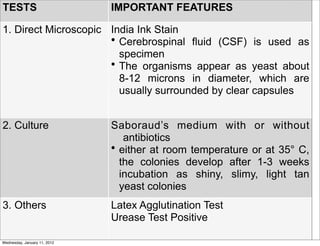
TESTS                         IMPORTANT FEATURES

1. Direct Microscopic India Ink Stain
                      • Cerebrospinal fluid (CSF) is used as
                        specimen
                      • The organisms appear as yeast about
                        8-12 microns in diameter, which are
                        usually surrounded by clear capsules


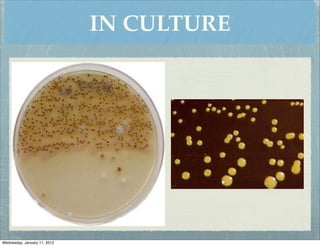
2. Culture                    Saboraud’s medium with or without
                                 antibiotics
                              • either at room temperature or at 35° C,
                                the colonies develop after 1-3 weeks
                                incubation as shiny, slimy, light tan
                                yeast colonies
3. Others                     Latex Agglutination Test
                              Urease Test Positive
                                Dr. Supachai Basit

Wednesday, January 11, 2012
IN CULTURE


Wednesday, January 11, 2012
TREATMENT & PREVENTION

            Amphotericin B in combination with
          5-fluorocytosine have been successful

          Fluconazole is as effective too

          Clean pigeon droppings

          Avoid visiting caves without protective
          gears
Wednesday, January 11, 2012

Systemic mycoses

  • 1.
    SYSTEMIC MYCOSES Wednesday, January 11, 2012
  • 2.
    SUMMARY OF DEEPMYCOSES DISEASES AND SAPROPHYTIC PHASE PARASITIC PHASE ETIOLOGIC AGENT Blastomycosis budding yeast with septate mycelium; conidia are Blastomyces dermatitidis broad base bud pyriform, globose or double colonies are white or beige, fluffly or glaborous Histoplasmosis septate mycelia microconidia; small single budded Histoplasma capsulatum tuberculate macroconidia yeast colonies are white and buff Coccidioidomycosis septate mycelium fragment to spherule (10-20 u) with Coccidiodes arthroconidia; colonies are endospores immitis buff or white and moth Paracoccidiodomycosis similar to B. dermatitidis large multiple budding Paracoccidioides yeast Wednesday, January 11, 2012
  • 3.
    CHARACTERISTICS TO REMEMBER Monomorphic Dimorphic No change in form/state Change in form in in response to stimulus response to stimulus like like temperature. temperature. Example Example, yeast at 25° C yeast at 37° C and and 37° C mycelium at 25° C Examples: Mycelium = Examples: Histoplasma capsulatum; Blastomyces dermatitidis; Aspergillus species; Yeast Paracoccidiodes brasiliensis; = Cryptococcus species Coccidiodes immitis Wednesday, January 11, 2012
  • 4.
    FACTORS AFFECTING DIMORPHISM Temperature Oxidation-reduction potential Availability of sulfhydril groups CO2 tension Wednesday, January 11, 2012
  • 5.
    Histoplasma capsulatum Dimorphic Mycelial phase: 25° C Macroconidia (8-14μm) Microconidia (2-4μm) Wednesday, January 11, 2012
  • 6.
    Histoplasma capsulatum At 37°C or at body temperature = budding yeast 2-3 x 3-4 μm Found predominantly in histiocytes Wednesday, January 11, 2012
  • 7.
    LIFE CYCLE soil with high nitrogen content, associated with the guano of bats and starlings rotting guano mixed with soil & feathers of the birds open environment, soil is nitrogen rich with a rainfall of 35-50 inches and 67-87% relative humidity caves, the main habitat of bats, which are the reservoir of Histoplasma capsulatum Wednesday, January 11, 2012
  • 8.
  • 9.
    CLASSIFICATION OF HISTOPLASMOSIS TYPE OF SPECIFIC COMMENTS INFECTION DISORDER • Asymptomatic or • Occurs with mild like flu normal exposure illness • Acute pulmonary • Occurs with Normal Hosts histoplasmosis heavy exposure • Pericarditis, • Rare mediastinal complications fibrosis Wednesday, January 11, 2012
  • 10.
    CLASSIFICATION OF HISTOPLASMOSIS TYPE OF SPECIFIC COMMENTS INFECTION DISORDER • Occurs in • Disseminated individuals who histoplasmosis have an immune Opportunistic defect Infection • Occurs in • Chronic individuals who pulmonary have a structural histoplasmosis defect Wednesday, January 11, 2012
  • 11.
    CLASSIFICATION OF HISTOPLASMOSIS TYPE OF SPECIFIC COMMENTS INFECTION DISORDER • Occurs in • Disseminated individuals who histoplasmosis have an immune Opportunistic defect Infection • Occurs in • Chronic individuals who pulmonary have a structural histoplasmosis defect Wednesday, January 11, 2012
  • 12.
    CLINICAL FORMS &SYMPTOMS TYPE OF INFECTION SPECIFIC DISORDER • Asymptomatic or flu-like syndrome Primary acute • Chest pain, shortness of breath and hoarseness • Radiologically, discrete lung lesion may or may not develop • Large pulmonary lesions develop Chronic cavitary • lesions may exist in a relative quiescent state • Often mistaken for tuberculosis • Only small percentage progress into this clinical forms • Disease of reticuloendothelial system in which organs infection may Severe disseminated develop • In massive dissemination, it could be fatal Wednesday, January 11, 2012
  • 13.
  • 14.
    LABORATORY DIAGNOSIS Direct Examination: KOH; Wright/Giemsa Culture: SDA; Smith and Goodman (for contaminated specimen); Yeast Extract = place the CM in a plastic bag Wednesday, January 11, 2012
  • 15.
    LABORATORY DIAGNOSIS Skin test with histoplasmin Ag CF test Immunodiffusion test Wednesday, January 11, 2012
  • 16.
    TREATMENT & PREVENTION Amphotericin B for disseminated infection Itraconazole for immunocompromised patients Cleaning of bat droppings Wednesday, January 11, 2012
  • 17.
    Blastomyces dermatitidis 2 phases: asexual & sexual Blastomyces dermatitidis (asexual phase) Ajellomyces dermatitidis (sexual phase) Dimorphic fungus Wednesday, January 11, 2012
  • 18.
    Blastomyces dermatitidis MYCELIAL FORM The mycelial phase at 25° C showed typical pyriform microconidia , which are about 2-4 microns in diameter. YEAST FORM At 37° C and at body temperature, this organism is a yeast 8-15 microns in diameter. Buds are produced singly and are attached to parent cell by broad base. Wednesday, January 11, 2012
  • 19.
    LIFE CYCLE The mode of transmission: inhalation of the spores or the microconidia Natural habitat: remains an enigma Favors environment with high nitrogen content, acid pH, abundant moisture, and perhaps enriched with animal excreta Wednesday, January 11, 2012
  • 20.
  • 21.
    BLASTOMYCOSIS Chicago Disease = Gilchrist’s disease = North American Blastomycosis Wednesday, January 11, 2012
  • 22.
    CLINICAL FORMS SYMPTOMS Pulmonary • Fever, cough and hoarseness • Productive cough, fever and weight loss after several months • Radiographically resembles tuberculosis Systemic • Extension of pulmonary form • Common sites of involvement are liver and spleen • Granulomatous lesions are present Cutaneous • Indicates systemic disease • May result from direct inoculation from the soil Wednesday, January 11, 2012
  • 23.
    TESTS IMPORTANT FEATURES 1. Direct Microscopic 20% KOH • specimen is sputum for pulmonary form and skin for cutaneous form • Biopsy material can also be used • Look for the presence of broad based buds 2. Culture Saborauds, Mycosel or Mycobiotic Agar • Fluffy, whitish brown fungus with pyriform spores • Culture is not routinely done 3. Skin Test Blastomycin • Has a tendency of high cross reactivity • Little diagnostic value Wednesday, January 11, 2012
  • 24.
  • 25.
    TREATMENT & PREVENTION Amphotericin B has been used but with erratic results 2-hydroxystilbamidine Ketoconazole, less nephrotoxicity Prevent fomite inhalation in endemic area Wednesday, January 11, 2012
  • 26.
    Coccidioides immitis Amphotericin B has been used but with erratic results Asexual phase: Coccidiodes immitis Sexual phase: not known MYCELIAL STAGE (25°C) septate hyphae mature in a manner such that alternate cells develop into arthroconidia being separated by vacuolized cells  arthroconidia separate readily and have a “barrel” shape appearance Wednesday, January 11, 2012
  • 27.
  • 28.
    Coccidioides immitis YEAST FORM In tissue and at body temperature: Develops into spherules (sporangia; 10-60μm) filled with endospores (2-5μm) Wednesday, January 11, 2012
  • 29.
  • 30.
    COCCIDIOMYCOSIS Posada’s Disease = San Joaquin Valley Fever = Desert Rheumatism TREATMENT & PREVENTION Generally difficult to manage regardless of drug use Amphotericin B is the drug of choice Itraconazole and fluconazole have been tried with little success Prevent spores inhalation Wednesday, January 11, 2012
  • 31.
    CLINICAL FORMS SYMPTOMS Primary Pulmonary • Occurs 7-28 days after inhalation of single spore • Positive skin test • Flu-like fever, malaise and cough • 10% develop erythrema nodosum or erythrema multiforme Benign Form • Precipitin and complement fixation titers appear • Development of well defined lung cavitation • Exist for years and could be unnoticed Disseminated Form • 1 in 500 patients progressed into this state • Fungi spreads into various organs • Prognosis is grave Wednesday, January 11, 2012
  • 32.
    TESTS IMPORTANT FEATURES 1. Direct Microscopic 10-20% KOH • sputum, tissue or skin are used as specimen • look for the presence of spherules 2. Culture Saboraud’s medium with or without antibiotics • room temperature, white fluffy fungus • arthrospores are dangerous to work with • Never try the organism in the petri dish but always on the bottle or test tube • Examine on the 3rd or 4th day, but must kill organisms with formalin before attempting to make an LPCB mount • Can prepare exoantigen 3. Others Skin test • conversion back to skin test positive (anergy) is an indication of grave prognosis Wednesday, January 11, 2012
  • 33.
  • 34.
    Paracoccidioimycosis brasiliensis Dimorphic Mycelial stage (25°C): no typical sporulation Yeast stage (37°C): with several budding cells attached to the parent cell, some in a “mariner’s wheel” arrangement about 2-30μm Wednesday, January 11, 2012
  • 35.
    LIFE CYCLE Transmitted by inhalation of the spores Restricted to South and Central America Isolated in acidic soil and its growth requires increased humidity natural habitat remains to be elucidated Wednesday, January 11, 2012
  • 36.
  • 37.
    PARACOCCIDIODOMYCOSIS South American Blastomycosis = Lutz- Splendore-Almeida’s Disease A chronic granulomatous disease of skin, mucous membranes, lymph nodes and internal organs Central and South America more specifically in Brazil Wednesday, January 11, 2012
  • 38.
    PARACOCCIDIODOMYCOSIS Females are as susceptible to infections as males, but the incidence of clinical disease in males is nine times higher Primary pulmonary disease is often inapparent Disseminated disease often causes ulcerative lesions of the buccal, nasal and occasionally gastrointestinal mucosa. Wednesday, January 11, 2012
  • 39.
    TESTS IMPORTANT FEATURES 1. Direct Microscopic 10-20% KOH • 1-2 drops are used • demonstration of multiple budding yeast 2. Culture Saboraud’s • At room temperature it grows a non spore forming septate fungus Brain Heart Infusion at 35° C • It produces yeast that is seen in tissue 3. Others • Paracoccidioidin skin test • Complement fixation test • Immunodiffusion test Dr. Supachai Basit Wednesday, January 11, 2012
  • 40.
    TREATMENT & PREVENTION Amphotericin B Itraconazole Long term therapy is required Prevent inhalation of dust in endemic area Wednesday, January 11, 2012
  • 41.
    Cryptococcus neoformans Monomorphic: always in yeast form whether at 25° or at 37° C. Unique feature: acidic mucopolysaccharide capsule Wednesday, January 11, 2012
  • 42.
    LIFE CYCLE The etiologic agent of cryptococcosis has been recovered in large numbers from the excreta debris of pigeon roosts, thus it appears to survive well in a dessicated, alkaline, nitrogen-rich and hypertonic environment There is a close relationship to the habitats of pigeon, but the organism does not infect the bird Wednesday, January 11, 2012
  • 43.
  • 44.
    CRYPTOCOCCOSIS Busse-Buschke’s Disease, Torulosis, European Blastomycosis The disease is worldwide in distribution. This yeast has been repeatedly isolated from sites inhabited by pigeons, particularly their roosts and droppings. Pigeons are not naturally infected. Wednesday, January 11, 2012
  • 45.
    CRYPTOCOCCOSIS Primary pulmonary cryptococcosis is usually inapparent but may be chronic, subacute or acute. The clinical entity is most often seen in cryptococcal meningitis. Osseous and cutaneous disease can be present without apparent neurologic involvement. Wednesday, January 11, 2012
  • 46.
  • 47.
  • 48.
    TESTS IMPORTANT FEATURES 1. Direct Microscopic India Ink Stain • Cerebrospinal fluid (CSF) is used as specimen • The organisms appear as yeast about 8-12 microns in diameter, which are usually surrounded by clear capsules 2. Culture Saboraud’s medium with or without antibiotics • either at room temperature or at 35° C, the colonies develop after 1-3 weeks incubation as shiny, slimy, light tan yeast colonies 3. Others Latex Agglutination Test Urease Test Positive Dr. Supachai Basit Wednesday, January 11, 2012
  • 49.
  • 50.
    TREATMENT & PREVENTION Amphotericin B in combination with 5-fluorocytosine have been successful Fluconazole is as effective too Clean pigeon droppings Avoid visiting caves without protective gears Wednesday, January 11, 2012