








SYSTEMIC
LUPUS
DR. SEETHAMONY PV
CONSULTANT PHYSICIAN
DR. KARUNAN KANNAMPOYILIL
Senior NEPHROLOGIST
& Founder &AMBASSADOR IFKF
ERYTHEMATOSIS
Quassia amara
SLE SYMPOSIUM
1.Introduction
2.History
3.Epidemiology
4.Pathophysiology
5.Pathology
6.Autoimmunity
7.Cliical features
8.Diagnosis
9.Managmment
10.Future
1.Introduction
Systemic lupus erythematosus (SLE) is a chronic multisystem autoimmune disorder
characterized by the development of autoantibodies and immune complexes
in association with a wide variety of clinical manifestations and tissue damage.
Several defects of multiple immunological components play a role
A wide range of immunological abnormality
Ability to produce pathogenic auto antibodies
Lack of T&B-lymphocyte regulation
Defective clearance of auto antigens and immune complexes
Majority of autoantibodies are directed at intracellular nucleoprotein particles,
Antinuclear antibodies(ANA) 98%
Anti-double-stranded DNA (dsDNA) antibodies are found in 50–80%
These latter autoantibodies are exclusive to lupus.
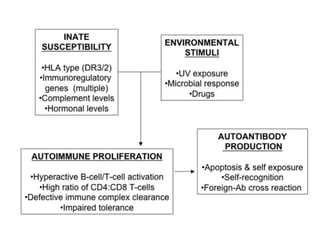
The precise etiology of SLE remains to be defined;
however, it is known that genetic predisposition and
Environmental and hormonal factors play important roles.
These factors interact to transform complex relations
between the host, pathogens, and the environment.
Along with recent advances in genetic research,
newly discovered genes associated with SLE confirm
the preexisting concept of pathogenesis and may also provide
A new biologic insights into the pathogenesis of the disorder
1.Introduction
2.History
3.Epidemiology
4.Pathophysiology
5.Pathology
6.Autoimmunity
7.Cliical features
8.Diagnosis
9.Managmment
10.Future
2.History
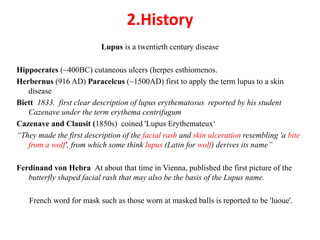
Lupus is a twentieth century disease
Hippocrates (~400BC) cutaneous ulcers (herpes esthiomenos.
Herbernus (916 AD) Paracelcus (~1500AD) first to apply the term lupus to a skin
disease
Biett 1833. first clear description of lupus erythematosus reported by his student
Cazenave under the term erythema centrifugum
Cazenave and Clausit (1850s) coined 'Lupus Erythemateux‘
“They made the first description of the facial rash and skin ulceration resembling 'a bite
from a wolf', from which some think lupus (Latin for wolf) derives its name”
Ferdinand von Hebra At about that time in Vienna, published the first picture of the
butterfly shaped facial rash that may also be the basis of the Lupus name.
French word for mask such as those worn at masked balls is reported to be 'luoue'.
Hebra, (1846)
“ under the name of Seborrhea Congestiva described disc-shaped patches and
introduced the butterfly simile for the malar rash”
Cazenave (1851)
“ renamed erythema centrifugum, calling it lupus erythematosus and gave a classic
description of discoid lupus erythematosus”
A number of terms used to describe cutaneous ulcers
Lupus
Noli me tangere
Herpes esthiomenos
Sir William Osler (1903) first mention
“He described 20 young ladies with skin rashes and chest pain resulting from
inflammation of the lining of the lung (pleurisy) or heart (pericarditis)
In addition, these patients also had kidney disease, strokes and
brain involvement severe enough to be fatal so that
18 had died within two years from presentation”
The history can be divided into three periods:
A.The classical period
B.The Neoclassical era
C.The modern era.
A. The classical period
Derivation of the term lupus & Clinical descriptions of the cutaneous lesions of
Lupus vulgaris,
Lupus profundus,
Discoid lupus &
Photosensitive nature of the malar/ butterfly rash
( Smith and Cyr in 1988.)
B. The Neoclassical era
1872 Kaposi first described the systemic nature of the disorder
(1) Subcutaneous nodules
(2) Arthritis -synovial hypertrophy small & large joints
(3) Lymphadenopathy
(4) fever
(5) Weight loss
(6) Anemia and
(7) Central nervous system involvement.
1904 Osler in Baltimore6 & Jadassohn in Vienna-Systemic Lupus
The existence of a disseminated or systemic form of lupus established
Over the next 30 years
Pathologic studies documented
Nonbacterial verrucous endocarditis (Libman-Sacks disease)
wire-loop lesions in glomerulonephritis
( 1941) Kemperer & colleagues in autopsy
Termed collagen vascular disease
This terminology, persists in usage now fifty years after its introduction
C. The modern era
1948 - Hargraves and colleagues discovery of the LE cell
Moore-the biologic false-positive test for syphilis
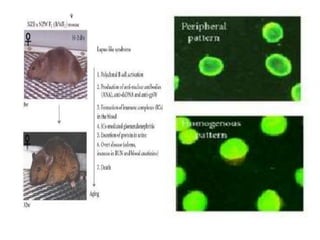
Friou, - immunofluorescent test for antinuclear antibodies
Antibodies to deoxyribonucleic acid (DNA)
Aantibodies to extractable nuclear antigens
(nuclear ribonucleoprotein (nRNP), Sm, Ro, La) &
Anticardiolipin antibodies;
Two major advances in the modern era
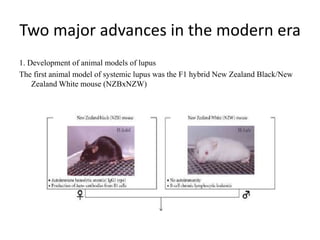
1. Development of animal models of lupus
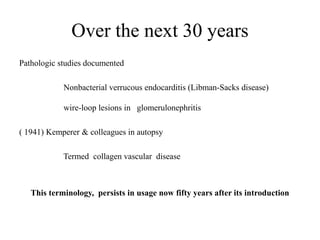
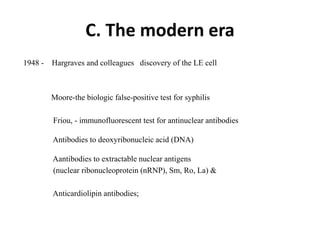
The first animal model of systemic lupus was the F1 hybrid New Zealand Black/New
Zealand White mouse (NZBxNZW)
2. Recognition of the role of genetic
1954 Leonhardt-first noted -familial occurrence of SLE
later Arnett and Shulman at Johns Hopkins.
Congenital heart block
due to anti-Ro and anti-La, (18 and 30 weeks gestation)
Finally, no discussion of the history of lupus is complete
without a review of the development of therapy
Payne(1894) quinine in lupus
1898- Salicylates in conjunction with quinine was also noted to be of benefit
Hench Middle of 20th century -Adrenocorticotrophic hormone &
Cortisone by revolutionized SLE treatment
INDIA
(!965)1995? -The first case followed by two more case reports
further a series of eight cases, till 1969
1968- Clinical immunology laboratory New Delhi
extensively studied and reported from that centre.
From mid-1980 onwards several other centres in different regions in India
Chennai Mumbai, Calcutta and Hydrabad, published their regional experience
1366 SLE patients seen in different regions of India-
Malaviya etal
1.Introduction
2.History
3.Epidemiology
4.Pathophysiology
5.Pathology
6.Autoimmunity
7.Cliical features
8.Diagnosis
9.Managmment
10.Future
EPIDEMIOLOGY
Incidence
2nd most common autoimmune disease in the world*
Gen.population- 20 to 150 cases per 100,000
In women -164 (white) to 406 (African American
Tripled - last 40 years
America, Europe& Asia-1 to 25 per 100,000
Geographic - more common in urban than rural
*Ref: Can morbidity and mortality of SLE be improved? Anurekha B, Elizabeth C ,Rosalind R.
Best Practice & Research Clinical Rheumatology 16: 2: 313-332, April
Prevalence
Higher- Asians,
Afro-Americans,
Afro-Caribbeans &
Hispanic Americans
Among Asian Indians compared
Lower- Americans of European decent in US
Caucasians in Britain
Blacks in Africa
New Zealand- Polynesians > Caucasians
N.European- Photosensitivity &discoid lesions -
S.European- anti-cardiolipin& anti-ds DNA
Gender
F:M - Children 3:1, Adults (Fertile)-7:1 to 15:1, PMW - 8:1
Genes- Xchromosomes (IRAK1, MECP2, TLR7)
Gene dose effect-
XXY (Klinefelter) d 14-fold increase SLEmen v/s general population
XO (Turner's syndrome)-under represented in women
X-inactivation,
Imprinting,
X or Y chromosome genetic modulators,
differential methylation of DNA & acetylation of histones bound to DNA,
intrauterine influences,
chronobiologic differences,
pregnancy, and menstruation
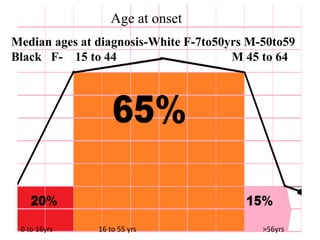
Age at onset
Median ages at diagnosis-White F-7to50yrs M-50to59
Black F- 15 to 44 M 45 to 64
0 to 16yrs 16 to 55 yrs >56yrs
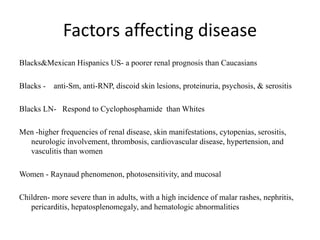
Factors affecting disease
Blacks&Mexican Hispanics US- a poorer renal prognosis than Caucasians
Blacks - anti-Sm, anti-RNP, discoid skin lesions, proteinuria, psychosis, & serositis
Blacks LN- Respond to Cyclophosphamide than Whites
Men -higher frequencies of renal disease, skin manifestations, cytopenias, serositis,
neurologic involvement, thrombosis, cardiovascular disease, hypertension, and
vasculitis than women
Women - Raynaud phenomenon, photosensitivity, and mucosal
Children- more severe than in adults, with a high incidence of malar rashes, nephritis,
pericarditis, hepatosplenomegaly, and hematologic abnormalities
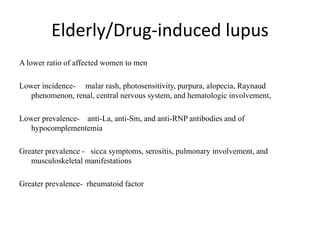
Elderly/Drug-induced lupus
A lower ratio of affected women to men
Lower incidence- malar rash, photosensitivity, purpura, alopecia, Raynaud
phenomenon, renal, central nervous system, and hematologic involvement,
Lower prevalence- anti-La, anti-Sm, and anti-RNP antibodies and of
hypocomplementemia
Greater prevalence - sicca symptoms, serositis, pulmonary involvement, and
musculoskeletal manifestations
Greater prevalence- rheumatoid factor
ETIOLOGY
Unknown
Genetic
Hormonal
Immunologic
&
Environmental factors.
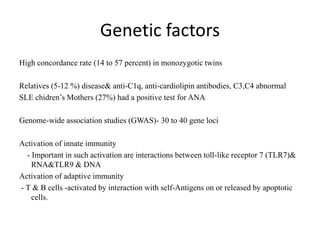
Genetic factors
High concordance rate (14 to 57 percent) in monozygotic twins
Relatives (5-12 %) disease& anti-C1q, anti-cardiolipin antibodies, C3,C4 abnormal
SLE chidren’s Mothers (27%) had a positive test for ANA
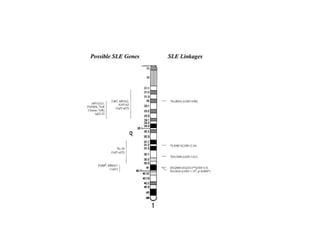
Genome-wide association studies (GWAS)- 30 to 40 gene loci
Activation of innate immunity
- Important in such activation are interactions between toll-like receptor 7 (TLR7)&
RNA&TLR9 & DNA
Activation of adaptive immunity
- T & B cells -activated by interaction with self-Antigens on or released by apoptotic
cells.
Genetic factors confer highest hazard ratios of 5 to 25
Deficiencies of complement - C1q (required to clear apoptotic cells) C 4A and B, C2
TREX1 gene mutation- (encodes 3 prime repair endonuclease1 that degrades DNA).
The most common genetic predisposition-MHC.
MHC - Genes for antigen presenting molecules
(class I -HLA-A,B, &-C and class II HLA molecules [HLA-DR, -DQ, & DP])
MHC also contains genes- complement components, cytokines,& heat shock protein.
Predisposing loci- DR2 &DR3, HR-2
But region is complex & involves multiple genes across the entire 120-gene region in
multiple ethnic groups
Other genes
Innate immunity –
(IRF5, Stat4, IRAK1, TNFAIP3, SPP1), are associated with IFN alpha pathways
Overexpression of IFNa-induced genes is found- peripheral blood cells of 60% Lupus
Polymorphisms in STAT4, PTPN22&IRF5 -HR or increased sensitivity to IFN-a
Furthermore,
STAT4 and IRF5 may have additive effects genes involve lymphocyte signaling (PTPN22,
OX40L, PD-1, BANK-1, LYN, BLK)- activation or suppression of T/B cell
activation/survival
Clearance of immune complexes ( C1q, C4 &C2 , FcgammaRIIA, RIIA and RIIIB, CRP, and
integrin alpha M [ITGAM])
IL-10 is conferred by a variation in gene copy number rather than by different alleles eg, Fc
gamma R3&C4
In summary
Except for the rare TREX1 mutation or deficiencies of early components of
complement, there is not a single gene polymorphism that creates high risk
Thus, a combination of susceptibility genes
OR
presence of susceptibility genes + absence of protective genes (such as TLR5
polymorphism or loss-of-function PTPN22 variant) are required to
"achieve" enough genetic susceptibility to permit disease development
In addition to genome-encoded susceptibility genes
Epigenetic modifications - important in pathogenesis
hypomethylation of DNA - influences transcription into protein.
The influence of microRNAs on transcription of several predisposing genes identified
The hypomethylation likely affects specific genes.
SNPs in SLE risk genes predispose to particular clinical subsets
As examples:
The SNP in the third intron of STAT4
(which predisposes to both rheumatoid arthritis and to SLE in several ethnic groups)
increases risk for anti-DNA antibodies, nephritis and the antiphospholipid syndrome
SNPs associated with LYN decrease risk for SLE susceptibility and for hematologic
manifestations in European-American cohorts
A CRP-A allele is associated with SLE nephritis but is inversely correlated with arthritis The
polymorphism of FcgammaRIIa associated with low binding of immune complexes
predisposes to lupus nephritis
A coding variant of the ITGAM gene is associated with the development of renal disease,
discoid rash and “immunological manifestations” in SLE with European ancestry
Stratification by disease phenotypes may be of benefit in genetic analyses of molecular
pathogenesis.
A GWAS of SLE patients identified several loci of particular interest
But none of the SNPs were strongly associated with SLE in case-control analysis.
Nephritis (2q34)
Hemolytic anemia (11q14)
Discoid lupus and thrombocytopenia (11p13)
Vitiligo (17p12)
production of certain autoantibodies (eg, anti-ds DNA [19p13.2])
Increased risk for end stage renal disease
Hormonal factors
Immunoregulatory function of hormones modulate the incidence and severity–
estradiol,
testosterone,
progesterone,
DHEA, and
pituitary hormones, including prolactin
As examples:
Estrogen-containing contraceptive- associated with a 50% risk(age ≤10 years) or PMW
SLE has been observed in some males with Klinefelter's syndrome
Altered sex hormone levels may predispose or result from the autoimmune process.
In women, plasma levels of the following hormones are decreased
testosterone
,
progesterone,
dehydroepiandrosterone (DHEA),
while estradiol and prolactin are increased.
Breastfeeding may decrease risk of developing SLE
etiologic role of Estrogen in SLE
1. Stimulates thymocytes, CD8+ and CD4+ T cells, B cells, macrophages,
2. Release of certain cytokines (eg, interleukin-1),
3. Expression of HLA & endothelial cell adhesion molecules (VCAM, ICAM)
4. Increased macrophage proto-oncogene expression and enhanced adhesion of
peripheral mononuclear cells to endothelium
5. Reduce apoptosis in self-reactive B cells, promoting selective maturation of Auto
reactive B cells with high affinity for anti-DNA.
6. Consequently- Auto antibodies - SLE.
Androgens - immunosuppressive.
Serum DHEA are low in nearly all patients with SLE
.
This may be mediated by impaired IL-2 production in SLE patients
Other hormones
Progesterone -downregulates T cell proliferation & increases the number of CD8 cells,
while lupus flares have been associated with hyperprolactinemia
Progesterone & high levels of estrogen promote a Th2 response, which favors
autoantibody production
Increased incidence of thyroid disease in SLE
Abnormalities of the hypothalamus-pituitary-adrenal axis in SLE.
Patients appear to have an abnormal reaction to stress- by a heightened response to
human corticotropin releasing hormone (hCRH)
Immune abnormalities
Remains unclear- primary- secondarily induced.
A disease with abnormalities in immune regulation Secondary to a loss of self
tolerance;- affected patients are no longer totally tolerant to all of their self-
antigens-develop an autoimmune response
The mediators are autoantibodies + immune complexes+ antigens
Autoantibodies may be present for years before the first symptom of disease appears
Self-antigens that are recognized are presented primarily on cell surfaces,
particularly by cells that are activated or undergoing apoptosis
where intracellular antigens access cell surfaces where they can be recognized by the
immune system
To form immune complexes, antigens have to leave, versus be “released from”, cells.
Phagocytosis & clearing-
IC of apoptotic cells& necrotic cell-derived material are defective in SLE
allowing persistence of Ag + IC
B cells/plasma cells that make autoantibodies are more persistently activated and driven
to maturation by BAFF(BLyS) and
by persistently activated T helper cells making B-supporting cytokines ( IL-6 &IL-10)
Elevated serum BAFF (BLyS)
promotes formation and survival of memory B cells and plasmablasts.
This increased autoantibody persistence is not downregulated appropriately by
anti-idiotypic antibodies,
or by CD4+CD25hi-Foxp3+ regulatory T cells,
or by CD8+ suppressor T cells.
AgAb complexes, particularly those containing DNA or RNA/proteins,
Activate the innate immune system via TLR-9 or TLR-7, respectively
.
Thus,
Dendritic cells are activated & release - type 1 interferons and TNF-alpha,
T cells release- IFN-gamma, IL6, IL10,
while NK and T cells fail to release - adequate quantities of TGF-beta
These cytokine patterns favor continued autoantibody formation
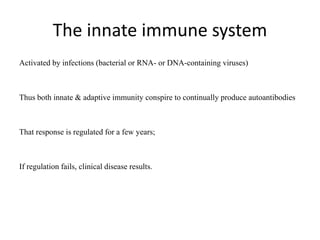
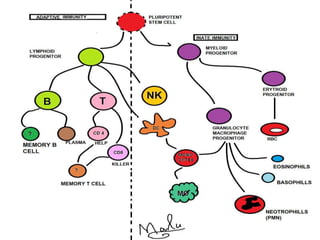
The innate immune system
Activated by infections (bacterial or RNA- or DNA-containing viruses)
Thus both innate & adaptive immunity conspire to continually produce autoantibodies
That response is regulated for a few years;
If regulation fails, clinical disease results.
1.Introduction
2.History
3.Epidemiology
4.Pathophysiology
5.Pathology
6.Autoimmunity
7.Cliical features
8.Diagnosis
9.Managmment
10.Future
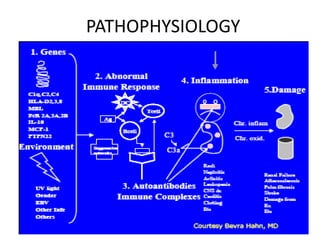
PATHOPHYSIOLOGY
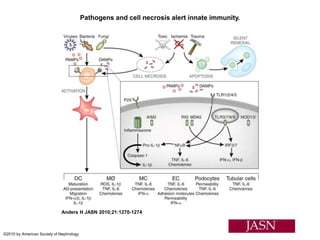
Pathogens and cell necrosis alert innate immunity.
Anders H JASN 2010;21:1270-1274
©2010 by American Society of Nephrology
B cell hyperactivity ("hypervigilant")
Hyperactive ("hypervigilant") immune system that attacks a person's own protein as if
it were foreign matter
One reason for this is poor adrenal function. Adrenal steroids modulate (slow down)
the immune system
when there is not enough of these steroids the immune system goes berserk.
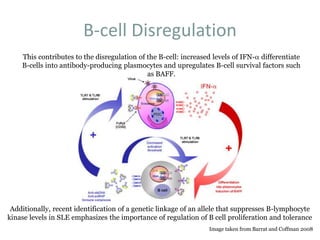
B-cell Disregulation
This contributes to the disregulation of the B-cell: increased levels of IFN-a differentiate
B-cells into antibody-producing plasmocytes and upregulates B-cell survival factors such
as BAFF.
Image taken from Barrat and Coffman 2008
Additionally, recent identification of a genetic linkage of an allele that suppresses B-lymphocyte
kinase levels in SLE emphasizes the importance of regulation of B cell proliferation and tolerance
B Cell Maturation Antigen Deficiency Exacerbates Lymphoproliferation and
Autoimmunity in Murine Lupus
Chao Jiang*,1, William M. Loo*,1, Erin J. Greenley*, Kenneth S. Tung†‡ and Loren D. Erickson*‡
Abstract: Systemic lupus erythematosus and its preclinical lupus-prone mouse models are autoimmune disorders
involving the production of pathogenic autoantibodies. Genetic predisposition to systemic lupus
erythematosus results in B cell hyperactivity, survival of self-reactive B cells, and differentiation to
autoantibody-secreting plasma cells (PCs).
BCMA/BAFF/B Cell
B Cell Maturation Antigen Deficiency *
Enhanced BAFF expression leads to B cell hyperplasia and autoimmunity
BAFF –a cytokine implicated in the survival and maturation of peripheral B
lymphocytes and T & B cell activation.
BAFF binds to 3 different receptors: TACI, BCMA and BAFF-R, whose expression is
restricted to B & T lymphocytes.
Elevated BAFF levels have been detected in the serum of SLE patients*
[BAFF: A regulatory cytokine of B lymphocytes
involved in autoimmunity and lymphoid cancer].
[Article in Spanish]
Reyes S LI, León B F, Rozas V MF, González J P, Naves P R.
Source
Instituto de Ciencias, Clínica Alemana, Facultad de Medicina, Universidad del Desarrollo.
Abstract
BAFF (B cell activating factor belonging to the TNF family) is a cytokine implicated in the survival
and maturation of peripheral B lymphocytes and T and B cell activation. BAFF binds to three
different receptors: TACI, BCMA and BAFF-R, whose expression is restricted to B and T
lymphocytes. BAFF and BAFF-R-deficient mice show a dramatic loss of peripheral B lymphocytes
and a severely reduced immune response. In contrast, an enhanced BAFF expression leads to B cell
hyperplasia and autoimmunity in mice. In vivo, administration of soluble decoy receptors for BAFF
effectively decreases disease progression in various autoimmune mouse models. These evidences
render BAFF as a potentially new therapeutic target. Elevated BAFF levels have been detected
in the serum of patients with autoimmune diseases, such as Systemic Lupus Erythematosus,
rheumatoid arthitis, Sjögren's syndrome, lymphoid cancers and HIV infection. In addition to
BAFF receptors, malignant B cells abnormally express BAFF, which attenuates apoptosis through
both autocrine and paracrine pathways. The data suggest that an increase in the expression of BAFF
induces an enhanced B and T cell activation and the survival of pathologically active B cells. In this
article, we review and discuss the participation of BAFF and its receptors in the immune response
and its involvement in immunodeficiency, autoimmunity, infections and lymphoid cancers as well as
the currently investigated therapies using BAFF antagonists in the treatment of these diseases.
BCMAD-Elevated BAFF/IFN
Genetic-HLA, X chromosome,Compliment def
Hormone – Oestrogen
Poor Adrenal function
Low blood levels of the hormone DHEA
Environment- UV rays,EB Virus,other inf,
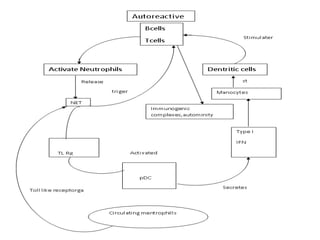
Nutrophils(NET)-Chronic activation of pDC -hyperreactive B cells - Production of
autoantibodies against nuclear self-antigens -pDC-actB cells-IFN
Neutrophil Extracellular Traps (NETs)
Sera of SLE patients immunogenic complexes composed of neutrophil-derived
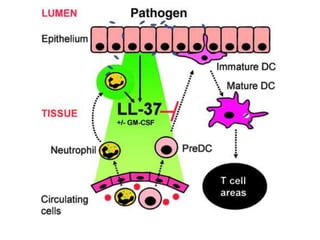
antimicrobial peptides (LL37,HNP-1,2,3) and self-DNA.
These complexes were produced by activated neutrophils in the form of web-like
structures known as neutrophil extracellular traps (NETs) and
efficiently triggered innate pDC activation via Toll-like receptor 9 (TLR9).
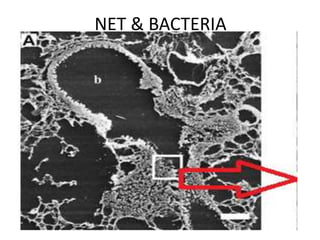
Casting NETs for microbes
Even death doesn’t stop a neutrophil from battling pathogens, as Fuchs et al. report on
page 231.
The infection-fighting cells often launch a NET, a mesh of DNA and enzymes that
snares and kills bacteria and fungi.
The authors show that NET release involves a unique type of cellular self-sacrifice and
depends on reactive oxygen species (ROS).
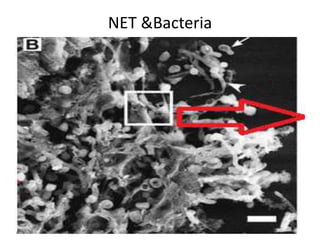
Neutrophil Extracellular Traps (Spiderman)
NET & BACTERIA
NET &Bacteria
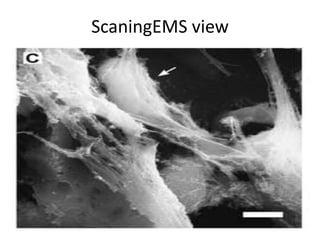
ScaningEMS view
Vicious cycle
• SLE patients were found to develop autoantibodies to both the self-DNA and
antimicrobial peptides in NETs
• Indicating that these complexes could also serve as autoantigens to trigger B cell
activation
• Circulating neutrophils from SLE patients released more NETs than those from
healthy donors.
Bacteria in Spidernet SEMS view
Vicious cycle
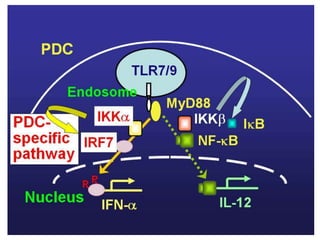
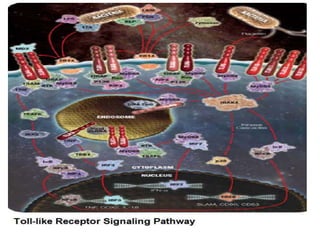
1. Mechanisms for type I interferon induction in
TLR7/9-stimulated dendritic cells
DCs sense nucleic acid adjuvants and produce type I interferon (IFN) in a subset-
dependent manner.
Among nucleic acid sensors, TLR7 and TLR9 are peculiar in that they recognize not
only pathogen- but also host-derived nucleic acids.
In fact, accumulating evidences suggest that TLR7/9-induced type I IFN production
play important roles in pathogenesis of autoimmune disorders such as SLE
.
Therefore, clarifying the TLR7/9 signaling mechanisms should contribute to the
development of therapeutic manipulation for such diseases.
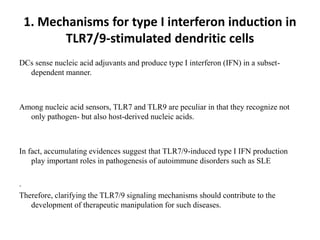
IF Demo
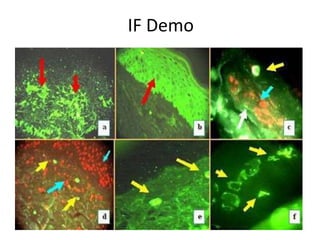
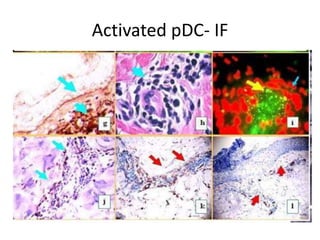
Activated pDC- IF
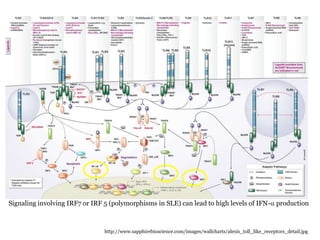
http://www.sapphirebioscience.com/images/wallcharts/alexis_toll_like_receptors_detail.jpg
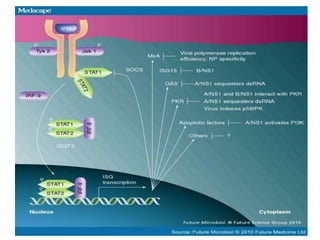
Signaling involving IRF7 or IRF 5 (polymorphisms in SLE) can lead to high levels of IFN-a production
1. Defects -NETOSIS
2. Defective-Apoptosis
3. Necrosis
4. Leads to defective immune clearence.
5. Increased rate of CD4/CD8
NET Video
Defective clearance of apoptotic cells
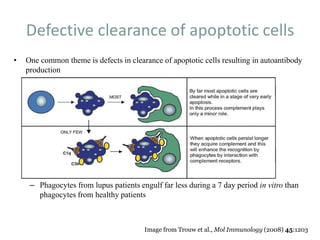
• One common theme is defects in clearance of apoptotic cells resulting in autoantibody
production
– Phagocytes from lupus patients engulf far less during a 7 day period in vitro than
phagocytes from healthy patients
Image from Trouw et al., Mol Immunology (2008) 45:1203
Defective clearance of apoptotic cells
 There may be a genetic component to defective apoptosis.
 Concordance is 25% among monozygotic twins but only 2% among dizygotic twins
suggesting a genetic component
 HLA-DR2 and HLA-DR3 confer relative risk of 2-5.
 C1q deficiency results in high likelihood of developing SLE
 Complement C4a deficiency: 80% of people with SLE have at least one null allele
Can lead to decreased clearance of apoptotic cells and increased inflammation
and presentation of self antigens
 Patients with SLE may also develop autoantibodies against adaptor molecules which
facilitate phagocytosis of apoptotic cells (C1q, MBL) resulting in defective clearance,
classical pathway complement activation, and recruitment of inflammatory cells.
Defective clearance of apoptotic cells
Delayed or defective apoptosis then allows for prolonged exposure of intracellular
antigens, “inflammatory cell death phenotype,”
Inflammatory cell recruitment and
presentation of normally protected intracellular components as antigens allowing for
autoantibody production
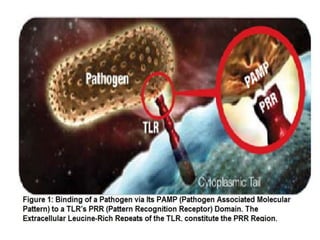
Instead, the innate immune system responds to common structures shared by a vast
majority of threats.
These common structures are called pathogen associated molecular patterns, or PAMPs,
and are recognized by the toll-like receptors, or TLRs.
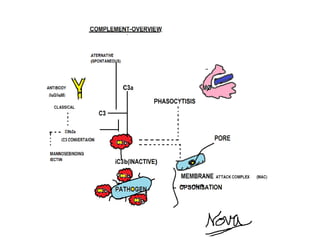
In addition to the cellular TLRs, an important part of the innate immune system
is the humoral complement system that opsonizes and
kills pathogens through the PAMP recognition mechanism
These highly conserved soluble and membrane bound proteins are collectively called
Pattern-Recognition Receptors (PRRs),
and it is the PAMP/PRR interaction that triggers the innate immune system.
While the history of TLR-dependent observations goes back 100 years,
most of the definitive work started about fifteen years ago.
A tremendous amount of work has been done during this time, including the discovery
of other PRR pathways.
cytosolic NOD (nucleotide oligomerization domain) proteins have been shown to be
important innate immune response components.
Pathogens and cell necrosis alert
innate immunity
All classes of pathogens release pathogen-associated molecular patterns that can
activate TLRs on the cell surface or in intracellular endosomes.
TLR activation induces the expression of pro-IL-1β, NF-κB–dependent cytokines and
chemokines, and IFN-α and IFN-β, the three dominant cytokine classes of innate
immunity.
NOD-like receptors and RIG helicases convert the recognition nucleic acids into
cytokine release.
TLR Video
Inflammasome-related sensors activate caspase 1, a necessary step for the secretion of
IL-1β.
Activation of such sensors has additional cell type–specific effects (e.g., in dendritic
cells [DC] or macrophages [MØ], mesangial cells [MC],35 glomerular endothelial
cells [EC],36 or podocytes
Cell necrosis can trigger identical effects because some intracellular molecules can act
as DAMPs on the same receptors
Apoptotic cell death and rapid clearance by phagocytes avoids unnecessary immune
activation.
TLR
TLR recognize molecular patterns (double stranded RNA, DNA, LPS etc) in order to
provide rapid response to invading pathogens
They use defined signaling pathways to result in production of inflammatory cytokines
and initiate inflammatory reactions
TLR7 and 9 are selectively expressed on PDCs
Regulation in endosomes may regulate control of NFkB vs. IRF7 activation in pDC
Ref: Toll-like receptors in systemic autoimmune disease. A. Marshak-Rothstein, Nat. Rev.
Immunol.6, 823–835 (2006).
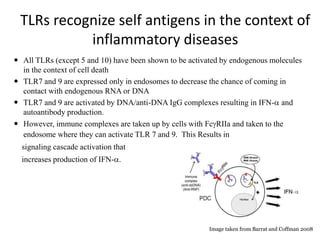
TLRs recognize self antigens in the context of
inflammatory diseases
 All TLRs (except 5 and 10) have been shown to be activated by endogenous molecules
in the context of cell death
 TLR7 and 9 are expressed only in endosomes to decrease the chance of coming in
contact with endogenous RNA or DNA
 TLR7 and 9 are activated by DNA/anti-DNA IgG complexes resulting in IFN-a and
autoantibody production.
 However, immune complexes are taken up by cells with FcgRIIa and taken to the
endosome where they can activate TLR 7 and 9. This Results in
signaling cascade activation that
increases production of IFN-a.
Image taken from Barrat and Coffman 2008
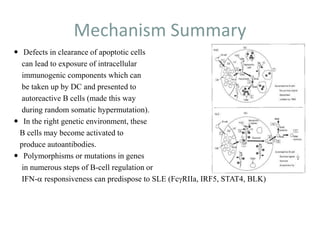
Mechanism Summary
 Defects in clearance of apoptotic cells
can lead to exposure of intracellular
immunogenic components which can
be taken up by DC and presented to
autoreactive B cells (made this way
during random somatic hypermutation).
 In the right genetic environment, these
B cells may become activated to
produce autoantibodies.
 Polymorphisms or mutations in genes
in numerous steps of B-cell regulation or
IFN-a responsiveness can predispose to SLE (FcgRIIa, IRF5, STAT4, BLK)
Mechanism Summary
Once autoantibodies (particularly anti-DS DNA) are present,
they can complex with DNA exposed on dying cells and
then bind to the FcgRIIa on PDCs, activate TLR 7 and 9,
and result in high levels of IFN-a production.
IFN-a encourages a feed-forward mechanism of
continued plasma cell activation
to produce increased amounts of autoantibodies and
encourage further disease progression and tissue destruction
The importance of IFN-a
IFN-a is able to activate APCs after uptake of self material as well as promote B cell
differentiation into plasma cells
IFN-a levels appear to correlate with disease severity and levels of anti-DS DNA in SLE
Patients with non-autoimmune diseases treated with IFN-a can develop positive
ANA, anti-DS DNA abs and occasionally SLE
Conditions that naturally increase IFN-a levels (sunburn, viral infections) can induce SLE
flares.
IFN-a regulated genes are expressed at higher levels in the blood of SLE patients
pDCs are the major producers of IFN-a
SLE patients have 50-100 fold fewer in circulation as they have migrated to lymph
tissues where they remain activated
SNPs in interferon signaling related genes (Tyk2 and interferon regulatory factor 5)
also confer increased likelihood of developing lupus
SLE susceptibility polymorphism in STAT4 results in increased sensitivity to IFN-a
signaling.
IFNs
A key early event that triggers autoimmunity in SLE is the chronic innate activation of
pDCs to secrete type I interferons (IFNs)
The high levels of IFNs induce an unabated differentiation of monocytes into Dendritic
cells
That stimulate autoreactive B and T cells, and lower the activation threshold of
autoreactive B cells, thereby promoting autoimmunity
Ref: A. N. Theofilopoulos, R. Baccala, B. Beutler, D. H. Kono, Type I interferons (a/b) in
immunity and autoimmunity. Annu. Rev. Immunol. 23, 307–336 (2005).
M. J. Shlomchik, Activating systemic autoimmunity: B’s, T’s, and tolls. Curr. Opin.
Immunol.21, 626–633 (2009).
W-A-S-P
• This establish a link between cells, neutrophils, pDC activation, and autoimmunity
providing new potential targets for the treatment
• Even though the researchers thinks that the B cell defect is due to the genetic
• predilection of the individuals.
Spiderman
• There is some way to prevent the proliferation and multiplication of B-cells are
• prevented, we can control SLE and other auto immune disease to certain extend
• The NET produced by neutrophils are like the Spiderman’s net
NECROSIS, APOPTOSIS AND NETOSIS
CELL DEATH
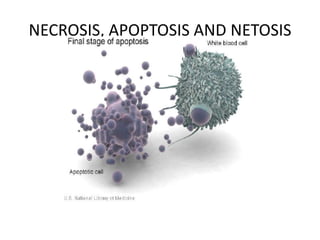
There are two ways of cell death either by necrosis or by apoptotic
In case of necrotic or inflammatory cell death various cell debris like DNA, nucleolus
chromatids etc are released in to the extracellular space which normally cached in the
NET and removed from the tissues.
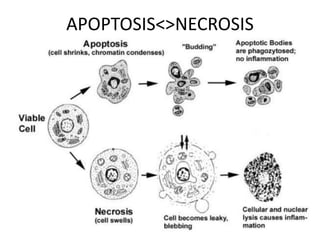
APOPTOSIS<>NECROSIS
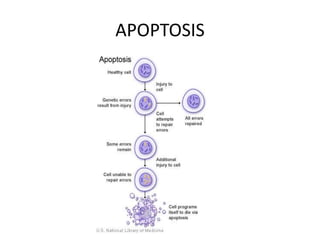
APOPTOSIS
Similarly apoptosis the cell debris are
removed with out any
immunological reactions.
Ref:Hallmarks of the apoptotic and necrotic cell death process.(Pic)
Apoptosis includes cellular shrinking, chromatin condensation and margination at the nuclear
periphery with the eventual formation of membrane-bound apoptotic bodies that contain
organelles, cytosol and nuclear fragments and are phagocytosed without triggering
inflammatory processes.The necrotic cell swells, becomes leaky and finally is disrupted and
releases its contents into the surrounding tissue resulting in inflammation. Modified from [Van
Cruchten, 2002].
APOPTOSIS
CLINICAL IMPLICATIONS OF BASIC
RESEARCH
• Thus, we@ identify the ability of neutrophils to activate pDCs through the release of
NETs and suggest that a dysregulation of this pathway drives chronic pDC
activation and autoimmunity in SLE.
Recent studies, such as those by Lande et al. @ and Garcia-Romo et al., have pushed the
neutrophil to the forefront of the pathogenesis of SLE and have provided insight
into how the implicated biochemical and cellular events are linked.
Ref: CLINICAL IMPLICATIONS OF BASIC RESEARCH
Systemic Lupus Erythematosus and the Neutrophil
Xavier Bosch, M.D., Ph.D.
N Engl J Med 2011; 365:758-760August 25, 2011
Activation pd
Spiderman
Thus playing a wonderful role by the NET (Spiderman).
In the case of autoimmune diseases and SLE
Either the apoptosis is defective or
after apoptotic cell death the removal of the debris are defective.
NETOSIS
It is proved that self-DNA in immune complexes of SLE patients contains Neutrophil
antimicrobial peptide LL37 and HNP.
These antimicrobial peptides were required for self-DNA to trigger TLR9 in pDCs by
forming complexes with the DNA that is protected from extracellular degradation.
Such immunogenic self-DNA–antimicrobial peptide complexes were released by dying
neutrophils undergoing NETosis,
a cell death process in which activated neutrophils extrude large amounts of nuclear
DNA into the extracellular space in the form of web-like structures called NETs
The ability of neutrophils to ingest and kill bacteria and fungi is an important
component of innate immunity
The microbicidal prowess of human neutrophils emanates from oxidative and
nonoxidative mechanisms
The former results from activation of an enzyme complex that oxidizes NADPH to
produce copious amounts of superoxide
whose dismutation yields hydrogen peroxide, which can form stronger oxidants by
reacting with myeloperoxidase .
The nonoxidative mechanisms of human neutrophils are mediated by antimicrobial
peptides and proteins stored within its various cytoplasmic granules
.
Cathepsin G, azurocidin (also called CAP37), BPI (also called CAP57), and defensins
are restricted to the primary (azurophil) granules, which also contain
myeloperoxidase, elastase, and proteinase 3
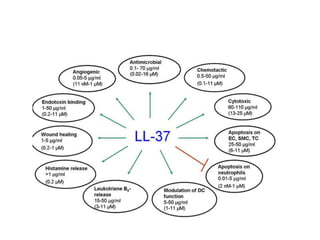
Lactoferrin and hCAP-18 (the precursor of LL-37) are restricted to the neutrophil’s
secondary (specific) granules .
Lysozyme, another antimicrobial molecule, occurs in both primary and secondary
granules
Whereas azurophil granule contents are delivered preferentially to intracellular
phagolysosomes, the specific granule contents are largely secreted extracellularly.
The precursor of LL-37 is a 19.3-kDa prepropeptide which, after losing its signal
sequence, is called hCAP-18
The cathelin domain of hCAP-18 places it within the cathelicidin family
.
Like other cathelicidins found in porcine, bovine, rabbit , and mouse , neutrophils,
hCAP-18’s cathelin domain is highly conserved and precedes the domain that
encodes an antimicrobial peptide.
Human hCAP-18 is expressed constitutively within neutrophils and the testes and is
inducibly expressed by keratinocytes .
Lupus Neutrophils Cast a Wide NET
inflammation and disease. self-DNA, activate pDC, leading to IFN release and furtherment
and aggravation of activated by anti-self antibodies release NETs
These NETs, which contain antimicrobial peptides complexed with Together, these findings
portray an important role for neutrophils in lupus pathogenesis, whereby neutrophils
high levels of interferon-±.oxygen species
Garcia-Romo et al. also show that these NETs potently activate dendritic cells, leading to
secretion of requires FcRIIa, signaling through the pattern recognition receptor Toll-like
receptor 7, and formation of reactive induce NETosis, and the released NETs contain
LL37 and another neutrophil protein, HMGB1.
Induction of NETosis neutrophils undergo accelerated cell death in culture.
Anti-ribonucleoprotein antibodies present in patient serum In a parallel study, Garcia-Romo
et al. look in detail at neutrophils in lupus, and show that lupus patient antibody than
control neutrophils.
T-cell Malfunctions
Fc region switch
ζ  εγ
Leads to malfunction in signaling and decreased IL-2 production
Increased levels of Ca2+
Leads to spontaneous apoptosis
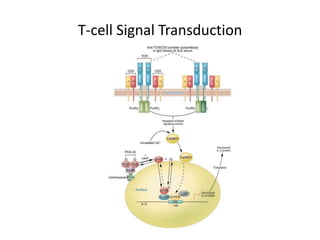
T-cell Signal Transduction
Activation of Complement System
Complement system is activated by the binding of antibodies to foreign debris.
In this case its over activation
RBCs lack CR1 receptor
Decreasing the affective removal of complexes
IgG Pathogen
IgG is the most “pathogenic” because it forms intermediate sized complexes that can
get to the small places and block them
.
DNA is the main antigen for which antibodies are formed
Extracellular DNA has an affinity for basement membrane where it is bound by
autoantibodies
Classical thickening of the basement membrane
Testing
• ESR
• Urinalysis
• Complement Test
– Tests levels of C3, C4, CH50
– Low levels indicates possible presence of disease
• FANA – Fluorescent antinuclear antibody
• Ouchterlony Test – shows interactions
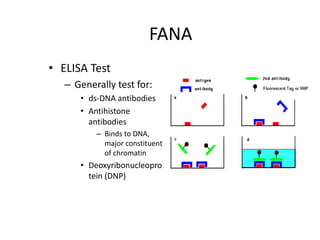
FANA
• ELISA Test
– Generally test for:
• ds-DNA antibodies
• Antihistone
antibodies
– Binds to DNA,
major constituent
of chromatin
• Deoxyribonucleopro
tein (DNP)
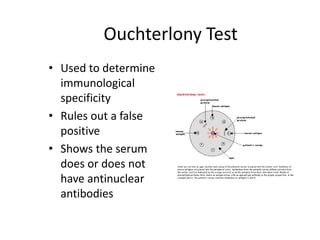
Ouchterlony Test
• Used to determine
immunological
specificity
• Rules out a false
positive
• Shows the serum
does or does not
have antinuclear
antibodies
Summary
• Lupus = Autoimmunity
– Systemic and affects connective tissue
• Caused by malfunctions of:
– T-cells
– B-cells
– Complement System
– Signal Transduction
• Can be lethal or not
• Unique to each individual
1.Introduction
2.History
3.Epidemiology
4.Pathophysiology
5.Pathology
6.Autoimmunity
7.Cliical features
8.Diagnosis
9.Managmment
10.Future
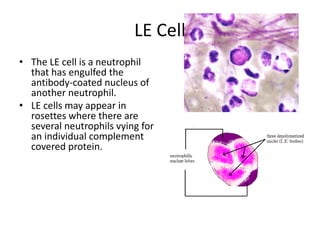
LE Cell
• The LE cell is a neutrophil
that has engulfed the
antibody-coated nucleus of
another neutrophil.
• LE cells may appear in
rosettes where there are
several neutrophils vying for
an individual complement
covered protein.
Main Pathology
• The plasma cells are producing antibodies that are
specific for self proteins, namely ds-DNA
• Overactive B-cells
• Suppressed regulatory function in T-cells
• Lack of T-cells
• Activation of the Complement system
Genetic Associations
HLA’s are loci on genes that code for certain β chain on the MHC complex
HLA-DR2
HLA-DR3
HLA-DQB1 – Involved in mediating production of antibodies to ds-DNA
Systemic lupus erythematosus (SLE) is a chronic inflammatory autoimmune disorder
associated with a wide range of physical findings.
The risk of developing SLE is, at least in part, genetic, but it is a complex genetic
illness with no clear mendelian pattern of inheritance. The disease tends to occur in
families.
Siblings of SLE patients have a risk of disease of about 2%.
However, even identical twins with SLE are concordant for disease in only 25% of
cases and are therefore discordant (ie, where one twin has SLE and one does not) in
about 75% of cases.[1]
MHC on chromosome 6, which contains the human lymphocyte antigens (HLA), was
the first described genetic link to SLE.
The protein products of the HLA genes are critical components of cell-to-cell
communication in the immune system.
Indeed, in some cases, HLA genes are more highly related to lupus-associated
autoantibodies than to the disease itself.
Nonetheless, carriage of specific alleles of HLA imparts about a 2-fold risk of SLE
above the general population.
Genome-wide genetic association studies (GWAS) have been performed in large
collections of SLE patients and controls.
These genome-wide studies of up to 500,000 single-nucleotide polymorphisms (SNPs)
have identified at least 30 and perhaps up to 50 genetic associations for SLE,[6, 7]
and replication studies have confirmed these findings, in nonwhite as well as white
cohorts
However, only a fraction of the genetic risk for SLE has so far been identified. Rare
alleles and mutations that impart a moderate risk of SLE remain undiscovered and
cannot be found by GWAS. Gene-gene interaction is virtually unexplored.
Nevertheless, although few of GWAS have identified actual causative alleles that
impart risk of SLE, the findings do have common themes.
Many of the genes implicated thus far can be categorized as involved in B lymphocyte
activation, apoptosis, or the interferon signaling pathway.
Such insight into the genetic pathogenesis of SLE may suggest new therapeutic targets
for the disease down the road.
Overactive B-cells
Estrogen is a stimulator of B-cell activity
Lupus is much more prevalent in females of ages 15-45
Height of Estrogen production
IL-10, also a B-cell stimulator is in high concentration
in lupus patient serum.
High concentration linked to cell damage caused by
inflammation
1.Introduction
2.History
3.Epidemiology
4.Pathophysiology
5.Pathology
6.Autoimmunity
7.Cliical features
8.Diagnosis
9.Managmment
10.Future
Total blood complement level: 41 to 90
hemolytic units
C1 level: 16 to 33 mg/dL
C3 levels:
Males: 88 to 252 mg/dL
Females: 88 to 206 mg/dL
C4 levels:
Males: 12 to 72 mg/dL
Females: 13 to 75 mg/dL
Note: mg/dL = milligrams per deciliter.
Note: Normal value ranges may vary slightly among different laboratories. Talk to your
doctor about the meaning of your specific test results.
Increased complement activity
1. Cancer
2. Certain infections
3. Ulcerative colitis
4. Decreased complement activity may be seen in:
5. Cirrhosis
6. Glomerulonephritis
7. Hereditary angioedema
8. Hepatitis
9. Kidney transplant rejection
10. Lupus nephritis
11. Malnutrition
12. Systemic lupus erythematosis
Autoantibodies
 ANA: against targets in the nucleus, but only those which have intrinsic immunological
activity: i.e.. They can activate the innate immune system via Toll-like receptors
 Anti DS-DNA in particular recognizes DNA in complex with nucleosome components
(histone-derived peptides in particular)
 Can correlate with nephritis
 Immune complexes with anti-DNA ab/DNA can increase the expression of IFN-a via
plamacytoid dendritic cells
 Anti-Sm: detects ribonucleoproteins involved in processing of mRNA; doesn’t track with
disease, specific for lupus
 SSA/Ro and SSB/La: detect ribonucleoproteins, associated with SICCA syndrome and
photosensitivity
 Anti NMDA to subunits NR2a and NR2b may be associated with neuropsychiatric
symptoms
 “Antiphospholipid” antibodies are ab against phospholipid-binding proteins or
phospholipids that are prothrombogenic. Ex: lupus anticoagulant, anticardiolipin, and anti
beta2-glycoprotein I
Why are autoantibodies so bad?
 Renal disease
 IgA, IgM, IgG and complement deposition in the mesangium and subendothelial and
subepithelial of the GBM that results in complement activation and recruitment of
inflammatory cells that result in tissue destruction.
 Cross reactivity of anti-DS DNA antibodies with a-actinin may also result in a direct
focusing of complement activation
 Skin disease
 Inflammation and breakdown of the dermal-epidermal junction.
 UV exposure can worsen because it promotes apoptosis in the skin resulting in
autoantibody binding and tissue injury via complement activation or inflammatory
cell activation
 Anti-Ro antibodies are associated with skin flares
Why are autoantibodies so bad?
• In the CNS, vasculitis is rare
– Anti-NMDA receptor antibodies may contribute to cerebral lupus phenotypes
– See more microinfarcts and degeneration or proliferative changes in blood vessels,
thought to be related to IC deposition
• Antiphospholipid abs may contribute to thrombotic events anywhere in the body
– aPLs bind to endothelial cells, monocytes, neutrophils and platelets causing
inflammation and procoagulant release
– This process is dependent on complement activation
How Understanding the Mechanism of
SLE will influence therapy
Currently, general immunosuppressants and antimalarials are the therapy of choice for
lupus (steroids, plaquenil) and lupus nephritis (cyclophosphamide –cellcept may
become an approved option)
Current therapies are limited by side effects
No new FDA approved drug for lupus have surfaced in 40 years
!
Research into the underlying mechanisms will allow for more directed therapies that may
provide better control of SLE with fewer side effects
How Understanding the Mechanism of
SLE will influence therapy
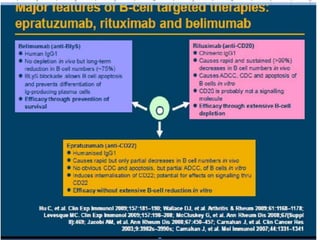
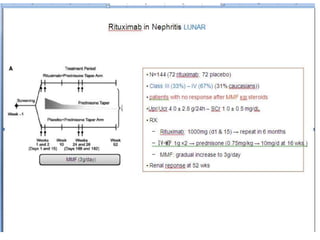
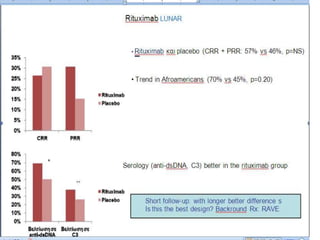
Removal of B cells may improve disease control
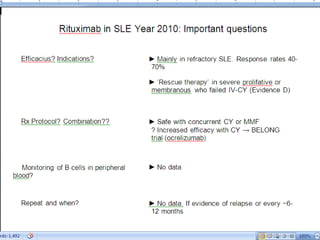
Open label trials of rituximab (anti CD-20) have shown up to 80% response, 50% with
sustained response after 12 months.
A recent RCT (EXPLORER) did not show a benefit with rituximab but patients were
very sick and both control and study patients received high doses of steroids which
may have undercut the benefit seen in patients given rituximab
Trials of anti-IFN-a antibodies are underway
Preliminary trials of inhibitory DNA sequences to block immune complex binding to
TLRs suggest that preventing aberrant TLR 7 and 9 activation decreases IFN-a levels
and disease flares
Anti-IL-10 trials are ongoing. Preliminary trials suggest improvement in skin and joint
symptoms
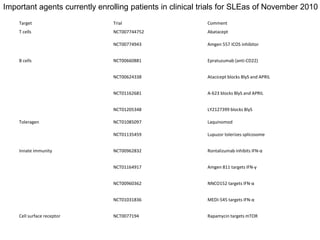
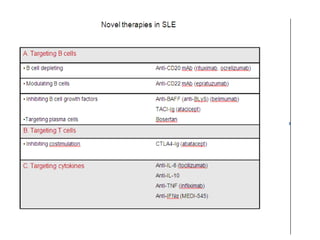
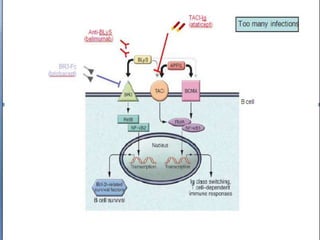
Trials are also ongoing to block other B-cell stimulating signals (anti-BlyS=Belimumab,
atacicept (soluble fusion protein that inhibits Blys ligand) and to block helper T cell
activation.
Summary
Lupus is a disease of autoantibody formation that results in varied clinical manifestations
Disregulation of apoptosis, B-cell survival and proliferation and IFN-a production appear
to be the major inciting events
Ongoing research into the mechanisms which lead to SLE will hopefully provide us with
novel effective therapies with improved side effect profiles
Why is lupus such a mystery to us?
Unlike many other autoimmune diseases, it affects many organs with varying disease
manifestations over time
This makes it difficult to diagnose: average is 4 years and 3 different doctors
There are all those antibodies to know…
Treatments are OLD with significant side effects
Clinical Implications
Although SLE is generally a complex genetic illness, there are several examples of
mutations that can produce a monogenetic form of the illness
Complete deficiency of the early complement components C2, C4, and C1q results in
SLE in 75%, 10%, and 90% of cases, respectively
However, complete complement deficiencies are quite rare and account for only a tiny
percentage of SLE cases.[3] More commonly, a low gene copy number of C4 is seen
as a risk factor for SLE, whereas a high copy number of C4 is protective against
SLE.[4]
Sex-chromosome copy number variations are also implicated in the risk of SLE. SLE is
about 10 times more common in women than in men. However, men with SLE have
15 times the risk of Klinefelter syndrome (47,XXY) as compared with the average
population, and the risk of SLE among men with 47,XXY is equal to that of
women.[5]
These data suggest that the predisposition of women to developing SLE is related to X
chromosome copy number, not to sex.
1.Introduction
2.History
3.Epidemiology
4.Pathophysiology
5.Pathology
6.Autoimmunity
7.Cliical features
8.Diagnosis
9.Managmment
10.Future
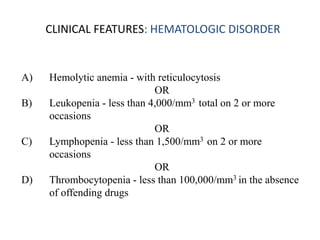
CLINICAL FEATURES: HEMATOLOGIC DISORDER
A) Hemolytic anemia - with reticulocytosis
OR
B) Leukopenia - less than 4,000/mm3 total on 2 or more
occasions
OR
C) Lymphopenia - less than 1,500/mm3 on 2 or more
occasions
OR
D) Thrombocytopenia - less than 100,000/mm3 in the absence
of offending drugs
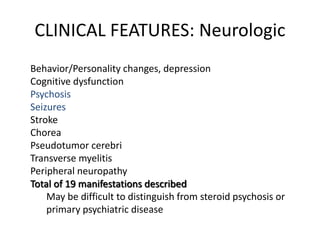
Behavior/Personality changes, depression
Cognitive dysfunction
Psychosis
Seizures
Stroke
Chorea
Pseudotumor cerebri
Transverse myelitis
Peripheral neuropathy
Total of 19 manifestations described
May be difficult to distinguish from steroid psychosis or
primary psychiatric disease
CLINICAL FEATURES: Neurologic
CLINICAL FEATURES: Renal (Lupus Nephritis)
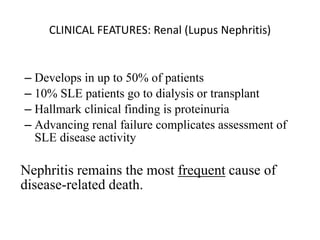
– Develops in up to 50% of patients
– 10% SLE patients go to dialysis or transplant
– Hallmark clinical finding is proteinuria
– Advancing renal failure complicates assessment of
SLE disease activity
Nephritis remains the most frequent cause of
disease-related death.
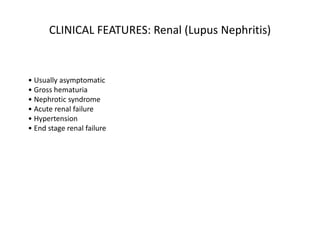
• Usually asymptomatic
• Gross hematuria
• Nephrotic syndrome
• Acute renal failure
• Hypertension
• End stage renal failure
CLINICAL FEATURES: Renal (Lupus Nephritis)
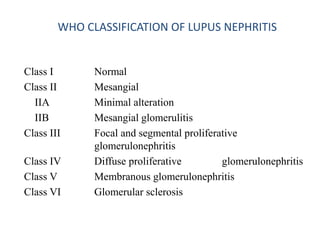
WHO CLASSIFICATION OF LUPUS NEPHRITIS
Class I Normal
Class II Mesangial
IIA Minimal alteration
IIB Mesangial glomerulitis
Class III Focal and segmental proliferative
glomerulonephritis
Class IV Diffuse proliferative glomerulonephritis
Class V Membranous glomerulonephritis
Class VI Glomerular sclerosis
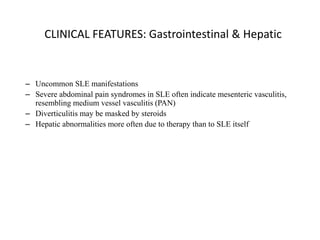
CLINICAL FEATURES: Gastrointestinal & Hepatic
– Uncommon SLE manifestations
– Severe abdominal pain syndromes in SLE often indicate mesenteric vasculitis,
resembling medium vessel vasculitis (PAN)
– Diverticulitis may be masked by steroids
– Hepatic abnormalities more often due to therapy than to SLE itself
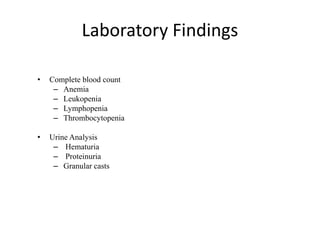
Laboratory Findings
• Complete blood count
– Anemia
– Leukopenia
– Lymphopenia
– Thrombocytopenia
• Urine Analysis
– Hematuria
– Proteinuria
– Granular casts
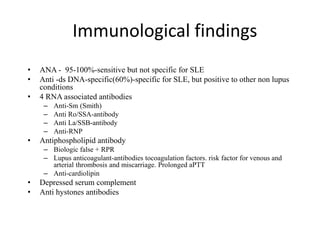
Immunological findings
• ANA - 95-100%-sensitive but not specific for SLE
• Anti -ds DNA-specific(60%)-specific for SLE, but positive to other non lupus
conditions
• 4 RNA associated antibodies
– Anti-Sm (Smith)
– Anti Ro/SSA-antibody
– Anti La/SSB-antibody
– Anti-RNP
• Antiphospholipid antibody
– Biologic false + RPR
– Lupus anticoagulant-antibodies tocoagulation factors. risk factor for venous and
arterial thrombosis and miscarriage. Prolonged aPTT
– Anti-cardiolipin
• Depressed serum complement
• Anti hystones antibodies
1.Introduction
2.History
3.Epidemiology
4.Pathophysiology
5.Pathology
6.Autoimmunity
7.Cliical features
8.Diagnosis
9.Managmment
10.Future
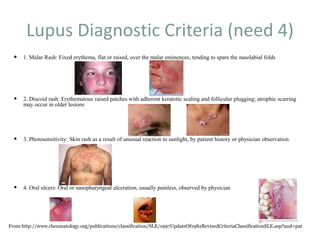
Lupus Diagnostic Criteria (need 4)
 1. Malar Rash: Fixed erythema, flat or raised, over the malar eminences, tending to spare the nasolabial folds
 2. Discoid rash: Erythematous raised patches with adherent keratotic scaling and follicular plugging; atrophic scarring
may occur in older lesions
 3. Photosensitivity: Skin rash as a result of unusual reaction to sunlight, by patient history or physician observation
 4. Oral ulcers: Oral or nasopharyngeal ulceration, usually painless, observed by physician
From http://www.rheumatology.org/publications/classification/SLE/1997UpdateOf1982RevisedCriteriaClassificationSLE.asp?aud=pat
Lupus Diagnostic Criteria (need 4)
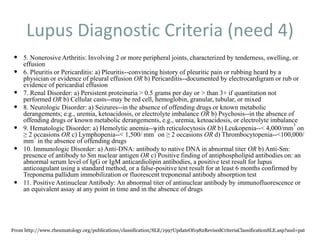
 5. Nonerosive Arthritis: Involving 2 or more peripheral joints, characterized by tenderness, swelling, or
effusion
 6. Pleuritis or Pericarditis: a) Pleuritis--convincing history of pleuritic pain or rubbing heard by a
physician or evidence of pleural effusion OR b) Pericarditis--documented by electrocardigram or rub or
evidence of pericardial effusion
 7. Renal Disorder: a) Persistent proteinuria > 0.5 grams per day or > than 3+ if quantitation not
performed OR b) Cellular casts--may be red cell, hemoglobin, granular, tubular, or mixed
 8. Neurologic Disorder: a) Seizures--in the absence of offending drugs or known metabolic
derangements; e.g., uremia, ketoacidosis, or electrolyte imbalance OR b) Psychosis--in the absence of
offending drugs or known metabolic derangements, e.g., uremia, ketoacidosis, or electrolyte imbalance
 9. Hematologic Disorder: a) Hemolytic anemia--with reticulocytosis OR b) Leukopenia--< 4,000/mm
3
on
≥ 2 occasions OR c) Lymphopenia--< 1,500/ mm
3
on ≥ 2 occasions OR d) Thrombocytopenia--<100,000/
mm
3
in the absence of offending drugs
 10. Immunologic Disorder: a) Anti-DNA: antibody to native DNA in abnormal titer OR b) Anti-Sm:
presence of antibody to Sm nuclear antigen OR c) Positive finding of antiphospholipid antibodies on: an
abnormal serum level of IgG or IgM anticardiolipin antibodies, a positive test result for lupus
anticoagulant using a standard method, or a false-positive test result for at least 6 months confirmed by
Treponema pallidum immobilization or fluorescent treponemal antibody absorption test
 11. Positive Antinuclear Antibody: An abnormal titer of antinuclear antibody by immunofluorescence or
an equivalent assay at any point in time and in the absence of drugs
From http://www.rheumatology.org/publications/classification/SLE/1997UpdateOf1982RevisedCriteriaClassificationSLE.asp?aud=pat
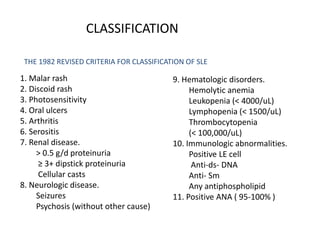
CLASSIFICATION
1. Malar rash
2. Discoid rash
3. Photosensitivity
4. Oral ulcers
5. Arthritis
6. Serositis
7. Renal disease.
> 0.5 g/d proteinuria
≥ 3+ dipstick proteinuria
Cellular casts
8. Neurologic disease.
Seizures
Psychosis (without other cause)
9. Hematologic disorders.
Hemolytic anemia
Leukopenia (< 4000/uL)
Lymphopenia (< 1500/uL)
Thrombocytopenia
(< 100,000/uL)
10. Immunologic abnormalities.
Positive LE cell
Anti-ds- DNA
Anti- Sm
Any antiphospholipid
11. Positive ANA ( 95-100% )
THE 1982 REVISED CRITERIA FOR CLASSIFICATION OF SLE
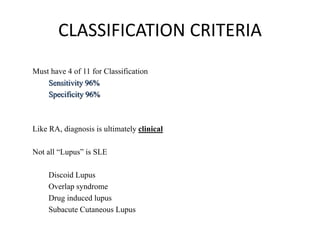
CLASSIFICATION CRITERIA
Must have 4 of 11 for Classification
Sensitivity 96%
Specificity 96%
Like RA, diagnosis is ultimately clinical
Not all “Lupus” is SLE
Discoid Lupus
Overlap syndrome
Drug induced lupus
Subacute Cutaneous Lupus
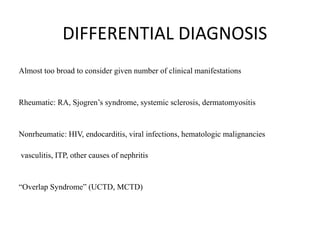
DIFFERENTIAL DIAGNOSIS
Almost too broad to consider given number of clinical manifestations
Rheumatic: RA, Sjogren’s syndrome, systemic sclerosis, dermatomyositis
Nonrheumatic: HIV, endocarditis, viral infections, hematologic malignancies
vasculitis, ITP, other causes of nephritis
“Overlap Syndrome” (UCTD, MCTD)
LUPUS RELATED SYNDROMES
Drug Induced Lupus
Classically associated with
hydralazine, isoniazid, procainamide
Male:Female ratio is equal
Nephritis and CNS abnormalities rare
Normal complement and no anti-DNA antibodies
Symptoms usually resolve with stopping drug
LUPUS RELATED SYNDROMES
Antiphospholipid Syndrome (APS)
Hypercoagulability with recurrent thrombosis of either venous or arterial
circulation
Thrombocytopenia-common
Pregnancy complication-miscarriage in first trimester
Lifelong anticoagulation warfarin is currently recommended for patients
with serious complications due to common recurrence of thrombosis
Antiphospholipid Antibodies
Primary when present without other SLE feature.
Secondary when usual SLE features present
LUPUS RELATED SYNDROMES
Raynaud’s Syndrome:
-Not part of the diagnostic criteria for SLE
- Does NOT warrant ANA if no other clinical evidence to suggest
autoimmune disease
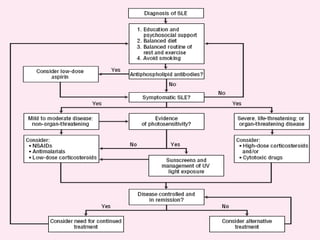
SLE – treatment I.
• Mild cases (mild skin or joint involvement): NSAID, local treatment, hydroxy-
chloroquin
• Cases of intermediate severity (serositis, cytopenia, marked skin or joint
involvement): corticosteroid (12-64 mg methylprednisolon), azathioprin,
methotrexat
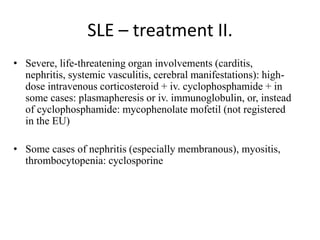
SLE – treatment II.
• Severe, life-threatening organ involvements (carditis,
nephritis, systemic vasculitis, cerebral manifestations): high-
dose intravenous corticosteroid + iv. cyclophosphamide + in
some cases: plasmapheresis or iv. immunoglobulin, or, instead
of cyclophosphamide: mycophenolate mofetil (not registered
in the EU)
• Some cases of nephritis (especially membranous), myositis,
thrombocytopenia: cyclosporine
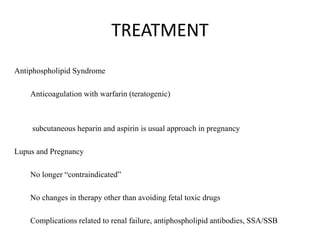
TREATMENT
Antiphospholipid Syndrome
Anticoagulation with warfarin (teratogenic)
subcutaneous heparin and aspirin is usual approach in pregnancy
Lupus and Pregnancy
No longer “contraindicated”
No changes in therapy other than avoiding fetal toxic drugs
Complications related to renal failure, antiphospholipid antibodies, SSA/SSB
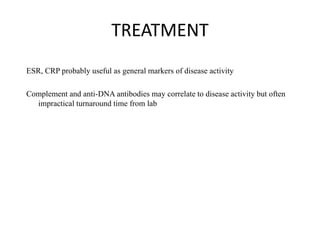
TREATMENT
ESR, CRP probably useful as general markers of disease activity
Complement and anti-DNA antibodies may correlate to disease activity but often
impractical turnaround time from lab
1.Introduction
2.History
3.Epidemiology
4.Pathophysiology
5.Pathology
6.Autoimmunity
7.Cliical features
8.Diagnosis
9.Managmment
10.Future
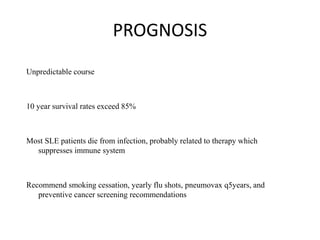
PROGNOSIS
Unpredictable course
10 year survival rates exceed 85%
Most SLE patients die from infection, probably related to therapy which
suppresses immune system
Recommend smoking cessation, yearly flu shots, pneumovax q5years, and
preventive cancer screening recommendations
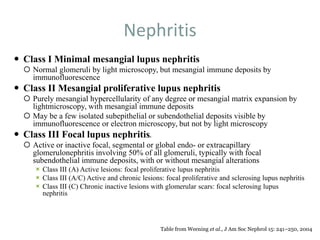
Nephritis
 Class I Minimal mesangial lupus nephritis
 Normal glomeruli by light microscopy, but mesangial immune deposits by
immunofluorescence
 Class II Mesangial proliferative lupus nephritis
 Purely mesangial hypercellularity of any degree or mesangial matrix expansion by
lightmicroscopy, with mesangial immune deposits
 May be a few isolated subepithelial or subendothelial deposits visible by
immunofluorescence or electron microscopy, but not by light microscopy
 Class III Focal lupus nephritisa
 Active or inactive focal, segmental or global endo- or extracapillary
glomerulonephritis involving 50% of all glomeruli, typically with focal
subendothelial immune deposits, with or without mesangial alterations
 Class III (A) Active lesions: focal proliferative lupus nephritis
 Class III (A/C) Active and chronic lesions: focal proliferative and sclerosing lupus nephritis
 Class III (C) Chronic inactive lesions with glomerular scars: focal sclerosing lupus
nephritis
Table from Weening et al., J Am Soc Nephrol 15: 241–250, 2004
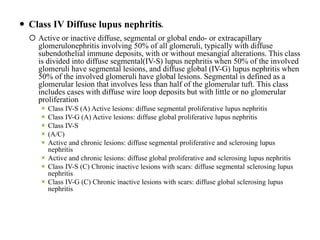
 Class IV Diffuse lupus nephritisb
 Active or inactive diffuse, segmental or global endo- or extracapillary
glomerulonephritis involving 50% of all glomeruli, typically with diffuse
subendothelial immune deposits, with or without mesangial alterations. This class
is divided into diffuse segmental(IV-S) lupus nephritis when 50% of the involved
glomeruli have segmental lesions, and diffuse global (IV-G) lupus nephritis when
50% of the involved glomeruli have global lesions. Segmental is defined as a
glomerular lesion that involves less than half of the glomerular tuft. This class
includes cases with diffuse wire loop deposits but with little or no glomerular
proliferation
 Class IV-S (A) Active lesions: diffuse segmental proliferative lupus nephritis
 Class IV-G (A) Active lesions: diffuse global proliferative lupus nephritis
 Class IV-S
 (A/C)
 Active and chronic lesions: diffuse segmental proliferative and sclerosing lupus
nephritis
 Active and chronic lesions: diffuse global proliferative and sclerosing lupus nephritis
 Class IV-S (C) Chronic inactive lesions with scars: diffuse segmental sclerosing lupus
nephritis
 Class IV-G (C) Chronic inactive lesions with scars: diffuse global sclerosing lupus
nephritis
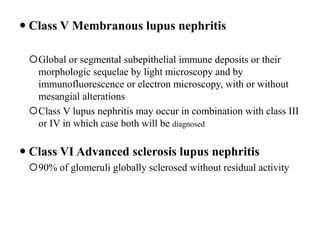
 Class V Membranous lupus nephritis
Global or segmental subepithelial immune deposits or their
morphologic sequelae by light microscopy and by
immunofluorescence or electron microscopy, with or without
mesangial alterations
Class V lupus nephritis may occur in combination with class III
or IV in which case both will be diagnosed
 Class VI Advanced sclerosis lupus nephritis
90% of glomeruli globally sclerosed without residual activity
Nephritis
Class I-no Rx
Class II-Rx if proteinuria >1000 mg/d
Class III and IV at high risk of progression so require aggressive immunosuppressive
therapy
Class V Rx with steroids
Class VI-dialysis or transplant
Nervous System
Headache is the most common complaint
ADD, mood disorders, anxiety, delirium, psychosis, seizures (generalized or partial)
Difficult to prove absolute causality
Generalized encephalopathies
Formal neuropsychiatric testing reveals deficits in 21-67% of patients with SLE
Cerebritis
Degenerative changes in small vessel walls, often with minimal or no inflammatory
infiltrates
May be related to immune complex deposition
Neuropathy secondary to vasculitis of vasa nervorum (often with dermatomyositis
overlap)
The ocular manifestations of lupus
include mucocutaneous lid involvement, secondary Sjögren's syndrome, retinal
vascular disease and neuro‐ophthalmic disease
.
Retinopathy is the most common ocular manifestation in lupus and usually consists of
cotton‐wool spots with intraretinal haemorrhages.
The more severe form of lupus retinitis consists of retinal arteriolitis and vascular
occlusion, resulting in capillary non‐perfusion, retinal haemorrhage and venous
stasis.
When larger vessels are involved, branch or central retinal artery or vein occlusion may
result, with secondary retinal neovascularization and vitreous haemorrhage
It has been shown that patients with lupus and raised concentrations of
antiphospholipid antibodies have a higher risk of developing retinal vaso‐occlusive
disease
Hematologic System
Chronic anemia is present in up to 80% of patients
Leukopenia is present in up to 50% of patients (lymphopenia more common than
neutropenia).
Thrombocytopenia ranges from modest to severe with bleeding complications
May reflect disease activity
May be first sign of SLE; predating other signs and symptoms by years.
Associated with the presence of anti-platelet antibodies
Secondary APS seen in about 40% of patients with SLE
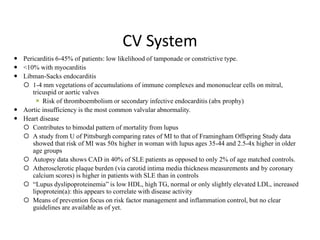
CV System
 Pericarditis 6-45% of patients: low likelihood of tamponade or constrictive type.
 <10% with myocarditis
 Libman-Sacks endocarditis
 1-4 mm vegetations of accumulations of immune complexes and mononuclear cells on mitral,
tricuspid or aortic valves
 Risk of thromboembolism or secondary infective endocarditis (abx prophy)
 Aortic insufficiency is the most common valvular abnormality.
 Heart disease
 Contributes to bimodal pattern of mortality from lupus
 A study from U of Pittsburgh comparing rates of MI to that of Framingham Offspring Study data
showed that risk of MI was 50x higher in woman with lupus ages 35-44 and 2.5-4x higher in older
age groups
 Autopsy data shows CAD in 40% of SLE patients as opposed to only 2% of age matched controls.
 Atherosclerotic plaque burden (via carotid intima media thickness measurements and by coronary
calcium scores) is higher in patients with SLE than in controls
 “Lupus dyslipoproteinemia” is low HDL, high TG, normal or only slightly elevated LDL, increased
lipoprotein(a): this appears to correlate with disease activity
 Means of prevention focus on risk factor management and inflammation control, but no clear
guidelines are available as of yet.
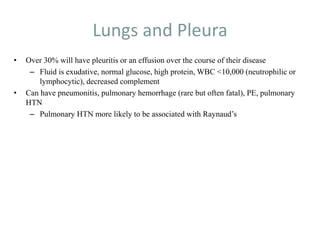
Lungs and Pleura
• Over 30% will have pleuritis or an effusion over the course of their disease
– Fluid is exudative, normal glucose, high protein, WBC <10,000 (neutrophilic or
lymphocytic), decreased complement
• Can have pneumonitis, pulmonary hemorrhage (rare but often fatal), PE, pulmonary
HTN
– Pulmonary HTN more likely to be associated with Raynaud’s
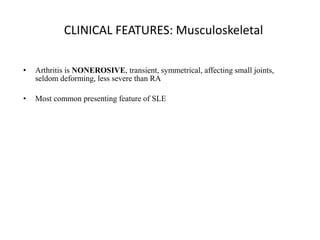
CLINICAL FEATURES: Musculoskeletal
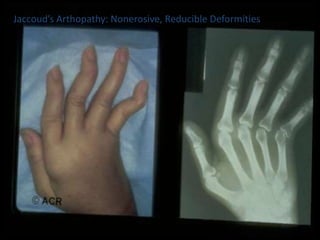
• Arthritis is NONEROSIVE, transient, symmetrical, affecting small joints,
seldom deforming, less severe than RA
• Most common presenting feature of SLE
Jaccoud’s Arthopathy: Nonerosive, Reducible Deformities
CLINICAL FEATURES: Musculoskeletal
– Synovitis-90% patients, often the earliest sign
– Osteoporosis
• From SLE itself and therapy (usually steroids)
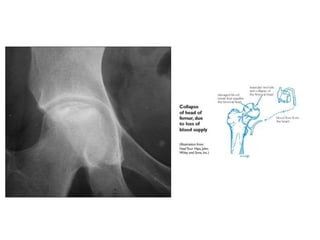
– Osteonecrosis (avascular necrosis)
• Can occur with & without history of steroid therapy
CLINICAL FEATURES: PLEUROPULMONAR
• Pleuritis/Pleural effusion
• Infiltrates/ Discoid Atelectasis
• Acute lupus pneumonitis
• Pulmonary hemorrhage
• “Shrinking lung” - diaphragm dysfunction
• Restrictive lung disease
CLINICAL FEATURES: Cardiac
– Pericarditis –in majority of patients
– Libman Sacks endocarditis
– Cardiac failure
– Cardiac Arrythmias-common
– Valvular heart disease
– Coronary Artery Disease
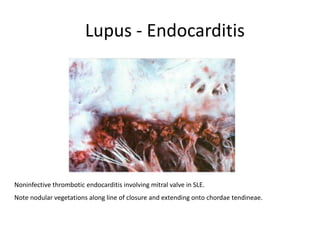
Lupus - Endocarditis
Noninfective thrombotic endocarditis involving mitral valve in SLE.
Note nodular vegetations along line of closure and extending onto chordae tendineae.
Early studies of corticosteroids &other
30 yrs ago, Donadio and colleagues published the results of a randomized study in 50 DP
GN and reduced creatinine clearance
The patients were randomly assigned to either prednisone alone or prednisone in
combination with oral cyclophosphamide (CTX).
The CS-only group received 60 mg daily for 1 to 3 months, and then tapered to receive 20
mg daily by 6 months.
Those in the second group received, in addition, oral CTX 2 mg/kg body weight, which was
subsequently titrated to the peripheral white cell count.
The majority of patients in both groups improved with therapy.
The patients who quickly progressed to ESRD were equally divided between the two
treatment regimens.
It was in the long-term follow-up that the CTX group appeared to do better: after a mean of
43 months, 10 of 21 patients in the prednisone-only group relapsed, compared to 3 of 21
in the prednisone-CTX group.
• Joanne M. Bargman University Health Network 2University of Toronto, Toronto,
Ontario, Canada 2008.
However, several other important
observations were made
Patients in both groups were equally likely to improve over the first 6 months.
This is an important lesson for treating an acutely ill lupus patient
Some physicians feel that there is an urgency to deliver intense immunosuppressive
therapy in the first few days of treatment of lupus nephritis.
This can lead to serious infectious consequences.
In 1984 a pooled analysis of eight studies of lupus nephritis, comprising 250 patients
(including children), 198 renal biopsies and 167 patients with biopsy evidence of diffuse
proliferative lupus nephritis, was published
Three of the studies came from the National Institutes of Health (NIH), and the study by
Donadio discussed above was also included.
Of the 250 patients, 113 received only corticosteroids, and the rest received corticosteroid
and other immunosuppressive agents (azathioprine and CTX)
Patients receiving the corticosteroid and another agent had a lower rate of deterioration of
kidney function.
The New England Journal of Medicine [4].
How did cyclophosphamide become
the drug of choice for lupus nephritis?
In addition, the prednisone-only patients were twice as likely to reach ESRD and to die
compared to the other group
When the immunosuppressive group was subdivided by drug received, there were only
approximately 60 patients in each group (pred versus CTX/pred; pred versus
AZA/pred), and statistical significance was lost for most comparisons, although
subjects treated with azathioprine and prednisone still showed statistically less renal
deterioration compared to those receiving prednisone alone
Furthermore, there was a decrease in the total deaths in the azathioprine group,
but not in the CTX group when each was compared with the prednisone-only cohort.
Indeed, the addition of CTX (but not azathioprine) was associated with a slightly higher
death rate from non-renal causes.
None of these studies was a head-to-head comparison
of the two immunosuppressive agents
However, the pooled analysis added credence to Donadio's finding that prednisone in
combination with another immunosuppressive drug was more efficacious than
prednisone alone.
Within the limitations of this kind of analysis, azathioprine appeared to be a helpful
drug in the management of diffuse proliferative lupus nephritis without the risk of
increasing non-renal (?infective) deaths, as was suggested with CTX
The latter part of the 1980s was dominated by a series of publications from the National
Institutes of Health on the interim and final outcomes of different treatment
protocols for the treatment of lupus nephritis
Another follow-up report just 1 year later, focusing on histologic predictors of outcome,
was published in The New England Journal of Medicine in 1984 and did not find a
difference among the different cytotoxic-drug regimens and renal outcome].
The NIH Publication and the
popularization of pulse CTX
Everything changed with the publication of another progress report, again in The New
England Journal of Medicine, in 1986
Patients who entered the lupus nephritis trials at the NIH between 1969 and 1981 were
included. There were 107 patients in total, and they were randomized into one of
five treatment protocols
(1) High-dose prednisone (1 mg/kg);
(2) Azathioprine (up to 4 mg/kg) + low-dose prednisone;
(3) Oral CTX (up to 4 mg/kg) + low-dose prednisone;
(4) Combined oral azathioprine and oral CTX (up to 1 mg/kg of each) and
(5) Intravenous CTX (0.5–1.0 g/m2 every 3 months titrated to a peripheral white cell
count nadir) + low-dose oral prednisone.
As mentioned, the protocol was changed in 1979 so that immunosuppressive agents
could be discontinued.
Furthermore, not all therapies were offered contemporaneously.
Groups 1, 2 and 3 were enrolled from 1969 to 1976, and groups 4 and 5 from 1973 to
1981
It is also important to note that the median serum creatinine was 1.0 mg/dl (88 μmol/l)
There has been criticism of subsequent lupus trials that the renal disease in these trials
was ‘too mild’
However, the serum creatinine was almost identical in these three studies
While this was one of the largest cohorts of lupus patients to be examined, the numbers
were still quite small
At 120 months of follow-up, where the curves diverge, the number of patients still in
the study was 11 in the azathioprine, 8 in the oral CTX and 3 in the combined oral
azathioprine/CTX groups.
There was just one patient in group 5 (IV CTX).
Despite the sizable methodological weaknesses outlined above, the ‘NIH protocol’ of
IV pulsed CTX became widely accepted as the gold standard of treatment.
It was new therapy, carried the cache of the National Institutes of Health and was the
protocol to which all others were compared thereafter
Furthermore, as Lewis observed: ‘The tendency to recommend parenteral
cyclophosphamide may in part reflect the mystique associated with a more invasive
intervention’
Finally, despite evidence that started to accrue suggesting that this therapy may not
necessarily lead to superior results compared to other immunosuppressive
regimens, it continued to be defended by the original investigators].
The paper by Contreras et al. was a randomized controlled trial of pulse CTX,
mycophenolate mofetil (MMF) and azathioprine in the treatment of proliferative
lupus nephritis
Unfortunately, the water was muddied by the protocol, in which all groups
received induction therapy with up to seven monthly boluses of CTX before
being randomized to the three treatment arms.
Nonetheless, both azathioprine and MMF-treated subjects fared well in this trial. The
cumulative rate of renal survival was 95% in the MMF group, 80% in those
receiving azathioprine and 74% in the intravenous CTX.
Importantly, of the five patients who died during the trial, four were in the CTX arm
and died of sepsis (the fifth death was in a patient receiving MMF).
Again, similar to the observations of Felson's analysis 20 years before, no patient in the
azathioprine group died during the study.
The best thing about MMF
• is that it will convince people that there are therapies for lupus nephritis other
than pulse CTX
• The issue of induction of therapy was re-addressed by the study of Ginzler and
colleagues where patients were randomized to receive MMF versus pulse CTX and
was designed as a short-term (24 week) equivalency study
• The pregnant patient with lupus represents a special challenge. Azathioprine is a D
class drug, acknowledging that there is evidence of human fetal risk, but the
benefits from its use may be acceptable in the pregnant patient with active lupus
• This is extrapolated from the pregnant transplant patient where this drug is usually
not discontinued [16].
Is the problem with CTX itself, or are
we using too high a dose?
The studies of the past 30 years have shown a worrisome trend of increased incidence
of severe infections and death in patients who received CTX
.
It would be hoped that the ‘payoff’ for the increased infections and deaths is that the
CTX is the more potent immunosuppressive agent and, therefore, leads to a better
control of the disease
Unfortunately, the same studies do not strongly support this contention.
The Euro-Lupus Nephritis Trial
examined the effects of ‘low-dose’ (3 g) versus ‘high-dose’ (mean of 8.5 g) CTX in a
randomized study of 90 patients with lupus nephritis.
Severe infections were more common in the high-dose group, although, interestingly,
the two deaths occurred in the patients taking low-dose CTX
There was a trend towards more renal remissions in the low-dose group (P = NS), and
the number of renal flares was no different
Of the 16 patients who experienced a renal flare in the high-dose group, 7 experienced
the flare while being actively treated with the CTX pulses.
This interesting trial suggests that the same result can be reached with lower rather than
higher doses of CTX and with a lower risk of severe infections
Despite the early switch to AZA at Month 3 in the ‘low-dose’ CTX group, there were
no more flares compared to the cohort continuing CTX
So this study could also be construed as one comparing changing to AZA at 3 months
versus continuing CTX for another 9 months and, once again, azathioprine comes
out well.
Conclusions
High-dose corticosteroids remain the mainstay of therapy for the initial treatment of
severe lupus nephritis.
A second agent is recommended as it is associated with a lower rate of relapse and, in
most cases, better renal outcome.
The second drug should be approached as a ‘disease-modifying’ agent and does not
necessarily have to be started on the day of diagnosis, especially if there is
suspicion of intercurrent infection.
The renal prognosis is ultimately determined by the severity of disease and, relatedly,
the amount of fixed renal damage.
It is clear that the use of potent immunosuppressive agents may effectively treat the
lupus, but are themselves associated with worrisome short-term and (perhaps
unknown?) long-term side effects
.
All intensive immunosuppressive therapy can be associated with severe side effects up
to and including death.
In this regard, data from the recent ASPREVA Study are awaited with interest
.
However, it is important to realize that CTX should not be considered the only useful
drug in the management of lupus nephritis.
Aspreva Lupus Management Study (ALMS): Extra-Renal Activity Results from the
Maintenance Phase.
Isenberg4, David A., Appel1, Gerald B., Dooley6, Mary Anne, Ginzler3, Ellen M.,
Jayne2, David, Wofsy5, David, Solomons7, Neil
• Background:
• The 36-month maintenance phase of the ALMS study (NCT00377637) compared
the efficacy and safety of mycophenolate mofetil (MMF) with azathioprine (AZA)
in patients with lupus nephritis (LN) classes III, IV and V achieving a clinical
response in the induction phase with corticosteroids (CS) and either MMF or
cyclophosphamide (IVC).
• Methods:
• Patients were re-randomized 1:1 to a double-blind comparison of either placebo
plus either oral MMF (2 g/day) or oral AZA (2 mg/kg/day). Patients were permitted
to receive corticosteroids (maximum dose: 10 mg/day prednisone or equivalent).
The primary efficacy outcome measure was time to treatment failure (death, end-
stage renal disease, sustained doubling of serum creatinine, and/or renal flare
[proteinuric or nephritic]). Patients who withdrew before reaching the primary
endpoint were censored at the time of withdrawal. Although this was primarily an
LN population, substantial extra-renal assessments were performed. Extra-renal
secondary parameters included time to major extra-renal flare (British Isles Lupus
Assessment Group [BILAG] score category A in one extra-renal system or three
systems with concurrent category B scores) and the characterization of extra-renal
activity. Immunology secondary parameters (levels of complement proteins C3 and
C4, and titers of antibodies to double-stranded DNA [anti-dsDNA]) and adverse
events (AEs) were also assessed.
Results
• Of 227 patients randomized (intent-to-treat population), 127 completed the full 3
years (MMF, 73/116 [62.9%]; AZA, 54/111 [48.6%]): MMF was superior to AZA
in the primary endpoint (p=0.003). Extra-renal disease characteristics and
immunology parameters were similar across groups at baseline. There were very
few occurrences of major extra-renal flare in either group during the study (8
[6.9%] for MMF, 7 [6.3%] for AZA), and time to major extra-renal flare did not
differ between groups (p=0.936). However, there were differences in the
characteristics of extra-renal activity. The most common manifestation of major
extra-renal flare in the MMF group was mucocutaneous and in the AZA group was
hematological. In the MMF group, 75 subjects (65.2%) experienced lupus-related
AEs compared with 79 (71.2%) in the AZA group, with musculoskeletal events
being the most common in both groups (MMF, 39/115 [33.9%]; AZA, 37/111
[33.3%]). At the end of the study, in patients who had completed 3 years, mean C3
and C4 levels were lower in the AZA group and mean anti-dsDNA titers were lower
in the MMF group; differences were not statistically significant.
Conclusions
In this population of LN patients who had responded to induction therapy, there were
low levels of extra-renal activity in the maintenance phase in both MMF and AZA
groups.
The use of nontargeted agents:
Important recent studies
The overwhelming majority of agents in development are biologics. However, some
nonbiological agents and drugs that are on the market for other disorders have been
or are under study for SLE. A detailed discussion of these studies is beyond the
scope of this minireview, but the salient points are summarized below:
1. Fish oil is ameliorative in patients with mild activity [6].
2. A large trial evaluating the efficacy of vitamin D is in progress (NCT 00418507).
3. The Canadian Cooperative Consortium recently demonstrated that methotrexate is
steroid sparing and has anti-inflammatory properties [7].
4. Mycophenolate mofetil is equivalent to cyclophosphamide as induction therapy for
SLE nephritis and is superior to azathioprine for maintenance [8,9].
5. Topical pinecrolimus and tacrolimus are effective for chronic cutaneous SLE [10].
6. Leflunomide improves SLE arthritis [11].
7. Dehydroepiandrostrone has modest effects at best in mild SLE and may diminish
fatigue and bone demineralization, as well as having steroid sparing properties [12].
In summary, none of the above agents are significantly ameliorative of SLE, and none
have been shown to significantly influence its morbidity or mortality when
compared to other agents currently available.
Azathioprine versus mycophenolate mofetil for long-term immunosuppression in
lupus nephritis: results from the MAINTAIN Nephritis Trial
Frédéric A Houssiau1,David D'Cruz2, Shirish Sangle2Philippe Remy3, Carlos
Vasconcelos4, Radmila Petrovic5, Christoph Fiehn6, Enrique de Ramon Garrido7,
Inge-Magrethe Gilboe8, Maria Tektonidou9, Daniel Blockmans10, Isabelle
Ravelingien11,Véronique le Guern12, Geneviève Depresseux1, Loïc Guillevin12,
Ricard Cervera13, the MAINTAIN Nephritis Trial Group
• Abstract
• Background Long-term immunosuppressive treatment does not efficiently prevent
relapses of lupus nephritis (LN). This investigator-initiated randomised trial tested
whether mycophenolate mofetil (MMF) was superior to azathioprine (AZA) as
maintenance treatment.
Methods
• A total of 105 patients with lupus with proliferative LN were included. All received
three daily intravenous pulses of 750 mg methylprednisolone, followed by oral
glucocorticoids and six fortnightly cyclophosphamide intravenous pulses of 500
mg. Based on randomisation performed at baseline, AZA (target dose: 2 mg/kg/day)
or MMF (target dose: 2 g/day) was given at week 12. Analyses were by intent to
treat. Time to renal flare was the primary end point. Mean (SD) follow-up of the
intent-to-treat population was 48 (14) months.
Ground rules: Requirements for a new
SLE drug
• The June 2010 FDA guidelines indicate that a candidate SLE drug should meet its
primary endpoint in two adequate well-controlled trials demonstrating superiority [4].
Studies should be at least 1 year in duration, and enrollees should fulfill the American
College of Rheumatology criteria for SLE. Steroid use variability should be minimized,
and sparing effects, if any, should be defined. Study patients should be stratified by the
severity of their SLE, with the British Isles Lupus Assessment Group (BILAG) 2004 [5]
guidelines being the preferred index for measuring disease reduction (although the
Systemic Lupus Erythematosus Disease Activity Index (SLEDAI), European
Community Lupus Activity Measure (ECLAM) and Systemic Lupus Activity Measure
(SLAM) are also acceptable). The document provides definitions for partial clinical
response, remission, reduction in flare and increase in time to flare; encourages the use
of patient-reported outcome measures; and leaves the door open for biomarkers and
surrogate markers (none of the current ones being acceptable) potentially applicable to
shorten the duration of a trial as well as improving our measurement of disease activity.
Any agent must demonstrate a satisfactory safety profile, and the document supports the
use of organ-specific measures (for example, the Cutaneous Lupus Activity Disease Area
and Severity Index (CLASI) for cutaneous disease), especially if the drug is efficacious
for one aspect of the disease but not another. The 2010 guidance document takes into
account "lessons learned" and nuances that make SLE drug development so complex.
Mechanism of action Examples of targets
T cells CTLA4-Ig, modified CD40L, inhibition of ICOS
Regulatory T cells: expanding CD4+CD25+,
CD8+CD28-
B cells mAbs to CD20, CD22, BlyS, TACi-Ig, BAFF-RFc
Proteosome/plasma cells
Cytokines Inhibition of IL-6, IL-10; TNF inhibitors
Innate immune system
Inhibition of IFN-α and IFN-γ, blockade of TLR-
7 and/or TLR-9, C5a inhibition
Toleragens
Peptides derived from nucleosomes,
splicosomes
Cell surface receptor activation inhibition Syk kinase, sirolimus
Targets for new therapies in systemic lupus erythematosusa
Target Trial Comment
T cells NCT007744752 Abatacept
NCT00774943 Amgen 557 ICOS inhibitor
B cells NCT00660881 Epratuzumab (anti-CD22)
NCT00624338 Atacicept blocks BlyS and APRIL
NCT01162681 A-623 blocks BlyS and APRIL
NCT01205348 LY2127399 blocks BlyS
Toleragen NCT01085097 Laquinomod
NCT01135459 Lupuzor tolerizes splicosome
Innate immunity NCT00962832 Rontalizumab inhibits IFN-α
NCT01164917 Amgen 811 targets IFN-γ
NCT00960362 NNCO152 targets IFN-α
NCT01031836 MEDI-545 targets IFN-α
Cell surface receptor NCT0077194 Rapamycin targets mTOR
Important agents currently enrolling patients in clinical trials for SLEas of November 2010
• Methods A total of 105 patients with lupus with proliferative LN were included. All
received three daily intravenous pulses of 750 mg methylprednisolone, followed by
oral glucocorticoids and six fortnightly cyclophosphamide intravenous pulses of
500 mg. Based on randomisation performed at baseline, AZA (target dose: 2
mg/kg/day) or MMF (target dose: 2 g/day) was given at week 12. Analyses were by
intent to treat. Time to renal flare was the primary end point. Mean (SD) follow-up
of the intent-to-treat population was 48 (14) months.
• Results The baseline clinical, biological and pathological characteristics of patients
allocated to AZA or MMF did not differ. Renal flares were observed in 13 (25%)
AZA-treated and 10 (19%) MMF-treated patients. Time to renal flare, to severe
systemic flare, to benign flare and to renal remission did not statistically differ.
Over a 3-year period, 24 h proteinuria, serum creatinine, serum albumin, serum C3,
haemoglobin and global disease activity scores improved similarly in both groups.
Doubling of serum creatinine occurred in four AZA-treated and three MMF-treated
patients. Adverse events did not differ between the groups except for
haematological cytopenias, which were statistically more frequent in the AZA
group (p=0.03) but led only one patient to drop out.
• Conclusions Fewer renal flares were observed in patients receiving MMF but the
difference did not reach statistical significance.
Anti-inflammatory targets:
Anti-TNF, cytokines, toleragens and cell surface receptor inhibition
• Many patients with RA who have SLE overlap disease have been treated with anti
tumor necrosis factor products [23]. Only infliximab has been studied to any extent
in pure SLE. Synovitis can be helped, but extra-articular manifestations may
worsen and anti-DNA, anticardiolipin levels can appear or increase.
• Anakinra (anti-IL-1Ra) is not effective for SLE, but tociluzumab (an anti-IL6) was
quite potent in a 16-patient open label phase I trial at the National Institutes of
Health [24]. An anti-interleukin (IL)-6 (CNTO 136; Johnson & Johnson, New
Brunswick, NJ, USA/Centocor, Horsham, PA, USA) nephritis trial is due to start in
late 2010. IL-10 can have favorable or unfavorable effects in SLE because of its
pleomorphic properties; however, a favorable phase I safety trial of an anti-IL-10
(Schering, Berlin, Germany) is not likely to lead to further development because of
its numerous contradictory actions. Promising strategies in murine SLE include
inhibition of IL-12, -17, -18, -21 and -23, which may have translatable effects in
humans.
• La Jolla Pharmaceutics (La Jolla, CA, USA) LJP394 (Riquent) was an anti-anti-
DNA B cell toleragen and edratide (TEVA, Petach Tikva, Isreal) a toleragen to the
anti-16/6 anti-DNA idiotype [25,26]. Both were safe in trials involving hundreds of
patients, but neither was effective enough to warrant further investigation.
Laquinomod ( TEVA) has been tested in over 3,000 patients with multiple sclerosis
and inflammatory bowel disease and appears to shift Th1 to Th2. An arthritis and
nephritis trial was begun in late 2010. Lupuzor (Cephalon, Frazer, PA, USA) is a
splicosomal peptide with U1 snRNP that promotes tolerance by preventing the
proliferation of CD4+ T cells, as well as promoting secretion of IL-10 and
decreasing anti-DNA in a European study. A phase IIb study is in progress.
• Syk kinase inhibits intracellular kinases, and its clinical efficacy was demonstrated
with R788 (Rigel, South San Francisco, CA, USA) in phase III RA trials [27].
There are plans to study this agent in SLE. Sirolimus (rapamycin) binds the
regulatory kinase mTOR and is used for renal transplant rejection prevention. Many
SLE patients with transplants currently take this agent, and a phase II trial is in
progress.
Innate immunity
including complement
Monoclonal antibodies to C5a were studied and shown to be safe in a phase I trial a
decade ago with eculizumab (Solaris/Alexion, Cheshire, CT, USA),
an agent now available for paroxysmal nocturnal hemoglobinuria [28].
A newer preparation from Novo Nordisk (Novo Nordisk, Bagsvaard, Denmark). had its
SLE trial halted due to concerns relating to neutropenia in control patients.
• Toll-like receptors (TLRs)-7 and -9 in immature dendritic cells are activated by
complexes of self-protein and RNA or DNA. These complexes are normally rapidly
cleared but accumulate in SLE because of clearance defects. TLR-7 and -9
activation induces secretion of interferons and promotes inflammation. Antimalarial
drugs target TLR-7 and -9, and the development of a small oral molecule with
similar actions has generated great interest from several companies (for example,
ESAI (Woodcliff Lake, NJ, USA), Coley (Dusseldorff, Germany)/Xiphon (New
Castle, Delaware, USA)/Pfizer (New York, NY, USA)). Medi-545 (sifalimumab;
Medimmune (Gaithersburg, MDm USA)/Astra Zeneca (Wilmington, DE, USA))
and rontalizumab (Roche) can decrease the α-interferon signature within days by
90% by looking at protein and gene expression and clear lesions in serial skin
biopsies in phase I studies [29,30] (Table ​(Table2).2). They are currently in phase
III trials. NNC0152 (Novo Nordisk) and Neovasc are further behind in
development, as is an agent which targets γ-interferon (AMG 811; Amgen).
The management of LN at the
beginning of the decade
Steroids alone not enough. Need for IST
Induction and maintenance therapy. Need for along-term follow-up ( more than 5 years)
The choice highly debatable: AZA, CY, CsA
Two sides: always CY vs never CY (Then the new kid came in the block: MMF )
Chan, Contreras and Ginzler studies all inNEJM)
Strong pro-MMF movement.
Official declaration of the end of the CY era!!
The management of LN at the end of
the decade
ALMS ( induction-maintenance) and MAINTAIN ( maintenance) studies
Induction: AZA, MMF or IV-CY (high or low- dose) or CsA for membranous
depending upon severity
MMF equal to CY for moderate proliferative LN ( ALMS)
Maintenance: AZA or MMF (contradicting results)
Lessons learned
Or
did we learn any lessons?
Prognostic factors-biomarkers
Prognostic markers at disease onset
- Poor: Anti-DNA, anti-phospholipids (APA), IFN-a
signature( in some ethnic groups)
- Good: other ENAs (ie Ro/La/Sm/RNP)
•Biomarkers for early response (8 weeks)
- improvement in proteinuria by at least 25%
- normalization of C3, C4 or both, increase in Hct
•Intermediate biomarkers ( 24 weeks)
- remission of proteinuria and normalization of Cr
Decrease in anti-DNA unreliable alone. Better if combined with C3
Lessons learned: Need for a strategy
targeting remission
By necessity, in lupus trials some patients are overtreated while some may be undertreated
Trials preoccupied with individual drugs not with a strategy of inducing remission/complete
response
In lupus every single trial has shown that if you restore renal function and decrease
proteinuria to less than 1 gm the outcome is good irrespective of the drug used
In real life, if a patient does not respond we modify/advance therapy
Our recommendation: start with 3 IV-MP pulses and your favorite drug AZA, MMF or CY
If no major response within 3 -4 months with AZA or MMF repeat pulses and reevaluate 3
months later or switch
If no complete response switch to CY or repeat biopsy and decide upon the biopsy
For patients on CY I would move this landmark at 6 and 12 months
One exception: severe LN
• A place for CY?
Yes as induction for severe LN or LN non-responding to AZA or MMF
• Impaired renal function/Adverse histology/Failure to respond after 3-6 mo of initial
RX
Where we would like to go?
Unmet needs
With current immunosuppressive therapies only a small
percentage of LN patients reach ESRD at 10 years
but…..
Flares are common….
up to 30% of patients will flare with 20% of these flares
being major flares requiring intensification of IST
Significant morbidity much related to steroids
IV-MP pulses during the induction
The use of IV-MP pulses in current treatment protocols cannot
be overemphasized.
There is circumstantial data to support the use of one to three
IV-MP pulses especially for patients with moderate or severe
nephritis.
In addition to expediting remission, IV-MP pulses may also
allow for the use of lower doses of glucocorticoids at the early
phases of the induction period.
Steroid -Free Imperial College Study
Day 1: 500 mg IV MP and 1g IV RTX
Day 15 500 mg IV MP and 1g IV RTX
Maintenance: MMF 500 mg bd titrated (1-3 mg/L) steroid free maintenance
Renal protection
Lupus nephritis: where are we now? Lupus nephritis: where are we now?
Lightstone L Curr Opin Rheumatol. 2010 May;22(3):252-6.
Lupus nephritis: treatment challenges
Dimitrios T Boumpas,MD, FACP, University of Crete and IMBB, FORTH
BIOSIMILARS (Superman)
Clinical<Failure> Basic
• Once we failed to prevent the formation
autoantibodies by the NET, search
continued to produce biologics
(Superman) against the antibodies
produced by the SLE.
One biologic fails
try another it fails
try another.....
In pockets and pipeline
• Autoantibodies seen in systemic lupus are directed against nuclear antigens such as
nucleosomes, DNA, and histone proteins found within the body's cells and plasma.
• Autoantibodies are involved in disease development either by forming immune
complexes that lodge in target organs, disrupting normal organ function, or by
cross-reacting with targeted antigens and damaging tissue.
antibody
• Targets of autoantibodies in SLE include nuclear and cytoplasmic macromolecules,
lipid components, and plasma proteins.
• The most frequently associated autoantibodies in SLE include smith (Sm),
nucleosomes, histones, and double stranded (ds) DNA.
• Anti-ds DNA antibodies are the most frequently detected antibodies in SLE.
• Aberrancy in multiple components of the immune system including B cells, T cells,
cytokines and growth factors.
Try try and try
• CD20 antibody. Rituximab, in SLE, reported an unexpected negative results.
• Belimumab, the monoclonal antibody against B-lymphocyte stimulator (BLyS),
showed significant clinical benefit.
• Studies of a co-stimulation blocker (abatacept), tumor necrosis factor inhibitor
(infliximab), and interleukin-6 inhibitor (tocilizumab)
• were either negative Studies of T cell and interferon inhibition remain in the early
development phase.
TOMORROW?
• Excessive B cell function including autoantibody production is a common feature
of SLE and considered to be intimately associated with spontaneous lymphokine
secretion by themselves.
• To clarify roles of IL- 6/IL-6 receptor autocrine activation pathway in autoantibody
production observed in patients with SLE, studied expression and function of IL- 6
receptors in comparison with those of IL-2 receptors, Tac on SLE B cells. IL-6
receptors and IL-2 receptors have been detected on B cells in the blood without any
in vitro stimuli in most patients with SLE.
In pipeline
• The introduction of anti-IL-6 receptor antibody, which inhibits binding to the
receptors of IL-6, and anti-IL-2 receptor antibody, anti-Tac to the cultures of SLE B
cells resulted in potent inhibition of spontaneous production of polyclonal Ig and
anti-DNA autoantibodies.
• In addition, fresh SLE B cells secreted high levels of IL-6 without any in vitro
stimuli.
B cells the culprit?
• These results indicate that constitutive expression of IL-6 receptors on B cells in
conjunction with spontaneous IL-6 production by B cells induces autocrine B cell
activation, which may lead to B cell hyperactivity and autoantibody secretion in
SLE patients.
1.Introduction
2.History
3.Epidemiology
4.Pathophysiology
5.Pathology
6.Autoimmunity
7.Cliical features
8.Diagnosis
9.Managmment
10.Future
Future
• Dysregulation of B cell activity observed in patients with SLE could thus be, at
least in part, independent of T cell help.
• Several new targeted biologic agents for treating lupus nephritis are on the horizon;
• However, it is important to determine the circumstances in which they should be
used, and how to optimally combine these agents with current or other new
therapies.
hope@
• Among the important ones are Tocilizumab a humanised monoclonal antibody that
binds interleukin -6 (IL-6) receptors.
• Ustekunumab is a human immunoglobulin (Ig) G1 antibody that neutralizes IL-12
and IL-23 mediated common response.
Fusion proteins*
• Alefacept a Fusion protein of the CD-2 blinding region of leukocyte function
associated antigen -3 and the CH2 and CH3 domain lgG1 inhibit T-cells activation
and induces apoptosis of memory T-cells.
• Abatacept modulates CD 80/CD86: CD28 Co-stimulatory signal needed for
activation of T-cells.
Anakinra
Anakinra competitively inhibit IL-1 binding to IL-1 type -1 receptor Retuximab.
CD 20 directed cytotoxic antibody.
Ref: Joanna m. Do biologics cause cancer? University of
Michigan.17.08.2011.
Conclusion
The war continues and warriors
The war and warriors
• The presence of NET (Spider web like) in the extra cellular space which (The
Spiderman helps in the elimination of enemy ) get neutralized by some weapons
(Neutrophil antimicrobial peptide LL37 and HNP) produced by the enemy in SLE.
Futile Attempts- Nepotism?
•The futile attempt in
search of various
biosimilars (Superman)
to protect from SLE still
continued.
-Hope for a good hope-
REFERENCES
•
1. Roberto Lande, et al.Peptide Complexes in Systemic Lupus Erythematosus
Neutrophils Activate Plasmacytoid Dendritic Cells by Releasing Self-DNA.Sci
Transl Med 3, 73ra19 (2011
2. Volker Brinkmann, Britta Laube, Ulrike Abu Abed, Christian Goosmann, Arturo
Zychlinsky.Neutrophil Extracellular Traps: How to Generate and Visualize Them.
www.youtube.com/poyilil. Video Article
3.M. J. Shlomchik, Activating systemic autoimmunity: B’s, T’s, and tolls. Curr.
Opin. Immunol.21, 626–633 (2009).
4. L. Rönnblom, V. Pascual, The innate immune system in SLE:
Type I interferons and dendritic cells. Lupus 17, 394–399 (2008).
5. A. N. Theofilopoulos, R. Baccala, B. Beutler, D. H. Kono, Type I interferons
(a/b) in immunityand autoimmunity. Annu. Rev. Immunol. 23, 307–336 (2005).
• 6. M. J. Shlomchik, Activating systemic autoimmunity: B’s, T’s, and tolls. Curr.
Opin. Immunol.21, 626–633 (2009).
7. Toll-like receptors in systemic autoimmune disease. A. Marshak-Rothstein, Nat.
Rev. Immunol.6, 823–835 (2006).
8. V. Brinkmann, U. Reichard, C. Goosmann, B. Fauler, Y. Uhlemann, D. S. Weiss,
Y. Weinrauch,
A. Zychlinsky, Neutrophil extracellular traps kill bacteria. Science 303, 1532–1535
(2004).
• 9. T. A. Fuchs, U. Abed, C. Goosmann, R. Hurwitz, I. Schulze, V. Wahn, Y.
Weinrauch, V. Brinkmann,
A. Zychlinsky, Novel cell death program leads to neutrophil extracellular traps. J.
Cell Biol.
176, 231–241 (2007).
10. V. Brinkmann, A. Zychlinsky, Beneficial suicide: Why neutrophils die to make
NETs. Nat.
Rev. Microbiol. 5, 577–582 (2007).
11. Joanna m. Do biologics cause cancer? University of
Michigan.17.08.2011.www.medscape.com.

SYSTEMIC LUPUS ERYTHEMATOSIS

  • 1.
    SYSTEMIC LUPUS DR. SEETHAMONY PV CONSULTANTPHYSICIAN DR. KARUNAN KANNAMPOYILIL Senior NEPHROLOGIST & Founder &AMBASSADOR IFKF ERYTHEMATOSIS
  • 2.
  • 3.
  • 4.
    1.Introduction Systemic lupus erythematosus(SLE) is a chronic multisystem autoimmune disorder characterized by the development of autoantibodies and immune complexes in association with a wide variety of clinical manifestations and tissue damage.
  • 5.
    Several defects ofmultiple immunological components play a role A wide range of immunological abnormality Ability to produce pathogenic auto antibodies Lack of T&B-lymphocyte regulation Defective clearance of auto antigens and immune complexes
  • 6.
    Majority of autoantibodiesare directed at intracellular nucleoprotein particles, Antinuclear antibodies(ANA) 98% Anti-double-stranded DNA (dsDNA) antibodies are found in 50–80% These latter autoantibodies are exclusive to lupus. The precise etiology of SLE remains to be defined; however, it is known that genetic predisposition and Environmental and hormonal factors play important roles.
  • 7.
    These factors interactto transform complex relations between the host, pathogens, and the environment. Along with recent advances in genetic research, newly discovered genes associated with SLE confirm the preexisting concept of pathogenesis and may also provide A new biologic insights into the pathogenesis of the disorder
  • 8.
  • 9.
    2.History Lupus is atwentieth century disease Hippocrates (~400BC) cutaneous ulcers (herpes esthiomenos. Herbernus (916 AD) Paracelcus (~1500AD) first to apply the term lupus to a skin disease Biett 1833. first clear description of lupus erythematosus reported by his student Cazenave under the term erythema centrifugum Cazenave and Clausit (1850s) coined 'Lupus Erythemateux‘ “They made the first description of the facial rash and skin ulceration resembling 'a bite from a wolf', from which some think lupus (Latin for wolf) derives its name” Ferdinand von Hebra At about that time in Vienna, published the first picture of the butterfly shaped facial rash that may also be the basis of the Lupus name. French word for mask such as those worn at masked balls is reported to be 'luoue'.
  • 10.
    Hebra, (1846) “ underthe name of Seborrhea Congestiva described disc-shaped patches and introduced the butterfly simile for the malar rash” Cazenave (1851) “ renamed erythema centrifugum, calling it lupus erythematosus and gave a classic description of discoid lupus erythematosus” A number of terms used to describe cutaneous ulcers Lupus Noli me tangere Herpes esthiomenos
  • 11.
    Sir William Osler(1903) first mention “He described 20 young ladies with skin rashes and chest pain resulting from inflammation of the lining of the lung (pleurisy) or heart (pericarditis) In addition, these patients also had kidney disease, strokes and brain involvement severe enough to be fatal so that 18 had died within two years from presentation”
  • 12.
    The history canbe divided into three periods: A.The classical period B.The Neoclassical era C.The modern era. A. The classical period Derivation of the term lupus & Clinical descriptions of the cutaneous lesions of Lupus vulgaris, Lupus profundus, Discoid lupus & Photosensitive nature of the malar/ butterfly rash ( Smith and Cyr in 1988.)
  • 13.
    B. The Neoclassicalera 1872 Kaposi first described the systemic nature of the disorder (1) Subcutaneous nodules (2) Arthritis -synovial hypertrophy small & large joints (3) Lymphadenopathy (4) fever (5) Weight loss (6) Anemia and (7) Central nervous system involvement. 1904 Osler in Baltimore6 & Jadassohn in Vienna-Systemic Lupus The existence of a disseminated or systemic form of lupus established
  • 14.
    Over the next30 years Pathologic studies documented Nonbacterial verrucous endocarditis (Libman-Sacks disease) wire-loop lesions in glomerulonephritis ( 1941) Kemperer & colleagues in autopsy Termed collagen vascular disease This terminology, persists in usage now fifty years after its introduction
  • 15.
    C. The modernera 1948 - Hargraves and colleagues discovery of the LE cell Moore-the biologic false-positive test for syphilis Friou, - immunofluorescent test for antinuclear antibodies Antibodies to deoxyribonucleic acid (DNA) Aantibodies to extractable nuclear antigens (nuclear ribonucleoprotein (nRNP), Sm, Ro, La) & Anticardiolipin antibodies;
  • 16.
    Two major advancesin the modern era 1. Development of animal models of lupus The first animal model of systemic lupus was the F1 hybrid New Zealand Black/New Zealand White mouse (NZBxNZW)
  • 18.
    2. Recognition ofthe role of genetic 1954 Leonhardt-first noted -familial occurrence of SLE later Arnett and Shulman at Johns Hopkins. Congenital heart block due to anti-Ro and anti-La, (18 and 30 weeks gestation)
  • 19.
    Finally, no discussionof the history of lupus is complete without a review of the development of therapy Payne(1894) quinine in lupus 1898- Salicylates in conjunction with quinine was also noted to be of benefit Hench Middle of 20th century -Adrenocorticotrophic hormone & Cortisone by revolutionized SLE treatment
  • 20.
    INDIA (!965)1995? -The firstcase followed by two more case reports further a series of eight cases, till 1969 1968- Clinical immunology laboratory New Delhi extensively studied and reported from that centre. From mid-1980 onwards several other centres in different regions in India Chennai Mumbai, Calcutta and Hydrabad, published their regional experience 1366 SLE patients seen in different regions of India- Malaviya etal
  • 21.
  • 22.
    EPIDEMIOLOGY Incidence 2nd most commonautoimmune disease in the world* Gen.population- 20 to 150 cases per 100,000 In women -164 (white) to 406 (African American Tripled - last 40 years America, Europe& Asia-1 to 25 per 100,000 Geographic - more common in urban than rural *Ref: Can morbidity and mortality of SLE be improved? Anurekha B, Elizabeth C ,Rosalind R. Best Practice & Research Clinical Rheumatology 16: 2: 313-332, April
  • 23.
    Prevalence Higher- Asians, Afro-Americans, Afro-Caribbeans & HispanicAmericans Among Asian Indians compared Lower- Americans of European decent in US Caucasians in Britain Blacks in Africa New Zealand- Polynesians > Caucasians N.European- Photosensitivity &discoid lesions - S.European- anti-cardiolipin& anti-ds DNA
  • 24.
    Gender F:M - Children3:1, Adults (Fertile)-7:1 to 15:1, PMW - 8:1 Genes- Xchromosomes (IRAK1, MECP2, TLR7) Gene dose effect- XXY (Klinefelter) d 14-fold increase SLEmen v/s general population XO (Turner's syndrome)-under represented in women X-inactivation, Imprinting, X or Y chromosome genetic modulators, differential methylation of DNA & acetylation of histones bound to DNA, intrauterine influences, chronobiologic differences, pregnancy, and menstruation
  • 25.
    Age at onset Medianages at diagnosis-White F-7to50yrs M-50to59 Black F- 15 to 44 M 45 to 64 0 to 16yrs 16 to 55 yrs >56yrs
  • 26.
    Factors affecting disease Blacks&MexicanHispanics US- a poorer renal prognosis than Caucasians Blacks - anti-Sm, anti-RNP, discoid skin lesions, proteinuria, psychosis, & serositis Blacks LN- Respond to Cyclophosphamide than Whites Men -higher frequencies of renal disease, skin manifestations, cytopenias, serositis, neurologic involvement, thrombosis, cardiovascular disease, hypertension, and vasculitis than women Women - Raynaud phenomenon, photosensitivity, and mucosal Children- more severe than in adults, with a high incidence of malar rashes, nephritis, pericarditis, hepatosplenomegaly, and hematologic abnormalities
  • 27.
    Elderly/Drug-induced lupus A lowerratio of affected women to men Lower incidence- malar rash, photosensitivity, purpura, alopecia, Raynaud phenomenon, renal, central nervous system, and hematologic involvement, Lower prevalence- anti-La, anti-Sm, and anti-RNP antibodies and of hypocomplementemia Greater prevalence - sicca symptoms, serositis, pulmonary involvement, and musculoskeletal manifestations Greater prevalence- rheumatoid factor
  • 28.
  • 29.
    Genetic factors High concordancerate (14 to 57 percent) in monozygotic twins Relatives (5-12 %) disease& anti-C1q, anti-cardiolipin antibodies, C3,C4 abnormal SLE chidren’s Mothers (27%) had a positive test for ANA Genome-wide association studies (GWAS)- 30 to 40 gene loci Activation of innate immunity - Important in such activation are interactions between toll-like receptor 7 (TLR7)& RNA&TLR9 & DNA Activation of adaptive immunity - T & B cells -activated by interaction with self-Antigens on or released by apoptotic cells.
  • 30.
    Genetic factors conferhighest hazard ratios of 5 to 25 Deficiencies of complement - C1q (required to clear apoptotic cells) C 4A and B, C2 TREX1 gene mutation- (encodes 3 prime repair endonuclease1 that degrades DNA). The most common genetic predisposition-MHC. MHC - Genes for antigen presenting molecules (class I -HLA-A,B, &-C and class II HLA molecules [HLA-DR, -DQ, & DP]) MHC also contains genes- complement components, cytokines,& heat shock protein. Predisposing loci- DR2 &DR3, HR-2 But region is complex & involves multiple genes across the entire 120-gene region in multiple ethnic groups
  • 31.
    Other genes Innate immunity– (IRF5, Stat4, IRAK1, TNFAIP3, SPP1), are associated with IFN alpha pathways Overexpression of IFNa-induced genes is found- peripheral blood cells of 60% Lupus Polymorphisms in STAT4, PTPN22&IRF5 -HR or increased sensitivity to IFN-a Furthermore, STAT4 and IRF5 may have additive effects genes involve lymphocyte signaling (PTPN22, OX40L, PD-1, BANK-1, LYN, BLK)- activation or suppression of T/B cell activation/survival Clearance of immune complexes ( C1q, C4 &C2 , FcgammaRIIA, RIIA and RIIIB, CRP, and integrin alpha M [ITGAM]) IL-10 is conferred by a variation in gene copy number rather than by different alleles eg, Fc gamma R3&C4
  • 32.
    In summary Except forthe rare TREX1 mutation or deficiencies of early components of complement, there is not a single gene polymorphism that creates high risk Thus, a combination of susceptibility genes OR presence of susceptibility genes + absence of protective genes (such as TLR5 polymorphism or loss-of-function PTPN22 variant) are required to "achieve" enough genetic susceptibility to permit disease development In addition to genome-encoded susceptibility genes Epigenetic modifications - important in pathogenesis hypomethylation of DNA - influences transcription into protein. The influence of microRNAs on transcription of several predisposing genes identified The hypomethylation likely affects specific genes.
  • 33.
    SNPs in SLErisk genes predispose to particular clinical subsets As examples: The SNP in the third intron of STAT4 (which predisposes to both rheumatoid arthritis and to SLE in several ethnic groups) increases risk for anti-DNA antibodies, nephritis and the antiphospholipid syndrome SNPs associated with LYN decrease risk for SLE susceptibility and for hematologic manifestations in European-American cohorts A CRP-A allele is associated with SLE nephritis but is inversely correlated with arthritis The polymorphism of FcgammaRIIa associated with low binding of immune complexes predisposes to lupus nephritis A coding variant of the ITGAM gene is associated with the development of renal disease, discoid rash and “immunological manifestations” in SLE with European ancestry Stratification by disease phenotypes may be of benefit in genetic analyses of molecular pathogenesis. A GWAS of SLE patients identified several loci of particular interest But none of the SNPs were strongly associated with SLE in case-control analysis.
  • 34.
    Nephritis (2q34) Hemolytic anemia(11q14) Discoid lupus and thrombocytopenia (11p13) Vitiligo (17p12) production of certain autoantibodies (eg, anti-ds DNA [19p13.2]) Increased risk for end stage renal disease
  • 35.
    Hormonal factors Immunoregulatory functionof hormones modulate the incidence and severity– estradiol, testosterone, progesterone, DHEA, and pituitary hormones, including prolactin As examples: Estrogen-containing contraceptive- associated with a 50% risk(age ≤10 years) or PMW SLE has been observed in some males with Klinefelter's syndrome
  • 36.
    Altered sex hormonelevels may predispose or result from the autoimmune process. In women, plasma levels of the following hormones are decreased testosterone , progesterone, dehydroepiandrosterone (DHEA), while estradiol and prolactin are increased. Breastfeeding may decrease risk of developing SLE
  • 37.
    etiologic role ofEstrogen in SLE 1. Stimulates thymocytes, CD8+ and CD4+ T cells, B cells, macrophages, 2. Release of certain cytokines (eg, interleukin-1), 3. Expression of HLA & endothelial cell adhesion molecules (VCAM, ICAM) 4. Increased macrophage proto-oncogene expression and enhanced adhesion of peripheral mononuclear cells to endothelium 5. Reduce apoptosis in self-reactive B cells, promoting selective maturation of Auto reactive B cells with high affinity for anti-DNA. 6. Consequently- Auto antibodies - SLE. Androgens - immunosuppressive. Serum DHEA are low in nearly all patients with SLE . This may be mediated by impaired IL-2 production in SLE patients
  • 38.
    Other hormones Progesterone -downregulatesT cell proliferation & increases the number of CD8 cells, while lupus flares have been associated with hyperprolactinemia Progesterone & high levels of estrogen promote a Th2 response, which favors autoantibody production Increased incidence of thyroid disease in SLE Abnormalities of the hypothalamus-pituitary-adrenal axis in SLE. Patients appear to have an abnormal reaction to stress- by a heightened response to human corticotropin releasing hormone (hCRH)
  • 39.
    Immune abnormalities Remains unclear-primary- secondarily induced. A disease with abnormalities in immune regulation Secondary to a loss of self tolerance;- affected patients are no longer totally tolerant to all of their self- antigens-develop an autoimmune response The mediators are autoantibodies + immune complexes+ antigens Autoantibodies may be present for years before the first symptom of disease appears Self-antigens that are recognized are presented primarily on cell surfaces, particularly by cells that are activated or undergoing apoptosis where intracellular antigens access cell surfaces where they can be recognized by the immune system To form immune complexes, antigens have to leave, versus be “released from”, cells.
  • 40.
    Phagocytosis & clearing- ICof apoptotic cells& necrotic cell-derived material are defective in SLE allowing persistence of Ag + IC B cells/plasma cells that make autoantibodies are more persistently activated and driven to maturation by BAFF(BLyS) and by persistently activated T helper cells making B-supporting cytokines ( IL-6 &IL-10) Elevated serum BAFF (BLyS) promotes formation and survival of memory B cells and plasmablasts. This increased autoantibody persistence is not downregulated appropriately by anti-idiotypic antibodies, or by CD4+CD25hi-Foxp3+ regulatory T cells, or by CD8+ suppressor T cells.
  • 41.
    AgAb complexes, particularlythose containing DNA or RNA/proteins, Activate the innate immune system via TLR-9 or TLR-7, respectively . Thus, Dendritic cells are activated & release - type 1 interferons and TNF-alpha, T cells release- IFN-gamma, IL6, IL10, while NK and T cells fail to release - adequate quantities of TGF-beta These cytokine patterns favor continued autoantibody formation
  • 42.
    The innate immunesystem Activated by infections (bacterial or RNA- or DNA-containing viruses) Thus both innate & adaptive immunity conspire to continually produce autoantibodies That response is regulated for a few years; If regulation fails, clinical disease results.
  • 48.
  • 49.
  • 50.
    Pathogens and cellnecrosis alert innate immunity. Anders H JASN 2010;21:1270-1274 ©2010 by American Society of Nephrology
  • 52.
    B cell hyperactivity("hypervigilant") Hyperactive ("hypervigilant") immune system that attacks a person's own protein as if it were foreign matter One reason for this is poor adrenal function. Adrenal steroids modulate (slow down) the immune system when there is not enough of these steroids the immune system goes berserk.
  • 53.
    B-cell Disregulation This contributesto the disregulation of the B-cell: increased levels of IFN-a differentiate B-cells into antibody-producing plasmocytes and upregulates B-cell survival factors such as BAFF. Image taken from Barrat and Coffman 2008 Additionally, recent identification of a genetic linkage of an allele that suppresses B-lymphocyte kinase levels in SLE emphasizes the importance of regulation of B cell proliferation and tolerance
  • 54.
    B Cell MaturationAntigen Deficiency Exacerbates Lymphoproliferation and Autoimmunity in Murine Lupus Chao Jiang*,1, William M. Loo*,1, Erin J. Greenley*, Kenneth S. Tung†‡ and Loren D. Erickson*‡ Abstract: Systemic lupus erythematosus and its preclinical lupus-prone mouse models are autoimmune disorders involving the production of pathogenic autoantibodies. Genetic predisposition to systemic lupus erythematosus results in B cell hyperactivity, survival of self-reactive B cells, and differentiation to autoantibody-secreting plasma cells (PCs).
  • 55.
    BCMA/BAFF/B Cell B CellMaturation Antigen Deficiency * Enhanced BAFF expression leads to B cell hyperplasia and autoimmunity BAFF –a cytokine implicated in the survival and maturation of peripheral B lymphocytes and T & B cell activation. BAFF binds to 3 different receptors: TACI, BCMA and BAFF-R, whose expression is restricted to B & T lymphocytes. Elevated BAFF levels have been detected in the serum of SLE patients*
  • 56.
    [BAFF: A regulatorycytokine of B lymphocytes involved in autoimmunity and lymphoid cancer]. [Article in Spanish] Reyes S LI, León B F, Rozas V MF, González J P, Naves P R. Source Instituto de Ciencias, Clínica Alemana, Facultad de Medicina, Universidad del Desarrollo. Abstract BAFF (B cell activating factor belonging to the TNF family) is a cytokine implicated in the survival and maturation of peripheral B lymphocytes and T and B cell activation. BAFF binds to three different receptors: TACI, BCMA and BAFF-R, whose expression is restricted to B and T lymphocytes. BAFF and BAFF-R-deficient mice show a dramatic loss of peripheral B lymphocytes and a severely reduced immune response. In contrast, an enhanced BAFF expression leads to B cell hyperplasia and autoimmunity in mice. In vivo, administration of soluble decoy receptors for BAFF effectively decreases disease progression in various autoimmune mouse models. These evidences render BAFF as a potentially new therapeutic target. Elevated BAFF levels have been detected in the serum of patients with autoimmune diseases, such as Systemic Lupus Erythematosus, rheumatoid arthitis, Sjögren's syndrome, lymphoid cancers and HIV infection. In addition to BAFF receptors, malignant B cells abnormally express BAFF, which attenuates apoptosis through both autocrine and paracrine pathways. The data suggest that an increase in the expression of BAFF induces an enhanced B and T cell activation and the survival of pathologically active B cells. In this article, we review and discuss the participation of BAFF and its receptors in the immune response and its involvement in immunodeficiency, autoimmunity, infections and lymphoid cancers as well as the currently investigated therapies using BAFF antagonists in the treatment of these diseases.
  • 57.
    BCMAD-Elevated BAFF/IFN Genetic-HLA, Xchromosome,Compliment def Hormone – Oestrogen Poor Adrenal function Low blood levels of the hormone DHEA Environment- UV rays,EB Virus,other inf, Nutrophils(NET)-Chronic activation of pDC -hyperreactive B cells - Production of autoantibodies against nuclear self-antigens -pDC-actB cells-IFN
  • 58.
    Neutrophil Extracellular Traps(NETs) Sera of SLE patients immunogenic complexes composed of neutrophil-derived antimicrobial peptides (LL37,HNP-1,2,3) and self-DNA. These complexes were produced by activated neutrophils in the form of web-like structures known as neutrophil extracellular traps (NETs) and efficiently triggered innate pDC activation via Toll-like receptor 9 (TLR9).
  • 59.
    Casting NETs formicrobes Even death doesn’t stop a neutrophil from battling pathogens, as Fuchs et al. report on page 231. The infection-fighting cells often launch a NET, a mesh of DNA and enzymes that snares and kills bacteria and fungi. The authors show that NET release involves a unique type of cellular self-sacrifice and depends on reactive oxygen species (ROS).
  • 60.
  • 61.
  • 62.
  • 63.
  • 64.
    Vicious cycle • SLEpatients were found to develop autoantibodies to both the self-DNA and antimicrobial peptides in NETs • Indicating that these complexes could also serve as autoantigens to trigger B cell activation • Circulating neutrophils from SLE patients released more NETs than those from healthy donors.
  • 65.
  • 66.
  • 68.
    1. Mechanisms fortype I interferon induction in TLR7/9-stimulated dendritic cells DCs sense nucleic acid adjuvants and produce type I interferon (IFN) in a subset- dependent manner. Among nucleic acid sensors, TLR7 and TLR9 are peculiar in that they recognize not only pathogen- but also host-derived nucleic acids. In fact, accumulating evidences suggest that TLR7/9-induced type I IFN production play important roles in pathogenesis of autoimmune disorders such as SLE . Therefore, clarifying the TLR7/9 signaling mechanisms should contribute to the development of therapeutic manipulation for such diseases.
  • 69.
  • 70.
  • 71.
    http://www.sapphirebioscience.com/images/wallcharts/alexis_toll_like_receptors_detail.jpg Signaling involving IRF7or IRF 5 (polymorphisms in SLE) can lead to high levels of IFN-a production
  • 72.
    1. Defects -NETOSIS 2.Defective-Apoptosis 3. Necrosis 4. Leads to defective immune clearence. 5. Increased rate of CD4/CD8
  • 73.
  • 74.
    Defective clearance ofapoptotic cells • One common theme is defects in clearance of apoptotic cells resulting in autoantibody production – Phagocytes from lupus patients engulf far less during a 7 day period in vitro than phagocytes from healthy patients Image from Trouw et al., Mol Immunology (2008) 45:1203
  • 75.
    Defective clearance ofapoptotic cells  There may be a genetic component to defective apoptosis.  Concordance is 25% among monozygotic twins but only 2% among dizygotic twins suggesting a genetic component  HLA-DR2 and HLA-DR3 confer relative risk of 2-5.  C1q deficiency results in high likelihood of developing SLE  Complement C4a deficiency: 80% of people with SLE have at least one null allele Can lead to decreased clearance of apoptotic cells and increased inflammation and presentation of self antigens  Patients with SLE may also develop autoantibodies against adaptor molecules which facilitate phagocytosis of apoptotic cells (C1q, MBL) resulting in defective clearance, classical pathway complement activation, and recruitment of inflammatory cells.
  • 76.
    Defective clearance ofapoptotic cells Delayed or defective apoptosis then allows for prolonged exposure of intracellular antigens, “inflammatory cell death phenotype,” Inflammatory cell recruitment and presentation of normally protected intracellular components as antigens allowing for autoantibody production
  • 77.
    Instead, the innateimmune system responds to common structures shared by a vast majority of threats. These common structures are called pathogen associated molecular patterns, or PAMPs, and are recognized by the toll-like receptors, or TLRs. In addition to the cellular TLRs, an important part of the innate immune system is the humoral complement system that opsonizes and kills pathogens through the PAMP recognition mechanism
  • 79.
    These highly conservedsoluble and membrane bound proteins are collectively called Pattern-Recognition Receptors (PRRs), and it is the PAMP/PRR interaction that triggers the innate immune system. While the history of TLR-dependent observations goes back 100 years, most of the definitive work started about fifteen years ago. A tremendous amount of work has been done during this time, including the discovery of other PRR pathways. cytosolic NOD (nucleotide oligomerization domain) proteins have been shown to be important innate immune response components.
  • 80.
    Pathogens and cellnecrosis alert innate immunity All classes of pathogens release pathogen-associated molecular patterns that can activate TLRs on the cell surface or in intracellular endosomes. TLR activation induces the expression of pro-IL-1β, NF-κB–dependent cytokines and chemokines, and IFN-α and IFN-β, the three dominant cytokine classes of innate immunity. NOD-like receptors and RIG helicases convert the recognition nucleic acids into cytokine release.
  • 83.
  • 84.
    Inflammasome-related sensors activatecaspase 1, a necessary step for the secretion of IL-1β. Activation of such sensors has additional cell type–specific effects (e.g., in dendritic cells [DC] or macrophages [MØ], mesangial cells [MC],35 glomerular endothelial cells [EC],36 or podocytes Cell necrosis can trigger identical effects because some intracellular molecules can act as DAMPs on the same receptors Apoptotic cell death and rapid clearance by phagocytes avoids unnecessary immune activation.
  • 85.
    TLR TLR recognize molecularpatterns (double stranded RNA, DNA, LPS etc) in order to provide rapid response to invading pathogens They use defined signaling pathways to result in production of inflammatory cytokines and initiate inflammatory reactions TLR7 and 9 are selectively expressed on PDCs Regulation in endosomes may regulate control of NFkB vs. IRF7 activation in pDC Ref: Toll-like receptors in systemic autoimmune disease. A. Marshak-Rothstein, Nat. Rev. Immunol.6, 823–835 (2006).
  • 86.
    TLRs recognize selfantigens in the context of inflammatory diseases  All TLRs (except 5 and 10) have been shown to be activated by endogenous molecules in the context of cell death  TLR7 and 9 are expressed only in endosomes to decrease the chance of coming in contact with endogenous RNA or DNA  TLR7 and 9 are activated by DNA/anti-DNA IgG complexes resulting in IFN-a and autoantibody production.  However, immune complexes are taken up by cells with FcgRIIa and taken to the endosome where they can activate TLR 7 and 9. This Results in signaling cascade activation that increases production of IFN-a. Image taken from Barrat and Coffman 2008
  • 88.
    Mechanism Summary  Defectsin clearance of apoptotic cells can lead to exposure of intracellular immunogenic components which can be taken up by DC and presented to autoreactive B cells (made this way during random somatic hypermutation).  In the right genetic environment, these B cells may become activated to produce autoantibodies.  Polymorphisms or mutations in genes in numerous steps of B-cell regulation or IFN-a responsiveness can predispose to SLE (FcgRIIa, IRF5, STAT4, BLK)
  • 89.
    Mechanism Summary Once autoantibodies(particularly anti-DS DNA) are present, they can complex with DNA exposed on dying cells and then bind to the FcgRIIa on PDCs, activate TLR 7 and 9, and result in high levels of IFN-a production. IFN-a encourages a feed-forward mechanism of continued plasma cell activation to produce increased amounts of autoantibodies and encourage further disease progression and tissue destruction
  • 90.
    The importance ofIFN-a IFN-a is able to activate APCs after uptake of self material as well as promote B cell differentiation into plasma cells IFN-a levels appear to correlate with disease severity and levels of anti-DS DNA in SLE Patients with non-autoimmune diseases treated with IFN-a can develop positive ANA, anti-DS DNA abs and occasionally SLE Conditions that naturally increase IFN-a levels (sunburn, viral infections) can induce SLE flares.
  • 91.
    IFN-a regulated genesare expressed at higher levels in the blood of SLE patients pDCs are the major producers of IFN-a SLE patients have 50-100 fold fewer in circulation as they have migrated to lymph tissues where they remain activated SNPs in interferon signaling related genes (Tyk2 and interferon regulatory factor 5) also confer increased likelihood of developing lupus SLE susceptibility polymorphism in STAT4 results in increased sensitivity to IFN-a signaling.
  • 92.
    IFNs A key earlyevent that triggers autoimmunity in SLE is the chronic innate activation of pDCs to secrete type I interferons (IFNs) The high levels of IFNs induce an unabated differentiation of monocytes into Dendritic cells That stimulate autoreactive B and T cells, and lower the activation threshold of autoreactive B cells, thereby promoting autoimmunity Ref: A. N. Theofilopoulos, R. Baccala, B. Beutler, D. H. Kono, Type I interferons (a/b) in immunity and autoimmunity. Annu. Rev. Immunol. 23, 307–336 (2005). M. J. Shlomchik, Activating systemic autoimmunity: B’s, T’s, and tolls. Curr. Opin. Immunol.21, 626–633 (2009).
  • 93.
    W-A-S-P • This establisha link between cells, neutrophils, pDC activation, and autoimmunity providing new potential targets for the treatment • Even though the researchers thinks that the B cell defect is due to the genetic • predilection of the individuals.
  • 94.
    Spiderman • There issome way to prevent the proliferation and multiplication of B-cells are • prevented, we can control SLE and other auto immune disease to certain extend • The NET produced by neutrophils are like the Spiderman’s net
  • 95.
  • 96.
    CELL DEATH There aretwo ways of cell death either by necrosis or by apoptotic In case of necrotic or inflammatory cell death various cell debris like DNA, nucleolus chromatids etc are released in to the extracellular space which normally cached in the NET and removed from the tissues.
  • 97.
  • 98.
    APOPTOSIS Similarly apoptosis thecell debris are removed with out any immunological reactions. Ref:Hallmarks of the apoptotic and necrotic cell death process.(Pic) Apoptosis includes cellular shrinking, chromatin condensation and margination at the nuclear periphery with the eventual formation of membrane-bound apoptotic bodies that contain organelles, cytosol and nuclear fragments and are phagocytosed without triggering inflammatory processes.The necrotic cell swells, becomes leaky and finally is disrupted and releases its contents into the surrounding tissue resulting in inflammation. Modified from [Van Cruchten, 2002].
  • 99.
  • 100.
    CLINICAL IMPLICATIONS OFBASIC RESEARCH • Thus, we@ identify the ability of neutrophils to activate pDCs through the release of NETs and suggest that a dysregulation of this pathway drives chronic pDC activation and autoimmunity in SLE. Recent studies, such as those by Lande et al. @ and Garcia-Romo et al., have pushed the neutrophil to the forefront of the pathogenesis of SLE and have provided insight into how the implicated biochemical and cellular events are linked. Ref: CLINICAL IMPLICATIONS OF BASIC RESEARCH Systemic Lupus Erythematosus and the Neutrophil Xavier Bosch, M.D., Ph.D. N Engl J Med 2011; 365:758-760August 25, 2011
  • 101.
  • 102.
    Spiderman Thus playing awonderful role by the NET (Spiderman). In the case of autoimmune diseases and SLE Either the apoptosis is defective or after apoptotic cell death the removal of the debris are defective.
  • 103.
    NETOSIS It is provedthat self-DNA in immune complexes of SLE patients contains Neutrophil antimicrobial peptide LL37 and HNP. These antimicrobial peptides were required for self-DNA to trigger TLR9 in pDCs by forming complexes with the DNA that is protected from extracellular degradation. Such immunogenic self-DNA–antimicrobial peptide complexes were released by dying neutrophils undergoing NETosis, a cell death process in which activated neutrophils extrude large amounts of nuclear DNA into the extracellular space in the form of web-like structures called NETs
  • 104.
    The ability ofneutrophils to ingest and kill bacteria and fungi is an important component of innate immunity The microbicidal prowess of human neutrophils emanates from oxidative and nonoxidative mechanisms The former results from activation of an enzyme complex that oxidizes NADPH to produce copious amounts of superoxide whose dismutation yields hydrogen peroxide, which can form stronger oxidants by reacting with myeloperoxidase .
  • 105.
    The nonoxidative mechanismsof human neutrophils are mediated by antimicrobial peptides and proteins stored within its various cytoplasmic granules . Cathepsin G, azurocidin (also called CAP37), BPI (also called CAP57), and defensins are restricted to the primary (azurophil) granules, which also contain myeloperoxidase, elastase, and proteinase 3 Lactoferrin and hCAP-18 (the precursor of LL-37) are restricted to the neutrophil’s secondary (specific) granules . Lysozyme, another antimicrobial molecule, occurs in both primary and secondary granules Whereas azurophil granule contents are delivered preferentially to intracellular phagolysosomes, the specific granule contents are largely secreted extracellularly.
  • 106.
    The precursor ofLL-37 is a 19.3-kDa prepropeptide which, after losing its signal sequence, is called hCAP-18 The cathelin domain of hCAP-18 places it within the cathelicidin family . Like other cathelicidins found in porcine, bovine, rabbit , and mouse , neutrophils, hCAP-18’s cathelin domain is highly conserved and precedes the domain that encodes an antimicrobial peptide. Human hCAP-18 is expressed constitutively within neutrophils and the testes and is inducibly expressed by keratinocytes .
  • 107.
    Lupus Neutrophils Casta Wide NET inflammation and disease. self-DNA, activate pDC, leading to IFN release and furtherment and aggravation of activated by anti-self antibodies release NETs These NETs, which contain antimicrobial peptides complexed with Together, these findings portray an important role for neutrophils in lupus pathogenesis, whereby neutrophils high levels of interferon-±.oxygen species Garcia-Romo et al. also show that these NETs potently activate dendritic cells, leading to secretion of requires FcRIIa, signaling through the pattern recognition receptor Toll-like receptor 7, and formation of reactive induce NETosis, and the released NETs contain LL37 and another neutrophil protein, HMGB1. Induction of NETosis neutrophils undergo accelerated cell death in culture. Anti-ribonucleoprotein antibodies present in patient serum In a parallel study, Garcia-Romo et al. look in detail at neutrophils in lupus, and show that lupus patient antibody than control neutrophils.
  • 108.
    T-cell Malfunctions Fc regionswitch ζ  εγ Leads to malfunction in signaling and decreased IL-2 production Increased levels of Ca2+ Leads to spontaneous apoptosis
  • 109.
  • 110.
    Activation of ComplementSystem Complement system is activated by the binding of antibodies to foreign debris. In this case its over activation RBCs lack CR1 receptor Decreasing the affective removal of complexes
  • 111.
    IgG Pathogen IgG isthe most “pathogenic” because it forms intermediate sized complexes that can get to the small places and block them . DNA is the main antigen for which antibodies are formed Extracellular DNA has an affinity for basement membrane where it is bound by autoantibodies Classical thickening of the basement membrane
  • 112.
    Testing • ESR • Urinalysis •Complement Test – Tests levels of C3, C4, CH50 – Low levels indicates possible presence of disease • FANA – Fluorescent antinuclear antibody • Ouchterlony Test – shows interactions
  • 113.
    FANA • ELISA Test –Generally test for: • ds-DNA antibodies • Antihistone antibodies – Binds to DNA, major constituent of chromatin • Deoxyribonucleopro tein (DNP)
  • 114.
    Ouchterlony Test • Usedto determine immunological specificity • Rules out a false positive • Shows the serum does or does not have antinuclear antibodies
  • 115.
    Summary • Lupus =Autoimmunity – Systemic and affects connective tissue • Caused by malfunctions of: – T-cells – B-cells – Complement System – Signal Transduction • Can be lethal or not • Unique to each individual
  • 116.
  • 117.
    LE Cell • TheLE cell is a neutrophil that has engulfed the antibody-coated nucleus of another neutrophil. • LE cells may appear in rosettes where there are several neutrophils vying for an individual complement covered protein.
  • 118.
    Main Pathology • Theplasma cells are producing antibodies that are specific for self proteins, namely ds-DNA • Overactive B-cells • Suppressed regulatory function in T-cells • Lack of T-cells • Activation of the Complement system
  • 119.
    Genetic Associations HLA’s areloci on genes that code for certain β chain on the MHC complex HLA-DR2 HLA-DR3 HLA-DQB1 – Involved in mediating production of antibodies to ds-DNA
  • 121.
    Systemic lupus erythematosus(SLE) is a chronic inflammatory autoimmune disorder associated with a wide range of physical findings. The risk of developing SLE is, at least in part, genetic, but it is a complex genetic illness with no clear mendelian pattern of inheritance. The disease tends to occur in families. Siblings of SLE patients have a risk of disease of about 2%. However, even identical twins with SLE are concordant for disease in only 25% of cases and are therefore discordant (ie, where one twin has SLE and one does not) in about 75% of cases.[1] MHC on chromosome 6, which contains the human lymphocyte antigens (HLA), was the first described genetic link to SLE. The protein products of the HLA genes are critical components of cell-to-cell communication in the immune system. Indeed, in some cases, HLA genes are more highly related to lupus-associated autoantibodies than to the disease itself. Nonetheless, carriage of specific alleles of HLA imparts about a 2-fold risk of SLE above the general population.
  • 122.
    Genome-wide genetic associationstudies (GWAS) have been performed in large collections of SLE patients and controls. These genome-wide studies of up to 500,000 single-nucleotide polymorphisms (SNPs) have identified at least 30 and perhaps up to 50 genetic associations for SLE,[6, 7] and replication studies have confirmed these findings, in nonwhite as well as white cohorts However, only a fraction of the genetic risk for SLE has so far been identified. Rare alleles and mutations that impart a moderate risk of SLE remain undiscovered and cannot be found by GWAS. Gene-gene interaction is virtually unexplored. Nevertheless, although few of GWAS have identified actual causative alleles that impart risk of SLE, the findings do have common themes. Many of the genes implicated thus far can be categorized as involved in B lymphocyte activation, apoptosis, or the interferon signaling pathway. Such insight into the genetic pathogenesis of SLE may suggest new therapeutic targets for the disease down the road.
  • 123.
    Overactive B-cells Estrogen isa stimulator of B-cell activity Lupus is much more prevalent in females of ages 15-45 Height of Estrogen production IL-10, also a B-cell stimulator is in high concentration in lupus patient serum. High concentration linked to cell damage caused by inflammation
  • 124.
  • 125.
    Total blood complementlevel: 41 to 90 hemolytic units C1 level: 16 to 33 mg/dL C3 levels: Males: 88 to 252 mg/dL Females: 88 to 206 mg/dL C4 levels: Males: 12 to 72 mg/dL Females: 13 to 75 mg/dL Note: mg/dL = milligrams per deciliter. Note: Normal value ranges may vary slightly among different laboratories. Talk to your doctor about the meaning of your specific test results.
  • 126.
    Increased complement activity 1.Cancer 2. Certain infections 3. Ulcerative colitis 4. Decreased complement activity may be seen in: 5. Cirrhosis 6. Glomerulonephritis 7. Hereditary angioedema 8. Hepatitis 9. Kidney transplant rejection 10. Lupus nephritis 11. Malnutrition 12. Systemic lupus erythematosis
  • 127.
    Autoantibodies  ANA: againsttargets in the nucleus, but only those which have intrinsic immunological activity: i.e.. They can activate the innate immune system via Toll-like receptors  Anti DS-DNA in particular recognizes DNA in complex with nucleosome components (histone-derived peptides in particular)  Can correlate with nephritis  Immune complexes with anti-DNA ab/DNA can increase the expression of IFN-a via plamacytoid dendritic cells  Anti-Sm: detects ribonucleoproteins involved in processing of mRNA; doesn’t track with disease, specific for lupus  SSA/Ro and SSB/La: detect ribonucleoproteins, associated with SICCA syndrome and photosensitivity  Anti NMDA to subunits NR2a and NR2b may be associated with neuropsychiatric symptoms  “Antiphospholipid” antibodies are ab against phospholipid-binding proteins or phospholipids that are prothrombogenic. Ex: lupus anticoagulant, anticardiolipin, and anti beta2-glycoprotein I
  • 128.
    Why are autoantibodiesso bad?  Renal disease  IgA, IgM, IgG and complement deposition in the mesangium and subendothelial and subepithelial of the GBM that results in complement activation and recruitment of inflammatory cells that result in tissue destruction.  Cross reactivity of anti-DS DNA antibodies with a-actinin may also result in a direct focusing of complement activation  Skin disease  Inflammation and breakdown of the dermal-epidermal junction.  UV exposure can worsen because it promotes apoptosis in the skin resulting in autoantibody binding and tissue injury via complement activation or inflammatory cell activation  Anti-Ro antibodies are associated with skin flares
  • 129.
    Why are autoantibodiesso bad? • In the CNS, vasculitis is rare – Anti-NMDA receptor antibodies may contribute to cerebral lupus phenotypes – See more microinfarcts and degeneration or proliferative changes in blood vessels, thought to be related to IC deposition • Antiphospholipid abs may contribute to thrombotic events anywhere in the body – aPLs bind to endothelial cells, monocytes, neutrophils and platelets causing inflammation and procoagulant release – This process is dependent on complement activation
  • 130.
    How Understanding theMechanism of SLE will influence therapy Currently, general immunosuppressants and antimalarials are the therapy of choice for lupus (steroids, plaquenil) and lupus nephritis (cyclophosphamide –cellcept may become an approved option) Current therapies are limited by side effects No new FDA approved drug for lupus have surfaced in 40 years ! Research into the underlying mechanisms will allow for more directed therapies that may provide better control of SLE with fewer side effects
  • 131.
    How Understanding theMechanism of SLE will influence therapy Removal of B cells may improve disease control Open label trials of rituximab (anti CD-20) have shown up to 80% response, 50% with sustained response after 12 months. A recent RCT (EXPLORER) did not show a benefit with rituximab but patients were very sick and both control and study patients received high doses of steroids which may have undercut the benefit seen in patients given rituximab Trials of anti-IFN-a antibodies are underway Preliminary trials of inhibitory DNA sequences to block immune complex binding to TLRs suggest that preventing aberrant TLR 7 and 9 activation decreases IFN-a levels and disease flares Anti-IL-10 trials are ongoing. Preliminary trials suggest improvement in skin and joint symptoms Trials are also ongoing to block other B-cell stimulating signals (anti-BlyS=Belimumab, atacicept (soluble fusion protein that inhibits Blys ligand) and to block helper T cell activation.
  • 132.
    Summary Lupus is adisease of autoantibody formation that results in varied clinical manifestations Disregulation of apoptosis, B-cell survival and proliferation and IFN-a production appear to be the major inciting events Ongoing research into the mechanisms which lead to SLE will hopefully provide us with novel effective therapies with improved side effect profiles
  • 133.
    Why is lupussuch a mystery to us? Unlike many other autoimmune diseases, it affects many organs with varying disease manifestations over time This makes it difficult to diagnose: average is 4 years and 3 different doctors There are all those antibodies to know… Treatments are OLD with significant side effects
  • 134.
    Clinical Implications Although SLEis generally a complex genetic illness, there are several examples of mutations that can produce a monogenetic form of the illness Complete deficiency of the early complement components C2, C4, and C1q results in SLE in 75%, 10%, and 90% of cases, respectively However, complete complement deficiencies are quite rare and account for only a tiny percentage of SLE cases.[3] More commonly, a low gene copy number of C4 is seen as a risk factor for SLE, whereas a high copy number of C4 is protective against SLE.[4] Sex-chromosome copy number variations are also implicated in the risk of SLE. SLE is about 10 times more common in women than in men. However, men with SLE have 15 times the risk of Klinefelter syndrome (47,XXY) as compared with the average population, and the risk of SLE among men with 47,XXY is equal to that of women.[5] These data suggest that the predisposition of women to developing SLE is related to X chromosome copy number, not to sex.
  • 135.
  • 137.
    CLINICAL FEATURES: HEMATOLOGICDISORDER A) Hemolytic anemia - with reticulocytosis OR B) Leukopenia - less than 4,000/mm3 total on 2 or more occasions OR C) Lymphopenia - less than 1,500/mm3 on 2 or more occasions OR D) Thrombocytopenia - less than 100,000/mm3 in the absence of offending drugs
  • 138.
    Behavior/Personality changes, depression Cognitivedysfunction Psychosis Seizures Stroke Chorea Pseudotumor cerebri Transverse myelitis Peripheral neuropathy Total of 19 manifestations described May be difficult to distinguish from steroid psychosis or primary psychiatric disease CLINICAL FEATURES: Neurologic
  • 139.
    CLINICAL FEATURES: Renal(Lupus Nephritis) – Develops in up to 50% of patients – 10% SLE patients go to dialysis or transplant – Hallmark clinical finding is proteinuria – Advancing renal failure complicates assessment of SLE disease activity Nephritis remains the most frequent cause of disease-related death.
  • 140.
    • Usually asymptomatic •Gross hematuria • Nephrotic syndrome • Acute renal failure • Hypertension • End stage renal failure CLINICAL FEATURES: Renal (Lupus Nephritis)
  • 141.
    WHO CLASSIFICATION OFLUPUS NEPHRITIS Class I Normal Class II Mesangial IIA Minimal alteration IIB Mesangial glomerulitis Class III Focal and segmental proliferative glomerulonephritis Class IV Diffuse proliferative glomerulonephritis Class V Membranous glomerulonephritis Class VI Glomerular sclerosis
  • 142.
    CLINICAL FEATURES: Gastrointestinal& Hepatic – Uncommon SLE manifestations – Severe abdominal pain syndromes in SLE often indicate mesenteric vasculitis, resembling medium vessel vasculitis (PAN) – Diverticulitis may be masked by steroids – Hepatic abnormalities more often due to therapy than to SLE itself
  • 143.
    Laboratory Findings • Completeblood count – Anemia – Leukopenia – Lymphopenia – Thrombocytopenia • Urine Analysis – Hematuria – Proteinuria – Granular casts
  • 144.
    Immunological findings • ANA- 95-100%-sensitive but not specific for SLE • Anti -ds DNA-specific(60%)-specific for SLE, but positive to other non lupus conditions • 4 RNA associated antibodies – Anti-Sm (Smith) – Anti Ro/SSA-antibody – Anti La/SSB-antibody – Anti-RNP • Antiphospholipid antibody – Biologic false + RPR – Lupus anticoagulant-antibodies tocoagulation factors. risk factor for venous and arterial thrombosis and miscarriage. Prolonged aPTT – Anti-cardiolipin • Depressed serum complement • Anti hystones antibodies
  • 145.
  • 146.
    Lupus Diagnostic Criteria(need 4)  1. Malar Rash: Fixed erythema, flat or raised, over the malar eminences, tending to spare the nasolabial folds  2. Discoid rash: Erythematous raised patches with adherent keratotic scaling and follicular plugging; atrophic scarring may occur in older lesions  3. Photosensitivity: Skin rash as a result of unusual reaction to sunlight, by patient history or physician observation  4. Oral ulcers: Oral or nasopharyngeal ulceration, usually painless, observed by physician From http://www.rheumatology.org/publications/classification/SLE/1997UpdateOf1982RevisedCriteriaClassificationSLE.asp?aud=pat
  • 147.
    Lupus Diagnostic Criteria(need 4)  5. Nonerosive Arthritis: Involving 2 or more peripheral joints, characterized by tenderness, swelling, or effusion  6. Pleuritis or Pericarditis: a) Pleuritis--convincing history of pleuritic pain or rubbing heard by a physician or evidence of pleural effusion OR b) Pericarditis--documented by electrocardigram or rub or evidence of pericardial effusion  7. Renal Disorder: a) Persistent proteinuria > 0.5 grams per day or > than 3+ if quantitation not performed OR b) Cellular casts--may be red cell, hemoglobin, granular, tubular, or mixed  8. Neurologic Disorder: a) Seizures--in the absence of offending drugs or known metabolic derangements; e.g., uremia, ketoacidosis, or electrolyte imbalance OR b) Psychosis--in the absence of offending drugs or known metabolic derangements, e.g., uremia, ketoacidosis, or electrolyte imbalance  9. Hematologic Disorder: a) Hemolytic anemia--with reticulocytosis OR b) Leukopenia--< 4,000/mm 3 on ≥ 2 occasions OR c) Lymphopenia--< 1,500/ mm 3 on ≥ 2 occasions OR d) Thrombocytopenia--<100,000/ mm 3 in the absence of offending drugs  10. Immunologic Disorder: a) Anti-DNA: antibody to native DNA in abnormal titer OR b) Anti-Sm: presence of antibody to Sm nuclear antigen OR c) Positive finding of antiphospholipid antibodies on: an abnormal serum level of IgG or IgM anticardiolipin antibodies, a positive test result for lupus anticoagulant using a standard method, or a false-positive test result for at least 6 months confirmed by Treponema pallidum immobilization or fluorescent treponemal antibody absorption test  11. Positive Antinuclear Antibody: An abnormal titer of antinuclear antibody by immunofluorescence or an equivalent assay at any point in time and in the absence of drugs From http://www.rheumatology.org/publications/classification/SLE/1997UpdateOf1982RevisedCriteriaClassificationSLE.asp?aud=pat
  • 148.
    CLASSIFICATION 1. Malar rash 2.Discoid rash 3. Photosensitivity 4. Oral ulcers 5. Arthritis 6. Serositis 7. Renal disease. > 0.5 g/d proteinuria ≥ 3+ dipstick proteinuria Cellular casts 8. Neurologic disease. Seizures Psychosis (without other cause) 9. Hematologic disorders. Hemolytic anemia Leukopenia (< 4000/uL) Lymphopenia (< 1500/uL) Thrombocytopenia (< 100,000/uL) 10. Immunologic abnormalities. Positive LE cell Anti-ds- DNA Anti- Sm Any antiphospholipid 11. Positive ANA ( 95-100% ) THE 1982 REVISED CRITERIA FOR CLASSIFICATION OF SLE
  • 149.
    CLASSIFICATION CRITERIA Must have4 of 11 for Classification Sensitivity 96% Specificity 96% Like RA, diagnosis is ultimately clinical Not all “Lupus” is SLE Discoid Lupus Overlap syndrome Drug induced lupus Subacute Cutaneous Lupus
  • 150.
    DIFFERENTIAL DIAGNOSIS Almost toobroad to consider given number of clinical manifestations Rheumatic: RA, Sjogren’s syndrome, systemic sclerosis, dermatomyositis Nonrheumatic: HIV, endocarditis, viral infections, hematologic malignancies vasculitis, ITP, other causes of nephritis “Overlap Syndrome” (UCTD, MCTD)
  • 151.
    LUPUS RELATED SYNDROMES DrugInduced Lupus Classically associated with hydralazine, isoniazid, procainamide Male:Female ratio is equal Nephritis and CNS abnormalities rare Normal complement and no anti-DNA antibodies Symptoms usually resolve with stopping drug
  • 152.
    LUPUS RELATED SYNDROMES AntiphospholipidSyndrome (APS) Hypercoagulability with recurrent thrombosis of either venous or arterial circulation Thrombocytopenia-common Pregnancy complication-miscarriage in first trimester Lifelong anticoagulation warfarin is currently recommended for patients with serious complications due to common recurrence of thrombosis Antiphospholipid Antibodies Primary when present without other SLE feature. Secondary when usual SLE features present
  • 153.
    LUPUS RELATED SYNDROMES Raynaud’sSyndrome: -Not part of the diagnostic criteria for SLE - Does NOT warrant ANA if no other clinical evidence to suggest autoimmune disease
  • 154.
    SLE – treatmentI. • Mild cases (mild skin or joint involvement): NSAID, local treatment, hydroxy- chloroquin • Cases of intermediate severity (serositis, cytopenia, marked skin or joint involvement): corticosteroid (12-64 mg methylprednisolon), azathioprin, methotrexat
  • 155.
    SLE – treatmentII. • Severe, life-threatening organ involvements (carditis, nephritis, systemic vasculitis, cerebral manifestations): high- dose intravenous corticosteroid + iv. cyclophosphamide + in some cases: plasmapheresis or iv. immunoglobulin, or, instead of cyclophosphamide: mycophenolate mofetil (not registered in the EU) • Some cases of nephritis (especially membranous), myositis, thrombocytopenia: cyclosporine
  • 156.
    TREATMENT Antiphospholipid Syndrome Anticoagulation withwarfarin (teratogenic) subcutaneous heparin and aspirin is usual approach in pregnancy Lupus and Pregnancy No longer “contraindicated” No changes in therapy other than avoiding fetal toxic drugs Complications related to renal failure, antiphospholipid antibodies, SSA/SSB
  • 157.
    TREATMENT ESR, CRP probablyuseful as general markers of disease activity Complement and anti-DNA antibodies may correlate to disease activity but often impractical turnaround time from lab
  • 158.
  • 160.
    PROGNOSIS Unpredictable course 10 yearsurvival rates exceed 85% Most SLE patients die from infection, probably related to therapy which suppresses immune system Recommend smoking cessation, yearly flu shots, pneumovax q5years, and preventive cancer screening recommendations
  • 162.
    Nephritis  Class IMinimal mesangial lupus nephritis  Normal glomeruli by light microscopy, but mesangial immune deposits by immunofluorescence  Class II Mesangial proliferative lupus nephritis  Purely mesangial hypercellularity of any degree or mesangial matrix expansion by lightmicroscopy, with mesangial immune deposits  May be a few isolated subepithelial or subendothelial deposits visible by immunofluorescence or electron microscopy, but not by light microscopy  Class III Focal lupus nephritisa  Active or inactive focal, segmental or global endo- or extracapillary glomerulonephritis involving 50% of all glomeruli, typically with focal subendothelial immune deposits, with or without mesangial alterations  Class III (A) Active lesions: focal proliferative lupus nephritis  Class III (A/C) Active and chronic lesions: focal proliferative and sclerosing lupus nephritis  Class III (C) Chronic inactive lesions with glomerular scars: focal sclerosing lupus nephritis Table from Weening et al., J Am Soc Nephrol 15: 241–250, 2004
  • 163.
     Class IVDiffuse lupus nephritisb  Active or inactive diffuse, segmental or global endo- or extracapillary glomerulonephritis involving 50% of all glomeruli, typically with diffuse subendothelial immune deposits, with or without mesangial alterations. This class is divided into diffuse segmental(IV-S) lupus nephritis when 50% of the involved glomeruli have segmental lesions, and diffuse global (IV-G) lupus nephritis when 50% of the involved glomeruli have global lesions. Segmental is defined as a glomerular lesion that involves less than half of the glomerular tuft. This class includes cases with diffuse wire loop deposits but with little or no glomerular proliferation  Class IV-S (A) Active lesions: diffuse segmental proliferative lupus nephritis  Class IV-G (A) Active lesions: diffuse global proliferative lupus nephritis  Class IV-S  (A/C)  Active and chronic lesions: diffuse segmental proliferative and sclerosing lupus nephritis  Active and chronic lesions: diffuse global proliferative and sclerosing lupus nephritis  Class IV-S (C) Chronic inactive lesions with scars: diffuse segmental sclerosing lupus nephritis  Class IV-G (C) Chronic inactive lesions with scars: diffuse global sclerosing lupus nephritis
  • 164.
     Class VMembranous lupus nephritis Global or segmental subepithelial immune deposits or their morphologic sequelae by light microscopy and by immunofluorescence or electron microscopy, with or without mesangial alterations Class V lupus nephritis may occur in combination with class III or IV in which case both will be diagnosed  Class VI Advanced sclerosis lupus nephritis 90% of glomeruli globally sclerosed without residual activity
  • 165.
    Nephritis Class I-no Rx ClassII-Rx if proteinuria >1000 mg/d Class III and IV at high risk of progression so require aggressive immunosuppressive therapy Class V Rx with steroids Class VI-dialysis or transplant
  • 166.
    Nervous System Headache isthe most common complaint ADD, mood disorders, anxiety, delirium, psychosis, seizures (generalized or partial) Difficult to prove absolute causality Generalized encephalopathies Formal neuropsychiatric testing reveals deficits in 21-67% of patients with SLE Cerebritis Degenerative changes in small vessel walls, often with minimal or no inflammatory infiltrates May be related to immune complex deposition Neuropathy secondary to vasculitis of vasa nervorum (often with dermatomyositis overlap)
  • 167.
    The ocular manifestationsof lupus include mucocutaneous lid involvement, secondary Sjögren's syndrome, retinal vascular disease and neuro‐ophthalmic disease . Retinopathy is the most common ocular manifestation in lupus and usually consists of cotton‐wool spots with intraretinal haemorrhages. The more severe form of lupus retinitis consists of retinal arteriolitis and vascular occlusion, resulting in capillary non‐perfusion, retinal haemorrhage and venous stasis. When larger vessels are involved, branch or central retinal artery or vein occlusion may result, with secondary retinal neovascularization and vitreous haemorrhage It has been shown that patients with lupus and raised concentrations of antiphospholipid antibodies have a higher risk of developing retinal vaso‐occlusive disease
  • 168.
    Hematologic System Chronic anemiais present in up to 80% of patients Leukopenia is present in up to 50% of patients (lymphopenia more common than neutropenia). Thrombocytopenia ranges from modest to severe with bleeding complications May reflect disease activity May be first sign of SLE; predating other signs and symptoms by years. Associated with the presence of anti-platelet antibodies Secondary APS seen in about 40% of patients with SLE
  • 169.
    CV System  Pericarditis6-45% of patients: low likelihood of tamponade or constrictive type.  <10% with myocarditis  Libman-Sacks endocarditis  1-4 mm vegetations of accumulations of immune complexes and mononuclear cells on mitral, tricuspid or aortic valves  Risk of thromboembolism or secondary infective endocarditis (abx prophy)  Aortic insufficiency is the most common valvular abnormality.  Heart disease  Contributes to bimodal pattern of mortality from lupus  A study from U of Pittsburgh comparing rates of MI to that of Framingham Offspring Study data showed that risk of MI was 50x higher in woman with lupus ages 35-44 and 2.5-4x higher in older age groups  Autopsy data shows CAD in 40% of SLE patients as opposed to only 2% of age matched controls.  Atherosclerotic plaque burden (via carotid intima media thickness measurements and by coronary calcium scores) is higher in patients with SLE than in controls  “Lupus dyslipoproteinemia” is low HDL, high TG, normal or only slightly elevated LDL, increased lipoprotein(a): this appears to correlate with disease activity  Means of prevention focus on risk factor management and inflammation control, but no clear guidelines are available as of yet.
  • 170.
    Lungs and Pleura •Over 30% will have pleuritis or an effusion over the course of their disease – Fluid is exudative, normal glucose, high protein, WBC <10,000 (neutrophilic or lymphocytic), decreased complement • Can have pneumonitis, pulmonary hemorrhage (rare but often fatal), PE, pulmonary HTN – Pulmonary HTN more likely to be associated with Raynaud’s
  • 171.
    CLINICAL FEATURES: Musculoskeletal •Arthritis is NONEROSIVE, transient, symmetrical, affecting small joints, seldom deforming, less severe than RA • Most common presenting feature of SLE
  • 172.
  • 173.
    CLINICAL FEATURES: Musculoskeletal –Synovitis-90% patients, often the earliest sign – Osteoporosis • From SLE itself and therapy (usually steroids) – Osteonecrosis (avascular necrosis) • Can occur with & without history of steroid therapy
  • 175.
    CLINICAL FEATURES: PLEUROPULMONAR •Pleuritis/Pleural effusion • Infiltrates/ Discoid Atelectasis • Acute lupus pneumonitis • Pulmonary hemorrhage • “Shrinking lung” - diaphragm dysfunction • Restrictive lung disease
  • 176.
    CLINICAL FEATURES: Cardiac –Pericarditis –in majority of patients – Libman Sacks endocarditis – Cardiac failure – Cardiac Arrythmias-common – Valvular heart disease – Coronary Artery Disease
  • 177.
    Lupus - Endocarditis Noninfectivethrombotic endocarditis involving mitral valve in SLE. Note nodular vegetations along line of closure and extending onto chordae tendineae.
  • 178.
    Early studies ofcorticosteroids &other 30 yrs ago, Donadio and colleagues published the results of a randomized study in 50 DP GN and reduced creatinine clearance The patients were randomly assigned to either prednisone alone or prednisone in combination with oral cyclophosphamide (CTX). The CS-only group received 60 mg daily for 1 to 3 months, and then tapered to receive 20 mg daily by 6 months. Those in the second group received, in addition, oral CTX 2 mg/kg body weight, which was subsequently titrated to the peripheral white cell count. The majority of patients in both groups improved with therapy. The patients who quickly progressed to ESRD were equally divided between the two treatment regimens. It was in the long-term follow-up that the CTX group appeared to do better: after a mean of 43 months, 10 of 21 patients in the prednisone-only group relapsed, compared to 3 of 21 in the prednisone-CTX group. • Joanne M. Bargman University Health Network 2University of Toronto, Toronto, Ontario, Canada 2008.
  • 179.
    However, several otherimportant observations were made Patients in both groups were equally likely to improve over the first 6 months. This is an important lesson for treating an acutely ill lupus patient Some physicians feel that there is an urgency to deliver intense immunosuppressive therapy in the first few days of treatment of lupus nephritis. This can lead to serious infectious consequences.
  • 180.
    In 1984 apooled analysis of eight studies of lupus nephritis, comprising 250 patients (including children), 198 renal biopsies and 167 patients with biopsy evidence of diffuse proliferative lupus nephritis, was published Three of the studies came from the National Institutes of Health (NIH), and the study by Donadio discussed above was also included. Of the 250 patients, 113 received only corticosteroids, and the rest received corticosteroid and other immunosuppressive agents (azathioprine and CTX) Patients receiving the corticosteroid and another agent had a lower rate of deterioration of kidney function. The New England Journal of Medicine [4].
  • 181.
    How did cyclophosphamidebecome the drug of choice for lupus nephritis? In addition, the prednisone-only patients were twice as likely to reach ESRD and to die compared to the other group When the immunosuppressive group was subdivided by drug received, there were only approximately 60 patients in each group (pred versus CTX/pred; pred versus AZA/pred), and statistical significance was lost for most comparisons, although subjects treated with azathioprine and prednisone still showed statistically less renal deterioration compared to those receiving prednisone alone Furthermore, there was a decrease in the total deaths in the azathioprine group, but not in the CTX group when each was compared with the prednisone-only cohort. Indeed, the addition of CTX (but not azathioprine) was associated with a slightly higher death rate from non-renal causes.
  • 182.
    None of thesestudies was a head-to-head comparison of the two immunosuppressive agents However, the pooled analysis added credence to Donadio's finding that prednisone in combination with another immunosuppressive drug was more efficacious than prednisone alone. Within the limitations of this kind of analysis, azathioprine appeared to be a helpful drug in the management of diffuse proliferative lupus nephritis without the risk of increasing non-renal (?infective) deaths, as was suggested with CTX The latter part of the 1980s was dominated by a series of publications from the National Institutes of Health on the interim and final outcomes of different treatment protocols for the treatment of lupus nephritis Another follow-up report just 1 year later, focusing on histologic predictors of outcome, was published in The New England Journal of Medicine in 1984 and did not find a difference among the different cytotoxic-drug regimens and renal outcome].
  • 183.
    The NIH Publicationand the popularization of pulse CTX Everything changed with the publication of another progress report, again in The New England Journal of Medicine, in 1986 Patients who entered the lupus nephritis trials at the NIH between 1969 and 1981 were included. There were 107 patients in total, and they were randomized into one of five treatment protocols (1) High-dose prednisone (1 mg/kg); (2) Azathioprine (up to 4 mg/kg) + low-dose prednisone; (3) Oral CTX (up to 4 mg/kg) + low-dose prednisone; (4) Combined oral azathioprine and oral CTX (up to 1 mg/kg of each) and (5) Intravenous CTX (0.5–1.0 g/m2 every 3 months titrated to a peripheral white cell count nadir) + low-dose oral prednisone.
  • 184.
    As mentioned, theprotocol was changed in 1979 so that immunosuppressive agents could be discontinued. Furthermore, not all therapies were offered contemporaneously. Groups 1, 2 and 3 were enrolled from 1969 to 1976, and groups 4 and 5 from 1973 to 1981 It is also important to note that the median serum creatinine was 1.0 mg/dl (88 μmol/l) There has been criticism of subsequent lupus trials that the renal disease in these trials was ‘too mild’ However, the serum creatinine was almost identical in these three studies
  • 185.
    While this wasone of the largest cohorts of lupus patients to be examined, the numbers were still quite small At 120 months of follow-up, where the curves diverge, the number of patients still in the study was 11 in the azathioprine, 8 in the oral CTX and 3 in the combined oral azathioprine/CTX groups. There was just one patient in group 5 (IV CTX). Despite the sizable methodological weaknesses outlined above, the ‘NIH protocol’ of IV pulsed CTX became widely accepted as the gold standard of treatment.
  • 186.
    It was newtherapy, carried the cache of the National Institutes of Health and was the protocol to which all others were compared thereafter Furthermore, as Lewis observed: ‘The tendency to recommend parenteral cyclophosphamide may in part reflect the mystique associated with a more invasive intervention’ Finally, despite evidence that started to accrue suggesting that this therapy may not necessarily lead to superior results compared to other immunosuppressive regimens, it continued to be defended by the original investigators].
  • 187.
    The paper byContreras et al. was a randomized controlled trial of pulse CTX, mycophenolate mofetil (MMF) and azathioprine in the treatment of proliferative lupus nephritis Unfortunately, the water was muddied by the protocol, in which all groups received induction therapy with up to seven monthly boluses of CTX before being randomized to the three treatment arms. Nonetheless, both azathioprine and MMF-treated subjects fared well in this trial. The cumulative rate of renal survival was 95% in the MMF group, 80% in those receiving azathioprine and 74% in the intravenous CTX. Importantly, of the five patients who died during the trial, four were in the CTX arm and died of sepsis (the fifth death was in a patient receiving MMF). Again, similar to the observations of Felson's analysis 20 years before, no patient in the azathioprine group died during the study.
  • 188.
    The best thingabout MMF • is that it will convince people that there are therapies for lupus nephritis other than pulse CTX • The issue of induction of therapy was re-addressed by the study of Ginzler and colleagues where patients were randomized to receive MMF versus pulse CTX and was designed as a short-term (24 week) equivalency study • The pregnant patient with lupus represents a special challenge. Azathioprine is a D class drug, acknowledging that there is evidence of human fetal risk, but the benefits from its use may be acceptable in the pregnant patient with active lupus • This is extrapolated from the pregnant transplant patient where this drug is usually not discontinued [16].
  • 189.
    Is the problemwith CTX itself, or are we using too high a dose? The studies of the past 30 years have shown a worrisome trend of increased incidence of severe infections and death in patients who received CTX . It would be hoped that the ‘payoff’ for the increased infections and deaths is that the CTX is the more potent immunosuppressive agent and, therefore, leads to a better control of the disease Unfortunately, the same studies do not strongly support this contention.
  • 190.
    The Euro-Lupus NephritisTrial examined the effects of ‘low-dose’ (3 g) versus ‘high-dose’ (mean of 8.5 g) CTX in a randomized study of 90 patients with lupus nephritis. Severe infections were more common in the high-dose group, although, interestingly, the two deaths occurred in the patients taking low-dose CTX There was a trend towards more renal remissions in the low-dose group (P = NS), and the number of renal flares was no different Of the 16 patients who experienced a renal flare in the high-dose group, 7 experienced the flare while being actively treated with the CTX pulses.
  • 191.
    This interesting trialsuggests that the same result can be reached with lower rather than higher doses of CTX and with a lower risk of severe infections Despite the early switch to AZA at Month 3 in the ‘low-dose’ CTX group, there were no more flares compared to the cohort continuing CTX So this study could also be construed as one comparing changing to AZA at 3 months versus continuing CTX for another 9 months and, once again, azathioprine comes out well.
  • 192.
    Conclusions High-dose corticosteroids remainthe mainstay of therapy for the initial treatment of severe lupus nephritis. A second agent is recommended as it is associated with a lower rate of relapse and, in most cases, better renal outcome. The second drug should be approached as a ‘disease-modifying’ agent and does not necessarily have to be started on the day of diagnosis, especially if there is suspicion of intercurrent infection. The renal prognosis is ultimately determined by the severity of disease and, relatedly, the amount of fixed renal damage.
  • 193.
    It is clearthat the use of potent immunosuppressive agents may effectively treat the lupus, but are themselves associated with worrisome short-term and (perhaps unknown?) long-term side effects . All intensive immunosuppressive therapy can be associated with severe side effects up to and including death. In this regard, data from the recent ASPREVA Study are awaited with interest . However, it is important to realize that CTX should not be considered the only useful drug in the management of lupus nephritis.
  • 194.
    Aspreva Lupus ManagementStudy (ALMS): Extra-Renal Activity Results from the Maintenance Phase. Isenberg4, David A., Appel1, Gerald B., Dooley6, Mary Anne, Ginzler3, Ellen M., Jayne2, David, Wofsy5, David, Solomons7, Neil
  • 195.
    • Background: • The36-month maintenance phase of the ALMS study (NCT00377637) compared the efficacy and safety of mycophenolate mofetil (MMF) with azathioprine (AZA) in patients with lupus nephritis (LN) classes III, IV and V achieving a clinical response in the induction phase with corticosteroids (CS) and either MMF or cyclophosphamide (IVC). • Methods: • Patients were re-randomized 1:1 to a double-blind comparison of either placebo plus either oral MMF (2 g/day) or oral AZA (2 mg/kg/day). Patients were permitted to receive corticosteroids (maximum dose: 10 mg/day prednisone or equivalent). The primary efficacy outcome measure was time to treatment failure (death, end- stage renal disease, sustained doubling of serum creatinine, and/or renal flare [proteinuric or nephritic]). Patients who withdrew before reaching the primary endpoint were censored at the time of withdrawal. Although this was primarily an LN population, substantial extra-renal assessments were performed. Extra-renal secondary parameters included time to major extra-renal flare (British Isles Lupus Assessment Group [BILAG] score category A in one extra-renal system or three systems with concurrent category B scores) and the characterization of extra-renal activity. Immunology secondary parameters (levels of complement proteins C3 and C4, and titers of antibodies to double-stranded DNA [anti-dsDNA]) and adverse events (AEs) were also assessed.
  • 196.
    Results • Of 227patients randomized (intent-to-treat population), 127 completed the full 3 years (MMF, 73/116 [62.9%]; AZA, 54/111 [48.6%]): MMF was superior to AZA in the primary endpoint (p=0.003). Extra-renal disease characteristics and immunology parameters were similar across groups at baseline. There were very few occurrences of major extra-renal flare in either group during the study (8 [6.9%] for MMF, 7 [6.3%] for AZA), and time to major extra-renal flare did not differ between groups (p=0.936). However, there were differences in the characteristics of extra-renal activity. The most common manifestation of major extra-renal flare in the MMF group was mucocutaneous and in the AZA group was hematological. In the MMF group, 75 subjects (65.2%) experienced lupus-related AEs compared with 79 (71.2%) in the AZA group, with musculoskeletal events being the most common in both groups (MMF, 39/115 [33.9%]; AZA, 37/111 [33.3%]). At the end of the study, in patients who had completed 3 years, mean C3 and C4 levels were lower in the AZA group and mean anti-dsDNA titers were lower in the MMF group; differences were not statistically significant.
  • 197.
    Conclusions In this populationof LN patients who had responded to induction therapy, there were low levels of extra-renal activity in the maintenance phase in both MMF and AZA groups.
  • 198.
    The use ofnontargeted agents: Important recent studies The overwhelming majority of agents in development are biologics. However, some nonbiological agents and drugs that are on the market for other disorders have been or are under study for SLE. A detailed discussion of these studies is beyond the scope of this minireview, but the salient points are summarized below: 1. Fish oil is ameliorative in patients with mild activity [6]. 2. A large trial evaluating the efficacy of vitamin D is in progress (NCT 00418507). 3. The Canadian Cooperative Consortium recently demonstrated that methotrexate is steroid sparing and has anti-inflammatory properties [7]. 4. Mycophenolate mofetil is equivalent to cyclophosphamide as induction therapy for SLE nephritis and is superior to azathioprine for maintenance [8,9]. 5. Topical pinecrolimus and tacrolimus are effective for chronic cutaneous SLE [10]. 6. Leflunomide improves SLE arthritis [11]. 7. Dehydroepiandrostrone has modest effects at best in mild SLE and may diminish fatigue and bone demineralization, as well as having steroid sparing properties [12].
  • 199.
    In summary, noneof the above agents are significantly ameliorative of SLE, and none have been shown to significantly influence its morbidity or mortality when compared to other agents currently available.
  • 200.
    Azathioprine versus mycophenolatemofetil for long-term immunosuppression in lupus nephritis: results from the MAINTAIN Nephritis Trial Frédéric A Houssiau1,David D'Cruz2, Shirish Sangle2Philippe Remy3, Carlos Vasconcelos4, Radmila Petrovic5, Christoph Fiehn6, Enrique de Ramon Garrido7, Inge-Magrethe Gilboe8, Maria Tektonidou9, Daniel Blockmans10, Isabelle Ravelingien11,Véronique le Guern12, Geneviève Depresseux1, Loïc Guillevin12, Ricard Cervera13, the MAINTAIN Nephritis Trial Group • Abstract • Background Long-term immunosuppressive treatment does not efficiently prevent relapses of lupus nephritis (LN). This investigator-initiated randomised trial tested whether mycophenolate mofetil (MMF) was superior to azathioprine (AZA) as maintenance treatment.
  • 201.
    Methods • A totalof 105 patients with lupus with proliferative LN were included. All received three daily intravenous pulses of 750 mg methylprednisolone, followed by oral glucocorticoids and six fortnightly cyclophosphamide intravenous pulses of 500 mg. Based on randomisation performed at baseline, AZA (target dose: 2 mg/kg/day) or MMF (target dose: 2 g/day) was given at week 12. Analyses were by intent to treat. Time to renal flare was the primary end point. Mean (SD) follow-up of the intent-to-treat population was 48 (14) months.
  • 202.
    Ground rules: Requirementsfor a new SLE drug • The June 2010 FDA guidelines indicate that a candidate SLE drug should meet its primary endpoint in two adequate well-controlled trials demonstrating superiority [4]. Studies should be at least 1 year in duration, and enrollees should fulfill the American College of Rheumatology criteria for SLE. Steroid use variability should be minimized, and sparing effects, if any, should be defined. Study patients should be stratified by the severity of their SLE, with the British Isles Lupus Assessment Group (BILAG) 2004 [5] guidelines being the preferred index for measuring disease reduction (although the Systemic Lupus Erythematosus Disease Activity Index (SLEDAI), European Community Lupus Activity Measure (ECLAM) and Systemic Lupus Activity Measure (SLAM) are also acceptable). The document provides definitions for partial clinical response, remission, reduction in flare and increase in time to flare; encourages the use of patient-reported outcome measures; and leaves the door open for biomarkers and surrogate markers (none of the current ones being acceptable) potentially applicable to shorten the duration of a trial as well as improving our measurement of disease activity. Any agent must demonstrate a satisfactory safety profile, and the document supports the use of organ-specific measures (for example, the Cutaneous Lupus Activity Disease Area and Severity Index (CLASI) for cutaneous disease), especially if the drug is efficacious for one aspect of the disease but not another. The 2010 guidance document takes into account "lessons learned" and nuances that make SLE drug development so complex.
  • 203.
    Mechanism of actionExamples of targets T cells CTLA4-Ig, modified CD40L, inhibition of ICOS Regulatory T cells: expanding CD4+CD25+, CD8+CD28- B cells mAbs to CD20, CD22, BlyS, TACi-Ig, BAFF-RFc Proteosome/plasma cells Cytokines Inhibition of IL-6, IL-10; TNF inhibitors Innate immune system Inhibition of IFN-α and IFN-γ, blockade of TLR- 7 and/or TLR-9, C5a inhibition Toleragens Peptides derived from nucleosomes, splicosomes Cell surface receptor activation inhibition Syk kinase, sirolimus Targets for new therapies in systemic lupus erythematosusa
  • 204.
    Target Trial Comment Tcells NCT007744752 Abatacept NCT00774943 Amgen 557 ICOS inhibitor B cells NCT00660881 Epratuzumab (anti-CD22) NCT00624338 Atacicept blocks BlyS and APRIL NCT01162681 A-623 blocks BlyS and APRIL NCT01205348 LY2127399 blocks BlyS Toleragen NCT01085097 Laquinomod NCT01135459 Lupuzor tolerizes splicosome Innate immunity NCT00962832 Rontalizumab inhibits IFN-α NCT01164917 Amgen 811 targets IFN-γ NCT00960362 NNCO152 targets IFN-α NCT01031836 MEDI-545 targets IFN-α Cell surface receptor NCT0077194 Rapamycin targets mTOR Important agents currently enrolling patients in clinical trials for SLEas of November 2010
  • 205.
    • Methods Atotal of 105 patients with lupus with proliferative LN were included. All received three daily intravenous pulses of 750 mg methylprednisolone, followed by oral glucocorticoids and six fortnightly cyclophosphamide intravenous pulses of 500 mg. Based on randomisation performed at baseline, AZA (target dose: 2 mg/kg/day) or MMF (target dose: 2 g/day) was given at week 12. Analyses were by intent to treat. Time to renal flare was the primary end point. Mean (SD) follow-up of the intent-to-treat population was 48 (14) months. • Results The baseline clinical, biological and pathological characteristics of patients allocated to AZA or MMF did not differ. Renal flares were observed in 13 (25%) AZA-treated and 10 (19%) MMF-treated patients. Time to renal flare, to severe systemic flare, to benign flare and to renal remission did not statistically differ. Over a 3-year period, 24 h proteinuria, serum creatinine, serum albumin, serum C3, haemoglobin and global disease activity scores improved similarly in both groups. Doubling of serum creatinine occurred in four AZA-treated and three MMF-treated patients. Adverse events did not differ between the groups except for haematological cytopenias, which were statistically more frequent in the AZA group (p=0.03) but led only one patient to drop out. • Conclusions Fewer renal flares were observed in patients receiving MMF but the difference did not reach statistical significance.
  • 206.
    Anti-inflammatory targets: Anti-TNF, cytokines,toleragens and cell surface receptor inhibition • Many patients with RA who have SLE overlap disease have been treated with anti tumor necrosis factor products [23]. Only infliximab has been studied to any extent in pure SLE. Synovitis can be helped, but extra-articular manifestations may worsen and anti-DNA, anticardiolipin levels can appear or increase. • Anakinra (anti-IL-1Ra) is not effective for SLE, but tociluzumab (an anti-IL6) was quite potent in a 16-patient open label phase I trial at the National Institutes of Health [24]. An anti-interleukin (IL)-6 (CNTO 136; Johnson & Johnson, New Brunswick, NJ, USA/Centocor, Horsham, PA, USA) nephritis trial is due to start in late 2010. IL-10 can have favorable or unfavorable effects in SLE because of its pleomorphic properties; however, a favorable phase I safety trial of an anti-IL-10 (Schering, Berlin, Germany) is not likely to lead to further development because of its numerous contradictory actions. Promising strategies in murine SLE include inhibition of IL-12, -17, -18, -21 and -23, which may have translatable effects in humans.
  • 207.
    • La JollaPharmaceutics (La Jolla, CA, USA) LJP394 (Riquent) was an anti-anti- DNA B cell toleragen and edratide (TEVA, Petach Tikva, Isreal) a toleragen to the anti-16/6 anti-DNA idiotype [25,26]. Both were safe in trials involving hundreds of patients, but neither was effective enough to warrant further investigation. Laquinomod ( TEVA) has been tested in over 3,000 patients with multiple sclerosis and inflammatory bowel disease and appears to shift Th1 to Th2. An arthritis and nephritis trial was begun in late 2010. Lupuzor (Cephalon, Frazer, PA, USA) is a splicosomal peptide with U1 snRNP that promotes tolerance by preventing the proliferation of CD4+ T cells, as well as promoting secretion of IL-10 and decreasing anti-DNA in a European study. A phase IIb study is in progress. • Syk kinase inhibits intracellular kinases, and its clinical efficacy was demonstrated with R788 (Rigel, South San Francisco, CA, USA) in phase III RA trials [27]. There are plans to study this agent in SLE. Sirolimus (rapamycin) binds the regulatory kinase mTOR and is used for renal transplant rejection prevention. Many SLE patients with transplants currently take this agent, and a phase II trial is in progress.
  • 208.
    Innate immunity including complement Monoclonalantibodies to C5a were studied and shown to be safe in a phase I trial a decade ago with eculizumab (Solaris/Alexion, Cheshire, CT, USA), an agent now available for paroxysmal nocturnal hemoglobinuria [28]. A newer preparation from Novo Nordisk (Novo Nordisk, Bagsvaard, Denmark). had its SLE trial halted due to concerns relating to neutropenia in control patients.
  • 209.
    • Toll-like receptors(TLRs)-7 and -9 in immature dendritic cells are activated by complexes of self-protein and RNA or DNA. These complexes are normally rapidly cleared but accumulate in SLE because of clearance defects. TLR-7 and -9 activation induces secretion of interferons and promotes inflammation. Antimalarial drugs target TLR-7 and -9, and the development of a small oral molecule with similar actions has generated great interest from several companies (for example, ESAI (Woodcliff Lake, NJ, USA), Coley (Dusseldorff, Germany)/Xiphon (New Castle, Delaware, USA)/Pfizer (New York, NY, USA)). Medi-545 (sifalimumab; Medimmune (Gaithersburg, MDm USA)/Astra Zeneca (Wilmington, DE, USA)) and rontalizumab (Roche) can decrease the α-interferon signature within days by 90% by looking at protein and gene expression and clear lesions in serial skin biopsies in phase I studies [29,30] (Table ​(Table2).2). They are currently in phase III trials. NNC0152 (Novo Nordisk) and Neovasc are further behind in development, as is an agent which targets γ-interferon (AMG 811; Amgen).
  • 210.
    The management ofLN at the beginning of the decade Steroids alone not enough. Need for IST Induction and maintenance therapy. Need for along-term follow-up ( more than 5 years) The choice highly debatable: AZA, CY, CsA Two sides: always CY vs never CY (Then the new kid came in the block: MMF ) Chan, Contreras and Ginzler studies all inNEJM) Strong pro-MMF movement. Official declaration of the end of the CY era!!
  • 211.
    The management ofLN at the end of the decade ALMS ( induction-maintenance) and MAINTAIN ( maintenance) studies Induction: AZA, MMF or IV-CY (high or low- dose) or CsA for membranous depending upon severity MMF equal to CY for moderate proliferative LN ( ALMS) Maintenance: AZA or MMF (contradicting results)
  • 215.
    Lessons learned Or did welearn any lessons?
  • 216.
    Prognostic factors-biomarkers Prognostic markersat disease onset - Poor: Anti-DNA, anti-phospholipids (APA), IFN-a signature( in some ethnic groups) - Good: other ENAs (ie Ro/La/Sm/RNP) •Biomarkers for early response (8 weeks) - improvement in proteinuria by at least 25% - normalization of C3, C4 or both, increase in Hct •Intermediate biomarkers ( 24 weeks) - remission of proteinuria and normalization of Cr Decrease in anti-DNA unreliable alone. Better if combined with C3
  • 217.
    Lessons learned: Needfor a strategy targeting remission By necessity, in lupus trials some patients are overtreated while some may be undertreated Trials preoccupied with individual drugs not with a strategy of inducing remission/complete response In lupus every single trial has shown that if you restore renal function and decrease proteinuria to less than 1 gm the outcome is good irrespective of the drug used In real life, if a patient does not respond we modify/advance therapy Our recommendation: start with 3 IV-MP pulses and your favorite drug AZA, MMF or CY If no major response within 3 -4 months with AZA or MMF repeat pulses and reevaluate 3 months later or switch If no complete response switch to CY or repeat biopsy and decide upon the biopsy For patients on CY I would move this landmark at 6 and 12 months One exception: severe LN
  • 218.
    • A placefor CY? Yes as induction for severe LN or LN non-responding to AZA or MMF • Impaired renal function/Adverse histology/Failure to respond after 3-6 mo of initial RX
  • 219.
    Where we wouldlike to go? Unmet needs With current immunosuppressive therapies only a small percentage of LN patients reach ESRD at 10 years but….. Flares are common…. up to 30% of patients will flare with 20% of these flares being major flares requiring intensification of IST Significant morbidity much related to steroids
  • 220.
    IV-MP pulses duringthe induction The use of IV-MP pulses in current treatment protocols cannot be overemphasized. There is circumstantial data to support the use of one to three IV-MP pulses especially for patients with moderate or severe nephritis. In addition to expediting remission, IV-MP pulses may also allow for the use of lower doses of glucocorticoids at the early phases of the induction period.
  • 221.
    Steroid -Free ImperialCollege Study Steroid -Free Imperial College Study Day 1: 500 mg IV MP and 1g IV RTX Day 15 500 mg IV MP and 1g IV RTX Maintenance: MMF 500 mg bd titrated (1-3 mg/L) steroid free maintenance Renal protection Lupus nephritis: where are we now? Lupus nephritis: where are we now? Lightstone L Curr Opin Rheumatol. 2010 May;22(3):252-6.
  • 244.
    Lupus nephritis: treatmentchallenges Dimitrios T Boumpas,MD, FACP, University of Crete and IMBB, FORTH
  • 245.
  • 246.
    Clinical<Failure> Basic • Oncewe failed to prevent the formation autoantibodies by the NET, search continued to produce biologics (Superman) against the antibodies produced by the SLE. One biologic fails try another it fails try another.....
  • 247.
    In pockets andpipeline • Autoantibodies seen in systemic lupus are directed against nuclear antigens such as nucleosomes, DNA, and histone proteins found within the body's cells and plasma. • Autoantibodies are involved in disease development either by forming immune complexes that lodge in target organs, disrupting normal organ function, or by cross-reacting with targeted antigens and damaging tissue.
  • 248.
    antibody • Targets ofautoantibodies in SLE include nuclear and cytoplasmic macromolecules, lipid components, and plasma proteins. • The most frequently associated autoantibodies in SLE include smith (Sm), nucleosomes, histones, and double stranded (ds) DNA. • Anti-ds DNA antibodies are the most frequently detected antibodies in SLE. • Aberrancy in multiple components of the immune system including B cells, T cells, cytokines and growth factors.
  • 249.
    Try try andtry • CD20 antibody. Rituximab, in SLE, reported an unexpected negative results. • Belimumab, the monoclonal antibody against B-lymphocyte stimulator (BLyS), showed significant clinical benefit. • Studies of a co-stimulation blocker (abatacept), tumor necrosis factor inhibitor (infliximab), and interleukin-6 inhibitor (tocilizumab) • were either negative Studies of T cell and interferon inhibition remain in the early development phase.
  • 250.
    TOMORROW? • Excessive Bcell function including autoantibody production is a common feature of SLE and considered to be intimately associated with spontaneous lymphokine secretion by themselves. • To clarify roles of IL- 6/IL-6 receptor autocrine activation pathway in autoantibody production observed in patients with SLE, studied expression and function of IL- 6 receptors in comparison with those of IL-2 receptors, Tac on SLE B cells. IL-6 receptors and IL-2 receptors have been detected on B cells in the blood without any in vitro stimuli in most patients with SLE.
  • 251.
    In pipeline • Theintroduction of anti-IL-6 receptor antibody, which inhibits binding to the receptors of IL-6, and anti-IL-2 receptor antibody, anti-Tac to the cultures of SLE B cells resulted in potent inhibition of spontaneous production of polyclonal Ig and anti-DNA autoantibodies. • In addition, fresh SLE B cells secreted high levels of IL-6 without any in vitro stimuli.
  • 252.
    B cells theculprit? • These results indicate that constitutive expression of IL-6 receptors on B cells in conjunction with spontaneous IL-6 production by B cells induces autocrine B cell activation, which may lead to B cell hyperactivity and autoantibody secretion in SLE patients.
  • 253.
  • 254.
    Future • Dysregulation ofB cell activity observed in patients with SLE could thus be, at least in part, independent of T cell help. • Several new targeted biologic agents for treating lupus nephritis are on the horizon; • However, it is important to determine the circumstances in which they should be used, and how to optimally combine these agents with current or other new therapies.
  • 255.
    hope@ • Among theimportant ones are Tocilizumab a humanised monoclonal antibody that binds interleukin -6 (IL-6) receptors. • Ustekunumab is a human immunoglobulin (Ig) G1 antibody that neutralizes IL-12 and IL-23 mediated common response.
  • 256.
    Fusion proteins* • Alefacepta Fusion protein of the CD-2 blinding region of leukocyte function associated antigen -3 and the CH2 and CH3 domain lgG1 inhibit T-cells activation and induces apoptosis of memory T-cells. • Abatacept modulates CD 80/CD86: CD28 Co-stimulatory signal needed for activation of T-cells.
  • 257.
    Anakinra Anakinra competitively inhibitIL-1 binding to IL-1 type -1 receptor Retuximab. CD 20 directed cytotoxic antibody. Ref: Joanna m. Do biologics cause cancer? University of Michigan.17.08.2011.
  • 258.
  • 259.
    The war andwarriors • The presence of NET (Spider web like) in the extra cellular space which (The Spiderman helps in the elimination of enemy ) get neutralized by some weapons (Neutrophil antimicrobial peptide LL37 and HNP) produced by the enemy in SLE.
  • 260.
    Futile Attempts- Nepotism? •Thefutile attempt in search of various biosimilars (Superman) to protect from SLE still continued.
  • 261.
    -Hope for agood hope-
  • 262.
    REFERENCES • 1. Roberto Lande,et al.Peptide Complexes in Systemic Lupus Erythematosus Neutrophils Activate Plasmacytoid Dendritic Cells by Releasing Self-DNA.Sci Transl Med 3, 73ra19 (2011 2. Volker Brinkmann, Britta Laube, Ulrike Abu Abed, Christian Goosmann, Arturo Zychlinsky.Neutrophil Extracellular Traps: How to Generate and Visualize Them. www.youtube.com/poyilil. Video Article 3.M. J. Shlomchik, Activating systemic autoimmunity: B’s, T’s, and tolls. Curr. Opin. Immunol.21, 626–633 (2009). 4. L. Rönnblom, V. Pascual, The innate immune system in SLE: Type I interferons and dendritic cells. Lupus 17, 394–399 (2008). 5. A. N. Theofilopoulos, R. Baccala, B. Beutler, D. H. Kono, Type I interferons (a/b) in immunityand autoimmunity. Annu. Rev. Immunol. 23, 307–336 (2005).
  • 263.
    • 6. M.J. Shlomchik, Activating systemic autoimmunity: B’s, T’s, and tolls. Curr. Opin. Immunol.21, 626–633 (2009). 7. Toll-like receptors in systemic autoimmune disease. A. Marshak-Rothstein, Nat. Rev. Immunol.6, 823–835 (2006). 8. V. Brinkmann, U. Reichard, C. Goosmann, B. Fauler, Y. Uhlemann, D. S. Weiss, Y. Weinrauch, A. Zychlinsky, Neutrophil extracellular traps kill bacteria. Science 303, 1532–1535 (2004).
  • 264.
    • 9. T.A. Fuchs, U. Abed, C. Goosmann, R. Hurwitz, I. Schulze, V. Wahn, Y. Weinrauch, V. Brinkmann, A. Zychlinsky, Novel cell death program leads to neutrophil extracellular traps. J. Cell Biol. 176, 231–241 (2007). 10. V. Brinkmann, A. Zychlinsky, Beneficial suicide: Why neutrophils die to make NETs. Nat. Rev. Microbiol. 5, 577–582 (2007). 11. Joanna m. Do biologics cause cancer? University of Michigan.17.08.2011.www.medscape.com.

Editor's Notes

  • #51 Pathogens and cell necrosis alert innate immunity. All classes of pathogens release pathogen-associated molecular patterns that can activate TLRs on the cell surface or in intracellular endosomes. TLR activation induces the expression of pro-IL-1β, NF-κB–dependent cytokines and chemokines, and IFN-α and IFN-β, the three dominant cytokine classes of innate immunity. NOD-like receptors and RIG helicases convert the recognition nucleic acids into cytokine release. Inflammasome-related sensors activate caspase 1, a necessary step for the secretion of IL-1β. Activation of such sensors has additional cell type–specific effects (e.g., in dendritic cells [DC] or macrophages [MØ], mesangial cells [MC],35 glomerular endothelial cells [EC],36 or podocytes.37,38 Cell necrosis can trigger identical effects because some intracellular molecules can act as DAMPs on the same receptors. Apoptotic cell death and rapid clearance by phagocytes avoids unnecessary immune activation.