









Vesicoureteral Reflux
KARUNAN KANNAMPOYILIL
Last updated;2002
WHAT is
●Vesicoureteral reflux (VUR) or the
retrograde flow of urine from the bladder
into the ureter, is an anatomic and
functional disorder with potentially
serious consequences.
●Primary Reflux & Secondary Reflux
P&S VUR
●Primary reflux is VUR in an otherwise normally
functioning lower urinary tract(UT),
●Secondary reflux is VUR that is associated with
or caused by an
obstructed or
poorly functioning lower UT,
such as that observed with
Posterior urethral valves (PUV) or
UreteroVesical Junction (UVJ)
●In both conditions, the UVJ fails to function
as a One-way valve, giving lower
urinary tract bacteria access to the
normally sterile upper tracts.
●Although VUR has been recognized as
an anatomic phenomenon for
centuries, not until relatively recently were
the substantial morbidity and mortality
associated with the condition recognized.
Early studies
●correlation between reflux and chronic
pyelonephritis in paraplegic individuals
●UTI, reflux, and CPN
●Suggested that prevention of VUR
●may result in reduced prevalence of renal
complications.
The objectives in the current Rx
●The first goal is the prevention of episodes of AcPN
associated morbidity and mortality.
●The second goal is to prevent the scarring of the
kidney associated with VUR (Reflux nephropathy),
which increases the risk of hypertension and renal failure
in children and adults with VUR.
●Advances in medical and surgical treatment of children
with VUR are now resulting in measurable decreases in
the prevalence of Reflux Nephropathy and its
sequelae: HTN, RF, ESKD.
Pathophysiology
●After entering the bladder through the
muscular hiatus,
●the normal distal ureter passes through
a submucosal tunnel
●before opening into the bladder lumen
via the ureteral orifice.
length of the submucosal tunnel
●If the length of the
submucosal tunnel or its
muscular backing is
inadequate,
●the valve mechanism is
incompetent, resulting in
reflux.
Basis for almost all surgery
●Careful anatomic measurements
suggest that the ratio of tunnel length
to ureteral diameter must be at
least 5:1 to prevent reflux.
●This fundamental observation is
the basis for almost all surgical
procedures to correct the disorder.
Beyond the fetal stage, anatomic reflux
alone rarely produces renal damage.
●Experiments in pigs have demonstrated renal
scarring in sterile refluxing systems, and while
the kidneys may display scarring and/
●or dysplasia in some patients with prenatally
identified and presumably sterile reflux,
●the overwhelming majority of data implicate
ascending infection and pyelonephritis as the
essential causes of reflux nephropathy.
Large studies have repeatedly
demonstrated a
close correlation btn
the frequency of UTI &
severity of RNP in VUR.
the "big bang" effect.
●One episode of
pyelonephritis produce
Scarring, especially in very
young.
●Ransley and Risdon named
this condition the "big bang"
effect.
Intrarenal Reflux
●Most scarring tends to occur at the
renal poles,
●Where the anatomy of the renal
papillae permits backflow of urine
into the collecting ducts.
●This phenomenon is referred to as
intrarenal reflux
●& gives pathogenic bacteria access
Renal failure
●Subsequent cascade of inflammation,
●Release of superoxide & other
mediators,
●Results in local tissue ischemia &
fibrosis.
●When enough renal parenchyma is
affected,
●HTN,RF can result.
Why little kidneys > prone
The reason kidneys of children
are so susceptible to damage is
Not clear,
But it may be caused by
reduced levels of renal
superoxide dismutase in
children.
Frequency
●In the US:
●Overall prevalence of VUR is
unknown,
●Rates of 1-2% ?
Internationally
●Many large studies have been performed
in Europe, where prevalence is estimated
to be similar to that in the United States.
●Disease frequency in
other parts of the world
is not well described.
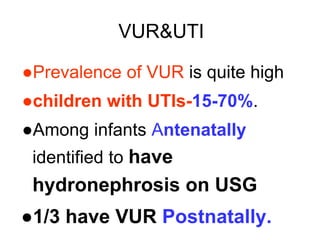
VUR&UTI
●Prevalence of VUR is quite high
●children with UTIs-15-70%.
●Among infants Antenatally
identified to have
hydronephrosis on USG
●1/3 have VUR Postnatally.
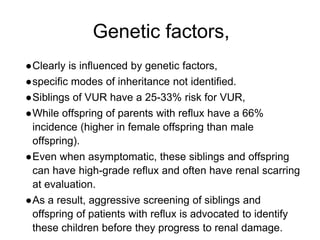
Genetic factors,
●Clearly is influenced by genetic factors,
●specific modes of inheritance not identified.
●Siblings of VUR have a 25-33% risk for VUR,
●While offspring of parents with reflux have a 66%
incidence (higher in female offspring than male
offspring).
●Even when asymptomatic, these siblings and offspring
can have high-grade reflux and often have renal scarring
at evaluation.
●As a result, aggressive screening of siblings and
offspring of patients with reflux is advocated to identify
these children before they progress to renal damage.
Race
●Reflux is more common in white
children than in those of other races.
●VUR is less common in black children,
●Since little is known about the specific
genetic linkage of VUR and the wide
variation of genes with
intermarriage, excluding any group
from evaluation is difficult.
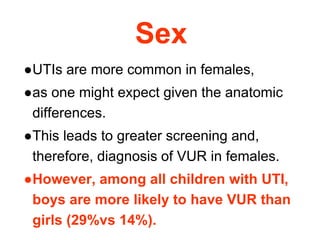
Sex
●UTIs are more common in females,
●as one might expect given the anatomic
differences.
●This leads to greater screening and,
therefore, diagnosis of VUR in females.
●However, among all children with UTI,
boys are more likely to have VUR than
girls (29%vs 14%).
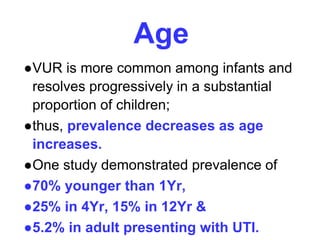
Age
●VUR is more common among infants and
resolves progressively in a substantial
proportion of children;
●thus, prevalence decreases as age
increases.
●One study demonstrated prevalence of
●70% younger than 1Yr,
●25% in 4Yr, 15% in 12Yr &
●5.2% in adult presenting with UTI.
History of
●VUR present in 1 of 2 distinct
groups.
●1st presents with hydronephrosis,
often identified antenatally by
ultrasound.
●These children typically progress
through evaluation and treatment
in the absence of clinical illness.
The second group
●presents with clinical UTI.
●Even for experienced pediatricians,
the diagnosis of UTI in children
can be difficult.
ononspecific SNS&SMS
oAs failure to thrive, with or without fever.
ovomiting, diarrhea, anorexia, and lethargy.
oOlder children may report voiding
symptoms or abdominal pain.
PN in young children
●With vague abdominal discomfort
rather than with the classic flank
pain and tenderness observed in
adults.
●The presence of fever, while highly
suggestive ofPN, is not reliable
enough to lead to the diagnosis.
Even today?!!!,
●Children occasionally
present with advanced RNP,
●Manifesting as headaches or
●CCF from untreated HTN,
●or with uremia of renal
failure
A small group of children
●without evidence of UTI present with
symptoms of sterile reflux,
●which can include flank or abdominal
pain before or during voiding,
●as well as double voiding or incomplete
emptying
●resulting from delayed drainage of
urine out of the upper tracts.
HTN&RF
●RNP may be the most common
cause of childhood HTN.
●Presence of hypertension
correlates well with the degree of
renal scarring, especially when
scarring is bilateral.
The mechanism
●The mechanism is thought to be
elevated renin levels produced by
damaged renal tissues.
●Although not all scarred kidneys in hypertensive
children produce excess renin,
●Resection of renal units in cases where
unilateral renal vein renin levels are elevated
substantially (ratio >1.5) can result in resolution
of hypertension.
Physical EX
●on physical examination suggest VUR
or UTI.
●Fever, flank or abd; tenderness,
●or an enlarged palpable kidney .
●Intact foreskin in male infants should
raise the index of suspicion.
●UTI and PN are substantially higher in
uncircumcised boys during the 1st yr.
In the absence
●Of reliable historical or
●Physical findings,
●Diagnosis is dependent
●On laboratory testing
●& imaging.
Lab Studies
●Diagnosis of UTI is dependent on
obtaining accurate urine cultures.
ostandard urine specimens by suprapubic
aspiration.
oAny growth considered significant.
oIf no samples are obtained by other means.
oGrowth of more than 100,000 CFU/mL is a
significant on a midstream-voided urine
cystitis from pyelonephritis.
●Although the WBC count,
●serum levels of C-reactive protein,
●and other blood tests
●used to assist with the diagnosis,
●no laboratory tests can reliably
distinguish cystitis from
pyelonephritis.
●CBC count can assist in tracking the
Imaging Studies
●Imaging is the basis of diagnosis and Mx of
VUR.
●USG& voiding cystourethrogram
(VCUG),
When,how,what&not
●Imaging after a first UTI is indicated in
all children < 5 years with UTI,
●Any age with UTI,
●Antenatally identified hydronephrosis
should be evaluated Postnatally.
●USG during the first 3 days of life may
have a high rate of false-negative
results
●because of Relative dehydration .
VCUG
●The STD criterion in
diagnosis of VUR
●Provides precise
anatomic detail & allows
Grading of the reflux.
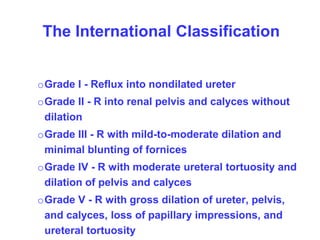
The International Classification
oGrade I - Reflux into nondilated ureter
oGrade II - R into renal pelvis and calyces without
dilation
oGrade III - R with mild-to-moderate dilation and
minimal blunting of fornices
oGrade IV - R with moderate ureteral tortuosity and
dilation of pelvis and calyces
oGrade V - R with gross dilation of ureter, pelvis,
and calyces, loss of papillary impressions, and
ureteral tortuosity
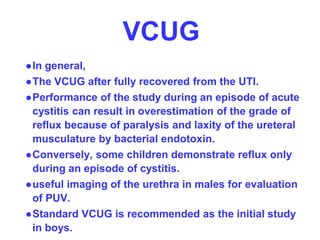
VCUG
●In general,
●The VCUG after fully recovered from the UTI.
●Performance of the study during an episode of acute
cystitis can result in overestimation of the grade of
reflux because of paralysis and laxity of the ureteral
musculature by bacterial endotoxin.
●Conversely, some children demonstrate reflux only
during an episode of cystitis.
●useful imaging of the urethra in males for evaluation
of PUV.
●Standard VCUG is recommended as the initial study
in boys.
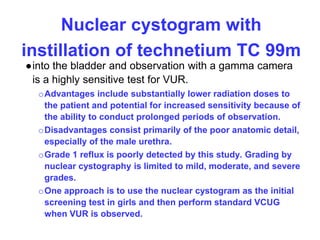
Nuclear cystogram with
instillation of technetium TC 99m
●into the bladder and observation with a gamma camera
is a highly sensitive test for VUR.
oAdvantages include substantially lower radiation doses to
the patient and potential for increased sensitivity because of
the ability to conduct prolonged periods of observation.
oDisadvantages consist primarily of the poor anatomic detail,
especially of the male urethra.
oGrade 1 reflux is poorly detected by this study. Grading by
nuclear cystography is limited to mild, moderate, and severe
grades.
oOne approach is to use the nuclear cystogram as the initial
screening test in girls and then perform standard VCUG
when VUR is observed.
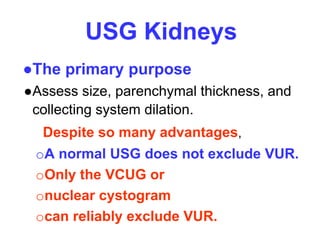
USG Kidneys
●The primary purpose
●Assess size, parenchymal thickness, and
collecting system dilation.
Despite so many advantages,
oA normal USG does not exclude VUR.
oOnly the VCUG or
onuclear cystogram
ocan reliably exclude VUR.
DMSA
●The primary
radiopharmaceutical used with
renal scintigraphy in the setting
of pyelonephritis and VUR is
technetium TC 99m–labeled
dimercaptosuccinic acid
(DMSA).
Cold Spots on Imaging
●This agent is taken up rapidly by
proximal renal tubular cells and is an
excellent indicator of functioning renal
parenchyma.
●Areas of acute inflammation or scarring
do not take up the radiopharmaceutical
and are revealed as cold spots on
imaging.
DMSA
●As a diagnostic tool during
suspected episodes of acute
PN.
●However, the indication is to
identify and monitor renal
scarring.
SPECT
●Single-photon emission
computed tomography
(SPECT)
●Allows for higher resolution
and more accuracy in
detection of renal scarring.
Urodynamic studies
●Reveal functional abn of lower urinary tract.
oSuch testing is most important in patients in
whom secondary reflux is suspected,
oSuch as patients with spina bifida or
oVCUG is suggestive of residual PUV
oSince Antireflux surgery is less successful
in cases with secondary reflux,
oIdentifying such cases before operative
intervention is critical.
Cystometrogram (CMG),
●The basic test is the cystometrogram (CMG),
during which a catheter with an intrinsic or
attached manometer is placed in the bladder and
the bladder is filled slowly with fluid while its
internal pressure is recorded.
●The CMG gives information about bladder
capacity and leak point, pressures at various
stages of filling, and the presence and frequency
of uninhibited (involuntary) bladder contractions.
Detrusor instability
●Detrusor instability is a common finding among
children with reflux, and, in some cases,
treatment with anticholinergic medication has
resulted in resolution of the reflux.
●The technical difficulty of performing urodynamic
studies in small children, especially infants, is a
significant obstacle.
Procedures
●Historically, cystoscopy was considered to
be a basic element of evaluation for VUR.
●The position and shape of the ureteral
orifices were thought to correlate with the
grade and prognosis.
●Subsequent data have demonstrated that
cystoscopic observations do not
significantly contribute to the radiographic
findings.
Cystoscopy
●Cystoscopy is sometimes
performed at the time of
ureteral reimplant surgery
●to identify additional anatomic
abnormalities,
●such as ureteral duplication
●and ureteral ectopia.
Histologic Findings
●Pathologic evaluation
does not play a
significant role in the
diagnosis of VUR.
Medical Care-AIMS/options
●To prevent kidney infection,
●kidney damage, and
●the complications of kidney damage.
●Treatment options
●medical therapy,
●surgical therapy, and
●surveillance.
RD Walker
●(1) spontaneous resolution of VUR is common in
young children but is less common as puberty
approaches,
●(2) severe reflux is unlikely to resolve
spontaneously,
●(3) sterile reflux, in general, does not result in
reflux nephropathy,
●(4) long-term antibiotic prophylaxis in children is
safe, and
●(5) surgery to correct VUR is highly successful in
experienced hands.
Surveillance
●Surveillance has become less common as the
safety of antibiotic prophylaxis has been
established and
●as the risks of kidney damage because of
delayed diagnosis and
●the treatment of UTI have become better
appreciated.
●Surveillance is still a reasonable option in older
children with reflux,
●however, especially boys who have not had
UTIs.
Initial treatment
●Supportive care and
●Prompt administration of appropriate antibiotics.
opreventing scar formation in kidneys with
pyelonephritis.
oAnimal studies have demonstrated that permanent
renal damage occurs if antibiotics are not started
within 72 hours,
oalthough other studies indicate an even shorter
window of opportunity.
oFor this reason, clinicians must maintain a high index
of suspicion for UTI in children.
mainstay of medical management
●is antibiotic prophylaxis.
●Once a child has been treated for UTI or has had
an abnormality identified on imaging, start the
child on prophylaxis.
●In general, antibiotics are continued until
anatomic abnormalities,
●such as VUR, are excluded or resolve with or
without intervention or
●until the child grows old enough that prophylaxis
is no longer necessary.
Virtually all children
●with a new diagnosis of grade I-IV reflux,
●& Some with grade V,
●Given a trial of medical treatment.
●This consists of antibiotics dosed at one
fourth of the therapeutic dosage and
●Regular follow-up care and imaging.
●A typical routine includes renal ultrasound
and
●VCUG or
●Nuclear cystogram every 12-18 months.
follow-up care
●Since a substantial number of children experience spontaneous
resolution of VUR (50-85% of cases with grade I-III VUR),
●medical treatment spares this group the morbidity of surgery while
protecting the kidneys from further damage.
●Once follow-up imaging demonstrates resolution of VUR, antibiotics
are discontinued.
●The importance of conscientious follow-up care during conservative
treatment cannot be overemphasized.
●Lack of compliance with medications or surveillance imaging
continues to result in reflux nephropathy and renal failure in children
in whom these outcomes were completely preventable.
boys approach puberty
●In boys with persistent VUR who have not had
recurrent UTIs, antibiotics are often discontinued
as the boys approach puberty.
●However, because of concerns about future
pregnancies, surgery is usually recommended in
girls approaching puberty who have persistent
VUR .
●Bladder and bowel management for
dysfunctional elimination are as follows
Anticholinergic medication
●Anticholinergic medication, in conjunction with timed voiding, may
improve symptoms of dysfunctional voiding and reduces the risk of
infection.
●Anticholinergic agents should be used in select patients so as not to
compound the problems of incomplete bladder emptying or
worsening constipation.
●A few of these patients benefit from some form of bladder training to
achieve balanced, low-pressure voiding with coordinated relaxation
of the external sphincter and pelvic floor.
●In children with primary bowel elimination problem, treatment with
enemas, dietary changes, and stool bulking agents, in coordination
with a pediatric gastroenterologist, is critical for success.
Diet
●Children with frequent UTIs often have
concurrent problems with constipation and poor
bowel habits.
●Institution of a bowel program in these children
can reduce the frequency of infection.
●High-fiber diets combined with a stool softener,
such as mineral oil (5 cc/d),
●can improve bowel function and reduce colonic
and rectal dilation.
Activity
●Children with VUR can engage in normal
activity.
●Toilet hygiene, especially proper wiping
technique in girls,
●should be taught to children of appropriate
age to reduce the frequency of UTI.
Drug Category
●Antibiotics -- These are used for maintenance of
sterile urine.
●Antibiotic agents used for prophylaxis in children
with VUR are chosen for their efficacy in the
urinary tract, safety, and tolerability.
●The typical dose is one fourth of the therapeutic
dose.
●They are usually administered as suspensions
once daily,
●typically in the evening to maximize overnight
drug levels in the bladder.
Surgical Care
●In the final analysis, the decision to
proceed to surgery is often made on
philosophical as much as scientific
grounds,
●and the medical, social, and emotional
needs of the patient and the family need to
be considered.
Indications for surgery
●(1) breakthrough febrile UTIs despite adequate antibiotic
prophylaxis,
●(2) severe reflux (grade V or bilateral grade IV) that is
unlikely to resolve spontaneously, especially if renal
scarring is present,
●(3) mild or moderate reflux in females that persists as the
patient approaches puberty, despite several years of
observation,
●(4) poor compliance with medications or surveillance
programs,
●and (5) poor renal growth or function or appearance of
new scars.
Principles
●Virtually all operations designed to treat
VUR involve reconstruction of the UVJ
●to create a lengthened submucosal
tunnel for the ureter,
●which functions as a one-way valve as
the bladder fills.
●Dozens of procedures have been
described.
Politano-Leadbetter procedure
●Developed in the 1950s, prototype intravesical operation
●The ureter is dissected completely free of its
attachments and
●passed through a new muscular hiatus created higher on
the bladder wall.
●The ureter is then passed down through a submucosal
tunnel,
●and the orifice is sutured to the mucosa at its original
meatal position.
●Success rate of 97-99%.
Cohen cross-trigonal technique
●An evolution of the PL
●most popular repair performed today.
●the original muscular hiatus is used,
●but the ureter is dissected from its attachments
and pulled across the trigone through a
submucosal tunnel,
●and the meatus is sutured into a new position at
the end of the tunnel.
●Reported rates of success range from 97-99%
with this technique as well.
Lich-Gregoire extravesical approach
●Developed concurrently in Europe and the United States, the Lich-
Gregoire repair approaches the bladder via the retroperitoneum.
●The ureter is dissected from the detrusor, but the orifice is left intact.
●A narrow furrow in the detrusor then is created, down to but not
disrupting the mucosa, extending cephalad from the ureteral orifice.
●The distal ureter is then laid into this furrow and the detrusor closed
over it.
●Although early American results were disappointing, further
experience and modifications have demonstrated success rates
comparable to the standard intravesical techniques.
●The extravesical approach has a significant frequency (16%) of
postoperative urinary retention or incomplete emptying, which
resolves spontaneously.
extravesical approach
●The was developed in an effort to avoid
the time and morbidity associated with the
cystotomy and ureteral anastomosis
required for intravesical repair.
●It is particularly useful in patients with
unilateral reflux.
endoscopic treatment of VUR
●Experimental, holds great promise
because it would allow treatment of the
underlying anatomic defect while avoiding
the morbidity of open surgery.
oThe technique involves injection of a bulking
substance into the muscular posterior wall of
the UVJ.
oThe resulting swelling compresses the ureteral
lumen, preventing reflux out of the bladder.
Persistent reflux after surgery
●Modern series consistently report success rates greater
than 95% for antireflux surgery.
●In cases in which reflux persists postoperatively,
observation with continued antibiotic prophylaxis is
indicated.
●A very high percentage of patients in whom surgery has
failed have voiding dysfunction,
●thus urodynamic evaluation should be considered in
these patients, especially if reoperation is considered.
●Even so, a substantial majority of patients with reflux at
the first postoperative study have complete resolution at
the 1-year follow-up point.
MortalityMorbidity●With isolated VUR is uncommon
●Morbidity is substantial,
●both from the A/c inf process
●From the sequelae of RN.
Changes in renal function
Decreases in urine-concentrating
ability (proportional to the degree of reflux)
& in GFR(proportional to the degree of renal
scarring)
have been measured in children with VUR.
Decreased renal and somatic
growth:
●Although renal growth assessment in
children is difficult because of imaging
variability,
●several studies have documented smaller
kidneys in children with reflux and
recurrent infections.
●Surgery may improve growth rates,
●but in severely scarred kidneys,
●stunting often persists.
properly treated children with VUR
●Although some studies have suggested
that somatic growth is affected negatively
in refluxing children and while children with
end-stage renal disease clearly have
decreased growth rates,
●more recent data have shown that
carefully monitored, properly treated
children with VUR have growth rates
within normal ranges.
UTI may cause reflux
●The possibility that UTI may cause reflux
has also been investigated.
●Indeed, a subset of patients has been
identified in whom reflux was detectable
only during an episode of cystitis.
However,
●most authorities think that UTI and reflux
are independent variables and that rates
of VUR are higher in children with UTI
because these children are actively
screened for reflux.
●The cause-and-effect picture is even less
clear in children with secondary reflux.
bladder outlet obstruction and
neurogenic bladder.
●Little doubt exists that rates of reflux are
increased in the setting of congenital
bladder outlet obstruction and neurogenic
bladder.
●More than 50% of boys with posterior
urethral valves have VUR.
●Similar results were seen in a series of
children undergoing urodynamic studies
for neurogenic bladder
high-pressure voiding and VUR
●That dysfunctional voiding, with its inherent
increase in intravesical pressure, can also result
in reflux, even in otherwise healthy children, is
becoming increasingly clear.
●Uninhibited bladder contractions, often
associated with contraction of the voluntarily
controlled external urinary sphincter to prevent
wetting, increase intravesical pressure.
●The combination of high-pressure voiding and
VUR increases the risk of pyelonephritis beyond
that of the child with low-pressure reflux.
voiding dysfunction and obstruction
●Confounding all of these data is the fact that
urodynamic studies on children are difficult to
perform and evaluate; this is true especially with
infants, in whom normal reference data are
sparse.
●Whether VUR observed in association with
voiding dysfunction and obstruction is a direct
result of that dysfunction or simply a component
of a grossly abnormal urinary tract is not known.
●A unique and complex group of children
presents with dysfunctional elimination, which
consists of a symptom complex heralded by
infection, severe constipation, and daytime
wetting.
●Despite the primary urinary tract presentation,
the primary focus should be in the management
of constipation and bowel habits.
●A subset of these children have infrequent
voiding and incomplete bladder emptying, which
further increases the likelihood of UTI.
DD
●Antenatal Hydronephrosis
Myelodysplasia and Neurogenic
Bladder Dysfunction
PUV
UPJ Obstruction
Urethral Anomalies and Urethral
Prolapse
Urinary Tract Infection
Prognosis:Primary reflux
●Studies comparing medical Mx Vs surgical Mx primary
VUR
●both have excellent long-term outcomes if surveillance is
conscientious and compliance is good.
●Rates of RN are similar in the 2 groups,
●surgically Rx have a lower prevalence of pyelonephritis.
●Recent studies of adults with childhood reflux and
children, the prevalence of RN lower than in historical
series.
●These results seem to validate current management
strategies.
Secondary reflux
●Treatment of children with secondary reflux
continues to pose challenges to pediatricians and
urologists.
●A clear understanding of bladder function is
essential.
●Other children have complex combinations of reflux,
obstruction, and bladder and renal dysfunction that
require a concerted multidisciplinary approach to
achieve the maximum potential benefit of therapy.

Vesicoureteral reflux c

  • 1.
  • 2.
    WHAT is ●Vesicoureteral reflux(VUR) or the retrograde flow of urine from the bladder into the ureter, is an anatomic and functional disorder with potentially serious consequences. ●Primary Reflux & Secondary Reflux
  • 3.
    P&S VUR ●Primary refluxis VUR in an otherwise normally functioning lower urinary tract(UT), ●Secondary reflux is VUR that is associated with or caused by an obstructed or poorly functioning lower UT, such as that observed with Posterior urethral valves (PUV) or
  • 4.
    UreteroVesical Junction (UVJ) ●Inboth conditions, the UVJ fails to function as a One-way valve, giving lower urinary tract bacteria access to the normally sterile upper tracts. ●Although VUR has been recognized as an anatomic phenomenon for centuries, not until relatively recently were the substantial morbidity and mortality associated with the condition recognized.
  • 5.
    Early studies ●correlation betweenreflux and chronic pyelonephritis in paraplegic individuals ●UTI, reflux, and CPN ●Suggested that prevention of VUR ●may result in reduced prevalence of renal complications.
  • 6.
    The objectives inthe current Rx ●The first goal is the prevention of episodes of AcPN associated morbidity and mortality. ●The second goal is to prevent the scarring of the kidney associated with VUR (Reflux nephropathy), which increases the risk of hypertension and renal failure in children and adults with VUR. ●Advances in medical and surgical treatment of children with VUR are now resulting in measurable decreases in the prevalence of Reflux Nephropathy and its sequelae: HTN, RF, ESKD.
  • 7.
    Pathophysiology ●After entering thebladder through the muscular hiatus, ●the normal distal ureter passes through a submucosal tunnel ●before opening into the bladder lumen via the ureteral orifice.
  • 8.
    length of thesubmucosal tunnel ●If the length of the submucosal tunnel or its muscular backing is inadequate, ●the valve mechanism is incompetent, resulting in reflux.
  • 9.
    Basis for almostall surgery ●Careful anatomic measurements suggest that the ratio of tunnel length to ureteral diameter must be at least 5:1 to prevent reflux. ●This fundamental observation is the basis for almost all surgical procedures to correct the disorder.
  • 10.
    Beyond the fetalstage, anatomic reflux alone rarely produces renal damage. ●Experiments in pigs have demonstrated renal scarring in sterile refluxing systems, and while the kidneys may display scarring and/ ●or dysplasia in some patients with prenatally identified and presumably sterile reflux, ●the overwhelming majority of data implicate ascending infection and pyelonephritis as the essential causes of reflux nephropathy.
  • 11.
    Large studies haverepeatedly demonstrated a close correlation btn the frequency of UTI & severity of RNP in VUR.
  • 12.
    the "big bang"effect. ●One episode of pyelonephritis produce Scarring, especially in very young. ●Ransley and Risdon named this condition the "big bang" effect.
  • 13.
    Intrarenal Reflux ●Most scarringtends to occur at the renal poles, ●Where the anatomy of the renal papillae permits backflow of urine into the collecting ducts. ●This phenomenon is referred to as intrarenal reflux ●& gives pathogenic bacteria access
  • 14.
    Renal failure ●Subsequent cascadeof inflammation, ●Release of superoxide & other mediators, ●Results in local tissue ischemia & fibrosis. ●When enough renal parenchyma is affected, ●HTN,RF can result.
  • 15.
    Why little kidneys> prone The reason kidneys of children are so susceptible to damage is Not clear, But it may be caused by reduced levels of renal superoxide dismutase in children.
  • 16.
    Frequency ●In the US: ●Overallprevalence of VUR is unknown, ●Rates of 1-2% ?
  • 17.
    Internationally ●Many large studieshave been performed in Europe, where prevalence is estimated to be similar to that in the United States. ●Disease frequency in other parts of the world is not well described.
  • 18.
    VUR&UTI ●Prevalence of VURis quite high ●children with UTIs-15-70%. ●Among infants Antenatally identified to have hydronephrosis on USG ●1/3 have VUR Postnatally.
  • 19.
    Genetic factors, ●Clearly isinfluenced by genetic factors, ●specific modes of inheritance not identified. ●Siblings of VUR have a 25-33% risk for VUR, ●While offspring of parents with reflux have a 66% incidence (higher in female offspring than male offspring). ●Even when asymptomatic, these siblings and offspring can have high-grade reflux and often have renal scarring at evaluation. ●As a result, aggressive screening of siblings and offspring of patients with reflux is advocated to identify these children before they progress to renal damage.
  • 20.
    Race ●Reflux is morecommon in white children than in those of other races. ●VUR is less common in black children, ●Since little is known about the specific genetic linkage of VUR and the wide variation of genes with intermarriage, excluding any group from evaluation is difficult.
  • 21.
    Sex ●UTIs are morecommon in females, ●as one might expect given the anatomic differences. ●This leads to greater screening and, therefore, diagnosis of VUR in females. ●However, among all children with UTI, boys are more likely to have VUR than girls (29%vs 14%).
  • 22.
    Age ●VUR is morecommon among infants and resolves progressively in a substantial proportion of children; ●thus, prevalence decreases as age increases. ●One study demonstrated prevalence of ●70% younger than 1Yr, ●25% in 4Yr, 15% in 12Yr & ●5.2% in adult presenting with UTI.
  • 23.
    History of ●VUR presentin 1 of 2 distinct groups. ●1st presents with hydronephrosis, often identified antenatally by ultrasound. ●These children typically progress through evaluation and treatment in the absence of clinical illness.
  • 24.
    The second group ●presentswith clinical UTI. ●Even for experienced pediatricians, the diagnosis of UTI in children can be difficult. ononspecific SNS&SMS oAs failure to thrive, with or without fever. ovomiting, diarrhea, anorexia, and lethargy. oOlder children may report voiding symptoms or abdominal pain.
  • 25.
    PN in youngchildren ●With vague abdominal discomfort rather than with the classic flank pain and tenderness observed in adults. ●The presence of fever, while highly suggestive ofPN, is not reliable enough to lead to the diagnosis.
  • 26.
    Even today?!!!, ●Children occasionally presentwith advanced RNP, ●Manifesting as headaches or ●CCF from untreated HTN, ●or with uremia of renal failure
  • 27.
    A small groupof children ●without evidence of UTI present with symptoms of sterile reflux, ●which can include flank or abdominal pain before or during voiding, ●as well as double voiding or incomplete emptying ●resulting from delayed drainage of urine out of the upper tracts.
  • 28.
    HTN&RF ●RNP may bethe most common cause of childhood HTN. ●Presence of hypertension correlates well with the degree of renal scarring, especially when scarring is bilateral.
  • 29.
    The mechanism ●The mechanismis thought to be elevated renin levels produced by damaged renal tissues. ●Although not all scarred kidneys in hypertensive children produce excess renin, ●Resection of renal units in cases where unilateral renal vein renin levels are elevated substantially (ratio >1.5) can result in resolution of hypertension.
  • 30.
    Physical EX ●on physicalexamination suggest VUR or UTI. ●Fever, flank or abd; tenderness, ●or an enlarged palpable kidney . ●Intact foreskin in male infants should raise the index of suspicion. ●UTI and PN are substantially higher in uncircumcised boys during the 1st yr.
  • 31.
    In the absence ●Ofreliable historical or ●Physical findings, ●Diagnosis is dependent ●On laboratory testing ●& imaging.
  • 32.
    Lab Studies ●Diagnosis ofUTI is dependent on obtaining accurate urine cultures. ostandard urine specimens by suprapubic aspiration. oAny growth considered significant. oIf no samples are obtained by other means. oGrowth of more than 100,000 CFU/mL is a significant on a midstream-voided urine
  • 33.
    cystitis from pyelonephritis. ●Althoughthe WBC count, ●serum levels of C-reactive protein, ●and other blood tests ●used to assist with the diagnosis, ●no laboratory tests can reliably distinguish cystitis from pyelonephritis. ●CBC count can assist in tracking the
  • 34.
    Imaging Studies ●Imaging isthe basis of diagnosis and Mx of VUR. ●USG& voiding cystourethrogram (VCUG),
  • 35.
    When,how,what&not ●Imaging after afirst UTI is indicated in all children < 5 years with UTI, ●Any age with UTI, ●Antenatally identified hydronephrosis should be evaluated Postnatally. ●USG during the first 3 days of life may have a high rate of false-negative results ●because of Relative dehydration .
  • 36.
    VCUG ●The STD criterionin diagnosis of VUR ●Provides precise anatomic detail & allows Grading of the reflux.
  • 37.
    The International Classification oGradeI - Reflux into nondilated ureter oGrade II - R into renal pelvis and calyces without dilation oGrade III - R with mild-to-moderate dilation and minimal blunting of fornices oGrade IV - R with moderate ureteral tortuosity and dilation of pelvis and calyces oGrade V - R with gross dilation of ureter, pelvis, and calyces, loss of papillary impressions, and ureteral tortuosity
  • 38.
    VCUG ●In general, ●The VCUGafter fully recovered from the UTI. ●Performance of the study during an episode of acute cystitis can result in overestimation of the grade of reflux because of paralysis and laxity of the ureteral musculature by bacterial endotoxin. ●Conversely, some children demonstrate reflux only during an episode of cystitis. ●useful imaging of the urethra in males for evaluation of PUV. ●Standard VCUG is recommended as the initial study in boys.
  • 39.
    Nuclear cystogram with instillationof technetium TC 99m ●into the bladder and observation with a gamma camera is a highly sensitive test for VUR. oAdvantages include substantially lower radiation doses to the patient and potential for increased sensitivity because of the ability to conduct prolonged periods of observation. oDisadvantages consist primarily of the poor anatomic detail, especially of the male urethra. oGrade 1 reflux is poorly detected by this study. Grading by nuclear cystography is limited to mild, moderate, and severe grades. oOne approach is to use the nuclear cystogram as the initial screening test in girls and then perform standard VCUG when VUR is observed.
  • 40.
    USG Kidneys ●The primarypurpose ●Assess size, parenchymal thickness, and collecting system dilation. Despite so many advantages, oA normal USG does not exclude VUR. oOnly the VCUG or onuclear cystogram ocan reliably exclude VUR.
  • 41.
    DMSA ●The primary radiopharmaceutical usedwith renal scintigraphy in the setting of pyelonephritis and VUR is technetium TC 99m–labeled dimercaptosuccinic acid (DMSA).
  • 42.
    Cold Spots onImaging ●This agent is taken up rapidly by proximal renal tubular cells and is an excellent indicator of functioning renal parenchyma. ●Areas of acute inflammation or scarring do not take up the radiopharmaceutical and are revealed as cold spots on imaging.
  • 43.
    DMSA ●As a diagnostictool during suspected episodes of acute PN. ●However, the indication is to identify and monitor renal scarring.
  • 44.
    SPECT ●Single-photon emission computed tomography (SPECT) ●Allowsfor higher resolution and more accuracy in detection of renal scarring.
  • 45.
    Urodynamic studies ●Reveal functionalabn of lower urinary tract. oSuch testing is most important in patients in whom secondary reflux is suspected, oSuch as patients with spina bifida or oVCUG is suggestive of residual PUV oSince Antireflux surgery is less successful in cases with secondary reflux, oIdentifying such cases before operative intervention is critical.
  • 46.
    Cystometrogram (CMG), ●The basictest is the cystometrogram (CMG), during which a catheter with an intrinsic or attached manometer is placed in the bladder and the bladder is filled slowly with fluid while its internal pressure is recorded. ●The CMG gives information about bladder capacity and leak point, pressures at various stages of filling, and the presence and frequency of uninhibited (involuntary) bladder contractions.
  • 47.
    Detrusor instability ●Detrusor instabilityis a common finding among children with reflux, and, in some cases, treatment with anticholinergic medication has resulted in resolution of the reflux. ●The technical difficulty of performing urodynamic studies in small children, especially infants, is a significant obstacle.
  • 48.
    Procedures ●Historically, cystoscopy wasconsidered to be a basic element of evaluation for VUR. ●The position and shape of the ureteral orifices were thought to correlate with the grade and prognosis. ●Subsequent data have demonstrated that cystoscopic observations do not significantly contribute to the radiographic findings.
  • 49.
    Cystoscopy ●Cystoscopy is sometimes performedat the time of ureteral reimplant surgery ●to identify additional anatomic abnormalities, ●such as ureteral duplication ●and ureteral ectopia.
  • 50.
    Histologic Findings ●Pathologic evaluation doesnot play a significant role in the diagnosis of VUR.
  • 51.
    Medical Care-AIMS/options ●To preventkidney infection, ●kidney damage, and ●the complications of kidney damage. ●Treatment options ●medical therapy, ●surgical therapy, and ●surveillance.
  • 52.
    RD Walker ●(1) spontaneousresolution of VUR is common in young children but is less common as puberty approaches, ●(2) severe reflux is unlikely to resolve spontaneously, ●(3) sterile reflux, in general, does not result in reflux nephropathy, ●(4) long-term antibiotic prophylaxis in children is safe, and ●(5) surgery to correct VUR is highly successful in experienced hands.
  • 53.
    Surveillance ●Surveillance has becomeless common as the safety of antibiotic prophylaxis has been established and ●as the risks of kidney damage because of delayed diagnosis and ●the treatment of UTI have become better appreciated. ●Surveillance is still a reasonable option in older children with reflux, ●however, especially boys who have not had UTIs.
  • 54.
    Initial treatment ●Supportive careand ●Prompt administration of appropriate antibiotics. opreventing scar formation in kidneys with pyelonephritis. oAnimal studies have demonstrated that permanent renal damage occurs if antibiotics are not started within 72 hours, oalthough other studies indicate an even shorter window of opportunity. oFor this reason, clinicians must maintain a high index of suspicion for UTI in children.
  • 55.
    mainstay of medicalmanagement ●is antibiotic prophylaxis. ●Once a child has been treated for UTI or has had an abnormality identified on imaging, start the child on prophylaxis. ●In general, antibiotics are continued until anatomic abnormalities, ●such as VUR, are excluded or resolve with or without intervention or ●until the child grows old enough that prophylaxis is no longer necessary.
  • 56.
    Virtually all children ●witha new diagnosis of grade I-IV reflux, ●& Some with grade V, ●Given a trial of medical treatment. ●This consists of antibiotics dosed at one fourth of the therapeutic dosage and ●Regular follow-up care and imaging. ●A typical routine includes renal ultrasound and ●VCUG or ●Nuclear cystogram every 12-18 months.
  • 57.
    follow-up care ●Since asubstantial number of children experience spontaneous resolution of VUR (50-85% of cases with grade I-III VUR), ●medical treatment spares this group the morbidity of surgery while protecting the kidneys from further damage. ●Once follow-up imaging demonstrates resolution of VUR, antibiotics are discontinued. ●The importance of conscientious follow-up care during conservative treatment cannot be overemphasized. ●Lack of compliance with medications or surveillance imaging continues to result in reflux nephropathy and renal failure in children in whom these outcomes were completely preventable.
  • 58.
    boys approach puberty ●Inboys with persistent VUR who have not had recurrent UTIs, antibiotics are often discontinued as the boys approach puberty. ●However, because of concerns about future pregnancies, surgery is usually recommended in girls approaching puberty who have persistent VUR . ●Bladder and bowel management for dysfunctional elimination are as follows
  • 59.
    Anticholinergic medication ●Anticholinergic medication,in conjunction with timed voiding, may improve symptoms of dysfunctional voiding and reduces the risk of infection. ●Anticholinergic agents should be used in select patients so as not to compound the problems of incomplete bladder emptying or worsening constipation. ●A few of these patients benefit from some form of bladder training to achieve balanced, low-pressure voiding with coordinated relaxation of the external sphincter and pelvic floor. ●In children with primary bowel elimination problem, treatment with enemas, dietary changes, and stool bulking agents, in coordination with a pediatric gastroenterologist, is critical for success.
  • 60.
    Diet ●Children with frequentUTIs often have concurrent problems with constipation and poor bowel habits. ●Institution of a bowel program in these children can reduce the frequency of infection. ●High-fiber diets combined with a stool softener, such as mineral oil (5 cc/d), ●can improve bowel function and reduce colonic and rectal dilation.
  • 61.
    Activity ●Children with VURcan engage in normal activity. ●Toilet hygiene, especially proper wiping technique in girls, ●should be taught to children of appropriate age to reduce the frequency of UTI.
  • 62.
    Drug Category ●Antibiotics --These are used for maintenance of sterile urine. ●Antibiotic agents used for prophylaxis in children with VUR are chosen for their efficacy in the urinary tract, safety, and tolerability. ●The typical dose is one fourth of the therapeutic dose. ●They are usually administered as suspensions once daily, ●typically in the evening to maximize overnight drug levels in the bladder.
  • 63.
    Surgical Care ●In thefinal analysis, the decision to proceed to surgery is often made on philosophical as much as scientific grounds, ●and the medical, social, and emotional needs of the patient and the family need to be considered.
  • 64.
    Indications for surgery ●(1)breakthrough febrile UTIs despite adequate antibiotic prophylaxis, ●(2) severe reflux (grade V or bilateral grade IV) that is unlikely to resolve spontaneously, especially if renal scarring is present, ●(3) mild or moderate reflux in females that persists as the patient approaches puberty, despite several years of observation, ●(4) poor compliance with medications or surveillance programs, ●and (5) poor renal growth or function or appearance of new scars.
  • 65.
    Principles ●Virtually all operationsdesigned to treat VUR involve reconstruction of the UVJ ●to create a lengthened submucosal tunnel for the ureter, ●which functions as a one-way valve as the bladder fills. ●Dozens of procedures have been described.
  • 66.
    Politano-Leadbetter procedure ●Developed inthe 1950s, prototype intravesical operation ●The ureter is dissected completely free of its attachments and ●passed through a new muscular hiatus created higher on the bladder wall. ●The ureter is then passed down through a submucosal tunnel, ●and the orifice is sutured to the mucosa at its original meatal position. ●Success rate of 97-99%.
  • 67.
    Cohen cross-trigonal technique ●Anevolution of the PL ●most popular repair performed today. ●the original muscular hiatus is used, ●but the ureter is dissected from its attachments and pulled across the trigone through a submucosal tunnel, ●and the meatus is sutured into a new position at the end of the tunnel. ●Reported rates of success range from 97-99% with this technique as well.
  • 68.
    Lich-Gregoire extravesical approach ●Developedconcurrently in Europe and the United States, the Lich- Gregoire repair approaches the bladder via the retroperitoneum. ●The ureter is dissected from the detrusor, but the orifice is left intact. ●A narrow furrow in the detrusor then is created, down to but not disrupting the mucosa, extending cephalad from the ureteral orifice. ●The distal ureter is then laid into this furrow and the detrusor closed over it. ●Although early American results were disappointing, further experience and modifications have demonstrated success rates comparable to the standard intravesical techniques. ●The extravesical approach has a significant frequency (16%) of postoperative urinary retention or incomplete emptying, which resolves spontaneously.
  • 69.
    extravesical approach ●The wasdeveloped in an effort to avoid the time and morbidity associated with the cystotomy and ureteral anastomosis required for intravesical repair. ●It is particularly useful in patients with unilateral reflux.
  • 70.
    endoscopic treatment ofVUR ●Experimental, holds great promise because it would allow treatment of the underlying anatomic defect while avoiding the morbidity of open surgery. oThe technique involves injection of a bulking substance into the muscular posterior wall of the UVJ. oThe resulting swelling compresses the ureteral lumen, preventing reflux out of the bladder.
  • 71.
    Persistent reflux aftersurgery ●Modern series consistently report success rates greater than 95% for antireflux surgery. ●In cases in which reflux persists postoperatively, observation with continued antibiotic prophylaxis is indicated. ●A very high percentage of patients in whom surgery has failed have voiding dysfunction, ●thus urodynamic evaluation should be considered in these patients, especially if reoperation is considered. ●Even so, a substantial majority of patients with reflux at the first postoperative study have complete resolution at the 1-year follow-up point.
  • 72.
    MortalityMorbidity●With isolated VURis uncommon ●Morbidity is substantial, ●both from the A/c inf process ●From the sequelae of RN.
  • 73.
    Changes in renalfunction Decreases in urine-concentrating ability (proportional to the degree of reflux) & in GFR(proportional to the degree of renal scarring) have been measured in children with VUR.
  • 74.
    Decreased renal andsomatic growth: ●Although renal growth assessment in children is difficult because of imaging variability, ●several studies have documented smaller kidneys in children with reflux and recurrent infections. ●Surgery may improve growth rates, ●but in severely scarred kidneys, ●stunting often persists.
  • 75.
    properly treated childrenwith VUR ●Although some studies have suggested that somatic growth is affected negatively in refluxing children and while children with end-stage renal disease clearly have decreased growth rates, ●more recent data have shown that carefully monitored, properly treated children with VUR have growth rates within normal ranges.
  • 76.
    UTI may causereflux ●The possibility that UTI may cause reflux has also been investigated. ●Indeed, a subset of patients has been identified in whom reflux was detectable only during an episode of cystitis.
  • 77.
    However, ●most authorities thinkthat UTI and reflux are independent variables and that rates of VUR are higher in children with UTI because these children are actively screened for reflux. ●The cause-and-effect picture is even less clear in children with secondary reflux.
  • 78.
    bladder outlet obstructionand neurogenic bladder. ●Little doubt exists that rates of reflux are increased in the setting of congenital bladder outlet obstruction and neurogenic bladder. ●More than 50% of boys with posterior urethral valves have VUR. ●Similar results were seen in a series of children undergoing urodynamic studies for neurogenic bladder
  • 79.
    high-pressure voiding andVUR ●That dysfunctional voiding, with its inherent increase in intravesical pressure, can also result in reflux, even in otherwise healthy children, is becoming increasingly clear. ●Uninhibited bladder contractions, often associated with contraction of the voluntarily controlled external urinary sphincter to prevent wetting, increase intravesical pressure. ●The combination of high-pressure voiding and VUR increases the risk of pyelonephritis beyond that of the child with low-pressure reflux.
  • 80.
    voiding dysfunction andobstruction ●Confounding all of these data is the fact that urodynamic studies on children are difficult to perform and evaluate; this is true especially with infants, in whom normal reference data are sparse. ●Whether VUR observed in association with voiding dysfunction and obstruction is a direct result of that dysfunction or simply a component of a grossly abnormal urinary tract is not known.
  • 81.
    ●A unique andcomplex group of children presents with dysfunctional elimination, which consists of a symptom complex heralded by infection, severe constipation, and daytime wetting. ●Despite the primary urinary tract presentation, the primary focus should be in the management of constipation and bowel habits. ●A subset of these children have infrequent voiding and incomplete bladder emptying, which further increases the likelihood of UTI.
  • 82.
    DD ●Antenatal Hydronephrosis Myelodysplasia andNeurogenic Bladder Dysfunction PUV UPJ Obstruction Urethral Anomalies and Urethral Prolapse Urinary Tract Infection
  • 83.
    Prognosis:Primary reflux ●Studies comparingmedical Mx Vs surgical Mx primary VUR ●both have excellent long-term outcomes if surveillance is conscientious and compliance is good. ●Rates of RN are similar in the 2 groups, ●surgically Rx have a lower prevalence of pyelonephritis. ●Recent studies of adults with childhood reflux and children, the prevalence of RN lower than in historical series. ●These results seem to validate current management strategies.
  • 84.
    Secondary reflux ●Treatment ofchildren with secondary reflux continues to pose challenges to pediatricians and urologists. ●A clear understanding of bladder function is essential. ●Other children have complex combinations of reflux, obstruction, and bladder and renal dysfunction that require a concerted multidisciplinary approach to achieve the maximum potential benefit of therapy.