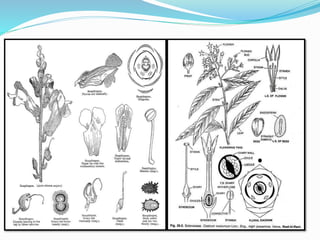
This document discusses the use of anatomical features of plants for resolving taxonomic problems and elucidating phylogenetic relationships. It describes various anatomical features that have been studied, including trichomes, stomata, leaf anatomy, nodal anatomy, cellular contents, wood anatomy, and flower anatomy. Specific examples are given of how studies of these anatomical features have helped classify plants and solve taxonomic controversies by distinguishing between genera, species, and sometimes families. The document advocates that anatomical studies provide important evidence that can be used alongside other data for systematic and phylogenetic studies of plants.
![Content :
Introduction
Vegetative organ:
1] Trichomes as criteria and it’s types
2] Stomata as criteria and it’s types
3] Leaf anatomy
4] Nodal anatomy
5] Cellular content
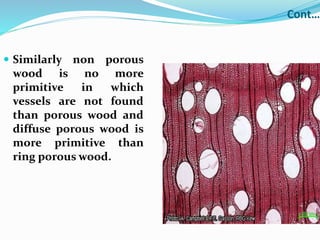
6] Wood anatomy
• Reproductive organ :
1] flower anatomy](https://image.slidesharecdn.com/systematicplantanatomywithspecialreferenceofvarious-180808175528/85/Systematic-plant-anatomy-with-special-reference-of-various-2-320.jpg)

![1.Vegetative organ :
A] Tricomes as criteria
Heintzelman and Howard (1944) supported the
segregation of two genera ottoschulzia and poraqueiba
of Icacinaceae on the basis of the evidence from
trichomes.
Controversy about the link between typheceae and
sparganiaceae could be resolved on the basis of
presence of sessile or glandular trichomes.
Inamdar (1967)confirms the position of Nyctanthes
within family oliaceae on the basis of structure and
ontogeny of trichomes.](https://image.slidesharecdn.com/systematicplantanatomywithspecialreferenceofvarious-180808175528/85/Systematic-plant-anatomy-with-special-reference-of-various-5-320.jpg)

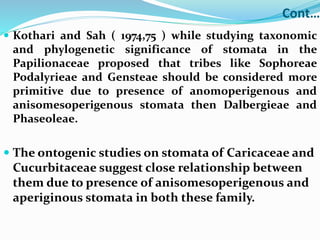
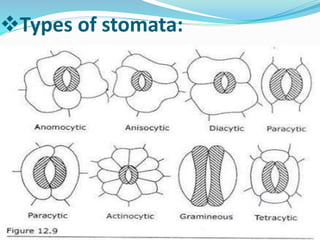
![B] Stomata as criteria:
Vesque (1889) classified stomata into four categories
which he named after in which these were found.
Von cotthem (1970) proposed a detailed account of
classification of stomata based on the number and
position of subsidiaries
Krisnamurthy and Kannabiran (1970)have successfully
used structure of stomata for identification of
fragmentary material in the pharmacognostical studies.
Pant and Mehra (1965) and Bir and coworker (1971)
supported the division of Rubiaceae into three
subfamilies Rubioideae, cinchonoideae and
Guettaroideae.](https://image.slidesharecdn.com/systematicplantanatomywithspecialreferenceofvarious-180808175528/85/Systematic-plant-anatomy-with-special-reference-of-various-7-320.jpg)
 Most read
 Most read
![C] Leaf Anatomy :
Carlquist (1961) has rightly stated that “The leaf is
perhaps anatomically most varied organ of
angiosperms and its anatomical variations often concur
closely with generic and specific and occasionally
familial lines.”
the leaf anatomy is one of the most reliable characters
useful in grass systematics .
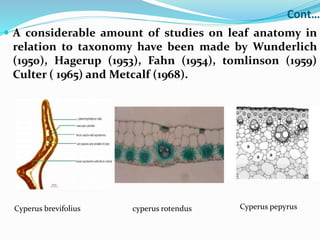
govindrajalu (1969) was able to formulate a key to
distinguish various species of cyperus on the basis of
leaf anatomy.
Ayensu (1974) has shown the Vellozia and Barbacenia of
velloziaceae can be distinguished from each other by
the form of sclerenchyma in the leaves.](https://image.slidesharecdn.com/systematicplantanatomywithspecialreferenceofvarious-180808175528/85/Systematic-plant-anatomy-with-special-reference-of-various-10-320.jpg)
![D] Nodal Anatomy :
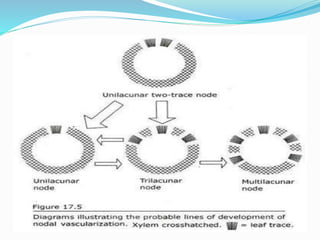
Sinnott (1914) recognised three fundamental types of
nodal anatomy in Dicotylelons A] unilacunar, B]
trilacunar and C] multilacunar.
Morsden and Bailey (1955) discovered to fourth type of
nodal anatomy unilacunar two trace.
A comparative study of nodal anatomy may also be
valuable for showing relationships of genera or even
species.
Bailey and Howard (1941) proposed that on the basis of
nodal structure the subfamily Icacinoideae of
Icacinaceae may be divided into two difference sections,
one section characterized by having trilacunar nodes
and other by having unilacunar nodes.](https://image.slidesharecdn.com/systematicplantanatomywithspecialreferenceofvarious-180808175528/85/Systematic-plant-anatomy-with-special-reference-of-various-12-320.jpg)
 Most read
![E] Cellular Contents :
Many types of chemical deposits such as plastids,
starches, proteins, tannins and crystals and other
mineral deposits occur in plant tissues.
The distribution pattern of the cells containing
chloroplast and other types of plastids is of systematic
value.
Reichert (1913) has shown that a care study of starch
grains of particular groups may reveal generic species
and even variable criteria.
Deposition of silica, calcium oxalate, calcium carbonate
and other chemical substances is characteristic of
certain taxa and they have been found of systematic
value.](https://image.slidesharecdn.com/systematicplantanatomywithspecialreferenceofvarious-180808175528/85/Systematic-plant-anatomy-with-special-reference-of-various-14-320.jpg)
![F] Wood Anatomy :
Carlqueist(1961) stated that the well established
trends of xylem evolution should be taken into
account by any systematist interested in
formulating relationships or evolutionary status of
angiosperm taxa.
The various features which have been used as
follows:
i] Vessels :
Vessels found solitary are considered as primitive
than those aggregated in groups such as pore
multipales, pore clusters and pore chains.](https://image.slidesharecdn.com/systematicplantanatomywithspecialreferenceofvarious-180808175528/85/Systematic-plant-anatomy-with-special-reference-of-various-16-320.jpg)
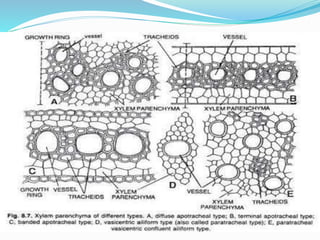
![ii]Wood Parenchayma
Apotracheal Paratracheal
Diffuse Banded Terminal Vasicentric Abaxial
Aliform Confluent](https://image.slidesharecdn.com/systematicplantanatomywithspecialreferenceofvarious-180808175528/85/Systematic-plant-anatomy-with-special-reference-of-various-18-320.jpg)
![iii] Rays :
Feature like rays abundance,
ray dimension, width and
cellular composition, degree
of wall thickness of ray cells,
pitting in ray parenchyma and
homogenous and
heterogenous nature have
been variously used for
taxonomic and phylogenetic
studies.
It is believed that
heterogenous rays are
primitive than homogenous
rays.](https://image.slidesharecdn.com/systematicplantanatomywithspecialreferenceofvarious-180808175528/85/Systematic-plant-anatomy-with-special-reference-of-various-20-320.jpg)
![iv] Storied Structured:
The term refers to the arrangement of cells or tissues in
horizontal series as seen in tangential section.
Storied structures are considered advanced over the
ones with non stratified cells.
Wood anatomy has also played an important role in
solving certain taxonomic problem. A few them are
mentioned here :
1] Engler and Prantl(1889) proposed amintiferae as least
specialised group but Hutchinson(1959), Cronquist
(1968), and Takhtajan(1969) consider Magnoliales as
most primitive group.](https://image.slidesharecdn.com/systematicplantanatomywithspecialreferenceofvarious-180808175528/85/Systematic-plant-anatomy-with-special-reference-of-various-21-320.jpg)
![Cont…
2] Hutchison(1959) placed Annonaceae in separate order
Annonales whereas Takhtajan (1969) placed it under
order Magnoliales. Purkayastha (1980) studied wood
anatomy of the family and found that annonaceae have
much advanced type of wood than magnoliales and
thus he supported Hutchinson in this respect.
3] Studies of Purkayastha (1980) on calcium oxalate
crystals found in wood of family Sapotaceae reveal that
the two genera of the family, Manilkara and Mimusops
cannot be morphologically distinguished but they can
be separated on the basis of chembered crystalliferous
strands of calcium oxalate.](https://image.slidesharecdn.com/systematicplantanatomywithspecialreferenceofvarious-180808175528/85/Systematic-plant-anatomy-with-special-reference-of-various-22-320.jpg)
![2] Reproductive organ
7] flower anatomy:
A flower has typical vascular ground plan, i.e.
sepals receive three distinct vascular traces , petals
and stamens received a single traces and carpels
three traces each.
During the course of evolution and specialization
of flower, the vascular plan has undergone
reduction, amplification cohesion and adnation of
vascular bundles.
Floral anatomy has played important role in solving
taxonomic problem may be the cases of Trapa and
Ruppia.](https://image.slidesharecdn.com/systematicplantanatomywithspecialreferenceofvarious-180808175528/85/Systematic-plant-anatomy-with-special-reference-of-various-23-320.jpg)