ORIGIN OF SEED AND PRE OVULE
Meaning of Seed Habit:
 Seed is a ripened or fertilised ovule. A
seed (ovule) may be defined as an
integumented indehiscent
megasporangium. There is further
elaboration of the megasporangium so as
to enable it to be an ideal starting point
for the development of a new plant.
 Thus seeds provide parental care to the
land plants, where megagametophyte is
retained within the indehiscent
megasporangium and is well-protected
by the integument. Moreover, apex of the
nucellus is elaborated for reception of
microspore and fertilisation takes place
through pollen tube or pollen tube-like
structure.
Origin of Seed Habit:
Stewart and Rothwell (1993) proposed six evolutionary events that
took place in ovule evolution after the onset of heterospory:
 1. Degeneration of three megaspores and formation of a single functional
megaspore in the megasporangium.
 2. Retention of the functional megaspore in the megasporangium (nucellus)
until embryo development.
 3. Formation of endosporic megagametophytes within an indehiscent
megasporangium.
 4. Elaboration of the apical part of nucellus to receive microspores or pollen
grains.
 5. Formation of an integument which delimited a micropyle.
 6. Formation of pollen tube or pollen tube-like structure from endosporic
microgametophyte.
 Due to the incomplete records of fossil plants it is difficult to predict the
exact order of these six events. However, the evolution of seed habit can be
evaluated on the basis of above- mentioned events.
Evolution of Integument in Seed Habit:
 Hypothesis:
 Several theories have been put forward
about the origin of integument.
 According to the synangial hypothesis by
Benson (1904), the integument evolved
from the sterilisation of the outer ring of
sporangia in a radial synangium.
 The nucellar modification theory was pro-
posed by Andrews (1961) based on the
structure of megasporangium of
Stauropteris burntislandica, a coenopterid
fern. According to this theory, a reduction
of megaspore from two to one took place
in one which was sunk towards the base of
the sporangium.
 The simple seed was evolved by further proliferation
of the sporangial wall and the subsequent division of
the basal vascular bundle to extend into the newly
formed integument. The occurrence of Palaeozoic
seeds such as Lagenostoma and Conostoma supports
this hypothesis.
 The most acceptable hypothesis is the telome concept
by Zimmermann in 1952. According to this
hypothesis, a dichotomously branched axial system
bearing terminal sporangia was the starting point.
 There was a gradual reduction of some of the axis and
one of the sporangia becomes surrounded by an
aggregation of sterile telomes. The fusion of the
telomes resulted in the formation of the integument.
Thus the primitive seed (preovule) consisted of a
naked megasporangium surrounded by a ring of
vascularised integumentary lobes.
Pre-Ovules:
 The evidences in support of the origin of seed (ovule) following telome
hypothesis came into existence after the discovery of several ovule-like
structures from the Upper Devonian and Lower Carboniferous strata. Though
these ovule-like structures fulfilled most of the seed characteristics, they lack a
well-defined micropyle.
 Stewart and Rothwell (1993) proposed the term ‘pre-ovule’ for such structures.
A pre-ovule may be defined as an ovule-like structure consisting of a
megasporangium which is either naked or invested by unfused or partially
fused integumentary lobes and thus lacks a well- defined micropyle.
 The investigations of Upper Devonian and Lower Carboniferous pre-ovules
have provided important clues in documenting the transition between pre-
ovules and the true ovules (seeds).
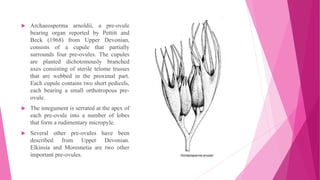
 Archaeosperma arnoldii, a pre-ovule
bearing organ reported by Pettitt and
Beck (1968) from Upper Devonian,
consists of a cupule that partially
surrounds four pre-ovules. The cupules
are planted dichotomously branched
axes consisting of sterile telome trusses
that are webbed in the proximal part.
Each cupule contains two short pedicels,
each bearing a small orthotropous pre-
ovule.
 The integument is serrated at the apex of
each pre-ovule into a number of lobes
that form a rudimentary micropyle.
 Several other pre-ovules have been
described from Upper Devonian.
Elkinsia and Moresnetia are two other
important pre-ovules.
 Elkinsia consists of loose tufts of cupules produced on a cruciately forked
branching system. Cupules are produced either singly or in pairs. Each cupule
consists of 16 sterile branch tips surrounding a total of four orthotropous
ovules. The integument is made up of four or five lobes that are fused at the
basal region only and thus lacks a well-defined micropyle.
 Moresnetia produced cupules much like those of Elkinsia. Moresnetia consists
of 8 to 10 thin integumentary lobes that are only fused at the base and tends to
flare away from the pre- ovule apex.
Evolution of ovules from pre-ovules:
 The evidence in support of the
fusion of telomes (integumentary
lobes) of pre-ovules to form
integument with its micropyle is
well-documented by A. G.
Long (1966). Long described a
number of Lower Carboniferous
pre-ovules from Scotland.
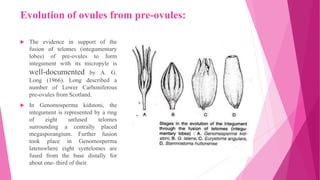
 In Genomosperma kidstoni, the
integument is represented by a ring
of eight unfused telomes
surrounding a centrally placed
megasporangium. Further fusion
took place in Genomosperma
latenswhere eight syntelomes are
fused from the base distally for
about one- third of their.
 In Physostoma elegans, the syntelomes are fused for one-half of their length. The more
advanced degree of fusion is noted in Archaeosperma arnoldii and Eurystoma angulare
where four syntelomes are fused from the base distally for about three-fourth of their
length and still lacks a well-defined micropyle. Stamnostoma huttonense has reached
the level of an ovule where the fusion of syntelomes is complete that delimited a
micropyle.
 Thus, the Lower Carboniferous ovules (seeds) demonstrate the direct relationship
between the degree of fusion of integumentary lobes and concomitant formation of
micropyle.