Synthetic Biology (The Cell as a Nanosystem) ARC Bioinformatics UC Davis Summer 2006
 
Synthetic Biology Nanotechnology is  emulating biology Molecular assemblers, molecular sensors ‘ Bots’ that deliver medicine to specific cells Biotechnology is helping out Genetic ‘reengineering’ of e-coli, phages Nano-Bio  or  Bio-Nano ? Two very interesting approaches…  The answer might be  ‘synthetic biology’
 
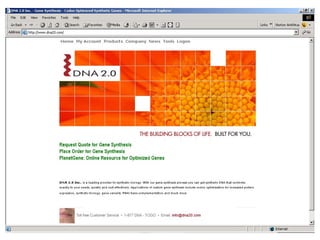
DNA  2.0 DNA 2.0 Inc.   is a leading provider for synthetic biology. With our gene synthesis process you can get synthetic DNA that conforms exactly to your needs, quickly and cost effectively. Applications of custom gene synthesis include codon optimization for increased protein expression, synthetic biology, gene variants, RNAi trans-complementation and much more.
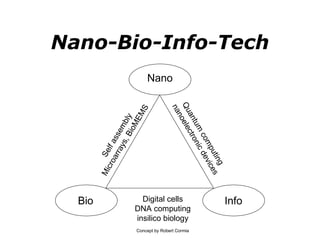
Nano-Bio-Info-Tech (NBIT) ‘ Fusion’  or ‘ convergence’  of Nanotechnology Biotechnology Information technology Focus of  regional  development Nanobiotechnology (DNA microarrays) Bioinformatics and Informatics Add  stem cell  and  genetic engineering
Some  Definitions… Bionanotechnology Biology  as seen through the eyes of nano How do molecules  work  in biology? How  can we make biology work for us ? Applications Self assembled protein metal complexes DNA scaffolding for arrayed assembly Phage injection of targeted viral DNA
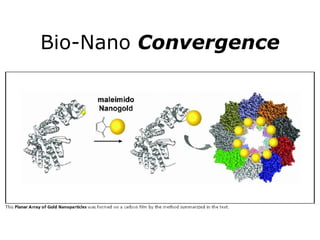
Bio-Nano  Convergence
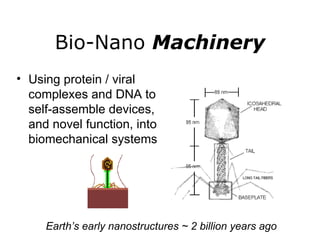
Bio-Nano  Machinery Using protein / viral complexes and DNA to self-assemble devices, and novel function, into  biomechanical systems Earth’s early nanostructures ~ 2 billion years ago
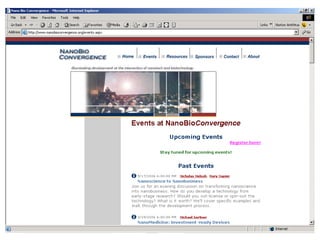
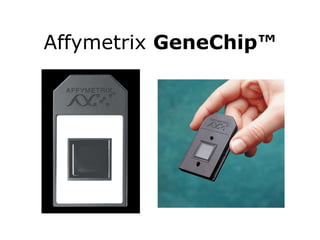
NanoBio Convergence Nanotechnology  used in  biotech DNA microarrays (GeneChip™) SNP genotyping applications Silicon microtechnology  for the lab Lab-On-A-Chip (LOC) System-On-A-Chip Biocompatible engineered surfaces Better performance / durability in humans
 
Affymetrix  GeneChip™
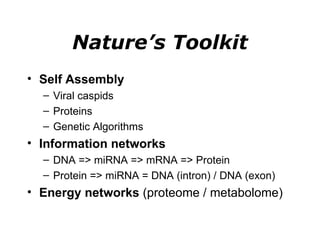
Nature’s Toolkit Self Assembly Viral caspids Proteins Genetic Algorithms Information networks DNA => miRNA => mRNA => Protein Protein => miRNA = DNA (intron) / DNA (exon) Energy networks  (proteome / metabolome)
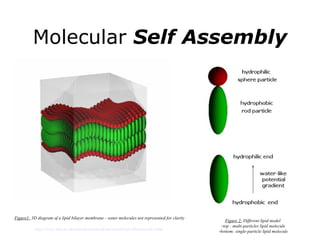
Molecular  Self Assembly Figure1:  3D diagram of a lipid bilayer membrane - water molecules not represented for clarity http://www.shu.ac.uk/schools/research/mri/model/micelles/micelles.htm   Figure 2:  Different lipid model  top : multi-particles lipid molecule bottom: single-particle lipid molecule
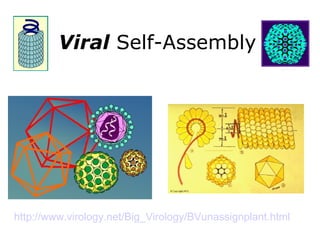
Viral  Self-Assembly http://www.virology.net/Big_Virology/BVunassignplant.html
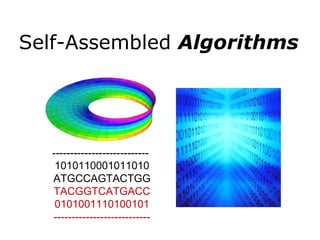
Self-Assembled  Algorithms ---------------------------  1010110001011010 ATGCCAGTACTGG TACGGTCATGACC 0101001110100101 ---------------------------
Bio-Nano-Info Looking at bio through the eyes of nano Physical properties of small / life systems Looking at nano through the eyes of bio Self-assembly of molecular nano structures Interaction of information and molecules Molecular assemblies as information and operating systems - nano execution of IT
Nano-Bio-Info-Tech Nano Bio Info Self assembly Microarrays, BioMEMS Quantum computing nanoelectronic devices Digital cells DNA computing insilico biology Concept by Robert Cormia
Bio- Informatics Looking at  life as an information system DNA as a  database RNA as a  decision network Proteins and genes as  runtime DLLs Modeling  gene regulatory networks Simulating  life as a computer program Using silicon to  validate biological models
Goal of  Digital Cells Simulate  a Gene Regulatory Network Goal of e-cell, CellML, and SBML projects Test  microarray data  for biological model Run expression data through GRN functions Create biological cells  with new functions Splice in promoters to control expression Create oscillating networks using operons
Digital Cell Components Bio-logic gates Inverters, oscillators Creating genomic circuitry Promoters, operons and genes Multigenic  oscillating solutions Ron Weiss  is  the  pioneer in the field http://www.princeton.edu/~rweiss/
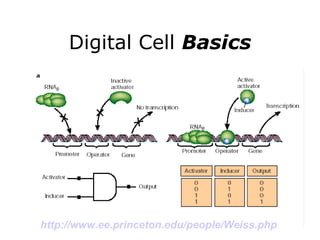
Digital Cell  Basics http://www.ee.princeton.edu/people/Weiss.php
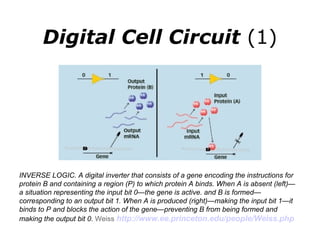
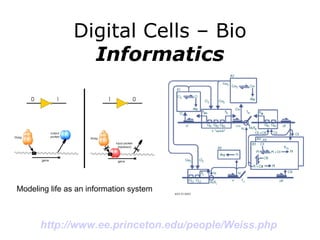
Digital Cell Circuit  (1) INVERSE LOGIC. A digital inverter that consists of a gene encoding the instructions for protein B and containing a region (P) to which protein A binds. When A is absent (left)—a situation representing the input bit 0—the gene is active. and B is formed—corresponding to an output bit 1. When A is produced (right)—making the input bit 1—it binds to P and blocks the action of the gene—preventing B from being formed and making the output bit 0.  Weiss  http://www.ee.princeton.edu/people/Weiss.php
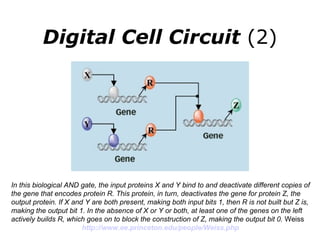
Digital Cell Circuit  (2) In this biological AND gate, the input proteins X and Y bind to and deactivate different copies of the gene that encodes protein R. This protein, in turn, deactivates the gene for protein Z, the output protein. If X and Y are both present, making both input bits 1, then R is not built but Z is, making the output bit 1. In the absence of X or Y or both, at least one of the genes on the left actively builds R, which goes on to block the construction of Z, making the output bit 0.  Weiss http://www.ee.princeton.edu/people/Weiss.php
Digital Cells – Bio  Informatics http://www.ee.princeton.edu/people/Weiss.php   Modeling life as an information system
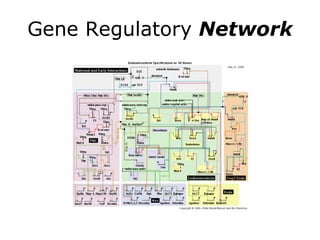
Gene Regulatory  Network
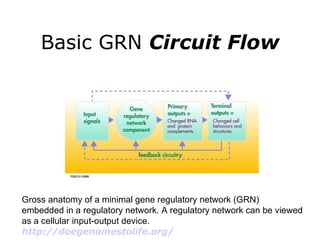
Basic GRN  Circuit Flow Gross anatomy of a minimal gene regulatory network (GRN) embedded in a regulatory network. A regulatory network can be viewed as a cellular input-output device.   http://doegenomestolife.org/
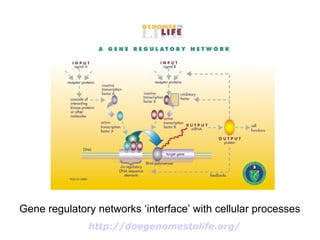
http://doegenomestolife.org/ Gene regulatory networks ‘interface’ with cellular processes
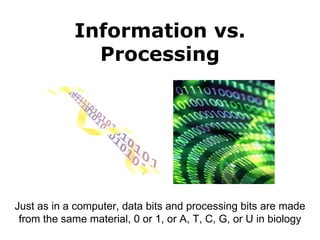
Information   vs.   Processing Just as in a computer, data bits and processing bits are made from the same material, 0 or 1, or A, T, C, G, or U in biology
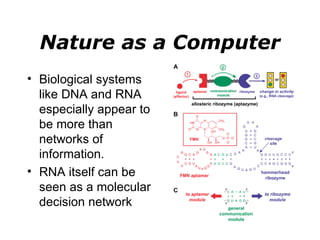
Nature as a Computer Biological systems like DNA and RNA especially appear to be more than networks of information. RNA itself can be seen as a molecular decision network
E-Cell E-Cell System  is an object-oriented software suite for  modeling, simulation , and  analysis of large scale complex systems   such as biological cells . Version 3 allows many components driven by  multiple algorithms  with  different timescales  to coexist
Computer Modeling Metabolic Pathways BioCyc – collection of organism specific metabolic pathway databases cellML is an XML based format for exchanging biological data from genes to proteins to metabolism
Digital Cells  Meet Synthetic Biology Model  the circuit Validate  the circuit Tinker  with the circuit Then… Alter  the gene to  build a new protein SNPs  will give you a  ‘first approach’ See if the new protein is  ‘well tolerated’
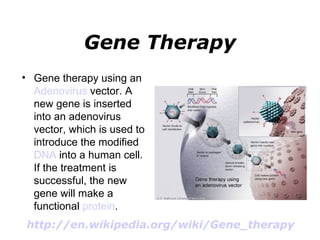
Gene Therapy Gene therapy using an  Adenovirus  vector. A new gene is inserted into an adenovirus vector, which is used to introduce the modified  DNA  into a human cell. If the treatment is successful, the new gene will make a functional  protein . http://en.wikipedia.org/wiki/Gene_therapy
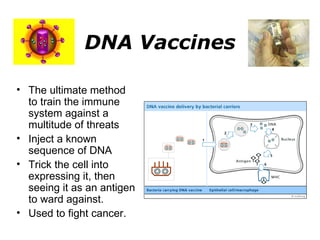
DNA Vaccines The ultimate method to train the immune system against a multitude of threats Inject a known sequence of DNA Trick the cell into expressing it, then seeing it as an antigen to ward against. Used to fight cancer.
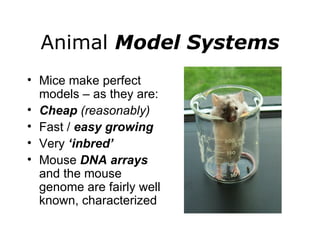
Animal  Model Systems Mice make perfect models – as they are: Cheap  (reasonably) Fast /  easy growing Very  ‘inbred’ Mouse  DNA arrays  and the mouse genome are fairly well known, characterized
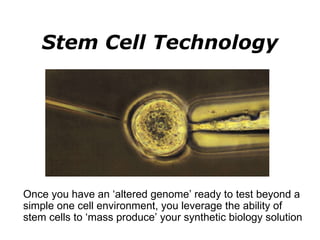
Stem Cell   Technology Once you have an ‘altered genome’ ready to test beyond a simple one cell environment, you leverage the ability of stem cells to ‘mass produce’ your synthetic biology solution
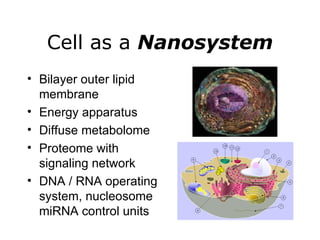
Cell as a  Nanosystem Bilayer outer lipid membrane Energy apparatus Diffuse metabolome Proteome with signaling network DNA / RNA operating system, nucleosome miRNA control units
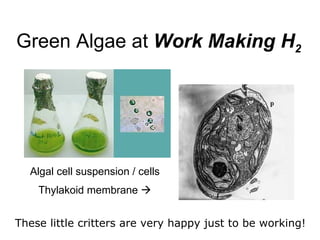
Green Algae at  Work Making H 2 Algal cell suspension / cells Thylakoid membrane   These little critters are very happy just to be working!
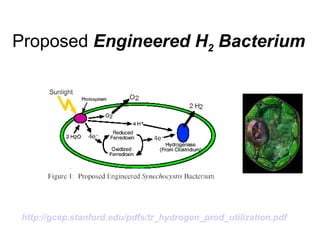
Proposed  Engineered H 2  Bacterium http://gcep.stanford.edu/pdfs/tr_hydrogen_prod_utilization.pdf
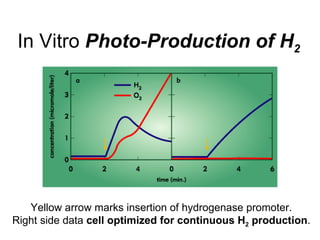
In Vitro  Photo-Production of H 2 Yellow arrow marks insertion of hydrogenase promoter. Right side data  cell optimized for continuous H 2  production .
Synthetic Biology  Roadmap Understanding of  gene elements  and  transcriptional control  at miRNA level Ability to  model protein structure , and surface potential /  folding / function Ability to  create functional operons  and  regulated  / feedback transcriptional control Stem cell and  gene therapy synergism
Role of Bioinformatics Where  are  genes? What are the regulatory inputs? What  are the  proteins? Where are post translational modifications? What  are the  pathways? What are the protein – RNA interactions? Can we  ‘modulate’  the operon networks to include  precision feedback control?
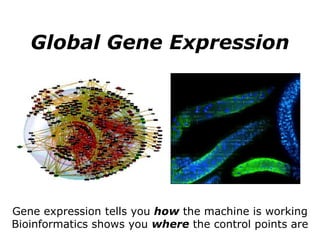
Global Gene Expression Gene expression tells you  how  the machine is working Bioinformatics shows you  where  the control points are
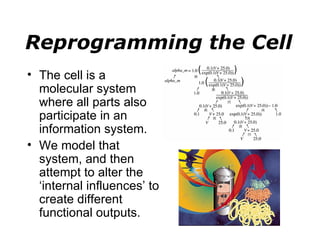
Reprogramming the Cell The cell is a molecular system where all parts also participate in an information system. We model that system, and then attempt to alter the ‘internal influences’ to create different functional outputs.
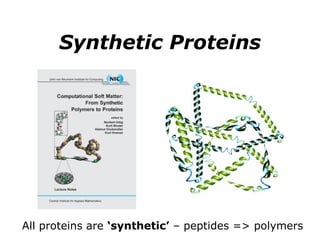
Synthetic Proteins All proteins are  ‘synthetic’  – peptides => polymers
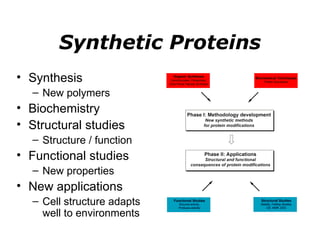
Synthetic Proteins Synthesis New polymers Biochemistry Structural studies Structure / function Functional studies New properties New applications Cell structure adapts well to environments
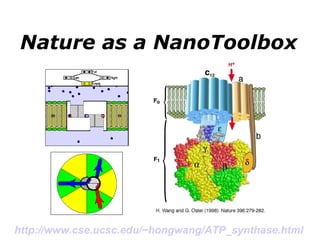
Nature as a NanoToolbox http://www.cse.ucsc.edu/~hongwang/ATP_synthase.html
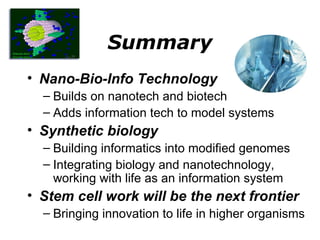
Summary Nano-Bio-Info Technology Builds on nanotech and biotech Adds information tech to model systems Synthetic biology Building informatics into modified genomes Integrating biology and nanotechnology, working with life as an information system Stem cell work will be the next frontier Bringing innovation to life in higher organisms
References http://www. ee .princeton.edu/people/Weiss.php http://www.dbi.udel.edu/   http://biospice.lbl.gov/   http://www.systems-biology.org/   http://www.e-cell.org/ http://sbml.org/   http://biocyc.org/ http://www.sbi.uni-rostock.de/teaching/research/   http://www.ipt.arc.nasa.gov/
Synthetic Biology

  • 1.
    Synthetic Biology (TheCell as a Nanosystem) ARC Bioinformatics UC Davis Summer 2006
  • 2.
  • 3.
    Synthetic Biology Nanotechnologyis emulating biology Molecular assemblers, molecular sensors ‘ Bots’ that deliver medicine to specific cells Biotechnology is helping out Genetic ‘reengineering’ of e-coli, phages Nano-Bio or Bio-Nano ? Two very interesting approaches… The answer might be ‘synthetic biology’
  • 4.
  • 5.
    DNA 2.0DNA 2.0 Inc. is a leading provider for synthetic biology. With our gene synthesis process you can get synthetic DNA that conforms exactly to your needs, quickly and cost effectively. Applications of custom gene synthesis include codon optimization for increased protein expression, synthetic biology, gene variants, RNAi trans-complementation and much more.
  • 6.
    Nano-Bio-Info-Tech (NBIT) ‘Fusion’ or ‘ convergence’ of Nanotechnology Biotechnology Information technology Focus of regional development Nanobiotechnology (DNA microarrays) Bioinformatics and Informatics Add stem cell and genetic engineering
  • 7.
    Some Definitions…Bionanotechnology Biology as seen through the eyes of nano How do molecules work in biology? How can we make biology work for us ? Applications Self assembled protein metal complexes DNA scaffolding for arrayed assembly Phage injection of targeted viral DNA
  • 8.
  • 9.
    Bio-Nano MachineryUsing protein / viral complexes and DNA to self-assemble devices, and novel function, into biomechanical systems Earth’s early nanostructures ~ 2 billion years ago
  • 10.
    NanoBio Convergence Nanotechnology used in biotech DNA microarrays (GeneChip™) SNP genotyping applications Silicon microtechnology for the lab Lab-On-A-Chip (LOC) System-On-A-Chip Biocompatible engineered surfaces Better performance / durability in humans
  • 11.
  • 12.
  • 13.
    Nature’s Toolkit SelfAssembly Viral caspids Proteins Genetic Algorithms Information networks DNA => miRNA => mRNA => Protein Protein => miRNA = DNA (intron) / DNA (exon) Energy networks (proteome / metabolome)
  • 14.
    Molecular SelfAssembly Figure1: 3D diagram of a lipid bilayer membrane - water molecules not represented for clarity http://www.shu.ac.uk/schools/research/mri/model/micelles/micelles.htm Figure 2: Different lipid model top : multi-particles lipid molecule bottom: single-particle lipid molecule
  • 15.
    Viral Self-Assemblyhttp://www.virology.net/Big_Virology/BVunassignplant.html
  • 16.
    Self-Assembled Algorithms--------------------------- 1010110001011010 ATGCCAGTACTGG TACGGTCATGACC 0101001110100101 ---------------------------
  • 17.
    Bio-Nano-Info Looking atbio through the eyes of nano Physical properties of small / life systems Looking at nano through the eyes of bio Self-assembly of molecular nano structures Interaction of information and molecules Molecular assemblies as information and operating systems - nano execution of IT
  • 18.
    Nano-Bio-Info-Tech Nano BioInfo Self assembly Microarrays, BioMEMS Quantum computing nanoelectronic devices Digital cells DNA computing insilico biology Concept by Robert Cormia
  • 19.
    Bio- Informatics Lookingat life as an information system DNA as a database RNA as a decision network Proteins and genes as runtime DLLs Modeling gene regulatory networks Simulating life as a computer program Using silicon to validate biological models
  • 20.
    Goal of Digital Cells Simulate a Gene Regulatory Network Goal of e-cell, CellML, and SBML projects Test microarray data for biological model Run expression data through GRN functions Create biological cells with new functions Splice in promoters to control expression Create oscillating networks using operons
  • 21.
    Digital Cell ComponentsBio-logic gates Inverters, oscillators Creating genomic circuitry Promoters, operons and genes Multigenic oscillating solutions Ron Weiss is the pioneer in the field http://www.princeton.edu/~rweiss/
  • 22.
    Digital Cell Basics http://www.ee.princeton.edu/people/Weiss.php
  • 23.
    Digital Cell Circuit (1) INVERSE LOGIC. A digital inverter that consists of a gene encoding the instructions for protein B and containing a region (P) to which protein A binds. When A is absent (left)—a situation representing the input bit 0—the gene is active. and B is formed—corresponding to an output bit 1. When A is produced (right)—making the input bit 1—it binds to P and blocks the action of the gene—preventing B from being formed and making the output bit 0. Weiss http://www.ee.princeton.edu/people/Weiss.php
  • 24.
    Digital Cell Circuit (2) In this biological AND gate, the input proteins X and Y bind to and deactivate different copies of the gene that encodes protein R. This protein, in turn, deactivates the gene for protein Z, the output protein. If X and Y are both present, making both input bits 1, then R is not built but Z is, making the output bit 1. In the absence of X or Y or both, at least one of the genes on the left actively builds R, which goes on to block the construction of Z, making the output bit 0. Weiss http://www.ee.princeton.edu/people/Weiss.php
  • 25.
    Digital Cells –Bio Informatics http://www.ee.princeton.edu/people/Weiss.php Modeling life as an information system
  • 26.
  • 27.
    Basic GRN Circuit Flow Gross anatomy of a minimal gene regulatory network (GRN) embedded in a regulatory network. A regulatory network can be viewed as a cellular input-output device. http://doegenomestolife.org/
  • 28.
    http://doegenomestolife.org/ Gene regulatorynetworks ‘interface’ with cellular processes
  • 29.
    Information vs. Processing Just as in a computer, data bits and processing bits are made from the same material, 0 or 1, or A, T, C, G, or U in biology
  • 30.
    Nature as aComputer Biological systems like DNA and RNA especially appear to be more than networks of information. RNA itself can be seen as a molecular decision network
  • 31.
    E-Cell E-Cell System is an object-oriented software suite for modeling, simulation , and analysis of large scale complex systems such as biological cells . Version 3 allows many components driven by multiple algorithms with different timescales to coexist
  • 32.
    Computer Modeling MetabolicPathways BioCyc – collection of organism specific metabolic pathway databases cellML is an XML based format for exchanging biological data from genes to proteins to metabolism
  • 33.
    Digital Cells Meet Synthetic Biology Model the circuit Validate the circuit Tinker with the circuit Then… Alter the gene to build a new protein SNPs will give you a ‘first approach’ See if the new protein is ‘well tolerated’
  • 34.
    Gene Therapy Genetherapy using an Adenovirus vector. A new gene is inserted into an adenovirus vector, which is used to introduce the modified DNA into a human cell. If the treatment is successful, the new gene will make a functional protein . http://en.wikipedia.org/wiki/Gene_therapy
  • 35.
    DNA Vaccines Theultimate method to train the immune system against a multitude of threats Inject a known sequence of DNA Trick the cell into expressing it, then seeing it as an antigen to ward against. Used to fight cancer.
  • 36.
    Animal ModelSystems Mice make perfect models – as they are: Cheap (reasonably) Fast / easy growing Very ‘inbred’ Mouse DNA arrays and the mouse genome are fairly well known, characterized
  • 37.
    Stem Cell Technology Once you have an ‘altered genome’ ready to test beyond a simple one cell environment, you leverage the ability of stem cells to ‘mass produce’ your synthetic biology solution
  • 38.
    Cell as a Nanosystem Bilayer outer lipid membrane Energy apparatus Diffuse metabolome Proteome with signaling network DNA / RNA operating system, nucleosome miRNA control units
  • 39.
    Green Algae at Work Making H 2 Algal cell suspension / cells Thylakoid membrane  These little critters are very happy just to be working!
  • 40.
    Proposed EngineeredH 2 Bacterium http://gcep.stanford.edu/pdfs/tr_hydrogen_prod_utilization.pdf
  • 41.
    In Vitro Photo-Production of H 2 Yellow arrow marks insertion of hydrogenase promoter. Right side data cell optimized for continuous H 2 production .
  • 42.
    Synthetic Biology Roadmap Understanding of gene elements and transcriptional control at miRNA level Ability to model protein structure , and surface potential / folding / function Ability to create functional operons and regulated / feedback transcriptional control Stem cell and gene therapy synergism
  • 43.
    Role of BioinformaticsWhere are genes? What are the regulatory inputs? What are the proteins? Where are post translational modifications? What are the pathways? What are the protein – RNA interactions? Can we ‘modulate’ the operon networks to include precision feedback control?
  • 44.
    Global Gene ExpressionGene expression tells you how the machine is working Bioinformatics shows you where the control points are
  • 45.
    Reprogramming the CellThe cell is a molecular system where all parts also participate in an information system. We model that system, and then attempt to alter the ‘internal influences’ to create different functional outputs.
  • 46.
    Synthetic Proteins Allproteins are ‘synthetic’ – peptides => polymers
  • 47.
    Synthetic Proteins SynthesisNew polymers Biochemistry Structural studies Structure / function Functional studies New properties New applications Cell structure adapts well to environments
  • 48.
    Nature as aNanoToolbox http://www.cse.ucsc.edu/~hongwang/ATP_synthase.html
  • 49.
    Summary Nano-Bio-Info TechnologyBuilds on nanotech and biotech Adds information tech to model systems Synthetic biology Building informatics into modified genomes Integrating biology and nanotechnology, working with life as an information system Stem cell work will be the next frontier Bringing innovation to life in higher organisms
  • 50.
    References http://www. ee.princeton.edu/people/Weiss.php http://www.dbi.udel.edu/ http://biospice.lbl.gov/ http://www.systems-biology.org/ http://www.e-cell.org/ http://sbml.org/ http://biocyc.org/ http://www.sbi.uni-rostock.de/teaching/research/ http://www.ipt.arc.nasa.gov/