De?mystifying Life SciencesMark Bünger, Research DirectorLux Research www.luxresearchinc.com22 Sept 2010 PICNIC Amsterdam
A few words aboutLux ResearchWe help clients capitalize on science-driven innovation We focus on emerging technologies in the chemicals and materials sector and the energy and environment sector (cleantech)We have practices in Water, Green Buildings, Nanomaterials, Solar, Energy Storage, Targeted Delivery, and Biofuels & BiomaterialsWe have clients on five continents – blue-chip corporations, government agencies and laboratories, universities, investors, and SMBsWe source our intelligence from direct interaction with CEOs, CTOs, CSOs, and R&D execs at cutting-edge technology firms in our sectors of focusWe draw on our network to:Continuously monitor emerging technologiesIdentify discontinuities in technology commercializationAssist with company and technology evaluationWe have global reach, with 40+ employees in New York, Boston, Singapore, and AmsterdamResearch team is 67% scientists, 33% business analystsSuntech solar factory, ChinaQatar Science and Technology ParkSvalbard Global Seed Vault, NorwayPICNIC, Amsterdam
Let’s talk aboutDemystifying Life SciencesGrok the techAssess the applicationsParticipate in the future
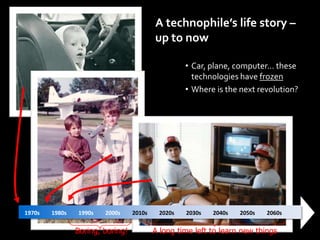
A technophile’s life story – up to nowCar, plane, computer… these technologies have frozenWhere is the next revolution?1970s1980s1990s2000s2010s2020s2030s2040s2050s2060sBoring, boring! A long time left to learn new things
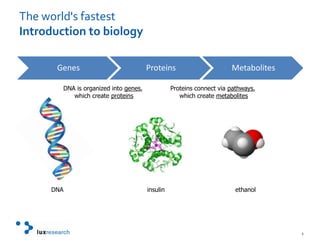
The world's fastest Introduction to biologyDNA is organized into genes, which create proteinsProteins connect via pathways, which create metabolitesDNAinsulinethanol
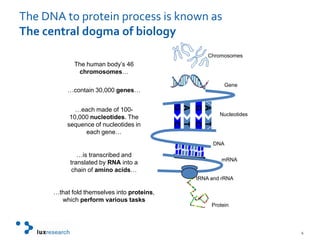
The DNA to protein process is known asThe central dogma of biology ATATGCGCChromosomesThe human body’s 46 chromosomes…Gene…contain 30,000 genes……each made of 100-10,000 nucleotides. The sequence of nucleotides in each gene…NucleotidesDNA…is transcribed and translated by RNA into a chain of amino acids…mRNAtRNA and rRNA…that fold themselves into proteins, which perform various tasksProtein
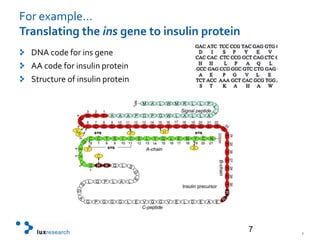
For example…Translating the ins gene to insulin proteinDNA code for ins geneAA code for insulin proteinStructure of insulin protein7
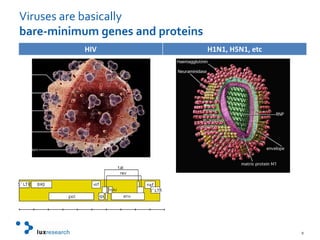
Viruses are basicallybare-minimum genes and proteins
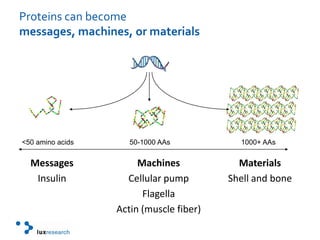
Proteins can become messages, machines, or materials<50 amino acids 	50-1000 AAs 	1000+ AAsMessagesInsulinMachinesCellular pumpFlagellaActin (muscle fiber)MaterialsShell and bone
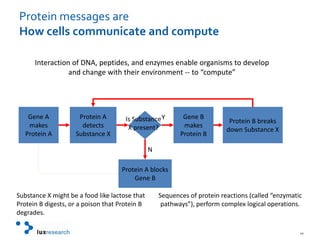
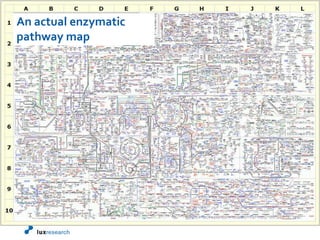
Protein messages areHow cells communicate and computeInteraction of DNA, peptides, and enzymes enable organisms to develop and change with their environment -- to “compute”Gene A makes Protein AGene B makes Protein BProtein B breaks down Substance XIs Substance X present?Protein A detects Substance XYNProtein A blocks Gene BSequences of protein reactions (called “enzymatic pathways”), perform complex logical operations.Substance X might be a food like lactose that Protein B digests, or a poison that Protein B degrades.
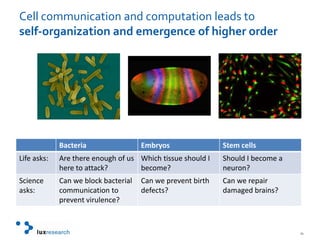
Cell communication and computation leads to self-organization and emergence of higher order
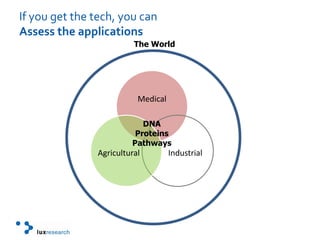
If you get the tech, you canAssess the applications The WorldDNAProteinsPathways
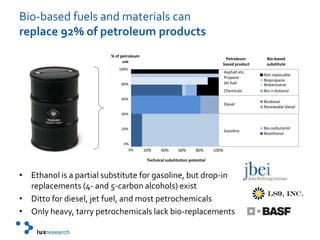
% of petroleum usePetroleum-based productBio-based substitute100%Asphalt etc.Not replacablePropaneBiopropaneJet fuel80%BiokeroseneChemicals Bio-n-butanol60%BiodieselDieselRenewable diesel40%Bio-isobutanol20%GasolineBioethanol0%0%20%40%60%80%100%Technical substitution potentialBio-based fuels and materials can replace 92% of petroleum productsEthanol is a partial substitute for gasoline, but drop-in replacements (4- and 5-carbon alcohols) existDitto for diesel, jet fuel, and most petrochemicals  Only heavy, tarry petrochemicals lack bio-replacements
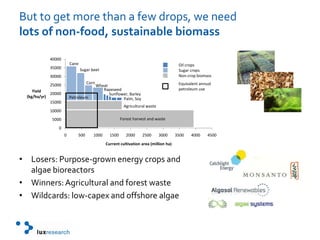
But to get more than a few drops, we need lots of non-food, sustainable biomassOil cropsCaneSugar cropsSugar beetNon-crop biomassCornEquivalent annual petroleum useRapeseedWheatSunflower, BarleyPetroleumPalm, SoyAgricultural wasteForest harvest and wasteLosers: Purpose-grown energy crops and algae bioreactorsWinners: Agricultural and forest waste Wildcards: low-capex and offshore algae
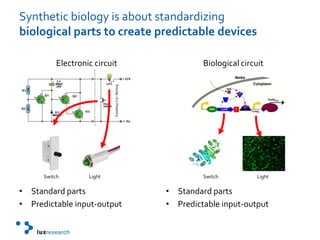
Synthetic biology is about standardizing biological parts to create predictable devicesElectronic circuitStandard partsPredictable input-outputBiological circuitStandard partsPredictable input-outputSwitchLightSwitchLight
An actual enzymatic pathway map
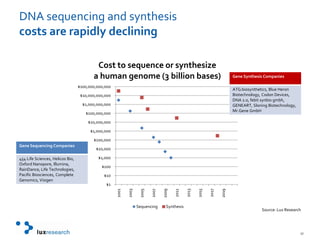
DNA sequencing and synthesis costs are rapidly decliningSource: Lux Research
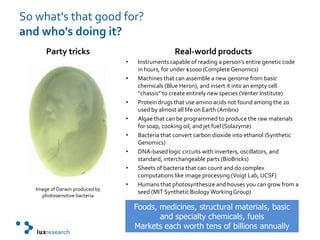
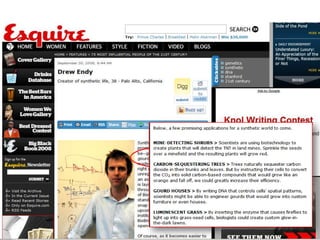
So what's that good for?and who's doing it?Party tricksImage of Darwin produced by photosensitive bacteriaReal-world productsInstruments capable of reading a person’s entire genetic code in hours, for under $1000 (Complete Genomics)Machines that can assemble a new genome from basic chemicals (Blue Heron), and insert it into an empty cell “chassis” to create entirely new species (Venter Institute)Protein drugs that use amino acids not found among the 20 used by almost all life on Earth (Ambrx)Algae that can be programmed to produce the raw materials for soap, cooking oil, and jet fuel (Solazyme) Bacteria that convert carbon dioxide into ethanol (Synthetic Genomics)DNA-based logic circuits with inverters, oscillators, and standard, interchangeable parts (BioBricks) Sheets of bacteria that can count and do complex computations like image processing (Voigt Lab, UCSF)Humans that photosynthesize and houses you can grow from a seed (MIT Synthetic Biology Working Group)Foods, medicines, structural materials, basic and specialty chemicals, fuelsMarkets each worth tens of billions annually
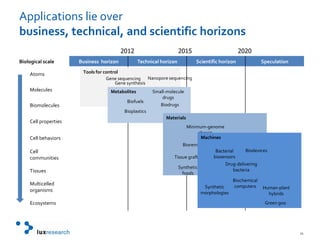
Applications lie over business, technical, and scientific horizons201220152020Tools for controlNanopore sequencingGene sequencingGene synthesisMetabolitesSmall-molecule drugsBiofuelsBiodrugsBioplasticsMaterialsMinimum-genome chassisMachinesBioremediationBiodevicesBacterial biosensorsTissue graftsDrug-delivering bacteriaSynthetic foodsBiochemical computersSynthetic morphologiesHuman-plant hybridsGreen goo
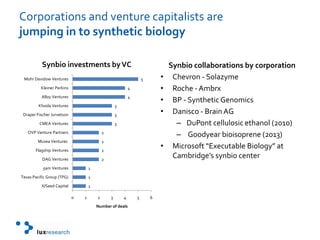
Corporations and venture capitalists are jumping in to synthetic biologySynbio collaborations by corporationChevron - SolazymeRoche - AmbrxBP - Synthetic GenomicsDanisco - Brain AGDuPont cellulosic ethanol (2010) Goodyear bioisoprene (2013)Microsoft “Executable Biology” at Cambridge’s synbio center
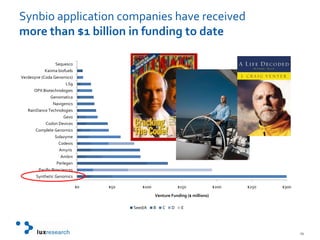
Synbio application companies have received more than $1 billion in funding to date
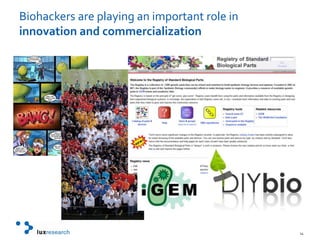
Biohackers are playing an important role in innovation and commercialization
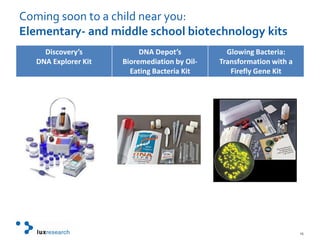
Coming soon to a child near you:Elementary- and middle school biotechnology kits
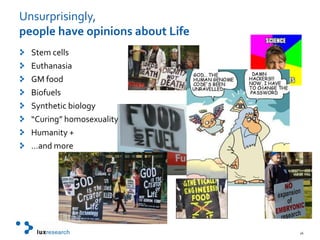
Unsurprisingly, people have opinions about LifeStem cellsEuthanasiaGM foodBiofuelsSynthetic biology“Curing” homosexualityHumanity +…and more
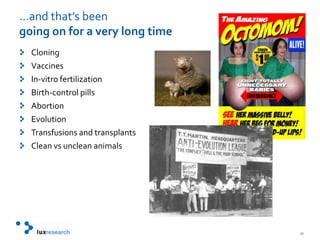
…and that’s been going on for a very long timeCloningVaccinesIn-vitro fertilizationBirth-control pillsAbortionEvolutionTransfusions and transplantsClean vs unclean animals
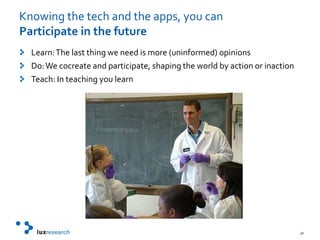
Knowing the tech and the apps, you canParticipate in the futureLearn: The last thing we need is more (uninformed) opinionsDo: We cocreate and participate, shaping the world by action or inactionTeach: In teaching you learn
Thank youMark Bünger, Research Directormark.bunger@luxresearchinc.com

Life Sciences De-Mystified - Mark Bünger - PICNIC '10

  • 1.
    De?mystifying Life SciencesMarkBünger, Research DirectorLux Research www.luxresearchinc.com22 Sept 2010 PICNIC Amsterdam
  • 2.
    A few wordsaboutLux ResearchWe help clients capitalize on science-driven innovation We focus on emerging technologies in the chemicals and materials sector and the energy and environment sector (cleantech)We have practices in Water, Green Buildings, Nanomaterials, Solar, Energy Storage, Targeted Delivery, and Biofuels & BiomaterialsWe have clients on five continents – blue-chip corporations, government agencies and laboratories, universities, investors, and SMBsWe source our intelligence from direct interaction with CEOs, CTOs, CSOs, and R&D execs at cutting-edge technology firms in our sectors of focusWe draw on our network to:Continuously monitor emerging technologiesIdentify discontinuities in technology commercializationAssist with company and technology evaluationWe have global reach, with 40+ employees in New York, Boston, Singapore, and AmsterdamResearch team is 67% scientists, 33% business analystsSuntech solar factory, ChinaQatar Science and Technology ParkSvalbard Global Seed Vault, NorwayPICNIC, Amsterdam
  • 3.
    Let’s talk aboutDemystifyingLife SciencesGrok the techAssess the applicationsParticipate in the future
  • 4.
    A technophile’s lifestory – up to nowCar, plane, computer… these technologies have frozenWhere is the next revolution?1970s1980s1990s2000s2010s2020s2030s2040s2050s2060sBoring, boring! A long time left to learn new things
  • 5.
    The world's fastestIntroduction to biologyDNA is organized into genes, which create proteinsProteins connect via pathways, which create metabolitesDNAinsulinethanol
  • 6.
    The DNA toprotein process is known asThe central dogma of biology ATATGCGCChromosomesThe human body’s 46 chromosomes…Gene…contain 30,000 genes……each made of 100-10,000 nucleotides. The sequence of nucleotides in each gene…NucleotidesDNA…is transcribed and translated by RNA into a chain of amino acids…mRNAtRNA and rRNA…that fold themselves into proteins, which perform various tasksProtein
  • 7.
    For example…Translating theins gene to insulin proteinDNA code for ins geneAA code for insulin proteinStructure of insulin protein7
  • 8.
  • 9.
    Proteins can becomemessages, machines, or materials<50 amino acids 50-1000 AAs 1000+ AAsMessagesInsulinMachinesCellular pumpFlagellaActin (muscle fiber)MaterialsShell and bone
  • 10.
    Protein messages areHowcells communicate and computeInteraction of DNA, peptides, and enzymes enable organisms to develop and change with their environment -- to “compute”Gene A makes Protein AGene B makes Protein BProtein B breaks down Substance XIs Substance X present?Protein A detects Substance XYNProtein A blocks Gene BSequences of protein reactions (called “enzymatic pathways”), perform complex logical operations.Substance X might be a food like lactose that Protein B digests, or a poison that Protein B degrades.
  • 11.
    Cell communication andcomputation leads to self-organization and emergence of higher order
  • 12.
    If you getthe tech, you canAssess the applications The WorldDNAProteinsPathways
  • 13.
    % of petroleumusePetroleum-based productBio-based substitute100%Asphalt etc.Not replacablePropaneBiopropaneJet fuel80%BiokeroseneChemicals Bio-n-butanol60%BiodieselDieselRenewable diesel40%Bio-isobutanol20%GasolineBioethanol0%0%20%40%60%80%100%Technical substitution potentialBio-based fuels and materials can replace 92% of petroleum productsEthanol is a partial substitute for gasoline, but drop-in replacements (4- and 5-carbon alcohols) existDitto for diesel, jet fuel, and most petrochemicals Only heavy, tarry petrochemicals lack bio-replacements
  • 14.
    But to getmore than a few drops, we need lots of non-food, sustainable biomassOil cropsCaneSugar cropsSugar beetNon-crop biomassCornEquivalent annual petroleum useRapeseedWheatSunflower, BarleyPetroleumPalm, SoyAgricultural wasteForest harvest and wasteLosers: Purpose-grown energy crops and algae bioreactorsWinners: Agricultural and forest waste Wildcards: low-capex and offshore algae
  • 15.
    Synthetic biology isabout standardizing biological parts to create predictable devicesElectronic circuitStandard partsPredictable input-outputBiological circuitStandard partsPredictable input-outputSwitchLightSwitchLight
  • 16.
  • 17.
    DNA sequencing andsynthesis costs are rapidly decliningSource: Lux Research
  • 18.
    So what's thatgood for?and who's doing it?Party tricksImage of Darwin produced by photosensitive bacteriaReal-world productsInstruments capable of reading a person’s entire genetic code in hours, for under $1000 (Complete Genomics)Machines that can assemble a new genome from basic chemicals (Blue Heron), and insert it into an empty cell “chassis” to create entirely new species (Venter Institute)Protein drugs that use amino acids not found among the 20 used by almost all life on Earth (Ambrx)Algae that can be programmed to produce the raw materials for soap, cooking oil, and jet fuel (Solazyme) Bacteria that convert carbon dioxide into ethanol (Synthetic Genomics)DNA-based logic circuits with inverters, oscillators, and standard, interchangeable parts (BioBricks) Sheets of bacteria that can count and do complex computations like image processing (Voigt Lab, UCSF)Humans that photosynthesize and houses you can grow from a seed (MIT Synthetic Biology Working Group)Foods, medicines, structural materials, basic and specialty chemicals, fuelsMarkets each worth tens of billions annually
  • 21.
    Applications lie overbusiness, technical, and scientific horizons201220152020Tools for controlNanopore sequencingGene sequencingGene synthesisMetabolitesSmall-molecule drugsBiofuelsBiodrugsBioplasticsMaterialsMinimum-genome chassisMachinesBioremediationBiodevicesBacterial biosensorsTissue graftsDrug-delivering bacteriaSynthetic foodsBiochemical computersSynthetic morphologiesHuman-plant hybridsGreen goo
  • 22.
    Corporations and venturecapitalists are jumping in to synthetic biologySynbio collaborations by corporationChevron - SolazymeRoche - AmbrxBP - Synthetic GenomicsDanisco - Brain AGDuPont cellulosic ethanol (2010) Goodyear bioisoprene (2013)Microsoft “Executable Biology” at Cambridge’s synbio center
  • 23.
    Synbio application companieshave received more than $1 billion in funding to date
  • 24.
    Biohackers are playingan important role in innovation and commercialization
  • 25.
    Coming soon toa child near you:Elementary- and middle school biotechnology kits
  • 26.
    Unsurprisingly, people haveopinions about LifeStem cellsEuthanasiaGM foodBiofuelsSynthetic biology“Curing” homosexualityHumanity +…and more
  • 27.
    …and that’s beengoing on for a very long timeCloningVaccinesIn-vitro fertilizationBirth-control pillsAbortionEvolutionTransfusions and transplantsClean vs unclean animals
  • 28.
    Knowing the techand the apps, you canParticipate in the futureLearn: The last thing we need is more (uninformed) opinionsDo: We cocreate and participate, shaping the world by action or inactionTeach: In teaching you learn
  • 29.
    Thank youMark Bünger,Research Directormark.bunger@luxresearchinc.com

Editor's Notes

  • #4 The life story of a technophile – up to nowCar, plane, computer – these technologies have frozenSo what happens next?