THIS MAY GET
COMPLICATED
The Sentence Patterns of Language
By Lanz Manipor
Before you get confused…
Grammar
mental representation of a speaker’s
linguistical competence
what a speaker knows about the
language, including its phonology,
morphology, syntax, semantics and
lexicon
Before you get confused…
Syntax
the rules of sentence formation
the component of the mental
grammar that represents speakers’
knowledge of the structure of
phrases and sentence
Syntax
σύν syn, "together", and τάξις táxis, "an ordering“
arrangement
refer directly to the rules and principles that govern
the sentence structure of any individual language
structure (word order)
Chief swore president
the Justice the in new
Chief swore president
the Justice the in new
Sequence is made up of meaningful words
Chief swore president
the Justice the in new
Sequence is made up of meaningful words
DOES IT MAKE SENSE?
Chief swore president
the Justice the in new
Every sentence is a sequence of words
But not every sequence of words is a sentence
Sequence of words that conform to the rules of syntax
are said to be …
well formed
Sequence of words that conform to the rules of syntax
are said to be …
well formed
GRAMMATICAL
Sequence of words that conform to the rules of syntax
are said to be …
Those that violate the syntactic rules are therefore …
ill formed
Those that violate the syntactic rules are therefore …
ill formed
UNGRAMMATICAL
Those that violate the syntactic rules are therefore …
well formed
GRAMMATICAL
Sequence of words that conform to the rules of syntax
are said to be …
ill formed
UNGRAMMATICAL
Those that violate the syntactic rules are therefore …
What Grammaticality is Based On
Determined by rules shared by the speakers of a
language
Example:
What Grammaticality is Based On
Determined by rules shared by the speakers of a
language
Example:
Jack and Jill ran the hill up.
What Grammaticality is Based On
I am proud to be my mother
What Grammaticality is Based On
Vicente believes to be a gentleman
What Grammaticality is Based On
Joana ate the baby
What Grammaticality is Not Based On
Not based on what is taught in school but on the
rules constructed unconsciously as children
Children acquire most of the syntactic rules of their
language even before learning to read.
Does not depend on having heard the sentence
before.
What Grammaticality is Not Based On
Not based on what is taught in school but on the
rules constructed unconsciously as children
Children acquire most of the syntactic rules of their
language even before learning to read.
Does not depend on having heard the sentence
before.
Example:
Enormous crickets in pink
socks danced at the prom.
What Grammaticality is Not Based On
Does not depend on the truth of the sentence
If it did, lying would be impossible.
Example:
What Grammaticality is Not Based On
Does not depend on the truth of the sentence
If it did, lying would be impossible.
Example:
I look like Piolo Pascual.
Syntactic Rules Accounts for:
Grammaticality of the sentence
Word order
Structural ambiguity
Grammatical relations
Whether different structures have different meanings
The creative aspect of language
What else do you know about syntax?
Ambiguity (Double Meaning)
Ex. synthetic buffalo hides
synthetic (buffalo hides)
(synthetic buffalo) hides
Grammatical Relations and how they are understood
Ex. Mary hired Bill.
Bill hired Mary.
Bill was hired by Mary.
Sentence Structure
The TREE
DIAGRAM
Root (entire
sentence)
Leaves (individual
words)
Hierarchical
structure
(groupings)
Constituent
structures
the child found the puppy
the puppy
Sentence Structure
Constituent Structure (every sentence has one or
more)
Synthetic buffalo hides
synthetic buffalo hides
buffalo hides
Synthetic buffalo hides
synthetic buffalo hides
buffalosynthetic
Syntactic Categories
A family of expressions that can substitute for one
another without loss of grammaticality
Ex. The child found the puppy.
Your neighbor found the puppy.
This yellow cat found the puppy.
He found the puppy.
Syntactic Categories
Noun Phrase (NP) – subject or object in the sentence
Verb Phrase (VP) – verb by NP or PP
Sentence (S)
Determiner (Det)
Adjective (Adj)
Adverb (Adv)
Noun (N)
Syntactic Categories
Pronoun (Pro)
Preposition (P)
Prepositional Phrase (PP)
Auxiliary Verb (Aux) –have, be, will, must, etc.
Verb (V)
Phrase Structure Trees
A tree diagram with syntactic category information
provided (syntactic labels)
Constituent structure tree
Phrase Structure Tree
the child found the puppy
S
the child
NP
found the puppy
VP
the
Det
child
N
found
V
the puppy
NP
the
Det
puppy
N
Sentence Structure
The TREE
DIAGRAM
Root (entire
sentence)
Leaves (individual
words)
Hierarchical
structure
(groupings)
Constituent
structures
the child found the puppy
the puppy
Phrase Structure Tree
the child found the puppy
S
the child
NP
found the puppy
VP
the
Det
child
N
found
V
the puppy
NP
the
Det
puppy
N
Phrase Structure Tree
S
NP VP
Det N V NP
Det N
the puppy
foundchildthe
Phrase Structure Tree
S
NP VP
Det N V NP
Det N
the puppy
foundchildthe Lexical Categories-lowest
categories in the tree.
Syntactic Categories
Node
Phrase Structure Tree
S
NP VP
Det N V NP
Det N
the puppy
foundchildthe Lexical Categories-lowest
categories in the tree.
Syntactic Categories
Node
“ALL” is
important
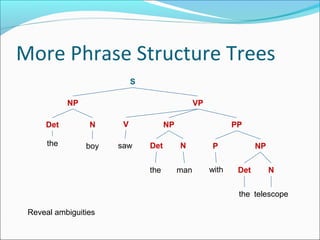
More Phrase Structure Trees
S
NP VP
Det NPN PP
the boy
V
saw P NPDet N
the man Det Nwith
the telescope
Three different structural positions representing three grammatical relations.
More Phrase Structure Trees
S
NP VP
Det NPN PP
the boy
V
saw P NPDet N
the man Det Nwith
the telescope
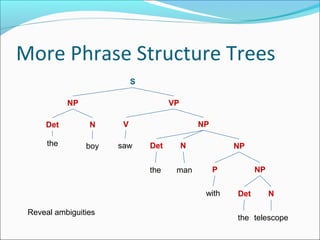
Reveal ambiguities
More Phrase Structure Trees
S
NP VP
Det NPN
the boy
V
saw
P NP
Det N
the man
Det Nwith
the telescope
NP
Reveal ambiguities
The Infinitude of Language
There is no longest sentence in any language
Speakers can lengthen any sentence by various means
Adding adjectives, clauses, etc.
The Infinitude of Language
Example: House that Jack built (nursery rhyme)
This is the farmer sowing the corn,
that kept the clock that crowed in the morn,
that waked the priest all shaven and shorn,
that married the man all tattered and torn,
that kissed the maiden all forlorn,
that milked the cow with the crumpled horn,
that tossed the dog, that worried the cat,
that killed the rat, that ate the malt,
that lay in the house that Jack built.
The Infinitude of Language
NP
Det N PP
P NP
Det N PP
P NP
Det N PP
P NP
Det N
the girl with the feather on the ribbon on the brim
Limitless aspect of language
Is reflected in phrase structure
Trees.
The Infinitude of Language
NP
Det N PP
P NP
Det N PP
P NP
Det N PP
P NP
Det N
the girl with the feather on the ribbon on the brim
But as the structures grow longer
They become more increasingly
Difficult to produce and understand.
-due to short term memory limitations
-muscular fatigue*
-breathlessness, etc.*
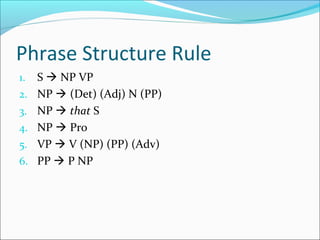
Phrase Structure Rule
1. S  NP VP
2. NP  (Det) (Adj) N (PP)
3. NP  that S
4. NP  Pro
5. VP  V (NP) (PP) (Adv)
6. PP  P NP
Phrase Structure Rule
1. S  NP VP
the boy found the ball
2. NP  (Det) (Adj) N (PP)
the beautiful girl on the piano
Phrase Structure Rule
3. NP  that S
NP
that S
I love Jenny
Phrase Structure Rule
S
NP
NP NP
VP
NP NP
that S
I love Jenny
the suitor knows
“Embedded”
Phrase Structure Rule
4. NP  Pro
I, You, We
5. VP  V (NP) (PP) (Adv)
blew the boat into the water suddenly
Phrase Structure Rule
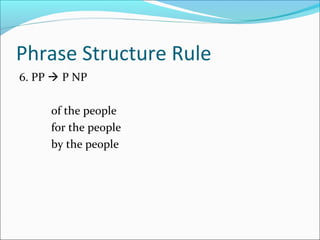
6. PP  P NP
of the people
for the people
by the people
Rules in other language
Sweden
NP  N Det
 Mann en
Japan
PP  NP P
 Tokyo kara
Any question?
S
NP VP
Pro V Pro
I thank you

Syntax 100909003947-phpapp01

  • 1.
  • 2.
    The Sentence Patternsof Language By Lanz Manipor
  • 3.
    Before you getconfused… Grammar mental representation of a speaker’s linguistical competence what a speaker knows about the language, including its phonology, morphology, syntax, semantics and lexicon
  • 4.
    Before you getconfused… Syntax the rules of sentence formation the component of the mental grammar that represents speakers’ knowledge of the structure of phrases and sentence
  • 5.
    Syntax σύν syn, "together",and τάξις táxis, "an ordering“ arrangement refer directly to the rules and principles that govern the sentence structure of any individual language structure (word order)
  • 6.
    Chief swore president theJustice the in new
  • 7.
    Chief swore president theJustice the in new Sequence is made up of meaningful words
  • 8.
    Chief swore president theJustice the in new Sequence is made up of meaningful words DOES IT MAKE SENSE?
  • 9.
    Chief swore president theJustice the in new Every sentence is a sequence of words But not every sequence of words is a sentence
  • 10.
    Sequence of wordsthat conform to the rules of syntax are said to be …
  • 11.
    well formed Sequence ofwords that conform to the rules of syntax are said to be …
  • 12.
    well formed GRAMMATICAL Sequence ofwords that conform to the rules of syntax are said to be …
  • 13.
    Those that violatethe syntactic rules are therefore …
  • 14.
    ill formed Those thatviolate the syntactic rules are therefore …
  • 15.
    ill formed UNGRAMMATICAL Those thatviolate the syntactic rules are therefore …
  • 16.
    well formed GRAMMATICAL Sequence ofwords that conform to the rules of syntax are said to be …
  • 17.
    ill formed UNGRAMMATICAL Those thatviolate the syntactic rules are therefore …
  • 18.
    What Grammaticality isBased On Determined by rules shared by the speakers of a language Example:
  • 19.
    What Grammaticality isBased On Determined by rules shared by the speakers of a language Example: Jack and Jill ran the hill up.
  • 20.
    What Grammaticality isBased On I am proud to be my mother
  • 21.
    What Grammaticality isBased On Vicente believes to be a gentleman
  • 22.
    What Grammaticality isBased On Joana ate the baby
  • 23.
    What Grammaticality isNot Based On Not based on what is taught in school but on the rules constructed unconsciously as children Children acquire most of the syntactic rules of their language even before learning to read. Does not depend on having heard the sentence before.
  • 24.
    What Grammaticality isNot Based On Not based on what is taught in school but on the rules constructed unconsciously as children Children acquire most of the syntactic rules of their language even before learning to read. Does not depend on having heard the sentence before. Example: Enormous crickets in pink socks danced at the prom.
  • 25.
    What Grammaticality isNot Based On Does not depend on the truth of the sentence If it did, lying would be impossible. Example:
  • 26.
    What Grammaticality isNot Based On Does not depend on the truth of the sentence If it did, lying would be impossible. Example: I look like Piolo Pascual.
  • 27.
    Syntactic Rules Accountsfor: Grammaticality of the sentence Word order Structural ambiguity Grammatical relations Whether different structures have different meanings The creative aspect of language
  • 28.
    What else doyou know about syntax? Ambiguity (Double Meaning) Ex. synthetic buffalo hides synthetic (buffalo hides) (synthetic buffalo) hides Grammatical Relations and how they are understood Ex. Mary hired Bill. Bill hired Mary. Bill was hired by Mary.
  • 29.
    Sentence Structure The TREE DIAGRAM Root(entire sentence) Leaves (individual words) Hierarchical structure (groupings) Constituent structures the child found the puppy the child found the puppy the child found the puppy the puppy
  • 30.
    Sentence Structure Constituent Structure(every sentence has one or more) Synthetic buffalo hides synthetic buffalo hides buffalo hides Synthetic buffalo hides synthetic buffalo hides buffalosynthetic
  • 31.
    Syntactic Categories A familyof expressions that can substitute for one another without loss of grammaticality Ex. The child found the puppy. Your neighbor found the puppy. This yellow cat found the puppy. He found the puppy.
  • 32.
    Syntactic Categories Noun Phrase(NP) – subject or object in the sentence Verb Phrase (VP) – verb by NP or PP Sentence (S) Determiner (Det) Adjective (Adj) Adverb (Adv) Noun (N)
  • 33.
    Syntactic Categories Pronoun (Pro) Preposition(P) Prepositional Phrase (PP) Auxiliary Verb (Aux) –have, be, will, must, etc. Verb (V)
  • 34.
    Phrase Structure Trees Atree diagram with syntactic category information provided (syntactic labels) Constituent structure tree
  • 35.
    Phrase Structure Tree thechild found the puppy S the child NP found the puppy VP the Det child N found V the puppy NP the Det puppy N
  • 36.
    Sentence Structure The TREE DIAGRAM Root(entire sentence) Leaves (individual words) Hierarchical structure (groupings) Constituent structures the child found the puppy the child found the puppy the child found the puppy the puppy
  • 37.
    Phrase Structure Tree thechild found the puppy S the child NP found the puppy VP the Det child N found V the puppy NP the Det puppy N
  • 38.
    Phrase Structure Tree S NPVP Det N V NP Det N the puppy foundchildthe
  • 39.
    Phrase Structure Tree S NPVP Det N V NP Det N the puppy foundchildthe Lexical Categories-lowest categories in the tree. Syntactic Categories Node
  • 40.
    Phrase Structure Tree S NPVP Det N V NP Det N the puppy foundchildthe Lexical Categories-lowest categories in the tree. Syntactic Categories Node “ALL” is important
  • 41.
    More Phrase StructureTrees S NP VP Det NPN PP the boy V saw P NPDet N the man Det Nwith the telescope Three different structural positions representing three grammatical relations.
  • 42.
    More Phrase StructureTrees S NP VP Det NPN PP the boy V saw P NPDet N the man Det Nwith the telescope Reveal ambiguities
  • 43.
    More Phrase StructureTrees S NP VP Det NPN the boy V saw P NP Det N the man Det Nwith the telescope NP Reveal ambiguities
  • 44.
    The Infinitude ofLanguage There is no longest sentence in any language Speakers can lengthen any sentence by various means Adding adjectives, clauses, etc.
  • 45.
    The Infinitude ofLanguage Example: House that Jack built (nursery rhyme) This is the farmer sowing the corn, that kept the clock that crowed in the morn, that waked the priest all shaven and shorn, that married the man all tattered and torn, that kissed the maiden all forlorn, that milked the cow with the crumpled horn, that tossed the dog, that worried the cat, that killed the rat, that ate the malt, that lay in the house that Jack built.
  • 46.
    The Infinitude ofLanguage NP Det N PP P NP Det N PP P NP Det N PP P NP Det N the girl with the feather on the ribbon on the brim Limitless aspect of language Is reflected in phrase structure Trees.
  • 47.
    The Infinitude ofLanguage NP Det N PP P NP Det N PP P NP Det N PP P NP Det N the girl with the feather on the ribbon on the brim But as the structures grow longer They become more increasingly Difficult to produce and understand. -due to short term memory limitations -muscular fatigue* -breathlessness, etc.*
  • 48.
    Phrase Structure Rule 1.S  NP VP 2. NP  (Det) (Adj) N (PP) 3. NP  that S 4. NP  Pro 5. VP  V (NP) (PP) (Adv) 6. PP  P NP
  • 49.
    Phrase Structure Rule 1.S  NP VP the boy found the ball 2. NP  (Det) (Adj) N (PP) the beautiful girl on the piano
  • 50.
    Phrase Structure Rule 3.NP  that S NP that S I love Jenny
  • 51.
    Phrase Structure Rule S NP NPNP VP NP NP that S I love Jenny the suitor knows “Embedded”
  • 52.
    Phrase Structure Rule 4.NP  Pro I, You, We 5. VP  V (NP) (PP) (Adv) blew the boat into the water suddenly
  • 53.
    Phrase Structure Rule 6.PP  P NP of the people for the people by the people
  • 54.
    Rules in otherlanguage Sweden NP  N Det  Mann en Japan PP  NP P  Tokyo kara
  • 55.
  • 56.
    S NP VP Pro VPro I thank you