syntax
P E N D I D I K A N B A H A S A I N G G R I S
F A K U L T A S B A H A S A D A N S E N I
U N I V E R S I T A S N E G E R I Y O G Y A K A R T A
2 0 1 7 / 2 0 1 8
Dosen pengampu: Siti Mukminatun S.S., M.Hum
Introduction to Linguistics
Oleh:
Machsuna Indriastuti (17202244028)
Nur Laila Rahmawati (17202244029)
Nur Afifah Firdaus Masykuri (17202244035)
Nanda Dwiana Pangestuti (17202244040)
2
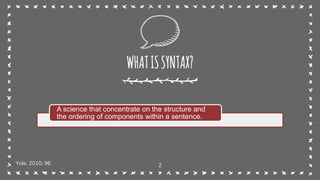
WHATISSYNTAX?
Yule, 2010: 96
A science that concentrate on the structure and
the ordering of components within a sentence.
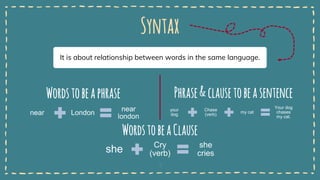
Syntax
3
It is about relationship between words in the same language.
near London
near
london
your
dog
Chase
(verb)
my cat
Your dog
chases
my cat.
Wordstobeaphrase Phrase&clausetobeasentence
WordstobeaClause
she Cry
(verb)
she
cries
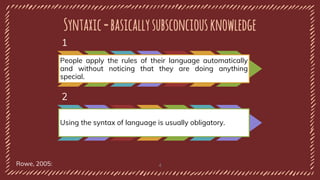
Syntaxic=basicallysubsconciousknowledge
4
1
People apply the rules of their language automatically
and without noticing that they are doing anything
special.
2
Using the syntax of language is usually obligatory.
Rowe, 2005:
5
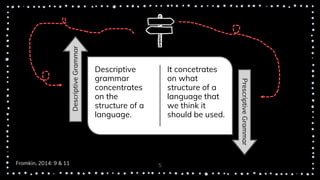
Descriptive
grammar
concentrates
on the
structure of a
language.
It concetrates
on what
structure of a
language that
we think it
should be used.
DescriptiveGrammar
PrescriptiveGrammar
Fromkin, 2014: 9 & 11
6
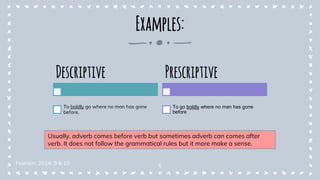
Descriptive
To boldly go where no man has gone
before.
Prescriptive
To go boldly where no man has gone
before
Fromkin, 2014: 9 & 10
Examples:
Usually, adverb comes before verb but sometimes adverb can comes after
verb. It does not follow the grammatical rules but it more make a sense.
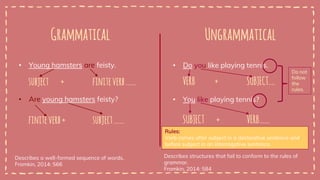
Grammatical
7
Ungrammatical
Describes a well-formed sequence of words.
Fromkin, 2014: 566
Describes structures that fail to conform to the rules of
grammar.
Fromkin, 2014: 584
• Young hamsters are feisty.
• Are young hamsters feisty?
• Do you like playing tennis.
• You like playing tennis?
subject + finiteverb......
finiteverb+ subject......
VERB + SUBJECT....
SUBJECT + VERB......
Rules:
Verb comes after subject in a declarative sentence and
before subject in an interrogative sentence.
Do not
follow
the
rules.
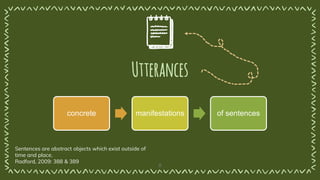
Utterances
8
concrete manifestations of sentences
Sentences are abstract objects which exist outside of
time and place.
Radford, 2009: 388 & 389
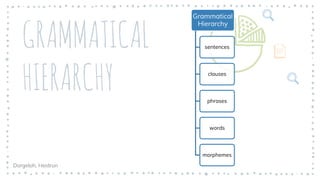
GRAMMATICAL
HIERARCHY
Dorgeloh, Heidrun
Grammatical
Hierarchy
sentences
clauses
phrases
words
morphemes
10
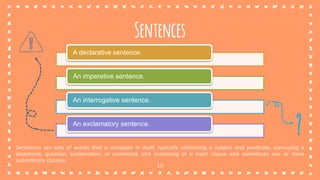
Sentences
Sentences are sets of words that is complete in itself, typically containing a subject and predicate, conveying a
statement, question, exclamation, or command, and consisting of a main clause and sometimes one or more
subordinate clauses.
A declarative sentence.
An imperative sentence.
An interrogative sentence.
An exclamatory sentence.
?
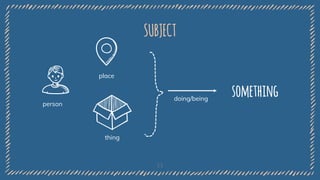
SUBJECT
11
person
place
thing
somethingdoing/being
12
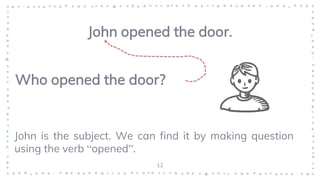
John opened the door.
Who opened the door?
John is the subject. We can find it by making question
using the verb “opened”.
13
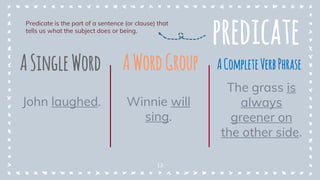
predicate
Predicate is the part of a sentence (or clause) that
tells us what the subject does or being.
ASingleWord AWordGroup ACompleteVerbPhrase
John laughed. Winnie will
sing.
The grass is
always
greener on
the other side.
14
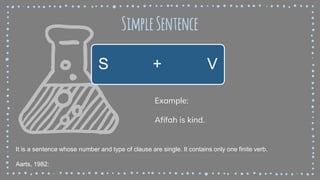
SimpleSentence
S + V
It is a sentence whose number and type of clause are single. It contains only one finite verb.
Aarts, 1982:
Example:
Afifah is kind.
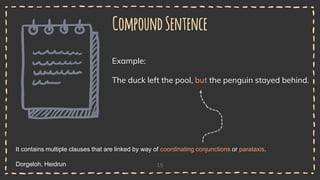
CompoundSentence
15
It contains multiple clauses that are linked by way of coordinating conjunctions or parataxis.
Dorgeloh, Heidrun
Example:
The duck left the pool, but the penguin stayed behind.
16
ComplexSentence
It consists of a main clause and at least one subordinate clause.
Dorgeloh, Heidrun
Example:
1. We expect [John will win the race].
2. We expect [John to win the race].
1. We expected [John would win the race].
2. We expected [John to win the race].
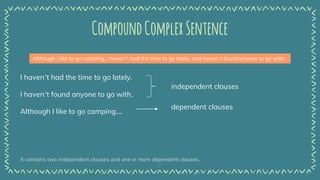
CompoundComplexSentence
17
I haven’t had the time to go lately.
I haven’t found anyone to go with.
Although I like to go camping....
independent clauses
dependent clauses
Although I like to go camping, I haven’t had the time to go lately, and haven’t found anyone to go with.
It contains two independent clauses and one or more dependent clauses.
18
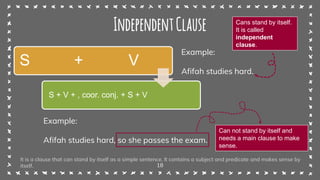
IndependentClause
It is a clause that can stand by itself as a simple sentence. It contains a subject and predicate and makes sense by
itself.
S + V
S + V + , coor. conj. + S + V
Example:
Afifah studies hard.
Example:
Afifah studies hard, so she passes the exam.
Cans stand by itself.
It is called
independent
clause.
Can not stand by itself and
needs a main clause to make
sense.
19
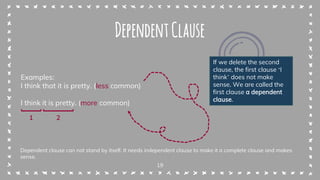
DependentClause
.
Dependent clause can not stand by itself. It needs independent clause to make it a complete clause and makes
sense.
Examples:
I think that it is pretty. (less common)
I think it is pretty. (more common)
1 2
If we delete the second
clause, the first clause ‘I
think’ does not make
sense. We are called the
first clause a dependent
clause.
20
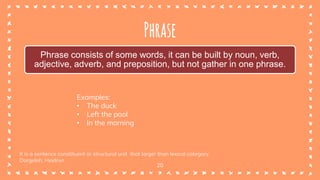
Phrase
It is a sentence constituent or structural unit that larger than lexical category.
Dorgeloh, Heidrun
Phrase consists of some words, it can be built by noun, verb,
adjective, adverb, and preposition, but not gather in one phrase.
Examples:
• The duck
• Left the pool
• In the morning
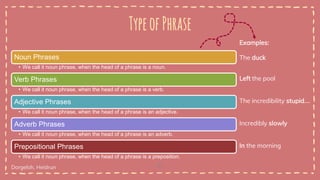
TypeofPhrase
21
Noun Phrases
• We call it noun phrase, when the head of a phrase is a noun.
Verb Phrases
• We call it noun phrase, when the head of a phrase is a verb.
Adjective Phrases
• We call it noun phrase, when the head of a phrase is an adjective.
Adverb Phrases
• We call it noun phrase, when the head of a phrase is an adverb.
Prepositional Phrases
• We call it noun phrase, when the head of a phrase is a preposition.
Examples:
The duck
Left the pool
The incredibility stupid....
Incredibly slowly
In the morning
Dorgeloh, Heidrun
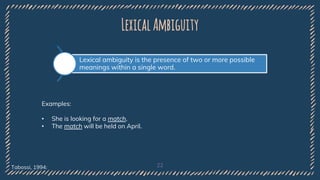
LexicalAmbiguity
22
Lexical ambiguity is the presence of two or more possible
meanings within a single word.
Examples:
• She is looking for a match.
• The match will be held on April.
Tabossi, 1994:
StructuralAmbiguity
23
Structural ambiguity occurs when a phrase, clause, or sentence can
be given two or more different as a result of the arrangement.
Examples:
• Scotsmen likes whisky more than [Scotsman likes Welshemen].
Radford, 2009: 371
24
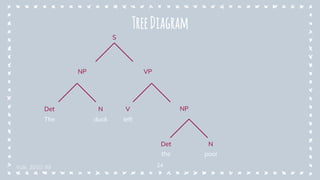
TreeDiagram
S
NP VP
NPDet N V
Det N
The duck left
the pool
Yule, 2010: 99
LabellingTheConstituentsofASentence
25
The dog loved the girl.
Art N
[The] [dog]
V
[loved]
Art N
[The] [girl]
S
NP
VP
NP
Yule, 2010: 89
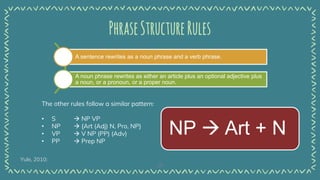
PhraseStructureRules
26
Yule, 2010:
A sentence rewrites as a noun phrase and a verb phrase.
A noun phrase rewrites as either an article plus an optional adjective plus
a noun, or a pronoun, or a proper noun.
The other rules follow a similar pattern:
• S  NP VP
• NP  {Art (Adj) N, Pro, NP}
• VP  V NP (PP) (Adv)
• PP  Prep NP
NP  Art + N
27
AGenerativeGrammar
A generative grammar is a grammar (or set of rules) that indicates the
structure and interpretation of sentences which native speakers of a
language accept as belonging to that language.
28
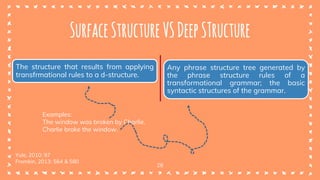
SurfaceStructureVSDeepSTructure
Yule, 2010: 97
Fromkin, 2013: 564 & 580
The structure that results from applying
transfrmational rules to a d-structure.
Any phrase structure tree generated by
the phrase structure rules of a
transformational grammar; the basic
syntactic structures of the grammar.
Examples:
The window was broken by Charlie.
Charlie broke the window.
References
Yule, George. 2010. The Study of Language: An Introduction. Cambridge: Cambridge University
Press.
Fromkin, Victoria & Rodman, Robbert & Hyams, Nina. 2013. An Introductin to Language. New
York: Cengage Learning.
Rowe, Bruce M. & Levine, Diane P. 2015. A Concise Introduction to Linguistics. ........
Radford, Andrew & Atkinson, Martin & Britain, David & Clahsen, Harald & Spencer, Andrew.
2009. Linguistics An Introduction. New York: Cambridge University Press.
Reader. 2009. Introduction to English Language and Linguistics. ............
Aarts, Flor & Aart, Jan. 1982. English Syntatic Structures. Oxford: Pergamon Press.
Al, Patrizia Tabossi et. 1994. “Semantic Effects on Syntatic Ambiguity Resolution” in Attrentin
and Performance XV. ............: Umita and M. Moscovitch. MIT Press.
29
30

Syntax (Introduction to Linguistics)

  • 1.
    syntax P E ND I D I K A N B A H A S A I N G G R I S F A K U L T A S B A H A S A D A N S E N I U N I V E R S I T A S N E G E R I Y O G Y A K A R T A 2 0 1 7 / 2 0 1 8 Dosen pengampu: Siti Mukminatun S.S., M.Hum Introduction to Linguistics Oleh: Machsuna Indriastuti (17202244028) Nur Laila Rahmawati (17202244029) Nur Afifah Firdaus Masykuri (17202244035) Nanda Dwiana Pangestuti (17202244040)
  • 2.
    2 WHATISSYNTAX? Yule, 2010: 96 Ascience that concentrate on the structure and the ordering of components within a sentence.
  • 3.
    Syntax 3 It is aboutrelationship between words in the same language. near London near london your dog Chase (verb) my cat Your dog chases my cat. Wordstobeaphrase Phrase&clausetobeasentence WordstobeaClause she Cry (verb) she cries
  • 4.
    Syntaxic=basicallysubsconciousknowledge 4 1 People apply therules of their language automatically and without noticing that they are doing anything special. 2 Using the syntax of language is usually obligatory. Rowe, 2005:
  • 5.
    5 Descriptive grammar concentrates on the structure ofa language. It concetrates on what structure of a language that we think it should be used. DescriptiveGrammar PrescriptiveGrammar Fromkin, 2014: 9 & 11
  • 6.
    6 Descriptive To boldly gowhere no man has gone before. Prescriptive To go boldly where no man has gone before Fromkin, 2014: 9 & 10 Examples: Usually, adverb comes before verb but sometimes adverb can comes after verb. It does not follow the grammatical rules but it more make a sense.
  • 7.
    Grammatical 7 Ungrammatical Describes a well-formedsequence of words. Fromkin, 2014: 566 Describes structures that fail to conform to the rules of grammar. Fromkin, 2014: 584 • Young hamsters are feisty. • Are young hamsters feisty? • Do you like playing tennis. • You like playing tennis? subject + finiteverb...... finiteverb+ subject...... VERB + SUBJECT.... SUBJECT + VERB...... Rules: Verb comes after subject in a declarative sentence and before subject in an interrogative sentence. Do not follow the rules.
  • 8.
    Utterances 8 concrete manifestations ofsentences Sentences are abstract objects which exist outside of time and place. Radford, 2009: 388 & 389
  • 9.
  • 10.
    10 Sentences Sentences are setsof words that is complete in itself, typically containing a subject and predicate, conveying a statement, question, exclamation, or command, and consisting of a main clause and sometimes one or more subordinate clauses. A declarative sentence. An imperative sentence. An interrogative sentence. An exclamatory sentence. ?
  • 11.
  • 12.
    12 John opened thedoor. Who opened the door? John is the subject. We can find it by making question using the verb “opened”.
  • 13.
    13 predicate Predicate is thepart of a sentence (or clause) that tells us what the subject does or being. ASingleWord AWordGroup ACompleteVerbPhrase John laughed. Winnie will sing. The grass is always greener on the other side.
  • 14.
    14 SimpleSentence S + V Itis a sentence whose number and type of clause are single. It contains only one finite verb. Aarts, 1982: Example: Afifah is kind.
  • 15.
    CompoundSentence 15 It contains multipleclauses that are linked by way of coordinating conjunctions or parataxis. Dorgeloh, Heidrun Example: The duck left the pool, but the penguin stayed behind.
  • 16.
    16 ComplexSentence It consists ofa main clause and at least one subordinate clause. Dorgeloh, Heidrun Example: 1. We expect [John will win the race]. 2. We expect [John to win the race]. 1. We expected [John would win the race]. 2. We expected [John to win the race].
  • 17.
    CompoundComplexSentence 17 I haven’t hadthe time to go lately. I haven’t found anyone to go with. Although I like to go camping.... independent clauses dependent clauses Although I like to go camping, I haven’t had the time to go lately, and haven’t found anyone to go with. It contains two independent clauses and one or more dependent clauses.
  • 18.
    18 IndependentClause It is aclause that can stand by itself as a simple sentence. It contains a subject and predicate and makes sense by itself. S + V S + V + , coor. conj. + S + V Example: Afifah studies hard. Example: Afifah studies hard, so she passes the exam. Cans stand by itself. It is called independent clause. Can not stand by itself and needs a main clause to make sense.
  • 19.
    19 DependentClause . Dependent clause cannot stand by itself. It needs independent clause to make it a complete clause and makes sense. Examples: I think that it is pretty. (less common) I think it is pretty. (more common) 1 2 If we delete the second clause, the first clause ‘I think’ does not make sense. We are called the first clause a dependent clause.
  • 20.
    20 Phrase It is asentence constituent or structural unit that larger than lexical category. Dorgeloh, Heidrun Phrase consists of some words, it can be built by noun, verb, adjective, adverb, and preposition, but not gather in one phrase. Examples: • The duck • Left the pool • In the morning
  • 21.
    TypeofPhrase 21 Noun Phrases • Wecall it noun phrase, when the head of a phrase is a noun. Verb Phrases • We call it noun phrase, when the head of a phrase is a verb. Adjective Phrases • We call it noun phrase, when the head of a phrase is an adjective. Adverb Phrases • We call it noun phrase, when the head of a phrase is an adverb. Prepositional Phrases • We call it noun phrase, when the head of a phrase is a preposition. Examples: The duck Left the pool The incredibility stupid.... Incredibly slowly In the morning Dorgeloh, Heidrun
  • 22.
    LexicalAmbiguity 22 Lexical ambiguity isthe presence of two or more possible meanings within a single word. Examples: • She is looking for a match. • The match will be held on April. Tabossi, 1994:
  • 23.
    StructuralAmbiguity 23 Structural ambiguity occurswhen a phrase, clause, or sentence can be given two or more different as a result of the arrangement. Examples: • Scotsmen likes whisky more than [Scotsman likes Welshemen]. • Scotsmen likes whisky more than [Scotsman likes Welshemen]. Radford, 2009: 371
  • 24.
    24 TreeDiagram S NP VP NPDet NV Det N The duck left the pool Yule, 2010: 99
  • 25.
    LabellingTheConstituentsofASentence 25 The dog lovedthe girl. Art N [The] [dog] V [loved] Art N [The] [girl] S NP VP NP Yule, 2010: 89
  • 26.
    PhraseStructureRules 26 Yule, 2010: A sentencerewrites as a noun phrase and a verb phrase. A noun phrase rewrites as either an article plus an optional adjective plus a noun, or a pronoun, or a proper noun. The other rules follow a similar pattern: • S  NP VP • NP  {Art (Adj) N, Pro, NP} • VP  V NP (PP) (Adv) • PP  Prep NP NP  Art + N
  • 27.
    27 AGenerativeGrammar A generative grammaris a grammar (or set of rules) that indicates the structure and interpretation of sentences which native speakers of a language accept as belonging to that language.
  • 28.
    28 SurfaceStructureVSDeepSTructure Yule, 2010: 97 Fromkin,2013: 564 & 580 The structure that results from applying transfrmational rules to a d-structure. Any phrase structure tree generated by the phrase structure rules of a transformational grammar; the basic syntactic structures of the grammar. Examples: The window was broken by Charlie. Charlie broke the window.
  • 29.
    References Yule, George. 2010.The Study of Language: An Introduction. Cambridge: Cambridge University Press. Fromkin, Victoria & Rodman, Robbert & Hyams, Nina. 2013. An Introductin to Language. New York: Cengage Learning. Rowe, Bruce M. & Levine, Diane P. 2015. A Concise Introduction to Linguistics. ........ Radford, Andrew & Atkinson, Martin & Britain, David & Clahsen, Harald & Spencer, Andrew. 2009. Linguistics An Introduction. New York: Cambridge University Press. Reader. 2009. Introduction to English Language and Linguistics. ............ Aarts, Flor & Aart, Jan. 1982. English Syntatic Structures. Oxford: Pergamon Press. Al, Patrizia Tabossi et. 1994. “Semantic Effects on Syntatic Ambiguity Resolution” in Attrentin and Performance XV. ............: Umita and M. Moscovitch. MIT Press. 29
  • 30.