WHAT IS
SYNTAX??
The partof grammar that represents a
speaker’s knowledge of sentences and
their structures is called syntax.
4.
Consider the
meaning in
thefollowing
sentences:
•‘I like what I get!’
•‘I get what I like!’
•‘I see what I eat!’
•‘I eat what I see!’
5.
What the
Syntax Rules
Do?
Therules of syntax combine words into
phrases and phrases into sentences.
1. The rules determine the correct word order
for a language.
For example, English is a Subject–Verb–Object
(SVO) language.
1. The President nominated a new
Supreme Court justice.
2. *President the Supreme new justice
Court a nominated.
The English sentence in (1) is grammatical
because the words occur in the right order;
The sentence in (2) is ungrammatical because
the word order is incorrect for English.
6.
2. A secondimportant role of the syntax is to describe the relationship between
the meaning of a particular group of words and the arrangement of those
words. For example, the sentences:
‘I like what I get!’
‘I get what I like!’
contain the same words, but the meanings are quite different.
7.
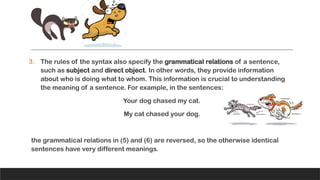
3. The rulesof the syntax also specify the grammatical relations of a sentence,
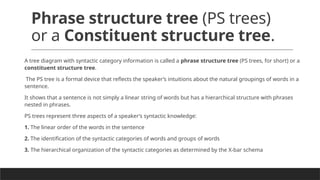
such as subject and direct object. In other words, they provide information
about who is doing what to whom. This information is crucial to understanding
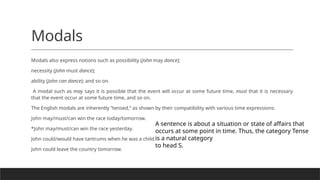
the meaning of a sentence. For example, in the sentences:
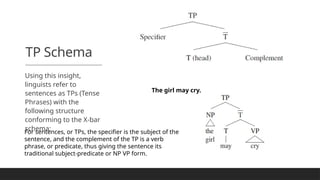
Your dog chased my cat.
My cat chased your dog.
the grammatical relations in (5) and (6) are reversed, so the otherwise identical
sentences have very different meanings.
8.
Lets analyze anotherexample:
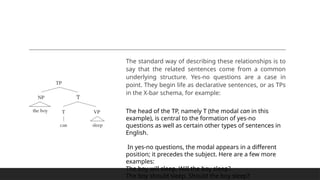
Consider the following examples:
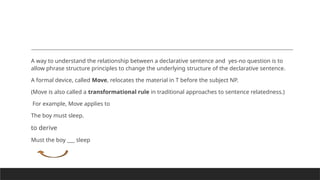
(a) Jack and Jill ran up the hill.
(b) *Jack and Jill ran the hill up.
(c) Up the hill ran Jack and Jill.
(d) Jack and Jill ran up the bill.
(e) Jack and Jill ran the bill up.
(f) *Up the bill ran Jack and Jill.
In ran up the hill, the words up the hill form a
unit, as follows:
He ran [up the hill].
The whole unit can be moved to the
beginning of the sentence, as in (7c), but we
cannot rearrange its subparts, as shown in
(7b).
On the other hand, in ran up the bill, the
words up the bill do not form a natural unit,
so they cannot be moved together, and (7f)
is ungrammatical.
9.
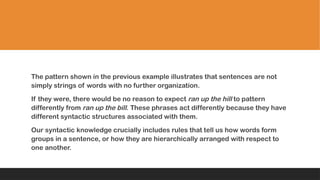
The pattern shownin the previous example illustrates that sentences are not
simply strings of words with no further organization.
If they were, there would be no reason to expect ran up the hill to pattern
differently from ran up the bill. These phrases act differently because they have
different syntactic structures associated with them.
Our syntactic knowledge crucially includes rules that tell us how words form
groups in a sentence, or how they are hierarchically arranged with respect to
one another.
The captain orderedall old men and women off the sinking ship.
[old men] and [women]
When we group them like this, the adjective old modifies both men and women.
[old [men and women]]
The rules of syntax allow both of these groupings, which is why the expression is
ambiguous. The following hierarchical diagrams, also called tree diagrams, illustrate the
same point:
13.
Syntactic
rules and
their
importance:
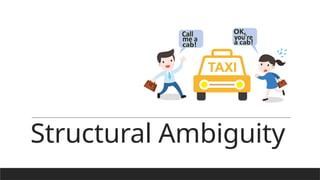
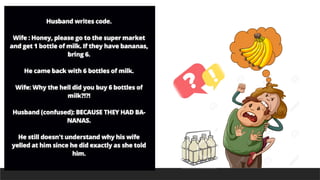
Often acombination of differing structure and double word-
meaning creates ambiguity (and humor) as in the cartoon.
Because these ambiguities are a result of different structures,
they are instances of structural ambiguity.
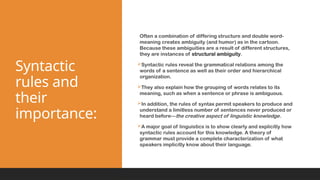
Syntactic rules reveal the grammatical relations among the
words of a sentence as well as their order and hierarchical
organization.
They also explain how the grouping of words relates to its
meaning, such as when a sentence or phrase is ambiguous.
In addition, the rules of syntax permit speakers to produce and
understand a limitless number of sentences never produced or
heard before—the creative aspect of linguistic knowledge.
A major goal of linguistics is to show clearly and explicitly how
syntactic rules account for this knowledge. A theory of
grammar must provide a complete characterization of what
speakers implicitly know about their language.
14.
What Grammaticality IsNot Based
On
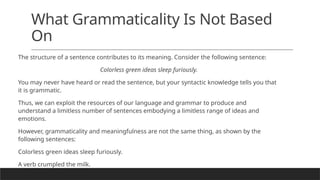
The structure of a sentence contributes to its meaning. Consider the following sentence:
Colorless green ideas sleep furiously.
You may never have heard or read the sentence, but your syntactic knowledge tells you that
it is grammatic.
Thus, we can exploit the resources of our language and grammar to produce and
understand a limitless number of sentences embodying a limitless range of ideas and
emotions.
However, grammaticality and meaningfulness are not the same thing, as shown by the
following sentences:
Colorless green ideas sleep furiously.
A verb crumpled the milk.
15.
Meaning and
the word
order
Onthe other hand, there are also
sentences that we understand even
though they are not well-formed
according to the rules of the syntax. For
example, most English speakers could
interpret
*The boy quickly in the house the ball
found.
although they know that the word order
is incorrect. To be a sentence, words
must conform to specific patterns
determined by the syntactic rules of the
language.
16.
Grammaticality and
Truth
Grammaticality alsodoes not depend on the truth of
sentences. If it did, lying would be easy to detect. Nor does it
depend on whether real objects are being discussed or
whether something is possible in the real world.
Untrue sentences can be grammatical, for example:
The sun rises at night and moon shines during the day!
The syntactic rules that permit us to produce, understand,
and make grammaticality judgments are unconscious rules.
The grammar is a mental grammar, different from the
prescriptive grammar rules that we are taught in school. We
develop the mental rules of grammar long before we attend
school.
17.
Sentence
Structure
The child founda puppy.
The sentence above may be grouped into
[the child] and [found a puppy],
corresponding to the subject and
predicate of the sentence.
A further division gives [the child] and
then [[found] [a puppy]], and finally the
individual words: [[the] [child]] [[found]
[[a] [puppy]]].
It’s sometimes easier to see the parts and
subparts of the sentence in a tree
diagram, as we did earlier to illustrate
ambiguity:
18.
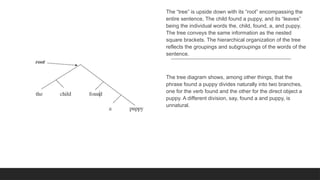
The “tree” isupside down with its “root” encompassing the
entire sentence, The child found a puppy, and its “leaves”
being the individual words the, child, found, a, and puppy.
The tree conveys the same information as the nested
square brackets. The hierarchical organization of the tree
reflects the groupings and subgroupings of the words of the
sentence.
The tree diagram shows, among other things, that the
phrase found a puppy divides naturally into two branches,
one for the verb found and the other for the direct object a
puppy. A different division, say, found a and puppy, is
unnatural.
The natural groupingsor parts of a sentence are
called constituents.
1. The first test is the “stand alone” test. If a group
of words can stand alone, for example, as an
answer to a question, they form a constituent.
So, in response to the question:
“What did you find?”
a speaker might answer
“a puppy”,
but not
“found a.”
A puppy can stand alone while found a cannot. We
have a clear intuition that one of these is a
meaningful unit and the other is just a list of words.
21.
2. The secondtest is “replacement by a
pronoun.”
Pronouns can substitute for natural groups. In
answer to the question:
“Where did you find a puppy?”
a speaker can say,
“I found him in the park.”
Words such as do (which is not a pronoun per
se) can also take the place of the entire
predicate found a puppy, as in
“John found a puppy and Bill did too.”
If a group of words can be replaced by a
pronoun or a word like do, it forms a
constituent.
22.
A third testof constituency is the “move as a unit” test. If a group of words can be moved,
they form a constituent. For example, if we compare the following sentences to the sentence
“The child found a puppy,”
we see that certain elements have moved:
It was a puppy that the child found.
A puppy was found by the child.
In the first example, the constituent a puppy has moved from its position following found;
in the second example, the positions of a puppy and the child have been changed.
In all such rearrangements the constituents a puppy and the child remain intact. Found a
does not remain intact, because it is not a constituent.
23.
Prepositional
phrases in
the predicate
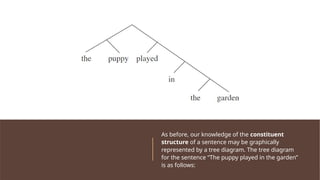
Somesentences have prepositional phrases
in the predicate. Consider
The puppy played in the garden.
We can use our tests to show that in the
garden is also a constituent, as follows:
Where did the puppy play? In the garden
(stand alone)
The puppy played there. (replacement by a
pronoun-like word)
In the garden is where the puppy played.
(move as a unit)
It was in the garden that the puppy played.
(move as a unit)
24.
As before, ourknowledge of the constituent
structure of a sentence may be graphically
represented by a tree diagram. The tree diagram
for the sentence “The puppy played in the garden”
is as follows:
25.
Syntactic Categories
Each groupingin the tree diagrams of “The child found a puppy” is a member of a large family of similar
expressions. For example, the child belongs to a family that includes the police officer, your neighbor, this yellow
cat, he, John, and countless others.
We can substitute any member of this family for the child without affecting the grammaticality of the sentence,
although the meaning of course would change.
A police officer found a puppy.
Your neighbor found a puppy.
This yellow cat found a puppy.
A family of expressions that can substitute for one another without loss of grammaticality is called a syntactic
category.
26.
The child, apolice officer, John, and so on belong to the syntactic
category noun phrase (NP), one of several syntactic categories
in English and all languages.
NPs may function as subjects or as objects in sentences.
An NP often contains a determiner (like a or the) and a noun, but
it may also consist of a proper name, a pronoun, a noun without
a determiner, or even a clause or a sentence.
Even though a proper noun like John and pronouns such as he
and him are single words, they are technically NPs, because they
pattern like NPs in being able to fill a subject or object or other
NP slots.
John found the puppy.
He found the puppy.
Boys love puppies.
The puppy loved him.
The puppy loved John.
27.
Syntactic categories arepart of a speaker’s knowledge of syntax.
a) a bird
(b) the red banjo
(c) have a nice day
(d) with a balloon
(e) the woman who was laughing
(f ) it
(g) John
(h) went
Speakers of English know that only items (a), (b), (e), (f),
and (g) in the list are NPs even if they have never heard
the term noun phrase before.
You can test this claim by inserting each expression into
three contexts:
What/who I heard was , Who found ? and was seen by
everyone.
For example, *Who found with a balloon? is ungrammatical,
as is
*Went was seen by everyone, as opposed to Who found it? or
John was seen by everyone.
Only NPs fit into these contexts because only NPs can
function as subjects and objects.
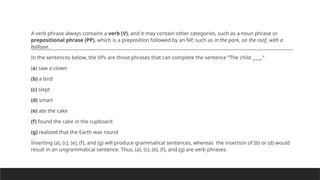
A verb phrasealways contains a verb (V), and it may contain other categories, such as a noun phrase or
prepositional phrase (PP), which is a preposition followed by an NP, such as in the park, on the roof, with a
balloon.
In the sentences below, the VPs are those phrases that can complete the sentence “The child ____.”
(a) saw a clown
(b) a bird
(c) slept
(d) smart
(e) ate the cake
(f) found the cake in the cupboard
(g) realized that the Earth was round
Inserting (a), (c), (e), (f), and (g) will produce grammatical sentences, whereas the insertion of (b) or (d) would
result in an ungrammatical sentence. Thus, (a), (c), (e), (f), and (g) are verb phrases.
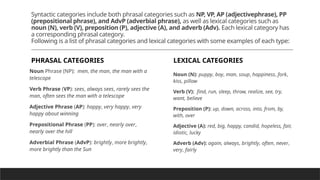
PHRASAL CATEGORIES
Noun Phrase(NP): men, the man, the man with a
telescope
Verb Phrase (VP): sees, always sees, rarely sees the
man, often sees the man with a telescope
Adjective Phrase (AP): happy, very happy, very
happy about winning
Prepositional Phrase (PP): over, nearly over,
nearly over the hill
Adverbial Phrase (AdvP): brightly, more brightly,
more brightly than the Sun
LEXICAL CATEGORIES
Noun (N): puppy, boy, man, soup, happiness, fork,
kiss, pillow
Verb (V): find, run, sleep, throw, realize, see, try,
want, believe
Preposition (P): up, down, across, into, from, by,
with, over
Adjective (A): red, big, happy, candid, hopeless, fair,
idiotic, lucky
Adverb (Adv): again, always, brightly, often, never,
very, fairly
Syntactic categories include both phrasal categories such as NP, VP, AP (adjectivephrase), PP
(prepositional phrase), and AdvP (adverbial phrase), as well as lexical categories such as
noun (N), verb (V), preposition (P), adjective (A), and adverb (Adv). Each lexical category has
a corresponding phrasal category.
Following is a list of phrasal categories and lexical categories with some examples of each type:
32.
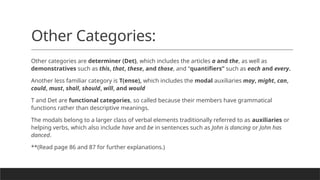
Other Categories:
Other categoriesare determiner (Det), which includes the articles a and the, as well as
demonstratives such as this, that, these, and those, and “quantifiers” such as each and every.
Another less familiar category is T(ense), which includes the modal auxiliaries may, might, can,
could, must, shall, should, will, and would
T and Det are functional categories, so called because their members have grammatical
functions rather than descriptive meanings.
The modals belong to a larger class of verbal elements traditionally referred to as auxiliaries or
helping verbs, which also include have and be in sentences such as John is dancing or John has
danced.
**(Read page 86 and 87 for further explanations.)
33.
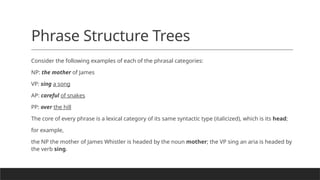
Phrase Structure Trees
Considerthe following examples of each of the phrasal categories:
NP: the mother of James
VP: sing a song
AP: careful of snakes
PP: over the hill
The core of every phrase is a lexical category of its same syntactic type (italicized), which is its head;
for example,
the NP the mother of James Whistler is headed by the noun mother; the VP sing an aria is headed by
the verb sing.
34.
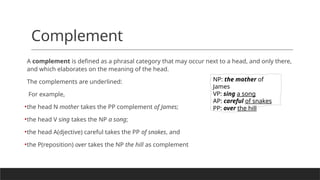
Complement
A complement isdefined as a phrasal category that may occur next to a head, and only there,
and which elaborates on the meaning of the head.
The complements are underlined:
For example,
•the head N mother takes the PP complement of James;
•the head V sing takes the NP a song;
•the head A(djective) careful takes the PP of snakes, and
•the P(reposition) over takes the NP the hill as complement
NP: the mother of
James
VP: sing a song
AP: careful of snakes
PP: over the hill
35.
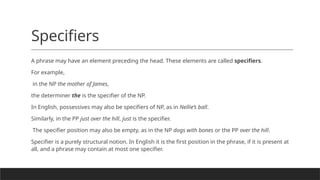
Specifiers
A phrase mayhave an element preceding the head. These elements are called specifiers.
For example,
in the NP the mother of James,
the determiner the is the specifier of the NP.
In English, possessives may also be specifiers of NP, as in Nellie’s ball.
Similarly, in the PP just over the hill, just is the specifier.
The specifier position may also be empty, as in the NP dogs with bones or the PP over the hill.
Specifier is a purely structural notion. In English it is the first position in the phrase, if it is present at
all, and a phrase may contain at most one specifier.
36.
Contd.
APs and VPsalso have a specifier position
their specifiers usually show up when the phrase is embedded in another sentence, as in:
a. Betty made [Jane careful of snakes].
b. I heard [Jana sing a song].
c. I saw [everyone at the stadium].
In (a) Jane is the specifier of the AP careful of snakes, in (b) Jana is the specifier of the VP sing
a song,
in (c) everyone is the specifier of the PP at the stadium.
37.
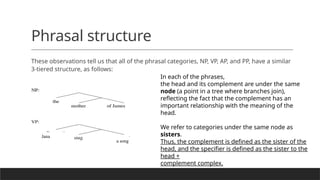
Phrasal structure
These observationstell us that all of the phrasal categories, NP, VP, AP, and PP, have a similar
3-tiered structure, as follows:
In each of the phrases,
the head and its complement are under the same
node (a point in a tree where branches join),
reflecting the fact that the complement has an
important relationship with the meaning of the
head.
We refer to categories under the same node as
sisters.
Thus, the complement is defined as the sister of the
head, and the specifier is defined as the sister to the
head +
complement complex.
a song
Jana
38.
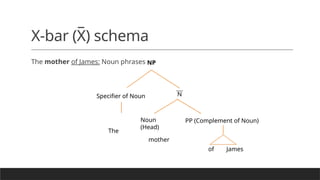
X-bar (X
̅ )schema
The mother of James: Noun phrases NP
Specifier of Noun
The
N
Noun
(Head)
PP (Complement of Noun)
mother
of James
39.
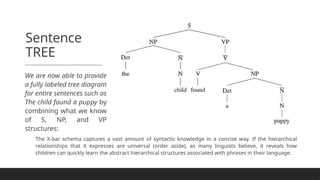
Sentence
TREE
We are nowable to provide
a fully labeled tree diagram
for entire sentences such as
The child found a puppy by
combining what we know
of S, NP, and VP
structures:
The X-bar schema captures a vast amount of syntactic knowledge in a concise way. If the hierarchical
relationships that it expresses are universal (order aside), as many linguists believe, it reveals how
children can quickly learn the abstract hierarchical structures associated with phrases in their language.
40.
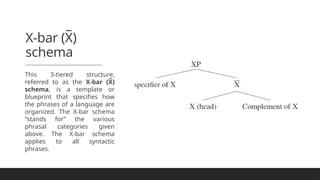
X-bar (X
̅ )
schema
This3-tiered structure,
referred to as the X-bar (X
̅ )
schema, is a template or
blueprint that specifies how
the phrases of a language are
organized. The X-bar schema
“stands for” the various
phrasal categories given
above. The X‑bar schema
applies to all syntactic
phrases.
41.
Phrase structure tree(PS trees)
or a Constituent structure tree.
A tree diagram with syntactic category information is called a phrase structure tree (PS trees, for short) or a
constituent structure tree.
The PS tree is a formal device that reflects the speaker’s intuitions about the natural groupings of words in a
sentence.
It shows that a sentence is not simply a linear string of words but has a hierarchical structure with phrases
nested in phrases.
PS trees represent three aspects of a speaker’s syntactic knowledge:
1. The linear order of the words in the sentence
2. The identification of the syntactic categories of words and groups of words
3. The hierarchical organization of the syntactic categories as determined by the X-bar schema
42.
Tense Phrases
Sentences arealways “tensed.” Tense provides a time-frame for the event or state described by the verb.
In English, present and past tenses are morphologically marked on the verb:
John dances. (present)
John danced. (past)
Future tense is expressed with the modal will (John will dance).
43.
Modals
Modals also expressnotions such as possibility (John may dance);
necessity (John must dance);
ability (John can dance); and so on.
A modal such as may says it is possible that the event will occur at some future time, must that it is necessary
that the event occur at some future time, and so on.
The English modals are inherently “tensed,” as shown by their compatibility with various time expressions:
John may/must/can win the race today/tomorrow.
*John may/must/can win the race yesterday.
John could/would have tantrums when he was a child.
John could leave the country tomorrow.
A sentence is about a situation or state of affairs that
occurs at some point in time. Thus, the category Tense
is a natural category
to head S.
44.
TP Schema
Using thisinsight,
linguists refer to
sentences as TPs (Tense
Phrases) with the
following structure
conforming to the X-bar
schema:
The girl may cry.
For sentences, or TPs, the specifier is the subject of the
sentence, and the complement of the TP is a verb
phrase, or predicate, thus giving the sentence its
traditional subject-predicate or NP VP form.
45.
Tense
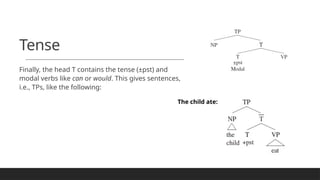
Finally, the headT contains the tense (±pst) and
modal verbs like can or would. This gives sentences,
i.e., TPs, like the following:
The child ate:
Transformational Analysis
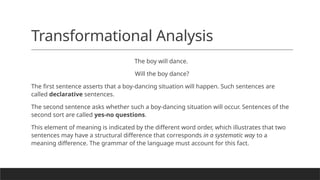
The boywill dance.
Will the boy dance?
The first sentence asserts that a boy-dancing situation will happen. Such sentences are
called declarative sentences.
The second sentence asks whether such a boy-dancing situation will occur. Sentences of the
second sort are called yes-no questions.
This element of meaning is indicated by the different word order, which illustrates that two
sentences may have a structural difference that corresponds in a systematic way to a
meaning difference. The grammar of the language must account for this fact.
49.
Transformational Analysis:
Definition: Asystem of language analysis that recognizes the relationship among
the various elements of a sentence and among the possible sentences and uses
processes or rules (some of which are called transformations) to express these
relationships.
50.
The standard wayof describing these relationships is to
say that the related sentences come from a common
underlying structure. Yes-no questions are a case in
point. They begin life as declarative sentences, or as TPs
in the X-bar schema, for example:
The head of the TP, namely T (the modal can in this
example), is central to the formation of yes-no
questions as well as certain other types of sentences in
English.
In yes-no questions, the modal appears in a different
position; it precedes the subject. Here are a few more
examples:
The boy will sleep. Will the boy sleep?
The boy should sleep. Should the boy sleep?
51.
A way tounderstand the relationship between a declarative sentence and yes-no question is to
allow phrase structure principles to change the underlying structure of the declarative sentence.
A formal device, called Move, relocates the material in T before the subject NP.
(Move is also called a transformational rule in traditional approaches to sentence relatedness.)
For example, Move applies to
The boy must sleep.
to derive
Must the boy ___ sleep
52.
The two stepsof yes-no questions:
Yes-no questions are thus generated in two steps.
1. PS-rules implement the X-bar schema to generate a basic structure.
2. Move applies to the basic structure to produce the derived structure.
The basic structures of sentences, also called deep structures or d-structures, conform to the X-bar
schema.
Variants on the basic sentence structures are derived via the transformational operation Move.
By generating questions in two steps, we are claiming that a principled structural relationship exists
between a question and its corresponding statement. Intuitively, we know that such sentences are
related.
The transformational rule is a formal way of representing this knowledge.
53.
The derived (new) structures—the ones that follow the application of transformational rules
—are called surface structures or s-structures.
The rules of the language that determine pronunciation apply to s-structures.
If no transformations apply, then d-structure and s-structure are the same.
If transformations apply, then s-structure is the result after all transformations have had
their effect.
Many sentence types are accounted for by transformations, which can alter phrase structure
trees by moving, adding, or deleting elements.
54.
Other sentence pairsthat are transformationally related are:
active-passive
The cat chased the mouse. The mouse was chased by the cat.
→
there-sentences
There is a bear in your closet. A bear is in your closet.
→
PP preposing
Tom Dooley stabbed her with his knife. With his knife Tom
→
Dooley stabbed her.


![Lets analyze another example:
Consider the following examples:
(a) Jack and Jill ran up the hill.
(b) *Jack and Jill ran the hill up.
(c) Up the hill ran Jack and Jill.
(d) Jack and Jill ran up the bill.
(e) Jack and Jill ran the bill up.
(f) *Up the bill ran Jack and Jill.
In ran up the hill, the words up the hill form a
unit, as follows:
He ran [up the hill].
The whole unit can be moved to the
beginning of the sentence, as in (7c), but we
cannot rearrange its subparts, as shown in
(7b).
On the other hand, in ran up the bill, the
words up the bill do not form a natural unit,
so they cannot be moved together, and (7f)
is ungrammatical.](https://image.slidesharecdn.com/presentation2-251125152542-f968e409/85/Syntax-the-sentence-pattern-introduction-8-320.jpg)
![The captain ordered all old men and women off the sinking ship.
[old men] and [women]
When we group them like this, the adjective old modifies both men and women.
[old [men and women]]
The rules of syntax allow both of these groupings, which is why the expression is
ambiguous. The following hierarchical diagrams, also called tree diagrams, illustrate the
same point:](https://image.slidesharecdn.com/presentation2-251125152542-f968e409/85/Syntax-the-sentence-pattern-introduction-11-320.jpg)
![Sentence
Structure
The child found a puppy.
The sentence above may be grouped into
[the child] and [found a puppy],
corresponding to the subject and
predicate of the sentence.
A further division gives [the child] and
then [[found] [a puppy]], and finally the
individual words: [[the] [child]] [[found]
[[a] [puppy]]].
It’s sometimes easier to see the parts and
subparts of the sentence in a tree
diagram, as we did earlier to illustrate
ambiguity:](https://image.slidesharecdn.com/presentation2-251125152542-f968e409/85/Syntax-the-sentence-pattern-introduction-17-320.jpg)

![Contd.
APs and VPs also have a specifier position
their specifiers usually show up when the phrase is embedded in another sentence, as in:
a. Betty made [Jane careful of snakes].
b. I heard [Jana sing a song].
c. I saw [everyone at the stadium].
In (a) Jane is the specifier of the AP careful of snakes, in (b) Jana is the specifier of the VP sing
a song,
in (c) everyone is the specifier of the PP at the stadium.](https://image.slidesharecdn.com/presentation2-251125152542-f968e409/85/Syntax-the-sentence-pattern-introduction-36-320.jpg)