SYNTAX
SR. JORZALIN GEORGE
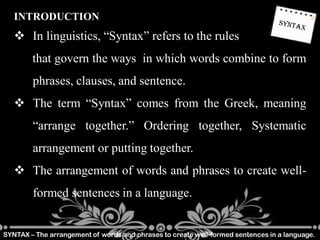
INTRODUCTION
 In linguistics, “Syntax” refers to the rules
that govern the ways in which words combine to form
phrases, clauses, and sentence.
 The term “Syntax” comes from the Greek, meaning
“arrange together.” Ordering together, Systematic
arrangement or putting together.
 The arrangement of words and phrases to create well-
formed sentences in a language.
SYNTAX – The arrangement of words and phrases to create well-formed sentences in a language.
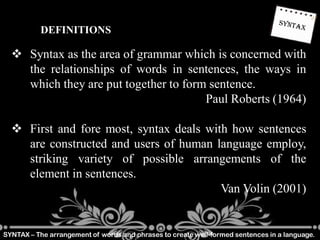
 Syntax as the area of grammar which is concerned with
the relationships of words in sentences, the ways in
which they are put together to form sentence.
Paul Roberts (1964)
 First and fore most, syntax deals with how sentences
are constructed and users of human language employ,
striking variety of possible arrangements of the
element in sentences.
Van Volin (2001)
DEFINITIONS
SYNTAX – The arrangement of words and phrases to create well-formed sentences in a language.
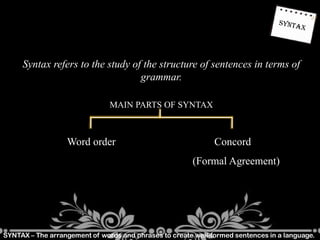
Syntax refers to the study of the structure of sentences in terms of
grammar.
MAIN PARTS OF SYNTAX
Word order Concord
(Formal Agreement)
SYNTAX – The arrangement of words and phrases to create well-formed sentences in a language.
I) WORD ORDER
 The ways words are arranged into a structure/ sentence
is called word order.
 It is important in English because many inflections(declension of
nouns and adjectives and conjugation of verbs) have been got rid
of in English.
 In classical languages like Latin, Greek and Sanskrit word order
is not that important, since they are fully inflected
SYNTAX – The arrangement of words and phrases to create well-formed sentences in a language.
In English there are certain word orders. They are:-
1) S-P (Subject - Predicate)
e.g. - Birds build nest.
2) P –S (Predicate - Subject)
e.g. - ……….., aren’t I?
3) P – S – P (Predicate – Subject - Predicate)
e.g. – Do you know the answer.
* P – S order is the normal word order in questions.
* S – P order is the normal word order in statements.
SYNTAX – The arrangement of words and phrases to create well-formed sentences in a language.
II) CONCORD
 Concord means formal agreement in person, number,
gender and tense between two or more parts of a sentence.
 Concord may be of different kinds.
1. Concord of person.
2. Notional Concord
3. Proximity Concord
4. Concord of collective nouns.
5. Concord of either… or, etc
6. Concord of Gender
7. Concord of tenses.
SYNTAX – The arrangement of words and phrases to create well-formed sentences in a language.
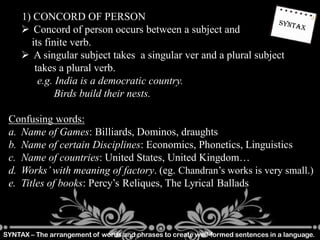
1) CONCORD OF PERSON
 Concord of person occurs between a subject and
its finite verb.
 A singular subject takes a singular ver and a plural subject
takes a plural verb.
e.g. India is a democratic country.
Birds build their nests.
Confusing words:
a. Name of Games: Billiards, Dominos, draughts
b. Name of certain Disciplines: Economics, Phonetics, Linguistics
c. Name of countries: United States, United Kingdom…
d. Works’ with meaning of factory. (eg. Chandran’s works is very small.)
e. Titles of books: Percy’s Reliques, The Lyrical Ballads
SYNTAX – The arrangement of words and phrases to create well-formed sentences in a language.
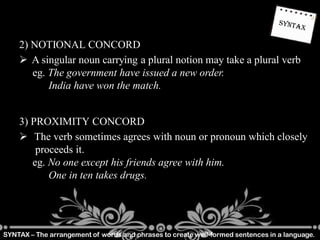
2) NOTIONAL CONCORD
 A singular noun carrying a plural notion may take a plural verb
eg. The government have issued a new order.
India have won the match.
3) PROXIMITY CONCORD
 The verb sometimes agrees with noun or pronoun which closely
proceeds it.
eg. No one except his friends agree with him.
One in ten takes drugs.
SYNTAX – The arrangement of words and phrases to create well-formed sentences in a language.
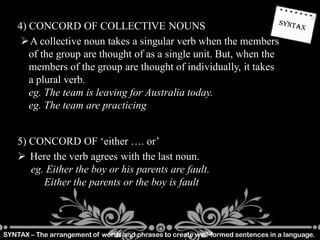
4) CONCORD OF COLLECTIVE NOUNS
A collective noun takes a singular verb when the members
of the group are thought of as a single unit. But, when the
members of the group are thought of individually, it takes
a plural verb.
eg. The team is leaving for Australia today.
eg. The team are practicing
5) CONCORD OF ‘either …. or’
 Here the verb agrees with the last noun.
eg. Either the boy or his parents are fault.
Either the parents or the boy is fault
SYNTAX – The arrangement of words and phrases to create well-formed sentences in a language.
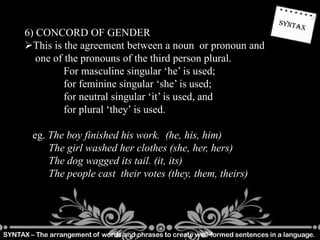
6) CONCORD OF GENDER
This is the agreement between a noun or pronoun and
one of the pronouns of the third person plural.
For masculine singular ‘he’ is used;
for feminine singular ‘she’ is used;
for neutral singular ‘it’ is used, and
for plural ‘they’ is used.
eg. The boy finished his work. (he, his, him)
The girl washed her clothes (she, her, hers)
The dog wagged its tail. (it, its)
The people cast their votes (they, them, theirs)
SYNTAX – The arrangement of words and phrases to create well-formed sentences in a language.
7) CONCORD OF TENSES
 This is also called sequence of tense. This is the
relationship between the tense in the main clause and
that in the subordinate clauses.
• When the main clause is in the past tense, the verb/verbs
in the subordinate clause will also be in the past tense.
• When the subordinate clause contains a universal truth,
the verb is in the present tense.
• When the main verb is in the present or in the future
tense, there is no need of changing the tense of the verb
in the subordinate clauses.
THANKYOU

SYNTAX - PDF

  • 1.
  • 2.
    INTRODUCTION  In linguistics,“Syntax” refers to the rules that govern the ways in which words combine to form phrases, clauses, and sentence.  The term “Syntax” comes from the Greek, meaning “arrange together.” Ordering together, Systematic arrangement or putting together.  The arrangement of words and phrases to create well- formed sentences in a language. SYNTAX – The arrangement of words and phrases to create well-formed sentences in a language.
  • 3.
     Syntax asthe area of grammar which is concerned with the relationships of words in sentences, the ways in which they are put together to form sentence. Paul Roberts (1964)  First and fore most, syntax deals with how sentences are constructed and users of human language employ, striking variety of possible arrangements of the element in sentences. Van Volin (2001) DEFINITIONS SYNTAX – The arrangement of words and phrases to create well-formed sentences in a language.
  • 4.
    SYNTAX – Thearrangement of words and phrases to create well-formed sentences in a language. Syntax refers to the study of the structure of sentences in terms of grammar. MAIN PARTS OF SYNTAX Word order Concord (Formal Agreement)
  • 5.
    SYNTAX – Thearrangement of words and phrases to create well-formed sentences in a language. I) WORD ORDER  The ways words are arranged into a structure/ sentence is called word order.  It is important in English because many inflections(declension of nouns and adjectives and conjugation of verbs) have been got rid of in English.  In classical languages like Latin, Greek and Sanskrit word order is not that important, since they are fully inflected
  • 6.
    SYNTAX – Thearrangement of words and phrases to create well-formed sentences in a language. In English there are certain word orders. They are:- 1) S-P (Subject - Predicate) e.g. - Birds build nest. 2) P –S (Predicate - Subject) e.g. - ……….., aren’t I? 3) P – S – P (Predicate – Subject - Predicate) e.g. – Do you know the answer. * P – S order is the normal word order in questions. * S – P order is the normal word order in statements.
  • 7.
    SYNTAX – Thearrangement of words and phrases to create well-formed sentences in a language. II) CONCORD  Concord means formal agreement in person, number, gender and tense between two or more parts of a sentence.  Concord may be of different kinds. 1. Concord of person. 2. Notional Concord 3. Proximity Concord 4. Concord of collective nouns. 5. Concord of either… or, etc 6. Concord of Gender 7. Concord of tenses.
  • 8.
    SYNTAX – Thearrangement of words and phrases to create well-formed sentences in a language. 1) CONCORD OF PERSON  Concord of person occurs between a subject and its finite verb.  A singular subject takes a singular ver and a plural subject takes a plural verb. e.g. India is a democratic country. Birds build their nests. Confusing words: a. Name of Games: Billiards, Dominos, draughts b. Name of certain Disciplines: Economics, Phonetics, Linguistics c. Name of countries: United States, United Kingdom… d. Works’ with meaning of factory. (eg. Chandran’s works is very small.) e. Titles of books: Percy’s Reliques, The Lyrical Ballads
  • 9.
    SYNTAX – Thearrangement of words and phrases to create well-formed sentences in a language. 2) NOTIONAL CONCORD  A singular noun carrying a plural notion may take a plural verb eg. The government have issued a new order. India have won the match. 3) PROXIMITY CONCORD  The verb sometimes agrees with noun or pronoun which closely proceeds it. eg. No one except his friends agree with him. One in ten takes drugs.
  • 10.
    SYNTAX – Thearrangement of words and phrases to create well-formed sentences in a language. 4) CONCORD OF COLLECTIVE NOUNS A collective noun takes a singular verb when the members of the group are thought of as a single unit. But, when the members of the group are thought of individually, it takes a plural verb. eg. The team is leaving for Australia today. eg. The team are practicing 5) CONCORD OF ‘either …. or’  Here the verb agrees with the last noun. eg. Either the boy or his parents are fault. Either the parents or the boy is fault
  • 11.
    SYNTAX – Thearrangement of words and phrases to create well-formed sentences in a language. 6) CONCORD OF GENDER This is the agreement between a noun or pronoun and one of the pronouns of the third person plural. For masculine singular ‘he’ is used; for feminine singular ‘she’ is used; for neutral singular ‘it’ is used, and for plural ‘they’ is used. eg. The boy finished his work. (he, his, him) The girl washed her clothes (she, her, hers) The dog wagged its tail. (it, its) The people cast their votes (they, them, theirs)
  • 12.
    SYNTAX – Thearrangement of words and phrases to create well-formed sentences in a language. 7) CONCORD OF TENSES  This is also called sequence of tense. This is the relationship between the tense in the main clause and that in the subordinate clauses. • When the main clause is in the past tense, the verb/verbs in the subordinate clause will also be in the past tense. • When the subordinate clause contains a universal truth, the verb is in the present tense. • When the main verb is in the present or in the future tense, there is no need of changing the tense of the verb in the subordinate clauses.
  • 13.