GRAMMAR
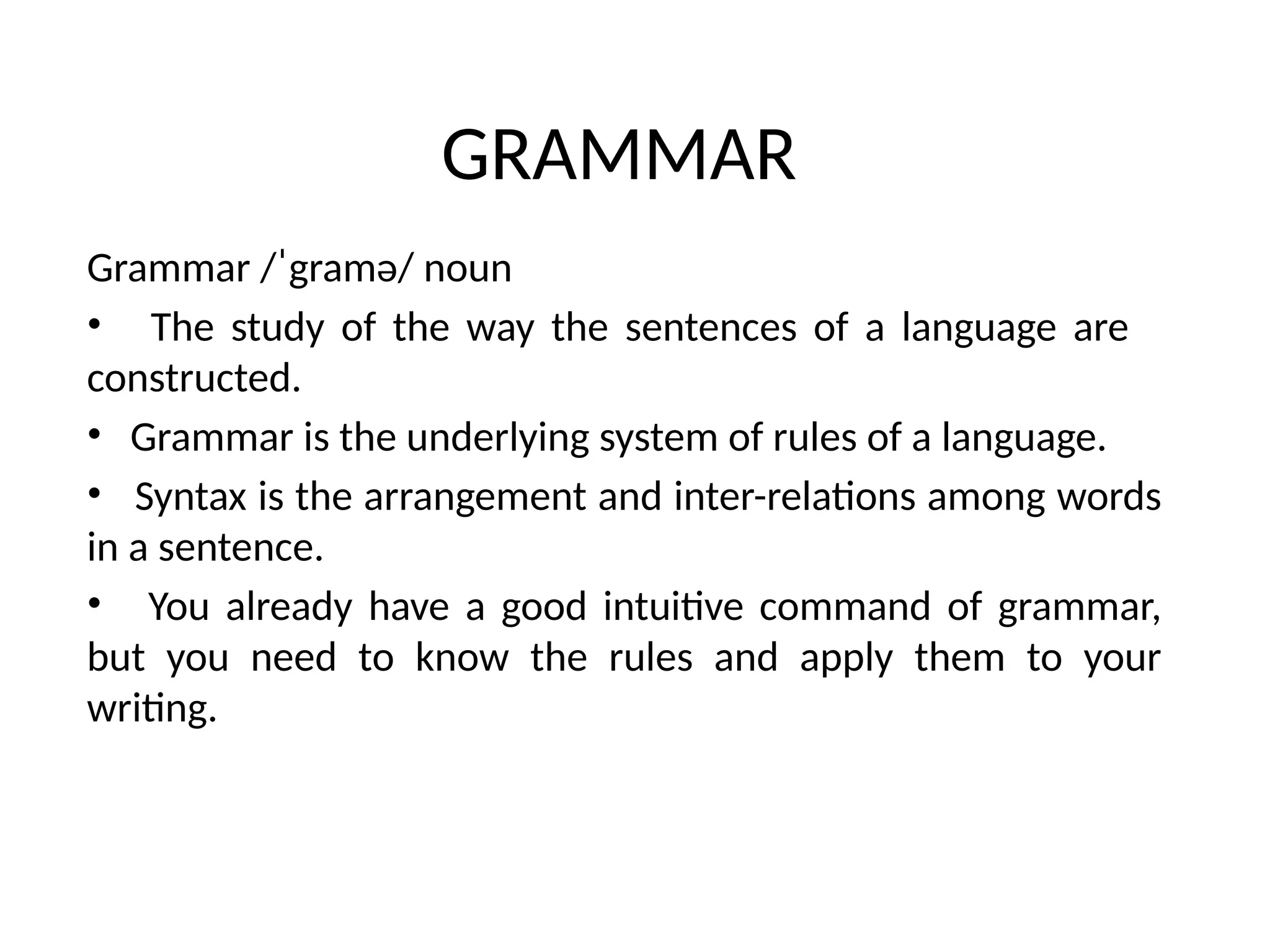
Grammar /ˈgramə/ noun
• The study of the way the sentences of a language are
constructed.
• Grammar is the underlying system of rules of a language.
• Syntax is the arrangement and inter-relations among words
in a sentence.
• You already have a good intuitive command of grammar,
but you need to know the rules and apply them to your
writing.
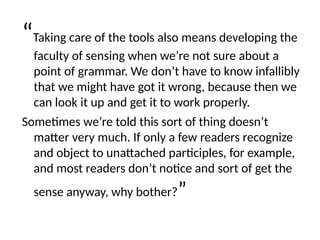
“Taking care of the tools also means developing the
faculty of sensing when we’re not sure about a
point of grammar. We don’t have to know infallibly
that we might have got it wrong, because then we
can look it up and get it to work properly.
Sometimes we’re told this sort of thing doesn’t
matter very much. If only a few readers recognize
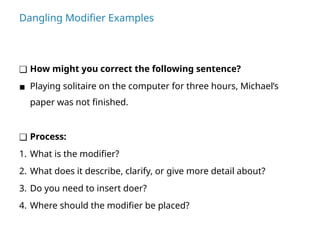
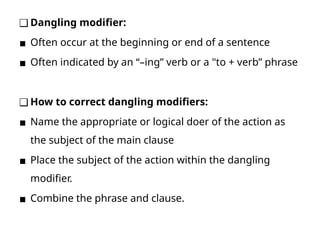
and object to unattached participles, for example,
and most readers don’t notice and sort of get the
sense anyway, why bother?”
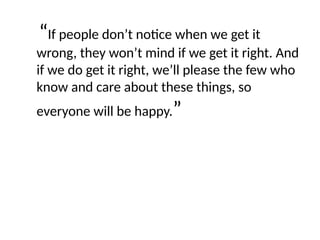
“If people don’t notice when we get it
wrong, they won’t mind if we get it right. And
if we do get it right, we’ll please the few who
know and care about these things, so
everyone will be happy.”
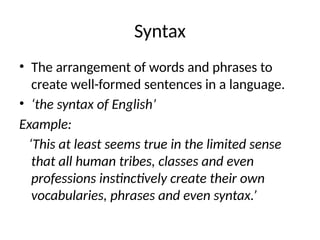
Syntax
• The arrangement of words and phrases to
create well-formed sentences in a language.
• ‘the syntax of English’
Example:
‘This at least seems true in the limited sense
that all human tribes, classes and even
professions instinctively create their own
vocabularies, phrases and even syntax.’
‘The meaning of a word varies when syntax is
arranged differently.’
‘Try to imagine a world without language; a
world where words, grammar and syntax
suddenly become meaningless.’
‘He spent eight years teaching high school
Latin, which perhaps explains the purity of his
syntax and word choices.’
Concord
Agreement between words in gender, number,
case, person, or any other grammatical
category which affects the forms of the words.
• Formal: Agreement or harmony between
people or groups.
• ‘a pact of peace and concord’
Parts of Speech
TRADITIONAL PARTS OF SPEECH
• 1. Noun: naming word (a chance)
• 2. Pronoun: noun substitute (their last chance)
• 3. Verb: doing or being word (they lost the chance)
• 4. Adjective: describes nouns or pronouns (fat chance)
• 5. Adverb: describes adjectives, verbs, or other adverbs (a very slim
chance; she danced divinely)
• 6. Article: specifies definiteness or indefiniteness of a noun (the
dance; a good chance)
• 7. Conjunction: joining word (a slim chance and a very slim chance)
• 8. Preposition: word that positions (at the dance)
• 9. Interjection: conveys emotion or sentiment (Wow! What a
dance!)
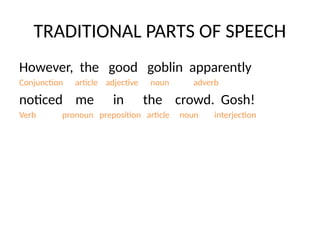
TRADITIONAL PARTS OF SPEECH
However, the good goblin apparently
Conjunction article adjective noun adverb
noticed me in the crowd. Gosh!
Verb pronoun preposition article noun interjection
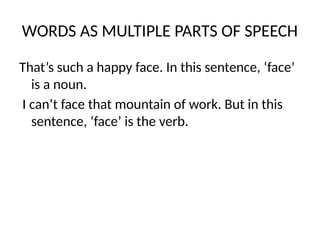
WORDS AS MULTIPLE PARTS OF SPEECH
That’s such a happy face. In this sentence, ‘face’
is a noun.
I can’t face that mountain of work. But in this
sentence, ‘face’ is the verb.
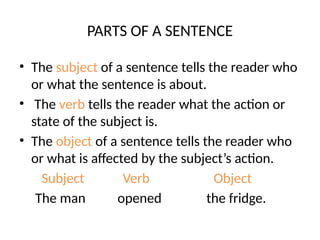
PARTS OF A SENTENCE
• The subject of a sentence tells the reader who
or what the sentence is about.
• The verb tells the reader what the action or
state of the subject is.
• The object of a sentence tells the reader who
or what is affected by the subject’s action.
Subject Verb Object
The man opened the fridge.
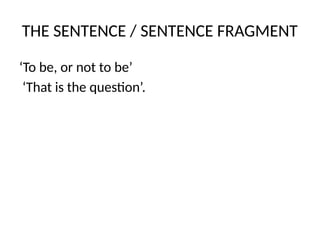
THE SENTENCE / SENTENCE FRAGMENT
‘To be, or not to be’
‘That is the question’.
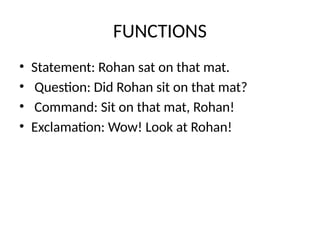
FUNCTIONS
• Statement: Rohan sat on that mat.
• Question: Did Rohan sit on that mat?
• Command: Sit on that mat, Rohan!
• Exclamation: Wow! Look at Rohan!
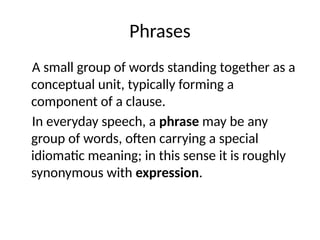
Phrases
A small group of words standing together as a
conceptual unit, typically forming a
component of a clause.
In everyday speech, a phrase may be any
group of words, often carrying a special
idiomatic meaning; in this sense it is roughly
synonymous with expression.
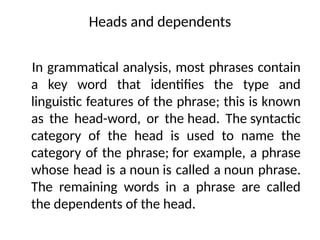
Heads and dependents
In grammatical analysis, most phrases contain
a key word that identifies the type and
linguistic features of the phrase; this is known
as the head-word, or the head. The syntactic
category of the head is used to name the
category of the phrase; for example, a phrase
whose head is a noun is called a noun phrase.
The remaining words in a phrase are called
the dependents of the head.
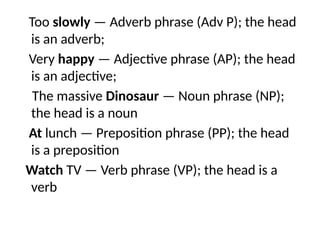
Too slowly — Adverb phrase (Adv P); the head
is an adverb;
Very happy — Adjective phrase (AP); the head
is an adjective;
The massive Dinosaur — Noun phrase (NP);
the head is a noun
At lunch — Preposition phrase (PP); the head
is a preposition
Watch TV — Verb phrase (VP); the head is a
verb
A CLAUSE
A clause is a group of words that includes a subject and
a verb.
A clause can be distinguished from a phrase, which does
not contain a subject and a verb (e.g., in the
afternoon, drinking from the bowl).
An independent clause can express a complete thought
(and can be a standalone sentence). A dependent
clause is usually a supporting part of a sentence, and it
cannot stand by itself as a meaningful proposition (idea).
• Clause
I climbed the stairs.
• A dependent (subordinate) clause does not
make sense on its own.
Because I climbed the stairs.
A Clause may have a combination of 5 elements:
Subject
Verb
Object
Complement
Adverbial
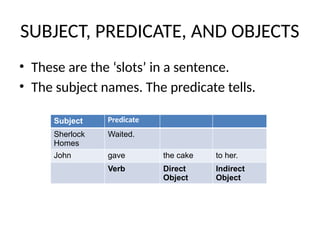
SUBJECT, PREDICATE, AND OBJECTS
• These are the ‘slots’ in a sentence.
• The subject names. The predicate tells.
Subject Predicate
Sherlock
Homes
Waited.
John gave the cake to her.
Verb Direct
Object
Indirect
Object
SENTENCE STRUCTURES / FORMS
1.Simple: one independent clause. Sherlock Holmes waited.
2. Compound: two or more independent clauses.
a) Sherlock Holmes waited ; however, Watson delayed his visit.
b) Sherlock Holmes waited, and [he] was missed at Lloyd’s
registers.
3. Complex: one dependent clause subordinated to one
independent clause, either at the beginning, in the middle, or at
the end.
a) While Watson moved the lamp, Sherlock Holmes waited.
b) Sherlock Holmes, though he was anxious to have his dinner,
waited.
c) Sherlock Holmes waited, while Watson moved the lamp.
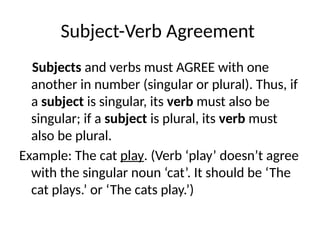
Subject-Verb Agreement
Subjects and verbs must AGREE with one
another in number (singular or plural). Thus, if
a subject is singular, its verb must also be
singular; if a subject is plural, its verb must
also be plural.
Example: The cat play. (Verb ‘play’ doesn’t agree
with the singular noun ‘cat’. It should be ‘The
cat plays.’ or ‘The cats play.’)
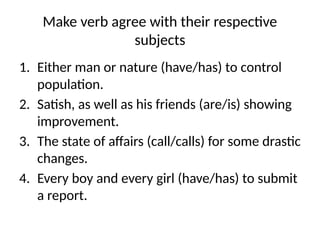
Make verb agree with their respective
subjects
1. Either man or nature (have/has) to control
population.
2. Satish, as well as his friends (are/is) showing
improvement.
3. The state of affairs (call/calls) for some drastic
changes.
4. Every boy and every girl (have/has) to submit
a report.
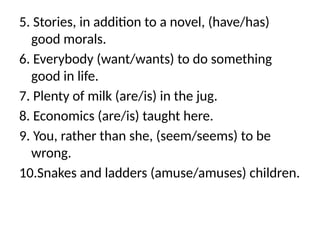
5. Stories, in addition to a novel, (have/has)
good morals.
6. Everybody (want/wants) to do something
good in life.
7. Plenty of milk (are/is) in the jug.
8. Economics (are/is) taught here.
9. You, rather than she, (seem/seems) to be
wrong.
10.Snakes and ladders (amuse/amuses) children.
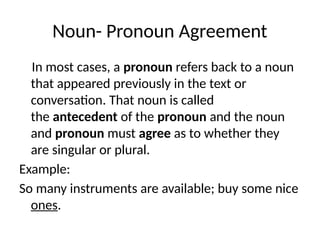
Noun- Pronoun Agreement
In most cases, a pronoun refers back to a noun
that appeared previously in the text or
conversation. That noun is called
the antecedent of the pronoun and the noun
and pronoun must agree as to whether they
are singular or plural.
Example:
So many instruments are available; buy some nice
ones.
Pronoun Reference
• A pronoun is a word used to stand for (or take the
place of) a noun. A pronoun should refer clearly to
one, clear, unmistakable noun coming before
the pronoun. This noun is called
the pronoun's antecedent.
• Every pronoun must agree with its antecedent
(the noun to which the pronoun refers or which it
replaces). A pronoun agrees with its antecedent when
they match in both number and gender.
Point out the antecedents
• He has been prompt in his reply, which
confirm my estimate of his character.
• Whom the chief favours, go places.
• She has come personally which means that
she is serious.
• Car-drivers are not supposed to drive the
vehicles when they are worn out and fatigued.
• When a remote control is used for channel-
surfing, it gives you a feeling of being in
command.
• This suggestion can remove the hurdles which
are causing us woes; these have been listed
here.
Prepositions
A preposition is a word such as after, in, to,
on, and with. Prepositions are usually used in front
of nouns or pronouns and they show
the relationship between the noun or pronoun and
other words in a sentence. They describe, for
example:
• the position of something:
Her bag was under the chair.
The dog crawled between us and lay down at our feet.
His flat was over the shop.
• the time when something happens:
They arrived on Sunday.
The class starts at 9 a.m.
Shortly after their marriage they moved to New
Delhi.
• the way in which something is done:
We went by train.
They stared at each other without speaking.
• Some prepositions are made up of more than
one word, for example:
They moved here because of the baby.
We sat next to each other.
The hotel is perched on top of a cliff.
Squinting Construction
• The word Squint means oblique or looking
askance, not directly.
Squinting construction therefore refers to
defective, diverted vision. In language it means
a loosely constructed sentence.
Squinting construction is generally the result of
carelessness and it makes a sentence vague,
ambiguous enigmatic and sometimes even
absurd.
Examples of squinting construction
• The items that we received finally met the
requirements.
• The people who reached the site timely were
able to welcome the visitors.
• The executive who complains about the
inadequate facilities endlessly postpones the
beginning of the actual work.
Jumbled Sentences
Proper sentences are made up of phrases and
their correct positioning within a given
sentence.
Steps to approach Jumbled Sentences
For Simple Sentences:
• Identify the subject.
• Identify the action (verb).
• Identify the object.
• Identify the complement.
• Write the sentences and see if it makes proper
sense.
For Complex Sentences:
• Identify the main clause.
• Identify the subordinate clause.
• Put them in the right sequence to make the
sentence.
Example 1
About/dreamt/you/I/yesterday
Identify the subject.
Identify the action.
Identify the object.
Identify the adverbial adjunct.
Example 2
Rohan/has not finished/her/yet/work.
• Identify the subject.
• Identify the action.
• Identify the object.
• Identify the adverbial adjunct.
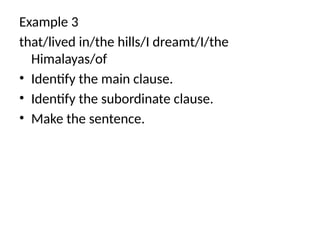
Example 3
that/lived in/the hills/I dreamt/I/the
Himalayas/of
• Identify the main clause.
• Identify the subordinate clause.
• Make the sentence.
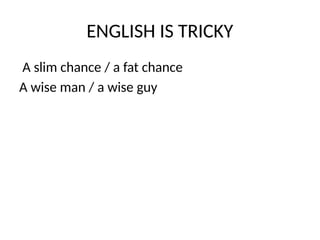
ENGLISH IS TRICKY
A slim chance / a fat chance
A wise man / a wise guy
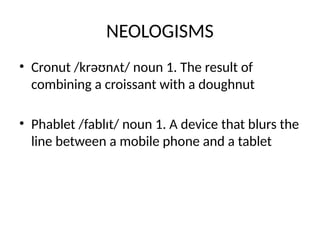
NEOLOGISMS
• Cronut /krəʊnʌt/ noun 1. The result of
combining a croissant with a doughnut
• Phablet /fablɪt/ noun 1. A device that blurs the
line between a mobile phone and a tablet
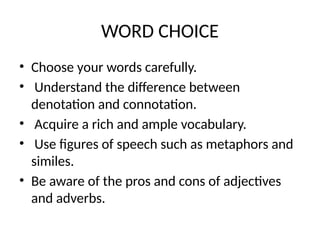
WORD CHOICE
• Choose your words carefully.
• Understand the difference between
denotation and connotation.
• Acquire a rich and ample vocabulary.
• Use figures of speech such as metaphors and
similes.
• Be aware of the pros and cons of adjectives
and adverbs.
ONE WORD OR TWO?
• This must-have policy is one that you must
have.
• This set-up is one that will set up a firm
structure.
SPELLING DIFFERENCES?
• Centre and center
• Honour and honor
• Defence and defense
• Organise and organize
• Mould and mold
British and American
Words ending in –re
• British English words that end in -re often end in -
er in American English:
• British US
• Centre center
• Fibre fiber
• Litre liter
• Theatre theater or theatre
Words ending in -our
• British English words ending in -our usually end
in -or in American English:
• British US
• Colour color
• Flavour flavor
• Humour humor
• Labour labor
• Neighbour neighbor
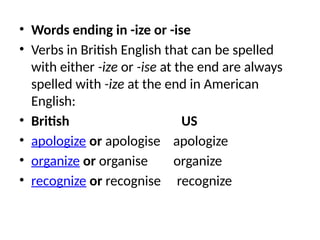
• Words ending in -ize or -ise
• Verbs in British English that can be spelled
with either -ize or -ise at the end are always
spelled with -ize at the end in American
English:
• British US
• apologize or apologise apologize
• organize or organise organize
• recognize or recognise recognize
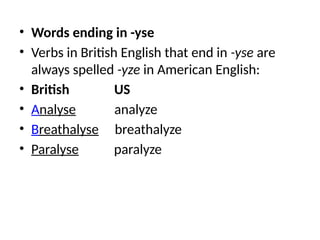
• Words ending in -yse
• Verbs in British English that end in -yse are
always spelled -yze in American English:
• British US
• Analyse analyze
• Breathalyse breathalyze
• Paralyse paralyze
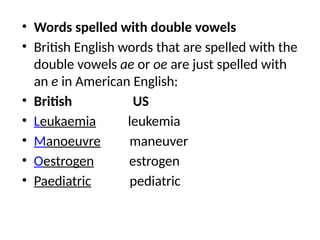
• Words spelled with double vowels
• British English words that are spelled with the
double vowels ae or oe are just spelled with
an e in American English:
• British US
• Leukaemia leukemia
• Manoeuvre maneuver
• Oestrogen estrogen
• Paediatric pediatric
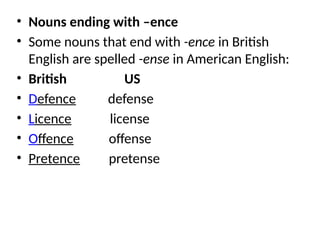
• Nouns ending with –ence
• Some nouns that end with -ence in British
English are spelled -ense in American English:
• British US
• Defence defense
• Licence license
• Offence offense
• Pretence pretense
• Nouns ending with –ogue
• Some nouns that end with -ogue in British
English end with either -og or -oguein
American English:
• British US
• Analogue analog or analogue
• Catalogue catalog or catalogue
• Dialogue dialog or dialogue
• The distinctions here are not hard and fast.
The spelling analogue is acceptable but not
very common in American English; catalog has
become the US norm, but catalogue is not
uncommon; dialogue is still preferred
over dialog.
• Aside from spelling differences, many items
and practices have different names in British
and American English. To explore further, see
British and American terms.
DIFFERENT TERMS
• Faucet/tap
• Movie/film
• Candy/sweets
• Cookie/biscuit
• Elevator/lift
• Check/bill
PRONOUNCING WORDS CORRECTLY
• Expresso – (Espresso)
• Anythink – (Anything)
• Datheth – (Date)
• Deteriate – (Deteriorate)
• Haitch – (Aitch)
• Stastistic – (Statistic)
AVOID FILLERS
• Ask not what your country can, you know, do
for you, but what you can, like, do for your
country, actually?
COMMUNICATION
CHAPTER 1
COMMUNICATION
Dr Tanu Sharma 57
https://youtu.be/
D3a3fgUkw6c
Introduction – Communication
Business Communication
Communication Process
Communication Barriers
Overcoming Communication
Barriers
What is there in it
Dr Tanu Sharma 58
Introduction Communication
• The word communication is
derived from a Latin word
‘Communis’ which means to
share or to participate.
• Two-way process of reaching
mutual understanding, in which
parties involved exchange
information, news, ideas and
feelings.
Dr Tanu Sharma 59
COMMUNICATION
• Communication is simply the act of transferring information from one place,
person or group to another.
• Every communication involves (at least) one sender, a message and a recipient.
This may sound simple, but communication is actually a very complex subject.
• The transmission of the message from sender to recipient can be affected by a huge
range of things. These include our emotions, the cultural situation, the medium used
to communicate, and even our location. The complexity is why good communication
skills are considered so desirable by employers around the world: accurate, effective
and unambiguous communication is actually extremely hard.
Dr Tanu Sharma 60
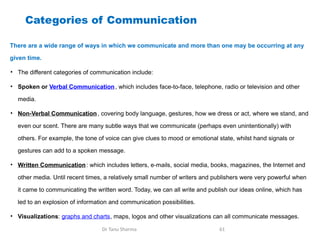
Categories of Communication
There are a wide range of ways in which we communicate and more than one may be occurring at any
given time.
• The different categories of communication include:
• Spoken or Verbal Communication, which includes face-to-face, telephone, radio or television and other
media.
• Non-Verbal Communication, covering body language, gestures, how we dress or act, where we stand, and
even our scent. There are many subtle ways that we communicate (perhaps even unintentionally) with
others. For example, the tone of voice can give clues to mood or emotional state, whilst hand signals or
gestures can add to a spoken message.
• Written Communication: which includes letters, e-mails, social media, books, magazines, the Internet and
other media. Until recent times, a relatively small number of writers and publishers were very powerful when
it came to communicating the written word. Today, we can all write and publish our ideas online, which has
led to an explosion of information and communication possibilities.
• Visualizations: graphs and charts, maps, logos and other visualizations can all communicate messages.
Dr Tanu Sharma 61
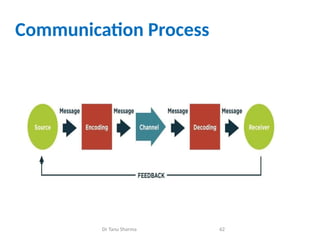
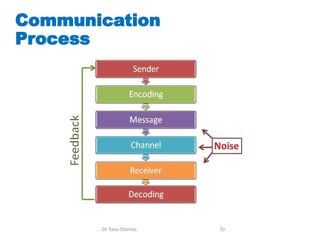
Communication Process
Dr Tanu Sharma 62
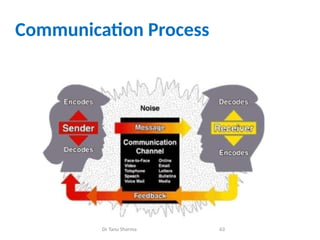
Communication Process
Dr Tanu Sharma 63
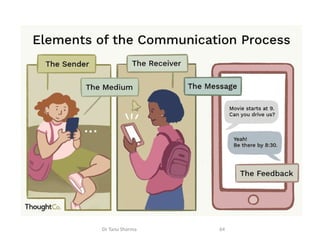
Dr Tanu Sharma 64
Communication Process
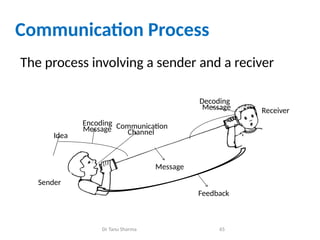
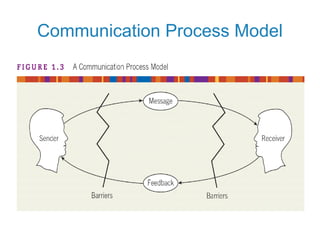
The process involving a sender and a reciver
Sender
Receiver
Message
Communication
Channel
Idea
Encoding
Message
Decoding
Message
Feedback
Dr Tanu Sharma 65
Communication
Process
• The communication process refers to a
series of actions or steps taken in order to
successfully communicate. It involves
several components such as the sender of
the communication, the actual message
being sent, the encoding of the message,
the receiver and the decoding of the
message
Dr Tanu Sharma 66
Communications is a continuous process which mainly
involves three elements viz. sender, message, and
receiver. The elements involved in the communication
process are explained below in detail:
1. Sender
• The sender or the communicator generates the
message and conveys it to the receiver. He is the
source and the one who starts the communication
2. Message
• It is the idea, information, view, fact, feeling, etc. that is
generated by the sender and is then intended to be
communicated further.
Dr Tanu Sharma 67
3. Encoding
• The message generated by the sender is encoded
symbolically such as in the form of words, pictures,
gestures, etc. before it is being conveyed.
4. Media
• It is the manner in which the encoded message is
transmitted. The message may be transmitted
orally or in writing. The medium of communication
includes telephone, internet, post, fax, e-mail, etc.
The choice of medium is decided by the sender.
5. Decoding
• It is the process of converting the symbols
encoded by the sender. After decoding the
message is received by the receiver.
Dr Tanu Sharma 68
6. Receiver
• He is the person who is last in the chain and for whom the
message was sent by the sender. Once the receiver
receives the message and understands it in proper
perspective and acts according to the message, only then
the purpose of communication is successful.
7. Feedback
• Once the receiver confirms to the sender that he has
received the message and understood it, the process of
communication is complete.
8. Noise
• It refers to any obstruction that is caused by the sender,
message or receiver during the process of communication.
For example, bad telephone connection, faulty encoding,
faulty decoding, inattentive receiver, poor understanding of
message due to prejudice or inappropriate gestures, etc.
Dr Tanu Sharma 69
Communication
Process
Dr Tanu Sharma 70
Importance of
Communication
1.The Basis of Co-ordination
• The manager explains to the employees the organizational goals,
modes of their achievement and also the interpersonal relationships
amongst them. This provides coordination between various employees
and also departments. Thus, communications act as a basis for
coordination in the organization.
2. Fluent Working
• A manager coordinates the human and physical elements of an
organization to run it smoothly and efficiently. This coordination is not
possible without proper communication.
3. The Basis of Decision Making
• Proper communication provides information to the manager that is
useful for decision making. No decisions could be taken in the absence
of information. Thus, communication is the basis for taking the right
decisions.
Dr Tanu Sharma 71
4. Increases Managerial Efficiency
• The manager conveys the targets and issues instructions and
allocates jobs to the subordinates. All of these aspects involve
communication. Thus, communication is essential for the quick
and effective performance of the managers and the entire
organization.
5. Increases Cooperation and Organizational Peace
• The two-way communication process promotes co-operation and
mutual understanding amongst the workers and also between
them and the management. This leads to less friction and thus
leads to industrial peace in the factory and efficient operations.
6. Boosts Morale of the Employees
• Good communication helps the workers to adjust to the physical
and social aspect of work. It also improves good human relations
in the industry. An efficient system of communication enables the
management to motivate, influence and satisfy the subordinates
which in turn boosts their morale and keeps them motivated.
Dr Tanu Sharma 72
What is Business Communication ?
• Business communication involves constant flow of information. Feedback is integral
part of business communication. Organizations these days are very large and involve
large number of people. There are various levels of hierarchy in an organization.
Greater the number of levels, the more difficult is the job of managing the organization.
• Communication here plays a very important role in process of directing and controlling
the people in the oragnization. Immediate feedback can be obtained and
misunderstandings if any can be avoided.
• There should be effective communication between superiors and subordinated in an
organization, between organization and society at large (for example between
management and trade unions). It is essential for success and growth of an
organization. Communication gaps should not occur in any organization.
Dr Tanu Sharma 73
Business
Communication
• Business Communication is goal oriented. The rules,
regulations and policies of a company have to be
communicated to people within and outside the
organization. Business Communication is regulated by
certain rules and norms. In early times, business
communication was limited to paper-work, telephone calls
etc. But now with advent of technology, we have cell
phones, video conferencing, emails, satellite
communication to support business communication.
Effective business communication helps in building
goodwill of an organization.
Dr Tanu Sharma 74
Business
Communication
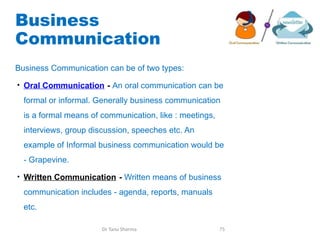
Business Communication can be of two types:
• Oral Communication - An oral communication can be
formal or informal. Generally business communication
is a formal means of communication, like : meetings,
interviews, group discussion, speeches etc. An
example of Informal business communication would be
- Grapevine.
• Written Communication - Written means of business
communication includes - agenda, reports, manuals
etc.
Dr Tanu Sharma 75
Oral communication
• Oral communication implies communication through
mouth. It includes individuals conversing with each other,
be it direct conversation or telephonic conversation.
Speeches, presentations, discussions are all forms of
oral communication. Oral communication is generally
recommended when the communication matter is of
temporary kind or where a direct interaction is required.
Face to face communication (meetings, lectures,
conferences, interviews, etc.) is significant so as to build
a rapport and trust.
Dr Tanu Sharma 76
Written
communication
• Written communication has great significance in today’s business
world. It is an innovative activity of the mind. Effective written
communication is essential for preparing worthy promotional
materials for business development. Speech came before writing.
But writing is more unique and formal than speech.
• Effective writing involves careful choice of words, their organization
in correct order in sentences formation as well as cohesive
composition of sentences. Also, writing is more valid and reliable
than speech. But while speech is spontaneous, writing causes delay
and takes time as feedback is not immediate.
Dr Tanu Sharma 77
Types of
Communication
1. Formal Communication
⮚Vertical Communication
⮚Horizontal Communication
2. Informal Communication
Dr Tanu Sharma 78
Types of Communication
1. Formal Communication
• Formal communications are the one which flows
through the official channels designed in the
organizational chart. It may take place between a
superior and a subordinate, a subordinate and a
superior or among the same cadre employees or
managers. These communications can be oral or in
writing and are generally recorded and filed in the
office.
• Formal communication may be further classified as
Vertical communication and Horizontal
communication.
Dr Tanu Sharma 79
Types of
Communication
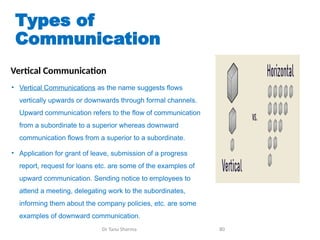
Vertical Communication
• Vertical Communications as the name suggests flows
vertically upwards or downwards through formal channels.
Upward communication refers to the flow of communication
from a subordinate to a superior whereas downward
communication flows from a superior to a subordinate.
• Application for grant of leave, submission of a progress
report, request for loans etc. are some of the examples of
upward communication. Sending notice to employees to
attend a meeting, delegating work to the subordinates,
informing them about the company policies, etc. are some
examples of downward communication.
Dr Tanu Sharma 80
Types of
Communication
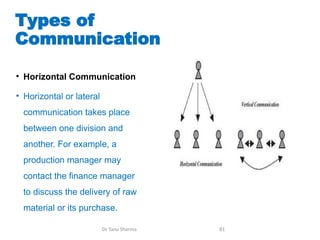
• Horizontal Communication
• Horizontal or lateral
communication takes place
between one division and
another. For example, a
production manager may
contact the finance manager
to discuss the delivery of raw
material or its purchase.
Dr Tanu Sharma 81
Dr Tanu Sharma 82
Types of Communication
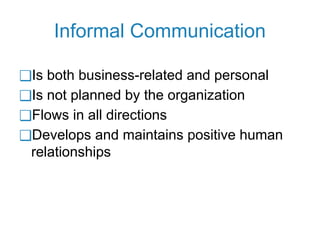
2. Informal Communication
• Any communication that takes place without following the formal
channels of communication is said to be informal communication.
The Informal communication is often referred to as the ‘grapevine’
as it spreads throughout the organization and in all directions
without any regard to the levels of authority.
• The informal communication spreads rapidly, often gets distorted
and it is very difficult to detect the source of such communication.
It also leads to rumors which are not true. People’s behavior is
often affected by the rumors and informal discussions which
sometimes may hamper the work environment.
• However, sometimes these channels may be helpful as they carry
information rapidly and, therefore, may be useful to the manager
at times. Informal channels are also used by the managers to
transmit information in order to know the reactions of his/her
subordinates.
Dr Tanu Sharma 83
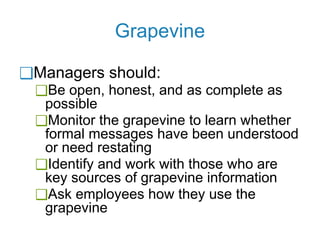
GRAPEVINE
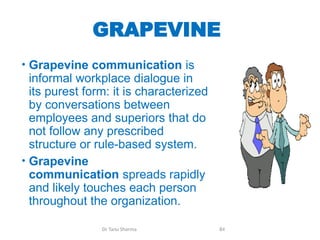
• Grapevine communication is
informal workplace dialogue in
its purest form: it is characterized
by conversations between
employees and superiors that do
not follow any prescribed
structure or rule-based system.
• Grapevine
communication spreads rapidly
and likely touches each person
throughout the organization.
Dr Tanu Sharma 84
Examples of Grapevine Network of
Communication
• Suppose the profit amount of a company is
known. Rumour is spread that this much profit
is there and on that basis bonus is declared.
• CEO may be in relation to the Production
Manager. They may have friendly relations
with each other.
Dr Tanu Sharma 85
Advantages of Grapevine
Communication
• Grapevine channels carry information rapidly. As soon as an employee gets to know
some confidential information, he becomes inquisitive and passes the details then to
his closest friend who in turn passes it to other. Thus, it spreads hastily.
• The managers get to know the reactions of their subordinates on their policies. Thus,
the feedback obtained is quick compared to formal channel of communication.
• The grapevine creates a sense of unity among the employees who share and discuss
their views with each other. Thus, grapevine helps in developing group cohesiveness.
• The grapevine serves as an emotional supportive value.
• The grapevine is a supplement in those cases where formal communication does not
work.
Dr Tanu Sharma 86
Disadvantages of Grapevine
Communication
• The grapevine carries partial information at times as it is more based on
rumours. Thus, it does not clearly depicts the complete state of affairs.
• The grapevine is not trustworthy always as it does not follows official path
of communication and is spread more by gossips and unconfirmed report.
• The productivity of employees may be hampered as they spend more time
talking rather than working.
• The grapevine leads to making hostility against the executives.
• The grapevine may hamper the goodwill of the organization as it may carry
false negative information about the high level people of the organization.
Dr Tanu Sharma 87
Communication
Barrier
Dr Tanu Sharma 88
Communication
Barriers
Barrier – Reason behind an un-effective communication.
The communication barriers may prevent communication or
carry incorrect meaning due to which misunderstandings may be
created. Therefore, it is essential for a manager to identify such
barriers and take appropriate measures to overcome them. The
barriers to communication in organizations can be broadly
grouped as follows:
Semantic, Organizational, Personal, Psychological.
Dr Tanu Sharma 89
1. Semantic Barriers
• These are concerned with the problems and obstructions in
the process of encoding and decoding of a message into
words or impressions. Normally, such barriers result due to
use of wrong words, faulty translations, different
interpretations, etc.
• For example, a manager has to communicate with workers
who have no knowledge of the English language and on
the other side, he is not well conversant with the Hindi
language. Here, language is a barrier to communication as
the manager may not be able to communicate properly
with the workers.
Dr Tanu Sharma 90
2. Psychological Barriers
• Emotional or psychological factors also act as barriers to
communication. The state of mind of both sender and
receiver of communication reflects in effective
communication. A worried person cannot communicate
properly and an angry recipient cannot understand the
message properly.
• Thus, at the time of communication, both the sender and
the receiver need to be psychologically sound. Also, they
should trust each other. If they do not believe each other,
they cannot understand each other’s message in its
original sense.
Dr Tanu Sharma 91
3. Organizational Barriers
• The factors related to organizational structure,
rules and regulations authority relationships, etc.
may sometimes act as barriers to effective
communication. In an organization with a highly
centralized pattern, people may not be
encouraged to have free communication. Also,
rigid rules and regulations and cumbersome
procedures may also become a hurdle to
communication.
Dr Tanu Sharma 92
4. Personal Barriers
• The personal factors of both sender and receiver may
act as a barrier to effective communication. If a
superior thinks that a particular communication may
adversely affect his authority, he may suppress such
communication.
• Also, if the superiors do not have confidence in the
competency of their subordinates, they may not ask for
their advice. The subordinates may not be willing to
offer useful suggestions in the absence of any reward
or appreciation for a good suggestion.
Dr Tanu Sharma 93
Overcoming
Communication Barriers
• There are a lot of communication barriers faced these
days by all. The message intended by the sender is not
understood by the receiver in the same terms and sense
and thus communication breakdown occurs. It is essential
to deal and cope up with these communication barriers so
as to ensure smooth and effective communication.
•
Dr Tanu Sharma 94
• Eliminating differences in perception
• Use of Simple Language: Use of simple and clear words should be emphasized. Use of
ambiguous words and jargons should be avoided.
• Reduction and elimination of noise levels: Noise is the main communication barrier which
must be overcome on priority basis. It is essential to identify the source of noise and then
eliminate that source.
• Active Listening: Listen attentively and carefully. There is a difference between “listening”
and “hearing”. Active listening means hearing with proper understanding of the message that
is heard. By asking questions the speaker can ensure whether his/her message is understood
or not by the receiver in the same terms as intended by the speaker.
• Emotional State: During communication one should make effective use of body language.
He/she should not show their emotions while communication as the receiver might
misinterpret the message being delivered. For example, if the conveyer of the message is in a
bad mood then the receiver might think that the information being delivered is not good.
Dr Tanu Sharma 95
• Simple Organizational Structure: The organizational structure should not be complex. The number of
hierarchical levels should be optimum. There should be a ideal span of control within the organization.
Simpler the organizational structure, more effective will be the communication.
• Avoid Information Overload: The managers should know how to prioritize their work. They should not
overload themselves with the work. They should spend quality time with their subordinates and should
listen to their problems and feedbacks actively.
• Give Constructive Feedback: Avoid giving negative feedback. The contents of the feedback might be
negative, but it should be delivered constructively. Constructive feedback will lead to effective
communication between the superior and subordinate.
• Proper Media Selection: The managers should properly select the medium of communication. Simple
messages should be conveyed orally, like: face to face interaction or meetings. Use of written means of
communication should be encouraged for delivering complex messages. For significant messages
reminders can be given by using written means of communication such as : Memos, Notices etc.
• Flexibility in meeting the targets: For effective communication in an organization the managers
should ensure that the individuals are meeting their targets timely without skipping the formal channels
of communication. There should not be much pressure on employees to meet their targets.
Dr Tanu Sharma 96
Self assessment
Q1. List the measures to improve communication effectiveness?
Answer: Measures to improve communication effectiveness are as
follows
• Communication of Clarification of the idea.
• Communication should be according to the needs of the receiver.
• Consulting others before communication.
• Awareness about the language, tone and body postures and gestures.
• Convey information useful to the receiver.
• Ensure proper feedback.
• Follow up communications.
• Be a good listener.
Dr Tanu Sharma 97
Positive, Neutral, and Social
Business Messages
Types of Messages
❑Positive or neutral
❑Claims
❑Adjustments
❑Social business messages
Positive or Neutral Message
❑Information will be pleasant, favorable, or neutral
to the receiver
❑The message may
❑Provide routine or unsolicited information
❑Request information or action
❑Respond favorably to a request for
information or action
Direct Plan
for Positive or Neutral Messages
❑The opening
❑The explanation
❑The sales appeal (if appropriate)
❑The friendly close
The Opening
❑Give the positive or neutral information.
❑Be optimistic.
❑Provide coherence.
❑Use emphasis techniques.
❑Stress receiver interests and benefits.
The Explanation
❑Present related information
❑Be objective
❑Be concise
❑Be positive
The Sales Appeal
(if appropriate)
❑Personalize the message
❑Suggest alternatives if appropriate
❑Aim for quick action
The Friendly Close
❑Build goodwill
❑Be concise
❑Be positive
❑Express appreciation
Requests for Information or Action
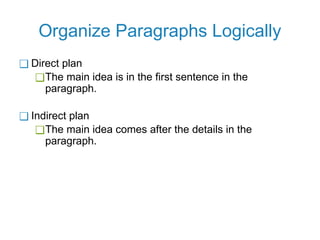
❑Use the direct plan
❑Present request and reason
❑Give information necessary for a response
❑Ask for action
Request Approvals
❑Use the direct plan
❑Open with the good news
❑Provide details or an explanation
❑Include a friendly close
Claims
❑Use the direct plan
❑Present the claim and its impact
❑Provide an explanation with background
information
❑State what you want the receiver to do
❑Include a friendly, optimistic close
Claim Adjustments
❑This is a positive response to a claim
❑Use the direct plan
❑Positive information
❑Convincing explanation
❑Effective, personalized sales appeal
❑Positive close
Negative Messages
Negative Messages
❑Convey unpleasant, disappointing, or
unfavorable information for the receiver
❑Can be an opportunity to resolve a business
problem successfully
Negative Messages
❑May use the direct or indirect plan
❑Consider these questions:
❑What message does the receiver expect?
❑How will the receiver respond emotionally to
the negative message?
❑Will it affect the individual’s ego or self-
esteem?
Use The Indirect Plan if:
❑The receiver expects a positive response.
❑The negative message affects the receiver
personally and will be upsetting.
❑The negative message is of importance, and the
receiver will react negatively.
❑The receiver prefers indirect communication due
to culture or other reasons.
Use the Direct Plan if:
❑The negative message may be expected, is
routine, or will not be upsetting to the receiver.
❑The negative information needs to be
emphasized.
❑Your receiver’s preference, cultural or otherwise,
is directness.
❑The message responds to a death or a tragedy.
Three Keys of Effective
Communicators
❑Adapt the message to the receiver’s viewpoint.
❑Emphasize positive, bias-free words.
❑Show respect for the receiver’s needs and
interests.
The Indirect Plan
❑Enables receivers to accept negative information
❑Enables receivers to maintain a satisfactory
relationship with you and your organization
Negative Messages Using the
Indirect Plan
❑Refused claims
❑Refused requests
❑Unfavorable decisions
❑Unsolicited unpleasant information
The Indirect Plan
❑Opening buffer
❑Logical explanation
❑Negative information
❑Constructive follow-up
❑Friendly close
Opening Buffer
❑Provides coherence
❑Builds goodwill
❑Is positive
❑Maintains neutrality and introduces the
explanation
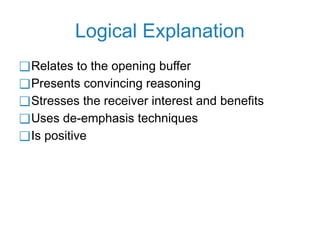
Logical Explanation
❑Relates to the opening buffer
❑Presents convincing reasoning
❑Stresses the receiver interest and benefits
❑Uses de-emphasis techniques
❑Is positive
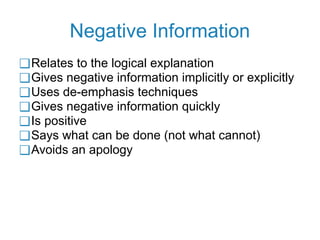
Negative Information
❑Relates to the logical explanation
❑Gives negative information implicitly or explicitly
❑Uses de-emphasis techniques
❑Gives negative information quickly
❑Is positive
❑Says what can be done (not what cannot)
❑Avoids an apology
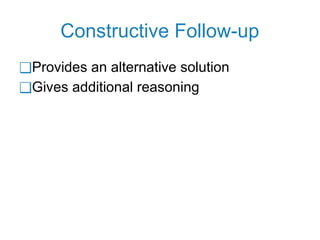
Constructive Follow-up
❑Provides an alternative solution
❑Gives additional reasoning
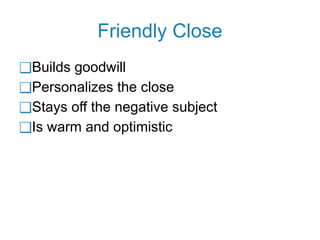
Friendly Close
❑Builds goodwill
❑Personalizes the close
❑Stays off the negative subject
❑Is warm and optimistic
Delivery Modes
❑Deliver important negative messages orally and
follow up with a written message.
❑Write negative messages that cannot be
handled orally on organization stationery.
❑Use email for most responses to email.
Use the Indirect Plan for
❑Request refusals
❑Denial of something that someone asked for
❑Adjustment refusals
❑Denial of a claim
❑Credit or loan refusals
❑Rejection of a loan or credit request
Unsolicited Negative Messages
❑May use the modified indirect plan
❑Begin with an explanation
❑Describe the changes and implications
❑End with a friendly close
Using the Direct Plan for Negative
Messages
❑ Begin with the main idea.
❑ Follow with the logical explanation.
❑ Then include the constructive follow-up.
❑ Finish with a friendly close.
Persuasive
Messages
Persuasive Message
❑A request for action when you believe the
receiver may be unaware, disinterested, or
unwilling
❑A communication to try to change the opinion of
a receiver
Planning the Persuasive Message
❑Analyze your receiver.
❑Identify the receiver’s motivators—his or her
goals, values, and needs.
❑Use the you-viewpoint.
❑Stress the receiver’s interests and benefits.
Primary Purposes of Persuasive
Messages
❑To have the receiver read or listen to the entire
message
❑To have the receiver take the requested action
133
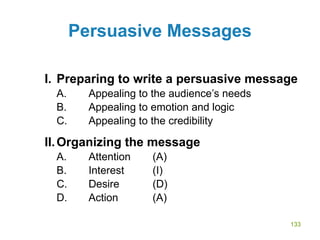
Persuasive Messages
I. Preparing to write a persuasive message
A. Appealing to the audience’s needs
B. Appealing to emotion and logic
C. Appealing to the credibility
II.Organizing the message
A. Attention (A)
B. Interest (I)
C. Desire (D)
D. Action (A)
134
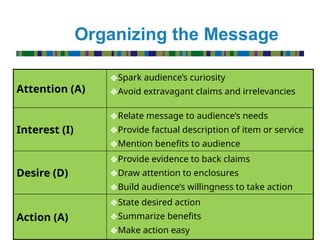
Organizing the Message
Attention (A)
❖Spark audience’s curiosity
❖Avoid extravagant claims and irrelevancies
Interest (I)
❖Relate message to audience’s needs
❖Provide factual description of item or service
❖Mention benefits to audience
Desire (D)
❖Provide evidence to back claims
❖Draw attention to enclosures
❖Build audience’s willingness to take action
Action (A)
❖State desired action
❖Summarize benefits
❖Make action easy
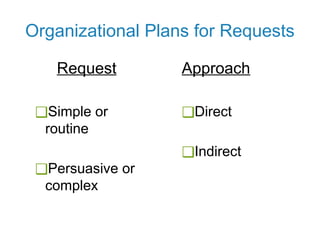
Organizational Plans for Requests
Request
❑Simple or
routine
❑Persuasive or
complex
Approach
❑Direct
❑Indirect
Recommendations
❑Recommendations attempt to persuade the
receiver to take the action proposed by the
sender.
❑Indirect plan used.
Organizational Plans for Claims
Claim
❑Simple or
routine
❑Special or
nonroutine
Approach
❑Direct
❑Indirect
Special Claims
❑Special or nonroutine claims are those in which
the fault is disputable.
❑Use the indirect plan.
Sales Messages
❑Sales messages take many different forms.
❑Know the product or service and its strengths,
weaknesses, competitors, and market.
Goal of Collection Messages
❑To collect the money due
❑To retain goodwill with the customer
Three Stages of Collection
Messages
❑Reminder
❑Appeal
❑Warning
Reminder
❑Is courteous because non-payment was likely an
oversight
❑Should use the direct plan
Appeal
❑Stronger message than the reminder stage
❑Should use the indirect plan
Warning
❑Last opportunity to pay before transfer to a
collection agency, a credit bureau, or an attorney
❑Only interest is in collecting past due amount
❑Should use the direct plan
❑Goodwill does not have to be maintained
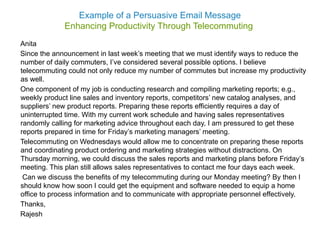
Example of a Persuasive Email Message
Enhancing Productivity Through Telecommuting
Anita
Since the announcement in last week’s meeting that we must identify ways to reduce the
number of daily commuters, I’ve considered several possible options. I believe
telecommuting could not only reduce my number of commutes but increase my productivity
as well.
One component of my job is conducting research and compiling marketing reports; e.g.,
weekly product line sales and inventory reports, competitors’ new catalog analyses, and
suppliers’ new product reports. Preparing these reports efficiently requires a day of
uninterrupted time. With my current work schedule and having sales representatives
randomly calling for marketing advice throughout each day, I am pressured to get these
reports prepared in time for Friday’s marketing managers’ meeting.
Telecommuting on Wednesdays would allow me to concentrate on preparing these reports
and coordinating product ordering and marketing strategies without distractions. On
Thursday morning, we could discuss the sales reports and marketing plans before Friday’s
meeting. This plan still allows sales representatives to contact me four days each week.
Can we discuss the benefits of my telecommuting during our Monday meeting? By then I
should know how soon I could get the equipment and software needed to equip a home
office to process information and to communicate with appropriate personnel effectively.
Thanks,
Rajesh
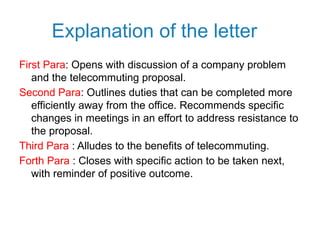
Explanation of the letter
First Para: Opens with discussion of a company problem
and the telecommuting proposal.
Second Para: Outlines duties that can be completed more
efficiently away from the office. Recommends specific
changes in meetings in an effort to address resistance to
the proposal.
Third Para : Alludes to the benefits of telecommuting.
Forth Para : Closes with specific action to be taken next,
with reminder of positive outcome.
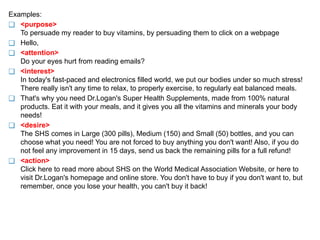
Examples:
❑ <purpose>
To persuade my reader to buy vitamins, by persuading them to click on a webpage
❑ Hello,
❑ <attention>
Do your eyes hurt from reading emails?
❑ <interest>
In today's fast-paced and electronics filled world, we put our bodies under so much stress!
There really isn't any time to relax, to properly exercise, to regularly eat balanced meals.
❑ That's why you need Dr.Logan's Super Health Supplements, made from 100% natural
products. Eat it with your meals, and it gives you all the vitamins and minerals your body
needs!
❑ <desire>
The SHS comes in Large (300 pills), Medium (150) and Small (50) bottles, and you can
choose what you need! You are not forced to buy anything you don't want! Also, if you do
not feel any improvement in 15 days, send us back the remaining pills for a full refund!
❑ <action>
Click here to read more about SHS on the World Medical Association Website, or here to
visit Dr.Logan's homepage and online store. You don't have to buy if you don't want to, but
remember, once you lose your health, you can't buy it back!
Power of Words
❑A rich vocabulary is the first requirement of good
expression.
❑English vocabulary is a mine of words which
seems to be inexhaustible.
❑To master language requires constant labour and
practice.
❑Just as we use multiplication table in Mathematics
to deal with infinite combinations of numbers, we
use methods to form several words from one word
and manage a great variety of forms.
“Words, so innocent and powerless as
they are, standing in a dictionary; how
potent for good and evil they become in
the hands of one who knows how to
choose and combine them.” — Nathaniel
Hawthorne
Purpose of vocabulary learning
Vocabulary is commonly defined as all the words
known and used by a particular person.
Unfortunately, this definition does not take into
account a range of issues involved in knowing a
word. There are some suggestions and conclusions
drawn from the studies related to vocabulary
acquisition such as keeping a notebook, regularly
reviewing and using vocabulary items in context. In
all areas it is very important to develop learners
speaking, reading/listening and writing vocabulary
to acquire language proficiency.
In everyday conversation we speak of
vocabulary in the singular; we speak of a
person’s vocabulary. This is actually an
oversimplification. The American Heritage
Dictionary defines vocabulary as “the sum
of words used by, understood by, or at the
command of a particular person or group.”
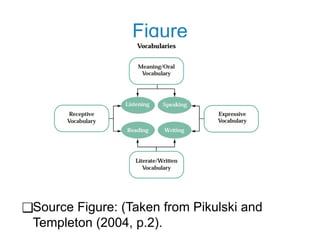
Figure
❑Source Figure: (Taken from Pikulski and
Templeton (2004, p.2).
Expressive Vocabulary
❑Expressive vocabulary consists of words
that we use when we speak or write.
Receptive vocabulary, on the other hand,
refers to words we confront when we listen
or read (Allen, 2006). Most often, we
require our expressive vocabulary
knowledge to be far greater than our
receptive vocabulary.
Receptive Vocabulary
❑With receptive vocabulary, we are
receiving information and don’t require as
much understanding. That is, you can
often comprehend the gist of what another
person is saying without understanding
every word in a sentence or conversation.
This is especially true because we
understand a spoken message with non-
verbal language and context clues.
Oral Vocabulary
❑Both listening and speaking is referred to as oral
vocabulary, whilst reading and writing denotes
literate vocabulary (Pikulski and Templeton,
2004). Apart from word meanings, oral vocabulary
particularly relies upon correct pronunciation.
Confusion and misunderstanding can result when
words are pronounced incorrectly. Hearing a word
said wrongly, or listening to a word that is not
spoken the way it is spelt, is often one of the
largest issues for the non-English speaker.
How to improve vocabulary?
❑When pondering the question of ‘how to
improve my vocabulary’, consider simply
listening. Research has demonstrated that
listening does build vocabulary – even
when the learner hears only a small
number of new words (Cohen, 2008).
Levels or ‘Tiers’ of Vocabulary by Beck et
al.
❑Level I Words
These are words that are used over and over in
everyday speech. Since they are so frequently used
in a variety of contexts, virtually everyone learn them.
Some examples of these words would be house, girl,
cat, up, umbrella, etc.
Level I words are sometimes referred to as
“conversational speech.” People learning English as
a second language will sometimes make progress
with this level of vocabulary but have difficulty making
progress with words at levels beyond this one
Level II Words
❑These are words that are likely to be learned
only through reading or through instruction.
They have been referred to as the vocabulary
of educated persons, as “academic
vocabulary,” and as “instructional vocabulary.”
They are words that are necessary for
general success in school. Words such as
perspective, generate, initiate, intermediate,
calculation, etc. are possible examples.
Level III Words
❑These are words associated with a particular
field of study or profession. These words make
up the technical vocabulary or jargon of a field.
Examples of Level III words from the field of
reading instruction include the terms digraph,
diphthong, schwa, metacomprehension, etc.
As one might expect, some words such as
calculation might be classified as either a
Level II or Level III word or both.
Level IV Words
❑These are words that are interesting but so rare and
esoteric that they are probably not useful even in most
educational environments, and they are not
associated with a field of study or profession.
Examples are words that were but no longer are used:
majuscule (a capital letter), xanthodont (one who has
yellow teeth like a rodent), noctuary (an account of
what happens in a night). Notice, however, that some
Level IV words are useful for teaching morphological
clues such as noct meaning “night” and dont or dent
referring to teeth. Level IV words are also helpful for
creating an interest in words and language.
Word Formation: Basic/Root/Primary
words
The words which have not been developed
or derived from any other word are known
as Root, basic or primary words.
For example:
White, tree, pain, drink, table etc.
Word Construction
The basic words can be developed into
several words, or classes of words, by
applying the following four methods:
1. Primary Derivational Construction
2. Secondary Derivational Construction
3. Compounding
4. Conversion
Primary Derivational Construction
When words are formed by effecting only
internal changes in the body of basic
words, we obtain primary derivatives. For
example:
Man (base) -- Men (plural)
Die (base) -- Death (noun)
Speak (base) – Speech(noun)
Blood (base) -- Bleed (verb)
In this category of word formation we
include all the changes which are effected
without adding a prefix or suffix to the
basic word.
We can derive nouns from verbs and
adjectives, and adjectives from nouns,
verbs and adjectives, and formation of
verbs from adjectives and nouns. We can
also derive plurals and feminine forms of
basic words.
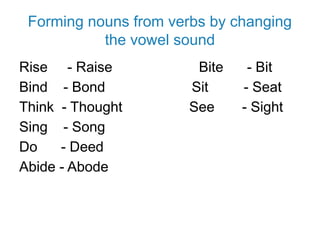
Forming nouns from verbs by changing
the vowel sound
Rise - Raise Bite - Bit
Bind - Bond Sit - Seat
Think - Thought See - Sight
Sing - Song
Do - Deed
Abide - Abode
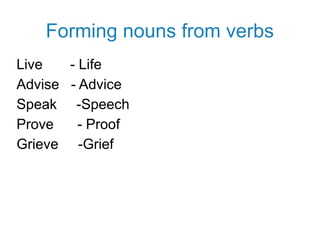
Forming nouns from verbs
Live - Life
Advise - Advice
Speak -Speech
Prove - Proof
Grieve -Grief
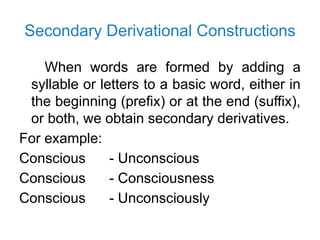
Secondary Derivational Constructions
When words are formed by adding a
syllable or letters to a basic word, either in
the beginning (prefix) or at the end (suffix),
or both, we obtain secondary derivatives.
For example:
Conscious - Unconscious
Conscious - Consciousness
Conscious - Unconsciously
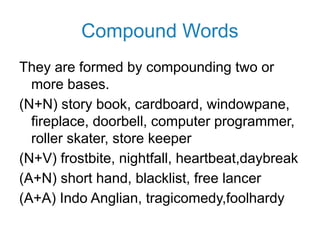
Compound Words
They are formed by compounding two or
more bases.
(N+N) story book, cardboard, windowpane,
fireplace, doorbell, computer programmer,
roller skater, store keeper
(N+V) frostbite, nightfall, heartbeat,daybreak
(A+N) short hand, blacklist, free lancer
(A+A) Indo Anglian, tragicomedy,foolhardy
Conversion
❑When we do not introduce any change in
the form of a base by primary or
secondary derivational construction, or by
compounding, we can form it into a new
word by assigning it to a different part of
speech. This process is called conversion.
Example:
1. Children play with a ball. (V)
2. They play in the play ground. (Adj)
3. Don’t think that it is a child’s play. (N)
4. He enjoyed his/her play-acting career.
(Adv)
The word ‘play’ retains its form, but it
functions as different parts of speech in
the above sentences.
Eponyms
Eponyms are the terms given to a particular
place, tribe, era, discovery or situation. Usually
such names and terms refer to some historical
characters, mythological figures or legendary or
fictional characters.
By eponyms the author/speaker/narrator intends
to convey the mystery, perplexity, controversy or
any other peculiarity about a person, place or
situation.
Eponyms are useful as it enriches our vocabulary
Eponyms and their uses
❑Word/Term: Achilles heel
❑Meaning/Background: A term used to
describe the vulnerable point on the body of
the invulnerable Achilles, the strongest
Greek warrior in the Trojan War.
❑Usage: Despite all the professed
preparation for the Cricket World Cup, the
careless fielding may turn out to be the
Indian team’s Achilles heel.
Word/Term: Narcissistic Attitude
Meaning and Background:
Excessive admiration for oneself, self-love,
egocentricism, and self-centredness. The
legend is derived from the legend of
Narcissus, a handsome Greek youth, who,
while seeing his reflection in a water pond,
fell in love with his own image.
Usage: We can certainly do a lot for the world
around us. For this, however, we need to rise
above our narcissistic tendencies and selfish
interests.
❑Word/term: Sisyphean task/Herculean
task/Mammoth task
❑Meaning/Background: A never ending labour, a
repetitive task full of tedium, drudgery and
boredom. The legend is derived from the story
of Sisyphus, who was punished for his
misdeeds to carry a huge boulder uphill. Every
time he reached the top of hill, the boulder
would slip down, forcing Sisyphus to go in its
chase once again.
❑Usage: Caught in the Sisyphean task everyday,
it’s difficult to give expression to acts of
creativity.
Some more words
❑Malapropism
❑Machiavellian
❑Chimerical
Developing Technical Vocabulary
Whatever field you choose to pursue, you
are bound to come across a large number
of words which are particular to that
subject or field of knowldege. For
achieving professional success, it is
crucial that you possess the technical
vocabulary to be able to communicate
well.
Laser Beams: Mostly they are just beams of
light but they have properties that
distinguish them from ordinary light.
Oxymoron: This combines two terms that
are normally contradictory to each other
such as pleasant nightmare, living death
Photosynthesis: a technique of converting
sunlight into energy, used by certain
organisms.
Telepathy: Knowing what other’s are feeling
through telepathy
Some more terms
❑Combustion: Two principal products being
water vapour and carbon dioxide.
❑Anthropologist: People who seek to
understand cultures, artifacts, knowledge
history of the world etc.
❑Amputate: Remove
❑Cookie: takes away browser memory
❑Juvenile: under age
Idiomatic Expressions
❑They add to one’s style of warmth,
intensity and a personal element which is
an essential feature of an emphatic and
effective expression. The context in which
they are used is also important.
❑Jump bail: Run away while being tried in
court
Example: He was on parole but he jumped
bail and was never traced.
❑Keep the ball rolling: Continue something
Example: Though there is no love left
between them Jimmy keeps the ball
rolling by calling up Alice sometimes.
❑Spill the beans: tell everything
unintentionally
Example: When the police exerted a little
more force, the thief spilled the beans.
❑Bad blood: Unfriendly feelings
Example: The movie shows how bad blood
between families can cause havoc.
❑Call it a day: To quit
Example: Immediately after the defeat, the
famous tennis star called it a day.
❑Spitting Image: Exact likeness
Example: We were astounded as he entered,
a spitting image of Amitabh Bachan.
❑Hand and Glove: Close cooperation in
something wrong or bad
Example: Criminals succeed because most
of the time the police are hand in glove
with them.
❑Halcyon days: Happy and peaceful times
Example: He craves for the halcyon days
when he was a child.
Based on your understanding, state if the
statements are true or false
❑A terrific act is one that terrifies you.
❑An accomplished speaker is quite
impressive.
❑A baritone voice is deep and powerful.
❑Inflections are the changes brought about in
the speech by a speaker.
❑If people are dressed immaculately, they are
dressed shabbily.
❑Things which are distinct are hardly visible.
❑An engrossing play is quite boring.
❑A drab life is quite monotonous.
❑A subtle joke is not direct.
❑Something puckish is mysterious.
❑A lanky person is lean and thin.
❑An emaciated person appears sturdy and
well built.
❑An enervated body is quite supple and
healthy.
Effective Communication
© 2006
Objectives
⮚ To consider verbal and non-verbal communication
methods
⮚ To understand and practise effective listening skills
⮚ To communicate in clear, respectful and non-
judgemental ways
⮚ To know when to seek advice
What is Communication?
What does it mean to you?
The process of communication is what allows us
to interact with other people; without it, we would
be unable to share knowledge or experiences
with anything outside of ourselves.
Common forms of communication include
speaking, writing, gestures, touch and
broadcasting.
Wikipedia definition
What is Communication?
Communication is the art of transmitting
information, ideas and attitudes from one
person to another.
Communication is the process of meaningful
interaction among human beings.
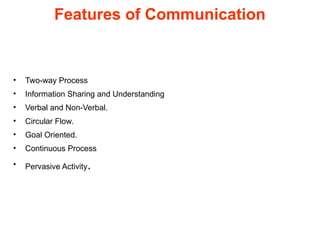
Features of Communication
• Two-way Process
• Information Sharing and Understanding
—
• Verbal and Non-Verbal.
—
• Circular Flow.
—
• Goal Oriented.
—
• Continuous Process
—
• Pervasive Activity
— .
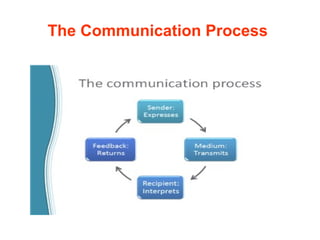
The Communication Process
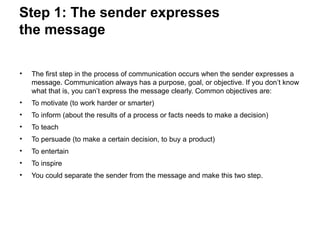
Step 1: The sender expresses
the message
• The first step in the process of communication occurs when the sender expresses a
message. Communication always has a purpose, goal, or objective. If you don’t know
what that is, you can’t express the message clearly. Common objectives are:
• To motivate (to work harder or smarter)
• To inform (about the results of a process or facts needs to make a decision)
• To teach
• To persuade (to make a certain decision, to buy a product)
• To entertain
• To inspire
• You could separate the sender from the message and make this two step.
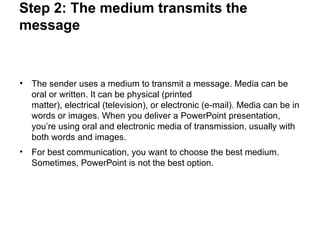
Step 2: The medium transmits the
message
• The sender uses a medium to transmit a message. Media can be
oral or written. It can be physical (printed
matter), electrical (television), or electronic (e-mail). Media can be in
words or images. When you deliver a PowerPoint presentation,
you’re using oral and electronic media of transmission, usually with
both words and images.
• For best communication, you want to choose the best medium.
Sometimes, PowerPoint is not the best option.
Step 3: The recipient interprets the
message
• The people who hear the message don’t always interpret it the way you’d like.
In fact, ask three people what they heard at a presentation and you’ll get three
different answers.
• What do you do?
• First, you construct and deliver the message with the audience in mind. What
do they want to hear? What do they need to hear? How much do they already
know? What perspectives do they bring with them? In other words, you need to
craft the message for the audience.
• Second, you try to remove any obstacles to clear understanding. In
communication theory, this is often called noise. Noise can be any of the
following:
• Distractions, such as an overly exciting or irrelevant background on your slides
• Discomforts, such as hard chairs or a cold room.
• Prejudices that people bring with them. You may need to state your
assumptions or explain why certain assumptions are not valid.
Step 4: Feedback returns the
interpretation of the recipient to the
sender
• Feedback ensures that the recipient understood the
message by sending the recipient’s interpretation back to
the sender. The recipient becomes the sender and the
sender becomes the recipient, completing the
communication loop.
• The important point is that you should use feedback to
restart the cycle. Did someone misunderstand a point?
Then explain it again in different words. See if the feedback
is more accurate the second time.
Verbal vs Non Verbal
Can we communicate without words?
Voice attributes
What are they and how do they affect communication?
Physical attributes
What could be considered here and how do they affect
communication?
The power of touch
What and when is OK?
Which is better, verbal or non verbal?
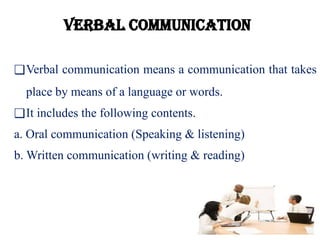
Verbal communication
❑Verbal communication means a communication that takes
place by means of a language or words.
❑It includes the following contents.
a. Oral communication (Speaking & listening)
b. Written communication (writing & reading)
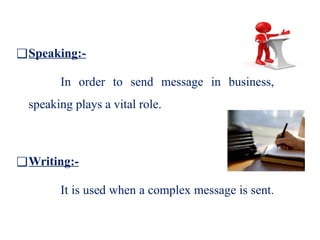
❑Speaking:-
In order to send message in business,
speaking plays a vital role.
❑Writing:-
It is used when a complex message is sent.
❑Listening:-
People in business spend more time in
obtaining information then transmitting it. Listening
is the most important way to receive information.
❑Reading:-
Reading involves understanding and
interpreting the material.
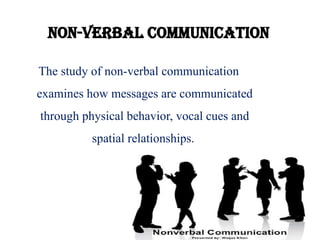
Non-Verbal Communication
The study of non-verbal communication
examines how messages are communicated
through physical behavior, vocal cues and
spatial relationships.
Non-verbal communication in
organization
❑Environment
❑Body placement
❑Posture
❑Gestures
❑Facial expressions and movement
❑Clothing, dress, appearance
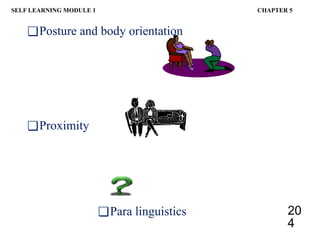
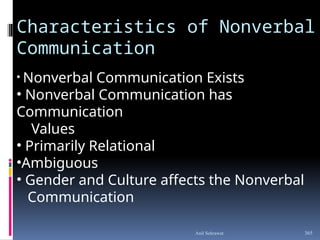
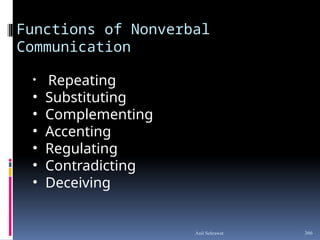
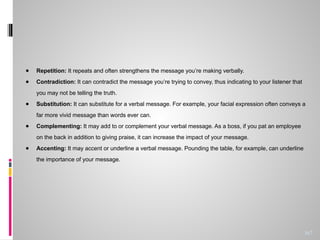
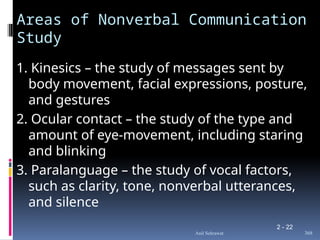
Major areas of nonverbal behaviors are:
❑Eye contact
❑Facial expressions
❑Gestures
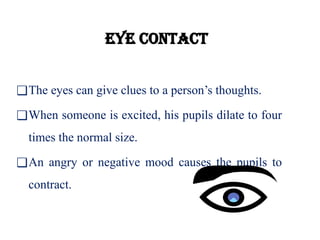
❑Posture and body orientation
❑Proximity
❑Para linguistics 20
4
SELF LEARNING MODULE 1 CHAPTER 5
Eye contact
❑The eyes can give clues to a person’s thoughts.
❑When someone is excited, his pupils dilate to four
times the normal size.
❑An angry or negative mood causes the pupils to
contract.
Eye contact
❑Direct eye-contact conveys interest, warmth,
credibility and concern.
❑Shifty eyes suggest dishonesty.
❑Downward gaze may be a sign of
submissiveness or inferiority
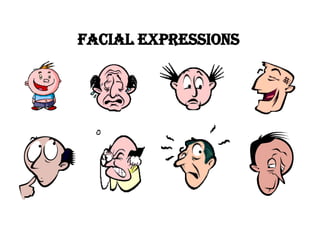
Facial expressions
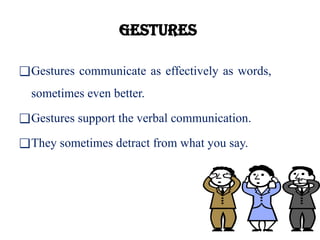
Gestures
❑Gestures communicate as effectively as words,
sometimes even better.
❑Gestures support the verbal communication.
❑They sometimes detract from what you say.
There are some negative gestures which should be avoided:
❑ Pointing at people- It is perceived as accusatory.
❑ Fiddling with your items-It gives the impression that you are nervous.
❑ Dragging the feet-It implies lethargy.
❑ Head Down- It suggests timidity.
❑ Drooping shoulders- It implies weariness and lethargy.
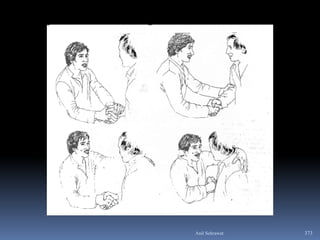
❑ Weak handshake-It implies meek and ineffectual
personality.
❑ Shifty eyes- It suggests nervousness.
❑ Arms crossed on the chest- It is a defensive gesture.
❑ Hands in pockets- Shows disrespect, and that you have
something to hide.
❑ Covering your mouth- It suggests you are lying.
❑ Shaking feet or legs- It shows indifference and
disinterest.
Non verbal communication case
study
At an early stage project meeting Mary, the project team leader,
presented her suggested project timetable to meet the project goals. During
the presentation she noticed that two team members were showing non-
verbal signs of disapproval. Simon was frowning and shaking his head
and Justin had leant back in his chair and folded his arms. Mary stopped
what she was saying, turned to Simon and Justin and asked ‘I sense you
are not supportive of what I’m saying. Can I clarify anything for you?’
Simon replied ‘You are right. I think the project timetable is unachievable.’
Mary responded by directing a question to the whole group ‘How do the
rest of you feel about the timetable I’m suggesting?’
By observing these valuable non-verbal cues Mary was able
to open up communication amongst the team and find an early
resolution to this problem. Had she ignored or not been aware of the
cues, she could well have encountered serious problems with
meeting the project timetable and ultimate completion. Additionally,
she might not have received the full support of two valuable team
members.
Personal Presentation
Does personal presentation make a difference to
the way we are perceived?
Does it matter?
What can we do about it - do we have to look
bland and boring?
What if our organisation has a dress code?
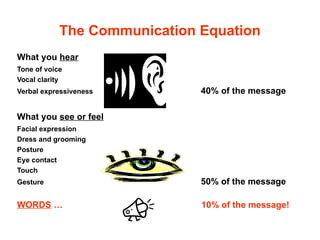
The Communication Equation
What you hear
Tone of voice
Vocal clarity
Verbal expressiveness 40% of the message
What you see or feel
Facial expression
Dress and grooming
Posture
Eye contact
Touch
Gesture 50% of the message
WORDS … 10% of the message!
Understanding Communication
We are going to consider:
The 2-Way communication process
Effective communication skills
Barriers to effective communication
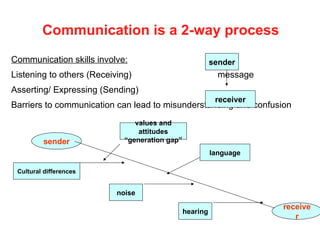
Communication is a 2-way process
Communication skills involve:
Listening to others (Receiving) message
Asserting/ Expressing (Sending)
Barriers to communication can lead to misunderstanding and confusion
sender
receiver
sender
receive
r
values and
attitudes
“generation gap”
Cultural differences
language
noise
hearing
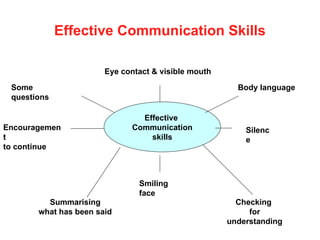
Effective Communication Skills
Effective
Communication
skills
Eye contact & visible mouth
Body language
Silenc
e
Checking
for
understanding
Smiling
face
Summarising
what has been said
Encouragemen
t
to continue
Some
questions
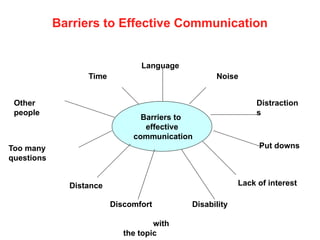
Barriers to Effective Communication
Barriers to
effective
communication
Language
Noise
Time
Distraction
s
Other
people
Put downs
Too many
questions
Distance
Discomfort
with
the topic
Disability
Lack of interest
Individual Differences
What individual factors could affect the way a
person “sends” or “receives” a message?
Is gender/ age a factor?
How can we adapt if :-
we have a problem ourselves or
the other person seems to have a problem?
Cultural Diversity
What do we know about the communication styles
of different cultures?
Consider verbal and non verbal, including dress
constraints, language difficulties, taboos.
Kellogg’s is the world’s leading producer of cereals. Its products are manufactured
in 18 countries and sold in more than 180 countries. Kellogg’s produces some of
the world’s most easily recognisable brands such as Kellogg’s Corn Flakes,
Coco Pops and Rice Krispies. For more than 100 years, Kellogg’s has been a
leader in health and nutrition through providing consumers with a wide variety of
food products.
• Research shows that children benefit from eating a healthy breakfast prior to the
start of the school day. However, too often children have no breakfast at all or
eat chocolate or crisps and a fizzy drink on their way to school.
• Devise a plan to communicate the importance of breakfast to selected target
audiences through a multi-platform campaign. This was in support of its ‘Help
give a child a breakfast’ campaign launched in October 2011.
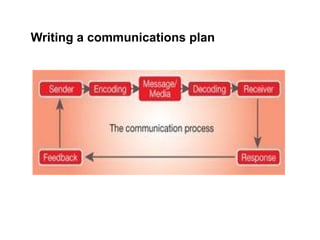
Writing a communications plan
• The communication process involves transmitting information from a sender to a
receiver. However, effective communication needs to ensure that the message has
been not only received but also clearly understood. This is relevant whether the
communication is internal or external. The message needs to be sent in a way that it
will appeal to and be understood easily by the target receiver or audience. This
involves selecting an appropriate format or channel to deliver the message.
• Examples of media that may be used include a leaflet, a television advert and a
personal letter. The feedback part of the process is vital as this is how the sender
knows if the message has been received correctly.
• For the message to be effective, barriers to communication (known as ‘noise’) need
to be eliminated or reduced. Noise is anything that might distort the message or
prevent the receiver getting or understanding the message. For example, noise might
include using language or jargon that the receiver will not understand or using a
channel such as email or the internet when the receiver does not have a computer.
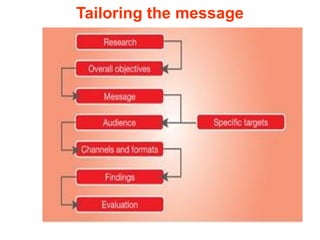
Tailoring the message
• A communications plan uses the same principles of tailoring the message and
the delivery channel for a target audience. A communications plan also sets
out the overall objectives to be achieved and the means by which these will
be measured.
• Businesses engage in both internal and external communication. Internal
communication may involve transmitting messages to shareholders, senior
managers, other employees or contractors. Communication externally may be
to a range of stakeholders including customers, suppliers, the media,
government or the wider public. In each case, the nature of the message and
the format used may be tailored to suit the audience. An effective internal
communications plan can help to give clear direction within the organisation
and improve employee motivation. Externally, it can even change public
opinion.
Etiquettes and Mannerism
“Good manners will open doors that the best
education cannot.”
-- Clarence Thomas
As per the Oxford dictionary etiquette is a
customary code of polite behaviour in society or
among members of a particular profession or
group; and manners as per oxford dictionary is a
way in which a thing is done or happens.
Etiquette at Meetings
❑Do stand while introducing others or being
introduced.
❑While introducing the participants, provide
only essential information about them
along with their names.
❑Try to address people by their titles and
last names. The way to address people
varies from country to country
❑Do a confident handshake with a
simultaneous eye contact.
Etiquette at Dining
Indian habits of eating and dining have a lot
of variety; therefore, one has to learn the
dining and eating etiquette consciously.
You must know the proper use of your
hands while eating, how to use table
napkins, in which hand should you hold
the fork and spoon, knife etc.
Tips for Dining
❑Look for the host to indicate your seat on
the table.
❑Put the napkin in your lap before
beginning to eat.
❑If you have to order, always opt for easy to
eat dishes.
❑Do not impose your choice of food on
others. Let others also give their choices.
❑Wait for all to start.
❑Put your hands on your lap if not eating.
❑Sit in the right posture with arms close to
your body.
❑Do not bring your head to the plate, but
take food to your mouth.
❑Match your eating pace with that of others.
❑Keep the conversations rolling on.
❑If you have to excuse yourself, keep napkin
on the chair.
❑At the end, place the napkin close to the
plate.
❑Move the chair to its original position after
you get up.
❑Involuntary awkward actions like sneezing,
yawning and hiccups. You must be prepared
to deal with these reflexes.
“You can get through life with bad manners,
but it is easier with good manners.”
--Lillian Gish
Technology Etiquette
Technology, becoming an inherent part of
our life, it is imperative to learn the
etiquette’s for using gadgets like mobiles
and computers, professionally.
Phone Etiquette
❑When you talk in public space, everyone around
is listening to you. To prevent your personal life
becoming public, you must not talk something
too personal.
❑While on the phone, do not converse with a
person around you, as this will lead to a lot of
confusion for the person on phone.
❑Avoid working on the computer while talking
over phone. Your attention may be diverted and
the person on phone may be irritated.
❑Avoid using cell phones completely in a
social setting, because that implies people
in the social setting are not important for
you.
❑Avoid using mobiles during meals, work
and meetings.
Incorrect No.: Ensure the no. dialled is
correct; if not, say sorry to the person for
disturbing him/her. Do not shout at a
person, if you receive a wrong call. The
person may be old, ill or desperate.
Voice Quality
Check how you sound on the phone.
The listener forms an image of your
personality by the tone and quality of your
voice.
Your voice reflects your mood and thoughts
Speak clearly with a pleasant tone.
Transfer smile through your voice
Make a good impression
❑Be courteous and introduce your self.
❑Give time to pick the Call
❑Avoid prolonged talks
❑Be careful on information sharing. Do not
reveal your identity without knowing the
person on the other end of the phone. If
the call is for someone else, keep the
mouthpiece down before shouting or
talking with th other person.
Email Etiquette
❑Be concise and to the point
❑Number your questions
❑Make use of proper spellings, grammar and
punctuation
❑Mention deadlines
❑Avoid abbreviations
❑Try to reply fast
❑Avoid attaching unnecessary files.
❑Do not write in capital letters
❑Use expressive subject lines
❑Go through the email once again before
you click ‘send’
Social Media Etiquette
Courtesy and kindness cultivate confidence
with good Netiquette. Doing things right
makes you feel good.
-- David
Chiles
❑Your social media profile must be complete
❑Avoid multiple profiles
❑You become what you post
❑Do not be ubiquitous in all media (Choose
one or two sites as you won’t have enough
time to be everywhere)
❑Be amicable (Write a helpful post,
recommend friend and strengthen
connection)
❑Be careful of spam
❑Be transparent to be trustworthy
❑Be careful about grammar and spelling
❑Do not write in all capitals
❑Do not share the same message again and again
❑Engage in constructive comments
❑Do not be stingy in giving credit (This rule
applies to print media also. If you are tempted
to take up somebody’s update, be polite in
acknowledging it. Send tweets to the people
whose work you like and enjoy. This will reflect
humility and you will develop more
connections.
❑Think before tagging
Video Conferencing Etiquette
❑Clarity in voice
❑Control body movement
❑Look at the camera
❑Do not interrupt
❑No side conversation
❑Dress appropriately
❑Be natural
Web Interview Etiquette
❑Download the software and get familiar with
it before the actual interview.
❑Have the similar name as your email id name
so that it is recognized fast and look
professional
❑Having immaculate sitting place, without
clutters around
❑Keep track of time and log in at the right
time
❑Have your resume with you and ensure to
send it as an attachment to the interviewer
❑Your web camera must be focused
❑Do not allow others to prompt you during
the interview
❑Microphone must be placed at the right
place.
Case-I
Dr. Raj is the MD of Taboo Steel Manufacturers
Pvt. Ltd. (TSMPL). He is an orthodox Brahmin
from a State in South India. He started TSMPL
14 years ago and became one of the top
business people in India. Mr. Xi Yung is a real
estate contractor who is presently in need of a
huge amount of steel for constructing a series of
apartments of 30 floors in China. A managerial
cadre person, Mr. Vasudev, working with Mr.
Young, told him to talk to TSML MD, Dr. Raj, so
that he can get some concession over the steel
price.
Mr. Vasudev arranged a meeting between them
on a Sunday. Although initially Dr. Raj was
reluctant to meet Mr. Young on a Sunday,
finally he agreed for this meeting.
Both met in the meeting room at the TSMPL
head office. Mr. Yung came in a black blazer
while Dr. Raj came in a white shirt. Mr. Yung
extended his hand to greet Dr. Raj with a
handshake, but the MD brought his palms
together, bowed his head slightly and greeted
Mr. Yung with Namaste. A surprised Yung
repeated the same gesture, addressing the
MD as Mr. Raj. He was not aware that the MD
was a doctor.
Dr. Raj felt bad and thought Mr. Yung might not have
known about him. To introduce himself properly to
Mr. Yung, Dr. Raj gave him his business card. Mr.
Yung took the card with the left hand and gave his
card with the right hand. However, Mr. Young
immediately put the MD’s card in his pocket without
looking at it and straight away started talking about
his requirement.
Dr. Raj felt that Mr. Yung was not paying any respect
to him and decided against giving any concession
to him even if he purchased steel in a huge quantity.
So, even after Mr. Yung clearly explaining his steel
requirement and informing
about the project schedule. Dr. Raj did not
pay any attention to Mr. Yung and gave
him no concession.
Questions:
1. What is the business etiquette to be
followed while conversing with Indians?
2. What, according to Dr. Raj, were the
mistakes made by Mr. Xi Yung during
their meeting?
Forming Correct Sentences
Choose the right words: Familiar,
Unbiased, Simple and Concise
Right words—Correct sentences—
Consistent paragraphs– Correct
grammar– Good Writing
Familiar Words
Substituting difficult words with familiar
words helps a message reach its target
audience. Look at these examples of
familiar alternatives for difficult words:
❑‘Garrulous nature’ can be ‘talkative
nature’.
❑‘Disparaging remarks’ can be ‘derogatory
remarks’
❑‘A pertinent point’ can be ‘a relevant point’.
❑‘A concurrent event’ can be ‘a simultaneous
event’.
❑‘Disseminating information’ can be ‘giving
information’
This however does not mean that we should
always use familiar words. The suitability of
the word in a sentence and the meaning
that it conveys are also important.
Use of unfamiliar words in an email:
From: Shekhar
To: Anurag
CC: George Joseph
Date: 26.10.2010
Sub: Discontent with my performance assessment
Dear Anurag,
The outcome of my appraisal is out for this cycle and what
I see for myself is nothing but a hollow bucket of false
promises.
From the beginning of this cycle, I have been performing to
the best of my abilities and the feedback from your end has
been excellent. In spite of gathering appreciation for the
work that I have undertaken I have barely managed to get
justified increment in my reward which is absolutely
appalling.
My contemporaries who on the other hand
have been mediocre have been bestowed
with better ratings and rewards.
What I fail to contemplate is what makes
me more vulnerable to such dispiriting
behaviour of the management. If this is the
trend at the forefront then I would prefer to
refrain from taking greater pains to achieve
significant milestones for the company.
Regards,
Shekhar
Use of familiar words in the same email:
From: Shekhar
To: Anurag
CC: George Joseph
Date: 26.10.2010
Sub: Dissatisfied with my performance assessment
Dear Anurag,
The result of my appraisal is out for this cycle and what
I see for myself is nothing but a set of false promises.
From the beginning of this cycle, I have been
performing to the best of my abilities and the feedback
from your end has been excellent. Keeping in view the
regular positive feedback for my work, I have barely
managed to get any deserving increment in my
remuneration, which is absolutely unacceptable.
My colleagues who on the other hand
have been very average performers have
got better ratings and rewards.
I fail to understand what exposes me to
such behaviour of the management. If this
is how it is going to be, then I would prefer
to stay away from working harder to
achieve something big in the company.
Regards,
Shekhar
Simple words
❑Simple words give a clear meaning to the
readers without misleading them.
❑Some complex or technical words may be
used in an organization.
❑Even if the audience is highly educated, it is
preferable to keep the vocabulary simple.
❑The use of difficult or long words does not
necessarily help you make a good
impression. Such an approach may, in fact,
backfire.
❑Difficult words always have a higher
probability of being misunderstood.
❑The use of complex words should be
particularly avoided in spoken
communication, as the person listening to
you cannot go back to these words in the
middle of a conversation and look them
up in a dictionary.
Concise Words
❑The words that you choose should convey
the meaning crisply and have a concrete
approach.
❑Avoid expressions that are vague. Instead
of saying “Our company ABC Lmdt. is one
of the largest in the industry” you could
say “Our company ABC Lmtd. is the
second largest in the textile industry.”
❑The use of concise words is very popular
when you are trying to grab the attention of the
audience– for example, “Two lakh square foot
of shopping mall experience.”
Some examples are:
Instead of “We lost money last year” we must
say “Our losses were Rs. 10000/- last year”
Instead of “We will meet next week” we must
say “We will meet on Monday morning.”
Instead of “The employee turnover was
significant” we must say “The employee
turnover was 10 per cent.”
List of complex words and their
alternatives
Concise Words Simple Words
Pursuit Search
Audacity Courage
Penchant Desire
Anomaly Irregularity
Apropos Regarding
Anguish Pain
Dwindle Diminish
Forming Correct Sentences
❑Remember the first word that comes to
your mind may not necessarily be the right
one.
❑A good sentence is a balance of three
characteristics: Simplicity, Conciseness
and complete information or entirety
What knowledge does a writer need in
order to write
❑A teacher in a language classroom asks
her students to write an article on the
effects of toxic waste on our environment.
What kind of knowledge would the
students need to have/employ in order to
perform this task successfully?
Four kinds of knowledge that we need in
order to write (2/2)
❑Knowledge of audience i.e. knowledge of who
we are writing to. The more one knows about
one’s audience the easier the writing is; both the
topic and the intended readers will influence the
kind of writing we do.
❑Stored writing plans: Background knowledge
(schemata) e.g. formal schemata: formal,
organisational structures of different types of text
and content schemata: background knowledge
of the content being written about.
The importance of audience
“Students mature as writers by
understanding how to write for different
audiences, contexts, and purposes.”
(NWP & Nagin, 2003, p. 26)
The writing prompt
❑The writing prompt should clearly state the
topic, genre, communicative purpose,
target audience of the writing task, as
well as the features of the output
expected of the students.
Steps for better sentence formation and
right paragraphs
❑Collect all the information
❑Plan what you want to write
❑Construct the sentences
❑Connect the sentences
Collect all the information
Remember vague and insufficient
information inevitably leads to poor
communication. Therefore, the most
important step in the construction of a
sentence is to have the right information,
without which you will get distracted.
Plan what you write
Writing the right sentences and placing them
logically is critical. Even the most
seasoned writers face this challenge.
Let us examine the following paragraphs:
Para 1. Kumar is very hard working. He has
been absent for the last couple of days.
This is due to his bad health. His
performance has also come down.
Para 2. Kumar has been very hard working.
Because of his bad health he has been
absent for the last three days. Lately, his
performance level is not as high as
before.
Para 3. Kumar has been absent for the last
three days due to his bad health. Although
an extremely hard worker, he has not
been able to maintain his performance
levels like before.
Para 4. Kumar is an extremely hard worker;
however, he has not been performing like
before. Due to his bad health he is absent
for the last three days.
All the 4 paras convey the same meaning
but have different styles owing to their
construction – a slight rearrangement in
the writer’s thoughts. It is better that we do
not connect two ideas unless we are
confident that they are related.
Construct the sentences
Efficient sentence construction is essential
for giving a holistic feel to what you write.
The sentences should not be too long or
cumbersome or choppy, but should be a
good blend of simple words and ideas
placed together logically.
Look at the following paragraphs
Paragraph 1
The employee turnover for the year 2009-10 has been
extremely high with over 2500 employees leaving the
company which have been higher than the previous
years and this has resulted in the decline of the
performance of the company with our net profit
falling by over a percentage point, share prices
dropping in by 3 per cent with the overall market
sentiments down and employees dissatisfied with the
performances of the company which have further
percolated down, with our existing customers unsure
of whether to continue business with us.
Paragraph 2
The employee turnover for the year 2009-10 has
been extremely high. Many employees have left
the company. This is higher than the previous
years. This has resulted in the decline of the
performance of the company. The net profit fell
by over a percentage point. Share prices also
dropped. The overall market sentiments are
down and the employees dissatisfied. This has
further percolated down. Our existing customers
are unsure of whether to continue business with
us.
Paragraph 3
The employee turnover for the year 2009-10 has
been extremely high with over 2500 employees
leaving the company. This is higher than our
previous years which have resulted in the decline of
the performance of the company. The net profit fell
by over a percentage point and share prices dropped
by 3 per cent. The overall market sentiments are
down and employees too are dissatisfied with the
performances of the company. This has further
percolated down, with our existing customers unsure
of whether to continue business with us.
These 3 paragraphs give us a few
lessons
❑Short sentences are better. However, too
many short sentences will cause a choppy
effect.
❑There needs to be a good mix of short and
medium-length sentences with clear
information.
❑Each sentence should have one clear idea.
❑Long sentences may create confusion,
though they are not always avoidable.
Connect the sentences
❑Do not over-express yourself
Example: Instead of writing “We would like to
reassure you about the fact that your shipment
will be on time.”
We should write “We assure you that you will be
receiving your shipment on time.”
❑Do not beat around the bush
Get quickly to the point. Unless the purpose
demands, it is better to present the idea directly.
Example: Instead of writing “As far as we
understand all our dues have been cleared till
date and we should be able to get a fresh
sanction of the loan”.
We should write “All our dues have been cleared
and we are looking for a fresh loan.”
❑Put related ideas together
Example: Rohan’s performance has fallen. He
has bought a new car.
The receiver of this message will not understand
the connection between the two sentences.
You must logically organize sentences.
Getting the paragraphs right
Paragraphs are a collection of thoughts that are
related and well-connected through sentences.
Their constructions depends on the writer’s ability to
do so.
Guidelines for writing better paragraphs:
❑ Have all related ideas in a paragraph.
❑ Have an introductory sentence.
❑ Provide only the information required.
❑ Do not make paragraphs too long.
❑ Make the paragraphs coherent (ideas flowing
logically throughout the message)
Features of a Paragraph
❑Unity (togetherness of ideas)
❑Coherence
❑Expansion & Emphasis
Structure of a Paragraph
❑Topic sentence/Introducer
❑Supporting details/Developers
❑The concluding sentence/terminator
Topic sentence
❑Introduces the main idea in a paragraph.
Mostly it appears at the beginning (Inductive)
but sometimes it does appear towards the
end of the paragraph (Deductive).
This could be of two types:
1. Structural : It describes the shape of the
argument
2. Interpretive: It offers a conclusion or
reaction or feeling.
Structural topic sentences (Examples)
❑There are three main reasons for high
inflation rate in Indian economy at present.
❑Positive thinking has several benefits.
❑Distance education in the past one decade
has had the following results.
Interpretive Topic Sentences(examples)
❑Almost 49 per cent of the children fail to complete
primary level education. In a recent study in 11
districts of Rajasthan, it was found that…
❑Access to basic services is extremely limited. It
was found that…
❑A recently released report by the Ministry of
Human Resource Development shows a nation-
wide decline in school dropout rates. In Himachal
Pradesh too, the number of students…
Construction of a Paragraph
Different strategies/techniques/styles of
constructing paragraphs
❑Narrative Description
❑Comparisons and Contrasts
❑Cause and Effect
❑Classifying
❑Quotations and Paraphrasing
❑Enumeration
❑Definition
❑Testimony
❑Facts, Figures, Instances and Examples
❑Episodes
❑Skillful use of Transitions and Connecting
Devices
Narrative Description
Read the paragraph:
The long, steep road that lead to Sholagar
Thotti– a village atop the Sathyamangalam
hills– is strewn with stories of fear, pain,
suffering, and ignominy. Our guide Jeeva Jothi
has a tale to tell at every turn. ‘This was where
Veerapan kidnapped actor Rajkumar’, he
says, pointing out a bungalow in Thalavadi
village.
Source: Kavitha Murlidharan, ‘Weary Victims’, The Week, 25
October 2009,p. 58
❑Narrative descriptions expresses an
intense emotion.
❑It helps sustain our interest in the details
that are structured through a narrative.
Comparisons and Contrasts
For developing paragraphs, two similar things
are compared or two dissimilar things are
contrasted. The purpose is to make the
argument forceful and emphatic.
Comparisons carry conviction
They authenticate our perspectives in an
objective manner.
The speaker by employing comparison and
contrasts sounds unbiased.
Cause and Effect
Through this method, paragraphs attempt to
establish a relationship between certain
events and the reasons behind them.
This enables the authors to convince their
readers in a scientific and logical manner.
Example
The effect of guilt in a person’s life can
easily be observed throughout his/her life.
Most of the time they are gloomy and keep
lamenting their past actions and their
present too keeps drifting away from them.
It leads to multiplication of guilt. This
vicious circle of guilt hence never allows
its victims to succeed or be happy in life.
Guilt saps all enthusiasm, energy and the
urge to survive or excel.
Classifying
In a classification paragraph, separate
items are grouped into categories
according to shared characteristics.
Depending on the subject, you may be
asked to classify people, organisms,
things or ideas. Topic sentence identifies
what is to be classified and the categories
used.
Example
If you choose to write about types of
computers (PCs and servers), each of
your developmental paragraphs will define
the characteristics of a different computer
type.
Quotations and Paraphrasing
Quoting authors, great speakers,
industrialists and business people, is an
excellent way to develop a paragraph.
Even common people could be quoted to
substantiate a point of view. When the
words of the commoners are used, it is
known as peer testimony.
Example
Corrupt people have no time to listen to
story of a poor peasant who says, “I have
two children who are given food on
alternate days. It is really painful to see
them hungry. But what can I do? I don’t
have enough to make both ends meet
everyday.
Enumeration
At times, we list a series of ideas, in order to
substantiate the topic sentence. This
device/technique is called enumeration.
Example 1
Despite the unprecedented growth and
development in post-independent India,
our country continues to be tormented by
a large number of social evils. Some of the
most disturbing ills prevalent in our society
are casteism, communalism, corruption
and child labour. It is difficult to say which
is the worst as all of them leave a terrible
impact on the social milieu.
Example 2
If you want to be safe on the road, go by
the following rules: While driving your
vehicle on the road, keep to your left;
always stick to your lane; never try to
overtake from the wrong side; drive within
the prescribed speed-limit; stop at every
red-light; use dippers at night and wear
your helmet while riding a two-wheeler.
Definition
Another way to develop a paragraph is by using
definition where the author intends to take up
some topic, term, issue or argument in a
particular way.
By providing the definition of a particular word, the
author is able to prepare his/her readers to
follow the intended line of thought or argument.
For example by explaining the term ‘Insomnia’,
the author will make things clear to his/her
reader.
Example
The term insomnia, derived from the Latin
root somn refers to the chronic and
habitual inability to fall asleep or remain
asleep for an inadequate length of time.
Testimony
Testimony is another effective way to develop a
paragraph. Testimony can be of two types–
Peer testimony and Expert testimony.
Testimonies lends credibility to the author’s
opinion which can be used to drive his/her
ideas home.
When a topic is controversial, the writer uses
expert testimony extensively to make the
reader understand different aspects of the
subject.
Facts, Figures, Instances, Episodes and
Examples
By citing statistics, percentages, and other
facts, the author tries to illustrate the topic
sentence.
Examples carry conviction and are therefore
preferred by writers. It is done in order to
create an immediate and intimate rapport
with the reader.
Example
It is generally believed that Americans are very
good speakers of English. Their articulation,
however, does not really seem to support such
beliefs. In fact, it seems that Americans use
sloppy articulation for quite a few expressions.
For example, I did not for them becomes I dint,
whereas the true contracted form for I did not
should be I didn’t. Similarly, you ought to in
American English sounds like you oughta
or you otta and you have to becomes you
hafta. The forceful and intense yes in BrE
is always a sloppy yeah for them and I
don’t know sounds like I dunno.
Using Transitions and Connecting
Devices
❑Transitions connect different ideas
expressed in a paragraph. Without using
them, it is impossible to develop an
impressive paragraph.
Those who believe in God seem to be aware
of His presence around them.
Moreover/However, skeptics suggest that it
is one thing to believe in God and/but quite
another to be aware of His presence. They
feel that but/though it is quite easy to keep
oneself in illusion, ignorance, and darkness,
and/yet quite difficult to be aware, awake,
and alive. Nevertheless/In fact, they feel
that God is not a matter of belief and/as
God is a power, a source of energy of which
we need to be conscious about.
Solve Practice Tests
Spoken and Written English
Informal spoken English has many features which, if
written down, make it appear rambling and
unstructured:
silent pauses, often indicated by a dash (-) in
transcription.
voice-filled pauses (e.g. –erm) indicating hesitation.
repetition (unplanned repeat, e.g. I – I – I get)
false starts (e.g. I mean, you know, etc.)
discourse markers and fillers (e.g. well, you see, etc.)
short forms and contractions (e.g. don’t, we’ll, gonna)
Cooperation in conversation
❑A conversation is not just a matter of giving and
receiving information. It is a form of social
interaction and participant cooperation is a basic
feature of conversation. There is a give-and take
process which is manifested in several ways:
❑Turn-taking, where the role of speaker is shared
in a conversation. This is shown in the interplay
of questions, answers and positive follow-up
comments.
❑Using fillers or discourse markers. These usually
add little information, but tell us something of
the speaker ’s attitude to their audience and what
they are saying.
Tag questions and ellipsis
❑With tag questions the speaker
asserts something and then invites
the listener ’s response.
❑Initial ellipsis is a characterisation of
informal talk. It creates the sort of
relaxed atmosphere that we try to
achieve in a cooperative social
situation.
You saw Anne last week, ……………?
We’ll meet again next week to discuss
this further, ……………?
Coordination
A preference for coordination of
clauses, rather than subordination
of clauses, is often a characteristic
of speech. Phrasal coordination,
on the other hand, is a
characteristic of writing.
❑If you are late again, you’ll be
fired.
❑Now that he’s been to Italy, he
wants to live there.
Tones
Tone is the type of pitch change which takes place
while stressing certain syllables. There are three basic
types of tone in English, each of which tends to
express a number of related meanings:
❑(i) falling tone : certainty, completeness,
independence (esp. straightforward statements, wh -
questions)
❑(ii) rising tone : uncertainty, incompleteness,
dependence (esp. yes-no questions, subsidiary
information)
❑(iii) fall-rise : combines the meaning of ‘certainty,
assertion’ with that of ‘incompleteness, dependence’
(esp. reservation, implied contrast, etc.).
Emotion
Emotive emphasis can be given in a variety of ways:
❑interjections: words like oh, ah, wow, ouch, etc.
❑exclamations beginning with what- and how-
phrases which do not cause subject-operator
❑inversion
❑emphatic so and such
❑repetition (which also denotes degree)
❑stress on the operator
❑nuclear stress on other words
❑intensifying adverbs and modifiers
❑The emotive force of a wh-question can be
strengthened by adding ever, on earth, etc. to the
wh-word.
❑Negative sentences can be intensified by adding
at all, a bit, whatever, a thing, etc. or by putting not
a before a noun. The negative element can also
be placed at the beginning of a clause, which
normally causes subject-operator inversion.
❑An exclamatory question is a yes-no question
spoken with an emphatic falling tone. It often has a
negative form.
❑A rhetorical question is more like a forceful
statement and can have a positive or negative
form. There are also rhetorical wh-questions.
Misplaced Modifiers
Modifier:
▪ Can be a word or group of words (phrase).
▪ A modifier describes, clarifies, or gives more detail about
other words in a sentence.
Misplaced modifier:
▪ A modifier in the wrong place in a sentence.
▪ Makes sentences awkward, confusing, or (unintentionally)
humorous.
Do these sentences have different
meanings? Why?
❑The dog under the tree bit Carrie.
❑The dog bit Carrie under the tree.
❑How can you correct this sentence?
▪ Buffy called her adorable kitten opening the
can of food and filled the bowl.
❑Process:
1. What is the modifier?
2. What word does it describe, clarify, or give
more detail about?
3. Where should the modifier be placed?
❑Misplaced modifier:
▪ Buffy called her adorable kitten opening
the can of food and filled the bowl.
❑Correctly placed modifier:
▪ Opening the can of food, Buffy called
her adorable kitten and filled the bowl.
Another correct option
“Buffy, opening the can of food, called her
adorable kitten and filled the food bowl.”
OR
A series of verb phrases would also be
correct:
“Buffy opened the can of food, called her
adorable kitten, and filled the food bowl.”
❑One-word modifiers can easily be
misplaced.
❑These include:
❑Almost, even, exactly, hardly, just,
merely, nearly, only, scarcely, simply
These eight words can also cause
confusion within sentences when they are
placed next to words that they are not
meant to modify.
❑Which sentence indicates that everyone in the class
failed the exam?
▪ Almost everyone in the class passed the calculus exam.
▪ Everyone in the class almost passed the calculus exam.
❑Which sentence indicates that Rohan earned some
money?
▪ Rohan nearly earned Rs100/-
▪ Rohan earned nearly Rs100/-
❑Misplaced Modifier:
▪ Modifier in the wrong place in a sentence.
❑Correct placement of modifiers:
▪ Modifiers go next to the word or phrase
they modify.
▪ One-word modifiers go before the word or
phrase they modify
Dangling Modifiers
▪ Do not sensibly modify anything in their
sentence.
▪ Modifier is present, but it has nothing to modify.
▪ Often occur at the beginning or end of a
sentence.
▪ Often indicated by an “–ing” verb or a “to” verb
❑What is the modifier modifying?
❑Having finished dinner, the cricket match
was turned on.
❑Remember, modifiers go next to the words or
phrases they modify.
3 ways to fix Dangling Modifiers
❑ Name the appropriate doer of the action as the subject of
the main clause.
▪ Having finished dinner, Rohit turned on the cricket match.
❑ 2. Place the subject of the action within the dangling
modifier:
▪ After Rohit finished dinner, he turned on the cricket match.
❑ 3. Combine the phrase and clause.
▪ Rohit turned on the cricket match after finishing dinner.
Dangling Modifier Examples
❑ How might you correct the following sentence?
▪ Playing solitaire on the computer for three hours, Michael’s
paper was not finished.
❑ Process:
1. What is the modifier?
2. What does it describe, clarify, or give more detail about?
3. Do you need to insert doer?
4. Where should the modifier be placed?
Possible revisions:
1. Playing solitaire on the computer for three hours,
Michael did not complete his paper.
2. Because Michael played solitaire on the computer
for three hours, he did not complete his paper.
3. Michael did not complete his paper because he
played solitaire on the computer for three hours.
❑ Dangling modifier:
▪ Often occur at the beginning or end of a sentence
▪ Often indicated by an “–ing” verb or a "to + verb” phrase
❑ How to correct dangling modifiers:
▪ Name the appropriate or logical doer of the action as
the subject of the main clause
▪ Place the subject of the action within the dangling
modifier.
▪ Combine the phrase and clause.
Business Communication
Communication
❑communication is a process of sharing
information, which is both dynamic and
interactive, and results in an exchange of
meaning and understanding.
Business Communication
The process of establishing a common
understanding between or among
people within a business environment.
❑Getting jobs you want
❑Gaining promotions
❑Providing leadership
❑Being productive on the job
❑Relating positively to others
❑Assuring the success of your organization
The Importance of Communicating
Effectively
Internal and External
Communication
❑Internal
❑Involves day-to-day exchange among
employees
❑External
❑Flows between an organization and the
entities with which it interacts
Business Communication is
Transactional
Give-and-take relationship between
sender and receiver in order to
establish a common understanding
Goals of Business Communication
1. Receiver understanding
2. Receiver response
3. Favorable relationship
4. Organizational goodwill
Internal Communication Patterns
❑Vertical
❑Horizontal
❑Network
Formal Communication
❑Is business related
❑May be written or oral
❑Is planned by the organization
❑Flows in all directions
❑Is essential for effective operation of the
business
Informal Communication
❑Is both business-related and personal
❑Is not planned by the organization
❑Flows in all directions
❑Develops and maintains positive human
relationships
Serial Communication
❑Chain of three or more people
❑Messages usually change as passed
❑Senders should
❑Keep the message simple
❑Request feedback
❑Receivers should
❑Take notes
❑Repeat the message
Grapevine
❑Managers should:
❑Be open, honest, and as complete as
possible
❑Monitor the grapevine to learn whether
formal messages have been understood
or need restating
❑Identify and work with those who are
key sources of grapevine information
❑Ask employees how they use the
grapevine
Communication Process Model
Office Politics
The competitive
environment that
exists within the
corporate culture
❑ Tony and Victor were assigned to work on an important project, one
that could have major implications for their careers. They didn’t
always agree on how to approach the task or on the best solution to
the problem, but both were satisfied with the final product.
❑ When Tony and Victor presented their proposal to the five-member
management team, it was not received well. Several weaknesses
were cited, and the men were asked to remedy them. After the
meeting, Tony made appointments with each manager to discuss his
or her concerns. He acknowledged the report’s weaknesses, asked
relevant questions, and gathered useful information.
❑ Victor looked for casual opportunities to interact with the two
managers he thought were most influential. He tried to distance
himself from the proposal by suggesting that he wasn’t really happy
with it but had been pressured to accept Tony’s solution.
❑ Both men were trying to maintain or improve their professional status
within the organization—one took a positive political approach, the
other a negative one.
Political Fundamentals
❑Be honest and ethical in all dealings with
people
❑Believe in yourself
❑Believe in your work
❑Do the best job you can
❑Keep your commitments
❑Be a pleasant person
❑Feel true respect for everyone
Sender’s Role
❑Selecting the type of message
❑Analyzing the receiver
❑Using the you-viewpoint
❑Encouraging feedback
❑Removing communication barriers
Receiver’s Role
❑Listening or reading carefully
❑Being open to different types of senders
and to new ideas
❑Making notes when necessary
❑Providing appropriate feedback to the
sender
❑Asking questions to clarify the message
Verbal and Nonverbal
Communication
❑Verbal Communication
❑Uses words
❑Nonverbal Communication
❑Does not use words
Message Channels
❑Written
❑Oral
❑Nonverbal
The You-Viewpoint
The sender gives primary consideration
to the receiver’s point of view when
composing and sending messages
Analyzing the Receiver
❑Knowledge
❑Interests
❑Attitudes
❑Emotional Reaction
Feedback
❑The sender’s role includes providing for
feedback
❑Ask directly or indirectly for a response
❑Assist the receiver in giving the
response
Communication Barriers
Any factor that interferes with the
success of the communication
process
Communication Barrier: Word Choice
❑Denotative versus connotative meaning
❑Idioms
❑Implications and inferences
More Communication Barriers
❑Incorrect grammar, sentence structure,
punctuation, and spelling
❑Wrong message type
❑Poor message appearance
❑Poor appearance of the sender
More Communication Barriers
❑Distracting environmental factors
❑Receiver’s capability
❑Ineffective listening skills
❑Other barriers
Non-Verbal
Communication
“What you do speaks so loudly that I
cannot hear what you say”
Ralph Waldo Emerson
363
Nonverbal Communication
Nonverbal communication includes all
unwritten and unspoken messages, both
intentional and unintentional.
364
Anil Sehrawat
Characteristics of Nonverbal
Communication
• Nonverbal Communication Exists
• Nonverbal Communication has
Communication
Values
• Primarily Relational
•Ambiguous
• Gender and Culture affects the Nonverbal
Communication
365
Anil Sehrawat
Functions of Nonverbal
Communication
• Repeating
• Substituting
• Complementing
• Accenting
• Regulating
• Contradicting
• Deceiving
366
Anil Sehrawat
367
● Repetition: It repeats and often strengthens the message you’re making verbally.
● Contradiction: It can contradict the message you’re trying to convey, thus indicating to your listener that
you may not be telling the truth.
● Substitution: It can substitute for a verbal message. For example, your facial expression often conveys a
far more vivid message than words ever can.
● Complementing: It may add to or complement your verbal message. As a boss, if you pat an employee
on the back in addition to giving praise, it can increase the impact of your message.
● Accenting: It may accent or underline a verbal message. Pounding the table, for example, can underline
the importance of your message.
2 - 22
Areas of Nonverbal Communication
Study
1. Kinesics – the study of messages sent by
body movement, facial expressions, posture,
and gestures
2. Ocular contact – the study of the type and
amount of eye-movement, including staring
and blinking
3. Paralanguage – the study of vocal factors,
such as clarity, tone, nonverbal utterances,
and silence
368
Anil Sehrawat
Areas of Nonverbal Communication
Study
4. Proxemics – the study of the meaning
of space, distance, and territoriality
5. Haptics – the study of touch, including
such actions as handshakes, hugs, and
back patting
6. Semiotics – the study of messages
implied by such objects as dress, decor,
address, and status symbols
369
Anil Sehrawat
COMPONENTS OF A MESSAGE (3Vs)
1. VERBAL
2. NON-VERBAL
VOCAL VISUAL
By combining ‘v’
elements differently
People Develop
Different “styles”
of communication
370
Anil Sehrawat
SINGNIFANCE OF NON-VERBAL
COMMUNICATION
▪ NVC play a significant role in
communication because they are real and
uncontrolled and true relay of messages.
▪ NVC can enhance a verbal message.
▪ NVC can contradict the message given
vocally by indicating obvious opposite
feelings.
▪ It is forceful to replace verbal thoughts.
371
Anil Sehrawat
NON-VERBAL COMMUNICATION
All communication that involves neither written nor
spoken words, but occur without the use of words.
•Body Movements - Kinesics
•Space - Proxemics
•Voice Patterns - Paralanguage
•Time - Chronemics
•Touch - Haptics
•Colour
•Layout/Design/Graphics
•Objects - Artifacts
372
Anil Sehrawat
373
Anil Sehrawat
Proxemics/Space
▪ Spatial changes gives tone to a
communication.
▪ It accents it and at times even overrides the
spoken words.
▪ Feature-Fixed Space-buildings
▪ Semi fixed-Feature Space- Placement of
movable objects
▪ Personal Space
374
Anil Sehrawat
Intimate
(Individual-to-1½’)
Perso
nal
(1½’-
4’)
Social
(4’-12’)
Public
(12’-16’ to
the point
you can
see
375
Anil Sehrawat
Proxemics: Assumptions
▪ Better allotted space
▪ Better protected territories
▪ Easier to invade the territory of lower-
status personnel
376
Anil Sehrawat
Use of space as it relates to space:
1.The higher people are in the organization,
the more and better space they are
allotted.
2.The higher people are in the organization:
the better protected their territory is.
3. The higher people are in the
organization-the easier it is for them to
made the territory of lower-status
personnel.
377
Anil Sehrawat
A “superior” can by placing himself
physically extremely close to a
subordinate create a certain type of
atmosphere.
Proxemics: importance
378
Anil Sehrawat
▪ Common
expressions
regarding
touch
▪ Being touchy
▪ keeping in touch.
▪ being out of touch with
reality.
▪ a touching gesture
▪ using the “soft touch”
on someone
▪ touching on an
important point
▪ Types of touch
379
Haptics (Touch)
brush
caress
clinch
cuddle
embrace
grope
handshake
high five
hit
hold
hug
feel
fondle
kiss
knuckle bump
nibble
pat
pinch
poke
prod
push
reach around
rub
scratch
shove
slap
spank
squeeze
stroke
tickle
Anil Sehrawat
Touch can
■convey positive or negative affect
■foster a favorable impression
■provide reassurance, empathy
▪enhance one’s perceived power
▪Touch must be perceived as appropriate in location,
duration, intensity.
▪friendly vs. flirty vs. sexual
Context is key
▪cultural considerations
▪gender differences
▪Situation or setting
Haptics (touch)
380
Anil Sehrawat
KINESICS:
(Body participates in communication)
▪ Facial Expressions
▪ Eye Contact
▪ Gestures
▪ Postures
▪ Movements
381
Anil Sehrawat
382
Anil Sehrawat
Facial Expressions
▪ Happiness
▪ Surprise
▪ Fear
▪ Anger
▪ Sadness
▪ Disgust
▪ Interest
▪ Determination
383
Anil Sehrawat
Facial Expressions Convey
Emotions
384
Anil Sehrawat
Gesture Types
▪ Emblems are nonverbal behaviours usually
hand movements that have precise meaning .
▪ Illustrators are gestures that accompany the
speech. Illustrators are used to illustrate,
emphasize, or repeat what is being said.
▪ Regulators are acts that help to initiate and
terminate the speech of participants in a social
situation.
▪ Affect Displays are our feelings expressed
through bodies
▪ Adaptors are self touching behaviours such as
scratching your arm, rubbing your cheek, picking
your nose, stroking your hair.
385
Anil Sehrawat
386
Anil Sehrawat
COMMUNICATION THROUGH BODY GESTURES: (SOME
EXAMPLES)
Emblems
387
Anil Sehrawat
Illustrators
388
Anil Sehrawat
389
Anil Sehrawat
Regulator
Readiness
▪ Hands on hips
▪ Sitting on edge of chair, arms spread and
hands grip edge of table.
390
Anil Sehrawat
Affect Display
Evaluation
▪ Chin stroking
▪ Hand with pointed finger held up to face
▪ Head tilted
▪ Pinching the bridge of nose
Boredom
▪ Tapping with feet
▪ Drumming on table
▪ Head on hand
▪ Blank stare
391
Anil Sehrawat
Adaptors
Nervousness/Anxiety
▪ Fidgeting in chair
▪ Hands covering mouth while speaking
▪ Tugging at pants or shirts
▪ Jingling coins in pockets
Self Control
▪ Locking ankles and clenched hands
▪ Gripping the wrist
392
Anil Sehrawat
Movements
General Purpose: Attention, Interaction
Specific Purpose:
1. To get rid of nervousness
2. To increase emphasis, suggest
transitions
3. Help in gaining audience attention
393
Anil Sehrawat
BEHAVIOUR REFLECTED THROUGH
BODY MOVEMENTS
▪ Attitude
▪ Status
▪ Affective status of moods
▪ Approval seeking
▪ Inclusiveness
▪ Interaction markers
394
Anil Sehrawat
PARALANGUAGE: VOICE and NON-
VERBAL VOCALISATION
VOICE SET:
Includes various measurements of voice
▪ Rate
▪ Pitch
▪ Rhythm
▪ Resonance
395
Anil Sehrawat
PARALANGUAGE: VOICE and NON-
VERBAL VOCALISATION
NON-VERBAL VOCALISATION: INCLUDES:
▪ Laughing
▪ Crying
▪ Verbal pause
▪ Interludes of Silence.
▪ “AH’s”, “OH’s”……… ETC……...
396
Anil Sehrawat
Colour
▪ Black is the colour of authority and
power, stability and strength
▪ White associated with purity (wedding
dresses); cleanliness (doctors in white
coats) and the safety of bright light
▪ Gray associated with the practical,
timeless, middle-of-the-road, solid
things in life.
▪ Red is the colour of energy. It's
associated with movement and
Anil Sehrawat 397
▪ Blue associated with steadfastness,
dependability, wisdom and loyalty
▪ Green associated with growth, nature, and
money.
▪ Yellow associated with laughter, happiness
and good times.
▪ Orange tied most with fun times, happy and
energetic days, warmth and organic
products. It is also associated with ambition.
▪ Purple associated with wealth, prosperity,
rich sophistication.
▪ Brown: associated with reliability, stability,
and friendship Anil Sehrawat 398
399
Anil Sehrawat
▪ Like all other forms of communication
non-verbal message should be sincere.
▪ Plan gestures and body movements
▪ Use gestures naturally to reinforce the
meaning you are expressing through
words.
▪ Too much shuffling of gestures and
postures is distracting and annoying.
400
Anil Sehrawat
So what we have
Learnt……
•Body Movements - Kinesics
•Space - Proxemics
•Voice Patterns - Paralanguage
•Time - Chronemics
•Touch - Haptics
•Colour
•Layout/design/graphics
•Objects - Artifacts
401
Anil Sehrawat
Business
Presentation
404
Anil Sehrawat
▪ Speaking is the most useful of our
communication skills.
▪ Managers advise tape-recording your talks to
improve speaking skills.
IMPROVING YOUR
SPEAKING
405
Anil Sehrawat
Raun Huff’s observations for
effective presentation
1. It is impossible to be clear
2. Audience remember 25% of what you say
3. May be you should start about half way through.
4. Contents-first requirement: once contents break-
down delivery is never far behind
5. Participation helps them to remember
6. Nervousness is not all that bad. if audience become
more concerned about your nerves than subject – it is
worst….
7. Eye contact is a strong force
8. People may lie, but not the body. language 406
Anil Sehrawat
JUDGES
SPEAKER
COMMITMENT
ADVOCATES
EVALUATES
AUDIENCE
WHAT IS A PRESENTATION
TO SOLVE A PROBLEM
407
Anil Sehrawat
PLANNING AN ORAL
PRESENTATION
408
Anil Sehrawat
409
Anil Sehrawat
STRUCTURE
I. Say what you will say (opening)
II. Say what you have to say (body)
III. Say what you said (closing)
410
Anil Sehrawat
WHY A STRUCTURE?
10
To decide what to ‘invest’ where?
0 4 7
1 8
2 3 5 6 9
OPENING---------BODY------------CLOSING-------
Q/A
411
Anil Sehrawat
OPENING
•catch attention
•relate purpose
•build focus
• preview main points
•build credibility
•create atmosphere
412
Anil Sehrawat
Organize Body of
Presentation
▪ Develop select main points. Streamline
your topic and summarize its principal
parts.
▪ Arrange the points logically:
chronologically, from most important to
least, by comparison and contrast, or by
some other strategy.
413
Anil Sehrawat
BODY
• Emphasize structure/break-up
• Summarize each point
• Emphasize transition
• Hold attention: questioning
audio visual aids
data
variety in tone
variety in gestures
humour ……
414
Anil Sehrawat
TIME
Audience’s
Interest
0
415
Anil Sehrawat
Nine Techniques for Gaining and
Keeping Audience Attention
▪ A Promise
▪ By the end of this presentation, you will be able
to . . .
▪ Drama
▪ Tell a moving story; describe a serious
problem.
▪ Eye contact
▪ Command attention at the beginning by
making eye contact with as many people as
possible.
416
Anil Sehrawat
Nine Techniques for Gaining and
Keeping Audience Attention
▪ Movement
▪ Leave lectern area. Move toward audience.
▪ Questions
▪ Ask for show of hands. Use rhetorical
questions.
▪ Demonstrations
▪ Include member of audience.
417
Anil Sehrawat
Nine Techniques for Gaining and
Keeping Audience Attention
▪ Samples/gimmicks
▪ Award prizes to volunteer participants; pass
out samples.
▪ Visuals
▪ Use a variety of visuals.
▪ Self-interest
▪ Audience wants to know “What’s in it for me?”
418
Anil Sehrawat
A GUIDE TO HUMOUR
• Facial expressions
• Timing
• Definite eye contact
• Practice before-hand
• Be brief
• Move directly to the point-directly
• Check effectiveness
419
Anil Sehrawat
ENDIN
G
• Use obvious expressions: to conclude, to
sum up, etc.
• Restate main points
• Outline next step
• End on a positive note
caution
Final summing is not a place to introduce new
idea
420
Anil Sehrawat
HANDLING QUESTIONS
1. A confused question
2. A hostile question
3. A two part/complex question
4. An off topic question
5. A question you can’t answer
421
Anil Sehrawat
PRESENTATION STRATEGY
MESSAGE
AUDIENCE MEDIA
TIME PLACE COST
PURPOSE
422
Anil Sehrawat
Identifying Your Purpose
▪ Decide what you want your audience to
believe, remember, or do when you
finish.
▪ Aim all parts of your talk toward your
purpose.
423
Anil Sehrawat
1. PURPOSE
• Informing
• Persuading
• Exploring
• Changing behaviour / attitudes
424
Anil Sehrawat
2. ANALYSING AUDIENCE
Demographics -size, age, education, sex, economic,
cultural background,
(hetro v/s homogeneous)
A.B.V.’S -hostile, receptive, indifferent
Relationships -known/un-known,
-respect your judgement
general - subject knowledge
environment -physical setting (f. v/s in. f.)
-competing stimuli
-(quiet v/s noisy)
-proximity (close v/s far)
425
3. STRUCTURING MESSAGE CONTENTS
The inverted pyramid style of organizing
information or evidences, may be of help in
structuring the presentation so as to retain
AUDIENCE’S ATTENTION
426
Anil Sehrawat
GO TO
Least important
START WITH
Most important
Inverted
Pyramid
427
Anil Sehrawat
GO TO
Least important
Backup information
START WITH
Most important
Conclusions
INVERTED
PYRAMID
428
Anil Sehrawat
GO TO
Least important
Backup information
Specifics
START WITH
Most important
Conclusions
Generic statement
Inverted
Pyramid
429
Anil Sehrawat
• Starting with the most important &
going down to least important point
• Starting with the conclusion & going
down to backup information
• Starting with the generic statement &
going down to specifics
430
Anil Sehrawat
3.1 APPROACHES TO PRESENTATION
•LOGOS-REASONING
•PATHOS-FEELINGS
•ETHOS-SOURCE CREDIBILITY
DEDUCTIVE
INDUCTIVE
431
Anil Sehrawat
3.2 SEQUENCING
• Chronological
• Topical
• Pattern of increasing difficulty
432
Anil Sehrawat
3.3 PRESENTATION METHODS
• Reading
• Memorized
• Speaking from notes
• Extemporaneous
• Impromptu
433
Anil Sehrawat
4. PRESENTATION: 10 COMMDANDMENTS
FOR AV AIDS
• Don’t cram
• Shun the irrelevant
• Organize and breakup
• Visualize
• Use fewer words
• Visibility
• Readability
434
Anil Sehrawat
4. PRESENTATION: 10 COMMANDMENTS
FOR AV AIDS
• Light colours in the background,
bright/dark colours for picture &
lettering
• Audibility
• Rehearse
435
Anil Sehrawat
PRESENTATION SKILLS
PERSONAL ASPECTS
SINCERITY
THOROUGHNESS CONFIDENCE
FRIENDLINESS
436
Anil Sehrawat
OVERCOMING STAGE FRIGHT
437
Anil Sehrawat
Symptoms of Stage Fright
▪ Stomach
butterflies
▪ Pounding heart
▪ Shortage of
breath
▪ Sweaty palms
▪ Dry throat
▪ Unsteady voice
▪ Trembling hands
▪ Wobbly knees
438
Anil Sehrawat
Ways to Overcome Stage Fright
▪ Select a familiar, relevant topic. Prepare
150 percent.
▪ Use positive self-talk.
▪ Convert your fear into anticipation and
enthusiasm.
▪ Shift the focus from yourself to your
visuals.
439
Anil Sehrawat
Ways to Overcome Stage Fright
▪ Give yourself permission to make an
occasional mistake.
▪ Ignore stumbles; keep going don’t
apologize.
▪ Make the listeners your partners. Get
them involved.
▪ Just before you speak, practice deep
breathing.
440
Anil Sehrawat
Confidence and Thoughts
▪ Weak is he who permit his thoughts to
control his action; strong is he who forces
his action to control his thoughts”
▪ To control one’s thoughts O.G. mandieno
has suggested; by giving his own example,
the following prescription:
441
Anil Sehrawat
Confidence and Thoughts
▪ If I feel uncertain I will raise my voice
▪ If I feel incompetent I will remember past
success
▪ If I feel insignificant I will remember my
goals
▪ If I feel sad I will laugh
▪ If I feel depressed I will sing
▪ If I feel fear I will plunge ahead
▪ If I feel inferior I will wear new clothes
▪ If I become overconfident I will recall my 442
Anil Sehrawat
Confidence & Thoughts
▪ If I feel satisfied I will remember my
competition
▪ If I enjoy moments of greatness I will
remember moments of shame
▪ If I become overly proud I will remember
moments of weakness
▪ If I feel all powerful I will think can I stop
the wind
443
Anil Sehrawat
444
Anil Sehrawat
445
Anil Sehrawat
1 B GESTURES
TO ELABORATE
TO POINT
TO DESCRIBE
TO EMPHASISE
1c EYE CONTACT
1d FACIAL EXPRESSIONS
1e OVERALL APPEARANCE
Vary and Adapt
Watch Timing
446
Anil Sehrawat
3. PARA-LANGUAGE
PICH
RATE
VOLUME
VOCAL QUALITY
PRONOUNCIATION
-
-
For: EMOTIONS, SIGNIFICANCE, MAGNITUDE…
447
Anil Sehrawat
In Sum……
448
Anil Sehrawat
Gather
and
Organize
Support
Write
and
Revise
Develop
Visual
Aids
Rehearse
Review
Audience
Feedback
Evaluate
Message/
Performance
Determine
Purpose Assess
Your
Receiver
Analyze
the
Occasion
Select
Speakin
g Style
Establish
Your
Objective
s
Presentatio
n
Process
449
Anil Sehrawat
Giving an effective presentation:
Using Powerpoint and structuring a scientific talk
based on a presentation at the
2005 Pew Foundation meeting by
Susan McConnell
Department of Biological Sciences
Stanford University
We may not be experts at public speaking,
but we are all experts at listening to talks
What do you want from a talk?
Before planning your talk think about
- its purpose,
-the audience you will be talking to,
-and the setting.
-Check on the time that has been allotted to
you.
- How big is the room?
• Don’t assume the audience will all be
experts.
• Never underestimate your audience!
What do you think of the following slide?
Emk1 knockdown inhibits lumen formation in
MDCK cells:
-RT-PCR: EMK1 is effectively knocked down in
MDCK cells 24 hours after transfection with P-
SUPER (control) or P-SUPER-siEMK1 plasmid;
knockdown confirmed on the right with antibodies to
EMK1.
- Collagen overlay assay: cells cultured 24 h on
collagen I before being overlaid with additional
collagen on the apical surface, analyzed 24 h later.
Note the lack of lumen in EMK1-KO cultures.
- Ca switch: control or EMK1-KO cells were plated in
low Ca medium 24 h upon transfection with pSUPER
or pSUPER-KO. After 12 h, cultures were switched to
normal medium for 24 h. Transmission EM of cells
sectioned perpendicular to the substratum shows lack
of microvilli in EMK1-KO cells.
Of course, it is far to confusing and a clear take-home
message does not come across !
This presentation will take you through a strategy for
presenting the data in a clear and logical way.
Powerpoint basics:
1. What font to use
This font is Arial.
This font is Comic
Sans.
This font is Papyrus.
This font is Times New Roman.
This font is Courier.
This font is Didot.
Serif fonts take longer to read…
Use a Sans Serif font:
Powerpoint basics:
1. What font to use
Some fonts look really good in boldface:
Arial vs. Arial bold
Comic Sans vs. Comic Sans
bold
Papyrus vs. Papryus bold
Powerpoint basics:
1. What font to use
Type size should be 18 points or
larger:
18 point
20 point
24 point
28 point
36 point
* References can be in 14 point
font
Powerpoint basics:
1. What font to use
AVOID USING ALL CAPITAL LETTERS
BECAUSE IT’S REALLY HARD TO READ!
Powerpoint basics:
2. Color
Dark letters against a light background work.
Powerpoint basics:
2. Color
Light letters against a dark background also work.
Powerpoint basics:
2. Color
Many experts feel that a dark blue or black
background works best for talks in a large room.
Powerpoint basics:
2. Color
Dark letters against a light background are best
for smaller rooms and for teaching.
Powerpoint basics:
2. Color
Avoid red-green combinations because a large fraction
of the human population is red-green colorblind.
Lots of people can’t read this –
and even if they could, it makes your eyes hurt.
Powerpoint basics:
2. Color
Other color combinations can be equally bad:
Powerpoint basics:
2. Color
View your slides in grayscale to ensure that there is
adequate color contrast in each slide.
Powerpoint basics:
3. Layout
Keep the layout and style as consistent as possible
Every slide should have a heading.
Sentences are preferred if it’s possible
to make a statement.
Powerpoint basics:
3. Layout
Limit text blocks to no more
than two lines each.
Powerpoint basics:
3. Layout
The reason for limiting text blocks to two lines is that
when the text block goes on and on forever, people in
the audience are going to have to make a huge effort
to read the text, which will preclude them from paying
attention to what you are saying. Every time you lose
their focus, your presentation suffers!
Powerpoint basics:
3. Layout
Lists should contain no more than 3 items:
• Item 1
• Item 2
• Item 3
Powerpoint basics:
3. Layout
It is often effective to “unveil” your list one by one:
• Point 1
• Point 2
• Point 3
You can do this using the “Slide show” - “animations”
-”custom” - option
Powerpoint basics:
3. Layout
Avoid sublists!
• Item 1
- Item 1a
- Item 1b
- Item 1c
• Item 2
- Item 2a
- Item 2b
• Item 3
Powerpoint basics:
3. Layout
Be generous with empty space.
Powerpoint basics:
3. Layout
If you try to cram too much
into a slide, and place things
too close to the sides, they
can get cut off if you’re
using a poor projector. In
any case, the slide looks all
cluttered and junky.
Powerpoint basics:
4. Style
Try your best to include a
simple image on every slide.
Powerpoint basics:
4. Style
Limit the number of items on each slide.
Each slide should make just one or two points!
Powerpoint basics:
4. Style
Arrrgh!
Powerpoint basics:
4. Style
Don’t try to show too many slides.
Often, less is more.
It’s very easy to use Powerpoint really badly
Emk1 knockdown inhibits lumen formation in
MDCK cells:
-RT-PCR: EMK1 is effectively knocked down in
MDCK cells 24 hours after transfection with P-
SUPER (control) or P-SUPER-siEMK1 plasmid;
knockdown confirmed on the right with antibodies to
EMK1.
- Collagen overlay assay: cells cultured 24 h on
collagen I before being overlaid with additional
collagen on the apical surface, analyzed 24 h later.
Note the lack of lumen in EMK1-KO cultures.
- Ca switch: control or EMK1-KO cells were plated in
low Ca medium 24 h upon transfection with pSUPER
or pSUPER-KO. After 12 h, cultures were switched to
normal medium for 24 h. Transmission EM of cells
sectioned perpendicular to the substratum shows lack
of microvilli in EMK1-KO cells.
It takes some work and forethought
to use Powerpoint well
It takes some work and forethought
to use Powerpoint well
Let’s break down the previous slide
into its minimum essential components
RT-PCR
Wester
n
MDCK (kidney)cells
EMK1 / Par1 can be knocked down in
MDCK (kidney) cells using siRNA methods
RT-PCR
Wester
n
MDCK cells
EMK1 / Par1 can be knocked down in
MDCK (kidney) cells using siRNA methods
MDCK cells form a lumen
following a change in extracellular [Ca++
]
gp135 β-
catenin
ZO-
1
Side view of
lumen
MDCK cells
Surface view from
lumen
MDCK cells form a lumen
following a change in extracellular [Ca++
]
gp135 β-
catenin
ZO-
1
Surface view from
lumen
Side view of
lumen
MDCK cells
gp135
Lumen formation is blocked
in EMK1 knockdown cells
β-
catenin
ZO-
1
MDCK cells EMK1
knockdown
EMK1 knockdown cells also fail to form microvilli
MDCK cells EMK1
knockdown
EMK1 knockdown cells also fail to form microvilli
MDCK cells EMK1
knockdown
The structure of a good talk: start broad,
get specific, and end broad
The structure of a good talk: start broad,
get specific, and end broad
The structure of a good talk: start broad,
get specific, and end broad
Start with the biggest questions
and get progressively more specific
A powerful tool in a talk is a “home slide”
Design and introduce a “home slide” that you’ll come
back to at each major transition in your talk.
A powerful tool in a talk is a “home slide”
Now we’ll build an introduction and a home slide
that puts the previous data into context.
Our bodies are full of tubes
digestive
enzymes
Intestine
:
How do cells become polarized and form a lumen?
digestive
enzymes
Intestine
:
MDCK cells are a model system for a polarized
cell type (from the kidney)
MDCK cells are highly polarized
apical proteins
MDCK cells are highly polarized
apical proteins centrosome
MDCK cells are highly polarized
apical proteins centrosome
tight junctions
MDCK cells are highly polarized
apical proteins
microtubules
centrosome
tight junctions
MDCK cells are highly polarized
apical proteins
microtubules
tight junctions
extracellular matrix
centrosome
MDCK cells lose their polarity in low [Ca++
]
low [Ca++
]
MDCK cells regain their polarity
in normal [Ca++
] and reform a lumen
normal [Ca++
]
MDCK cells regain their polarity
in normal [Ca++
] and reform a lumen
normal [Ca++
]
tim
e
Questions addressed today:
• What molecular mechanisms
regulate cell polarization?
Questions addressed today:
• What molecular mechanisms
regulate cell polarization?
• What molecular mechanisms
regulate lumen formation?
Questions addressed today:
• What molecular mechanisms
regulate cell polarization?
• What molecular mechanisms
regulate lumen formation?
• How do different tissues form
different types of tubes?
The structure of a good talk: start broad,
get specific, and end broad
The middle is the meat of the talk…
…but talks are delivered to audiences
with limited attention spans
Audience attention curve
The structure of a good talk: start broad,
get specific, and end broad
The middle is also the time at which
the audience tends to zone out
The structure of a good talk: start broad,
get specific, and end broad
After going into depth, come back to
your home slide to make transitions
The structure of a good talk: start broad,
get specific, and end broad
Nontechnical
General
technical
Specialist
After going into depth, come back to
your home slide to make transitions
The structure of a good talk: start broad,
get specific, and end broad
Nontechnical
General
technical
Specialist
Let’s review “episode 1” (which we’ve
already designed) and add a home slide
Questions addressed today:
• What molecular mechanisms
regulate cell polarization?
• What molecular mechanisms
regulate lumen formation?
• How do different tissues form
different types of tubes?
EMK1 (also known as Par1) is a serine-threonine
kinase that is essential for cell polarity
EMK1 localizes to
tight junctions
RT-PCR
Wester
n
MDCK cells
EMK1 / Par1 can be knocked down in
MDCK (kidney) cells using siRNA methods
gp135
Lumen formation is blocked
in EMK1 knockdown cells
β-
catenin
ZO-
1
MDCK cells EMK1
knockdown
Use your home slide repeatedly to build a theme
over time and enable the audience to catch up
home slide
Nontechnical
General
technical
Specialist
Over the course of the talk, you can
progressively build a fairly complex model
final home slide
Nontechnical
General
technical
Specialist
EMK1 regulates microtubules and
cell polarity in two steps
The structure of a good talk: start broad,
get specific, and end broad
Focus now on conclusions
Audience attention increases as you signal
the end of the talk – so avoid false endings!
Audience attention curve
The structure of a good talk: start broad,
get specific, and end broad
End with the most specific conclusions
then build back out to the “big picture”
Organizing a great talk
• Be smart about Powerpoint
Organizing a great talk
• Be smart about Powerpoint
• Your introduction should
start broad then get specific
Organizing a great talk
• Be smart about Powerpoint
• Your introduction should
start broad then get specific
• Think of your talk as
consisting of episodes
Organizing a great talk
• Be smart about Powerpoint
• Your introduction should
start broad then get specific
• Think of your talk as
consisting of episodes
• Use a home slide to make
transitions effectively
Organizing a great talk
• Be smart about Powerpoint
• Your introduction should
start broad then get specific
• Think of your talk as
consisting of episodes
• Use a home slide to make
transitions effectively
• Your conclusion should start
specific but end broadly
There is more to giving a good talk than
showing good slides
Do face the audience and make eye contact
Do be enthusiastic and vary the tone of your
voice,
Don’t pace up and down but also don’t stand
rigid!
Don’t wave your pointer all over the slide
Don’t take lots of drinks- it is distracting and
unprofessional
There is more to giving a good talk than
showing good slides
Do practice beforehand, preferably using a
video camera and timer
Do ask your friends (and family) for feedback
Don’t use too many gimmicks
Here are some of the things many listeners
want from a talk:
A great resource is
The Craft of Scientific
Presentations
by Michael Alley
Principles of Business
Communication
Writing Process
KISS
❑Keep
❑It
❑Short and
❑Simple
❑Word choice
❑Sentence construction
❑Paragraph development
Composing Effective Messages
Choosing Words
❑ Use effective words that your receiver will understand
and that will elicit the response you want.
❑ Use a dictionary and thesaurus.
❑ Follow the 6 principles of choosing words.
Six Principles of Choosing Words
❑ Choose understandable words.
❑ Use specific, precise words.
❑ Choose strong words.
❑ Emphasize positive words.
❑ Avoid overused words.
❑ Avoid obsolete words.
Choose Understandable Words
❑ Analyze your receiver’s knowledge, interests, opinions,
and emotional reactions.
❑ Use words that are in your receiver’s vocabulary.
❑ Technical words relate to a specific field; use them only
with an audience from that field.
❑ E.g. abdicate – resign
affluence - wealth
Use Specific, Precise Words
❑ Use specific words with clear and precise meanings.
❑ Avoid vague or abstract words such as “many” and
“several”, which mean different things to different people.
few – five
Choose Strong Words
❑ A strong word creates a vivid image in the receiver’s
mind.
❑ A power word has a distinct meaning and creates a
visual image.
Emphasize Positive Words
❑ Positive words convey optimism and confidence.
❑ Negative words trigger unpleasant emotions.
Avoid Overused Words
Overused words have lost effectiveness because
they have been used too much in conversation or
written messages.
e.g. Actually, awesome
Avoid Obsolete Words
❑ Obsolete words are out-of-date and sound pompous,
dull, and stiff.
❑ Obsolete expressions are stilted and unnatural.
❑ Conversational language works best for business
communication.
Developing Sentences
❑ Compose clear sentences.
❑ Use short sentences.
❑ Prefer active voice in sentences.
❑ Give sentences appropriate emphasis.
Compose Clear Sentences
❑ Use words that are precise, understandable, strong, and
positive.
❑ Give sentences unity.
❑ Keep related words together.
❑ Use correct grammar.
Use Short Sentences
❑ Short sentences (15 to 20 words) are generally easier to
understand.
❑ Vary the length of your sentences for interest.
❑ Use complete sentences that have a subject, a verb, and
express a complete thought.
❑ Omit unnecessary words.
❑ Limit content in each sentence.
Prefer Active Voice
❑ Active voice
❑the subject does the acting
❑ Passive voice
❑the subject is acted upon
Give Sentences Appropriate
Emphasis
❑ Emphasize important ideas.
❑ Use length.
❑ Use location.
❑ Use sentence structure.
❑ Repeat key words.
❑ Tell the receiver what is important.
❑ Be specific or general.
❑ Use format.
❑ Use mechanical means.
Forming Paragraphs
❑ Use short paragraphs.
❑ Give paragraphs unity.
❑ Organize paragraphs logically.
❑ Give paragraphs appropriate emphasis.
❑ Provide paragraph coherence.
Use Short Paragraphs
❑ Use short paragraphs to make the message easier to
read and understand.
❑ Keep paragraphs in letters and memos to four to five
lines each.
❑ Compose business reports with paragraphs of six to
seven lines.
Give Paragraphs Unity
All the sentences in a paragraph relate to one topic.
Organize Paragraphs Logically
❑ Direct plan
❑The main idea is in the first sentence in the
paragraph.
❑ Indirect plan
❑The main idea comes after the details in the
paragraph.
Using Unbiased Language
❑ Avoid gender-biased language.
❑ Avoid other biased language.
Give Paragraphs Appropriate
Emphasis
❑ Length
❑ Location
❑ Repetition
❑ Explicitness
❑ Format
❑ Mechanics
Provide Paragraph Coherence
❑ Make a smooth transition from one sentence or
paragraph to the next.
❑ Sequence items in a consistent order.
❑ Use transitional words.
❑ Use tie-in sentences.
Composing With Style
❑ Develop your own unique style.
❑ Be yourself and allow your personality to shine through.
Message Formats
Letter Writing
Notice
Memo
Circular
Agenda
Minutes of the Meeting
Resume Writing
❑Formatting letters
❑Formatting memos
Message Formats
Letters
❑Used for external communication
❑Used for formal internal messages to employees
Standard Parts of a Letter
❑Heading
❑Inside address
❑Salutation
❑Body
❑Complimentary close
❑Signature block
❑Reference initials
Standard Parts of a Letter
Heading
❑Letterhead or keyed return address
❑Date
❑Spell out the month
Inside Address
❑Receiver’s name and professional title
❑Department name
❑Company name
❑Street address
❑City, State, and PIN code
Salutation
❑Begins one blank line below the inside address
❑Dear ________:
❑Should match the first line of the inside address
Body
❑Begins one blank line below the salutation
❑No blank lines within paragraphs and one blank
line between paragraphs
Complimentary Close
❑Examples:
❑Sincerely,
❑Sincerely yours,
❑Respectfully,
❑Placed one blank line below the last line of the
body
Signature Block
❑Writer’s signed name
❑Writer’s keyed name
❑Writer’s title
Reference Initials
❑Show who keyed the letter
❑May also show who wrote the letter if different
than the person who signed it
Supplementary Parts of a Letter
❑Attention line
❑Subject line
❑Company name in signature block
❑Enclosure or attachment notation
❑Copy notation
❑Postscript
Punctuation Styles
❑Mixed punctuation
❑colon after the salutation
❑comma after the complimentary close
❑Open punctuation
❑no punctuation after the salutation
❑no punctuation after the complimentary close
Personal Business Letters
❑Written by an individual conducting business of a
personal nature
❑Contain the same elements as a business letter
International Business
Correspondence
❑Each country and culture may have a unique
business letter format.
Envelopes
Memos and E-Mail
❑Memos and E-mail
❑Internal business communication
❑Less formal and shorter than letters
❑E-mail
❑When used for external communication
should be informal, not casual
Memo Format
❑To
❑From
❑Date
❑Subject
Memo Format
Stationery
❑Size
❑Weight
❑Color
❑Quality
❑Envelope Paper
Email
❑Write an appropriate subject line
❑Explain and discuss the topic.
❑Introduce relevant details or examples.
❑ Consider columns, headings, numbered or
bulleted lists, and so forth.
❑To end the message, you have the following
options:
▪ Action information
▪ Dates or deadlines
▪ Summary of the message
▪ Closing thought
Email
▪ Use graphic highlighting to enhance
reading, comprehension, and retention.
▪ Consider columns, headings, numbered
or bulleted lists, and so forth.
Formatting E-Mail
Messages
Dear Dawn:
To speed telephone installation and improve service within the
main facility, we are starting a new application procedure.
Service request forms will be available at various locations
within the three buildings. When you require telephone service,
pick up a request form at your nearest location. Fill in the
pertinent facts, obtain approval from your division head, and
send the form to Brent White.
Please call me at 451-0593 if you have any questions about this
new procedure.
Best,
Jay Murray, Vice President, Facilities and Operations
Phone: (245) 451-0593 ● Fax: (245) 451-3389
E-Mail: jmurray@pro.com
Use a
complimentary
close and
include your
contact
information.
Include a
salutation
for a
friendly
tone.
Single-space
body;
double-space
between
paragraphs.
Use angle
brackets
for Internet
addresses
Write
complete
sentences
and use
upper and
lower-
case
letters.
Notices
❑To draw the attention of audience to a
topic or issue
❑Written by an individual or organization
Name of the organization
The word “NOTICE”
Date of issue
Proper heading /title
Body: should answer the questions like
-Who
- What
-When
-Where
Name and designation of the issuing authority
A circular Letter sample announcing the
opening of a branch in a city
The Electronic World
2/6, Mohakhali, Dhaka-1212
Dear Customer,
We have come to your City
Do you wish to come to your home?
Just within five years of being established, the Electronic World has made a name in the supply of anything and everything in electric
domestic appliances. Having won the recognition of our customers in Chittagong for our goods and service, we have now opened a new
outlet in your city, at the address given above.
The Electrical World is the largest traders of all types of electrical appliances for your home. It will be a pleasure to assist you in the
purchase, fitting and maintenance of your domestic electrical equipment. You will get specialized service from us in installing various
electrical appliances at your home.
Whatever you are planning to buy this month, you can make a choice from our wide selection of refrigerators, washing machine, blender,
oven, toaster, mixers, grinders, TV, VCD, DVD, air conditions etc. We have different models and brands for the mentioned appliances. We
hope our product will provide you the” best service in the city. As we always look for the benefits and satisfaction of customers, you can
enjoy credit services,, guarantee and warranty at our shop made for you.
You are most welcome to our showroom at the above-mentioned address. You will be glad each and every time when you will visit your
shop: The Electronic World.
Yours cordially,
S. A Khan
Marketing Manager
The Electronic world.
Writing An Agenda
❑Follow these easy step in writing an agenda.
1.Write the title of the agenda.
2.Followed by a who, when, and where
information.
3.Write an overview of the meeting.
4.Outline the topics and/or activities and give a
sufficient allotted time.
5.Add extra instructions.
6.Check for errors.
How To write a Resume
The 3 resume formats are
❑ 1) Reverse chronological resume format - This is the most
popular resume format and is ideal for people with plenty of work
experience that is relevant to the position they’re interested in.
❑ 2) Functional/skills-based resume format – If you lack relevant
work experience because you are a student/recent graduate, or you
are looking to make a career change, the skills-based format is a
better choice.
❑ 3) Combination resume format – The combination resume is a
great choice for job-seekers with a very diverse skill-set. It’s useful if
you’re applying for a role that requires expertise in 3-4 different
fields, and you want to show all that in your resume. Say, for
example, you’re applying for a senior management role, and the
requirements are expertise in Management, Sales, and Software
Development.
❑ Resume Layout Must-Haves
❑ 1. One page in length. You should only go for 2 pages if you really,
really believe that it’ll add significant value. HR managers in big firms
get around 1,000+ resumes per month. They’re not going to spend
their valuable time reading your life story!
❑ 2. Clear section headings. Pick a heading (H2, for example) and use
it for all the section headers.
❑ 3. Ample white-space, especially around the margins.
❑ 4. Easy-to-read font. We’d recommend sticking to what stands out,
but not too much. Do: Ubuntu, Roboto, Overpass, etc. Don’t (ever):
Comic Sans
❑ 5. Pick the right font size. As a rule of thumb, go for 11 - 12 pt for
normal text, and 14 - 16 pt for section titles.
❑ 6. As a rule of thumb, save your resume as PDF. Word is a popular
alternative, but it has a good chance of messing up your resume
formatting.
The most popular sections for a resume are:
❑Contact Information
❑Professional Resume Summary or Objective
❑Work Experience (and Achievements)
❑Education
❑Skills
❑Optional Sections - Languages, Publications,
Hobbies, etc.
Reverse Chronological Order
❑ Contact Information – The most consistent element
across all three resume formats, contact details must be
outlined near the top.
❑ Career Objective – This type of resume introduction can
be used by anyone, and allows job-seekers to tailor their
resume to their employer.
❑ Work Experience – For this format, you must have a
consistent work history (or one that isn’t too patchy).
❑ Additional Skills – Your skills section can still be used
to highlight personal attributes you’re proud of.
❑ Education – Your degrees (any) and certifications (if
relevant) should be highlighted.
❑ Awards
Functional
❑ Contact Information – Regardless of your format, this will be
always near or at the top of your resume.
❑ Qualifications Summary – Highlights your strongest areas right off
the bat.
❑ Work Experience – Note how small this section is, and how time
periods are omitted. This is to de-emphasize experience, and
highlight other sections.
❑ Relevant Skills – Skills are the greatest selling point for someone
who lacks a clear work history, so this section must be robust.
❑ Education – Include your highest degree, and feel free to list a key
(relevant) certification here too.
❑ Awards & Honors – If you have any notable work-related awards,
list the most significant.
Objective
❑A resume objective is, in a nutshell, the goal
of your resume. It communicates your
motivation for getting into a new field. As
with a resume summary, a resume objective
should be around 2-3 sentences.
❑As we’ve mentioned before, a resume
objective is the go-to for anyone that either
has no work experience or is going through
a career change.
Minutes of the Meeting
Decisions made about each agenda item, for example:
❑ Actions taken or agreed to be taken.
❑ Next steps.
❑ Voting outcomes – e.g., (if necessary, details regarding who made motions;
who seconded and approved or via show of hands, etc.)
❑ Motions taken or rejected.
❑ Items to be held over.
❑ New business.
❑ Next meeting date and time.
What are meeting minutes?
❑Meeting minutes, or mom (for minutes of
meeting) can be defined as the written
record of everything that's happened
during a meeting. They're used to inform
people who didn't attend the meeting
about what happened, or to keep track of
what was decided during the meeting so
that you can revisit it and use it to inform
future decisions.
What should you include when writing
meeting minutes?
❑The five steps that you must include are:
❑Pre-Planning
❑Record taking - at the meeting
❑Minutes writing or transcribing
❑Distributing or sharing of meeting minutes
❑Filing or storage of minutes for future refer
ence
What is the purpose of meeting
minutes?
❑ You shouldn’t be intimidated by the term “minutes” since it’s actually a little
misleading. After all, your committee or Board doesn’t want or need a record
of its meeting proceedings minute by minute! But it is important to capture
the essence of the meeting, including details such as:
❑ decisions made (motions made, votes, etc.)
❑ next steps planned
❑ identification and tracking of action items
❑ Minutes are a tangible record of the meeting for its participants and a source
of information for members who were unable to attend. In some cases,
meeting minutes can act as a reference point, for example:
❑ when a meeting’s outcomes impact other collaborative activities or projects
within the organization
❑ minutes can serve to notify (or remind) individuals of tasks assigned to them
and/or timelines
Common Errors
1. a. I have written him to come back.
b. I have written to him to come back.
c. I have written him coming back.
d. I have written to him come back.
2. a. It is regarded sacred.
b. It is regarded to be sacred.
c. It is regarded as sacred.
d. It is regarded sacreds.
3. a. Both of them did not care for money.
b. Neither of them cared for money.
c. None of them cared of money.
d. Both of them did not care with money.
4. a. Either give me an advice or keep quiet.
b. Either give an advise or keep quiet.
c. Either advise me or keep quiet.
d. Either give me some advise or keep quiet.
Indinisms
• Commonly used expressions in Indian English
• Identity the errors commonly made by a large
number of Indians while speaking and writing
English
• Learning how to avoid the commonly
employed incorrect Indian English usages and
prefer the standard English usage instead
Indian English versus Standard English
• By walk
Many of us say ‘These days I am going to office
by walk’ SEU usage: ‘These days I am going to
office on foot.’
• Dickey
‘Don’t go for this car; it has a very small dickey.’
SEU usage: Boot or Trunk.
• Hail from
Common replacement for belong to and come
from. It is no longer in use and we should say
instead ‘I come from/belong to Rajasthan’
• Cut jokes
‘Sidhu knows how to cut witty jokes.’
Jokes are not cut, they are cracked or told
• Good name
Culture specific as in India, everyone has two
names, formal and informal. This doesn’t
happen all over the world. SEU: Name
• Time is over
‘Stop writing; time is over?’
SEU: Time is up
Similarly when we run short of a grocery item,
the correct expression is run out of something.
• Tell me
Indian replacement for the more sophisticated
and polite ‘How can I help you?’
• Colony: Locality/Residential area
• Better half: wife
Clichés
Cliché refers to an expression that has been
overused to the extent that it loses its original
meaning or novelty. A cliché may also refer to
actions and events that are predictable
because of some previous events.
All examples of cliché are expressions that
were once new and fresh. They won
popularity in the public and hence have been
used so extensively that now sound boring as
they have lost their original charm. For
instance, the phrase “as red as a rose” must
have been a fresh and innovative expression
at some point in time, but today it is
considered universally as a cliché, and doesn't
make an impact when used in everyday or
formal writing.
Expressions that are not Clichés
It is important to keep in mind that constant
reuse of expressions does not necessarily
create a cliché. Typical expressions that are
used almost at all times in formal ceremonies,
festivals, courts, etc. are not considered cliché
examples; rather they befit such occasions,
and are regarded as more appropriate.
Examples
• “I second the motion” (Board or council meeting)
• “I now pronounce you man and wife” (Wedding
Ceremony)
• “I do solemnly swear (or affirm) that I will
faithfully execute the office of President of the
United States, and will to the best of my ability,
preserve, protect and defend the Constitution of
the United States.” (Oath-taking ceremony)
• “Happy Birthday!”
Similarly, certain epithets like “reverend” and
“father” are attached to the names of church
officials. Besides, people of the royal family are
addressed with epithets “Your Grace,” “Your
Highness,” or “Your Royal Highness.” Such
expressions are part of proper etiquette, and
do not fall under the category of cliché.
In describing time, the following expressions
have turned into cliché:
• in the nick of time – to happen just in time
• only time will tell – to become clear over time
• a matter of time – to happen sooner or later
• at the speed of light – to do something very
quickly
• lasted an eternity – to last for a very long time
• lost track of time – to stop paying attention to
time
In describing people, these expressions have
turned into cliché:
• as brave as a lion – describes a very brave person
• as clever as a fox – describes a very clever person
• as old as the hills – describes an old person or
idea
• a diamond in the rough – describes someone with
a brilliant future
• fit as a fiddle – describes a person in a good shape
• as meek as a lamb – describes a person who is
too weak and humble
In describing various sentiments, a number
of expressions have turned into cliché:
• frightened to death – to be too frightened
• scared out of one’s wits – to be too frightened
• all is fair in love and war – to go to any extent
to claim somebody’s love
• all is well that ends well – a happy ending reduces
the severity of problems that come in one’s way
• every cloud has a silver lining – problems also
have something good in them
Some more common clichés:
• They all lived happily ever after
• Fall head over heals
• Waking up on the wrong side of the bed
• The quiet before the storm
• Between the devil and the deep blue sea
Words often Confused
1. Envious (someone who feels envy for others)
e.g. Avoid being envious, be competitive.
Enviable (worthy of admiration)
e.g. Rohan’s achievement has made him enviable
in his family.
2. Industrious (laborious)
e.g. Only the industrious students succeed in life.
Industrial (relating to industry)
The modern Indian society is becoming an
industrial one.
3. Allusion (reference)
e.g. If you can interpret some of the allusions in
his poetry, you can actually understand Eliot.
Illusion (deceptive appearance or impression)
e.g. Don’t have any illusions; be realistic and
practical.
4. Fare (travel charges): The train fare will be
reimbursed.
Fair (just): Be fair to others.
5. Hoard (accumulate): Man always intends to
hoard more and more.
Horde (group): The horde rushed into the hall
the moment the gates were opened.
6. Ingenious (imaginative): Give ingenious
answers in the interview and get the job.
Ingenuous (lacking imagination): Answer
ingenuously and people start laughing at you.
7. Prescribe (to direct): The medicines that the
doctor has prescribed are not available.
Proscribe (to prohibit): The doctor proscribed
sugar so that he could control his diabetes.
Practice tests
Self awareness and Personal
Goal Setting
Self awareness
•
•Meaning- Knowing one’s own
⮚ Attitudes- opinion
•
⮚ Feelings- emotion
•
⮚ Motives- purpose
•
⮚ Desires- needs
•
⮚ Strengths-weaknesses
•
⮚ Accurate self assessment
Key areas of self awareness
• Personality traits
• Personal values
• Habits
• Emotions
• Psychological needs
How to create self awareness?
• Seeking feedback from others
• Reflecting on one’s own feelings and
behaviours
• Taking self scoring tests
JoHari Window
The Johari Window: A Model for Self-Understanding
Model considers that there is information
—
• you and others know
• only you know about yourself
• only others know about you
• nobody knows
Minimum openness- Ineffective personality
Open Blind
Hidden Dark
More openness- Effective personality
Open Blind
Hidden Dark
Johari Window
• The four panes are interrelated
• Changes to one pane impact the size of the
—
others
• As relationships develop, the open area
—
should grow
Self analysis
• It involves asking our self following questions.
• Do you like where you are and what you have
become?
• Have you ever wished that your life was
different?
• Can your relationship improve?
• Are you producing the results that you want?
Self analysis
Think for a moment and identify
• the areas you normally excel
• the areas you normally face difficulties
• Kind of people, events, and things you like the
most and those you dislike
• The people, events that bring you
happiness/sadness
• The nature and extent of openness you have
with others
Goal setting
What is Goal Setting
• Goal: the result or achievement toward which
effort is directed; aim; end. (Dictionary.com)
• Setting: to put (something or someone) in a
particular place
How do Goals work?
• The Mechanistic Theory
– Four ways goals influence performance:
1. Makes performer focus on the important aspects of
the task
2. Helps the performer show more effort
3. Helps to increase persistence
4. Learners develop ad employ new learning strategies
through goal setting
Goal Setting Guidelines ★
1. Set moderately difficult but realistic goals
2. Short term and Long term Goals
3. Set Process and Performance Goals as well as Outcome
goals
4. Set goals for practice and competition
5. Set positive goals as opposed to negative goals
6. Identify target dates for attaining goals
7. Identify Goal-Achievement Strategies
8. Record goals once they have been identified
9. Provide for goal evaluation
10. Provide support for goals
11. Set group goals
Effective Goal Settings
• PLANING
• KEEPING TRACK
• REVIEWING
• “JUST DO IT”
Tips and Tricks
• Don’t neglect any details
• Don’t procrastinate
• Have an action plan
– Write down the goals
• Look for the perfect balance in achieving your goals
– Positive light even failures
– Rushing
• Take time out to breathe deeply.
• Surround yourself with people that believe in you
S.M.A.R.T.O.P.P ★
• S pecific
• M easurable
• A ttainable
• R ealistic
• T ime
• O utcome
• P rocess
• P erformance

Full_English_PPTs_Including_Grammar.pptx

  • 1.
    GRAMMAR Grammar /ˈgramə/ noun •The study of the way the sentences of a language are constructed. • Grammar is the underlying system of rules of a language. • Syntax is the arrangement and inter-relations among words in a sentence. • You already have a good intuitive command of grammar, but you need to know the rules and apply them to your writing.
  • 2.
    “Taking care ofthe tools also means developing the faculty of sensing when we’re not sure about a point of grammar. We don’t have to know infallibly that we might have got it wrong, because then we can look it up and get it to work properly. Sometimes we’re told this sort of thing doesn’t matter very much. If only a few readers recognize and object to unattached participles, for example, and most readers don’t notice and sort of get the sense anyway, why bother?”
  • 3.
    “If people don’tnotice when we get it wrong, they won’t mind if we get it right. And if we do get it right, we’ll please the few who know and care about these things, so everyone will be happy.”
  • 4.
    Syntax • The arrangementof words and phrases to create well-formed sentences in a language. • ‘the syntax of English’ Example: ‘This at least seems true in the limited sense that all human tribes, classes and even professions instinctively create their own vocabularies, phrases and even syntax.’
  • 5.
    ‘The meaning ofa word varies when syntax is arranged differently.’ ‘Try to imagine a world without language; a world where words, grammar and syntax suddenly become meaningless.’ ‘He spent eight years teaching high school Latin, which perhaps explains the purity of his syntax and word choices.’
  • 6.
    Concord Agreement between wordsin gender, number, case, person, or any other grammatical category which affects the forms of the words. • Formal: Agreement or harmony between people or groups. • ‘a pact of peace and concord’
  • 7.
  • 8.
    TRADITIONAL PARTS OFSPEECH • 1. Noun: naming word (a chance) • 2. Pronoun: noun substitute (their last chance) • 3. Verb: doing or being word (they lost the chance) • 4. Adjective: describes nouns or pronouns (fat chance) • 5. Adverb: describes adjectives, verbs, or other adverbs (a very slim chance; she danced divinely) • 6. Article: specifies definiteness or indefiniteness of a noun (the dance; a good chance) • 7. Conjunction: joining word (a slim chance and a very slim chance) • 8. Preposition: word that positions (at the dance) • 9. Interjection: conveys emotion or sentiment (Wow! What a dance!)
  • 9.
    TRADITIONAL PARTS OFSPEECH However, the good goblin apparently Conjunction article adjective noun adverb noticed me in the crowd. Gosh! Verb pronoun preposition article noun interjection
  • 10.
    WORDS AS MULTIPLEPARTS OF SPEECH That’s such a happy face. In this sentence, ‘face’ is a noun. I can’t face that mountain of work. But in this sentence, ‘face’ is the verb.
  • 11.
    PARTS OF ASENTENCE • The subject of a sentence tells the reader who or what the sentence is about. • The verb tells the reader what the action or state of the subject is. • The object of a sentence tells the reader who or what is affected by the subject’s action. Subject Verb Object The man opened the fridge.
  • 12.
    THE SENTENCE /SENTENCE FRAGMENT ‘To be, or not to be’ ‘That is the question’.
  • 13.
    FUNCTIONS • Statement: Rohansat on that mat. • Question: Did Rohan sit on that mat? • Command: Sit on that mat, Rohan! • Exclamation: Wow! Look at Rohan!
  • 14.
    Phrases A small groupof words standing together as a conceptual unit, typically forming a component of a clause. In everyday speech, a phrase may be any group of words, often carrying a special idiomatic meaning; in this sense it is roughly synonymous with expression.
  • 15.
    Heads and dependents Ingrammatical analysis, most phrases contain a key word that identifies the type and linguistic features of the phrase; this is known as the head-word, or the head. The syntactic category of the head is used to name the category of the phrase; for example, a phrase whose head is a noun is called a noun phrase. The remaining words in a phrase are called the dependents of the head.
  • 16.
    Too slowly —Adverb phrase (Adv P); the head is an adverb; Very happy — Adjective phrase (AP); the head is an adjective; The massive Dinosaur — Noun phrase (NP); the head is a noun At lunch — Preposition phrase (PP); the head is a preposition Watch TV — Verb phrase (VP); the head is a verb
  • 17.
    A CLAUSE A clauseis a group of words that includes a subject and a verb. A clause can be distinguished from a phrase, which does not contain a subject and a verb (e.g., in the afternoon, drinking from the bowl). An independent clause can express a complete thought (and can be a standalone sentence). A dependent clause is usually a supporting part of a sentence, and it cannot stand by itself as a meaningful proposition (idea).
  • 18.
    • Clause I climbedthe stairs. • A dependent (subordinate) clause does not make sense on its own. Because I climbed the stairs.
  • 19.
    A Clause mayhave a combination of 5 elements: Subject Verb Object Complement Adverbial
  • 20.
    SUBJECT, PREDICATE, ANDOBJECTS • These are the ‘slots’ in a sentence. • The subject names. The predicate tells. Subject Predicate Sherlock Homes Waited. John gave the cake to her. Verb Direct Object Indirect Object
  • 21.
    SENTENCE STRUCTURES /FORMS 1.Simple: one independent clause. Sherlock Holmes waited. 2. Compound: two or more independent clauses. a) Sherlock Holmes waited ; however, Watson delayed his visit. b) Sherlock Holmes waited, and [he] was missed at Lloyd’s registers. 3. Complex: one dependent clause subordinated to one independent clause, either at the beginning, in the middle, or at the end. a) While Watson moved the lamp, Sherlock Holmes waited. b) Sherlock Holmes, though he was anxious to have his dinner, waited. c) Sherlock Holmes waited, while Watson moved the lamp.
  • 22.
    Subject-Verb Agreement Subjects andverbs must AGREE with one another in number (singular or plural). Thus, if a subject is singular, its verb must also be singular; if a subject is plural, its verb must also be plural. Example: The cat play. (Verb ‘play’ doesn’t agree with the singular noun ‘cat’. It should be ‘The cat plays.’ or ‘The cats play.’)
  • 23.
    Make verb agreewith their respective subjects 1. Either man or nature (have/has) to control population. 2. Satish, as well as his friends (are/is) showing improvement. 3. The state of affairs (call/calls) for some drastic changes. 4. Every boy and every girl (have/has) to submit a report.
  • 24.
    5. Stories, inaddition to a novel, (have/has) good morals. 6. Everybody (want/wants) to do something good in life. 7. Plenty of milk (are/is) in the jug. 8. Economics (are/is) taught here. 9. You, rather than she, (seem/seems) to be wrong. 10.Snakes and ladders (amuse/amuses) children.
  • 25.
    Noun- Pronoun Agreement Inmost cases, a pronoun refers back to a noun that appeared previously in the text or conversation. That noun is called the antecedent of the pronoun and the noun and pronoun must agree as to whether they are singular or plural. Example: So many instruments are available; buy some nice ones.
  • 26.
    Pronoun Reference • Apronoun is a word used to stand for (or take the place of) a noun. A pronoun should refer clearly to one, clear, unmistakable noun coming before the pronoun. This noun is called the pronoun's antecedent. • Every pronoun must agree with its antecedent (the noun to which the pronoun refers or which it replaces). A pronoun agrees with its antecedent when they match in both number and gender.
  • 27.
    Point out theantecedents • He has been prompt in his reply, which confirm my estimate of his character. • Whom the chief favours, go places. • She has come personally which means that she is serious. • Car-drivers are not supposed to drive the vehicles when they are worn out and fatigued.
  • 28.
    • When aremote control is used for channel- surfing, it gives you a feeling of being in command. • This suggestion can remove the hurdles which are causing us woes; these have been listed here.
  • 29.
    Prepositions A preposition isa word such as after, in, to, on, and with. Prepositions are usually used in front of nouns or pronouns and they show the relationship between the noun or pronoun and other words in a sentence. They describe, for example: • the position of something: Her bag was under the chair. The dog crawled between us and lay down at our feet. His flat was over the shop.
  • 30.
    • the timewhen something happens: They arrived on Sunday. The class starts at 9 a.m. Shortly after their marriage they moved to New Delhi. • the way in which something is done: We went by train. They stared at each other without speaking.
  • 31.
    • Some prepositionsare made up of more than one word, for example: They moved here because of the baby. We sat next to each other. The hotel is perched on top of a cliff.
  • 32.
    Squinting Construction • Theword Squint means oblique or looking askance, not directly. Squinting construction therefore refers to defective, diverted vision. In language it means a loosely constructed sentence. Squinting construction is generally the result of carelessness and it makes a sentence vague, ambiguous enigmatic and sometimes even absurd.
  • 33.
    Examples of squintingconstruction • The items that we received finally met the requirements. • The people who reached the site timely were able to welcome the visitors. • The executive who complains about the inadequate facilities endlessly postpones the beginning of the actual work.
  • 34.
    Jumbled Sentences Proper sentencesare made up of phrases and their correct positioning within a given sentence.
  • 35.
    Steps to approachJumbled Sentences For Simple Sentences: • Identify the subject. • Identify the action (verb). • Identify the object. • Identify the complement. • Write the sentences and see if it makes proper sense.
  • 36.
    For Complex Sentences: •Identify the main clause. • Identify the subordinate clause. • Put them in the right sequence to make the sentence. Example 1 About/dreamt/you/I/yesterday Identify the subject. Identify the action. Identify the object. Identify the adverbial adjunct.
  • 37.
    Example 2 Rohan/has notfinished/her/yet/work. • Identify the subject. • Identify the action. • Identify the object. • Identify the adverbial adjunct.
  • 38.
    Example 3 that/lived in/thehills/I dreamt/I/the Himalayas/of • Identify the main clause. • Identify the subordinate clause. • Make the sentence.
  • 39.
    ENGLISH IS TRICKY Aslim chance / a fat chance A wise man / a wise guy
  • 40.
    NEOLOGISMS • Cronut /krəʊnʌt/noun 1. The result of combining a croissant with a doughnut • Phablet /fablɪt/ noun 1. A device that blurs the line between a mobile phone and a tablet
  • 41.
    WORD CHOICE • Chooseyour words carefully. • Understand the difference between denotation and connotation. • Acquire a rich and ample vocabulary. • Use figures of speech such as metaphors and similes. • Be aware of the pros and cons of adjectives and adverbs.
  • 42.
    ONE WORD ORTWO? • This must-have policy is one that you must have. • This set-up is one that will set up a firm structure.
  • 43.
    SPELLING DIFFERENCES? • Centreand center • Honour and honor • Defence and defense • Organise and organize • Mould and mold
  • 44.
    British and American Wordsending in –re • British English words that end in -re often end in - er in American English: • British US • Centre center • Fibre fiber • Litre liter • Theatre theater or theatre
  • 45.
    Words ending in-our • British English words ending in -our usually end in -or in American English: • British US • Colour color • Flavour flavor • Humour humor • Labour labor • Neighbour neighbor
  • 46.
    • Words endingin -ize or -ise • Verbs in British English that can be spelled with either -ize or -ise at the end are always spelled with -ize at the end in American English: • British US • apologize or apologise apologize • organize or organise organize • recognize or recognise recognize
  • 47.
    • Words endingin -yse • Verbs in British English that end in -yse are always spelled -yze in American English: • British US • Analyse analyze • Breathalyse breathalyze • Paralyse paralyze
  • 48.
    • Words spelledwith double vowels • British English words that are spelled with the double vowels ae or oe are just spelled with an e in American English: • British US • Leukaemia leukemia • Manoeuvre maneuver • Oestrogen estrogen • Paediatric pediatric
  • 49.
    • Nouns endingwith –ence • Some nouns that end with -ence in British English are spelled -ense in American English: • British US • Defence defense • Licence license • Offence offense • Pretence pretense
  • 50.
    • Nouns endingwith –ogue • Some nouns that end with -ogue in British English end with either -og or -oguein American English: • British US • Analogue analog or analogue • Catalogue catalog or catalogue • Dialogue dialog or dialogue
  • 51.
    • The distinctionshere are not hard and fast. The spelling analogue is acceptable but not very common in American English; catalog has become the US norm, but catalogue is not uncommon; dialogue is still preferred over dialog. • Aside from spelling differences, many items and practices have different names in British and American English. To explore further, see British and American terms.
  • 52.
    DIFFERENT TERMS • Faucet/tap •Movie/film • Candy/sweets • Cookie/biscuit • Elevator/lift • Check/bill
  • 53.
    PRONOUNCING WORDS CORRECTLY •Expresso – (Espresso) • Anythink – (Anything) • Datheth – (Date) • Deteriate – (Deteriorate) • Haitch – (Aitch) • Stastistic – (Statistic)
  • 54.
    AVOID FILLERS • Asknot what your country can, you know, do for you, but what you can, like, do for your country, actually?
  • 56.
  • 57.
    COMMUNICATION Dr Tanu Sharma57 https://youtu.be/ D3a3fgUkw6c
  • 58.
    Introduction – Communication BusinessCommunication Communication Process Communication Barriers Overcoming Communication Barriers What is there in it Dr Tanu Sharma 58
  • 59.
    Introduction Communication • Theword communication is derived from a Latin word ‘Communis’ which means to share or to participate. • Two-way process of reaching mutual understanding, in which parties involved exchange information, news, ideas and feelings. Dr Tanu Sharma 59
  • 60.
    COMMUNICATION • Communication issimply the act of transferring information from one place, person or group to another. • Every communication involves (at least) one sender, a message and a recipient. This may sound simple, but communication is actually a very complex subject. • The transmission of the message from sender to recipient can be affected by a huge range of things. These include our emotions, the cultural situation, the medium used to communicate, and even our location. The complexity is why good communication skills are considered so desirable by employers around the world: accurate, effective and unambiguous communication is actually extremely hard. Dr Tanu Sharma 60
  • 61.
    Categories of Communication Thereare a wide range of ways in which we communicate and more than one may be occurring at any given time. • The different categories of communication include: • Spoken or Verbal Communication, which includes face-to-face, telephone, radio or television and other media. • Non-Verbal Communication, covering body language, gestures, how we dress or act, where we stand, and even our scent. There are many subtle ways that we communicate (perhaps even unintentionally) with others. For example, the tone of voice can give clues to mood or emotional state, whilst hand signals or gestures can add to a spoken message. • Written Communication: which includes letters, e-mails, social media, books, magazines, the Internet and other media. Until recent times, a relatively small number of writers and publishers were very powerful when it came to communicating the written word. Today, we can all write and publish our ideas online, which has led to an explosion of information and communication possibilities. • Visualizations: graphs and charts, maps, logos and other visualizations can all communicate messages. Dr Tanu Sharma 61
  • 62.
  • 63.
  • 64.
  • 65.
    Communication Process The processinvolving a sender and a reciver Sender Receiver Message Communication Channel Idea Encoding Message Decoding Message Feedback Dr Tanu Sharma 65
  • 66.
    Communication Process • The communicationprocess refers to a series of actions or steps taken in order to successfully communicate. It involves several components such as the sender of the communication, the actual message being sent, the encoding of the message, the receiver and the decoding of the message Dr Tanu Sharma 66
  • 67.
    Communications is acontinuous process which mainly involves three elements viz. sender, message, and receiver. The elements involved in the communication process are explained below in detail: 1. Sender • The sender or the communicator generates the message and conveys it to the receiver. He is the source and the one who starts the communication 2. Message • It is the idea, information, view, fact, feeling, etc. that is generated by the sender and is then intended to be communicated further. Dr Tanu Sharma 67
  • 68.
    3. Encoding • Themessage generated by the sender is encoded symbolically such as in the form of words, pictures, gestures, etc. before it is being conveyed. 4. Media • It is the manner in which the encoded message is transmitted. The message may be transmitted orally or in writing. The medium of communication includes telephone, internet, post, fax, e-mail, etc. The choice of medium is decided by the sender. 5. Decoding • It is the process of converting the symbols encoded by the sender. After decoding the message is received by the receiver. Dr Tanu Sharma 68
  • 69.
    6. Receiver • Heis the person who is last in the chain and for whom the message was sent by the sender. Once the receiver receives the message and understands it in proper perspective and acts according to the message, only then the purpose of communication is successful. 7. Feedback • Once the receiver confirms to the sender that he has received the message and understood it, the process of communication is complete. 8. Noise • It refers to any obstruction that is caused by the sender, message or receiver during the process of communication. For example, bad telephone connection, faulty encoding, faulty decoding, inattentive receiver, poor understanding of message due to prejudice or inappropriate gestures, etc. Dr Tanu Sharma 69
  • 70.
  • 71.
    Importance of Communication 1.The Basisof Co-ordination • The manager explains to the employees the organizational goals, modes of their achievement and also the interpersonal relationships amongst them. This provides coordination between various employees and also departments. Thus, communications act as a basis for coordination in the organization. 2. Fluent Working • A manager coordinates the human and physical elements of an organization to run it smoothly and efficiently. This coordination is not possible without proper communication. 3. The Basis of Decision Making • Proper communication provides information to the manager that is useful for decision making. No decisions could be taken in the absence of information. Thus, communication is the basis for taking the right decisions. Dr Tanu Sharma 71
  • 72.
    4. Increases ManagerialEfficiency • The manager conveys the targets and issues instructions and allocates jobs to the subordinates. All of these aspects involve communication. Thus, communication is essential for the quick and effective performance of the managers and the entire organization. 5. Increases Cooperation and Organizational Peace • The two-way communication process promotes co-operation and mutual understanding amongst the workers and also between them and the management. This leads to less friction and thus leads to industrial peace in the factory and efficient operations. 6. Boosts Morale of the Employees • Good communication helps the workers to adjust to the physical and social aspect of work. It also improves good human relations in the industry. An efficient system of communication enables the management to motivate, influence and satisfy the subordinates which in turn boosts their morale and keeps them motivated. Dr Tanu Sharma 72
  • 73.
    What is BusinessCommunication ? • Business communication involves constant flow of information. Feedback is integral part of business communication. Organizations these days are very large and involve large number of people. There are various levels of hierarchy in an organization. Greater the number of levels, the more difficult is the job of managing the organization. • Communication here plays a very important role in process of directing and controlling the people in the oragnization. Immediate feedback can be obtained and misunderstandings if any can be avoided. • There should be effective communication between superiors and subordinated in an organization, between organization and society at large (for example between management and trade unions). It is essential for success and growth of an organization. Communication gaps should not occur in any organization. Dr Tanu Sharma 73
  • 74.
    Business Communication • Business Communicationis goal oriented. The rules, regulations and policies of a company have to be communicated to people within and outside the organization. Business Communication is regulated by certain rules and norms. In early times, business communication was limited to paper-work, telephone calls etc. But now with advent of technology, we have cell phones, video conferencing, emails, satellite communication to support business communication. Effective business communication helps in building goodwill of an organization. Dr Tanu Sharma 74
  • 75.
    Business Communication Business Communication canbe of two types: • Oral Communication - An oral communication can be formal or informal. Generally business communication is a formal means of communication, like : meetings, interviews, group discussion, speeches etc. An example of Informal business communication would be - Grapevine. • Written Communication - Written means of business communication includes - agenda, reports, manuals etc. Dr Tanu Sharma 75
  • 76.
    Oral communication • Oralcommunication implies communication through mouth. It includes individuals conversing with each other, be it direct conversation or telephonic conversation. Speeches, presentations, discussions are all forms of oral communication. Oral communication is generally recommended when the communication matter is of temporary kind or where a direct interaction is required. Face to face communication (meetings, lectures, conferences, interviews, etc.) is significant so as to build a rapport and trust. Dr Tanu Sharma 76
  • 77.
    Written communication • Written communicationhas great significance in today’s business world. It is an innovative activity of the mind. Effective written communication is essential for preparing worthy promotional materials for business development. Speech came before writing. But writing is more unique and formal than speech. • Effective writing involves careful choice of words, their organization in correct order in sentences formation as well as cohesive composition of sentences. Also, writing is more valid and reliable than speech. But while speech is spontaneous, writing causes delay and takes time as feedback is not immediate. Dr Tanu Sharma 77
  • 78.
    Types of Communication 1. FormalCommunication ⮚Vertical Communication ⮚Horizontal Communication 2. Informal Communication Dr Tanu Sharma 78
  • 79.
    Types of Communication 1.Formal Communication • Formal communications are the one which flows through the official channels designed in the organizational chart. It may take place between a superior and a subordinate, a subordinate and a superior or among the same cadre employees or managers. These communications can be oral or in writing and are generally recorded and filed in the office. • Formal communication may be further classified as Vertical communication and Horizontal communication. Dr Tanu Sharma 79
  • 80.
    Types of Communication Vertical Communication •Vertical Communications as the name suggests flows vertically upwards or downwards through formal channels. Upward communication refers to the flow of communication from a subordinate to a superior whereas downward communication flows from a superior to a subordinate. • Application for grant of leave, submission of a progress report, request for loans etc. are some of the examples of upward communication. Sending notice to employees to attend a meeting, delegating work to the subordinates, informing them about the company policies, etc. are some examples of downward communication. Dr Tanu Sharma 80
  • 81.
    Types of Communication • HorizontalCommunication • Horizontal or lateral communication takes place between one division and another. For example, a production manager may contact the finance manager to discuss the delivery of raw material or its purchase. Dr Tanu Sharma 81
  • 82.
  • 83.
    Types of Communication 2.Informal Communication • Any communication that takes place without following the formal channels of communication is said to be informal communication. The Informal communication is often referred to as the ‘grapevine’ as it spreads throughout the organization and in all directions without any regard to the levels of authority. • The informal communication spreads rapidly, often gets distorted and it is very difficult to detect the source of such communication. It also leads to rumors which are not true. People’s behavior is often affected by the rumors and informal discussions which sometimes may hamper the work environment. • However, sometimes these channels may be helpful as they carry information rapidly and, therefore, may be useful to the manager at times. Informal channels are also used by the managers to transmit information in order to know the reactions of his/her subordinates. Dr Tanu Sharma 83
  • 84.
    GRAPEVINE • Grapevine communicationis informal workplace dialogue in its purest form: it is characterized by conversations between employees and superiors that do not follow any prescribed structure or rule-based system. • Grapevine communication spreads rapidly and likely touches each person throughout the organization. Dr Tanu Sharma 84
  • 85.
    Examples of GrapevineNetwork of Communication • Suppose the profit amount of a company is known. Rumour is spread that this much profit is there and on that basis bonus is declared. • CEO may be in relation to the Production Manager. They may have friendly relations with each other. Dr Tanu Sharma 85
  • 86.
    Advantages of Grapevine Communication •Grapevine channels carry information rapidly. As soon as an employee gets to know some confidential information, he becomes inquisitive and passes the details then to his closest friend who in turn passes it to other. Thus, it spreads hastily. • The managers get to know the reactions of their subordinates on their policies. Thus, the feedback obtained is quick compared to formal channel of communication. • The grapevine creates a sense of unity among the employees who share and discuss their views with each other. Thus, grapevine helps in developing group cohesiveness. • The grapevine serves as an emotional supportive value. • The grapevine is a supplement in those cases where formal communication does not work. Dr Tanu Sharma 86
  • 87.
    Disadvantages of Grapevine Communication •The grapevine carries partial information at times as it is more based on rumours. Thus, it does not clearly depicts the complete state of affairs. • The grapevine is not trustworthy always as it does not follows official path of communication and is spread more by gossips and unconfirmed report. • The productivity of employees may be hampered as they spend more time talking rather than working. • The grapevine leads to making hostility against the executives. • The grapevine may hamper the goodwill of the organization as it may carry false negative information about the high level people of the organization. Dr Tanu Sharma 87
  • 88.
  • 89.
    Communication Barriers Barrier – Reasonbehind an un-effective communication. The communication barriers may prevent communication or carry incorrect meaning due to which misunderstandings may be created. Therefore, it is essential for a manager to identify such barriers and take appropriate measures to overcome them. The barriers to communication in organizations can be broadly grouped as follows: Semantic, Organizational, Personal, Psychological. Dr Tanu Sharma 89
  • 90.
    1. Semantic Barriers •These are concerned with the problems and obstructions in the process of encoding and decoding of a message into words or impressions. Normally, such barriers result due to use of wrong words, faulty translations, different interpretations, etc. • For example, a manager has to communicate with workers who have no knowledge of the English language and on the other side, he is not well conversant with the Hindi language. Here, language is a barrier to communication as the manager may not be able to communicate properly with the workers. Dr Tanu Sharma 90
  • 91.
    2. Psychological Barriers •Emotional or psychological factors also act as barriers to communication. The state of mind of both sender and receiver of communication reflects in effective communication. A worried person cannot communicate properly and an angry recipient cannot understand the message properly. • Thus, at the time of communication, both the sender and the receiver need to be psychologically sound. Also, they should trust each other. If they do not believe each other, they cannot understand each other’s message in its original sense. Dr Tanu Sharma 91
  • 92.
    3. Organizational Barriers •The factors related to organizational structure, rules and regulations authority relationships, etc. may sometimes act as barriers to effective communication. In an organization with a highly centralized pattern, people may not be encouraged to have free communication. Also, rigid rules and regulations and cumbersome procedures may also become a hurdle to communication. Dr Tanu Sharma 92
  • 93.
    4. Personal Barriers •The personal factors of both sender and receiver may act as a barrier to effective communication. If a superior thinks that a particular communication may adversely affect his authority, he may suppress such communication. • Also, if the superiors do not have confidence in the competency of their subordinates, they may not ask for their advice. The subordinates may not be willing to offer useful suggestions in the absence of any reward or appreciation for a good suggestion. Dr Tanu Sharma 93
  • 94.
    Overcoming Communication Barriers • Thereare a lot of communication barriers faced these days by all. The message intended by the sender is not understood by the receiver in the same terms and sense and thus communication breakdown occurs. It is essential to deal and cope up with these communication barriers so as to ensure smooth and effective communication. • Dr Tanu Sharma 94
  • 95.
    • Eliminating differencesin perception • Use of Simple Language: Use of simple and clear words should be emphasized. Use of ambiguous words and jargons should be avoided. • Reduction and elimination of noise levels: Noise is the main communication barrier which must be overcome on priority basis. It is essential to identify the source of noise and then eliminate that source. • Active Listening: Listen attentively and carefully. There is a difference between “listening” and “hearing”. Active listening means hearing with proper understanding of the message that is heard. By asking questions the speaker can ensure whether his/her message is understood or not by the receiver in the same terms as intended by the speaker. • Emotional State: During communication one should make effective use of body language. He/she should not show their emotions while communication as the receiver might misinterpret the message being delivered. For example, if the conveyer of the message is in a bad mood then the receiver might think that the information being delivered is not good. Dr Tanu Sharma 95
  • 96.
    • Simple OrganizationalStructure: The organizational structure should not be complex. The number of hierarchical levels should be optimum. There should be a ideal span of control within the organization. Simpler the organizational structure, more effective will be the communication. • Avoid Information Overload: The managers should know how to prioritize their work. They should not overload themselves with the work. They should spend quality time with their subordinates and should listen to their problems and feedbacks actively. • Give Constructive Feedback: Avoid giving negative feedback. The contents of the feedback might be negative, but it should be delivered constructively. Constructive feedback will lead to effective communication between the superior and subordinate. • Proper Media Selection: The managers should properly select the medium of communication. Simple messages should be conveyed orally, like: face to face interaction or meetings. Use of written means of communication should be encouraged for delivering complex messages. For significant messages reminders can be given by using written means of communication such as : Memos, Notices etc. • Flexibility in meeting the targets: For effective communication in an organization the managers should ensure that the individuals are meeting their targets timely without skipping the formal channels of communication. There should not be much pressure on employees to meet their targets. Dr Tanu Sharma 96
  • 97.
    Self assessment Q1. Listthe measures to improve communication effectiveness? Answer: Measures to improve communication effectiveness are as follows • Communication of Clarification of the idea. • Communication should be according to the needs of the receiver. • Consulting others before communication. • Awareness about the language, tone and body postures and gestures. • Convey information useful to the receiver. • Ensure proper feedback. • Follow up communications. • Be a good listener. Dr Tanu Sharma 97
  • 99.
    Positive, Neutral, andSocial Business Messages
  • 100.
    Types of Messages ❑Positiveor neutral ❑Claims ❑Adjustments ❑Social business messages
  • 101.
    Positive or NeutralMessage ❑Information will be pleasant, favorable, or neutral to the receiver ❑The message may ❑Provide routine or unsolicited information ❑Request information or action ❑Respond favorably to a request for information or action
  • 102.
    Direct Plan for Positiveor Neutral Messages ❑The opening ❑The explanation ❑The sales appeal (if appropriate) ❑The friendly close
  • 103.
    The Opening ❑Give thepositive or neutral information. ❑Be optimistic. ❑Provide coherence. ❑Use emphasis techniques. ❑Stress receiver interests and benefits.
  • 104.
    The Explanation ❑Present relatedinformation ❑Be objective ❑Be concise ❑Be positive
  • 105.
    The Sales Appeal (ifappropriate) ❑Personalize the message ❑Suggest alternatives if appropriate ❑Aim for quick action
  • 106.
    The Friendly Close ❑Buildgoodwill ❑Be concise ❑Be positive ❑Express appreciation
  • 107.
    Requests for Informationor Action ❑Use the direct plan ❑Present request and reason ❑Give information necessary for a response ❑Ask for action
  • 108.
    Request Approvals ❑Use thedirect plan ❑Open with the good news ❑Provide details or an explanation ❑Include a friendly close
  • 109.
    Claims ❑Use the directplan ❑Present the claim and its impact ❑Provide an explanation with background information ❑State what you want the receiver to do ❑Include a friendly, optimistic close
  • 110.
    Claim Adjustments ❑This isa positive response to a claim ❑Use the direct plan ❑Positive information ❑Convincing explanation ❑Effective, personalized sales appeal ❑Positive close
  • 111.
  • 112.
    Negative Messages ❑Convey unpleasant,disappointing, or unfavorable information for the receiver ❑Can be an opportunity to resolve a business problem successfully
  • 113.
    Negative Messages ❑May usethe direct or indirect plan ❑Consider these questions: ❑What message does the receiver expect? ❑How will the receiver respond emotionally to the negative message? ❑Will it affect the individual’s ego or self- esteem?
  • 114.
    Use The IndirectPlan if: ❑The receiver expects a positive response. ❑The negative message affects the receiver personally and will be upsetting. ❑The negative message is of importance, and the receiver will react negatively. ❑The receiver prefers indirect communication due to culture or other reasons.
  • 115.
    Use the DirectPlan if: ❑The negative message may be expected, is routine, or will not be upsetting to the receiver. ❑The negative information needs to be emphasized. ❑Your receiver’s preference, cultural or otherwise, is directness. ❑The message responds to a death or a tragedy.
  • 116.
    Three Keys ofEffective Communicators ❑Adapt the message to the receiver’s viewpoint. ❑Emphasize positive, bias-free words. ❑Show respect for the receiver’s needs and interests.
  • 117.
    The Indirect Plan ❑Enablesreceivers to accept negative information ❑Enables receivers to maintain a satisfactory relationship with you and your organization
  • 118.
    Negative Messages Usingthe Indirect Plan ❑Refused claims ❑Refused requests ❑Unfavorable decisions ❑Unsolicited unpleasant information
  • 119.
    The Indirect Plan ❑Openingbuffer ❑Logical explanation ❑Negative information ❑Constructive follow-up ❑Friendly close
  • 120.
    Opening Buffer ❑Provides coherence ❑Buildsgoodwill ❑Is positive ❑Maintains neutrality and introduces the explanation
  • 121.
    Logical Explanation ❑Relates tothe opening buffer ❑Presents convincing reasoning ❑Stresses the receiver interest and benefits ❑Uses de-emphasis techniques ❑Is positive
  • 122.
    Negative Information ❑Relates tothe logical explanation ❑Gives negative information implicitly or explicitly ❑Uses de-emphasis techniques ❑Gives negative information quickly ❑Is positive ❑Says what can be done (not what cannot) ❑Avoids an apology
  • 123.
    Constructive Follow-up ❑Provides analternative solution ❑Gives additional reasoning
  • 124.
    Friendly Close ❑Builds goodwill ❑Personalizesthe close ❑Stays off the negative subject ❑Is warm and optimistic
  • 125.
    Delivery Modes ❑Deliver importantnegative messages orally and follow up with a written message. ❑Write negative messages that cannot be handled orally on organization stationery. ❑Use email for most responses to email.
  • 126.
    Use the IndirectPlan for ❑Request refusals ❑Denial of something that someone asked for ❑Adjustment refusals ❑Denial of a claim ❑Credit or loan refusals ❑Rejection of a loan or credit request
  • 127.
    Unsolicited Negative Messages ❑Mayuse the modified indirect plan ❑Begin with an explanation ❑Describe the changes and implications ❑End with a friendly close
  • 128.
    Using the DirectPlan for Negative Messages ❑ Begin with the main idea. ❑ Follow with the logical explanation. ❑ Then include the constructive follow-up. ❑ Finish with a friendly close.
  • 129.
  • 130.
    Persuasive Message ❑A requestfor action when you believe the receiver may be unaware, disinterested, or unwilling ❑A communication to try to change the opinion of a receiver
  • 131.
    Planning the PersuasiveMessage ❑Analyze your receiver. ❑Identify the receiver’s motivators—his or her goals, values, and needs. ❑Use the you-viewpoint. ❑Stress the receiver’s interests and benefits.
  • 132.
    Primary Purposes ofPersuasive Messages ❑To have the receiver read or listen to the entire message ❑To have the receiver take the requested action
  • 133.
    133 Persuasive Messages I. Preparingto write a persuasive message A. Appealing to the audience’s needs B. Appealing to emotion and logic C. Appealing to the credibility II.Organizing the message A. Attention (A) B. Interest (I) C. Desire (D) D. Action (A)
  • 134.
    134 Organizing the Message Attention(A) ❖Spark audience’s curiosity ❖Avoid extravagant claims and irrelevancies Interest (I) ❖Relate message to audience’s needs ❖Provide factual description of item or service ❖Mention benefits to audience Desire (D) ❖Provide evidence to back claims ❖Draw attention to enclosures ❖Build audience’s willingness to take action Action (A) ❖State desired action ❖Summarize benefits ❖Make action easy
  • 135.
    Organizational Plans forRequests Request ❑Simple or routine ❑Persuasive or complex Approach ❑Direct ❑Indirect
  • 136.
    Recommendations ❑Recommendations attempt topersuade the receiver to take the action proposed by the sender. ❑Indirect plan used.
  • 137.
    Organizational Plans forClaims Claim ❑Simple or routine ❑Special or nonroutine Approach ❑Direct ❑Indirect
  • 138.
    Special Claims ❑Special ornonroutine claims are those in which the fault is disputable. ❑Use the indirect plan.
  • 139.
    Sales Messages ❑Sales messagestake many different forms. ❑Know the product or service and its strengths, weaknesses, competitors, and market.
  • 140.
    Goal of CollectionMessages ❑To collect the money due ❑To retain goodwill with the customer
  • 141.
    Three Stages ofCollection Messages ❑Reminder ❑Appeal ❑Warning
  • 142.
    Reminder ❑Is courteous becausenon-payment was likely an oversight ❑Should use the direct plan
  • 143.
    Appeal ❑Stronger message thanthe reminder stage ❑Should use the indirect plan
  • 144.
    Warning ❑Last opportunity topay before transfer to a collection agency, a credit bureau, or an attorney ❑Only interest is in collecting past due amount ❑Should use the direct plan ❑Goodwill does not have to be maintained
  • 145.
    Example of aPersuasive Email Message Enhancing Productivity Through Telecommuting Anita Since the announcement in last week’s meeting that we must identify ways to reduce the number of daily commuters, I’ve considered several possible options. I believe telecommuting could not only reduce my number of commutes but increase my productivity as well. One component of my job is conducting research and compiling marketing reports; e.g., weekly product line sales and inventory reports, competitors’ new catalog analyses, and suppliers’ new product reports. Preparing these reports efficiently requires a day of uninterrupted time. With my current work schedule and having sales representatives randomly calling for marketing advice throughout each day, I am pressured to get these reports prepared in time for Friday’s marketing managers’ meeting. Telecommuting on Wednesdays would allow me to concentrate on preparing these reports and coordinating product ordering and marketing strategies without distractions. On Thursday morning, we could discuss the sales reports and marketing plans before Friday’s meeting. This plan still allows sales representatives to contact me four days each week. Can we discuss the benefits of my telecommuting during our Monday meeting? By then I should know how soon I could get the equipment and software needed to equip a home office to process information and to communicate with appropriate personnel effectively. Thanks, Rajesh
  • 146.
    Explanation of theletter First Para: Opens with discussion of a company problem and the telecommuting proposal. Second Para: Outlines duties that can be completed more efficiently away from the office. Recommends specific changes in meetings in an effort to address resistance to the proposal. Third Para : Alludes to the benefits of telecommuting. Forth Para : Closes with specific action to be taken next, with reminder of positive outcome.
  • 147.
    Examples: ❑ <purpose> To persuademy reader to buy vitamins, by persuading them to click on a webpage ❑ Hello, ❑ <attention> Do your eyes hurt from reading emails? ❑ <interest> In today's fast-paced and electronics filled world, we put our bodies under so much stress! There really isn't any time to relax, to properly exercise, to regularly eat balanced meals. ❑ That's why you need Dr.Logan's Super Health Supplements, made from 100% natural products. Eat it with your meals, and it gives you all the vitamins and minerals your body needs! ❑ <desire> The SHS comes in Large (300 pills), Medium (150) and Small (50) bottles, and you can choose what you need! You are not forced to buy anything you don't want! Also, if you do not feel any improvement in 15 days, send us back the remaining pills for a full refund! ❑ <action> Click here to read more about SHS on the World Medical Association Website, or here to visit Dr.Logan's homepage and online store. You don't have to buy if you don't want to, but remember, once you lose your health, you can't buy it back!
  • 149.
    Power of Words ❑Arich vocabulary is the first requirement of good expression. ❑English vocabulary is a mine of words which seems to be inexhaustible. ❑To master language requires constant labour and practice. ❑Just as we use multiplication table in Mathematics to deal with infinite combinations of numbers, we use methods to form several words from one word and manage a great variety of forms.
  • 150.
    “Words, so innocentand powerless as they are, standing in a dictionary; how potent for good and evil they become in the hands of one who knows how to choose and combine them.” — Nathaniel Hawthorne
  • 151.
    Purpose of vocabularylearning Vocabulary is commonly defined as all the words known and used by a particular person. Unfortunately, this definition does not take into account a range of issues involved in knowing a word. There are some suggestions and conclusions drawn from the studies related to vocabulary acquisition such as keeping a notebook, regularly reviewing and using vocabulary items in context. In all areas it is very important to develop learners speaking, reading/listening and writing vocabulary to acquire language proficiency.
  • 152.
    In everyday conversationwe speak of vocabulary in the singular; we speak of a person’s vocabulary. This is actually an oversimplification. The American Heritage Dictionary defines vocabulary as “the sum of words used by, understood by, or at the command of a particular person or group.”
  • 153.
    Figure ❑Source Figure: (Takenfrom Pikulski and Templeton (2004, p.2).
  • 154.
    Expressive Vocabulary ❑Expressive vocabularyconsists of words that we use when we speak or write. Receptive vocabulary, on the other hand, refers to words we confront when we listen or read (Allen, 2006). Most often, we require our expressive vocabulary knowledge to be far greater than our receptive vocabulary.
  • 155.
    Receptive Vocabulary ❑With receptivevocabulary, we are receiving information and don’t require as much understanding. That is, you can often comprehend the gist of what another person is saying without understanding every word in a sentence or conversation. This is especially true because we understand a spoken message with non- verbal language and context clues.
  • 156.
    Oral Vocabulary ❑Both listeningand speaking is referred to as oral vocabulary, whilst reading and writing denotes literate vocabulary (Pikulski and Templeton, 2004). Apart from word meanings, oral vocabulary particularly relies upon correct pronunciation. Confusion and misunderstanding can result when words are pronounced incorrectly. Hearing a word said wrongly, or listening to a word that is not spoken the way it is spelt, is often one of the largest issues for the non-English speaker.
  • 157.
    How to improvevocabulary? ❑When pondering the question of ‘how to improve my vocabulary’, consider simply listening. Research has demonstrated that listening does build vocabulary – even when the learner hears only a small number of new words (Cohen, 2008).
  • 158.
    Levels or ‘Tiers’of Vocabulary by Beck et al. ❑Level I Words These are words that are used over and over in everyday speech. Since they are so frequently used in a variety of contexts, virtually everyone learn them. Some examples of these words would be house, girl, cat, up, umbrella, etc. Level I words are sometimes referred to as “conversational speech.” People learning English as a second language will sometimes make progress with this level of vocabulary but have difficulty making progress with words at levels beyond this one
  • 159.
    Level II Words ❑Theseare words that are likely to be learned only through reading or through instruction. They have been referred to as the vocabulary of educated persons, as “academic vocabulary,” and as “instructional vocabulary.” They are words that are necessary for general success in school. Words such as perspective, generate, initiate, intermediate, calculation, etc. are possible examples.
  • 160.
    Level III Words ❑Theseare words associated with a particular field of study or profession. These words make up the technical vocabulary or jargon of a field. Examples of Level III words from the field of reading instruction include the terms digraph, diphthong, schwa, metacomprehension, etc. As one might expect, some words such as calculation might be classified as either a Level II or Level III word or both.
  • 161.
    Level IV Words ❑Theseare words that are interesting but so rare and esoteric that they are probably not useful even in most educational environments, and they are not associated with a field of study or profession. Examples are words that were but no longer are used: majuscule (a capital letter), xanthodont (one who has yellow teeth like a rodent), noctuary (an account of what happens in a night). Notice, however, that some Level IV words are useful for teaching morphological clues such as noct meaning “night” and dont or dent referring to teeth. Level IV words are also helpful for creating an interest in words and language.
  • 162.
    Word Formation: Basic/Root/Primary words Thewords which have not been developed or derived from any other word are known as Root, basic or primary words. For example: White, tree, pain, drink, table etc.
  • 163.
    Word Construction The basicwords can be developed into several words, or classes of words, by applying the following four methods: 1. Primary Derivational Construction 2. Secondary Derivational Construction 3. Compounding 4. Conversion
  • 164.
    Primary Derivational Construction Whenwords are formed by effecting only internal changes in the body of basic words, we obtain primary derivatives. For example: Man (base) -- Men (plural) Die (base) -- Death (noun) Speak (base) – Speech(noun) Blood (base) -- Bleed (verb)
  • 165.
    In this categoryof word formation we include all the changes which are effected without adding a prefix or suffix to the basic word. We can derive nouns from verbs and adjectives, and adjectives from nouns, verbs and adjectives, and formation of verbs from adjectives and nouns. We can also derive plurals and feminine forms of basic words.
  • 166.
    Forming nouns fromverbs by changing the vowel sound Rise - Raise Bite - Bit Bind - Bond Sit - Seat Think - Thought See - Sight Sing - Song Do - Deed Abide - Abode
  • 167.
    Forming nouns fromverbs Live - Life Advise - Advice Speak -Speech Prove - Proof Grieve -Grief
  • 168.
    Secondary Derivational Constructions Whenwords are formed by adding a syllable or letters to a basic word, either in the beginning (prefix) or at the end (suffix), or both, we obtain secondary derivatives. For example: Conscious - Unconscious Conscious - Consciousness Conscious - Unconsciously
  • 169.
    Compound Words They areformed by compounding two or more bases. (N+N) story book, cardboard, windowpane, fireplace, doorbell, computer programmer, roller skater, store keeper (N+V) frostbite, nightfall, heartbeat,daybreak (A+N) short hand, blacklist, free lancer (A+A) Indo Anglian, tragicomedy,foolhardy
  • 170.
    Conversion ❑When we donot introduce any change in the form of a base by primary or secondary derivational construction, or by compounding, we can form it into a new word by assigning it to a different part of speech. This process is called conversion.
  • 171.
    Example: 1. Children playwith a ball. (V) 2. They play in the play ground. (Adj) 3. Don’t think that it is a child’s play. (N) 4. He enjoyed his/her play-acting career. (Adv) The word ‘play’ retains its form, but it functions as different parts of speech in the above sentences.
  • 172.
    Eponyms Eponyms are theterms given to a particular place, tribe, era, discovery or situation. Usually such names and terms refer to some historical characters, mythological figures or legendary or fictional characters. By eponyms the author/speaker/narrator intends to convey the mystery, perplexity, controversy or any other peculiarity about a person, place or situation. Eponyms are useful as it enriches our vocabulary
  • 173.
    Eponyms and theiruses ❑Word/Term: Achilles heel ❑Meaning/Background: A term used to describe the vulnerable point on the body of the invulnerable Achilles, the strongest Greek warrior in the Trojan War. ❑Usage: Despite all the professed preparation for the Cricket World Cup, the careless fielding may turn out to be the Indian team’s Achilles heel.
  • 174.
    Word/Term: Narcissistic Attitude Meaningand Background: Excessive admiration for oneself, self-love, egocentricism, and self-centredness. The legend is derived from the legend of Narcissus, a handsome Greek youth, who, while seeing his reflection in a water pond, fell in love with his own image. Usage: We can certainly do a lot for the world around us. For this, however, we need to rise above our narcissistic tendencies and selfish interests.
  • 175.
    ❑Word/term: Sisyphean task/Herculean task/Mammothtask ❑Meaning/Background: A never ending labour, a repetitive task full of tedium, drudgery and boredom. The legend is derived from the story of Sisyphus, who was punished for his misdeeds to carry a huge boulder uphill. Every time he reached the top of hill, the boulder would slip down, forcing Sisyphus to go in its chase once again. ❑Usage: Caught in the Sisyphean task everyday, it’s difficult to give expression to acts of creativity.
  • 176.
  • 177.
    Developing Technical Vocabulary Whateverfield you choose to pursue, you are bound to come across a large number of words which are particular to that subject or field of knowldege. For achieving professional success, it is crucial that you possess the technical vocabulary to be able to communicate well.
  • 178.
    Laser Beams: Mostlythey are just beams of light but they have properties that distinguish them from ordinary light. Oxymoron: This combines two terms that are normally contradictory to each other such as pleasant nightmare, living death Photosynthesis: a technique of converting sunlight into energy, used by certain organisms. Telepathy: Knowing what other’s are feeling through telepathy
  • 179.
    Some more terms ❑Combustion:Two principal products being water vapour and carbon dioxide. ❑Anthropologist: People who seek to understand cultures, artifacts, knowledge history of the world etc. ❑Amputate: Remove ❑Cookie: takes away browser memory ❑Juvenile: under age
  • 180.
    Idiomatic Expressions ❑They addto one’s style of warmth, intensity and a personal element which is an essential feature of an emphatic and effective expression. The context in which they are used is also important.
  • 181.
    ❑Jump bail: Runaway while being tried in court Example: He was on parole but he jumped bail and was never traced. ❑Keep the ball rolling: Continue something Example: Though there is no love left between them Jimmy keeps the ball rolling by calling up Alice sometimes. ❑Spill the beans: tell everything unintentionally Example: When the police exerted a little more force, the thief spilled the beans.
  • 182.
    ❑Bad blood: Unfriendlyfeelings Example: The movie shows how bad blood between families can cause havoc. ❑Call it a day: To quit Example: Immediately after the defeat, the famous tennis star called it a day. ❑Spitting Image: Exact likeness Example: We were astounded as he entered, a spitting image of Amitabh Bachan. ❑Hand and Glove: Close cooperation in something wrong or bad
  • 183.
    Example: Criminals succeedbecause most of the time the police are hand in glove with them. ❑Halcyon days: Happy and peaceful times Example: He craves for the halcyon days when he was a child.
  • 184.
    Based on yourunderstanding, state if the statements are true or false ❑A terrific act is one that terrifies you. ❑An accomplished speaker is quite impressive. ❑A baritone voice is deep and powerful. ❑Inflections are the changes brought about in the speech by a speaker. ❑If people are dressed immaculately, they are dressed shabbily. ❑Things which are distinct are hardly visible.
  • 185.
    ❑An engrossing playis quite boring. ❑A drab life is quite monotonous. ❑A subtle joke is not direct. ❑Something puckish is mysterious. ❑A lanky person is lean and thin. ❑An emaciated person appears sturdy and well built. ❑An enervated body is quite supple and healthy.
  • 187.
  • 188.
    Objectives ⮚ To considerverbal and non-verbal communication methods ⮚ To understand and practise effective listening skills ⮚ To communicate in clear, respectful and non- judgemental ways ⮚ To know when to seek advice
  • 189.
    What is Communication? Whatdoes it mean to you? The process of communication is what allows us to interact with other people; without it, we would be unable to share knowledge or experiences with anything outside of ourselves. Common forms of communication include speaking, writing, gestures, touch and broadcasting. Wikipedia definition
  • 190.
    What is Communication? Communicationis the art of transmitting information, ideas and attitudes from one person to another. Communication is the process of meaningful interaction among human beings.
  • 191.
    Features of Communication •Two-way Process • Information Sharing and Understanding — • Verbal and Non-Verbal. — • Circular Flow. — • Goal Oriented. — • Continuous Process — • Pervasive Activity — .
  • 192.
  • 193.
    Step 1: Thesender expresses the message • The first step in the process of communication occurs when the sender expresses a message. Communication always has a purpose, goal, or objective. If you don’t know what that is, you can’t express the message clearly. Common objectives are: • To motivate (to work harder or smarter) • To inform (about the results of a process or facts needs to make a decision) • To teach • To persuade (to make a certain decision, to buy a product) • To entertain • To inspire • You could separate the sender from the message and make this two step.
  • 194.
    Step 2: Themedium transmits the message • The sender uses a medium to transmit a message. Media can be oral or written. It can be physical (printed matter), electrical (television), or electronic (e-mail). Media can be in words or images. When you deliver a PowerPoint presentation, you’re using oral and electronic media of transmission, usually with both words and images. • For best communication, you want to choose the best medium. Sometimes, PowerPoint is not the best option.
  • 195.
    Step 3: Therecipient interprets the message • The people who hear the message don’t always interpret it the way you’d like. In fact, ask three people what they heard at a presentation and you’ll get three different answers. • What do you do? • First, you construct and deliver the message with the audience in mind. What do they want to hear? What do they need to hear? How much do they already know? What perspectives do they bring with them? In other words, you need to craft the message for the audience. • Second, you try to remove any obstacles to clear understanding. In communication theory, this is often called noise. Noise can be any of the following: • Distractions, such as an overly exciting or irrelevant background on your slides • Discomforts, such as hard chairs or a cold room. • Prejudices that people bring with them. You may need to state your assumptions or explain why certain assumptions are not valid.
  • 196.
    Step 4: Feedbackreturns the interpretation of the recipient to the sender • Feedback ensures that the recipient understood the message by sending the recipient’s interpretation back to the sender. The recipient becomes the sender and the sender becomes the recipient, completing the communication loop. • The important point is that you should use feedback to restart the cycle. Did someone misunderstand a point? Then explain it again in different words. See if the feedback is more accurate the second time.
  • 197.
    Verbal vs NonVerbal Can we communicate without words? Voice attributes What are they and how do they affect communication? Physical attributes What could be considered here and how do they affect communication? The power of touch What and when is OK? Which is better, verbal or non verbal?
  • 198.
    Verbal communication ❑Verbal communicationmeans a communication that takes place by means of a language or words. ❑It includes the following contents. a. Oral communication (Speaking & listening) b. Written communication (writing & reading)
  • 199.
    ❑Speaking:- In order tosend message in business, speaking plays a vital role. ❑Writing:- It is used when a complex message is sent.
  • 200.
    ❑Listening:- People in businessspend more time in obtaining information then transmitting it. Listening is the most important way to receive information. ❑Reading:- Reading involves understanding and interpreting the material.
  • 201.
    Non-Verbal Communication The studyof non-verbal communication examines how messages are communicated through physical behavior, vocal cues and spatial relationships.
  • 202.
    Non-verbal communication in organization ❑Environment ❑Bodyplacement ❑Posture ❑Gestures ❑Facial expressions and movement ❑Clothing, dress, appearance
  • 203.
    Major areas ofnonverbal behaviors are: ❑Eye contact ❑Facial expressions ❑Gestures
  • 204.
    ❑Posture and bodyorientation ❑Proximity ❑Para linguistics 20 4 SELF LEARNING MODULE 1 CHAPTER 5
  • 205.
    Eye contact ❑The eyescan give clues to a person’s thoughts. ❑When someone is excited, his pupils dilate to four times the normal size. ❑An angry or negative mood causes the pupils to contract.
  • 206.
    Eye contact ❑Direct eye-contactconveys interest, warmth, credibility and concern. ❑Shifty eyes suggest dishonesty. ❑Downward gaze may be a sign of submissiveness or inferiority
  • 207.
  • 208.
    Gestures ❑Gestures communicate aseffectively as words, sometimes even better. ❑Gestures support the verbal communication. ❑They sometimes detract from what you say.
  • 209.
    There are somenegative gestures which should be avoided: ❑ Pointing at people- It is perceived as accusatory. ❑ Fiddling with your items-It gives the impression that you are nervous. ❑ Dragging the feet-It implies lethargy. ❑ Head Down- It suggests timidity. ❑ Drooping shoulders- It implies weariness and lethargy.
  • 210.
    ❑ Weak handshake-Itimplies meek and ineffectual personality. ❑ Shifty eyes- It suggests nervousness. ❑ Arms crossed on the chest- It is a defensive gesture. ❑ Hands in pockets- Shows disrespect, and that you have something to hide. ❑ Covering your mouth- It suggests you are lying. ❑ Shaking feet or legs- It shows indifference and disinterest.
  • 211.
    Non verbal communicationcase study At an early stage project meeting Mary, the project team leader, presented her suggested project timetable to meet the project goals. During the presentation she noticed that two team members were showing non- verbal signs of disapproval. Simon was frowning and shaking his head and Justin had leant back in his chair and folded his arms. Mary stopped what she was saying, turned to Simon and Justin and asked ‘I sense you are not supportive of what I’m saying. Can I clarify anything for you?’ Simon replied ‘You are right. I think the project timetable is unachievable.’ Mary responded by directing a question to the whole group ‘How do the rest of you feel about the timetable I’m suggesting?’
  • 212.
    By observing thesevaluable non-verbal cues Mary was able to open up communication amongst the team and find an early resolution to this problem. Had she ignored or not been aware of the cues, she could well have encountered serious problems with meeting the project timetable and ultimate completion. Additionally, she might not have received the full support of two valuable team members.
  • 213.
    Personal Presentation Does personalpresentation make a difference to the way we are perceived? Does it matter? What can we do about it - do we have to look bland and boring? What if our organisation has a dress code?
  • 214.
    The Communication Equation Whatyou hear Tone of voice Vocal clarity Verbal expressiveness 40% of the message What you see or feel Facial expression Dress and grooming Posture Eye contact Touch Gesture 50% of the message WORDS … 10% of the message!
  • 215.
    Understanding Communication We aregoing to consider: The 2-Way communication process Effective communication skills Barriers to effective communication
  • 216.
    Communication is a2-way process Communication skills involve: Listening to others (Receiving) message Asserting/ Expressing (Sending) Barriers to communication can lead to misunderstanding and confusion sender receiver sender receive r values and attitudes “generation gap” Cultural differences language noise hearing
  • 217.
    Effective Communication Skills Effective Communication skills Eyecontact & visible mouth Body language Silenc e Checking for understanding Smiling face Summarising what has been said Encouragemen t to continue Some questions
  • 218.
    Barriers to EffectiveCommunication Barriers to effective communication Language Noise Time Distraction s Other people Put downs Too many questions Distance Discomfort with the topic Disability Lack of interest
  • 219.
    Individual Differences What individualfactors could affect the way a person “sends” or “receives” a message? Is gender/ age a factor? How can we adapt if :- we have a problem ourselves or the other person seems to have a problem?
  • 220.
    Cultural Diversity What dowe know about the communication styles of different cultures? Consider verbal and non verbal, including dress constraints, language difficulties, taboos.
  • 221.
    Kellogg’s is theworld’s leading producer of cereals. Its products are manufactured in 18 countries and sold in more than 180 countries. Kellogg’s produces some of the world’s most easily recognisable brands such as Kellogg’s Corn Flakes, Coco Pops and Rice Krispies. For more than 100 years, Kellogg’s has been a leader in health and nutrition through providing consumers with a wide variety of food products. • Research shows that children benefit from eating a healthy breakfast prior to the start of the school day. However, too often children have no breakfast at all or eat chocolate or crisps and a fizzy drink on their way to school. • Devise a plan to communicate the importance of breakfast to selected target audiences through a multi-platform campaign. This was in support of its ‘Help give a child a breakfast’ campaign launched in October 2011.
  • 222.
  • 223.
    • The communicationprocess involves transmitting information from a sender to a receiver. However, effective communication needs to ensure that the message has been not only received but also clearly understood. This is relevant whether the communication is internal or external. The message needs to be sent in a way that it will appeal to and be understood easily by the target receiver or audience. This involves selecting an appropriate format or channel to deliver the message. • Examples of media that may be used include a leaflet, a television advert and a personal letter. The feedback part of the process is vital as this is how the sender knows if the message has been received correctly. • For the message to be effective, barriers to communication (known as ‘noise’) need to be eliminated or reduced. Noise is anything that might distort the message or prevent the receiver getting or understanding the message. For example, noise might include using language or jargon that the receiver will not understand or using a channel such as email or the internet when the receiver does not have a computer.
  • 224.
  • 225.
    • A communicationsplan uses the same principles of tailoring the message and the delivery channel for a target audience. A communications plan also sets out the overall objectives to be achieved and the means by which these will be measured. • Businesses engage in both internal and external communication. Internal communication may involve transmitting messages to shareholders, senior managers, other employees or contractors. Communication externally may be to a range of stakeholders including customers, suppliers, the media, government or the wider public. In each case, the nature of the message and the format used may be tailored to suit the audience. An effective internal communications plan can help to give clear direction within the organisation and improve employee motivation. Externally, it can even change public opinion.
  • 228.
    Etiquettes and Mannerism “Goodmanners will open doors that the best education cannot.” -- Clarence Thomas As per the Oxford dictionary etiquette is a customary code of polite behaviour in society or among members of a particular profession or group; and manners as per oxford dictionary is a way in which a thing is done or happens.
  • 229.
    Etiquette at Meetings ❑Dostand while introducing others or being introduced. ❑While introducing the participants, provide only essential information about them along with their names. ❑Try to address people by their titles and last names. The way to address people varies from country to country ❑Do a confident handshake with a simultaneous eye contact.
  • 230.
    Etiquette at Dining Indianhabits of eating and dining have a lot of variety; therefore, one has to learn the dining and eating etiquette consciously. You must know the proper use of your hands while eating, how to use table napkins, in which hand should you hold the fork and spoon, knife etc.
  • 231.
    Tips for Dining ❑Lookfor the host to indicate your seat on the table. ❑Put the napkin in your lap before beginning to eat. ❑If you have to order, always opt for easy to eat dishes. ❑Do not impose your choice of food on others. Let others also give their choices.
  • 232.
    ❑Wait for allto start. ❑Put your hands on your lap if not eating. ❑Sit in the right posture with arms close to your body. ❑Do not bring your head to the plate, but take food to your mouth. ❑Match your eating pace with that of others. ❑Keep the conversations rolling on. ❑If you have to excuse yourself, keep napkin on the chair.
  • 233.
    ❑At the end,place the napkin close to the plate. ❑Move the chair to its original position after you get up. ❑Involuntary awkward actions like sneezing, yawning and hiccups. You must be prepared to deal with these reflexes. “You can get through life with bad manners, but it is easier with good manners.” --Lillian Gish
  • 234.
    Technology Etiquette Technology, becomingan inherent part of our life, it is imperative to learn the etiquette’s for using gadgets like mobiles and computers, professionally.
  • 235.
    Phone Etiquette ❑When youtalk in public space, everyone around is listening to you. To prevent your personal life becoming public, you must not talk something too personal. ❑While on the phone, do not converse with a person around you, as this will lead to a lot of confusion for the person on phone. ❑Avoid working on the computer while talking over phone. Your attention may be diverted and the person on phone may be irritated.
  • 236.
    ❑Avoid using cellphones completely in a social setting, because that implies people in the social setting are not important for you. ❑Avoid using mobiles during meals, work and meetings. Incorrect No.: Ensure the no. dialled is correct; if not, say sorry to the person for disturbing him/her. Do not shout at a person, if you receive a wrong call. The person may be old, ill or desperate.
  • 237.
    Voice Quality Check howyou sound on the phone. The listener forms an image of your personality by the tone and quality of your voice. Your voice reflects your mood and thoughts Speak clearly with a pleasant tone. Transfer smile through your voice Make a good impression
  • 238.
    ❑Be courteous andintroduce your self. ❑Give time to pick the Call ❑Avoid prolonged talks ❑Be careful on information sharing. Do not reveal your identity without knowing the person on the other end of the phone. If the call is for someone else, keep the mouthpiece down before shouting or talking with th other person.
  • 239.
    Email Etiquette ❑Be conciseand to the point ❑Number your questions ❑Make use of proper spellings, grammar and punctuation ❑Mention deadlines ❑Avoid abbreviations ❑Try to reply fast ❑Avoid attaching unnecessary files. ❑Do not write in capital letters
  • 240.
    ❑Use expressive subjectlines ❑Go through the email once again before you click ‘send’
  • 241.
    Social Media Etiquette Courtesyand kindness cultivate confidence with good Netiquette. Doing things right makes you feel good. -- David Chiles
  • 242.
    ❑Your social mediaprofile must be complete ❑Avoid multiple profiles ❑You become what you post ❑Do not be ubiquitous in all media (Choose one or two sites as you won’t have enough time to be everywhere) ❑Be amicable (Write a helpful post, recommend friend and strengthen connection) ❑Be careful of spam ❑Be transparent to be trustworthy
  • 243.
    ❑Be careful aboutgrammar and spelling ❑Do not write in all capitals ❑Do not share the same message again and again ❑Engage in constructive comments ❑Do not be stingy in giving credit (This rule applies to print media also. If you are tempted to take up somebody’s update, be polite in acknowledging it. Send tweets to the people whose work you like and enjoy. This will reflect humility and you will develop more connections. ❑Think before tagging
  • 244.
    Video Conferencing Etiquette ❑Clarityin voice ❑Control body movement ❑Look at the camera ❑Do not interrupt ❑No side conversation ❑Dress appropriately ❑Be natural
  • 245.
    Web Interview Etiquette ❑Downloadthe software and get familiar with it before the actual interview. ❑Have the similar name as your email id name so that it is recognized fast and look professional ❑Having immaculate sitting place, without clutters around ❑Keep track of time and log in at the right time
  • 246.
    ❑Have your resumewith you and ensure to send it as an attachment to the interviewer ❑Your web camera must be focused ❑Do not allow others to prompt you during the interview ❑Microphone must be placed at the right place.
  • 247.
    Case-I Dr. Raj isthe MD of Taboo Steel Manufacturers Pvt. Ltd. (TSMPL). He is an orthodox Brahmin from a State in South India. He started TSMPL 14 years ago and became one of the top business people in India. Mr. Xi Yung is a real estate contractor who is presently in need of a huge amount of steel for constructing a series of apartments of 30 floors in China. A managerial cadre person, Mr. Vasudev, working with Mr. Young, told him to talk to TSML MD, Dr. Raj, so that he can get some concession over the steel price.
  • 248.
    Mr. Vasudev arrangeda meeting between them on a Sunday. Although initially Dr. Raj was reluctant to meet Mr. Young on a Sunday, finally he agreed for this meeting. Both met in the meeting room at the TSMPL head office. Mr. Yung came in a black blazer while Dr. Raj came in a white shirt. Mr. Yung extended his hand to greet Dr. Raj with a handshake, but the MD brought his palms together, bowed his head slightly and greeted Mr. Yung with Namaste. A surprised Yung repeated the same gesture, addressing the MD as Mr. Raj. He was not aware that the MD
  • 249.
    was a doctor. Dr.Raj felt bad and thought Mr. Yung might not have known about him. To introduce himself properly to Mr. Yung, Dr. Raj gave him his business card. Mr. Yung took the card with the left hand and gave his card with the right hand. However, Mr. Young immediately put the MD’s card in his pocket without looking at it and straight away started talking about his requirement. Dr. Raj felt that Mr. Yung was not paying any respect to him and decided against giving any concession to him even if he purchased steel in a huge quantity. So, even after Mr. Yung clearly explaining his steel requirement and informing
  • 250.
    about the projectschedule. Dr. Raj did not pay any attention to Mr. Yung and gave him no concession. Questions: 1. What is the business etiquette to be followed while conversing with Indians? 2. What, according to Dr. Raj, were the mistakes made by Mr. Xi Yung during their meeting?
  • 252.
    Forming Correct Sentences Choosethe right words: Familiar, Unbiased, Simple and Concise Right words—Correct sentences— Consistent paragraphs– Correct grammar– Good Writing
  • 253.
    Familiar Words Substituting difficultwords with familiar words helps a message reach its target audience. Look at these examples of familiar alternatives for difficult words: ❑‘Garrulous nature’ can be ‘talkative nature’. ❑‘Disparaging remarks’ can be ‘derogatory remarks’
  • 254.
    ❑‘A pertinent point’can be ‘a relevant point’. ❑‘A concurrent event’ can be ‘a simultaneous event’. ❑‘Disseminating information’ can be ‘giving information’ This however does not mean that we should always use familiar words. The suitability of the word in a sentence and the meaning that it conveys are also important.
  • 255.
    Use of unfamiliarwords in an email: From: Shekhar To: Anurag CC: George Joseph Date: 26.10.2010 Sub: Discontent with my performance assessment Dear Anurag, The outcome of my appraisal is out for this cycle and what I see for myself is nothing but a hollow bucket of false promises. From the beginning of this cycle, I have been performing to the best of my abilities and the feedback from your end has been excellent. In spite of gathering appreciation for the work that I have undertaken I have barely managed to get justified increment in my reward which is absolutely appalling.
  • 256.
    My contemporaries whoon the other hand have been mediocre have been bestowed with better ratings and rewards. What I fail to contemplate is what makes me more vulnerable to such dispiriting behaviour of the management. If this is the trend at the forefront then I would prefer to refrain from taking greater pains to achieve significant milestones for the company. Regards, Shekhar
  • 257.
    Use of familiarwords in the same email: From: Shekhar To: Anurag CC: George Joseph Date: 26.10.2010 Sub: Dissatisfied with my performance assessment Dear Anurag, The result of my appraisal is out for this cycle and what I see for myself is nothing but a set of false promises. From the beginning of this cycle, I have been performing to the best of my abilities and the feedback from your end has been excellent. Keeping in view the regular positive feedback for my work, I have barely managed to get any deserving increment in my remuneration, which is absolutely unacceptable.
  • 258.
    My colleagues whoon the other hand have been very average performers have got better ratings and rewards. I fail to understand what exposes me to such behaviour of the management. If this is how it is going to be, then I would prefer to stay away from working harder to achieve something big in the company. Regards, Shekhar
  • 259.
    Simple words ❑Simple wordsgive a clear meaning to the readers without misleading them. ❑Some complex or technical words may be used in an organization. ❑Even if the audience is highly educated, it is preferable to keep the vocabulary simple. ❑The use of difficult or long words does not necessarily help you make a good impression. Such an approach may, in fact, backfire.
  • 260.
    ❑Difficult words alwayshave a higher probability of being misunderstood. ❑The use of complex words should be particularly avoided in spoken communication, as the person listening to you cannot go back to these words in the middle of a conversation and look them up in a dictionary.
  • 261.
    Concise Words ❑The wordsthat you choose should convey the meaning crisply and have a concrete approach. ❑Avoid expressions that are vague. Instead of saying “Our company ABC Lmdt. is one of the largest in the industry” you could say “Our company ABC Lmtd. is the second largest in the textile industry.”
  • 262.
    ❑The use ofconcise words is very popular when you are trying to grab the attention of the audience– for example, “Two lakh square foot of shopping mall experience.” Some examples are: Instead of “We lost money last year” we must say “Our losses were Rs. 10000/- last year” Instead of “We will meet next week” we must say “We will meet on Monday morning.” Instead of “The employee turnover was significant” we must say “The employee turnover was 10 per cent.”
  • 263.
    List of complexwords and their alternatives Concise Words Simple Words Pursuit Search Audacity Courage Penchant Desire Anomaly Irregularity Apropos Regarding Anguish Pain Dwindle Diminish
  • 264.
    Forming Correct Sentences ❑Rememberthe first word that comes to your mind may not necessarily be the right one. ❑A good sentence is a balance of three characteristics: Simplicity, Conciseness and complete information or entirety
  • 265.
    What knowledge doesa writer need in order to write ❑A teacher in a language classroom asks her students to write an article on the effects of toxic waste on our environment. What kind of knowledge would the students need to have/employ in order to perform this task successfully?
  • 266.
    Four kinds ofknowledge that we need in order to write (2/2) ❑Knowledge of audience i.e. knowledge of who we are writing to. The more one knows about one’s audience the easier the writing is; both the topic and the intended readers will influence the kind of writing we do. ❑Stored writing plans: Background knowledge (schemata) e.g. formal schemata: formal, organisational structures of different types of text and content schemata: background knowledge of the content being written about.
  • 267.
    The importance ofaudience “Students mature as writers by understanding how to write for different audiences, contexts, and purposes.” (NWP & Nagin, 2003, p. 26)
  • 268.
    The writing prompt ❑Thewriting prompt should clearly state the topic, genre, communicative purpose, target audience of the writing task, as well as the features of the output expected of the students.
  • 269.
    Steps for bettersentence formation and right paragraphs ❑Collect all the information ❑Plan what you want to write ❑Construct the sentences ❑Connect the sentences
  • 270.
    Collect all theinformation Remember vague and insufficient information inevitably leads to poor communication. Therefore, the most important step in the construction of a sentence is to have the right information, without which you will get distracted.
  • 271.
    Plan what youwrite Writing the right sentences and placing them logically is critical. Even the most seasoned writers face this challenge. Let us examine the following paragraphs: Para 1. Kumar is very hard working. He has been absent for the last couple of days. This is due to his bad health. His performance has also come down.
  • 272.
    Para 2. Kumarhas been very hard working. Because of his bad health he has been absent for the last three days. Lately, his performance level is not as high as before. Para 3. Kumar has been absent for the last three days due to his bad health. Although an extremely hard worker, he has not been able to maintain his performance levels like before.
  • 273.
    Para 4. Kumaris an extremely hard worker; however, he has not been performing like before. Due to his bad health he is absent for the last three days.
  • 274.
    All the 4paras convey the same meaning but have different styles owing to their construction – a slight rearrangement in the writer’s thoughts. It is better that we do not connect two ideas unless we are confident that they are related.
  • 275.
    Construct the sentences Efficientsentence construction is essential for giving a holistic feel to what you write. The sentences should not be too long or cumbersome or choppy, but should be a good blend of simple words and ideas placed together logically.
  • 276.
    Look at thefollowing paragraphs Paragraph 1 The employee turnover for the year 2009-10 has been extremely high with over 2500 employees leaving the company which have been higher than the previous years and this has resulted in the decline of the performance of the company with our net profit falling by over a percentage point, share prices dropping in by 3 per cent with the overall market sentiments down and employees dissatisfied with the performances of the company which have further percolated down, with our existing customers unsure of whether to continue business with us.
  • 277.
    Paragraph 2 The employeeturnover for the year 2009-10 has been extremely high. Many employees have left the company. This is higher than the previous years. This has resulted in the decline of the performance of the company. The net profit fell by over a percentage point. Share prices also dropped. The overall market sentiments are down and the employees dissatisfied. This has further percolated down. Our existing customers are unsure of whether to continue business with us.
  • 278.
    Paragraph 3 The employeeturnover for the year 2009-10 has been extremely high with over 2500 employees leaving the company. This is higher than our previous years which have resulted in the decline of the performance of the company. The net profit fell by over a percentage point and share prices dropped by 3 per cent. The overall market sentiments are down and employees too are dissatisfied with the performances of the company. This has further percolated down, with our existing customers unsure of whether to continue business with us.
  • 279.
    These 3 paragraphsgive us a few lessons ❑Short sentences are better. However, too many short sentences will cause a choppy effect. ❑There needs to be a good mix of short and medium-length sentences with clear information. ❑Each sentence should have one clear idea. ❑Long sentences may create confusion, though they are not always avoidable.
  • 280.
    Connect the sentences ❑Donot over-express yourself Example: Instead of writing “We would like to reassure you about the fact that your shipment will be on time.” We should write “We assure you that you will be receiving your shipment on time.” ❑Do not beat around the bush Get quickly to the point. Unless the purpose demands, it is better to present the idea directly.
  • 281.
    Example: Instead ofwriting “As far as we understand all our dues have been cleared till date and we should be able to get a fresh sanction of the loan”. We should write “All our dues have been cleared and we are looking for a fresh loan.” ❑Put related ideas together Example: Rohan’s performance has fallen. He has bought a new car. The receiver of this message will not understand the connection between the two sentences. You must logically organize sentences.
  • 282.
    Getting the paragraphsright Paragraphs are a collection of thoughts that are related and well-connected through sentences. Their constructions depends on the writer’s ability to do so. Guidelines for writing better paragraphs: ❑ Have all related ideas in a paragraph. ❑ Have an introductory sentence. ❑ Provide only the information required. ❑ Do not make paragraphs too long. ❑ Make the paragraphs coherent (ideas flowing logically throughout the message)
  • 283.
    Features of aParagraph ❑Unity (togetherness of ideas) ❑Coherence ❑Expansion & Emphasis
  • 284.
    Structure of aParagraph ❑Topic sentence/Introducer ❑Supporting details/Developers ❑The concluding sentence/terminator
  • 285.
    Topic sentence ❑Introduces themain idea in a paragraph. Mostly it appears at the beginning (Inductive) but sometimes it does appear towards the end of the paragraph (Deductive). This could be of two types: 1. Structural : It describes the shape of the argument 2. Interpretive: It offers a conclusion or reaction or feeling.
  • 286.
    Structural topic sentences(Examples) ❑There are three main reasons for high inflation rate in Indian economy at present. ❑Positive thinking has several benefits. ❑Distance education in the past one decade has had the following results.
  • 287.
    Interpretive Topic Sentences(examples) ❑Almost49 per cent of the children fail to complete primary level education. In a recent study in 11 districts of Rajasthan, it was found that… ❑Access to basic services is extremely limited. It was found that… ❑A recently released report by the Ministry of Human Resource Development shows a nation- wide decline in school dropout rates. In Himachal Pradesh too, the number of students…
  • 288.
    Construction of aParagraph Different strategies/techniques/styles of constructing paragraphs ❑Narrative Description ❑Comparisons and Contrasts ❑Cause and Effect ❑Classifying ❑Quotations and Paraphrasing ❑Enumeration ❑Definition
  • 289.
    ❑Testimony ❑Facts, Figures, Instancesand Examples ❑Episodes ❑Skillful use of Transitions and Connecting Devices
  • 290.
    Narrative Description Read theparagraph: The long, steep road that lead to Sholagar Thotti– a village atop the Sathyamangalam hills– is strewn with stories of fear, pain, suffering, and ignominy. Our guide Jeeva Jothi has a tale to tell at every turn. ‘This was where Veerapan kidnapped actor Rajkumar’, he says, pointing out a bungalow in Thalavadi village. Source: Kavitha Murlidharan, ‘Weary Victims’, The Week, 25 October 2009,p. 58
  • 291.
    ❑Narrative descriptions expressesan intense emotion. ❑It helps sustain our interest in the details that are structured through a narrative.
  • 292.
    Comparisons and Contrasts Fordeveloping paragraphs, two similar things are compared or two dissimilar things are contrasted. The purpose is to make the argument forceful and emphatic. Comparisons carry conviction They authenticate our perspectives in an objective manner. The speaker by employing comparison and contrasts sounds unbiased.
  • 293.
    Cause and Effect Throughthis method, paragraphs attempt to establish a relationship between certain events and the reasons behind them. This enables the authors to convince their readers in a scientific and logical manner.
  • 294.
    Example The effect ofguilt in a person’s life can easily be observed throughout his/her life. Most of the time they are gloomy and keep lamenting their past actions and their present too keeps drifting away from them. It leads to multiplication of guilt. This vicious circle of guilt hence never allows its victims to succeed or be happy in life. Guilt saps all enthusiasm, energy and the urge to survive or excel.
  • 295.
    Classifying In a classificationparagraph, separate items are grouped into categories according to shared characteristics. Depending on the subject, you may be asked to classify people, organisms, things or ideas. Topic sentence identifies what is to be classified and the categories used.
  • 296.
    Example If you chooseto write about types of computers (PCs and servers), each of your developmental paragraphs will define the characteristics of a different computer type.
  • 297.
    Quotations and Paraphrasing Quotingauthors, great speakers, industrialists and business people, is an excellent way to develop a paragraph. Even common people could be quoted to substantiate a point of view. When the words of the commoners are used, it is known as peer testimony.
  • 298.
    Example Corrupt people haveno time to listen to story of a poor peasant who says, “I have two children who are given food on alternate days. It is really painful to see them hungry. But what can I do? I don’t have enough to make both ends meet everyday.
  • 299.
    Enumeration At times, welist a series of ideas, in order to substantiate the topic sentence. This device/technique is called enumeration.
  • 300.
    Example 1 Despite theunprecedented growth and development in post-independent India, our country continues to be tormented by a large number of social evils. Some of the most disturbing ills prevalent in our society are casteism, communalism, corruption and child labour. It is difficult to say which is the worst as all of them leave a terrible impact on the social milieu.
  • 301.
    Example 2 If youwant to be safe on the road, go by the following rules: While driving your vehicle on the road, keep to your left; always stick to your lane; never try to overtake from the wrong side; drive within the prescribed speed-limit; stop at every red-light; use dippers at night and wear your helmet while riding a two-wheeler.
  • 302.
    Definition Another way todevelop a paragraph is by using definition where the author intends to take up some topic, term, issue or argument in a particular way. By providing the definition of a particular word, the author is able to prepare his/her readers to follow the intended line of thought or argument. For example by explaining the term ‘Insomnia’, the author will make things clear to his/her reader.
  • 303.
    Example The term insomnia,derived from the Latin root somn refers to the chronic and habitual inability to fall asleep or remain asleep for an inadequate length of time.
  • 304.
    Testimony Testimony is anothereffective way to develop a paragraph. Testimony can be of two types– Peer testimony and Expert testimony. Testimonies lends credibility to the author’s opinion which can be used to drive his/her ideas home. When a topic is controversial, the writer uses expert testimony extensively to make the reader understand different aspects of the subject.
  • 305.
    Facts, Figures, Instances,Episodes and Examples By citing statistics, percentages, and other facts, the author tries to illustrate the topic sentence. Examples carry conviction and are therefore preferred by writers. It is done in order to create an immediate and intimate rapport with the reader.
  • 306.
    Example It is generallybelieved that Americans are very good speakers of English. Their articulation, however, does not really seem to support such beliefs. In fact, it seems that Americans use sloppy articulation for quite a few expressions. For example, I did not for them becomes I dint, whereas the true contracted form for I did not should be I didn’t. Similarly, you ought to in American English sounds like you oughta
  • 307.
    or you ottaand you have to becomes you hafta. The forceful and intense yes in BrE is always a sloppy yeah for them and I don’t know sounds like I dunno.
  • 308.
    Using Transitions andConnecting Devices ❑Transitions connect different ideas expressed in a paragraph. Without using them, it is impossible to develop an impressive paragraph.
  • 309.
    Those who believein God seem to be aware of His presence around them. Moreover/However, skeptics suggest that it is one thing to believe in God and/but quite another to be aware of His presence. They feel that but/though it is quite easy to keep oneself in illusion, ignorance, and darkness, and/yet quite difficult to be aware, awake, and alive. Nevertheless/In fact, they feel that God is not a matter of belief and/as God is a power, a source of energy of which we need to be conscious about.
  • 310.
  • 312.
    Spoken and WrittenEnglish Informal spoken English has many features which, if written down, make it appear rambling and unstructured: silent pauses, often indicated by a dash (-) in transcription. voice-filled pauses (e.g. –erm) indicating hesitation. repetition (unplanned repeat, e.g. I – I – I get) false starts (e.g. I mean, you know, etc.) discourse markers and fillers (e.g. well, you see, etc.) short forms and contractions (e.g. don’t, we’ll, gonna)
  • 313.
    Cooperation in conversation ❑Aconversation is not just a matter of giving and receiving information. It is a form of social interaction and participant cooperation is a basic feature of conversation. There is a give-and take process which is manifested in several ways: ❑Turn-taking, where the role of speaker is shared in a conversation. This is shown in the interplay of questions, answers and positive follow-up comments. ❑Using fillers or discourse markers. These usually add little information, but tell us something of the speaker ’s attitude to their audience and what they are saying.
  • 314.
    Tag questions andellipsis ❑With tag questions the speaker asserts something and then invites the listener ’s response. ❑Initial ellipsis is a characterisation of informal talk. It creates the sort of relaxed atmosphere that we try to achieve in a cooperative social situation. You saw Anne last week, ……………? We’ll meet again next week to discuss this further, ……………?
  • 315.
    Coordination A preference forcoordination of clauses, rather than subordination of clauses, is often a characteristic of speech. Phrasal coordination, on the other hand, is a characteristic of writing. ❑If you are late again, you’ll be fired. ❑Now that he’s been to Italy, he wants to live there.
  • 316.
    Tones Tone is thetype of pitch change which takes place while stressing certain syllables. There are three basic types of tone in English, each of which tends to express a number of related meanings: ❑(i) falling tone : certainty, completeness, independence (esp. straightforward statements, wh - questions) ❑(ii) rising tone : uncertainty, incompleteness, dependence (esp. yes-no questions, subsidiary information) ❑(iii) fall-rise : combines the meaning of ‘certainty, assertion’ with that of ‘incompleteness, dependence’ (esp. reservation, implied contrast, etc.).
  • 317.
    Emotion Emotive emphasis canbe given in a variety of ways: ❑interjections: words like oh, ah, wow, ouch, etc. ❑exclamations beginning with what- and how- phrases which do not cause subject-operator ❑inversion ❑emphatic so and such ❑repetition (which also denotes degree) ❑stress on the operator ❑nuclear stress on other words ❑intensifying adverbs and modifiers
  • 318.
    ❑The emotive forceof a wh-question can be strengthened by adding ever, on earth, etc. to the wh-word. ❑Negative sentences can be intensified by adding at all, a bit, whatever, a thing, etc. or by putting not a before a noun. The negative element can also be placed at the beginning of a clause, which normally causes subject-operator inversion. ❑An exclamatory question is a yes-no question spoken with an emphatic falling tone. It often has a negative form. ❑A rhetorical question is more like a forceful statement and can have a positive or negative form. There are also rhetorical wh-questions.
  • 320.
    Misplaced Modifiers Modifier: ▪ Canbe a word or group of words (phrase). ▪ A modifier describes, clarifies, or gives more detail about other words in a sentence. Misplaced modifier: ▪ A modifier in the wrong place in a sentence. ▪ Makes sentences awkward, confusing, or (unintentionally) humorous.
  • 321.
    Do these sentenceshave different meanings? Why? ❑The dog under the tree bit Carrie. ❑The dog bit Carrie under the tree.
  • 322.
    ❑How can youcorrect this sentence? ▪ Buffy called her adorable kitten opening the can of food and filled the bowl. ❑Process: 1. What is the modifier? 2. What word does it describe, clarify, or give more detail about? 3. Where should the modifier be placed?
  • 323.
    ❑Misplaced modifier: ▪ Buffycalled her adorable kitten opening the can of food and filled the bowl. ❑Correctly placed modifier: ▪ Opening the can of food, Buffy called her adorable kitten and filled the bowl.
  • 324.
    Another correct option “Buffy,opening the can of food, called her adorable kitten and filled the food bowl.” OR A series of verb phrases would also be correct: “Buffy opened the can of food, called her adorable kitten, and filled the food bowl.”
  • 325.
    ❑One-word modifiers caneasily be misplaced. ❑These include: ❑Almost, even, exactly, hardly, just, merely, nearly, only, scarcely, simply These eight words can also cause confusion within sentences when they are placed next to words that they are not meant to modify.
  • 326.
    ❑Which sentence indicatesthat everyone in the class failed the exam? ▪ Almost everyone in the class passed the calculus exam. ▪ Everyone in the class almost passed the calculus exam. ❑Which sentence indicates that Rohan earned some money? ▪ Rohan nearly earned Rs100/- ▪ Rohan earned nearly Rs100/-
  • 327.
    ❑Misplaced Modifier: ▪ Modifierin the wrong place in a sentence. ❑Correct placement of modifiers: ▪ Modifiers go next to the word or phrase they modify. ▪ One-word modifiers go before the word or phrase they modify
  • 328.
    Dangling Modifiers ▪ Donot sensibly modify anything in their sentence. ▪ Modifier is present, but it has nothing to modify. ▪ Often occur at the beginning or end of a sentence. ▪ Often indicated by an “–ing” verb or a “to” verb
  • 329.
    ❑What is themodifier modifying? ❑Having finished dinner, the cricket match was turned on. ❑Remember, modifiers go next to the words or phrases they modify.
  • 330.
    3 ways tofix Dangling Modifiers ❑ Name the appropriate doer of the action as the subject of the main clause. ▪ Having finished dinner, Rohit turned on the cricket match. ❑ 2. Place the subject of the action within the dangling modifier: ▪ After Rohit finished dinner, he turned on the cricket match. ❑ 3. Combine the phrase and clause. ▪ Rohit turned on the cricket match after finishing dinner.
  • 331.
    Dangling Modifier Examples ❑How might you correct the following sentence? ▪ Playing solitaire on the computer for three hours, Michael’s paper was not finished. ❑ Process: 1. What is the modifier? 2. What does it describe, clarify, or give more detail about? 3. Do you need to insert doer? 4. Where should the modifier be placed?
  • 332.
    Possible revisions: 1. Playingsolitaire on the computer for three hours, Michael did not complete his paper. 2. Because Michael played solitaire on the computer for three hours, he did not complete his paper. 3. Michael did not complete his paper because he played solitaire on the computer for three hours.
  • 333.
    ❑ Dangling modifier: ▪Often occur at the beginning or end of a sentence ▪ Often indicated by an “–ing” verb or a "to + verb” phrase ❑ How to correct dangling modifiers: ▪ Name the appropriate or logical doer of the action as the subject of the main clause ▪ Place the subject of the action within the dangling modifier. ▪ Combine the phrase and clause.
  • 335.
  • 336.
    Communication ❑communication is aprocess of sharing information, which is both dynamic and interactive, and results in an exchange of meaning and understanding.
  • 337.
    Business Communication The processof establishing a common understanding between or among people within a business environment.
  • 338.
    ❑Getting jobs youwant ❑Gaining promotions ❑Providing leadership ❑Being productive on the job ❑Relating positively to others ❑Assuring the success of your organization The Importance of Communicating Effectively
  • 339.
    Internal and External Communication ❑Internal ❑Involvesday-to-day exchange among employees ❑External ❑Flows between an organization and the entities with which it interacts
  • 340.
    Business Communication is Transactional Give-and-takerelationship between sender and receiver in order to establish a common understanding
  • 341.
    Goals of BusinessCommunication 1. Receiver understanding 2. Receiver response 3. Favorable relationship 4. Organizational goodwill
  • 342.
  • 343.
    Formal Communication ❑Is businessrelated ❑May be written or oral ❑Is planned by the organization ❑Flows in all directions ❑Is essential for effective operation of the business
  • 344.
    Informal Communication ❑Is bothbusiness-related and personal ❑Is not planned by the organization ❑Flows in all directions ❑Develops and maintains positive human relationships
  • 345.
    Serial Communication ❑Chain ofthree or more people ❑Messages usually change as passed ❑Senders should ❑Keep the message simple ❑Request feedback ❑Receivers should ❑Take notes ❑Repeat the message
  • 346.
    Grapevine ❑Managers should: ❑Be open,honest, and as complete as possible ❑Monitor the grapevine to learn whether formal messages have been understood or need restating ❑Identify and work with those who are key sources of grapevine information ❑Ask employees how they use the grapevine
  • 347.
  • 348.
    Office Politics The competitive environmentthat exists within the corporate culture
  • 349.
    ❑ Tony andVictor were assigned to work on an important project, one that could have major implications for their careers. They didn’t always agree on how to approach the task or on the best solution to the problem, but both were satisfied with the final product. ❑ When Tony and Victor presented their proposal to the five-member management team, it was not received well. Several weaknesses were cited, and the men were asked to remedy them. After the meeting, Tony made appointments with each manager to discuss his or her concerns. He acknowledged the report’s weaknesses, asked relevant questions, and gathered useful information. ❑ Victor looked for casual opportunities to interact with the two managers he thought were most influential. He tried to distance himself from the proposal by suggesting that he wasn’t really happy with it but had been pressured to accept Tony’s solution. ❑ Both men were trying to maintain or improve their professional status within the organization—one took a positive political approach, the other a negative one.
  • 350.
    Political Fundamentals ❑Be honestand ethical in all dealings with people ❑Believe in yourself ❑Believe in your work ❑Do the best job you can ❑Keep your commitments ❑Be a pleasant person ❑Feel true respect for everyone
  • 351.
    Sender’s Role ❑Selecting thetype of message ❑Analyzing the receiver ❑Using the you-viewpoint ❑Encouraging feedback ❑Removing communication barriers
  • 352.
    Receiver’s Role ❑Listening orreading carefully ❑Being open to different types of senders and to new ideas ❑Making notes when necessary ❑Providing appropriate feedback to the sender ❑Asking questions to clarify the message
  • 353.
    Verbal and Nonverbal Communication ❑VerbalCommunication ❑Uses words ❑Nonverbal Communication ❑Does not use words
  • 354.
  • 355.
    The You-Viewpoint The sendergives primary consideration to the receiver’s point of view when composing and sending messages
  • 356.
  • 357.
    Feedback ❑The sender’s roleincludes providing for feedback ❑Ask directly or indirectly for a response ❑Assist the receiver in giving the response
  • 358.
    Communication Barriers Any factorthat interferes with the success of the communication process
  • 359.
    Communication Barrier: WordChoice ❑Denotative versus connotative meaning ❑Idioms ❑Implications and inferences
  • 360.
    More Communication Barriers ❑Incorrectgrammar, sentence structure, punctuation, and spelling ❑Wrong message type ❑Poor message appearance ❑Poor appearance of the sender
  • 361.
    More Communication Barriers ❑Distractingenvironmental factors ❑Receiver’s capability ❑Ineffective listening skills ❑Other barriers
  • 363.
    Non-Verbal Communication “What you dospeaks so loudly that I cannot hear what you say” Ralph Waldo Emerson 363
  • 364.
    Nonverbal Communication Nonverbal communicationincludes all unwritten and unspoken messages, both intentional and unintentional. 364 Anil Sehrawat
  • 365.
    Characteristics of Nonverbal Communication •Nonverbal Communication Exists • Nonverbal Communication has Communication Values • Primarily Relational •Ambiguous • Gender and Culture affects the Nonverbal Communication 365 Anil Sehrawat
  • 366.
    Functions of Nonverbal Communication •Repeating • Substituting • Complementing • Accenting • Regulating • Contradicting • Deceiving 366 Anil Sehrawat
  • 367.
    367 ● Repetition: Itrepeats and often strengthens the message you’re making verbally. ● Contradiction: It can contradict the message you’re trying to convey, thus indicating to your listener that you may not be telling the truth. ● Substitution: It can substitute for a verbal message. For example, your facial expression often conveys a far more vivid message than words ever can. ● Complementing: It may add to or complement your verbal message. As a boss, if you pat an employee on the back in addition to giving praise, it can increase the impact of your message. ● Accenting: It may accent or underline a verbal message. Pounding the table, for example, can underline the importance of your message.
  • 368.
    2 - 22 Areasof Nonverbal Communication Study 1. Kinesics – the study of messages sent by body movement, facial expressions, posture, and gestures 2. Ocular contact – the study of the type and amount of eye-movement, including staring and blinking 3. Paralanguage – the study of vocal factors, such as clarity, tone, nonverbal utterances, and silence 368 Anil Sehrawat
  • 369.
    Areas of NonverbalCommunication Study 4. Proxemics – the study of the meaning of space, distance, and territoriality 5. Haptics – the study of touch, including such actions as handshakes, hugs, and back patting 6. Semiotics – the study of messages implied by such objects as dress, decor, address, and status symbols 369 Anil Sehrawat
  • 370.
    COMPONENTS OF AMESSAGE (3Vs) 1. VERBAL 2. NON-VERBAL VOCAL VISUAL By combining ‘v’ elements differently People Develop Different “styles” of communication 370 Anil Sehrawat
  • 371.
    SINGNIFANCE OF NON-VERBAL COMMUNICATION ▪NVC play a significant role in communication because they are real and uncontrolled and true relay of messages. ▪ NVC can enhance a verbal message. ▪ NVC can contradict the message given vocally by indicating obvious opposite feelings. ▪ It is forceful to replace verbal thoughts. 371 Anil Sehrawat
  • 372.
    NON-VERBAL COMMUNICATION All communicationthat involves neither written nor spoken words, but occur without the use of words. •Body Movements - Kinesics •Space - Proxemics •Voice Patterns - Paralanguage •Time - Chronemics •Touch - Haptics •Colour •Layout/Design/Graphics •Objects - Artifacts 372 Anil Sehrawat
  • 373.
  • 374.
    Proxemics/Space ▪ Spatial changesgives tone to a communication. ▪ It accents it and at times even overrides the spoken words. ▪ Feature-Fixed Space-buildings ▪ Semi fixed-Feature Space- Placement of movable objects ▪ Personal Space 374 Anil Sehrawat
  • 375.
  • 376.
    Proxemics: Assumptions ▪ Betterallotted space ▪ Better protected territories ▪ Easier to invade the territory of lower- status personnel 376 Anil Sehrawat
  • 377.
    Use of spaceas it relates to space: 1.The higher people are in the organization, the more and better space they are allotted. 2.The higher people are in the organization: the better protected their territory is. 3. The higher people are in the organization-the easier it is for them to made the territory of lower-status personnel. 377 Anil Sehrawat
  • 378.
    A “superior” canby placing himself physically extremely close to a subordinate create a certain type of atmosphere. Proxemics: importance 378 Anil Sehrawat
  • 379.
    ▪ Common expressions regarding touch ▪ Beingtouchy ▪ keeping in touch. ▪ being out of touch with reality. ▪ a touching gesture ▪ using the “soft touch” on someone ▪ touching on an important point ▪ Types of touch 379 Haptics (Touch) brush caress clinch cuddle embrace grope handshake high five hit hold hug feel fondle kiss knuckle bump nibble pat pinch poke prod push reach around rub scratch shove slap spank squeeze stroke tickle Anil Sehrawat
  • 380.
    Touch can ■convey positiveor negative affect ■foster a favorable impression ■provide reassurance, empathy ▪enhance one’s perceived power ▪Touch must be perceived as appropriate in location, duration, intensity. ▪friendly vs. flirty vs. sexual Context is key ▪cultural considerations ▪gender differences ▪Situation or setting Haptics (touch) 380 Anil Sehrawat
  • 381.
    KINESICS: (Body participates incommunication) ▪ Facial Expressions ▪ Eye Contact ▪ Gestures ▪ Postures ▪ Movements 381 Anil Sehrawat
  • 382.
  • 383.
    Facial Expressions ▪ Happiness ▪Surprise ▪ Fear ▪ Anger ▪ Sadness ▪ Disgust ▪ Interest ▪ Determination 383 Anil Sehrawat
  • 384.
  • 385.
    Gesture Types ▪ Emblemsare nonverbal behaviours usually hand movements that have precise meaning . ▪ Illustrators are gestures that accompany the speech. Illustrators are used to illustrate, emphasize, or repeat what is being said. ▪ Regulators are acts that help to initiate and terminate the speech of participants in a social situation. ▪ Affect Displays are our feelings expressed through bodies ▪ Adaptors are self touching behaviours such as scratching your arm, rubbing your cheek, picking your nose, stroking your hair. 385 Anil Sehrawat
  • 386.
    386 Anil Sehrawat COMMUNICATION THROUGHBODY GESTURES: (SOME EXAMPLES) Emblems
  • 387.
  • 388.
  • 389.
  • 390.
    Regulator Readiness ▪ Hands onhips ▪ Sitting on edge of chair, arms spread and hands grip edge of table. 390 Anil Sehrawat
  • 391.
    Affect Display Evaluation ▪ Chinstroking ▪ Hand with pointed finger held up to face ▪ Head tilted ▪ Pinching the bridge of nose Boredom ▪ Tapping with feet ▪ Drumming on table ▪ Head on hand ▪ Blank stare 391 Anil Sehrawat
  • 392.
    Adaptors Nervousness/Anxiety ▪ Fidgeting inchair ▪ Hands covering mouth while speaking ▪ Tugging at pants or shirts ▪ Jingling coins in pockets Self Control ▪ Locking ankles and clenched hands ▪ Gripping the wrist 392 Anil Sehrawat
  • 393.
    Movements General Purpose: Attention,Interaction Specific Purpose: 1. To get rid of nervousness 2. To increase emphasis, suggest transitions 3. Help in gaining audience attention 393 Anil Sehrawat
  • 394.
    BEHAVIOUR REFLECTED THROUGH BODYMOVEMENTS ▪ Attitude ▪ Status ▪ Affective status of moods ▪ Approval seeking ▪ Inclusiveness ▪ Interaction markers 394 Anil Sehrawat
  • 395.
    PARALANGUAGE: VOICE andNON- VERBAL VOCALISATION VOICE SET: Includes various measurements of voice ▪ Rate ▪ Pitch ▪ Rhythm ▪ Resonance 395 Anil Sehrawat
  • 396.
    PARALANGUAGE: VOICE andNON- VERBAL VOCALISATION NON-VERBAL VOCALISATION: INCLUDES: ▪ Laughing ▪ Crying ▪ Verbal pause ▪ Interludes of Silence. ▪ “AH’s”, “OH’s”……… ETC……... 396 Anil Sehrawat
  • 397.
    Colour ▪ Black isthe colour of authority and power, stability and strength ▪ White associated with purity (wedding dresses); cleanliness (doctors in white coats) and the safety of bright light ▪ Gray associated with the practical, timeless, middle-of-the-road, solid things in life. ▪ Red is the colour of energy. It's associated with movement and Anil Sehrawat 397
  • 398.
    ▪ Blue associatedwith steadfastness, dependability, wisdom and loyalty ▪ Green associated with growth, nature, and money. ▪ Yellow associated with laughter, happiness and good times. ▪ Orange tied most with fun times, happy and energetic days, warmth and organic products. It is also associated with ambition. ▪ Purple associated with wealth, prosperity, rich sophistication. ▪ Brown: associated with reliability, stability, and friendship Anil Sehrawat 398
  • 399.
  • 400.
    ▪ Like allother forms of communication non-verbal message should be sincere. ▪ Plan gestures and body movements ▪ Use gestures naturally to reinforce the meaning you are expressing through words. ▪ Too much shuffling of gestures and postures is distracting and annoying. 400 Anil Sehrawat
  • 401.
    So what wehave Learnt…… •Body Movements - Kinesics •Space - Proxemics •Voice Patterns - Paralanguage •Time - Chronemics •Touch - Haptics •Colour •Layout/design/graphics •Objects - Artifacts 401 Anil Sehrawat
  • 404.
  • 405.
    ▪ Speaking isthe most useful of our communication skills. ▪ Managers advise tape-recording your talks to improve speaking skills. IMPROVING YOUR SPEAKING 405 Anil Sehrawat
  • 406.
    Raun Huff’s observationsfor effective presentation 1. It is impossible to be clear 2. Audience remember 25% of what you say 3. May be you should start about half way through. 4. Contents-first requirement: once contents break- down delivery is never far behind 5. Participation helps them to remember 6. Nervousness is not all that bad. if audience become more concerned about your nerves than subject – it is worst…. 7. Eye contact is a strong force 8. People may lie, but not the body. language 406 Anil Sehrawat
  • 407.
    JUDGES SPEAKER COMMITMENT ADVOCATES EVALUATES AUDIENCE WHAT IS APRESENTATION TO SOLVE A PROBLEM 407 Anil Sehrawat
  • 408.
  • 409.
  • 410.
    STRUCTURE I. Say whatyou will say (opening) II. Say what you have to say (body) III. Say what you said (closing) 410 Anil Sehrawat
  • 411.
    WHY A STRUCTURE? 10 Todecide what to ‘invest’ where? 0 4 7 1 8 2 3 5 6 9 OPENING---------BODY------------CLOSING------- Q/A 411 Anil Sehrawat
  • 412.
    OPENING •catch attention •relate purpose •buildfocus • preview main points •build credibility •create atmosphere 412 Anil Sehrawat
  • 413.
    Organize Body of Presentation ▪Develop select main points. Streamline your topic and summarize its principal parts. ▪ Arrange the points logically: chronologically, from most important to least, by comparison and contrast, or by some other strategy. 413 Anil Sehrawat
  • 414.
    BODY • Emphasize structure/break-up •Summarize each point • Emphasize transition • Hold attention: questioning audio visual aids data variety in tone variety in gestures humour …… 414 Anil Sehrawat
  • 415.
  • 416.
    Nine Techniques forGaining and Keeping Audience Attention ▪ A Promise ▪ By the end of this presentation, you will be able to . . . ▪ Drama ▪ Tell a moving story; describe a serious problem. ▪ Eye contact ▪ Command attention at the beginning by making eye contact with as many people as possible. 416 Anil Sehrawat
  • 417.
    Nine Techniques forGaining and Keeping Audience Attention ▪ Movement ▪ Leave lectern area. Move toward audience. ▪ Questions ▪ Ask for show of hands. Use rhetorical questions. ▪ Demonstrations ▪ Include member of audience. 417 Anil Sehrawat
  • 418.
    Nine Techniques forGaining and Keeping Audience Attention ▪ Samples/gimmicks ▪ Award prizes to volunteer participants; pass out samples. ▪ Visuals ▪ Use a variety of visuals. ▪ Self-interest ▪ Audience wants to know “What’s in it for me?” 418 Anil Sehrawat
  • 419.
    A GUIDE TOHUMOUR • Facial expressions • Timing • Definite eye contact • Practice before-hand • Be brief • Move directly to the point-directly • Check effectiveness 419 Anil Sehrawat
  • 420.
    ENDIN G • Use obviousexpressions: to conclude, to sum up, etc. • Restate main points • Outline next step • End on a positive note caution Final summing is not a place to introduce new idea 420 Anil Sehrawat
  • 421.
    HANDLING QUESTIONS 1. Aconfused question 2. A hostile question 3. A two part/complex question 4. An off topic question 5. A question you can’t answer 421 Anil Sehrawat
  • 422.
    PRESENTATION STRATEGY MESSAGE AUDIENCE MEDIA TIMEPLACE COST PURPOSE 422 Anil Sehrawat
  • 423.
    Identifying Your Purpose ▪Decide what you want your audience to believe, remember, or do when you finish. ▪ Aim all parts of your talk toward your purpose. 423 Anil Sehrawat
  • 424.
    1. PURPOSE • Informing •Persuading • Exploring • Changing behaviour / attitudes 424 Anil Sehrawat
  • 425.
    2. ANALYSING AUDIENCE Demographics-size, age, education, sex, economic, cultural background, (hetro v/s homogeneous) A.B.V.’S -hostile, receptive, indifferent Relationships -known/un-known, -respect your judgement general - subject knowledge environment -physical setting (f. v/s in. f.) -competing stimuli -(quiet v/s noisy) -proximity (close v/s far) 425
  • 426.
    3. STRUCTURING MESSAGECONTENTS The inverted pyramid style of organizing information or evidences, may be of help in structuring the presentation so as to retain AUDIENCE’S ATTENTION 426 Anil Sehrawat
  • 427.
    GO TO Least important STARTWITH Most important Inverted Pyramid 427 Anil Sehrawat
  • 428.
    GO TO Least important Backupinformation START WITH Most important Conclusions INVERTED PYRAMID 428 Anil Sehrawat
  • 429.
    GO TO Least important Backupinformation Specifics START WITH Most important Conclusions Generic statement Inverted Pyramid 429 Anil Sehrawat
  • 430.
    • Starting withthe most important & going down to least important point • Starting with the conclusion & going down to backup information • Starting with the generic statement & going down to specifics 430 Anil Sehrawat
  • 431.
    3.1 APPROACHES TOPRESENTATION •LOGOS-REASONING •PATHOS-FEELINGS •ETHOS-SOURCE CREDIBILITY DEDUCTIVE INDUCTIVE 431 Anil Sehrawat
  • 432.
    3.2 SEQUENCING • Chronological •Topical • Pattern of increasing difficulty 432 Anil Sehrawat
  • 433.
    3.3 PRESENTATION METHODS •Reading • Memorized • Speaking from notes • Extemporaneous • Impromptu 433 Anil Sehrawat
  • 434.
    4. PRESENTATION: 10COMMDANDMENTS FOR AV AIDS • Don’t cram • Shun the irrelevant • Organize and breakup • Visualize • Use fewer words • Visibility • Readability 434 Anil Sehrawat
  • 435.
    4. PRESENTATION: 10COMMANDMENTS FOR AV AIDS • Light colours in the background, bright/dark colours for picture & lettering • Audibility • Rehearse 435 Anil Sehrawat
  • 436.
    PRESENTATION SKILLS PERSONAL ASPECTS SINCERITY THOROUGHNESSCONFIDENCE FRIENDLINESS 436 Anil Sehrawat
  • 437.
  • 438.
    Symptoms of StageFright ▪ Stomach butterflies ▪ Pounding heart ▪ Shortage of breath ▪ Sweaty palms ▪ Dry throat ▪ Unsteady voice ▪ Trembling hands ▪ Wobbly knees 438 Anil Sehrawat
  • 439.
    Ways to OvercomeStage Fright ▪ Select a familiar, relevant topic. Prepare 150 percent. ▪ Use positive self-talk. ▪ Convert your fear into anticipation and enthusiasm. ▪ Shift the focus from yourself to your visuals. 439 Anil Sehrawat
  • 440.
    Ways to OvercomeStage Fright ▪ Give yourself permission to make an occasional mistake. ▪ Ignore stumbles; keep going don’t apologize. ▪ Make the listeners your partners. Get them involved. ▪ Just before you speak, practice deep breathing. 440 Anil Sehrawat
  • 441.
    Confidence and Thoughts ▪Weak is he who permit his thoughts to control his action; strong is he who forces his action to control his thoughts” ▪ To control one’s thoughts O.G. mandieno has suggested; by giving his own example, the following prescription: 441 Anil Sehrawat
  • 442.
    Confidence and Thoughts ▪If I feel uncertain I will raise my voice ▪ If I feel incompetent I will remember past success ▪ If I feel insignificant I will remember my goals ▪ If I feel sad I will laugh ▪ If I feel depressed I will sing ▪ If I feel fear I will plunge ahead ▪ If I feel inferior I will wear new clothes ▪ If I become overconfident I will recall my 442 Anil Sehrawat
  • 443.
    Confidence & Thoughts ▪If I feel satisfied I will remember my competition ▪ If I enjoy moments of greatness I will remember moments of shame ▪ If I become overly proud I will remember moments of weakness ▪ If I feel all powerful I will think can I stop the wind 443 Anil Sehrawat
  • 444.
  • 445.
  • 446.
    1 B GESTURES TOELABORATE TO POINT TO DESCRIBE TO EMPHASISE 1c EYE CONTACT 1d FACIAL EXPRESSIONS 1e OVERALL APPEARANCE Vary and Adapt Watch Timing 446 Anil Sehrawat
  • 447.
    3. PARA-LANGUAGE PICH RATE VOLUME VOCAL QUALITY PRONOUNCIATION - - For:EMOTIONS, SIGNIFICANCE, MAGNITUDE… 447 Anil Sehrawat
  • 448.
  • 449.
  • 451.
    Giving an effectivepresentation: Using Powerpoint and structuring a scientific talk based on a presentation at the 2005 Pew Foundation meeting by Susan McConnell Department of Biological Sciences Stanford University
  • 452.
    We may notbe experts at public speaking, but we are all experts at listening to talks
  • 453.
    What do youwant from a talk?
  • 454.
    Before planning yourtalk think about - its purpose, -the audience you will be talking to, -and the setting. -Check on the time that has been allotted to you. - How big is the room?
  • 455.
    • Don’t assumethe audience will all be experts. • Never underestimate your audience!
  • 456.
    What do youthink of the following slide?
  • 457.
    Emk1 knockdown inhibitslumen formation in MDCK cells: -RT-PCR: EMK1 is effectively knocked down in MDCK cells 24 hours after transfection with P- SUPER (control) or P-SUPER-siEMK1 plasmid; knockdown confirmed on the right with antibodies to EMK1. - Collagen overlay assay: cells cultured 24 h on collagen I before being overlaid with additional collagen on the apical surface, analyzed 24 h later. Note the lack of lumen in EMK1-KO cultures. - Ca switch: control or EMK1-KO cells were plated in low Ca medium 24 h upon transfection with pSUPER or pSUPER-KO. After 12 h, cultures were switched to normal medium for 24 h. Transmission EM of cells sectioned perpendicular to the substratum shows lack of microvilli in EMK1-KO cells.
  • 458.
    Of course, itis far to confusing and a clear take-home message does not come across ! This presentation will take you through a strategy for presenting the data in a clear and logical way.
  • 459.
    Powerpoint basics: 1. Whatfont to use This font is Arial. This font is Comic Sans. This font is Papyrus. This font is Times New Roman. This font is Courier. This font is Didot. Serif fonts take longer to read… Use a Sans Serif font:
  • 460.
    Powerpoint basics: 1. Whatfont to use Some fonts look really good in boldface: Arial vs. Arial bold Comic Sans vs. Comic Sans bold Papyrus vs. Papryus bold
  • 461.
    Powerpoint basics: 1. Whatfont to use Type size should be 18 points or larger: 18 point 20 point 24 point 28 point 36 point * References can be in 14 point font
  • 462.
    Powerpoint basics: 1. Whatfont to use AVOID USING ALL CAPITAL LETTERS BECAUSE IT’S REALLY HARD TO READ!
  • 463.
    Powerpoint basics: 2. Color Darkletters against a light background work.
  • 464.
    Powerpoint basics: 2. Color Lightletters against a dark background also work.
  • 465.
    Powerpoint basics: 2. Color Manyexperts feel that a dark blue or black background works best for talks in a large room.
  • 466.
    Powerpoint basics: 2. Color Darkletters against a light background are best for smaller rooms and for teaching.
  • 467.
    Powerpoint basics: 2. Color Avoidred-green combinations because a large fraction of the human population is red-green colorblind. Lots of people can’t read this – and even if they could, it makes your eyes hurt.
  • 468.
    Powerpoint basics: 2. Color Othercolor combinations can be equally bad:
  • 469.
    Powerpoint basics: 2. Color Viewyour slides in grayscale to ensure that there is adequate color contrast in each slide.
  • 470.
    Powerpoint basics: 3. Layout Keepthe layout and style as consistent as possible Every slide should have a heading. Sentences are preferred if it’s possible to make a statement.
  • 471.
    Powerpoint basics: 3. Layout Limittext blocks to no more than two lines each.
  • 472.
    Powerpoint basics: 3. Layout Thereason for limiting text blocks to two lines is that when the text block goes on and on forever, people in the audience are going to have to make a huge effort to read the text, which will preclude them from paying attention to what you are saying. Every time you lose their focus, your presentation suffers!
  • 473.
    Powerpoint basics: 3. Layout Listsshould contain no more than 3 items: • Item 1 • Item 2 • Item 3
  • 474.
    Powerpoint basics: 3. Layout Itis often effective to “unveil” your list one by one: • Point 1 • Point 2 • Point 3 You can do this using the “Slide show” - “animations” -”custom” - option
  • 475.
    Powerpoint basics: 3. Layout Avoidsublists! • Item 1 - Item 1a - Item 1b - Item 1c • Item 2 - Item 2a - Item 2b • Item 3
  • 476.
    Powerpoint basics: 3. Layout Begenerous with empty space.
  • 477.
    Powerpoint basics: 3. Layout Ifyou try to cram too much into a slide, and place things too close to the sides, they can get cut off if you’re using a poor projector. In any case, the slide looks all cluttered and junky.
  • 478.
    Powerpoint basics: 4. Style Tryyour best to include a simple image on every slide.
  • 479.
    Powerpoint basics: 4. Style Limitthe number of items on each slide. Each slide should make just one or two points!
  • 480.
  • 481.
    Powerpoint basics: 4. Style Don’ttry to show too many slides. Often, less is more.
  • 482.
    It’s very easyto use Powerpoint really badly
  • 483.
    Emk1 knockdown inhibitslumen formation in MDCK cells: -RT-PCR: EMK1 is effectively knocked down in MDCK cells 24 hours after transfection with P- SUPER (control) or P-SUPER-siEMK1 plasmid; knockdown confirmed on the right with antibodies to EMK1. - Collagen overlay assay: cells cultured 24 h on collagen I before being overlaid with additional collagen on the apical surface, analyzed 24 h later. Note the lack of lumen in EMK1-KO cultures. - Ca switch: control or EMK1-KO cells were plated in low Ca medium 24 h upon transfection with pSUPER or pSUPER-KO. After 12 h, cultures were switched to normal medium for 24 h. Transmission EM of cells sectioned perpendicular to the substratum shows lack of microvilli in EMK1-KO cells.
  • 484.
    It takes somework and forethought to use Powerpoint well
  • 485.
    It takes somework and forethought to use Powerpoint well Let’s break down the previous slide into its minimum essential components
  • 486.
    RT-PCR Wester n MDCK (kidney)cells EMK1 /Par1 can be knocked down in MDCK (kidney) cells using siRNA methods
  • 487.
    RT-PCR Wester n MDCK cells EMK1 /Par1 can be knocked down in MDCK (kidney) cells using siRNA methods
  • 488.
    MDCK cells forma lumen following a change in extracellular [Ca++ ] gp135 β- catenin ZO- 1 Side view of lumen MDCK cells Surface view from lumen
  • 489.
    MDCK cells forma lumen following a change in extracellular [Ca++ ] gp135 β- catenin ZO- 1 Surface view from lumen Side view of lumen MDCK cells
  • 490.
    gp135 Lumen formation isblocked in EMK1 knockdown cells β- catenin ZO- 1 MDCK cells EMK1 knockdown
  • 491.
    EMK1 knockdown cellsalso fail to form microvilli MDCK cells EMK1 knockdown
  • 492.
    EMK1 knockdown cellsalso fail to form microvilli MDCK cells EMK1 knockdown
  • 493.
    The structure ofa good talk: start broad, get specific, and end broad
  • 494.
    The structure ofa good talk: start broad, get specific, and end broad
  • 495.
    The structure ofa good talk: start broad, get specific, and end broad Start with the biggest questions and get progressively more specific
  • 496.
    A powerful toolin a talk is a “home slide” Design and introduce a “home slide” that you’ll come back to at each major transition in your talk.
  • 497.
    A powerful toolin a talk is a “home slide” Now we’ll build an introduction and a home slide that puts the previous data into context.
  • 498.
    Our bodies arefull of tubes
  • 499.
    Our bodies arefull of tubes digestive enzymes Intestine :
  • 500.
    How do cellsbecome polarized and form a lumen? digestive enzymes Intestine :
  • 501.
    MDCK cells area model system for a polarized cell type (from the kidney)
  • 502.
    MDCK cells arehighly polarized
  • 503.
    MDCK cells arehighly polarized apical proteins
  • 504.
    MDCK cells arehighly polarized apical proteins centrosome
  • 505.
    MDCK cells arehighly polarized apical proteins centrosome tight junctions
  • 506.
    MDCK cells arehighly polarized apical proteins microtubules centrosome tight junctions
  • 507.
    MDCK cells arehighly polarized apical proteins microtubules tight junctions extracellular matrix centrosome
  • 508.
    MDCK cells losetheir polarity in low [Ca++ ] low [Ca++ ]
  • 509.
    MDCK cells regaintheir polarity in normal [Ca++ ] and reform a lumen normal [Ca++ ]
  • 510.
    MDCK cells regaintheir polarity in normal [Ca++ ] and reform a lumen normal [Ca++ ] tim e
  • 511.
  • 512.
    Questions addressed today: •What molecular mechanisms regulate cell polarization?
  • 513.
    Questions addressed today: •What molecular mechanisms regulate cell polarization? • What molecular mechanisms regulate lumen formation?
  • 514.
    Questions addressed today: •What molecular mechanisms regulate cell polarization? • What molecular mechanisms regulate lumen formation? • How do different tissues form different types of tubes?
  • 515.
    The structure ofa good talk: start broad, get specific, and end broad The middle is the meat of the talk…
  • 516.
    …but talks aredelivered to audiences with limited attention spans Audience attention curve
  • 517.
    The structure ofa good talk: start broad, get specific, and end broad The middle is also the time at which the audience tends to zone out
  • 518.
    The structure ofa good talk: start broad, get specific, and end broad After going into depth, come back to your home slide to make transitions
  • 519.
    The structure ofa good talk: start broad, get specific, and end broad Nontechnical General technical Specialist After going into depth, come back to your home slide to make transitions
  • 520.
    The structure ofa good talk: start broad, get specific, and end broad Nontechnical General technical Specialist Let’s review “episode 1” (which we’ve already designed) and add a home slide
  • 521.
    Questions addressed today: •What molecular mechanisms regulate cell polarization? • What molecular mechanisms regulate lumen formation? • How do different tissues form different types of tubes?
  • 522.
    EMK1 (also knownas Par1) is a serine-threonine kinase that is essential for cell polarity EMK1 localizes to tight junctions
  • 523.
    RT-PCR Wester n MDCK cells EMK1 /Par1 can be knocked down in MDCK (kidney) cells using siRNA methods
  • 524.
    gp135 Lumen formation isblocked in EMK1 knockdown cells β- catenin ZO- 1 MDCK cells EMK1 knockdown
  • 525.
    Use your homeslide repeatedly to build a theme over time and enable the audience to catch up home slide Nontechnical General technical Specialist
  • 526.
    Over the courseof the talk, you can progressively build a fairly complex model final home slide Nontechnical General technical Specialist
  • 527.
    EMK1 regulates microtubulesand cell polarity in two steps
  • 528.
    The structure ofa good talk: start broad, get specific, and end broad Focus now on conclusions
  • 529.
    Audience attention increasesas you signal the end of the talk – so avoid false endings! Audience attention curve
  • 530.
    The structure ofa good talk: start broad, get specific, and end broad End with the most specific conclusions then build back out to the “big picture”
  • 531.
    Organizing a greattalk • Be smart about Powerpoint
  • 532.
    Organizing a greattalk • Be smart about Powerpoint • Your introduction should start broad then get specific
  • 533.
    Organizing a greattalk • Be smart about Powerpoint • Your introduction should start broad then get specific • Think of your talk as consisting of episodes
  • 534.
    Organizing a greattalk • Be smart about Powerpoint • Your introduction should start broad then get specific • Think of your talk as consisting of episodes • Use a home slide to make transitions effectively
  • 535.
    Organizing a greattalk • Be smart about Powerpoint • Your introduction should start broad then get specific • Think of your talk as consisting of episodes • Use a home slide to make transitions effectively • Your conclusion should start specific but end broadly
  • 536.
    There is moreto giving a good talk than showing good slides Do face the audience and make eye contact Do be enthusiastic and vary the tone of your voice, Don’t pace up and down but also don’t stand rigid! Don’t wave your pointer all over the slide Don’t take lots of drinks- it is distracting and unprofessional
  • 537.
    There is moreto giving a good talk than showing good slides Do practice beforehand, preferably using a video camera and timer Do ask your friends (and family) for feedback Don’t use too many gimmicks
  • 538.
    Here are someof the things many listeners want from a talk:
  • 539.
    A great resourceis The Craft of Scientific Presentations by Michael Alley
  • 541.
  • 542.
  • 543.
    ❑Word choice ❑Sentence construction ❑Paragraphdevelopment Composing Effective Messages
  • 544.
    Choosing Words ❑ Useeffective words that your receiver will understand and that will elicit the response you want. ❑ Use a dictionary and thesaurus. ❑ Follow the 6 principles of choosing words.
  • 545.
    Six Principles ofChoosing Words ❑ Choose understandable words. ❑ Use specific, precise words. ❑ Choose strong words. ❑ Emphasize positive words. ❑ Avoid overused words. ❑ Avoid obsolete words.
  • 546.
    Choose Understandable Words ❑Analyze your receiver’s knowledge, interests, opinions, and emotional reactions. ❑ Use words that are in your receiver’s vocabulary. ❑ Technical words relate to a specific field; use them only with an audience from that field. ❑ E.g. abdicate – resign affluence - wealth
  • 547.
    Use Specific, PreciseWords ❑ Use specific words with clear and precise meanings. ❑ Avoid vague or abstract words such as “many” and “several”, which mean different things to different people. few – five
  • 548.
    Choose Strong Words ❑A strong word creates a vivid image in the receiver’s mind. ❑ A power word has a distinct meaning and creates a visual image.
  • 549.
    Emphasize Positive Words ❑Positive words convey optimism and confidence. ❑ Negative words trigger unpleasant emotions.
  • 550.
    Avoid Overused Words Overusedwords have lost effectiveness because they have been used too much in conversation or written messages. e.g. Actually, awesome
  • 551.
    Avoid Obsolete Words ❑Obsolete words are out-of-date and sound pompous, dull, and stiff. ❑ Obsolete expressions are stilted and unnatural. ❑ Conversational language works best for business communication.
  • 552.
    Developing Sentences ❑ Composeclear sentences. ❑ Use short sentences. ❑ Prefer active voice in sentences. ❑ Give sentences appropriate emphasis.
  • 553.
    Compose Clear Sentences ❑Use words that are precise, understandable, strong, and positive. ❑ Give sentences unity. ❑ Keep related words together. ❑ Use correct grammar.
  • 554.
    Use Short Sentences ❑Short sentences (15 to 20 words) are generally easier to understand. ❑ Vary the length of your sentences for interest. ❑ Use complete sentences that have a subject, a verb, and express a complete thought. ❑ Omit unnecessary words. ❑ Limit content in each sentence.
  • 555.
    Prefer Active Voice ❑Active voice ❑the subject does the acting ❑ Passive voice ❑the subject is acted upon
  • 556.
    Give Sentences Appropriate Emphasis ❑Emphasize important ideas. ❑ Use length. ❑ Use location. ❑ Use sentence structure. ❑ Repeat key words. ❑ Tell the receiver what is important. ❑ Be specific or general. ❑ Use format. ❑ Use mechanical means.
  • 557.
    Forming Paragraphs ❑ Useshort paragraphs. ❑ Give paragraphs unity. ❑ Organize paragraphs logically. ❑ Give paragraphs appropriate emphasis. ❑ Provide paragraph coherence.
  • 558.
    Use Short Paragraphs ❑Use short paragraphs to make the message easier to read and understand. ❑ Keep paragraphs in letters and memos to four to five lines each. ❑ Compose business reports with paragraphs of six to seven lines.
  • 559.
    Give Paragraphs Unity Allthe sentences in a paragraph relate to one topic.
  • 560.
    Organize Paragraphs Logically ❑Direct plan ❑The main idea is in the first sentence in the paragraph. ❑ Indirect plan ❑The main idea comes after the details in the paragraph.
  • 561.
    Using Unbiased Language ❑Avoid gender-biased language. ❑ Avoid other biased language.
  • 562.
    Give Paragraphs Appropriate Emphasis ❑Length ❑ Location ❑ Repetition ❑ Explicitness ❑ Format ❑ Mechanics
  • 563.
    Provide Paragraph Coherence ❑Make a smooth transition from one sentence or paragraph to the next. ❑ Sequence items in a consistent order. ❑ Use transitional words. ❑ Use tie-in sentences.
  • 564.
    Composing With Style ❑Develop your own unique style. ❑ Be yourself and allow your personality to shine through.
  • 566.
  • 567.
  • 568.
    Letters ❑Used for externalcommunication ❑Used for formal internal messages to employees
  • 569.
    Standard Parts ofa Letter ❑Heading ❑Inside address ❑Salutation ❑Body ❑Complimentary close ❑Signature block ❑Reference initials
  • 570.
  • 571.
    Heading ❑Letterhead or keyedreturn address ❑Date ❑Spell out the month
  • 572.
    Inside Address ❑Receiver’s nameand professional title ❑Department name ❑Company name ❑Street address ❑City, State, and PIN code
  • 573.
    Salutation ❑Begins one blankline below the inside address ❑Dear ________: ❑Should match the first line of the inside address
  • 574.
    Body ❑Begins one blankline below the salutation ❑No blank lines within paragraphs and one blank line between paragraphs
  • 575.
  • 576.
    Signature Block ❑Writer’s signedname ❑Writer’s keyed name ❑Writer’s title
  • 577.
    Reference Initials ❑Show whokeyed the letter ❑May also show who wrote the letter if different than the person who signed it
  • 578.
    Supplementary Parts ofa Letter ❑Attention line ❑Subject line ❑Company name in signature block ❑Enclosure or attachment notation ❑Copy notation ❑Postscript
  • 579.
    Punctuation Styles ❑Mixed punctuation ❑colonafter the salutation ❑comma after the complimentary close ❑Open punctuation ❑no punctuation after the salutation ❑no punctuation after the complimentary close
  • 580.
    Personal Business Letters ❑Writtenby an individual conducting business of a personal nature ❑Contain the same elements as a business letter
  • 581.
    International Business Correspondence ❑Each countryand culture may have a unique business letter format.
  • 582.
  • 583.
    Memos and E-Mail ❑Memosand E-mail ❑Internal business communication ❑Less formal and shorter than letters ❑E-mail ❑When used for external communication should be informal, not casual
  • 584.
  • 585.
  • 586.
  • 587.
    Email ❑Write an appropriatesubject line ❑Explain and discuss the topic. ❑Introduce relevant details or examples. ❑ Consider columns, headings, numbered or bulleted lists, and so forth. ❑To end the message, you have the following options: ▪ Action information ▪ Dates or deadlines ▪ Summary of the message ▪ Closing thought
  • 588.
    Email ▪ Use graphichighlighting to enhance reading, comprehension, and retention. ▪ Consider columns, headings, numbered or bulleted lists, and so forth.
  • 589.
    Formatting E-Mail Messages Dear Dawn: Tospeed telephone installation and improve service within the main facility, we are starting a new application procedure. Service request forms will be available at various locations within the three buildings. When you require telephone service, pick up a request form at your nearest location. Fill in the pertinent facts, obtain approval from your division head, and send the form to Brent White. Please call me at 451-0593 if you have any questions about this new procedure. Best, Jay Murray, Vice President, Facilities and Operations Phone: (245) 451-0593 ● Fax: (245) 451-3389 E-Mail: jmurray@pro.com Use a complimentary close and include your contact information. Include a salutation for a friendly tone. Single-space body; double-space between paragraphs. Use angle brackets for Internet addresses Write complete sentences and use upper and lower- case letters.
  • 590.
    Notices ❑To draw theattention of audience to a topic or issue ❑Written by an individual or organization
  • 591.
    Name of theorganization The word “NOTICE” Date of issue Proper heading /title Body: should answer the questions like -Who - What -When -Where Name and designation of the issuing authority
  • 592.
    A circular Lettersample announcing the opening of a branch in a city The Electronic World 2/6, Mohakhali, Dhaka-1212 Dear Customer, We have come to your City Do you wish to come to your home? Just within five years of being established, the Electronic World has made a name in the supply of anything and everything in electric domestic appliances. Having won the recognition of our customers in Chittagong for our goods and service, we have now opened a new outlet in your city, at the address given above. The Electrical World is the largest traders of all types of electrical appliances for your home. It will be a pleasure to assist you in the purchase, fitting and maintenance of your domestic electrical equipment. You will get specialized service from us in installing various electrical appliances at your home. Whatever you are planning to buy this month, you can make a choice from our wide selection of refrigerators, washing machine, blender, oven, toaster, mixers, grinders, TV, VCD, DVD, air conditions etc. We have different models and brands for the mentioned appliances. We hope our product will provide you the” best service in the city. As we always look for the benefits and satisfaction of customers, you can enjoy credit services,, guarantee and warranty at our shop made for you. You are most welcome to our showroom at the above-mentioned address. You will be glad each and every time when you will visit your shop: The Electronic World. Yours cordially, S. A Khan Marketing Manager The Electronic world.
  • 593.
    Writing An Agenda ❑Followthese easy step in writing an agenda. 1.Write the title of the agenda. 2.Followed by a who, when, and where information. 3.Write an overview of the meeting. 4.Outline the topics and/or activities and give a sufficient allotted time. 5.Add extra instructions. 6.Check for errors.
  • 594.
    How To writea Resume
  • 595.
    The 3 resumeformats are ❑ 1) Reverse chronological resume format - This is the most popular resume format and is ideal for people with plenty of work experience that is relevant to the position they’re interested in. ❑ 2) Functional/skills-based resume format – If you lack relevant work experience because you are a student/recent graduate, or you are looking to make a career change, the skills-based format is a better choice. ❑ 3) Combination resume format – The combination resume is a great choice for job-seekers with a very diverse skill-set. It’s useful if you’re applying for a role that requires expertise in 3-4 different fields, and you want to show all that in your resume. Say, for example, you’re applying for a senior management role, and the requirements are expertise in Management, Sales, and Software Development.
  • 596.
    ❑ Resume LayoutMust-Haves ❑ 1. One page in length. You should only go for 2 pages if you really, really believe that it’ll add significant value. HR managers in big firms get around 1,000+ resumes per month. They’re not going to spend their valuable time reading your life story! ❑ 2. Clear section headings. Pick a heading (H2, for example) and use it for all the section headers. ❑ 3. Ample white-space, especially around the margins. ❑ 4. Easy-to-read font. We’d recommend sticking to what stands out, but not too much. Do: Ubuntu, Roboto, Overpass, etc. Don’t (ever): Comic Sans ❑ 5. Pick the right font size. As a rule of thumb, go for 11 - 12 pt for normal text, and 14 - 16 pt for section titles. ❑ 6. As a rule of thumb, save your resume as PDF. Word is a popular alternative, but it has a good chance of messing up your resume formatting.
  • 597.
    The most popularsections for a resume are: ❑Contact Information ❑Professional Resume Summary or Objective ❑Work Experience (and Achievements) ❑Education ❑Skills ❑Optional Sections - Languages, Publications, Hobbies, etc.
  • 598.
    Reverse Chronological Order ❑Contact Information – The most consistent element across all three resume formats, contact details must be outlined near the top. ❑ Career Objective – This type of resume introduction can be used by anyone, and allows job-seekers to tailor their resume to their employer. ❑ Work Experience – For this format, you must have a consistent work history (or one that isn’t too patchy). ❑ Additional Skills – Your skills section can still be used to highlight personal attributes you’re proud of. ❑ Education – Your degrees (any) and certifications (if relevant) should be highlighted. ❑ Awards
  • 599.
    Functional ❑ Contact Information– Regardless of your format, this will be always near or at the top of your resume. ❑ Qualifications Summary – Highlights your strongest areas right off the bat. ❑ Work Experience – Note how small this section is, and how time periods are omitted. This is to de-emphasize experience, and highlight other sections. ❑ Relevant Skills – Skills are the greatest selling point for someone who lacks a clear work history, so this section must be robust. ❑ Education – Include your highest degree, and feel free to list a key (relevant) certification here too. ❑ Awards & Honors – If you have any notable work-related awards, list the most significant.
  • 600.
    Objective ❑A resume objectiveis, in a nutshell, the goal of your resume. It communicates your motivation for getting into a new field. As with a resume summary, a resume objective should be around 2-3 sentences. ❑As we’ve mentioned before, a resume objective is the go-to for anyone that either has no work experience or is going through a career change.
  • 601.
    Minutes of theMeeting Decisions made about each agenda item, for example: ❑ Actions taken or agreed to be taken. ❑ Next steps. ❑ Voting outcomes – e.g., (if necessary, details regarding who made motions; who seconded and approved or via show of hands, etc.) ❑ Motions taken or rejected. ❑ Items to be held over. ❑ New business. ❑ Next meeting date and time.
  • 602.
    What are meetingminutes? ❑Meeting minutes, or mom (for minutes of meeting) can be defined as the written record of everything that's happened during a meeting. They're used to inform people who didn't attend the meeting about what happened, or to keep track of what was decided during the meeting so that you can revisit it and use it to inform future decisions.
  • 603.
    What should youinclude when writing meeting minutes? ❑The five steps that you must include are: ❑Pre-Planning ❑Record taking - at the meeting ❑Minutes writing or transcribing ❑Distributing or sharing of meeting minutes ❑Filing or storage of minutes for future refer ence
  • 604.
    What is thepurpose of meeting minutes? ❑ You shouldn’t be intimidated by the term “minutes” since it’s actually a little misleading. After all, your committee or Board doesn’t want or need a record of its meeting proceedings minute by minute! But it is important to capture the essence of the meeting, including details such as: ❑ decisions made (motions made, votes, etc.) ❑ next steps planned ❑ identification and tracking of action items ❑ Minutes are a tangible record of the meeting for its participants and a source of information for members who were unable to attend. In some cases, meeting minutes can act as a reference point, for example: ❑ when a meeting’s outcomes impact other collaborative activities or projects within the organization ❑ minutes can serve to notify (or remind) individuals of tasks assigned to them and/or timelines
  • 606.
    Common Errors 1. a.I have written him to come back. b. I have written to him to come back. c. I have written him coming back. d. I have written to him come back. 2. a. It is regarded sacred. b. It is regarded to be sacred. c. It is regarded as sacred.
  • 607.
    d. It isregarded sacreds. 3. a. Both of them did not care for money. b. Neither of them cared for money. c. None of them cared of money. d. Both of them did not care with money. 4. a. Either give me an advice or keep quiet. b. Either give an advise or keep quiet. c. Either advise me or keep quiet. d. Either give me some advise or keep quiet.
  • 608.
    Indinisms • Commonly usedexpressions in Indian English • Identity the errors commonly made by a large number of Indians while speaking and writing English • Learning how to avoid the commonly employed incorrect Indian English usages and prefer the standard English usage instead
  • 609.
    Indian English versusStandard English • By walk Many of us say ‘These days I am going to office by walk’ SEU usage: ‘These days I am going to office on foot.’ • Dickey ‘Don’t go for this car; it has a very small dickey.’ SEU usage: Boot or Trunk.
  • 610.
    • Hail from Commonreplacement for belong to and come from. It is no longer in use and we should say instead ‘I come from/belong to Rajasthan’ • Cut jokes ‘Sidhu knows how to cut witty jokes.’ Jokes are not cut, they are cracked or told • Good name Culture specific as in India, everyone has two names, formal and informal. This doesn’t happen all over the world. SEU: Name
  • 611.
    • Time isover ‘Stop writing; time is over?’ SEU: Time is up Similarly when we run short of a grocery item, the correct expression is run out of something. • Tell me Indian replacement for the more sophisticated and polite ‘How can I help you?’ • Colony: Locality/Residential area • Better half: wife
  • 612.
    Clichés Cliché refers toan expression that has been overused to the extent that it loses its original meaning or novelty. A cliché may also refer to actions and events that are predictable because of some previous events.
  • 613.
    All examples ofcliché are expressions that were once new and fresh. They won popularity in the public and hence have been used so extensively that now sound boring as they have lost their original charm. For instance, the phrase “as red as a rose” must have been a fresh and innovative expression at some point in time, but today it is considered universally as a cliché, and doesn't make an impact when used in everyday or formal writing.
  • 614.
    Expressions that arenot Clichés It is important to keep in mind that constant reuse of expressions does not necessarily create a cliché. Typical expressions that are used almost at all times in formal ceremonies, festivals, courts, etc. are not considered cliché examples; rather they befit such occasions, and are regarded as more appropriate.
  • 615.
    Examples • “I secondthe motion” (Board or council meeting) • “I now pronounce you man and wife” (Wedding Ceremony) • “I do solemnly swear (or affirm) that I will faithfully execute the office of President of the United States, and will to the best of my ability, preserve, protect and defend the Constitution of the United States.” (Oath-taking ceremony) • “Happy Birthday!”
  • 616.
    Similarly, certain epithetslike “reverend” and “father” are attached to the names of church officials. Besides, people of the royal family are addressed with epithets “Your Grace,” “Your Highness,” or “Your Royal Highness.” Such expressions are part of proper etiquette, and do not fall under the category of cliché.
  • 617.
    In describing time,the following expressions have turned into cliché: • in the nick of time – to happen just in time • only time will tell – to become clear over time • a matter of time – to happen sooner or later • at the speed of light – to do something very quickly • lasted an eternity – to last for a very long time • lost track of time – to stop paying attention to time
  • 618.
    In describing people,these expressions have turned into cliché: • as brave as a lion – describes a very brave person • as clever as a fox – describes a very clever person • as old as the hills – describes an old person or idea • a diamond in the rough – describes someone with a brilliant future • fit as a fiddle – describes a person in a good shape • as meek as a lamb – describes a person who is too weak and humble
  • 619.
    In describing varioussentiments, a number of expressions have turned into cliché: • frightened to death – to be too frightened • scared out of one’s wits – to be too frightened • all is fair in love and war – to go to any extent to claim somebody’s love • all is well that ends well – a happy ending reduces the severity of problems that come in one’s way • every cloud has a silver lining – problems also have something good in them
  • 620.
    Some more commonclichés: • They all lived happily ever after • Fall head over heals • Waking up on the wrong side of the bed • The quiet before the storm • Between the devil and the deep blue sea
  • 621.
    Words often Confused 1.Envious (someone who feels envy for others) e.g. Avoid being envious, be competitive. Enviable (worthy of admiration) e.g. Rohan’s achievement has made him enviable in his family. 2. Industrious (laborious) e.g. Only the industrious students succeed in life. Industrial (relating to industry) The modern Indian society is becoming an industrial one.
  • 622.
    3. Allusion (reference) e.g.If you can interpret some of the allusions in his poetry, you can actually understand Eliot. Illusion (deceptive appearance or impression) e.g. Don’t have any illusions; be realistic and practical. 4. Fare (travel charges): The train fare will be reimbursed. Fair (just): Be fair to others.
  • 623.
    5. Hoard (accumulate):Man always intends to hoard more and more. Horde (group): The horde rushed into the hall the moment the gates were opened. 6. Ingenious (imaginative): Give ingenious answers in the interview and get the job. Ingenuous (lacking imagination): Answer ingenuously and people start laughing at you.
  • 624.
    7. Prescribe (todirect): The medicines that the doctor has prescribed are not available. Proscribe (to prohibit): The doctor proscribed sugar so that he could control his diabetes. Practice tests
  • 626.
    Self awareness andPersonal Goal Setting
  • 627.
    Self awareness • •Meaning- Knowingone’s own ⮚ Attitudes- opinion • ⮚ Feelings- emotion • ⮚ Motives- purpose • ⮚ Desires- needs • ⮚ Strengths-weaknesses • ⮚ Accurate self assessment
  • 628.
    Key areas ofself awareness • Personality traits • Personal values • Habits • Emotions • Psychological needs
  • 629.
    How to createself awareness? • Seeking feedback from others • Reflecting on one’s own feelings and behaviours • Taking self scoring tests
  • 630.
  • 631.
    The Johari Window:A Model for Self-Understanding Model considers that there is information — • you and others know • only you know about yourself • only others know about you • nobody knows
  • 632.
    Minimum openness- Ineffectivepersonality Open Blind Hidden Dark
  • 633.
    More openness- Effectivepersonality Open Blind Hidden Dark
  • 634.
    Johari Window • Thefour panes are interrelated • Changes to one pane impact the size of the — others • As relationships develop, the open area — should grow
  • 635.
    Self analysis • Itinvolves asking our self following questions. • Do you like where you are and what you have become? • Have you ever wished that your life was different? • Can your relationship improve? • Are you producing the results that you want?
  • 636.
    Self analysis Think fora moment and identify • the areas you normally excel • the areas you normally face difficulties • Kind of people, events, and things you like the most and those you dislike • The people, events that bring you happiness/sadness • The nature and extent of openness you have with others
  • 637.
  • 638.
    What is GoalSetting • Goal: the result or achievement toward which effort is directed; aim; end. (Dictionary.com) • Setting: to put (something or someone) in a particular place
  • 639.
    How do Goalswork? • The Mechanistic Theory – Four ways goals influence performance: 1. Makes performer focus on the important aspects of the task 2. Helps the performer show more effort 3. Helps to increase persistence 4. Learners develop ad employ new learning strategies through goal setting
  • 640.
    Goal Setting Guidelines★ 1. Set moderately difficult but realistic goals 2. Short term and Long term Goals 3. Set Process and Performance Goals as well as Outcome goals 4. Set goals for practice and competition 5. Set positive goals as opposed to negative goals 6. Identify target dates for attaining goals 7. Identify Goal-Achievement Strategies 8. Record goals once they have been identified 9. Provide for goal evaluation 10. Provide support for goals 11. Set group goals
  • 641.
    Effective Goal Settings •PLANING • KEEPING TRACK • REVIEWING • “JUST DO IT”
  • 642.
    Tips and Tricks •Don’t neglect any details • Don’t procrastinate • Have an action plan – Write down the goals • Look for the perfect balance in achieving your goals – Positive light even failures – Rushing • Take time out to breathe deeply. • Surround yourself with people that believe in you
  • 643.
    S.M.A.R.T.O.P.P ★ • Specific • M easurable • A ttainable • R ealistic • T ime • O utcome • P rocess • P erformance

Editor's Notes

  • #188 Check that these objectives are what participants expect.
  • #214 Discuss how this came across in the introductions when people talked about their LOVE items and their HATE items. How did they sound? How did they look? How much weight did the actual words carry compared with their vocal expression and faces?
  • #215 Explain that this is a little bit of theory but helps make sense as to why communication can go right or wrong and can be handy to remember in lots of circumstances.
  • #217 Encourage participants to think about a situation where they must communicate with someone who is hard of hearing; anxious; has been put down in the past; doesn’t know who you are – what are some of the things you can do to help communication?
  • #218 Show the title of this slide and ask people to see if they can suggest some of the barriers-Then reveal the diagram when there has been 2 to 3 mins of ideas from the group
  • #220 Ask participants in pairs to identify as many different cultural groups that they can think of that they may come across in their vol work. Are their differences in communicating? What are they? Which are the ones that matter?
  • #380 Of 13 studies examined, “it can be concluded touch always produces as much, and in many cases more compliance than no touch, all other things being held equal” (p. 174). Segrin, C. (1993). The effects of nonverbal behavior on outcomes of compliance gaining attempts. Communication Studies, 44, 169–187, p. 174.