SYNTAX
PHRASES AND CLAUSES
GRAMMAR
is the study of the rules governing the use of a
given natural language, and, as such, is a field
of linguistics (the scientific study of language).
Traditionally, grammar included morphology
and syntax.
In modern liguistics these subfields are complemented
by phonetics, phonology, semantics and pragmatics.
Review: The Five Grammatical Units
Halliday’s Hierarchy
1. The Sentence: one or more clauses
2. The Clause: one or more phrases
3. The Phrase: one or more words
4. The Word: one or more morphemes
5. The Morpheme: the smallest unit in form and
meaning
Identify the Units: “The child found the puppy while he
was walking along the river.”
WHAT IS ‘SYNTAX’?
• Knowing a language includes the ability to
construct phrases and sentences/clauses out
of morphemes and words. The part of the
grammar that represents a speaker’s
knowledge of these structures and their
formation is called Syntax!
• In other words, syntax is the study of
sentence patterns of language.
The aim of this study is to show you what
syntactic structure is and what the rules that
determine syntactic structure are like.
What meant by structure here, is ‘word order’.
The meaning of a sentence depends on the
order in which words occur in a sentence.
Compare the following sentences:
I sing because I am happy.
I am happy because I sing.
The two sentences above have the same
categories and number of words, but
different in structure (words order); thus,
they have different meanings.
SYNTACTIC CATEGORY
Syntactic category is a set of words and/or
phrases in language which share a significant
number of common characteristics.
Syntactic categories commonly include:
1. Parts of Speech (Determiner, Adjective, Noun,
Pronoun, Preposition, Adverb, Auxiliary, Verb etc.)
2. Phrase Structure Grammars (Noun Phrase, Adjective
Phrase, Verb Phrase, Adverb Phrase, Preposition
Phrase)
3. Sentence – the core of the structure
SYNTACTIC LABELS
Sentence [S]
Determiner [Det]
Adjective [Adj]
Adverb [Adv]
Noun [N]
Verb [V]
Pronoun [Pro]
Preposition [P]
Auxiliary Verb [Aux]
Preposition Phrase [PP]
Adverb Phrase [AdvP]
Adjective Phrase [AdjP]
Noun Phrase [NP]
Verb Phrase [VP]
up
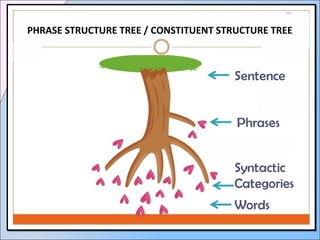
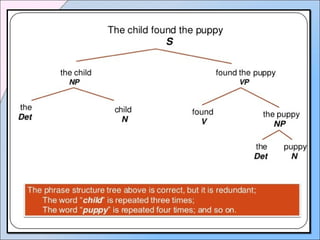
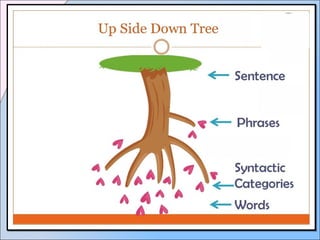
PHRASE STRUCTURE TREE / CONSTITUENT STRUCTURE TREE
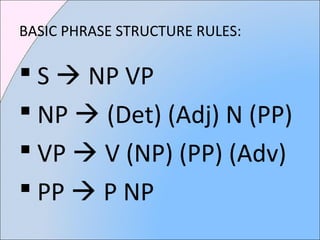
BASIC PHRASE STRUCTURE RULES:
 S  NP VP
 NP  (Det) (Adj) N (PP)
 VP  V (NP) (PP) (Adv)
 PP  P NP
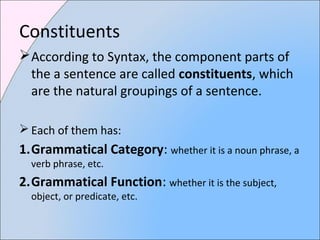
Constituents
According to Syntax, the component parts of
the a sentence are called constituents, which
are the natural groupings of a sentence.
 Each of them has:
1.Grammatical Category: whether it is a noun phrase, a
verb phrase, etc.
2.Grammatical Function: whether it is the subject,
object, or predicate, etc.
Grammatical Function & Category
The Subject: To study grammar is fun. [Category: Infinitive]
The Predicate: I cried. [Intransitive Verb]
The Subjective Complement: It was dark. [Adjective]
The Direct Object: He loves reading. [Gerund]
The Indirect Object: I gave the beggar a coin. [Noun Phrase]
The Objective Complement:
I found the box empty. [Adjective]
A Constituent is formed if…
1. Constituent can stand alone
Ex. “What did you find?” “A puppy.” (not “found a”)
2. Constituents can be replaced by one word
Ex. “Where did you find the puppy?”
“I found him along the river.”
3. Constituents move together
Ex. “It was the puppy that the child found.”
“The puppy was found by the child.”
Syntax (Phrases and Clauses)

Syntax (Phrases and Clauses)

  • 1.
  • 2.
    GRAMMAR is the studyof the rules governing the use of a given natural language, and, as such, is a field of linguistics (the scientific study of language). Traditionally, grammar included morphology and syntax. In modern liguistics these subfields are complemented by phonetics, phonology, semantics and pragmatics.
  • 3.
    Review: The FiveGrammatical Units Halliday’s Hierarchy 1. The Sentence: one or more clauses 2. The Clause: one or more phrases 3. The Phrase: one or more words 4. The Word: one or more morphemes 5. The Morpheme: the smallest unit in form and meaning Identify the Units: “The child found the puppy while he was walking along the river.”
  • 4.
    WHAT IS ‘SYNTAX’? •Knowing a language includes the ability to construct phrases and sentences/clauses out of morphemes and words. The part of the grammar that represents a speaker’s knowledge of these structures and their formation is called Syntax! • In other words, syntax is the study of sentence patterns of language.
  • 5.
    The aim ofthis study is to show you what syntactic structure is and what the rules that determine syntactic structure are like. What meant by structure here, is ‘word order’. The meaning of a sentence depends on the order in which words occur in a sentence.
  • 6.
    Compare the followingsentences: I sing because I am happy. I am happy because I sing. The two sentences above have the same categories and number of words, but different in structure (words order); thus, they have different meanings.
  • 7.
    SYNTACTIC CATEGORY Syntactic categoryis a set of words and/or phrases in language which share a significant number of common characteristics.
  • 8.
    Syntactic categories commonlyinclude: 1. Parts of Speech (Determiner, Adjective, Noun, Pronoun, Preposition, Adverb, Auxiliary, Verb etc.) 2. Phrase Structure Grammars (Noun Phrase, Adjective Phrase, Verb Phrase, Adverb Phrase, Preposition Phrase) 3. Sentence – the core of the structure
  • 10.
    SYNTACTIC LABELS Sentence [S] Determiner[Det] Adjective [Adj] Adverb [Adv] Noun [N] Verb [V] Pronoun [Pro] Preposition [P] Auxiliary Verb [Aux] Preposition Phrase [PP] Adverb Phrase [AdvP] Adjective Phrase [AdjP] Noun Phrase [NP] Verb Phrase [VP]
  • 11.
    up PHRASE STRUCTURE TREE/ CONSTITUENT STRUCTURE TREE
  • 13.
    BASIC PHRASE STRUCTURERULES:  S  NP VP  NP  (Det) (Adj) N (PP)  VP  V (NP) (PP) (Adv)  PP  P NP
  • 14.
    Constituents According to Syntax,the component parts of the a sentence are called constituents, which are the natural groupings of a sentence.  Each of them has: 1.Grammatical Category: whether it is a noun phrase, a verb phrase, etc. 2.Grammatical Function: whether it is the subject, object, or predicate, etc.
  • 15.
    Grammatical Function &Category The Subject: To study grammar is fun. [Category: Infinitive] The Predicate: I cried. [Intransitive Verb] The Subjective Complement: It was dark. [Adjective] The Direct Object: He loves reading. [Gerund] The Indirect Object: I gave the beggar a coin. [Noun Phrase] The Objective Complement: I found the box empty. [Adjective]
  • 16.
    A Constituent isformed if… 1. Constituent can stand alone Ex. “What did you find?” “A puppy.” (not “found a”) 2. Constituents can be replaced by one word Ex. “Where did you find the puppy?” “I found him along the river.” 3. Constituents move together Ex. “It was the puppy that the child found.” “The puppy was found by the child.”