English Syntax
WORD CLASSES
GROUP 4
Fitri Yunida (F42112016)
Iga Yolanda (F42112018)
Word classes
 What are word classes ?
 Criterion for word classes
 Morphological criterion
 Morpho-syntactic criterion
 Syntactic criterion
 Semantic criterion: what words mean
 Semantic criterion: what speakers do with
words
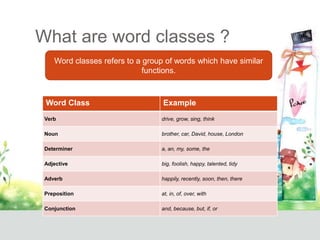
What are word classes ?
Word Class Example
Verb drive, grow, sing, think
Noun brother, car, David, house, London
Determiner a, an, my, some, the
Adjective big, foolish, happy, talented, tidy
Adverb happily, recently, soon, then, there
Preposition at, in, of, over, with
Conjunction and, because, but, if, or
Word classes refers to a group of words which have similar
functions.
Morphological criterion
The singular form criterion is used in the
heading because what is at stake is simply
whether a given word allow grammatical
suffixes or not.
Example
(1). a. Sobaka lajala
Dog barked “The dog barked”
The suffix –a signals the animal doing the barking
b. Koshka tsarapala sobaku
Cat scratched dog “The cat scratched the dog”
It as direct object suffix –u which marks the animal being
scratched
c. Petr dal sobake kost’
Peter gave dog bone “Peter gave the dog a
bone”
It has its oblique object suffix –e which mark the recipient of
the bone
Based on the example above , there are the grammatical suffixes in
Russian which means the suffixes in the ending of the word (head),
have the relationship between the noun and the verb in a clause.
There are few nouns in Russian take no suffixes
Example: Kakadu( cockatoo), taksi(taxi),
kofe(coffee)
These nouns which do not vary their shape are
called as invariable words.
English does not have the grammatical suffixes as
Russian, but English nouns typically take a plural
ending –fish-fishes, cat-cats and dog-dogs.
Some nouns in English do not take a plural suffix –
for example sheep, deer- and are said to be
invariable
Morpho-syntactic criterion
These criteria have to do with inflectional suffixes.
The suffixes in…
 nouns are inflected for information about number and
case
 Verbs are inflected for information about tense, person
and number
 Adverbs and preposition are not inflected
 English adjectives are not associated with number or
case, but many of them take suffixes signaling a
greater quantity of some property (for example bigger,
biggest)
* Case is the relationship between the noun and the verb in a clause which is
signaled by different suffixes
*inflectional suffixes express grammatical information, such ‘plural’ or –ing
forms
Example:
(2). a. Sobaki lajut
Dogs bark “The dogs are barking”
Sobaki is the subject but also plural, and it has a
different suffix, -I
b. Petr dal kost’ sobakam
Peter gave bone to dogs “Peter gave a bone to
the dogs”
Sobakam refers to the recipient and is plural and it too
has a different suffix, -am
So, the suffixes signal information about case and
about number
Other example:
Verbs also take inflection:
Speak-speaking
Verbs in Russian signal information about time, person and
number
(3). a. govorit o Moskve
Speaks about Moscow “He/she is speaking about Moscow”
b. Govarjat o Moskve
Speak about Moscow “They are speaking about
Moscow”
c. Govorju o moskve
Speak-I about Moscow “I am speaking about Moscow”
d. Govorili o moskve
Spoke about Moscow “They were speaking about
Moscow”
Syntactic criterion
The syntactic criteria for word classes
are based on what words a given word occurs
with and the types of phrase in which a given
word occurs.
(4). a. The dog stole the turkey.
b. The children chased the dog.
c. The cook saved no scraps for the dog.
Dog occurs to the left of stole in (4a), to the right
of chased in (4b), and to the right of saved in (4c)
but separated from it by the intervening word
for. Dog also occurs in a noun phrase and can be
modified by a word such as the – The dog stole the
turkey – or by an adjective – Hungry dogs stole the
turkey – or by the and an adjective together – The
hungry dogs stole the turkey.Based on the example above, the given word in noun phrase can be
occur anywhere by adding the article (for some noun) or change the
article with adjective (Hungry dogs ).
 A noun can occur in different positions (left
and right) in relation to the verb.
 Noun allow an article to their left; but adjective
do not.
 Some nouns can be pluralized, but adjective
cannot.
Semantic criterion
What words mean
It deals with meaning (dictionary and speaker’s
meaning)
Example :
Nouns as words denoting people, place or things
Verbs as words denoting an action.
What speakers do with words
It refers to the principle that ‘when speakers perform
speech acts, they also perform actions
E.G: Speakers ask, assert, issue commands, describe,
narrate, etc.
Speakers and writers pick what are called
verbs when predicating,
adjectives when adding to the information carried by a
noun (that is, when they perform the speech act of
modifying) and
adverbs when they add to the information carried by a
verb or an adjective.
*Speech acts is any word or string of words that express meaning.
Speakers use speech acts : to assert, to refer to entities, to predicate ( is
expressed in the formula of “someone saying something about a person
or thing”) and to issue a command.
Summary
The different classes of words – for example
nouns, verbs, adjectives, adverbs, prepositions – were
traditionally defined by what they denoted – people,
places and things (nouns), action (verbs) aand
properties (adjectives). This definiton is inadequate
although meaning still has an important part to play.
Reliable definitions are based on formal criteria –
morphological (does a given word take inflectional
sufixes or is it invariable?), morpho-syntactic ( does
given word take suffixes having to do with person and
number, or with case?) and syntactic (where in
aphrase or clause does a given word occur?). Once
formal criteria have been set up, the connection
between word classes and meaning can be studied.
This bear not just on what a given word or class of
words refers to but on what speakers and writers do

word classes

  • 1.
    English Syntax WORD CLASSES GROUP4 Fitri Yunida (F42112016) Iga Yolanda (F42112018)
  • 2.
    Word classes  Whatare word classes ?  Criterion for word classes  Morphological criterion  Morpho-syntactic criterion  Syntactic criterion  Semantic criterion: what words mean  Semantic criterion: what speakers do with words
  • 3.
    What are wordclasses ? Word Class Example Verb drive, grow, sing, think Noun brother, car, David, house, London Determiner a, an, my, some, the Adjective big, foolish, happy, talented, tidy Adverb happily, recently, soon, then, there Preposition at, in, of, over, with Conjunction and, because, but, if, or Word classes refers to a group of words which have similar functions.
  • 4.
    Morphological criterion The singularform criterion is used in the heading because what is at stake is simply whether a given word allow grammatical suffixes or not.
  • 5.
    Example (1). a. Sobakalajala Dog barked “The dog barked” The suffix –a signals the animal doing the barking b. Koshka tsarapala sobaku Cat scratched dog “The cat scratched the dog” It as direct object suffix –u which marks the animal being scratched c. Petr dal sobake kost’ Peter gave dog bone “Peter gave the dog a bone” It has its oblique object suffix –e which mark the recipient of the bone Based on the example above , there are the grammatical suffixes in Russian which means the suffixes in the ending of the word (head), have the relationship between the noun and the verb in a clause.
  • 6.
    There are fewnouns in Russian take no suffixes Example: Kakadu( cockatoo), taksi(taxi), kofe(coffee) These nouns which do not vary their shape are called as invariable words. English does not have the grammatical suffixes as Russian, but English nouns typically take a plural ending –fish-fishes, cat-cats and dog-dogs. Some nouns in English do not take a plural suffix – for example sheep, deer- and are said to be invariable
  • 7.
    Morpho-syntactic criterion These criteriahave to do with inflectional suffixes. The suffixes in…  nouns are inflected for information about number and case  Verbs are inflected for information about tense, person and number  Adverbs and preposition are not inflected  English adjectives are not associated with number or case, but many of them take suffixes signaling a greater quantity of some property (for example bigger, biggest) * Case is the relationship between the noun and the verb in a clause which is signaled by different suffixes *inflectional suffixes express grammatical information, such ‘plural’ or –ing forms
  • 8.
    Example: (2). a. Sobakilajut Dogs bark “The dogs are barking” Sobaki is the subject but also plural, and it has a different suffix, -I b. Petr dal kost’ sobakam Peter gave bone to dogs “Peter gave a bone to the dogs” Sobakam refers to the recipient and is plural and it too has a different suffix, -am So, the suffixes signal information about case and about number
  • 9.
    Other example: Verbs alsotake inflection: Speak-speaking Verbs in Russian signal information about time, person and number (3). a. govorit o Moskve Speaks about Moscow “He/she is speaking about Moscow” b. Govarjat o Moskve Speak about Moscow “They are speaking about Moscow” c. Govorju o moskve Speak-I about Moscow “I am speaking about Moscow” d. Govorili o moskve Spoke about Moscow “They were speaking about Moscow”
  • 10.
    Syntactic criterion The syntacticcriteria for word classes are based on what words a given word occurs with and the types of phrase in which a given word occurs.
  • 11.
    (4). a. Thedog stole the turkey. b. The children chased the dog. c. The cook saved no scraps for the dog. Dog occurs to the left of stole in (4a), to the right of chased in (4b), and to the right of saved in (4c) but separated from it by the intervening word for. Dog also occurs in a noun phrase and can be modified by a word such as the – The dog stole the turkey – or by an adjective – Hungry dogs stole the turkey – or by the and an adjective together – The hungry dogs stole the turkey.Based on the example above, the given word in noun phrase can be occur anywhere by adding the article (for some noun) or change the article with adjective (Hungry dogs ).
  • 12.
     A nouncan occur in different positions (left and right) in relation to the verb.  Noun allow an article to their left; but adjective do not.  Some nouns can be pluralized, but adjective cannot.
  • 13.
    Semantic criterion What wordsmean It deals with meaning (dictionary and speaker’s meaning) Example : Nouns as words denoting people, place or things Verbs as words denoting an action.
  • 14.
    What speakers dowith words It refers to the principle that ‘when speakers perform speech acts, they also perform actions E.G: Speakers ask, assert, issue commands, describe, narrate, etc. Speakers and writers pick what are called verbs when predicating, adjectives when adding to the information carried by a noun (that is, when they perform the speech act of modifying) and adverbs when they add to the information carried by a verb or an adjective. *Speech acts is any word or string of words that express meaning. Speakers use speech acts : to assert, to refer to entities, to predicate ( is expressed in the formula of “someone saying something about a person or thing”) and to issue a command.
  • 15.
    Summary The different classesof words – for example nouns, verbs, adjectives, adverbs, prepositions – were traditionally defined by what they denoted – people, places and things (nouns), action (verbs) aand properties (adjectives). This definiton is inadequate although meaning still has an important part to play. Reliable definitions are based on formal criteria – morphological (does a given word take inflectional sufixes or is it invariable?), morpho-syntactic ( does given word take suffixes having to do with person and number, or with case?) and syntactic (where in aphrase or clause does a given word occur?). Once formal criteria have been set up, the connection between word classes and meaning can be studied. This bear not just on what a given word or class of words refers to but on what speakers and writers do