English Syntax ESCUELA : NOMBRES: Ciencias de la Educación, Mención Inglés Dra. Rosario María Burneo  BIMESTRE:  First bimester
TEXTO GUIA : AN INTRODUCTION TO ENGLISH SYNTAX By Jim Miller
Pay attention Por favor,  prepare sus preguntas con anticipación. Estas serán respondidas al final de la presentación
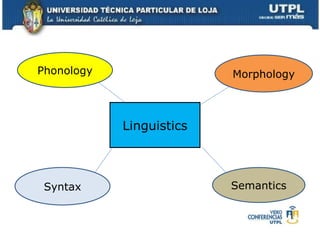
Linguistics Phonology Syntax Semantics Morphology
Syntax  deals with how words are put together to form phrases; how phases are joined to form clauses; and  how clauses form sentences. Syntax enables speakers  to compose complex messages in order to communicate effectively.
UNIT ONE :  HEADS AND MODIFIERS The  head  of a phrase is the word that carries the most meaning. A  modifier  provides extra information about the head word. Houses These old  houses The houses in my town
Modification According to Generative Grammar, Modification is the use of a word or structure to tell more about the person, thing, action or quality being modified.
**************** Heads and modifiers build different types of phrases Noun phrase :  the large house Ad. phrase :  very sad Prep. Phrase :  in the garden Verb Phrase:  w ork hard
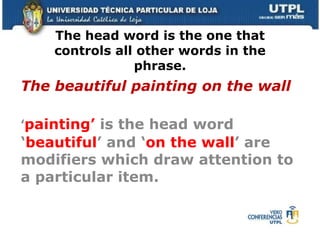
The head word is the one that controls all other words in the phrase. The beautiful painting on the wall ‘ painting’  is the head word ‘ beautiful ’ and ‘ on the wall ’ are modifiers which draw attention to a particular item.
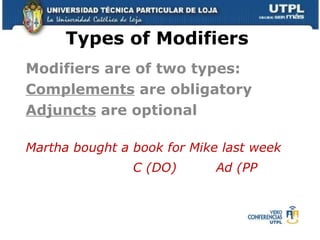
Types of Modifiers  Modifiers are of two types: Complements  are obligatory Adjuncts  are optional Martha bought a book for Mike last week C (DO)  Ad (PP
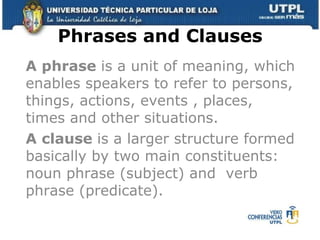
Phrases and Clauses A phrase  is a unit of meaning, which enables speakers to refer to persons, things, actions, events , places, times and other situations. A clause  is a larger structure formed basically by two main constituents:  noun phrase (subject) and  verb phrase (predicate).
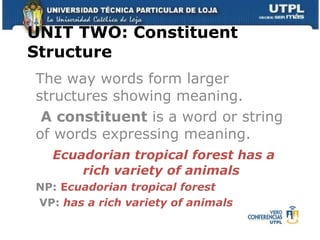
UNIT TWO: Constituent Structure The way words form larger structures showing meaning. A constituent  is a word or string of words expressing meaning. Ecuadorian tropical forest has a rich variety of animals NP:   E cuadorian tropical forest  VP:  has a rich variety of animals
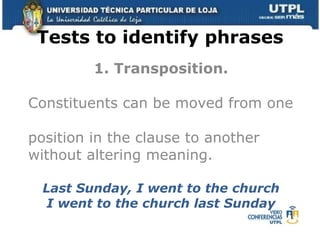
Tests to identify phrases 1. Transposition. Constituents can be moved from one  position in the clause to another  without altering meaning. Last Sunday, I went to the church I went to the church last Sunday
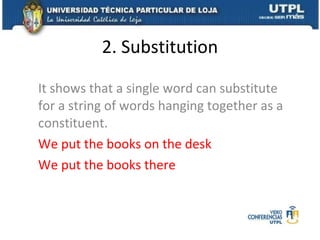
2. Substitution It shows that a single word can substitute for a string of words hanging together as a constituent.  We put the books on the desk We put the books there
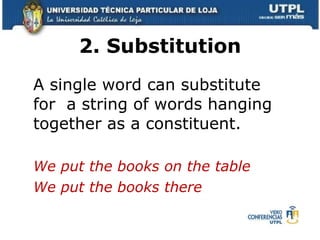
2. Substitution A single word can substitute for  a string of words hanging together as a constituent. We put the books on the table We put the books there
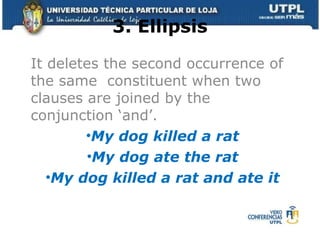
3. Ellipsis It deletes the second occurrence of the same  constituent when two clauses are joined by the conjunction ‘and’. My dog killed a rat My dog ate the rat My dog killed a rat and ate it
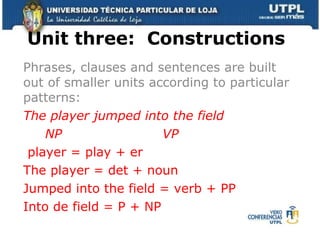
Unit three:  Constructions Phrases, clauses and sentences are built out of smaller units according to particular patterns: The player jumped into the field   NP  VP  player = play + er  The player = det + noun Jumped into the field = verb + PP Into de field = P + NP
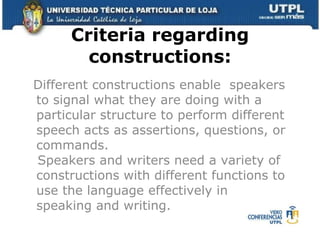
Criteria regarding constructions: Different constructions enable  speakers to signal what they are doing with a particular structure to perform different speech acts as assertions, questions, or commands.   Speakers and writers need a variety of constructions with different functions to use the language effectively in speaking and writing.
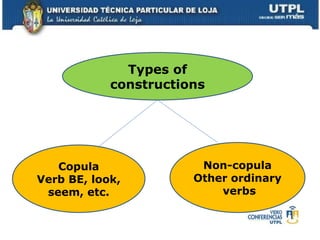
Copula Verb BE, look, seem, etc. Non-copula Other ordinary  verbs Types of constructions
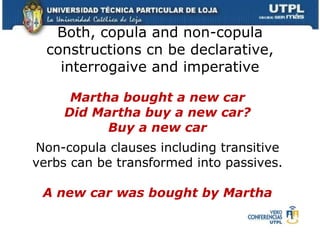
Both, copula and non-copula constructions cn be declarative, interrogaive and imperative Martha bought a new car Did Martha buy a new car? Buy a new car Non-copula clauses including transitive verbs can be transformed into passives. A new car was bought by Martha
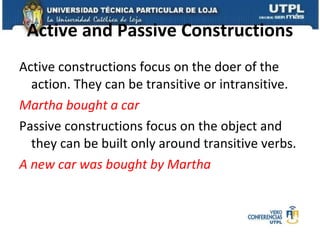
Active and Passive Constructions Active constructions focus on the doer of the action. They can be transitive or intransitive. Martha bought a car Passive constructions focus on the object and they can be built only around transitive verbs. A new car was bought by Martha
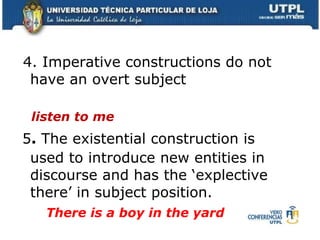
4. Imperative constructions do not have an overt subject listen to me  5 .  The existential construction is used to introduce new entities in discourse and has the ‘explective there’ in subject position.   There is a boy in the yard
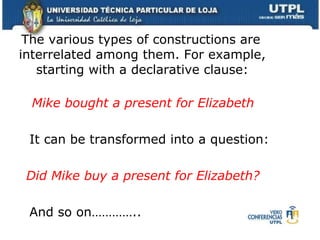
The various types of constructions are interrelated among them. For example, starting with a declarative clause: Mike bought a present for Elizabeth It can be transformed into a question:  Did Mike buy a present for Elizabeth? And so on…………..
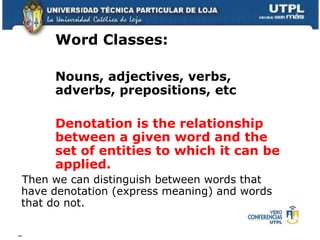
Word Classes:  Nouns, adjectives, verbs, adverbs, prepositions, etc Denotation is the relationship between a given word and the set of entities to which it can be applied. Then we can distinguish between words that have denotation (express meaning) and words that do not.
Content words  They have denotation; it is to say, that they express meaning;  They apply to people things, places, actions, states, properties and situations (noun, verbs, adjectives, adverbs).
Grammatical words  They   are also called “function  words”. They are used as links to join content words. The definite and indefinite articles, demonstrative adjectives, auxiliaries, among others belong to this group.
CRITERIA TO RECOGNIZE PHRASES MORPHO-SYNTACTIC CRITERION SYNTACTIC CRITERION SEMANTIC CRITERION
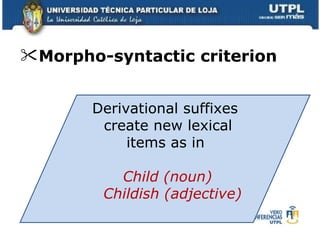
Morpho-syntactic criterion  Derivational suffixes create new lexical items as in  Child (noun) Childish (adjective)
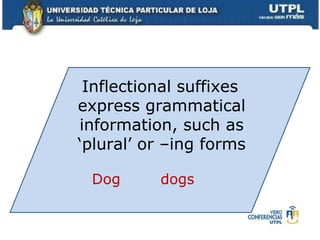
Inflectional suffixes express grammatical information, such as ‘plural’ or –ing forms Dog  dogs
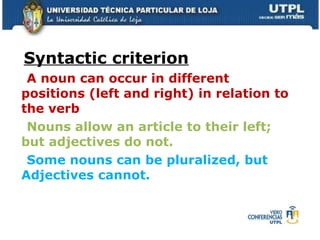
Syntactic criterion A noun can occur in different positions (left and right) in relation to the verb   Nouns allow an article to their left; but adjectives do not. Some nouns can be pluralized, but Adjectives cannot.
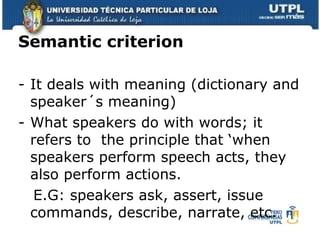
Semantic criterion It deals with meaning (dictionary and speaker´s meaning)  What speakers do with words; it refers to  the principle that ‘when speakers perform speech acts, they also perform actions. E.G: speakers ask, assert, issue commands, describe, narrate, etc.
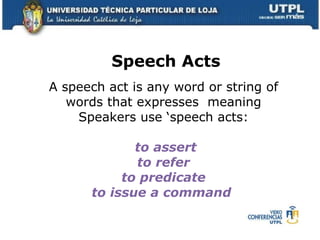
A speech act is any word or string of words that expresses  meaning Speakers use ‘speech acts:   to assert to refer to predicate to issue a command  Speech Acts
The Lexicon The lexicon is the set of all words in a language that are registered in a dictionary. Content Words Function words
Verbs Each individual verb might take different words as complements or adjuncts. I lost my book in the park last night Complements  are obligatory modifiers, which typically occur next to the verb: my book   (direct object, complement)
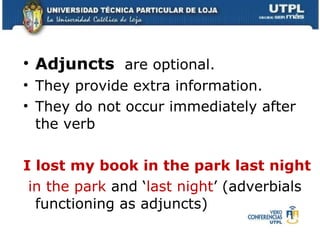
Adjuncts  are optional.  They provide extra information. They do not occur immediately after the verb I lost my book in the park last night in the park  and  ‘ last night ’ (adverbials functioning as adjuncts)
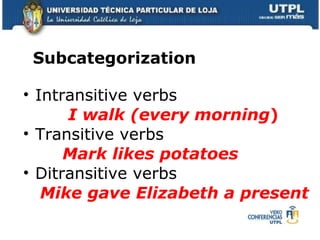
Subcategorization Intransitive verbs I walk (every morning ) Transitive verbs Mark likes potatoes Ditransitive verbs Mike gave Elizabeth a present
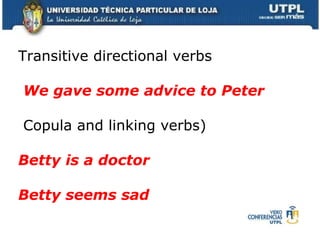
Transitive directional verbs We gave some advice to Peter Copula and linking verbs) Betty is a doctor Betty seems sad
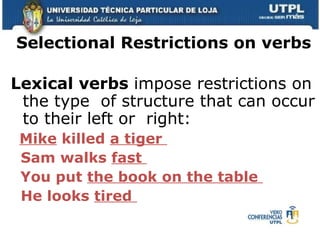
Selectional Restrictions on verbs Lexical verbs  impose restrictions on the type  of structure that can occur to their left or  right: Mike  killed  a tiger   Sam walks  fast  You put  the book on the table   He looks  tired
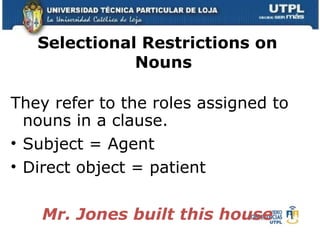
Selectional Restrictions on Nouns They refer to the roles assigned to nouns in a clause. Subject = Agent Direct object = patient Mr. Jones built this house
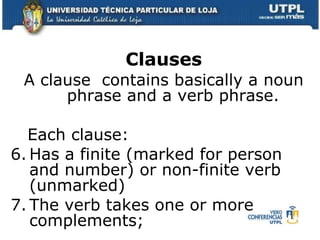
Clauses A clause  contains basically a noun phrase and a verb phrase. Each clause: Has a finite (marked for person and number) or non-finite verb (unmarked) The verb takes one or more complements;
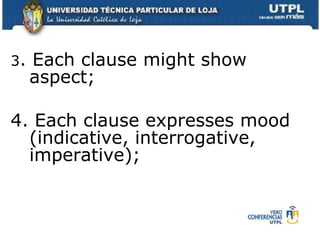
3 . Each clause might show aspect; 4. Each clause expresses mood (indicative, interrogative, imperative);
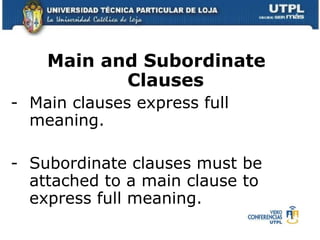
Main and Subordinate Clauses Main clauses express full meaning. Subordinate clauses must be attached to a main clause to express full meaning.
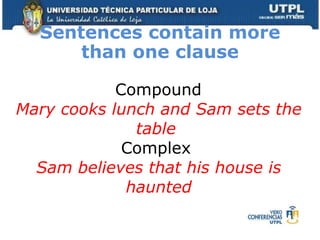
Sentences contain more than one clause Compound  Mary cooks lunch and Sam sets the table  Complex  Sam believes that his house is haunted
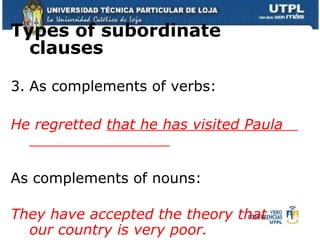
Types of subordinate clauses As complements of verbs: He regretted  that he has visited Paula  As complements of nouns: They have accepted the theory that  our country is very poor.
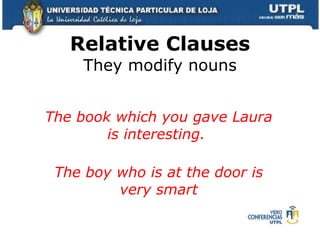
Relative Clauses They modify nouns The book which you gave Laura is interesting.    The boy who is at the door is very smart
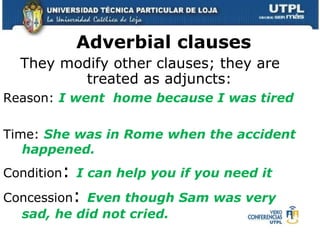
Adverbial clauses  They modify other clauses; they are treated as adjuncts: Reason:  I went  home because I was tired Time:  She was in Rome when the accident happened. Condition :  I can help you if you need it Concession :  Even though Sam was very sad, he did not cried.
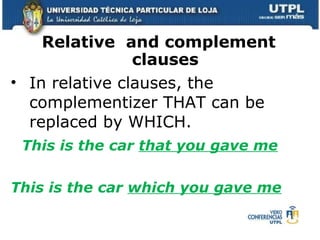
Relative  and complement clauses   In relative clauses, the complementizer THAT can be replaced by WHICH. This is the car  that you gave me This is the car  which you gave me
In complement clauses, the word THAT can not be replaced by a WH-word: Liz likes the idea that I will quit smoking  * Liz likes the idea which I will quit  smoking
Thank you God  Bless  You Questions? Mgs. Rosario María Burneo [email_address] Phone: 2570275 Ext.2326 Tutoring: 13:00 to 15:00,  Monday - Friday
 

SYNTAX ( I Bimestre Abril Agosto 2011)

  • 1.
    English Syntax ESCUELA: NOMBRES: Ciencias de la Educación, Mención Inglés Dra. Rosario María Burneo BIMESTRE: First bimester
  • 2.
    TEXTO GUIA :AN INTRODUCTION TO ENGLISH SYNTAX By Jim Miller
  • 3.
    Pay attention Porfavor, prepare sus preguntas con anticipación. Estas serán respondidas al final de la presentación
  • 4.
    Linguistics Phonology SyntaxSemantics Morphology
  • 5.
    Syntax dealswith how words are put together to form phrases; how phases are joined to form clauses; and how clauses form sentences. Syntax enables speakers to compose complex messages in order to communicate effectively.
  • 6.
    UNIT ONE : HEADS AND MODIFIERS The head of a phrase is the word that carries the most meaning. A modifier provides extra information about the head word. Houses These old houses The houses in my town
  • 7.
    Modification According toGenerative Grammar, Modification is the use of a word or structure to tell more about the person, thing, action or quality being modified.
  • 8.
    **************** Heads andmodifiers build different types of phrases Noun phrase : the large house Ad. phrase : very sad Prep. Phrase : in the garden Verb Phrase: w ork hard
  • 9.
    The head wordis the one that controls all other words in the phrase. The beautiful painting on the wall ‘ painting’ is the head word ‘ beautiful ’ and ‘ on the wall ’ are modifiers which draw attention to a particular item.
  • 10.
    Types of Modifiers Modifiers are of two types: Complements are obligatory Adjuncts are optional Martha bought a book for Mike last week C (DO) Ad (PP
  • 11.
    Phrases and ClausesA phrase is a unit of meaning, which enables speakers to refer to persons, things, actions, events , places, times and other situations. A clause is a larger structure formed basically by two main constituents: noun phrase (subject) and verb phrase (predicate).
  • 12.
    UNIT TWO: ConstituentStructure The way words form larger structures showing meaning. A constituent is a word or string of words expressing meaning. Ecuadorian tropical forest has a rich variety of animals NP: E cuadorian tropical forest VP: has a rich variety of animals
  • 13.
    Tests to identifyphrases 1. Transposition. Constituents can be moved from one position in the clause to another without altering meaning. Last Sunday, I went to the church I went to the church last Sunday
  • 14.
    2. Substitution Itshows that a single word can substitute for a string of words hanging together as a constituent. We put the books on the desk We put the books there
  • 15.
    2. Substitution Asingle word can substitute for a string of words hanging together as a constituent. We put the books on the table We put the books there
  • 16.
    3. Ellipsis Itdeletes the second occurrence of the same constituent when two clauses are joined by the conjunction ‘and’. My dog killed a rat My dog ate the rat My dog killed a rat and ate it
  • 17.
    Unit three: Constructions Phrases, clauses and sentences are built out of smaller units according to particular patterns: The player jumped into the field NP VP player = play + er The player = det + noun Jumped into the field = verb + PP Into de field = P + NP
  • 18.
    Criteria regarding constructions:Different constructions enable speakers to signal what they are doing with a particular structure to perform different speech acts as assertions, questions, or commands. Speakers and writers need a variety of constructions with different functions to use the language effectively in speaking and writing.
  • 19.
    Copula Verb BE,look, seem, etc. Non-copula Other ordinary verbs Types of constructions
  • 20.
    Both, copula andnon-copula constructions cn be declarative, interrogaive and imperative Martha bought a new car Did Martha buy a new car? Buy a new car Non-copula clauses including transitive verbs can be transformed into passives. A new car was bought by Martha
  • 21.
    Active and PassiveConstructions Active constructions focus on the doer of the action. They can be transitive or intransitive. Martha bought a car Passive constructions focus on the object and they can be built only around transitive verbs. A new car was bought by Martha
  • 22.
    4. Imperative constructionsdo not have an overt subject listen to me 5 . The existential construction is used to introduce new entities in discourse and has the ‘explective there’ in subject position. There is a boy in the yard
  • 23.
    The various typesof constructions are interrelated among them. For example, starting with a declarative clause: Mike bought a present for Elizabeth It can be transformed into a question: Did Mike buy a present for Elizabeth? And so on…………..
  • 24.
    Word Classes: Nouns, adjectives, verbs, adverbs, prepositions, etc Denotation is the relationship between a given word and the set of entities to which it can be applied. Then we can distinguish between words that have denotation (express meaning) and words that do not.
  • 25.
    Word Classes: Nouns, adjectives, verbs, adverbs, prepositions, etc Denotation is the relationship between a given word and the set of entities to which it can be applied. Then we can distinguish between words that have denotation (express meaning) and words that do not.
  • 26.
    Content words They have denotation; it is to say, that they express meaning; They apply to people things, places, actions, states, properties and situations (noun, verbs, adjectives, adverbs).
  • 27.
    Grammatical words They are also called “function words”. They are used as links to join content words. The definite and indefinite articles, demonstrative adjectives, auxiliaries, among others belong to this group.
  • 28.
    CRITERIA TO RECOGNIZEPHRASES MORPHO-SYNTACTIC CRITERION SYNTACTIC CRITERION SEMANTIC CRITERION
  • 29.
    Morpho-syntactic criterion Derivational suffixes create new lexical items as in Child (noun) Childish (adjective)
  • 30.
    Inflectional suffixes expressgrammatical information, such as ‘plural’ or –ing forms Dog dogs
  • 31.
    Syntactic criterion Anoun can occur in different positions (left and right) in relation to the verb Nouns allow an article to their left; but adjectives do not. Some nouns can be pluralized, but Adjectives cannot.
  • 32.
    Semantic criterion Itdeals with meaning (dictionary and speaker´s meaning) What speakers do with words; it refers to the principle that ‘when speakers perform speech acts, they also perform actions. E.G: speakers ask, assert, issue commands, describe, narrate, etc.
  • 33.
    A speech actis any word or string of words that expresses meaning Speakers use ‘speech acts: to assert to refer to predicate to issue a command Speech Acts
  • 34.
    The Lexicon Thelexicon is the set of all words in a language that are registered in a dictionary. Content Words Function words
  • 35.
    Verbs Each individualverb might take different words as complements or adjuncts. I lost my book in the park last night Complements are obligatory modifiers, which typically occur next to the verb: my book (direct object, complement)
  • 36.
    Adjuncts areoptional. They provide extra information. They do not occur immediately after the verb I lost my book in the park last night in the park and ‘ last night ’ (adverbials functioning as adjuncts)
  • 37.
    Subcategorization Intransitive verbsI walk (every morning ) Transitive verbs Mark likes potatoes Ditransitive verbs Mike gave Elizabeth a present
  • 38.
    Transitive directional verbsWe gave some advice to Peter Copula and linking verbs) Betty is a doctor Betty seems sad
  • 39.
    Selectional Restrictions onverbs Lexical verbs impose restrictions on the type of structure that can occur to their left or right: Mike killed a tiger Sam walks fast You put the book on the table He looks tired
  • 40.
    Selectional Restrictions onNouns They refer to the roles assigned to nouns in a clause. Subject = Agent Direct object = patient Mr. Jones built this house
  • 41.
    Clauses A clause contains basically a noun phrase and a verb phrase. Each clause: Has a finite (marked for person and number) or non-finite verb (unmarked) The verb takes one or more complements;
  • 42.
    3 . Eachclause might show aspect; 4. Each clause expresses mood (indicative, interrogative, imperative);
  • 43.
    Main and SubordinateClauses Main clauses express full meaning. Subordinate clauses must be attached to a main clause to express full meaning.
  • 44.
    Sentences contain morethan one clause Compound Mary cooks lunch and Sam sets the table Complex Sam believes that his house is haunted
  • 45.
    Types of subordinateclauses As complements of verbs: He regretted that he has visited Paula As complements of nouns: They have accepted the theory that our country is very poor.
  • 46.
    Relative Clauses Theymodify nouns The book which you gave Laura is interesting. The boy who is at the door is very smart
  • 47.
    Adverbial clauses They modify other clauses; they are treated as adjuncts: Reason: I went home because I was tired Time: She was in Rome when the accident happened. Condition : I can help you if you need it Concession : Even though Sam was very sad, he did not cried.
  • 48.
    Relative andcomplement clauses In relative clauses, the complementizer THAT can be replaced by WHICH. This is the car that you gave me This is the car which you gave me
  • 49.
    In complement clauses,the word THAT can not be replaced by a WH-word: Liz likes the idea that I will quit smoking * Liz likes the idea which I will quit smoking
  • 50.
    Thank you God Bless You Questions? Mgs. Rosario María Burneo [email_address] Phone: 2570275 Ext.2326 Tutoring: 13:00 to 15:00, Monday - Friday
  • 51.