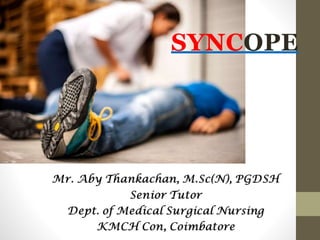
SYNCOPE
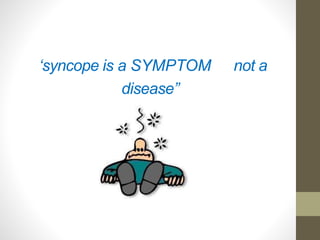
‘syncope is a SYMPTOM not a
disease’’
DEFINITION
• SYNCOPE is defined as
‘sudden and transient loss of
consciousness which is secondary to
period of cerebral ischemia’’
greek :- ‘ to interrupt’’
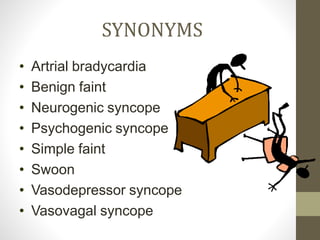
SYNONYMS
• Artrial bradycardia
• Benign faint
• Neurogenic syncope
• Psychogenic syncope
• Simple faint
• Swoon
• Vasodepressor syncope
• Vasovagal syncope
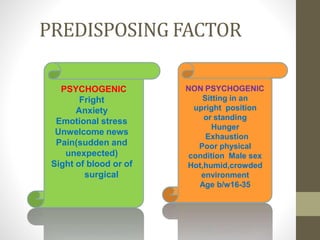
PREDISPOSING FACTOR
PSYCHOGENIC
Fright
Anxiety
Emotional stress
Unwelcome news
Pain(sudden and
unexpected)
Sight of blood or of
surgical
NON PSYCHOGENIC
Sitting in an
upright position
or standing
Hunger
Exhaustion
Poor physical
condition Male sex
Hot,humid,crowded
environment
Age b/w16-35
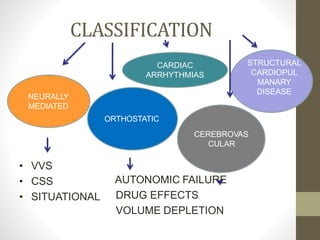
CLASSIFICATION
• VVS
• CSS
• SITUATIONAL
AUTONOMIC FAILURE
DRUG EFFECTS
VOLUME DEPLETION
NEURALLY
MEDIATED
CARDIAC
ARRHYTHMIAS
ORTHOSTATIC
CEREBROVAS
CULAR
STRUCTURAL
CARDIOPUL
MANARY
DISEASE
Central nervous system ischemia triggered
Syncope :
The central ischemic response is triggered by
an inadequate supply of oxygenated blood in the
brain cause the typical symptoms of fainting: pale
skin, rapid breathing, nausea and weakness of the
limbs, particularly of the legs.
If the ischaemia is intense or prolonged, limb
weakness progresses to collapse.
An individual with very little skin
pigmentation may appear to have all color drained
from his or her face at the onset of an episode.
Vasovagal (situational) syncope
One of the most common types which may occur in
response to any of a variety of triggers, such as scary,
embarrassing or uneasy situations, during blood drawing, or
moments of sudden unusually high stress.
There are many different syncope syndromes which all fall
under the umbrella of vasovagal syncope related by the
same central mechanism, such as urination ("micturition
syncope"), defecation ("defecation syncope"), and others
related to trauma and stress.
Deglutition (Swallowing) syncope
Syncope may occur during deglutition. "Deglutition
syncope is characterised by loss of consciousness on
swallowing; it has been associated not only with ingestion of
solid food, but also with carbonated and ice-cold beverages,
and even belching.
CaRdiaC SynCope
Cardiac arrhythmias : most common cause of cardiac
syncope is cardiac arrhythmia (abnormal heart rhythm)
wherein the heart beats too slowly, too rapidly, or too
irregularly to pump enough blood to the brain.
Two major groups of arrhythmias are bradycardia and tachycardia.
Obstructive cardiac lesion
Aortic stenosis and mitral stenosis
are the most common examples
Blood pressure
Orthostatic (postural) hypotensive faints
are associated with movement from lying
or sitting to a standing position, standing
up too quickly, or being in a very hot
room.
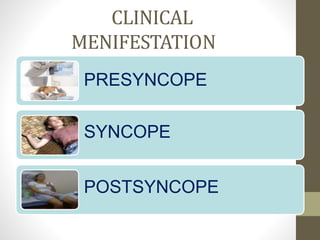
CLINICAL
MENIFESTATION
PRESYNCOPE
SYNCOPE
POSTSYNCOPE
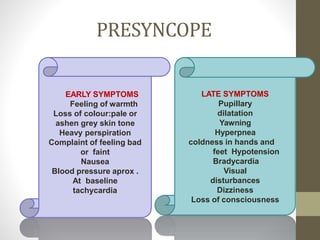
PRESYNCOPE
EARLY SYMPTOMS
Feeling of warmth
Loss of colour:pale or
ashen grey skin tone
Heavy perspiration
Complaint of feeling bad
or faint
Nausea
Blood pressure aprox .
At baseline
tachycardia
LATE SYMPTOMS
Pupillary
dilatation
Yawning
Hyperpnea
coldness in hands and
feet Hypotension
Bradycardia
Visual
disturbances
Dizziness
Loss of consciousness
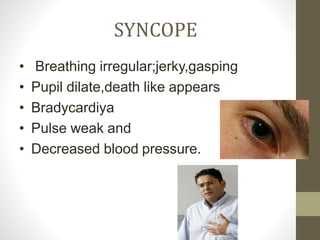
SYNCOPE
• Breathing irregular;jerky,gasping
• Pupil dilate,death like appears
• Bradycardiya
• Pulse weak and
• Decreased blood pressure.
POSTSYNCOPE
• Pallor,nausea,weakness.sweating from
few min. to many hrs.
• Short period of mental confusion
• Disorientation
• Blood pressure and heart
rate- normal
• Tendency of second attack
if allowed to stand or sit too soon
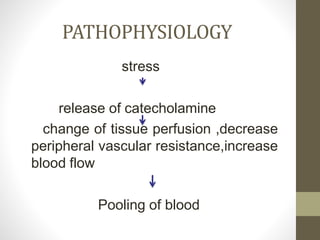
PATHOPHYSIOLOGY
stress
release of catecholamine
change of tissue perfusion ,decrease
peripheral vascular resistance,increase
blood flow
Pooling of blood
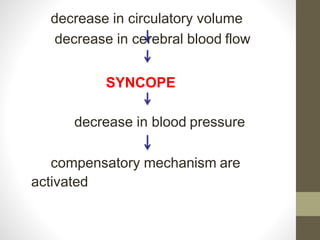
decrease in circulatory volume
decrease in cerebral blood flow
SYNCOPE
decrease in blood pressure
compensatory mechanism are
activated
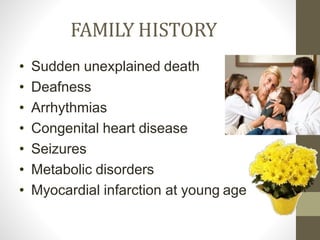
FAMILY HISTORY
• Sudden unexplained death
• Deafness
• Arrhythmias
• Congenital heart disease
• Seizures
• Metabolic disorders
• Myocardial infarction at young age
HISTORY
• Time and day
• Activities preceding (recurrent/at
rest, exercise associated, on standing)
• Prodromes, associated symptoms
• Duration of LOC
• Injuries
• Medications, ingestions
• Cardiac History
M A N A G E M E NT
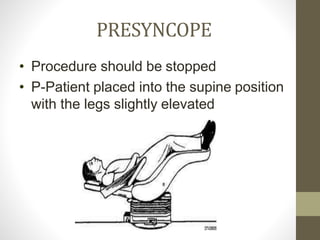
PRESYNCOPE
• Procedure should be stopped
• P-Patient placed into the supine position
with the legs slightly elevated
• A- airway
• B- breathing
• C- circulation
• D- drugs
SYNCOPE
• Step 1:- Assess consciousness
• Step 2:-Call for assistence
• Step 3:-Position the patient:- placing the
patient in supine position
• Step 4:-Assess and open airway
• Step 5:-Assess airway potency and
breathing
• Step 6:-Assess circulation
IF THE PATIENT CONTINUES TO REMAIN
UNCONSCIOUS SUMMON MEDICAL
ASSISTANCE IMMEDIATELY
• Step 8:-Administer oxygen
• Step 9:-Monitor vital signs
• Step 10:-provide definitive management
• Step 11:-delay patient recovery
DEFINITIVE MANAGEMENT
• Loosening of clothes
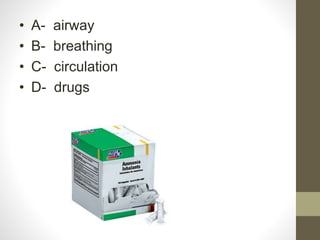
• Respiratory stimulant:-aromatic ammonia
• Cold towel on patient’s forehead.
• Blanket placed
• If bradycardia persist:- anticholinergics
atropine-0.5mg or max 3 mg
POSTSYNCOPE
• The possibilities of second episode of
syncope during this period of time.
• Prior to dismissal ,the doctor should
determine from the patient what the
primary precipitating event was and what
other factors may have been present such
as hunger or fear.
PRECAUTION
• Controlling the predisposing factors
• Before the patient enters the treatment area
• It should be made certain that the patient
has eaten recently
• a comfortable enviromental temperature and
humidity in the office
• Stress reduction modalities can be employed
• Sedation through variety of drugs
• Reducing anxiety
• Proper positioning and receiving supplemental
oxygen
TREATMENT
• Place the patient in head low position With lower
limb elevated
(trendelenburg position)
• monitor pulse
• If pulse is normal
– Sprinkle cold water
– Carry a gauge dipped in aromatic spirit of ammonia close
to patients nostrils
• If bradycardia
– Injection of atropine 6mg i.v.
– Injection of mephentramine 10-30 mg i.m.
• If patient is still not responding support
respiration (start
oxygen)
In case syncope is caused by cardiac
disease, the treatment is much more
sophisticated than that of vasovagal
syncope and may involve pacemakers
and implantable cardioverter-
defibrillators depending on the precise
cardiac cause.
CONCLUSION
Syncope is a common symptom,
often with dramatic consequences,
which deserves thorough investigation
and appropriate treatment of its cause.
• There are many causes of syncope
• Be vigilant in ruling out the life-threatening ones!
• Use the ultrasound machine
• Take into account the risks of hospitalization
Syncope

Syncope

  • 1.
  • 2.
    ‘syncope is aSYMPTOM not a disease’’
  • 3.
    DEFINITION • SYNCOPE isdefined as ‘sudden and transient loss of consciousness which is secondary to period of cerebral ischemia’’ greek :- ‘ to interrupt’’
  • 4.
    SYNONYMS • Artrial bradycardia •Benign faint • Neurogenic syncope • Psychogenic syncope • Simple faint • Swoon • Vasodepressor syncope • Vasovagal syncope
  • 5.
    PREDISPOSING FACTOR PSYCHOGENIC Fright Anxiety Emotional stress Unwelcomenews Pain(sudden and unexpected) Sight of blood or of surgical NON PSYCHOGENIC Sitting in an upright position or standing Hunger Exhaustion Poor physical condition Male sex Hot,humid,crowded environment Age b/w16-35
  • 6.
    CLASSIFICATION • VVS • CSS •SITUATIONAL AUTONOMIC FAILURE DRUG EFFECTS VOLUME DEPLETION NEURALLY MEDIATED CARDIAC ARRHYTHMIAS ORTHOSTATIC CEREBROVAS CULAR STRUCTURAL CARDIOPUL MANARY DISEASE
  • 8.
    Central nervous systemischemia triggered Syncope : The central ischemic response is triggered by an inadequate supply of oxygenated blood in the brain cause the typical symptoms of fainting: pale skin, rapid breathing, nausea and weakness of the limbs, particularly of the legs. If the ischaemia is intense or prolonged, limb weakness progresses to collapse. An individual with very little skin pigmentation may appear to have all color drained from his or her face at the onset of an episode.
  • 9.
    Vasovagal (situational) syncope Oneof the most common types which may occur in response to any of a variety of triggers, such as scary, embarrassing or uneasy situations, during blood drawing, or moments of sudden unusually high stress. There are many different syncope syndromes which all fall under the umbrella of vasovagal syncope related by the same central mechanism, such as urination ("micturition syncope"), defecation ("defecation syncope"), and others related to trauma and stress. Deglutition (Swallowing) syncope Syncope may occur during deglutition. "Deglutition syncope is characterised by loss of consciousness on swallowing; it has been associated not only with ingestion of solid food, but also with carbonated and ice-cold beverages, and even belching.
  • 10.
    CaRdiaC SynCope Cardiac arrhythmias: most common cause of cardiac syncope is cardiac arrhythmia (abnormal heart rhythm) wherein the heart beats too slowly, too rapidly, or too irregularly to pump enough blood to the brain. Two major groups of arrhythmias are bradycardia and tachycardia. Obstructive cardiac lesion Aortic stenosis and mitral stenosis are the most common examples Blood pressure Orthostatic (postural) hypotensive faints are associated with movement from lying or sitting to a standing position, standing up too quickly, or being in a very hot room.
  • 12.
  • 13.
    PRESYNCOPE EARLY SYMPTOMS Feeling ofwarmth Loss of colour:pale or ashen grey skin tone Heavy perspiration Complaint of feeling bad or faint Nausea Blood pressure aprox . At baseline tachycardia LATE SYMPTOMS Pupillary dilatation Yawning Hyperpnea coldness in hands and feet Hypotension Bradycardia Visual disturbances Dizziness Loss of consciousness
  • 14.
    SYNCOPE • Breathing irregular;jerky,gasping •Pupil dilate,death like appears • Bradycardiya • Pulse weak and • Decreased blood pressure.
  • 15.
    POSTSYNCOPE • Pallor,nausea,weakness.sweating from fewmin. to many hrs. • Short period of mental confusion • Disorientation • Blood pressure and heart rate- normal • Tendency of second attack if allowed to stand or sit too soon
  • 16.
    PATHOPHYSIOLOGY stress release of catecholamine changeof tissue perfusion ,decrease peripheral vascular resistance,increase blood flow Pooling of blood
  • 17.
    decrease in circulatoryvolume decrease in cerebral blood flow SYNCOPE decrease in blood pressure compensatory mechanism are activated
  • 18.
    FAMILY HISTORY • Suddenunexplained death • Deafness • Arrhythmias • Congenital heart disease • Seizures • Metabolic disorders • Myocardial infarction at young age
  • 19.
    HISTORY • Time andday • Activities preceding (recurrent/at rest, exercise associated, on standing) • Prodromes, associated symptoms • Duration of LOC • Injuries • Medications, ingestions • Cardiac History
  • 20.
    M A NA G E M E NT
  • 21.
    PRESYNCOPE • Procedure shouldbe stopped • P-Patient placed into the supine position with the legs slightly elevated
  • 22.
    • A- airway •B- breathing • C- circulation • D- drugs
  • 23.
    SYNCOPE • Step 1:-Assess consciousness • Step 2:-Call for assistence • Step 3:-Position the patient:- placing the patient in supine position • Step 4:-Assess and open airway • Step 5:-Assess airway potency and breathing • Step 6:-Assess circulation
  • 24.
    IF THE PATIENTCONTINUES TO REMAIN UNCONSCIOUS SUMMON MEDICAL ASSISTANCE IMMEDIATELY
  • 25.
    • Step 8:-Administeroxygen • Step 9:-Monitor vital signs • Step 10:-provide definitive management • Step 11:-delay patient recovery
  • 26.
    DEFINITIVE MANAGEMENT • Looseningof clothes • Respiratory stimulant:-aromatic ammonia • Cold towel on patient’s forehead. • Blanket placed • If bradycardia persist:- anticholinergics atropine-0.5mg or max 3 mg
  • 27.
    POSTSYNCOPE • The possibilitiesof second episode of syncope during this period of time. • Prior to dismissal ,the doctor should determine from the patient what the primary precipitating event was and what other factors may have been present such as hunger or fear.
  • 28.
    PRECAUTION • Controlling thepredisposing factors • Before the patient enters the treatment area • It should be made certain that the patient has eaten recently • a comfortable enviromental temperature and humidity in the office • Stress reduction modalities can be employed • Sedation through variety of drugs • Reducing anxiety • Proper positioning and receiving supplemental oxygen
  • 29.
    TREATMENT • Place thepatient in head low position With lower limb elevated (trendelenburg position) • monitor pulse • If pulse is normal – Sprinkle cold water – Carry a gauge dipped in aromatic spirit of ammonia close to patients nostrils • If bradycardia – Injection of atropine 6mg i.v. – Injection of mephentramine 10-30 mg i.m. • If patient is still not responding support respiration (start oxygen)
  • 30.
    In case syncopeis caused by cardiac disease, the treatment is much more sophisticated than that of vasovagal syncope and may involve pacemakers and implantable cardioverter- defibrillators depending on the precise cardiac cause.
  • 31.
    CONCLUSION Syncope is acommon symptom, often with dramatic consequences, which deserves thorough investigation and appropriate treatment of its cause. • There are many causes of syncope • Be vigilant in ruling out the life-threatening ones! • Use the ultrasound machine • Take into account the risks of hospitalization