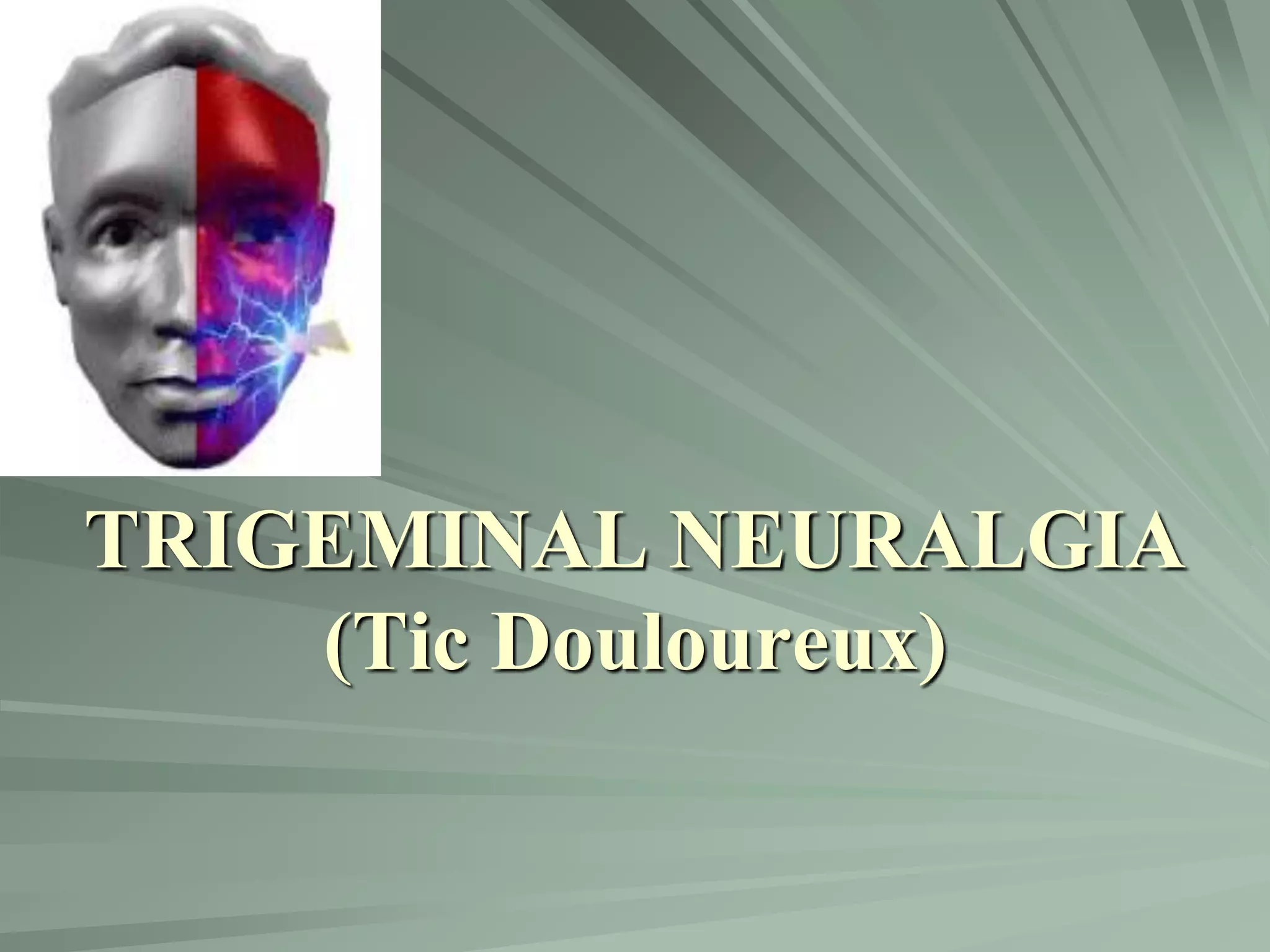
TRIGEMINAL NEURALGIA
(Tic Douloureux)
International Association for the Study of
Pain defines pain as
"an unpleasant sensory and emotional
experience associated with actual or
potential tissue damage, or described in
terms of such damage."
"if it isn't unpleasant, it isn't pain."
categories:
Somatic from the noxious
stimulation of normal
structures that innervate the
affected area
Normal or Physiologic
Neuropathic
arises in the absence of any
noxious stimulation.
a functional or structural
abnormality within the
nervous system itself.
episodic (paroxysmal) and
continuous
Pathophysiologic
psychogenic
arises from psychological causes.
Neither elicited by noxious stimuli nor an
abnormality within the neural system
General characteristics of
neuropathic pain
Pain in the absence of obvious nociception
Pain that can be intense and out of
proportion to the degree of stimulation
Pain quality that is bright, stimulating and
burning
Pain that is relatively unresponsive to low
doses of narcotic analgesics.
TRIGEMINAL NEURALGIA
(Tic Douloureux)
HISTORY
John lock------------1677
(1st description)
Nicolous Andre-----1756
(Tic douloreux)
John Fother Gills---1773
(Full description)
Other Names----- (Prosopalgia,
Face Palsy, Suicide disease)
Trigeminal – Cranial nerve V
Neur – Nerve related
Algia - Pain
Definition;
Trigeminal neuralgia (TN) is defined as
sudden,usually unilateral, severe, brief,
stabbing, lancinating, recurring pain in the
distribution of one or more branches of 5th
cranial nerve.
Age
Average age of onset - typically sixth
decade
may present at any age.
Symptomatic or secondary trigeminal
neuralgia tends to occur in younger
patients.
Sex
F more than M
5.9 : 3.4
In 100000
KCD. 242 CASES in 3 years
(PODJ 25 (2) Dec 2005)
Mean age; 43.88 with peak inci.age.50 - 60
M:F----1.068:1
Rt—63.22%, Lt—35.95%,Bil; o.82% (2. F)
Branch; Max & Mand almost equal.40.08%
& 39.667%.Opth.2.08%(5 cases in combi.)
Relation with diet
A. Elite class with v luxurious socio economic
status.-----------------------NIL.
B. Good socio economic status.—2.49%
C. Moderate s e status-------------36.77%
D. V V poor Labor class---------60.74%
IT SHOWS THAT THERE MIGHT BE
SOME DEFICIENCY OF IMPORTANT
INGREDIENTS IN THE DIET.
 V3 commonly involved than V2.
Types of Trigeminal Neuralgia and Their Causes:
1. Typical Trigeminal Neuralgia (Tic Douloureux)
2. Atypical Trigeminal Neuralgia
3. Pre-Trigeminal Neuralgia
4. Multiple Sclerosis-Related Trigeminal Neuralgia
5. Secondary or Tumor Related Trigeminal Neuralgia
6. Trigeminal Neuropathy or Post-Traumatic Trigeminal
Neuralgia
TRIGEMINAL NEURALGIA
CAUSES:
 PRIMARY
 Idiopathic
 SECONDARY.
 TUMORS (acoustic neuroma,cerebellopontine
angle tumors, Schwanoma. Pituitary gland
tumor)
VASCULAR
 Pulsatile compression of adjacent artery .
INFLAMMATORY; multiple sclerosis
POST TRAUMATIC.
 Viral
 Accident
 Dental trauma
 Sinus trauma
Clinical Features
Sudden, Sharp, Shooting, lancinating, unilateral paroxysmal,
intermittent, shock like pain.
trigger zones ; V1;
V1 over the supraorbital ridge
V2; Skin of the upper lip, ala nasi , cheek,gums.
V3; lower lip,teeth, gums, tongue
Rarely crosses the midline.
short duration-seconds
During attack, hands over the affected side, stop activities, hold
or rub the face which may redden or the eyes water until the
attack subs.
Paroxysms----weeks / months cycles
Electric shock like –like electric light in rain
Bad oral hygiene
No attacks during sleep
History of extractions
Loss of weight
Depression
Trigeminal Neuralgia
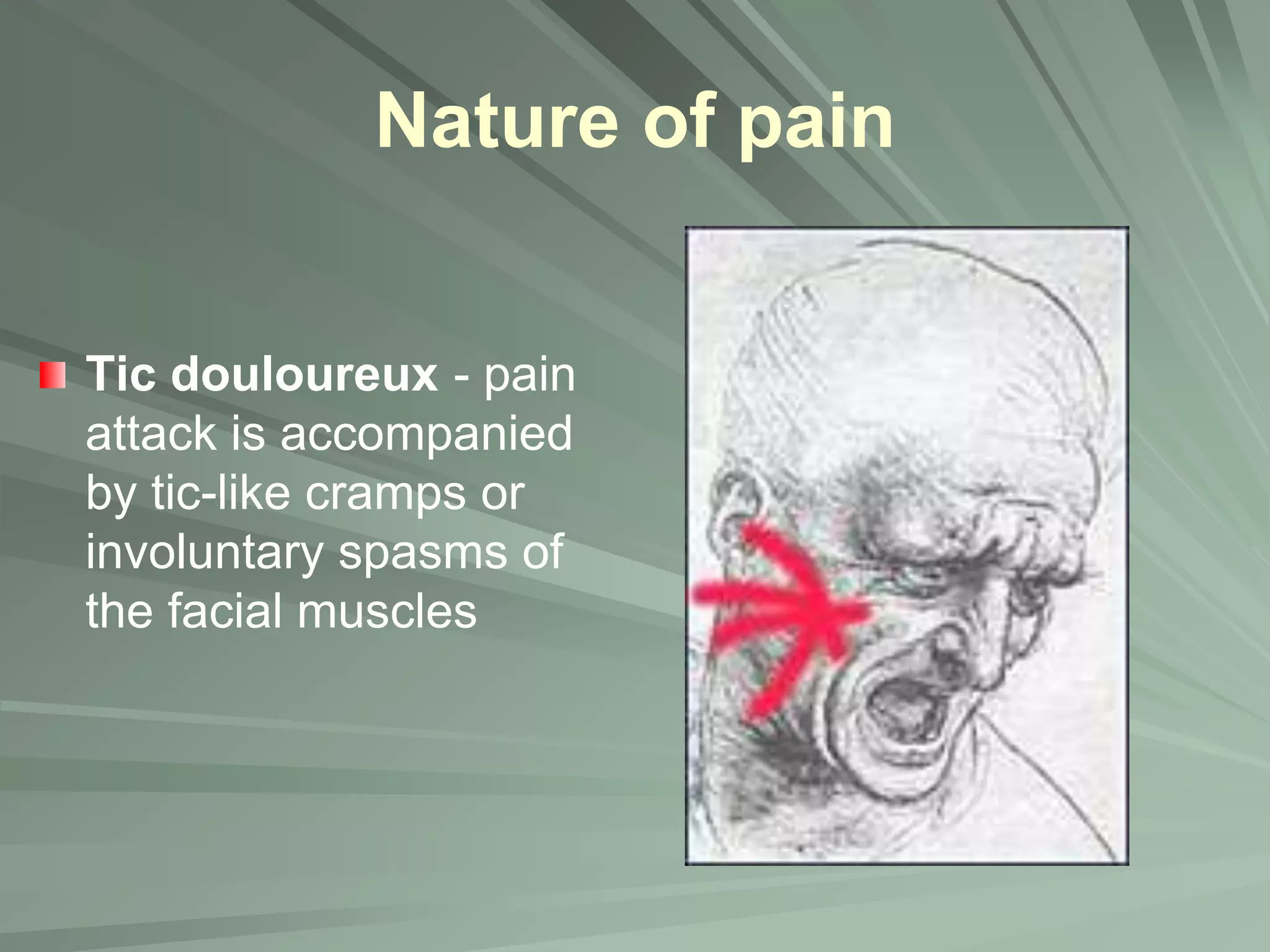
Nature of pain
Tic douloureux - pain
attack is accompanied
by tic-like cramps or
involuntary spasms of
the facial muscles
DIAGNOSTIC CRITERIA(IHS)
 paroxysmal attacks of pain lasting a second to 2mins and
affect one or more division of trigeminal nerve .
 CHARACTERISTICS
 Sharp
 Intense
 Stabbing
 Superficial
 Precipitated by trigger zone
 Doesn’t cross the midline
No Neurological deficit's
 Attacks are stereotyped.
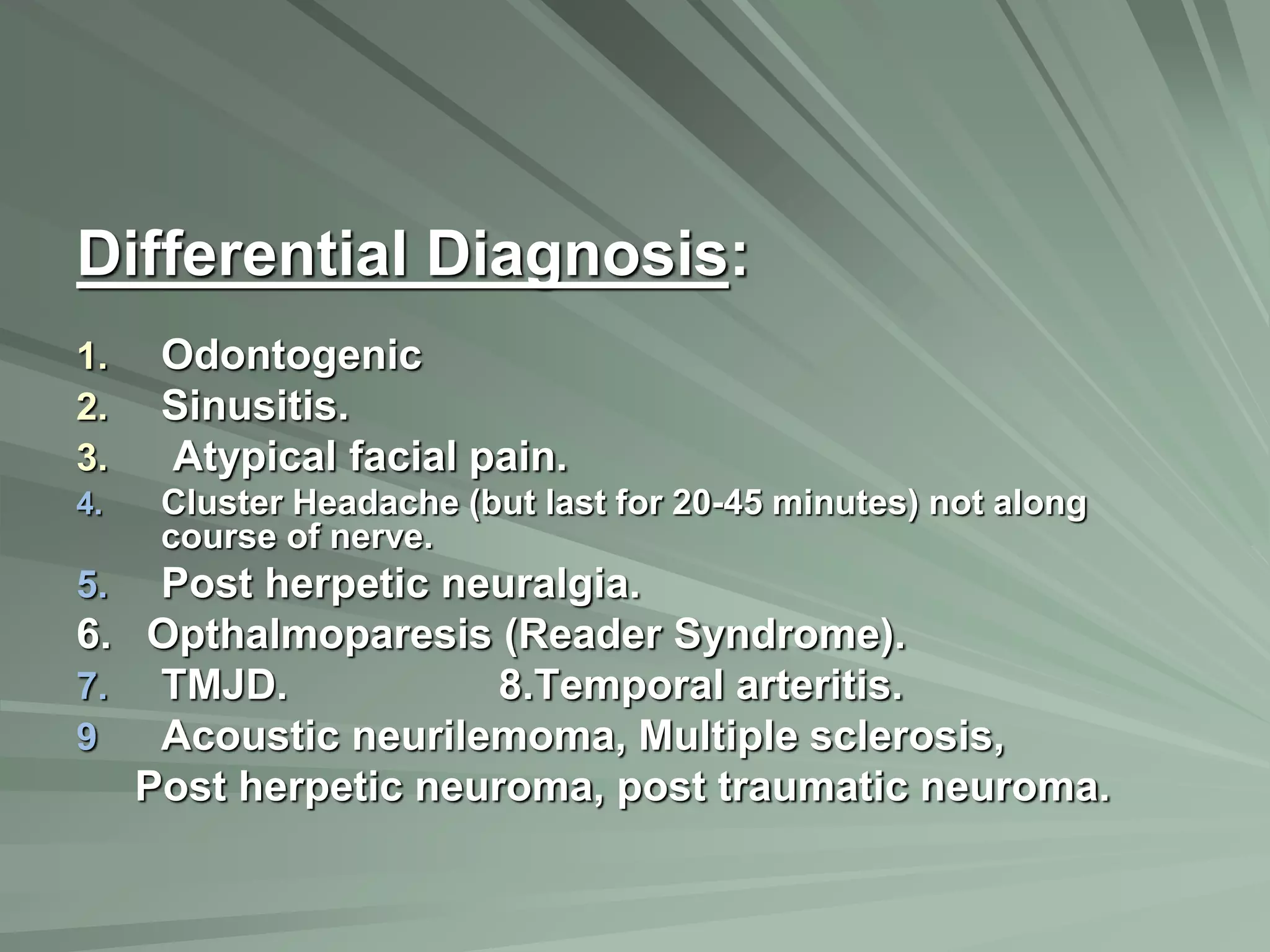
Differential Diagnosis:
1. Odontogenic
2. Sinusitis.
3. Atypical facial pain.
4. Cluster Headache (but last for 20-45 minutes) not along
course of nerve.
5. Post herpetic neuralgia.
6. Opthalmoparesis (Reader Syndrome).
7. TMJD. 8.Temporal arteritis.
9 Acoustic neurilemoma, Multiple sclerosis,
Post herpetic neuroma, post traumatic neuroma.
DIAGNOSIS
 History.
 Clinical Features.
 Local Anaesthesia
 Carbamazepine response
 Age less than 35 years, suspect space occupying
lesions or arteriovenous malformations
intracranially.
 MRI,CT SCAN
Management
3 aspects
1. Support and Education.
2. Medical.
3. Surgical.
Management
No treatment modality to permanently
eliminate
Managed initially with medication
Surgical if refractory to medical
management or develops serious side
effects
Support and Education:
Make patient aware that it is not life
threatening.
Realize the severity of condition.
Educate for:
Causes
Therapies
Reassurance and Follow up.
Medical Management
Medical Management
Do not respond to conventional analgesic drugs
Controlling drugs exert their effect by depressing
excitatory afferent transmission or through
facilitation of segmental inhibition
Although mechanisms not fully clear, treatment
for TN is still quite successful.
slowly discontinue the medications when the
patient is asymptomatic to see if the patient is in
a pain-free remission period.
ANTICONVULSANTS
– Carbamazepine
– Gabapentin Cap Xaar
(Pregabalin)
– Phenytoin
– Divalproex Sodium
– Lamotrigine
SKELETAL MUSCLE RELAXANTS
– Baclofen
ANTIANXIETY DRUGS
– Clonazepam
Carbamazepine
still the drug of choice for the initial
management
stabilization of neuronal membranes by
blocking sodium channels thus preventing
the generation of an action potential.
selective for hyperactive sodium channels.
Carbamazepine
Started with a dose of 100 mg twice daily.
increased by 100 mg/day until either a
decrease in pain is noted or signs of
toxicity appear.
suggested maximum dose is 1500 mg.
sustained-release form of carbamazepine
is also available for a more sustained
effect.
bioavailability can be assessed through
blood levels
Carbamazepine
Side Effects
most common side effects - rash, sedation,
vertigo, blurred vision, and ataxia.
Other reactions although low - aplastic anemia,
leukopenia and thrombocytopenia.
complete blood count (CBC) before prescribing
Also potential for inducing serious liver toxicity -
liver function tests.
Blood smear and liver function tests should be
repeated every few weeks at the start of therapy
and then once or twice a year thereafter.
Surgical Management
Neurosurgical interventions
when medical therapy proves ineffective in
controlling TN pain.
potential benefits as well as risks of
complications or long-term side effects.
None of the surgical interventions are
effective in every case.
no accurate way to predict.
SURGERY
Peripheral neurectomy
– Supraorbital
– Infraorbital
– lingual
– Inferior alveolar
– Long buccal neurectomy
Nerve Injury / Destructive Procedures
(Rhizotomies)
Non-nerve injury procedures
Rhizotomies
Peripheral Trigeminal Nerve Blocks,
Sectioning and Avulsions
Percutaneous Rhizotomies
Stereotactic Radiosurgery (Gamma
Knife)
Microsurgical Rhizotomy
Peripheral Trigeminal Nerve
Blocks, Sectioning and
Avulsions
Increased susceptibility to surgical
complications.
Very elderly, frail or medically unfit.
A relatively simple means to injure any
branch of the trigeminal nerve.
By injection of alcohol, cutting
(sectioning) or
avulsion of the nerve branch,
cryo surgery
Effective immediately
Also cause severe or complete
numbness at least temporarily.
Often recurs
Other interventions for long-
term disease control.
Rhizotomies
Percutaneous Rhizotomies
Percutaneous Glycerol Rhizotomy
Percutaneous Balloon Compression
Rhizotomy
Radiofrequency Rhizotomy
Percutaneous Glycerol Rhizotomy
Percutaneous Balloon
Compression Rhizotomy
Radiofrequency Rhizotomy
Stereotactic Radiosurgery
(Gamma Knife)
focused radiation to the
trigeminal nerve root
Frame applied to the
patient’s head and then
MRI
positioned in the Gamma
Knife (up to 201 focused
beams of cobalt radiation)
delayed injury & pain
reduction within a few
weeks
Microsurgical Rhizotomy
Nerve Decompression
alleviates neurovascular compression
by placing inert shredded Teflon® felt
implants between offending vessels and
the trigeminal nerve root
CONCLUSION
Proper diagnosis is the key
Peripheral neurectomy needs to be
encouraged
Psychological support.
Role of the Dentist
TN a Medical Dilemma
Patients who are fit for surgery now but
might not be in 10 years should be
referred now, not in 10 years when the
drugs no longer work and the surgery is
more likely to be dangerous.
SURGICAL MANAGEMENT
Peripheral procedure
Ganglion procedure
Open procedure
PERIPHERAL PROCEDURE
Neurectomy
Cryotherapy
Alcohol injection
Radiofrequency
GANGLION PROCEDURE
Radiofrequency thermocoagulation
(Temperature 60-80c)
Glycerol injection (glycerol rhizotomy, 16g
needle, 0.5-0.75ml)
Balloon compression (4 FG Catheter,
1minute)
Stereotactic Radiosurgery (70-90 grays)
OPEN OPERATIONS
Microvascular decompression (by
Retromastoid incision 5-6cm)
Trigeminal root sectioning (sensory
rhizotomy)
trigeminal neuralgia

trigeminal neuralgia

  • 1.
  • 2.
    International Association forthe Study of Pain defines pain as "an unpleasant sensory and emotional experience associated with actual or potential tissue damage, or described in terms of such damage."
  • 3.
    "if it isn'tunpleasant, it isn't pain."
  • 4.
    categories: Somatic from thenoxious stimulation of normal structures that innervate the affected area Normal or Physiologic
  • 5.
    Neuropathic arises in theabsence of any noxious stimulation. a functional or structural abnormality within the nervous system itself. episodic (paroxysmal) and continuous Pathophysiologic
  • 6.
    psychogenic arises from psychologicalcauses. Neither elicited by noxious stimuli nor an abnormality within the neural system
  • 7.
    General characteristics of neuropathicpain Pain in the absence of obvious nociception Pain that can be intense and out of proportion to the degree of stimulation Pain quality that is bright, stimulating and burning Pain that is relatively unresponsive to low doses of narcotic analgesics.
  • 8.
  • 9.
    HISTORY John lock------------1677 (1st description) NicolousAndre-----1756 (Tic douloreux) John Fother Gills---1773 (Full description) Other Names----- (Prosopalgia, Face Palsy, Suicide disease)
  • 10.
    Trigeminal – Cranialnerve V Neur – Nerve related Algia - Pain
  • 11.
    Definition; Trigeminal neuralgia (TN)is defined as sudden,usually unilateral, severe, brief, stabbing, lancinating, recurring pain in the distribution of one or more branches of 5th cranial nerve.
  • 12.
    Age Average age ofonset - typically sixth decade may present at any age. Symptomatic or secondary trigeminal neuralgia tends to occur in younger patients.
  • 13.
    Sex F more thanM 5.9 : 3.4 In 100000
  • 14.
    KCD. 242 CASESin 3 years (PODJ 25 (2) Dec 2005) Mean age; 43.88 with peak inci.age.50 - 60 M:F----1.068:1 Rt—63.22%, Lt—35.95%,Bil; o.82% (2. F) Branch; Max & Mand almost equal.40.08% & 39.667%.Opth.2.08%(5 cases in combi.)
  • 15.
    Relation with diet A.Elite class with v luxurious socio economic status.-----------------------NIL. B. Good socio economic status.—2.49% C. Moderate s e status-------------36.77% D. V V poor Labor class---------60.74%
  • 16.
    IT SHOWS THATTHERE MIGHT BE SOME DEFICIENCY OF IMPORTANT INGREDIENTS IN THE DIET.
  • 19.
     V3 commonlyinvolved than V2.
  • 20.
    Types of TrigeminalNeuralgia and Their Causes: 1. Typical Trigeminal Neuralgia (Tic Douloureux) 2. Atypical Trigeminal Neuralgia 3. Pre-Trigeminal Neuralgia 4. Multiple Sclerosis-Related Trigeminal Neuralgia 5. Secondary or Tumor Related Trigeminal Neuralgia 6. Trigeminal Neuropathy or Post-Traumatic Trigeminal Neuralgia TRIGEMINAL NEURALGIA
  • 21.
    CAUSES:  PRIMARY  Idiopathic SECONDARY.  TUMORS (acoustic neuroma,cerebellopontine angle tumors, Schwanoma. Pituitary gland tumor)
  • 22.
    VASCULAR  Pulsatile compressionof adjacent artery . INFLAMMATORY; multiple sclerosis POST TRAUMATIC.  Viral  Accident  Dental trauma  Sinus trauma
  • 24.
    Clinical Features Sudden, Sharp,Shooting, lancinating, unilateral paroxysmal, intermittent, shock like pain. trigger zones ; V1; V1 over the supraorbital ridge V2; Skin of the upper lip, ala nasi , cheek,gums. V3; lower lip,teeth, gums, tongue Rarely crosses the midline. short duration-seconds During attack, hands over the affected side, stop activities, hold or rub the face which may redden or the eyes water until the attack subs.
  • 25.
    Paroxysms----weeks / monthscycles Electric shock like –like electric light in rain Bad oral hygiene No attacks during sleep History of extractions Loss of weight Depression
  • 27.
  • 28.
    Nature of pain Ticdouloureux - pain attack is accompanied by tic-like cramps or involuntary spasms of the facial muscles
  • 30.
    DIAGNOSTIC CRITERIA(IHS)  paroxysmalattacks of pain lasting a second to 2mins and affect one or more division of trigeminal nerve .  CHARACTERISTICS  Sharp  Intense  Stabbing  Superficial  Precipitated by trigger zone  Doesn’t cross the midline No Neurological deficit's  Attacks are stereotyped.
  • 31.
    Differential Diagnosis: 1. Odontogenic 2.Sinusitis. 3. Atypical facial pain. 4. Cluster Headache (but last for 20-45 minutes) not along course of nerve. 5. Post herpetic neuralgia. 6. Opthalmoparesis (Reader Syndrome). 7. TMJD. 8.Temporal arteritis. 9 Acoustic neurilemoma, Multiple sclerosis, Post herpetic neuroma, post traumatic neuroma.
  • 33.
    DIAGNOSIS  History.  ClinicalFeatures.  Local Anaesthesia  Carbamazepine response  Age less than 35 years, suspect space occupying lesions or arteriovenous malformations intracranially.  MRI,CT SCAN
  • 35.
    Management 3 aspects 1. Supportand Education. 2. Medical. 3. Surgical.
  • 36.
    Management No treatment modalityto permanently eliminate Managed initially with medication Surgical if refractory to medical management or develops serious side effects
  • 37.
    Support and Education: Makepatient aware that it is not life threatening. Realize the severity of condition. Educate for: Causes Therapies Reassurance and Follow up.
  • 38.
  • 40.
    Medical Management Do notrespond to conventional analgesic drugs Controlling drugs exert their effect by depressing excitatory afferent transmission or through facilitation of segmental inhibition Although mechanisms not fully clear, treatment for TN is still quite successful. slowly discontinue the medications when the patient is asymptomatic to see if the patient is in a pain-free remission period.
  • 41.
    ANTICONVULSANTS – Carbamazepine – GabapentinCap Xaar (Pregabalin) – Phenytoin – Divalproex Sodium – Lamotrigine SKELETAL MUSCLE RELAXANTS – Baclofen ANTIANXIETY DRUGS – Clonazepam
  • 42.
    Carbamazepine still the drugof choice for the initial management stabilization of neuronal membranes by blocking sodium channels thus preventing the generation of an action potential. selective for hyperactive sodium channels.
  • 44.
    Carbamazepine Started with adose of 100 mg twice daily. increased by 100 mg/day until either a decrease in pain is noted or signs of toxicity appear. suggested maximum dose is 1500 mg. sustained-release form of carbamazepine is also available for a more sustained effect. bioavailability can be assessed through blood levels
  • 45.
    Carbamazepine Side Effects most commonside effects - rash, sedation, vertigo, blurred vision, and ataxia. Other reactions although low - aplastic anemia, leukopenia and thrombocytopenia. complete blood count (CBC) before prescribing Also potential for inducing serious liver toxicity - liver function tests. Blood smear and liver function tests should be repeated every few weeks at the start of therapy and then once or twice a year thereafter.
  • 47.
  • 48.
    Neurosurgical interventions when medicaltherapy proves ineffective in controlling TN pain. potential benefits as well as risks of complications or long-term side effects. None of the surgical interventions are effective in every case. no accurate way to predict.
  • 49.
    SURGERY Peripheral neurectomy – Supraorbital –Infraorbital – lingual – Inferior alveolar – Long buccal neurectomy
  • 52.
    Nerve Injury /Destructive Procedures (Rhizotomies) Non-nerve injury procedures
  • 54.
    Rhizotomies Peripheral Trigeminal NerveBlocks, Sectioning and Avulsions Percutaneous Rhizotomies Stereotactic Radiosurgery (Gamma Knife) Microsurgical Rhizotomy
  • 55.
    Peripheral Trigeminal Nerve Blocks,Sectioning and Avulsions Increased susceptibility to surgical complications. Very elderly, frail or medically unfit. A relatively simple means to injure any branch of the trigeminal nerve.
  • 56.
    By injection ofalcohol, cutting (sectioning) or avulsion of the nerve branch, cryo surgery Effective immediately Also cause severe or complete numbness at least temporarily. Often recurs Other interventions for long- term disease control.
  • 57.
  • 58.
    Percutaneous Rhizotomies Percutaneous GlycerolRhizotomy Percutaneous Balloon Compression Rhizotomy Radiofrequency Rhizotomy
  • 59.
  • 60.
  • 61.
  • 62.
    Stereotactic Radiosurgery (Gamma Knife) focusedradiation to the trigeminal nerve root Frame applied to the patient’s head and then MRI positioned in the Gamma Knife (up to 201 focused beams of cobalt radiation) delayed injury & pain reduction within a few weeks
  • 63.
  • 64.
    Nerve Decompression alleviates neurovascularcompression by placing inert shredded Teflon® felt implants between offending vessels and the trigeminal nerve root
  • 66.
    CONCLUSION Proper diagnosis isthe key Peripheral neurectomy needs to be encouraged Psychological support. Role of the Dentist TN a Medical Dilemma
  • 67.
    Patients who arefit for surgery now but might not be in 10 years should be referred now, not in 10 years when the drugs no longer work and the surgery is more likely to be dangerous.
  • 68.
  • 69.
  • 70.
    GANGLION PROCEDURE Radiofrequency thermocoagulation (Temperature60-80c) Glycerol injection (glycerol rhizotomy, 16g needle, 0.5-0.75ml) Balloon compression (4 FG Catheter, 1minute) Stereotactic Radiosurgery (70-90 grays)
  • 71.
    OPEN OPERATIONS Microvascular decompression(by Retromastoid incision 5-6cm) Trigeminal root sectioning (sensory rhizotomy)