1
SYNCOPE
SYNCOPE
2
SYNCOPE
•Definition
•Predisposing factors
•Pathophysiology and clinical manifestations.
•Management
•Drugs used in management
3
Definition
 Greek word `SYNKOPTEIN` - to cut or break
 Syncope is defined as transient loss of
consciousness due to reduced cerebral blood
flow.
 A transient, self limited loss of consciousness
usually leading to falling. The onset of
syncope is relatively rapid, and the
subsequent recovery is spontaneous,
complete, and relatively prompt.
4
Causes
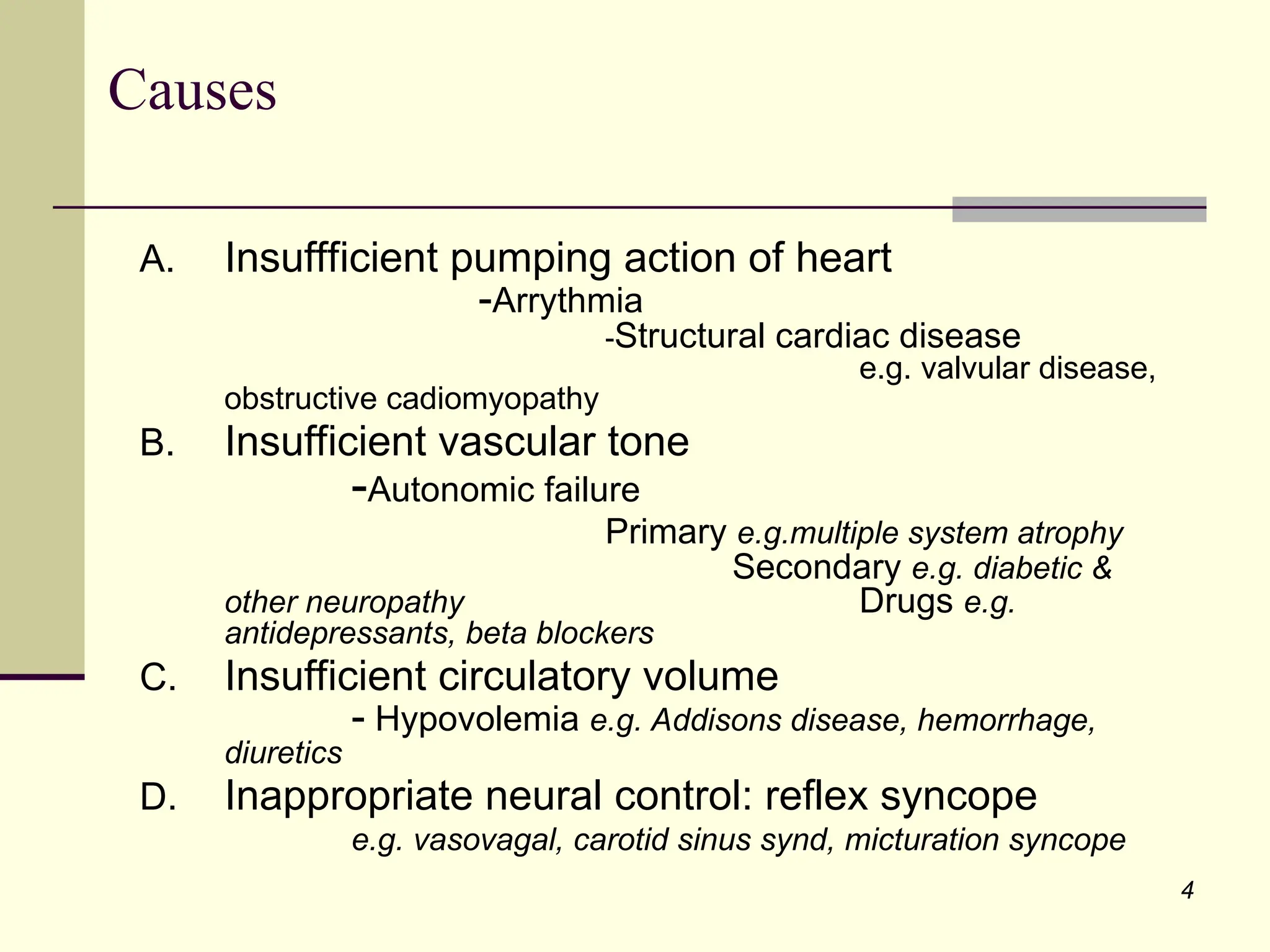
A. Insuffficient pumping action of heart
-Arrythmia
-Structural cardiac disease
e.g. valvular disease,
obstructive cadiomyopathy
B. Insufficient vascular tone
-Autonomic failure
Primary e.g.multiple system atrophy
Secondary e.g. diabetic &
other neuropathy Drugs e.g.
antidepressants, beta blockers
C. Insufficient circulatory volume
- Hypovolemia e.g. Addisons disease, hemorrhage,
diuretics
D. Inappropriate neural control: reflex syncope
e.g. vasovagal, carotid sinus synd, micturation syncope
5
EPIDEMIOLOGY
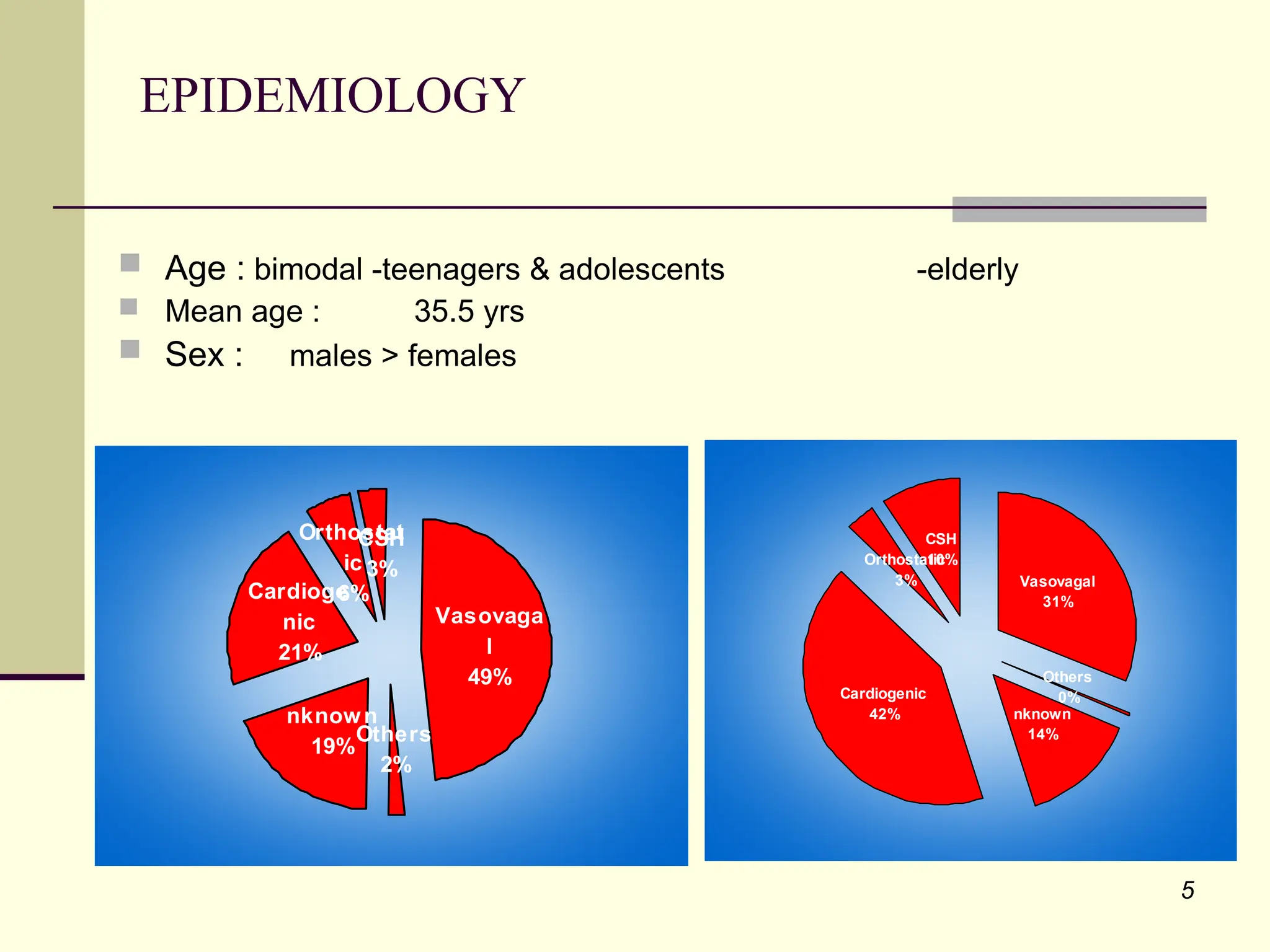
 Age : bimodal -teenagers & adolescents -elderly
 Mean age : 35.5 yrs
 Sex : males > females
Vasovaga
l
49%
Others
2%
nknown
19%
Cardioge
nic
21%
Orthostat
ic
6%
CSH
3% Vasovagal
31%
Others
0%
nknown
14%
Cardiogenic
42%
Orthostatic
3%
CSH
10%
6
Predisposing factors
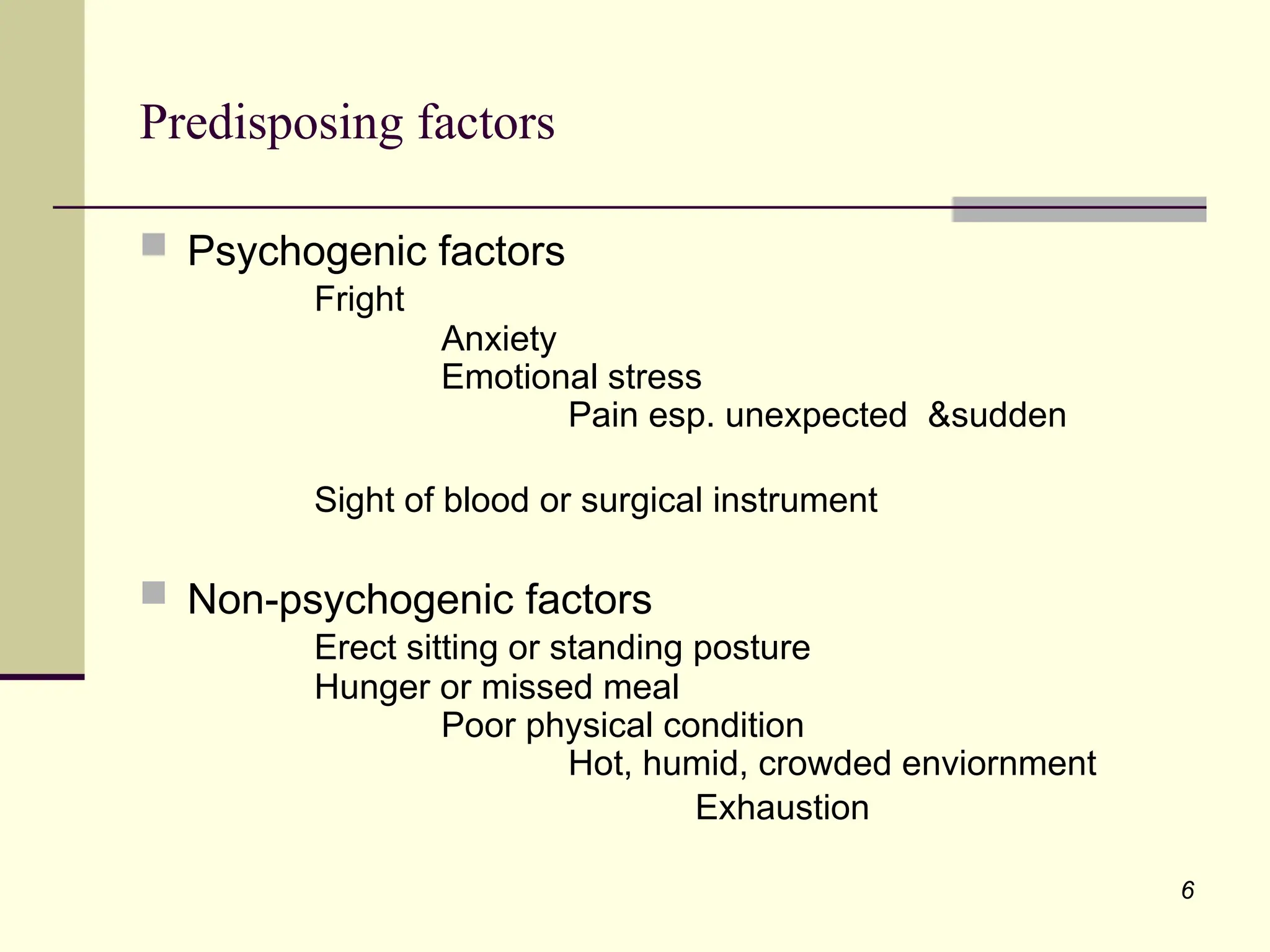
 Psychogenic factors
Fright
Anxiety
Emotional stress
Pain esp. unexpected &sudden
Sight of blood or surgical instrument
 Non-psychogenic factors
Erect sitting or standing posture
Hunger or missed meal
Poor physical condition
Hot, humid, crowded enviornment
Exhaustion
7
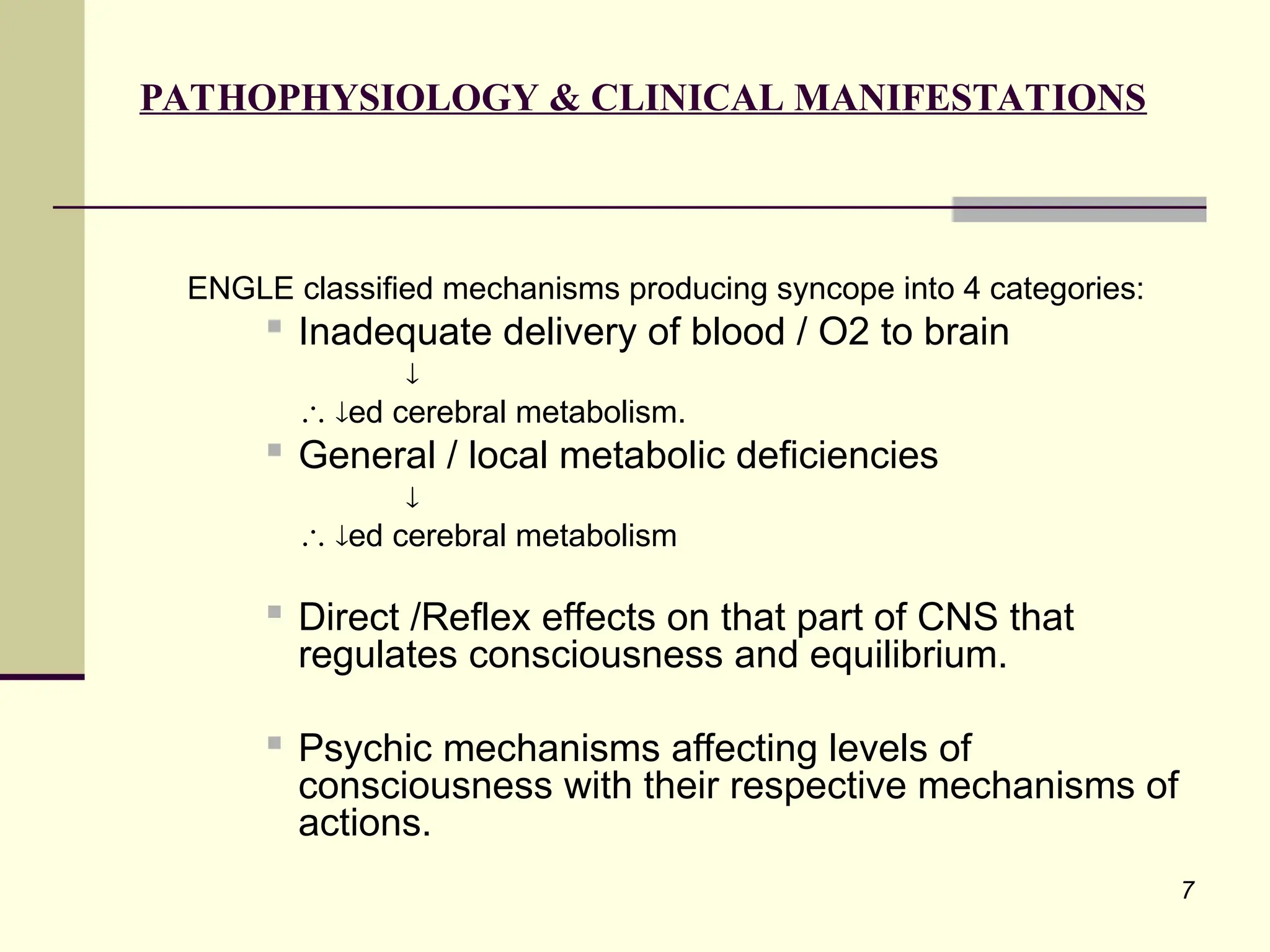
PATHOPHYSIOLOGY & CLINICAL MANIFESTATIONS
ENGLE classified mechanisms producing syncope into 4 categories:

Inadequate delivery of blood / O2 to brain

 ed cerebral metabolism.
 General / local metabolic deficiencies

 ed cerebral metabolism
 Direct /Reflex effects on that part of CNS that
regulates consciousness and equilibrium.

Psychic mechanisms affecting levels of
consciousness with their respective mechanisms of
actions.
8
PATHOPHYSIOLOGY & CLINICAL MANIFESTATIONS OF
VASODEPRESSOR SYNCOPE:
Grouped into 3 different phases:
Pre-Syncope
Syncope
Post-Syncope
9
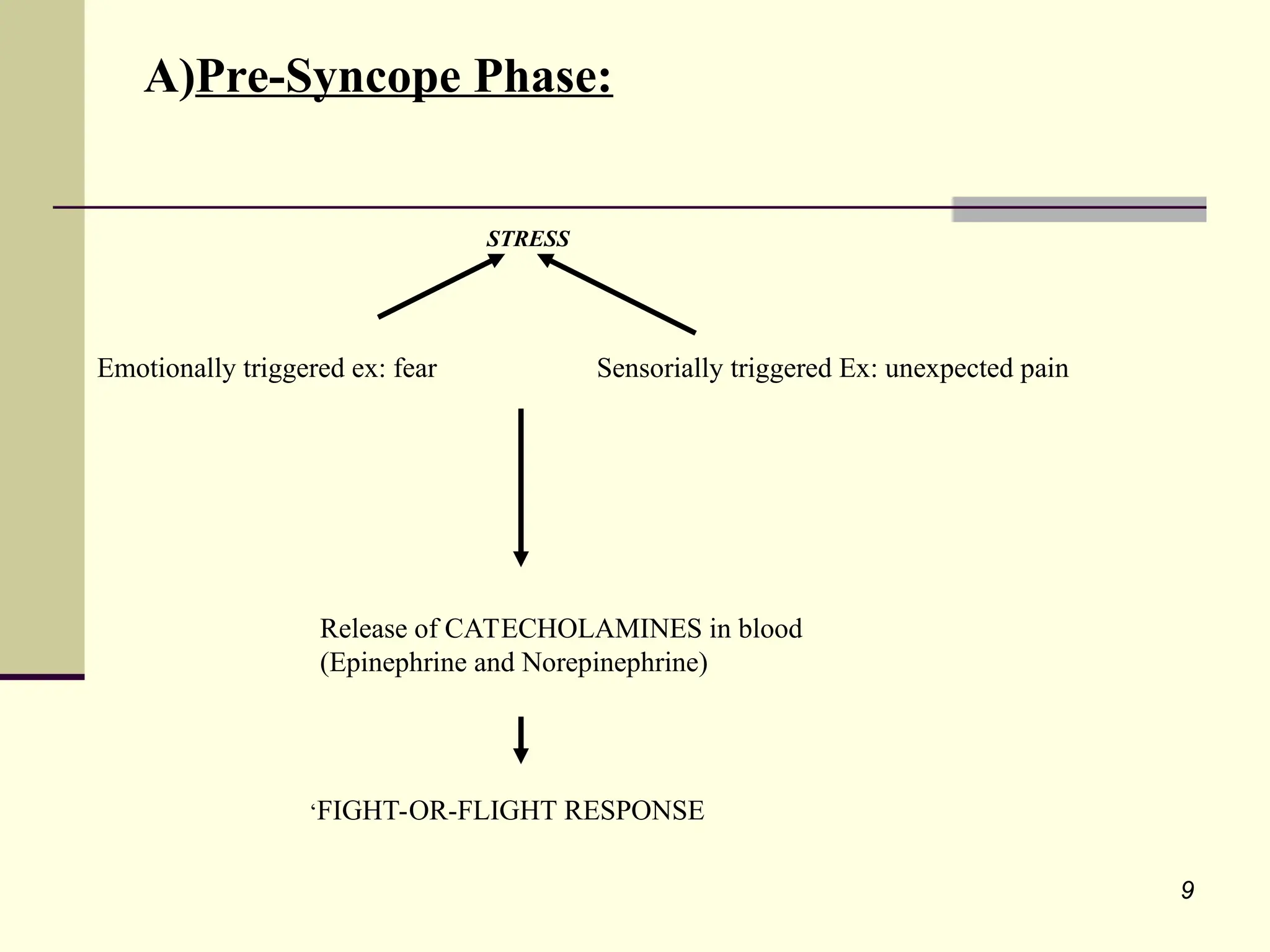
A)Pre-Syncope Phase:
STRESS
Emotionally triggered ex: fear Sensorially triggered Ex: unexpected pain
Release of CATECHOLAMINES in blood
(Epinephrine and Norepinephrine)
‘FIGHT-OR-FLIGHT RESPONSE
10
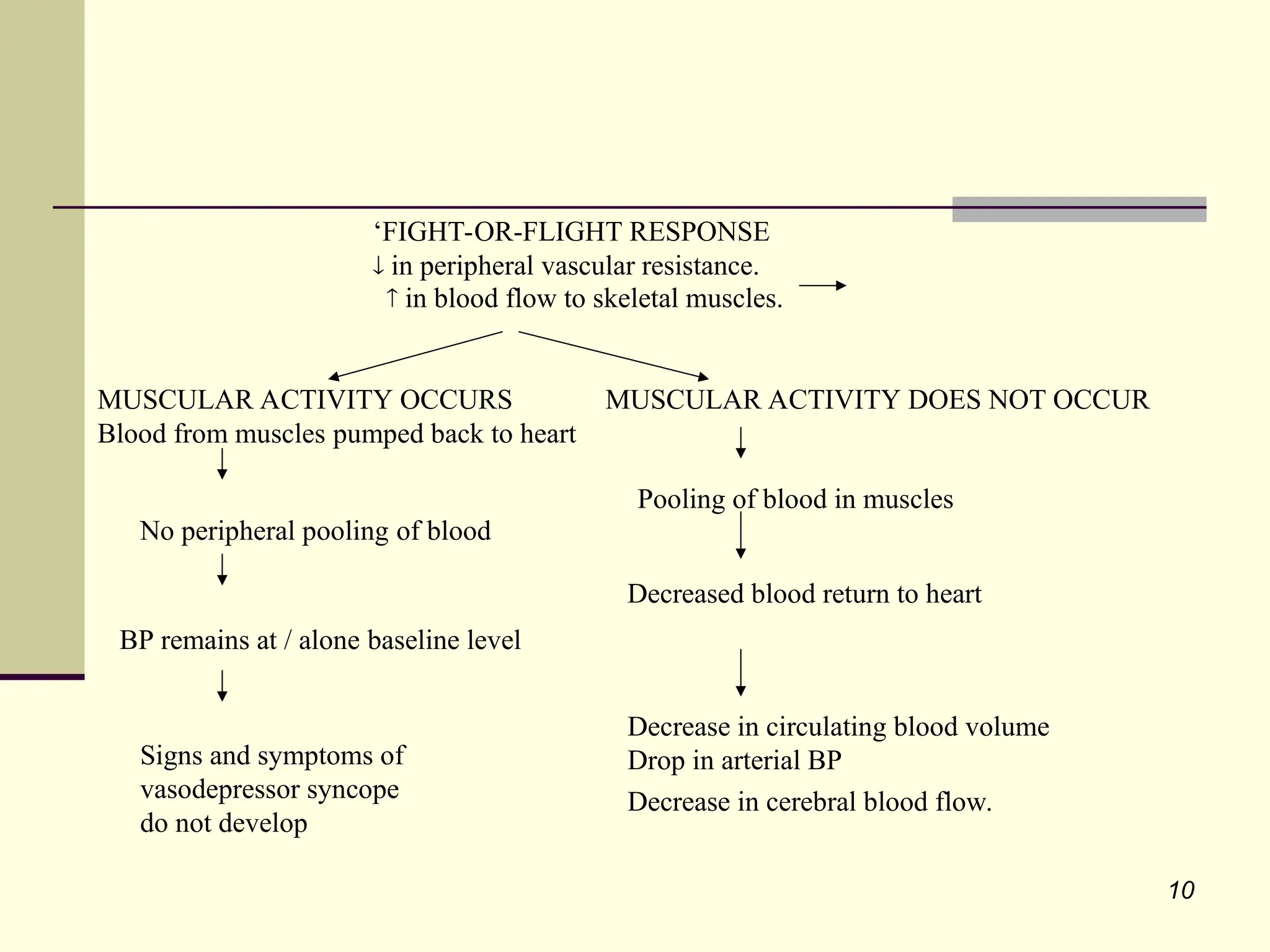
‘FIGHT-OR-FLIGHT RESPONSE
 in peripheral vascular resistance.
 in blood flow to skeletal muscles.
MUSCULAR ACTIVITY OCCURS MUSCULAR ACTIVITY DOES NOT OCCUR
Blood from muscles pumped back to heart
No peripheral pooling of blood
BP remains at / alone baseline level
Signs and symptoms of
vasodepressor syncope
do not develop
Pooling of blood in muscles
Decrease in circulating blood volume
Drop in arterial BP
Decrease in cerebral blood flow.
Decreased blood return to heart
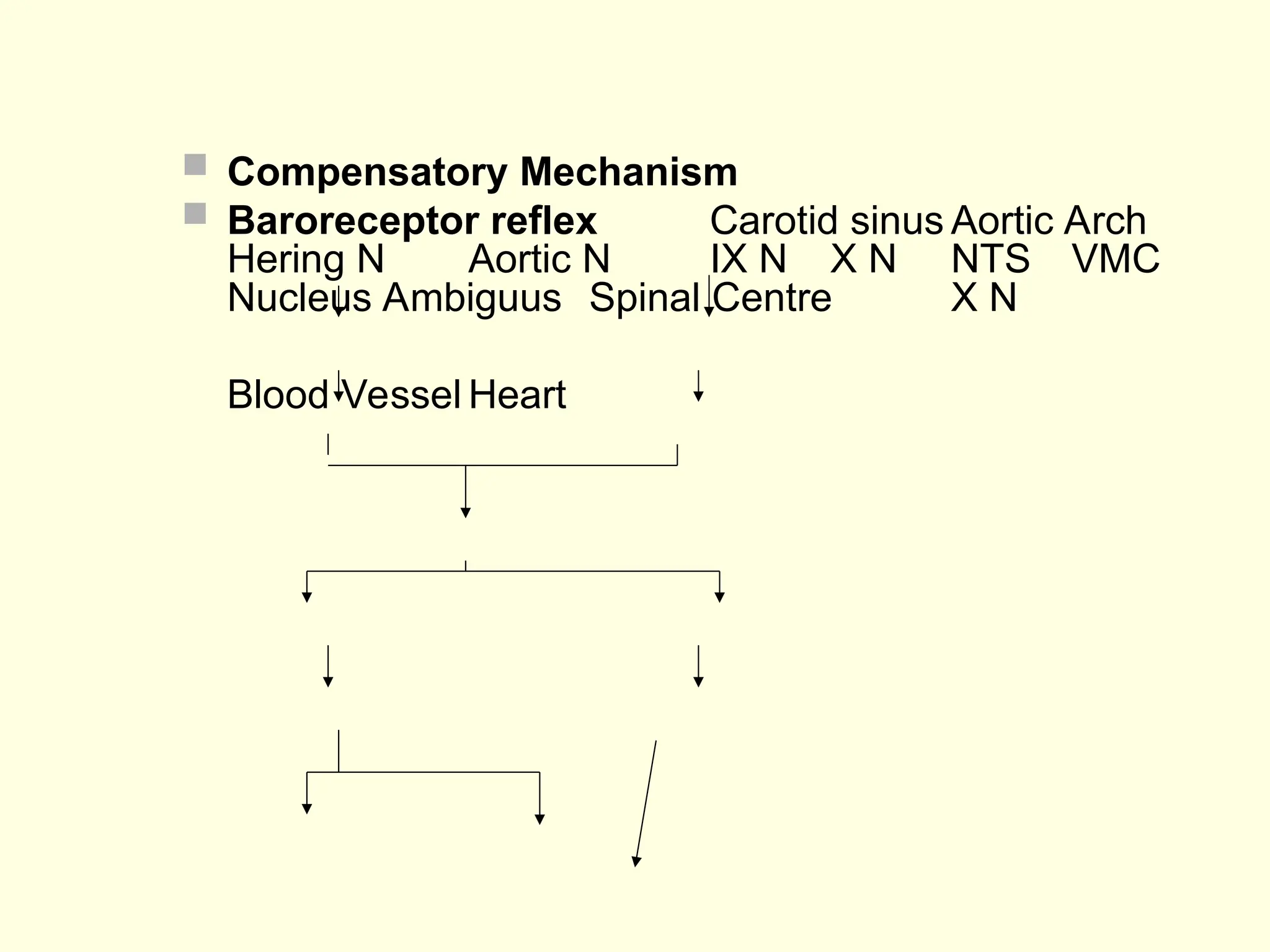
 Compensatory Mechanism
 Baroreceptor reflex Carotid sinus Aortic Arch
Hering N Aortic N IX N X N NTS VMC
Nucleus Ambiguus Spinal Centre X N
Blood Vessel Heart
12
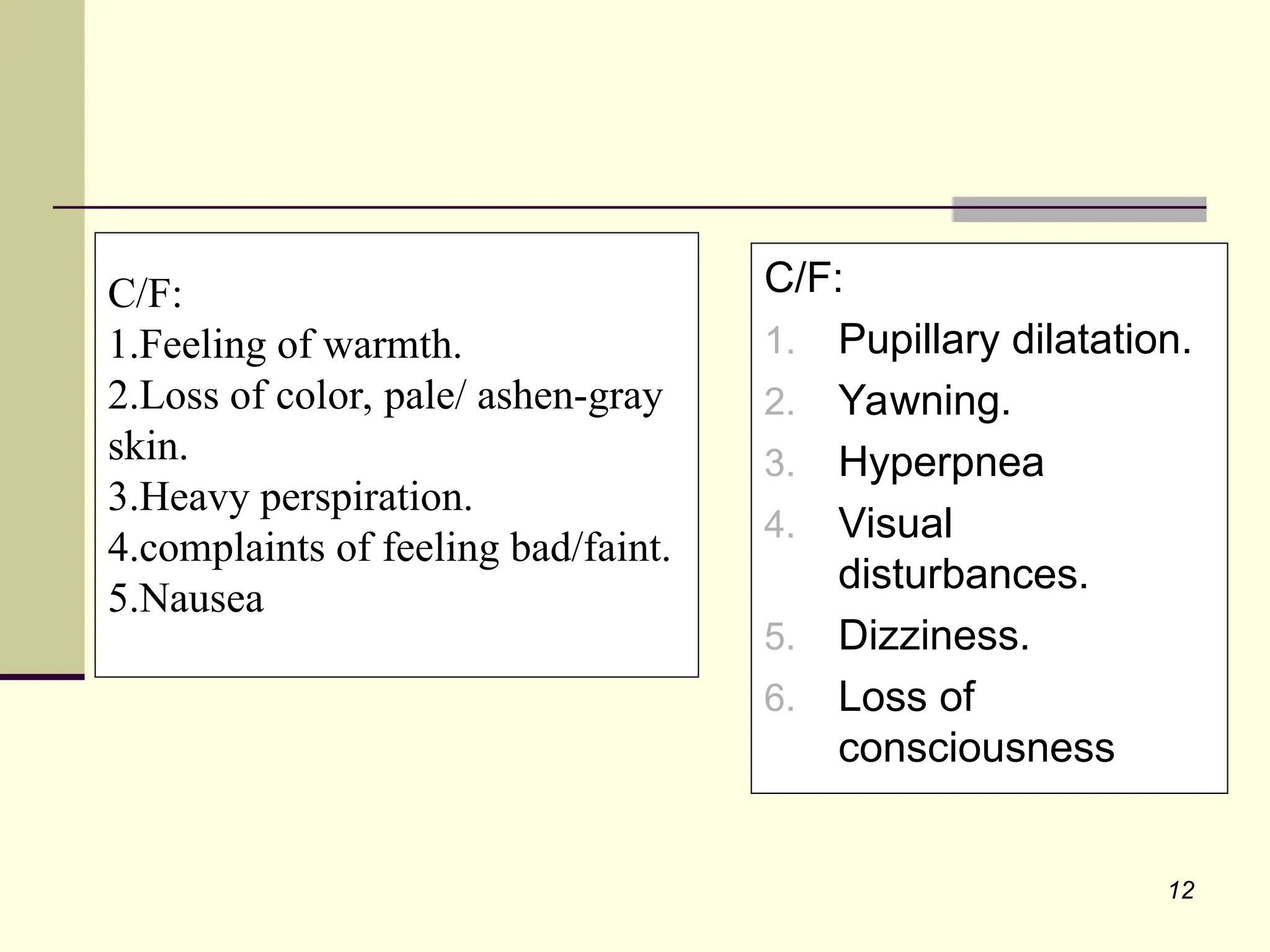
C/F:
1.Feeling of warmth.
2.Loss of color, pale/ ashen-gray
skin.
3.Heavy perspiration.
4.complaints of feeling bad/faint.
5.Nausea
C/F:
1. Pupillary dilatation.
2. Yawning.
3. Hyperpnea
4. Visual
disturbances.
5. Dizziness.
6. Loss of
consciousness
13
 CRITICAL LEVEL of cerebral blood flow for the
maintenance of consciousness.
30ml of blood / 100gm of brain tissue/ min.
 NORMAL VALUE of blood flow is 50-55 ml/100gm/min.
- Equivalent to 70mm Hg SBP in normotensive patients.
- Reached with SBP>70mm Hg in patients with
atherosclerosis and high BP.
 Human brain uses-
- 20% of total body O2
- 6.5% of total glucose consumed by body.
 For a normal individual in supine position - Cerebral
blood flow – 750ml/min.
SYNCOPE PHASE
14
 Breathing -Irregular, jerky and gasping.
 Dilation of pupils.
 Cerebral ischemia -
Convulsive movements.
Muscular twitching of hands, legs or facial
muscles.
 Bradycardia
  BP
 Pulse-weak and thready.
 Loss of consciousness + Generalized muscular
relaxation.

Partial / complete airway obstruction
Clinical features:
15
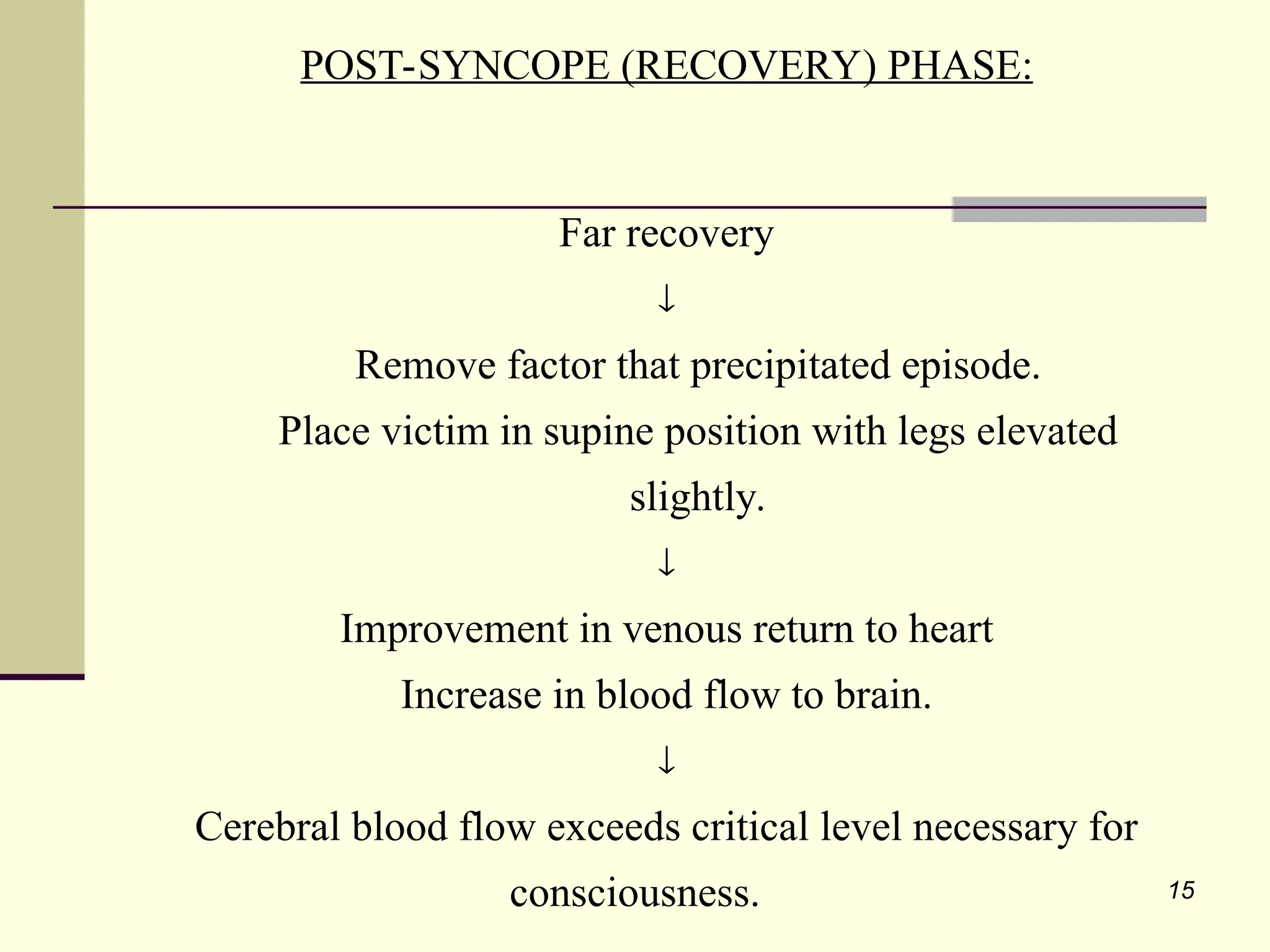
POST-SYNCOPE (RECOVERY) PHASE:
Far recovery

Remove factor that precipitated episode.
Place victim in supine position with legs elevated
slightly.

Improvement in venous return to heart
Increase in blood flow to brain.

Cerebral blood flow exceeds critical level necessary for
consciousness.
16
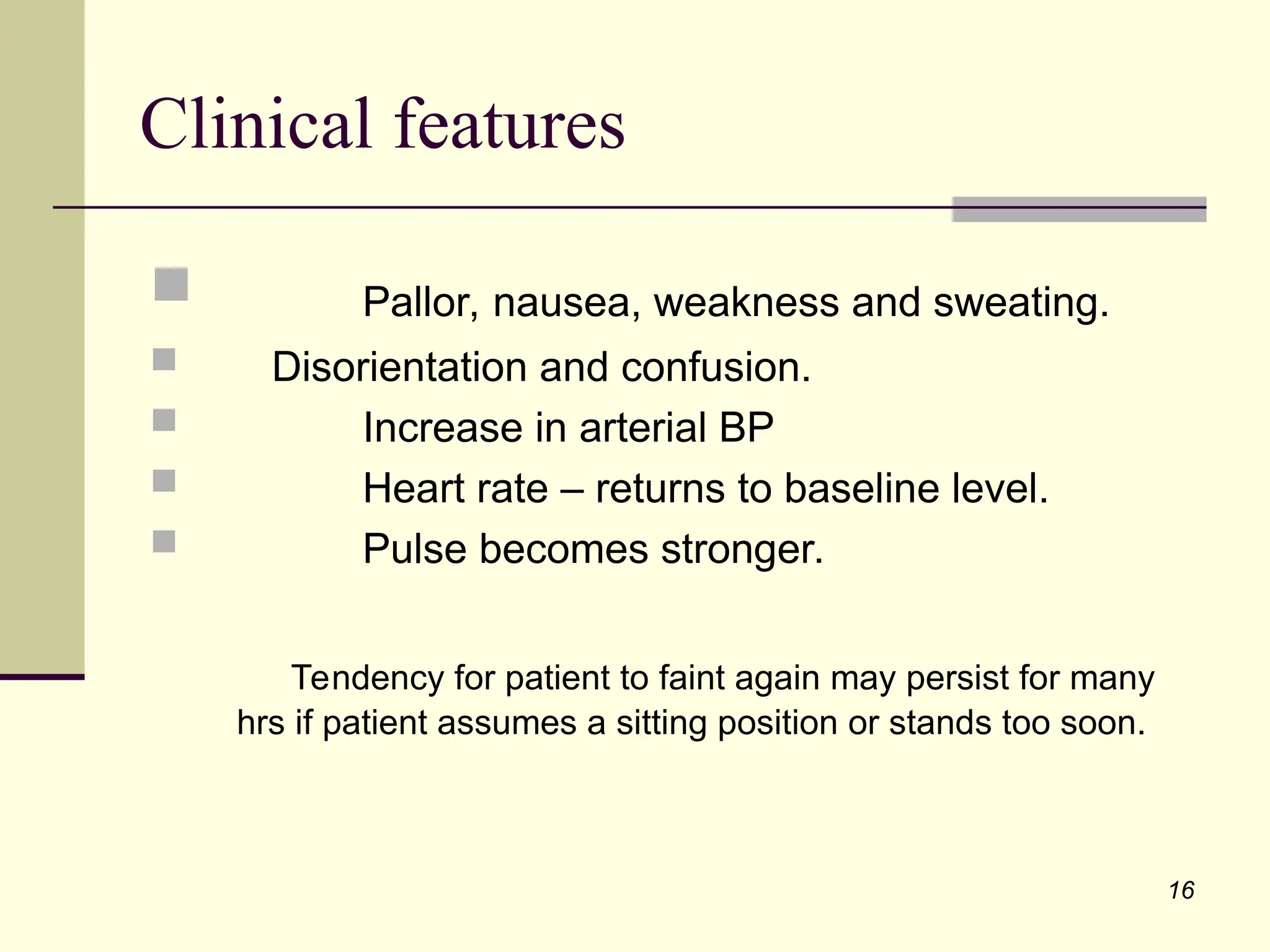
 Pallor, nausea, weakness and sweating.
 Disorientation and confusion.
 Increase in arterial BP
 Heart rate – returns to baseline level.
 Pulse becomes stronger.
Tendency for patient to faint again may persist for many
hrs if patient assumes a sitting position or stands too soon.
Clinical features
17
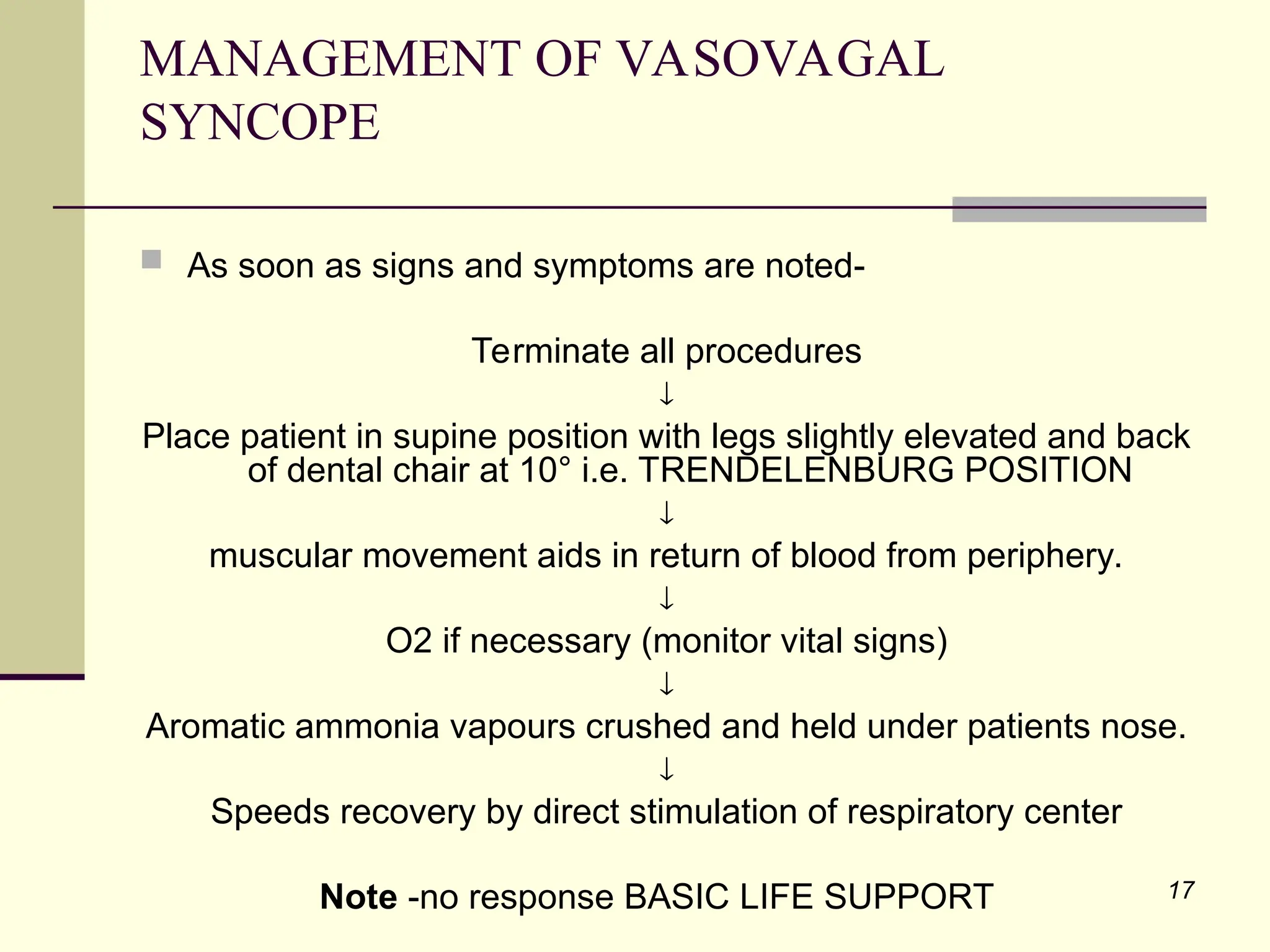
 As soon as signs and symptoms are noted-
Terminate all procedures

Place patient in supine position with legs slightly elevated and back
of dental chair at 10° i.e. TRENDELENBURG POSITION

muscular movement aids in return of blood from periphery.

O2 if necessary (monitor vital signs)

Aromatic ammonia vapours crushed and held under patients nose.

Speeds recovery by direct stimulation of respiratory center
Note -no response BASIC LIFE SUPPORT
MANAGEMENT OF VASOVAGAL
SYNCOPE
18
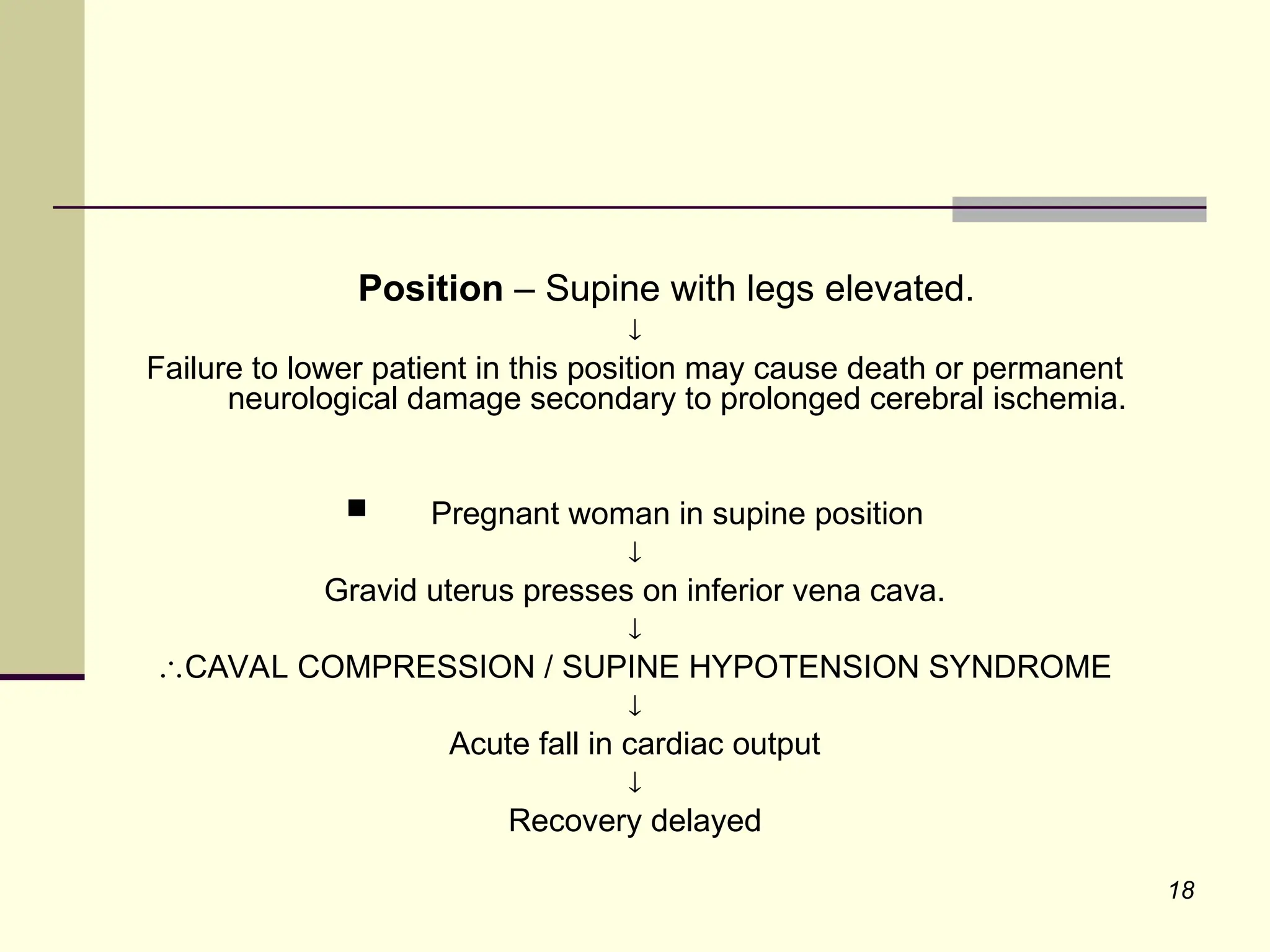
Position – Supine with legs elevated.

Failure to lower patient in this position may cause death or permanent
neurological damage secondary to prolonged cerebral ischemia.
 Pregnant woman in supine position

Gravid uterus presses on inferior vena cava.

CAVAL COMPRESSION / SUPINE HYPOTENSION SYNDROME

Acute fall in cardiac output

Recovery delayed
19
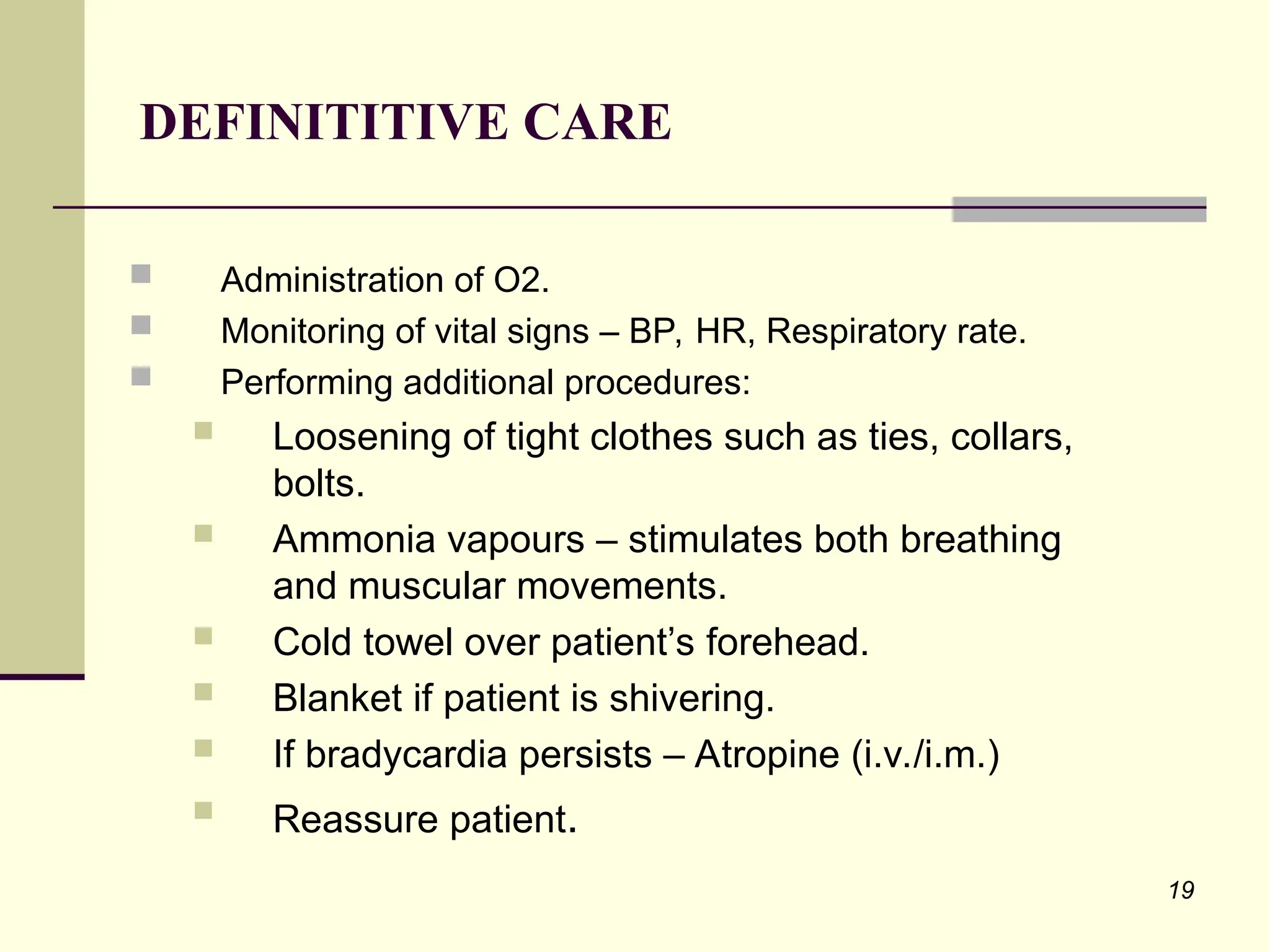
 Administration of O2.
 Monitoring of vital signs – BP, HR, Respiratory rate.
 Performing additional procedures:
 Loosening of tight clothes such as ties, collars,
bolts.
 Ammonia vapours – stimulates both breathing
and muscular movements.
 Cold towel over patient’s forehead.
 Blanket if patient is shivering.
 If bradycardia persists – Atropine (i.v./i.m.)
 Reassure patient.
DEFINITITIVE CARE
20
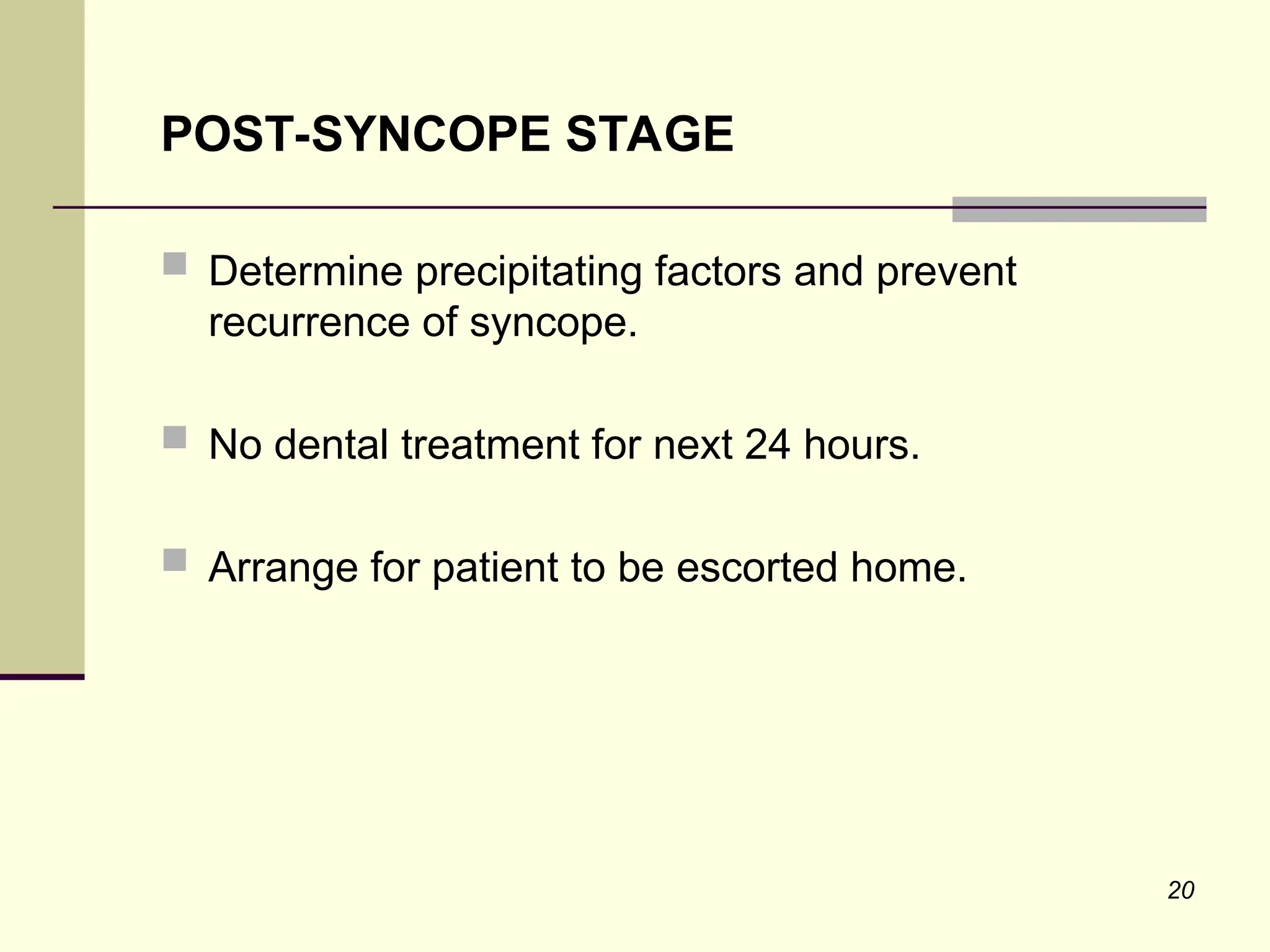
POST-SYNCOPE STAGE
 Determine precipitating factors and prevent
recurrence of syncope.
 No dental treatment for next 24 hours.
 Arrange for patient to be escorted home.
21
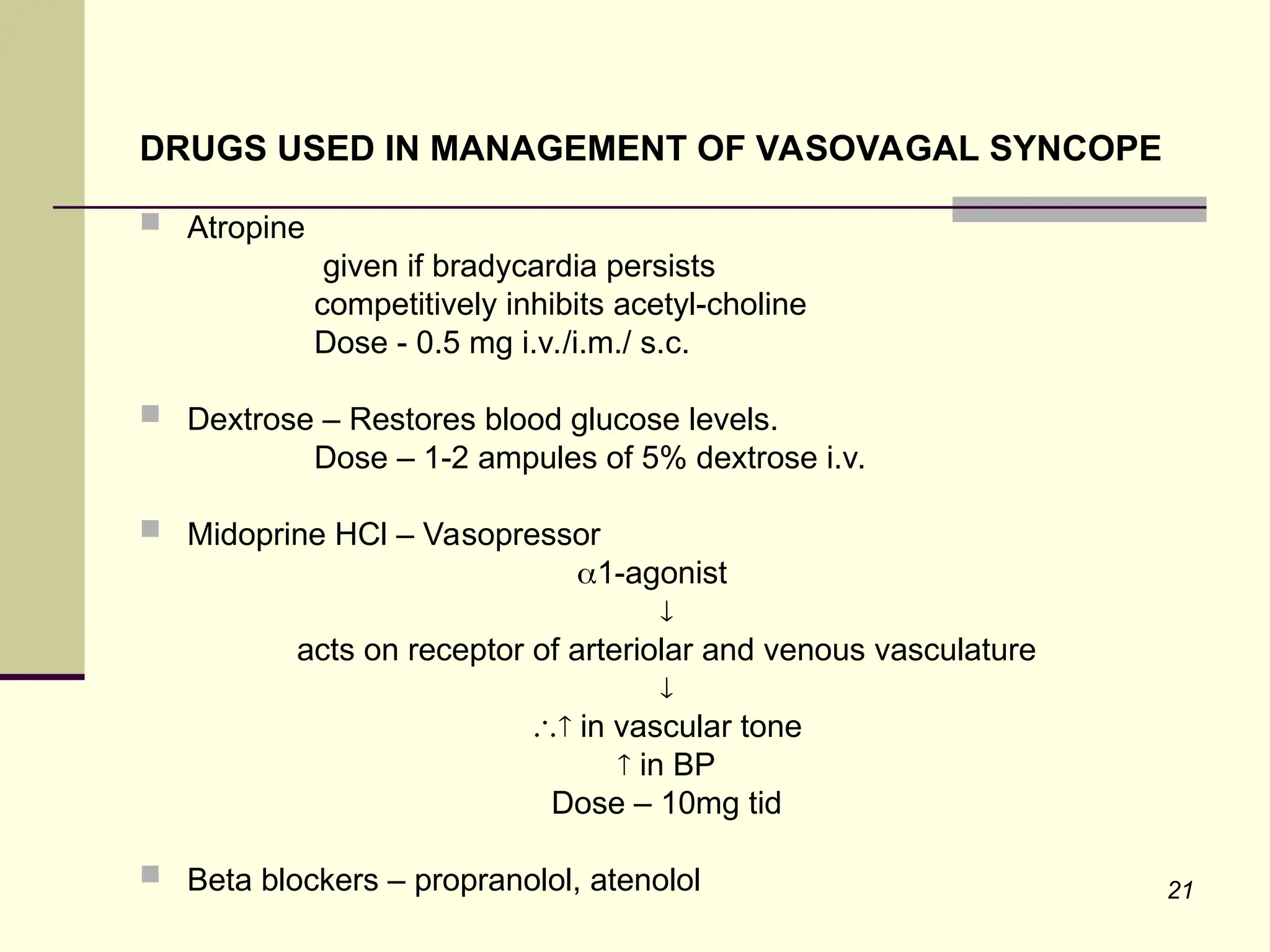
DRUGS USED IN MANAGEMENT OF VASOVAGAL SYNCOPE
 Atropine
given if bradycardia persists
competitively inhibits acetyl-choline
Dose - 0.5 mg i.v./i.m./ s.c.
 Dextrose – Restores blood glucose levels.
Dose – 1-2 ampules of 5% dextrose i.v.
 Midoprine HCl – Vasopressor
1-agonist

acts on receptor of arteriolar and venous vasculature

 in vascular tone
 in BP
Dose – 10mg tid
 Beta blockers – propranolol, atenolol
22
Thank You

A overview of basic concept on syncope.ppt

  • 1.
  • 2.
    2 SYNCOPE •Definition •Predisposing factors •Pathophysiology andclinical manifestations. •Management •Drugs used in management
  • 3.
    3 Definition  Greek word`SYNKOPTEIN` - to cut or break  Syncope is defined as transient loss of consciousness due to reduced cerebral blood flow.  A transient, self limited loss of consciousness usually leading to falling. The onset of syncope is relatively rapid, and the subsequent recovery is spontaneous, complete, and relatively prompt.
  • 4.
    4 Causes A. Insuffficient pumpingaction of heart -Arrythmia -Structural cardiac disease e.g. valvular disease, obstructive cadiomyopathy B. Insufficient vascular tone -Autonomic failure Primary e.g.multiple system atrophy Secondary e.g. diabetic & other neuropathy Drugs e.g. antidepressants, beta blockers C. Insufficient circulatory volume - Hypovolemia e.g. Addisons disease, hemorrhage, diuretics D. Inappropriate neural control: reflex syncope e.g. vasovagal, carotid sinus synd, micturation syncope
  • 5.
    5 EPIDEMIOLOGY  Age :bimodal -teenagers & adolescents -elderly  Mean age : 35.5 yrs  Sex : males > females Vasovaga l 49% Others 2% nknown 19% Cardioge nic 21% Orthostat ic 6% CSH 3% Vasovagal 31% Others 0% nknown 14% Cardiogenic 42% Orthostatic 3% CSH 10%
  • 6.
    6 Predisposing factors  Psychogenicfactors Fright Anxiety Emotional stress Pain esp. unexpected &sudden Sight of blood or surgical instrument  Non-psychogenic factors Erect sitting or standing posture Hunger or missed meal Poor physical condition Hot, humid, crowded enviornment Exhaustion
  • 7.
    7 PATHOPHYSIOLOGY & CLINICALMANIFESTATIONS ENGLE classified mechanisms producing syncope into 4 categories:  Inadequate delivery of blood / O2 to brain   ed cerebral metabolism.  General / local metabolic deficiencies   ed cerebral metabolism  Direct /Reflex effects on that part of CNS that regulates consciousness and equilibrium.  Psychic mechanisms affecting levels of consciousness with their respective mechanisms of actions.
  • 8.
    8 PATHOPHYSIOLOGY & CLINICALMANIFESTATIONS OF VASODEPRESSOR SYNCOPE: Grouped into 3 different phases: Pre-Syncope Syncope Post-Syncope
  • 9.
    9 A)Pre-Syncope Phase: STRESS Emotionally triggeredex: fear Sensorially triggered Ex: unexpected pain Release of CATECHOLAMINES in blood (Epinephrine and Norepinephrine) ‘FIGHT-OR-FLIGHT RESPONSE
  • 10.
    10 ‘FIGHT-OR-FLIGHT RESPONSE  inperipheral vascular resistance.  in blood flow to skeletal muscles. MUSCULAR ACTIVITY OCCURS MUSCULAR ACTIVITY DOES NOT OCCUR Blood from muscles pumped back to heart No peripheral pooling of blood BP remains at / alone baseline level Signs and symptoms of vasodepressor syncope do not develop Pooling of blood in muscles Decrease in circulating blood volume Drop in arterial BP Decrease in cerebral blood flow. Decreased blood return to heart
  • 11.
     Compensatory Mechanism Baroreceptor reflex Carotid sinus Aortic Arch Hering N Aortic N IX N X N NTS VMC Nucleus Ambiguus Spinal Centre X N Blood Vessel Heart
  • 12.
    12 C/F: 1.Feeling of warmth. 2.Lossof color, pale/ ashen-gray skin. 3.Heavy perspiration. 4.complaints of feeling bad/faint. 5.Nausea C/F: 1. Pupillary dilatation. 2. Yawning. 3. Hyperpnea 4. Visual disturbances. 5. Dizziness. 6. Loss of consciousness
  • 13.
    13  CRITICAL LEVELof cerebral blood flow for the maintenance of consciousness. 30ml of blood / 100gm of brain tissue/ min.  NORMAL VALUE of blood flow is 50-55 ml/100gm/min. - Equivalent to 70mm Hg SBP in normotensive patients. - Reached with SBP>70mm Hg in patients with atherosclerosis and high BP.  Human brain uses- - 20% of total body O2 - 6.5% of total glucose consumed by body.  For a normal individual in supine position - Cerebral blood flow – 750ml/min. SYNCOPE PHASE
  • 14.
    14  Breathing -Irregular,jerky and gasping.  Dilation of pupils.  Cerebral ischemia - Convulsive movements. Muscular twitching of hands, legs or facial muscles.  Bradycardia   BP  Pulse-weak and thready.  Loss of consciousness + Generalized muscular relaxation.  Partial / complete airway obstruction Clinical features:
  • 15.
    15 POST-SYNCOPE (RECOVERY) PHASE: Farrecovery  Remove factor that precipitated episode. Place victim in supine position with legs elevated slightly.  Improvement in venous return to heart Increase in blood flow to brain.  Cerebral blood flow exceeds critical level necessary for consciousness.
  • 16.
    16  Pallor, nausea,weakness and sweating.  Disorientation and confusion.  Increase in arterial BP  Heart rate – returns to baseline level.  Pulse becomes stronger. Tendency for patient to faint again may persist for many hrs if patient assumes a sitting position or stands too soon. Clinical features
  • 17.
    17  As soonas signs and symptoms are noted- Terminate all procedures  Place patient in supine position with legs slightly elevated and back of dental chair at 10° i.e. TRENDELENBURG POSITION  muscular movement aids in return of blood from periphery.  O2 if necessary (monitor vital signs)  Aromatic ammonia vapours crushed and held under patients nose.  Speeds recovery by direct stimulation of respiratory center Note -no response BASIC LIFE SUPPORT MANAGEMENT OF VASOVAGAL SYNCOPE
  • 18.
    18 Position – Supinewith legs elevated.  Failure to lower patient in this position may cause death or permanent neurological damage secondary to prolonged cerebral ischemia.  Pregnant woman in supine position  Gravid uterus presses on inferior vena cava.  CAVAL COMPRESSION / SUPINE HYPOTENSION SYNDROME  Acute fall in cardiac output  Recovery delayed
  • 19.
    19  Administration ofO2.  Monitoring of vital signs – BP, HR, Respiratory rate.  Performing additional procedures:  Loosening of tight clothes such as ties, collars, bolts.  Ammonia vapours – stimulates both breathing and muscular movements.  Cold towel over patient’s forehead.  Blanket if patient is shivering.  If bradycardia persists – Atropine (i.v./i.m.)  Reassure patient. DEFINITITIVE CARE
  • 20.
    20 POST-SYNCOPE STAGE  Determineprecipitating factors and prevent recurrence of syncope.  No dental treatment for next 24 hours.  Arrange for patient to be escorted home.
  • 21.
    21 DRUGS USED INMANAGEMENT OF VASOVAGAL SYNCOPE  Atropine given if bradycardia persists competitively inhibits acetyl-choline Dose - 0.5 mg i.v./i.m./ s.c.  Dextrose – Restores blood glucose levels. Dose – 1-2 ampules of 5% dextrose i.v.  Midoprine HCl – Vasopressor 1-agonist  acts on receptor of arteriolar and venous vasculature   in vascular tone  in BP Dose – 10mg tid  Beta blockers – propranolol, atenolol
  • 22.