COMMON UPPER &
LOWER EXTREMITY
DISORDERS
BURSITIS
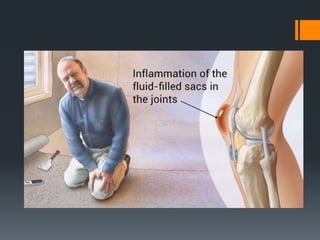
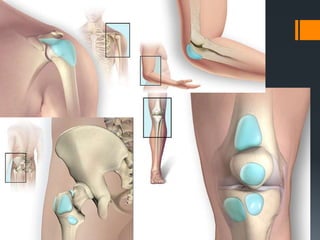
Inflammation of the fluid-filled pads (bursae) that act
as cushions at the joints.
The most common locations for bursitis are in the
shoulder, elbow and hip. But also bursitis in knee,
heel and the base of big toe also identified.
Bursitis often occurs near joints that perform
frequent repetitive motion.
Treatment typically involves resting the affected joint
and protecting it from further trauma.
In most cases, bursitis pain goes away within a few
weeks with proper treatment, but recurrent flare-ups
of bursitis are common.
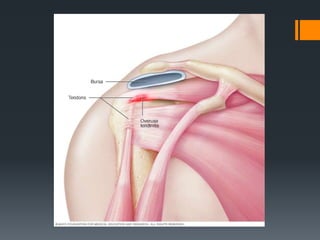
Tendonitis
A condition in which the tissue connecting muscle to bone
becomes inflame
tendon — the thick fibrous cords that attach muscle to bone.
The condition causes pain and tenderness just outside a
joint.
While tendinitis can occur in any of the tendons, it's most
common around shoulders, elbows, wrists, knees and
heels.
Most cases of tendinitis can be successfully treated with
rest, physical therapy and medications to reduce pain. If
tendinitis is severe and leads to the rupture of a tendon,
surgery is indicated.
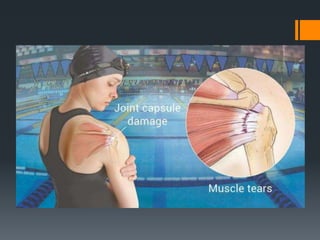
Impingement syndrome
Shoulder pain caused by connective tissue (a tendon)
rubbing on a shoulder blade.
Shoulder impingement syndrome is
a syndrome involving tendonitis (inflammation of tend
ons) of the rotator cuff muscles as they pass through
the subacromial space, the passage beneath
the acromion.
It is particularly associated with tendonitis of
the supraspinatus muscle.
This can result in pain, weakness, and loss of
movement at the shoulder.
Oral anti-inflammatory medications -- such
as aspirin, naproxen, or ibuprofen, remain the most
common treatment for impingement syndrome.
Carpal tunnel syndrome
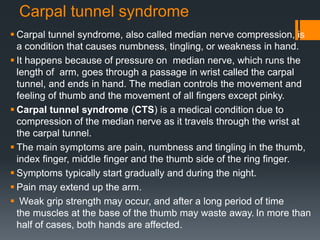
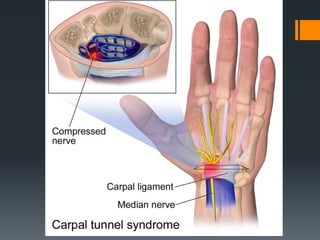
 Carpal tunnel syndrome, also called median nerve compression, is
a condition that causes numbness, tingling, or weakness in hand.
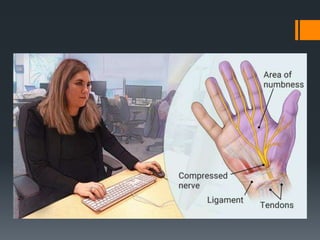
 It happens because of pressure on median nerve, which runs the
length of arm, goes through a passage in wrist called the carpal
tunnel, and ends in hand. The median controls the movement and
feeling of thumb and the movement of all fingers except pinky.
 Carpal tunnel syndrome (CTS) is a medical condition due to
compression of the median nerve as it travels through the wrist at
the carpal tunnel.
 The main symptoms are pain, numbness and tingling in the thumb,
index finger, middle finger and the thumb side of the ring finger.
 Symptoms typically start gradually and during the night.
 Pain may extend up the arm.
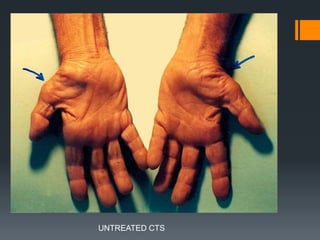
 Weak grip strength may occur, and after a long period of time
the muscles at the base of the thumb may waste away. In more than
half of cases, both hands are affected.
Risk factors include obesity, repetitive wrist
work, pregnancy, genetics, and rheumatoid
arthritis.
 There is tentative evidence
that hypothyroidism increases the risk.
Being physically active can decrease the risk of
developing CTS.
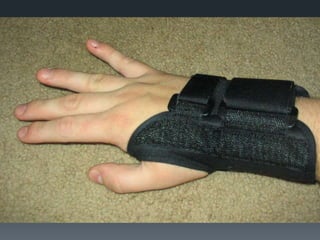
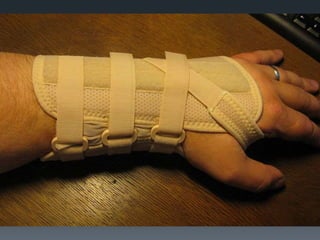
Symptoms can be improved by wearing a wrist
splint or with corticosteroid injections.
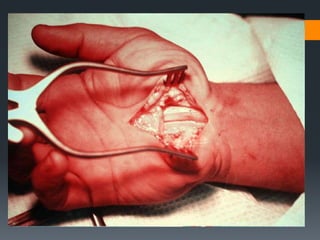
Surgery to cut the transverse carpal ligament is
effective with better results at a year compared to
non-surgical options.
UNTREATED CTS
GANGLION
 A non-cancerous lump, often on the tendons or joints of
wrists and hands. Drain the cyst with a needle or removing
the cyst surgically will be an treatment option
Dupuytren's contracture
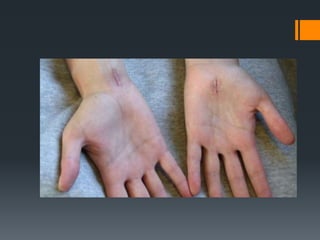
 Dupuytren's contracture is a condition in which one or more fingers
become permanently bent in a flexed position.
 It usually begins as small, hard nodules just under the skin of the palm,
then worsens over time until the fingers can no longer be straightened.
 Causes : Unknown
 Risk factors :Family history, alcoholism, smoking, thyroid
problems, liver disease, diabetes, epilepsy
 Treatment : Steroid injections, clostridial collagenase injections, surgery
CALLUS
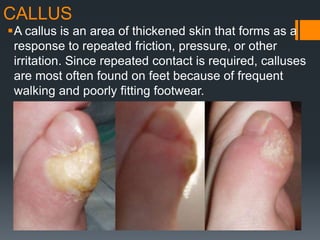
A callus is an area of thickened skin that forms as a
response to repeated friction, pressure, or other
irritation. Since repeated contact is required, calluses
are most often found on feet because of frequent
walking and poorly fitting footwear.
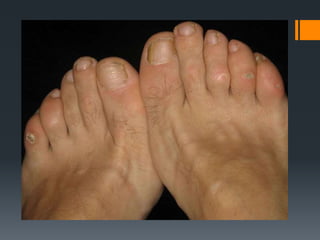
CORNS
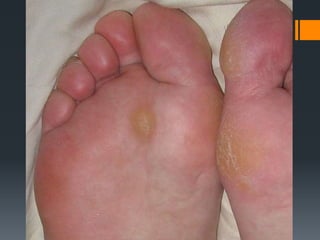
 Thick, hardened layers of skin caused by friction and
pressure.
 Overgrowth of horny layer of epidermis
Common Upper and Lower extrimity disorders

Common Upper and Lower extrimity disorders

  • 1.
    COMMON UPPER & LOWEREXTREMITY DISORDERS
  • 2.
    BURSITIS Inflammation of thefluid-filled pads (bursae) that act as cushions at the joints. The most common locations for bursitis are in the shoulder, elbow and hip. But also bursitis in knee, heel and the base of big toe also identified. Bursitis often occurs near joints that perform frequent repetitive motion. Treatment typically involves resting the affected joint and protecting it from further trauma. In most cases, bursitis pain goes away within a few weeks with proper treatment, but recurrent flare-ups of bursitis are common.
  • 5.
    Tendonitis A condition inwhich the tissue connecting muscle to bone becomes inflame tendon — the thick fibrous cords that attach muscle to bone. The condition causes pain and tenderness just outside a joint. While tendinitis can occur in any of the tendons, it's most common around shoulders, elbows, wrists, knees and heels. Most cases of tendinitis can be successfully treated with rest, physical therapy and medications to reduce pain. If tendinitis is severe and leads to the rupture of a tendon, surgery is indicated.
  • 7.
    Impingement syndrome Shoulder paincaused by connective tissue (a tendon) rubbing on a shoulder blade. Shoulder impingement syndrome is a syndrome involving tendonitis (inflammation of tend ons) of the rotator cuff muscles as they pass through the subacromial space, the passage beneath the acromion. It is particularly associated with tendonitis of the supraspinatus muscle. This can result in pain, weakness, and loss of movement at the shoulder. Oral anti-inflammatory medications -- such as aspirin, naproxen, or ibuprofen, remain the most common treatment for impingement syndrome.
  • 9.
    Carpal tunnel syndrome Carpal tunnel syndrome, also called median nerve compression, is a condition that causes numbness, tingling, or weakness in hand.  It happens because of pressure on median nerve, which runs the length of arm, goes through a passage in wrist called the carpal tunnel, and ends in hand. The median controls the movement and feeling of thumb and the movement of all fingers except pinky.  Carpal tunnel syndrome (CTS) is a medical condition due to compression of the median nerve as it travels through the wrist at the carpal tunnel.  The main symptoms are pain, numbness and tingling in the thumb, index finger, middle finger and the thumb side of the ring finger.  Symptoms typically start gradually and during the night.  Pain may extend up the arm.  Weak grip strength may occur, and after a long period of time the muscles at the base of the thumb may waste away. In more than half of cases, both hands are affected.
  • 11.
    Risk factors includeobesity, repetitive wrist work, pregnancy, genetics, and rheumatoid arthritis.  There is tentative evidence that hypothyroidism increases the risk. Being physically active can decrease the risk of developing CTS. Symptoms can be improved by wearing a wrist splint or with corticosteroid injections. Surgery to cut the transverse carpal ligament is effective with better results at a year compared to non-surgical options.
  • 12.
  • 18.
    GANGLION  A non-cancerouslump, often on the tendons or joints of wrists and hands. Drain the cyst with a needle or removing the cyst surgically will be an treatment option
  • 19.
    Dupuytren's contracture  Dupuytren'scontracture is a condition in which one or more fingers become permanently bent in a flexed position.  It usually begins as small, hard nodules just under the skin of the palm, then worsens over time until the fingers can no longer be straightened.  Causes : Unknown  Risk factors :Family history, alcoholism, smoking, thyroid problems, liver disease, diabetes, epilepsy  Treatment : Steroid injections, clostridial collagenase injections, surgery
  • 20.
    CALLUS A callus isan area of thickened skin that forms as a response to repeated friction, pressure, or other irritation. Since repeated contact is required, calluses are most often found on feet because of frequent walking and poorly fitting footwear.
  • 22.
    CORNS  Thick, hardenedlayers of skin caused by friction and pressure.  Overgrowth of horny layer of epidermis