UNIVERSIDAD TECNICA DE MACHALA
ACADEMIC UNIT OF CHEMICAL
SCIENCES AND HEALTH
MEDICINE SCHOOL
ENGLISH
CARDIOVASCULAR
SINCOPE
STUDENTS
William Cruz
Kevin Herrera
Jorge Pacheco
Angie Chamba
Sonia Quijilema
TEACHER:
Mgs. Barreto Huilcapi Lina Maribel
CLASS:
EIGHTH SEMESTER ‘’A’’
Machala, El Oro
2018
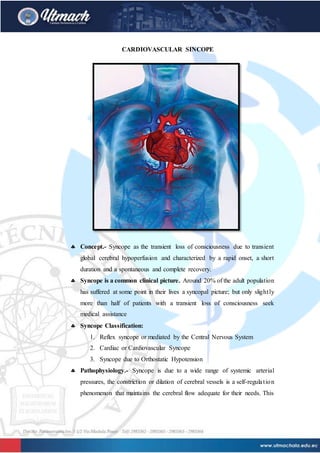
CARDIOVASCULAR SINCOPE
 Concept.- Syncope as the transient loss of consciousness due to transient
global cerebral hypoperfusion and characterized by a rapid onset, a short
duration and a spontaneous and complete recovery.
 Syncope is a common clinical picture. Around 20% of the adult population
has suffered at some point in their lives a syncopal picture; but only slightly
more than half of patients with a transient loss of consciousness seek
medical assistance
 Syncope Classification:
1. Reflex syncope or mediated by the Central Nervous System
2. Cardiac or Cardiovascular Syncope
3. Syncope due to Orthostatic Hypotension
 Pathophysiology.- Syncope is due to a wide range of systemic arterial
pressures, the constriction or dilation of cerebral vessels is a self-regulation
phenomenon that maintains the cerebral flow adequate for their needs. This
situation of global cerebral hypoperfusion can be reached by a critical
decrease in cardiac output, by inadequate peripheral resistances or by a
combination of both.
 Cardiac or cardiovascular syncope.- The sudden decrease of the minute
volume or cardiac output, or the inability to increase it during exercise due
to the presence of a cardiac alteration, constitutes the pathophysiological
basis of cardiac syncope. The basic alteration may be an arrhythmia, an
obstructive process or the appearance of an acute mechanical dysfunction.
It occurs in both bradyarrhythmias and tachyarrhythmias; The most
common syncopal arrhythmias are, in decreasing order of frequency,
atrioventricular (AV) block, ventricular tachycardia, sinus dysfunction, and
supraventricular tachycardia.
The syncope of AV block constitutes the so-called Stokes-Adams syndrome.
Generally, syncope occurs at the time of the appearance of a complete infrahisian
AV block due to asystole that occurs until the subsidiary pacemakers are started.
Syncope due to orthostatic hypotension. With the passage from decubitus to
standing, there is a displacement of the circulating volume, so that 500-700 mL of
blood are retained in the lower extremities and the vessels of the splanchnic area,
which determines a reduction of the venous return and cardiac output.
 Syncope Reflexes or Mediated by the Vasovagal System.- The term
«vasovagal syncope» consists of reflex syncope characterized
physiopathologically by the association, to a greater or lesser degree, of
vagal stimulation and sympathetic inhibition, which results in bradycardia
and hypotension. It is triggered by emotions, pain, heat, agglomerations,
sight of blood or various medical procedures. The loss of consciousness can
be preceded by a brief phase of general malaise, with pallor, sweating and
nausea, among others.
 Clinical Table.- In some etiological forms there may be previous symptoms
of precordial pain (syncope caused by an ischemic heart event) or other
locations (dissecting aneurysm of the aorta, pulmonary embolism,
vasovagal syncope triggered by painful episodes), rapid palpitations
(arrhythmic syncope) , but also in some cases syncopes of other etiologies),
etc.
Loss of consciousness is accompanied by loss of muscle tone and falling to the floor
if the patient is standing. It is common for syncope to cause different types of
trauma, which can sometimes be serious. The duration of the loss of consciousness
is brief, usually a few seconds or minutes. Longer loss of consciousness (greater
than 5 min) should alert other processes.
 Diagnostic Methods.- The first diagnostic step is the anamnesis, the
physical examination, the practice of an ECG and, if there are no
contraindications, the performance of carotid sinus massage and orthostatic
stress tests. This step is the most important of all the evaluation. With the
data obtained, the doctor must be able to:
a) Establish if the patient has suffered a true syncope
b) Diagnose vasovagal syncope with typical triggers, orthostatic
hypotension, syncope reflexes associated with different
situations (swallowing, defecatory), some arrhythmic syncopes
evident in the ECG (AV block, bradyarrhythmias,
tachyarrhythmias) and the existence of carotid sinus
hypersensitivity
c) Diagnose or suspect the existence of heart disease or
neurological disease and request the necessary complementary
tests to confirm the diagnosis
d) Assess the neuropsychic status of the patient and the possible
pharmacological or toxic contribution in the triggering of
syncope
e) Decide whether the patient should be hospitalized or not.
 Treatment.- If the patient is seen during the syncopal episode, the following
should be done:
a) ensure that you are not in a situation of cardiac arrest
b) place the patient in the supine position with the head down and
the legs elevated
c) perform an immediate clinical examination as complete as
possible in order to try to determine the syncopal mechanism.
The suspicion of syncope due to acute cardiological processes (arrhythmias,
ischemic heart disease, dissecting aortic aneurysm, tamponade) should motivate
urgent hospital admission.
In orthostatic hypotension, the search and withdrawal of drugs that can contribute
to it is essential. In cases due to generalized neurological alterations or localized in
the baroreceptor reflex arc, the treatment is complex and, sometimes, ineffective.
Recurrent vasovagal syncope poses important problems for its prevention. In this
sense, the main measures are:
1. Reassure the patient while explaining the generally benign nature of the
picture;
2. Avoid known triggers;
3. If there is no contraindication, liberalize the intake of water and salt;
4. Avoid excessive consumption of alcohol;
5. In cases that require hypotensive medication, adjust / decrease doses,
and
6. In cases with premonitory symptoms, the patient must learn to perform
certain maneuvers to try to juggle the crises (crossing of the legs and
tension of the gluteal muscles, isometric contraction of the hands or
arms, adopting the decubitus position, etc.).
Although several drugs have been used in the prevention of vasovagal syncope
among the most used drugs, we have the following drugs (vagolytics, beta-blockers,
a-adrenergic drugs, serotonin reuptake inhibitors, etc.) so far there is no irrefutable
evidence of Its utility.
SOURCE BIBLIOGRAPHY:
R.Ruiz Granell; ¨Sincope Cardiogenico¨; In Farreras V-Rozman C "Internal
Medicine" 18th Edition, El Sevier, Barcelona- Spain 2016, page 460-464

Cardiovascular sincope (5)

  • 1.
    UNIVERSIDAD TECNICA DEMACHALA ACADEMIC UNIT OF CHEMICAL SCIENCES AND HEALTH MEDICINE SCHOOL ENGLISH CARDIOVASCULAR SINCOPE STUDENTS William Cruz Kevin Herrera Jorge Pacheco Angie Chamba Sonia Quijilema TEACHER: Mgs. Barreto Huilcapi Lina Maribel CLASS: EIGHTH SEMESTER ‘’A’’ Machala, El Oro 2018
  • 2.
    CARDIOVASCULAR SINCOPE  Concept.-Syncope as the transient loss of consciousness due to transient global cerebral hypoperfusion and characterized by a rapid onset, a short duration and a spontaneous and complete recovery.  Syncope is a common clinical picture. Around 20% of the adult population has suffered at some point in their lives a syncopal picture; but only slightly more than half of patients with a transient loss of consciousness seek medical assistance  Syncope Classification: 1. Reflex syncope or mediated by the Central Nervous System 2. Cardiac or Cardiovascular Syncope 3. Syncope due to Orthostatic Hypotension  Pathophysiology.- Syncope is due to a wide range of systemic arterial pressures, the constriction or dilation of cerebral vessels is a self-regulation phenomenon that maintains the cerebral flow adequate for their needs. This
  • 3.
    situation of globalcerebral hypoperfusion can be reached by a critical decrease in cardiac output, by inadequate peripheral resistances or by a combination of both.  Cardiac or cardiovascular syncope.- The sudden decrease of the minute volume or cardiac output, or the inability to increase it during exercise due to the presence of a cardiac alteration, constitutes the pathophysiological basis of cardiac syncope. The basic alteration may be an arrhythmia, an obstructive process or the appearance of an acute mechanical dysfunction. It occurs in both bradyarrhythmias and tachyarrhythmias; The most common syncopal arrhythmias are, in decreasing order of frequency, atrioventricular (AV) block, ventricular tachycardia, sinus dysfunction, and supraventricular tachycardia. The syncope of AV block constitutes the so-called Stokes-Adams syndrome. Generally, syncope occurs at the time of the appearance of a complete infrahisian AV block due to asystole that occurs until the subsidiary pacemakers are started. Syncope due to orthostatic hypotension. With the passage from decubitus to standing, there is a displacement of the circulating volume, so that 500-700 mL of blood are retained in the lower extremities and the vessels of the splanchnic area, which determines a reduction of the venous return and cardiac output.  Syncope Reflexes or Mediated by the Vasovagal System.- The term «vasovagal syncope» consists of reflex syncope characterized physiopathologically by the association, to a greater or lesser degree, of vagal stimulation and sympathetic inhibition, which results in bradycardia and hypotension. It is triggered by emotions, pain, heat, agglomerations, sight of blood or various medical procedures. The loss of consciousness can be preceded by a brief phase of general malaise, with pallor, sweating and nausea, among others.  Clinical Table.- In some etiological forms there may be previous symptoms of precordial pain (syncope caused by an ischemic heart event) or other locations (dissecting aneurysm of the aorta, pulmonary embolism, vasovagal syncope triggered by painful episodes), rapid palpitations
  • 4.
    (arrhythmic syncope) ,but also in some cases syncopes of other etiologies), etc. Loss of consciousness is accompanied by loss of muscle tone and falling to the floor if the patient is standing. It is common for syncope to cause different types of trauma, which can sometimes be serious. The duration of the loss of consciousness is brief, usually a few seconds or minutes. Longer loss of consciousness (greater than 5 min) should alert other processes.  Diagnostic Methods.- The first diagnostic step is the anamnesis, the physical examination, the practice of an ECG and, if there are no contraindications, the performance of carotid sinus massage and orthostatic stress tests. This step is the most important of all the evaluation. With the data obtained, the doctor must be able to: a) Establish if the patient has suffered a true syncope b) Diagnose vasovagal syncope with typical triggers, orthostatic hypotension, syncope reflexes associated with different situations (swallowing, defecatory), some arrhythmic syncopes evident in the ECG (AV block, bradyarrhythmias, tachyarrhythmias) and the existence of carotid sinus hypersensitivity c) Diagnose or suspect the existence of heart disease or neurological disease and request the necessary complementary tests to confirm the diagnosis d) Assess the neuropsychic status of the patient and the possible pharmacological or toxic contribution in the triggering of syncope e) Decide whether the patient should be hospitalized or not.  Treatment.- If the patient is seen during the syncopal episode, the following should be done: a) ensure that you are not in a situation of cardiac arrest b) place the patient in the supine position with the head down and the legs elevated
  • 5.
    c) perform animmediate clinical examination as complete as possible in order to try to determine the syncopal mechanism. The suspicion of syncope due to acute cardiological processes (arrhythmias, ischemic heart disease, dissecting aortic aneurysm, tamponade) should motivate urgent hospital admission. In orthostatic hypotension, the search and withdrawal of drugs that can contribute to it is essential. In cases due to generalized neurological alterations or localized in the baroreceptor reflex arc, the treatment is complex and, sometimes, ineffective. Recurrent vasovagal syncope poses important problems for its prevention. In this sense, the main measures are: 1. Reassure the patient while explaining the generally benign nature of the picture; 2. Avoid known triggers; 3. If there is no contraindication, liberalize the intake of water and salt; 4. Avoid excessive consumption of alcohol; 5. In cases that require hypotensive medication, adjust / decrease doses, and 6. In cases with premonitory symptoms, the patient must learn to perform certain maneuvers to try to juggle the crises (crossing of the legs and tension of the gluteal muscles, isometric contraction of the hands or arms, adopting the decubitus position, etc.). Although several drugs have been used in the prevention of vasovagal syncope among the most used drugs, we have the following drugs (vagolytics, beta-blockers, a-adrenergic drugs, serotonin reuptake inhibitors, etc.) so far there is no irrefutable evidence of Its utility. SOURCE BIBLIOGRAPHY: R.Ruiz Granell; ¨Sincope Cardiogenico¨; In Farreras V-Rozman C "Internal Medicine" 18th Edition, El Sevier, Barcelona- Spain 2016, page 460-464