Structural bioinformatics ofprotein and
RNA
Course Instructor: Ayisha Aman
Course: Bioinformatics
Course# BTH-3051
2.
What is structuralbioinformatics?
Structural bioinformatics is the branch of bioinformatics which
is related to the analysis and prediction of the three-dimensional
structure of biological macromolecules such as proteins, RNA, and
DNA.
It deals with generalizations about macromolecular 3D structure
such as comparisons of overall folds and local motifs, principles of
molecular folding, evolution, and binding interactions, and
structure/function relationships, working both from
experimentally solved structures and from computational models.
Bioinformatics Tools for
MacromoleculesStructure Visualization
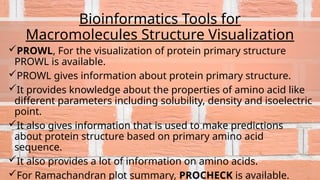
PROWL, For the visualization of protein primary structure
PROWL is available.
PROWL gives information about protein primary structure.
It provides knowledge about the properties of amino acid like
different parameters including solubility, density and isoelectric
point.
It also gives information that is used to make predictions
about protein structure based on primary amino acid
sequence.
It also provides a lot of information on amino acids.
For Ramachandran plot summary, PROCHECK is available.
8.
Protein Structure Databases
Proteindatabank (PDB)
The Protein Data Bank (PDB) is a crystallographic database for the
three-dimensional structural data of large biological molecules, such
as proteins and nucleic acids.
It is the platform for processing and distribution of 3D
macromolecular structure data primarily determined experimentally.
Here structures are deposited by using X ray crystallography and
NMR.
This database provides access to the structural data as well as
methods to visualize the structure and to download structural
information.
9.
NCBI Structure (MMDB)
NCBIstructure database is called MMDB
(Molecular Modeling Database).
Entrez page provides you access to MMDB.
This database contains macromolecular 3D
structure , also contains tools for structure
visualization. MMDB contains both protein and
polynucleotide with 10,000 structure.
10.
Protein Structure visualizationdatabases and tools
Cn3-D (See in 3D) is a structure and sequence alignment viewer
for NCBI databases. It allows to view 3D structures.
Rasmol, most popular tool (software) for protein structure
visualization. It reads molecular structure from PDB.
Other include Chemscape Chime & Protein Explorer.
Swiss PDB Viewer, by this tool we can analyze several proteins
simultaneously.
Kinemages, in this , entire image can be rotated, parts can be
turned on or off etc.
PDBsum, it is the database that gives pictorial summary on
each macromolecular structure from PDB.
11.
Protein Structure Alignmentand its
databases
VAST, (Vector Alignment Search Tool), by
NCBI and is used to identify similar
protein 3D structures.
DALI server, protein structure alignment
tool, used for comparing structures in 3D.
12.
Domain Architecture Databases
CDD,(Conserved Domain Database)
CDART, (Conserved domain architecture
retrieval tool) , is used to search for
protein with similar domain architecture.
SCOP (Structural Classificationof
Protein)
A structural classification of proteins provides detailed and comprehensive
description of structural and evolutionary relationships between all proteins.
The Structural Classification of Proteins (SCOP) database is a largely
manual classification of protein structural domains based on similarities of
their structures and amino acid sequences.
A motivation for this classification is to determine the evolutionary
relationship between proteins.
Proteins with the same shapes but having little sequence or functional
similarity are placed in different superfamilies, and are assumed to have only
a very distant common ancestor.
Proteins having the same shape and some similarity of sequence and/or
function are placed in "families", and are assumed to have a closer common
ancestor.
15.
CATH (Class, Architecture,Topology &
Homologous superfamily)
It provides classification of protein domain
structures.
Class, similar secondary structure.
Architecture (fold), major structural similarity.
Topology (Superfamily), probable common
ancestry
Family , clear evolutionary relationships.