• Swine influenza or “swine flu” is a highly contagious acute
respiratory disease of pigs, caused by swine influenza H1N1 virus
• Swine flu is caused by Type A influenza virus that causes regular
outbreaks in pigs
• Swine flu virus have been reported to spread from person-to-
person.
What is Swine Flu?
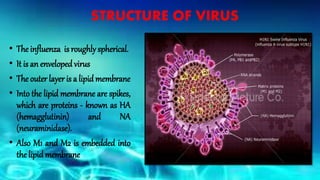
STRUCTURE OF VIRUS
• The influenza is roughly spherical.
• It is an enveloped virus
• The outer layer is a lipid membrane
• Into the lipid membrane are spikes,
which are proteins - known as HA
(hemagglutinin) and NA
(neuraminidase).
• Also M1 and M2 is embedded into
the lipid membrane
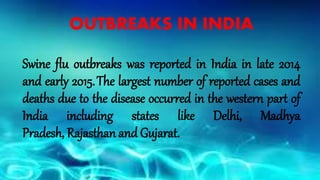
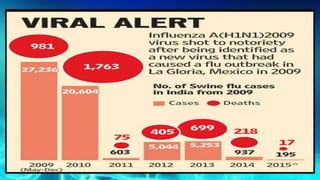
OUTBREAKS IN INDIA
Swine flu outbreaks was reported in India in late 2014
and early 2015.The largest number of reported cases and
deaths due to the disease occurred in the western part of
India including states like Delhi, Madhya
Pradesh, Rajasthan and Gujarat.
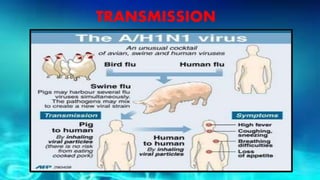
TRANSMISSION
How man is Exposed ?
Most commonly, these cases
occur in persons with direct
exposure to pigs (e.g. children
near pigs at a fair or workers
in the swine industry). In
addition, there have been
documented cases of one
person spreading swine flu to
others.
Pigs infect Humans
Pigs can pass mutated
viruses back to humans, and

these can be passed from
human to human.
Transmission among
humans is thought to occur
in the same way as with
seasonal flu. .
How do people catch swine flu?
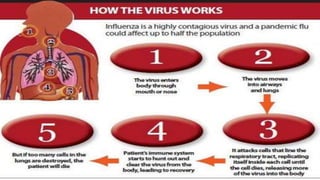
• Flu is generally transmitted through the respiratory tract.
• Droplets of infected body fluids may carry flu when people cough
or sneeze.
• Studies indicate that masks called N95 respirators, when properly
used, filter germs from the breath and hamper the spread of flu.

• Neither contact with pigs nor eating pork has been linked to the
spread of the flu.
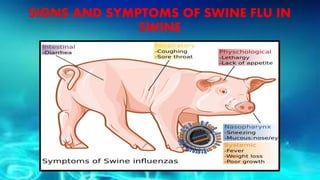
SIGNS AND SYMPTOMS OF SWINE FLU IN
SWINE
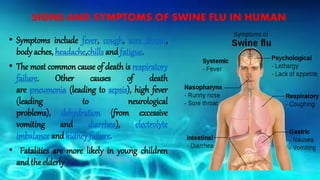
SIGNS AND SYMPTOMS OF SWINE FLU IN HUMAN
• Symptoms include fever, cough, sore throat,
body aches, headache,chills and fatigue.

• The most common cause of death is respiratory
failure. Other causes of death
are pneumonia (leading to sepsis), high fever
(leading to neurological
problems), dehydration (from excessive
vomiting and diarrhea), electrolyte

imbalance and kidney failure.
• Fatalities are more likely in young children
and the elderly
Temperature is the key swine flu symptom
• Temperature rises from normal 37 degree Celsius to
upto 40 degree Celsius.
• Sustained fever above 38 degree Celsius is necessary
for positive diagnosis.
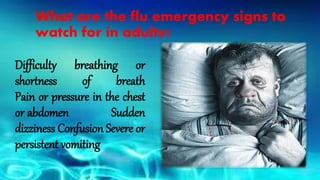
What are the flu emergency signs to
watch for in adults?
Difficulty breathing or
shortness of breath
Pain or pressure in the chest
or abdomen Sudden
dizziness Confusion Severe or
persistent vomiting
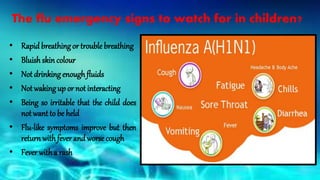
The flu emergency signs to watch for in children?
• Rapid breathingor trouble breathing
• Bluish skin colour
• Not drinkingenoughfluids
• Not wakingup or not interacting
• Being so irritable that the child does
not want to be held
• Flu-like symptoms improve but then
return with fever and worse cough
• Fever witha rash
DIAGNOSIS
To diagnose swine influenza A
infection, a respiratory specimen
would generally need to be collected
within the first 4 to 5 days of illness
(when an infected person is most likely
to be shedding virus). However, some
persons, especially children, may shed
virus for 10 days or longer.
Identification as a swine flu influenza
A virus
Rapid Diagnosis
•RT PCR can make
rapid Diagnosis
Currently Available Test
• Rapid Antigen Tests: not as sensitive as other available tests.
RT–PCR Virus isolation Virus Genome Sequencing Four–
fold rise in swine influenza A (H1N1) virus specific
neutralizing antibodies.
• It is important to note that samples from all cases, once the
Pandemic starts, are not required to be tested
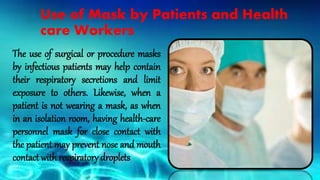
Use of Mask by Patients and Health
care Workers
The use of surgical or procedure masks
by infectious patients may help contain
their respiratory secretions and limit
exposure to others. Likewise, when a
patient is not wearing a mask, as when
in an isolation room, having health-care
personnel mask for close contact with
the patient may prevent nose and mouth
contact with respiratory droplets
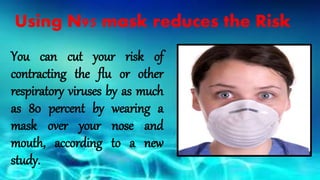
Using N95 mask reduces the Risk
You can cut your risk of
contracting the flu or other
respiratory viruses by as much
as 80 percent by wearing a
mask over your nose and
mouth, according to a new
study.
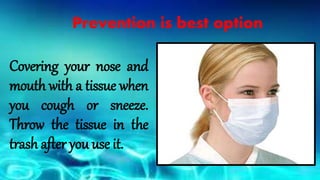
Covering your nose and
mouth with a tissue when
you cough or sneeze.
Throw the tissue in the
trash after you use it.
Prevention is best option
Vaccination is the primary method for preventing Influenza
in persons at high risk for complications secondary to
influenza infection.
Administration of antiviral medications, either for the early
treatment of influenza infection or for prophylaxis against
infection, is a useful adjunct in the control of influenza in
these persons
Best way to Prevent Influenza
Control with Antiviral Drugs
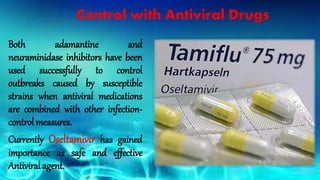
Both adamantine and
neuraminidase inhibitors have been
used successfully to control
outbreaks caused by susceptible
strains when antiviral medications
are combined with other infection-
control measures.
Currently Oseltamivir has gained
importance as safe and effective
Antiviral agent.
Everyone 6 months of age and older should
get vaccinated against the flu as soon as the
2010-2011 season vaccine is available. People at
high risk of serious flu complications include
young children, pregnant women, people
with chronic health conditions like asthma,
diabetes or heart and lung disease and people
65 years and older.
Swine flu Vaccination
“flu shot”
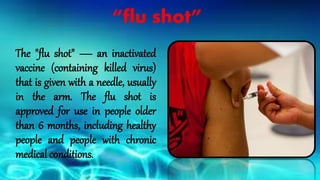
The "flu shot" — an inactivated
vaccine (containing killed virus)
that is given with a needle, usually
in the arm. The flu shot is
approved for use in people older
than 6 months, including healthy
people and people with chronic
medical conditions.
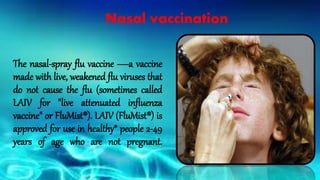
Nasal vaccination
The nasal-spray flu vaccine —a vaccine
made with live, weakened flu viruses that
do not cause the flu (sometimes called
LAIV for "live attenuated influenza
vaccine" or FluMist®). LAIV (FluMist®) is
approved for use in healthy* people 2-49
years of age who are not pregnant.
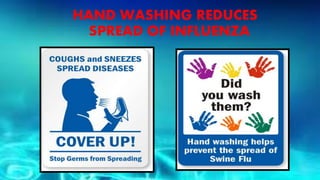
HAND WASHING REDUCES
SPREAD OF INFLUENZA
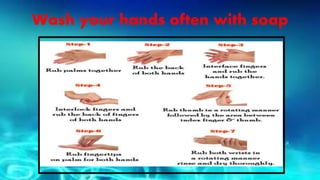
Wash your hands often with soap
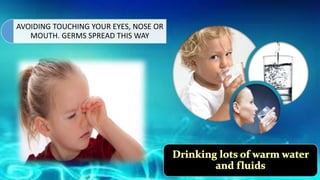
AVOIDING TOUCHING YOUR EYES, NOSE OR
MOUTH. GERMS SPREAD THIS WAY
AVOID VISITING UNHYGIENIC PLACES
HEALTHY FOODS THAT HELP
AVOID SWINE FLU | BOOST
IMMUNE SYSTEM
FOODS RICH IN PROTEIN, LIKE ,EGGS, FISH, MILK, BEANS, NUTS, SEEDS
AND SOY-BASED FOODS, HAVING MINIMUM 3 SERVINGS OF THESE
FOODS PER DAY WILL HELP BUILD A BARRIER AGAINST VIRAL
INFECTIONS LIKE SWINE FLU.
WHOLE GRAINS AND PUMPKIN SEEDS, ALSO BUILD ANTIBODIES
AGAINST SWINE FLU.
CLOVES ANDRAWGARLIC (A SOURCE OF ALLICIN)
ARE AGAINNATURALDEFENSE AGAINST SWINE FLU
THANK YOU
Presented by
Foram Gandhi and Rashmi Yadav

Swineflu

  • 3.
    • Swine influenzaor “swine flu” is a highly contagious acute respiratory disease of pigs, caused by swine influenza H1N1 virus • Swine flu is caused by Type A influenza virus that causes regular outbreaks in pigs • Swine flu virus have been reported to spread from person-to- person. What is Swine Flu?
  • 4.
    STRUCTURE OF VIRUS •The influenza is roughly spherical. • It is an enveloped virus • The outer layer is a lipid membrane • Into the lipid membrane are spikes, which are proteins - known as HA (hemagglutinin) and NA (neuraminidase). • Also M1 and M2 is embedded into the lipid membrane
  • 7.
    OUTBREAKS IN INDIA Swineflu outbreaks was reported in India in late 2014 and early 2015.The largest number of reported cases and deaths due to the disease occurred in the western part of India including states like Delhi, Madhya Pradesh, Rajasthan and Gujarat.
  • 10.
  • 11.
    How man isExposed ? Most commonly, these cases occur in persons with direct exposure to pigs (e.g. children near pigs at a fair or workers in the swine industry). In addition, there have been documented cases of one person spreading swine flu to others.
  • 12.
    Pigs infect Humans Pigscan pass mutated viruses back to humans, and these can be passed from human to human. Transmission among humans is thought to occur in the same way as with seasonal flu. .
  • 13.
    How do peoplecatch swine flu? • Flu is generally transmitted through the respiratory tract. • Droplets of infected body fluids may carry flu when people cough or sneeze. • Studies indicate that masks called N95 respirators, when properly used, filter germs from the breath and hamper the spread of flu. • Neither contact with pigs nor eating pork has been linked to the spread of the flu.
  • 14.
    SIGNS AND SYMPTOMSOF SWINE FLU IN SWINE
  • 15.
    SIGNS AND SYMPTOMSOF SWINE FLU IN HUMAN • Symptoms include fever, cough, sore throat, body aches, headache,chills and fatigue. • The most common cause of death is respiratory failure. Other causes of death are pneumonia (leading to sepsis), high fever (leading to neurological problems), dehydration (from excessive vomiting and diarrhea), electrolyte imbalance and kidney failure. • Fatalities are more likely in young children and the elderly
  • 16.
    Temperature is thekey swine flu symptom • Temperature rises from normal 37 degree Celsius to upto 40 degree Celsius. • Sustained fever above 38 degree Celsius is necessary for positive diagnosis.
  • 17.
    What are theflu emergency signs to watch for in adults? Difficulty breathing or shortness of breath Pain or pressure in the chest or abdomen Sudden dizziness Confusion Severe or persistent vomiting
  • 18.
    The flu emergencysigns to watch for in children? • Rapid breathingor trouble breathing • Bluish skin colour • Not drinkingenoughfluids • Not wakingup or not interacting • Being so irritable that the child does not want to be held • Flu-like symptoms improve but then return with fever and worse cough • Fever witha rash
  • 19.
    DIAGNOSIS To diagnose swineinfluenza A infection, a respiratory specimen would generally need to be collected within the first 4 to 5 days of illness (when an infected person is most likely to be shedding virus). However, some persons, especially children, may shed virus for 10 days or longer. Identification as a swine flu influenza A virus
  • 20.
    Rapid Diagnosis •RT PCRcan make rapid Diagnosis
  • 21.
    Currently Available Test •Rapid Antigen Tests: not as sensitive as other available tests. RT–PCR Virus isolation Virus Genome Sequencing Four– fold rise in swine influenza A (H1N1) virus specific neutralizing antibodies. • It is important to note that samples from all cases, once the Pandemic starts, are not required to be tested
  • 22.
    Use of Maskby Patients and Health care Workers The use of surgical or procedure masks by infectious patients may help contain their respiratory secretions and limit exposure to others. Likewise, when a patient is not wearing a mask, as when in an isolation room, having health-care personnel mask for close contact with the patient may prevent nose and mouth contact with respiratory droplets
  • 23.
    Using N95 maskreduces the Risk You can cut your risk of contracting the flu or other respiratory viruses by as much as 80 percent by wearing a mask over your nose and mouth, according to a new study.
  • 24.
    Covering your noseand mouth with a tissue when you cough or sneeze. Throw the tissue in the trash after you use it. Prevention is best option
  • 25.
    Vaccination is theprimary method for preventing Influenza in persons at high risk for complications secondary to influenza infection. Administration of antiviral medications, either for the early treatment of influenza infection or for prophylaxis against infection, is a useful adjunct in the control of influenza in these persons Best way to Prevent Influenza
  • 27.
    Control with AntiviralDrugs Both adamantine and neuraminidase inhibitors have been used successfully to control outbreaks caused by susceptible strains when antiviral medications are combined with other infection- control measures. Currently Oseltamivir has gained importance as safe and effective Antiviral agent.
  • 29.
    Everyone 6 monthsof age and older should get vaccinated against the flu as soon as the 2010-2011 season vaccine is available. People at high risk of serious flu complications include young children, pregnant women, people with chronic health conditions like asthma, diabetes or heart and lung disease and people 65 years and older. Swine flu Vaccination
  • 30.
    “flu shot” The "flushot" — an inactivated vaccine (containing killed virus) that is given with a needle, usually in the arm. The flu shot is approved for use in people older than 6 months, including healthy people and people with chronic medical conditions.
  • 31.
    Nasal vaccination The nasal-sprayflu vaccine —a vaccine made with live, weakened flu viruses that do not cause the flu (sometimes called LAIV for "live attenuated influenza vaccine" or FluMist®). LAIV (FluMist®) is approved for use in healthy* people 2-49 years of age who are not pregnant.
  • 32.
  • 33.
    Wash your handsoften with soap
  • 34.
    AVOIDING TOUCHING YOUREYES, NOSE OR MOUTH. GERMS SPREAD THIS WAY
  • 35.
  • 36.
    HEALTHY FOODS THATHELP AVOID SWINE FLU | BOOST IMMUNE SYSTEM
  • 37.
    FOODS RICH INPROTEIN, LIKE ,EGGS, FISH, MILK, BEANS, NUTS, SEEDS AND SOY-BASED FOODS, HAVING MINIMUM 3 SERVINGS OF THESE FOODS PER DAY WILL HELP BUILD A BARRIER AGAINST VIRAL INFECTIONS LIKE SWINE FLU.
  • 38.
    WHOLE GRAINS ANDPUMPKIN SEEDS, ALSO BUILD ANTIBODIES AGAINST SWINE FLU.
  • 39.
    CLOVES ANDRAWGARLIC (ASOURCE OF ALLICIN) ARE AGAINNATURALDEFENSE AGAINST SWINE FLU
  • 41.
    THANK YOU Presented by ForamGandhi and Rashmi Yadav