

SUTURE MATERIALS
DR. MD. SHERAJUL ISLAM
MBBS,FCPS,FACS,FICS,FMAS
ASSISTANT PROFESSOR (SURGERY)
• What is Suture?
• What is Stitch?
Although stitches and sutures are widely referred to as one and the same, in
medical terms they are actually two different things.
Sutures are the threads or strands used to close a wound
Stitches” (stitching) refers to the actual process of closing the wound
closing the wound
However, “suturing” is often used to mean stitching
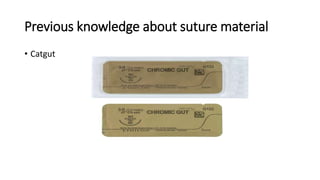
Previous knowledge about suture material
• Catgut
Previous knowledge about suture material
Vicryl
Previous knowledge about suture material
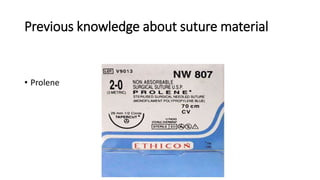
• Prolene
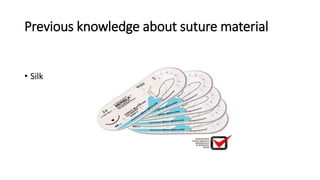
Previous knowledge about suture material
• Silk
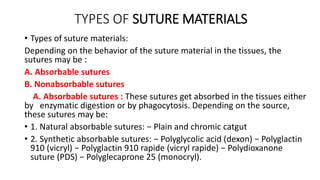
TYPES OF SUTURE MATERIALS
• Types of suture materials:
Depending on the behavior of the suture material in the tissues, the
sutures may be :
A. Absorbable sutures
B. Nonabsorbable sutures
A. Absorbable sutures : These sutures get absorbed in the tissues either
by enzymatic digestion or by phagocytosis. Depending on the source,
these sutures may be:
• 1. Natural absorbable sutures: − Plain and chromic catgut
• 2. Synthetic absorbable sutures: − Polyglycolic acid (dexon) − Polyglactin
910 (vicryl) − Polyglactin 910 rapide (vicryl rapide) − Polydioxanone
suture (PDS) − Polyglecaprone 25 (monocryl).
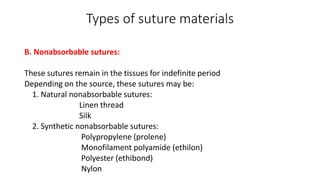
Types of suture materials
B. Nonabsorbable sutures:
These sutures remain in the tissues for indefinite period
Depending on the source, these sutures may be:
1. Natural nonabsorbable sutures:
Linen thread
Silk
2. Synthetic nonabsorbable sutures:
Polypropylene (prolene)
Monofilament polyamide (ethilon)
Polyester (ethibond)
Nylon
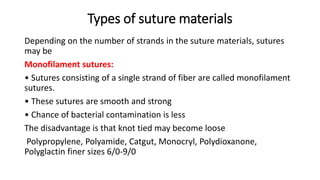
Types of suture materials
Depending on the number of strands in the suture materials, sutures
may be
Monofilament sutures:
• Sutures consisting of a single strand of fiber are called monofilament
sutures.
• These sutures are smooth and strong
• Chance of bacterial contamination is less
The disadvantage is that knot tied may become loose
Polypropylene, Polyamide, Catgut, Monocryl, Polydioxanone,
Polyglactin finer sizes 6/0-9/0
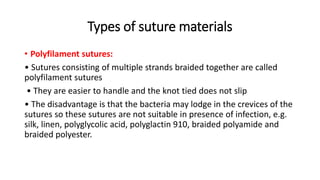
Types of suture materials
• Polyfilament sutures:
• Sutures consisting of multiple strands braided together are called
polyfilament sutures
• They are easier to handle and the knot tied does not slip
• The disadvantage is that the bacteria may lodge in the crevices of the
sutures so these sutures are not suitable in presence of infection, e.g.
silk, linen, polyglycolic acid, polyglactin 910, braided polyamide and
braided polyester.
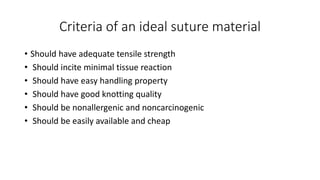
Criteria of an ideal suture material
• Should have adequate tensile strength
• Should incite minimal tissue reaction
• Should have easy handling property
• Should have good knotting quality
• Should be nonallergenic and noncarcinogenic
• Should be easily available and cheap
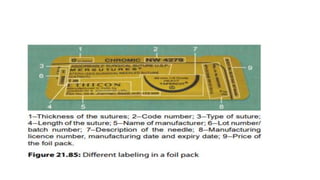
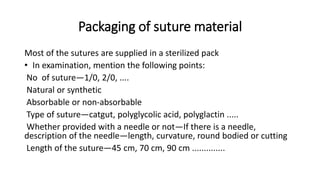
Packaging of suture material
Most of the sutures are supplied in a sterilized pack
• In examination, mention the following points:
No of suture—1/0, 2/0, ....
Natural or synthetic
Absorbable or non-absorbable
Type of suture—catgut, polyglycolic acid, polyglactin .....
Whether provided with a needle or not—If there is a needle,
description of the needle—length, curvature, round bodied or cutting
Length of the suture—45 cm, 70 cm, 90 cm ..............
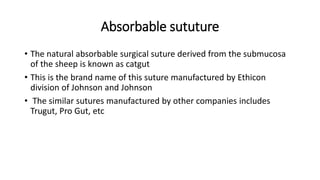
Absorbable sututure
• The natural absorbable surgical suture derived from the submucosa
of the sheep is known as catgut
• This is the brand name of this suture manufactured by Ethicon
division of Johnson and Johnson
• The similar sutures manufactured by other companies includes
Trugut, Pro Gut, etc
Characteristics of Catgut:
• Derived from the submucosa of sheep's intestine or serosa of cattle's intestine
• It is 99% collagen
• This is absorbed by a process of enzymatic digestion by proteolytic enzymes
contained in the polymorphs and macrophages
• Catgut is easy to handle and knots well
• Absorption rate depends on the size of the catgut and whether it is plain or
chromicised
• Plain catgut loses 50% tensile strength in tissues in 3 days and loses all tensile
strength in 15 days ,gets absorbed in tissues within 60 days
• Chromic catgut loses 50% tensile strength in 7 days and loses all its tensile
strength in 28 days, gets absorbed in tissues in 90–100 days
• In presence of infection the catgut gets absorbed earlier
Uses of Catgut
a. Plain catgut:
• Plain catgut is used to tie small subcutaneous vessels
• Used to approximate subcutaneous tissues during closure of an incision
• Used during circumcision to suture the cut margins of the prepuce
• Used in repair of wounds of lip or oral cavity
b. Chromic catgut:
• Used to suture muscles, bowel anastomosis, closure of peritoneum
• Used during appendicectomy. The mesoappendix is tied with 1-0 chromic catgut
suture. The base of the appendix is tied with a 1-0 or 2-0 chromic catgut suture.
The stump of the appendix may be inverted with a Z or a purse string suture
applied with a 2-0 atraumatic catgut suture. The peritoneum, muscles and the
external oblique aponeurosis is apposed by 2-0 chromic catgut sutures
• To be continued….

SUTURE MATERIALS.pptx

  • 1.
    SUTURE MATERIALS DR. MD.SHERAJUL ISLAM MBBS,FCPS,FACS,FICS,FMAS ASSISTANT PROFESSOR (SURGERY)
  • 2.
    • What isSuture? • What is Stitch? Although stitches and sutures are widely referred to as one and the same, in medical terms they are actually two different things. Sutures are the threads or strands used to close a wound Stitches” (stitching) refers to the actual process of closing the wound closing the wound However, “suturing” is often used to mean stitching
  • 3.
    Previous knowledge aboutsuture material • Catgut
  • 4.
    Previous knowledge aboutsuture material Vicryl
  • 5.
    Previous knowledge aboutsuture material • Prolene
  • 6.
    Previous knowledge aboutsuture material • Silk
  • 7.
    TYPES OF SUTUREMATERIALS • Types of suture materials: Depending on the behavior of the suture material in the tissues, the sutures may be : A. Absorbable sutures B. Nonabsorbable sutures A. Absorbable sutures : These sutures get absorbed in the tissues either by enzymatic digestion or by phagocytosis. Depending on the source, these sutures may be: • 1. Natural absorbable sutures: − Plain and chromic catgut • 2. Synthetic absorbable sutures: − Polyglycolic acid (dexon) − Polyglactin 910 (vicryl) − Polyglactin 910 rapide (vicryl rapide) − Polydioxanone suture (PDS) − Polyglecaprone 25 (monocryl).
  • 8.
    Types of suturematerials B. Nonabsorbable sutures: These sutures remain in the tissues for indefinite period Depending on the source, these sutures may be: 1. Natural nonabsorbable sutures: Linen thread Silk 2. Synthetic nonabsorbable sutures: Polypropylene (prolene) Monofilament polyamide (ethilon) Polyester (ethibond) Nylon
  • 9.
    Types of suturematerials Depending on the number of strands in the suture materials, sutures may be Monofilament sutures: • Sutures consisting of a single strand of fiber are called monofilament sutures. • These sutures are smooth and strong • Chance of bacterial contamination is less The disadvantage is that knot tied may become loose Polypropylene, Polyamide, Catgut, Monocryl, Polydioxanone, Polyglactin finer sizes 6/0-9/0
  • 10.
    Types of suturematerials • Polyfilament sutures: • Sutures consisting of multiple strands braided together are called polyfilament sutures • They are easier to handle and the knot tied does not slip • The disadvantage is that the bacteria may lodge in the crevices of the sutures so these sutures are not suitable in presence of infection, e.g. silk, linen, polyglycolic acid, polyglactin 910, braided polyamide and braided polyester.
  • 11.
    Criteria of anideal suture material • Should have adequate tensile strength • Should incite minimal tissue reaction • Should have easy handling property • Should have good knotting quality • Should be nonallergenic and noncarcinogenic • Should be easily available and cheap
  • 13.
    Packaging of suturematerial Most of the sutures are supplied in a sterilized pack • In examination, mention the following points: No of suture—1/0, 2/0, .... Natural or synthetic Absorbable or non-absorbable Type of suture—catgut, polyglycolic acid, polyglactin ..... Whether provided with a needle or not—If there is a needle, description of the needle—length, curvature, round bodied or cutting Length of the suture—45 cm, 70 cm, 90 cm ..............
  • 14.
    Absorbable sututure • Thenatural absorbable surgical suture derived from the submucosa of the sheep is known as catgut • This is the brand name of this suture manufactured by Ethicon division of Johnson and Johnson • The similar sutures manufactured by other companies includes Trugut, Pro Gut, etc
  • 15.
    Characteristics of Catgut: •Derived from the submucosa of sheep's intestine or serosa of cattle's intestine • It is 99% collagen • This is absorbed by a process of enzymatic digestion by proteolytic enzymes contained in the polymorphs and macrophages • Catgut is easy to handle and knots well • Absorption rate depends on the size of the catgut and whether it is plain or chromicised • Plain catgut loses 50% tensile strength in tissues in 3 days and loses all tensile strength in 15 days ,gets absorbed in tissues within 60 days • Chromic catgut loses 50% tensile strength in 7 days and loses all its tensile strength in 28 days, gets absorbed in tissues in 90–100 days • In presence of infection the catgut gets absorbed earlier
  • 16.
    Uses of Catgut a.Plain catgut: • Plain catgut is used to tie small subcutaneous vessels • Used to approximate subcutaneous tissues during closure of an incision • Used during circumcision to suture the cut margins of the prepuce • Used in repair of wounds of lip or oral cavity b. Chromic catgut: • Used to suture muscles, bowel anastomosis, closure of peritoneum • Used during appendicectomy. The mesoappendix is tied with 1-0 chromic catgut suture. The base of the appendix is tied with a 1-0 or 2-0 chromic catgut suture. The stump of the appendix may be inverted with a Z or a purse string suture applied with a 2-0 atraumatic catgut suture. The peritoneum, muscles and the external oblique aponeurosis is apposed by 2-0 chromic catgut sutures
  • 17.
    • To becontinued….