SUTURING MATERIALS
AND TECHNIQUES
T.HUDSON JONATHAN
1ST YR MDS
CONTENTS
• Introduction
• General principles
• Features of ideal suture material
• Size of suture material
• Classification of suturing material
• Surgical needles
• Knots and types
• Types of suturing
• Conclusion
• References
Introduction
• Sutures are tiny threads,wire or other material
used to sew body tissue and skin together.They
may be placed deep in the tissues or superficially
to close a wound.(Perry et al 2014)
• The primary objective of suturing is to position
and secure surgical flaps to prompt optimal
healing without any tension in that area.(Ulin AW
et al 1975)
• Sutures are maintained in the desired position
until healing has progressed to the point at which
sutures are no longer needed.
General principles
• Grasp the needle 2/3 front and 1/3 behind the
needle holder.
• The needle should pass perpendicular to the
tissue.
• The needle should pass at an equal depth and
distance on both sides of the wound.
• Pass the needle from the thinner to the thicker
tissue.
• The suture should never be closed under tension.
• The knot should be placed 2-3mm from the
incision.
• Suture should pass over the dental papilla,and
not the empty socket.
• Use few knots as possible.
• Use least amount of suture that will secure
the wound.
• Use the smallest suture possible to close the
wound.
Features of ideal suture material
• Should have high tensile strength to hold the
margins approximately till the healing is
complete.
• Should not cause any allergic or tissue
inflammation.
• Should have least capillarity so that the suture
material does not soak in the inflammed tissue
fluid
• Should have good knoting properties.
• Should be easily sterilized.
• Should be visible in the surgical field.
• Should be resonablly inexpensive.
Size of suture material
• Suture materials are available in various sizes
depending on its tensile strength.
• The standard for identifying varying tensile
strength of a given suture material is determined
by the number of zeros.(Lober CW et al 1986)
• The smaller the cross sectional diameter the
more zeros the suture has.
• Sizes start with a 0 and progress downward
through 00,000,4-0,10-0.
• Thus 4-0 nylon has a greatest diameter than 6-
0 nylon and therefore a greater tensile
strength.
Classification of suturing materials
Based on number of filaments:
• Monofilaments(steel,nylon)
• Multifilaments(silk,cotton)
Based on suture diameter in descend order
from 5,4,3,2,1-0 till 11-0 size.
Based on absorbability
• Absorbable
• Non absorbable
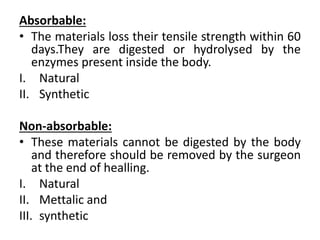
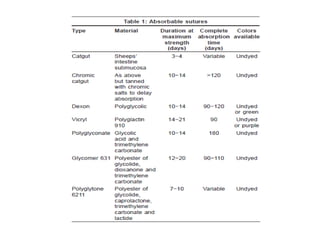
Absorbable:
• The materials loss their tensile strength within 60
days.They are digested or hydrolysed by the
enzymes present inside the body.
I. Natural
II. Synthetic
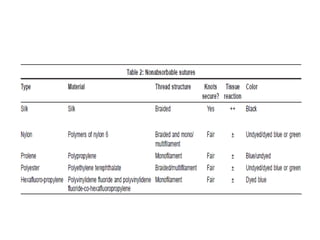
Non-absorbable:
• These materials cannot be digested by the body
and therefore should be removed by the surgeon
at the end of healling.
I. Natural
II. Mettalic and
III. synthetic
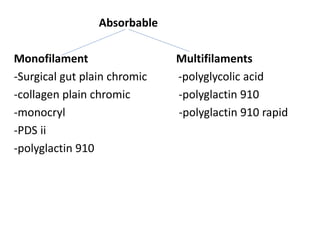
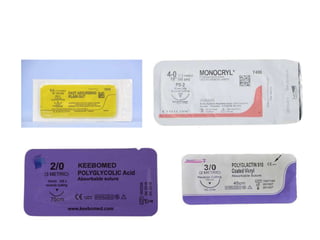
Absorbable
Monofilament Multifilaments
-Surgical gut plain chromic -polyglycolic acid
-collagen plain chromic -polyglactin 910
-monocryl -polyglactin 910 rapid
-PDS ii
-polyglactin 910
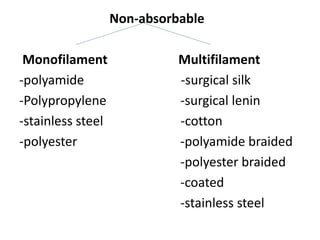
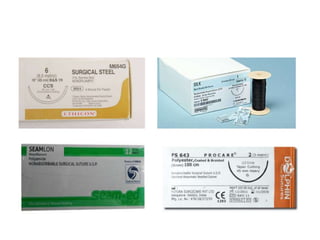
Non-absorbable
Monofilament Multifilament
-polyamide -surgical silk
-Polypropylene -surgical lenin
-stainless steel -cotton
-polyester -polyamide braided
-polyester braided
-coated
-stainless steel
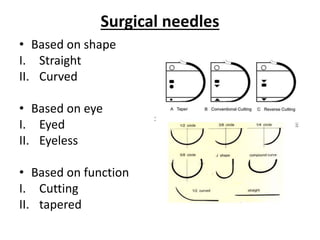
Surgical needles
• Based on shape
I. Straight
II. Curved
• Based on eye
I. Eyed
II. Eyeless
• Based on function
I. Cutting
II. tapered
knots
• Knot is composed of a number of tight
throws,each throws represents a weave of the
two strands and ears that are the cut ends of
the suture.(Meinel L,et al 2005)
• Components of knot comprises of
Loop
Knot
ears
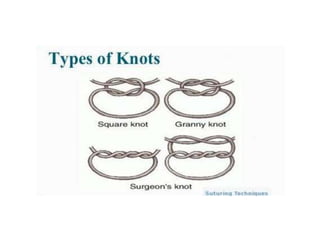
Types of knots:
• Sqaure knot-two single tie in opposite direction
• Granny knot-two or three tie in the same
direction
• Surgeon’s knot(2-1)-the first tie is double and the
second tie is single in opposite direction
• Surgeon’s knot(2-2)-the first and second tie are
double in opposite direction.
Technique:
• The needle is held with the needle holder and it
should enter the tissues at right angles and be no
less than 2-3mm from the incision.
• The needle is then carried through the tissue
where it follows the needle’s curvature.
• Sutures of any type that are placed in the
interdental papilae should enter and exit the
tissue at a point located below the imaginary line
that forms the base of the triangle of the
interdental papilla.
• The location of sutures for the closure of the
palatal flap depends on the extension of the
flap elevation that has been performed.
• If the elevation is slight or moderate,the
sutures can be placed in the quadrant closest
to the teeth.
• If the elevation is substantial, the sutures
should be placed in the central quadrants of
the palate.
Types of suturing:
Interrupted sutures
• Circumferential :direct/loop
• Figure of eight
• Mattress
-vertical
-horizontal
Continuous sutures
• Independent sling suture
• Mattress
-vertical
-horizontal
• Continuous locking
 Simple sling suture
 Periosteal suture
 Horizontal mattress suture:
• It is often used for interproximal areas of diastema or
wide interdental spaces to adapt the interdental
papilla properly against the bone.
• Two sutures are often necessary,and the horizontal
mattress suture can be incorporated with the
continuous independent sling sutures.
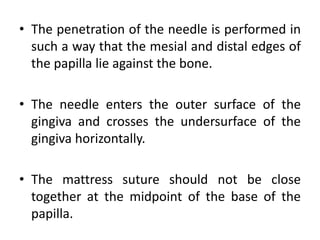
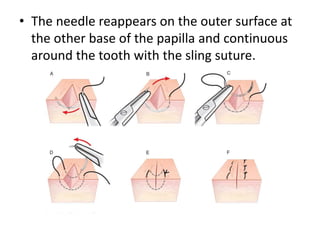
• The penetration of the needle is performed in
such a way that the mesial and distal edges of
the papilla lie against the bone.
• The needle enters the outer surface of the
gingiva and crosses the undersurface of the
gingiva horizontally.
• The mattress suture should not be close
together at the midpoint of the base of the
papilla.
• The needle reappears on the outer surface at
the other base of the papilla and continuous
around the tooth with the sling suture.
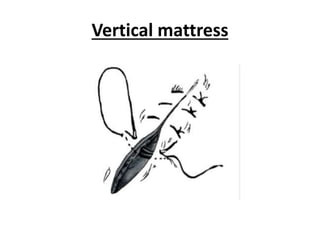
Vertical mattress
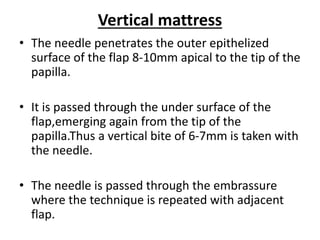
• The needle penetrates the outer epithelized
surface of the flap 8-10mm apical to the tip of the
papilla.
• It is passed through the under surface of the
flap,emerging again from the tip of the
papilla.Thus a vertical bite of 6-7mm is taken with
the needle.
• The needle is passed through the embrassure
where the technique is repeated with adjacent
flap.
Vertical mattress
Direct suture
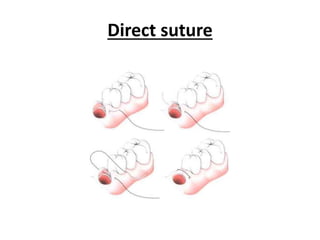
• The needle penetrates the outer surface of
the first flap.The under surface of the opposite
flap is engaged and the suture is brought back
to the initial side where the knot is tied.
• These sutures are used when bone graft are
placed and when closed opposition of
scalloped incision is required.
Direct suture
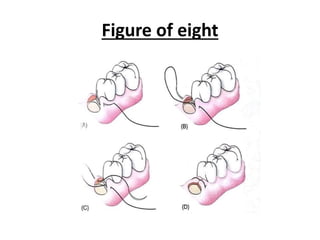
Figure of eight:
• The needle penetrates the outer surface of
the first flap and the outer surface of the
opposite flap.
• The suture is brought back to the first flap and
the knot is tied.
• These sutures are placed when flaps are not in
close apposition because of apical flap
position or non scalloped incisions.
Figure of eight
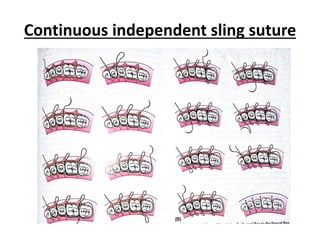
Continuous independent sling suture:
• A sling suture is used when both a facial flap
and a lingual flap are used and when they
involve many teeth.(Carranza,12th ed)
• The continuous,independent sling suture is
initiated on the facial papilla closest to the
midline,because this is the easiest place to
position the final knot.
• A continuous sling suture is laced for each
papilla on the facial surface.
• When the last tooth is reached,the suture is
anchored around it to prevent any pulling of
the facial sutures,when the lingual flap is
sutured around the teeth in a similar manner.
• The suture is again anchored around the last
tooth before tying the final knot.
• The facial and lingual flap are completely
independent of each other because of the
anchoring around both the initial and final
tooth.
• It is especially appropriate for the maxillary
arch because the palatal gingiva is attached
and fibrous,whereas the facial tissue is thinner
and mobile.
Continuous independent sling suture
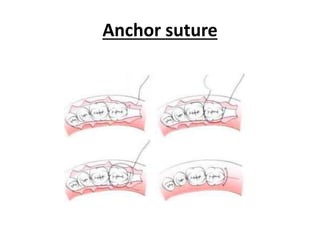
Anchor suture:
• The closing of a flap mesial and distal to a
tooth,as in the mesial or distal wedge procedure,
is best accompained by the anchor suture.
• This suture closes the facial and lingual flap and
adapts them tightly against the tooth.
• The needle is placed at the line angle area of the
facial or lingual flap adjacent to the tooth,
anchored around the tooth passed beneath the
opposite flap and tied.It can be repeated for each
area that require it.
Anchor suture
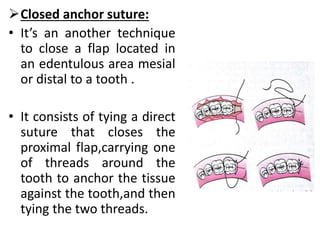
Closed anchor suture:
• It’s an another technique
to close a flap located in
an edentulous area mesial
or distal to a tooth .
• It consists of tying a direct
suture that closes the
proximal flap,carrying one
of threads around the
tooth to anchor the tissue
against the tooth,and then
tying the two threads.
Periosteal suture:
• The periosteal suture is used to hold the
apically displaced partial thickness flaps on
the periosteum.
• There are two types of periosteal sutures: the
holding suture and closing suture.(Verbist
G,et al 2007)
• The holding suture is the horizontal mattress
suture placed at the base of the displaced flap
to secure it into the new position.
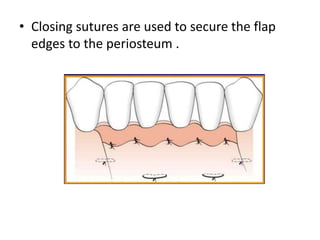
• Closing sutures are used to secure the flap
edges to the periosteum .
Conclusion
• Due to daily surgical procedures carried out by
dentist,a greater knowledge of suturing
armantarium and materials is needed.
• The success of technique sensitive surgeries
depends on the clinicians knowledge and skills
to close the wound and achieve optimal
healing.(Mohan H et al, 2009)
• The innovation in suturing materials decrease
the potential for post operative infections.
References
• Clinical periodontology – Carranza 12th ed.
• Textbook of oral and maxillo facial surgery – S.M.
Balaji.
• Suture materials and suture techniques – myele et al
2015.
• Basic suture technique for oral mucosa – Griffin et
al,cllinical advances in periodontics 2011
• Sutures and suturing techniques in skin closure-Mohan
H et al, Indian J Dermatol Venereol Leprol | July-
August 2009 | Vol 75 | Issue 4
THANK YOU

Suturing techniques ppt

  • 1.
  • 2.
    CONTENTS • Introduction • Generalprinciples • Features of ideal suture material • Size of suture material • Classification of suturing material • Surgical needles • Knots and types • Types of suturing • Conclusion • References
  • 3.
    Introduction • Sutures aretiny threads,wire or other material used to sew body tissue and skin together.They may be placed deep in the tissues or superficially to close a wound.(Perry et al 2014) • The primary objective of suturing is to position and secure surgical flaps to prompt optimal healing without any tension in that area.(Ulin AW et al 1975) • Sutures are maintained in the desired position until healing has progressed to the point at which sutures are no longer needed.
  • 4.
    General principles • Graspthe needle 2/3 front and 1/3 behind the needle holder. • The needle should pass perpendicular to the tissue. • The needle should pass at an equal depth and distance on both sides of the wound.
  • 5.
    • Pass theneedle from the thinner to the thicker tissue. • The suture should never be closed under tension. • The knot should be placed 2-3mm from the incision. • Suture should pass over the dental papilla,and not the empty socket.
  • 6.
    • Use fewknots as possible. • Use least amount of suture that will secure the wound. • Use the smallest suture possible to close the wound.
  • 7.
    Features of idealsuture material • Should have high tensile strength to hold the margins approximately till the healing is complete. • Should not cause any allergic or tissue inflammation. • Should have least capillarity so that the suture material does not soak in the inflammed tissue fluid
  • 8.
    • Should havegood knoting properties. • Should be easily sterilized. • Should be visible in the surgical field. • Should be resonablly inexpensive.
  • 9.
    Size of suturematerial • Suture materials are available in various sizes depending on its tensile strength. • The standard for identifying varying tensile strength of a given suture material is determined by the number of zeros.(Lober CW et al 1986) • The smaller the cross sectional diameter the more zeros the suture has.
  • 10.
    • Sizes startwith a 0 and progress downward through 00,000,4-0,10-0. • Thus 4-0 nylon has a greatest diameter than 6- 0 nylon and therefore a greater tensile strength.
  • 11.
    Classification of suturingmaterials Based on number of filaments: • Monofilaments(steel,nylon) • Multifilaments(silk,cotton) Based on suture diameter in descend order from 5,4,3,2,1-0 till 11-0 size. Based on absorbability • Absorbable • Non absorbable
  • 12.
    Absorbable: • The materialsloss their tensile strength within 60 days.They are digested or hydrolysed by the enzymes present inside the body. I. Natural II. Synthetic Non-absorbable: • These materials cannot be digested by the body and therefore should be removed by the surgeon at the end of healling. I. Natural II. Mettalic and III. synthetic
  • 13.
    Absorbable Monofilament Multifilaments -Surgical gutplain chromic -polyglycolic acid -collagen plain chromic -polyglactin 910 -monocryl -polyglactin 910 rapid -PDS ii -polyglactin 910
  • 16.
    Non-absorbable Monofilament Multifilament -polyamide -surgicalsilk -Polypropylene -surgical lenin -stainless steel -cotton -polyester -polyamide braided -polyester braided -coated -stainless steel
  • 20.
    Surgical needles • Basedon shape I. Straight II. Curved • Based on eye I. Eyed II. Eyeless • Based on function I. Cutting II. tapered
  • 21.
    knots • Knot iscomposed of a number of tight throws,each throws represents a weave of the two strands and ears that are the cut ends of the suture.(Meinel L,et al 2005) • Components of knot comprises of Loop Knot ears
  • 22.
    Types of knots: •Sqaure knot-two single tie in opposite direction • Granny knot-two or three tie in the same direction • Surgeon’s knot(2-1)-the first tie is double and the second tie is single in opposite direction • Surgeon’s knot(2-2)-the first and second tie are double in opposite direction.
  • 24.
    Technique: • The needleis held with the needle holder and it should enter the tissues at right angles and be no less than 2-3mm from the incision. • The needle is then carried through the tissue where it follows the needle’s curvature. • Sutures of any type that are placed in the interdental papilae should enter and exit the tissue at a point located below the imaginary line that forms the base of the triangle of the interdental papilla.
  • 25.
    • The locationof sutures for the closure of the palatal flap depends on the extension of the flap elevation that has been performed. • If the elevation is slight or moderate,the sutures can be placed in the quadrant closest to the teeth. • If the elevation is substantial, the sutures should be placed in the central quadrants of the palate.
  • 26.
    Types of suturing: Interruptedsutures • Circumferential :direct/loop • Figure of eight • Mattress -vertical -horizontal Continuous sutures • Independent sling suture • Mattress -vertical -horizontal
  • 27.
    • Continuous locking Simple sling suture  Periosteal suture  Horizontal mattress suture: • It is often used for interproximal areas of diastema or wide interdental spaces to adapt the interdental papilla properly against the bone. • Two sutures are often necessary,and the horizontal mattress suture can be incorporated with the continuous independent sling sutures.
  • 28.
    • The penetrationof the needle is performed in such a way that the mesial and distal edges of the papilla lie against the bone. • The needle enters the outer surface of the gingiva and crosses the undersurface of the gingiva horizontally. • The mattress suture should not be close together at the midpoint of the base of the papilla.
  • 29.
    • The needlereappears on the outer surface at the other base of the papilla and continuous around the tooth with the sling suture.
  • 30.
    Vertical mattress • Theneedle penetrates the outer epithelized surface of the flap 8-10mm apical to the tip of the papilla. • It is passed through the under surface of the flap,emerging again from the tip of the papilla.Thus a vertical bite of 6-7mm is taken with the needle. • The needle is passed through the embrassure where the technique is repeated with adjacent flap.
  • 31.
  • 32.
    Direct suture • Theneedle penetrates the outer surface of the first flap.The under surface of the opposite flap is engaged and the suture is brought back to the initial side where the knot is tied. • These sutures are used when bone graft are placed and when closed opposition of scalloped incision is required.
  • 33.
  • 34.
    Figure of eight: •The needle penetrates the outer surface of the first flap and the outer surface of the opposite flap. • The suture is brought back to the first flap and the knot is tied. • These sutures are placed when flaps are not in close apposition because of apical flap position or non scalloped incisions.
  • 35.
  • 36.
    Continuous independent slingsuture: • A sling suture is used when both a facial flap and a lingual flap are used and when they involve many teeth.(Carranza,12th ed) • The continuous,independent sling suture is initiated on the facial papilla closest to the midline,because this is the easiest place to position the final knot.
  • 37.
    • A continuoussling suture is laced for each papilla on the facial surface. • When the last tooth is reached,the suture is anchored around it to prevent any pulling of the facial sutures,when the lingual flap is sutured around the teeth in a similar manner. • The suture is again anchored around the last tooth before tying the final knot.
  • 38.
    • The facialand lingual flap are completely independent of each other because of the anchoring around both the initial and final tooth. • It is especially appropriate for the maxillary arch because the palatal gingiva is attached and fibrous,whereas the facial tissue is thinner and mobile.
  • 39.
  • 40.
    Anchor suture: • Theclosing of a flap mesial and distal to a tooth,as in the mesial or distal wedge procedure, is best accompained by the anchor suture. • This suture closes the facial and lingual flap and adapts them tightly against the tooth. • The needle is placed at the line angle area of the facial or lingual flap adjacent to the tooth, anchored around the tooth passed beneath the opposite flap and tied.It can be repeated for each area that require it.
  • 41.
  • 42.
    Closed anchor suture: •It’s an another technique to close a flap located in an edentulous area mesial or distal to a tooth . • It consists of tying a direct suture that closes the proximal flap,carrying one of threads around the tooth to anchor the tissue against the tooth,and then tying the two threads.
  • 43.
    Periosteal suture: • Theperiosteal suture is used to hold the apically displaced partial thickness flaps on the periosteum. • There are two types of periosteal sutures: the holding suture and closing suture.(Verbist G,et al 2007) • The holding suture is the horizontal mattress suture placed at the base of the displaced flap to secure it into the new position.
  • 44.
    • Closing suturesare used to secure the flap edges to the periosteum .
  • 45.
    Conclusion • Due todaily surgical procedures carried out by dentist,a greater knowledge of suturing armantarium and materials is needed. • The success of technique sensitive surgeries depends on the clinicians knowledge and skills to close the wound and achieve optimal healing.(Mohan H et al, 2009) • The innovation in suturing materials decrease the potential for post operative infections.
  • 46.
    References • Clinical periodontology– Carranza 12th ed. • Textbook of oral and maxillo facial surgery – S.M. Balaji. • Suture materials and suture techniques – myele et al 2015. • Basic suture technique for oral mucosa – Griffin et al,cllinical advances in periodontics 2011 • Sutures and suturing techniques in skin closure-Mohan H et al, Indian J Dermatol Venereol Leprol | July- August 2009 | Vol 75 | Issue 4
  • 47.