URETHRAL CATHETERISATION
DR. MD. SHERAJUL ISLAM
FCPS (Surgery), FACS(USA)
Assistant Professor, Surgery
Sheikh Sayera Khatun Medical College
History
Sushruta, surgeon of ancient India (6th
century BC) described gold, silver, iron and
wood tubes lubricated with ghee for the
evacuation of urine
Aulus Cornelius Celsus (25 BC–AD 50)
described bronze and lead pipes for urethral
catheterization in De Re Medicina
 Frederick Foley, a medical student in
Boston, designed the modern catheter in the
1930s
Fortunately catheters now come in latex,
silicone, Teflon and PVC, with some coated in
Introduction
Catheterization is an invasive
procedure
 It should be carried out in a
sensitive manner, maintaining the
patient’s dignity at all times
The indication of catheterization
determines whether long- or short-
term catheters are used and should
be considered prior to the procedure
Indications
Acute urinary retention
Haematuria
 Accurate assessment of urinary output
and volume status
 Delivery of medications
Contraindicati
ons
Lack of consent
 Phimosis/paraphimosis (a relative
contraindication)
Urethral stricture
Rupture urethra
Penile fracture
Equipment
 Dressing pack
 Male catheter
 Catheter drainage bag
 Normal saline cleaning solution
 Gauze
 Sterile lidocaine anaesthetic gel
 10 mL sterile water
 10 mL syringe
 Sterile gloves
 Disposable, loose-fitting outer sterile gloves
 Kidney bowl
Catheter size
charrières (ch) after the 19th century French
instrument maker Joseph Charrières,
representing the outer diameter of the
catheter
 The size of the catheter in charrières is
equivalent to three times its diameter in
millimeters (mm):12 ch catheter measures 4
mm in diameter
 These measurements are commonly
referred to as ‘French gauge’
 A larger-gauge catheter may be required in
circumstances such as haematuria or pyuria,
where clots or debris may obstruct urinary
Catheter size
catheter may be required, with bladder
irrigation being delivered via a third
catheter lumen to maintain catheter
patency
Larger catheters are more likely to cause
urethral damage, but too small a catheter
can result in leakage around the catheter
Various types are available: Foley, Coude
tip (elbow shaped at the tip for negotiating
the prostate) and straight
The smallest Foley catheter likely to be
effective is normally first choice for
general use, usually size 10, 12 or 14 ch
Bi channel
Foley’s
catheter
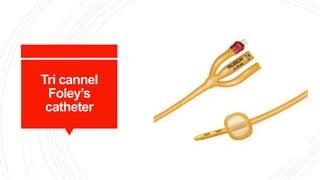
Tri cannel
Foley’s
catheter
Coude tip
Tip Box
If the catheter will not pass down the
urethra, consider using more anaesthetic
gel and inserting a larger-sized catheter
Paradoxical though this may seem, a
larger catheter will be less flexible in the
urethra and hence more likely to negotiate
the tighter prostatic urethra
However, never apply substantial force
when inserting a catheter; if the catheter
does not pass (secondary to a stricture,
for example) withdraw the catheter and
discuss with your seniors
Cross-section
of male
urogenital
anatomy
A) External
anatomy of the
female
urogenital area
B) Cross-
section of
female
urogenital
anatomy
Practical
procedure
 Explain the procedure to the patient and gain
consent
 In case of female Position the patient supine
on the bed with their legs bent and then
relaxed open, exposing the perineum, ensure
that the perineum is well lit (e.g. using a
gynaecology bedside lamp)
 Open the equipment onto a clean trolley,
ensuring the urinary catheter remains inside
the internal packaging
 Wash your hands and wear sterile gloves with
a second overlying pair of disposable sterile
gloves
Practical
procedure
 Hold the penis with a sterile gauze swab
around the shaft with your non-dominant
hand, Retract the foreskin and gently cleanse
the urethral meatus with gauze soaked in
normal saline, directing the wiping motion
away from the urethra –in case of MALE
 Part the labia with the fingers of your non-
dominant hand. Using your dominant hand
gently cleanse the perineum with gauze
soaked in sterile normal saline wiping from
anterior to posterior (i.e. towards the anus to
avoid introducing microbes from this region)
in case of FEMALE
Practical
procedure
 Place sterile drapes over the exposed groin and
make a hole in the drape to place the penis
through
 Gently insert the pre-filled lidocaine gel syringe
tip into the urethral meatus of the penis
 Warn the patient of a stinging sensation and
slowly insert 10 mL of the lidocaine gel
 Dispose of the outer gloves
 Expose the catheter tip from the inner packaging
by tearing the perforations and gently insert the
catheter into the urethral meatus with your
dominant hand, holding it through its inner
package
Practical
procedure
 In female, part the labia with the fingers
of your non-dominant hand, and gently
insert the catheter into the urethra with
your dominant hand holding it through its
inner package
Practical
procedure
 As you advance the catheter using a
twisting or rotating motion continue to
release it from its inner package by
tearing the perforations, hence
maintaining a ‘non-touch technique’
Advance the full length of the catheter to
its bifurcation and place a kidney bowl
between the patient’s legs
Remove the last of the inner packaging
and attach the catheter bag
Practical
procedure
Once urine is draining, inflate the balloon
with 10 mL of sterile water
Gently pull back the catheter until
resistance is felt and it resumes a fixed
position (i.e. the catheter balloon is at the
bladder neck)
Pull forward the penile foreskin (to
prevent paraphimosis)
 Wipe off any excess lidocaine gel
The catheter bag should hang below
pelvis level to avoid retrograde flow and
catheter-borne infections
Practical
procedure
 Record the date and time the catheter
was inserted in the patient’s medical
notes
 Note:
— the type and size of catheter used
— the volume of sterile water used to
inflate the catheter balloon
— the residual volume
— post-procedure investigations and
complications
Tip Box
The absence of urine on inserting the
catheter its full length to the bifurcation
implies one of two possibilities: an empty
bladder or insertion into a false passage
Try to flush the catheter with 50 mL of
sterile normal saline using a bladder
syringe
 If flushes easily and can subsequently be
aspirated, it is most likely that the catheter
tip is situated in the bladder
 If doubt remains then remove the
catheter and discuss with your seniors
Tip Box
Antibiotic cover is likely to be required
when changing a catheter due to
catheter-associated urinary tract
infection
Consult with local protocols or
microbiology for advice as to specific
antimicrobials
POST-
PROCEDURE
INVESTIGATION
S
Catheter sample urine for urine dip and
microscopy, culture and sensitivity
 Urine output on a fluid balance chart
Complications
 Local discomfort – offer topical lidocaine gel and
simple oral analgesia
 Haematuria (secondary to local trauma)
 Catheter-associated urinary tract infection (or
abscess formation reported with large-gauge
catheters)
 Stricture formation or the formation of a false
passage
 Slowing of urine/no urine post catheter insertion:
— secondary to catheter blockage (e.g. debris
from pyuria or excess anaesthetic gel occluding
catheter tip)
— empty bladder
— haematuria (clots blocking catheter)

Urethral catheterisation for MBBS

  • 1.
    URETHRAL CATHETERISATION DR. MD.SHERAJUL ISLAM FCPS (Surgery), FACS(USA) Assistant Professor, Surgery Sheikh Sayera Khatun Medical College
  • 2.
    History Sushruta, surgeon ofancient India (6th century BC) described gold, silver, iron and wood tubes lubricated with ghee for the evacuation of urine Aulus Cornelius Celsus (25 BC–AD 50) described bronze and lead pipes for urethral catheterization in De Re Medicina  Frederick Foley, a medical student in Boston, designed the modern catheter in the 1930s Fortunately catheters now come in latex, silicone, Teflon and PVC, with some coated in
  • 3.
    Introduction Catheterization is aninvasive procedure  It should be carried out in a sensitive manner, maintaining the patient’s dignity at all times The indication of catheterization determines whether long- or short- term catheters are used and should be considered prior to the procedure
  • 4.
    Indications Acute urinary retention Haematuria Accurate assessment of urinary output and volume status  Delivery of medications
  • 5.
    Contraindicati ons Lack of consent Phimosis/paraphimosis (a relative contraindication) Urethral stricture Rupture urethra Penile fracture
  • 6.
    Equipment  Dressing pack Male catheter  Catheter drainage bag  Normal saline cleaning solution  Gauze  Sterile lidocaine anaesthetic gel  10 mL sterile water  10 mL syringe  Sterile gloves  Disposable, loose-fitting outer sterile gloves  Kidney bowl
  • 7.
    Catheter size charrières (ch)after the 19th century French instrument maker Joseph Charrières, representing the outer diameter of the catheter  The size of the catheter in charrières is equivalent to three times its diameter in millimeters (mm):12 ch catheter measures 4 mm in diameter  These measurements are commonly referred to as ‘French gauge’  A larger-gauge catheter may be required in circumstances such as haematuria or pyuria, where clots or debris may obstruct urinary
  • 8.
    Catheter size catheter maybe required, with bladder irrigation being delivered via a third catheter lumen to maintain catheter patency Larger catheters are more likely to cause urethral damage, but too small a catheter can result in leakage around the catheter Various types are available: Foley, Coude tip (elbow shaped at the tip for negotiating the prostate) and straight The smallest Foley catheter likely to be effective is normally first choice for general use, usually size 10, 12 or 14 ch
  • 9.
  • 10.
  • 11.
  • 12.
    Tip Box If thecatheter will not pass down the urethra, consider using more anaesthetic gel and inserting a larger-sized catheter Paradoxical though this may seem, a larger catheter will be less flexible in the urethra and hence more likely to negotiate the tighter prostatic urethra However, never apply substantial force when inserting a catheter; if the catheter does not pass (secondary to a stricture, for example) withdraw the catheter and discuss with your seniors
  • 13.
  • 14.
    A) External anatomy ofthe female urogenital area
  • 15.
  • 16.
    Practical procedure  Explain theprocedure to the patient and gain consent  In case of female Position the patient supine on the bed with their legs bent and then relaxed open, exposing the perineum, ensure that the perineum is well lit (e.g. using a gynaecology bedside lamp)  Open the equipment onto a clean trolley, ensuring the urinary catheter remains inside the internal packaging  Wash your hands and wear sterile gloves with a second overlying pair of disposable sterile gloves
  • 17.
    Practical procedure  Hold thepenis with a sterile gauze swab around the shaft with your non-dominant hand, Retract the foreskin and gently cleanse the urethral meatus with gauze soaked in normal saline, directing the wiping motion away from the urethra –in case of MALE  Part the labia with the fingers of your non- dominant hand. Using your dominant hand gently cleanse the perineum with gauze soaked in sterile normal saline wiping from anterior to posterior (i.e. towards the anus to avoid introducing microbes from this region) in case of FEMALE
  • 18.
    Practical procedure  Place steriledrapes over the exposed groin and make a hole in the drape to place the penis through  Gently insert the pre-filled lidocaine gel syringe tip into the urethral meatus of the penis  Warn the patient of a stinging sensation and slowly insert 10 mL of the lidocaine gel  Dispose of the outer gloves  Expose the catheter tip from the inner packaging by tearing the perforations and gently insert the catheter into the urethral meatus with your dominant hand, holding it through its inner package
  • 19.
    Practical procedure  In female,part the labia with the fingers of your non-dominant hand, and gently insert the catheter into the urethra with your dominant hand holding it through its inner package
  • 20.
    Practical procedure  As youadvance the catheter using a twisting or rotating motion continue to release it from its inner package by tearing the perforations, hence maintaining a ‘non-touch technique’ Advance the full length of the catheter to its bifurcation and place a kidney bowl between the patient’s legs Remove the last of the inner packaging and attach the catheter bag
  • 21.
    Practical procedure Once urine isdraining, inflate the balloon with 10 mL of sterile water Gently pull back the catheter until resistance is felt and it resumes a fixed position (i.e. the catheter balloon is at the bladder neck) Pull forward the penile foreskin (to prevent paraphimosis)  Wipe off any excess lidocaine gel The catheter bag should hang below pelvis level to avoid retrograde flow and catheter-borne infections
  • 22.
    Practical procedure  Record thedate and time the catheter was inserted in the patient’s medical notes  Note: — the type and size of catheter used — the volume of sterile water used to inflate the catheter balloon — the residual volume — post-procedure investigations and complications
  • 23.
    Tip Box The absenceof urine on inserting the catheter its full length to the bifurcation implies one of two possibilities: an empty bladder or insertion into a false passage Try to flush the catheter with 50 mL of sterile normal saline using a bladder syringe  If flushes easily and can subsequently be aspirated, it is most likely that the catheter tip is situated in the bladder  If doubt remains then remove the catheter and discuss with your seniors
  • 24.
    Tip Box Antibiotic coveris likely to be required when changing a catheter due to catheter-associated urinary tract infection Consult with local protocols or microbiology for advice as to specific antimicrobials
  • 25.
    POST- PROCEDURE INVESTIGATION S Catheter sample urinefor urine dip and microscopy, culture and sensitivity  Urine output on a fluid balance chart
  • 26.
    Complications  Local discomfort– offer topical lidocaine gel and simple oral analgesia  Haematuria (secondary to local trauma)  Catheter-associated urinary tract infection (or abscess formation reported with large-gauge catheters)  Stricture formation or the formation of a false passage  Slowing of urine/no urine post catheter insertion: — secondary to catheter blockage (e.g. debris from pyuria or excess anaesthetic gel occluding catheter tip) — empty bladder — haematuria (clots blocking catheter)