Suturing (2 hrs)
By Ame Mehadi(BSc, MSc in EMCCN)
Lecturer
Trainer of Basic Emergency Care & Perioperative Nursing Training
School of Nursing & Midwifery
College of Health & Medical Sciences
Haramaya University
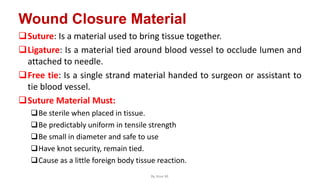
Wound Closure Material
Suture: Is a material used to bring tissue together.
Ligature: Is a material tied around blood vessel to occlude lumen and
attached to needle.
Free tie: Is a single strand material handed to surgeon or assistant to
tie blood vessel.
Suture Material Must:
Be sterile when placed in tissue.
Be predictably uniform in tensile strength
Be small in diameter and safe to use
Have knot security, remain tied.
Cause as a little foreign body tissue reaction.
By Ame M.
Wound Closure Materials
Are used to approximate the edge of incision (=tissue apposition)
Facilitates wound healing.
Minimizes the size of scar.
Firmly holds the organs in position.
Classifications
A suture – a stitch used in surgery to approximate living tissues or
structures until the normal process of healing are completed.
A ligature – is a suture used to encircle blood vessels to arrest or
control bleeding.
3
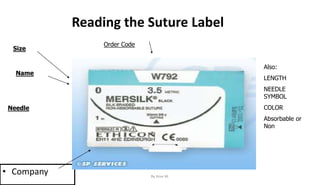
Reading the Suture Label
• Company
Needle
Size
Order Code
Name
Also:
LENGTH
NEEDLE
SYMBOL
COLOR
Absorbable or
Non
By Ame M.
SUTURE MATERIALS
Sutures are made of variety of materials with variety of properties.
Non-absorbable
Use when possible
Braided suture not ideal for contaminated wounds
May sterilize polyester thread or nylon line when commercial suture
unavailable.
Absorbable
Degrades, loses tensile strength within 60 days.
Option when not possible for patient to return or for children for whom
suture removal may be difficult.
By Ame M.
Classification of suture material
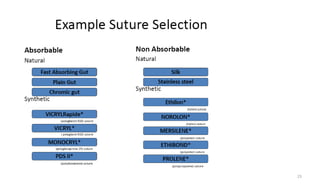
Absorbable suture:
 Prepared form collagen or synthetic polymer they are absorbed or
digested by the body cells and tissue fluids.
Non absorbable suture:
 Effectively resist enzymatic digestion or absorption in living tissue.
 Subdivision of suture material:
 Monofilament suture:
 Consisting of single thread that is non-capillary.
 Multifilament suture:
 Made of more than one thread held together, it is considered capillary
By Ame M.
Characteristics of Suture Material
Absorbable Vs. Non-absorbable
Monofilament Vs. Multifilament
Natural Vs. Synthetic
7
Absorbable – Sutures/Ligatures
Two types: Natural Vs. Synthetic
Absorbable natural
Catgut
Collagen
 Living tissue
Absorbable synthetic:-
Polyglycolic acid
PDS/Polydioxinon suture
Vicryl
Dexon
8
I. The absorbable – Natural sutures
digested and absorbed during process of healing
1) Surgical Gut
the most commonly used this group.
made from sub mucosal layer of 1st, 3rd layer of the intestine of the
sheep.
It has two parts (plain and chromic catgut)
Collagen derived from the sub mucosa or serosa of beef intestine
Ranging from the heaviest size 3/0 to finest size 7/0
Digested by body enzymes and absorbed by tissue.
Types of Surgical Gut:
a) Plain Surgical Gut
b) Chromic Surgical Gut
9
I. Absorbable suture………
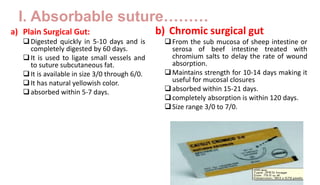
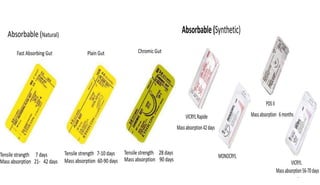
a) Plain Surgical Gut:
Digested quickly in 5-10 days and is
completely digested by 60 days.
It is used to ligate small vessels and
to suture subcutaneous fat.
It is available in size 3/0 through 6/0.
It has natural yellowish color.
absorbed within 5-7 days.
b) Chromic surgical gut
From the sub mucosa of sheep intestine or
serosa of beef intestine treated with
chromium salts to delay the rate of wound
absorption.
Maintains strength for 10-14 days making it
useful for mucosal closures
absorbed within 15-21 days.
completely absorption is within 120 days.
Size range 3/0 to 7/0.
The rate of absorption is influenced by:
Type of tissue:
The surgical gut absorbed much more rapidly in mucous membrane, and
absorbed slowly in subcutaneous fat.
Condition of tissue:
Absorption takes place more rapidly in absence of infection.
General health status of patient:
Surgical gut may be absorbed more rapidly in well nourished tissue or healthy
tissue, but in old pt it may remain for long time.
Type of surgical gut:
Plain gut is untreated but chromic gut is treated to provide greater resistance
to absorption.
By Ame M.
Handling characteristic of surgical gut and
collagen suture:
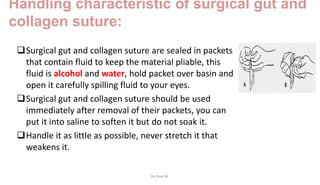
Surgical gut and collagen suture are sealed in packets
that contain fluid to keep the material pliable, this
fluid is alcohol and water, hold packet over basin and
open it carefully spilling fluid to your eyes.
Surgical gut and collagen suture should be used
immediately after removal of their packets, you can
put it into saline to soften it but do not soak it.
Handle it as little as possible, never stretch it that
weakens it.
By Ame M.
Sutures………
Sterilization of surgical catgut effected by Gamma- radiation, before it
has been packed and sealed.
The choice of the surgical catgut:
for ligature of small blood vessels are:
2/0, 3/0 plain cat gut is sufficient.
For ligation of large blood vessels 2/0, 3/0 and
pedicles in gynecological requires chromic catgut 3 or 2.
The size of the catgut depends on the requirements of particular
surgeon.
The suturing of stomach and bowels in adult are 2/0, 3/0 but in children
3/0 chromic catgut is sufficient.
13
Natural sutures.........
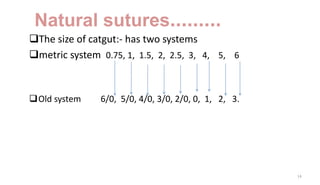
The size of catgut:- has two systems
metric system 0.75, 1, 1.5, 2, 2.5, 3, 4, 5, 6
Old system 6/0, 5/0, 4/0, 3/0, 2/0, 0, 1, 2, 3.
14
2. Synthetic Absorbable– Polymers
Dyed or un dyed,
intruded and braided,
multifilament
absorbed by slow hydrolysis process in the presence of tissue
fluid.
non-antigenic, no pyrogenic and produce only mild tissue reaction
during absorption.
Are very tensile strength longer than catgut
e.g. PDS- 60-90 day’s duration for absorption.
Example
a)VICRYLE
b)Monocryl
15
Sutures………
• Adult peritoneum and muscle are sutured with the size of 2/0 or 0 chromic catgut.
• Fascia can be sutured with the size of 1 and 2 chromic catgut but, in children 2/0,
3/0 is sufficient.
• Subcutaneous tissue can be sutured with plain catgut 2/0, 3/0 are preferable.
• Some surgeons use chromic catgut through out the operation.
• Plain catgut is not used in peritoneum or fascia suturing due to its rapid absorption.
• It is widely used in urinary tract operation to prevent formation of renal calculi.
16
2. Synthetic Absorbable– Polymers……
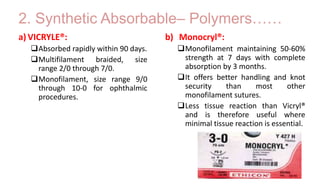
a) VICRYLE®:
Absorbed rapidly within 90 days.
Multifilament braided, size
range 2/0 through 7/0.
Monofilament, size range 9/0
through 10-0 for ophthalmic
procedures.
b) Monocryl®:
Monofilament maintaining 50-60%
strength at 7 days with complete
absorption by 3 months.
It offers better handling and knot
security than most other
monofilament sutures.
Less tissue reaction than Vicryl®
and is therefore useful where
minimal tissue reaction is essential.
II. Non-Absorbable Ligature/Suture
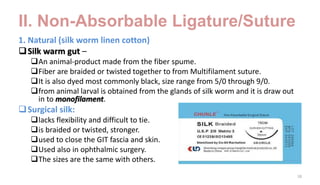
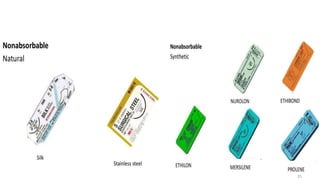
1. Natural (silk worm linen cotton)
Silk warm gut –
An animal-product made from the fiber spume.
Fiber are braided or twisted together to from Multifilament suture.
It is also dyed most commonly black, size range from 5/0 through 9/0.
from animal larval is obtained from the glands of silk worm and it is draw out
in to monofilament.
Surgical silk:
lacks flexibility and difficult to tie.
is braided or twisted, stronger.
used to close the GIT fascia and skin.
Used also in ophthalmic surgery.
The sizes are the same with others.
18
II. Non absorbable suture…………
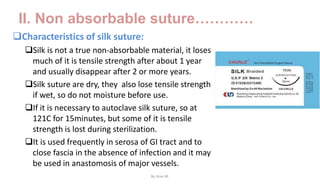
Characteristics of silk suture:
Silk is not a true non-absorbable material, it loses
much of it is tensile strength after about 1 year
and usually disappear after 2 or more years.
Silk suture are dry, they also lose tensile strength
if wet, so do not moisture before use.
If it is necessary to autoclave silk suture, so at
121C for 15minutes, but some of it is tensile
strength is lost during sterilization.
It is used frequently in serosa of GI tract and to
close fascia in the absence of infection and it may
be used in anastomosis of major vessels.
By Ame M.
Synthetic Non-absorbable Sutures
Polyamides
monofilament – single nylon
Multi filament
Polyesters ------Polyethylene
20
Synthetic non-absorbable polymers
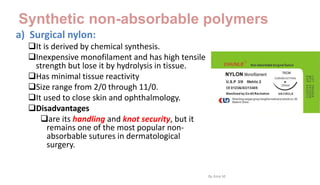
a) Surgical nylon:
It is derived by chemical synthesis.
Inexpensive monofilament and has high tensile
strength but lose it by hydrolysis in tissue.
Has minimal tissue reactivity
Size range from 2/0 through 11/0.
It used to close skin and ophthalmology.
Disadvantages
are its handling and knot security, but it
remains one of the most popular non-
absorbable sutures in dermatological
surgery.
By Ame M.
Synthetic non-absorbable polymers………
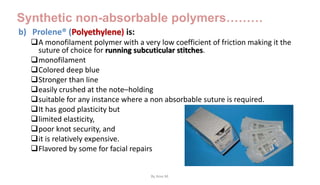
b) Prolene® (Polyethylene) is:
A monofilament polymer with a very low coefficient of friction making it the
suture of choice for running subcuticular stitches.
monofilament
Colored deep blue
Stronger than line
easily crushed at the note–holding
suitable for any instance where a non absorbable suture is required.
It has good plasticity but
limited elasticity,
poor knot security, and
it is relatively expensive.
Flavored by some for facial repairs
By Ame M.
23
24
25
Factors that influence the choice of
suture materials
Biologic characteristics of the suture material
Healing characteristics of the tissue
Location and length of the incision
Presence or absence of contamination and/or infection
Patient problems such as obesity, debility, advanced age and diseases
Physical characteristics of the material such as ease of passing through
tissue, knot tying and other
personal preference of the surgeon.
By Ame M.
The Metallic Wires
Prepared from:-
Stainless steel used for orthopedic & thoracic surgery.
Alloys of tantalum
Silver obtained as a single strained suture &/or twisted/braided.
used in closing abdominal incisions in obese or (Ca) patients.
For esophageal anastomosis
for closure of chest incision or
as mesh in the repair of hernial defect.
27
Metal Clips (Sutures)
Applied with special instrument:-
The insertion forceps known as:
Michel-----applier
Kifa------ Removal
Adhesive skin closure.
28
Surgical Needles
 Are needed to safely carrying the suture material via tissue with the least
amount of trauma.
 Are strong enough, doesn’t break easily.
 Are rigid enough to prevent excess bending.
 Sharp enough to penetrate tissue with minimal resistance.
 Approximately the size with suture.
 Free of corrosion to prevent infection and trauma.
 All surgical needles have 3 basic components:-
The point the body/shaft of the eyes.
The point of needles mostly used for cutting tapered or blunt.
Body of needle-nares in wire length shape and finish (depend on nature and location
of tissue)
French eye needle (spring eye/spring eye)
Eyeless needle-continuous suture.
29
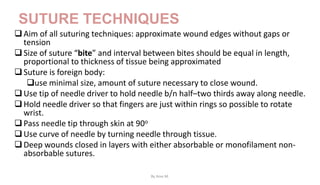
SUTURE TECHNIQUES
Aim of all suturing techniques: approximate wound edges without gaps or
tension
Size of suture “bite” and interval between bites should be equal in length,
proportional to thickness of tissue being approximated
Suture is foreign body:
use minimal size, amount of suture necessary to close wound.
Use tip of needle driver to hold needle b/n half–two thirds away along needle.
Hold needle driver so that fingers are just within rings so possible to rotate
wrist.
Pass needle tip through skin at 90o
Use curve of needle by turning needle through tissue.
Deep wounds closed in layers with either absorbable or monofilament non-
absorbable sutures.
By Ame M.
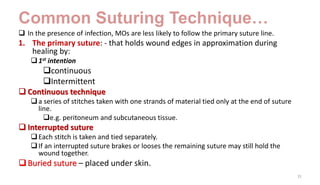
Common Suturing Technique…
 In the presence of infection, MOs are less likely to follow the primary suture line.
1. The primary suture: - that holds wound edges in approximation during
healing by:
1st intention
continuous
Intermittent
 Continuous technique
a series of stitches taken with one strands of material tied only at the end of suture
line.
e.g. peritoneum and subcutaneous tissue.
 Interrupted suture
Each stitch is taken and tied separately.
If an interrupted suture brakes or looses the remaining suture may still hold the
wound together.
Buried suture – placed under skin.
31
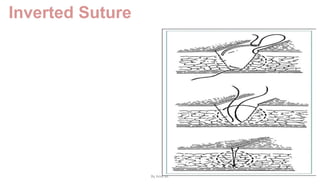
Inverted Suture
By Ame M.
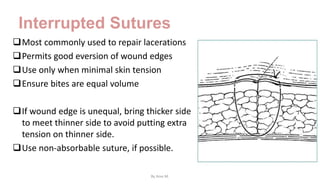
Interrupted Sutures
Most commonly used to repair lacerations
Permits good eversion of wound edges
Use only when minimal skin tension
Ensure bites are equal volume
If wound edge is unequal, bring thicker side
to meet thinner side to avoid putting extra
tension on thinner side.
Use non-absorbable suture, if possible.
By Ame M.
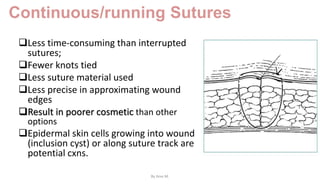
Continuous/running Sutures
Less time-consuming than interrupted
sutures;
Fewer knots tied
Less suture material used
Less precise in approximating wound
edges
Result in poorer cosmetic than other
options
Epidermal skin cells growing into wound
(inclusion cyst) or along suture track are
potential cxns.
By Ame M.
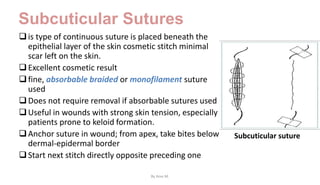
Subcuticular Sutures
is type of continuous suture is placed beneath the
epithelial layer of the skin cosmetic stitch minimal
scar left on the skin.
Excellent cosmetic result
fine, absorbable braided or monofilament suture
used
Does not require removal if absorbable sutures used
Useful in wounds with strong skin tension, especially
patients prone to keloid formation.
Anchor suture in wound; from apex, take bites below
dermal-epidermal border
Start next stitch directly opposite preceding one
Subcuticular suture
By Ame M.
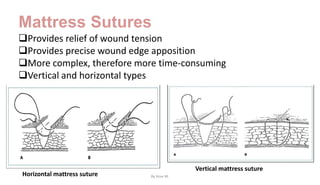
Mattress Sutures
Provides relief of wound tension
Provides precise wound edge apposition
More complex, therefore more time-consuming
Vertical and horizontal types
Vertical mattress suture
Horizontal mattress suture By Ame M.
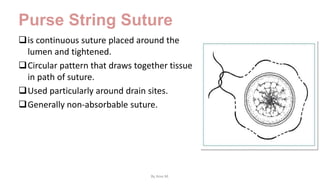
Purse String Suture
is continuous suture placed around the
lumen and tightened.
Circular pattern that draws together tissue
in path of suture.
Used particularly around drain sites.
Generally non-absorbable suture.
By Ame M.
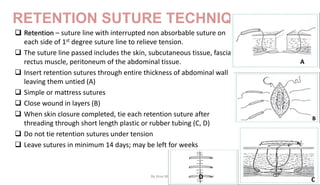
RETENTION SUTURE TECHNIQUES
 Retention – suture line with interrupted non absorbable suture on
each side of 1st degree suture line to relieve tension.
 The suture line passed includes the skin, subcutaneous tissue, fascia
rectus muscle, peritoneum of the abdominal tissue.
 Insert retention sutures through entire thickness of abdominal wall
leaving them untied (A)
 Simple or mattress sutures
 Close wound in layers (B)
 When skin closure completed, tie each retention suture after
threading through short length plastic or rubber tubing (C, D)
 Do not tie retention sutures under tension
 Leave sutures in minimum 14 days; may be left for weeks
A
B
By Ame M.
C
D

Suturing

  • 1.
    Suturing (2 hrs) ByAme Mehadi(BSc, MSc in EMCCN) Lecturer Trainer of Basic Emergency Care & Perioperative Nursing Training School of Nursing & Midwifery College of Health & Medical Sciences Haramaya University
  • 2.
    Wound Closure Material Suture:Is a material used to bring tissue together. Ligature: Is a material tied around blood vessel to occlude lumen and attached to needle. Free tie: Is a single strand material handed to surgeon or assistant to tie blood vessel. Suture Material Must: Be sterile when placed in tissue. Be predictably uniform in tensile strength Be small in diameter and safe to use Have knot security, remain tied. Cause as a little foreign body tissue reaction. By Ame M.
  • 3.
    Wound Closure Materials Areused to approximate the edge of incision (=tissue apposition) Facilitates wound healing. Minimizes the size of scar. Firmly holds the organs in position. Classifications A suture – a stitch used in surgery to approximate living tissues or structures until the normal process of healing are completed. A ligature – is a suture used to encircle blood vessels to arrest or control bleeding. 3
  • 4.
    Reading the SutureLabel • Company Needle Size Order Code Name Also: LENGTH NEEDLE SYMBOL COLOR Absorbable or Non By Ame M.
  • 5.
    SUTURE MATERIALS Sutures aremade of variety of materials with variety of properties. Non-absorbable Use when possible Braided suture not ideal for contaminated wounds May sterilize polyester thread or nylon line when commercial suture unavailable. Absorbable Degrades, loses tensile strength within 60 days. Option when not possible for patient to return or for children for whom suture removal may be difficult. By Ame M.
  • 6.
    Classification of suturematerial Absorbable suture:  Prepared form collagen or synthetic polymer they are absorbed or digested by the body cells and tissue fluids. Non absorbable suture:  Effectively resist enzymatic digestion or absorption in living tissue.  Subdivision of suture material:  Monofilament suture:  Consisting of single thread that is non-capillary.  Multifilament suture:  Made of more than one thread held together, it is considered capillary By Ame M.
  • 7.
    Characteristics of SutureMaterial Absorbable Vs. Non-absorbable Monofilament Vs. Multifilament Natural Vs. Synthetic 7
  • 8.
    Absorbable – Sutures/Ligatures Twotypes: Natural Vs. Synthetic Absorbable natural Catgut Collagen  Living tissue Absorbable synthetic:- Polyglycolic acid PDS/Polydioxinon suture Vicryl Dexon 8
  • 9.
    I. The absorbable– Natural sutures digested and absorbed during process of healing 1) Surgical Gut the most commonly used this group. made from sub mucosal layer of 1st, 3rd layer of the intestine of the sheep. It has two parts (plain and chromic catgut) Collagen derived from the sub mucosa or serosa of beef intestine Ranging from the heaviest size 3/0 to finest size 7/0 Digested by body enzymes and absorbed by tissue. Types of Surgical Gut: a) Plain Surgical Gut b) Chromic Surgical Gut 9
  • 10.
    I. Absorbable suture……… a)Plain Surgical Gut: Digested quickly in 5-10 days and is completely digested by 60 days. It is used to ligate small vessels and to suture subcutaneous fat. It is available in size 3/0 through 6/0. It has natural yellowish color. absorbed within 5-7 days. b) Chromic surgical gut From the sub mucosa of sheep intestine or serosa of beef intestine treated with chromium salts to delay the rate of wound absorption. Maintains strength for 10-14 days making it useful for mucosal closures absorbed within 15-21 days. completely absorption is within 120 days. Size range 3/0 to 7/0.
  • 11.
    The rate ofabsorption is influenced by: Type of tissue: The surgical gut absorbed much more rapidly in mucous membrane, and absorbed slowly in subcutaneous fat. Condition of tissue: Absorption takes place more rapidly in absence of infection. General health status of patient: Surgical gut may be absorbed more rapidly in well nourished tissue or healthy tissue, but in old pt it may remain for long time. Type of surgical gut: Plain gut is untreated but chromic gut is treated to provide greater resistance to absorption. By Ame M.
  • 12.
    Handling characteristic ofsurgical gut and collagen suture: Surgical gut and collagen suture are sealed in packets that contain fluid to keep the material pliable, this fluid is alcohol and water, hold packet over basin and open it carefully spilling fluid to your eyes. Surgical gut and collagen suture should be used immediately after removal of their packets, you can put it into saline to soften it but do not soak it. Handle it as little as possible, never stretch it that weakens it. By Ame M.
  • 13.
    Sutures……… Sterilization of surgicalcatgut effected by Gamma- radiation, before it has been packed and sealed. The choice of the surgical catgut: for ligature of small blood vessels are: 2/0, 3/0 plain cat gut is sufficient. For ligation of large blood vessels 2/0, 3/0 and pedicles in gynecological requires chromic catgut 3 or 2. The size of the catgut depends on the requirements of particular surgeon. The suturing of stomach and bowels in adult are 2/0, 3/0 but in children 3/0 chromic catgut is sufficient. 13
  • 14.
    Natural sutures......... The sizeof catgut:- has two systems metric system 0.75, 1, 1.5, 2, 2.5, 3, 4, 5, 6 Old system 6/0, 5/0, 4/0, 3/0, 2/0, 0, 1, 2, 3. 14
  • 15.
    2. Synthetic Absorbable–Polymers Dyed or un dyed, intruded and braided, multifilament absorbed by slow hydrolysis process in the presence of tissue fluid. non-antigenic, no pyrogenic and produce only mild tissue reaction during absorption. Are very tensile strength longer than catgut e.g. PDS- 60-90 day’s duration for absorption. Example a)VICRYLE b)Monocryl 15
  • 16.
    Sutures……… • Adult peritoneumand muscle are sutured with the size of 2/0 or 0 chromic catgut. • Fascia can be sutured with the size of 1 and 2 chromic catgut but, in children 2/0, 3/0 is sufficient. • Subcutaneous tissue can be sutured with plain catgut 2/0, 3/0 are preferable. • Some surgeons use chromic catgut through out the operation. • Plain catgut is not used in peritoneum or fascia suturing due to its rapid absorption. • It is widely used in urinary tract operation to prevent formation of renal calculi. 16
  • 17.
    2. Synthetic Absorbable–Polymers…… a) VICRYLE®: Absorbed rapidly within 90 days. Multifilament braided, size range 2/0 through 7/0. Monofilament, size range 9/0 through 10-0 for ophthalmic procedures. b) Monocryl®: Monofilament maintaining 50-60% strength at 7 days with complete absorption by 3 months. It offers better handling and knot security than most other monofilament sutures. Less tissue reaction than Vicryl® and is therefore useful where minimal tissue reaction is essential.
  • 18.
    II. Non-Absorbable Ligature/Suture 1.Natural (silk worm linen cotton) Silk warm gut – An animal-product made from the fiber spume. Fiber are braided or twisted together to from Multifilament suture. It is also dyed most commonly black, size range from 5/0 through 9/0. from animal larval is obtained from the glands of silk worm and it is draw out in to monofilament. Surgical silk: lacks flexibility and difficult to tie. is braided or twisted, stronger. used to close the GIT fascia and skin. Used also in ophthalmic surgery. The sizes are the same with others. 18
  • 19.
    II. Non absorbablesuture………… Characteristics of silk suture: Silk is not a true non-absorbable material, it loses much of it is tensile strength after about 1 year and usually disappear after 2 or more years. Silk suture are dry, they also lose tensile strength if wet, so do not moisture before use. If it is necessary to autoclave silk suture, so at 121C for 15minutes, but some of it is tensile strength is lost during sterilization. It is used frequently in serosa of GI tract and to close fascia in the absence of infection and it may be used in anastomosis of major vessels. By Ame M.
  • 20.
    Synthetic Non-absorbable Sutures Polyamides monofilament– single nylon Multi filament Polyesters ------Polyethylene 20
  • 21.
    Synthetic non-absorbable polymers a)Surgical nylon: It is derived by chemical synthesis. Inexpensive monofilament and has high tensile strength but lose it by hydrolysis in tissue. Has minimal tissue reactivity Size range from 2/0 through 11/0. It used to close skin and ophthalmology. Disadvantages are its handling and knot security, but it remains one of the most popular non- absorbable sutures in dermatological surgery. By Ame M.
  • 22.
    Synthetic non-absorbable polymers……… b)Prolene® (Polyethylene) is: A monofilament polymer with a very low coefficient of friction making it the suture of choice for running subcuticular stitches. monofilament Colored deep blue Stronger than line easily crushed at the note–holding suitable for any instance where a non absorbable suture is required. It has good plasticity but limited elasticity, poor knot security, and it is relatively expensive. Flavored by some for facial repairs By Ame M.
  • 23.
  • 24.
  • 25.
  • 26.
    Factors that influencethe choice of suture materials Biologic characteristics of the suture material Healing characteristics of the tissue Location and length of the incision Presence or absence of contamination and/or infection Patient problems such as obesity, debility, advanced age and diseases Physical characteristics of the material such as ease of passing through tissue, knot tying and other personal preference of the surgeon. By Ame M.
  • 27.
    The Metallic Wires Preparedfrom:- Stainless steel used for orthopedic & thoracic surgery. Alloys of tantalum Silver obtained as a single strained suture &/or twisted/braided. used in closing abdominal incisions in obese or (Ca) patients. For esophageal anastomosis for closure of chest incision or as mesh in the repair of hernial defect. 27
  • 28.
    Metal Clips (Sutures) Appliedwith special instrument:- The insertion forceps known as: Michel-----applier Kifa------ Removal Adhesive skin closure. 28
  • 29.
    Surgical Needles  Areneeded to safely carrying the suture material via tissue with the least amount of trauma.  Are strong enough, doesn’t break easily.  Are rigid enough to prevent excess bending.  Sharp enough to penetrate tissue with minimal resistance.  Approximately the size with suture.  Free of corrosion to prevent infection and trauma.  All surgical needles have 3 basic components:- The point the body/shaft of the eyes. The point of needles mostly used for cutting tapered or blunt. Body of needle-nares in wire length shape and finish (depend on nature and location of tissue) French eye needle (spring eye/spring eye) Eyeless needle-continuous suture. 29
  • 30.
    SUTURE TECHNIQUES Aim ofall suturing techniques: approximate wound edges without gaps or tension Size of suture “bite” and interval between bites should be equal in length, proportional to thickness of tissue being approximated Suture is foreign body: use minimal size, amount of suture necessary to close wound. Use tip of needle driver to hold needle b/n half–two thirds away along needle. Hold needle driver so that fingers are just within rings so possible to rotate wrist. Pass needle tip through skin at 90o Use curve of needle by turning needle through tissue. Deep wounds closed in layers with either absorbable or monofilament non- absorbable sutures. By Ame M.
  • 31.
    Common Suturing Technique… In the presence of infection, MOs are less likely to follow the primary suture line. 1. The primary suture: - that holds wound edges in approximation during healing by: 1st intention continuous Intermittent  Continuous technique a series of stitches taken with one strands of material tied only at the end of suture line. e.g. peritoneum and subcutaneous tissue.  Interrupted suture Each stitch is taken and tied separately. If an interrupted suture brakes or looses the remaining suture may still hold the wound together. Buried suture – placed under skin. 31
  • 32.
  • 33.
    Interrupted Sutures Most commonlyused to repair lacerations Permits good eversion of wound edges Use only when minimal skin tension Ensure bites are equal volume If wound edge is unequal, bring thicker side to meet thinner side to avoid putting extra tension on thinner side. Use non-absorbable suture, if possible. By Ame M.
  • 34.
    Continuous/running Sutures Less time-consumingthan interrupted sutures; Fewer knots tied Less suture material used Less precise in approximating wound edges Result in poorer cosmetic than other options Epidermal skin cells growing into wound (inclusion cyst) or along suture track are potential cxns. By Ame M.
  • 35.
    Subcuticular Sutures is typeof continuous suture is placed beneath the epithelial layer of the skin cosmetic stitch minimal scar left on the skin. Excellent cosmetic result fine, absorbable braided or monofilament suture used Does not require removal if absorbable sutures used Useful in wounds with strong skin tension, especially patients prone to keloid formation. Anchor suture in wound; from apex, take bites below dermal-epidermal border Start next stitch directly opposite preceding one Subcuticular suture By Ame M.
  • 36.
    Mattress Sutures Provides reliefof wound tension Provides precise wound edge apposition More complex, therefore more time-consuming Vertical and horizontal types Vertical mattress suture Horizontal mattress suture By Ame M.
  • 37.
    Purse String Suture iscontinuous suture placed around the lumen and tightened. Circular pattern that draws together tissue in path of suture. Used particularly around drain sites. Generally non-absorbable suture. By Ame M.
  • 38.
    RETENTION SUTURE TECHNIQUES Retention – suture line with interrupted non absorbable suture on each side of 1st degree suture line to relieve tension.  The suture line passed includes the skin, subcutaneous tissue, fascia rectus muscle, peritoneum of the abdominal tissue.  Insert retention sutures through entire thickness of abdominal wall leaving them untied (A)  Simple or mattress sutures  Close wound in layers (B)  When skin closure completed, tie each retention suture after threading through short length plastic or rubber tubing (C, D)  Do not tie retention sutures under tension  Leave sutures in minimum 14 days; may be left for weeks A B By Ame M. C D

Editor's Notes

  • #10 the row, catgut can be hardened or chromicised by immersing strands in chromic salt solution: to prolong the time of absorption to reduce irritation, The degree of hardness depends up on how long the cat gut is immersed in chromic salt solution. e.g.- in peritoneum and serous membrane less day(2-3) day’s immersion.