SUTURE MATERIAL
Dr. HIREN PATOLIYA
Seth Nandlal Dhoot Hospital
Aurangabad
CONTENTS
• INTRODUCTION
• REQUISITES OF IDEAL SUTURE
• CLASSIFICATION
• SELECTION OF SUTURE MATERIAL
• ABSORPTION OF SUTURE MATERIAL
• BIOLOGICAL RESPONSE OF BODY TO SUTURE
INTRODUCTION
• SUTURE MEANS TO “SEW” OR “SEAM”. IN
SURGERY SUTURE IS THE ACT OF SEWING OR
BRINGING TISSUE TOGETHER AND HOLDING
THEM IN APPOSITION UNTIL HEALING HAS
TAKEN PLACE.
• SUTURE IS A STRAND OF MATERIAL USED TO
LIGATE BLOOD VESSLES AND TYO
APPROXIMNATE TISSUE TOGETHER.
GOALS OF SUTURING
SUTURING IS PERFORMED TO
• PROVIDE ADEQUATE TENSION
• MAINTAIN HEMOSTASIS
• PROVIDE SUPPORT FOR TISSUE MARGINS
• REDUCE POST OP PAIN
• PREVENT BONE EXPOSURE
• PERMIT PROPER FLAP POSITION.
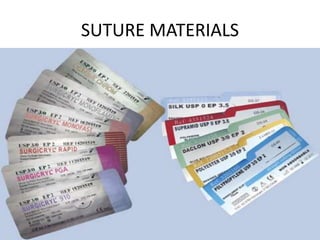
SUTURE MATERIALS
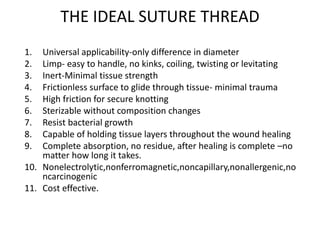
THE IDEAL SUTURE THREAD
1. Universal applicability-only difference in diameter
2. Limp- easy to handle, no kinks, coiling, twisting or levitating
3. Inert-Minimal tissue strength
4. Frictionless surface to glide through tissue- minimal trauma
5. High friction for secure knotting
6. Sterizable without composition changes
7. Resist bacterial growth
8. Capable of holding tissue layers throughout the wound healing
9. Complete absorption, no residue, after healing is complete –no
matter how long it takes.
10. Nonelectrolytic,nonferromagnetic,noncapillary,nonallergenic,no
ncarcinogenic
11. Cost effective.
CLASSIFICATION OF SUTURE
MATERIALS
• ACCORDING TO SOURCE:-
• NATURAL
• SYNTHETIC
• METALLIC
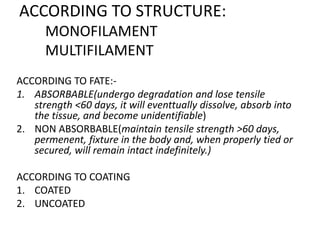
ACCORDING TO STRUCTURE:
MONOFILAMENT
MULTIFILAMENT
ACCORDING TO FATE:-
1. ABSORBABLE(undergo degradation and lose tensile
strength <60 days, it will eventtually dissolve, absorb into
the tissue, and become unidentifiable)
2. NON ABSORBABLE(maintain tensile strength >60 days,
permenent, fixture in the body and, when properly tied or
secured, will remain intact indefinitely.)
ACCORDING TO COATING
1. COATED
2. UNCOATED
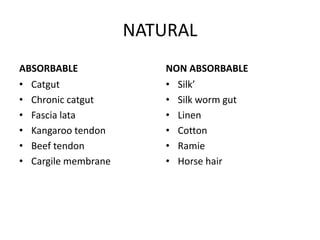
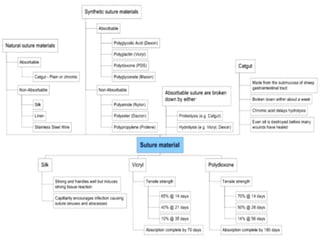
NATURAL
ABSORBABLE
• Catgut
• Chronic catgut
• Fascia lata
• Kangaroo tendon
• Beef tendon
• Cargile membrane
NON ABSORBABLE
• Silk’
• Silk worm gut
• Linen
• Cotton
• Ramie
• Horse hair
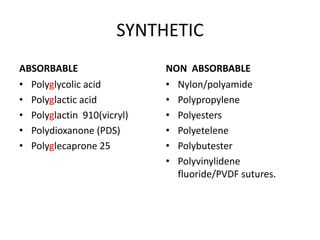
SYNTHETIC
ABSORBABLE
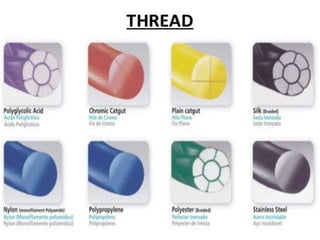
• Polyglycolic acid
• Polyglactic acid
• Polyglactin 910(vicryl)
• Polydioxanone (PDS)
• Polyglecaprone 25
NON ABSORBABLE
• Nylon/polyamide
• Polypropylene
• Polyesters
• Polyetelene
• Polybutester
• Polyvinylidene
fluoride/PVDF sutures.
According to structure
• Monofilament • Polyfilament
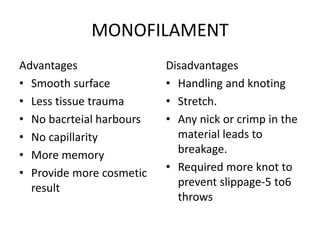
MONOFILAMENT
Advantages
• Smooth surface
• Less tissue trauma
• No bacrteial harbours
• No capillarity
• More memory
• Provide more cosmetic
result
Disadvantages
• Handling and knoting
• Stretch.
• Any nick or crimp in the
material leads to
breakage.
• Required more knot to
prevent slippage-5 to6
throws
MONOFILAMENT
ABSORBABLE
• Surgical gut-plain/chromic
• Polydiaxanone
• polyglactin910
NON ABSORBABLE
• Polypropylene
• Polyester
• Nylon/polyamide
• Polyvinylidene
fluoride/PVDF sutures
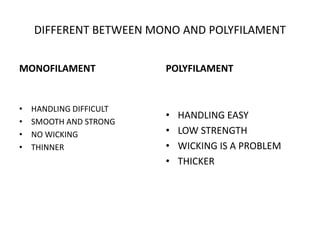
DIFFERENT BETWEEN MONO AND POLYFILAMENT
MONOFILAMENT
• HANDLING DIFFICULT
• SMOOTH AND STRONG
• NO WICKING
• THINNER
POLYFILAMENT
• HANDLING EASY
• LOW STRENGTH
• WICKING IS A PROBLEM
• THICKER
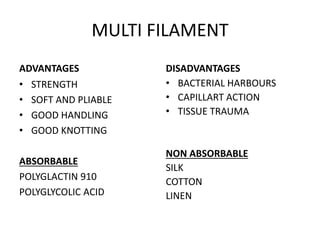
MULTI FILAMENT
ADVANTAGES
• STRENGTH
• SOFT AND PLIABLE
• GOOD HANDLING
• GOOD KNOTTING
ABSORBABLE
POLYGLACTIN 910
POLYGLYCOLIC ACID
DISADVANTAGES
• BACTERIAL HARBOURS
• CAPILLART ACTION
• TISSUE TRAUMA
NON ABSORBABLE
SILK
COTTON
LINEN
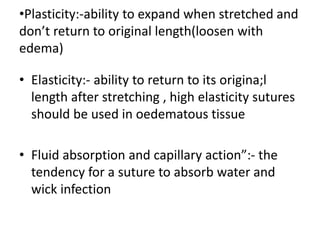
•Plasticity:-ability to expand when stretched and
don’t return to original length(loosen with
edema)
• Elasticity:- ability to return to its origina;l
length after stretching , high elasticity sutures
should be used in oedematous tissue
• Fluid absorption and capillary action”:- the
tendency for a suture to absorb water and
wick infection
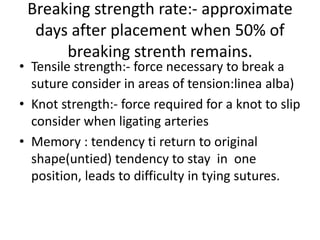
Breaking strength rate:- approximate
days after placement when 50% of
breaking strenth remains.
• Tensile strength:- force necessary to break a
suture consider in areas of tension:linea alba)
• Knot strength:- force required for a knot to slip
consider when ligating arteries
• Memory : tendency ti return to original
shape(untied) tendency to stay in one
position, leads to difficulty in tying sutures.
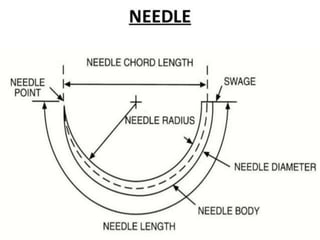
Shape of niddle
• Curved:- designed to be held with a needle
holder used for most suturing
• Straight:- oftern hand held, used to secure
percutaneously placed devices( central and
arterial lines)
Types of  Suture material

Types of Suture material

  • 1.
    SUTURE MATERIAL Dr. HIRENPATOLIYA Seth Nandlal Dhoot Hospital Aurangabad
  • 2.
    CONTENTS • INTRODUCTION • REQUISITESOF IDEAL SUTURE • CLASSIFICATION • SELECTION OF SUTURE MATERIAL • ABSORPTION OF SUTURE MATERIAL • BIOLOGICAL RESPONSE OF BODY TO SUTURE
  • 3.
    INTRODUCTION • SUTURE MEANSTO “SEW” OR “SEAM”. IN SURGERY SUTURE IS THE ACT OF SEWING OR BRINGING TISSUE TOGETHER AND HOLDING THEM IN APPOSITION UNTIL HEALING HAS TAKEN PLACE. • SUTURE IS A STRAND OF MATERIAL USED TO LIGATE BLOOD VESSLES AND TYO APPROXIMNATE TISSUE TOGETHER.
  • 4.
    GOALS OF SUTURING SUTURINGIS PERFORMED TO • PROVIDE ADEQUATE TENSION • MAINTAIN HEMOSTASIS • PROVIDE SUPPORT FOR TISSUE MARGINS • REDUCE POST OP PAIN • PREVENT BONE EXPOSURE • PERMIT PROPER FLAP POSITION.
  • 5.
  • 7.
    THE IDEAL SUTURETHREAD 1. Universal applicability-only difference in diameter 2. Limp- easy to handle, no kinks, coiling, twisting or levitating 3. Inert-Minimal tissue strength 4. Frictionless surface to glide through tissue- minimal trauma 5. High friction for secure knotting 6. Sterizable without composition changes 7. Resist bacterial growth 8. Capable of holding tissue layers throughout the wound healing 9. Complete absorption, no residue, after healing is complete –no matter how long it takes. 10. Nonelectrolytic,nonferromagnetic,noncapillary,nonallergenic,no ncarcinogenic 11. Cost effective.
  • 8.
    CLASSIFICATION OF SUTURE MATERIALS •ACCORDING TO SOURCE:- • NATURAL • SYNTHETIC • METALLIC
  • 9.
    ACCORDING TO STRUCTURE: MONOFILAMENT MULTIFILAMENT ACCORDINGTO FATE:- 1. ABSORBABLE(undergo degradation and lose tensile strength <60 days, it will eventtually dissolve, absorb into the tissue, and become unidentifiable) 2. NON ABSORBABLE(maintain tensile strength >60 days, permenent, fixture in the body and, when properly tied or secured, will remain intact indefinitely.) ACCORDING TO COATING 1. COATED 2. UNCOATED
  • 10.
    NATURAL ABSORBABLE • Catgut • Chroniccatgut • Fascia lata • Kangaroo tendon • Beef tendon • Cargile membrane NON ABSORBABLE • Silk’ • Silk worm gut • Linen • Cotton • Ramie • Horse hair
  • 11.
    SYNTHETIC ABSORBABLE • Polyglycolic acid •Polyglactic acid • Polyglactin 910(vicryl) • Polydioxanone (PDS) • Polyglecaprone 25 NON ABSORBABLE • Nylon/polyamide • Polypropylene • Polyesters • Polyetelene • Polybutester • Polyvinylidene fluoride/PVDF sutures.
  • 12.
    According to structure •Monofilament • Polyfilament
  • 13.
    MONOFILAMENT Advantages • Smooth surface •Less tissue trauma • No bacrteial harbours • No capillarity • More memory • Provide more cosmetic result Disadvantages • Handling and knoting • Stretch. • Any nick or crimp in the material leads to breakage. • Required more knot to prevent slippage-5 to6 throws
  • 14.
    MONOFILAMENT ABSORBABLE • Surgical gut-plain/chromic •Polydiaxanone • polyglactin910 NON ABSORBABLE • Polypropylene • Polyester • Nylon/polyamide • Polyvinylidene fluoride/PVDF sutures
  • 15.
    DIFFERENT BETWEEN MONOAND POLYFILAMENT MONOFILAMENT • HANDLING DIFFICULT • SMOOTH AND STRONG • NO WICKING • THINNER POLYFILAMENT • HANDLING EASY • LOW STRENGTH • WICKING IS A PROBLEM • THICKER
  • 16.
    MULTI FILAMENT ADVANTAGES • STRENGTH •SOFT AND PLIABLE • GOOD HANDLING • GOOD KNOTTING ABSORBABLE POLYGLACTIN 910 POLYGLYCOLIC ACID DISADVANTAGES • BACTERIAL HARBOURS • CAPILLART ACTION • TISSUE TRAUMA NON ABSORBABLE SILK COTTON LINEN
  • 19.
    •Plasticity:-ability to expandwhen stretched and don’t return to original length(loosen with edema) • Elasticity:- ability to return to its origina;l length after stretching , high elasticity sutures should be used in oedematous tissue • Fluid absorption and capillary action”:- the tendency for a suture to absorb water and wick infection
  • 20.
    Breaking strength rate:-approximate days after placement when 50% of breaking strenth remains. • Tensile strength:- force necessary to break a suture consider in areas of tension:linea alba) • Knot strength:- force required for a knot to slip consider when ligating arteries • Memory : tendency ti return to original shape(untied) tendency to stay in one position, leads to difficulty in tying sutures.
  • 23.
    Shape of niddle •Curved:- designed to be held with a needle holder used for most suturing • Straight:- oftern hand held, used to secure percutaneously placed devices( central and arterial lines)