TOURNIQUET
By Dr Atanu Kayal , first year PGT (ORTHOPAEDICS)
DEFINITION
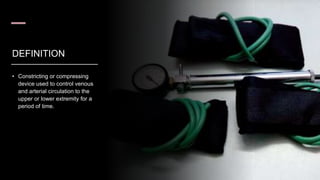
• Constricting or compressing
device used to control venous
and arterial circulation to the
upper or lower extremity for a
period of time.
FUNCTIONS
• Promote optimum surgical conditions(create a blood less
field).
• To control bleeding in life or limb threatening situations.
• To engorge vessels for venipuncture.
TYPES OF TOURNIQUET
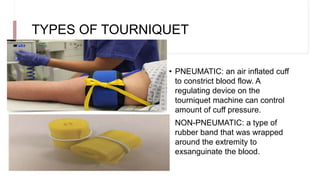
• PNEUMATIC: an air inflated cuff
to constrict blood flow. A
regulating device on the
tourniquet machine can control
amount of cuff pressure.
• NON-PNEUMATIC: a type of
rubber band that was wrapped
around the extremity to
exsanguinate the blood.
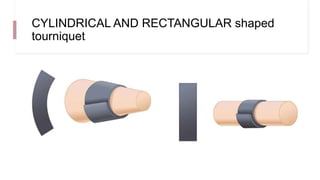
CYLINDRICAL AND RECTANGULAR shaped
tourniquet
TOURNIQUET
CUFF
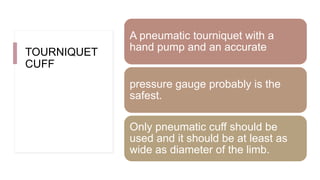
A pneumatic tourniquet with a
hand pump and an accurate
pressure gauge probably is the
safest.
Only pneumatic cuff should be
used and it should be at least as
wide as diameter of the limb.
EXSANGUINATION
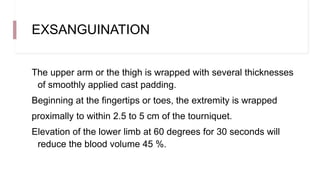
The upper arm or the thigh is wrapped with several thicknesses
of smoothly applied cast padding.
Beginning at the fingertips or toes, the extremity is wrapped
proximally to within 2.5 to 5 cm of the tourniquet.
Elevation of the lower limb at 60 degrees for 30 seconds will
reduce the blood volume 45 %.
TOURNIQUET
PRESSURE
and TIME
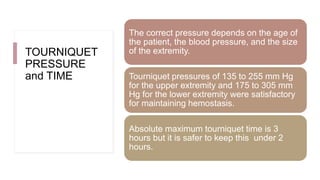
The correct pressure depends on the age of
the patient, the blood pressure, and the size
of the extremity.
Tourniquet pressures of 135 to 255 mm Hg
for the upper extremity and 175 to 305 mm
Hg for the lower extremity were satisfactory
for maintaining hemostasis.
Absolute maximum tourniquet time is 3
hours but it is safer to keep this under 2
hours.
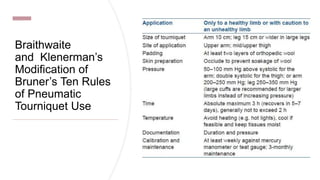
Braithwaite
and Klenerman’s
Modification of
Bruner’s Ten Rules
of Pneumatic
Tourniquet Use
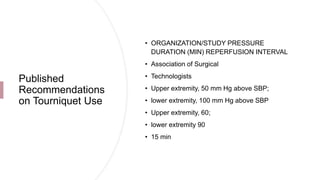
Published
Recommendations
on Tourniquet Use
• ORGANIZATION/STUDY PRESSURE
DURATION (MIN) REPERFUSION INTERVAL
• Association of Surgical
• Technologists
• Upper extremity, 50 mm Hg above SBP;
• lower extremity, 100 mm Hg above SBP
• Upper extremity, 60;
• lower extremity 90
• 15 min
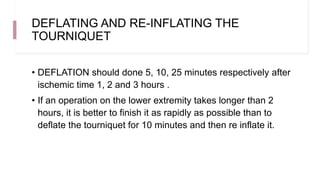
DEFLATING AND RE-INFLATING THE
TOURNIQUET
• DEFLATION should done 5, 10, 25 minutes respectively after
ischemic time 1, 2 and 3 hours .
• If an operation on the lower extremity takes longer than 2
hours, it is better to finish it as rapidly as possible than to
deflate the tourniquet for 10 minutes and then re inflate it.
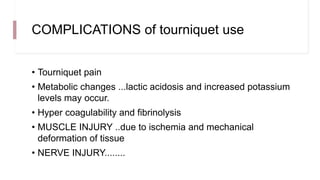
COMPLICATIONS of tourniquet use
• Tourniquet pain
• Metabolic changes ...lactic acidosis and increased potassium
levels may occur.
• Hyper coagulability and fibrinolysis
• MUSCLE INJURY ..due to ischemia and mechanical
deformation of tissue
• NERVE INJURY........
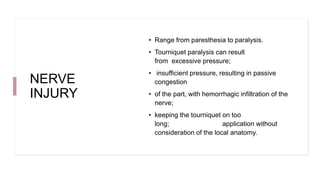
NERVE
INJURY
• Range from paresthesia to paralysis.
• Tourniquet paralysis can result
from excessive pressure;
• insufficient pressure, resulting in passive
congestion
• of the part, with hemorrhagic infiltration of the
nerve;
• keeping the tourniquet on too
long; application without
consideration of the local anatomy.
POST
TOURNIQUET
SYNDROME
• first recognized by Bunnell, is a common
reaction to prolonged ischemia and is
characterized by edema, pallor, joint stiffness,
motor weakness, and subjective numbness.
• Spontaneous resolution usually occurs within
1 week.
• Compartment syndrome, rhabdomyolysis, and
pulmonary
emboli are rare complications of tourniquet use
The use of
preoperative
prophylactic
antibiotics
in operations
• A prospective randomized study found that the
administration of antibiotics 1 minute after
tourniquet inflation resulted in a
significantly lower infection rate than the
administration of antibiotics 5 minutes before
tourniquet inflation.
THANK
YOU...................

Tourniquet

  • 1.
    TOURNIQUET By Dr AtanuKayal , first year PGT (ORTHOPAEDICS)
  • 2.
    DEFINITION • Constricting orcompressing device used to control venous and arterial circulation to the upper or lower extremity for a period of time.
  • 3.
    FUNCTIONS • Promote optimumsurgical conditions(create a blood less field). • To control bleeding in life or limb threatening situations. • To engorge vessels for venipuncture.
  • 4.
    TYPES OF TOURNIQUET •PNEUMATIC: an air inflated cuff to constrict blood flow. A regulating device on the tourniquet machine can control amount of cuff pressure. • NON-PNEUMATIC: a type of rubber band that was wrapped around the extremity to exsanguinate the blood.
  • 5.
    CYLINDRICAL AND RECTANGULARshaped tourniquet
  • 6.
    TOURNIQUET CUFF A pneumatic tourniquetwith a hand pump and an accurate pressure gauge probably is the safest. Only pneumatic cuff should be used and it should be at least as wide as diameter of the limb.
  • 7.
    EXSANGUINATION The upper armor the thigh is wrapped with several thicknesses of smoothly applied cast padding. Beginning at the fingertips or toes, the extremity is wrapped proximally to within 2.5 to 5 cm of the tourniquet. Elevation of the lower limb at 60 degrees for 30 seconds will reduce the blood volume 45 %.
  • 8.
    TOURNIQUET PRESSURE and TIME The correctpressure depends on the age of the patient, the blood pressure, and the size of the extremity. Tourniquet pressures of 135 to 255 mm Hg for the upper extremity and 175 to 305 mm Hg for the lower extremity were satisfactory for maintaining hemostasis. Absolute maximum tourniquet time is 3 hours but it is safer to keep this under 2 hours.
  • 9.
    Braithwaite and Klenerman’s Modification of Bruner’sTen Rules of Pneumatic Tourniquet Use
  • 10.
    Published Recommendations on Tourniquet Use •ORGANIZATION/STUDY PRESSURE DURATION (MIN) REPERFUSION INTERVAL • Association of Surgical • Technologists • Upper extremity, 50 mm Hg above SBP; • lower extremity, 100 mm Hg above SBP • Upper extremity, 60; • lower extremity 90 • 15 min
  • 11.
    DEFLATING AND RE-INFLATINGTHE TOURNIQUET • DEFLATION should done 5, 10, 25 minutes respectively after ischemic time 1, 2 and 3 hours . • If an operation on the lower extremity takes longer than 2 hours, it is better to finish it as rapidly as possible than to deflate the tourniquet for 10 minutes and then re inflate it.
  • 12.
    COMPLICATIONS of tourniquetuse • Tourniquet pain • Metabolic changes ...lactic acidosis and increased potassium levels may occur. • Hyper coagulability and fibrinolysis • MUSCLE INJURY ..due to ischemia and mechanical deformation of tissue • NERVE INJURY........
  • 13.
    NERVE INJURY • Range fromparesthesia to paralysis. • Tourniquet paralysis can result from excessive pressure; • insufficient pressure, resulting in passive congestion • of the part, with hemorrhagic infiltration of the nerve; • keeping the tourniquet on too long; application without consideration of the local anatomy.
  • 14.
    POST TOURNIQUET SYNDROME • first recognizedby Bunnell, is a common reaction to prolonged ischemia and is characterized by edema, pallor, joint stiffness, motor weakness, and subjective numbness. • Spontaneous resolution usually occurs within 1 week. • Compartment syndrome, rhabdomyolysis, and pulmonary emboli are rare complications of tourniquet use
  • 15.
    The use of preoperative prophylactic antibiotics inoperations • A prospective randomized study found that the administration of antibiotics 1 minute after tourniquet inflation resulted in a significantly lower infection rate than the administration of antibiotics 5 minutes before tourniquet inflation.
  • 16.