Sutures, Needles,
Suturing Techniques,
and Knot Tying
1
Presented by
Dr. Avinash Rathore
I yr Post Graduate
Dept of Oral and
Maxillofacial Surgery
Introduction
History
Definition
Goals of suturing
Suture materials
- Introduction
- Requisites of ideal suture material
- Classification
- Selection of suture material
- Absorption of suture material
- Biological response of body to suture.
Suture armamentarium- needles, needle holder, scissor
Principles of suturing
Suturing Techniques- Indications, Advantages, Disadvantages
Knots
Suture Removal
Other methods of wound closure
CONTENTS
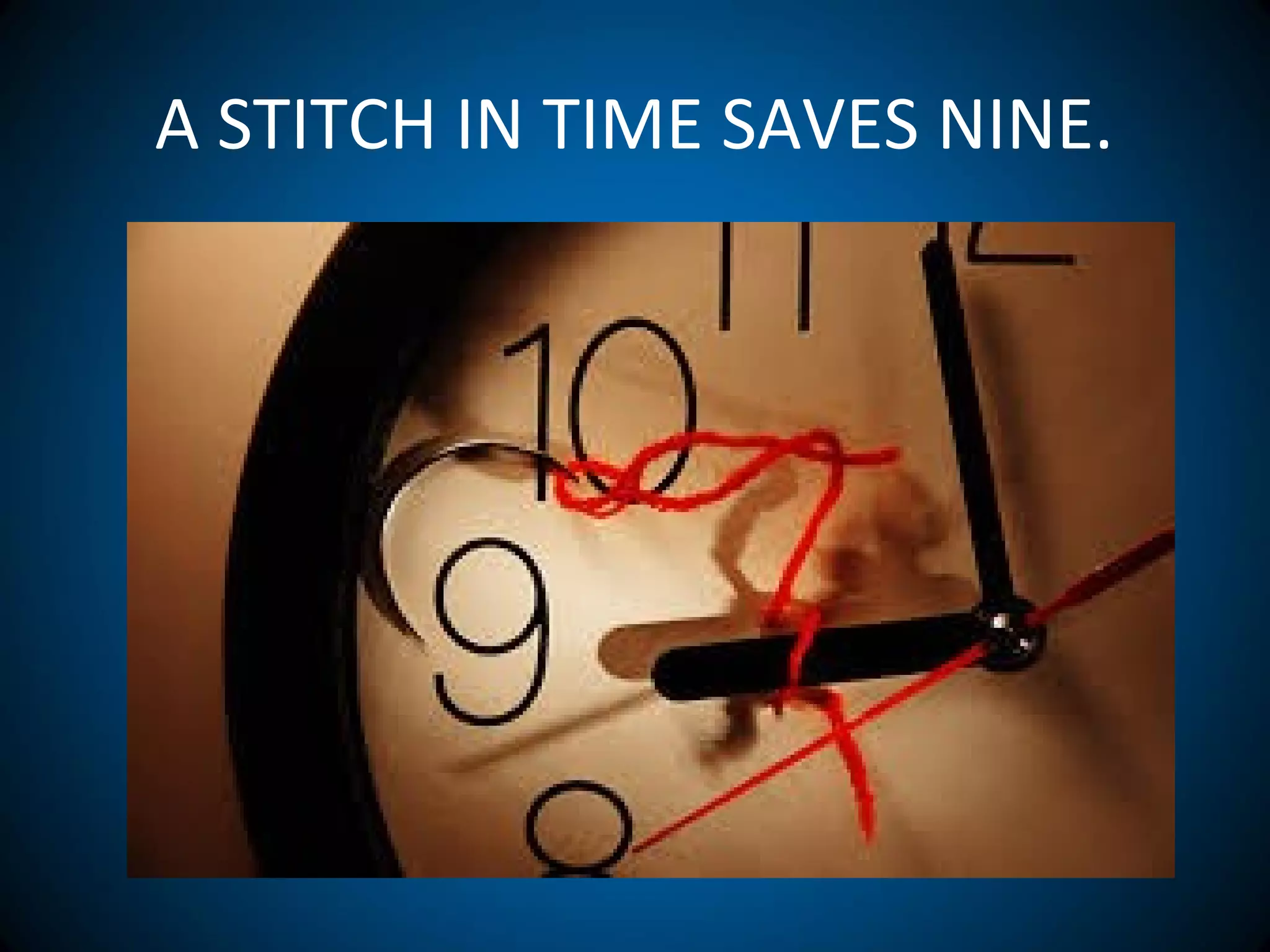
A STITCH IN TIME SAVES NINE.
• Suture means to ‘sew’ or ‘seam’. In
surgery suture is the act of sewing or
bringing tissue together and holding them
in apposition until healing has taken
place.
• . A suture is a strand of material used to ligate blood
vessels and to approximate tissues together.
INTRODUCTION
DEFINITIONS
• DEFINITION: suture material is an artificial fibre
used to keep wound together until they hold
sufficiently well by themselves by natural fibre
(collagen) which is synthesized and woven into a
stronger scar
• Suture is a Stitch/Series of Stiches made to secure
apposition of the edges of a Surgical/Traumatic
wound (Wilkins)
• Any Strand of Material utilised to ligate blood vessels
or approximate Tissues (Silverstein L.H 1999)
Historical Landmarks
• The earliest records of surgical suture date
back to 3500 B.C. in Egypt. The script is now
known as The Edwin Smith Surgical
Papyrus.
• The oldest physical evidence of surgical
suture dates to between 500-1000 B.C.
Evidenced by several mummies who had
been sutured which were found in Egypt.
• Hippocrites first used the term ‘suture’ in
400 B.C. The meaning is literally to ‘sew’ or
• In 100 B.C., Cornelius Celsus, a Roman,
used the word as a noun and a verb – “the
suture” and “to suture”.
• The first sutures were fashioned from hair,
cotton, tendon, or silk. They were used on
needles made of bone, stone, or wood.
• Sutures were originally used to close open
wounds, but shortly were adapted to ligate
tissue as well. This method was successful
but infection rate was extremely high.
Historical Landmarks
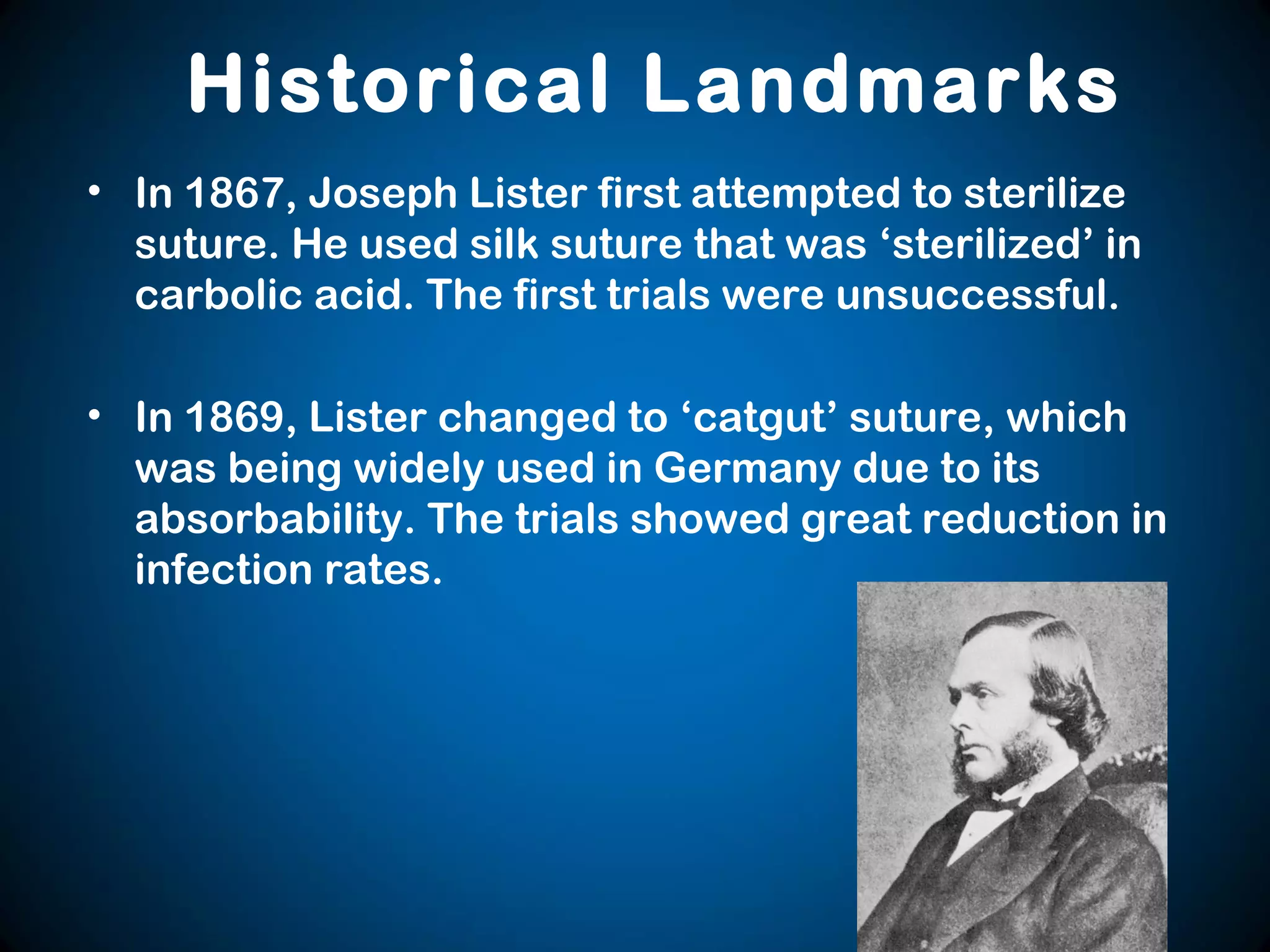
• In 1867, Joseph Lister first attempted to sterilize
suture. He used silk suture that was ‘sterilized’ in
carbolic acid. The first trials were unsuccessful.
• In 1869, Lister changed to ‘catgut’ suture, which
was being widely used in Germany due to its
absorbability. The trials showed great reduction in
infection rates.
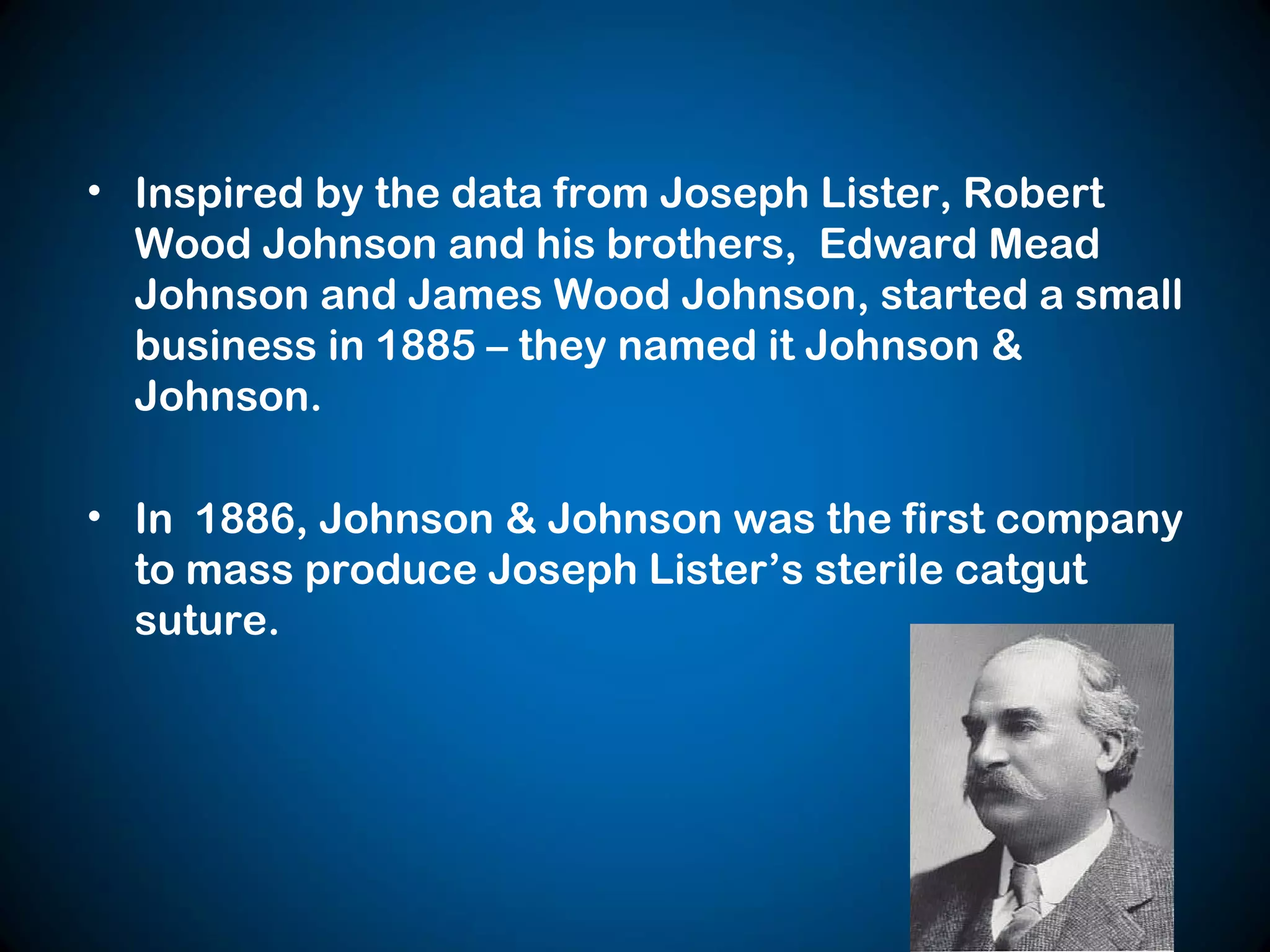
• Inspired by the data from Joseph Lister, Robert
Wood Johnson and his brothers, Edward Mead
Johnson and James Wood Johnson, started a small
business in 1885 – they named it Johnson &
Johnson.
• In 1886, Johnson & Johnson was the first company
to mass produce Joseph Lister’s sterile catgut
suture.
• Johnson & Johnson, off of its success from
sterile suture and sterile dressing sales,
became incorporated in 1887.
• In 1906, Iodine was first produced in
Germany by the B. Braun Company.
• In 1956, Johnson & Johnson created an
independent division for its suture
production and sales – it was named
Ethicon.
Goals of Suturing
• Maintain haemostasis.
• Permit primary intention healing.
• Reduces postoperative pain.
• Permit proper flap position.
• Produce aesthetically pleasing scar by
approximating skin edges.
LACERATE MEANS-
12
Look At the Wound, Assess it
Anesthetic Considerations
Cleaning the Wound
Equipment – Set Up
Repair of the Wound
Assessing Results, Anticipate Complications
Tetanus Immunization Status
Educate the Patient Regarding Wound Care
Suture Properties
• Absorption:
– Progressive breakdown and loss of mass and/or
volume of suture material; does not correlate with
initial tensile strength. Ultimately, tensile strength
is lost as the suture degrades.
• Capillary Absorption :
– Extent to which absorbed fluid is transferred along
the suture.
• Fluid Absorption:
– Ability to take up fluid after immersion.
Suture Properties
• Tensile Strength:
– Measure of a material or tissue's ability to resist
deformation and breakage
• Breaking Strength:
– The tension at which suture failure occurs. The
maximum limit of the tensile strength.
• Elasticity:
– Measure of the ability of the material to regain its
original form and length after deformation. If
deformed beyond its elastic property, the suture is
greatly weakened.
Suture Properties
• Plasticity:
– Measure of the ability to deform without breaking.
• Memory:
– Inherent tendency of suture material to retain its
shape. Related to the elasticity, plasticity, and
diameter of the suture.
• Pliability:
– Ease of manipulating the suture, such as the ability
to adjust knot tension and to secure knots. Related
to the suture material, filament type, and diameter.
Suture Properties
• Straight-Pull Tensile Strength:
– Linear breaking strength of suture material.
• Knot Strength:
– Amount of force necessary to cause a knot to slip
(related to the coefficient of friction and plasticity)
• Knot-Pull Tensile Strength:
• Breaking strength of the knot.
(10-40% weaker at knot)
Suture Properties
• Suture Pullout Value:
– The amount of force on a suture required to cause
tissue failure.
• Measurement of the strength of a particular tissue
• Variable depending on anatomic site and composition
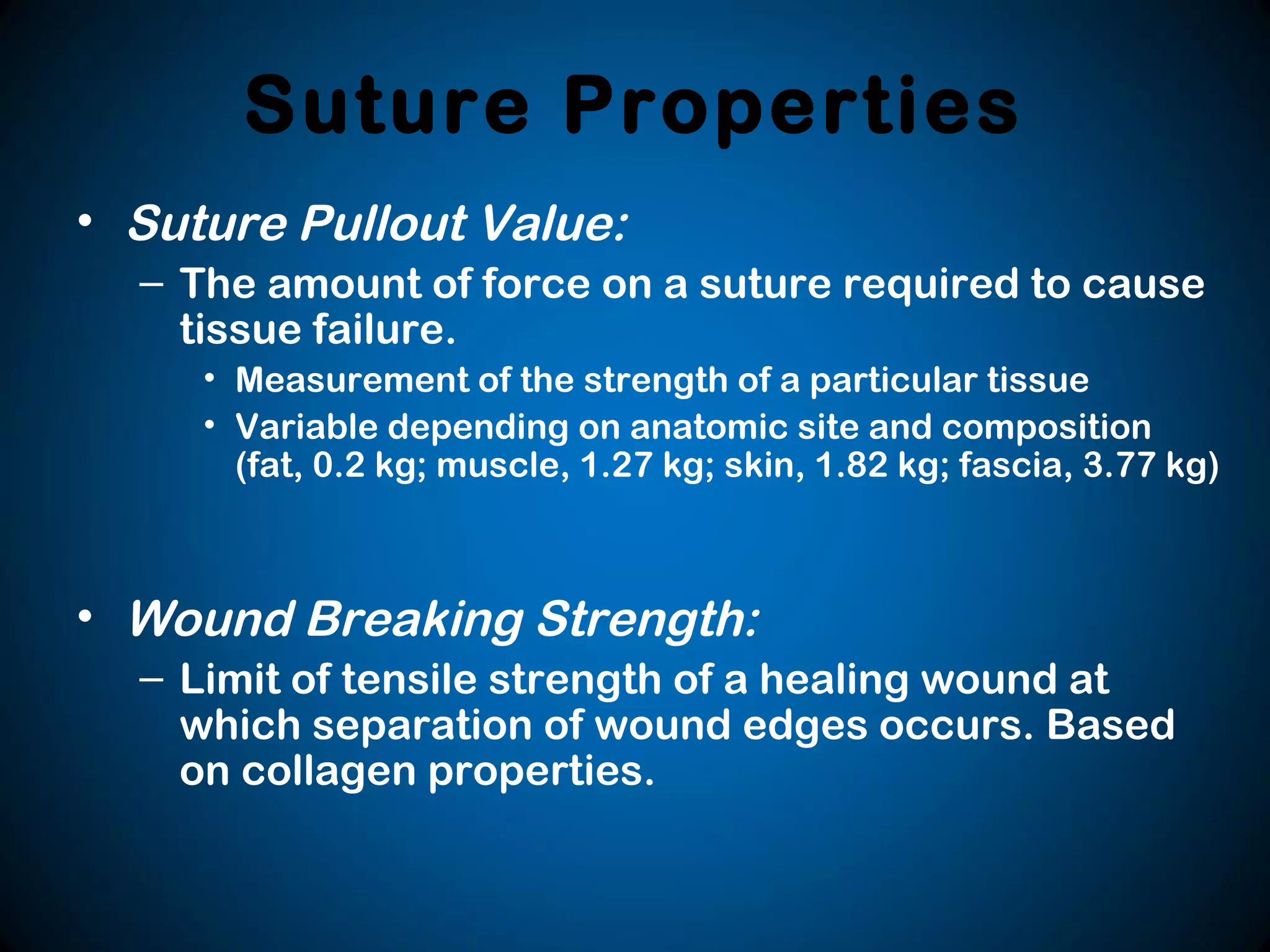
(fat, 0.2 kg; muscle, 1.27 kg; skin, 1.82 kg; fascia, 3.77 kg)
• Wound Breaking Strength:
– Limit of tensile strength of a healing wound at
which separation of wound edges occurs. Based
on collagen properties.
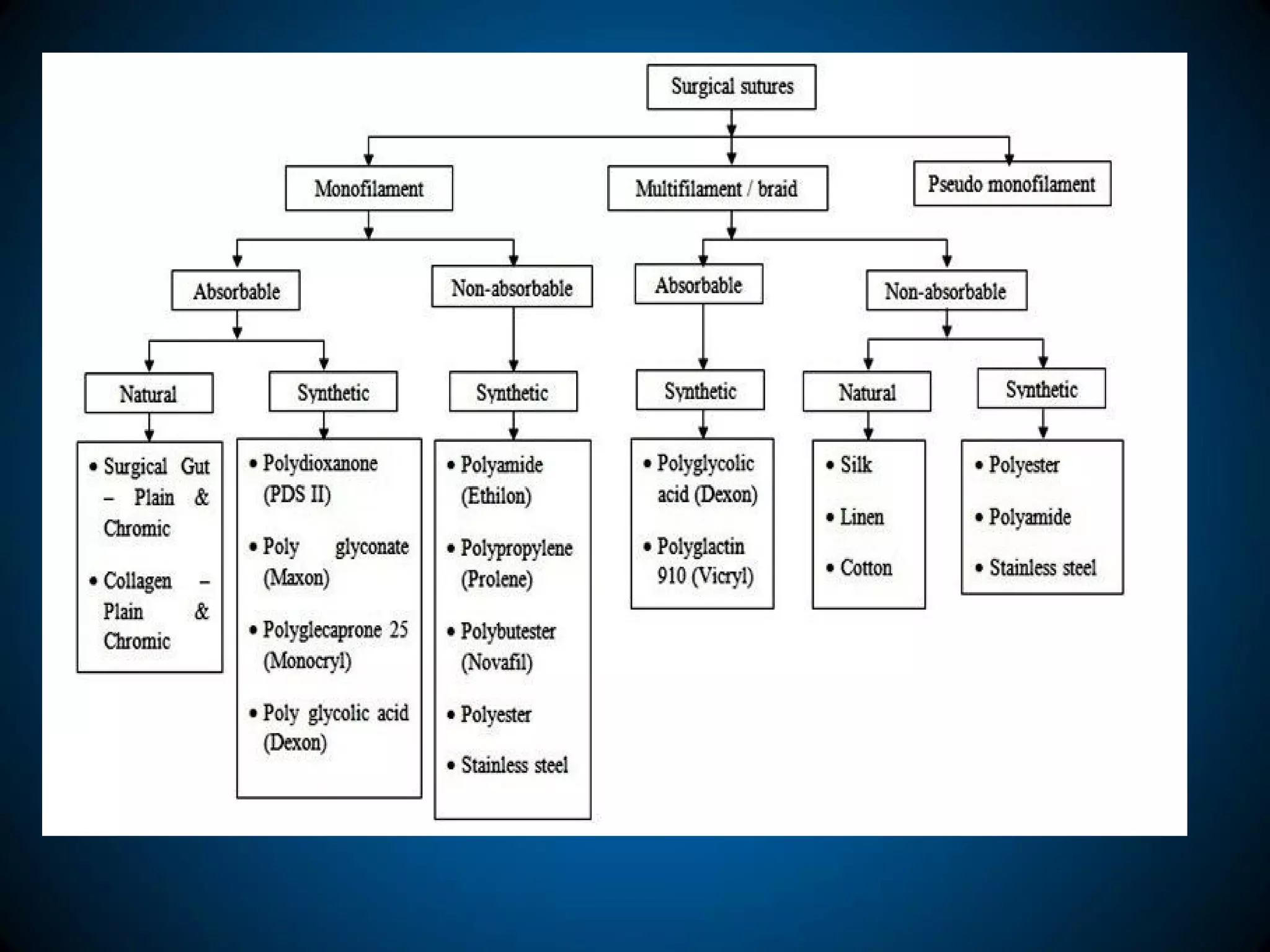
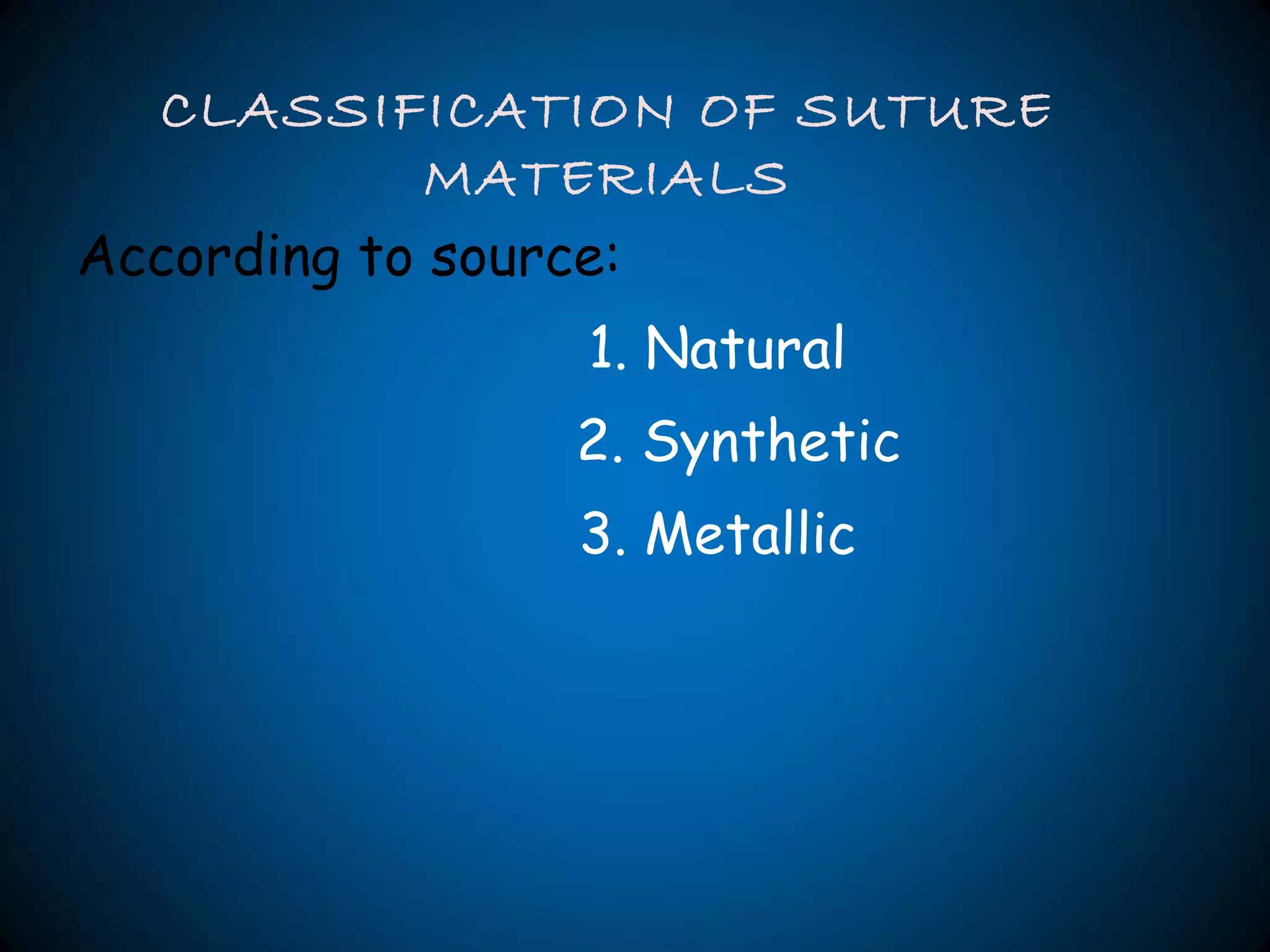
According to source:
1. Natural
2. Synthetic
3. Metallic
CLASSIFICATION OF SUTURE
MATERIALS
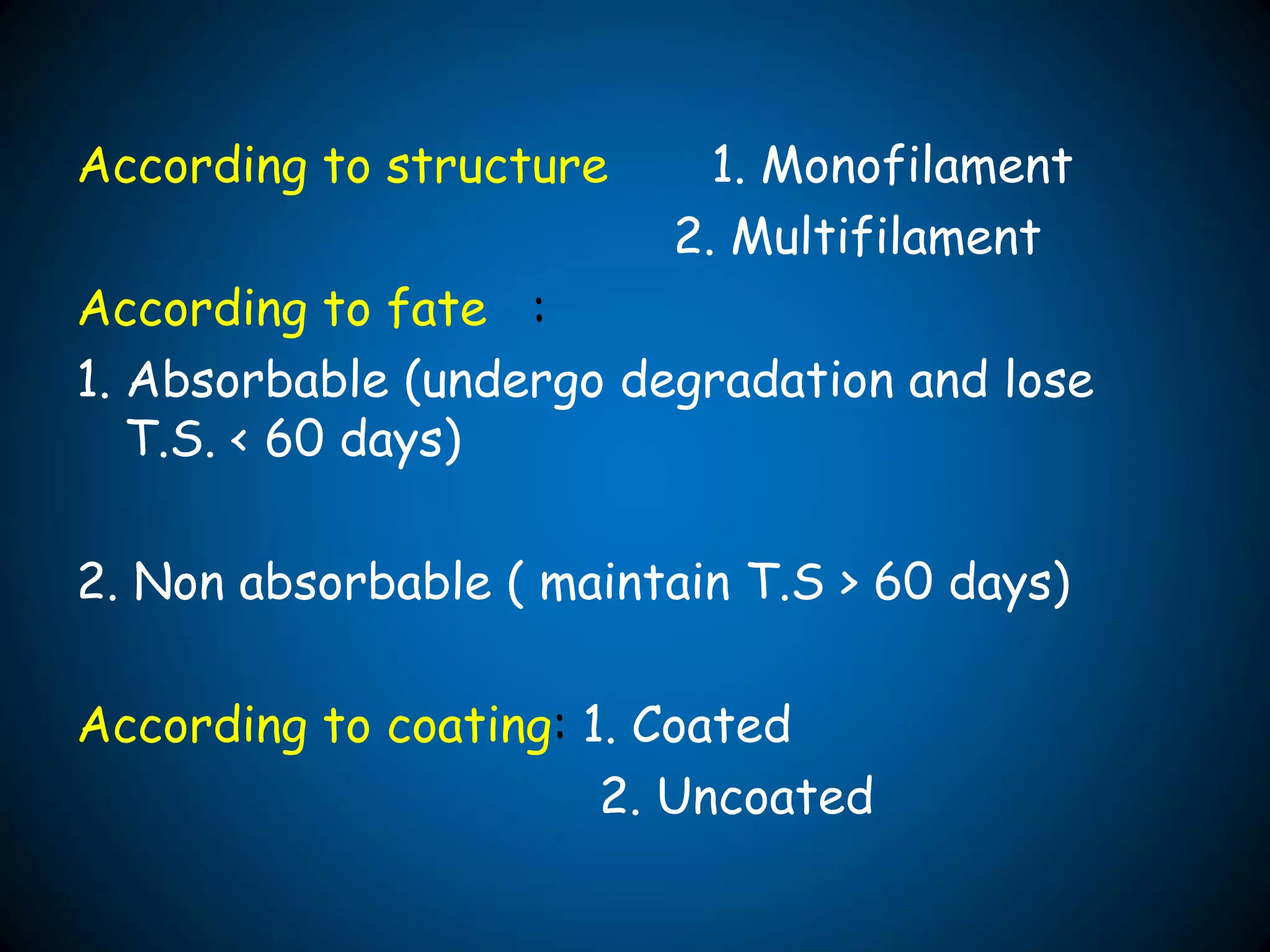
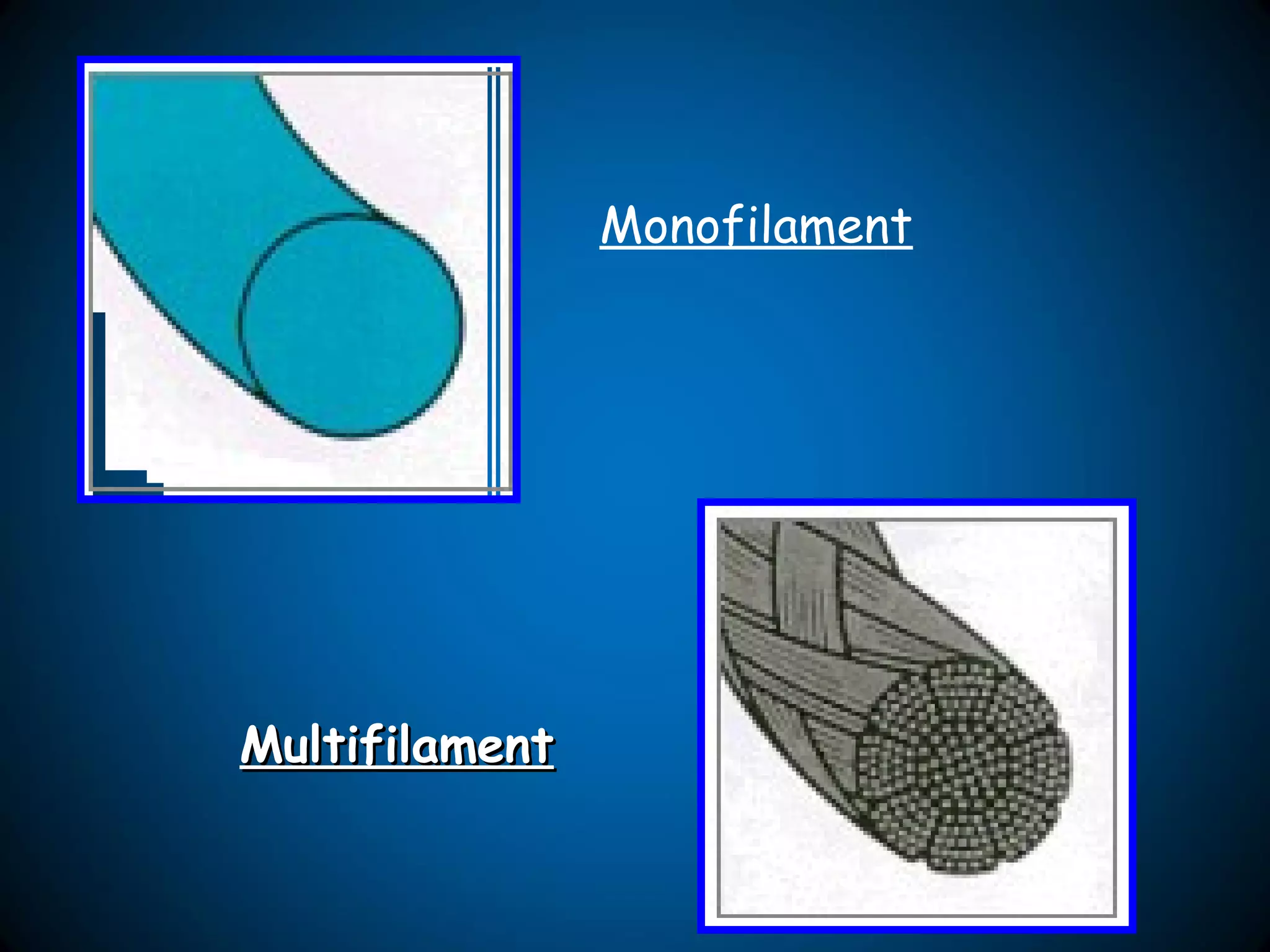
According to structure 1. Monofilament
2. Multifilament
According to fate :
1. Absorbable (undergo degradation and lose
T.S. < 60 days)
2. Non absorbable ( maintain T.S > 60 days)
According to coating: 1. Coated
2. Uncoated
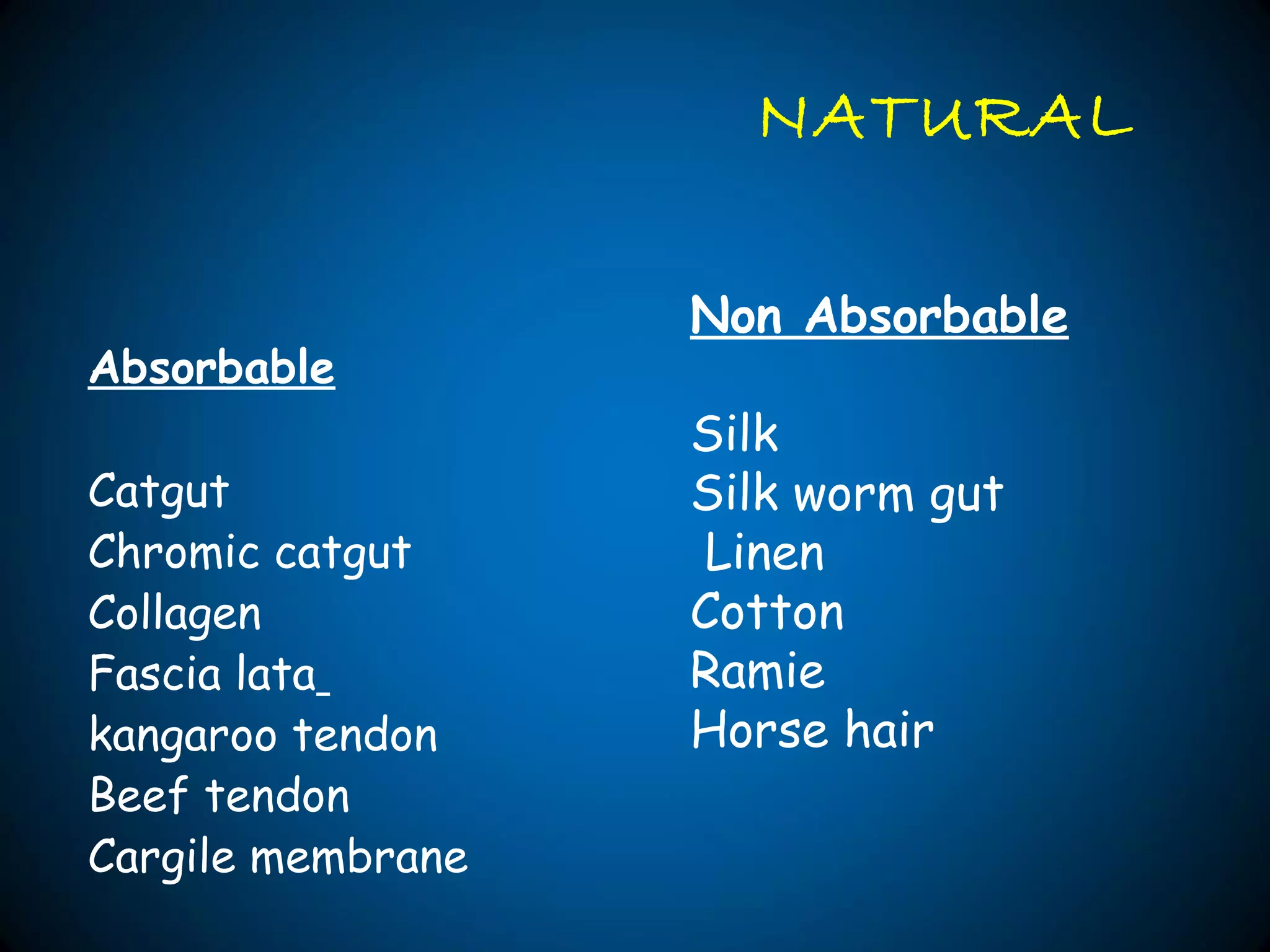
Absorbable
Catgut
Chromic catgut
Collagen
Fascia lata
kangaroo tendon
Beef tendon
Cargile membrane
NATURAL
Non Absorbable
Silk
Silk worm gut
Linen
Cotton
Ramie
Horse hair
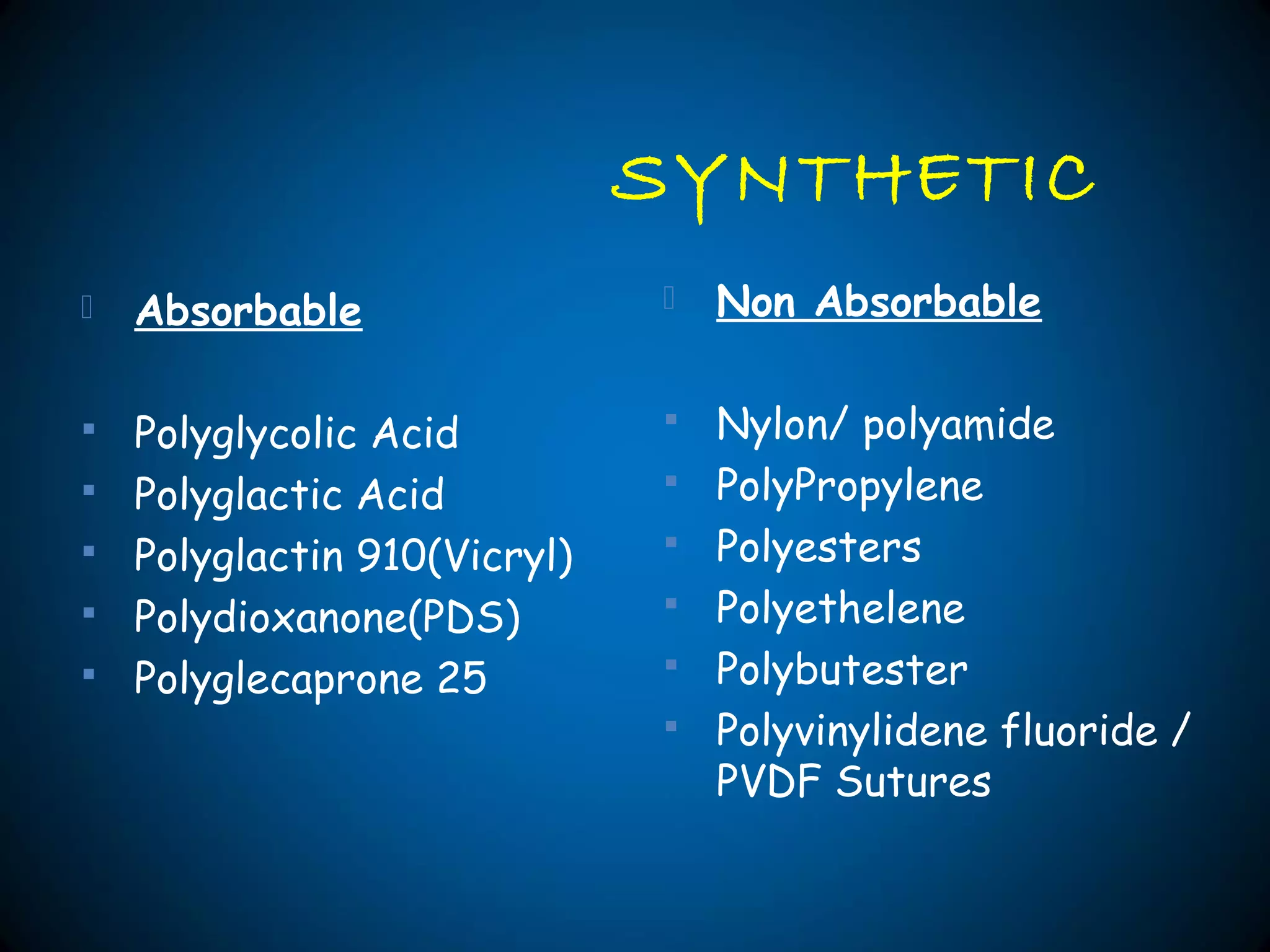
SYNTHETIC
 Absorbable
 Polyglycolic Acid
 Polyglactic Acid
 Polyglactin 910(Vicryl)
 Polydioxanone(PDS)
 Polyglecaprone 25
 Non Absorbable
 Nylon/ polyamide
 PolyPropylene
 Polyesters
 Polyethelene
 Polybutester
 Polyvinylidene fluoride /
PVDF Sutures
Monofilament
MultifilamentMultifilament
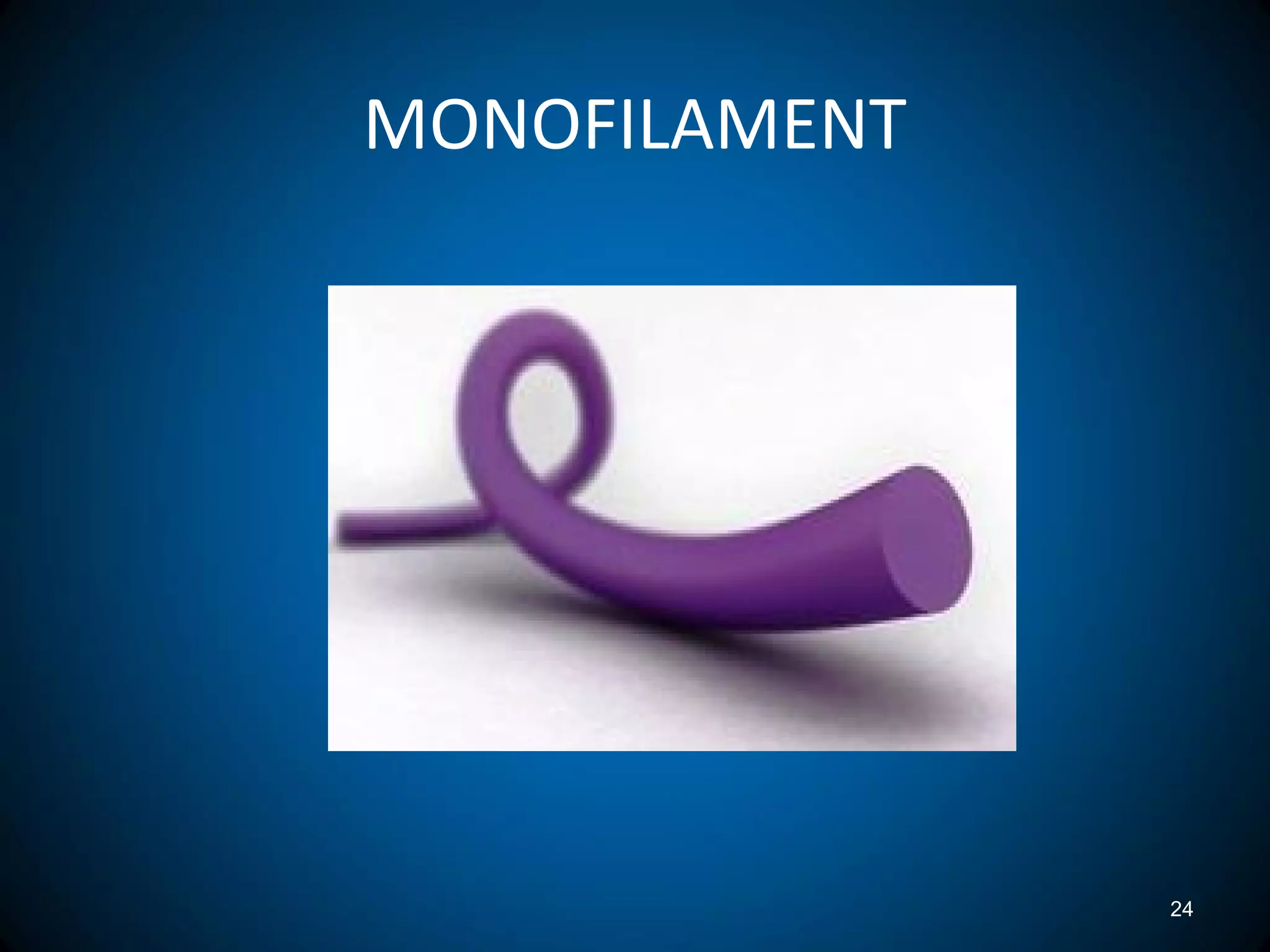
MONOFILAMENT
24
MONOFILAMENT
Advantages
• Smooth surface
• Less tissue
trauma
• No bacterial
harbours
• No capillarity
Disadvantages
• Handling and
knotting
• Stretch
• Any nick or crimp
in the material
leads to breakage.
MONOFILAMENT
 Absorbable
 Surgical Gut- Plain,
Chromic
 Polydiaxanone
 Non Absorbable
 Polypropylene
 Polyester
 Nylon/polyamide
 Polyvinylidene fluoride /
PVDF Sutures
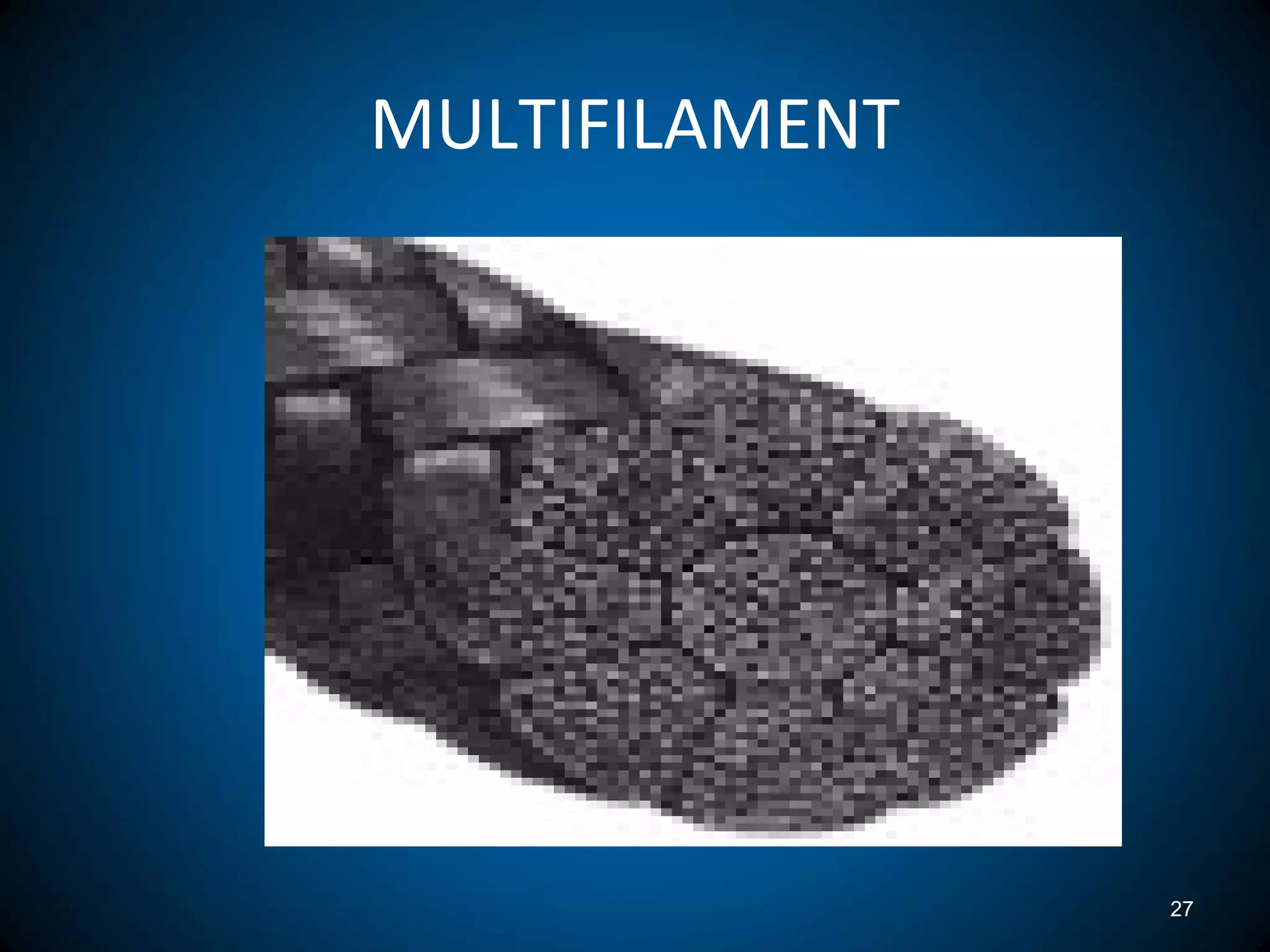
MULTIFILAMENT
27
MULTI FILAMENT
Advantages
• Strength
• Soft and pliable
• Good handling
• Good knotting
Disadvantages
• Bacterial
harbours
• Capillary action
• Tissue trauma
MULTIFILAMENT
 Absorbable
 Polyglactin 910
 Polyglycolic Acid
 Non Absorbable
 Silk
 Cotton
 Linen
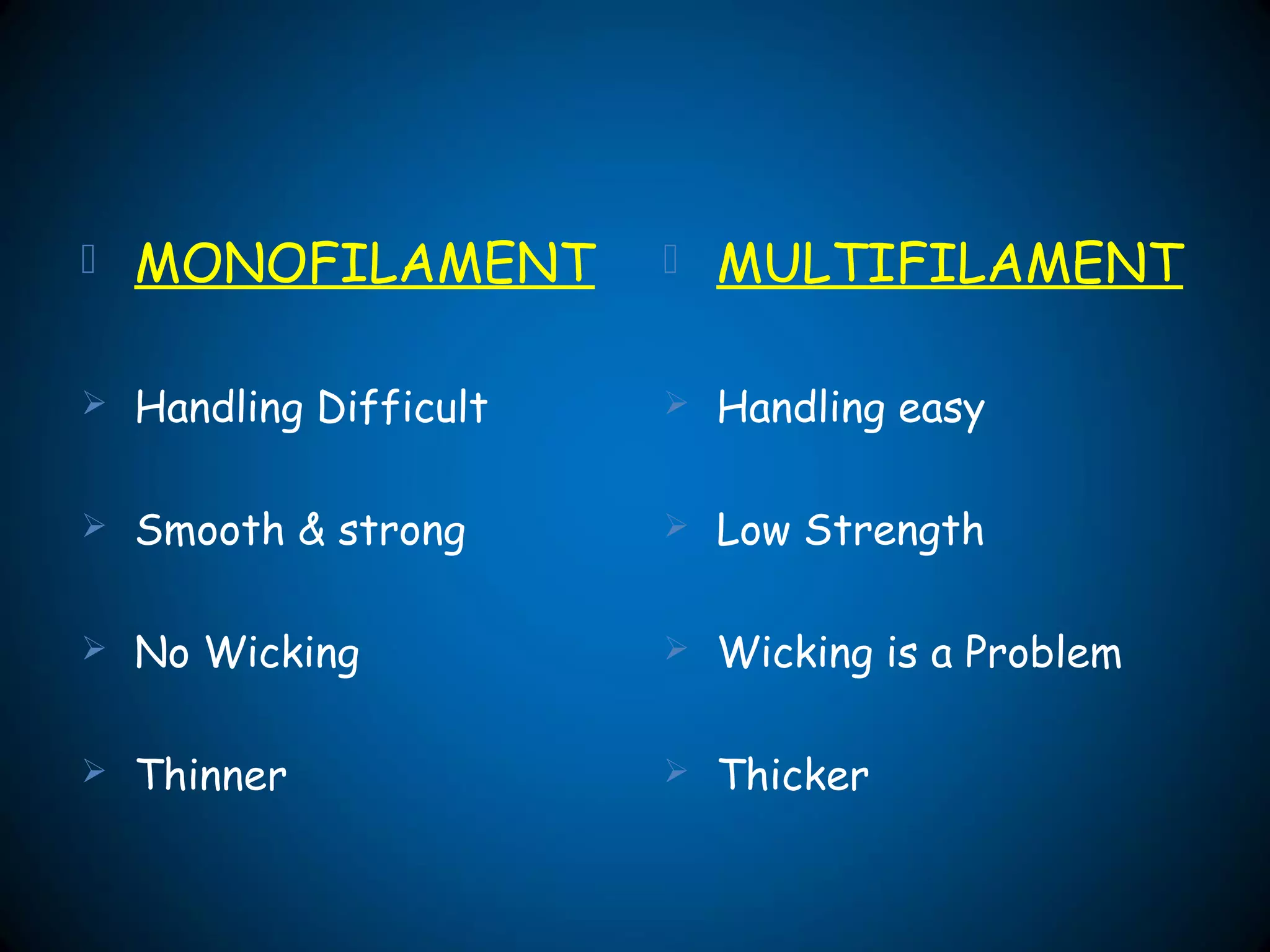
 MONOFILAMENT
 Handling Difficult
 Smooth & strong
 No Wicking
 Thinner
 MULTIFILAMENT
 Handling easy
 Low Strength
 Wicking is a Problem
 Thicker
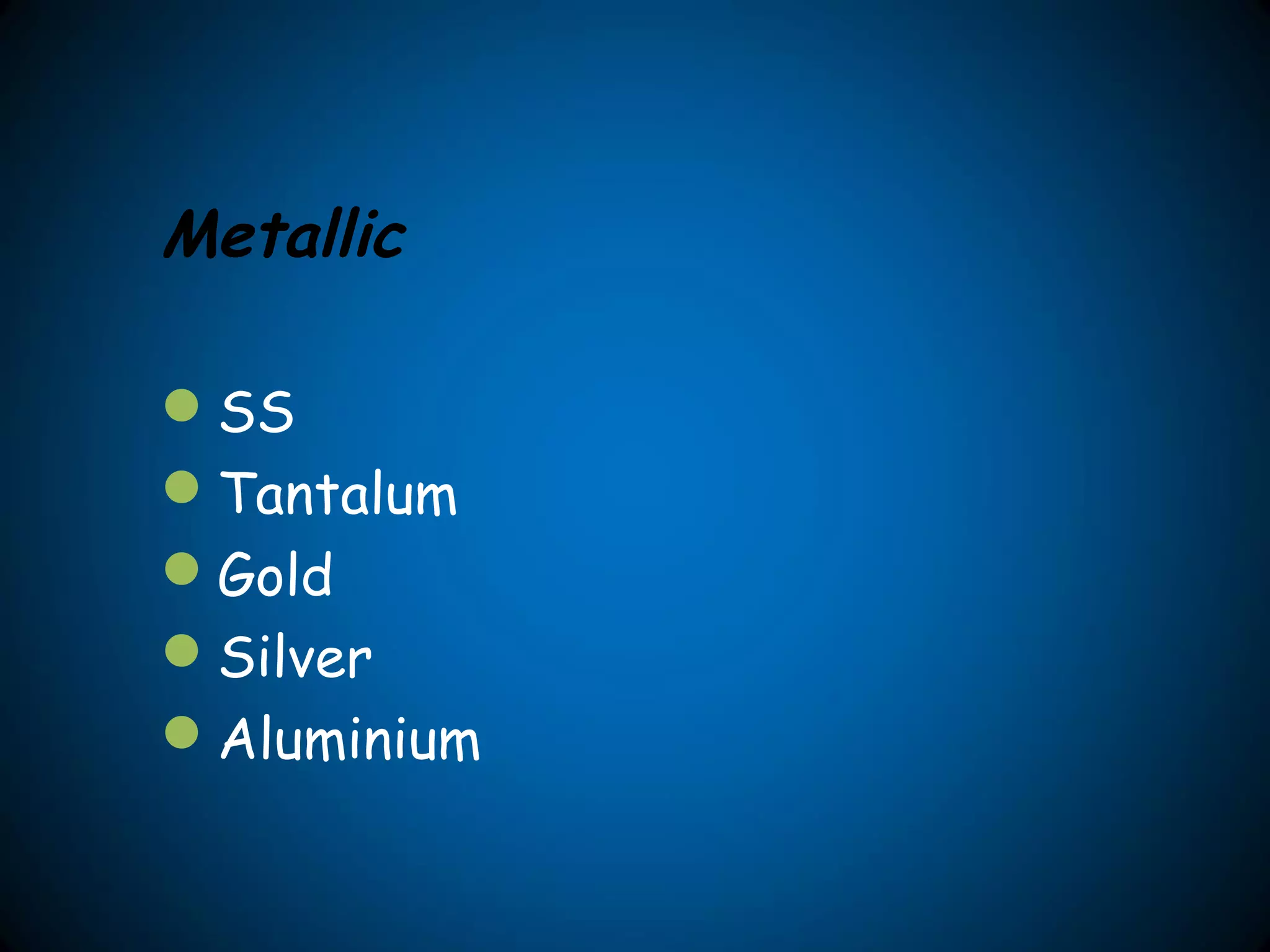
Metallic
SS
Tantalum
Gold
Silver
Aluminium
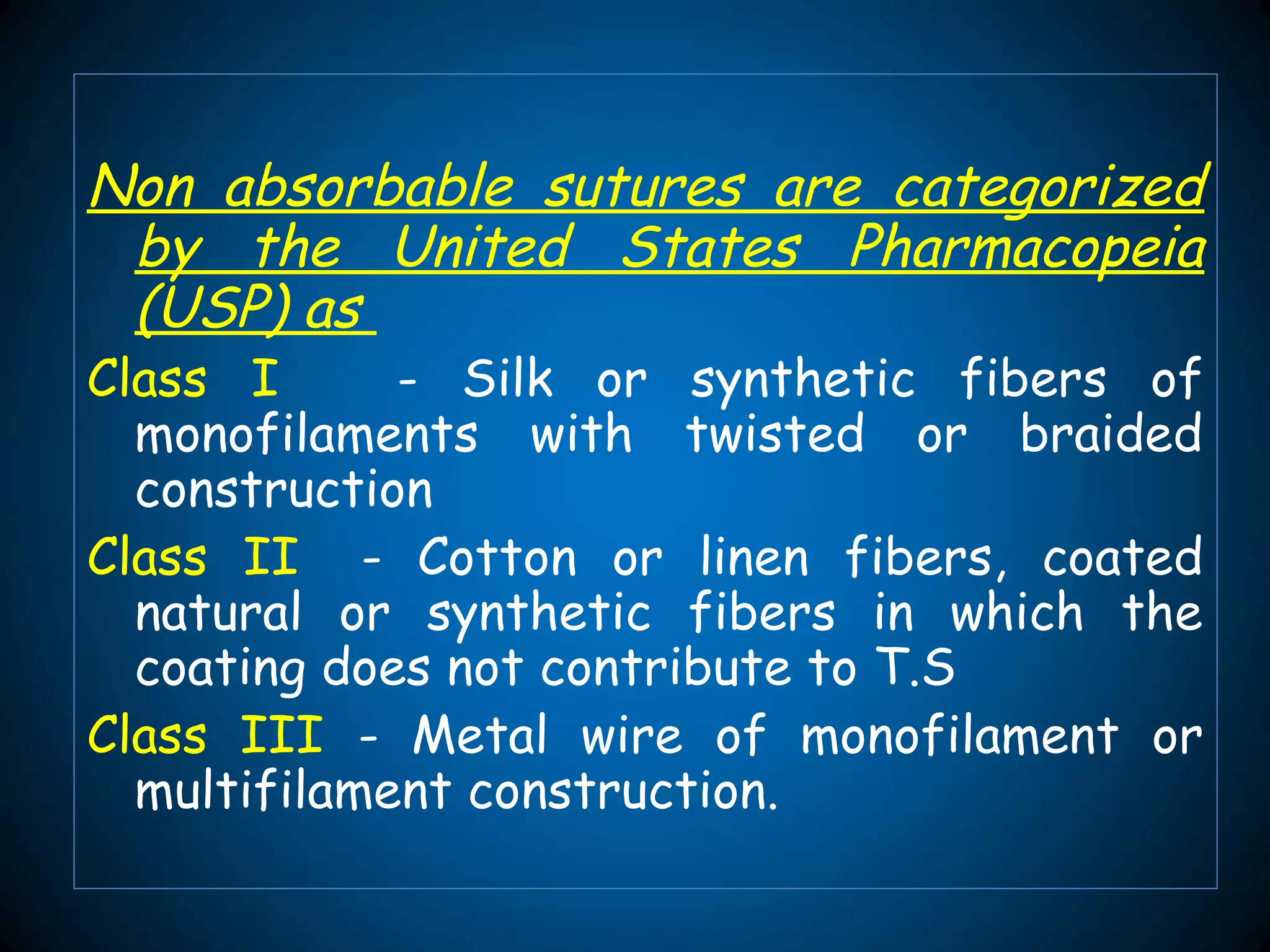
Non absorbable sutures are categorized
by the United States Pharmacopeia
(USP) as
Class I - Silk or synthetic fibers of
monofilaments with twisted or braided
construction
Class II - Cotton or linen fibers, coated
natural or synthetic fibers in which the
coating does not contribute to T.S
Class III - Metal wire of monofilament or
multifilament construction.
Suture Size (Diameter)
 It is the oldest known absorbable suture material.
 According to Katz and Turner (1970), Galen referred to gut suture
as early as 175 A.D.
 It is derived from sheep or bovine intestine and is classified as
natural, monofilament and absorbable suture.
 Gut is the most variable suture material in
terms of tensile strength and absorbability.
GUT
GUT SUTURE
 Gut has the smallest strength of any of the commonly used suture materials
(Herrmann 1971).
 The percentage of collagen in the suture determines its tensile strength and its
ability to be absorbed by the body without adverse reaction.
 When placed intraorally through mucosal surfaces, the sutures resorb in 3-5
days.
GUT SUTURE
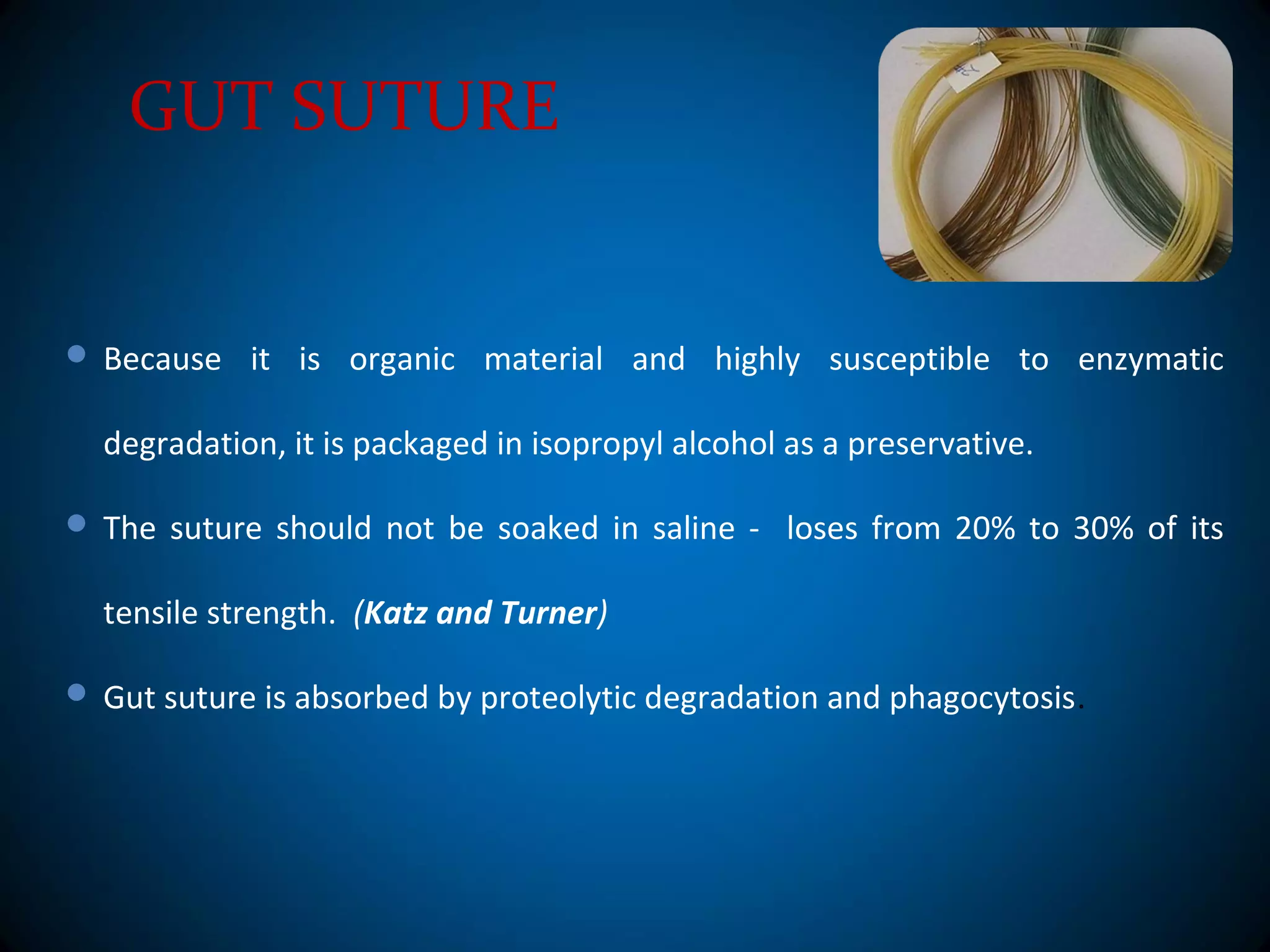
 Because it is organic material and highly susceptible to enzymatic
degradation, it is packaged in isopropyl alcohol as a preservative.
 The suture should not be soaked in saline - loses from 20% to 30% of its
tensile strength. (Katz and Turner)
 Gut suture is absorbed by proteolytic degradation and phagocytosis.
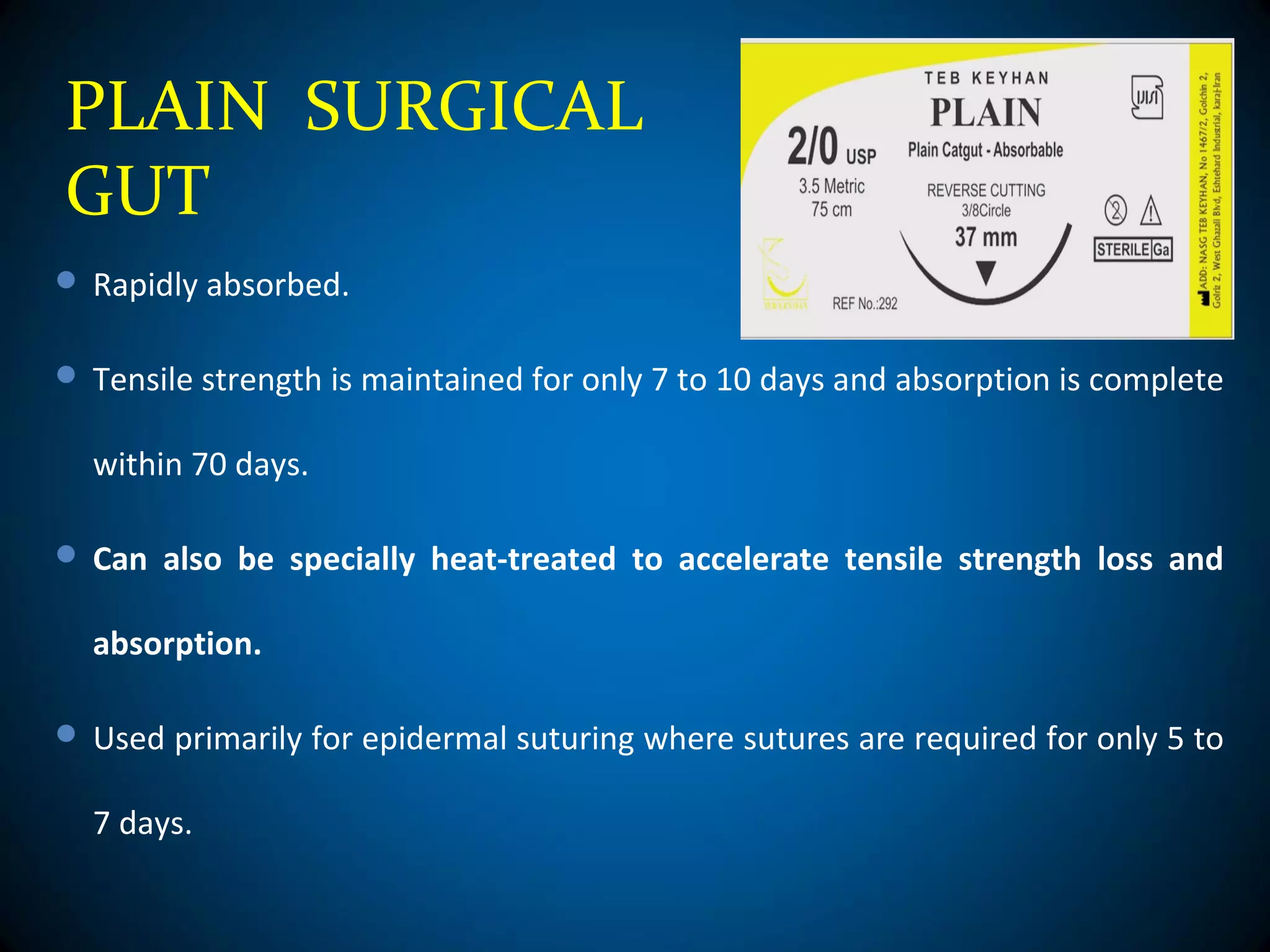
PLAIN SURGICAL
GUT
 Rapidly absorbed.
 Tensile strength is maintained for only 7 to 10 days and absorption is complete
within 70 days.
 Can also be specially heat-treated to accelerate tensile strength loss and
absorption.
 Used primarily for epidermal suturing where sutures are required for only 5 to
7 days.
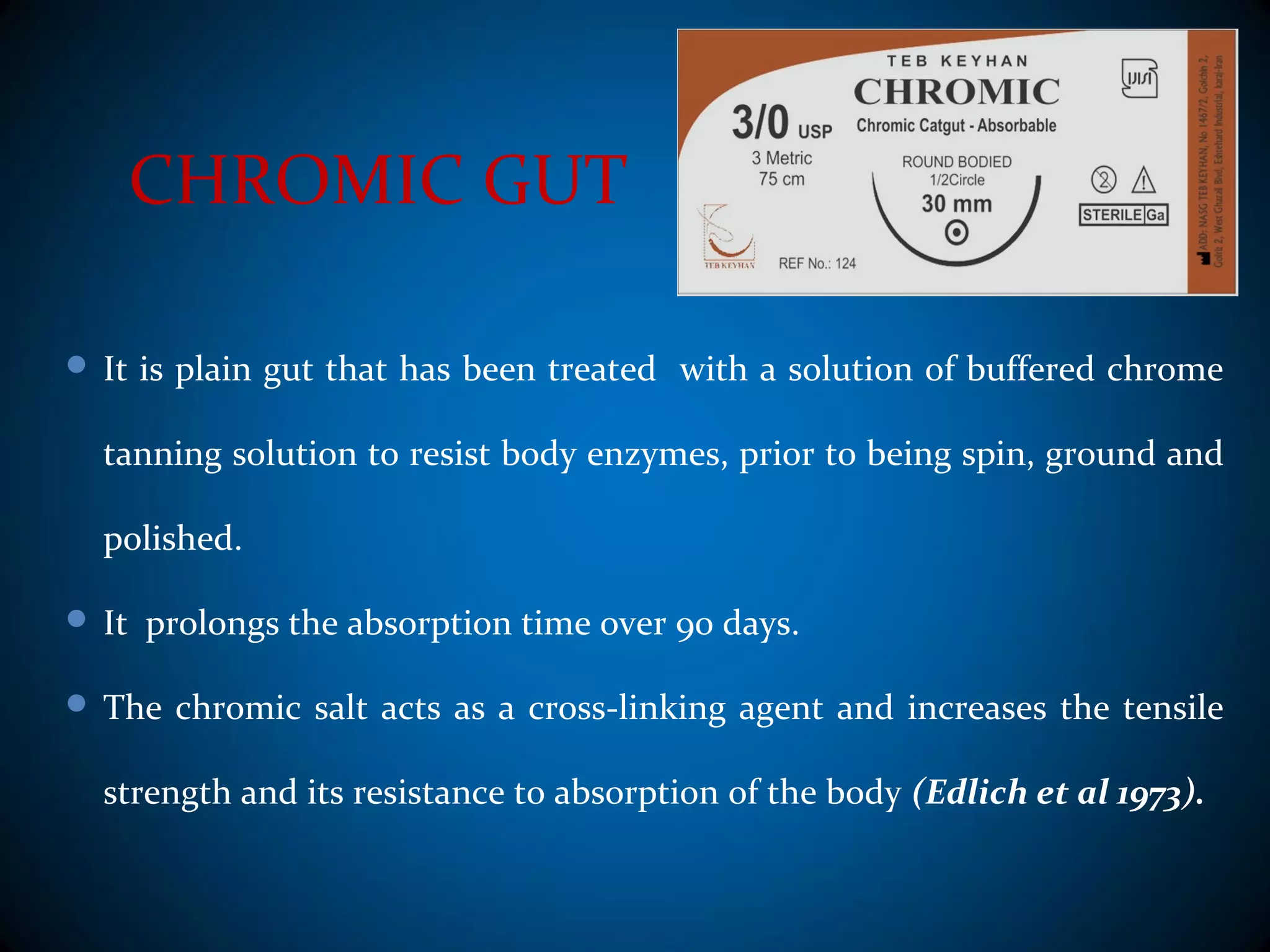
CHROMIC GUT
 It is plain gut that has been treated with a solution of buffered chrome
tanning solution to resist body enzymes, prior to being spin, ground and
polished.
 It prolongs the absorption time over 90 days.
 The chromic salt acts as a cross-linking agent and increases the tensile
strength and its resistance to absorption of the body (Edlich et al 1973).
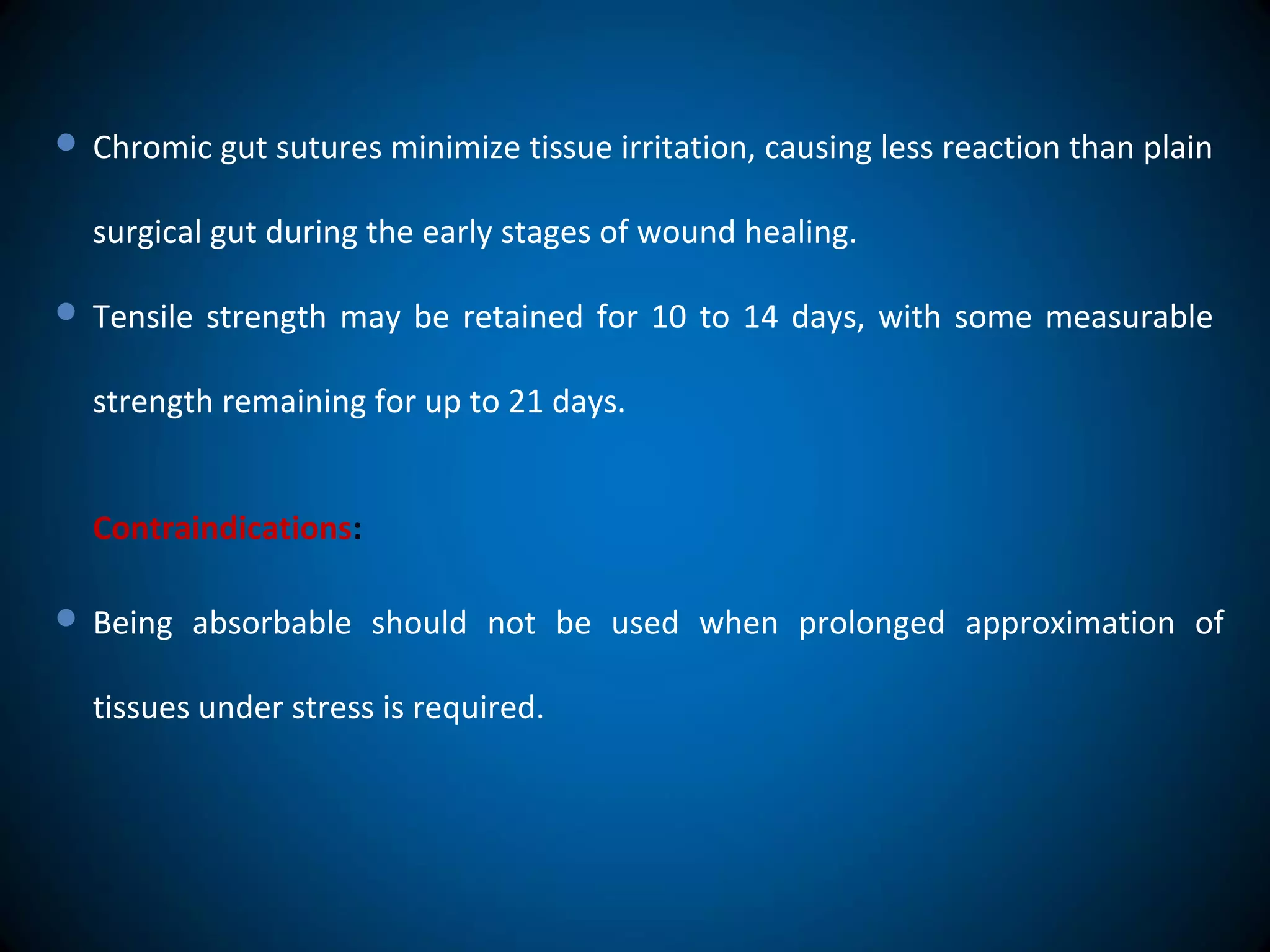
 Chromic gut sutures minimize tissue irritation, causing less reaction than plain
surgical gut during the early stages of wound healing.
 Tensile strength may be retained for 10 to 14 days, with some measurable
strength remaining for up to 21 days.
Contraindications:
 Being absorbable should not be used when prolonged approximation of
tissues under stress is required.
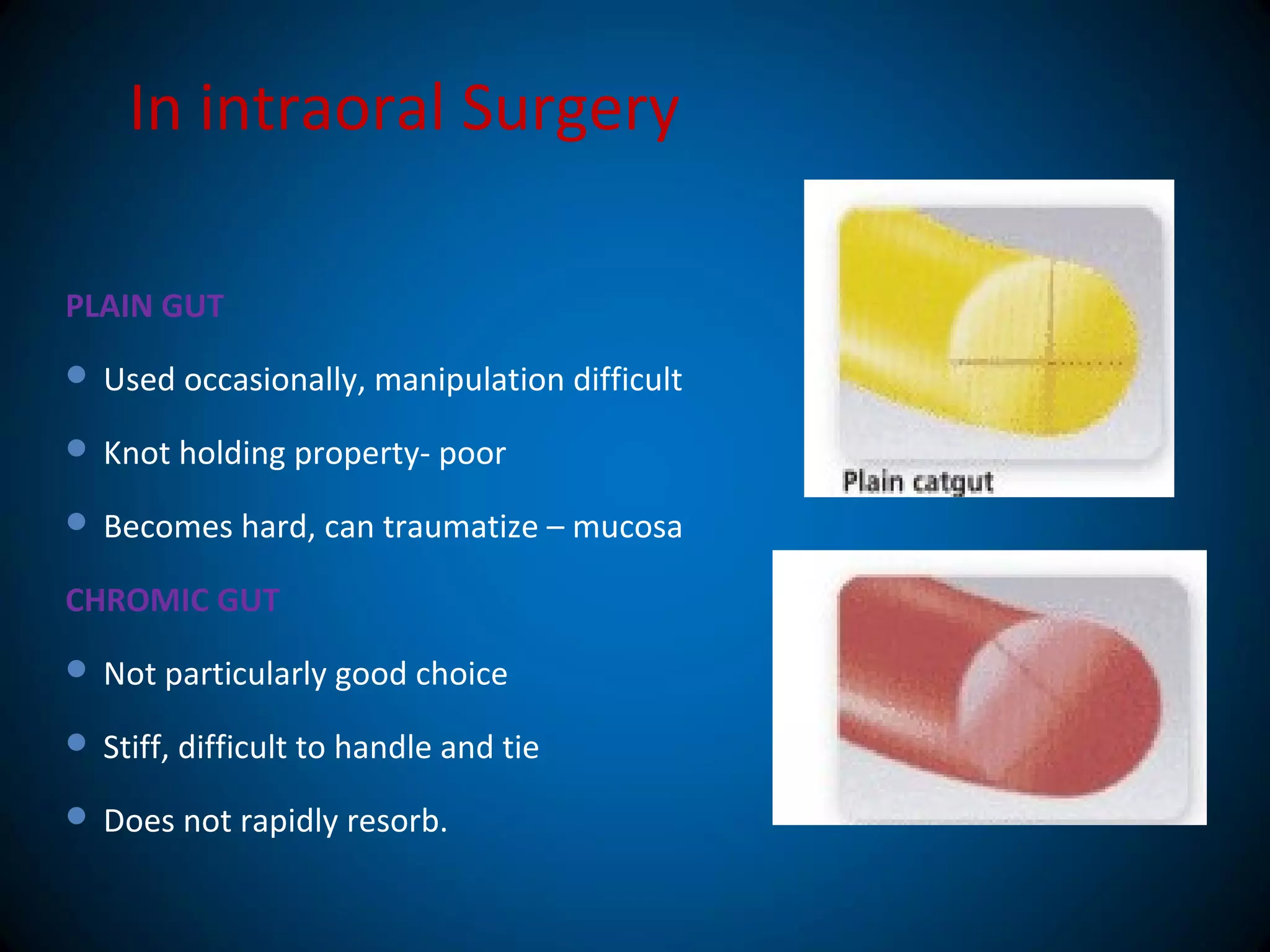
In intraoral Surgery
PLAIN GUT
 Used occasionally, manipulation difficult
 Knot holding property- poor
 Becomes hard, can traumatize – mucosa
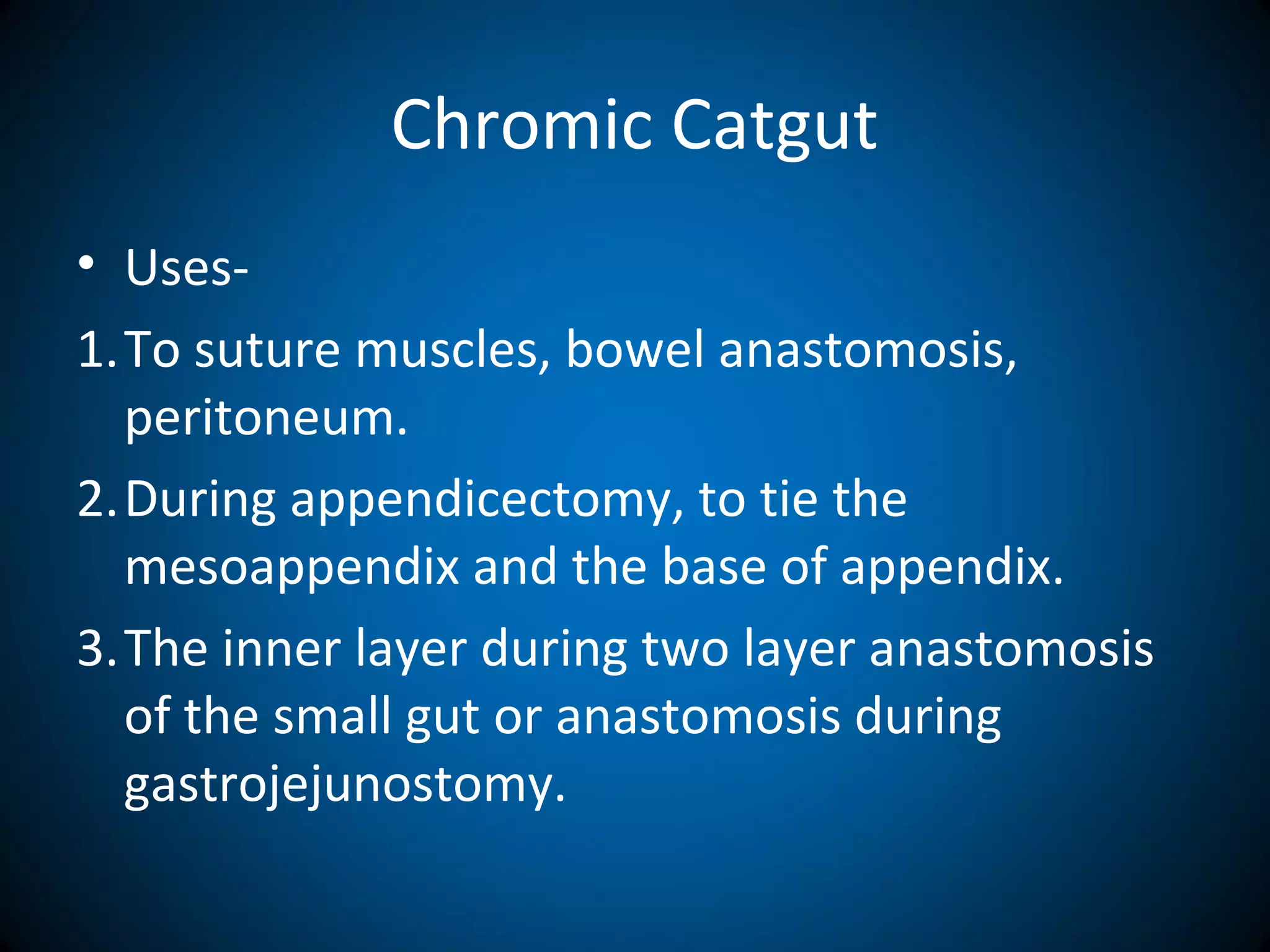
CHROMIC GUT
 Not particularly good choice
 Stiff, difficult to handle and tie
 Does not rapidly resorb.
Chromic Catgut
• Uses-
1.To suture muscles, bowel anastomosis,
peritoneum.
2.During appendicectomy, to tie the
mesoappendix and the base of appendix.
3.The inner layer during two layer anastomosis
of the small gut or anastomosis during
gastrojejunostomy.
Chromic Catgut
4. During cholecystectomy, to stop bleeding from gall
bladder bed.
For most of the above said uses however, polygalactin
sutures are replacing catgut.
POLYGLACTIN
910
 They come under trade name “Vicryl”
 Synthetic absorbable sterile surgical suture composed of a copolymer made
from 90% glycolide and 10% L-lactide.
 Coated vicryl suture is prepared by coating vicryl suture material with a
mixture composed of equal parts of copolymer of glycolide and lactide
(polyglactin 370) and calcium stearate.
 Dexon and Vicryl, when braided are the strongest of the absorbable suture
materials.
 According to Dardik, and Lanfman (1971), metabolites of polyglycolic acid are
metabolised via the citric acid cycle and produce energy, Co2 and water.
 Available as braided dyed violet or undyed natural strands in a variety of
lengths with or without needles.
COATED VICRYL PLUS ANTIBACTERIAL
(POLYGLACTIN 910) SUTURE
 Coated VICRYL Plus Antibacterial suture contains one of the purest forms of the
broad-spectrum antibacterial agent triclosan .
 Coated VICRYL Plus Antibacterial suture offers protection against bacterial
colonization of the suture.
 Degree of inflammation is less as
seen in plain/chromic catgut sutures.
In vivo studies demonstrate that
 Coated VICRYL Plus Antibacterial suture has a zone of inhibition that is
effective against the pathogens that most often cause surgical site infection
(SSI)
Staphylococcus aureus, methicillin-resistant Staphy aureus (MRSA),
Staphy epidermidis, methicillin-resistant Staphy epidermidis (MRSE)
(Rothenburger S et al 2002)
 VICRYL Plus Antibacterial suture has no adverse effect on normal wound
healing. (Gilbert P et al 2002)
POLYGLECAPRONE
25
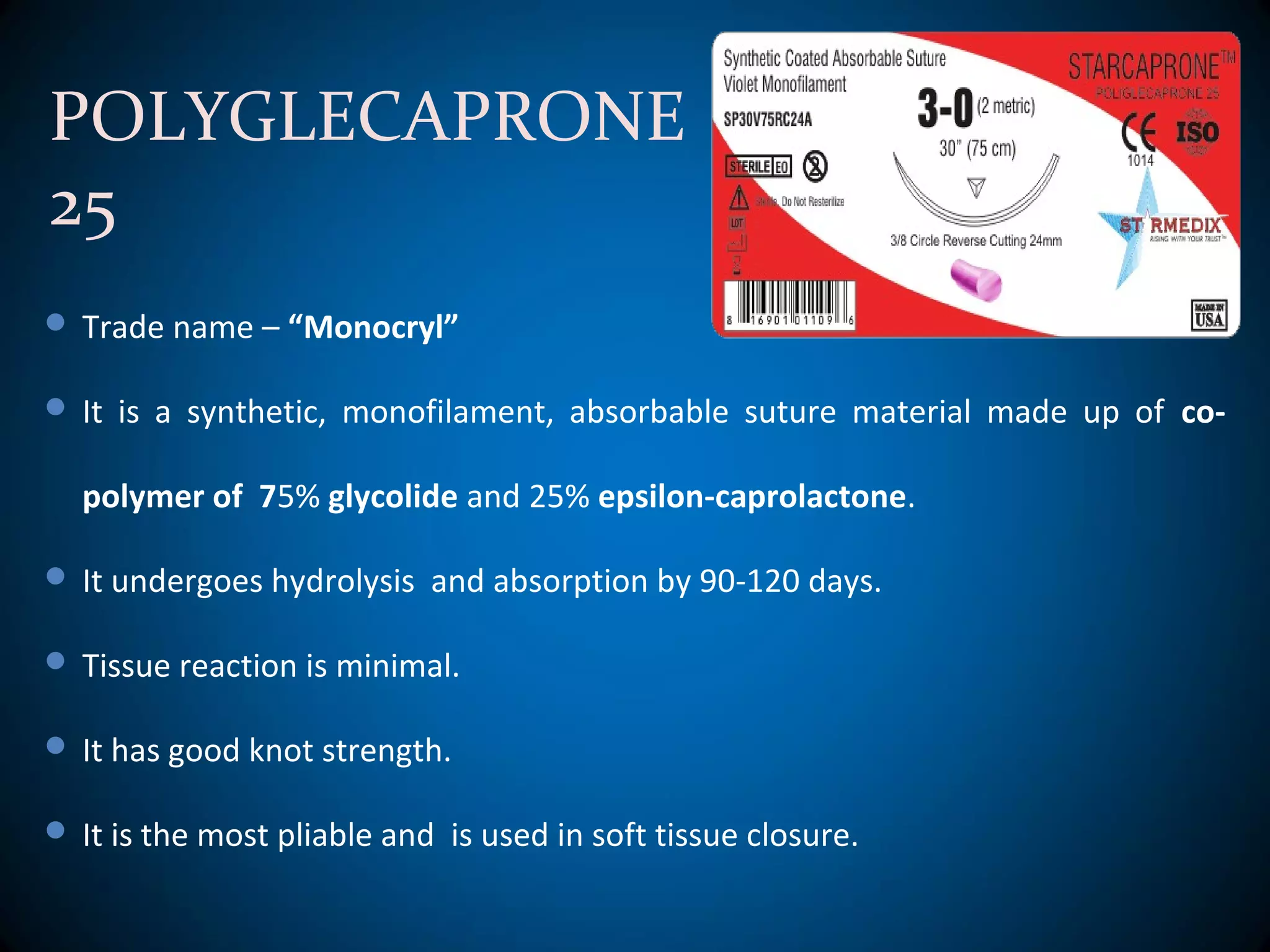
 Trade name – “Monocryl”
 It is a synthetic, monofilament, absorbable suture material made up of co-
polymer of 75% glycolide and 25% epsilon-caprolactone.
 It undergoes hydrolysis and absorption by 90-120 days.
 Tissue reaction is minimal.
 It has good knot strength.
 It is the most pliable and is used in soft tissue closure.
 Biologic behaviour similar to that of PGA 910.
 Narry Filho 2002 - Because of its favorable characteristics it can be used not
only deep in tissues, but also in superficial tissues of oral mucosa.
 Tremendous tensile strength (highest) but is very stiff.
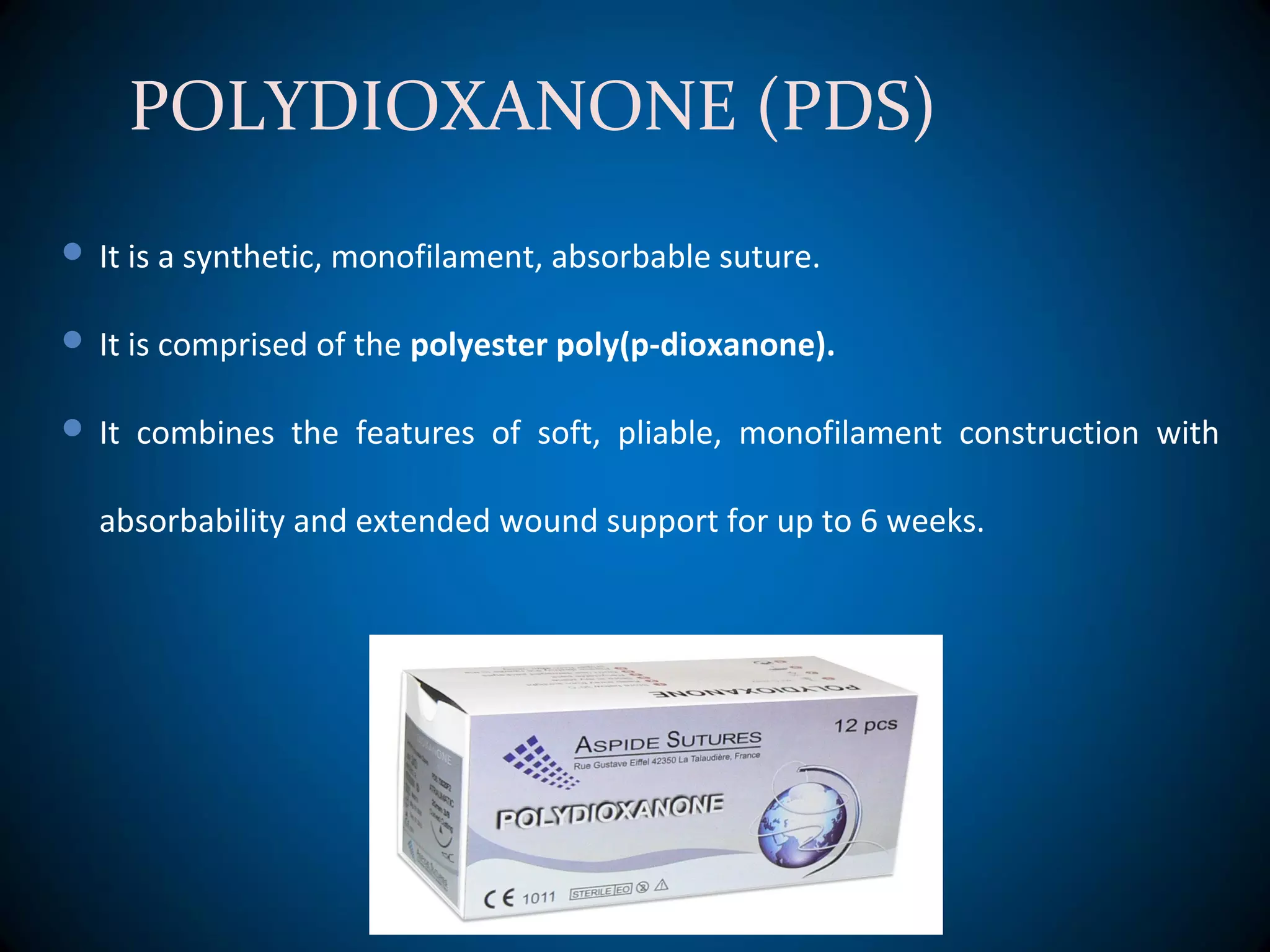
POLYDIOXANONE (PDS)
 It is a synthetic, monofilament, absorbable suture.
 It is comprised of the polyester poly(p-dioxanone).
 It combines the features of soft, pliable, monofilament construction with
absorbability and extended wound support for up to 6 weeks.
 It undergoes slow hydrolysis and takes 110-210 days to get absorbed.
 It has good tensile strength and moderate knot tensile strength. PDS sutures
are available clear or dyed violet to enhance visibility.
Uses:
 Absorbable suture with extended wound support.
Contraindication:
 Being absorbable should not be used when prolonged approximation of
tissues under stress is required.
NON RESORBABLE SUTURE MATERIALSNON RESORBABLE SUTURE MATERIALS
SURGICAL SILKSURGICAL SILK
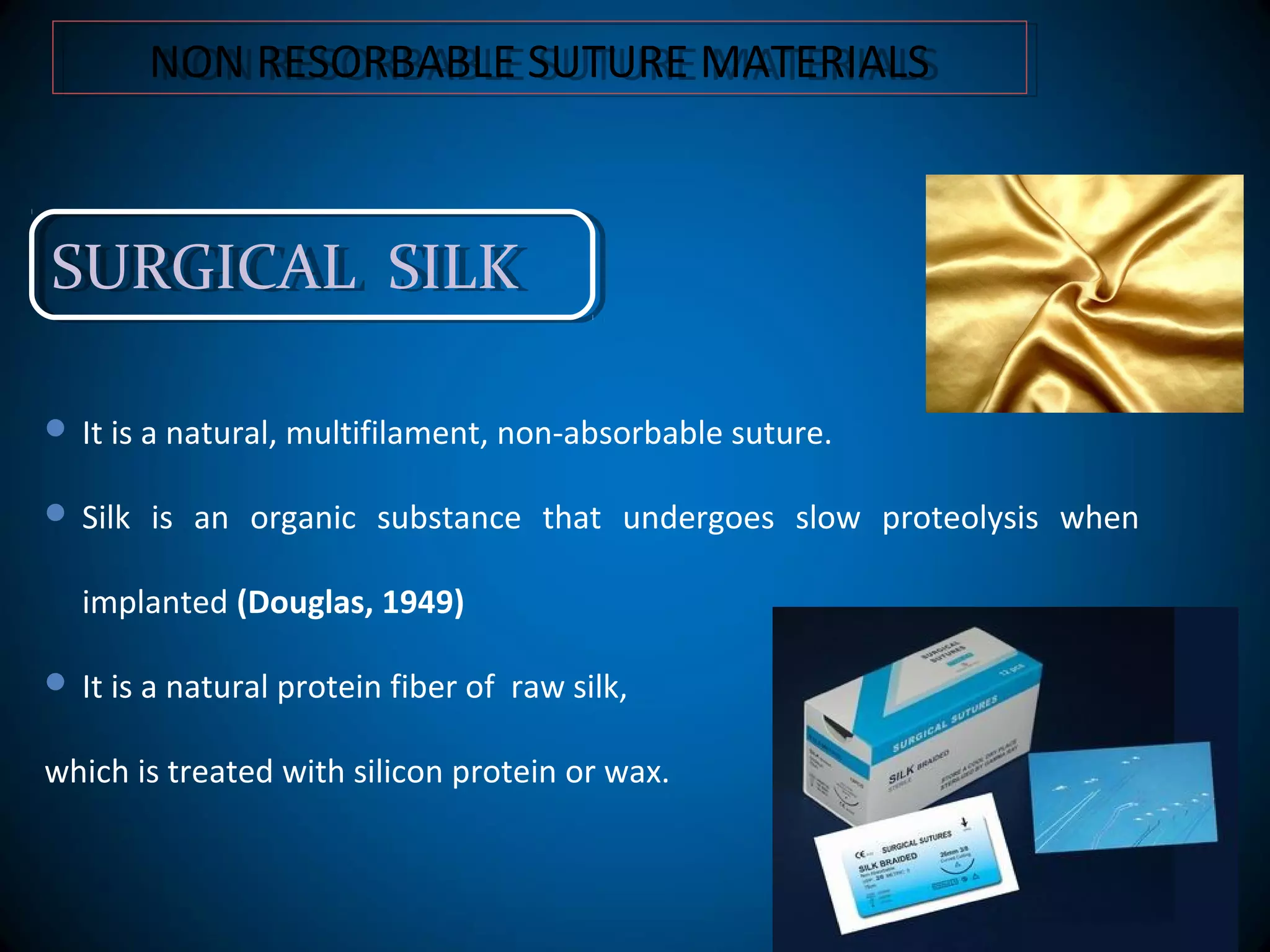
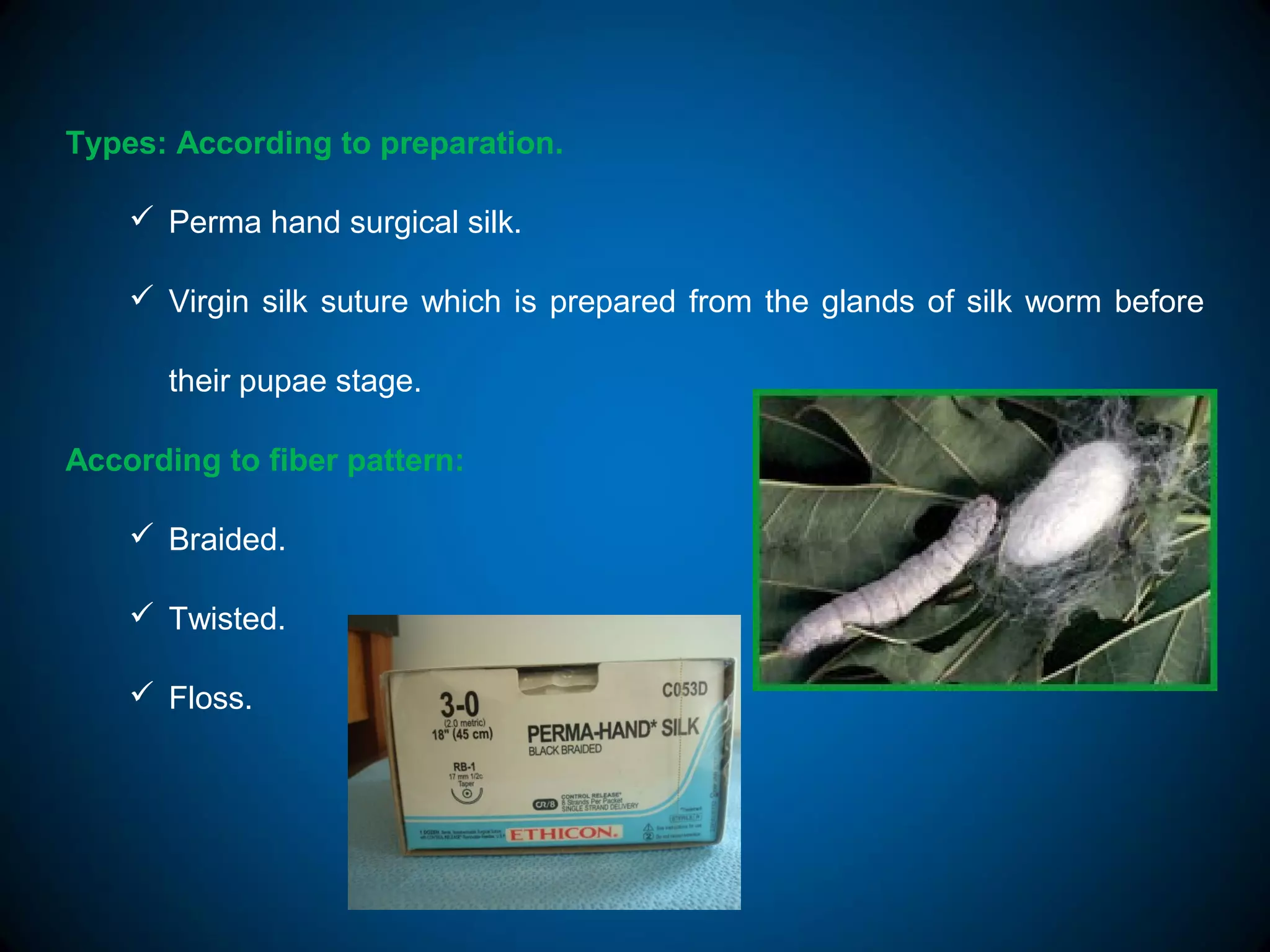
 It is a natural, multifilament, non-absorbable suture.
 Silk is an organic substance that undergoes slow proteolysis when
implanted (Douglas, 1949)
 It is a natural protein fiber of raw silk,
which is treated with silicon protein or wax.
 Silk loses most of the tensile strength after 1 year of implantation and usually
disappears after 2 years.
 It is the most popular inexpensive suture material for intraoral use.
 It is braided, which gives it excellent handling characteristics.
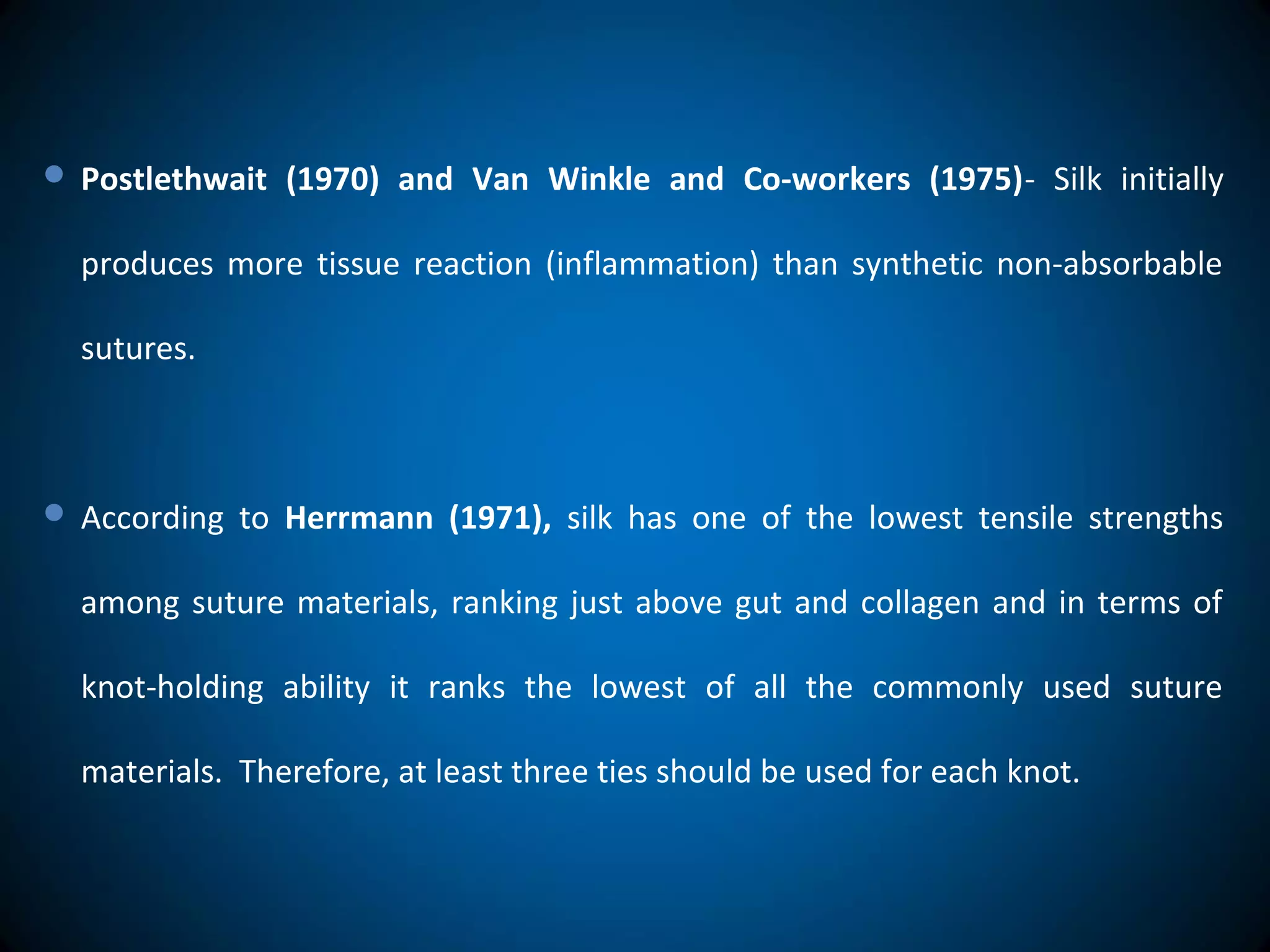
Types: According to preparation.
 Perma hand surgical silk.
 Virgin silk suture which is prepared from the glands of silk worm before
their pupae stage.
According to fiber pattern:
 Braided.
 Twisted.
 Floss.
 Postlethwait (1970) and Van Winkle and Co-workers (1975)- Silk initially
produces more tissue reaction (inflammation) than synthetic non-absorbable
sutures.
 According to Herrmann (1971), silk has one of the lowest tensile strengths
among suture materials, ranking just above gut and collagen and in terms of
knot-holding ability it ranks the lowest of all the commonly used suture
materials. Therefore, at least three ties should be used for each knot.
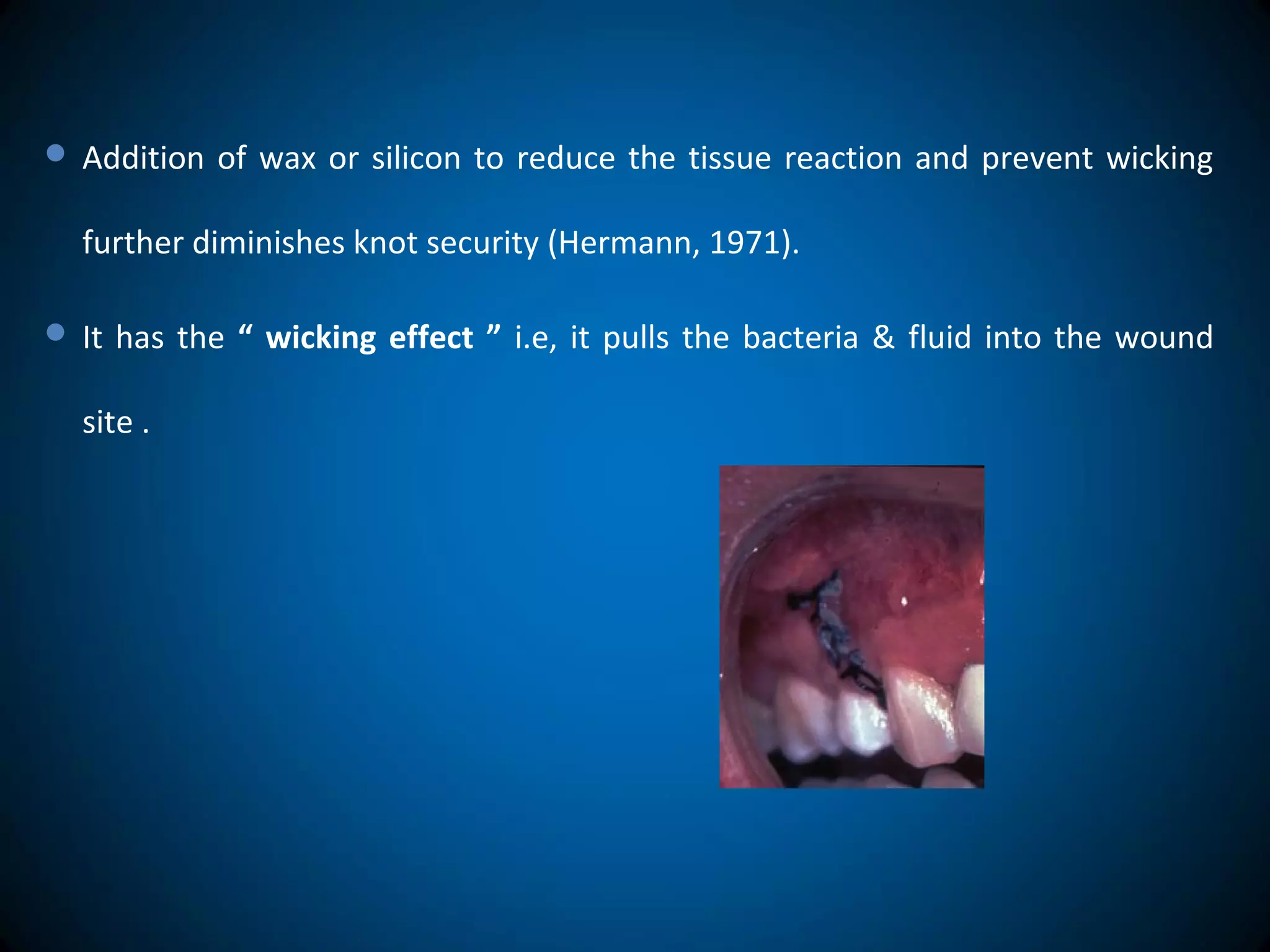
 Addition of wax or silicon to reduce the tissue reaction and prevent wicking
further diminishes knot security (Hermann, 1971).
 It has the “ wicking effect ” i.e, it pulls the bacteria & fluid into the wound
site .
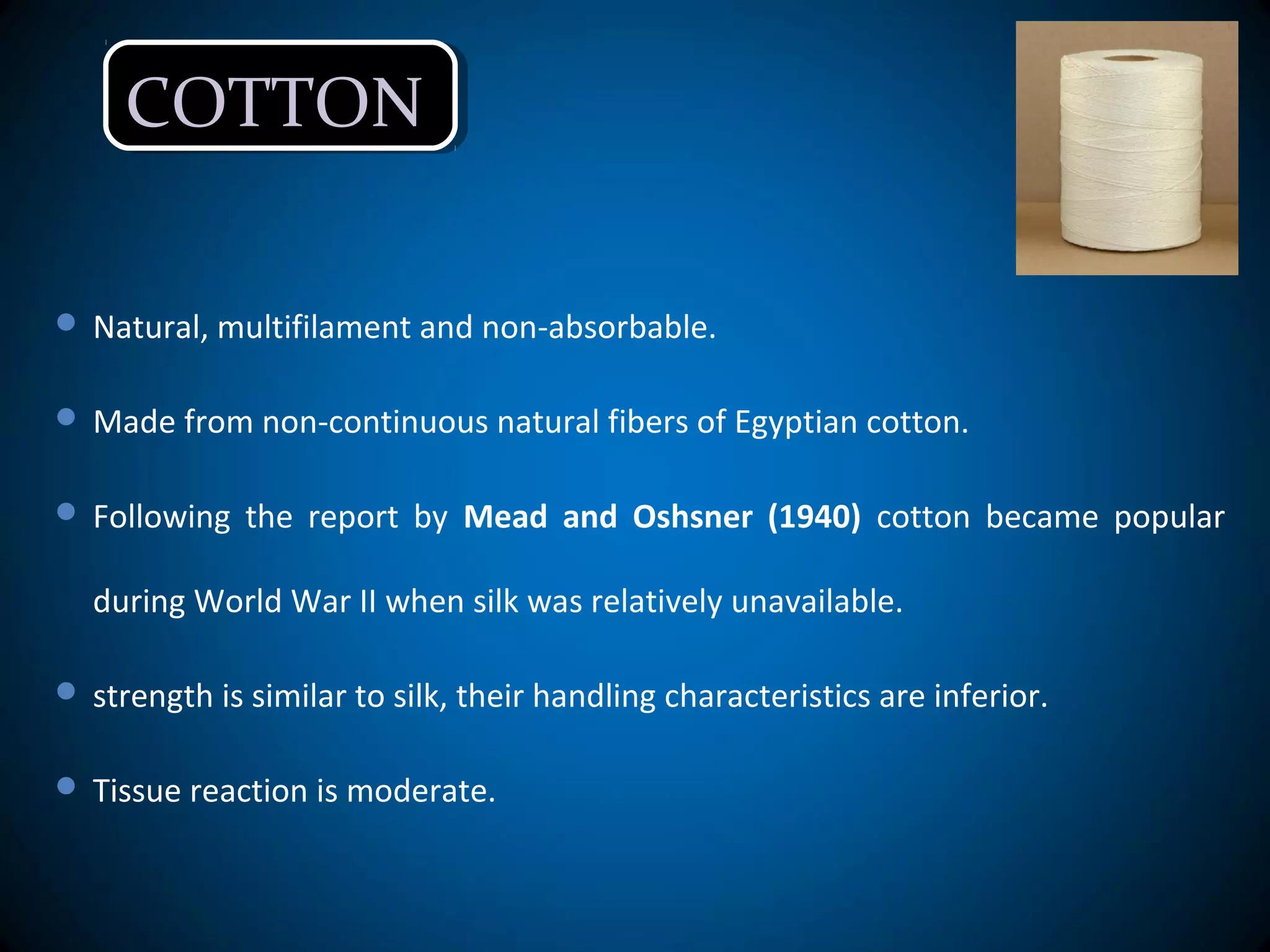
COTTONCOTTON
 Natural, multifilament and non-absorbable.
 Made from non-continuous natural fibers of Egyptian cotton.
 Following the report by Mead and Oshsner (1940) cotton became popular
during World War II when silk was relatively unavailable.
 strength is similar to silk, their handling characteristics are inferior.
 Tissue reaction is moderate.
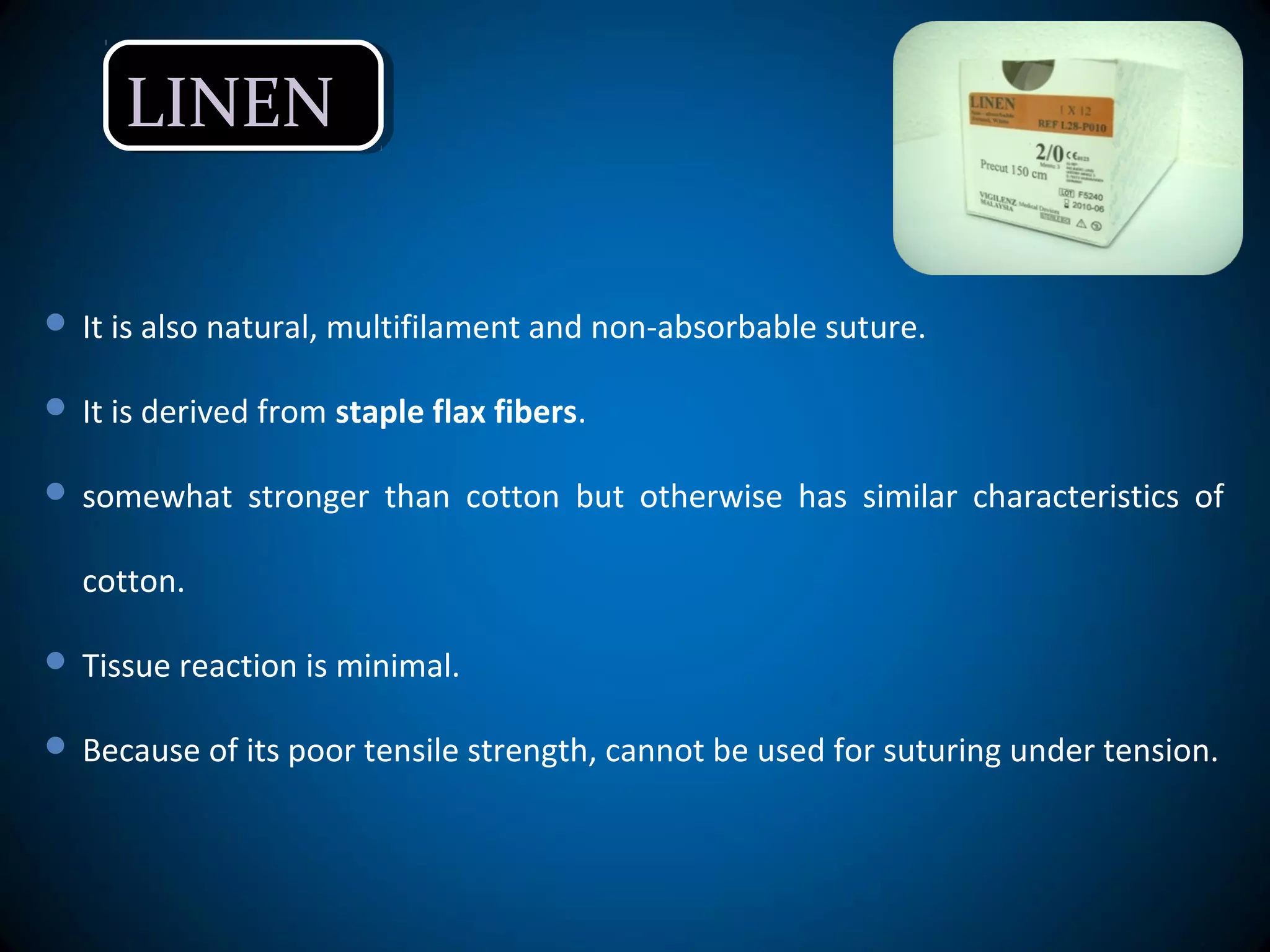
LINENLINEN
 It is also natural, multifilament and non-absorbable suture.
 It is derived from staple flax fibers.
 somewhat stronger than cotton but otherwise has similar characteristics of
cotton.
 Tissue reaction is minimal.
 Because of its poor tensile strength, cannot be used for suturing under tension.
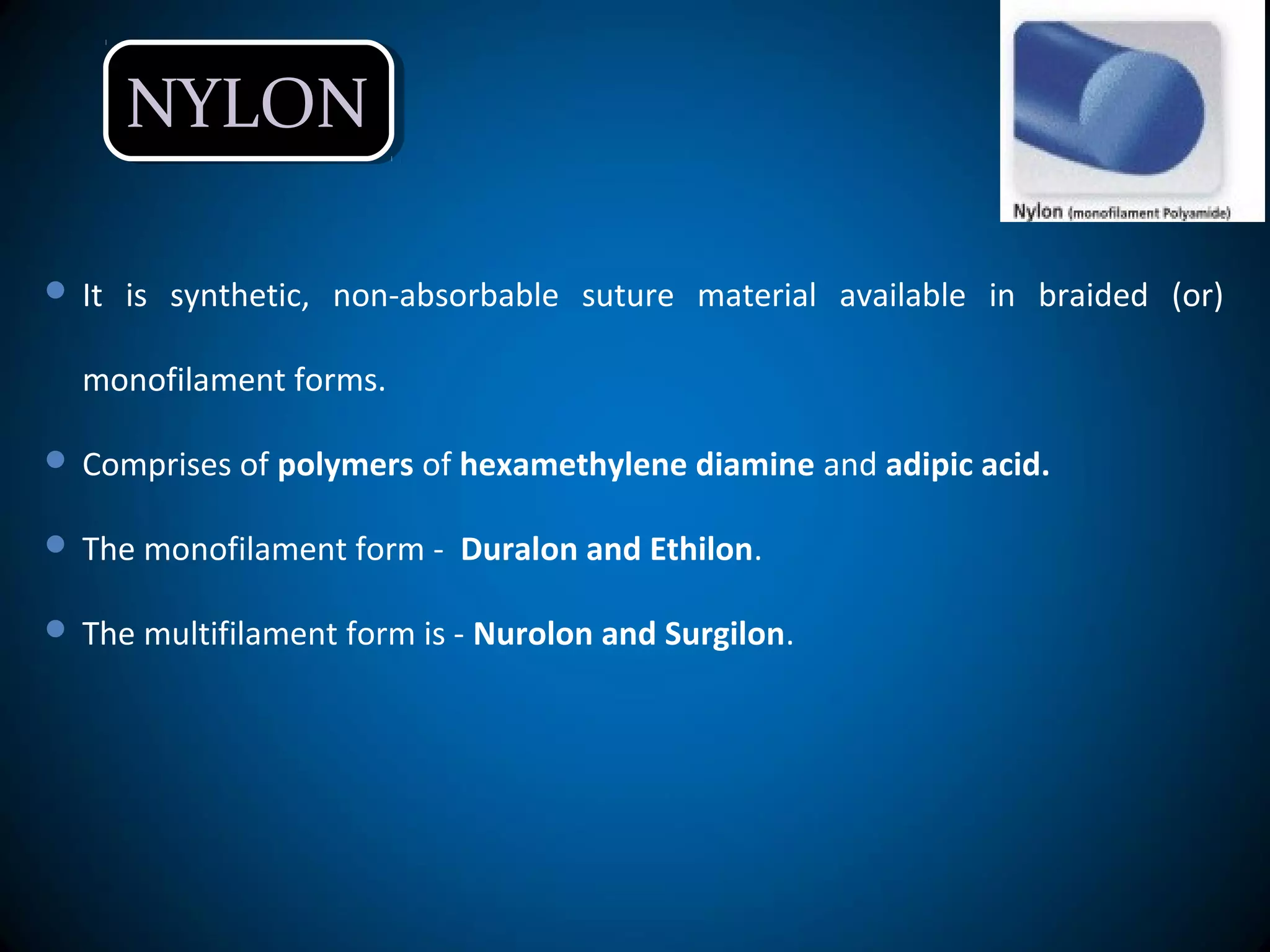
NYLONNYLON
 It is synthetic, non-absorbable suture material available in braided (or)
monofilament forms.
 Comprises of polymers of hexamethylene diamine and adipic acid.
 The monofilament form - Duralon and Ethilon.
 The multifilament form is - Nurolon and Surgilon.
 Nylon possesses the property of “memory”
 Generally, multiple square knots are necessary to maintain the tie.
 It degrades at a rate of 15-20% per year.
 Herrmann (1971) has shown that nylon has good tensile strength but ranks
below that of steel.
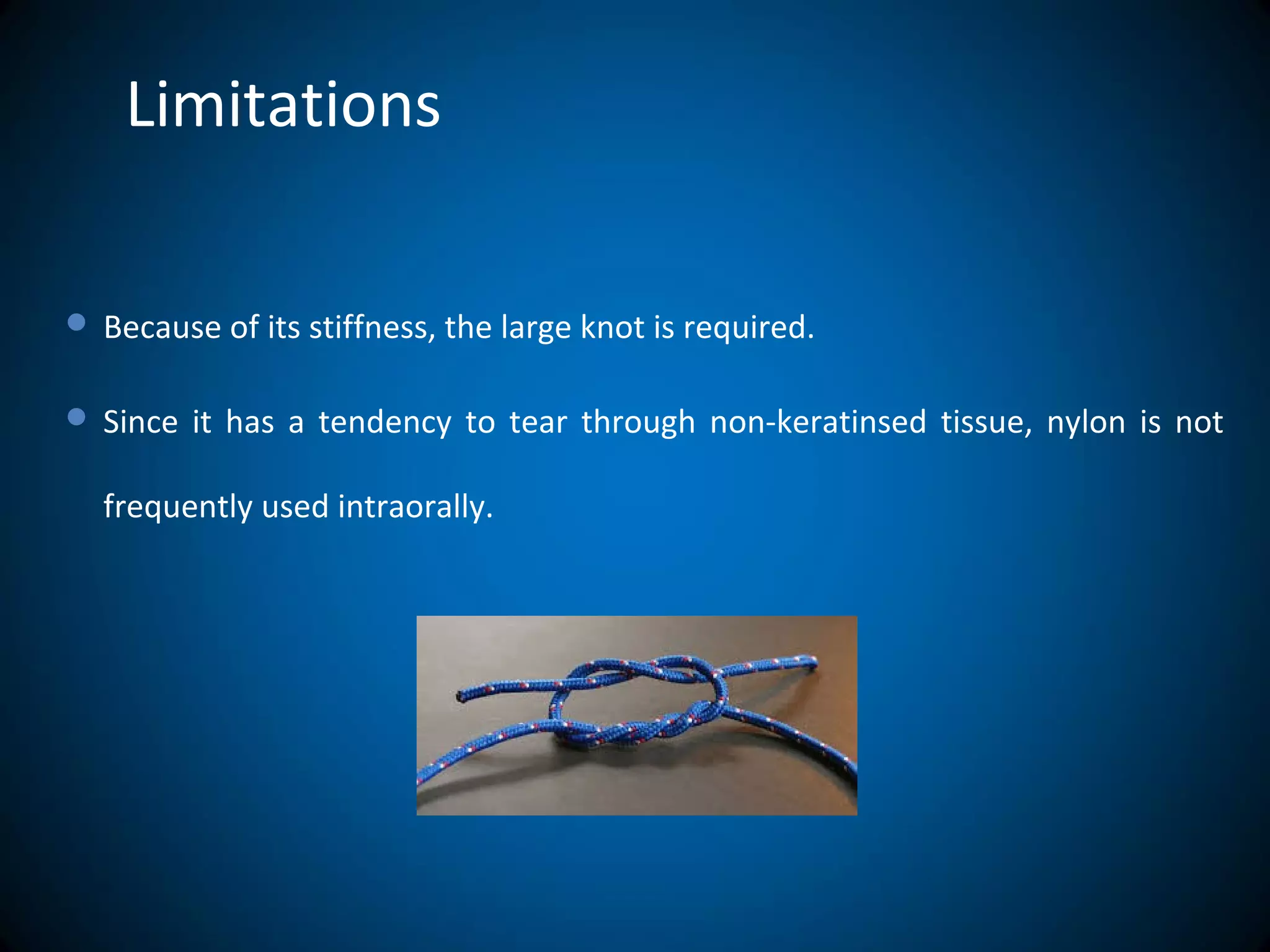
Limitations
 Because of its stiffness, the large knot is required.
 Since it has a tendency to tear through non-keratinsed tissue, nylon is not
frequently used intraorally.
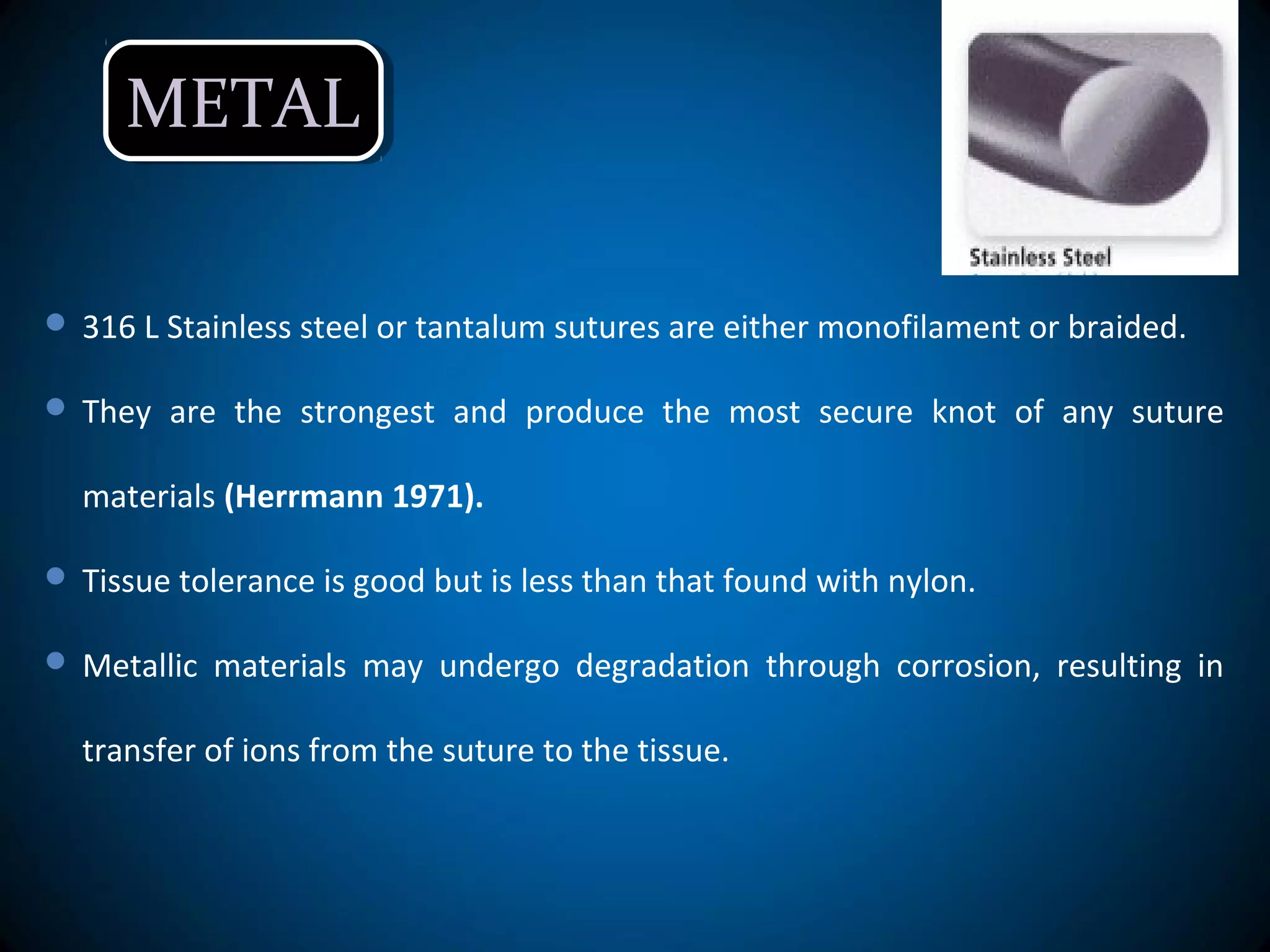
METALMETAL
 316 L Stainless steel or tantalum sutures are either monofilament or braided.
 They are the strongest and produce the most secure knot of any suture
materials (Herrmann 1971).
 Tissue tolerance is good but is less than that found with nylon.
 Metallic materials may undergo degradation through corrosion, resulting in
transfer of ions from the suture to the tissue.
 Tissue reaction to these ions can occur.
 Metallic sutures are stiff and do not conform to the suture pathway during
host movement.
 The resultant irritation may produce tissue damage and increased
susceptibility to infection.
 In oral and maxillofacial surgery used for suspension of splints (or) arch bars
not as suture material.
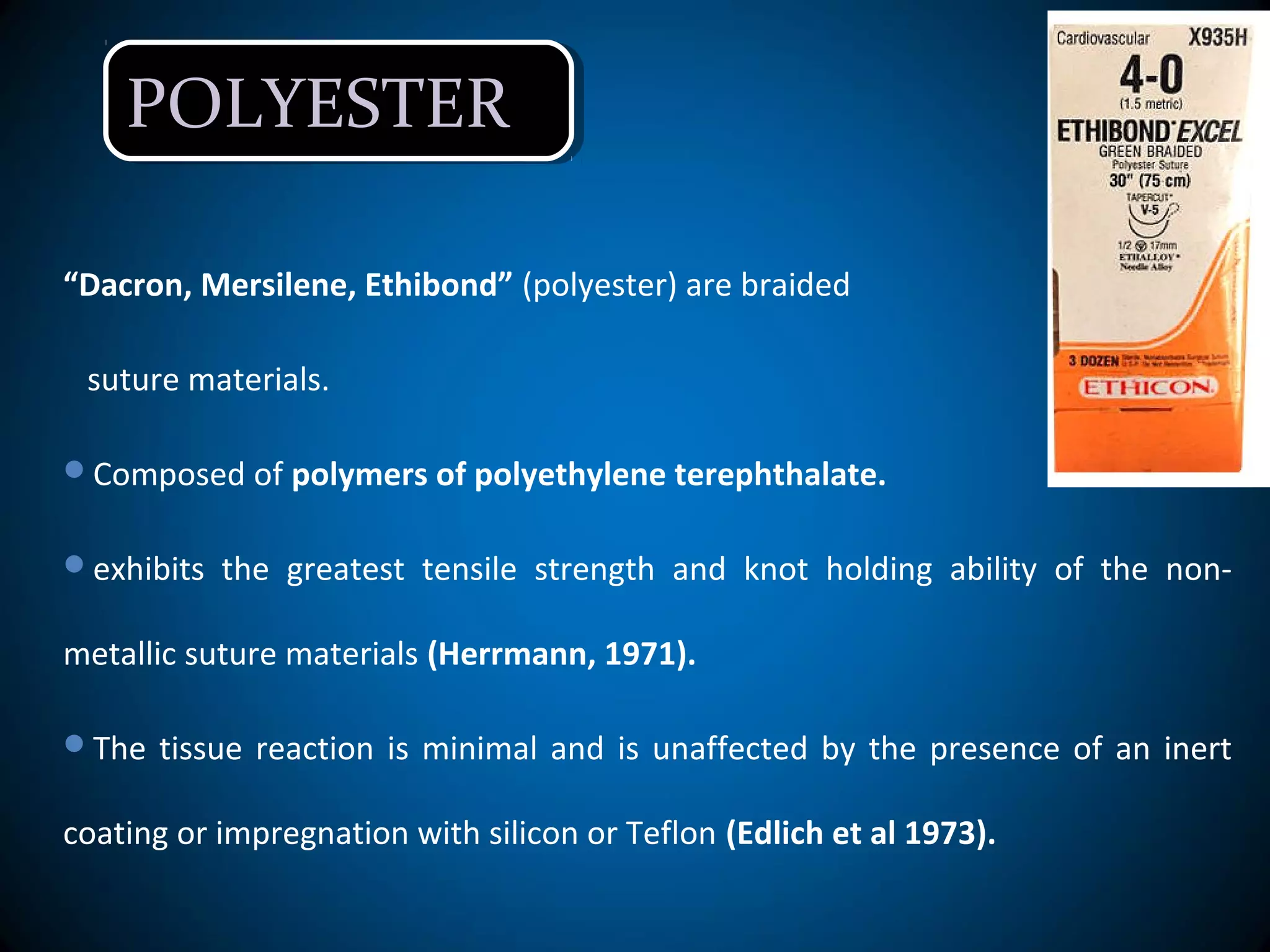
POLYESTERPOLYESTER
“Dacron, Mersilene, Ethibond” (polyester) are braided
suture materials.
Composed of polymers of polyethylene terephthalate.
exhibits the greatest tensile strength and knot holding ability of the non-
metallic suture materials (Herrmann, 1971).
The tissue reaction is minimal and is unaffected by the presence of an inert
coating or impregnation with silicon or Teflon (Edlich et al 1973).
POLYPROPYLENEPOLYPROPYLENE
 Trade name – “Prolene”
 It is synthetic, monofilament and non-absorbable.
 Composed of an isotactic crystalline stereoisomer of polypropylene.
 It exhibits good tensile strength, minimal and transient tissue reaction.
 It is used in all types of soft tissue approximation.
 It shows excellent handling characteristics.
Advantage of plasticity of prolene
 When swelling occurs , prolene will stretch to accommodate the wound
,thus there will be little cutting through the tissue.
 When swelling recedes , the suture will remain loose & keep the edges
properly approximated.
EXPANDED POLYTETRAFLUROETHYLENE
(E-PTFE) GORE-TEX
EXPANDED POLYTETRAFLUROETHYLENE
(E-PTFE) GORE-TEX
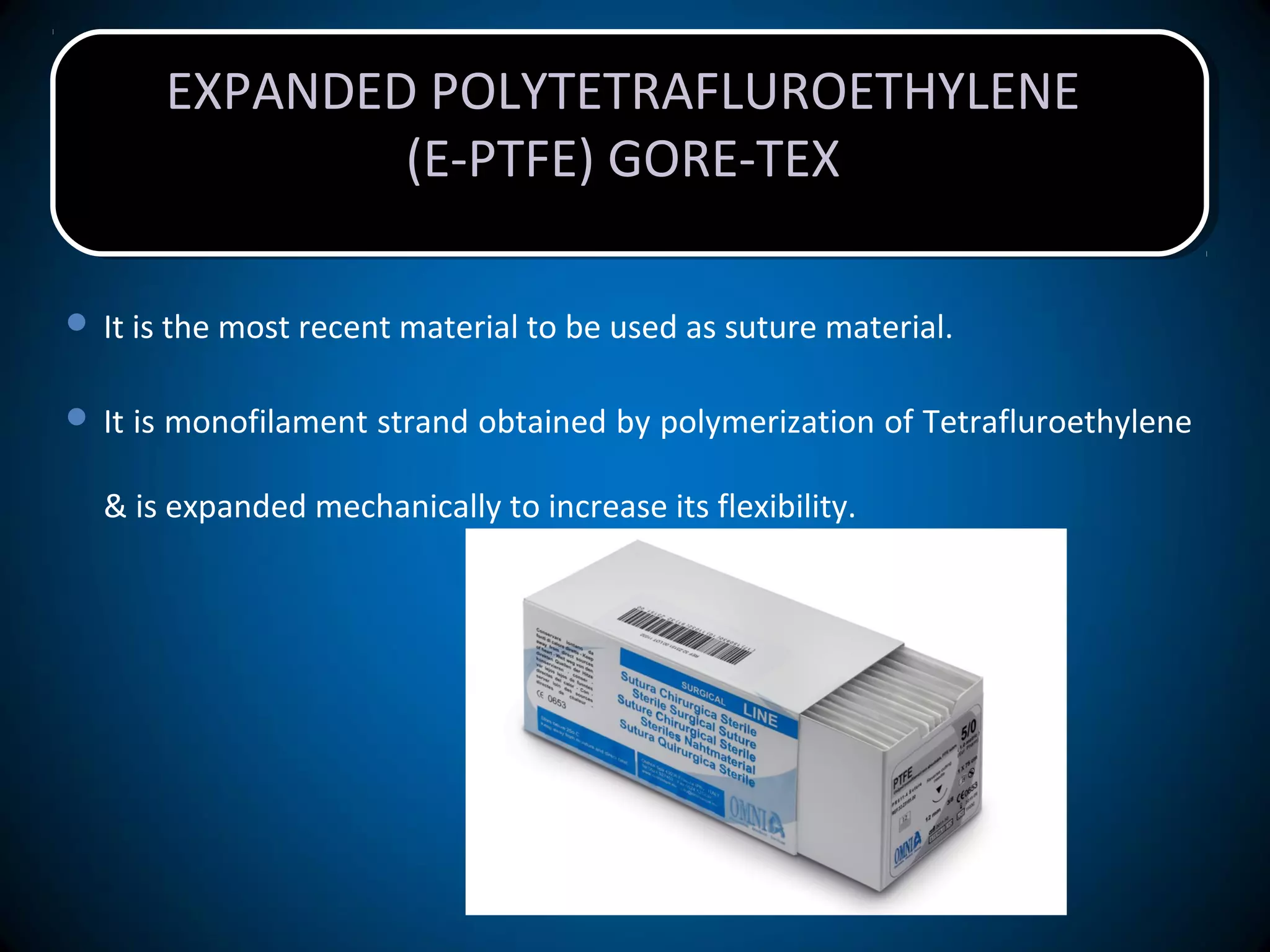
 It is the most recent material to be used as suture material.
 It is monofilament strand obtained by polymerization of Tetrafluroethylene
& is expanded mechanically to increase its flexibility.
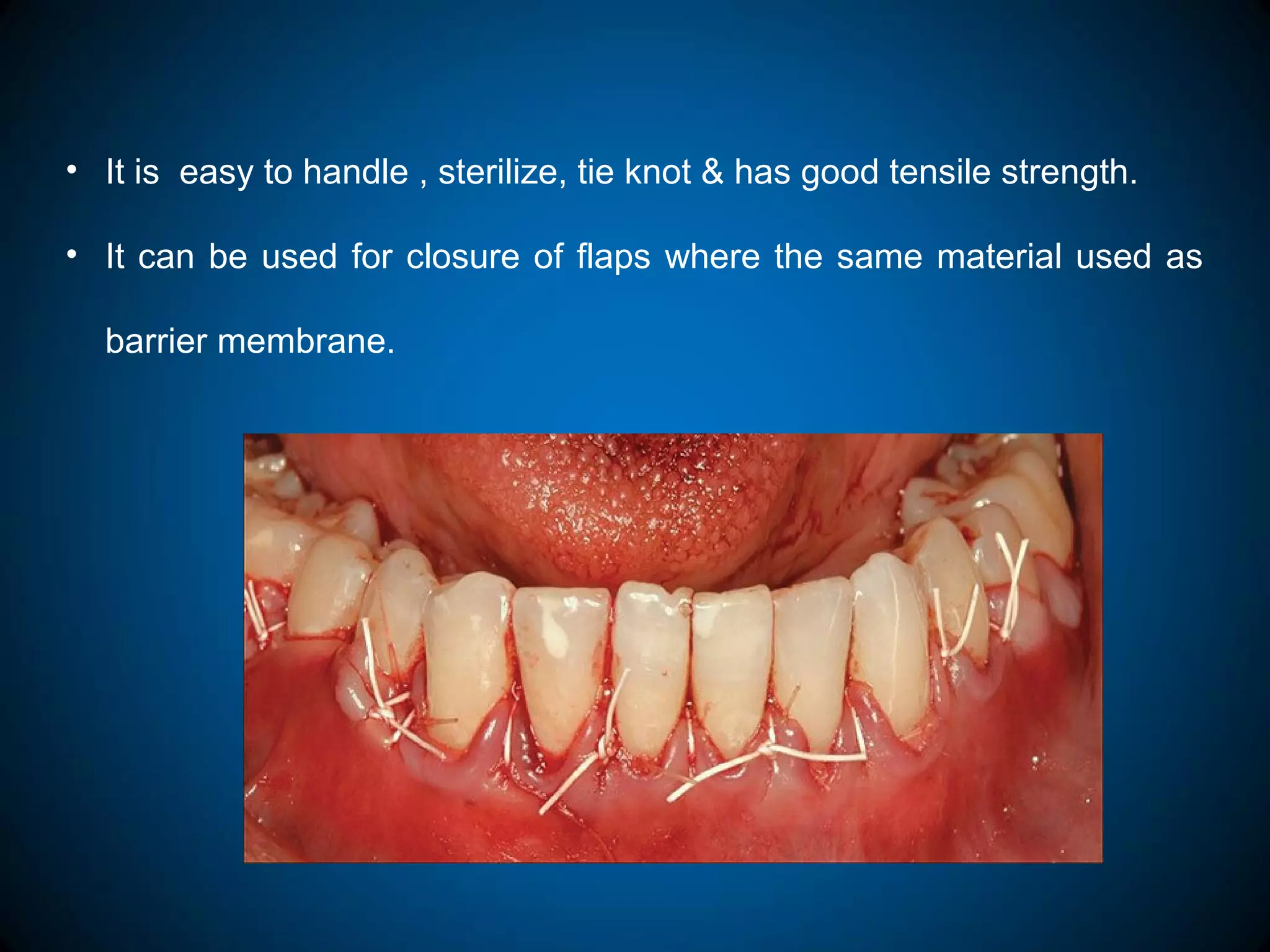
• It is easy to handle , sterilize, tie knot & has good tensile strength.
• It can be used for closure of flaps where the same material used as
barrier membrane.
NEWER MATERIALSNEWER MATERIALS
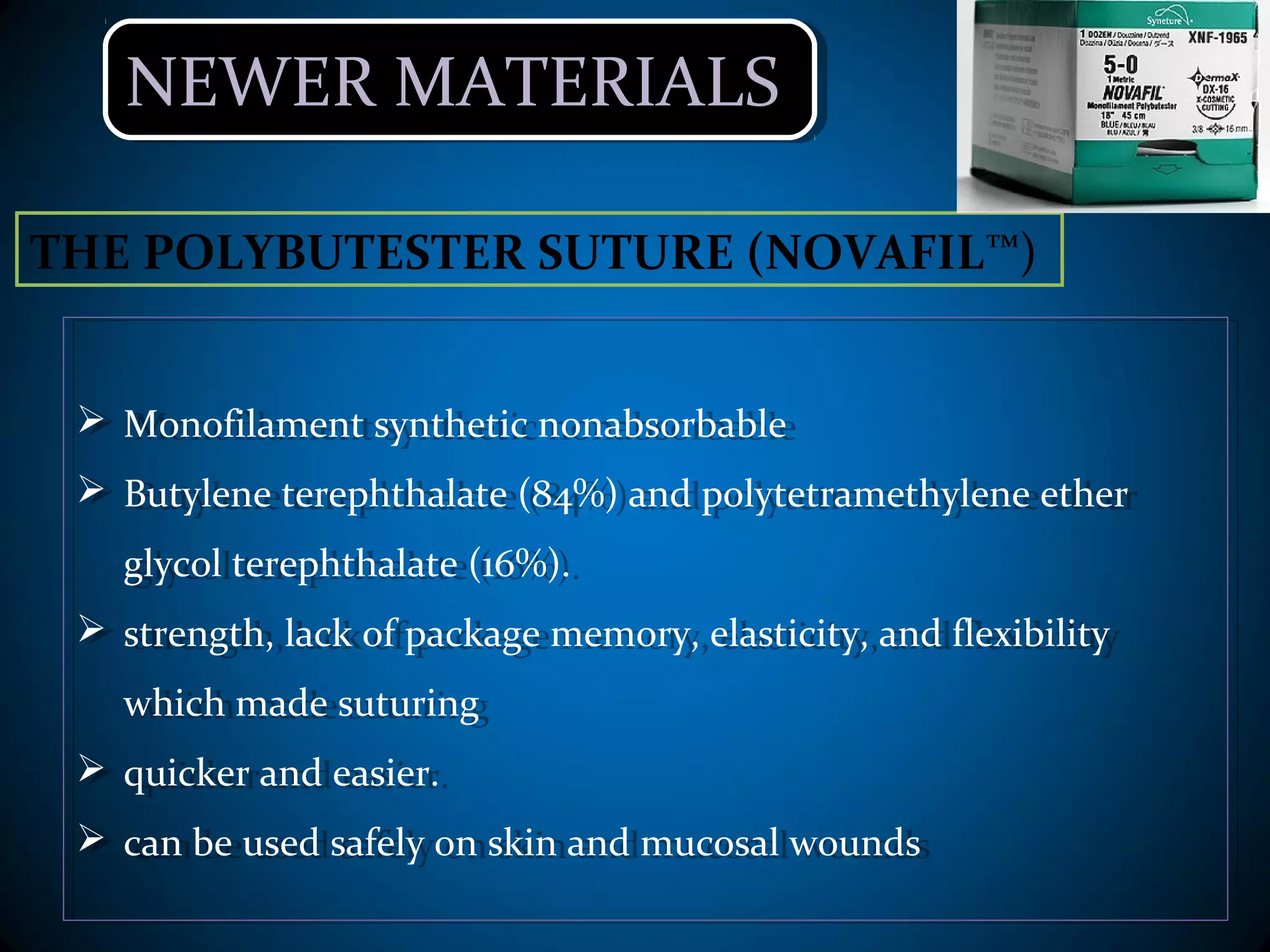
 Monofilament synthetic nonabsorbable
 Butylene terephthalate (84%) and polytetramethylene ether
glycol terephthalate (16%).
 strength, lack of package memory, elasticity, and flexibility
which made suturing
 quicker and easier.
 can be used safely on skin and mucosal wounds
 Monofilament synthetic nonabsorbable
 Butylene terephthalate (84%) and polytetramethylene ether
glycol terephthalate (16%).
 strength, lack of package memory, elasticity, and flexibility
which made suturing
 quicker and easier.
 can be used safely on skin and mucosal wounds
THE POLYBUTESTER SUTURE (NOVAFIL™)
2. POLYSORB- MONOFILAMENT,
ABORBABLE
 Copolymers of glycolide and lactide were then synthesized to
produce a Lactomer™ copolymer).
 Glycolide provides for high initial tensile strength, but hydrolyses
rapidly in tissue. Lactide has a slower and controlled rate of
hydrolysis, and provides for prolonged tensile strength in tissue.
 Copolymers of glycolide and lactide were then synthesized to
produce a Lactomer™ copolymer).
 Glycolide provides for high initial tensile strength, but hydrolyses
rapidly in tissue. Lactide has a slower and controlled rate of
hydrolysis, and provides for prolonged tensile strength in tissue.
 The Lactomer™ copolymer consists of glycolide and lactide in a 9:1
ratio.
 The handling characteristics were found to be superior to those of the
Polyglactin 910™ suture.
 The Lactomer™ copolymer consists of glycolide and lactide in a 9:1
ratio.
 The handling characteristics were found to be superior to those of the
Polyglactin 910™ suture.
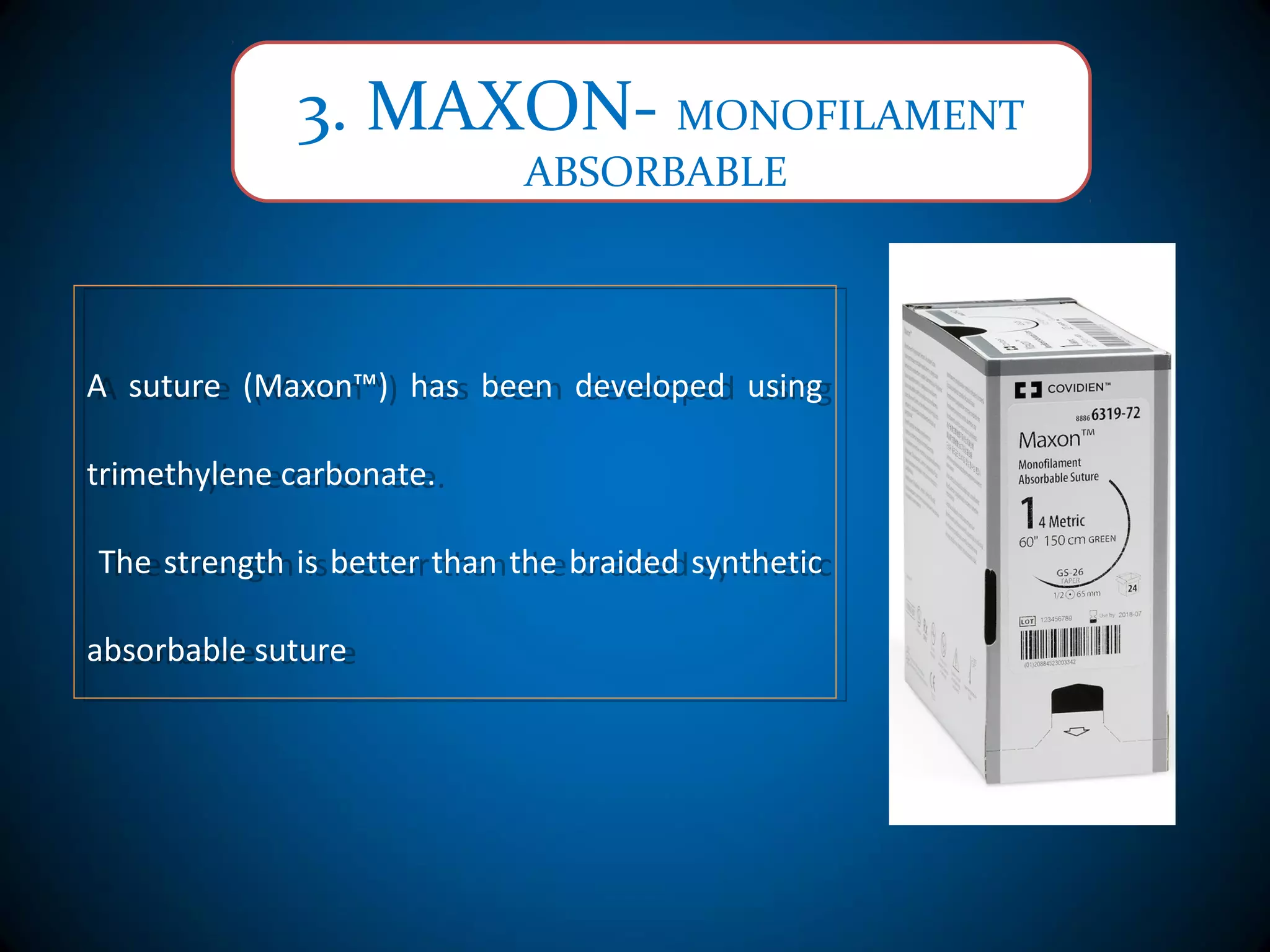
3. MAXON- MONOFILAMENT
ABSORBABLE
A suture (Maxon™) has been developed using
trimethylene carbonate.
The strength is better than the braided synthetic
absorbable suture
A suture (Maxon™) has been developed using
trimethylene carbonate.
The strength is better than the braided synthetic
absorbable suture
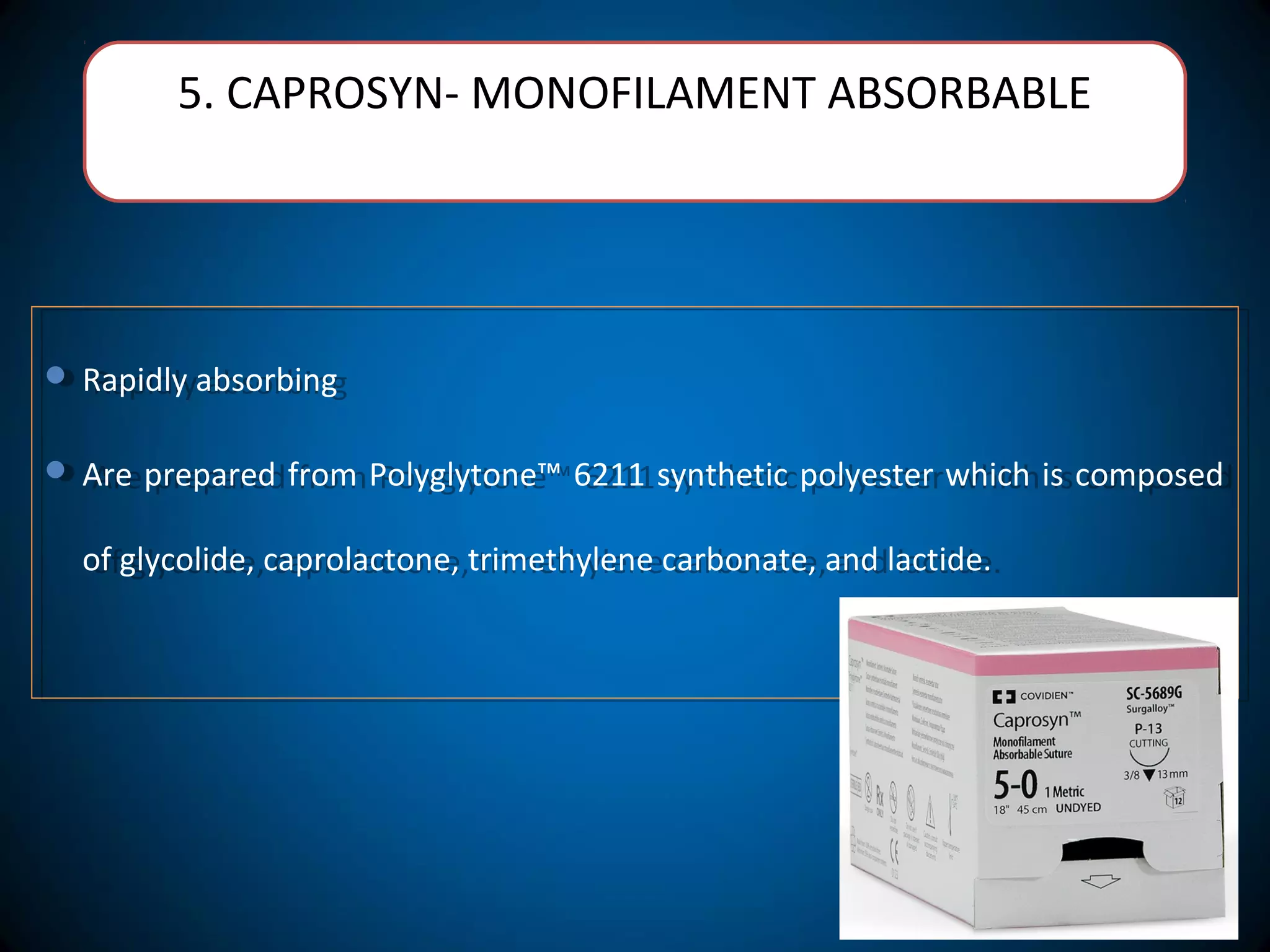
5. CAPROSYN- MONOFILAMENT ABSORBABLE
 Rapidly absorbing
 Are prepared from Polyglytone™ 6211 synthetic polyester which is composed
of glycolide, caprolactone, trimethylene carbonate, and lactide.
 Rapidly absorbing
 Are prepared from Polyglytone™ 6211 synthetic polyester which is composed
of glycolide, caprolactone, trimethylene carbonate, and lactide.
Compared to chromic gut it has:
Significantly greater mean breaking strength, handling properties were far
superior, The smooth surface of the Caprosyn™ sutures encountered lower
drag forces, it was much easier to reposition the Caprosyn™ knotted sutures.
Are an excellent alternative to Chromic Gut sutures.
Compared to chromic gut it has:
Significantly greater mean breaking strength, handling properties were far
superior, The smooth surface of the Caprosyn™ sutures encountered lower
drag forces, it was much easier to reposition the Caprosyn™ knotted sutures.
Are an excellent alternative to Chromic Gut sutures.
SUTURE SELECTION
• Location of wound
• Static and dynamic wound tension
• Presence of infection (fever)
• Cost of suture material
75
• The initial body response to sutures is almost identical
in the first 4-7 days, regardless of the suture
material.
• The early response is a generalized acute aseptic
inflammation, involving primarily polymorphonuclear
leukocytes.
• After few days mononuclear cells, fibroblasts &
histiocytes become evident.
• Capillary formation occurs at the end of this initial
phase.
BIOLOGIC RESPONSE OF BODY TO SUTURE
MATERIALS
AFTER 4-7 DAYS
The response is related more to the type of suture material.
For eg. Plain gut elicits an intense reaction with macrophages and
polymorphonuclear leucocytes predominating, while non-absorbable materials
show a less intense relatively acellular histological pattern.
In human study conducted by Elen and Conen the presence of the
suture increased the susceptibility to infection by a factor of 10,000
times.
• Natural Absorbable – Proteolytic
degradation. Intense tissue response
• Synthetic Absorbable – Hydrolysis. Less
Intense
• Non Absorbable – Encapsulation. Acellular
Response
ARMAMENTERIUM
FOR SUTURING
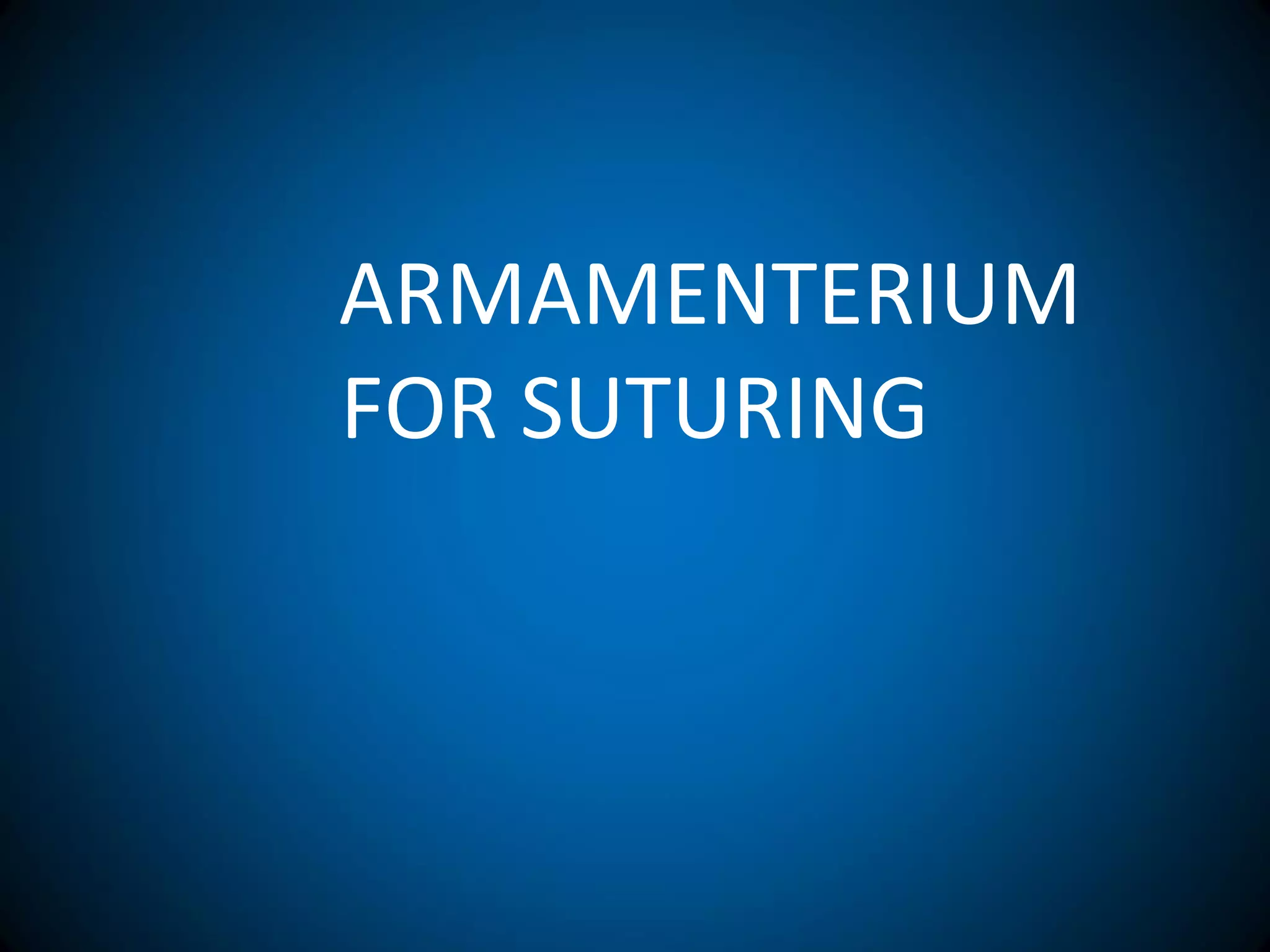
Armamenterium
 SUTURE MATERIAL
 SUTURING NEEDLE
 NEEDLE HOLDER
 TISSUE HOLDING FORCEP
 SUTURE CUTTING SCISSOR
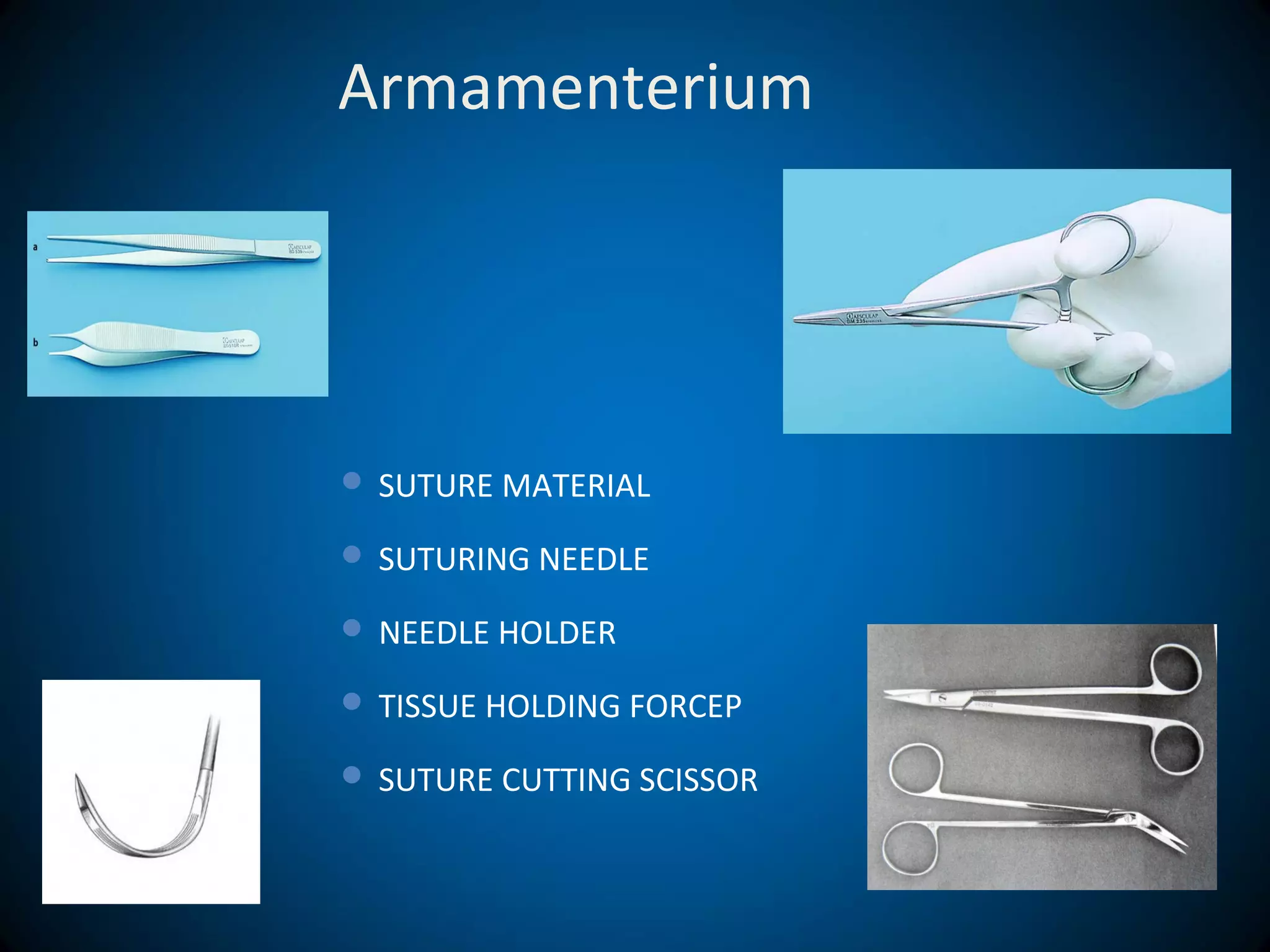
NEEDLE HOLDERS
 Must be made of non corrosive, high
strength good quality steel alloy with
jaws designed for holding the suture
needle securely.
 It may be short or long ,broad or
narrow, slotted or flat, concave or
convex.
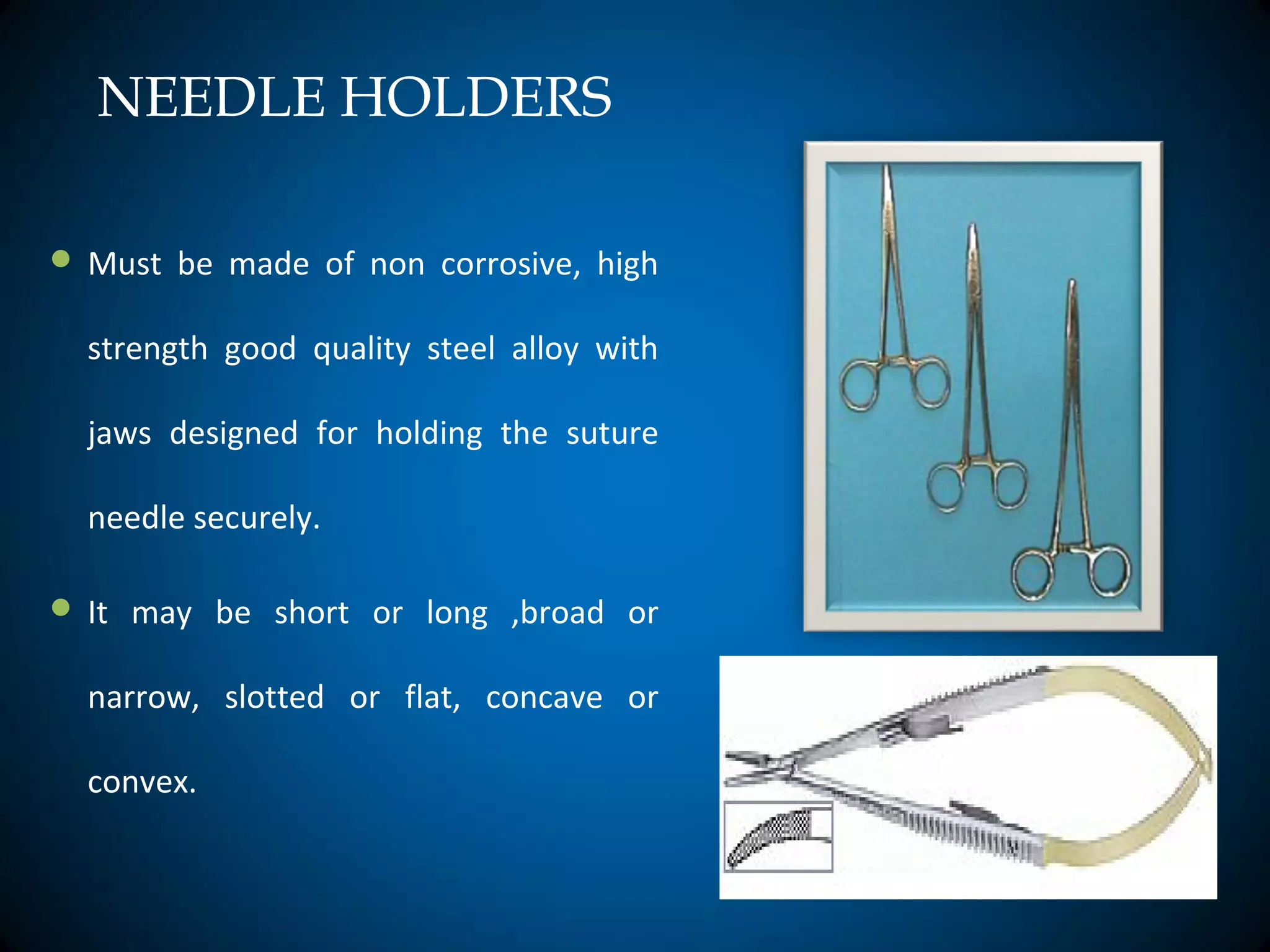
Jaws with tungsten carbide particles embedded in them offer two distinct
advantages.
Good holding power
Less damage to suture material
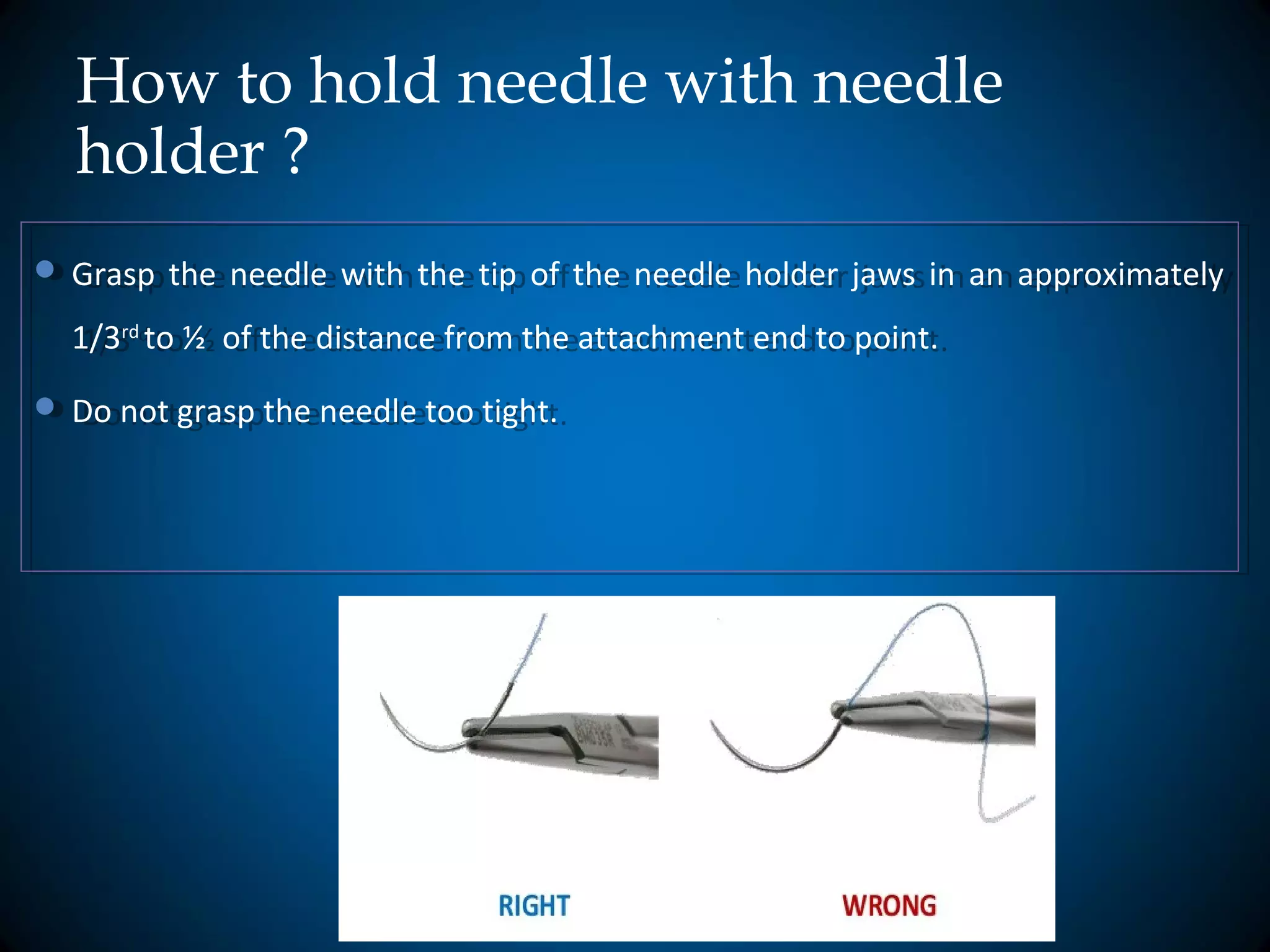
How to hold needle with needle
holder ?
 Grasp the needle with the tip of the needle holder jaws in an approximately
1/3rd
to ½ of the distance from the attachment end to point.
 Do not grasp the needle too tight.
 Grasp the needle with the tip of the needle holder jaws in an approximately
1/3rd
to ½ of the distance from the attachment end to point.
 Do not grasp the needle too tight.
Suture Needles
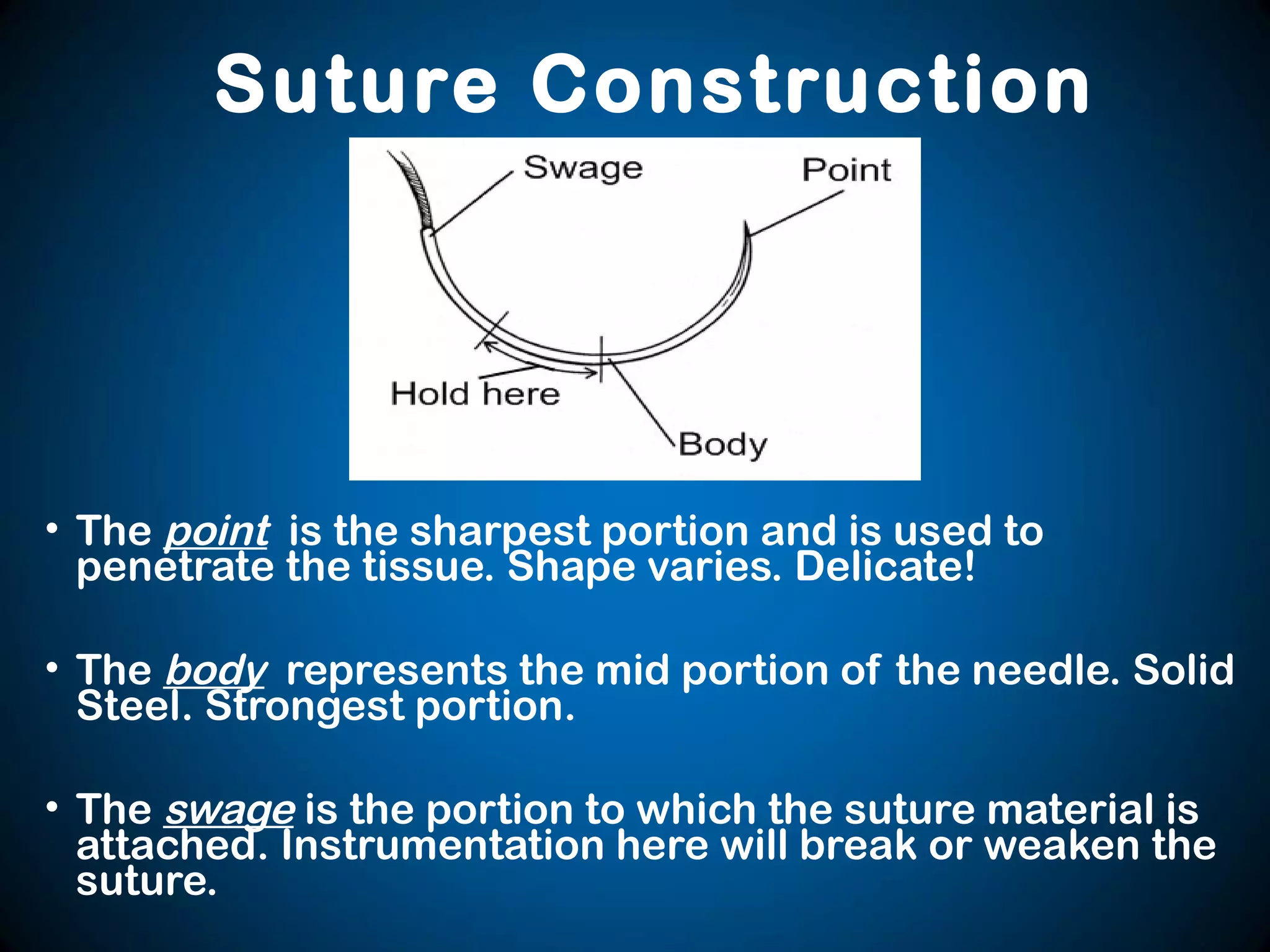
Suture Construction
• The point is the sharpest portion and is used to
penetrate the tissue. Shape varies. Delicate!
• The body represents the mid portion of the needle. Solid
Steel. Strongest portion.
• The swage is the portion to which the suture material is
attached. Instrumentation here will break or weaken the
suture.
Things to consider…
• While chosing a needle type for suturing
• Type of needle- Type of tissue being closed
• Curvature of the needle- based on working
space in operative field
Needle material
• Initially stainless steel needles were being
used
• Now we use Surgalloy- a high nickel stainless
steel
– Gives it better resistance to bending and breakage
Structure of suturing needle
Anatomy of the needle
• Chord length- straight line distance from point
of curve to swage
• Needle length- the entire length of the needle
• Radius- distance between the centre of the
circle to the body of the needle if the curved
needle were to make a full circle
• Diameter- thickness of the needle
Anatomy of the needle
• Swage: This is the suture attachment end
creates a single, continuous unit of suture
and needle. This may be designed to allow
easy release of the needle and suture material
(pop-off)
• The surgical needle may be coated
with silicone to allow easier tissue passage.
Types of suture needles
• Round bodied
– Minimises the tissue trauma because the needle
pierces the tissue without cutting it.
– Used for suturing peritoneum, abdominal viscera,
myocardium, dura.
• Cutting needle
– Have two opposing cutting edges.
– Designed to cut through tough difficult to penetrate
structures.
– Used in plastic surgery, especially of the face.
Types of suture needles
• Reverse cutting needle
– Designed with cutting edge
on the outer convex side
– For skin, oral mucosa,
tendon sheaths
• Blunt needles
– To dissect to friable tissue
rather than cutting
through it
– For suturing liver and
kidney
94
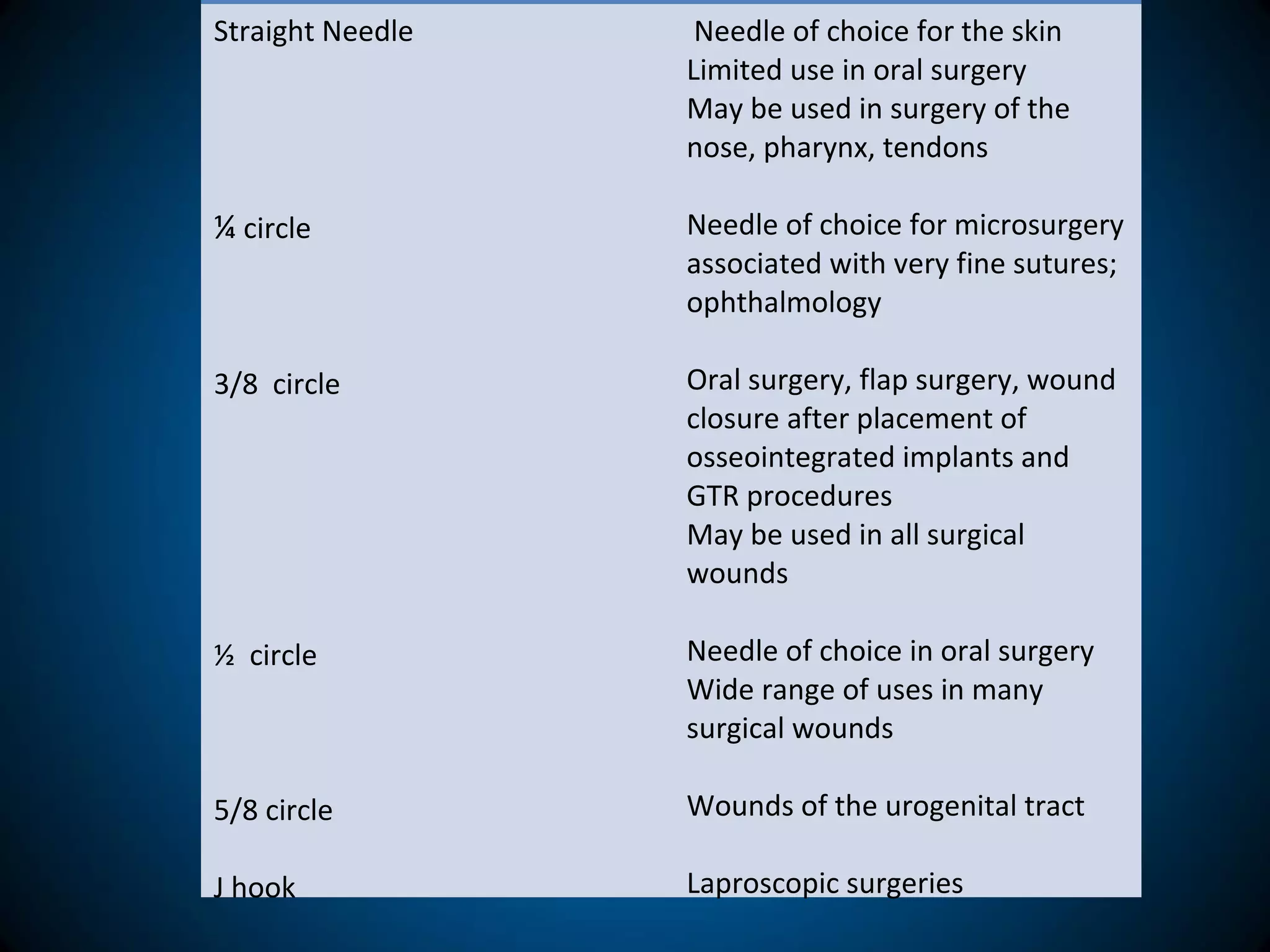
Shapes of sututre needles
Straight Needle
¼ circle
3/8 circle
½ circle
5/8 circle
J hook
Needle of choice for the skin
Limited use in oral surgery
May be used in surgery of the
nose, pharynx, tendons
Needle of choice for microsurgery
associated with very fine sutures;
ophthalmology
Oral surgery, flap surgery, wound
closure after placement of
osseointegrated implants and
GTR procedures
May be used in all surgical
wounds
Needle of choice in oral surgery
Wide range of uses in many
surgical wounds
Wounds of the urogenital tract
Laproscopic surgeries
PRINCIPLES OF SUTURING
1.The needle holder should grasp the needle at approximately ¾
of the distance from the point.
2.The needle should enter the tissue perpendicular to the
surface.if the needle pierces the tissue obliquely a tear may
develop.
3.The needle should be passed through the tissue following the
curve of the needle.treating a curved needle as a straight needle
for example will result in tissue damage.
4.The suture should be placed at an equal distance(2-3mm)from
the incision on both sides and at an equal depth.This principle
can be modified in cases where the tissue edges to be sutured
are at different levels;then passage of the suture closer to the
edge of the lower side and farther from the edge of the higher
side will tend to approximte the levels ,another method involves
passage of the suture at an equal distance from the wound
margin on both the sides but deeper into the tissue on the lower
side and more superficially on the higher side.
• 5.If one side is free(as with a flap)and other fixed,the needle
should be passed from the free to the fixed side.
• 6.If one tissue is thinner than the other then the needle
should be passed from the thinner to thicker side.
• 7.If one tissue plane is deeper than the other then the needle
should be passed from deeper to the superficial side.
• 8.The distance that the needle is passed into the tissue should
be greater than the tissue edge.this will ensure a degree of
tissue eversion .some degree of tissue eversion is desirable in
anticipation of scar contracture.
• 9.The tissue should not be closed under tension ,since they
will either tear or necrose around the suture.If tension is
present the tissue layer should be undermined to relieve it.
• 10.The suture should be tied so the tissue is merely
approximated not blanched.
• 11.The knot should not be placed over the incision line.
• 12.Sutures should be placed aproximately 3-4mm apart.the
closeness of the suture depends upon the anticipated
tension across the suture line.closer spaced sutures are
indicated in areas of underlying muscular activity such as the
tongue or in the other areas of increased tension.
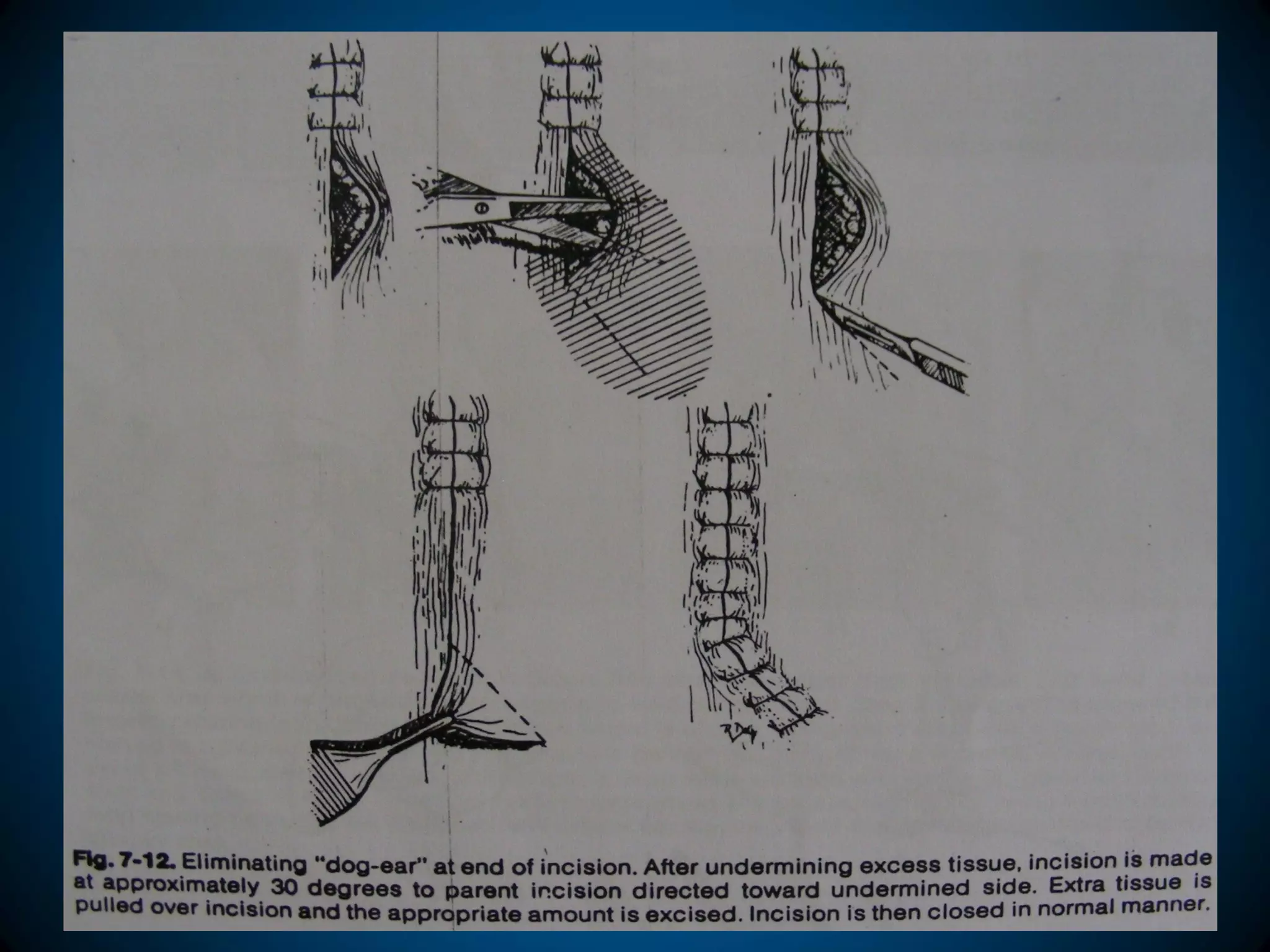
13.Occasionaly extra tissue may be present on one side of the
incision and a cause a “dog ear”to be formed in the final phase
of wound closure.simply extending the length of incision to hide
the excess will produce an unsatisfactory result.technique to
deal with is a release in extension of the laceration or incision
line.
Suture Technique
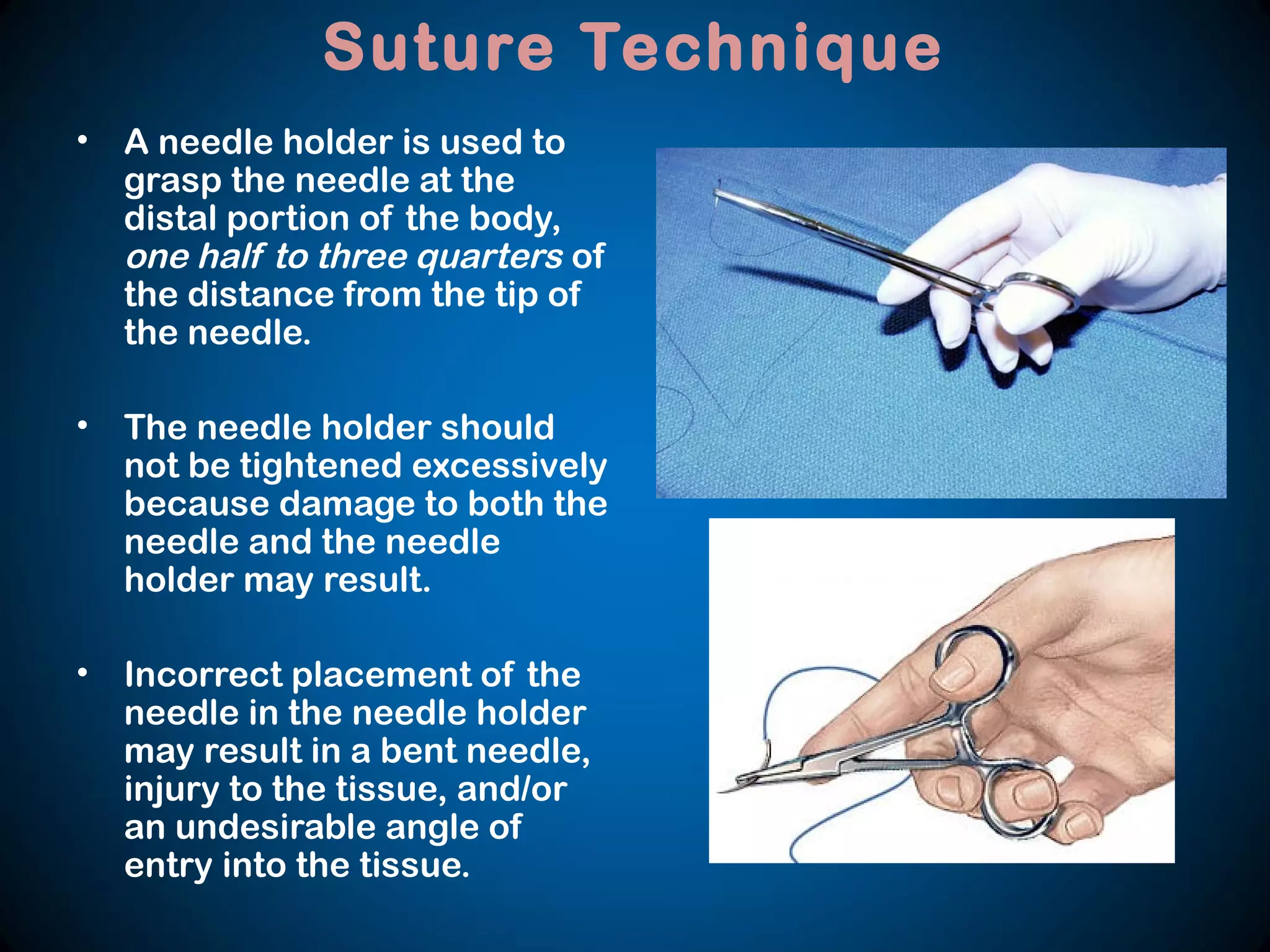
• A needle holder is used to
grasp the needle at the
distal portion of the body,
one half to three quarters of
the distance from the tip of
the needle.
• The needle holder should
not be tightened excessively
because damage to both the
needle and the needle
holder may result.
• Incorrect placement of the
needle in the needle holder
may result in a bent needle,
injury to the tissue, and/or
an undesirable angle of
entry into the tissue.
Suturing Technique
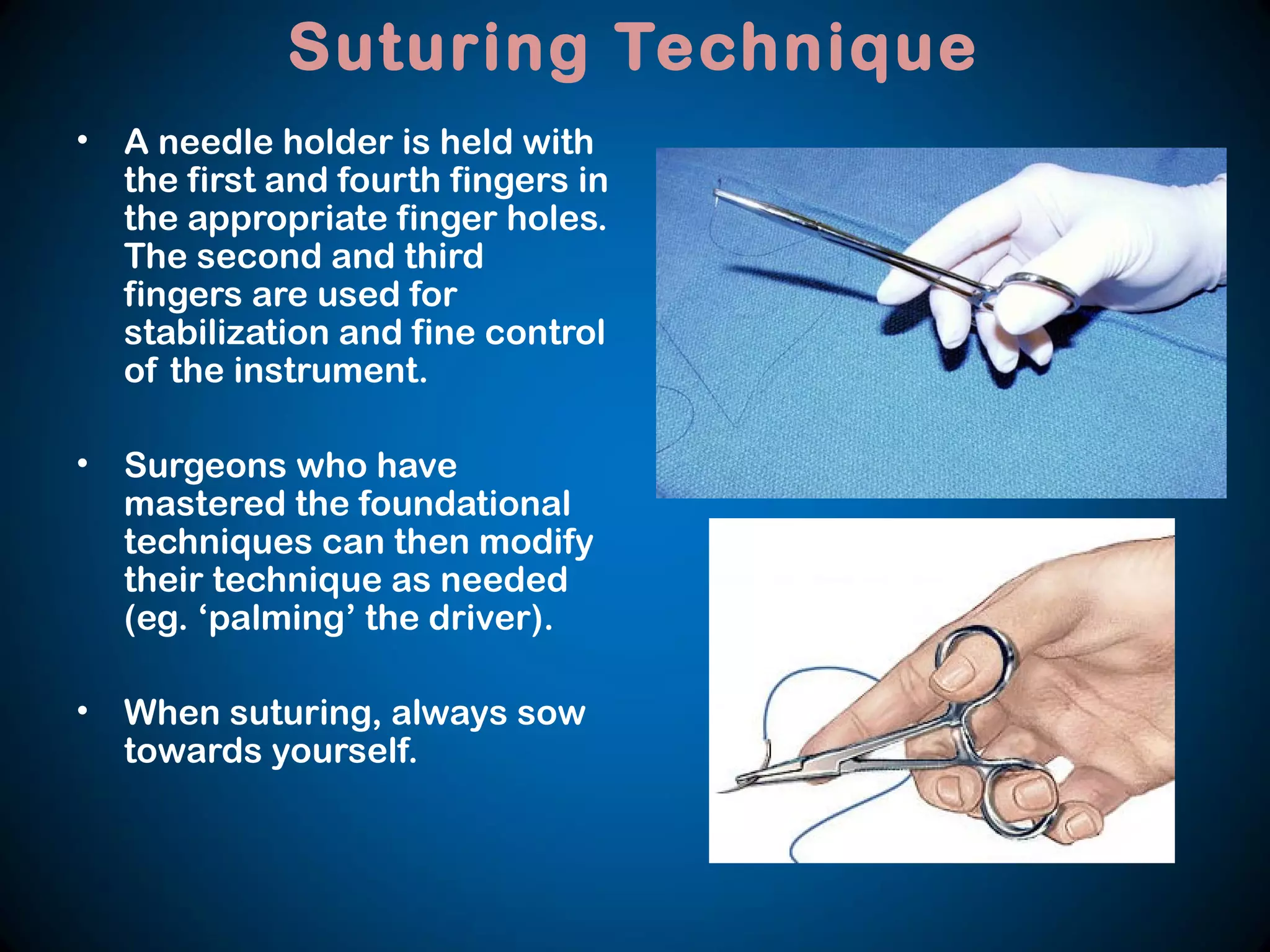
• A needle holder is held with
the first and fourth fingers in
the appropriate finger holes.
The second and third
fingers are used for
stabilization and fine control
of the instrument.
• Surgeons who have
mastered the foundational
techniques can then modify
their technique as needed
(eg. ‘palming’ the driver).
• When suturing, always sow
towards yourself.
• The tissue must be stabilized to
allow needle placement. Toothed
or plain forceps may be used to
gently grasp the tissue. Excessive
trauma to the tissue being should
be avoided to reduce the possibility
of tissue strangulation and
necrosis.
• Forceps are meant primarily for
grasping tissue. Not for handling
the needle.
• Sometimes it is necessary to grasp
the needle as it exits the tissue
after a pass. Grasping and
stabilizing the needle should be
done prior to releasing the needle
holder. Otherwise, the needle may
become lost in the tissues.
Suturing Technique
105
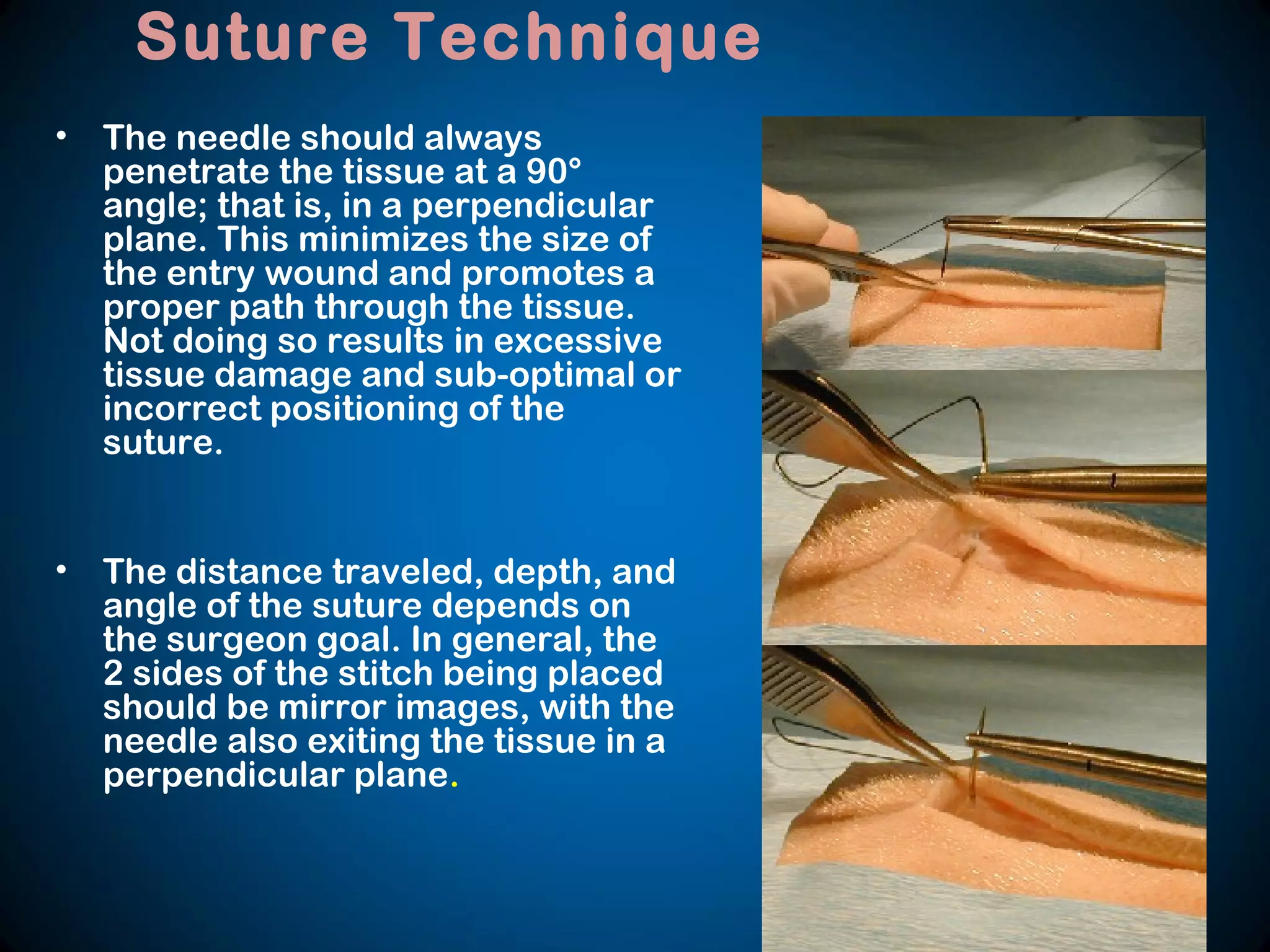
• The needle should always
penetrate the tissue at a 90°
angle; that is, in a perpendicular
plane. This minimizes the size of
the entry wound and promotes a
proper path through the tissue.
Not doing so results in excessive
tissue damage and sub-optimal or
incorrect positioning of the
suture.
• The distance traveled, depth, and
angle of the suture depends on
the surgeon goal. In general, the
2 sides of the stitch being placed
should be mirror images, with the
needle also exiting the tissue in a
perpendicular plane.
Suture Technique
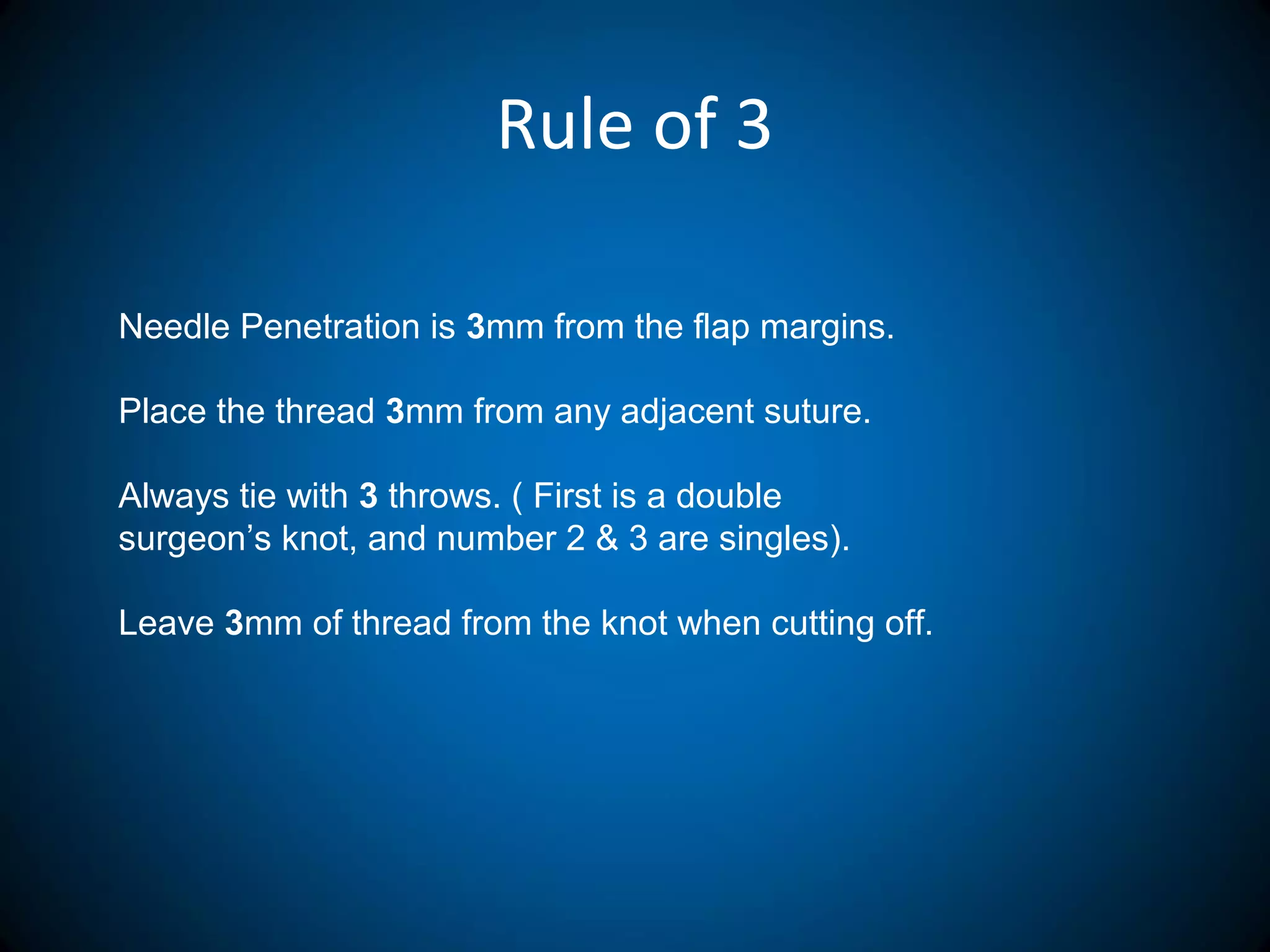
Rule of 3
Needle Penetration is 3mm from the flap margins.
Place the thread 3mm from any adjacent suture.
Always tie with 3 throws. ( First is a double
surgeon’s knot, and number 2 & 3 are singles).
Leave 3mm of thread from the knot when cutting off.
INTERRUPTED SUTURESINTERRUPTED SUTURES
They are also called “ solitary sutures ” .They have shorter span & close
only a shorter distance of flap.
Indications:
•Vertical incision
• Tuberosity and retromolar areas
•Bone regeneration procedures with or without guided tissue
regeneration
•Widman flaps, open flap curettage, unrepositioned flaps, or apically
positioned flaps where maximum interproximal coverage is required
•Edentulous areas, osseointegrated implants
•Partial or split-thickness flaps
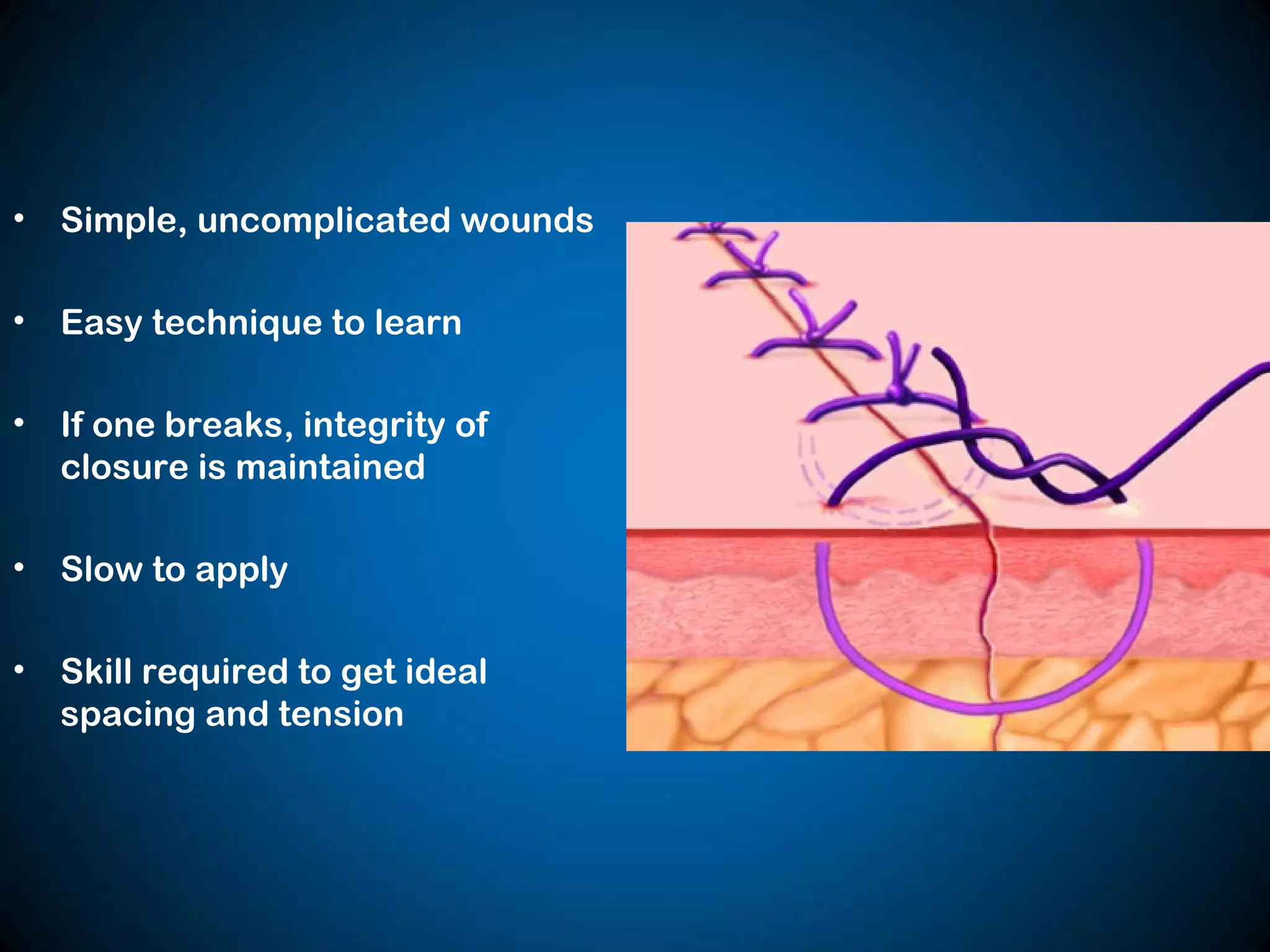
• Simple, uncomplicated wounds
• Easy technique to learn
• If one breaks, integrity of
closure is maintained
• Slow to apply
• Skill required to get ideal
spacing and tension
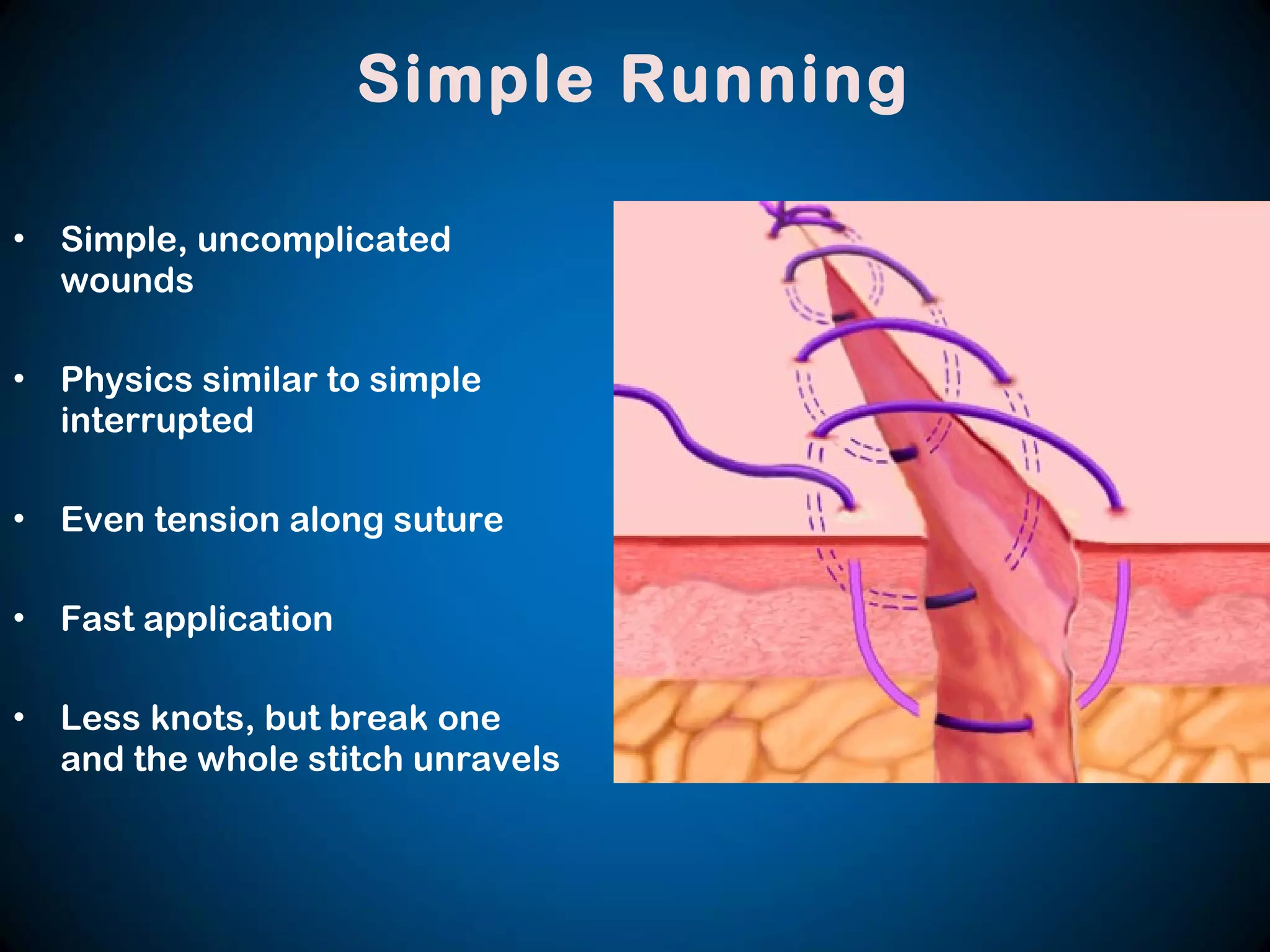
• Simple, uncomplicated
wounds
• Physics similar to simple
interrupted
• Even tension along suture
• Fast application
• Less knots, but break one
and the whole stitch unravels
Simple Running
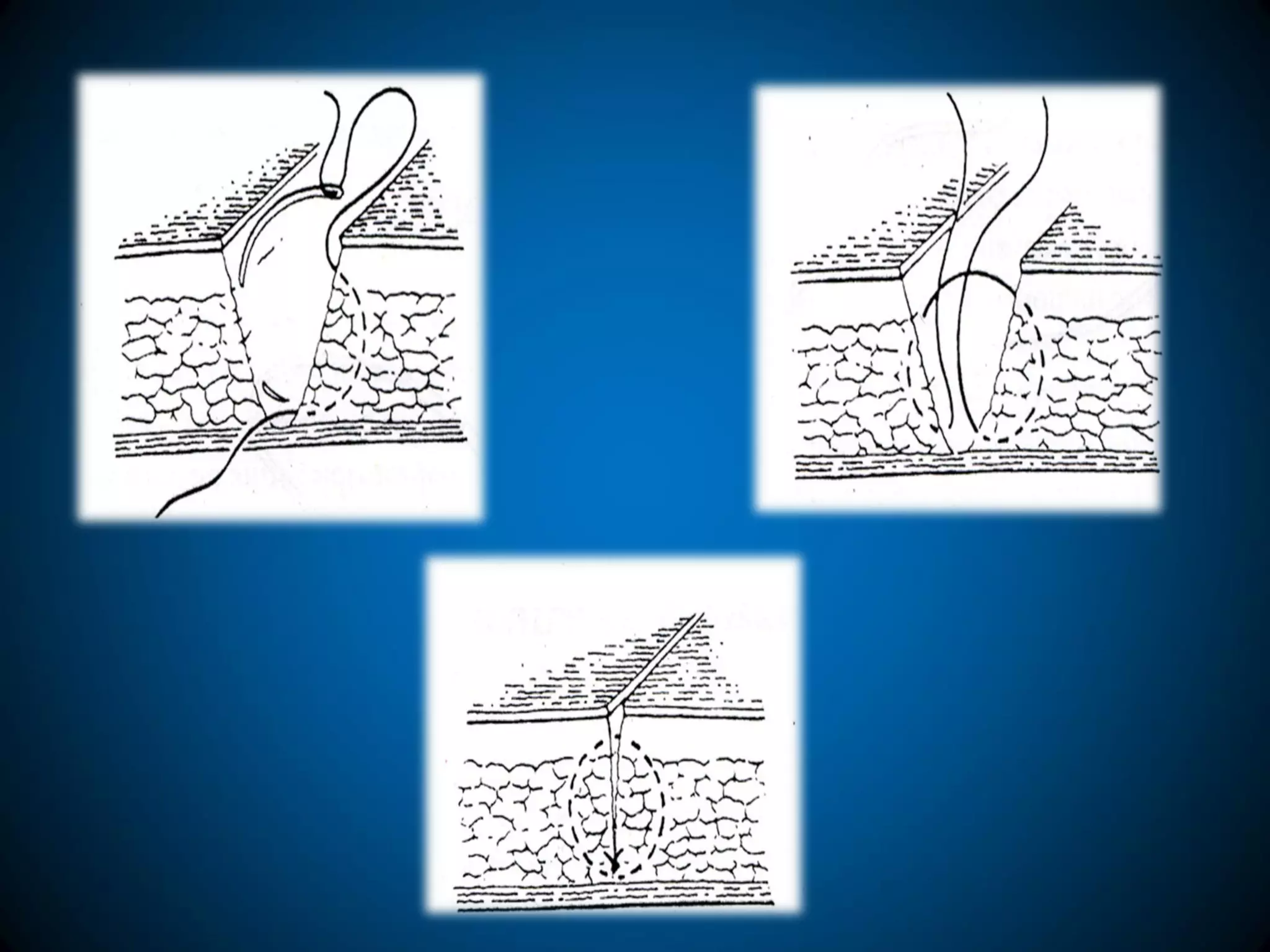
Used to close deep wounds in layers. Knots will
be inverted or buried, so that the knot does not
lie between the skin margin and cause
inflammation or infection.
To bury the knot, first pass of the needle should
be from within the wound and through the
lower portion of the dermal layer. Needle then
passed through the dermal layer and emerge
through subcutaneous tissue and knot is tied.
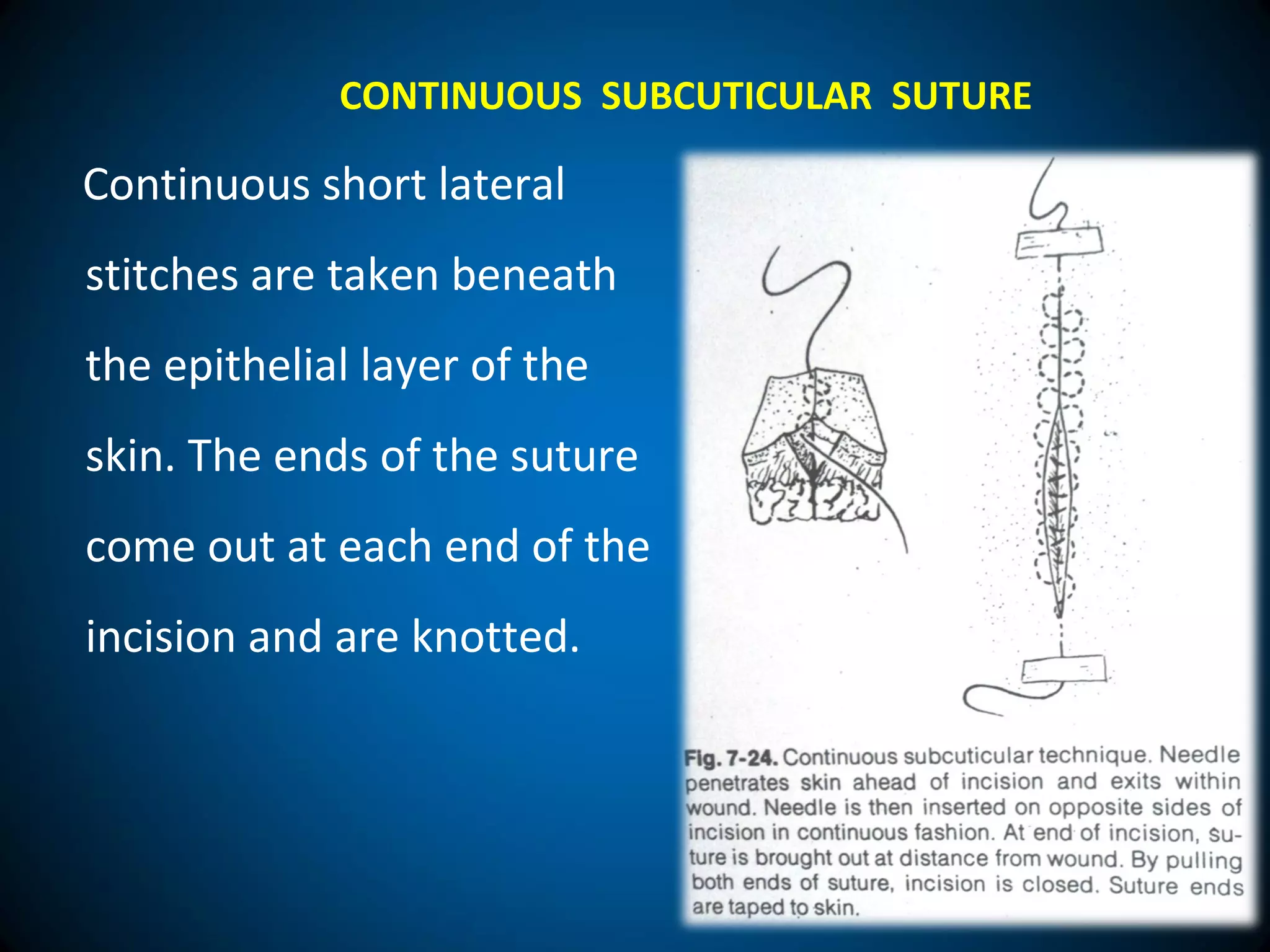
SUBCUTICULAR SUTURE
Continuous short lateral
stitches are taken beneath
the epithelial layer of the
skin. The ends of the suture
come out at each end of the
incision and are knotted.
CONTINUOUS SUBCUTICULAR SUTURE
Advantages
•Excellent cosmetic result
•Useful in wounds with strong skin tension,
especially for patients prone to keloid formation.
•Anchor suture in wound and, from apex, take bites
below the dermal-epidermal layer
•Start next stitch directly opposite the one that
precedes it.
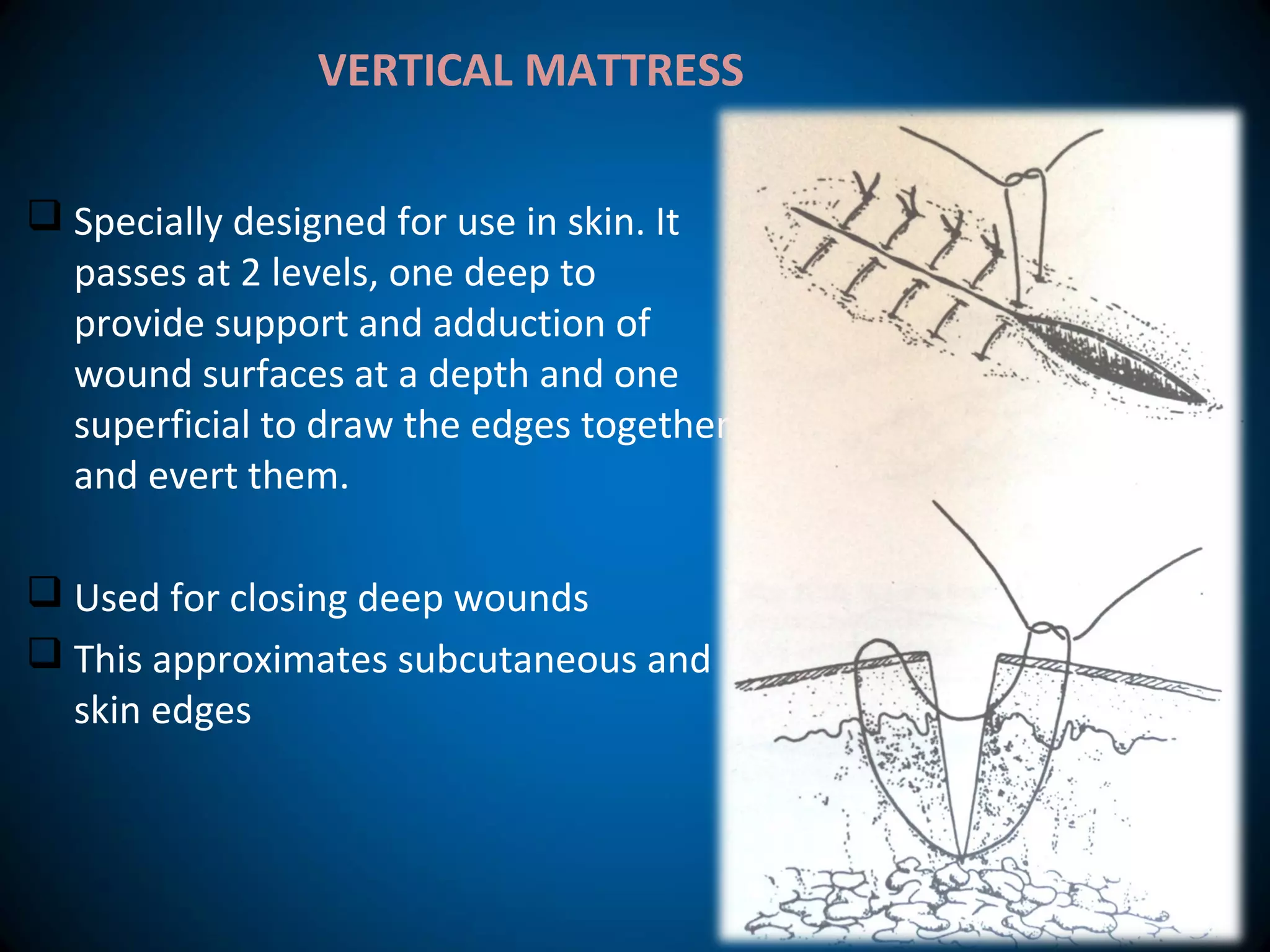
 Specially designed for use in skin. It
passes at 2 levels, one deep to
provide support and adduction of
wound surfaces at a depth and one
superficial to draw the edges together
and evert them.
 Used for closing deep wounds
 This approximates subcutaneous and
skin edges
VERTICAL MATTRESS
Needle passed from one edge to the other and again from
latter edge to the fist and knot tied.
When needle is brought back from second flap to the first,
depth of penetration is more superficial.
Advantages :
• for better adaptation and maximum tissue approximation
• To get eversion of wound margins slightly
• Where healing is expected to be delayed for any reason, it is
better to give wound added support by vertical mattress. Used
to control soft tissue hemorrhage.
• Runs parallel to the blood supply of the edge of the flap and
therefore not interfering with healing.
• Uses: abdominal surgeries & closure of skin wounds.
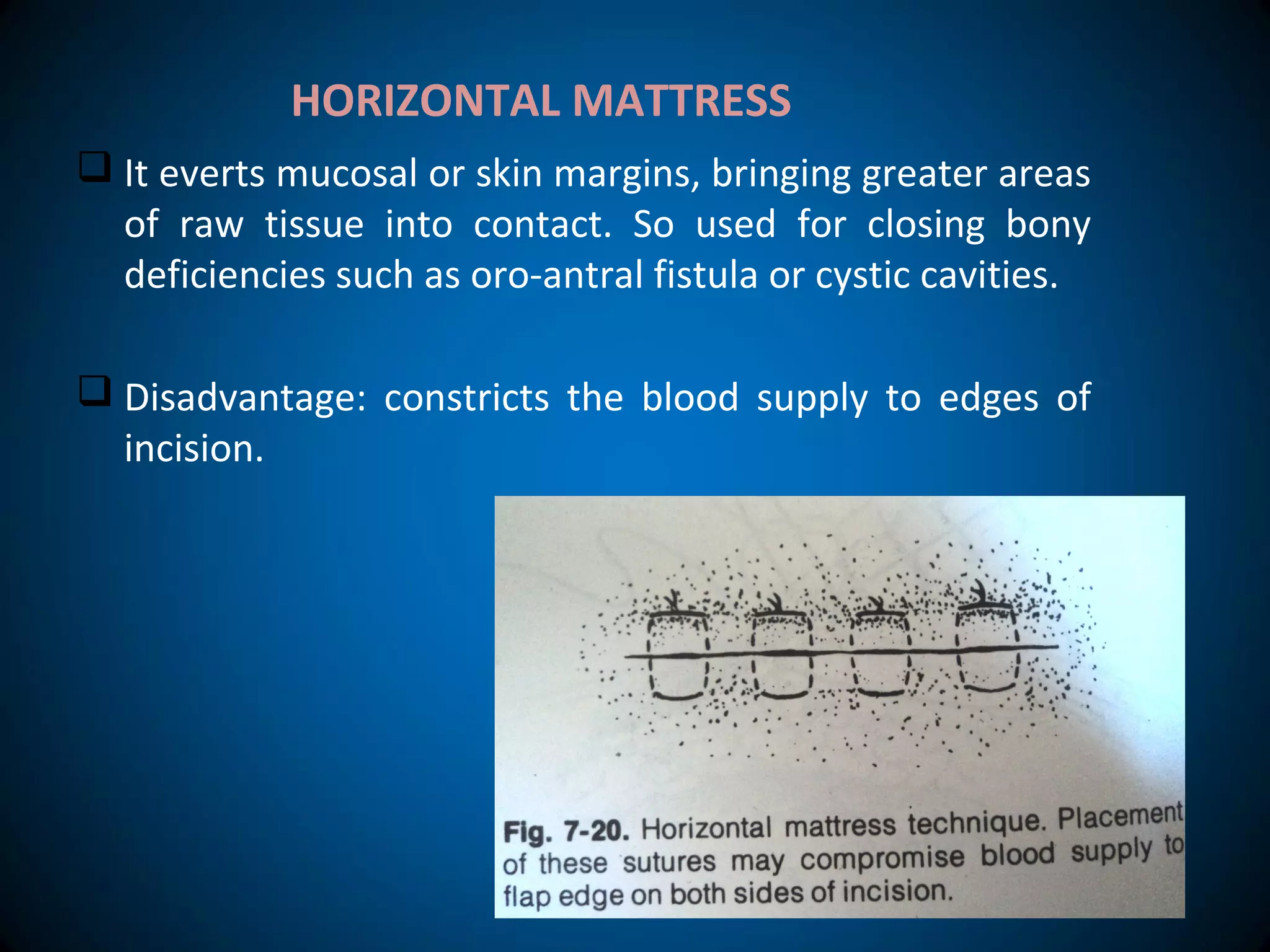
 It everts mucosal or skin margins, bringing greater areas
of raw tissue into contact. So used for closing bony
deficiencies such as oro-antral fistula or cystic cavities.
 Disadvantage: constricts the blood supply to edges of
incision.
HORIZONTAL MATTRESS
Needle passed from one
edge to the other and
again from the latter to the
first and a knot is tied.
Distance of needle
penetration and depth of
penetration is same for
each entry point, but
horizontal distance of the
points of penetration on
the same side of the flap
differs.
Advantages:
Will evert mucosal or skin margins, bringing greater areas
of raw tissue into contact.
-So used for closing bony deficiencies such as oro-antral
fistula or cystic cavities, extraction socket wounds.
• Prevents the flap from being inverted into the cavity.
• To control post-operative hemorrhage from gingiva around
the tooth socket to tense the mucoperiosteum over the
underlying bone.
• It does not cut through the tissue ,so used in case
of tissue under tension (inadequate tissue)
Disadvantages:
• More trouble to insert.
• Constricts the blood supply to the incision if
improperly used, cause wound necrosis and
dehiscence
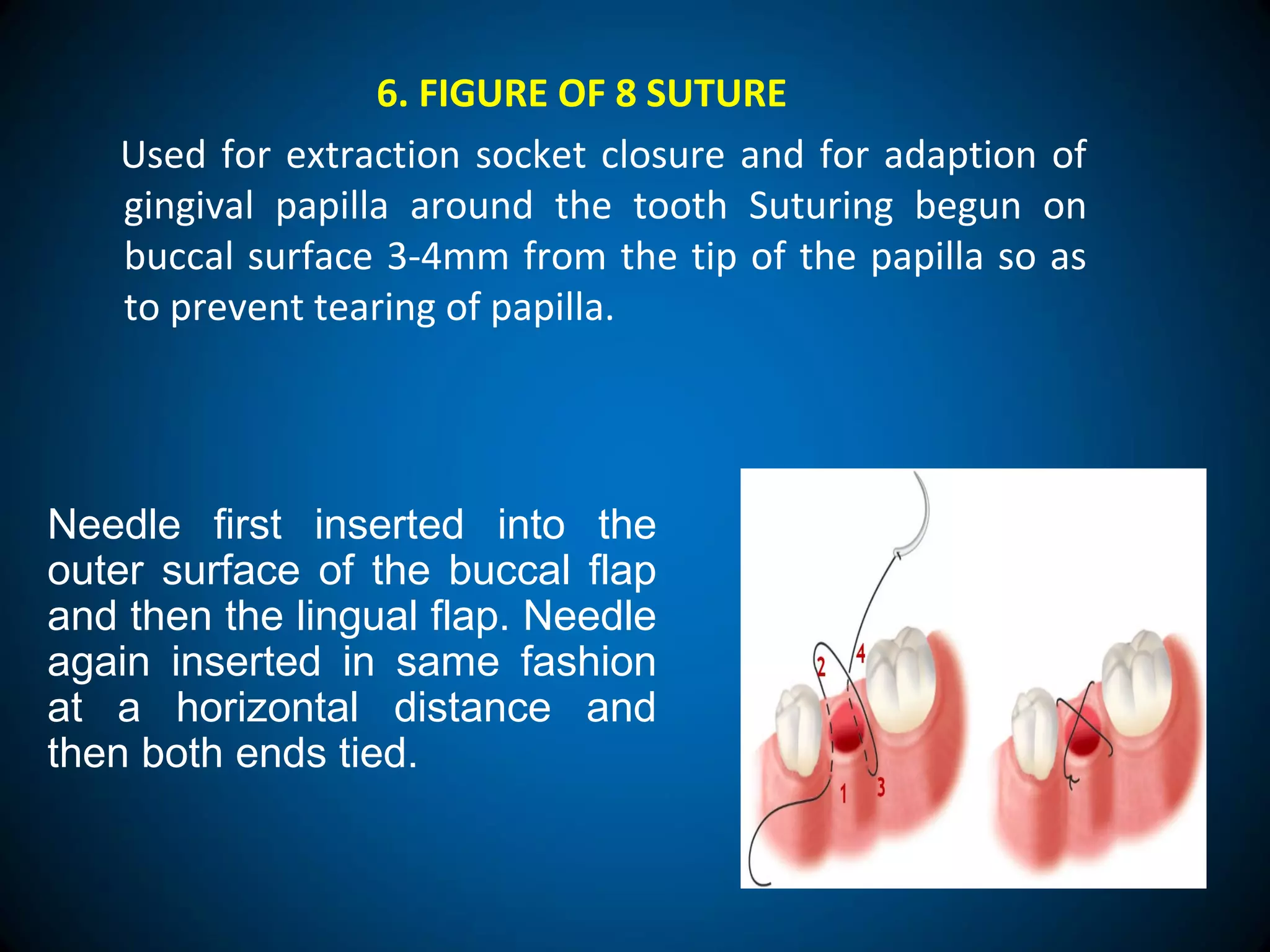
6. FIGURE OF 8 SUTURE
Used for extraction socket closure and for adaption of
gingival papilla around the tooth Suturing begun on
buccal surface 3-4mm from the tip of the papilla so as
to prevent tearing of papilla.
Needle first inserted into the
outer surface of the buccal flap
and then the lingual flap. Needle
again inserted in same fashion
at a horizontal distance and
then both ends tied.
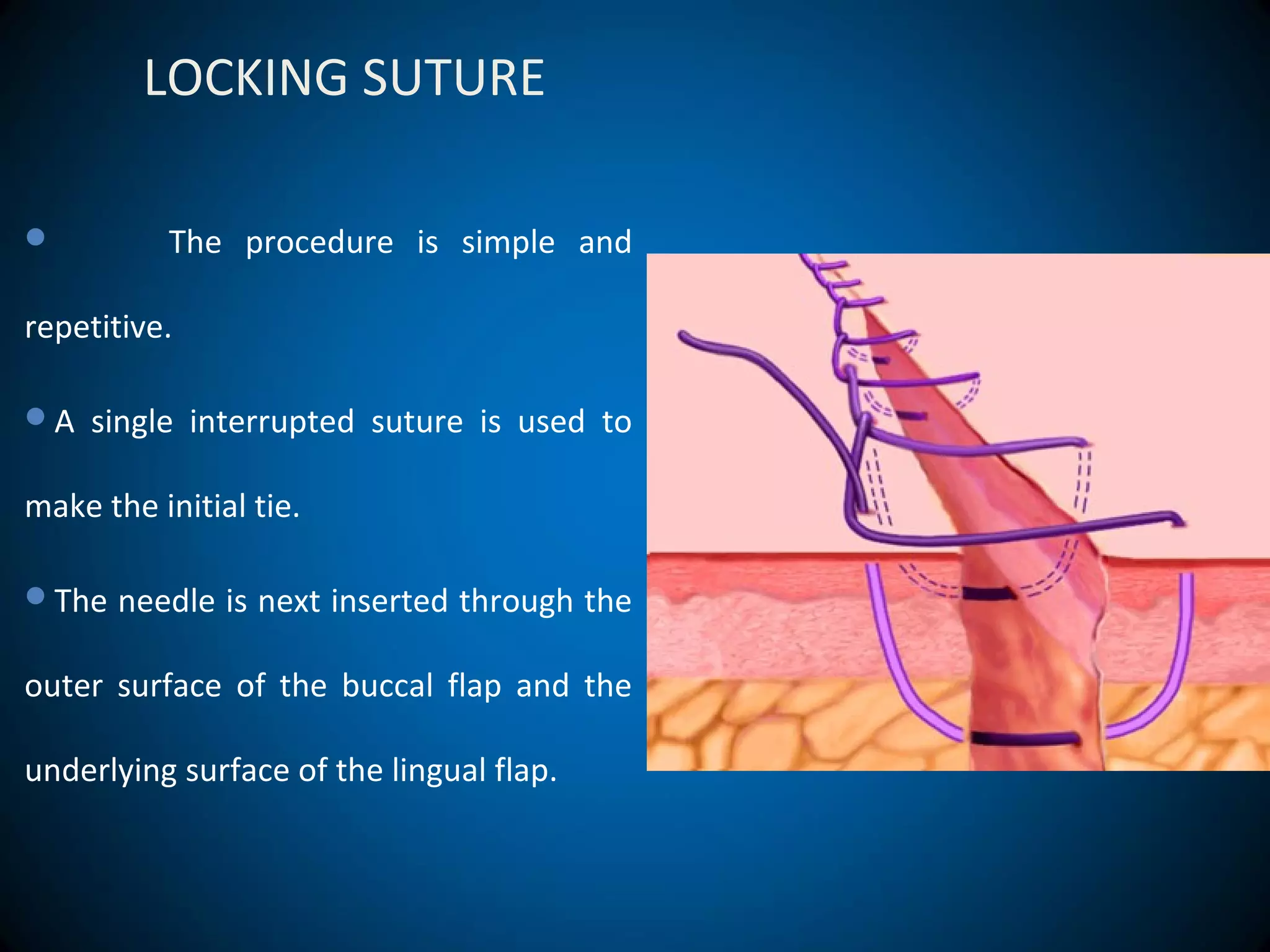
LOCKING SUTURE
 The procedure is simple and
repetitive.
A single interrupted suture is used to
make the initial tie.
The needle is next inserted through the
outer surface of the buccal flap and the
underlying surface of the lingual flap.
• The needle is then passed through the remaining loop of the suture,
and the suture is pulled tightly, thus locking it.
• This procedure is continued until the final suture is tied off at the
terminal end .
Other Common Sutures
125
Principles of knot tying
• Ensure that the knot is firm enough to
eliminate slippage
• Make sure that the knot is as small as possible
and the free ends are as short as feasible
• Avoid damaging suture material while
handling
• Avoid excessive tension
• Do not tie the knots too tightly- prevent
strangulation of tissue
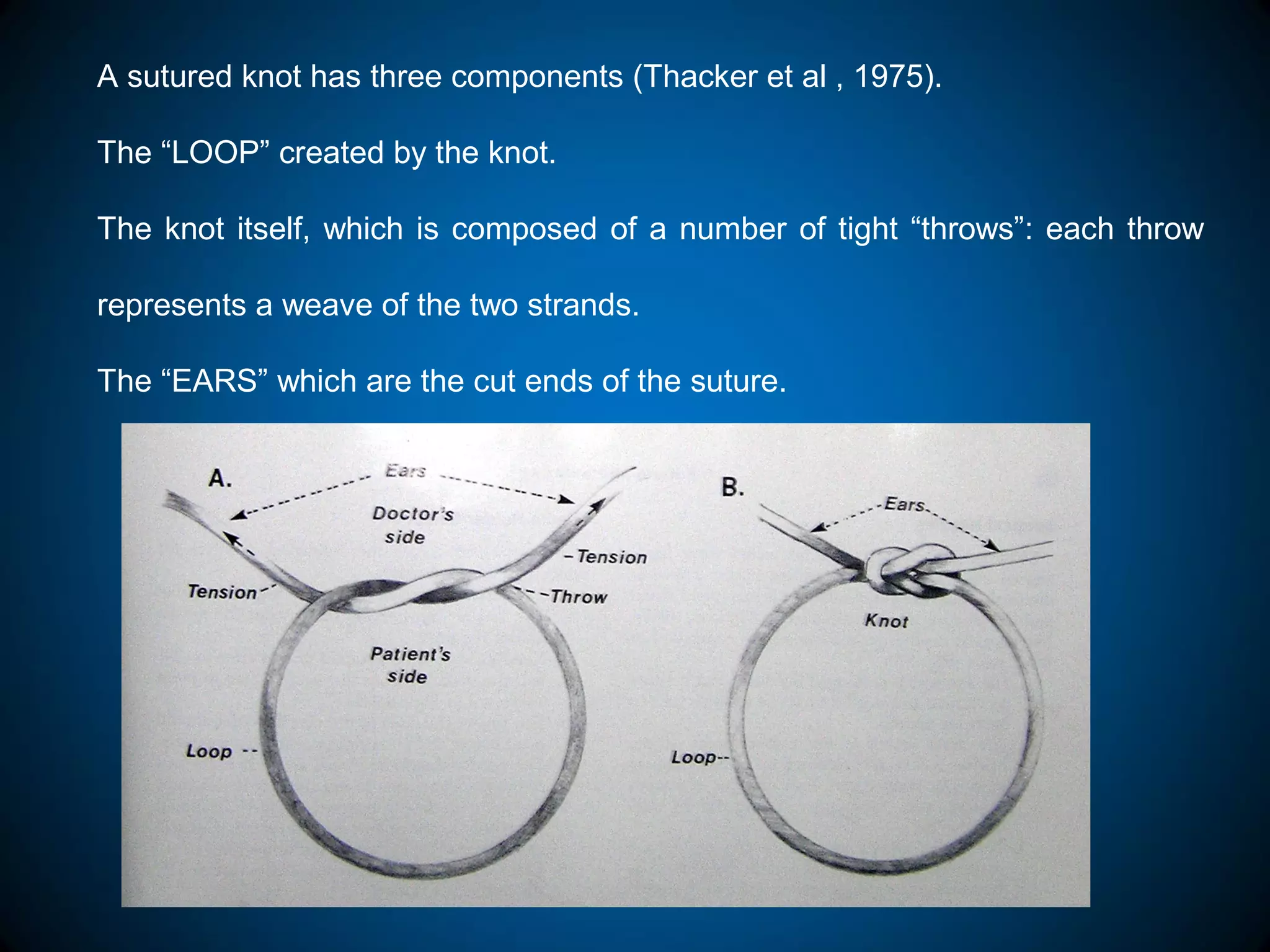
 The purpose of knots is to join the two ends of the suture in a secure but
gentle way. Knots must be placed tightly enough to prevent slippage and
loosening of the flap but not to blanch the tissues. They are generally placed
on buccal aspects of flaps.
A sutured knot has three components (Thacker et al , 1975).
The “LOOP” created by the knot.
The knot itself, which is composed of a number of tight “throws”: each throw
represents a weave of the two strands.
The “EARS” which are the cut ends of the suture.
The knot may be tied in 2 techniques
 INSTRUMENT TIE  Using needle holder
 ONE- HANDED & TWO-HANDED TIE  Using fingers
Types of knots
Overhang knot
Square knot / reef knot
Surgeon’s knot
Slip (or) Granny knot
OVERHANG KNOT
It is the basic knot which is
simple loop made by
crossing the free end of the
suture over the standing
part one time.
SURGEONS KNOT
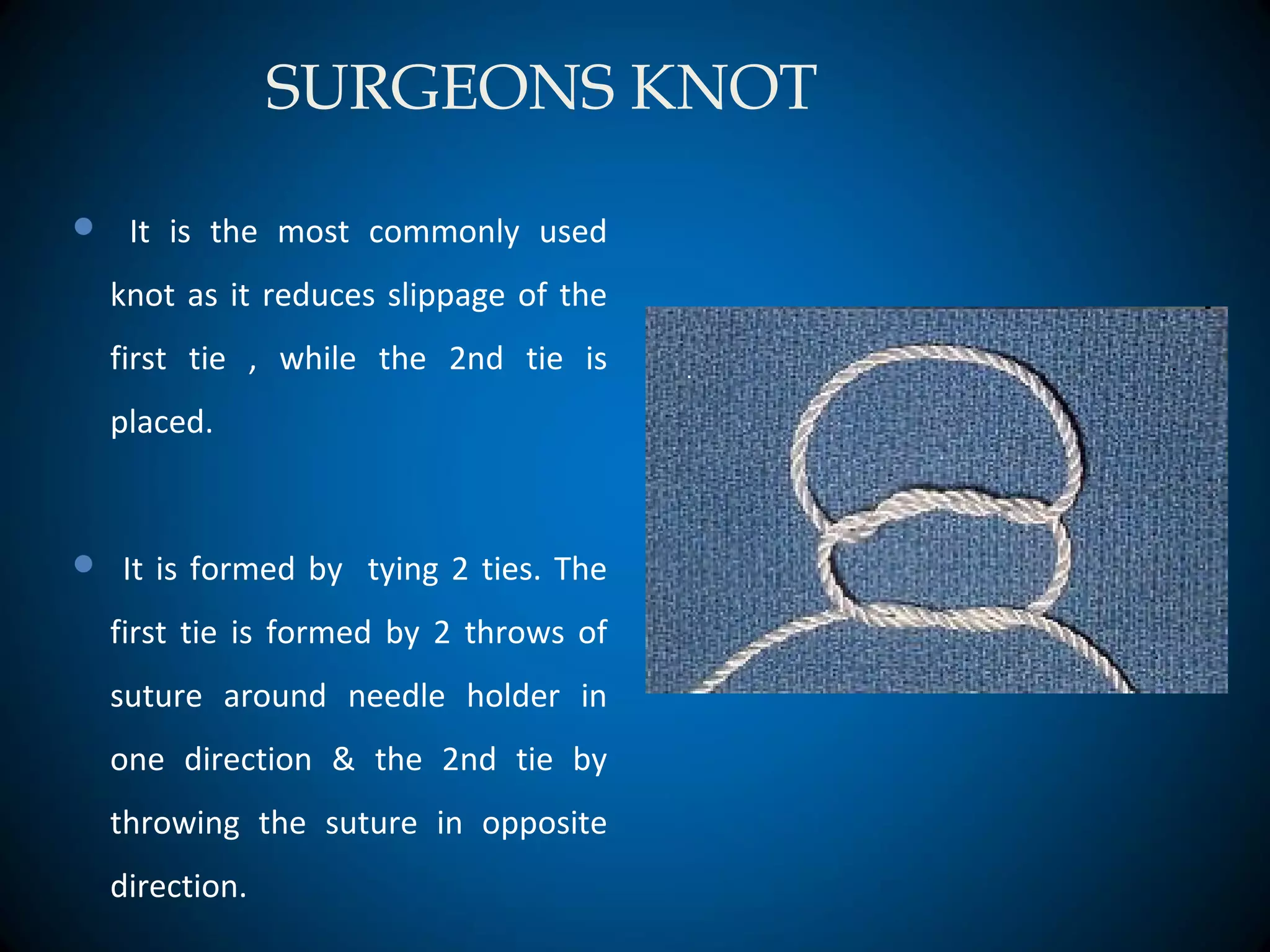
 It is the most commonly used
knot as it reduces slippage of the
first tie , while the 2nd tie is
placed.
 It is formed by tying 2 ties. The
first tie is formed by 2 throws of
suture around needle holder in
one direction & the 2nd tie by
throwing the suture in opposite
direction.
SQUARE KNOT
It is made by tying two
overhang knots each done in
opposite directions.
This knot is easy to tie but
loosen when synthetic/
monofilament sutures are
used.
SLIP/GRANNY KNOT
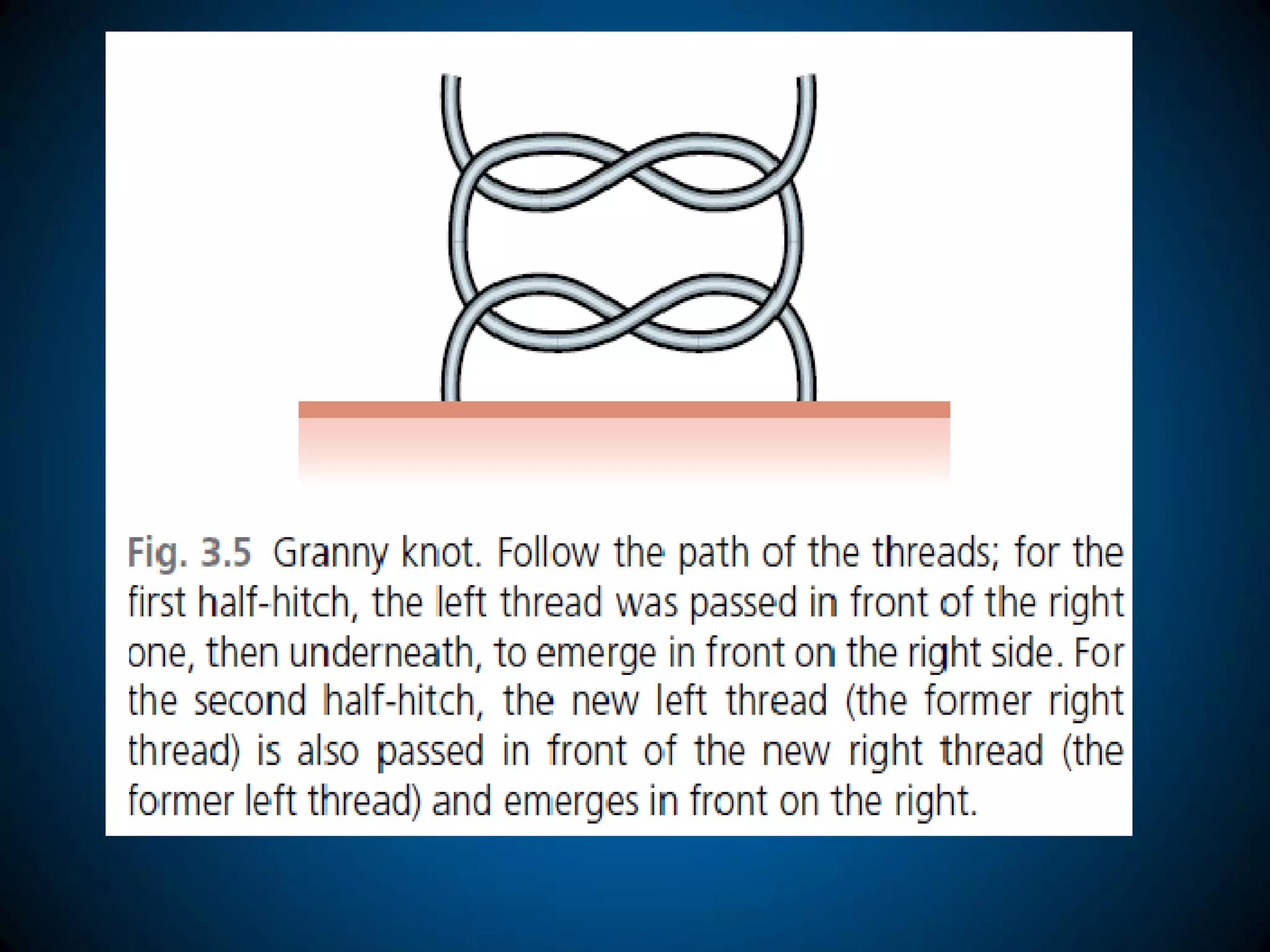
 It is similar to square knot , in it both
the overhang knots are placed in same
direction.
 The advantage of this knot is even
after placing the second knot it can be
further tightened with one or two
additional overhang knots.
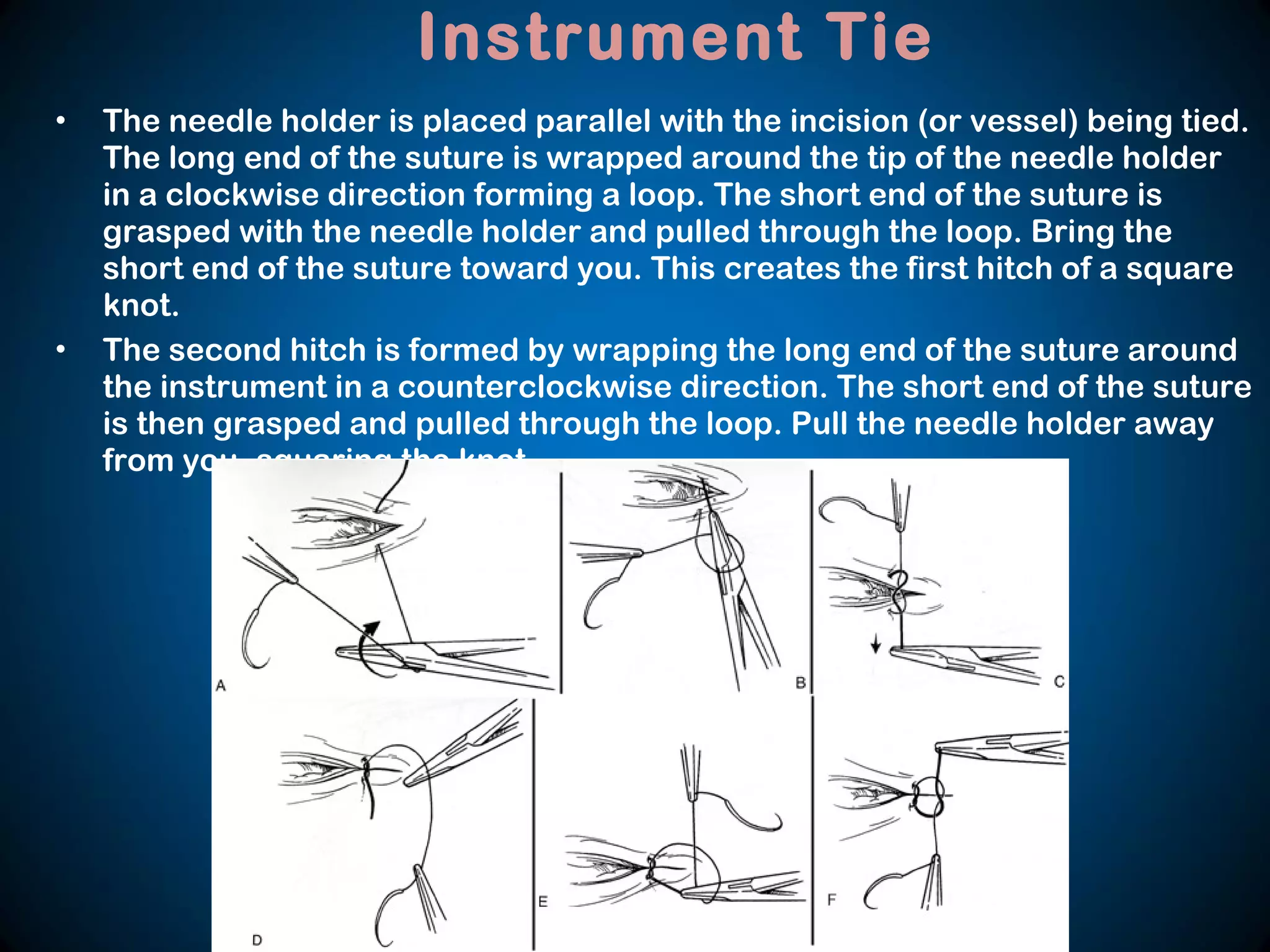
• The needle holder is placed parallel with the incision (or vessel) being tied.
The long end of the suture is wrapped around the tip of the needle holder
in a clockwise direction forming a loop. The short end of the suture is
grasped with the needle holder and pulled through the loop. Bring the
short end of the suture toward you. This creates the first hitch of a square
knot.
• The second hitch is formed by wrapping the long end of the suture around
the instrument in a counterclockwise direction. The short end of the suture
is then grasped and pulled through the loop. Pull the needle holder away
from you, squaring the knot.
Instrument Tie
• The greatest precision in maintaining constant tension
on the suture during the tying process
• Preferred by most surgeons (especially when others
are tying)
• Easier of the techniques to master successfully
• More reliably produces square knots
• If you want to be a surgeon, master this technique
Two Handed Tie
• The one-handed knot is so named because all of the
maneuvering, including releasing and re-grasping the
free end, is done with one hand. The other hand
merely holds the fixed segment taut.
• One handed knots have the advantage of allowing
more speed in tying, but have less tension control of
the segments.
• The maneuvering is done with the left hand so that a
surgeon tying his own knots during suturing can
continue to hold the needle holder in his right hand.
• More difficult to achieve excellent square knots.
Unforgiving of lapses in technique.
One Handed Tie
SUTURE
REMOVAL
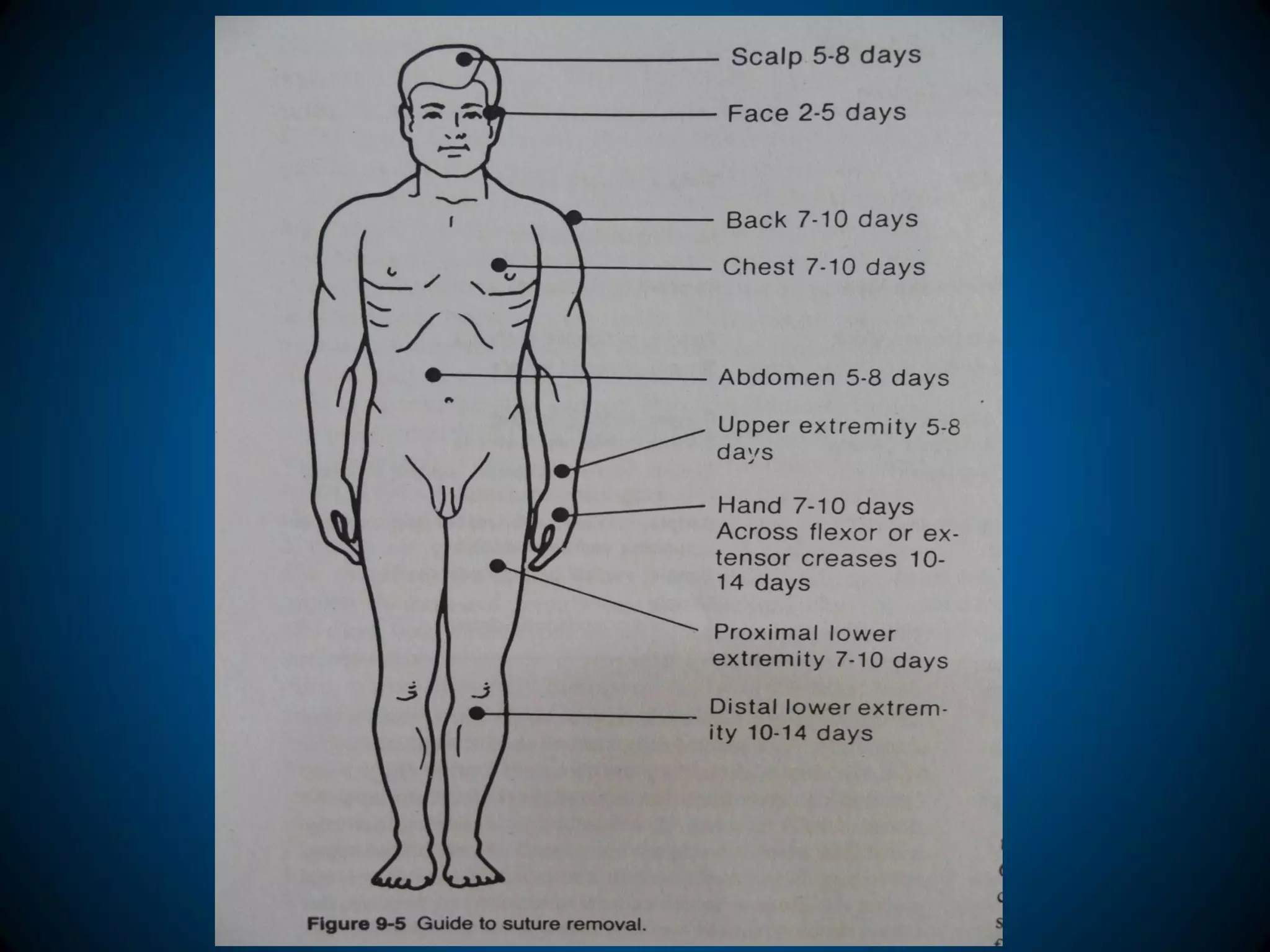
Skin wounds regain TS slowly. It can be removed
in 3-10 days when the wound gained 5%-10% of
final TS. Skin sutures on face removed between
3-5 days. Alternate sutures removed on 3rd day
and remaining sutures after 2 days.
SUTURE REMOVAL
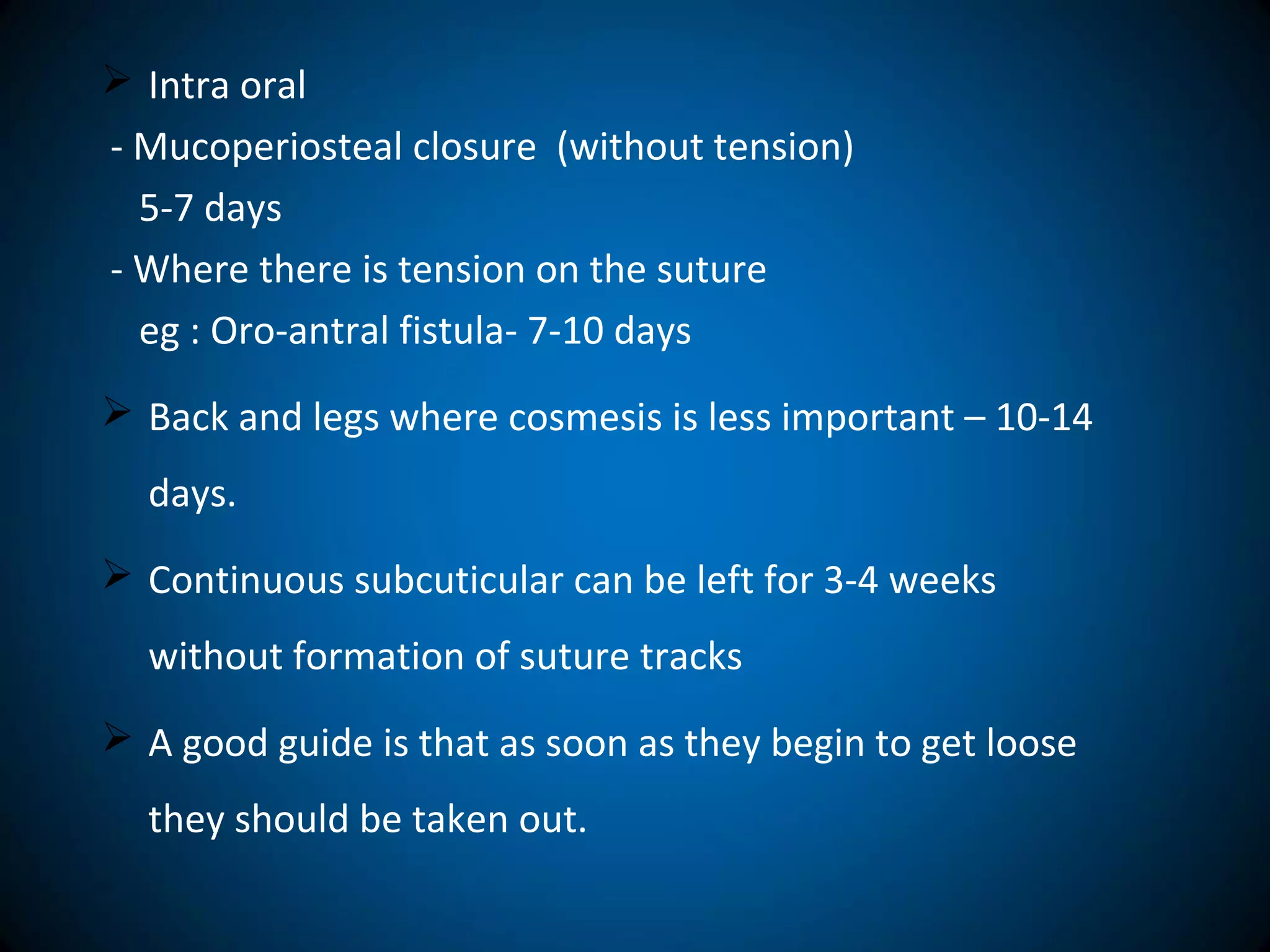
 Intra oral
- Mucoperiosteal closure (without tension)
5-7 days
- Where there is tension on the suture
eg : Oro-antral fistula- 7-10 days
 Back and legs where cosmesis is less important – 10-14
days.
 Continuous subcuticular can be left for 3-4 weeks
without formation of suture tracks
 A good guide is that as soon as they begin to get loose
they should be taken out.
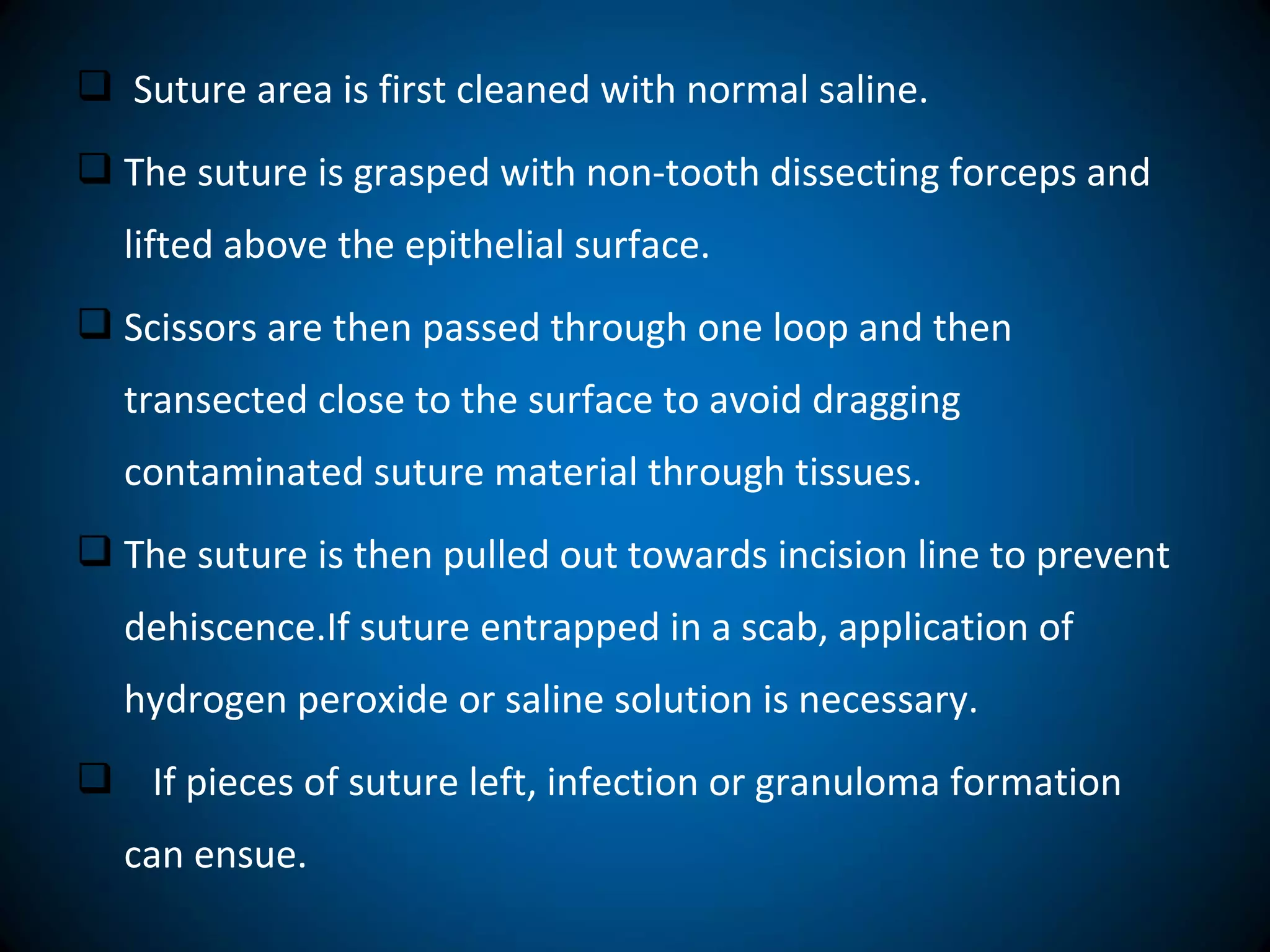
 Suture area is first cleaned with normal saline.
 The suture is grasped with non-tooth dissecting forceps and
lifted above the epithelial surface.
 Scissors are then passed through one loop and then
transected close to the surface to avoid dragging
contaminated suture material through tissues.
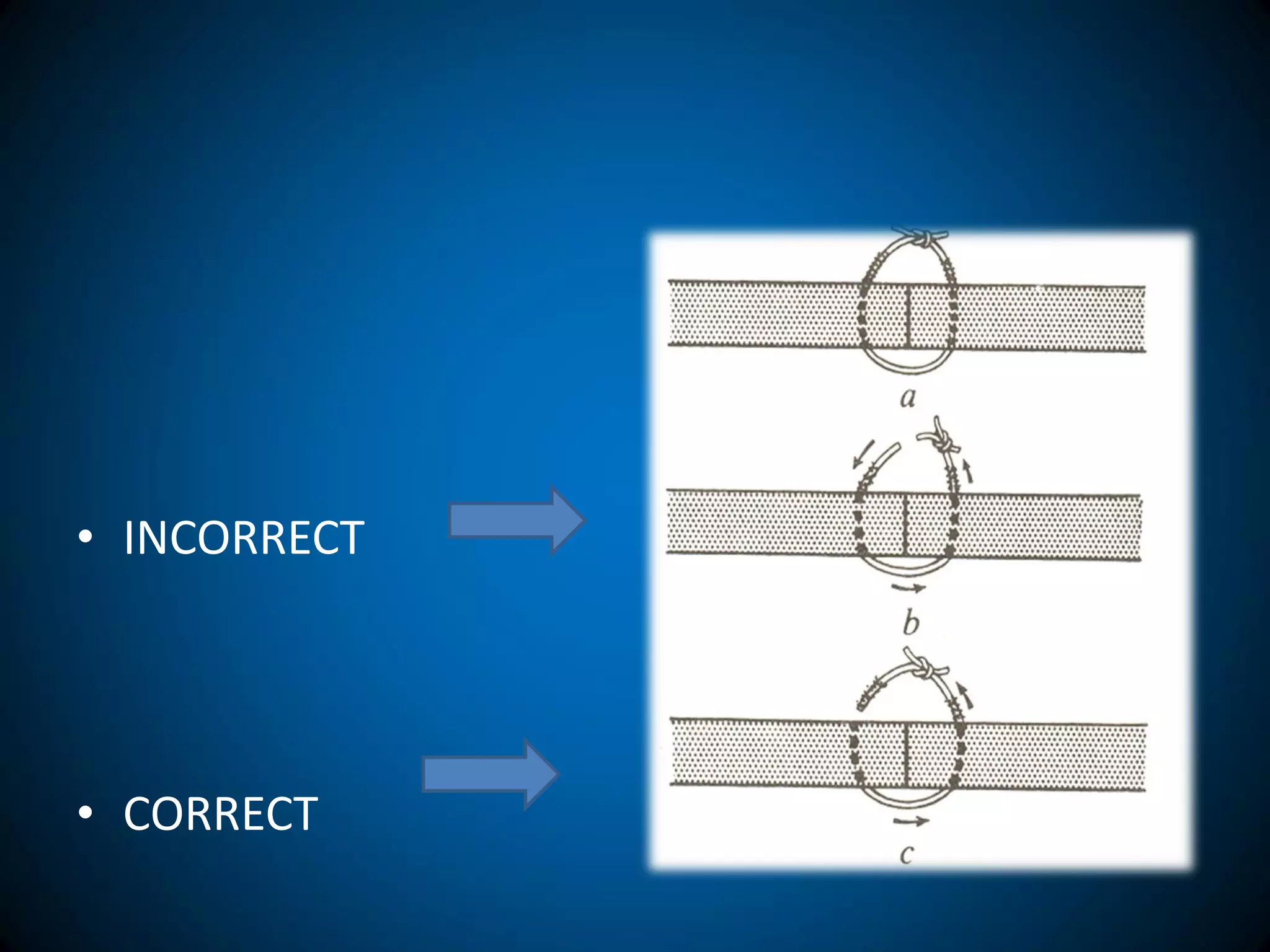
 The suture is then pulled out towards incision line to prevent
dehiscence.If suture entrapped in a scab, application of
hydrogen peroxide or saline solution is necessary.
 If pieces of suture left, infection or granuloma formation
can ensue.
• INCORRECT
• CORRECT
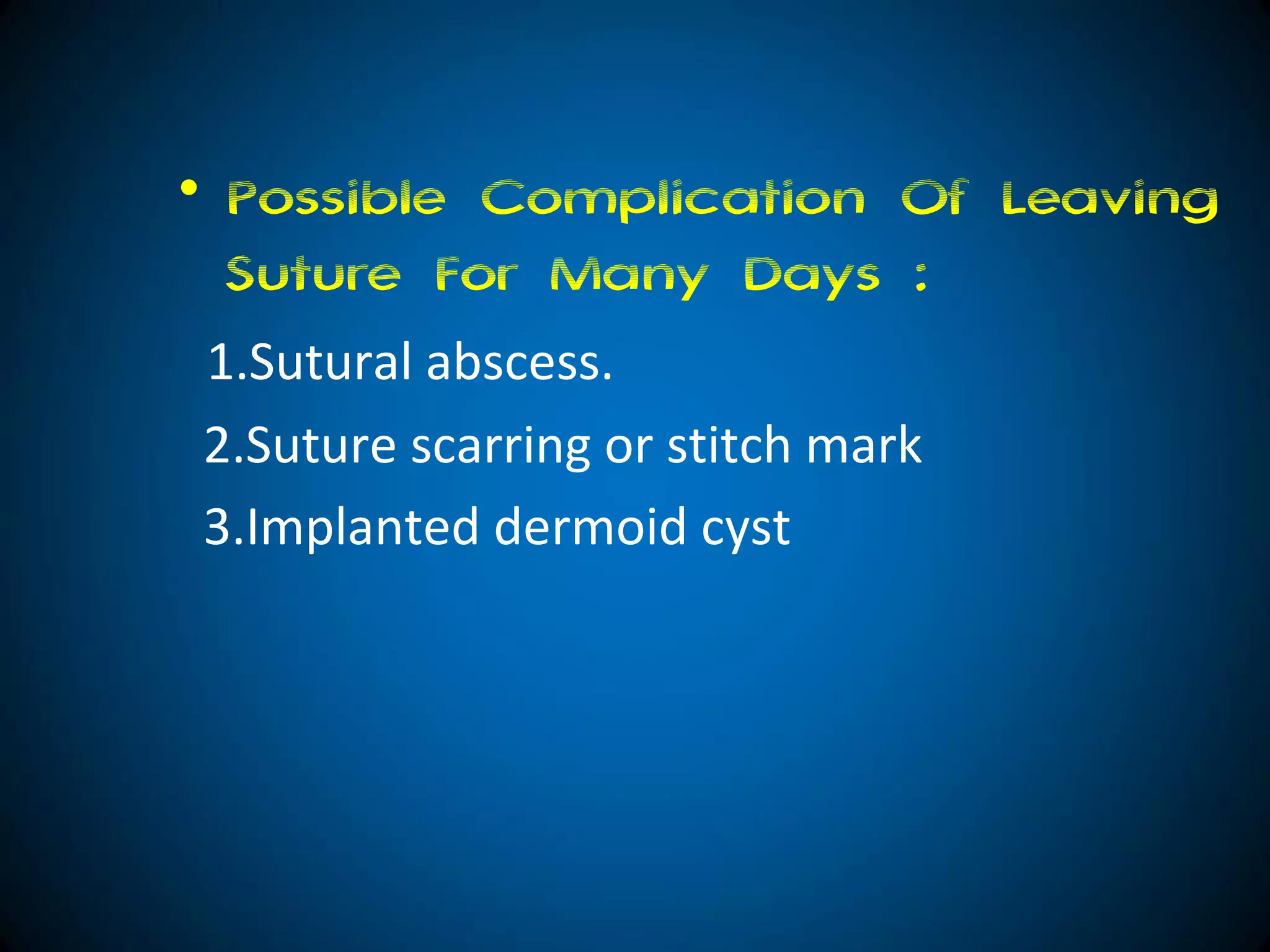
• Possible Complication Of Leaving
Suture For Many Days :
1.Sutural abscess.
2.Suture scarring or stitch mark
3.Implanted dermoid cyst
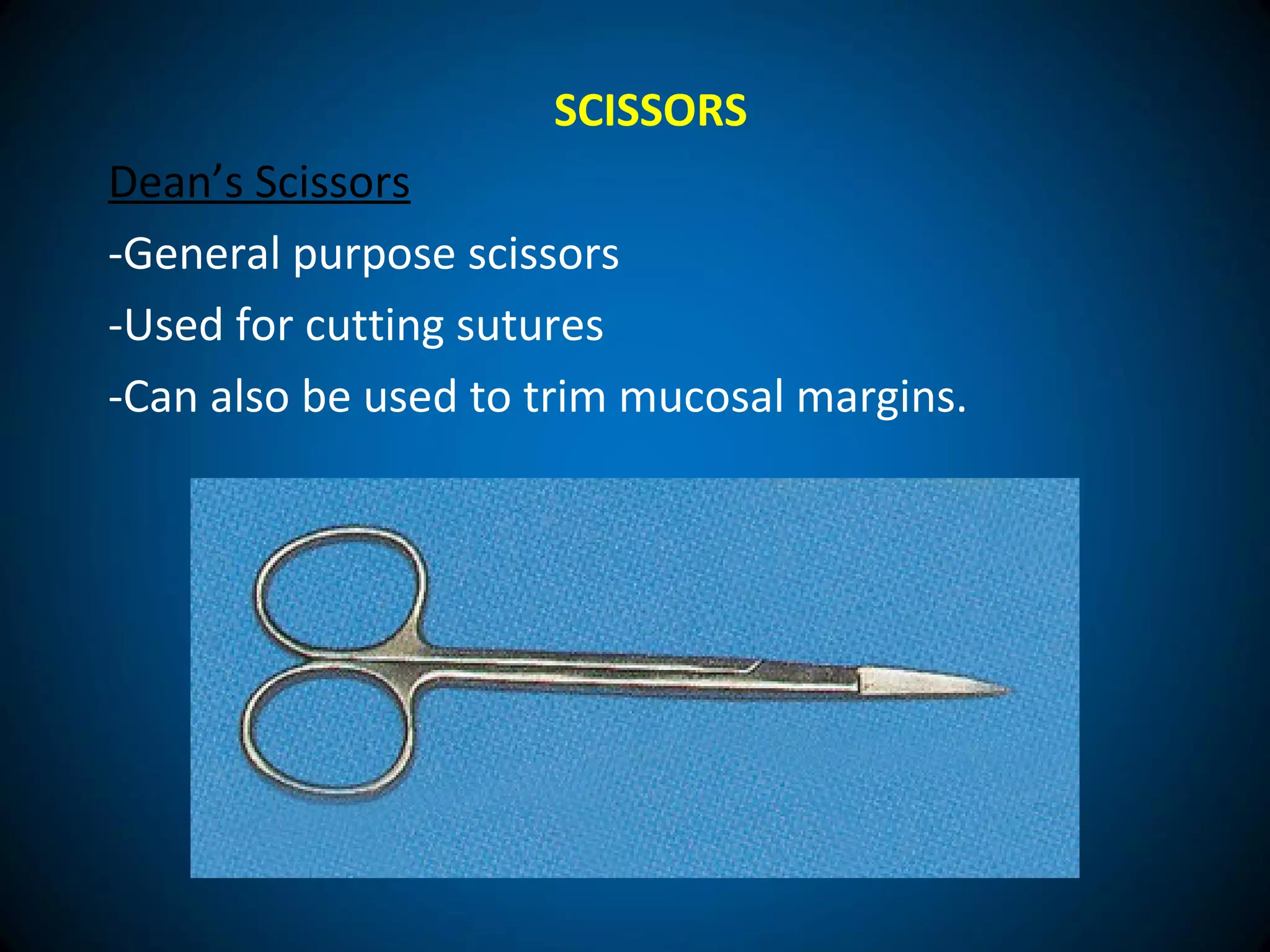
SCISSORS
Dean’s Scissors
-General purpose scissors
-Used for cutting sutures
-Can also be used to trim mucosal margins.
SUTURE MARKS
Suture marks are caused by 3 factors
1.Skin sutures left in place longer than 7 days,
resulting in epithelialisation of suture track
2.Tissue necrosis from sutures that were tied too
tightly or became tight due to tissue edema
3.Use of reactive sutures in the skin.
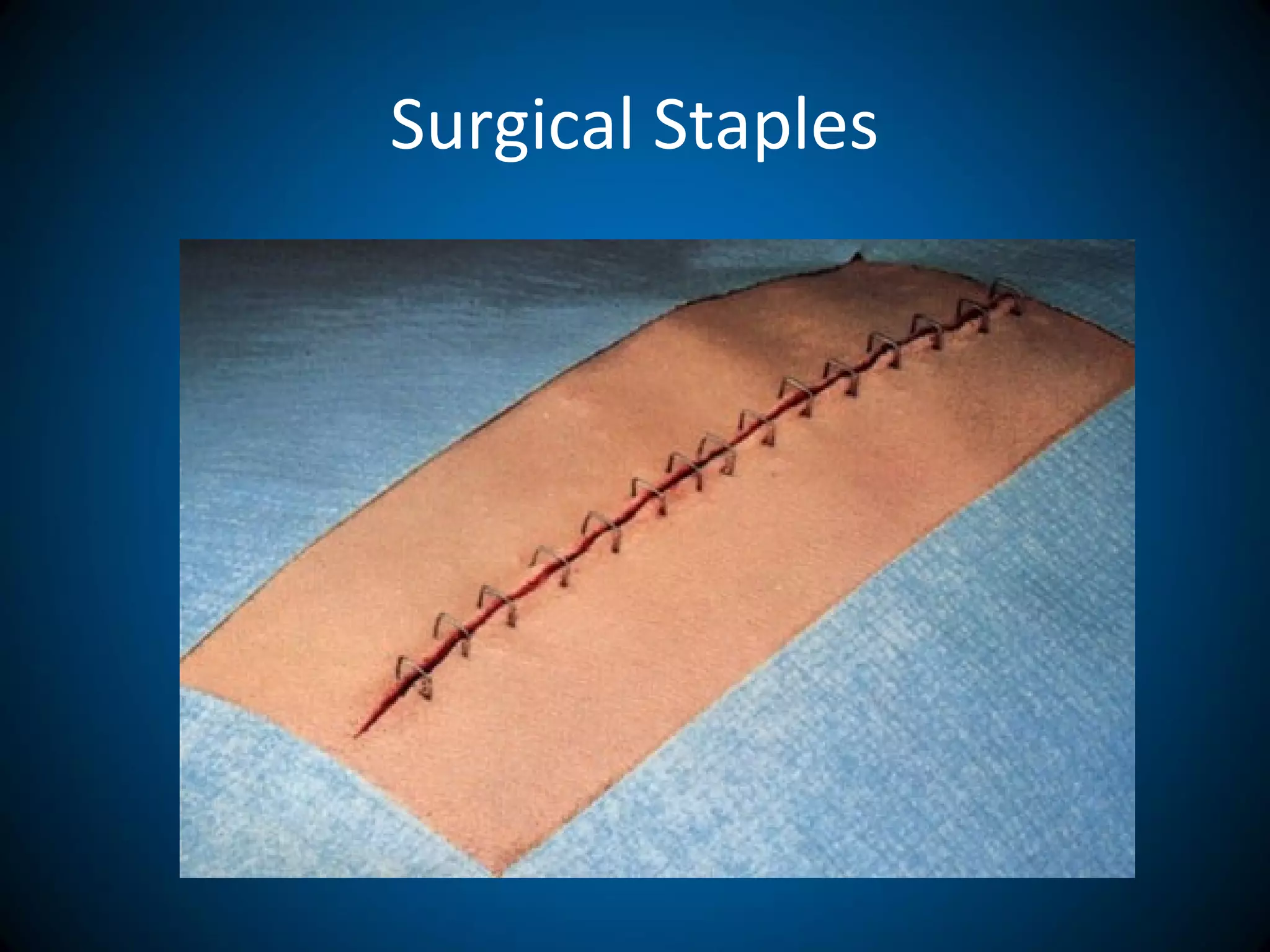
Surgical Staples
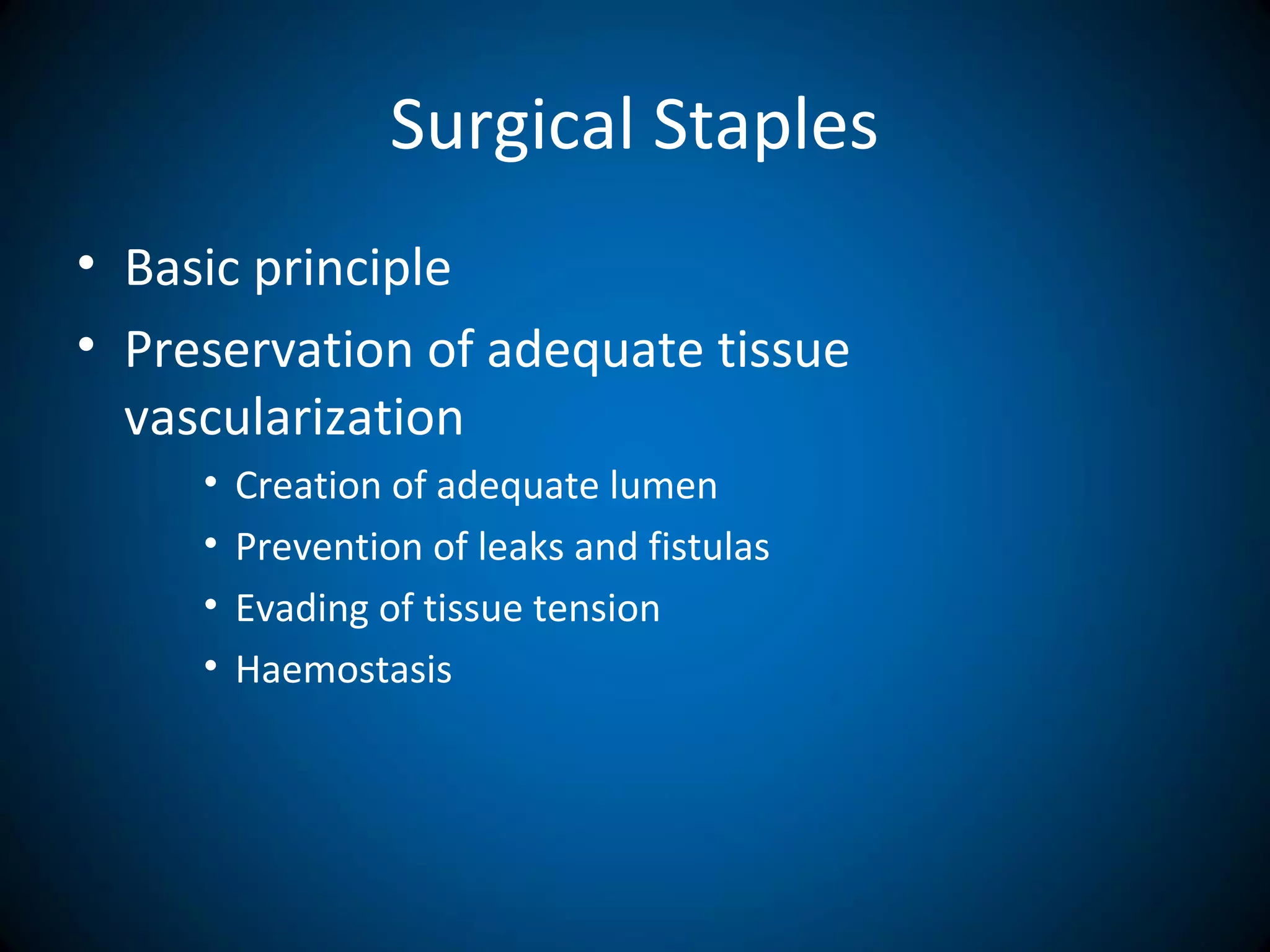
Surgical Staples
• Basic principle
• Preservation of adequate tissue
vascularization
• Creation of adequate lumen
• Prevention of leaks and fistulas
• Evading of tissue tension
• Haemostasis
Surgical Staples
• Advantages
• Less tissue reaction
• Accelerated wound healing
• Efficiency
• Less anesthesia and intra operative time
Surgical Staples
• Types of staplers
• Linear stapler- used for closure of a linear wound
• Circular or intraluminal staplers- used in GI surgeries for
end-to-end, end-to-side, side-to-end or side-to-side
anastomosis. They offer a circular, double staggered row of
staples.
• Ligating and dividing stapler- issues a double row of two
staples and ligates the tissue. The tissue can then be
divided between the staple lines.
Surgical Staples
• Purse string suture clamps- for placement of
purse string sutures.
• Skin staplers- to approximate skin edges.
• Endoscopic staplers
Skin stapler
Fibrin Glue
• Synthesized from bovine blood
• Uses
• Used to control bleeding and approximating tissues
that are difficult to approximate by suturing, eg. Liver,
spleen and lung.
• Microsurgical anastomosis of blood vessels
• Used in Cardiopulmonary bypass surgery
• Repair ocular implants
• Close superficial lacerations and fistula
• Repair dural tears
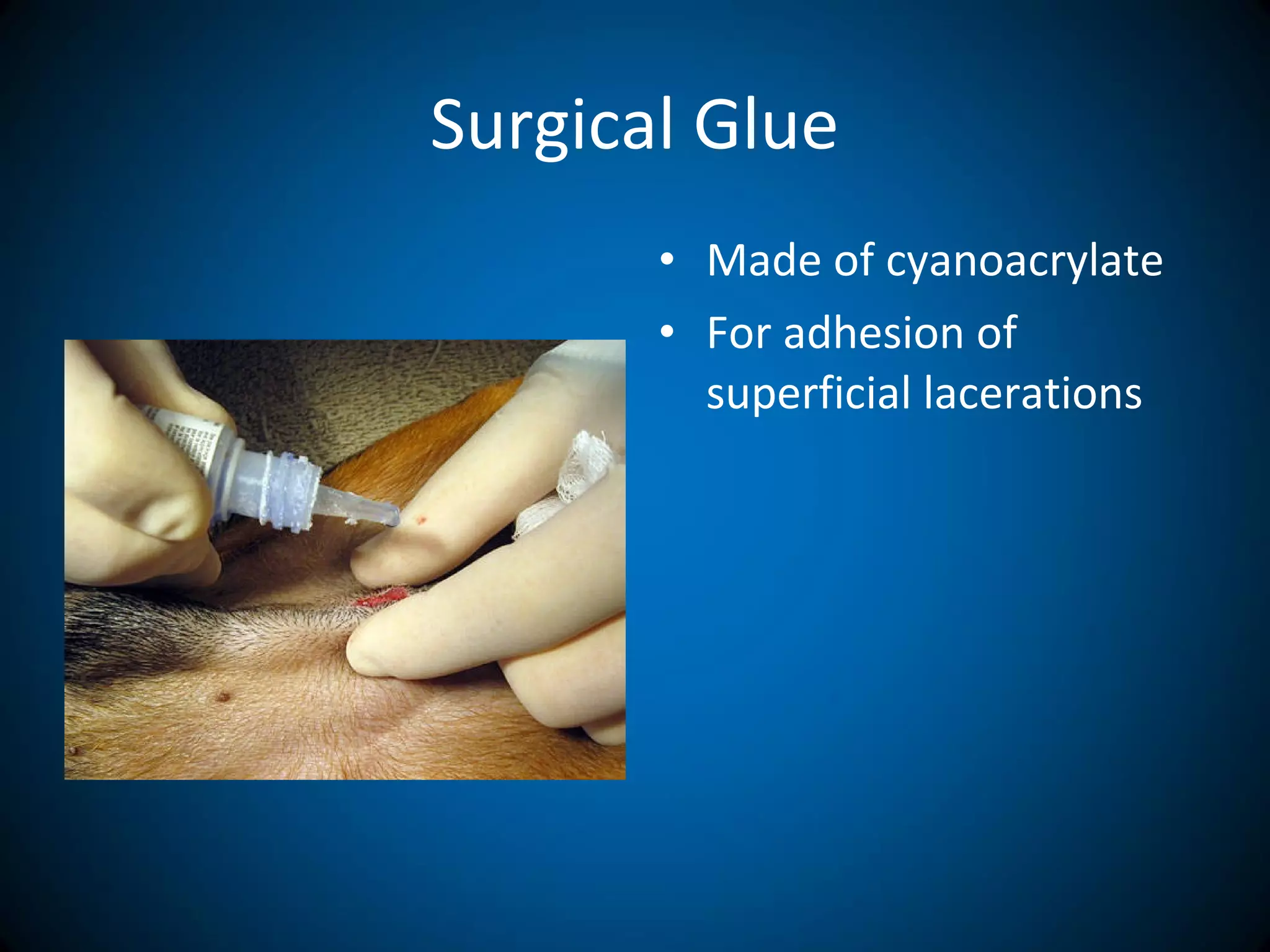
Surgical Glue
• Made of cyanoacrylate
• For adhesion of
superficial lacerations
ADHESIVES/GLUES
 Simplifies Skin Closure
 No Suture Related Problems
 Noinflammation
 Local Anaesthetic Not Needed
 Used In Facial Lacerations & Children
 Acts As Barrier Against Microbes
 Dermabond(octyl-2-cyanoacrylate)
 Approved By Us Fda
Tissue Adhesives
• BEFORE CURING
• Sterilizable
• Easy in preparation
• Viscous liquid or liquid
possible for spray
• Nontoxic
• Rapidly curable under wet
physiological conditions (pH
7.3, 37*C, 1 atm)
• Reasonable cost
• AFTER CURING
• Strongly bondable to tissues
• Biostable union until wound
healing
• Tough and pliable
• Resorbable after wound
healing
• Nontoxic
• Nonobstructive to wound
healing or promoting
wound healing
Natural Tissue – Fibrin Glue
• First reported in 1940
• Mimics blood clot – major component fibrin
network
• Excellent tissue adhesive but insufficient in
amount for larger wounds
• Nontoxic if human protein sources are used to
obtain fibrin
Synthetic Systems:
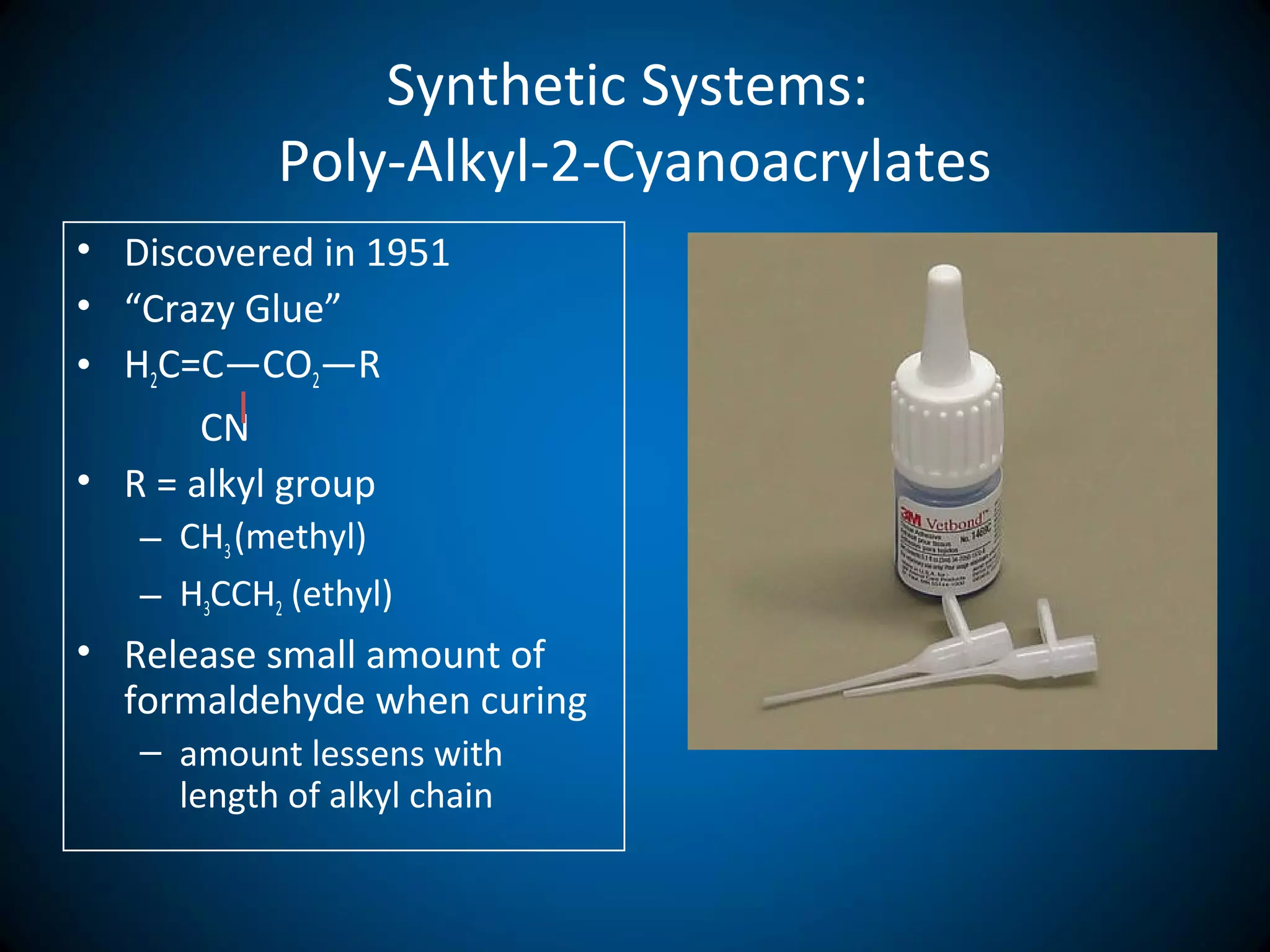
Poly-Alkyl-2-Cyanoacrylates
• Discovered in 1951
• “Crazy Glue”
• H2C=C―CO2―R
CN
• R = alkyl group
– CH3(methyl)
– H3CCH2 (ethyl)
• Release small amount of
formaldehyde when curing
– amount lessens with
length of alkyl chain
Characteristics of Currently Available Adhesive
Systems
Fibrin Glue Cyanoacrylate
Handling Excellent Poor
Set time Medium Short
Tissue bonding Poor Good
Pliability Excellent Poor
Toxicity Low Medium
Resorbability Good Poor
Cell infiltration Excellent Poor
Other Experimental Systems
• Gelatin-based adhesives
– Mimic coagulation but without fibrin
• Polyurethane (-HNOCO-) based adhesives
– Capped with isocyanate to rapidly gel upon
exposure to water
– More flexible than current cyanoacrylate
adhesives
• Collagen-based adhesives
FIBRIN BASED TISSUE ADHESIVES
• Achieve Haemostasis
• Seals The Tissues
• Fixate Skin Grafts
• Arrest C.S.F Leak
• TISSEEL & HEMASEEL
*Image via Bing
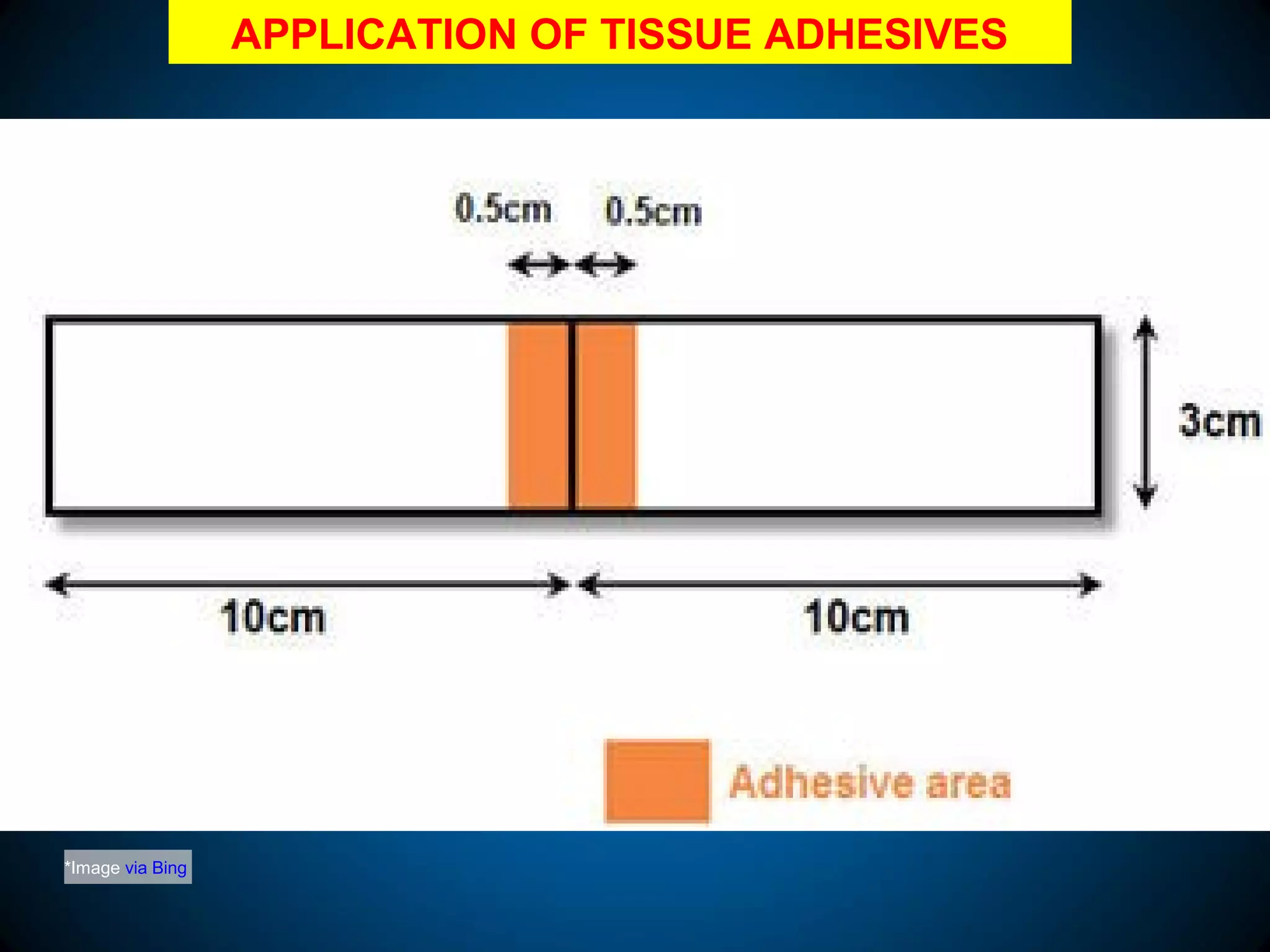
APPLICATION OF TISSUE ADHESIVES
III COSEAL Surgical sealant
• Completely surgical vascular sealant
• Used in vascular surgeries as an adjunctive
haemostat
• Seals immediately
• It is not a substitute for sutures, staples but an
adjunct
• No contraindication
• Should not be injected into vessels
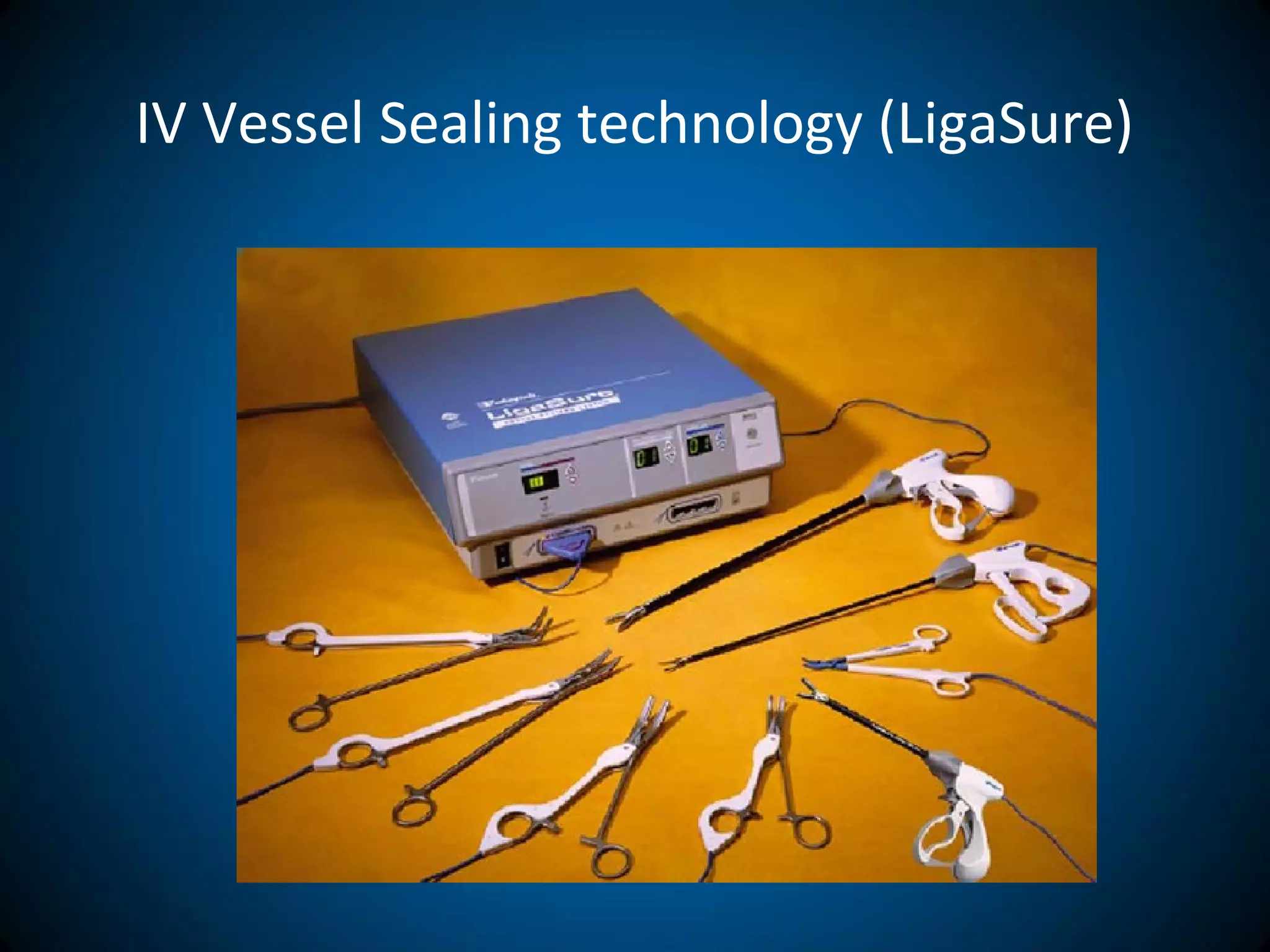
IV Vessel Sealing technology (LigaSure)
Vessel Sealing technology (LigaSure)
• For ligating vessels and tissue bundles
• Works by fusing the collagen and elastin fibres in
vessels to seal the blood flow
• It uses ‘Instant Response Technology’- It is a
feedback controlled response system that
diagnoses the tissue type in the jaws of the
instrument and delivers the appropriate amount
of energy to effectively seal the vessel or tissue
bundle.
• Thermal spread upto 1mm
• No sticking or charring of tissue.
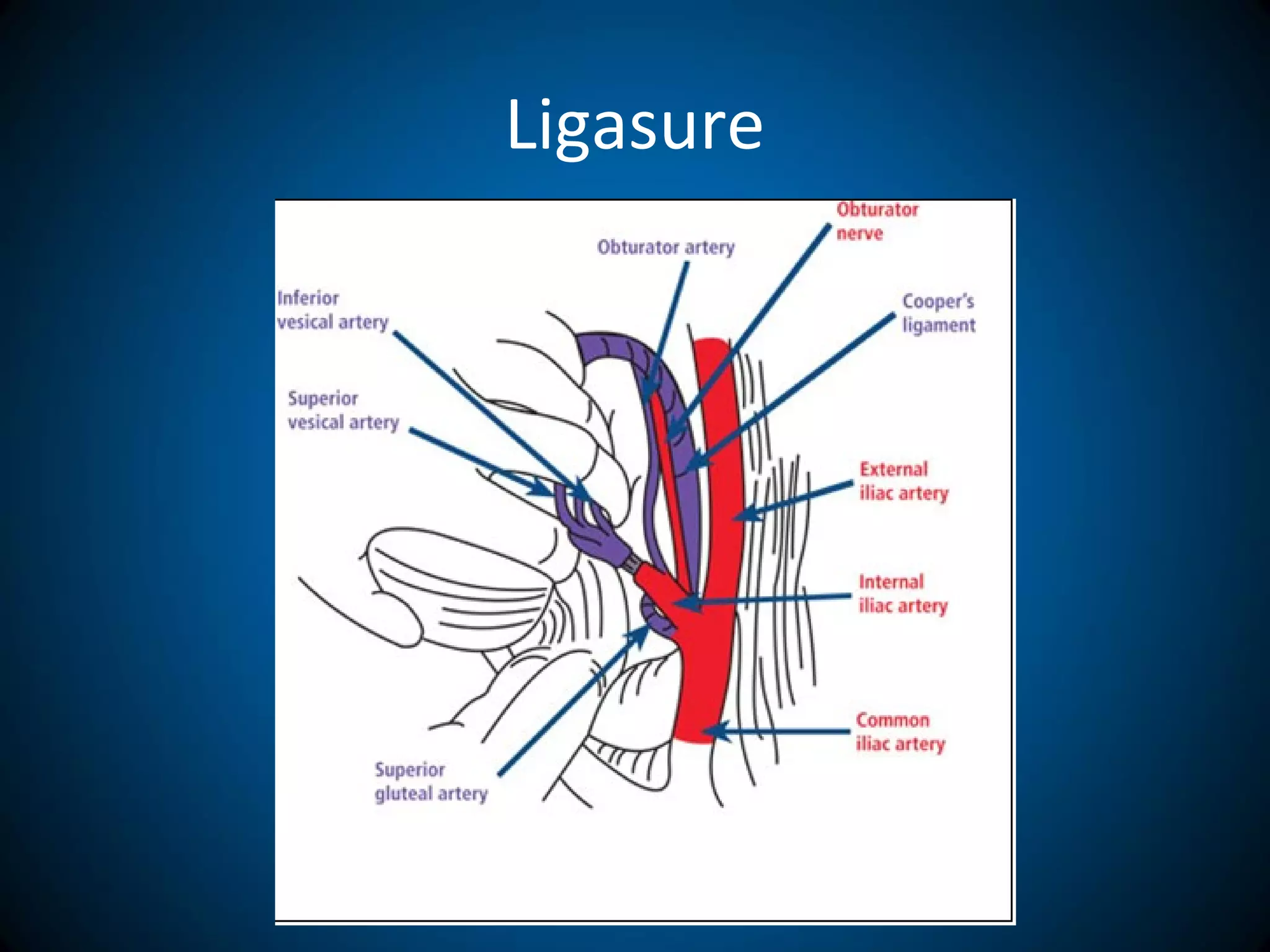
Ligasure
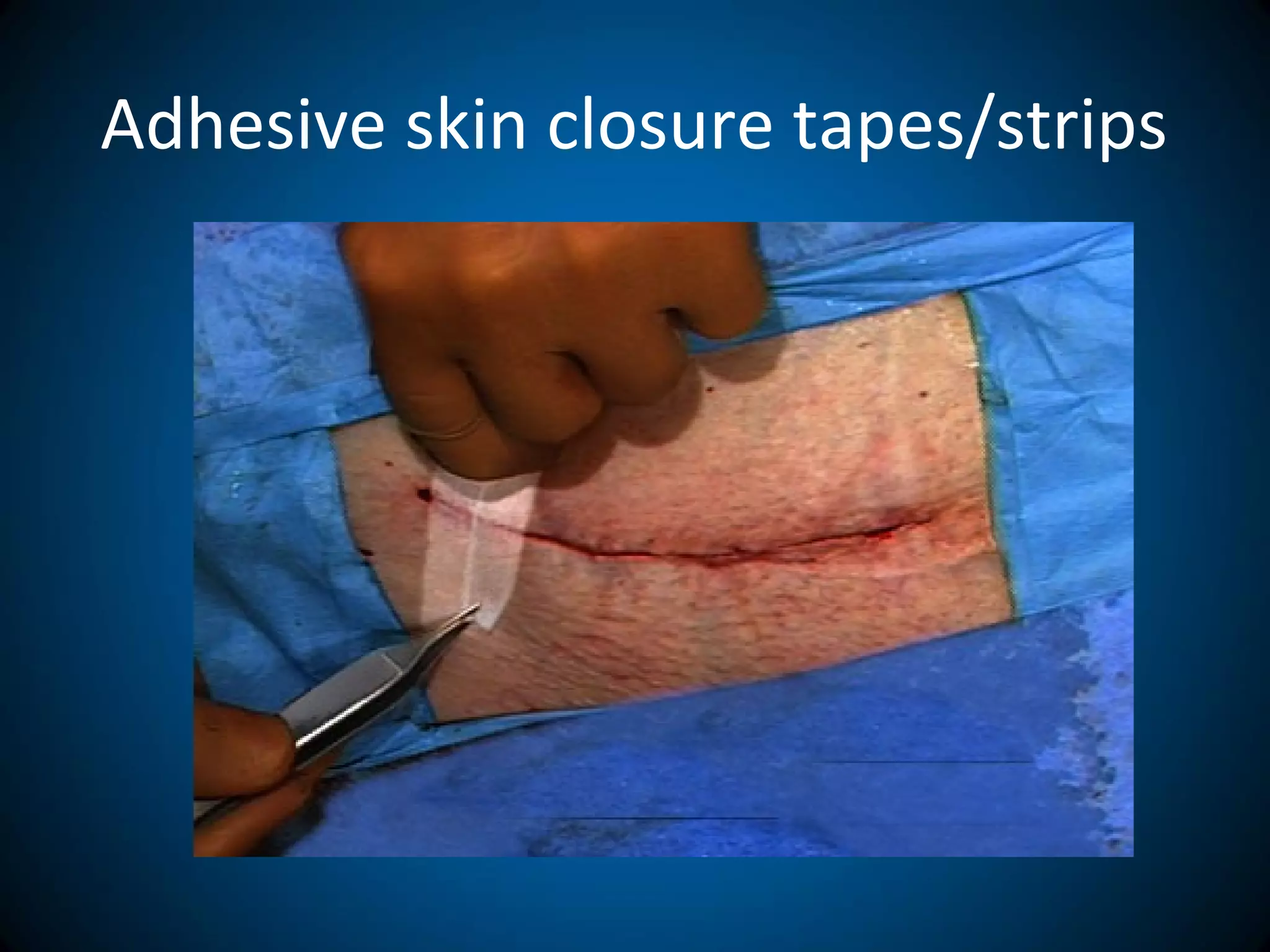
Adhesive skin closure tapes/strips
• Made of nylon or polypropelene
• Used to reinforce subcuticular skin closure
or to approximate wound edges of small
incisions or lacerations
• Minimal tissue reactivity
• Low rate of infection
• No ischemia or necrosis
• Is gentler to the skin than needle
• May have an additional microbiocidal
Adhesive skin closure tapes/strips
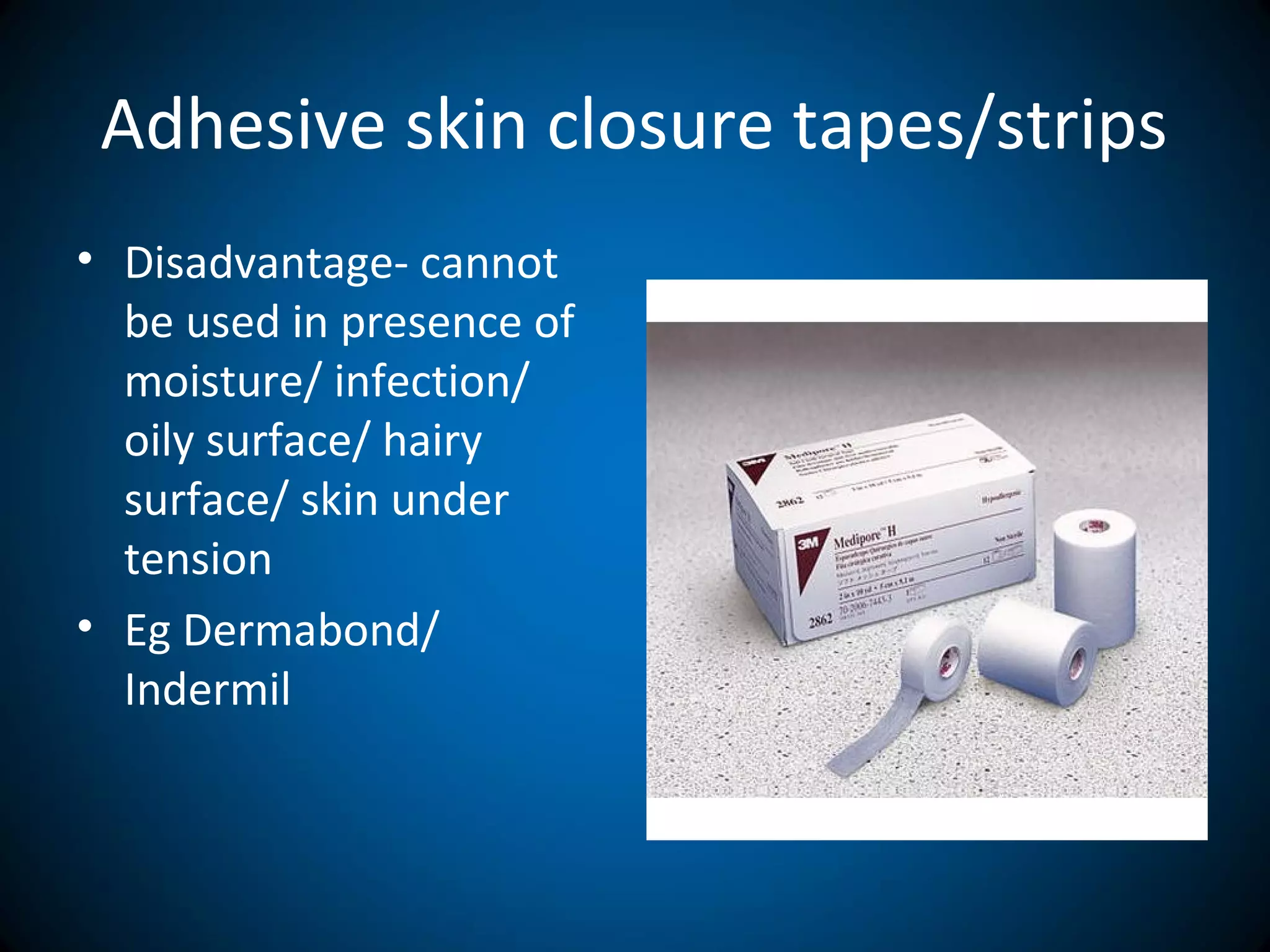
• Disadvantage- cannot
be used in presence of
moisture/ infection/
oily surface/ hairy
surface/ skin under
tension
• Eg Dermabond/
Indermil
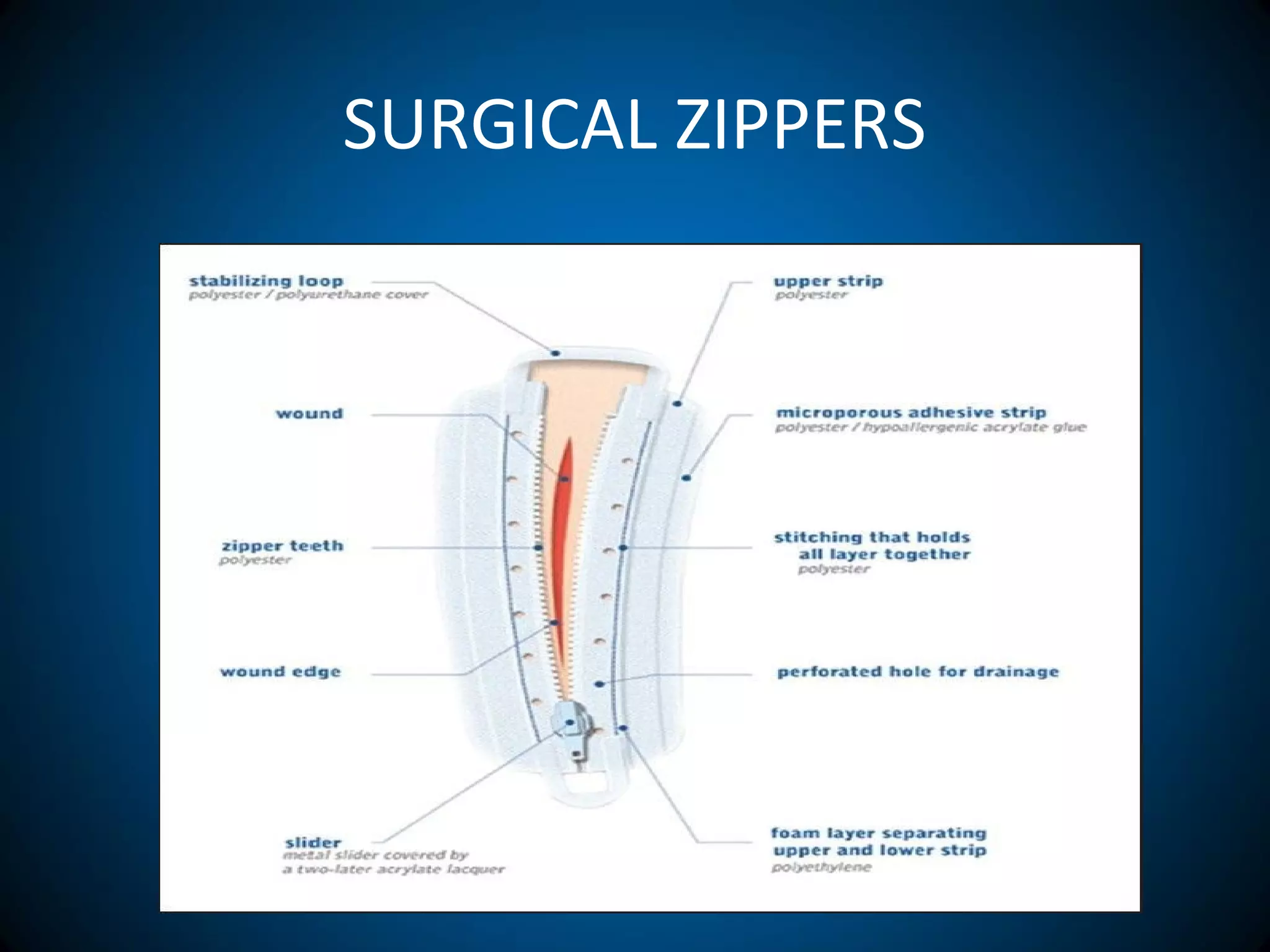
SURGICAL ZIPPERS
STERILIZATION OF SUTURES
 Sterilization differs according to the suture material and are usually done by
the manufacturer.
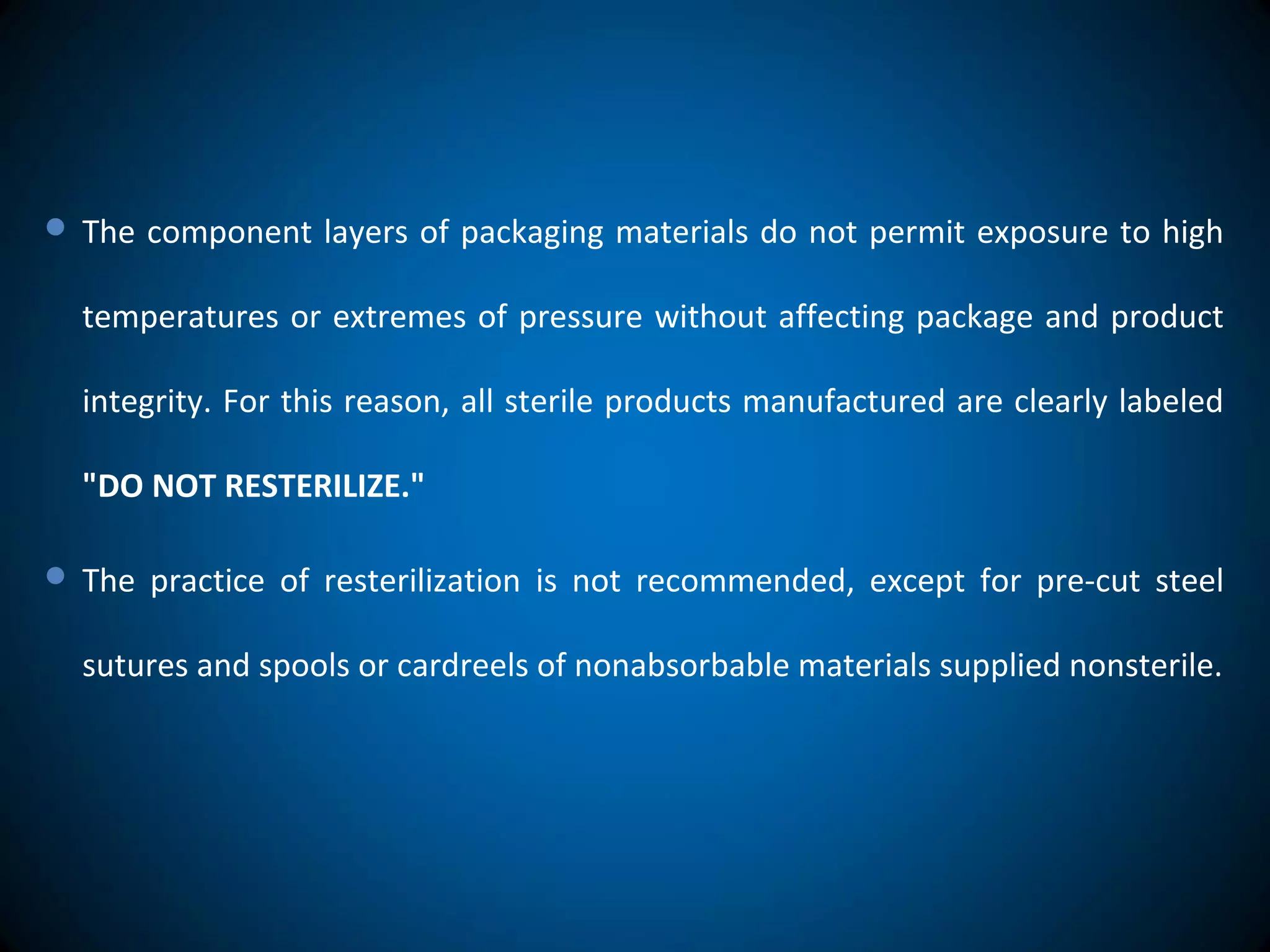
 Some sutures are sterilized with gamma radiation like silk, nylon, e-PTFE.
 Some suture material cannot withstand gamma
radiation like plain catgut, chromic catgut, PGA 910.
 Ethylene oxide gas.
 The component layers of packaging materials do not permit exposure to high
temperatures or extremes of pressure without affecting package and product
integrity. For this reason, all sterile products manufactured are clearly labeled
"DO NOT RESTERILIZE."
 The practice of resterilization is not recommended, except for pre-cut steel
sutures and spools or cardreels of nonabsorbable materials supplied nonsterile.
CONCLUSION
“The success of surgery starts with a
good incision , but becomes perfectly
complete only with good suturing”
Great Teacher of SurgeryGreat Teacher of Surgery
Dr. Hamilton Bailey (1894-1961)Dr. Hamilton Bailey (1894-1961)
• BASIC SURGICAL TECHNIQUES-R M KIRK
• Atlas of Minor Oral Surgery- Harry Dym
• Laskin vol-1
• Textbook of TRAUMA IN oral & maxillofacial
surgery-FONSECA
• Minor Oral Surgery- Goeffrey L.Howe
• Text book of surgery: SABISTON
• Suture material techniques and knots. Serag wieesneR
REFERENCE

sutures and suturing technique and knots

  • 1.
    Sutures, Needles, Suturing Techniques, andKnot Tying 1 Presented by Dr. Avinash Rathore I yr Post Graduate Dept of Oral and Maxillofacial Surgery
  • 2.
    Introduction History Definition Goals of suturing Suturematerials - Introduction - Requisites of ideal suture material - Classification - Selection of suture material - Absorption of suture material - Biological response of body to suture. Suture armamentarium- needles, needle holder, scissor Principles of suturing Suturing Techniques- Indications, Advantages, Disadvantages Knots Suture Removal Other methods of wound closure CONTENTS
  • 3.
    A STITCH INTIME SAVES NINE.
  • 4.
    • Suture meansto ‘sew’ or ‘seam’. In surgery suture is the act of sewing or bringing tissue together and holding them in apposition until healing has taken place. • . A suture is a strand of material used to ligate blood vessels and to approximate tissues together. INTRODUCTION
  • 5.
    DEFINITIONS • DEFINITION: suturematerial is an artificial fibre used to keep wound together until they hold sufficiently well by themselves by natural fibre (collagen) which is synthesized and woven into a stronger scar • Suture is a Stitch/Series of Stiches made to secure apposition of the edges of a Surgical/Traumatic wound (Wilkins) • Any Strand of Material utilised to ligate blood vessels or approximate Tissues (Silverstein L.H 1999)
  • 6.
    Historical Landmarks • Theearliest records of surgical suture date back to 3500 B.C. in Egypt. The script is now known as The Edwin Smith Surgical Papyrus. • The oldest physical evidence of surgical suture dates to between 500-1000 B.C. Evidenced by several mummies who had been sutured which were found in Egypt. • Hippocrites first used the term ‘suture’ in 400 B.C. The meaning is literally to ‘sew’ or
  • 7.
    • In 100B.C., Cornelius Celsus, a Roman, used the word as a noun and a verb – “the suture” and “to suture”. • The first sutures were fashioned from hair, cotton, tendon, or silk. They were used on needles made of bone, stone, or wood. • Sutures were originally used to close open wounds, but shortly were adapted to ligate tissue as well. This method was successful but infection rate was extremely high.
  • 8.
    Historical Landmarks • In1867, Joseph Lister first attempted to sterilize suture. He used silk suture that was ‘sterilized’ in carbolic acid. The first trials were unsuccessful. • In 1869, Lister changed to ‘catgut’ suture, which was being widely used in Germany due to its absorbability. The trials showed great reduction in infection rates.
  • 9.
    • Inspired bythe data from Joseph Lister, Robert Wood Johnson and his brothers, Edward Mead Johnson and James Wood Johnson, started a small business in 1885 – they named it Johnson & Johnson. • In 1886, Johnson & Johnson was the first company to mass produce Joseph Lister’s sterile catgut suture.
  • 10.
    • Johnson &Johnson, off of its success from sterile suture and sterile dressing sales, became incorporated in 1887. • In 1906, Iodine was first produced in Germany by the B. Braun Company. • In 1956, Johnson & Johnson created an independent division for its suture production and sales – it was named Ethicon.
  • 11.
    Goals of Suturing •Maintain haemostasis. • Permit primary intention healing. • Reduces postoperative pain. • Permit proper flap position. • Produce aesthetically pleasing scar by approximating skin edges.
  • 12.
    LACERATE MEANS- 12 Look Atthe Wound, Assess it Anesthetic Considerations Cleaning the Wound Equipment – Set Up Repair of the Wound Assessing Results, Anticipate Complications Tetanus Immunization Status Educate the Patient Regarding Wound Care
  • 13.
    Suture Properties • Absorption: –Progressive breakdown and loss of mass and/or volume of suture material; does not correlate with initial tensile strength. Ultimately, tensile strength is lost as the suture degrades. • Capillary Absorption : – Extent to which absorbed fluid is transferred along the suture. • Fluid Absorption: – Ability to take up fluid after immersion.
  • 14.
    Suture Properties • TensileStrength: – Measure of a material or tissue's ability to resist deformation and breakage • Breaking Strength: – The tension at which suture failure occurs. The maximum limit of the tensile strength. • Elasticity: – Measure of the ability of the material to regain its original form and length after deformation. If deformed beyond its elastic property, the suture is greatly weakened.
  • 15.
    Suture Properties • Plasticity: –Measure of the ability to deform without breaking. • Memory: – Inherent tendency of suture material to retain its shape. Related to the elasticity, plasticity, and diameter of the suture. • Pliability: – Ease of manipulating the suture, such as the ability to adjust knot tension and to secure knots. Related to the suture material, filament type, and diameter.
  • 16.
    Suture Properties • Straight-PullTensile Strength: – Linear breaking strength of suture material. • Knot Strength: – Amount of force necessary to cause a knot to slip (related to the coefficient of friction and plasticity) • Knot-Pull Tensile Strength: • Breaking strength of the knot. (10-40% weaker at knot)
  • 17.
    Suture Properties • SuturePullout Value: – The amount of force on a suture required to cause tissue failure. • Measurement of the strength of a particular tissue • Variable depending on anatomic site and composition (fat, 0.2 kg; muscle, 1.27 kg; skin, 1.82 kg; fascia, 3.77 kg) • Wound Breaking Strength: – Limit of tensile strength of a healing wound at which separation of wound edges occurs. Based on collagen properties.
  • 19.
    According to source: 1.Natural 2. Synthetic 3. Metallic CLASSIFICATION OF SUTURE MATERIALS
  • 20.
    According to structure1. Monofilament 2. Multifilament According to fate : 1. Absorbable (undergo degradation and lose T.S. < 60 days) 2. Non absorbable ( maintain T.S > 60 days) According to coating: 1. Coated 2. Uncoated
  • 21.
    Absorbable Catgut Chromic catgut Collagen Fascia lata kangarootendon Beef tendon Cargile membrane NATURAL Non Absorbable Silk Silk worm gut Linen Cotton Ramie Horse hair
  • 22.
    SYNTHETIC  Absorbable  PolyglycolicAcid  Polyglactic Acid  Polyglactin 910(Vicryl)  Polydioxanone(PDS)  Polyglecaprone 25  Non Absorbable  Nylon/ polyamide  PolyPropylene  Polyesters  Polyethelene  Polybutester  Polyvinylidene fluoride / PVDF Sutures
  • 23.
  • 24.
  • 25.
    MONOFILAMENT Advantages • Smooth surface •Less tissue trauma • No bacterial harbours • No capillarity Disadvantages • Handling and knotting • Stretch • Any nick or crimp in the material leads to breakage.
  • 26.
    MONOFILAMENT  Absorbable  SurgicalGut- Plain, Chromic  Polydiaxanone  Non Absorbable  Polypropylene  Polyester  Nylon/polyamide  Polyvinylidene fluoride / PVDF Sutures
  • 27.
  • 28.
    MULTI FILAMENT Advantages • Strength •Soft and pliable • Good handling • Good knotting Disadvantages • Bacterial harbours • Capillary action • Tissue trauma
  • 29.
    MULTIFILAMENT  Absorbable  Polyglactin910  Polyglycolic Acid  Non Absorbable  Silk  Cotton  Linen
  • 30.
     MONOFILAMENT  HandlingDifficult  Smooth & strong  No Wicking  Thinner  MULTIFILAMENT  Handling easy  Low Strength  Wicking is a Problem  Thicker
  • 31.
  • 32.
    Non absorbable suturesare categorized by the United States Pharmacopeia (USP) as Class I - Silk or synthetic fibers of monofilaments with twisted or braided construction Class II - Cotton or linen fibers, coated natural or synthetic fibers in which the coating does not contribute to T.S Class III - Metal wire of monofilament or multifilament construction.
  • 33.
  • 34.
  • 35.
     It isthe oldest known absorbable suture material.  According to Katz and Turner (1970), Galen referred to gut suture as early as 175 A.D.  It is derived from sheep or bovine intestine and is classified as natural, monofilament and absorbable suture.  Gut is the most variable suture material in terms of tensile strength and absorbability. GUT
  • 36.
    GUT SUTURE  Guthas the smallest strength of any of the commonly used suture materials (Herrmann 1971).  The percentage of collagen in the suture determines its tensile strength and its ability to be absorbed by the body without adverse reaction.  When placed intraorally through mucosal surfaces, the sutures resorb in 3-5 days.
  • 37.
    GUT SUTURE  Becauseit is organic material and highly susceptible to enzymatic degradation, it is packaged in isopropyl alcohol as a preservative.  The suture should not be soaked in saline - loses from 20% to 30% of its tensile strength. (Katz and Turner)  Gut suture is absorbed by proteolytic degradation and phagocytosis.
  • 38.
    PLAIN SURGICAL GUT  Rapidlyabsorbed.  Tensile strength is maintained for only 7 to 10 days and absorption is complete within 70 days.  Can also be specially heat-treated to accelerate tensile strength loss and absorption.  Used primarily for epidermal suturing where sutures are required for only 5 to 7 days.
  • 39.
    CHROMIC GUT  Itis plain gut that has been treated with a solution of buffered chrome tanning solution to resist body enzymes, prior to being spin, ground and polished.  It prolongs the absorption time over 90 days.  The chromic salt acts as a cross-linking agent and increases the tensile strength and its resistance to absorption of the body (Edlich et al 1973).
  • 40.
     Chromic gutsutures minimize tissue irritation, causing less reaction than plain surgical gut during the early stages of wound healing.  Tensile strength may be retained for 10 to 14 days, with some measurable strength remaining for up to 21 days. Contraindications:  Being absorbable should not be used when prolonged approximation of tissues under stress is required.
  • 41.
    In intraoral Surgery PLAINGUT  Used occasionally, manipulation difficult  Knot holding property- poor  Becomes hard, can traumatize – mucosa CHROMIC GUT  Not particularly good choice  Stiff, difficult to handle and tie  Does not rapidly resorb.
  • 42.
    Chromic Catgut • Uses- 1.Tosuture muscles, bowel anastomosis, peritoneum. 2.During appendicectomy, to tie the mesoappendix and the base of appendix. 3.The inner layer during two layer anastomosis of the small gut or anastomosis during gastrojejunostomy.
  • 43.
    Chromic Catgut 4. Duringcholecystectomy, to stop bleeding from gall bladder bed. For most of the above said uses however, polygalactin sutures are replacing catgut.
  • 44.
    POLYGLACTIN 910  They comeunder trade name “Vicryl”  Synthetic absorbable sterile surgical suture composed of a copolymer made from 90% glycolide and 10% L-lactide.  Coated vicryl suture is prepared by coating vicryl suture material with a mixture composed of equal parts of copolymer of glycolide and lactide (polyglactin 370) and calcium stearate.
  • 45.
     Dexon andVicryl, when braided are the strongest of the absorbable suture materials.  According to Dardik, and Lanfman (1971), metabolites of polyglycolic acid are metabolised via the citric acid cycle and produce energy, Co2 and water.  Available as braided dyed violet or undyed natural strands in a variety of lengths with or without needles.
  • 46.
    COATED VICRYL PLUSANTIBACTERIAL (POLYGLACTIN 910) SUTURE  Coated VICRYL Plus Antibacterial suture contains one of the purest forms of the broad-spectrum antibacterial agent triclosan .  Coated VICRYL Plus Antibacterial suture offers protection against bacterial colonization of the suture.  Degree of inflammation is less as seen in plain/chromic catgut sutures.
  • 47.
    In vivo studiesdemonstrate that  Coated VICRYL Plus Antibacterial suture has a zone of inhibition that is effective against the pathogens that most often cause surgical site infection (SSI) Staphylococcus aureus, methicillin-resistant Staphy aureus (MRSA), Staphy epidermidis, methicillin-resistant Staphy epidermidis (MRSE) (Rothenburger S et al 2002)  VICRYL Plus Antibacterial suture has no adverse effect on normal wound healing. (Gilbert P et al 2002)
  • 48.
    POLYGLECAPRONE 25  Trade name– “Monocryl”  It is a synthetic, monofilament, absorbable suture material made up of co- polymer of 75% glycolide and 25% epsilon-caprolactone.  It undergoes hydrolysis and absorption by 90-120 days.  Tissue reaction is minimal.  It has good knot strength.  It is the most pliable and is used in soft tissue closure.
  • 49.
     Biologic behavioursimilar to that of PGA 910.  Narry Filho 2002 - Because of its favorable characteristics it can be used not only deep in tissues, but also in superficial tissues of oral mucosa.  Tremendous tensile strength (highest) but is very stiff.
  • 50.
    POLYDIOXANONE (PDS)  Itis a synthetic, monofilament, absorbable suture.  It is comprised of the polyester poly(p-dioxanone).  It combines the features of soft, pliable, monofilament construction with absorbability and extended wound support for up to 6 weeks.
  • 51.
     It undergoesslow hydrolysis and takes 110-210 days to get absorbed.  It has good tensile strength and moderate knot tensile strength. PDS sutures are available clear or dyed violet to enhance visibility. Uses:  Absorbable suture with extended wound support. Contraindication:  Being absorbable should not be used when prolonged approximation of tissues under stress is required.
  • 52.
    NON RESORBABLE SUTUREMATERIALSNON RESORBABLE SUTURE MATERIALS SURGICAL SILKSURGICAL SILK  It is a natural, multifilament, non-absorbable suture.  Silk is an organic substance that undergoes slow proteolysis when implanted (Douglas, 1949)  It is a natural protein fiber of raw silk, which is treated with silicon protein or wax.
  • 53.
     Silk losesmost of the tensile strength after 1 year of implantation and usually disappears after 2 years.  It is the most popular inexpensive suture material for intraoral use.  It is braided, which gives it excellent handling characteristics.
  • 54.
    Types: According topreparation.  Perma hand surgical silk.  Virgin silk suture which is prepared from the glands of silk worm before their pupae stage. According to fiber pattern:  Braided.  Twisted.  Floss.
  • 55.
     Postlethwait (1970)and Van Winkle and Co-workers (1975)- Silk initially produces more tissue reaction (inflammation) than synthetic non-absorbable sutures.  According to Herrmann (1971), silk has one of the lowest tensile strengths among suture materials, ranking just above gut and collagen and in terms of knot-holding ability it ranks the lowest of all the commonly used suture materials. Therefore, at least three ties should be used for each knot.
  • 56.
     Addition ofwax or silicon to reduce the tissue reaction and prevent wicking further diminishes knot security (Hermann, 1971).  It has the “ wicking effect ” i.e, it pulls the bacteria & fluid into the wound site .
  • 57.
    COTTONCOTTON  Natural, multifilamentand non-absorbable.  Made from non-continuous natural fibers of Egyptian cotton.  Following the report by Mead and Oshsner (1940) cotton became popular during World War II when silk was relatively unavailable.  strength is similar to silk, their handling characteristics are inferior.  Tissue reaction is moderate.
  • 58.
    LINENLINEN  It isalso natural, multifilament and non-absorbable suture.  It is derived from staple flax fibers.  somewhat stronger than cotton but otherwise has similar characteristics of cotton.  Tissue reaction is minimal.  Because of its poor tensile strength, cannot be used for suturing under tension.
  • 59.
    NYLONNYLON  It issynthetic, non-absorbable suture material available in braided (or) monofilament forms.  Comprises of polymers of hexamethylene diamine and adipic acid.  The monofilament form - Duralon and Ethilon.  The multifilament form is - Nurolon and Surgilon.
  • 60.
     Nylon possessesthe property of “memory”  Generally, multiple square knots are necessary to maintain the tie.  It degrades at a rate of 15-20% per year.  Herrmann (1971) has shown that nylon has good tensile strength but ranks below that of steel.
  • 61.
    Limitations  Because ofits stiffness, the large knot is required.  Since it has a tendency to tear through non-keratinsed tissue, nylon is not frequently used intraorally.
  • 62.
    METALMETAL  316 LStainless steel or tantalum sutures are either monofilament or braided.  They are the strongest and produce the most secure knot of any suture materials (Herrmann 1971).  Tissue tolerance is good but is less than that found with nylon.  Metallic materials may undergo degradation through corrosion, resulting in transfer of ions from the suture to the tissue.
  • 63.
     Tissue reactionto these ions can occur.  Metallic sutures are stiff and do not conform to the suture pathway during host movement.  The resultant irritation may produce tissue damage and increased susceptibility to infection.  In oral and maxillofacial surgery used for suspension of splints (or) arch bars not as suture material.
  • 64.
    POLYESTERPOLYESTER “Dacron, Mersilene, Ethibond”(polyester) are braided suture materials. Composed of polymers of polyethylene terephthalate. exhibits the greatest tensile strength and knot holding ability of the non- metallic suture materials (Herrmann, 1971). The tissue reaction is minimal and is unaffected by the presence of an inert coating or impregnation with silicon or Teflon (Edlich et al 1973).
  • 65.
    POLYPROPYLENEPOLYPROPYLENE  Trade name– “Prolene”  It is synthetic, monofilament and non-absorbable.  Composed of an isotactic crystalline stereoisomer of polypropylene.  It exhibits good tensile strength, minimal and transient tissue reaction.  It is used in all types of soft tissue approximation.  It shows excellent handling characteristics.
  • 66.
    Advantage of plasticityof prolene  When swelling occurs , prolene will stretch to accommodate the wound ,thus there will be little cutting through the tissue.  When swelling recedes , the suture will remain loose & keep the edges properly approximated.
  • 67.
    EXPANDED POLYTETRAFLUROETHYLENE (E-PTFE) GORE-TEX EXPANDEDPOLYTETRAFLUROETHYLENE (E-PTFE) GORE-TEX  It is the most recent material to be used as suture material.  It is monofilament strand obtained by polymerization of Tetrafluroethylene & is expanded mechanically to increase its flexibility.
  • 68.
    • It iseasy to handle , sterilize, tie knot & has good tensile strength. • It can be used for closure of flaps where the same material used as barrier membrane.
  • 69.
    NEWER MATERIALSNEWER MATERIALS Monofilament synthetic nonabsorbable  Butylene terephthalate (84%) and polytetramethylene ether glycol terephthalate (16%).  strength, lack of package memory, elasticity, and flexibility which made suturing  quicker and easier.  can be used safely on skin and mucosal wounds  Monofilament synthetic nonabsorbable  Butylene terephthalate (84%) and polytetramethylene ether glycol terephthalate (16%).  strength, lack of package memory, elasticity, and flexibility which made suturing  quicker and easier.  can be used safely on skin and mucosal wounds THE POLYBUTESTER SUTURE (NOVAFIL™)
  • 70.
    2. POLYSORB- MONOFILAMENT, ABORBABLE Copolymers of glycolide and lactide were then synthesized to produce a Lactomer™ copolymer).  Glycolide provides for high initial tensile strength, but hydrolyses rapidly in tissue. Lactide has a slower and controlled rate of hydrolysis, and provides for prolonged tensile strength in tissue.  Copolymers of glycolide and lactide were then synthesized to produce a Lactomer™ copolymer).  Glycolide provides for high initial tensile strength, but hydrolyses rapidly in tissue. Lactide has a slower and controlled rate of hydrolysis, and provides for prolonged tensile strength in tissue.
  • 71.
     The Lactomer™copolymer consists of glycolide and lactide in a 9:1 ratio.  The handling characteristics were found to be superior to those of the Polyglactin 910™ suture.  The Lactomer™ copolymer consists of glycolide and lactide in a 9:1 ratio.  The handling characteristics were found to be superior to those of the Polyglactin 910™ suture.
  • 72.
    3. MAXON- MONOFILAMENT ABSORBABLE Asuture (Maxon™) has been developed using trimethylene carbonate. The strength is better than the braided synthetic absorbable suture A suture (Maxon™) has been developed using trimethylene carbonate. The strength is better than the braided synthetic absorbable suture
  • 73.
    5. CAPROSYN- MONOFILAMENTABSORBABLE  Rapidly absorbing  Are prepared from Polyglytone™ 6211 synthetic polyester which is composed of glycolide, caprolactone, trimethylene carbonate, and lactide.  Rapidly absorbing  Are prepared from Polyglytone™ 6211 synthetic polyester which is composed of glycolide, caprolactone, trimethylene carbonate, and lactide.
  • 74.
    Compared to chromicgut it has: Significantly greater mean breaking strength, handling properties were far superior, The smooth surface of the Caprosyn™ sutures encountered lower drag forces, it was much easier to reposition the Caprosyn™ knotted sutures. Are an excellent alternative to Chromic Gut sutures. Compared to chromic gut it has: Significantly greater mean breaking strength, handling properties were far superior, The smooth surface of the Caprosyn™ sutures encountered lower drag forces, it was much easier to reposition the Caprosyn™ knotted sutures. Are an excellent alternative to Chromic Gut sutures.
  • 75.
    SUTURE SELECTION • Locationof wound • Static and dynamic wound tension • Presence of infection (fever) • Cost of suture material 75
  • 76.
    • The initialbody response to sutures is almost identical in the first 4-7 days, regardless of the suture material. • The early response is a generalized acute aseptic inflammation, involving primarily polymorphonuclear leukocytes. • After few days mononuclear cells, fibroblasts & histiocytes become evident. • Capillary formation occurs at the end of this initial phase. BIOLOGIC RESPONSE OF BODY TO SUTURE MATERIALS
  • 77.
    AFTER 4-7 DAYS Theresponse is related more to the type of suture material. For eg. Plain gut elicits an intense reaction with macrophages and polymorphonuclear leucocytes predominating, while non-absorbable materials show a less intense relatively acellular histological pattern. In human study conducted by Elen and Conen the presence of the suture increased the susceptibility to infection by a factor of 10,000 times.
  • 78.
    • Natural Absorbable– Proteolytic degradation. Intense tissue response • Synthetic Absorbable – Hydrolysis. Less Intense • Non Absorbable – Encapsulation. Acellular Response
  • 79.
  • 80.
    Armamenterium  SUTURE MATERIAL SUTURING NEEDLE  NEEDLE HOLDER  TISSUE HOLDING FORCEP  SUTURE CUTTING SCISSOR
  • 81.
    NEEDLE HOLDERS  Mustbe made of non corrosive, high strength good quality steel alloy with jaws designed for holding the suture needle securely.  It may be short or long ,broad or narrow, slotted or flat, concave or convex.
  • 82.
    Jaws with tungstencarbide particles embedded in them offer two distinct advantages. Good holding power Less damage to suture material
  • 83.
    How to holdneedle with needle holder ?  Grasp the needle with the tip of the needle holder jaws in an approximately 1/3rd to ½ of the distance from the attachment end to point.  Do not grasp the needle too tight.  Grasp the needle with the tip of the needle holder jaws in an approximately 1/3rd to ½ of the distance from the attachment end to point.  Do not grasp the needle too tight.
  • 84.
  • 85.
    Suture Construction • Thepoint is the sharpest portion and is used to penetrate the tissue. Shape varies. Delicate! • The body represents the mid portion of the needle. Solid Steel. Strongest portion. • The swage is the portion to which the suture material is attached. Instrumentation here will break or weaken the suture.
  • 86.
    Things to consider… •While chosing a needle type for suturing • Type of needle- Type of tissue being closed • Curvature of the needle- based on working space in operative field
  • 87.
    Needle material • Initiallystainless steel needles were being used • Now we use Surgalloy- a high nickel stainless steel – Gives it better resistance to bending and breakage
  • 88.
  • 89.
    Anatomy of theneedle • Chord length- straight line distance from point of curve to swage • Needle length- the entire length of the needle • Radius- distance between the centre of the circle to the body of the needle if the curved needle were to make a full circle • Diameter- thickness of the needle
  • 90.
    Anatomy of theneedle • Swage: This is the suture attachment end creates a single, continuous unit of suture and needle. This may be designed to allow easy release of the needle and suture material (pop-off) • The surgical needle may be coated with silicone to allow easier tissue passage.
  • 91.
  • 92.
    Types of sutureneedles • Round bodied – Minimises the tissue trauma because the needle pierces the tissue without cutting it. – Used for suturing peritoneum, abdominal viscera, myocardium, dura. • Cutting needle – Have two opposing cutting edges. – Designed to cut through tough difficult to penetrate structures. – Used in plastic surgery, especially of the face.
  • 93.
    Types of sutureneedles • Reverse cutting needle – Designed with cutting edge on the outer convex side – For skin, oral mucosa, tendon sheaths • Blunt needles – To dissect to friable tissue rather than cutting through it – For suturing liver and kidney
  • 94.
  • 95.
  • 96.
    Straight Needle ¼ circle 3/8circle ½ circle 5/8 circle J hook Needle of choice for the skin Limited use in oral surgery May be used in surgery of the nose, pharynx, tendons Needle of choice for microsurgery associated with very fine sutures; ophthalmology Oral surgery, flap surgery, wound closure after placement of osseointegrated implants and GTR procedures May be used in all surgical wounds Needle of choice in oral surgery Wide range of uses in many surgical wounds Wounds of the urogenital tract Laproscopic surgeries
  • 97.
    PRINCIPLES OF SUTURING 1.Theneedle holder should grasp the needle at approximately ¾ of the distance from the point. 2.The needle should enter the tissue perpendicular to the surface.if the needle pierces the tissue obliquely a tear may develop. 3.The needle should be passed through the tissue following the curve of the needle.treating a curved needle as a straight needle for example will result in tissue damage.
  • 98.
    4.The suture shouldbe placed at an equal distance(2-3mm)from the incision on both sides and at an equal depth.This principle can be modified in cases where the tissue edges to be sutured are at different levels;then passage of the suture closer to the edge of the lower side and farther from the edge of the higher side will tend to approximte the levels ,another method involves passage of the suture at an equal distance from the wound margin on both the sides but deeper into the tissue on the lower side and more superficially on the higher side.
  • 99.
    • 5.If oneside is free(as with a flap)and other fixed,the needle should be passed from the free to the fixed side. • 6.If one tissue is thinner than the other then the needle should be passed from the thinner to thicker side. • 7.If one tissue plane is deeper than the other then the needle should be passed from deeper to the superficial side. • 8.The distance that the needle is passed into the tissue should be greater than the tissue edge.this will ensure a degree of tissue eversion .some degree of tissue eversion is desirable in anticipation of scar contracture.
  • 100.
    • 9.The tissueshould not be closed under tension ,since they will either tear or necrose around the suture.If tension is present the tissue layer should be undermined to relieve it. • 10.The suture should be tied so the tissue is merely approximated not blanched. • 11.The knot should not be placed over the incision line. • 12.Sutures should be placed aproximately 3-4mm apart.the closeness of the suture depends upon the anticipated tension across the suture line.closer spaced sutures are indicated in areas of underlying muscular activity such as the tongue or in the other areas of increased tension.
  • 101.
    13.Occasionaly extra tissuemay be present on one side of the incision and a cause a “dog ear”to be formed in the final phase of wound closure.simply extending the length of incision to hide the excess will produce an unsatisfactory result.technique to deal with is a release in extension of the laceration or incision line.
  • 103.
    Suture Technique • Aneedle holder is used to grasp the needle at the distal portion of the body, one half to three quarters of the distance from the tip of the needle. • The needle holder should not be tightened excessively because damage to both the needle and the needle holder may result. • Incorrect placement of the needle in the needle holder may result in a bent needle, injury to the tissue, and/or an undesirable angle of entry into the tissue.
  • 104.
    Suturing Technique • Aneedle holder is held with the first and fourth fingers in the appropriate finger holes. The second and third fingers are used for stabilization and fine control of the instrument. • Surgeons who have mastered the foundational techniques can then modify their technique as needed (eg. ‘palming’ the driver). • When suturing, always sow towards yourself.
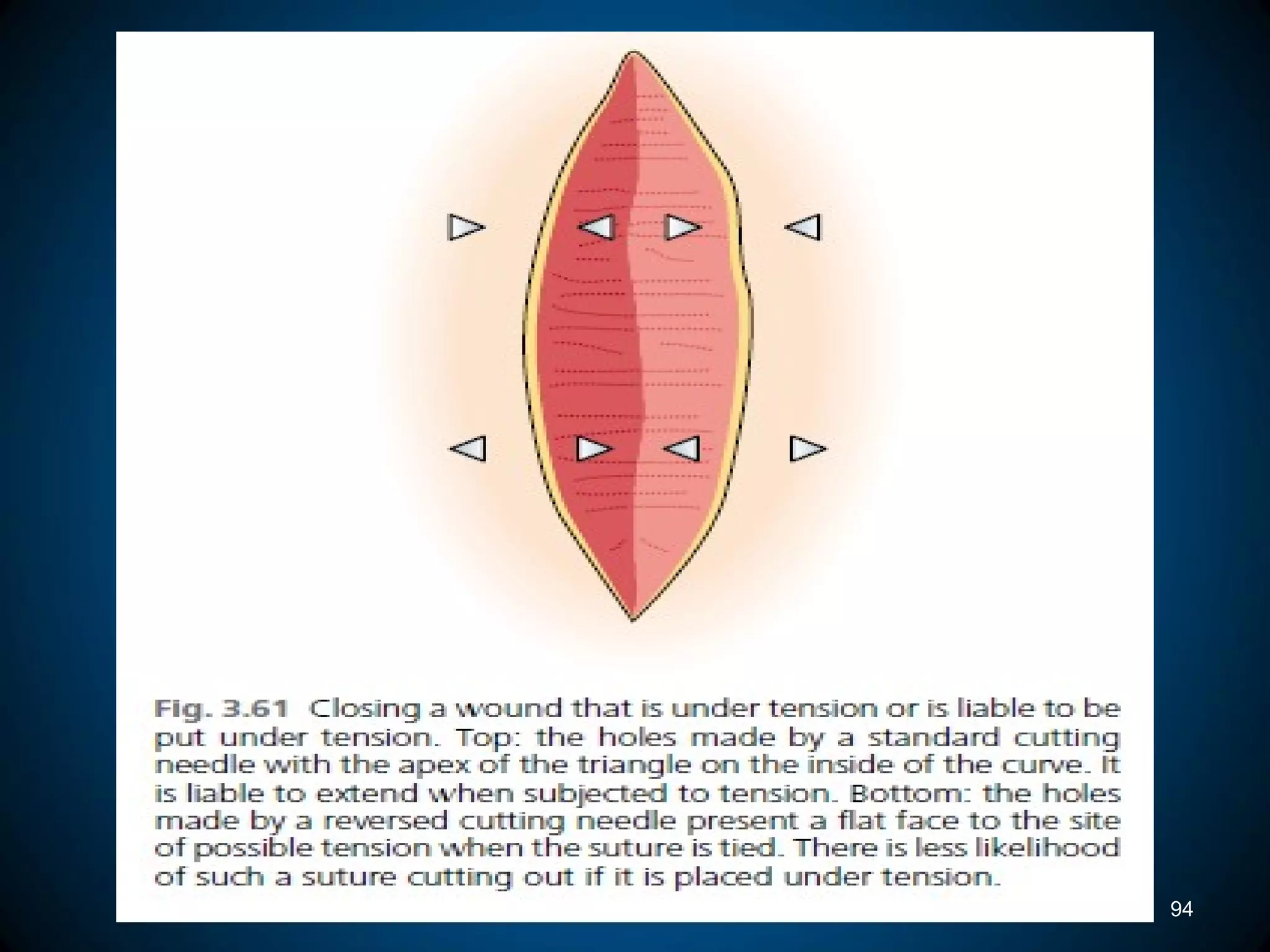
  • 105.
    • The tissuemust be stabilized to allow needle placement. Toothed or plain forceps may be used to gently grasp the tissue. Excessive trauma to the tissue being should be avoided to reduce the possibility of tissue strangulation and necrosis. • Forceps are meant primarily for grasping tissue. Not for handling the needle. • Sometimes it is necessary to grasp the needle as it exits the tissue after a pass. Grasping and stabilizing the needle should be done prior to releasing the needle holder. Otherwise, the needle may become lost in the tissues. Suturing Technique 105
  • 106.
    • The needleshould always penetrate the tissue at a 90° angle; that is, in a perpendicular plane. This minimizes the size of the entry wound and promotes a proper path through the tissue. Not doing so results in excessive tissue damage and sub-optimal or incorrect positioning of the suture. • The distance traveled, depth, and angle of the suture depends on the surgeon goal. In general, the 2 sides of the stitch being placed should be mirror images, with the needle also exiting the tissue in a perpendicular plane. Suture Technique
  • 107.
    Rule of 3 NeedlePenetration is 3mm from the flap margins. Place the thread 3mm from any adjacent suture. Always tie with 3 throws. ( First is a double surgeon’s knot, and number 2 & 3 are singles). Leave 3mm of thread from the knot when cutting off.
  • 108.
    INTERRUPTED SUTURESINTERRUPTED SUTURES Theyare also called “ solitary sutures ” .They have shorter span & close only a shorter distance of flap. Indications: •Vertical incision • Tuberosity and retromolar areas •Bone regeneration procedures with or without guided tissue regeneration •Widman flaps, open flap curettage, unrepositioned flaps, or apically positioned flaps where maximum interproximal coverage is required •Edentulous areas, osseointegrated implants •Partial or split-thickness flaps
  • 109.
    • Simple, uncomplicatedwounds • Easy technique to learn • If one breaks, integrity of closure is maintained • Slow to apply • Skill required to get ideal spacing and tension
  • 110.
    • Simple, uncomplicated wounds •Physics similar to simple interrupted • Even tension along suture • Fast application • Less knots, but break one and the whole stitch unravels Simple Running
  • 111.
    Used to closedeep wounds in layers. Knots will be inverted or buried, so that the knot does not lie between the skin margin and cause inflammation or infection. To bury the knot, first pass of the needle should be from within the wound and through the lower portion of the dermal layer. Needle then passed through the dermal layer and emerge through subcutaneous tissue and knot is tied. SUBCUTICULAR SUTURE
  • 113.
    Continuous short lateral stitchesare taken beneath the epithelial layer of the skin. The ends of the suture come out at each end of the incision and are knotted. CONTINUOUS SUBCUTICULAR SUTURE
  • 114.
    Advantages •Excellent cosmetic result •Usefulin wounds with strong skin tension, especially for patients prone to keloid formation. •Anchor suture in wound and, from apex, take bites below the dermal-epidermal layer •Start next stitch directly opposite the one that precedes it.
  • 115.
     Specially designedfor use in skin. It passes at 2 levels, one deep to provide support and adduction of wound surfaces at a depth and one superficial to draw the edges together and evert them.  Used for closing deep wounds  This approximates subcutaneous and skin edges VERTICAL MATTRESS
  • 116.
    Needle passed fromone edge to the other and again from latter edge to the fist and knot tied. When needle is brought back from second flap to the first, depth of penetration is more superficial.
  • 117.
    Advantages : • forbetter adaptation and maximum tissue approximation • To get eversion of wound margins slightly • Where healing is expected to be delayed for any reason, it is better to give wound added support by vertical mattress. Used to control soft tissue hemorrhage. • Runs parallel to the blood supply of the edge of the flap and therefore not interfering with healing. • Uses: abdominal surgeries & closure of skin wounds.
  • 118.
     It evertsmucosal or skin margins, bringing greater areas of raw tissue into contact. So used for closing bony deficiencies such as oro-antral fistula or cystic cavities.  Disadvantage: constricts the blood supply to edges of incision. HORIZONTAL MATTRESS
  • 119.
    Needle passed fromone edge to the other and again from the latter to the first and a knot is tied. Distance of needle penetration and depth of penetration is same for each entry point, but horizontal distance of the points of penetration on the same side of the flap differs.
  • 120.
    Advantages: Will evert mucosalor skin margins, bringing greater areas of raw tissue into contact. -So used for closing bony deficiencies such as oro-antral fistula or cystic cavities, extraction socket wounds. • Prevents the flap from being inverted into the cavity. • To control post-operative hemorrhage from gingiva around the tooth socket to tense the mucoperiosteum over the underlying bone.
  • 121.
    • It doesnot cut through the tissue ,so used in case of tissue under tension (inadequate tissue) Disadvantages: • More trouble to insert. • Constricts the blood supply to the incision if improperly used, cause wound necrosis and dehiscence
  • 122.
    6. FIGURE OF8 SUTURE Used for extraction socket closure and for adaption of gingival papilla around the tooth Suturing begun on buccal surface 3-4mm from the tip of the papilla so as to prevent tearing of papilla. Needle first inserted into the outer surface of the buccal flap and then the lingual flap. Needle again inserted in same fashion at a horizontal distance and then both ends tied.
  • 123.
    LOCKING SUTURE  Theprocedure is simple and repetitive. A single interrupted suture is used to make the initial tie. The needle is next inserted through the outer surface of the buccal flap and the underlying surface of the lingual flap.
  • 124.
    • The needleis then passed through the remaining loop of the suture, and the suture is pulled tightly, thus locking it. • This procedure is continued until the final suture is tied off at the terminal end .
  • 125.
  • 126.
    Principles of knottying • Ensure that the knot is firm enough to eliminate slippage • Make sure that the knot is as small as possible and the free ends are as short as feasible • Avoid damaging suture material while handling • Avoid excessive tension • Do not tie the knots too tightly- prevent strangulation of tissue
  • 127.
     The purposeof knots is to join the two ends of the suture in a secure but gentle way. Knots must be placed tightly enough to prevent slippage and loosening of the flap but not to blanch the tissues. They are generally placed on buccal aspects of flaps.
  • 128.
    A sutured knothas three components (Thacker et al , 1975). The “LOOP” created by the knot. The knot itself, which is composed of a number of tight “throws”: each throw represents a weave of the two strands. The “EARS” which are the cut ends of the suture.
  • 129.
    The knot maybe tied in 2 techniques  INSTRUMENT TIE  Using needle holder  ONE- HANDED & TWO-HANDED TIE  Using fingers
  • 130.
    Types of knots Overhangknot Square knot / reef knot Surgeon’s knot Slip (or) Granny knot
  • 131.
    OVERHANG KNOT It isthe basic knot which is simple loop made by crossing the free end of the suture over the standing part one time.
  • 132.
    SURGEONS KNOT  Itis the most commonly used knot as it reduces slippage of the first tie , while the 2nd tie is placed.  It is formed by tying 2 ties. The first tie is formed by 2 throws of suture around needle holder in one direction & the 2nd tie by throwing the suture in opposite direction.
  • 133.
    SQUARE KNOT It ismade by tying two overhang knots each done in opposite directions. This knot is easy to tie but loosen when synthetic/ monofilament sutures are used.
  • 134.
    SLIP/GRANNY KNOT  Itis similar to square knot , in it both the overhang knots are placed in same direction.  The advantage of this knot is even after placing the second knot it can be further tightened with one or two additional overhang knots.
  • 136.
    • The needleholder is placed parallel with the incision (or vessel) being tied. The long end of the suture is wrapped around the tip of the needle holder in a clockwise direction forming a loop. The short end of the suture is grasped with the needle holder and pulled through the loop. Bring the short end of the suture toward you. This creates the first hitch of a square knot. • The second hitch is formed by wrapping the long end of the suture around the instrument in a counterclockwise direction. The short end of the suture is then grasped and pulled through the loop. Pull the needle holder away from you, squaring the knot. Instrument Tie
  • 137.
    • The greatestprecision in maintaining constant tension on the suture during the tying process • Preferred by most surgeons (especially when others are tying) • Easier of the techniques to master successfully • More reliably produces square knots • If you want to be a surgeon, master this technique Two Handed Tie
  • 138.
    • The one-handedknot is so named because all of the maneuvering, including releasing and re-grasping the free end, is done with one hand. The other hand merely holds the fixed segment taut. • One handed knots have the advantage of allowing more speed in tying, but have less tension control of the segments. • The maneuvering is done with the left hand so that a surgeon tying his own knots during suturing can continue to hold the needle holder in his right hand. • More difficult to achieve excellent square knots. Unforgiving of lapses in technique. One Handed Tie
  • 139.
  • 140.
    Skin wounds regainTS slowly. It can be removed in 3-10 days when the wound gained 5%-10% of final TS. Skin sutures on face removed between 3-5 days. Alternate sutures removed on 3rd day and remaining sutures after 2 days. SUTURE REMOVAL
  • 141.
     Intra oral -Mucoperiosteal closure (without tension) 5-7 days - Where there is tension on the suture eg : Oro-antral fistula- 7-10 days  Back and legs where cosmesis is less important – 10-14 days.  Continuous subcuticular can be left for 3-4 weeks without formation of suture tracks  A good guide is that as soon as they begin to get loose they should be taken out.
  • 143.
     Suture areais first cleaned with normal saline.  The suture is grasped with non-tooth dissecting forceps and lifted above the epithelial surface.  Scissors are then passed through one loop and then transected close to the surface to avoid dragging contaminated suture material through tissues.  The suture is then pulled out towards incision line to prevent dehiscence.If suture entrapped in a scab, application of hydrogen peroxide or saline solution is necessary.  If pieces of suture left, infection or granuloma formation can ensue.
  • 144.
  • 145.
    • Possible ComplicationOf Leaving Suture For Many Days : 1.Sutural abscess. 2.Suture scarring or stitch mark 3.Implanted dermoid cyst
  • 146.
    SCISSORS Dean’s Scissors -General purposescissors -Used for cutting sutures -Can also be used to trim mucosal margins.
  • 147.
    SUTURE MARKS Suture marksare caused by 3 factors 1.Skin sutures left in place longer than 7 days, resulting in epithelialisation of suture track 2.Tissue necrosis from sutures that were tied too tightly or became tight due to tissue edema 3.Use of reactive sutures in the skin.
  • 148.
  • 149.
    Surgical Staples • Basicprinciple • Preservation of adequate tissue vascularization • Creation of adequate lumen • Prevention of leaks and fistulas • Evading of tissue tension • Haemostasis
  • 150.
    Surgical Staples • Advantages •Less tissue reaction • Accelerated wound healing • Efficiency • Less anesthesia and intra operative time
  • 151.
    Surgical Staples • Typesof staplers • Linear stapler- used for closure of a linear wound • Circular or intraluminal staplers- used in GI surgeries for end-to-end, end-to-side, side-to-end or side-to-side anastomosis. They offer a circular, double staggered row of staples. • Ligating and dividing stapler- issues a double row of two staples and ligates the tissue. The tissue can then be divided between the staple lines.
  • 152.
    Surgical Staples • Pursestring suture clamps- for placement of purse string sutures. • Skin staplers- to approximate skin edges. • Endoscopic staplers
  • 153.
  • 154.
    Fibrin Glue • Synthesizedfrom bovine blood • Uses • Used to control bleeding and approximating tissues that are difficult to approximate by suturing, eg. Liver, spleen and lung. • Microsurgical anastomosis of blood vessels • Used in Cardiopulmonary bypass surgery • Repair ocular implants • Close superficial lacerations and fistula • Repair dural tears
  • 155.
    Surgical Glue • Madeof cyanoacrylate • For adhesion of superficial lacerations
  • 156.
    ADHESIVES/GLUES  Simplifies SkinClosure  No Suture Related Problems  Noinflammation  Local Anaesthetic Not Needed  Used In Facial Lacerations & Children  Acts As Barrier Against Microbes  Dermabond(octyl-2-cyanoacrylate)  Approved By Us Fda
  • 157.
    Tissue Adhesives • BEFORECURING • Sterilizable • Easy in preparation • Viscous liquid or liquid possible for spray • Nontoxic • Rapidly curable under wet physiological conditions (pH 7.3, 37*C, 1 atm) • Reasonable cost • AFTER CURING • Strongly bondable to tissues • Biostable union until wound healing • Tough and pliable • Resorbable after wound healing • Nontoxic • Nonobstructive to wound healing or promoting wound healing
  • 158.
    Natural Tissue –Fibrin Glue • First reported in 1940 • Mimics blood clot – major component fibrin network • Excellent tissue adhesive but insufficient in amount for larger wounds • Nontoxic if human protein sources are used to obtain fibrin
  • 159.
    Synthetic Systems: Poly-Alkyl-2-Cyanoacrylates • Discoveredin 1951 • “Crazy Glue” • H2C=C―CO2―R CN • R = alkyl group – CH3(methyl) – H3CCH2 (ethyl) • Release small amount of formaldehyde when curing – amount lessens with length of alkyl chain
  • 160.
    Characteristics of CurrentlyAvailable Adhesive Systems Fibrin Glue Cyanoacrylate Handling Excellent Poor Set time Medium Short Tissue bonding Poor Good Pliability Excellent Poor Toxicity Low Medium Resorbability Good Poor Cell infiltration Excellent Poor
  • 161.
    Other Experimental Systems •Gelatin-based adhesives – Mimic coagulation but without fibrin • Polyurethane (-HNOCO-) based adhesives – Capped with isocyanate to rapidly gel upon exposure to water – More flexible than current cyanoacrylate adhesives • Collagen-based adhesives
  • 162.
    FIBRIN BASED TISSUEADHESIVES • Achieve Haemostasis • Seals The Tissues • Fixate Skin Grafts • Arrest C.S.F Leak • TISSEEL & HEMASEEL
  • 163.
    *Image via Bing APPLICATIONOF TISSUE ADHESIVES
  • 164.
    III COSEAL Surgicalsealant • Completely surgical vascular sealant • Used in vascular surgeries as an adjunctive haemostat • Seals immediately • It is not a substitute for sutures, staples but an adjunct • No contraindication • Should not be injected into vessels
  • 165.
    IV Vessel Sealingtechnology (LigaSure)
  • 166.
    Vessel Sealing technology(LigaSure) • For ligating vessels and tissue bundles • Works by fusing the collagen and elastin fibres in vessels to seal the blood flow • It uses ‘Instant Response Technology’- It is a feedback controlled response system that diagnoses the tissue type in the jaws of the instrument and delivers the appropriate amount of energy to effectively seal the vessel or tissue bundle. • Thermal spread upto 1mm • No sticking or charring of tissue.
  • 167.
  • 168.
  • 169.
    Adhesive skin closuretapes/strips • Made of nylon or polypropelene • Used to reinforce subcuticular skin closure or to approximate wound edges of small incisions or lacerations • Minimal tissue reactivity • Low rate of infection • No ischemia or necrosis • Is gentler to the skin than needle • May have an additional microbiocidal
  • 170.
    Adhesive skin closuretapes/strips • Disadvantage- cannot be used in presence of moisture/ infection/ oily surface/ hairy surface/ skin under tension • Eg Dermabond/ Indermil
  • 171.
  • 172.
    STERILIZATION OF SUTURES Sterilization differs according to the suture material and are usually done by the manufacturer.  Some sutures are sterilized with gamma radiation like silk, nylon, e-PTFE.  Some suture material cannot withstand gamma radiation like plain catgut, chromic catgut, PGA 910.  Ethylene oxide gas.
  • 173.
     The componentlayers of packaging materials do not permit exposure to high temperatures or extremes of pressure without affecting package and product integrity. For this reason, all sterile products manufactured are clearly labeled "DO NOT RESTERILIZE."  The practice of resterilization is not recommended, except for pre-cut steel sutures and spools or cardreels of nonabsorbable materials supplied nonsterile.
  • 174.
    CONCLUSION “The success ofsurgery starts with a good incision , but becomes perfectly complete only with good suturing” Great Teacher of SurgeryGreat Teacher of Surgery Dr. Hamilton Bailey (1894-1961)Dr. Hamilton Bailey (1894-1961)
  • 175.
    • BASIC SURGICALTECHNIQUES-R M KIRK • Atlas of Minor Oral Surgery- Harry Dym • Laskin vol-1 • Textbook of TRAUMA IN oral & maxillofacial surgery-FONSECA • Minor Oral Surgery- Goeffrey L.Howe • Text book of surgery: SABISTON • Suture material techniques and knots. Serag wieesneR REFERENCE

Editor's Notes