Dan AdsitLiz FerrillErin FowlerSurrealismSurrealismLiz FerrillDan AdsitErin Fowler6th hour
BackgroundFounded in 1924 by André Breton (Surrealist Manifesto)Manifesto stated: it was the means of uniting the conscious and unconscious realmsThe world of dream and fantasy would be joined to the everyday rational world in a “surreality”Emphasis on psychic automatism: artist using the interplay between free creation and unconscious where there is no conscious controlMajor artists include Dali, Magritte, Man Ray, Ernst, and Miró
HistoryThe revolution took place through the medium of automatic writing
Automatic writing: continuation of writing without thinking what is beneath your pen, writing as fast as you can, choosing a letter to begin a sentence at random
Gave an outlet for repressed thoughts and instincts
History Cont.Dadaism provided a “vital staging point”
Considered to be the pre-Surrealist phase
Surrealism has a lighter spirit than Dadaism
December 1, 1924: La Revolution Surrealistewas the “the most shocking review in the world”
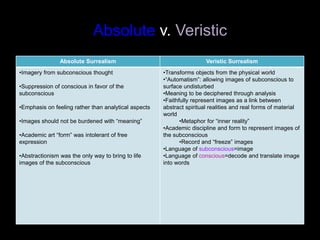
Two distinct groups emerge: Veristic and Absolute SurrealistsAbsolutev. Veristic
History Cont.Surrealists’ Goal: attempt to discover a super-reality Tap into hallucinatory power of the irrationalSurrealist poets were reluctant to align themselves with visual artists (laborious process of painting, drawing, sculpting were at odds with spontaneity of uninhibited expression)Surrealist movement in Europe dissolved with onset of World War IIRenewal in the United States around 1940
Influences on SurrealismWorld War IWorld War IIDadaHeisenbergSigmund Freud and Carl JungEinstein
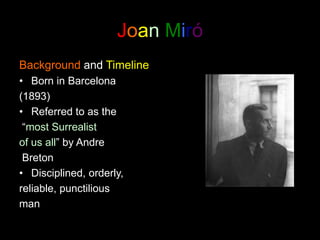
JoanMiróBackground and TimelineBorn in Barcelona (1893)Referred to as the “most Surrealist of us all” by Andre BretonDisciplined, orderly, reliable, punctilious man
JoanMiró Timeline1913-17: Fauvist influence-Close objects with bright, broken colors, decorative ornaments1918: Detailistic phase/poetic realism (farms)“The Farm”(1921)
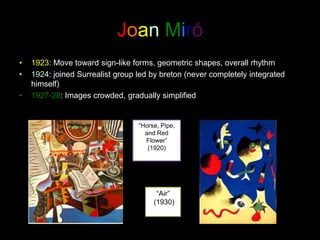
JoanMiró1923: Move toward sign-like forms, geometric shapes, overall rhythm1924: joined Surrealist group led by breton (never completely integrated himself) 1927-28: Images crowded, gradually simplified“Horse, Pipe, and Red Flower”(1920)“Air” (1930)
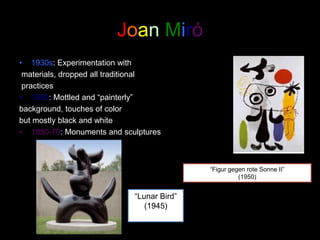
JoanMiró1930s: Experimentation with materials, dropped all traditional practices1950: Mottled and “painterly” background, touches of colorbut mostly black and white1950-70: Monuments and sculptures“Figurgegen rote Sonne II”(1950)“Lunar Bird”(1945)
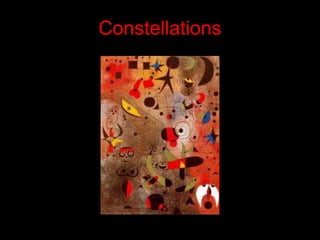
Constellations
Miró:PaintingsInfluenced by:Catalan folk art (flat, 2-dimensional, natural forms)Romanesque church frescoes in native SpainCrude execution, simple, flat, cartoon-like imagesPrimary colors with thick black boundaryDark surrounding fieldMemory, fantasy, “hunger hallucinations”, informalismGrattage: partial images (complete image in mind of viewer), scrap paint off canvas with a trowel, increase textureConcentrated interest on the symbol embedded in piece
Miró:PaintingsPaintings have a whimsical, humorous quality (like a 5 year old’s drawings)Differences of scale (largest object is most important)Playfully distorted animal forms, geometric constructions, organic shapesLimited range of bright colorsOverall type composition: encompass entire canvas evenlyMovement (curves, organic forms)Characterized by body language and freshness
Harlequin’s Carnival (1924-1925)
Still Life with Old Shoe (1937)
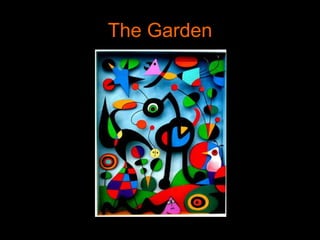
The Garden
SalvadorDali“Every morning upon awakening, I experience a supreme pleasure: that of being Salvador Dali”1904-1989
Dali’sBeginningPaintingsLandscapes, houses, olive trees, portraits, boats
Bright and exuberant colors
Influenced by cubism, psychology, and philosophy
Finds comfort in art from ambiguous sexuality
Encouraged by Roman Pichot
“The Sick Child” (1915)Mother’sDeathSwitched from portraits and landscapes to images that reflect his tormented soul
Influenced by Neo-Cubists, Impressionists, and Realists, Hieronymus Bosch’s landscapes of hell“Garden of Earthly Delights” (1515)
MeetingPicasso (1926)“Figure on the Rocks” (1926)“Apparatus and Hand” (1927)
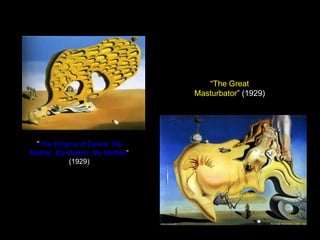
Un ChienAndalou(1929)http://www.youtube.com/watch?v=pib9zv1dHcE“The Great Masturbator” (1929)“The Enigma of Desire: My Mother, My Mother, My Mother” (1929)
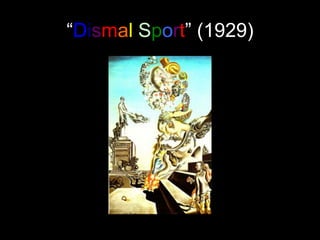
“DismalSport” (1929)
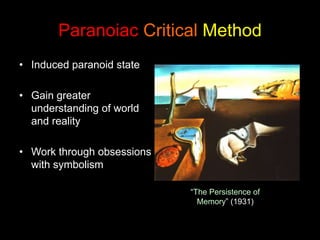
ParanoiacCriticalMethodInduced paranoid state Gain greater understanding of world and realityWork through obsessions with symbolism“The Persistence of Memory” (1931)
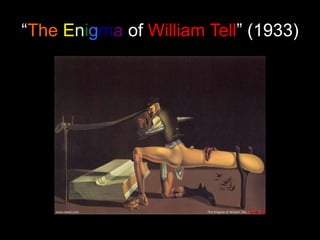
“TheEnigma of WilliamTell” (1933)
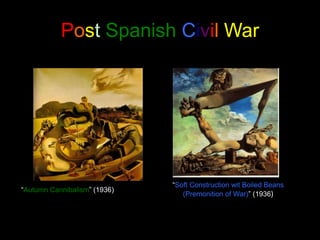
PostSpanishCivilWar“Soft Construction wit Boiled Beans (Premonition of War)” (1936)“Autumn Cannibalism” (1936)
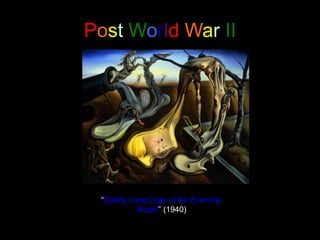
PostWorldWarII“Daddy Long Legs of the Evening-Hope!” (1940)
NuclearMysticismMysticism: Energy behind Roman Catholicism
Paintings become more comprehensible to public
Reflects growing interest in Catholicism and in post WWII science and physics
Heisenberg replaces Freud as “father”“Galatea of the Spheres” (1952)
“The Disintegration of the Persistence of Memory” (1954)
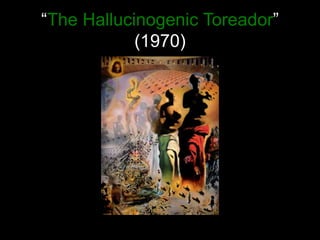
“The Hallucinogenic Toreador” (1970)
AndreBretonWriter/poetPublished magazine, La RévolutionsurréalisteOne of the founders and leaders of the Surrealist movementMain Style:Automatic writing
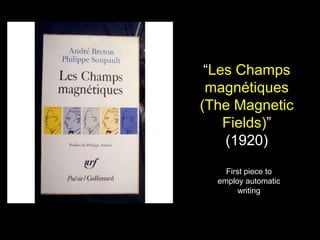
“Les Champs magnétiques(The Magnetic Fields)”(1920)First piece to employ automatic writing
TheSurrealistManifesto (1924)“pure psychic automatism whereby one’s intention is to express, either verbally or in writing, or in any other way, the real functioning of thought”
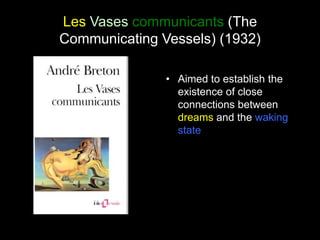
LesVasescommunicants (The Communicating Vessels) (1932)Aimed to establish the existence of close connections between dreams and the waking state
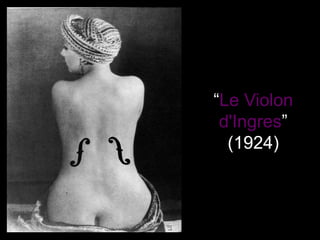
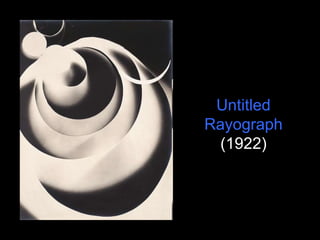
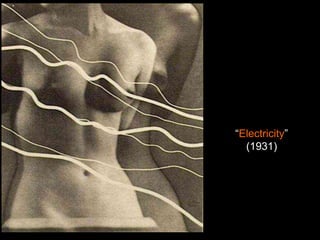
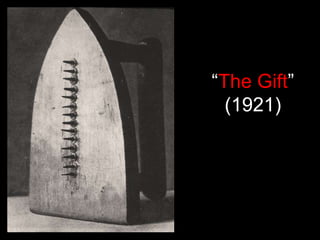
ManRay- “I photographed as I painted, transforming the subject as a painter would”- “I do not photograph nature. I photograph my visions”Experimented with new photography procedures:Rayograph: photographs without a camera-Also experimented with writing, painting, and Surrealist objects
“Le Violond'Ingres” (1924)
Untitled Rayograph(1922)
“Electricity”(1931)
“The Gift”(1921)
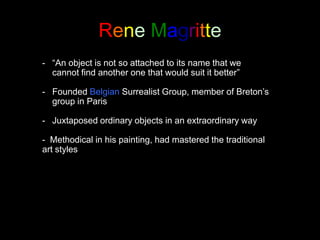
ReneMagritte“An object is not so attached to its name that we cannot find another one that would suit it better”
Founded Belgian Surrealist Group, member of Breton’s group in Paris
Juxtaposed ordinary objects in an extraordinary way -  Methodical in his painting, had mastered the traditional art styles
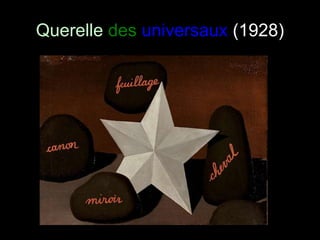
Querelledesuniversaux (1928)
Latrahisondesimages (The Treachery of Images) (1929)“This is not a pipe”

Surrealism final presentation