SURREALISM
Revision
Origin
• It was an artistic movement that brought
together artists, thinkers and researchers
• They were involved in a hunt of sense of
expression of the unconscious
• They were searching for the definition of n
– New aesthetic
– New humankind
– New social order
Origin
• Their forerunners were the Italian Metaphysical
painters
• It came into being after the French poet Andre
Breton 1 published Manifeste du Surrealisme
• Breton suggested that rational thought was
repressive to the powers of creativity and
imagination and thus inimical to artistic
expression
• Breton admired Freud and its concept of the
subconscious
Beginnings
• It is closely related to some forms of
abstract art
• At the end of World War I Tristan Tzara,
leader of the Dada, wanted to attack
society through scandal
• He believed that society that creates the
monstrosity of war do not deserve art so
he decided to create an anti-art, full of
ugliness instead of beauty.
Beginnings
• Tzara wanted to offend the new industrial
commercial world of the bourgeoisie.
• His victims did not feel insulted
• They saw this art as a reaction against old
art
• The result was the opposite to its original
one because anti-art became art.
Beginnings
• One group of artists did not follow Tzara´s ideas
• The Surrealist movement gained momentum
after the Dadaá
• It was led by Breton
• The artists researched and studied the work of
Freud and Jung
• Some of the artists expressed themselves
– In the abstract tradition
– In the symbolic tradition
Groups
• The two forms of expression formed two
distinct trends:
–Automatism
–Veristic
• There are two different interpretations of
Freud and Jung
Automatists
• Artists interpreted it as referring to a suppression
of consciousness in favour of the subconscious
• They were more focused on feeling and less
analytical
• They understood Automatism as the automatic
way in which the images of the subconscious
reach the conscience.
• They believed that images should not be
burdened with meaning.
Automatism
• They saw the academic discipline of art as
intolerant of the free expression of feeling
• They felt form which had dominated the
history of art, was a culprit in that
intolerance
• They believed abstractionism was the only
way to bring to life the images of the
subconscious.
Automatism
• Coming from the Dada tradition, these
artist:
– Linked scandal
– Insult
– Irreverence toward the elite´s with freedom
• They continued to believe that lack of form
was a way to rebel against them.
Veristic Surrealists
• They interpreted automatism to mean
allowing the images of the subconscious
to surface undisturbed so that their
meaning could be deciphered through
analysis
• They wanted to faithfully represent these
images as a link between:
– The abstract spiritual realities
– The real forms of the material world.
Veristic Surrealists
• To them the object stood as a metaphor
for an inner reality
• Through metaphor the concrete world
could be understood, not only by looking
at the objects, but also by looking into
them.
Veristic Surrealists
• They saw academic discipline and form as
the means to represent the images of the
subconscious with veracity
• The images would easily dissolve into the
unknown
• They hoped to find a way to follow the
images of the subconscious until the
conscience could understand their
meaning.
Veristic Surrealists
• The language of the subconscious is the
image
• The consciousness had to learn to decode
that language so it could translate it into its
own language of words.
• Later they branched out into three other
groups.
Struggle of Surrealism
• For the automatists the approach to the
mystery of nature is to never become
conscious of the mystery
• The Veristic Surrealist quest is none other
than the one described by Breton as the
cause of freedom and the transformation
of man´s consciousness
Struggle of Surrealism
• In the works of surrealist we find
– The legacy of
• Bosch
• Brueguel
• William Blake
• The Symbolic painters of the 19th
century
– The perennial questioning of philosophy
– The search of psychology
– The spirit of mysticism
Struggle of Surrealism
• It is a work based on the desire to permit
the forces that created the world to
illuminate our vision
• They must allow us to consciously develop
our human potential.
Struggle of Surrealism
• Veristic surrealist recognize the difficulties
that their movement has faced during the
second half of the twentieth century as it
attempted to become a major cultural
force
• The United States wholeheartedly
embraced abstraction and modernism.
Struggle of Surrealism
• They shared the belief of abstract artist
that
– the chaos of action painting and automatism
were expression of freedom and
– that form, subjugation and inhibition walked
hand in hand
• The American art establishment looked at
the image of form with mistrust until the
advent of Pop Art.
Struggle of Surrealism
• The Surrealism had to fight against:
– Pop-Art
– Photorealism
• Veristic Surrealism is the only historical
artistic expression still in want of
recognition as a cultural force in the
twentieth century
Characteristics
• It was highly influenced by the
psychoanalysis:
– Images are as confusing and startling as
those of dreams
– Can have a realistic, though irrational style,
precisely describing dreamlike fantasies.
Characteristics
• They were influenced by:
•Symbolism
•Metaphysical Painting of Giorgio
de Chirico
•Dadaism
Characteristics
• Some of them have a more abstract style.
• In this case they invented spontaneous
techniques, modelled upon the
psychotherapeutic procedure of free
association as a means to eliminate
conscious control in order to express the
working of the unconscious mind, such as
exquisite corpse.
Exquisite Corpse
• There were aleatoric techniques for
producing visual or literally art
• This activity was frequently considered as
a game.
• It is based upon an old parlour game in
which players take turns writing on a sheet
of paper folded it to conceal part of the
writing and them pass it to the next player
for another contribution.
Exquisite Corpse
• This technique was used by artists to
produce drawings and collages.
• The first efforts are reminiscent of
children’s books that allow the making of
pictures with multiple ages divided at
various levels, involved assigning a
section of a body to each player
Exquisite Corpse
• A majority resulted in images that only
vaguely resembled the human form.
• Some participants in early exquisite
corpses were Tanguy, Miro and Man Ray.
• Later adaptations have involved using
other means of passing the work around,
using different media.
Techniques
• Surrealism has the same lack of prejudice
of Dadaism both in the use of
photographic procedures and object
production out of their normal use.
• Traditional techniques, because those can
be appropriate for depicting imaginations
Artists
• Some of the better known representatives of this
movement are:
• Max Ernst
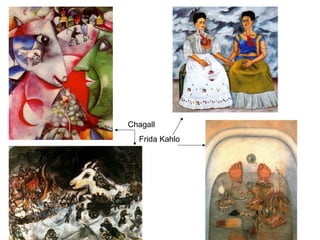
• Frida Kahlo
• Marc Chagall
• Joan Miro
• Man Ray
• Salvador Dali
• René Magritte
• Yves Tanguy
• Oscar Dominguez
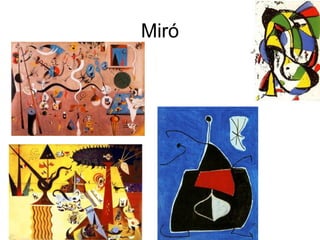
Joan Miro
• He used symbolic keys to depict the
unconscious.
• His principle is not the organic world.
• His world is simple, clear
• His mythology is easy, transparent.
• His painting is unstressed, freely
chromatic, without equilibrium among
signs and colours
Miró
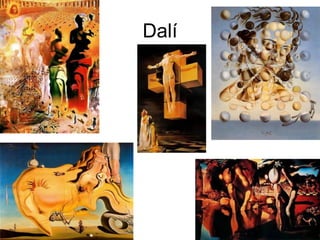
Salvador Dali
• His view is full of sexual connotations.
• Highly rhetorical works.
• Mix of lubricous and holy
• He overcame cynically the bolshevism.
• Ambiguous mix of reaction and anarchy.
• Very complicated compositions.
Dalí
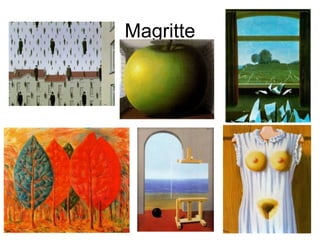
Rene Magritte
• He is the artist who worked in a deepest
way the lack of logic of the image.
• He invented the anti-history
• He discovered the non-sense of the
normal.
• He created with great detail and realism
images of ambiguous significance that
could have a double sense
Magritte
Max Ernst
• He reached to the deepest critic of the
form as a depiction and the style as
something unitary.
• He used any technique that would be
useful for transmitting his ideas. He used:
– Collage
– Frottage
• His work is frequently a pile of rubbish of
bourgeois culture.
Hans Arp
• He was previously involved in the
Dadaism.
• He depicted organic forms, both in
painting and sculpture.
• He used:
– Geometric shapes
– Orthogonal images
– Continuously curve forms, concave and
convex.
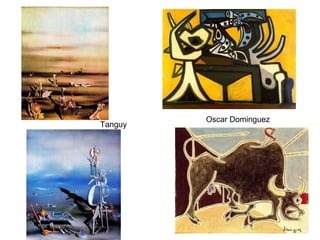
Yves Tanguy
• He invented the anti-Nature:
–Never ending landscapes,
–Planet like settings
–Lack of light and sun
–Remains of an organic life:
• Bones
• Mummified fruits
• Fossils and shells
Expansion
• Other artist contributed to the expansion of
the Surrealism, equally in Europe and in
the United States.
• Soon it appeared as a way of eluding the
reality of the problems through:
– Ambiguity
– Paradox
Expansion
• The movement gained prestige with the
adhesion of artists such as Picasso.
• The analytical cubism, discomposing the
objects did a similar work as that of the
Surrealism.
•
Oscar Dominguez
Tanguy
Chagall
Frida Kahlo

Surrealism (new)

  • 1.
  • 2.
    Origin • It wasan artistic movement that brought together artists, thinkers and researchers • They were involved in a hunt of sense of expression of the unconscious • They were searching for the definition of n – New aesthetic – New humankind – New social order
  • 3.
    Origin • Their forerunnerswere the Italian Metaphysical painters • It came into being after the French poet Andre Breton 1 published Manifeste du Surrealisme • Breton suggested that rational thought was repressive to the powers of creativity and imagination and thus inimical to artistic expression • Breton admired Freud and its concept of the subconscious
  • 4.
    Beginnings • It isclosely related to some forms of abstract art • At the end of World War I Tristan Tzara, leader of the Dada, wanted to attack society through scandal • He believed that society that creates the monstrosity of war do not deserve art so he decided to create an anti-art, full of ugliness instead of beauty.
  • 5.
    Beginnings • Tzara wantedto offend the new industrial commercial world of the bourgeoisie. • His victims did not feel insulted • They saw this art as a reaction against old art • The result was the opposite to its original one because anti-art became art.
  • 6.
    Beginnings • One groupof artists did not follow Tzara´s ideas • The Surrealist movement gained momentum after the Dadaá • It was led by Breton • The artists researched and studied the work of Freud and Jung • Some of the artists expressed themselves – In the abstract tradition – In the symbolic tradition
  • 7.
    Groups • The twoforms of expression formed two distinct trends: –Automatism –Veristic • There are two different interpretations of Freud and Jung
  • 8.
    Automatists • Artists interpretedit as referring to a suppression of consciousness in favour of the subconscious • They were more focused on feeling and less analytical • They understood Automatism as the automatic way in which the images of the subconscious reach the conscience. • They believed that images should not be burdened with meaning.
  • 9.
    Automatism • They sawthe academic discipline of art as intolerant of the free expression of feeling • They felt form which had dominated the history of art, was a culprit in that intolerance • They believed abstractionism was the only way to bring to life the images of the subconscious.
  • 10.
    Automatism • Coming fromthe Dada tradition, these artist: – Linked scandal – Insult – Irreverence toward the elite´s with freedom • They continued to believe that lack of form was a way to rebel against them.
  • 11.
    Veristic Surrealists • Theyinterpreted automatism to mean allowing the images of the subconscious to surface undisturbed so that their meaning could be deciphered through analysis • They wanted to faithfully represent these images as a link between: – The abstract spiritual realities – The real forms of the material world.
  • 12.
    Veristic Surrealists • Tothem the object stood as a metaphor for an inner reality • Through metaphor the concrete world could be understood, not only by looking at the objects, but also by looking into them.
  • 13.
    Veristic Surrealists • Theysaw academic discipline and form as the means to represent the images of the subconscious with veracity • The images would easily dissolve into the unknown • They hoped to find a way to follow the images of the subconscious until the conscience could understand their meaning.
  • 14.
    Veristic Surrealists • Thelanguage of the subconscious is the image • The consciousness had to learn to decode that language so it could translate it into its own language of words. • Later they branched out into three other groups.
  • 15.
    Struggle of Surrealism •For the automatists the approach to the mystery of nature is to never become conscious of the mystery • The Veristic Surrealist quest is none other than the one described by Breton as the cause of freedom and the transformation of man´s consciousness
  • 16.
    Struggle of Surrealism •In the works of surrealist we find – The legacy of • Bosch • Brueguel • William Blake • The Symbolic painters of the 19th century – The perennial questioning of philosophy – The search of psychology – The spirit of mysticism
  • 17.
    Struggle of Surrealism •It is a work based on the desire to permit the forces that created the world to illuminate our vision • They must allow us to consciously develop our human potential.
  • 18.
    Struggle of Surrealism •Veristic surrealist recognize the difficulties that their movement has faced during the second half of the twentieth century as it attempted to become a major cultural force • The United States wholeheartedly embraced abstraction and modernism.
  • 19.
    Struggle of Surrealism •They shared the belief of abstract artist that – the chaos of action painting and automatism were expression of freedom and – that form, subjugation and inhibition walked hand in hand • The American art establishment looked at the image of form with mistrust until the advent of Pop Art.
  • 20.
    Struggle of Surrealism •The Surrealism had to fight against: – Pop-Art – Photorealism • Veristic Surrealism is the only historical artistic expression still in want of recognition as a cultural force in the twentieth century
  • 21.
    Characteristics • It washighly influenced by the psychoanalysis: – Images are as confusing and startling as those of dreams – Can have a realistic, though irrational style, precisely describing dreamlike fantasies.
  • 22.
    Characteristics • They wereinfluenced by: •Symbolism •Metaphysical Painting of Giorgio de Chirico •Dadaism
  • 23.
    Characteristics • Some ofthem have a more abstract style. • In this case they invented spontaneous techniques, modelled upon the psychotherapeutic procedure of free association as a means to eliminate conscious control in order to express the working of the unconscious mind, such as exquisite corpse.
  • 24.
    Exquisite Corpse • Therewere aleatoric techniques for producing visual or literally art • This activity was frequently considered as a game. • It is based upon an old parlour game in which players take turns writing on a sheet of paper folded it to conceal part of the writing and them pass it to the next player for another contribution.
  • 25.
    Exquisite Corpse • Thistechnique was used by artists to produce drawings and collages. • The first efforts are reminiscent of children’s books that allow the making of pictures with multiple ages divided at various levels, involved assigning a section of a body to each player
  • 26.
    Exquisite Corpse • Amajority resulted in images that only vaguely resembled the human form. • Some participants in early exquisite corpses were Tanguy, Miro and Man Ray. • Later adaptations have involved using other means of passing the work around, using different media.
  • 27.
    Techniques • Surrealism hasthe same lack of prejudice of Dadaism both in the use of photographic procedures and object production out of their normal use. • Traditional techniques, because those can be appropriate for depicting imaginations
  • 28.
    Artists • Some ofthe better known representatives of this movement are: • Max Ernst • Frida Kahlo • Marc Chagall • Joan Miro • Man Ray • Salvador Dali • René Magritte • Yves Tanguy • Oscar Dominguez
  • 29.
    Joan Miro • Heused symbolic keys to depict the unconscious. • His principle is not the organic world. • His world is simple, clear • His mythology is easy, transparent. • His painting is unstressed, freely chromatic, without equilibrium among signs and colours
  • 30.
  • 31.
    Salvador Dali • Hisview is full of sexual connotations. • Highly rhetorical works. • Mix of lubricous and holy • He overcame cynically the bolshevism. • Ambiguous mix of reaction and anarchy. • Very complicated compositions.
  • 32.
  • 33.
    Rene Magritte • Heis the artist who worked in a deepest way the lack of logic of the image. • He invented the anti-history • He discovered the non-sense of the normal. • He created with great detail and realism images of ambiguous significance that could have a double sense
  • 34.
  • 35.
    Max Ernst • Hereached to the deepest critic of the form as a depiction and the style as something unitary. • He used any technique that would be useful for transmitting his ideas. He used: – Collage – Frottage • His work is frequently a pile of rubbish of bourgeois culture.
  • 36.
    Hans Arp • Hewas previously involved in the Dadaism. • He depicted organic forms, both in painting and sculpture. • He used: – Geometric shapes – Orthogonal images – Continuously curve forms, concave and convex.
  • 37.
    Yves Tanguy • Heinvented the anti-Nature: –Never ending landscapes, –Planet like settings –Lack of light and sun –Remains of an organic life: • Bones • Mummified fruits • Fossils and shells
  • 38.
    Expansion • Other artistcontributed to the expansion of the Surrealism, equally in Europe and in the United States. • Soon it appeared as a way of eluding the reality of the problems through: – Ambiguity – Paradox
  • 39.
    Expansion • The movementgained prestige with the adhesion of artists such as Picasso. • The analytical cubism, discomposing the objects did a similar work as that of the Surrealism. •
  • 40.
  • 41.