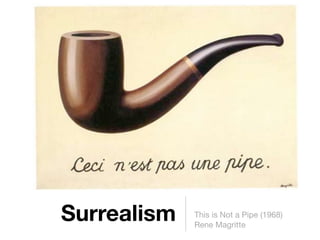
Surrealism   This is Not a Pipe (1968)
             Rene Magritte
What is Surrealism?

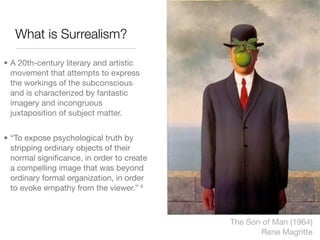
• A 20th-century literary and artistic
  movement that attempts to express
  the workings of the subconscious
  and is characterized by fantastic
  imagery and incongruous
  juxtaposition of subject matter.


• “To expose psychological truth by
  stripping ordinary objects of their
  normal significance, in order to create
  a compelling image that was beyond
  ordinary formal organization, in order
  to evoke empathy from the viewer.” 4


                                           The Son of Man (1964)
                                                  Rene Magritte
Origins of Surrealism
• Surrealsim grew from the Dada
  Movement (1916-23), an anti-war,
  anti-materialistic and anti-
  nationalism movement that
  rejected traditional art standards.


• Dadaism was born from the work
  of avant-garde painters, poets and
  filmmakers who flocked to Zurich,
  Switzerland before and during
  WWI, and literally meant “hobby-
  horse” in French.


• Surrealism was also influenced by
  Abstraction and Expressionism,
  and somewhat by Futurism and
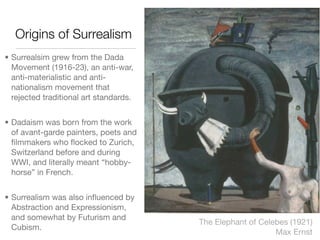
                                        The Elephant of Celebes (1921)
  Cubism.
                                                            Max Ernst
The Surrealist Movement

• Surrealism began around WWI, and was popular through WWII.


• The movement was a reaction against the nationalism (the country/state is most
  important or one’s country/state is better than all others) and rationalism
  (appealing to reason) movements that led to WW I and WWII.


• The Surrealist Movement began in Paris, France and spread throughout Europe
  and beyond.


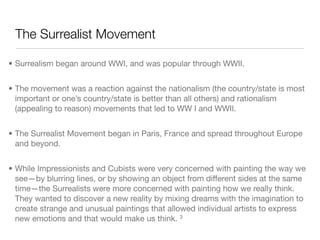
• While Impressionists and Cubists were very concerned with painting the way we
  see—by blurring lines, or by showing an object from different sides at the same
  time—the Surrealists were more concerned with painting how we really think.
  They wanted to discover a new reality by mixing dreams with the imagination to
  create strange and unusual paintings that allowed individual artists to express
  new emotions and that would make us think. 3
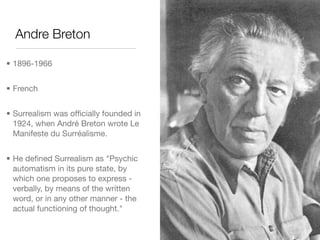
Andre Breton

• 1896-1966


• French


• Surrealism was officially founded in
  1924, when André Breton wrote Le
  Manifeste du Surréalisme.


• He defined Surrealism as "Psychic
  automatism in its pure state, by
  which one proposes to express -
  verbally, by means of the written
  word, or in any other manner - the
  actual functioning of thought."
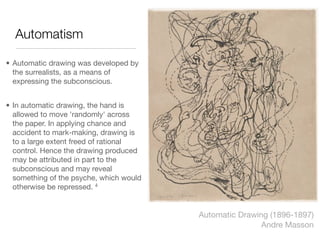
Automatism

• Automatic drawing was developed by
  the surrealists, as a means of
  expressing the subconscious.


• In automatic drawing, the hand is
  allowed to move 'randomly' across
  the paper. In applying chance and
  accident to mark-making, drawing is
  to a large extent freed of rational
  control. Hence the drawing produced
  may be attributed in part to the
  subconscious and may reveal
  something of the psyche, which would
  otherwise be repressed. 4


                                         Automatic Drawing (1896-1897)
                                                         Andre Masson
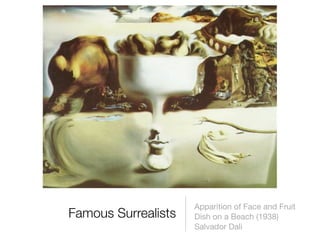
Apparition of Face and Fruit
Famous Surrealists   Dish on a Beach (1938)
                     Salvador Dali
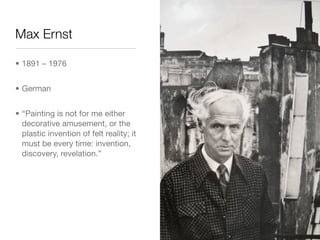
Max Ernst

• 1891 – 1976


• German


• “Painting is not for me either
  decorative amusement, or the
  plastic invention of felt reality; it
  must be every time: invention,
  discovery, revelation.”
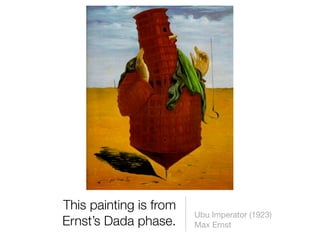
This painting is from
                        Ubu Imperator (1923)
Ernst’s Dada phase.     Max Ernst
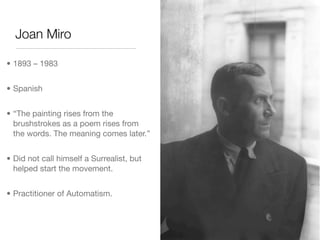
Joan Miro

• 1893 – 1983


• Spanish


• “The painting rises from the
  brushstrokes as a poem rises from
  the words. The meaning comes later.”


• Did not call himself a Surrealist, but
  helped start the movement.


• Practitioner of Automatism.
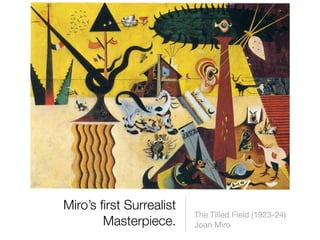
Miro’s first Surrealist
                         The Tilled Field (1923-24)
       Masterpiece.      Joan Miro
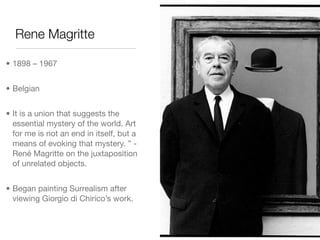
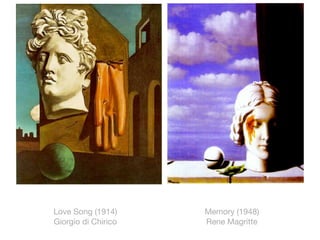
Rene Magritte

• 1898 – 1967


• Belgian


• It is a union that suggests the
  essential mystery of the world. Art
  for me is not an end in itself, but a
  means of evoking that mystery. ” -
  René Magritte on the juxtaposition
  of unrelated objects.


• Began painting Surrealism after
  viewing Giorgio di Chirico’s work.
Love Song (1914)     Memory (1948)
Giorgio di Chirico   Rene Magritte
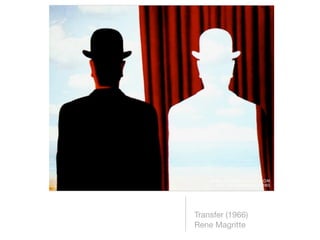
Transfer (1966)
Rene Magritte
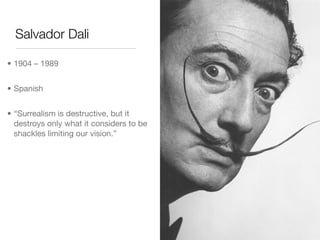
Salvador Dali

• 1904 – 1989


• Spanish


• “Surrealism is destructive, but it
  destroys only what it considers to be
  shackles limiting our vision.”
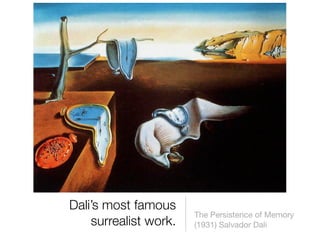
Dali’s most famous
                       The Persistence of Memory
    surrealist work.   (1931) Salvador Dali
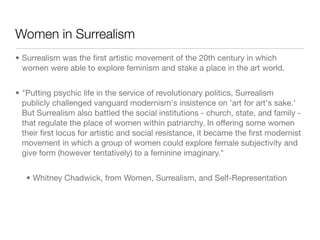
Women in Surrealism
• Surrealism was the first artistic movement of the 20th century in which
  women were able to explore feminism and stake a place in the art world.


• "Putting psychic life in the service of revolutionary politics, Surrealism
  publicly challenged vanguard modernism's insistence on 'art for art's sake.'
  But Surrealism also battled the social institutions - church, state, and family -
  that regulate the place of women within patriarchy. In offering some women
  their first locus for artistic and social resistance, it became the first modernist
  movement in which a group of women could explore female subjectivity and
  give form (however tentatively) to a feminine imaginary."


   • Whitney Chadwick, from Women, Surrealism, and Self-Representation
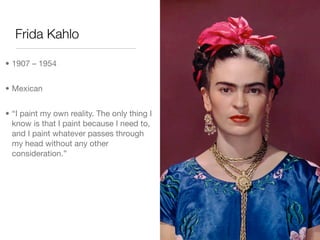
Frida Kahlo

• 1907 – 1954


• Mexican


• “I paint my own reality. The only thing I
  know is that I paint because I need to,
  and I paint whatever passes through
  my head without any other
  consideration.”
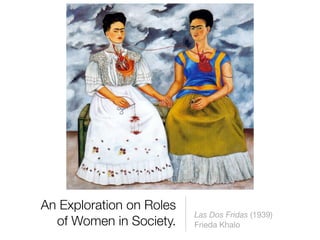
An Exploration on Roles
                          Las Dos Fridas (1939)
  of Women in Society.    Frieda Khalo
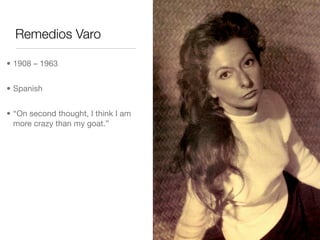
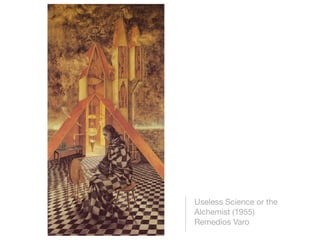
Remedios Varo

• 1908 – 1963


• Spanish


• “On second thought, I think I am
  more crazy than my goat.”
Useless Science or the
Alchemist (1955)
Remedios Varo
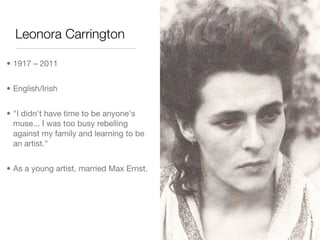
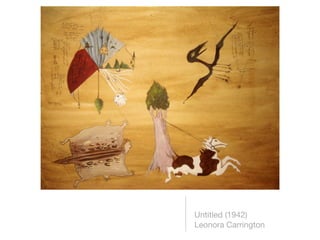
Leonora Carrington

• 1917 – 2011


• English/Irish


• "I didn't have time to be anyone's
  muse... I was too busy rebelling
  against my family and learning to be
  an artist."


• As a young artist, married Max Ernst.
Untitled (1942)
Leonora Carrington
Impact of Surrealism

• Influenced writing and art, as well as several literary and artistic movements,
  such as:


   • postmodernism


   • magic realism


• Surrealism: “It defines a range of creative acts of revolt and efforts to liberate
  the imagination” 2
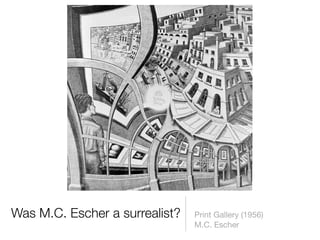
Was M.C. Escher a surrealist?   Print Gallery (1956)
                                M.C. Escher
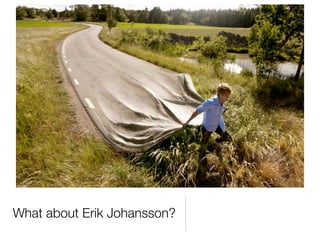
What about Erik Johansson?
References

1 - http://www.surrealist.com/


2 - http://www.newworldencyclopedia.org/entry/Surrealism


3 - http://thedali.org/education/lessons.html


4 - http://en.wikipedia.org/wiki/Automatic_drawing#Automatic_drawing

Surrealism

  • 1.
    Surrealism This is Not a Pipe (1968) Rene Magritte
  • 2.
    What is Surrealism? •A 20th-century literary and artistic movement that attempts to express the workings of the subconscious and is characterized by fantastic imagery and incongruous juxtaposition of subject matter. • “To expose psychological truth by stripping ordinary objects of their normal significance, in order to create a compelling image that was beyond ordinary formal organization, in order to evoke empathy from the viewer.” 4 The Son of Man (1964) Rene Magritte
  • 3.
    Origins of Surrealism •Surrealsim grew from the Dada Movement (1916-23), an anti-war, anti-materialistic and anti- nationalism movement that rejected traditional art standards. • Dadaism was born from the work of avant-garde painters, poets and filmmakers who flocked to Zurich, Switzerland before and during WWI, and literally meant “hobby- horse” in French. • Surrealism was also influenced by Abstraction and Expressionism, and somewhat by Futurism and The Elephant of Celebes (1921) Cubism. Max Ernst
  • 4.
    The Surrealist Movement •Surrealism began around WWI, and was popular through WWII. • The movement was a reaction against the nationalism (the country/state is most important or one’s country/state is better than all others) and rationalism (appealing to reason) movements that led to WW I and WWII. • The Surrealist Movement began in Paris, France and spread throughout Europe and beyond. • While Impressionists and Cubists were very concerned with painting the way we see—by blurring lines, or by showing an object from different sides at the same time—the Surrealists were more concerned with painting how we really think. They wanted to discover a new reality by mixing dreams with the imagination to create strange and unusual paintings that allowed individual artists to express new emotions and that would make us think. 3
  • 5.
    Andre Breton • 1896-1966 •French • Surrealism was officially founded in 1924, when André Breton wrote Le Manifeste du Surréalisme. • He defined Surrealism as "Psychic automatism in its pure state, by which one proposes to express - verbally, by means of the written word, or in any other manner - the actual functioning of thought."
  • 6.
    Automatism • Automatic drawingwas developed by the surrealists, as a means of expressing the subconscious. • In automatic drawing, the hand is allowed to move 'randomly' across the paper. In applying chance and accident to mark-making, drawing is to a large extent freed of rational control. Hence the drawing produced may be attributed in part to the subconscious and may reveal something of the psyche, which would otherwise be repressed. 4 Automatic Drawing (1896-1897) Andre Masson
  • 7.
    Apparition of Faceand Fruit Famous Surrealists Dish on a Beach (1938) Salvador Dali
  • 8.
    Max Ernst • 1891– 1976 • German • “Painting is not for me either decorative amusement, or the plastic invention of felt reality; it must be every time: invention, discovery, revelation.”
  • 9.
    This painting isfrom Ubu Imperator (1923) Ernst’s Dada phase. Max Ernst
  • 10.
    Joan Miro • 1893 –1983 • Spanish • “The painting rises from the brushstrokes as a poem rises from the words. The meaning comes later.” • Did not call himself a Surrealist, but helped start the movement. • Practitioner of Automatism.
  • 11.
    Miro’s first Surrealist The Tilled Field (1923-24) Masterpiece. Joan Miro
  • 12.
    Rene Magritte • 1898– 1967 • Belgian • It is a union that suggests the essential mystery of the world. Art for me is not an end in itself, but a means of evoking that mystery. ” - René Magritte on the juxtaposition of unrelated objects. • Began painting Surrealism after viewing Giorgio di Chirico’s work.
  • 13.
    Love Song (1914) Memory (1948) Giorgio di Chirico Rene Magritte
  • 14.
  • 15.
    Salvador Dali • 1904 –1989 • Spanish • “Surrealism is destructive, but it destroys only what it considers to be shackles limiting our vision.”
  • 16.
    Dali’s most famous The Persistence of Memory surrealist work. (1931) Salvador Dali
  • 17.
    Women in Surrealism •Surrealism was the first artistic movement of the 20th century in which women were able to explore feminism and stake a place in the art world. • "Putting psychic life in the service of revolutionary politics, Surrealism publicly challenged vanguard modernism's insistence on 'art for art's sake.' But Surrealism also battled the social institutions - church, state, and family - that regulate the place of women within patriarchy. In offering some women their first locus for artistic and social resistance, it became the first modernist movement in which a group of women could explore female subjectivity and give form (however tentatively) to a feminine imaginary." • Whitney Chadwick, from Women, Surrealism, and Self-Representation
  • 18.
    Frida Kahlo • 1907 –1954 • Mexican • “I paint my own reality. The only thing I know is that I paint because I need to, and I paint whatever passes through my head without any other consideration.”
  • 19.
    An Exploration onRoles Las Dos Fridas (1939) of Women in Society. Frieda Khalo
  • 20.
    Remedios Varo • 1908– 1963 • Spanish • “On second thought, I think I am more crazy than my goat.”
  • 21.
    Useless Science orthe Alchemist (1955) Remedios Varo
  • 22.
    Leonora Carrington • 1917 –2011 • English/Irish • "I didn't have time to be anyone's muse... I was too busy rebelling against my family and learning to be an artist." • As a young artist, married Max Ernst.
  • 23.
  • 24.
    Impact of Surrealism •Influenced writing and art, as well as several literary and artistic movements, such as: • postmodernism • magic realism • Surrealism: “It defines a range of creative acts of revolt and efforts to liberate the imagination” 2
  • 25.
    Was M.C. Eschera surrealist? Print Gallery (1956) M.C. Escher
  • 26.
    What about ErikJohansson?
  • 27.
    References 1 - http://www.surrealist.com/ 2- http://www.newworldencyclopedia.org/entry/Surrealism 3 - http://thedali.org/education/lessons.html 4 - http://en.wikipedia.org/wiki/Automatic_drawing#Automatic_drawing