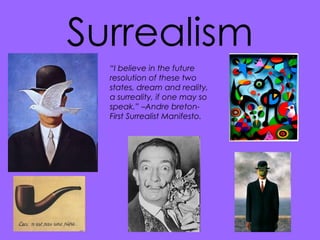
Surrealism “ I believe in the future resolution of these two states, dream and reality, a surreality, if one may so speak.” –Andre breton- First Surrealist Manifesto.
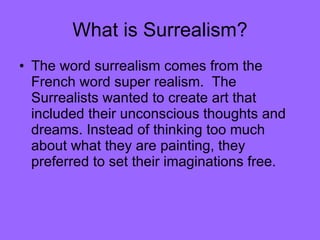
What is Surrealism? The word surrealism comes from the French word super realism.  The Surrealists wanted to create art that included their unconscious thoughts and dreams. Instead of thinking too much about what they are painting, they preferred to set their imaginations free.
Giorgio di Chirico  The Child’s Brain 1914
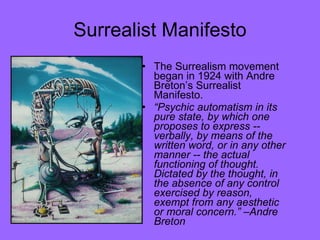
Surrealist Manifesto The Surrealism movement began in 1924 with Andre Breton’s Surrealist Manifesto.  “ Psychic automatism in its pure state, by which one proposes to express -- verbally, by means of the written word, or in any other manner -- the actual functioning of thought. Dictated by the thought, in the absence of any control exercised by reason, exempt from any aesthetic or moral concern.” –Andre Breton
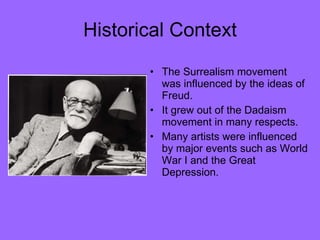
Historical Context The Surrealism movement was influenced by the ideas of Freud.  It grew out of the Dadaism movement in many respects. Many artists were influenced by major events such as World War I and the Great Depression.
Characteristics General Characteristics include:  the element of surprise  free association  uncensored thought  dream-like subject matter spontaneous techniques Examples: automatic drawing, frottage, and decalcomania.  However, Surrealism was a very individualistic movement and each artist added their own style and meaning.
Automatic Surrealism In the beginning of the Surrealism movement, one technique of Surrealism, Automatic Surrealism, was prominent.  It was used as a means to illustrate the subconscious.  In this art, the hand can move freely and randomly across the canvas.  Max Ernst coined the term frottage, which is also used in this automatic style of Surrealism.
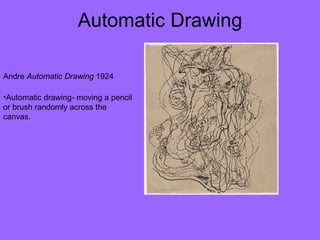
Automatic Drawing Andre  Automatic Drawing  1924  Automatic drawing- moving a pencil or brush randomly across the canvas.
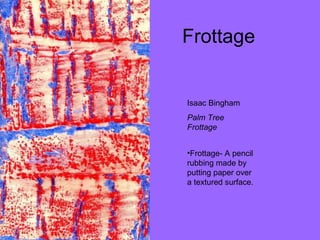
Frottage  Isaac Bingham Palm Tree Frottage Frottage- A pencil rubbing made by putting paper over a textured surface.
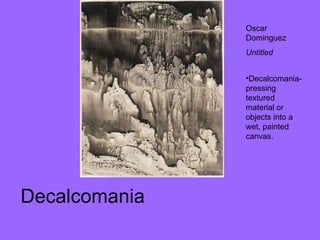
Decalcomania Oscar Dominguez Untitled  Decalcomania- pressing textured material or objects into a wet, painted canvas.
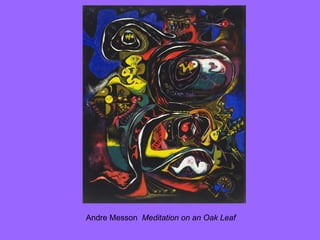
Andre Messon  Meditation on an Oak Leaf
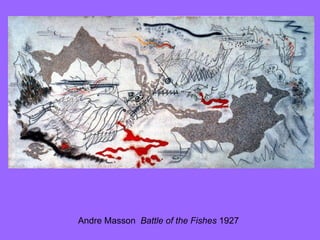
Andre Masson  Battle of the Fishes  1927
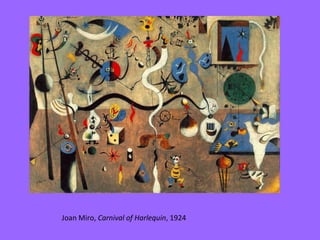
Joan Miro,  Carnival of Harlequin , 1924
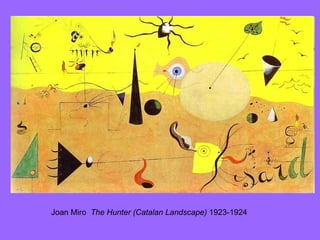
Joan Miro  The Hunter (Catalan Landscape)  1923-1924
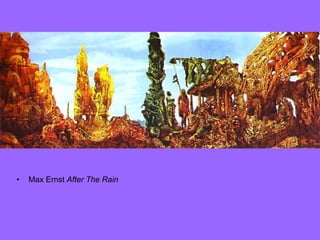
Max Ernst  After The Rain
Max Ernst  Gray Forest  1927
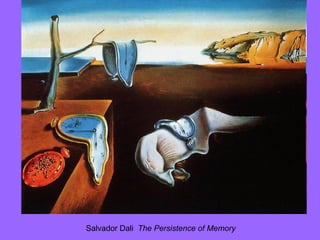
Illustionistic Dream Imagery The automatism used by Masson and Miro, and Ernst’s “frottage” technique dominated the first year of the Surrealism movement.  However, artists like Rene Magritte, Yves Tanguy, and Salvador Dali emerged with a new style in Surrealism.  Quite different from previous artists, these artists focused on hallucinatory and fantastic subject matter in meticulously and realistically portrayed images.
Salvador Dali  The Persistence of Memory
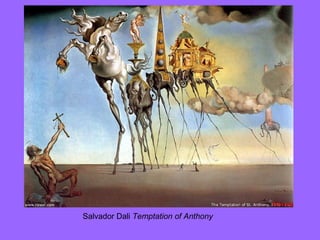
Salvador Dali  Temptation of Anthony
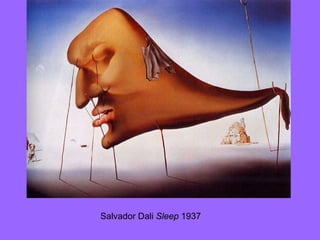
Salvador Dali  Sleep  1937
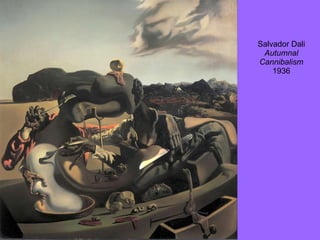
Salvador Dali Autumnal Cannibalism 1936
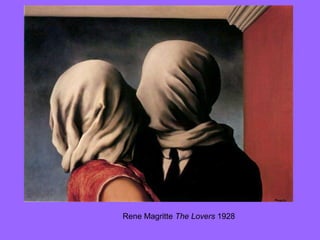
Rene Magritte  The Lovers  1928
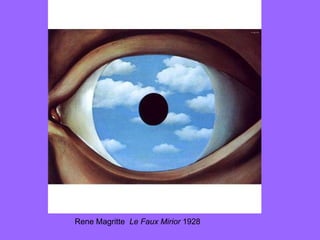
Rene Magritte  Le Faux Mirior  1928
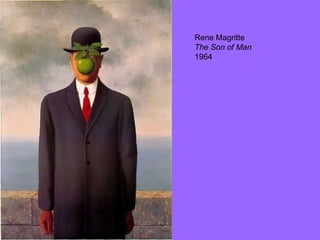
Rene Magritte The Son of Man 1964
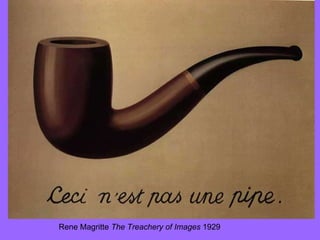
Rene Magritte  The Treachery of Images  1929
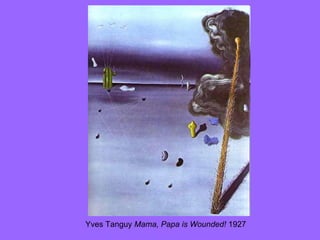
Yves Tanguy  Mama, Papa is Wounded!  1927
Yves Tanguy Indefinite Divisibility 1942
Yves Tanguy Extinction of Useless Lights 1927
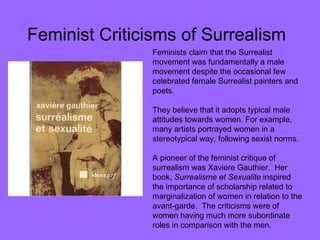
Feminist Criticisms of Surrealism Feminists claim that the Surrealist movement was fundamentally a male movement despite the occasional few celebrated female Surrealist painters and poets.  They believe that it adopts typical male attitudes towards women. For example, many artists portrayed women in a stereotypical way, following sexist norms. A pioneer of the feminist critique of surrealism was Xaviere Gauthier.  Her book,  Surrealisme et Sexualite  inspired the importance of scholarship related to marginalization of women in relation to the avant-garde.  The criticisms were of women having much more subordinate roles in comparison with the men.
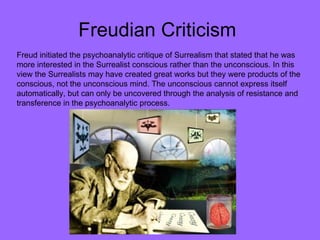
Freudian Criticism  Freud initiated the psychoanalytic critique of Surrealism that stated that he was  more interested in the Surrealist conscious rather than the unconscious. In this  view the Surrealists may have created great works but they were products of the conscious, not the unconscious mind. The unconscious cannot express itself  automatically, but can only be uncovered through the analysis of resistance and transference in the psychoanalytic process.
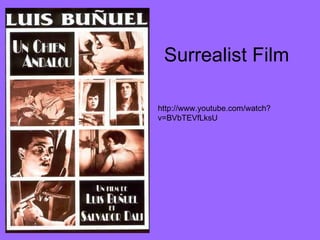
Surrealist Film  http://www.youtube.com/watch?v=BVbTEVfLksU
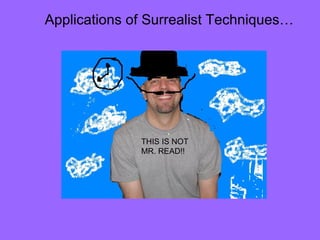
THIS IS NOT MR. READ!! Applications of Surrealist Techniques…

Surrealism final

  • 1.
    Surrealism “ Ibelieve in the future resolution of these two states, dream and reality, a surreality, if one may so speak.” –Andre breton- First Surrealist Manifesto.
  • 2.
    What is Surrealism?The word surrealism comes from the French word super realism. The Surrealists wanted to create art that included their unconscious thoughts and dreams. Instead of thinking too much about what they are painting, they preferred to set their imaginations free.
  • 3.
    Giorgio di Chirico The Child’s Brain 1914
  • 4.
    Surrealist Manifesto TheSurrealism movement began in 1924 with Andre Breton’s Surrealist Manifesto. “ Psychic automatism in its pure state, by which one proposes to express -- verbally, by means of the written word, or in any other manner -- the actual functioning of thought. Dictated by the thought, in the absence of any control exercised by reason, exempt from any aesthetic or moral concern.” –Andre Breton
  • 5.
    Historical Context TheSurrealism movement was influenced by the ideas of Freud. It grew out of the Dadaism movement in many respects. Many artists were influenced by major events such as World War I and the Great Depression.
  • 6.
    Characteristics General Characteristicsinclude: the element of surprise free association uncensored thought dream-like subject matter spontaneous techniques Examples: automatic drawing, frottage, and decalcomania. However, Surrealism was a very individualistic movement and each artist added their own style and meaning.
  • 7.
    Automatic Surrealism Inthe beginning of the Surrealism movement, one technique of Surrealism, Automatic Surrealism, was prominent. It was used as a means to illustrate the subconscious. In this art, the hand can move freely and randomly across the canvas. Max Ernst coined the term frottage, which is also used in this automatic style of Surrealism.
  • 8.
    Automatic Drawing Andre Automatic Drawing 1924 Automatic drawing- moving a pencil or brush randomly across the canvas.
  • 9.
    Frottage IsaacBingham Palm Tree Frottage Frottage- A pencil rubbing made by putting paper over a textured surface.
  • 10.
    Decalcomania Oscar DominguezUntitled Decalcomania- pressing textured material or objects into a wet, painted canvas.
  • 11.
    Andre Messon Meditation on an Oak Leaf
  • 12.
    Andre Masson Battle of the Fishes 1927
  • 13.
    Joan Miro, Carnival of Harlequin , 1924
  • 14.
    Joan Miro The Hunter (Catalan Landscape) 1923-1924
  • 15.
    Max Ernst After The Rain
  • 16.
    Max Ernst Gray Forest 1927
  • 17.
    Illustionistic Dream ImageryThe automatism used by Masson and Miro, and Ernst’s “frottage” technique dominated the first year of the Surrealism movement. However, artists like Rene Magritte, Yves Tanguy, and Salvador Dali emerged with a new style in Surrealism. Quite different from previous artists, these artists focused on hallucinatory and fantastic subject matter in meticulously and realistically portrayed images.
  • 18.
    Salvador Dali The Persistence of Memory
  • 19.
    Salvador Dali Temptation of Anthony
  • 20.
    Salvador Dali Sleep 1937
  • 21.
    Salvador Dali AutumnalCannibalism 1936
  • 22.
    Rene Magritte The Lovers 1928
  • 23.
    Rene Magritte Le Faux Mirior 1928
  • 24.
    Rene Magritte TheSon of Man 1964
  • 25.
    Rene Magritte The Treachery of Images 1929
  • 26.
    Yves Tanguy Mama, Papa is Wounded! 1927
  • 27.
    Yves Tanguy IndefiniteDivisibility 1942
  • 28.
    Yves Tanguy Extinctionof Useless Lights 1927
  • 29.
    Feminist Criticisms ofSurrealism Feminists claim that the Surrealist movement was fundamentally a male movement despite the occasional few celebrated female Surrealist painters and poets. They believe that it adopts typical male attitudes towards women. For example, many artists portrayed women in a stereotypical way, following sexist norms. A pioneer of the feminist critique of surrealism was Xaviere Gauthier. Her book, Surrealisme et Sexualite inspired the importance of scholarship related to marginalization of women in relation to the avant-garde. The criticisms were of women having much more subordinate roles in comparison with the men.
  • 30.
    Freudian Criticism Freud initiated the psychoanalytic critique of Surrealism that stated that he was more interested in the Surrealist conscious rather than the unconscious. In this view the Surrealists may have created great works but they were products of the conscious, not the unconscious mind. The unconscious cannot express itself automatically, but can only be uncovered through the analysis of resistance and transference in the psychoanalytic process.
  • 31.
    Surrealist Film http://www.youtube.com/watch?v=BVbTEVfLksU
  • 32.
    THIS IS NOTMR. READ!! Applications of Surrealist Techniques…