


REM KUMAR RAI
ELBOW
 Posterior approach
 Anterolateral approach
 Medial approach
 Anterior approach of medial cubital fossa
 Posterolateral approach of radial head
POSTERIOR APPROACH
INDICATION :- open reduction internal fixation
of fracture of distal humerus
Removal of loose bodies with
in the elbow joint
Treatment of non union of
distal humerus
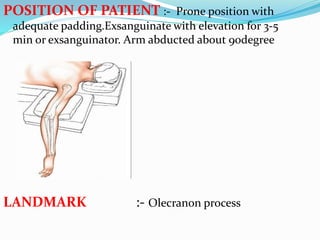
POSITION OF PATIENT :- Prone position with
adequate padding.Exsanguinate with elevation for 3-5
min or exsanguinator. Arm abducted about 90degree
LANDMARK :- Olecranon process
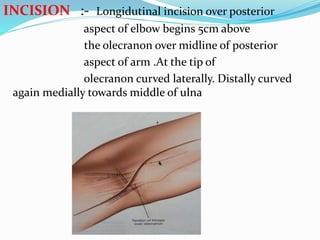
INCISION :- Longidutinal incision over posterior
aspect of elbow begins 5cm above
the olecranon over midline of posterior
aspect of arm .At the tip of
olecranon curved laterally. Distally curved
again medially towards middle of ulna
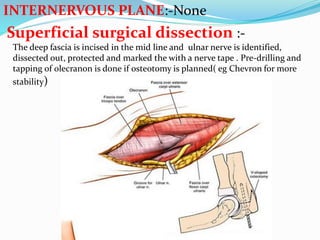
INTERNERVOUS PLANE:-None
Superficial surgical dissection :-
The deep fascia is incised in the mid line and ulnar nerve is identified,
dissected out, protected and marked the with a nerve tape . Pre-drilling and
tapping of olecranon is done if osteotomy is planned( eg Chevron for more
stability)
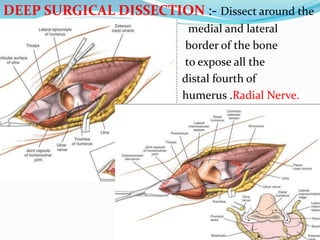
DEEP SURGICAL DISSECTION :- Dissect around the
medial and lateral
border of the bone
to expose all the
distal fourth of
humerus .Radial Nerve.
STRUCTURES AT RISK :-
Ulnar nerve : Identify and protect.
Median nerve : Always remain in subperiosteal plane
Radial nerve: Don’t dissect too proximal at lateral intermuscular
septum
Brachial artery: Anteriorly located
Extension:-
Proximally– Not possible than the distal third of humerus
Distally - can be extended along the subcutaneous border of ulna
MEDIAL APPROACH
INDICATIONS :- Removal of loose bodies
Open reduction and internal
fixation of fractures of the
corocoid process of the ulna
Open reduction and internal
fixation of fractures of the
medial humeral condyle and
epicondyle.
Contraindications:
1. Exploration of elbow as poor access to
the lateral side
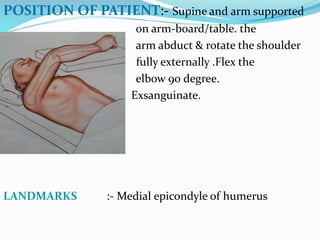
POSITION OF PATIENT:- Supine and arm supported
on arm-board/table. the
arm abduct & rotate the shoulder
fully externally .Flex the
elbow 90 degree.
Exsanguinate.
LANDMARKS :- Medial epicondyle of humerus
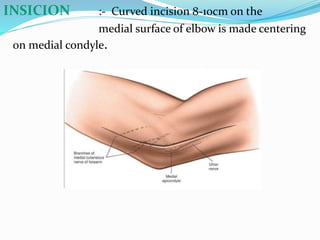
INSICION :- Curved incision 8-10cm on the
medial surface of elbow is made centering
on medial condyle.
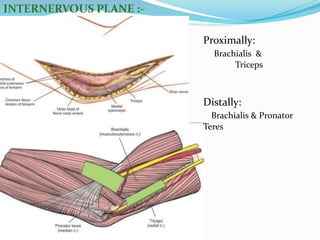
INTERNERVOUS PLANE :-
Proximally:
Brachialis &
Triceps
Distally:
Brachialis & Pronator
Teres
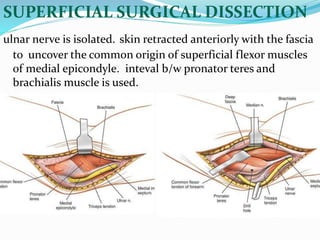
SUPERFICIAL SURGICAL DISSECTION
ulnar nerve is isolated. skin retracted anteriorly with the fascia
to uncover the common origin of superficial flexor muscles
of medial epicondyle. inteval b/w pronator teres and
brachialis muscle is used.
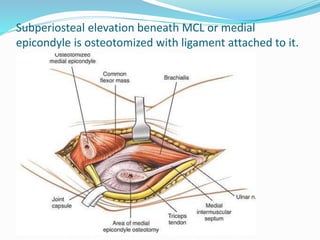
Subperiosteal elevation beneath MCL or medial
epicondyle is osteotomized with ligament attached to it.
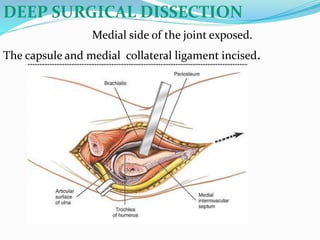
DEEP SURGICAL DISSECTION
Medial side of the joint exposed.
The capsule and medial collateral ligament incised.
STRUCTURES AT RISK
Ulnar nerve.
Median nerve and its main branch AIN with vigorous traction
of medial epicondyle or superficial flexor muscles
EXTENSION
Proximally :
b/w triceps and brachialis muscle subperiosteally
Distally:
exposure provides adequate view of the
brachialis inserting into coronoid. it cannot offer a more
distal exposure but only upto the branching off of the
median nerve.
ANTEROLATERAL APPROACH
INDICATIONS :- Open reduction and internal fixation
of the capitulum #
Excision of proximal radius tumors
Treatment of aseptic necrosis of the capitulum
Drainage of septic elbow arthritis
Neural decompression :lesions of the proximal
half of the PIN and of the proximal part of the
superficial radial nerve access to the arcade Frohse, as well as
treatment of radial head fractures with paralysis of this nerve
Biceps tendon avulsion re-attachment to radial
tuberosity
TEA
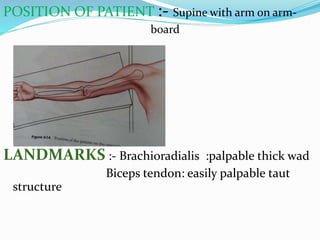
POSITION OF PATIENT :- Supine with arm on arm-
board
LANDMARKS :- Brachioradialis :palpable thick wad
Biceps tendon: easily palpable taut
structure
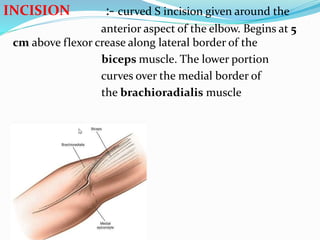
INCISION :- curved S incision given around the
anterior aspect of the elbow. Begins at 5
cm above flexor crease along lateral border of the
biceps muscle. The lower portion
curves over the medial border of
the brachioradialis muscle
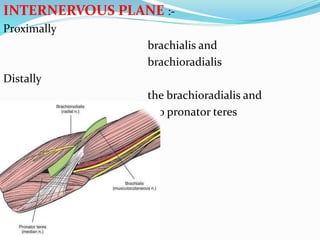
INTERNERVOUS PLANE :-
Proximally
brachialis and
brachioradialis
Distally
the brachioradialis and
pro pronator teres
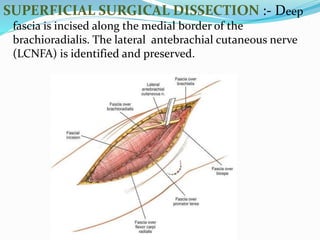
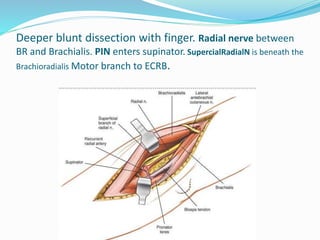
SUPERFICIAL SURGICAL DISSECTION :- Deep
fascia is incised along the medial border of the
brachioradialis. The lateral antebrachial cutaneous nerve
(LCNFA) is identified and preserved.
Deeper blunt dissection with finger. Radial nerve between
BR and Brachialis. PIN enters supinator. SupercialRadialN is beneath the
Brachioradialis Motor branch to ECRB.
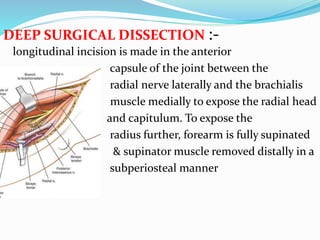
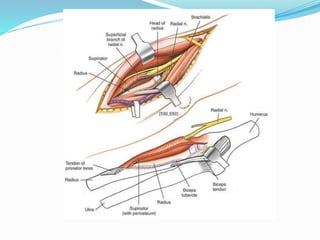
DEEP SURGICAL DISSECTION :-
longitudinal incision is made in the anterior
capsule of the joint between the
radial nerve laterally and the brachialis
muscle medially to expose the radial head
and capitulum. To expose the
radius further, forearm is fully supinated
& supinator muscle removed distally in a
subperiosteal manner
STRUCTURES AT RISK :-
Radial nerve : in brachioradialis and brachialis interval
Posterior interosseous nerve : Winding around the radial
neck.
Lateral cutaneous nerve of forearm: LCNFA emerging
from brachioradialis and biceps brachii interval
Reccurent branch of radial artery: Ligation decreases
post-op bleed and chance of VIC
EXTENSION:-
Proximally: BR/Triceps
Distally: Along entire anterior surface of the radius between
BR/PT and further distally BR/FCR.
ANTERIOR APPROACH OF CUBITAL FOSSA
INDICATIONS :-
Repair of lacerations to the
Median nerve
Brachial artery
Biceps tendon
Radial nerve
Biceps tendon re-insertion
Posttraumatic anterior capsular contractures release
Excision of tumors
POSITION OF PATIENT :- Supine position with arm
in anatomical position
LANDMARKS :- Brachoradialis: fleshy wad
tendon of biceps: taut
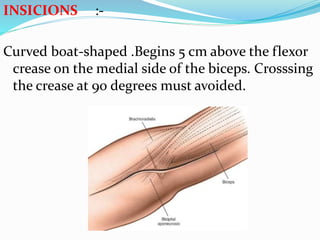
INSICIONS :-
Curved boat-shaped .Begins 5 cm above the flexor
crease on the medial side of the biceps. Crosssing
the crease at 90 degrees must avoided.
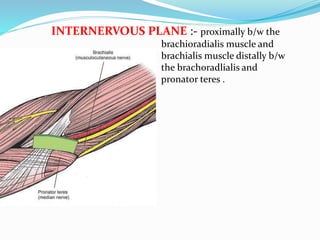
INTERNERVOUS PLANE :- proximally b/w the
brachioradialis muscle and
brachialis muscle distally b/w
the brachoradlialis and
pronator teres .
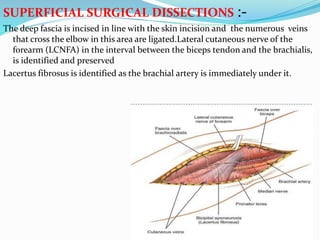
SUPERFICIAL SURGICAL DISSECTIONS :-
The deep fascia is incised in line with the skin incision and the numerous veins
that cross the elbow in this area are ligated.Lateral cutaneous nerve of the
forearm (LCNFA) in the interval between the biceps tendon and the brachialis,
is identified and preserved
Lacertus fibrosus is identified as the brachial artery is immediately under it.
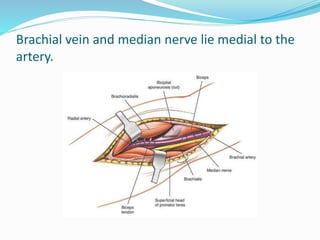
Brachial vein and median nerve lie medial to the
artery.
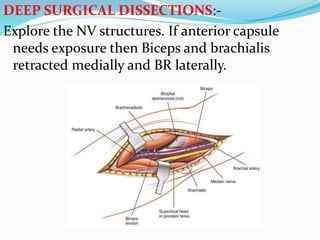
DEEP SURGICAL DISSECTIONS:-
Explore the NV structures. If anterior capsule
needs exposure then Biceps and brachialis
retracted medially and BR laterally.
STRUCTURES AT RISK
 1. LCNFA a sensory branch of musculocutaneous nerve
at distal ¼ of the arm. Emerges between biceps &
brachialis.
 2. Radial artery
 3.PIN
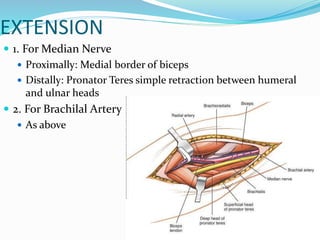
EXTENSION
 1. For Median Nerve
 Proximally: Medial border of biceps
 Distally: Pronator Teres simple retraction between humeral
and ulnar heads
 2. For Brachilal Artery
 As above
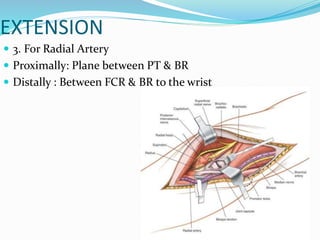
EXTENSION
 3. For Radial Artery
 Proximally: Plane between PT & BR
 Distally : Between FCR & BR to the wrist
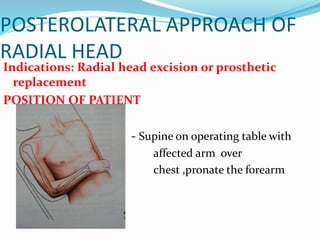
POSTEROLATERAL APPROACH OF
RADIAL HEAD
Indications: Radial head excision or prosthetic
replacement
POSITION OF PATIENT
- Supine on operating table with
affected arm over
chest ,pronate the forearm
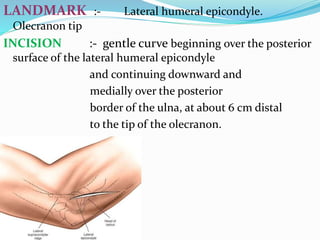
LANDMARK :- Lateral humeral epicondyle.
Olecranon tip
INCISION :- gentle curve beginning over the posterior
surface of the lateral humeral epicondyle
and continuing downward and
medially over the posterior
border of the ulna, at about 6 cm distal
to the tip of the olecranon.
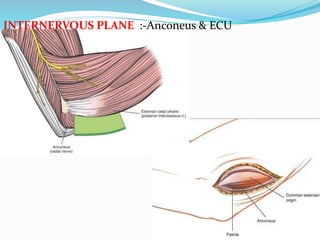
INTERNERVOUS PLANE :-Anconeus & ECU
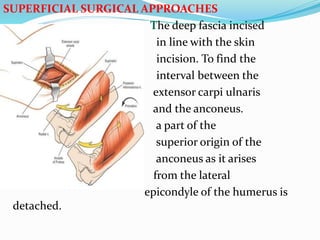
SUPERFICIAL SURGICAL APPROACHES
The deep fascia incised
in line with the skin
incision. To find the
interval between the
extensor carpi ulnaris
and the anconeus.
a part of the
superior origin of the
anconeus as it arises
from the lateral
epicondyle of the humerus is
detached.
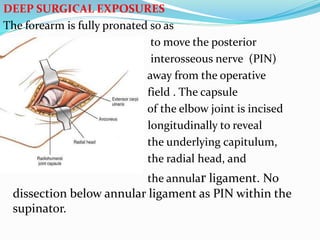
DEEP SURGICAL EXPOSURES
The forearm is fully pronated so as
to move the posterior
interosseous nerve (PIN)
away from the operative
field . The capsule
of the elbow joint is incised
longitudinally to reveal
the underlying capitulum,
the radial head, and
the annular ligament. No
dissection below annular ligament as PIN within the
supinator.
STRUCTURES AT RISK :-
Posterior interosseous nerve :
Remain proximal to the annular ligament.
Pronate the Forearm to keep the PIN far from the operative field.
Place the retractors directly on the bone.
Avoid retractors directly opposite to the bicipital tuberosity
Radial nerve :
Don’t extend anteriorly
Surgical approaches to the elbow

Surgical approaches to the elbow

  • 1.
  • 2.
    ELBOW  Posterior approach Anterolateral approach  Medial approach  Anterior approach of medial cubital fossa  Posterolateral approach of radial head
  • 3.
    POSTERIOR APPROACH INDICATION :-open reduction internal fixation of fracture of distal humerus Removal of loose bodies with in the elbow joint Treatment of non union of distal humerus
  • 4.
    POSITION OF PATIENT:- Prone position with adequate padding.Exsanguinate with elevation for 3-5 min or exsanguinator. Arm abducted about 90degree LANDMARK :- Olecranon process
  • 5.
    INCISION :- Longidutinalincision over posterior aspect of elbow begins 5cm above the olecranon over midline of posterior aspect of arm .At the tip of olecranon curved laterally. Distally curved again medially towards middle of ulna
  • 6.
    INTERNERVOUS PLANE:-None Superficial surgicaldissection :- The deep fascia is incised in the mid line and ulnar nerve is identified, dissected out, protected and marked the with a nerve tape . Pre-drilling and tapping of olecranon is done if osteotomy is planned( eg Chevron for more stability)
  • 7.
    DEEP SURGICAL DISSECTION:- Dissect around the medial and lateral border of the bone to expose all the distal fourth of humerus .Radial Nerve.
  • 8.
    STRUCTURES AT RISK:- Ulnar nerve : Identify and protect. Median nerve : Always remain in subperiosteal plane Radial nerve: Don’t dissect too proximal at lateral intermuscular septum Brachial artery: Anteriorly located Extension:- Proximally– Not possible than the distal third of humerus Distally - can be extended along the subcutaneous border of ulna
  • 9.
    MEDIAL APPROACH INDICATIONS :-Removal of loose bodies Open reduction and internal fixation of fractures of the corocoid process of the ulna Open reduction and internal fixation of fractures of the medial humeral condyle and epicondyle. Contraindications: 1. Exploration of elbow as poor access to the lateral side
  • 10.
    POSITION OF PATIENT:-Supine and arm supported on arm-board/table. the arm abduct & rotate the shoulder fully externally .Flex the elbow 90 degree. Exsanguinate. LANDMARKS :- Medial epicondyle of humerus
  • 11.
    INSICION :- Curvedincision 8-10cm on the medial surface of elbow is made centering on medial condyle.
  • 12.
    INTERNERVOUS PLANE :- Proximally: Brachialis& Triceps Distally: Brachialis & Pronator Teres
  • 13.
    SUPERFICIAL SURGICAL DISSECTION ulnarnerve is isolated. skin retracted anteriorly with the fascia to uncover the common origin of superficial flexor muscles of medial epicondyle. inteval b/w pronator teres and brachialis muscle is used.
  • 14.
    Subperiosteal elevation beneathMCL or medial epicondyle is osteotomized with ligament attached to it.
  • 15.
    DEEP SURGICAL DISSECTION Medialside of the joint exposed. The capsule and medial collateral ligament incised.
  • 16.
    STRUCTURES AT RISK Ulnarnerve. Median nerve and its main branch AIN with vigorous traction of medial epicondyle or superficial flexor muscles EXTENSION Proximally : b/w triceps and brachialis muscle subperiosteally Distally: exposure provides adequate view of the brachialis inserting into coronoid. it cannot offer a more distal exposure but only upto the branching off of the median nerve.
  • 17.
    ANTEROLATERAL APPROACH INDICATIONS :-Open reduction and internal fixation of the capitulum # Excision of proximal radius tumors Treatment of aseptic necrosis of the capitulum Drainage of septic elbow arthritis Neural decompression :lesions of the proximal half of the PIN and of the proximal part of the superficial radial nerve access to the arcade Frohse, as well as treatment of radial head fractures with paralysis of this nerve Biceps tendon avulsion re-attachment to radial tuberosity TEA
  • 18.
    POSITION OF PATIENT:- Supine with arm on arm- board LANDMARKS :- Brachioradialis :palpable thick wad Biceps tendon: easily palpable taut structure
  • 19.
    INCISION :- curvedS incision given around the anterior aspect of the elbow. Begins at 5 cm above flexor crease along lateral border of the biceps muscle. The lower portion curves over the medial border of the brachioradialis muscle
  • 20.
    INTERNERVOUS PLANE :- Proximally brachialisand brachioradialis Distally the brachioradialis and pro pronator teres
  • 21.
    SUPERFICIAL SURGICAL DISSECTION:- Deep fascia is incised along the medial border of the brachioradialis. The lateral antebrachial cutaneous nerve (LCNFA) is identified and preserved.
  • 22.
    Deeper blunt dissectionwith finger. Radial nerve between BR and Brachialis. PIN enters supinator. SupercialRadialN is beneath the Brachioradialis Motor branch to ECRB.
  • 23.
    DEEP SURGICAL DISSECTION:- longitudinal incision is made in the anterior capsule of the joint between the radial nerve laterally and the brachialis muscle medially to expose the radial head and capitulum. To expose the radius further, forearm is fully supinated & supinator muscle removed distally in a subperiosteal manner
  • 25.
    STRUCTURES AT RISK:- Radial nerve : in brachioradialis and brachialis interval Posterior interosseous nerve : Winding around the radial neck. Lateral cutaneous nerve of forearm: LCNFA emerging from brachioradialis and biceps brachii interval Reccurent branch of radial artery: Ligation decreases post-op bleed and chance of VIC EXTENSION:- Proximally: BR/Triceps Distally: Along entire anterior surface of the radius between BR/PT and further distally BR/FCR.
  • 26.
    ANTERIOR APPROACH OFCUBITAL FOSSA INDICATIONS :- Repair of lacerations to the Median nerve Brachial artery Biceps tendon Radial nerve Biceps tendon re-insertion Posttraumatic anterior capsular contractures release Excision of tumors
  • 27.
    POSITION OF PATIENT:- Supine position with arm in anatomical position LANDMARKS :- Brachoradialis: fleshy wad tendon of biceps: taut
  • 28.
    INSICIONS :- Curved boat-shaped.Begins 5 cm above the flexor crease on the medial side of the biceps. Crosssing the crease at 90 degrees must avoided.
  • 29.
    INTERNERVOUS PLANE :-proximally b/w the brachioradialis muscle and brachialis muscle distally b/w the brachoradlialis and pronator teres .
  • 30.
    SUPERFICIAL SURGICAL DISSECTIONS:- The deep fascia is incised in line with the skin incision and the numerous veins that cross the elbow in this area are ligated.Lateral cutaneous nerve of the forearm (LCNFA) in the interval between the biceps tendon and the brachialis, is identified and preserved Lacertus fibrosus is identified as the brachial artery is immediately under it.
  • 31.
    Brachial vein andmedian nerve lie medial to the artery.
  • 32.
    DEEP SURGICAL DISSECTIONS:- Explorethe NV structures. If anterior capsule needs exposure then Biceps and brachialis retracted medially and BR laterally.
  • 33.
    STRUCTURES AT RISK 1. LCNFA a sensory branch of musculocutaneous nerve at distal ¼ of the arm. Emerges between biceps & brachialis.  2. Radial artery  3.PIN
  • 34.
    EXTENSION  1. ForMedian Nerve  Proximally: Medial border of biceps  Distally: Pronator Teres simple retraction between humeral and ulnar heads  2. For Brachilal Artery  As above
  • 35.
    EXTENSION  3. ForRadial Artery  Proximally: Plane between PT & BR  Distally : Between FCR & BR to the wrist
  • 36.
    POSTEROLATERAL APPROACH OF RADIALHEAD Indications: Radial head excision or prosthetic replacement POSITION OF PATIENT - Supine on operating table with affected arm over chest ,pronate the forearm
  • 37.
    LANDMARK :- Lateralhumeral epicondyle. Olecranon tip INCISION :- gentle curve beginning over the posterior surface of the lateral humeral epicondyle and continuing downward and medially over the posterior border of the ulna, at about 6 cm distal to the tip of the olecranon.
  • 38.
  • 39.
    SUPERFICIAL SURGICAL APPROACHES Thedeep fascia incised in line with the skin incision. To find the interval between the extensor carpi ulnaris and the anconeus. a part of the superior origin of the anconeus as it arises from the lateral epicondyle of the humerus is detached.
  • 40.
    DEEP SURGICAL EXPOSURES Theforearm is fully pronated so as to move the posterior interosseous nerve (PIN) away from the operative field . The capsule of the elbow joint is incised longitudinally to reveal the underlying capitulum, the radial head, and the annular ligament. No dissection below annular ligament as PIN within the supinator.
  • 41.
    STRUCTURES AT RISK:- Posterior interosseous nerve : Remain proximal to the annular ligament. Pronate the Forearm to keep the PIN far from the operative field. Place the retractors directly on the bone. Avoid retractors directly opposite to the bicipital tuberosity Radial nerve : Don’t extend anteriorly