Surgical Approaches To The Hip
Capt. Hein Htet Naing
PG 3rd Year
1
Basic Approach
“5”
!Anterior approach
!Anterolateral approach
!Lateral approach
!Posterior approach
!Medial approach
2
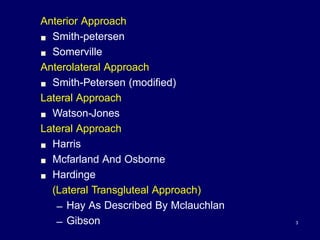
Anterior Approach
! Smith-petersen
! Somerville
Anterolateral Approach
! Smith-Petersen (modified)
Lateral Approach
! Watson-Jones
Lateral Approach
! Harris
! Mcfarland And Osborne
! Hardinge
(Lateral Transgluteal Approach)
– Hay As Described By Mclauchlan
– Gibson 3
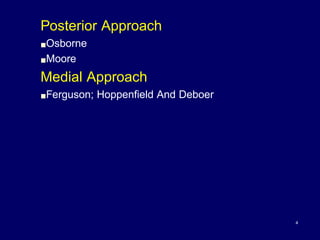
Posterior Approach
!Osborne
!Moore
Medial Approach
!Ferguson; Hoppenfield And Deboer
4
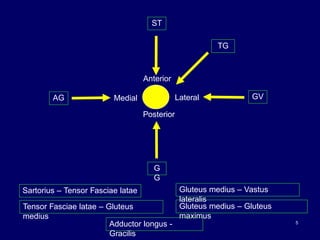
5
Anterior
Lateral
Medial
Posterior
Sartorius – Tensor Fasciae latae
Tensor Fasciae latae – Gluteus
medius
Gluteus medius – Gluteus
maximus
Adductor longus -
Gracilis
Gluteus medius – Vastus
lateralis
ST
TG
AG
G
G
GV
Anterior Iliofemoral Approach
(Smith Peterson)
! Gives safe access to hip & ilium
Indications:
1. Open reduction of congenital dislocations when
dislocated femoral head is anterosuperior to
acetabulum
2. Synovial biopsies
3. Intra articular fusions
4. THR
5. Hemiarthroplasty
6. Excision of tumors (pelvis)
7. Pelvic osteotomies using upper part of approach
6
7
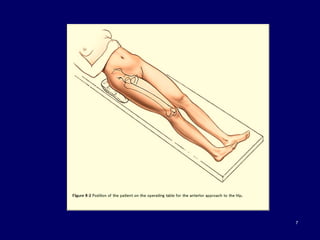
1. Begin the
incision at the
middle of the iliac
crest
2. Carry it anteriorly
to ASIS and
distally and
slightly laterally
10 to 12 cm
8
3. Divide the superficial and deep fasciae
9
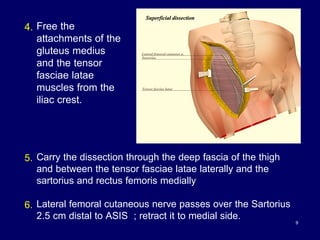
4. Free the
attachments of the
gluteus medius
and the tensor
fasciae latae
muscles from the
iliac crest.
5. Carry the dissection through the deep fascia of the thigh
and between the tensor fasciae latae laterally and the
sartorius and rectus femoris medially
6. Lateral femoral cutaneous nerve passes over the Sartorius
2.5 cm distal to ASIS ; retract it to medial side.
10
7. Expose and incise
the capsule
transversely and
reveal the femoral
head and proximal
margin of
acetabulum.
8. Capsule may be sectioned along its attachment to the
acetabular labrum (cotyloid ligament) to give the required
exposure.
9. If necessary, the ligamentum teres may be divided with a
curved knife or with scissors.
Dangers
NERVES:
LFCN. of thigh- may be injured b/w sartorius & TFL.
Femoral N. – may be injured if plane is missed during
deep dissection as it lies anterior to hip , medial to RF,
lateral to the femoralA.
VESSELS:
Ascending branch of Lat.Circumflex F.A.- May be
injured in the plane b/t TFL & Sartorius.
11
! Reattachment of fascia lata to iliac crest difficult
! Osteotomy of overhang of iliac crest is performed
b/w Ext. Oblique medially & fascia lata to as far as
origin of g.maximus.
! TFL, G.medius & G.minimus dissected
subperiosteally to expose hip joint capsule.
! Closure – Iliac osteotomy fragment reattached with
non-absorbable sutures through holes drilled.
Schaubel Modification Of SP Anterior Approach
12
13
Somerville
•Transverse “bikini” incision for irreducible congenital
dislocation of the hip
•sequential steps must be performed:
1. psoas tenotomy,
2. Complete medial capsulotomy including the
transverse acetabular ligament,
3. excision of hypertrophied ligamentum teres,
4. reduction of the femoral head into acetabulum.
1. Make a straight skin incision, beginning anteriorly
inferiorly and medial to ASIS and coursing obliquely
superiorly and posteriorly to the middle of iliac crest
2. Reflect the abductor muscles subperiosteally from
the iliac wing distally to the capsule of the joint.
14
15
3. Increase exposure of the capsule by separating
the tensor fasciae latae from the sartorius for
about 2.5 cm inferior to the anterior superior spine.
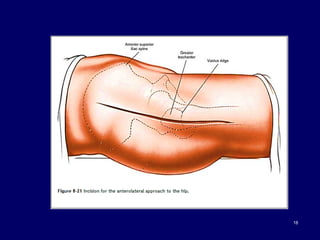
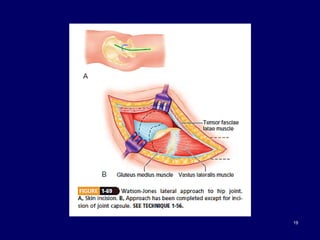
Anterolateral Approach:
( Watson-Jones )
! Most commonly used for THR
! Abductor mechanism released either by trochanteric
osteotomy / by cutting the ant.part of GL.medius & the
whole Gl. minimus of the G.T
Indications:
1. THR
2. ORIF of fracture NOF
3. Hemiarthroplasty
4. Synovial biopsy
5. Biopsy Femoral N.
16
17
18
19
C
ADE- Kocher Langenbeck Incision
BDE- Gibson Original Skin Incision
CDE- Modified Gibson Approach 20
21
! Deep surgical dissection consists in detaching part or all
of the abductor mechanism and dissecting up the
femoral neck superficial to the capsule.
! Incise the capsule of the joint longitudinally along the
anterosuperior surface of the femoral neck.
22
! Nerve
! Femoral N - Placing retractors into substance of
iliopsoas Or overexuberant retraction can
damage it.
! Vessels
! Femoral Artery & Vein – damaged by
acetabular retractors that penetrate iliopsoas
substance.
! Profunda Femoris Artery
Dangers
23
Lateral Approach To Hip
! Excellent approach to hip replacement.
! No need for trochanteric osteotomy.
! Early mobilisation of pt possible as the Gl.medius is
preserved.
! But not a wider approach as anterolateral approach.
Position:
Supine with GT at the edge of the table.
24
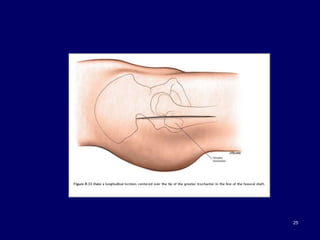
25
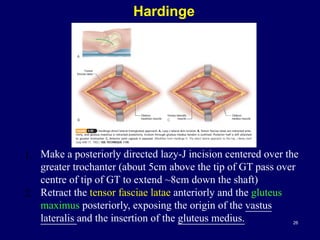
Hardinge
26
1. Make a posteriorly directed lazy-J incision centered over the
greater trochanter (about 5cm above the tip of GT pass over
centre of tip of GT to extend ~8cm down the shaft)
2. Retract the tensor fasciae latae anteriorly and the gluteus
maximus posteriorly, exposing the origin of the vastus
lateralis and the insertion of the gluteus medius.
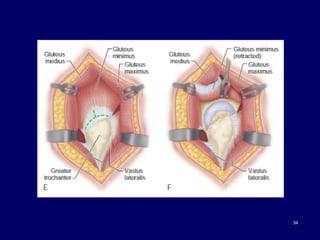
! Incise the tendon of the gluteus medius obliquely
across the greater trochanter, leaving the posterior half
still attached to the trochanter
! Split the GL. Medius starting in the middle of GT. 27
28
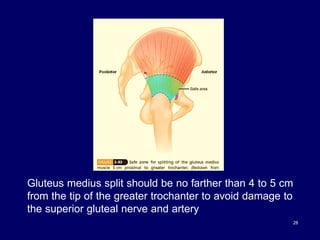
Gluteus medius split should be no farther than 4 to 5 cm
from the tip of the greater trochanter to avoid damage to
the superior gluteal nerve and artery
! Elevate the tendinous insertions of the anterior
portions of the gluteus minimus and vastus lateralis
muscles.
! Abduction of the thigh exposes the anterior capsule
of the hip joint.
! Incise the capsule as desired.
! During closure, repair the tendon of the gluteus
medius with nonabsorbable braided sutures
29
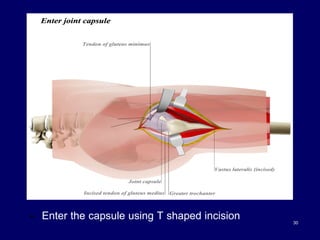
• Enter the capsule using T shaped incision 30
Dangers:
Nerves:
! Sup.GL.N. damage at the upper end of incision above
GT.
! Prevented by stay suture in the GL. Med
! Femoral N. damaged by inadvertly placed retraction
! Prevented by placing retractor strictly on the bone.
Vessels:
! Fem. Vessels by retractor
31
Harris Approach
! Lateral approach for extensive exposure of the hip.
! Permits hip dislocation ant & post.
! But requires GT osteotomy.
So risks are - Trochanteric non-union,
Trochanteric bursitis,
Heterotopic ossification
32
Harris
33
34
Some Other Modifications
McFarland & Osborne
lateral approach
! Preserves the integrity of
the gluteus medius muscle.
! Combined mass of
G.medius & Vastus
lateralis with their
tendinous junction is
elevated & retracted
anteriorly.
Hardinge lateral
Transgluteal approach
! Strong mobile tendon of
gluteus medius is
incised obliquely across
GT leaving posterior half
still attached to GT.
! GT Osteotomy is
avoided.
35
36
37
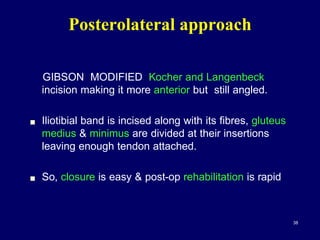
GIBSON MODIFIED Kocher and Langenbeck
incision making it more anterior but still angled.
! Iliotibial band is incised along with its fibres, gluteus
medius & minimus are divided at their insertions
leaving enough tendon attached.
! So, closure is easy & post-op rehabilitation is rapid
Posterolateral approach
38
39
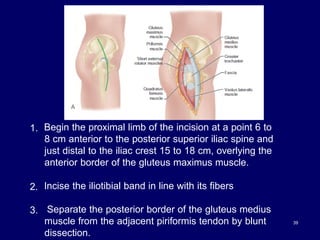
1. Begin the proximal limb of the incision at a point 6 to
8 cm anterior to the posterior superior iliac spine and
just distal to the iliac crest 15 to 18 cm, overlying the
anterior border of the gluteus maximus muscle.
2. Incise the iliotibial band in line with its fibers
3. Separate the posterior border of the gluteus medius
muscle from the adjacent piriformis tendon by blunt
dissection.
40
4. Divide the gluteus medius and
minimus muscles at their
insertions, but leave enough of
their tendons attached to
greater trochanter.
5. Incise the capsule superiorly in
the axis of the femoral neck
from the acetabulum to the
intertrochanteric line
41
6. The hip now can be dislocated by flexing the hip and knee
and abducting and externally rotating the thigh
7. To preserve the insertion of the abductor muscles,
osteotomize the trochanter and later reattach it with two
wire loops, 6.5-mm lag screws, or cable grip.
8. Wire loops are passed through the insertion of the muscles
proximal to the trochanter and through a hole drilled in the
femoral shaft 4 cm distal to the osteotomy.
Modification Of Gibson Posterolateral
Approach
42
Gibson Approach Modified
By Marcy and Fletcher
! For insertion of a prosthesis in which the hip is
dislocated by internal rotation.
! Anterior part of the joint capsule is preserved to
keep the hip from dislocating anteriorly after
surgery.
43
Posterior Approach:
(Moores Approach)
! Most commonly used approach & practical
! Easy ,safe, quick
Indications:
Hemiarthroplasty
THR including revision
ORIF of post. Acetabular #
Dependent drainage in hip sepsis
Removal loose bodies
Pedicle bone grafting
Open reduction of posterior dislocation
44
45
46
Position:
True lateral with affected limb above
Landmark: GT
Incision:
! 10-15cm curved centered on posterior aspect of GT
! Begin proximally 6-8cms posterosuperior to posterior aspect of
GT
! Continue to GT
! Curve the incision in line with fibers of Gluteus Maximus
! Continue along shaft of femur.
Incision is identical to Kocher-Langenbeck Approach ,
except localized posterior to GT
47
48
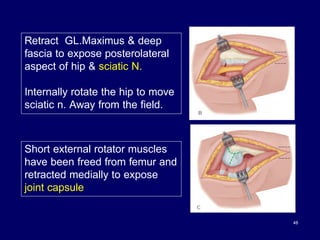
Retract GL.Maximus & deep
fascia to expose posterolateral
aspect of hip & sciatic N.
Internally rotate the hip to move
sciatic n. Away from the field.
Short external rotator muscles
have been freed from femur and
retracted medially to expose
joint capsule
49
Short Rotators
! capsule has been opened, and hip joint has been
dislocated by flexing, adducting, and internally rotating
thigh.
50
MEDIAL APPROACH
(LUDOLFFS APPROACH)
INDICATIONS:
! Open reduction of congenital dislocation of hip.
! Biopsy & RX of tumors of the inf.portion of femoral
neck & medial aspect of proximal shaft.
! Psoas release
! Obturator neurectomy.
! By making short transverse/longitudinal incision-
used for adductor release
51
POSITION:
Supine with affected hip flexed , abducted & externally rotated.
Sole of foot lies along the medial side of opp. Knee.
LANDMARKS:
Adductor longus traced to its origin
Pubic tubercle
GT
52
INCISION:
Longitudinal incision on the medial thigh starting 3cm below
pubic tubercle that runs down over adductor longus
Length depends on amount of femur to be exposed
53
Femur
54
Lateral Approach
55
56
57
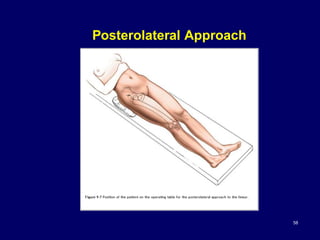
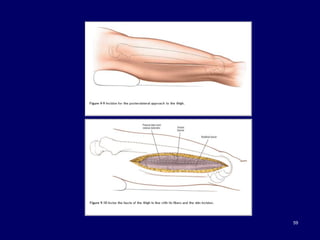
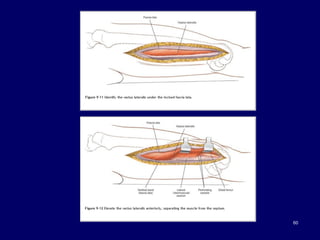
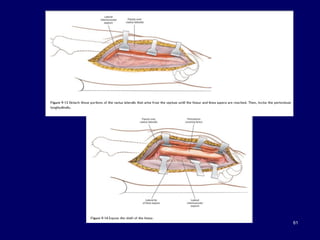
Posterolateral Approach
58
59
60
61
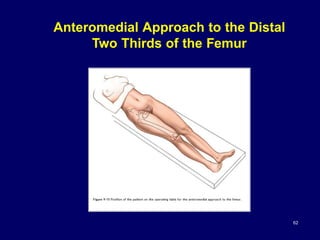
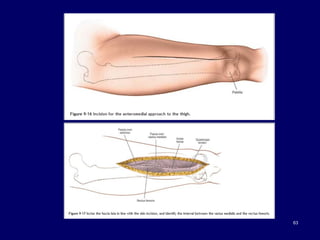
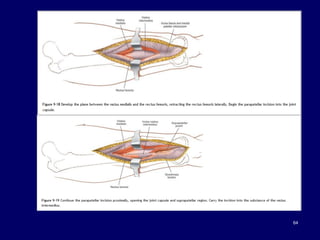
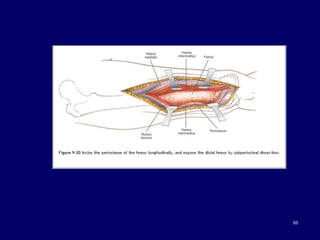
Anteromedial Approach to the Distal
Two Thirds of the Femur
62
63
64
65
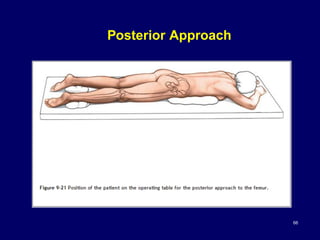
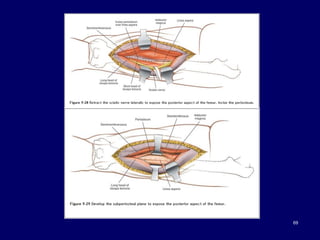
Posterior Approach
66
67
68
69
Thank You
70

Hip Arthroplasty Approach.pdf

  • 1.
    Surgical Approaches ToThe Hip Capt. Hein Htet Naing PG 3rd Year 1
  • 2.
    Basic Approach “5” !Anterior approach !Anterolateralapproach !Lateral approach !Posterior approach !Medial approach 2
  • 3.
    Anterior Approach ! Smith-petersen !Somerville Anterolateral Approach ! Smith-Petersen (modified) Lateral Approach ! Watson-Jones Lateral Approach ! Harris ! Mcfarland And Osborne ! Hardinge (Lateral Transgluteal Approach) – Hay As Described By Mclauchlan – Gibson 3
  • 4.
  • 5.
    5 Anterior Lateral Medial Posterior Sartorius – TensorFasciae latae Tensor Fasciae latae – Gluteus medius Gluteus medius – Gluteus maximus Adductor longus - Gracilis Gluteus medius – Vastus lateralis ST TG AG G G GV
  • 6.
    Anterior Iliofemoral Approach (SmithPeterson) ! Gives safe access to hip & ilium Indications: 1. Open reduction of congenital dislocations when dislocated femoral head is anterosuperior to acetabulum 2. Synovial biopsies 3. Intra articular fusions 4. THR 5. Hemiarthroplasty 6. Excision of tumors (pelvis) 7. Pelvic osteotomies using upper part of approach 6
  • 7.
  • 8.
    1. Begin the incisionat the middle of the iliac crest 2. Carry it anteriorly to ASIS and distally and slightly laterally 10 to 12 cm 8 3. Divide the superficial and deep fasciae
  • 9.
    9 4. Free the attachmentsof the gluteus medius and the tensor fasciae latae muscles from the iliac crest. 5. Carry the dissection through the deep fascia of the thigh and between the tensor fasciae latae laterally and the sartorius and rectus femoris medially 6. Lateral femoral cutaneous nerve passes over the Sartorius 2.5 cm distal to ASIS ; retract it to medial side.
  • 10.
    10 7. Expose andincise the capsule transversely and reveal the femoral head and proximal margin of acetabulum. 8. Capsule may be sectioned along its attachment to the acetabular labrum (cotyloid ligament) to give the required exposure. 9. If necessary, the ligamentum teres may be divided with a curved knife or with scissors.
  • 11.
    Dangers NERVES: LFCN. of thigh-may be injured b/w sartorius & TFL. Femoral N. – may be injured if plane is missed during deep dissection as it lies anterior to hip , medial to RF, lateral to the femoralA. VESSELS: Ascending branch of Lat.Circumflex F.A.- May be injured in the plane b/t TFL & Sartorius. 11
  • 12.
    ! Reattachment offascia lata to iliac crest difficult ! Osteotomy of overhang of iliac crest is performed b/w Ext. Oblique medially & fascia lata to as far as origin of g.maximus. ! TFL, G.medius & G.minimus dissected subperiosteally to expose hip joint capsule. ! Closure – Iliac osteotomy fragment reattached with non-absorbable sutures through holes drilled. Schaubel Modification Of SP Anterior Approach 12
  • 13.
    13 Somerville •Transverse “bikini” incisionfor irreducible congenital dislocation of the hip •sequential steps must be performed: 1. psoas tenotomy, 2. Complete medial capsulotomy including the transverse acetabular ligament, 3. excision of hypertrophied ligamentum teres, 4. reduction of the femoral head into acetabulum.
  • 14.
    1. Make astraight skin incision, beginning anteriorly inferiorly and medial to ASIS and coursing obliquely superiorly and posteriorly to the middle of iliac crest 2. Reflect the abductor muscles subperiosteally from the iliac wing distally to the capsule of the joint. 14
  • 15.
    15 3. Increase exposureof the capsule by separating the tensor fasciae latae from the sartorius for about 2.5 cm inferior to the anterior superior spine.
  • 16.
    Anterolateral Approach: ( Watson-Jones) ! Most commonly used for THR ! Abductor mechanism released either by trochanteric osteotomy / by cutting the ant.part of GL.medius & the whole Gl. minimus of the G.T Indications: 1. THR 2. ORIF of fracture NOF 3. Hemiarthroplasty 4. Synovial biopsy 5. Biopsy Femoral N. 16
  • 17.
  • 18.
  • 19.
  • 20.
    C ADE- Kocher LangenbeckIncision BDE- Gibson Original Skin Incision CDE- Modified Gibson Approach 20
  • 21.
  • 22.
    ! Deep surgicaldissection consists in detaching part or all of the abductor mechanism and dissecting up the femoral neck superficial to the capsule. ! Incise the capsule of the joint longitudinally along the anterosuperior surface of the femoral neck. 22
  • 23.
    ! Nerve ! FemoralN - Placing retractors into substance of iliopsoas Or overexuberant retraction can damage it. ! Vessels ! Femoral Artery & Vein – damaged by acetabular retractors that penetrate iliopsoas substance. ! Profunda Femoris Artery Dangers 23
  • 24.
    Lateral Approach ToHip ! Excellent approach to hip replacement. ! No need for trochanteric osteotomy. ! Early mobilisation of pt possible as the Gl.medius is preserved. ! But not a wider approach as anterolateral approach. Position: Supine with GT at the edge of the table. 24
  • 25.
  • 26.
    Hardinge 26 1. Make aposteriorly directed lazy-J incision centered over the greater trochanter (about 5cm above the tip of GT pass over centre of tip of GT to extend ~8cm down the shaft) 2. Retract the tensor fasciae latae anteriorly and the gluteus maximus posteriorly, exposing the origin of the vastus lateralis and the insertion of the gluteus medius.
  • 27.
    ! Incise thetendon of the gluteus medius obliquely across the greater trochanter, leaving the posterior half still attached to the trochanter ! Split the GL. Medius starting in the middle of GT. 27
  • 28.
    28 Gluteus medius splitshould be no farther than 4 to 5 cm from the tip of the greater trochanter to avoid damage to the superior gluteal nerve and artery
  • 29.
    ! Elevate thetendinous insertions of the anterior portions of the gluteus minimus and vastus lateralis muscles. ! Abduction of the thigh exposes the anterior capsule of the hip joint. ! Incise the capsule as desired. ! During closure, repair the tendon of the gluteus medius with nonabsorbable braided sutures 29
  • 30.
    • Enter thecapsule using T shaped incision 30
  • 31.
    Dangers: Nerves: ! Sup.GL.N. damageat the upper end of incision above GT. ! Prevented by stay suture in the GL. Med ! Femoral N. damaged by inadvertly placed retraction ! Prevented by placing retractor strictly on the bone. Vessels: ! Fem. Vessels by retractor 31
  • 32.
    Harris Approach ! Lateralapproach for extensive exposure of the hip. ! Permits hip dislocation ant & post. ! But requires GT osteotomy. So risks are - Trochanteric non-union, Trochanteric bursitis, Heterotopic ossification 32
  • 33.
  • 34.
  • 35.
    Some Other Modifications McFarland& Osborne lateral approach ! Preserves the integrity of the gluteus medius muscle. ! Combined mass of G.medius & Vastus lateralis with their tendinous junction is elevated & retracted anteriorly. Hardinge lateral Transgluteal approach ! Strong mobile tendon of gluteus medius is incised obliquely across GT leaving posterior half still attached to GT. ! GT Osteotomy is avoided. 35
  • 36.
  • 37.
  • 38.
    GIBSON MODIFIED Kocherand Langenbeck incision making it more anterior but still angled. ! Iliotibial band is incised along with its fibres, gluteus medius & minimus are divided at their insertions leaving enough tendon attached. ! So, closure is easy & post-op rehabilitation is rapid Posterolateral approach 38
  • 39.
    39 1. Begin theproximal limb of the incision at a point 6 to 8 cm anterior to the posterior superior iliac spine and just distal to the iliac crest 15 to 18 cm, overlying the anterior border of the gluteus maximus muscle. 2. Incise the iliotibial band in line with its fibers 3. Separate the posterior border of the gluteus medius muscle from the adjacent piriformis tendon by blunt dissection.
  • 40.
    40 4. Divide thegluteus medius and minimus muscles at their insertions, but leave enough of their tendons attached to greater trochanter. 5. Incise the capsule superiorly in the axis of the femoral neck from the acetabulum to the intertrochanteric line
  • 41.
    41 6. The hipnow can be dislocated by flexing the hip and knee and abducting and externally rotating the thigh 7. To preserve the insertion of the abductor muscles, osteotomize the trochanter and later reattach it with two wire loops, 6.5-mm lag screws, or cable grip. 8. Wire loops are passed through the insertion of the muscles proximal to the trochanter and through a hole drilled in the femoral shaft 4 cm distal to the osteotomy.
  • 42.
    Modification Of GibsonPosterolateral Approach 42
  • 43.
    Gibson Approach Modified ByMarcy and Fletcher ! For insertion of a prosthesis in which the hip is dislocated by internal rotation. ! Anterior part of the joint capsule is preserved to keep the hip from dislocating anteriorly after surgery. 43
  • 44.
    Posterior Approach: (Moores Approach) !Most commonly used approach & practical ! Easy ,safe, quick Indications: Hemiarthroplasty THR including revision ORIF of post. Acetabular # Dependent drainage in hip sepsis Removal loose bodies Pedicle bone grafting Open reduction of posterior dislocation 44
  • 45.
  • 46.
  • 47.
    Position: True lateral withaffected limb above Landmark: GT Incision: ! 10-15cm curved centered on posterior aspect of GT ! Begin proximally 6-8cms posterosuperior to posterior aspect of GT ! Continue to GT ! Curve the incision in line with fibers of Gluteus Maximus ! Continue along shaft of femur. Incision is identical to Kocher-Langenbeck Approach , except localized posterior to GT 47
  • 48.
    48 Retract GL.Maximus &deep fascia to expose posterolateral aspect of hip & sciatic N. Internally rotate the hip to move sciatic n. Away from the field. Short external rotator muscles have been freed from femur and retracted medially to expose joint capsule
  • 49.
  • 50.
    ! capsule hasbeen opened, and hip joint has been dislocated by flexing, adducting, and internally rotating thigh. 50
  • 51.
    MEDIAL APPROACH (LUDOLFFS APPROACH) INDICATIONS: !Open reduction of congenital dislocation of hip. ! Biopsy & RX of tumors of the inf.portion of femoral neck & medial aspect of proximal shaft. ! Psoas release ! Obturator neurectomy. ! By making short transverse/longitudinal incision- used for adductor release 51
  • 52.
    POSITION: Supine with affectedhip flexed , abducted & externally rotated. Sole of foot lies along the medial side of opp. Knee. LANDMARKS: Adductor longus traced to its origin Pubic tubercle GT 52
  • 53.
    INCISION: Longitudinal incision onthe medial thigh starting 3cm below pubic tubercle that runs down over adductor longus Length depends on amount of femur to be exposed 53
  • 54.
  • 55.
  • 56.
  • 57.
  • 58.
  • 59.
  • 60.
  • 61.
  • 62.
    Anteromedial Approach tothe Distal Two Thirds of the Femur 62
  • 63.
  • 64.
  • 65.
  • 66.
  • 67.
  • 68.
  • 69.
  • 70.