HYDROGEN DAMAGE OF METALLIC MATERIALS T.K. G. NAMBOODHIRI PROFESSOR OF METALLURGICAL ENGINEERING (Retired) BANARAS HINDU UNIVERSITY VARANASI
Introduction Hydrogen-most ubiquitous element Minute amounts can damage metals Can be easily picked up by metals during melting, casting, working, fabrication and use Many forms of hydrogen damage
Classification of hydrogen damage HYDROGEN ENVIRONMENT EMBRITTLEMENT CRACKING DEGRADATION   OF OTHER   MECHANICAL PROPERTIES LOSS IN TENSILE DUCTILITY SLOW STRAIN RATE EMBRITTLEMENT HYDROGEN EMBRITTLEMENT HYDRIDE EMBRITTLEMENT HYDROGEN DAMAGE SOLID   SOLUTION HARDENING HIGH STRAIN RATE EMBRITTLEMENT CREATION   OF INTERNAL   DEFECTS POROSITY SHATTER   CRACKS , FLAKES, FISH EYES BLISTERING HYDROGEN ATTACK HYDROGEN STRESS
Solid solution hardening. Hydrogen hardens metals like Nb,Ta and Ti at concentrations within solid solubility limits. These metals may be Embrittled at high strain rates.
HYDROGEN EMBRITTLEMENT HYDROGEN EMBRITTLEMENT HYDROGEN ENVIRONMENT EMBRITTLEMENT HYDROGEN STRESS CRACKING LOSS IN TENSILE DUCTILITY & OTHER MECHANICAL PROPERTIES
Hydride embrittlement Seen in hydride forming metals like Ti, V, Zr Low strain rate embrittlement : At low H concentrations. Similar to H.E.. Caused by stress-nucleated hydrides High strain rate embrittlement : At high H concentrations. Due to hydride precipitates. Enhanced by high strain rates.
Creation of internal defects Blistering :  Formation and collection of molecular hydrogen at internal defects like grain boundaries, inclusions and laminations, build-up of high pressures leading to formation and growth of blisters Shatter cracks and flakes : Internal fissures seen in large forgings due to segregated H Fish-eyes : bright patches of embrittled regions visible on fracture surfaces of weldments.
Creation of internal defects Micro-perforations:  Exposure to high hydrogen pressures at R.T. may develop small fissures or micro-perforations Porosity:  Liquid metals containing large amounts of H liberate it during solidification causing porosity in Fe, Al and Mg. H content, cooling rate, external pressure and H partial pressure control porosity Hydrogen attack : Exposure of steels to high pressure H at high temperatures causes H to react with carbon of steel to produce methane. Leads to decarburization, dissolution of carbides and weakening of the steel.
CHARACTERISTICS OF IMPORTANT H. D. PROCESSES HYDROGEN EMBRITTLEMENT HYDROGEN INDUCED BLISTER CRACKING HYDROGEN ATTACK
Characteristics of Hydrogen Embrittlement Strain rate and temperature sensitivity Delayed failure Sub critical cracking and threshold stress intensity Effects on tensile properties Fracture mechanisms
Strain rate and temperature sensitivity of H.E. Most pronounced at slow strain rates and ambient temperatures Decreases monotonically with increasing strain rate Minimum at around room temperature
Delayed failure in H.E. Incubation period independent of stress Time to failure increases with decreasing stress Discontinuous crack propagation Lower critical stress below which no failure H causes delayed failure in many materials Parameters strongly dependent on H content
Effects of H on tensile properties Increased/decreased/unaffected Y.S. Strain localization/Luders band/serrated yielding Increased/decreased flow stress and work hardening rate Increased screw dislocation velocity and dislocation multiplication Loss in tensile ductility
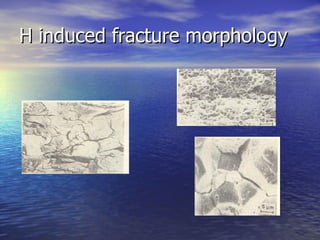
Fracture mechanisms in H.E. H promotes all fracture mechanisms MVC in low strength steels Ductile, quasi-cleavage or I.G. fractures in high strength steels I.G.failure in Ni I.G. or Transgranular cleavage(fluted morphology) in Ti alloys. I.G., cleavage or M.V.C. in Al alloys.
H induced fracture morphology
Hydrogen Induced Blister Cracking (HIBC) Metallurgical parameters: Non-metallic inclusions, Sulfur content, alloy segregation and microstructure. Very low S levels and inclusion shape control to eliminate HIBC nucleation. Reduction in hardness of segregated zones to prevent HIBC propagation. Environmental parameters: Hydrogen fugacity. A threshold fugacity below which HIBC does not occur.
HYDROGEN INDUCED BLISTERS Top picture shows hydrogen induced blisters in a  pipe line carrying hydrogen sulfide containing  fluids Bottom picture shows the cross section of a blister
Hydrogen Induced Blister Cracking (HIBC) Hydrogen blisters nucleate on inclusion stringers and cause cracking when their internal gas pressure exceeds the fracture stress- HSLA/Line pipe steels. Straight or step-wise cracking
HYDROGEN ATTACK Equipment in contact with hydrogen at  temperatures above 260 C and hydrogen partial pressures above 690 KPa may suffer from high temperature hydrogen attack.  Atomic hydrogen diffuses readily in steels and reacts with carbon present to form methane which collects at grain boundaries and in minute voids.  Methane pressure build-up leads to cracking
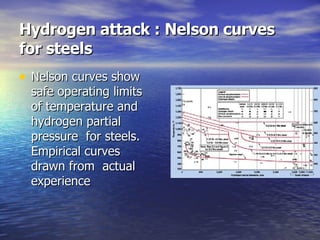
Hydrogen attack : Nelson curves for steels Nelson curves show safe operating limits of temperature and hydrogen partial pressure  for steels. Empirical curves drawn from  actual experience
Prevention of Hydrogen damage Metallurgical control:  Alloy chemistry, crystal structure, microstructure and substructure. Environmental control:  Inhibition by organic compounds like nitriles, sulfoxides, azoles and amines.
CONCLUSIONS SMALL QUANTITIES OF HYDROGEN CAN SERIOUSLY AFFECT THE PROPERTIES OF MANY STRUCTURAL MATERIALS HYDROGEN DAMAGE HAS MANY FORMS CAREFUL SELECTION OF MATERIALS, PROCESSING STEPS AND ENVIRONMENTS CAN PREVENT HYDROGEN DAMAGE

Hydrogen Damage

  • 1.
    HYDROGEN DAMAGE OFMETALLIC MATERIALS T.K. G. NAMBOODHIRI PROFESSOR OF METALLURGICAL ENGINEERING (Retired) BANARAS HINDU UNIVERSITY VARANASI
  • 2.
    Introduction Hydrogen-most ubiquitouselement Minute amounts can damage metals Can be easily picked up by metals during melting, casting, working, fabrication and use Many forms of hydrogen damage
  • 3.
    Classification of hydrogendamage HYDROGEN ENVIRONMENT EMBRITTLEMENT CRACKING DEGRADATION OF OTHER MECHANICAL PROPERTIES LOSS IN TENSILE DUCTILITY SLOW STRAIN RATE EMBRITTLEMENT HYDROGEN EMBRITTLEMENT HYDRIDE EMBRITTLEMENT HYDROGEN DAMAGE SOLID SOLUTION HARDENING HIGH STRAIN RATE EMBRITTLEMENT CREATION OF INTERNAL DEFECTS POROSITY SHATTER CRACKS , FLAKES, FISH EYES BLISTERING HYDROGEN ATTACK HYDROGEN STRESS
  • 4.
    Solid solution hardening.Hydrogen hardens metals like Nb,Ta and Ti at concentrations within solid solubility limits. These metals may be Embrittled at high strain rates.
  • 5.
    HYDROGEN EMBRITTLEMENT HYDROGENEMBRITTLEMENT HYDROGEN ENVIRONMENT EMBRITTLEMENT HYDROGEN STRESS CRACKING LOSS IN TENSILE DUCTILITY & OTHER MECHANICAL PROPERTIES
  • 6.
    Hydride embrittlement Seenin hydride forming metals like Ti, V, Zr Low strain rate embrittlement : At low H concentrations. Similar to H.E.. Caused by stress-nucleated hydrides High strain rate embrittlement : At high H concentrations. Due to hydride precipitates. Enhanced by high strain rates.
  • 7.
    Creation of internaldefects Blistering : Formation and collection of molecular hydrogen at internal defects like grain boundaries, inclusions and laminations, build-up of high pressures leading to formation and growth of blisters Shatter cracks and flakes : Internal fissures seen in large forgings due to segregated H Fish-eyes : bright patches of embrittled regions visible on fracture surfaces of weldments.
  • 8.
    Creation of internaldefects Micro-perforations: Exposure to high hydrogen pressures at R.T. may develop small fissures or micro-perforations Porosity: Liquid metals containing large amounts of H liberate it during solidification causing porosity in Fe, Al and Mg. H content, cooling rate, external pressure and H partial pressure control porosity Hydrogen attack : Exposure of steels to high pressure H at high temperatures causes H to react with carbon of steel to produce methane. Leads to decarburization, dissolution of carbides and weakening of the steel.
  • 9.
    CHARACTERISTICS OF IMPORTANTH. D. PROCESSES HYDROGEN EMBRITTLEMENT HYDROGEN INDUCED BLISTER CRACKING HYDROGEN ATTACK
  • 10.
    Characteristics of HydrogenEmbrittlement Strain rate and temperature sensitivity Delayed failure Sub critical cracking and threshold stress intensity Effects on tensile properties Fracture mechanisms
  • 11.
    Strain rate andtemperature sensitivity of H.E. Most pronounced at slow strain rates and ambient temperatures Decreases monotonically with increasing strain rate Minimum at around room temperature
  • 12.
    Delayed failure inH.E. Incubation period independent of stress Time to failure increases with decreasing stress Discontinuous crack propagation Lower critical stress below which no failure H causes delayed failure in many materials Parameters strongly dependent on H content
  • 13.
    Effects of Hon tensile properties Increased/decreased/unaffected Y.S. Strain localization/Luders band/serrated yielding Increased/decreased flow stress and work hardening rate Increased screw dislocation velocity and dislocation multiplication Loss in tensile ductility
  • 14.
    Fracture mechanisms inH.E. H promotes all fracture mechanisms MVC in low strength steels Ductile, quasi-cleavage or I.G. fractures in high strength steels I.G.failure in Ni I.G. or Transgranular cleavage(fluted morphology) in Ti alloys. I.G., cleavage or M.V.C. in Al alloys.
  • 15.
  • 16.
    Hydrogen Induced BlisterCracking (HIBC) Metallurgical parameters: Non-metallic inclusions, Sulfur content, alloy segregation and microstructure. Very low S levels and inclusion shape control to eliminate HIBC nucleation. Reduction in hardness of segregated zones to prevent HIBC propagation. Environmental parameters: Hydrogen fugacity. A threshold fugacity below which HIBC does not occur.
  • 17.
    HYDROGEN INDUCED BLISTERSTop picture shows hydrogen induced blisters in a pipe line carrying hydrogen sulfide containing fluids Bottom picture shows the cross section of a blister
  • 18.
    Hydrogen Induced BlisterCracking (HIBC) Hydrogen blisters nucleate on inclusion stringers and cause cracking when their internal gas pressure exceeds the fracture stress- HSLA/Line pipe steels. Straight or step-wise cracking
  • 19.
    HYDROGEN ATTACK Equipmentin contact with hydrogen at temperatures above 260 C and hydrogen partial pressures above 690 KPa may suffer from high temperature hydrogen attack. Atomic hydrogen diffuses readily in steels and reacts with carbon present to form methane which collects at grain boundaries and in minute voids. Methane pressure build-up leads to cracking
  • 20.
    Hydrogen attack :Nelson curves for steels Nelson curves show safe operating limits of temperature and hydrogen partial pressure for steels. Empirical curves drawn from actual experience
  • 21.
    Prevention of Hydrogendamage Metallurgical control: Alloy chemistry, crystal structure, microstructure and substructure. Environmental control: Inhibition by organic compounds like nitriles, sulfoxides, azoles and amines.
  • 22.
    CONCLUSIONS SMALL QUANTITIESOF HYDROGEN CAN SERIOUSLY AFFECT THE PROPERTIES OF MANY STRUCTURAL MATERIALS HYDROGEN DAMAGE HAS MANY FORMS CAREFUL SELECTION OF MATERIALS, PROCESSING STEPS AND ENVIRONMENTS CAN PREVENT HYDROGEN DAMAGE