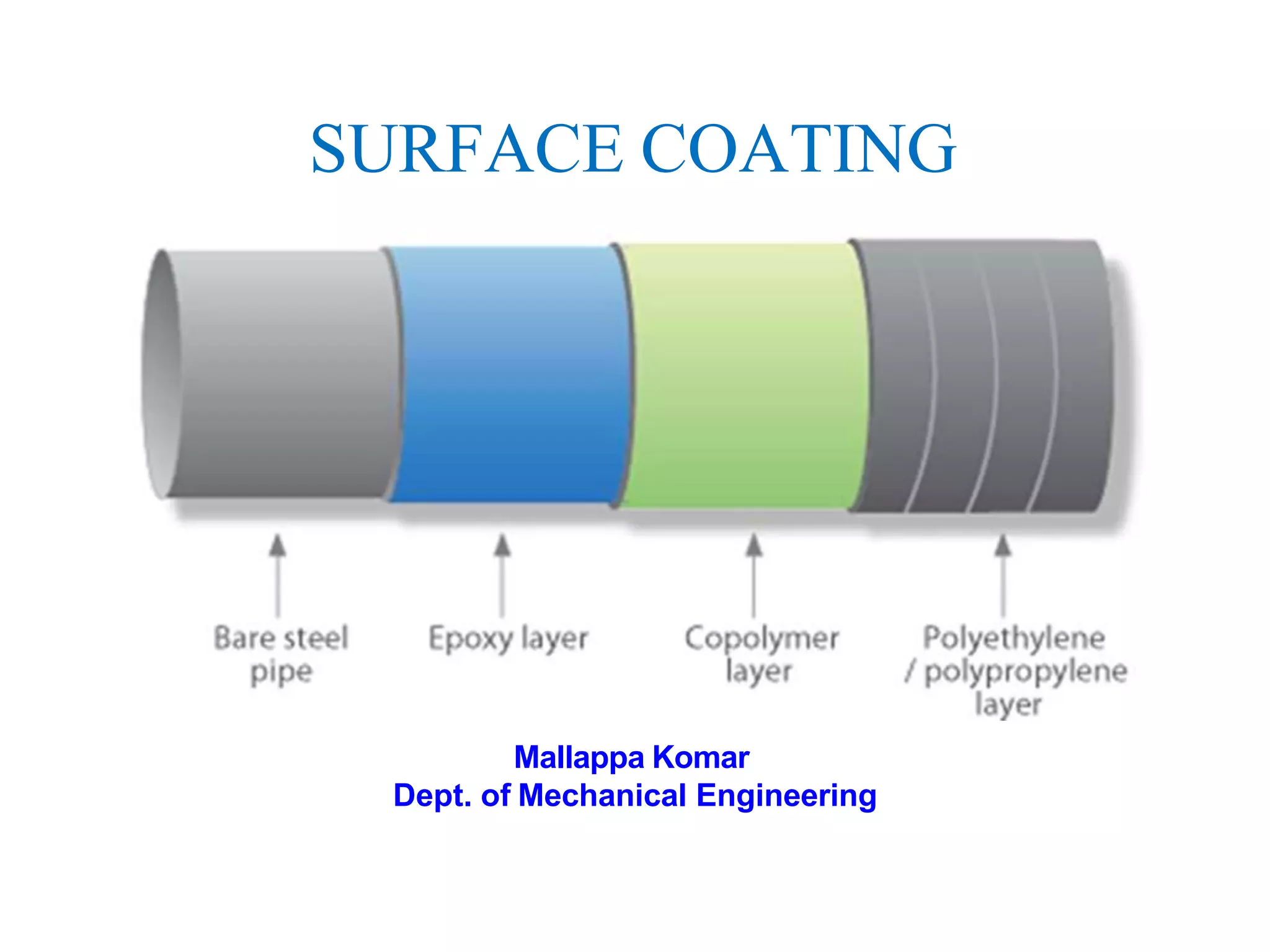
SURFACE COATING
Mallappa Komar
Dept. of Mechanical Engineering
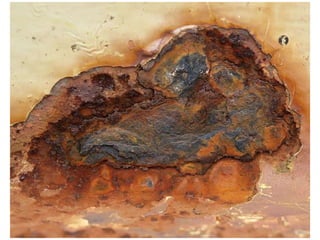
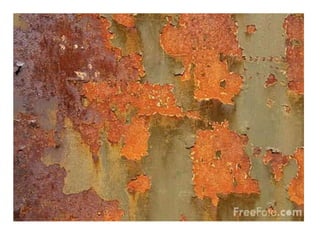
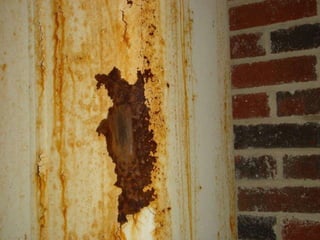
Corrosion is defined as the
deterioration of a material,
usually a metal, because of a
reaction with its environment.
CORROSION IS
 A natural phenomenon that occurs over time.
 An electrochemical reaction (on metals) Happens
at different rates with different metals and in
different environments
 If we expose iron or steel to air and water we can
expect to see rust form in a short time, showing
the familiar color of red-brown iron oxide.
 Depending on the environment the rust may
develop in minutes
 With other metals such as copper, brass, zinc,
aluminum, and stainless steel we can expect
corrosion to take place, but it might take longer to
develop.
 One reason for the reduction of the corrosion rate
with these metals is the potential formation of
metallic oxides of copper, zinc, aluminum, and
chromium.
 Unfortunately ordinary iron or steel does not form
this protective layer, so must be separated from the
environment by some other means.
 Generally protective coatings are utilized for this
purpose.
Coating
 A coating is a covering that is applied to the surface of an
object, usually referred to as the substrate.
 The purpose of applying the coating may be decorative,
functional, or both.
 The coating itself may be an all-over coating, completely
covering the substrate, or it may only cover parts of the
substrate.
 An example of all of these types of coating is a product
label on many drinks bottles- one side has an all-over
functional coating (the adhesive) and the other side has
one or more decorative coatings in an appropriate pattern
(the printing) to form the words and images.
Functions of coatings
• Adhesive –
• adhesive tape, pressure-sensitive labels, iron-
on fabric
• Changing adhesion properties
• Non-stick PTFE coated- cooking pans
• Release coatings e.g. silicone-coated release
liners for many self-adhesive products
• primers encourage subsequent coatings to
adhere well (also sometimes have anti-corrosive
properties)
Optical coatings
• Reflective coatings for mirrors
• Anti-reflective coatings e.g. on spectacles
• UV- absorbent coatings for protection of eyes or
increasing the life of the substrate
• Tinted as used in some coloured lighting, tinted
glazing, or sunglasses
• Catalytic e.g. some self-cleaning glass
• Light-sensitive as previously used to
make photographic film
Protective
• Most paints are to some extent protecting the substrate
• Hard anti-scratch coating on plastics and other materials
e.g. of titanium nitride to reduce scratching, improve wear
resistance, etc.
• Anti-corrosion
• Underbody sealant for cars
• Many plating products
• Waterproof fabric and waterproof paper
• antimicrobial surface
• Magnetic properties such as for magnetic media
like cassette tapes, floppy disks, and some mass transit
tickets
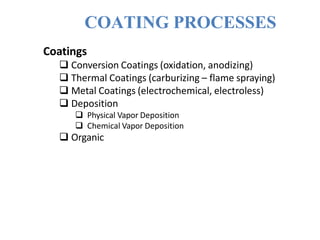
COATING PROCESSES
Coatings
 Conversion Coatings (oxidation, anodizing)
 Thermal Coatings (carburizing – flame spraying)
 Metal Coatings (electrochemical, electroless)
 Deposition
 Physical Vapor Deposition
 Chemical Vapor Deposition
 Organic
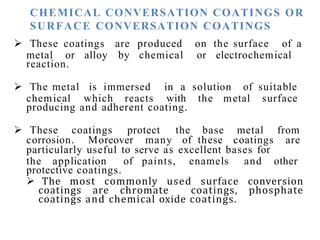
CHEMICAL CONVERSATION COATINGS OR
SURFACE CONVERSATION COATINGS
 These coatings are produced on the surface of a
metal or alloy by chemical or electrochemical
reaction.
 The metal is immersed in a solution of suitable
chemical which reacts with the metal surface
producing and adherent coating.
 These coatings protect the base metal from
corrosion. Moreover many of these coatings are
particularly useful to serve as excellent bases for
the application of paints, enamels and other
protective coatings.
 The most commonly used surface conversion
coatings are chromate coatings, phosphate
coatings and chemical oxide coatings.
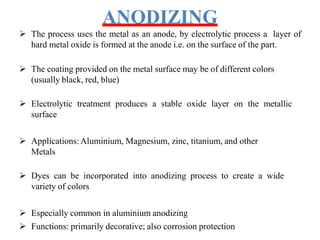
ANODIZING
 The process uses the metal as an anode, by electrolytic process a layer of
hard metal oxide is formed at the anode i.e. on the surface of the part.
 The coating provided on the metal surface may be of different colors
(usually black, red, blue)
 Electrolytic treatment produces a stable oxide layer on the metallic
surface
 Applications:Aluminium, Magnesium, zinc, titanium, and other
Metals
 Dyes can be incorporated into anodizing process to create a wide
variety of colors
 Especially common in aluminium anodizing
 Functions: primarily decorative; also corrosion protection
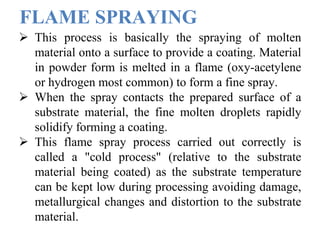
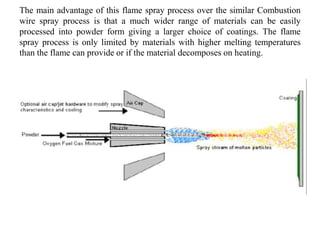
FLAME SPRAYING
 This process is basically the spraying of molten
material onto a surface to provide a coating. Material
in powder form is melted in a flame (oxy-acetylene
or hydrogen most common) to form a fine spray.
 When the spray contacts the prepared surface of a
substrate material, the fine molten droplets rapidly
solidify forming a coating.
 This flame spray process carried out correctly is
called a "cold process" (relative to the substrate
material being coated) as the substrate temperature
can be kept low during processing avoiding damage,
metallurgical changes and distortion to the substrate
material.
The main advantage of this flame spray process over the similar Combustion
wire spray process is that a much wider range of materials can be easily
processed into powder form giving a larger choice of coatings. The flame
spray process is only limited by materials with higher melting temperatures
than the flame can provide or if the material decomposes on heating.
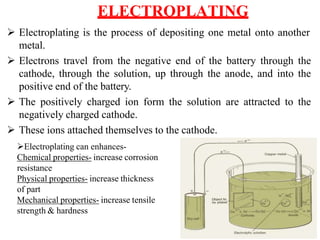
ELECTROPLATING
 Electroplating is the process of depositing one metal onto another
metal.
 Electrons travel from the negative end of the battery through the
cathode, through the solution, up through the anode, and into the
positive end of the battery.
 The positively charged ion form the solution are attracted to the
negatively charged cathode.
 These ions attached themselves to the cathode.
Electroplating can enhances-
Chemical properties- increase corrosion
resistance
Physical properties- increase thickness
of part
Mechanical properties- increase tensile
strength & hardness
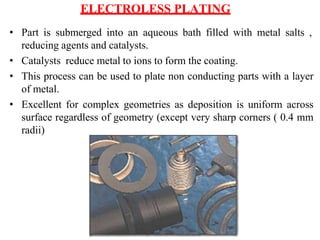
ELECTROLESS PLATING
• Part is submerged into an aqueous bath filled with metal salts ,
reducing agents and catalysts.
• Catalysts reduce metal to ions to form the coating.
• This process can be used to plate non conducting parts with a layer
of metal.
• Excellent for complex geometries as deposition is uniform across
surface regardless of geometry (except very sharp corners ( 0.4 mm
radii)
Vapor Deposition-
They are of two types-
1) Physical vapor deposition(PVD)
2) Chemical vapor deposition(CVD)
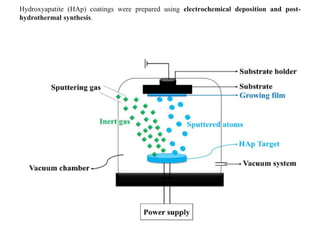
Physical vapor deposition(PVD)
 Family of processes in which a material is converted to its
vapor phase in a vacuum chamber and condensed onto substrate
surface as a very thin film.
 The most common methods of PVD are Sputtering and Thermal
Evaporation.
 Because in the PVD process, the material is transported and
accumulated atom-by-atom or molecule by molecule in a vacuum
to the substrate surface, the deposited films have high purity and
efficiency that for many applications compared to other deposition
methods are preferred.
Hydroxyapatite (HAp) coatings were prepared using electrochemical deposition and post-
hydrothermal synthesis.
Applications of PVD-
 For example, in the construction of the most
important part of any microchip and semiconductor
device, durable protective layers, optical
lenses, solar panels and many parts and medical
devices, the PVD thin film provides basic functional
characteristics for the final product.
 In general, wherever there is a need for coating with
very thin, pure, durable and clean thin films, PVD is
the key to solving the problem.
Its advantages include the following:
 PVD-coated thin films are more
resistant to corrosion than coatings
made using other coating processes such
as plating. Most PVD coatings are
impact resistant and also very abrasion
resistant. These coatings are often able
to withstand high temperatures
 High purity of the deposited thin films
and the possibility of controlling the
structure of the layers
 Thin films are cheaper bulk of
material(for example, a thin layer of
gold is much cheaper than a piece of
gold)
 Using the PVD method, it is possible to
deposit almost any type of inorganic
material and some organic materials on
a diverse and wide group of surfaces
and substrates
 High environmental compatibility
 Provide a variety of techniques for
deposition of a specific material
Disadvantages of PVD:
 Limitations on the coverage of
parts with complex geometric
shapes. Of course, this limitation
has been largely overcome by
various methods of moving the
substrate
 Some PVD methods and
techniques require high attention
and accuracy of the user due to the
high vacuum and high temperature
of the coating environment.
 Cooling water circulation systems
are needed to dissipate the
generated heat load and prevent
damage to the components of
the coating systems
 Chemical vapor deposition (CVD) is the formation
of a non-volatile solid film on a substrate due to the
reaction of vapor-phase chemical reactants. CVD is
an atmosphere-controlled process conducted at
elevated temperatures of around 1925°F (1051°C) in
a CVD reactor.
 CVD is used to create coatings for a variety of
applications such as wear resistance, corrosion
resistance, high temperature protection, erosion
protection and combinations thereof.
CHEMICAL VAPOR DEPOSITION (CVD)
A basic CVD process consists of the following steps:
1.A mixture of reactant gases and diluent inert gases are introduced into
the reaction chamber.
2.The gas moves to the substrate.
3.The reactants are adsorbed on the surface of the substrate.
4.The reactants undergo chemical reactions with the substrate to form the
film.
5.The gaseous byproducts of the reactions are desorbed and evacuated
from the reaction chamber.
 Chemical vapor deposition coatings are fine grained, have high purity
and are harder than similar materials produced using conventional
ceramic fabrication processes.
 This process is a very versatile one that can be used on products that
may be difficult to coat with other methods. It is commonly used to
protect electronic components, such as integrated circuits, against
corrosion.
• Metallic coatings are mostly
applied on Iron and steel because
these are cheap and
used construction
commonly
materials.
Metallic Coatings
 It is used for producing a coating of low melting metal
such as Zn, Sn, Ph, Al etc on relatively higher melting
metals such as iron, steel, copper etc.
 This is done by immersing the base metal covered
by a layer of molten flux.
 The flux is used to keep the base metal surface clean
and also to prevent oxidation of the molten metal.
 Most widely used hot dipping methods are : (i)
galvanization and (ii) tinning
1. Hot Dipping
 It is the process of coating Zn over iron
or steel sheet by immersing it in molten
Zn. The procedure involves the following
stages.
 The iron or steel article is first cleaned by
pickling with dil H2So4 for 15 – 20 min.
at 60 – 900C in an acid bath.
 This treatment also removes any oxide
layer present on the surface of the metal.
GALVANIZATION
Galvanization
 The article is then washed with water in a
washing bath & dried in a drying chamber.
 It is then passed through a pair of hot rollers to
remove excess of Zn and to get uniform thickness
for coating.
 Then it is annealed at about 6500C & cooled
slowly.
 In the case of Zn coating even if the protecting
layer has cracks on it, iron being cathodic does not
get corroded.
 It is then dipped in a bath of molten
Zn kept at 425 – 4350C.
 TheSurface of the bath is covered with
NH4Cl flux to prevent oxide formation.
 The article gets coated with a thin layer
of Zn.
Galvanization
Applications
This method is widely used for protection of
Fe from atmospheric corrosion in the form
of articles like roofing sheets, wires, pipes,
nails, screws, tubes etc.
It is to be noted that galvanized utensils
should not come in contact with acids.
 It is an eg. For cathodic coatings. It is the process of coating of
Sn over Fe or steel articles by immersing it in molten Sn.
 The process consists in Ist treating the iron sheet with dil
H2So4 to remove any oxide film.
 After this it is passed through a bath of ZnCl2 flux which helps
the molten Sn to adhere to the metal sheet.
 Next the sheet passes through palm oil which prevents
through a pair of hot rollers to remove excess of Sn & produce
uniform thickness for Sn coating.
TINNING
 Tinning is widely used for coating steel, Cu and brass
sheets which are used for making containers for
storing food studs, oils, kerosene & packing food
materials.
 Tinned Cu sheets are used for making cooking
utensils & refrigeration equipments.
Applications

Surface Coating.pptx

  • 1.
    SURFACE COATING Mallappa Komar Dept.of Mechanical Engineering
  • 2.
    Corrosion is definedas the deterioration of a material, usually a metal, because of a reaction with its environment.
  • 3.
    CORROSION IS  Anatural phenomenon that occurs over time.  An electrochemical reaction (on metals) Happens at different rates with different metals and in different environments  If we expose iron or steel to air and water we can expect to see rust form in a short time, showing the familiar color of red-brown iron oxide.  Depending on the environment the rust may develop in minutes
  • 7.
     With othermetals such as copper, brass, zinc, aluminum, and stainless steel we can expect corrosion to take place, but it might take longer to develop.  One reason for the reduction of the corrosion rate with these metals is the potential formation of metallic oxides of copper, zinc, aluminum, and chromium.  Unfortunately ordinary iron or steel does not form this protective layer, so must be separated from the environment by some other means.  Generally protective coatings are utilized for this purpose.
  • 8.
    Coating  A coatingis a covering that is applied to the surface of an object, usually referred to as the substrate.  The purpose of applying the coating may be decorative, functional, or both.  The coating itself may be an all-over coating, completely covering the substrate, or it may only cover parts of the substrate.  An example of all of these types of coating is a product label on many drinks bottles- one side has an all-over functional coating (the adhesive) and the other side has one or more decorative coatings in an appropriate pattern (the printing) to form the words and images.
  • 9.
    Functions of coatings •Adhesive – • adhesive tape, pressure-sensitive labels, iron- on fabric • Changing adhesion properties • Non-stick PTFE coated- cooking pans • Release coatings e.g. silicone-coated release liners for many self-adhesive products • primers encourage subsequent coatings to adhere well (also sometimes have anti-corrosive properties)
  • 10.
    Optical coatings • Reflectivecoatings for mirrors • Anti-reflective coatings e.g. on spectacles • UV- absorbent coatings for protection of eyes or increasing the life of the substrate • Tinted as used in some coloured lighting, tinted glazing, or sunglasses • Catalytic e.g. some self-cleaning glass • Light-sensitive as previously used to make photographic film
  • 11.
    Protective • Most paintsare to some extent protecting the substrate • Hard anti-scratch coating on plastics and other materials e.g. of titanium nitride to reduce scratching, improve wear resistance, etc. • Anti-corrosion • Underbody sealant for cars • Many plating products • Waterproof fabric and waterproof paper • antimicrobial surface • Magnetic properties such as for magnetic media like cassette tapes, floppy disks, and some mass transit tickets
  • 12.
    COATING PROCESSES Coatings  ConversionCoatings (oxidation, anodizing)  Thermal Coatings (carburizing – flame spraying)  Metal Coatings (electrochemical, electroless)  Deposition  Physical Vapor Deposition  Chemical Vapor Deposition  Organic
  • 13.
    CHEMICAL CONVERSATION COATINGSOR SURFACE CONVERSATION COATINGS  These coatings are produced on the surface of a metal or alloy by chemical or electrochemical reaction.  The metal is immersed in a solution of suitable chemical which reacts with the metal surface producing and adherent coating.  These coatings protect the base metal from corrosion. Moreover many of these coatings are particularly useful to serve as excellent bases for the application of paints, enamels and other protective coatings.  The most commonly used surface conversion coatings are chromate coatings, phosphate coatings and chemical oxide coatings.
  • 14.
    ANODIZING  The processuses the metal as an anode, by electrolytic process a layer of hard metal oxide is formed at the anode i.e. on the surface of the part.  The coating provided on the metal surface may be of different colors (usually black, red, blue)  Electrolytic treatment produces a stable oxide layer on the metallic surface  Applications:Aluminium, Magnesium, zinc, titanium, and other Metals  Dyes can be incorporated into anodizing process to create a wide variety of colors  Especially common in aluminium anodizing  Functions: primarily decorative; also corrosion protection
  • 16.
    FLAME SPRAYING  Thisprocess is basically the spraying of molten material onto a surface to provide a coating. Material in powder form is melted in a flame (oxy-acetylene or hydrogen most common) to form a fine spray.  When the spray contacts the prepared surface of a substrate material, the fine molten droplets rapidly solidify forming a coating.  This flame spray process carried out correctly is called a "cold process" (relative to the substrate material being coated) as the substrate temperature can be kept low during processing avoiding damage, metallurgical changes and distortion to the substrate material.
  • 17.
    The main advantageof this flame spray process over the similar Combustion wire spray process is that a much wider range of materials can be easily processed into powder form giving a larger choice of coatings. The flame spray process is only limited by materials with higher melting temperatures than the flame can provide or if the material decomposes on heating.
  • 18.
    ELECTROPLATING  Electroplating isthe process of depositing one metal onto another metal.  Electrons travel from the negative end of the battery through the cathode, through the solution, up through the anode, and into the positive end of the battery.  The positively charged ion form the solution are attracted to the negatively charged cathode.  These ions attached themselves to the cathode. Electroplating can enhances- Chemical properties- increase corrosion resistance Physical properties- increase thickness of part Mechanical properties- increase tensile strength & hardness
  • 19.
    ELECTROLESS PLATING • Partis submerged into an aqueous bath filled with metal salts , reducing agents and catalysts. • Catalysts reduce metal to ions to form the coating. • This process can be used to plate non conducting parts with a layer of metal. • Excellent for complex geometries as deposition is uniform across surface regardless of geometry (except very sharp corners ( 0.4 mm radii)
  • 20.
    Vapor Deposition- They areof two types- 1) Physical vapor deposition(PVD) 2) Chemical vapor deposition(CVD) Physical vapor deposition(PVD)  Family of processes in which a material is converted to its vapor phase in a vacuum chamber and condensed onto substrate surface as a very thin film.  The most common methods of PVD are Sputtering and Thermal Evaporation.  Because in the PVD process, the material is transported and accumulated atom-by-atom or molecule by molecule in a vacuum to the substrate surface, the deposited films have high purity and efficiency that for many applications compared to other deposition methods are preferred.
  • 21.
    Hydroxyapatite (HAp) coatingswere prepared using electrochemical deposition and post- hydrothermal synthesis.
  • 22.
    Applications of PVD- For example, in the construction of the most important part of any microchip and semiconductor device, durable protective layers, optical lenses, solar panels and many parts and medical devices, the PVD thin film provides basic functional characteristics for the final product.  In general, wherever there is a need for coating with very thin, pure, durable and clean thin films, PVD is the key to solving the problem.
  • 23.
    Its advantages includethe following:  PVD-coated thin films are more resistant to corrosion than coatings made using other coating processes such as plating. Most PVD coatings are impact resistant and also very abrasion resistant. These coatings are often able to withstand high temperatures  High purity of the deposited thin films and the possibility of controlling the structure of the layers  Thin films are cheaper bulk of material(for example, a thin layer of gold is much cheaper than a piece of gold)  Using the PVD method, it is possible to deposit almost any type of inorganic material and some organic materials on a diverse and wide group of surfaces and substrates  High environmental compatibility  Provide a variety of techniques for deposition of a specific material Disadvantages of PVD:  Limitations on the coverage of parts with complex geometric shapes. Of course, this limitation has been largely overcome by various methods of moving the substrate  Some PVD methods and techniques require high attention and accuracy of the user due to the high vacuum and high temperature of the coating environment.  Cooling water circulation systems are needed to dissipate the generated heat load and prevent damage to the components of the coating systems
  • 24.
     Chemical vapordeposition (CVD) is the formation of a non-volatile solid film on a substrate due to the reaction of vapor-phase chemical reactants. CVD is an atmosphere-controlled process conducted at elevated temperatures of around 1925°F (1051°C) in a CVD reactor.  CVD is used to create coatings for a variety of applications such as wear resistance, corrosion resistance, high temperature protection, erosion protection and combinations thereof. CHEMICAL VAPOR DEPOSITION (CVD)
  • 25.
    A basic CVDprocess consists of the following steps: 1.A mixture of reactant gases and diluent inert gases are introduced into the reaction chamber. 2.The gas moves to the substrate. 3.The reactants are adsorbed on the surface of the substrate. 4.The reactants undergo chemical reactions with the substrate to form the film. 5.The gaseous byproducts of the reactions are desorbed and evacuated from the reaction chamber.  Chemical vapor deposition coatings are fine grained, have high purity and are harder than similar materials produced using conventional ceramic fabrication processes.  This process is a very versatile one that can be used on products that may be difficult to coat with other methods. It is commonly used to protect electronic components, such as integrated circuits, against corrosion.
  • 26.
    • Metallic coatingsare mostly applied on Iron and steel because these are cheap and used construction commonly materials. Metallic Coatings
  • 27.
     It isused for producing a coating of low melting metal such as Zn, Sn, Ph, Al etc on relatively higher melting metals such as iron, steel, copper etc.  This is done by immersing the base metal covered by a layer of molten flux.  The flux is used to keep the base metal surface clean and also to prevent oxidation of the molten metal.  Most widely used hot dipping methods are : (i) galvanization and (ii) tinning 1. Hot Dipping
  • 28.
     It isthe process of coating Zn over iron or steel sheet by immersing it in molten Zn. The procedure involves the following stages.  The iron or steel article is first cleaned by pickling with dil H2So4 for 15 – 20 min. at 60 – 900C in an acid bath.  This treatment also removes any oxide layer present on the surface of the metal. GALVANIZATION
  • 29.
    Galvanization  The articleis then washed with water in a washing bath & dried in a drying chamber.  It is then passed through a pair of hot rollers to remove excess of Zn and to get uniform thickness for coating.  Then it is annealed at about 6500C & cooled slowly.  In the case of Zn coating even if the protecting layer has cracks on it, iron being cathodic does not get corroded.
  • 30.
     It isthen dipped in a bath of molten Zn kept at 425 – 4350C.  TheSurface of the bath is covered with NH4Cl flux to prevent oxide formation.  The article gets coated with a thin layer of Zn. Galvanization
  • 31.
    Applications This method iswidely used for protection of Fe from atmospheric corrosion in the form of articles like roofing sheets, wires, pipes, nails, screws, tubes etc. It is to be noted that galvanized utensils should not come in contact with acids.
  • 32.
     It isan eg. For cathodic coatings. It is the process of coating of Sn over Fe or steel articles by immersing it in molten Sn.  The process consists in Ist treating the iron sheet with dil H2So4 to remove any oxide film.  After this it is passed through a bath of ZnCl2 flux which helps the molten Sn to adhere to the metal sheet.  Next the sheet passes through palm oil which prevents through a pair of hot rollers to remove excess of Sn & produce uniform thickness for Sn coating. TINNING
  • 33.
     Tinning iswidely used for coating steel, Cu and brass sheets which are used for making containers for storing food studs, oils, kerosene & packing food materials.  Tinned Cu sheets are used for making cooking utensils & refrigeration equipments. Applications