Lecture-7
Suneel Bonal
Agriculture Building
Uttaranchal College of Polytechnic
Room Number:207
Content-
• Electrolysis,
• Faraday’s Laws of Electrolysis
•Definition related to electrolysis and faraday’s law of Electrolysis.
Electrolysis
Electro deposition is the process of coating a thin layer of one metal on top of
different metal to modify its surface properties. It is done to achieve the desire
electrical and corrosion resistance, reduce wear & friction, improve heat
tolerance and for decoration.
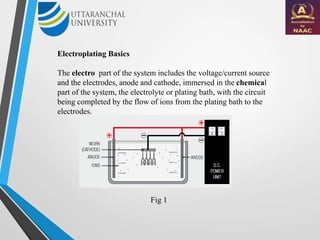
Electroplating Basics
The electro part of the system includes the voltage/current source
and the electrodes, anode and cathode, immersed in the chemical
part of the system, the electrolyte or plating bath, with the circuit
being completed by the flow of ions from the plating bath to the
electrodes.
Fig 1
The metal to be deposited may be the anode and be ionized and go into
solution in the electrolyte, or come from the composition of the plating
bath.
Copper, tin, silver and nickel metal usually comes from anodes, while
gold salts are usually added to the plating bath in a controlled process to
maintain the composition of the bath.
The plating bath generally contains other ions to facilitate current
flow between the electrodes. The deposition of metal takes place at
the cathode.
The overall plating process occurs in the following sequence:
1. Power supply pumps electrons into the cathode.
2. An electron from the cathode transfers to a positively charged metal ion in the
solution and the reduced metal plates onto the cathode.
3. Ionic conduction through the plating bath completes the circuit to the anode.
4. At the anode two different processes take place depending on whether the
anode material is soluble, the source of the metal to be plated, or insoluble, inert.
If the anode material is soluble, a metal atom gives up an electron and goes into
the solution as a positively charged metal ion replenishing the metal content of
the plating bath. If the anode is inert a negatively charged ion from the plating
bath gives up an electron to the anode.
5.The electron flows from the anode to the power supply completing
the circuit. The deposition of metal at the cathode requires an electron
so the rate of deposition depends on the flow of electrons, that is, the
current flowing from the rectifier. The thickness of the deposit,
therefore, depends on the current and the length of time the
current is applied.
This relationship is a result of Faraday‘s law which relates the weight
of a substance produced by an anode or cathode electrode reaction
during electrolysis as being directly proportional to the quantity of
electricity passed through the cell.
Faraday’s Laws of Electrolysis
From his experiments, Faraday introduced two fundamental laws which govern
the phenomenon of electrolysis. These are:
First Law. The mass of ions liberated at an electrode is directly proportional to
the quantity of electricity i.e. charge which passes through the electrolyte.
Or
The weight of a substance liberated from an electrolyte in a given time is
proportional to the quantity of electricity passing through the electrolyte.
That is W Proporsonal Q Proporsonal It , where I is the current and t is the
time.
W = Zit
Where Z is a constant called electro-chemical equivalent.
If I = 1 ampere and T= one second then,
Z = W , which gives a definition of Z.
“ The electro-chemical equivalent of a substance is the amount
of that substance by weight liberated in unit time by unit
current. ”
Second Law.
The masses of ions of different substances liberated by the same
quantity of electricity are proportional to their chemical
equivalent weights.
or
If the same current flows through several electrolytes, the weights
of ions liberated are proportional to their chemical equivalents
“The chemical equivalent of a substance is the weight of the
substance which can displace or combine with unit weight of
hydrogen .Obviously, the chemical equivalent of hydrogen is
one.”
Definition related to electrolysis and faraday’s
law of Electrolysis
•Current Efficiency
•Energy Efficiency
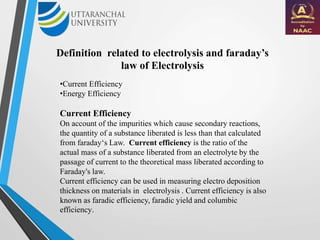
Current Efficiency
On account of the impurities which cause secondary reactions,
the quantity of a substance liberated is less than that calculated
from faraday‘s Law. Current efficiency is the ratio of the
actual mass of a substance liberated from an electrolyte by the
passage of current to the theoretical mass liberated according to
Faraday's law.
Current efficiency can be used in measuring electro deposition
thickness on materials in electrolysis . Current efficiency is also
known as faradic efficiency, faradic yield and columbic
efficiency.
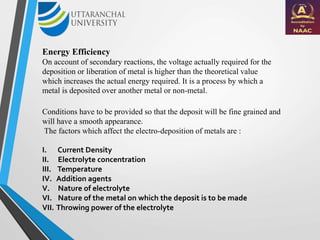
Energy Efficiency
On account of secondary reactions, the voltage actually required for the
deposition or liberation of metal is higher than the theoretical value
which increases the actual energy required. It is a process by which a
metal is deposited over another metal or non-metal.
Conditions have to be provided so that the deposit will be fine grained and
will have a smooth appearance.
The factors which affect the electro-deposition of metals are :
I. Current Density
II. Electrolyte concentration
III. Temperature
IV. Addition agents
V. Nature of electrolyte
VI. Nature of the metal on which the deposit is to be made
VII. Throwing power of the electrolyte
THANK YOU!

Lecture 7_poly_(ueet).pptx

  • 1.
    Lecture-7 Suneel Bonal Agriculture Building UttaranchalCollege of Polytechnic Room Number:207
  • 2.
    Content- • Electrolysis, • Faraday’sLaws of Electrolysis •Definition related to electrolysis and faraday’s law of Electrolysis.
  • 3.
    Electrolysis Electro deposition isthe process of coating a thin layer of one metal on top of different metal to modify its surface properties. It is done to achieve the desire electrical and corrosion resistance, reduce wear & friction, improve heat tolerance and for decoration.
  • 4.
    Electroplating Basics The electropart of the system includes the voltage/current source and the electrodes, anode and cathode, immersed in the chemical part of the system, the electrolyte or plating bath, with the circuit being completed by the flow of ions from the plating bath to the electrodes. Fig 1
  • 5.
    The metal tobe deposited may be the anode and be ionized and go into solution in the electrolyte, or come from the composition of the plating bath. Copper, tin, silver and nickel metal usually comes from anodes, while gold salts are usually added to the plating bath in a controlled process to maintain the composition of the bath. The plating bath generally contains other ions to facilitate current flow between the electrodes. The deposition of metal takes place at the cathode.
  • 6.
    The overall platingprocess occurs in the following sequence: 1. Power supply pumps electrons into the cathode. 2. An electron from the cathode transfers to a positively charged metal ion in the solution and the reduced metal plates onto the cathode. 3. Ionic conduction through the plating bath completes the circuit to the anode. 4. At the anode two different processes take place depending on whether the anode material is soluble, the source of the metal to be plated, or insoluble, inert. If the anode material is soluble, a metal atom gives up an electron and goes into the solution as a positively charged metal ion replenishing the metal content of the plating bath. If the anode is inert a negatively charged ion from the plating bath gives up an electron to the anode.
  • 7.
    5.The electron flowsfrom the anode to the power supply completing the circuit. The deposition of metal at the cathode requires an electron so the rate of deposition depends on the flow of electrons, that is, the current flowing from the rectifier. The thickness of the deposit, therefore, depends on the current and the length of time the current is applied. This relationship is a result of Faraday‘s law which relates the weight of a substance produced by an anode or cathode electrode reaction during electrolysis as being directly proportional to the quantity of electricity passed through the cell.
  • 8.
    Faraday’s Laws ofElectrolysis From his experiments, Faraday introduced two fundamental laws which govern the phenomenon of electrolysis. These are: First Law. The mass of ions liberated at an electrode is directly proportional to the quantity of electricity i.e. charge which passes through the electrolyte. Or The weight of a substance liberated from an electrolyte in a given time is proportional to the quantity of electricity passing through the electrolyte. That is W Proporsonal Q Proporsonal It , where I is the current and t is the time. W = Zit Where Z is a constant called electro-chemical equivalent. If I = 1 ampere and T= one second then, Z = W , which gives a definition of Z.
  • 9.
    “ The electro-chemicalequivalent of a substance is the amount of that substance by weight liberated in unit time by unit current. ” Second Law. The masses of ions of different substances liberated by the same quantity of electricity are proportional to their chemical equivalent weights. or If the same current flows through several electrolytes, the weights of ions liberated are proportional to their chemical equivalents “The chemical equivalent of a substance is the weight of the substance which can displace or combine with unit weight of hydrogen .Obviously, the chemical equivalent of hydrogen is one.”
  • 10.
    Definition related toelectrolysis and faraday’s law of Electrolysis •Current Efficiency •Energy Efficiency Current Efficiency On account of the impurities which cause secondary reactions, the quantity of a substance liberated is less than that calculated from faraday‘s Law. Current efficiency is the ratio of the actual mass of a substance liberated from an electrolyte by the passage of current to the theoretical mass liberated according to Faraday's law. Current efficiency can be used in measuring electro deposition thickness on materials in electrolysis . Current efficiency is also known as faradic efficiency, faradic yield and columbic efficiency.
  • 11.
    Energy Efficiency On accountof secondary reactions, the voltage actually required for the deposition or liberation of metal is higher than the theoretical value which increases the actual energy required. It is a process by which a metal is deposited over another metal or non-metal. Conditions have to be provided so that the deposit will be fine grained and will have a smooth appearance. The factors which affect the electro-deposition of metals are : I. Current Density II. Electrolyte concentration III. Temperature IV. Addition agents V. Nature of electrolyte VI. Nature of the metal on which the deposit is to be made VII. Throwing power of the electrolyte
  • 12.